

The protective role of estrogen and estrogen receptors in cardiovascular disease and the controversial use of estrogen therapy
Open accessThe DOI matches its Crossref record; 140 of the 140 references it cites were found in a registry or an index.
Abstract
Epidemiologic studies have previously suggested that premenopausal females have reduced incidence of cardiovascular disease (CVD) when compared to age-matched males, and the incidence and severity of CVD increases postmenopause. The lower incidence of cardiovascular disease in women during reproductive age is attributed at least in part to estrogen (E2). E2 binds to the traditional E2 receptors (ERs), estrogen receptor alpha (ERα), and estrogen receptor beta (ERβ), as well as the more recently identified G-protein-coupled ER (GPR30), and can exert both genomic and non-genomic actions. This review summarizes the protective role of E2 and its receptors in the cardiovascular system and discusses its underlying mechanisms with an emphasis on oxidative stress, fibrosis, angiogenesis, and vascular function. This review also presents the sexual dimorphic role of ERs in modulating E2 action in cardiovascular disease. The controversies surrounding the clinical use of exogenous E2 as a therapeutic agent for cardiovascular disease in women due to the possible risks of thrombotic events, cancers, and arrhythmia are also discussed. Endogenous local E2 biosynthesis from the conversion of testosterone to E2 via aromatase enzyme offers a novel therapeutic paradigm. Targeting specific ERs in the cardiovascular system may result in novel and possibly safer therapeutic options for cardiovascular protection.
Overview
The claims and statistics of this paper haven’t been checked yet.
Free: it reads the open-access text and checks the first 5 claims that cite a source we can check. Create a free account to check every claim.
Integrity signals
Registry
Cites
Statistics
Figures
Verification
Claims the paper makes
The claims and statistics of this paper haven’t been checked yet.
Free: it reads the open-access text and checks the first 5 claims that cite a source we can check. Create a free account to check every claim.
Claims other papers make about this one
Each is checked against this paper’s own text: does it say what the citing paper says it does?
The source backs part of the claim, not all of it — or backs it for a different population, condition or comparison.
In the citing paper
“Through these receptors, estrogen promotes vasodilation, modulates nitric oxide pathways, and limits vascular inflammation, reducing the risk of endothelial dysfunction, arterial stiffness, and atherosclerosis.”
From Endometriosis and Cardiovascular Disease: Exploring Pathophysiological Interconnections and Risk Mechanisms (2025) · cites this paper as [14]
Experimental — accuracy not yet measuredThe source backs part of the claim, not all of it — or backs it for a different population, condition or comparison.
In the citing paper
“In women, estrogen protects cardiovascular safety by maintaining endothelial protective effects via estrogen receptor action, such as Erα, ERβ, and GPR30, reducing oxidative stress and influencing the lipid profile.”
From Endometriosis and Cardiovascular Disease: Exploring Pathophysiological Interconnections and Risk Mechanisms (2025) · cites this paper as [14]
Experimental — accuracy not yet measuredThe source backs part of the claim, not all of it — or backs it for a different population, condition or comparison.
In the citing paper
“The role of E2 has been well established to play a regulatory metabolic role via ERα in peripheral tissues such as skeletal muscle and WAT (130, 160–162)”
From Metabolic impact of endogenously produced estrogens by adipose tissue in females and males across the lifespan (2025) · cites this paper as [160]
Experimental — accuracy not yet measuredThe cited source says what the claim attributes to it.
In the citing paper
“These benefits are diminished with lower estrogen levels in postmenopausal women, contributing to a higher CVD risk (Figure 1).”
From Endometriosis and Cardiovascular Disease: Exploring Pathophysiological Interconnections and Risk Mechanisms (2025) · cites this paper as [14]
Self-check
Percentages, sums and reported differences re-computed from the paper’s own numbers.
The self-check needs the paper’s full text.
Citations
Cites
1 retracted
Retracted Article: Anti-Thrombotic Effects of Selective Estrogen Receptor Modulator Tamoxifen
Nayak, M. K., Singh, S. K., Roy, A., Prakash, V., Kumar, A. A., & Dash, D. (2011) · Thrombosis and Haemostasis · doi:10.1160/th11-03-0178 · Cited by 14
RetractedHeart Disease and Stroke Statistics—2016 Update: A Report From the American Heart Association
Mozaffarian, D., Benjamin, E. J., Go, A. S., Arnett, D. K., Blaha, M. J., Cushman, M., Das, S. R., de Ferranti, S., Després, J.-P., Fullerton, H. J., et al. (2016) · Circulation · doi:10.1161/cir.0000000000000350 · Cited by 6,596 · cited 1×
“It is well-known that the incidence of cardiovascular events is significantly lower in women when compared to age-matched men even following menopause [109].”
BackgroundHulley, S. (1998) · JAMA · doi:10.1001/jama.280.7.605 · Cited by 6,216
Endothelial dysfunction in cardiovascular diseases: the role of oxidant stress
Cai, H., & Harrison, D. G. (2000) · Circulation Research · doi:10.1161/01.res.87.10.840 · Cited by 3,839 · cited 1×
“E2 failed to increase homing of EPCs to the injured myocardium in eNOS-null mice [68].”
The mitochondrial permeability transition
Zoratti, M., & Szabò, I. (1995) · Biochimica et Biophysica Acta (BBA) - Reviews on Biomembranes · doi:10.1016/0304-4157(95)00003-a · Cited by 2,401
Grady, D., Herrington, D., Bittner, V., Blumenthal, R., Davidson, M., Hlatky, M., Hsia, J., Hulley, S., Herd, A., Khan, S., et al. (2002) · JAMA · doi:10.1001/jama.288.1.49 · Cited by 1,930
Molecular Mechanisms of Myocardial Remodeling
SWYNGHEDAUW, B. (1999) · Physiological Reviews · doi:10.1152/physrev.1999.79.1.215 · Cited by 1,460 · cited 1×
“myocyte hypertrophy, fibroblast proliferation, fibrosis, an accumulation of fibrillar collagens, and myocyte apoptosis [33].”
BackgroundEndothelial dysfunction: cardiovascular risk factors, therapy, and outcome.
Hadi, H. A. R., Carr, C. S., & Suwaidi, J. M. S. A. (2005) · PubMed Central · Cited by 1,078
Shiojima, I. (2005) · Journal of Clinical Investigation · doi:10.1172/jci24682 · Cited by 939 · cited 1×
“Increased cardiac angiogenesis is necessary to maintain LV function during adaptive hypertrophy and compensated heart hypertrophy as the larger LV has an obvious need for more blood vessels [56, 57].”
BackgroundSources of estrogen and their importance
Simpson, E. R. (2003) · The Journal of Steroid Biochemistry and Molecular Biology · doi:10.1016/s0960-0760(03)00360-1 · Cited by 936 · cited 2×
“This extragonadal E2 production plays an important role, as it remains the only source of endogenous E2 production in postmenopausal women and men [10].”
Backgroundp53-induced inhibition of Hif-1 causes cardiac dysfunction during pressure overload
Sano, M., Minamino, T., Toko, H., Miyauchi, H., Orimo, M., Qin, Y., Akazawa, H., Tateno, K., Kayama, Y., Harada, M., et al. (2007) · Nature · doi:10.1038/nature05602 · Cited by 905
Canonico, M., Oger, E., Plu-Bureau, G., Conard, J., Meyer, G., Lévesque, H., Trillot, N., Barrellier, M.-T., Wahl, D., Emmerich, J., et al. (2007) · Circulation · doi:10.1161/circulationaha.106.642280 · Cited by 864
Activation of Aldehyde Dehydrogenase-2 Reduces Ischemic Damage to the Heart
Chen, C.-H., Budas, G. R., Churchill, E. N., Disatnik, M.-H., Hurley, T. D., & Mochly-Rosen, D. (2008) · Science · doi:10.1126/science.1158554 · Cited by 767 · cited 1×
“Activation of ALDH has previously been reported to protect the heart against ischemic damage [21].”
BackgroundSchierbeck, L. L., Rejnmark, L., Tofteng, C. L., Stilgren, L., Eiken, P., Mosekilde, L., Kober, L., & Jensen, J.-E. B. (2012) · BMJ · doi:10.1136/bmj.e6409 · Cited by 747 · cited 2×
“Another randomized study in women (45–58 years old) also showed a significantly reduced risk of mortality, heart failure, or myocardial infarction if HRT was initiated early after menopause [121].”
BackgroundAromatase-deficient (ArKO) mice have a phenotype of increased adiposity
Jones, M. E. E., Thorburn, A. W., Britt, K. L., Hewitt, K. N., Wreford, N. G., Proietto, J., Oz, O. K., Leury, B. J., Robertson, K. M., Yao, S., et al. (2000) · Proceedings of the National Academy of Sciences · doi:10.1073/pnas.97.23.12735 · Cited by 729 · cited 1×
“The ablation of aromatase has also been demonstrated to be associated with increased adiposity [101] and progressive insulin resistance [102], which are significant factors in the development of cardiovascular diseases including atherosclerosis and diabetic cardiomyopathy.”
BackgroundMyofibroblast-mediated mechanisms of pathological remodelling of the heart
Weber, K. T., Sun, Y., Bhattacharya, S. K., Ahokas, R. A., & Gerling, I. C. (2013) · Nature Reviews Cardiology · doi:10.1038/nrcardio.2012.158 · Cited by 673
Adams, M. R., Kaplan, J. R., Manuck, S. B., Koritnik, D. R., Parks, J. S., Wolfe, M. S., & Clarkson, T. B. (1990) · Arteriosclerosis: An Official Journal of the American Heart Association, Inc. · doi:10.1161/01.atv.10.6.1051 · Cited by 605
Gene Expression in Fibroblasts and Fibrosis: Involvement in Cardiac Hypertrophy
Manabe, I., Shindo, T., & Nagai, R. (2002) · Circulation Research · doi:10.1161/01.res.0000046452.67724.b8 · Cited by 512
Thomas, C. V., Coker, M. L., Zellner, J. L., Handy, J. R., Crumbley, A. J., & Spinale, F. G. (1998) · Circulation · doi:10.1161/01.cir.97.17.1708 · Cited by 443
Cardiac myocytes and fibroblasts contain functional estrogen receptors1
Grohé, C., Kahlert, S., Löbbert, K., Stimpel, M., Karas, R. H., Vetter, H., & Neyses, L. (1997) · FEBS Letters · doi:10.1016/s0014-5793(97)01179-4 · Cited by 382
Lemasters, J. J., Qian, T., He, L., Kim, J.-S., Elmore, S. P., Cascio, W. E., & Brenner, D. A. (2002) · Antioxidants & Redox Signaling · doi:10.1089/152308602760598918 · Cited by 377
Filardo, E. J. (2002) · The Journal of Steroid Biochemistry and Molecular Biology · doi:10.1016/s0960-0760(01)00190-x · Cited by 373 · cited 1×
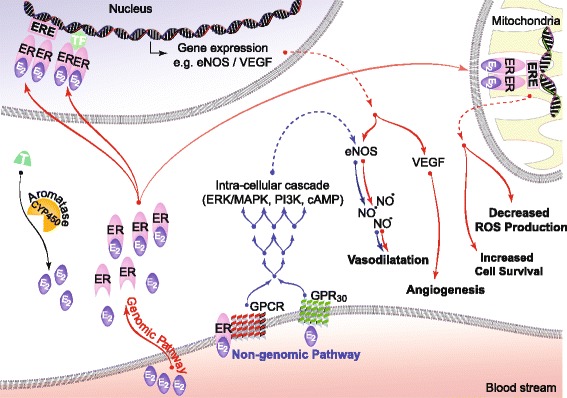
“E2 binding to GPR30 activates adenylyl cyclase, mitogen-activated protein kinases (MAPK), and extracellular signalregulated kinases, ERK1 and ERK2, resulting in mobilization of intracellular calcium [24].”
BackgroundSpinale, F. G., Coker, M. L., Thomas, C. V., Walker, J. D., Mukherjee, R., & Hebbar, L. (1998) · Circulation Research · doi:10.1161/01.res.82.4.482 · Cited by 372
VEGF-A Induces Expression of eNOS and iNOS in Endothelial Cells via VEGF Receptor-2 (KDR)
Kroll, J., & Waltenberger, J. (1998) · Biochemical and Biophysical Research Communications · doi:10.1006/bbrc.1998.9719 · Cited by 367 · cited 1×
“VEGF starts a signaling cascade which stimulates nitric oxide synthase 3 (eNOS) and nitric oxide (NO) production, endothelial cell proliferation, migration of tube structures, and differentiation into mature blood vessels [61, 62].”
BackgroundHarman, S. M., Black, D. M., Naftolin, F., Brinton, E. A., Budoff, M. J., Cedars, M. I., Hopkins, P. N., Lobo, R. A., Manson, J. E., Merriam, G. R., et al. (2014) · Annals of Internal Medicine · doi:10.7326/m14-0353 · Cited by 344 · cited 1×
“A more recent randomized study that administered HRT to women (42–58 years old) within 6–36 months following the onset of menopause supports the “Critical Window” hypothesis as certain risk factors for CVD were reduced [120].”
BackgroundMatsumura, S.-I., Iwanaga, S., Mochizuki, S., Okamoto, H., Ogawa, S., & Okada, Y. (2005) · Journal of Clinical Investigation · doi:10.1172/jci200522304 · Cited by 339
Sex Hormones and Sex Chromosomes Cause Sex Differences in the Development of Cardiovascular Diseases
Arnold, A. P., Cassis, L. A., Eghbali, M., Reue, K., & Sandberg, K. (2017) · Arteriosclerosis, Thrombosis, and Vascular Biology · doi:10.1161/atvbaha.116.307301 · Cited by 335 · cited 1×
“compared to age-matched men well beyond menopause [6].”
ResultSelf-citationLagranha, C. J., Deschamps, A., Aponte, A., Steenbergen, C., & Murphy, E. (2010) · Circulation Research · doi:10.1161/circresaha.109.213645 · Cited by 326 · cited 22×
“Odening et al. showed that E2 also increases ventricular arrhythmias and sudden cardiac death in OVX transgenic long QT rabbits [133].”
BackgroundInfluentialBulun, S. E., Sebastian, S., Takayama, K., Suzuki, T., Sasano, H., & Shozu, M. (2003) · The Journal of Steroid Biochemistry and Molecular Biology · doi:10.1016/s0960-0760(03)00359-5 · Cited by 321 · cited 1×
“Aromatase is widely distributed in gonadal and extragonadal tissues including the bone, brain, adipose tissue, and blood vessels [88].”
BackgroundEstrogenic control of mitochondrial function and biogenesis
Klinge, C. M. (2008) · Journal of Cellular Biochemistry · doi:10.1002/jcb.21936 · Cited by 318 · cited 1×
“Both traditional ERs and GPR30 are localized on the mitochondrial membrane in cardiac tissue, and activation of these receptors via E2 can trigger transcriptional changes in nuclear and mitochondrial genes influencing mitochondrial function, cell survival, and ultimately cardioprotection [18, 19].”
BackgroundThe roles of gender, the menopause and hormone replacement on cardiovascular function
Hayward, C. (2000) · Cardiovascular Research · doi:10.1016/s0008-6363(00)00005-5 · Cited by 315 · cited 2×
“Female protection against CVD is associated with sex hormone levels as the incidence and severity of CVD increases in women postmenopause [3], and the prevalence of coronary artery disease (CAD) is greater in young women who had an oophorectomy compared to those with intact ovaries [4].”
BackgroundHayashidani, S., Tsutsui, H., Ikeuchi, M., Shiomi, T., Matsusaka, H., Kubota, T., Imanaka-Yoshida, K., Itoh, T., & Takeshita, A. (2003) · American Journal of Physiology-Heart and Circulatory Physiology · doi:10.1152/ajpheart.00207.2003 · Cited by 315
Peterson, J. (2000) · Cardiovascular Research · doi:10.1016/s0008-6363(00)00029-8 · Cited by 298
Estrogen regulation of angiotensin-converting enzyme mRNA
Gallagher, P. E., Li, P., Lenhart, J. R., Chappell, M. C., & Brosnihan, K. B. (1999) · Hypertension · doi:10.1161/01.hyp.33.1.323 · Cited by 290
Flamme, I., Breier, G., & Risau, W. (1995) · Developmental Biology · doi:10.1006/dbio.1995.1180 · Cited by 264
Heart and Estrogen/progestin Replacement Study (HERS)
Grady, D., Applegate, W., Bush, T., Furberg, C., Riggs, B., & Hulley, S. B. (1998) · Controlled Clinical Trials · doi:10.1016/s0197-2456(98)00010-5 · Cited by 260
Estrogen Reduces Myointimal Proliferation After Balloon Injury of Rat Carotid Artery
Chen, S.-J., Li, H., Durand, J., Oparil, S., & Chen, Y.-F. (1996) · Circulation · doi:10.1161/01.cir.93.3.577 · Cited by 257
Estrogen inhibits the response-to-injury in a mouse carotid artery model.
Sullivan, T. R., Karas, R. H., Aronovitz, M., Faller, G. T., Ziar, J. P., Smith, J. J., O'Donnell, T. F., & Mendelsohn, M. E. (1995) · Journal of Clinical Investigation · doi:10.1172/jci118307 · Cited by 243
Critical window hypothesis of hormone therapy and cognition: a scientific update on clinical studies
Maki, P. M. (2013) · Menopause · doi:10.1097/gme.0b013e3182960cf8 · Cited by 242 · cited 1×
“The hypothesis supports the view that HRT could be effective if started early at the onset of menopause [119].”
BackgroundVascular endothelium: an integrator of pathophysiologic stimuli in atherosclerosis.
Gimbrone, M. A. (1995) · The American Journal of Cardiology · doi:10.1016/0002-9149(95)80016-l · Cited by 225 · cited 1×
“Stimulation of cardiac neoangiogenesis by E2 in HF is not only limited to the LV, as E2 also stimulates angiogenesis in RV failure secondary to PH in male rats [67].”
BackgroundEstrogen receptor beta mediates gender differences in ischemia/reperfusion injury
GABEL, S., WALKER, V, LONDON, R., STEENBERGEN, C., KORACH, K., & MURPHY, E. (2005) · Journal of Molecular and Cellular Cardiology · doi:10.1016/j.yjmcc.2004.11.013 · Cited by 222 · cited 2×
“tional recovery following I/R injury [78].”
BackgroundIwakura, A., Shastry, S., Luedemann, C., Hamada, H., Kawamoto, A., Kishore, R., Zhu, Y., Qin, G., Silver, M., Thorne, T., et al. (2006) · Circulation · doi:10.1161/circulationaha.105.553925 · Cited by 211
The Expanding Complexity of Estrogen Receptor Signaling in the Cardiovascular System
Menazza, S., & Murphy, E. (2016) · Circulation Research · doi:10.1161/circresaha.115.305376 · Cited by 210 · cited 1×
“While there is abundant data supporting E2 as a cardoprotective agent in experimental models of CVD, E2 replacement therapy in postmenopausal women has been very controversial [5].”
BackgroundKhosrow-Khavar, F., Filion, K. B., Al-Qurashi, S., Torabi, N., Bouganim, N., Suissa, S., & Azoulay, L. (2017) · Annals of Oncology · doi:10.1093/annonc/mdw673 · Cited by 208
Sutendra, G., Dromparis, P., Paulin, R., Zervopoulos, S., Haromy, A., Nagendran, J., & Michelakis, E. D. (2013) · Journal of Molecular Medicine · doi:10.1007/s00109-013-1059-4 · Cited by 204 · cited 1×
“However, an imbalance between cardiac growth and neoangiogenesis over time can induce the progression of compensated heart hypertrophy to HF [58].”
BackgroundBopassa, J. C., Eghbali, M., Toro, L., & Stefani, E. (2010) · American Journal of Physiology-Heart and Circulatory Physiology · doi:10.1152/ajpheart.00588.2009 · Cited by 197 · cited 3×
“found that during I/R injury, GPR30 activation by E2 in adult male mice results in cardioprotection by inhibiting the opening of the mitochondrial permeability transition pore (mPTP) via activation of the ERK pathway [11].”
BackgroundInfluentialSelf-citationBergman, M. R., Teerlink, J. R., Mahimkar, R., Li, L., Zhu, B.-Q., Nguyen, A., Dahi, S., Karliner, J. S., & Lovett, D. H. (2007) · American Journal of Physiology-Heart and Circulatory Physiology · doi:10.1152/ajpheart.00434.2006 · Cited by 191 · cited 1×
“vere remodeling [48], while its inhibition attenuates cardiac remodeling and improves survival after MI or pressure overload [49–51].”
BackgroundEstrogens, progestogens and thrombosis
Rosendaal, F. R., Van Hylckama Vlieg, A., Tanis, B. C., & Helmerhorst, F. M. (2003) · Journal of Thrombosis and Haemostasis · doi:10.1046/j.1538-7836.2003.00264.x · Cited by 188 · cited 1×
“Progestin also contributes to this risk as oral contraceptives or HRT containing thirdgeneration progestogens (desogestrel or gestodene) are associated with a higher risk of venous thrombosis than those containing second-generation progestogens (such as levonorgestrel) [138].”
BackgroundLocalized Expression of Aromatase in Human Vascular Tissues
Harada, N., Sasano, H., Murakami, H., Ohkuma, T., Nagura, H., & Takagi, Y. (1999) · Circulation Research · doi:10.1161/01.res.84.11.1285 · Cited by 184 · cited 3×
“Local production of E2 in these tissues by aromatase plays an important role in the physiological functions of these tissues [89].”
BackgroundInfluentialTakeda, K., Toda, K., Saibara, T., Nakagawa, M., Saika, K., Onishi, T., Sugiura, T., & Shizuta, Y. (2003) · Journal of Endocrinology · doi:10.1677/joe.0.1760237 · Cited by 182 · cited 1×
“The ablation of aromatase has also been demonstrated to be associated with increased adiposity [101] and progressive insulin resistance [102], which are significant factors in the development of cardiovascular diseases including atherosclerosis and diabetic cardiomyopathy.”
BackgroundHuman Aromatase: Gene Resequencing and Functional Genomics
Ma, C. X., Adjei, A. A., Salavaggione, O. E., Coronel, J., Pelleymounter, L., Wang, L., Eckloff, B. W., Schaid, D., Wieben, E. D., Adjei, A. A., et al. (2005) · Cancer Research · doi:10.1158/0008-5472.can-05-1218 · Cited by 182 · cited 1×
“gests that genetic variations in CYP19 might contribute to variations in the pathophysiology of E2-dependent diseases [94].”
BackgroundKararigas, G., Dworatzek, E., Petrov, G., Summer, H., Schulze, T. M., Baczko, I., Knosalla, C., Golz, S., Hetzer, R., & Regitz-Zagrosek, V. (2014) · European Journal of Heart Failure · doi:10.1002/ejhf.171 · Cited by 180
Estrogen Induces Vascular Wall Dilation
Guo, X., Razandi, M., Pedram, A., Kassab, G., & Levin, E. R. (2005) · Journal of Biological Chemistry · doi:10.1074/jbc.m501244200 · Cited by 179
Hamada, H., Kim, M. K., Iwakura, A., Ii, M., Thorne, T., Qin, G., Asai, J., Tsutsumi, Y., Sekiguchi, H., Silver, M., et al. (2006) · Circulation · doi:10.1161/circulationaha.106.631465 · Cited by 176
Chen, J.-Q., Yager, J. D., & Russo, J. (2005) · Biochimica et Biophysica Acta (BBA) - Molecular Cell Research · doi:10.1016/j.bbamcr.2005.08.001 · Cited by 176 · cited 1×
“These abnormalities can largely be attributed to changes in mitochondrial homeostasis [16, 17].”
BackgroundProgression of heart failure: A role for interstitial fibrosis
Sabbah, H. N., Sharov, V. G., Lesch, M., & Goldstein, S. (1995) · Molecular and Cellular Biochemistry · doi:10.1007/bf00944780 · Cited by 167 · cited 1×
“a decrease in angiogenesis in the heart as well as an increase of oxygen diffusion distance, thus leading to myocyte hypoxia [34].”
BackgroundRegulation of estrogen synthesis in postmenopausal women
Purohit, A., & Reed, M. J. (2002) · Steroids · doi:10.1016/s0039-128x(02)00046-6 · Cited by 166 · cited 2×
“Plasma concentrations of cytokines known to stimulate aromatase activity were shown to increase over time in males and females [87].”
Background17β-Estradiol, Its Metabolites, and Progesterone Inhibit Cardiac Fibroblast Growth
Dubey, R. K., Gillespie, D. G., Jackson, E. K., & Keller, P. J. (1998) · Hypertension · doi:10.1161/01.hyp.31.1.522 · Cited by 163
Effect of Bilateral Oophorectomy on Women's Long-Term Health
Parker, W. H., Jacoby, V., Shoupe, D., & Rocca, W. (2009) · Women's Health · doi:10.2217/whe.09.42 · Cited by 161 · cited 1×
“Female protection against CVD is associated with sex hormone levels as the incidence and severity of CVD increases in women postmenopause [3], and the prevalence of coronary artery disease (CAD) is greater in young women who had an oophorectomy compared to those with intact ovaries [4].”
BackgroundSudhir, K., Chou, T. M., Mullen, W. L., Hausmann, D., Collins, P., Yock, P. G., & Chatterjee, K. (1995) · Journal of the American College of Cardiology · doi:10.1016/0735-1097(95)00248-3 · Cited by 159 · cited 2×
“coronary arteries that was not attenuated by pretreatment with l-NAME or the classic ER antagonist, ICI 182,780 [85].”
BackgroundEstrogen Rescues Preexisting Severe Pulmonary Hypertension in Rats
Umar, S., Iorga, A., Matori, H., Nadadur, R. D., Li, J., Maltese, F., van der Laarse, A., & Eghbali, M. (2011) · American Journal of Respiratory and Critical Care Medicine · doi:10.1164/rccm.201101-0078oc · Cited by 159 · cited 1×
“Both studies found that E2 was no longer able to rescue HF in the presence of an angiogenesis inhibitor, which indicates that E2 protects against LV and RV HF in male rodents by stimulating angiogenesis [40, 63].”
BackgroundSelf-citationMatsusaka, H., Ide, T., Matsushima, S., Ikeuchi, M., Kubota, T., Sunagawa, K., Kinugawa, S., & Tsutsui, H. (2006) · Hypertension · doi:10.1161/01.hyp.0000208840.30778.00 · Cited by 159
Sex-Dependent Influence of Endogenous Estrogen in Pulmonary Hypertension
Mair, K. M., Wright, A. F., Duggan, N., Rowlands, D. J., Hussey, M. J., Roberts, S., Fullerton, J., Nilsen, M., Loughlin, L., Thomas, M., et al. (2014) · American Journal of Respiratory and Critical Care Medicine · doi:10.1164/rccm.201403-0483oc · Cited by 158 · cited 1×
“Aromatase inhibition using anastrozole (an aromatase inhibitor) reversed adverse RV remodeling in female Sugen hypoxia rats [106].”
MethodXue, B., Pamidimukkala, J., Lubahn, D. B., & Hay, M. (2007) · American Journal of Physiology-Heart and Circulatory Physiology · doi:10.1152/ajpheart.01011.2005 · Cited by 156
Estrogens regulate life and death in mitochondria
Klinge, C. M. (2017) · Journal of Bioenergetics and Biomembranes · doi:10.1007/s10863-017-9704-1 · Cited by 152 · cited 1×
“Both traditional ERs and GPR30 are localized on the mitochondrial membrane in cardiac tissue, and activation of these receptors via E2 can trigger transcriptional changes in nuclear and mitochondrial genes influencing mitochondrial function, cell survival, and ultimately cardioprotection [18, 19].”
BackgroundOdening, K. E., Choi, B., Liu, G. X., Hartmann, K. M., Ziv, O., Chaves, L., Schofield, L., Centracchio, J. N., Zehender, M., Peng, X., et al. (2012) · Heart Rhythm · doi:10.1016/j.hrthm.2012.01.009 · Cited by 149 · cited 1×
“showed that E2 also increases ventricular arrhythmias and sudden cardiac death in OVX transgenic long QT rabbits [133].”
BackgroundEstrogen Receptor Activation and Cardioprotection in Ischemia Reperfusion Injury
Deschamps, A. M., Murphy, E., & Sun, J. (2010) · Trends in Cardiovascular Medicine · doi:10.1016/j.tcm.2010.05.001 · Cited by 149 · cited 2×
“genomic and rapid non-genomic action [12].”
MethodMyocardial ischemia-reperfusion injury in estrogen receptor-α knockout and wild-type mice
Zhai, P., Eurell, T. E., Cooke, P. S., Lubahn, D. B., & Gross, D. R. (2000) · American Journal of Physiology-Heart and Circulatory Physiology · doi:10.1152/ajpheart.2000.278.5.h1640 · Cited by 141
Estrogen Receptor-β Activation Results in S-Nitrosylation of Proteins Involved in Cardioprotection
Lin, J., Steenbergen, C., Murphy, E., & Sun, J. (2009) · Circulation · doi:10.1161/circulationaha.109.868729 · Cited by 136
Activation of estrogen receptor-α protects the in vivo rabbit heart from ischemia-reperfusion injury
Booth, E. A., Obeid, N. R., & Lucchesi, B. R. (2005) · American Journal of Physiology-Heart and Circulatory Physiology · doi:10.1152/ajpheart.00479.2005 · Cited by 136
Pelzer, T., Loza, P.-A. A., Hu, K., Bayer, B., Dienesch, C., Calvillo, L., Couse, J. F., Korach, K. S., Neyses, L., & Ertl, G. (2005) · Circulation · doi:10.1161/01.cir.0000159262.18512.46 · Cited by 127
Role of GPER in estrogen-dependent nitric oxide formation and vasodilation
Fredette, N. C., Meyer, M. R., & Prossnitz, E. R. (2018) · The Journal of Steroid Biochemistry and Molecular Biology · doi:10.1016/j.jsbmb.2017.05.006 · Cited by 124 · cited 2×
“elucidated the mechanism by which E2 and G-1 induce vasodilation in male human endothelial cells and GPR30-KO mice [83].”
BackgroundEffects of metformin on breast cancer cell proliferation, the AMPK pathway and the cell cycle
Hadad, S. M., Hardie, D. G., Appleyard, V., & Thompson, A. M. (2013) · Clinical & Translational Oncology · doi:10.1007/s12094-013-1144-8 · Cited by 119 · cited 1×
“Studies have also shown that metformin (a drug used to treat type 2 diabetes by controlling blood glucose levels) reversed elevated RV systolic pressure and hypertrophy in Sugen hypoxia female rats, independent of glycemia, without any effects on systemic blood pressure, cardiac output, or heart rate [107].”
BackgroundOdening, K. E., & Koren, G. (2014) · Heart Rhythm · doi:10.1016/j.hrthm.2014.06.023 · Cited by 119 · cited 1×
“trol cardiac cell excitation and repolarization [129].”
Postmenopausal Hormone Therapy and Cognitive Function in Healthy Older Women
Grodstein, F., Chen, J., Pollen, D. A., Albert, M. S., Wilson, R. S., Folstein, M. F., Evans, D. A., & Stampfer, M. J. (2000) · Journal of the American Geriatrics Society · doi:10.1111/j.1532-5415.2000.tb04748.x · Cited by 115 · cited 1×
“3 mg/day) was shown to decrease major coronary events in women [122] and coronary artery Iorga et al.”
BackgroundThe importance of having two X chromosomes
Arnold, A. P., Reue, K., Eghbali, M., Vilain, E., Chen, X., Ghahramani, N., Itoh, Y., Li, J., Link, J. C., Ngun, T., et al. (2016) · Philosophical Transactions of the Royal Society B: Biological Sciences · doi:10.1098/rstb.2015.0113 · Cited by 114
Self-citation17β-Estradiol inhibits matrix metalloproteinase-2 transcription via MAP kinase in fibroblasts
Mahmoodzadeh, S., Dworatzek, E., Fritschka, S., Pham, T. H., & Regitz-Zagrosek, V. (2010) · Cardiovascular Research · doi:10.1093/cvr/cvp350 · Cited by 112
G-Protein Coupled Receptor 30 (GPR30): A Novel Regulator of Endothelial Inflammation
Chakrabarti, S., & Davidge, S. T. (2012) · PLoS ONE · doi:10.1371/journal.pone.0052357 · Cited by 108
Lindsey, S. H., Carver, K. A., Prossnitz, E. R., & Chappell, M. C. (2011) · Journal of Cardiovascular Pharmacology · doi:10.1097/fjc.0b013e3182135f1c · Cited by 107 · cited 2×
“These data suggest that GPR30 activation by E2 or selective agonist induces vasorelaxation in female rodent aortas through a partially endothelium and eNOS-dependent mechanism [82].”
BackgroundTreatment with an estrogen receptor-beta-selective agonist is cardioprotective
Nikolic, I., Liu, D., Bell, J. A., Collins, J. B., Steenbergen, C., & Murphy, E. (2007) · Journal of Molecular and Cellular Cardiology · doi:10.1016/j.yjmcc.2007.01.014 · Cited by 106 · cited 1×
“Gene profiling in this experimental model revealed that treatment with DPN is associated with a significant increase in cardioprotective genes, including those encoding NO biosynthesis and anti-apoptotic proteins [80].”
BackgroundKhurana, R., & Simons, M. (2003) · Trends in Cardiovascular Medicine · doi:10.1016/s1050-1738(02)00259-1 · Cited by 106 · cited 1×
“factors that promote endothelial proliferation and organization into tubular structures [59, 60].”
BackgroundLi, J., Chen, X., McClusky, R., Ruiz-Sundstrom, M., Itoh, Y., Umar, S., Arnold, A. P., & Eghbali, M. (2014) · Cardiovascular Research · doi:10.1093/cvr/cvu064 · Cited by 105
Self-citationMetformin Reverses Development of Pulmonary Hypertension via Aromatase Inhibition
Dean, A., Nilsen, M., Loughlin, L., Salt, I. P., & MacLean, M. R. (2016) · Hypertension · doi:10.1161/hypertensionaha.116.07353 · Cited by 105 · cited 1×
“Interestingly, metformin was shown to inhibit aromatase without any adverse effects on the RV [108].”
BackgroundBabiker, F. A., Windt, L. J. D., van Eickels, M., Thijssen, V. L., Bronsaer, R., Grohé, C., van Bilsen, M., & Doevendans, P. A. (2004) · Circulation · doi:10.1161/01.cir.0000105682.85732.bd · Cited by 103
ZHANG, Y., LU, N., XUE, Y., ZHANG, M., LI, Y., SI, Y., BIAN, X., JIA, Y., & WANG, Y. (2012) · Molecular Medicine Reports · doi:10.3892/mmr.2012.744 · Cited by 102
Bayard, F. (1995) · Endocrinology · doi:10.1210/en.136.4.1523 · Cited by 101 · cited 1×
“onary endothelial cells (ECs) in vitro [96, 97].”
Vascular endothelial function in health and diseases
Khazaei, M., Moien-afshari, F., & Laher, I. (2008) · Pathophysiology · doi:10.1016/j.pathophys.2008.02.002 · Cited by 99
Ardelt, A. A., McCullough, L. D., Korach, K. S., Wang, M. M., Munzenmaier, D. H., & Hurn, P. D. (2005) · Stroke · doi:10.1161/01.str.0000153795.38388.72 · Cited by 97
Widder, J. D., Pelzer, T., von Poser-Klein, C., Hu, K., Jazbutyte, V., Fritzemeier, K., Hegele‐Hartung, C., Neyses, L., & Bauersachs, J. K. (2003) · Hypertension · doi:10.1161/01.hyp.0000098661.37637.89 · Cited by 94
PELZER, T., JAZBUTYTE, V, HU, K., SEGERER, S., NAHRENDORF, M., NORDBECK, P., BONZ, A., MUCK, J., FRITZEMEIER, K., & HEGELEHARTUNG, C. (2005) · Cardiovascular Research · doi:10.1016/j.cardiores.2005.04.035 · Cited by 84 · cited 1×
“Treatment of spontaneously hypertensive OVX female rats with E2 or a selective ERα agonists resulted in improved endothelial function, reduced cardiac hypertrophy, and improved cardiac outcomes when compared to OVX rats without treatment [74, 75].”
BackgroundRescue of Pressure Overload‐Induced Heart Failure by Estrogen Therapy
Iorga, A., Li, J., Sharma, S., Umar, S., Bopassa, J. C., Nadadur, R. D., Centala, A., Ren, S., Saito, T., Toro, L., et al. (2016) · Journal of the American Heart Association · doi:10.1161/jaha.115.002482 · Cited by 83 · cited 7×
“E2 treatment resulted in an upregulation of ERβ transcript expression which could elucidate the mechanism by which E2 exerts its effects inhibiting fibrosis [40].”
BackgroundInfluentialSelf-citationElkin, M., Orgel, A., & Kleinman, H. K. (2004) · JNCI Journal of the National Cancer Institute · doi:10.1093/jnci/djh140 · Cited by 82
Abdel-Qadir, H. M., Amir, E., Fischer, H. D., Fu, L., Austin, P. C., Harvey, P., Rochon, P. A., Lee, D. S., & Anderson, G. (2016) · European Journal of Cancer · doi:10.1016/j.ejca.2016.08.022 · Cited by 82 · cited 1×
“higher risk of ischemic heart disease versus tamoxifen, a broad ER antagonist [110].”
BackgroundZhu, X., Tang, Z., Cong, B., Du, J., Wang, C., Wang, L., Ni, X., & Lu, J. (2013) · Menopause The Journal of The North American Menopause Society · doi:10.1097/gme.0b013e3182874732 · Cited by 80 · cited 3×
“ing E2 in female rodents may protect against cardiovascular stressors due to increased antioxidant expression [30].”
BackgroundInfluentialJazbutyte, V., Arias-Loza, P.-A., Hu, K., Widder, J., Govindaraj, V., von Poser-Klein, C., Bauersachs, J. K., Fritzemeier, K., Hegele‐Hartung, C., Neyses, L., et al. (2007) · Cardiovascular Research · doi:10.1093/cvr/cvm081 · Cited by 79 · cited 1×
“revealed that administration of a selective ERβ agonist to spontaneously hypertensive OVX female rats attenuated hypertrophy, lowered peripheral artery resistance, and decreased systolic blood pressure [76].”
BackgroundFemale Adult Mouse Cardiomyocytes Are Protected Against Oxidative Stress
Wang, F., He, Q., Sun, Y., Dai, X., & Yang, X.-P. (2010) · Hypertension · doi:10.1161/hypertensionaha.110.150839 · Cited by 76
Lenhart, P. M., Broselid, S., Barrick, C. J., Leeb-Lundberg, L. M. F., & Caron, K. M. (2013) · Journal of Molecular Endocrinology · doi:10.1530/jme-13-0021 · Cited by 76 · cited 2×
“GPR30 activation via G-1, the authors found the cardioprotection conferred by G-1 to be both Ramp3 and sex specific [84].”
BackgroundDarpö, B., Karnad, D. R., Badilini, F., Florian, J., Garnett, C. E., Kothari, S., Panicker, G. K., & Sarapa, N. (2013) · British Journal of Clinical Pharmacology · doi:10.1111/bcp.12201 · Cited by 74 · cited 1×
“Since females are more prone to drug-induced arrhythmia than males [135], further studies are needed to examine whether the female heart has a unique sensitivity to E2 in the presence of certain drugs.”
BackgroundWharton, W., Gleason, C. E., Miller, V. M., & Asthana, S. (2013) · Brain Research · doi:10.1016/j.brainres.2013.04.011 · Cited by 73 · cited 1×
“with or without progestin as well as test different modes of E2 administration (CEE or transdermal E2) [125].”
Mitochondria and heart failure: new insights into an energetic problem.
Chen, L., & Knowlton, A. A. (2010) · PubMed · Cited by 71
Ropero, A. B., Eghbali, M., Minosyan, T. Y., Tang, G., Toro, L., & Stefani, E. (2006) · Journal of Molecular and Cellular Cardiology · doi:10.1016/j.yjmcc.2006.05.022 · Cited by 67
Self-citationLee, H., & Eghbali-Webb, M. (1998) · Journal of Molecular and Cellular Cardiology · doi:10.1006/jmcc.1998.0699 · Cited by 66 · cited 8×
“These data suggest that E2 acts on the fibroblasts to regulate ECM remodeling and modulate myocardial function via ER and MAPK-dependent mechanisms.”
BackgroundInfluentialWhite, R. E., Han, G., Dimitropoulou, C., Zhu, S., Miyake, K., Fulton, D. J., Dave, S. R., & Barman, S. A. (2005) · American Journal of Physiology-Heart and Circulatory Physiology · doi:10.1152/ajpheart.01173.2004 · Cited by 66
Mahmoodzadeh, S. (2014) · Journal of Cell Science & Therapy · doi:10.4172/2157-7013.1000153 · Cited by 65
Wang, L., Tang, Z., Zhao, W., Cong, B., Lu, J., Tang, X., Li, X., Zhu, X., & Ni, X. (2015) · Endocrinology · doi:10.1210/en.2014-1362 · Cited by 65 · cited 1×
“decreased levels of microRNA 22 (miR-22) through Sp1 coactivation [29].”
BackgroundGender Differences in Ischemic Heart Disease
Wake, R., & Yoshiyama, M. (2009) · Recent Advances in Cardiovascular Drug Discovery (Formerly Recent Patents on Cardiovascular Drug Discovery) · doi:10.2174/157489009789152249 · Cited by 64 · cited 1×
“Women have reduced incidence of CVD when compared to age-matched males and present with CVD 10 years later than men [1].”
BackgroundNadadur, R. D., Umar, S., Wong, G., Eghbali, M., Iorga, A., Matori, H., Partow-Navid, R., & Eghbali, M. (2012) · Journal of Applied Physiology · doi:10.1152/japplphysiol.01349.2011 · Cited by 62 · cited 2×
“Lastly, our group has shown that E2 and ERβ activation reverse right ventricular failure caused by pulmonary hypertension (PH) in intact male rats [52].”
BackgroundSelf-citationActivation of GPR30 inhibits cardiac fibroblast proliferation
Wang, H., Zhao, Z., Lin, M., & Groban, L. (2015) · Molecular and Cellular Biochemistry · doi:10.1007/s11010-015-2405-3 · Cited by 60 · cited 1×
“In vivo, G-1 treatment attenuated the adverse interstitial collagen deposition and fibroblast proliferation resulting from high-salt diet or E2 depletion from OVX in female rats [43].”
BackgroundRodger, F. E., Young, F. M., Fraser, H. M., & Illingworth, P. J. (1997) · Human Reproduction · doi:10.1093/humrep/12.8.1723 · Cited by 60
Estrogen receptor beta signals to inhibition of cardiac fibrosis
Pedram, A., Razandi, M., Narayanan, R., & Levin, E. R. (2016) · Molecular and Cellular Endocrinology · doi:10.1016/j.mce.2016.06.018 · Cited by 60 · cited 2×
“E2 inhibits fibrosis through ERβ as E2 administration was shown to prevent AngII-induced cardiac fibrosis in female OVX wild-type (WT) mice but not in ERβ knockout mice [39].”
BackgroundYan, S., Song, W., Chen, Y., Hong, K., Rubinstein, J., & Wang, H. (2013) · Food and Chemical Toxicology · doi:10.1016/j.fct.2013.02.011 · Cited by 58 · cited 3×
“The proarrhythmic action of E2 was due to alterations of calcium handling in cardiomyocytes mediated through ERβ signaling [131].”
BackgroundAromatase Deficiency Confers Paradoxical Postischemic Cardioprotection
Bell, J. R., Mellor, K. M., Wollermann, A. C., Ip, W. T. K., Reichelt, M. E., Meachem, S. J., Simpson, E. R., & Delbridge, L. M. D. (2011) · Endocrinology · doi:10.1210/en.2011-1212 · Cited by 57 · cited 1×
“investigated the role of aromatase deficiency in I/R injury using aromatase knockout (ArKO) female mice and found that the recovery of left ventricular developed pressure as well calcium handling was substantially improved in ArKO versus wild-type (WT) mouse hearts [103].”
MethodBayard, F., Clamens, S., Delsol, G., Blaes, N., Maret, A., & Faye, J. (2007) · Novartis Foundation symposium · doi:10.1002/9780470514757.ch7 · Cited by 51 · cited 1×
“onary endothelial cells (ECs) in vitro [96, 97].”
Li, T., Xiao, X., Zhang, J., Zhu, Y., Hu, Y., Zang, J., Lu, K., Tian-de, Y., Heng-jiang, G., Peng, X., et al. (2014) · American Journal of Physiology-Heart and Circulatory Physiology · doi:10.1152/ajpheart.00645.2013 · Cited by 51 · cited 1×
“found that the expression of ERβ and GPR30, but not ERα, are significantly decreased in the arteries of female rats [126].”
BackgroundSchuster, I., Mahmoodzadeh, S., Dworatzek, E., Jaisser, F., Messaoudi, S., Morano, I., & Regitz-Zagrosek, V. (2016) · Clinical Science · doi:10.1042/cs20150609 · Cited by 51 · cited 1×
“examined the role of ERβ in regulating myocardial infarct size post-LAD [42].”
BackgroundPhilp, K. L., Hussain, M., Byrne, N., Diver, M. J., Hart, G., & Coker, S. J. (2006) · British Journal of Pharmacology · doi:10.1038/sj.bjp.0706850 · Cited by 49
Pavón, N., Abundis, E. M., Hernández, L., Gallardo‐Pérez, J. C., Álvarez‐Delgado, C., Cerbón, M. A., Pérez-Torres, I., Aranda‐Fraustro, A., & Chávez, E. (2012) · The Journal of Steroid Biochemistry and Molecular Biology · doi:10.1016/j.jsbmb.2012.05.003 · Cited by 48
Coelingh Bennink, H. J. T., Verhoeven, C., Zimmerman, Y., Visser, M., Foidart, J.-M., & Gemzell-Danielsson, K. (2017) · Menopause · doi:10.1097/gme.0000000000000823 · Cited by 45
Wang, H., Li, Q., Wang, T., Yang, G., Wang, Y., Zhang, X., Sang, Q., Wang, H., Zhao, X., Xing, Q., et al. (2011) · MHR: Basic science of reproductive medicine · doi:10.1093/molehr/gar007 · Cited by 44
Appt, S. E., Kaplan, J. R., Clarkson, T. B., Cline, J. M., Christian, P. J., & Hoyer, P. B. (2006) · Fertility and Sterility · doi:10.1016/j.fertnstert.2006.05.004 · Cited by 43 · cited 1×
“atherosclerosis in adult female monkeys [123].”
FGF-1: a human growth factor in the induction of neoangiogenesis
Stegmann, T. (1998) · Expert Opinion on Investigational Drugs · doi:10.1517/13543784.7.12.2011 · Cited by 42 · cited 1×
“factors that promote endothelial proliferation and organization into tubular structures [59, 60].”
BackgroundJazbutyte, V., Stumpner, J., Redel, A., Lorenzen, J. M., Roewer, N., Thum, T., & Kehl, F. (2012) · PLoS ONE · doi:10.1371/journal.pone.0042032 · Cited by 40 · cited 1×
“conversion of androgens to E2 likely affects cardiac function and structural modeling [90].”
BackgroundThe effects of hormones on arrhythmias in women.
Bailey, M. S., & Curtis, A. B. (2002) · PubMed · Cited by 40
Wang, Y. (2011) · Molecular Medicine Reports · doi:10.3892/mmr.2011.616 · Cited by 38
Sex hormone levels in patients with sudden cardiac arrest
Narayanan, K., Havmoeller, R. J., Reinier, K., Jerger, K., Teodorescu, C., Uy‐Evanado, A., Navarro, J., Huertas‐Vázquez, A., Gunson, K., Jui, J., et al. (2014) · Heart Rhythm · doi:10.1016/j.hrthm.2014.08.031 · Cited by 36 · cited 1×
“On the other hand, higher estradiol levels in both women and men were associated with higher SCA events [134].”
BackgroundZhou, L., Chen, H., Mao, X., Qi, H., Baker, P. N., & Zhang, H. (2017) · International Journal of Molecular Medicine · doi:10.3892/ijmm.2017.2957 · Cited by 33
Bell, J. R., Bernasochi, G. B., Varma, U., Boon, W. C., Ellem, S. J., Risbridger, G. P., & Delbridge, L. M. D. (2014) · American Journal of Physiology-Heart and Circulatory Physiology · doi:10.1152/ajpheart.00012.2014 · Cited by 27
Extracellular matrix and cardiac interstitium: restriction is not a restricted phenomenon.
Maisch, B. (1995) · PubMed · Cited by 23
Association of Aromatase Inhibitors With Coronary Heart Disease in Women With Early Breast Cancer
Šeruga, B., Zadnik, V., Kuhar, C. G., Marinko, T., Čufer, T., Zakotnik, B., Zorman, D., Ocaña, A., & Amir, E. (2014) · Cancer Investigation · doi:10.3109/07357907.2014.880452 · Cited by 22 · cited 1×
“cantly increased the hazard for CAD compared to tamoxifen [111].”
BackgroundSykes, B., Steyn, P. M. V., Vignali, J. D., Winalski, J., Lozier, J., Bell, W. E., & Turner, J. (2016) · Brain Sciences · doi:10.3390/brainsci6040051 · Cited by 22 · cited 1×
“an aromatase inhibitor triggered cardiac arrhythmias in the developing zebrafish [130].”
BackgroundSkyttä, T., TUOHINEN, S. S., Virtanen, V., Raatikainen, P. M. J., & Kellokumpu‐Lehtinen, P. (2015) · PubMed · Cited by 20
In female rat heart mitochondria, oophorectomy results in loss of oxidative phosphorylation
Pavón, N., Cabrera‐Orefice, A., Gallardo‐Pérez, J. C., Uribe‐Alvarez, C., Rivero-Segura, N. A., Vázquez-Martínez, E. R., Cerbón, M. A., Abundis, E. M., Torres-Narváez, J. C., Martínez‐Memije, R., et al. (2016) · Journal of Endocrinology · doi:10.1530/joe-16-0161 · Cited by 17 · cited 1×
“significant changes in the oxidative phosphorylationrelated proteins including cytochrome c oxidase and ATP synthase [28].”
BackgroundA gender-independent proarrhythmic action of 17β-estradiol in anaesthetized rabbits
Philp, K. L., Hart, G., & Coker, S. J. (2007) · European Journal of Pharmacology · doi:10.1016/j.ejphar.2007.07.035 · Cited by 15
Bell, J. R., Bernasochi, G. B., Wollermann, A. C., Raaijmakers, A. J. A., Boon, W. C., Simpson, E. R., Curl, C. L., Mellor, K. M., & Delbridge, L. M. D. (2015) · Endocrinology · doi:10.1210/en.2014-1700 · Cited by 14 · cited 2×
“Later on, the same group demonstrated that isolated cardiomyocytes from ArKO female mice exhibited greater basal calcium transient amplitude and shortening than in WT [104].”
BackgroundWang, B., Fu, Z.-Y., Ma, Y., Huang, D., Liu, F., Dong, C., Wang, T., & Meng, Y. J. (2015) · Genetic Testing and Molecular Biomarkers · doi:10.1089/gtmb.2015.0157 · Cited by 13
Sex steroids in relation to cardiac structure and function in men
Smet, M. A. J. D., Lapauw, B., & Backer, T. D. (2016) · Andrologia · doi:10.1111/and.12610 · Cited by 12
Schwitter, J., Kozerke, S., Bremerich, J., Baltes, C., Jost, C. A., Birkhäuser, M., Boesiger, P., & Buser, P. T. (2007) · Journal of Cardiovascular Magnetic Resonance · doi:10.1080/10976640601138730 · Cited by 11
Association of CYP19 Gene Polymorphism with Vertebral Fractures in Japanese Postmenopausal Women
Koudu, Y., Onouchi, T., Hosoi, T., & Horiuchi, T. (2011) · Biochemical Genetics · doi:10.1007/s10528-011-9483-z · Cited by 9
Rest-injected 201thallium in the evaluation of myocardial viability.
Filardi, P. P., Dellegrottaglie, S., & Chiariello, M. (1999) · PubMed · Cited by 6
Risks and benefits of hormone replacement therapy for the prevention of cardiovascular disease.
Sarrel, P. M. (1999) · PubMed · Cited by 3
Cited by
Cardiovascular Risks Associated with Gender and Aging
Rodgers, J. L., Jones, J., Bolleddu, S. I., Vanthenapalli, S., Rodgers, L. E., Shah, K., Karia, K., & Panguluri, S. K. (2019) · Journal of Cardiovascular Development and Disease · doi:10.3390/jcdd6020019 · Cited by 1,024
“However, to da e, the effects of estrogen replac ment on cardiovascul r he lt is still large y controversial [8].”
BackgroundResultInfluentialEstrogen receptor signaling mechanisms
(2019) · Advances in Protein Chemistry and Structural Biology · doi:10.1016/bs.apcsb.2019.01.001 · Cited by 988
“However, it has been found that these compounds can affect cellular and molecular processes leading to severe effects on health, and their use in medical therapeutics remains controversial (Aravindakshan, Gregory, Marcogliese, Fournier, & Cyr, 2004; Aravindakshan, Paquet, et al., 2004; Arukwe, Celius, Walther, & Goksø…”
BackgroundRole of estrogen receptors in health and disease
Chen, P., Li, B., & Ou-Yang, L. (2022) · Frontiers in Endocrinology · doi:10.3389/fendo.2022.839005 · Cited by 339
Protective Effects of Estrogen on Cardiovascular Disease Mediated by Oxidative Stress
Xiang, D., Liu, Y., Zhou, S., Zhou, E., & Wang, Y. (2021) · Oxidative Medicine and Cellular Longevity · doi:10.1155/2021/5523516 · Cited by 286
“The classic mode of estrogen action is the genomic effect mechanism in which estrogen enters the nucleus and combines with nuclear ERs to form a dimer, and then the estrogen-receptor complex binds to estrogen response elements and further regulates the gene expression and corresponding proteins, which triggers a serie…”
BackgroundSex differences in mechanisms of arterial stiffness
DuPont, J. J., Kenney, R. M., Patel, A. R., & Jaffe, I. Z. (2019) · British Journal of Pharmacology · doi:10.1111/bph.14624 · Cited by 290
“These receptors mediate the actions of steroid hormones through both genomic and rapid non‐ genomic actions, which have been previously reviewed and are outside the scope of this review (Iorga et al., 2017; Mendelsohn & Karas, 1999, 2005).”
Background
Metadata
- Authors
- Iorga, A., Cunningham, C. M., Moazeni, S., Ruffenach, G., Umar, S., & Eghbali, M.
- Affiliations
- University of Southern California (US)
- University of California, Los Angeles (US)
- Corresponding author
- Eghbali, Mansoureh
- Venue
- Biology of Sex Differences
- Published
- 2017-10-24
- Volume
- 8
- Issue
- 1
- Pages
- 33-33
- ISSN
- 2042-6410 (ISSN-L)
- PMC
- PMC5655818
- OpenAlex
- W2766043255
- Cited by
- 914
- References
- 140
- Citations by year
- 2026: 91 · 2025: 157 · 2024: 156 · 2023: 143 · 2022: 114 · 2021: 113 · 2020: 88 · 2019: 38 · 2018: 12 · 2017: 2
- FWCI
- 4.91
- Type
- journal article
- Language
- en
- Open access
- gold
- doi.org
- Licence
- cc-by
- creativecommons.org/licenses/by/4.0/ (tdm)
- creativecommons.org/licenses/by/4.0/ (vor)
- Locations
- Biology of Sex Differences (publishedVersion, cc-by)
- Europe PMC (PubMed Central) (publishedVersion, cc-by)
- PubMed Central (publishedVersion, cc-by)
- PubMed (publishedVersion)
- DOAJ (DOAJ: Directory of Open Access Journals) (submittedVersion, cc-by-sa)
- eScholarship (California Digital Library) (submittedVersion)
- Funders
- American Heart Association (AHA-17PRE33420159, AHA16GRANT27760058)
- National Institutes of Health (R01HL131182-01A1, T32-GM065823, HD00722)
- Topics
- Life Sciences › Biochemistry, Genetics and Molecular Biology › Endocrinology › Estrogen and related hormone effects
- Health Sciences › Medicine › Endocrinology, Diabetes and Metabolism › Menopause: Health Impacts and Treatments
- Health Sciences › Nursing › Nutrition and Dietetics › Phytoestrogen effects and research
- Keywords
- estrogen, estrogen receptor, estrogen receptor alpha, estrogen receptor beta, GPR30, cardiovascular disease, postmenopause, sex differences, oxidative stress, fibrosis, angiogenesis, vascular function, aromatase, thrombosis risk, cardioprotection
- MeSH terms
- Animals, Cardiovascular Agents, Cardiovascular Diseases, Estrogens, Humans, Receptors, Estrogen
About these checks
Registry, retraction, Cites and statistics results are computed, not judged, with one exception: a printed reference that no index lists is read once by a model before it counts as a citation error. Claims are extracted by a model and kept only when their quote appears verbatim in the text; each cited source is then checked, with a model’s help, for whether it says what the claim relies on. Those verdicts can be wrong — read the claim’s quote and the cited source before relying on one.
Statistics and arithmetic are recomputed, not judged.
Confidence bands are shown only for fields calibrated on our annotated test set. None is calibrated yet, so no band is shown.
What counts as a claim ›How we measure confidence ›How we check this ›
Are you an author, or do you see a problem with this page? Request a review
Data sources
Bibliographic data: Semantic Scholar, OpenAlex, Crossref.
Contains information from the Semantic Scholar Academic Graph Datasets, made available under the ODC Attribution License (ODC-BY 1.0).
Semantic Scholar’s data is described in: Kinney, R., et al. (2023). The Semantic Scholar Open Data Platform. arXiv:2301.10140.
