

Formal guidelines: Management of acute respiratory distress syndrome.
Open accessThe DOI matches its Crossref record; 146 of the 146 references it cites were found in a registry or an index.
Abstract
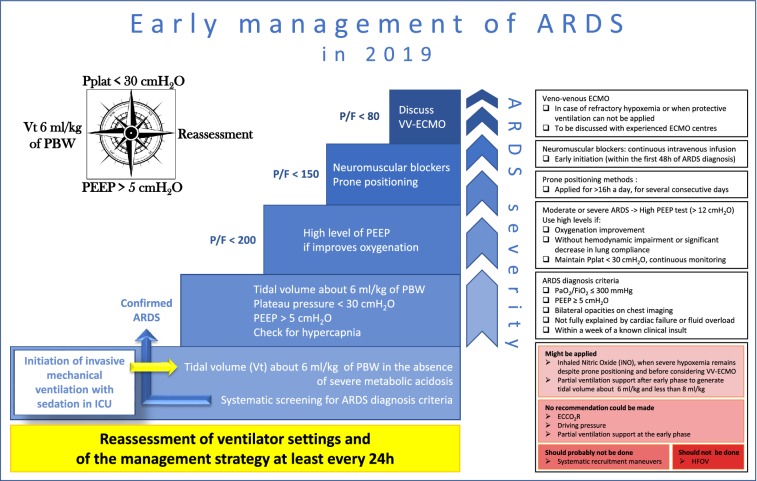
Fifteen recommendations and a therapeutic algorithm regarding the management of acute respiratory distress syndrome (ARDS) at the early phase in adults are proposed. The Grade of Recommendation Assessment, Development and Evaluation (GRADE) methodology has been followed. Four recommendations (low tidal volume, plateau pressure limitation, no oscillatory ventilation, and prone position) had a high level of proof (GRADE 1 + or 1 -); four (high positive end-expiratory pressure [PEEP] in moderate and severe ARDS, muscle relaxants, recruitment maneuvers, and venovenous extracorporeal membrane oxygenation [ECMO]) a low level of proof (GRADE 2 + or 2 -); seven (surveillance, tidal volume for non ARDS mechanically ventilated patients, tidal volume limitation in the presence of low plateau pressure, PEEP > 5 cmH2O, high PEEP in the absence of deleterious effect, pressure mode allowing spontaneous ventilation after the acute phase, and nitric oxide) corresponded to a level of proof that did not allow use of the GRADE classification and were expert opinions. Lastly, for three aspects of ARDS management (driving pressure, early spontaneous ventilation, and extracorporeal carbon dioxide removal), the experts concluded that no sound recommendation was possible given current knowledge. The recommendations and the therapeutic algorithm were approved by the experts with strong agreement.
Overview
The claims and statistics of this paper haven’t been checked yet.
Free: it reads the open-access text and checks the first 5 claims that cite a source we can check. Create a free account to check every claim.
Integrity signals
Registry
Cites
Statistics
Figures
Verification
Claims the paper makes
The claims and statistics of this paper haven’t been checked yet.
Free: it reads the open-access text and checks the first 5 claims that cite a source we can check. Create a free account to check every claim.
Claims other papers make about this one
Each is checked against this paper’s own text: does it say what the citing paper says it does?
In the citing paper
“A recent systematic review which included five RCTs also identified a strong relationship between plateau pressure and mortality [434].”
From Surviving sepsis campaign: international guidelines for management of sepsis and septic shock 2021 (2021) · cites this paper as [434]
Self-check
Percentages, sums and reported differences re-computed from the paper’s own numbers.
The self-check needs the paper’s full text.
Citations
Cites
(2000) · New England Journal of Medicine · doi:10.1056/nejm200005043421801 · Cited by 12,941
Chen, Y., Wang, L., Kang, Q., Zhang, X., Yu, G., Wan, X., Wang, J., & Zhu, K. (2017) · Cellular Physiology and Biochemistry · doi:10.1159/000477308 · Cited by 10,679
Acute Respiratory Distress Syndrome: The Berlin Definition
(2012) · JAMA · doi:10.1001/jama.2012.5669 · Cited by 8,731
Bellani, G., Laffey, J. G., Pham, T., Fan, E., Brochard, L., Esteban, A., Gattinoni, L., van Haren, F., Larsson, A., McAuley, D. F., et al. (2016) · JAMA · doi:10.1001/jama.2016.0291 · Cited by 5,766 · cited 10×
“Plateau pressure was measured in only 40% of ARDS patients [2].”
BackgroundMethodInfluentialSelf-citationProne positioning in severe acute respiratory distress syndrome.
Guérin, C., Reignier, J., Richard, J.-C., Beuret, P., Gacouin, A., Boulain, T., Mercier, E., Badet, M., Mercat, A., Baudin, O., et al. (2013) · New England Journal of Medicine · doi:10.1056/nejmoa1214103 · Cited by 4,040
Self-citationEffect of a protective-ventilation strategy on mortality in the acute respiratory distress syndrome.
Amato, M. B. P., Barbas, C. S. V., Medeiros, D. M., Magaldi, R. B., Schettino, G. P., Lorenzi-Filho, G., Kairalla, R. A., Deheinzelin, D., Munoz, C., Oliveira, R., et al. (1998) · New England Journal of Medicine · doi:10.1056/nejm199802053380602 · Cited by 3,654
Peek, G. J., Mugford, M., Tiruvoipati, R., Wilson, A., Allen, E., Thalanany, M. M., Hibbert, C. L., Truesdale, A., Clemens, F., Cooper, N., et al. (2009) · The Lancet · doi:10.1016/s0140-6736(09)61069-2 · Cited by 3,395
Functional Disability 5 Years after Acute Respiratory Distress Syndrome
Herridge, M. S., Tansey, C. M., Matté, A., Tomlinson, G., Diaz-Granados, N., Cooper, A., Guest, C. B., Mazer, C. D., Mehta, S., Stewart, T. E., et al. (2011) · New England Journal of Medicine · doi:10.1056/nejmoa1011802 · Cited by 2,847
Driving pressure and survival in the acute respiratory distress syndrome.
Amato, M. B. P., Meade, M. O., Slutsky, A. S., Brochard, L., Costa, E. L. V., Schoenfeld, D. A., Stewart, T. E., Briel, M., Talmor, D., Mercat, A., et al. (2015) · New England Journal of Medicine · doi:10.1056/nejmsa1410639 · Cited by 2,801
Self-citation(2004) · New England Journal of Medicine · doi:10.1056/nejmoa032193 · Cited by 2,565
Research works printed but not linked: 1
- Cavalcanti AB Suzumura EA Laranjeira LN Paisani DM Damiani LP Guimaraes HP Effect of lung recruitment and titrated positive end-expiratory pressure (PEEP) vs low PEEP on mortality in patients with acute respiratory distress syndrome: a randomized clinical trial JAMA 2017 318 14 1335 1345 10.1001/jama.2017.14171 28973363 PMC5710484 · DOI · Paper page
Cited by
Surviving sepsis campaign: international guidelines for management of sepsis and septic shock 2021
Evans, L., Rhodes, A., Alhazzani, W., Antonelli, M., Coopersmith, C. M., French, C., Machado, F. R., Mcintyre, L., Ostermann, M., Prescott, H. C., et al. (2021) · Intensive Care Medicine · doi:10.1007/s00134-021-06506-y · Cited by 5,082
Surviving Sepsis Campaign: International Guidelines for Management of Sepsis and Septic Shock 2021.
Evans, L., Rhodes, A., Alhazzani, W., Antonelli, M., Coopersmith, C. M., French, C., Machado, F. R., Mcintyre, L., Ostermann, M., Prescott, H. C., et al. (2021) · Critical Care Medicine · doi:10.1097/ccm.0000000000005337 · Cited by 2,935
Alhazzani, W., Møller, M. H., Arabi, Y. M., Loeb, M., Gong, M. N., Fan, E., Oczkowski, S., Levy, M. M., Derde, L., Dzierba, A., et al. (2020) · Intensive Care Medicine · doi:10.1007/s00134-020-06022-5 · Cited by 2,105
“Several professional societies have issued recommendations on the use of NMBAs in ARDS [100, [120] [121] [122] [123] .”
Alhazzani, W., Møller, M. H., Arabi, Y. M., Loeb, M., Gong, M. N., Fan, E., Oczkowski, S., Levy, M. M., Derde, L., Dzierba, A., et al. (2020) · Critical Care Medicine · doi:10.1097/ccm.0000000000004363 · Cited by 1,565
“Accordingly, we used, as sources of indirect evidence, data on Middle East Respiratory Syndrome Coronavirus (MERS-CoV), Severe Acute Respiratory Syndrome (SARS), and other coronaviruses; in the same way, we considered, as indirect evidence, published data on supportive care in the ICU from studies on influenza and oth…”
2019 Novel coronavirus: where we are and what we know
Cheng, Z. J., & Shan, J. (2020) · Infection · doi:10.1007/s15010-020-01401-y · Cited by 629
“The low tidal volume, plateau pressure limitation, no oscillatory ventilation, and prone position has been evidenced as high-proof (32).”
BackgroundProne position in ARDS patients: why, when, how and for whom
Guérin, C., Albert, R. K., Beitler, J., Gattinoni, L., Jaber, S., Marini, J. J., Munshi, L., Papazian, L., Pesenti, A., Vieillard-Baron, A., et al. (2020) · Intensive Care Medicine · doi:10.1007/s00134-020-06306-w · Cited by 532
Self-citationDequin, P.-F., Heming, N., Meziani, F., Plantefève, G., Voiriot, G., Badié, J., François, B., Aubron, C., Ricard, J.-D., Ehrmann, S., et al. (2020) · JAMA · doi:10.1001/jama.2020.16761 · Cited by 499
Self-citationFan, E., Beitler, J. R., Brochard, L., Calfee, C. S., Ferguson, N. D., Slutsky, A. S., & Brodie, D. (2020) · The Lancet Respiratory Medicine · doi:10.1016/s2213-2600(20)30304-0 · Cited by 473
Self-citationOrtiz-Prado, E., Simbaña-Rivera, K., Gómez- Barreno, L., Rubio-Neira, M., Guaman, L. P., Kyriakidis, N. C., Muslin, C., Jaramillo, A. M. G., Barba-Ostria, C., Cevallos-Robalino, D., et al. (2020) · Diagnostic Microbiology and Infectious Disease · doi:10.1016/j.diagmicrobio.2020.115094 · Cited by 458
Schmidt, M., Hajage, D., Lebreton, G., Monsel, A., Voiriot, G., Levy, D., Baron, E., Beurton, A., Chommeloux, J., Meng, P., et al. (2020) · The Lancet Respiratory Medicine · doi:10.1016/s2213-2600(20)30328-3 · Cited by 458
Self-citationGorman, E. A., O’Kane, C. M., & McAuley, D. F. (2022) · The Lancet · doi:10.1016/s0140-6736(22)01439-8 · Cited by 423
Analgesia and sedation in patients with ARDS
Chanques, G., Constantin, J.-M., Devlin, J. W., Ely, E. W., Fraser, G. L., Gélinas, C., Girard, T. D., Guérin, C., Jabaudon, M., Jaber, S., et al. (2020) · Intensive Care Medicine · doi:10.1007/s00134-020-06307-9 · Cited by 313
Self-citationSARS-CoV-2 Infection and Cardiovascular Disease: COVID-19 Heart
Dhakal, B. P., Sweitzer, N. K., Indik, J. H., Acharya, D., & William, P. (2020) · Heart, Lung and Circulation · doi:10.1016/j.hlc.2020.05.101 · Cited by 213
“1010 Respiratory Management Supplemental oxygen to maintain oxygen saturation above 90%, early intubation and use of low tidal volume and high positive end expiratory pressure (PEEP) are recommended in the management of respiratory distress (Table 2, Figure 2) [89,90].”
Hue, S., Beldi-Ferchiou, A., Bendib, I., Surenaud, M., Fourati, S., Frapard, T., Rivoal, S., Razazi, K., Carteaux, G., Delfau-Larue, M.-H., et al. (2020) · American Journal of Respiratory and Critical Care Medicine · doi:10.1164/rccm.202005-1885oc · Cited by 196
Nasa, P., Azoulay, E., Khanna, A. K., Jain, R., Gupta, S., Javeri, Y., Juneja, D., Rangappa, P., Sundararajan, K., Alhazzani, W., et al. (2021) · Critical Care · doi:10.1186/s13054-021-03491-y · Cited by 185
“The experts suggested that recruitment manoeuvres, if ever used should be individualised, in view of the potential harmful effects as seen in non-COVID-19-related ARDS [50, 51].”
BackgroundSelf-citationPulmonary infections complicating ARDS
Luyt, C.-E., Bouadma, L., Morris, A. C., Dhanani, J. A., Kollef, M., Lipman, J., Martin-Loeches, I., Nseir, S., Ranzani, O. T., Roquilly, A., et al. (2020) · Intensive Care Medicine · doi:10.1007/s00134-020-06292-z · Cited by 164
Li, J., Luo, J., Pavlov, I., Perez, Y., Tan, W., Roca, O., Tavernier, E., Kharat, A., McNicholas, B., Ibarra-Estrada, M., et al. (2022) · The Lancet Respiratory Medicine · doi:10.1016/s2213-2600(22)00043-1 · Cited by 167
Self-citationPost-resuscitation shock: recent advances in pathophysiology and treatment
Jozwiak, M., Bougouin, W., Géri, G., Grimaldi, D., & Cariou, A. (2020) · Annals of Intensive Care · doi:10.1186/s13613-020-00788-z · Cited by 154
“Thus, although no study has specifically investigated this issue, a PEEP level between 4 and 8 cmH20 [47], or higher in patients with acute respiratory distress syndrome [50], seems to be rationale.”
BackgroundMechanical Ventilation in ARDS
Jia, S., & Hyzy, R. C. (2022) · Springer eBooks · doi:10.1007/978-3-031-14138-6_20 · Cited by 148
Mesenchymal stem cell therapy for acute respiratory distress syndrome: from basic to clinics
Qin, H., & Zhao, A. (2020) · Protein & Cell · doi:10.1007/s13238-020-00738-2 · Cited by 155
“Although some supportive care approaches are established, ARDS remains devastating and life-threatening (Bellani et al., 2016; Papazian et al., 2019).”
BackgroundRazazi, K., Arrestier, R., Haudebourg, A.-F., Benelli, B., Carteaux, G., Decousser, J., Fourati, S., Woerther, P., Schlemmer, F., Charles‐Nelson, A., et al. (2020) · Critical Care · doi:10.1186/s13054-020-03417-0 · Cited by 159
“Other treatments, including neuromuscular blocking agents, inhaled nitric oxide, prone positioning, and veno-venous extra-corporeal membrane oxygenation were administered with respect to national guidelines [8].”
MethodTranslational medicine for acute lung injury
Zhang, J., Guo, Y., Mak, M., & Tao, Z. (2024) · Journal of Translational Medicine · doi:10.1186/s12967-023-04828-7 · Cited by 148
“Since then, various recommendations have been made for ARDS patient management [16, 17].”
BackgroundNeuromuscular blockade in patients with ARDS: a rapid practice guideline
Alhazzani, W., Belley-Cote, E., Møller, M. H., Angus, D. C., Papazian, L., Arabi, Y. M., Citerio, G., Connolly, B., Denehy, L., Fox-Robichaud, A., et al. (2020) · Intensive Care Medicine · doi:10.1007/s00134-020-06227-8 · Cited by 123
Self-citationIbarra-Estrada, M. Á., Li, J., Pavlov, I., Perez, Y., Roca, O., Tavernier, E., McNicholas, B., Vines, D. L., Marín‐Rosales, M., Vargas-Obieta, A., et al. (2022) · Critical Care · doi:10.1186/s13054-022-03950-0 · Cited by 104
“APP: Awake prone positioning; COVID‑19: Coronavirus disease; AHRF: Acute hypoxemic respiratory failure; HFNC: High‑flow nasal cannula; RR: Relative risk; IQR: Interquartile range; ARDS: Acute respiratory distress syndrome; RT‑ PCR: Reverse‑transcriptase polymerase chain reaction; SpO2: Pulse oximetry oxygen; FIO2: Fra…”
BackgroundLopes‐Pacheco, M., Robba, C., Rocco, P. R. M., & Pelosi, P. P. (2019) · Cell Biology and Toxicology · doi:10.1007/s10565-019-09493-5 · Cited by 96
“…management, prone positioning, and extracorporeal membrane oxygenation (ECMO), it remains a devastating, lifethreatening disorder associated with a high mortality rate (ranging from 35 to 60% depending on underlying disease severity) (Bellani et al. 2016; Máca et al. 2017; Papazian et al. 2019).”
BackgroundMethodInfluentialChand, S., Kapoor, S., Orsi, D., Fazzari, M. J., Tanner, T. G., Umeh, G. C., Islam, M., & Dicpinigaitis, P. V. (2020) · Journal of Intensive Care Medicine · doi:10.1177/0885066620946692 · Cited by 96
Pensier, J., JONG, A. D., Hajjej, Z., Molinari, N., Carr, J., Belafia, F., Chanques, G., Futier, E., Azoulay, É., & Jaber, S. (2019) · Intensive Care Medicine · doi:10.1007/s00134-019-05821-9 · Cited by 103
Self-citationChallenges in ARDS Definition, Management, and Identification of Effective Personalized Therapies
Battaglini, D., Fazzini, B., Silva, P. L., Cruz, F. F., Ball, L., Robba, C., Rocco, P. R. M., & Pelosi, P. P. (2023) · Journal of Clinical Medicine · doi:10.3390/jcm12041381 · Cited by 97
Diehl, J., Péron, N., Chocron, R., Debuc, B., Guérot, E., Hauw‐Berlemont, C., Hermann, B., Augy, J.-L., Younan, R., Novara, A., et al. (2020) · Annals of Intensive Care · doi:10.1186/s13613-020-00716-1 · Cited by 93
Guideline-based management of acute respiratory failure and acute respiratory distress syndrome
Fujishima, S. (2023) · Journal of Intensive Care · doi:10.1186/s40560-023-00658-3 · Cited by 119
Villa, G., Romagnoli, S., Rosa, S. D., Greco, M., Resta, M. V., Montin, D. P., Prato, F., Patera, F., Ferrari, F., Rotondo, G., et al. (2020) · Critical Care · doi:10.1186/s13054-020-03322-6 · Cited by 86
“Measurement of IL-6 was evaluated by immunoassay analysis (Simple PlexTM, ProteinSimple, San Jose, California, USA) [21] across all centers.”
MethodHow I personalize fluid therapy in septic shock?
Monnet, X., Lai, C., & Teboul, J. (2023) · Critical Care · doi:10.1186/s13054-023-04363-3 · Cited by 89
“Recruitment manoeuvres [45] are only indicated in ARDS patients and not routinely [46], which greatly limits their use.”
BackgroundHo, A. T. N., Patolia, S., & Guervilly, C. (2020) · Journal of Intensive Care · doi:10.1186/s40560-020-0431-z · Cited by 80
Razazi, K., Arrestier, R., Haudebourg, A.-F., Benelli, B., Carteaux, G., Decousser, J., Fourati, S., Woerther, P., Schlemmer, F., Charles‐Nelson, A., et al. (2021) · Critical Care · doi:10.1186/s13054-021-03517-5 · Cited by 74
Jonkman, A. H., Telías, I., Spinelli, E., Akoumianaki, E., & Piquilloud, L. (2023) · European Respiratory Review · doi:10.1183/16000617.0186-2022 · Cited by 75
Chen, Z., Zhong, M., Luo, Y., Deng, L., Hu, Z., & Song, Y. (2019) · Respiratory Research · doi:10.1186/s12931-019-1229-1 · Cited by 74
ECCO2R therapy in the ICU: consensus of a European round table meeting
Combes, A., Auzinger, G. M., Capellier, G., du Cheyron, D., Clement, I. D., Consales, G., Dąbrowski, W., Bels, D. D., de Molina, F. J. G., Gottschalk, A., et al. (2020) · Critical Care · doi:10.1186/s13054-020-03210-z · Cited by 79
Self-citationDyspnoea in acutely ill mechanically ventilated adult patients: an ERS/ESICM statement
Demoule, A., Decavèle, M., Antonelli, M. M., Camporota, L., Abroug, F., Adler, D., Azoulay, É., Başoğlu, M., Campbell, M., Grasselli, G., et al. (2024) · Intensive Care Medicine · doi:10.1007/s00134-023-07246-x · Cited by 80
“A cornerstone of lung protective ventilation is the use of low tidal volume, around 6 mL per kg predicted body weight [159].”
Gendreau, S., Géri, G., Pham, T. O., Vieillard‐Baron, A., & Dessap, A. M. (2022) · Intensive Care Medicine · doi:10.1007/s00134-022-06640-1 · Cited by 76
Self-citationMaskin, L. P., Bonelli, I., Olarte, G. L., Pálizas, F., Velo, A. E., Lurbet, M. F., Lovazzano, P., Kotsias, S., Attie, S., Saubidet, I. L., et al. (2021) · Journal of Intensive Care Medicine · doi:10.1177/08850666211066799 · Cited by 67
Prone positioning under VV-ECMO in SARS-CoV-2-induced acute respiratory distress syndrome
Garcia, B., Cousin, N., Bourel, C., Jourdain, M., Poissy, J., Duburcq, T., on behalf of the Lille Intensive Care COVID-19 group, Boddaert, P., Durand, A., Kalioubie, A. E., et al. (2020) · Critical Care · doi:10.1186/s13054-020-03162-4 · Cited by 65
for the COVADIS study group, Vandenbunder, B., Ehrmann, S., Piagnerelli, M., Sauneuf, B., Serck, N., Soumagne, T., Textoris, J., Vinsonneau, C., Aïssaoui, N., et al. (2021) · Critical Care · doi:10.1186/s13054-020-03433-0 · Cited by 69
“It is known that high Pplat (above 28–30 cmH2O) is associated with ARDS mortality and thus guidelines recommend to target a Pplat below this threshold [19, 41], our study could, however, plead for a COVID-19-specific lower Pplat threshold as the association between Pplat and outcome was observed despite 90% of the pre…”
MethodResultTargeting ferroptosis using Chinese herbal compounds to treat respiratory diseases
Xu, M., Zhang, D., & Yan, J. (2024) · Phytomedicine · doi:10.1016/j.phymed.2024.155738 · Cited by 74
Coronavirus disease 2019: acute Fanconi syndrome precedes acute kidney injury
Kormann, R., Jacquot, A., Alla, A., Corbel, A., Koszutski, M., Voirin, P., Parrilla, M. G., Bevilacqua, S., Schvoerer, É., Guéant, J., et al. (2020) · Clinical Kidney Journal · doi:10.1093/ckj/sfaa109 · Cited by 69
“All patients admitted to the ICU required invasive mechanical ventilation due to respiratory failure and received lungprotective ventilation (low tidal volume and positive end-expiratory pressures set according to severity of hypoxemia) as per the ARDS management guidelines [17].”
MethodInhaled Sedation in Acute Respiratory Distress Syndrome: The SESAR Randomized Clinical Trial
Jabaudon, M., Quenot, J., Badie, J. C., Audard, J., Jaber, S., Rieu, B., Varillon, C., Monsel, A., Thouy, F., Lorber, J., et al. (2025) · JAMA · doi:10.1001/jama.2025.3169 · Cited by 69
Self-citationHraiech, S., Yoshida, T., Annane, D., Duggal, A., Fanelli, V., Gacouin, A., Heunks, L. M. A., Jaber, S., Sottile, P. D., & Papazian, L. (2020) · Intensive Care Medicine · doi:10.1007/s00134-020-06297-8 · Cited by 67
Self-citationDuration of prone position sessions: a prospective cohort study
Jochmans, S., Mazerand, S., Chelly, J., Pourcine, F., Sy, O., Thieulot-Rolin, N., Ellrodt, O., Rochettes, E. M. D., Michaud, G., Serbource‐Goguel, J., et al. (2020) · Annals of Intensive Care · doi:10.1186/s13613-020-00683-7 · Cited by 67
Llitjos, J., Bredin, S., Lascarrou, J.-B., Soumagne, T., Cojocaru, M., Leclerc, M., Lepetit, A., Gouhier, A., Charpentier, J., Piton, G., et al. (2021) · Annals of Intensive Care · doi:10.1186/s13613-021-00812-w · Cited by 63
“of ARDS in the COVID-19 cohort followed the French Intensive Care Society guidelines [10].”
MethodInterplay of hypoxia-inducible factors and oxygen therapy in cardiovascular medicine
Liang, Y., Ruan, W., Jiang, Y., Smalling, R. W., Yuan, X., & Eltzschig, H. K. (2023) · Nature Reviews Cardiology · doi:10.1038/s41569-023-00886-y · Cited by 73
Peri-operative and critical care concerns in coronavirus pandemic
Bajwa, S. S., Sarna, R., Bawa, C., & Mehdiratta, L. (2020) · Indian Journal of Anaesthesia · doi:10.4103/ija.ija_272_20 · Cited by 59
“[26, 27] Deep sedation in the form of midazolam, propofol or fentanyl infusions are recommended to curb patient's respiratory drive and prevent dyssynchrony.”
BackgroundOkin, D. A., Huang, C., Alba, G. A., Jesudasen, S. J., Dandawate, N. A., Gavralidis, A., Chang, L. L., Moin, E. E., Ahmad, I., Witkin, A. S., et al. (2022) · CHEST Journal · doi:10.1016/j.chest.2022.10.034 · Cited by 65
“Before proning 12 (10-14) 12 (10-14) 12 (10-14) .”
Agresti, N., Lalezari, J. P., Amodeo, P. P., Mody, K., Mosher, S. F., Seethamraju, H., Kelly, S. A., Pourhassan, N. Z., Sudduth, C. D., Bovinet, C., et al. (2021) · Journal of Translational Autoimmunity · doi:10.1016/j.jtauto.2021.100083 · Cited by 65
Hussain, M. S., Sharma, P., Dhanjal, D. S., Khurana, N., Vyas, M., Sharma, N., Mehta, M., Tambuwala, M. M., Satija, S., Sohal, S. S., et al. (2021) · Chemico-Biological Interactions · doi:10.1016/j.cbi.2021.109637 · Cited by 67
Prone positioning combined with high-flow nasal cannula in severe noninfectious ARDS
Pérez‐Nieto, O. R., Gutiérrez, M. A. G., Deloya-Tomás, E., & Ñamendys-Silva, S. A. (2020) · Critical Care · doi:10.1186/s13054-020-2821-y · Cited by 57
Petit, M., Jullien, E., & Vieillard‐Baron, A. (2022) · Frontiers in Physiology · doi:10.3389/fphys.2021.797252 · Cited by 64
Self-citationComparison of COVID-19 Induced Respiratory Failure and Typical ARDS: Similarities and Differences
Lu, S., Huang, X., Liu, R., Lan, Y., Yu, L., Zeng, F., Tang, X., & He, H. (2022) · Frontiers in Medicine · doi:10.3389/fmed.2022.829771 · Cited by 67
Diagnosis and management of acute respiratory distress syndrome
Fernando, S. M., Ferreyro, B. L., Urner, M., Munshi, L., & Fan, E. (2021) · Canadian Medical Association Journal · doi:10.1503/cmaj.202661 · Cited by 66
Thillai, M., Patvardhan, C., Swietlik, E. M., McLellan, T., Backer, J. D., Lanclus, M., Backer, W. D., & Ruggiero, A. (2020) · Thorax · doi:10.1136/thoraxjnl-2020-215395 · Cited by 55
Prone position in mechanically ventilated patients
Papazian, L., Munshi, L., & Guérin, C. (2022) · Intensive Care Medicine · doi:10.1007/s00134-022-06731-z · Cited by 69
“A metaanalysis of 8 randomised controlled trials (RCTs) (2129 patients) demonstrated a mortality benefit of PP across studies restricted to moderate-to-severe ARDS [6] and subsequently PP has been recommended by societies and guidelines committees in the management of moderateto-severe ARDS [7].”
Self-citationProne Positioning for Acute Hypoxemic Respiratory Failure and ARDS
Rampon, G. L., Simpson, S. Q., & Agrawal, R. (2022) · CHEST Journal · doi:10.1016/j.chest.2022.09.020 · Cited by 62
Acute respiratory distress syndrome in acute pancreatitis
Shah, J., & Rana, S. S. (2020) · Indian Journal of Gastroenterology · doi:10.1007/s12664-020-01016-z · Cited by 60
“In no way, the Honorary Editor-in-Chief, Editorial Table 4 General principles in management of acute respiratory distress syndrome [83, 85, 109] Intervention ARDS severity”
BackgroundPéju, E., Belicard, F., Silva, S., Hraiech, S., Painvin, B., Kamel, T., Thille, A. W., Goury, A., Grimaldi, D., Jung, B., et al. (2022) · Intensive Care Medicine · doi:10.1007/s00134-022-06833-8 · Cited by 55
“Neuromuscular blocker agents and prone positioning sessions were used according to current recommendations in non COVID-19 patients [21].”
BackgroundMethodSelf-citationGrimaldi, D., Aïssaoui, N., Blonz, G., Carbutti, G., Courcelle, R., Gaudry, S., Gaultier, A., D’hondt, A., Higny, J., Horlait, G., et al. (2020) · Annals of Intensive Care · doi:10.1186/s13613-020-00751-y · Cited by 56
Abruzzo, A., Gorantla, V. R., & Thomas, S. (2022) · Thrombosis Research · doi:10.1016/j.thromres.2022.02.015 · Cited by 51
Extended prone positioning duration for COVID-19-related ARDS: benefits and detriments
Walter, T., Zucman, N., Mullaert, J., Thiry, I., Gernez, C., Roux, D., & Ricard, J.-D. (2022) · Critical Care · doi:10.1186/s13054-022-04081-2 · Cited by 59
“ARDS was managed according to the recommendations of the French intensive care society (SRLF) [10].”
BackgroundMethodSelf-citationBugarin, J. D., Došenović, S., Ilić, D., Delić, N., Saric, I., Ugrina, I., Stipić, S. S., Duplančić, B., & Šarić, L. (2023) · Nutrients · doi:10.3390/nu15051234 · Cited by 53
“In cases of moderate and severe acute respiratory distress syndrome (ARDS) when adequate oxygenation could not be achieved, patients were ventilated in prone position in the early phase of ICU stay according to the Berlin definition [36,37].”
MethodIntubation rate of patients with hypoxia due to COVID-19 treated with awake proning: A meta-analysis
Cardona, S., Downing, J. V., Alfalasi, R. B., Bzhilyanskaya, V., MILZMAN, D. P., Rehan, M., Schwartz, B., Yardi, I., Yazdanpanah, F., & Tran, Q. K. (2021) · The American Journal of Emergency Medicine · doi:10.1016/j.ajem.2021.01.058 · Cited by 49
“In the supineposition, ventral alveolimay be overinflated bymechanical ventilation (leading to volutrauma and barotrauma), whilemore dorsal alveoli are compressed (atelectrauma) by the ventral lung as well as the heart and diaphragm [17-22].”
Nieman, G. F., Al-Khalisy, H., Kollisch-Singule, M. C., Satalin, J. M., Blair, S., Trikha, G., Andrews, P., Madden, M., Gatto, L. A., & Habashi, N. M. (2020) · Frontiers in Physiology · doi:10.3389/fphys.2020.00227 · Cited by 54
“Despite these disappointing results, the low-Vt ARDSnet method is still recommended as the standard-of-care protective ventilation strategy for ARDS patients (Fan et al., 2017, 2018; Papazian et al., 2019).”
MethodLellouche, F., Delorme, M., & Brochard, L. J. (2020) · CHEST Journal · doi:10.1016/j.chest.2020.02.033 · Cited by 49
Self-citationSylvestre, A., Adda, M., Maltese, F., Lannelongue, A., Daviet, F., Parzy, G., Coiffard, B., Roch, A., Loundou, A., Baumstarck, K., et al. (2019) · Annals of Intensive Care · doi:10.1186/s13613-019-0556-1 · Cited by 48
Self-citationTen golden rules for individualized mechanical ventilation in acute respiratory distress syndrome
Battaglini, D., Sottano, M., Ball, L., Robba, C., Rocco, P. R. M., & Pelosi, P. P. (2021) · Journal of Intensive Medicine · doi:10.1016/j.jointm.2021.01.003 · Cited by 54
“f RMs; at present, they are not recommended in treatment uidelines for patients with severe ARDS [19] .”
Inhaled pulmonary vasodilators: a narrative review
Liu, K., Wang, H., Yu, S.-J., Tu, G.-W., & Luo, Z. (2021) · Annals of Translational Medicine · doi:10.21037/atm-20-4895 · Cited by 51
“In recent guidelines of the ARDS, iNO corresponded to a level of proof that were expert opinions (123).”
BackgroundHraiech, S., Bonnardel, É., Guervilly, C., Fabre, C., Loundou, A., Forel, J.-M., Adda, M., Parzy, G., Cavaillé, G., Coiffard, B., et al. (2019) · Annals of Intensive Care · doi:10.1186/s13613-019-0616-6 · Cited by 46
Self-citationCourcelle, R., Gaudry, S., Serck, N., Blonz, G., Lascarrou, J.-B., Grimaldi, D., on behalf the COVADIS study group, Aïssaoui, N., Carbutti, G., D’hondt, A., et al. (2020) · Critical Care · doi:10.1186/s13054-020-03164-2 · Cited by 51
Hemodynamic Implications of Prone Positioning in Patients with ARDS
Lai, C., Monnet, X., & Teboul, J. (2023) · Critical Care · doi:10.1186/s13054-023-04369-x · Cited by 50
Bagate, F., Tuffet, S., Masi, P., Perier, F., Razazi, K., de Prost, N., Carteaux, G., Payen, D. M., & Dessap, A. M. (2020) · Annals of Intensive Care · doi:10.1186/s13613-020-00769-2 · Cited by 45
Prone position in COVID 19-associated acute respiratory failure
Kharat, A., Simon, M. E., & Guérin, C. (2021) · Current Opinion in Critical Care · doi:10.1097/mcc.0000000000000900 · Cited by 55
Self-citationMechanical Ventilation in Patients with Traumatic Brain Injury: Is it so Different?
Taran, S., Cho, S., & Stevens, R. D. (2022) · Neurocritical Care · doi:10.1007/s12028-022-01593-1 · Cited by 54
“Guidelines are not unanimous in their support of RMs as a routine part of care in patients with ARDS [11, 12], and limited data in patients with brain injury have demonstrated that RMs can cause critical elevation in ICP and reduction in CPP [26].”
BackgroundMethodInfluentialLv, H., Liu, Q., Sun, Y., Yi, X., Wei, X., Liu, W., Zhang, Q., Yi, H., & Chen, G. (2020) · Annals of Translational Medicine · doi:10.21037/atm.2020.02.105 · Cited by 46
“Until recently, limited supportive interventions were the only effective drug treatment for ALI (5,6).”
BackgroundWang, Z., Zhang, L., Huang, T., Yang, R., Cheng, H., Wang, H., Yin, H., & Lyu, J. (2022) · Heart & Lung · doi:10.1016/j.hrtlng.2022.11.005 · Cited by 50
Medical nutrition therapy in patients receiving ECMO: Evidence‐based guidance for clinical practice
Dresen, E., Naidoo, O., Hill, A., Elke, G., Lindner, M., Jonckheer, J., Waele, E. D., Meybohm, P., Modir, R., Patel, J. J., et al. (2022) · Journal of Parenteral and Enteral Nutrition · doi:10.1002/jpen.2467 · Cited by 49
Zhang, J., Yan, W., Dong, Y., Luo, X., Miao, H., Maimaijuma, T., Xu, X., Jiang, H., Huang, Z., Qi, L., et al. (2024) · Journal of Thoracic Disease · doi:10.21037/jtd-24-1191 · Cited by 53
“A systematic evaluation involving five randomized controlled trials found a relationship between platform pressure and mortality (169).”
Jirak, P., Larbig, R. K., Shomanova, Z., Fröb, E., Dankl, D., Torgersen, C., Frank, N., Mahringer, M., Butkiene, D., Haake, H., et al. (2020) · ESC Heart Failure · doi:10.1002/ehf2.13136 · Cited by 48
“The control cohort was recruited from a consecutive, retrospective cohort of 1029 patients treated between 2016 and March 2020, requiring ventilator therapy (non-invasive or invasive ventilation) due to respiratory failure induced by severe pneumonia of non-COVID-19 origin according to current intensive care guideline…”
MethodLai, C., Shi, R., Beurton, A., Moretto, F., Ayed, S., Fage, N., Gavelli, F., Pavot, A., Dres, M., Teboul, J., et al. (2023) · Critical Care · doi:10.1186/s13054-023-04424-7 · Cited by 48
Tan, W., Xu, D.-Y., Xu, M., Wang, Z.-F., Dai, B., Li, L., Zhao, H., Wang, W., & Kang, J. (2021) · Therapeutic Advances in Respiratory Disease · doi:10.1177/17534666211009407 · Cited by 51
Lauretani, F., Ravazzoni, G., Roberti, M. F., Longobucco, Y., Adorni, E., Grossi, M., Iorio, A. D., Porta, U. L., Fazio, C. D., Gallini, E., et al. (2020) · Acta bio-medica dell'Ateneo parmense/Acta biomedica · doi:10.23750/abm.v91i2.9629 · Cited by 49
“• Severe ARDS – The PaO2/FiO2 is ≤100 mmHg (47).”
Huber, W., Findeisen, M., Lahmer, T., Herner, A., Rasch, S., Mayr, U., Hoppmann, P., Jaitner, J., Okrojek, R., Brettner, F., et al. (2020) · PLoS ONE · doi:10.1371/journal.pone.0232720 · Cited by 45
“However, early recognition and grading of ARDS is crucial, since the effectiveness of several therapeutic measures depends on their early initiation [2, 4, 6, 10, 36].”
BackgroundExtended prone positioning for intubated ARDS: a review
Walter, T., & Ricard, J.-D. (2023) · Critical Care · doi:10.1186/s13054-023-04526-2 · Cited by 44
“Background Prone positioning (PP) is one of the few measures which have demonstrated an impact on patient outcomes with a significant reduction in mortality of mechanically ventilated patients with acute respiratory distress syndrome (ARDS) [1].”
BackgroundDeGrado, J. R., Szumita, P. M., Schuler, B. R., Dube, K. M., Lenox, J., Kim, E. Y., Weinhouse, G. L., & Massaro, A. F. (2020) · Critical Care Explorations · doi:10.1097/cce.0000000000000259 · Cited by 39
“The pathophysiology of ARDS includes diffuse alveolar damage occurring early in the exudative phase, leaky alveolar capillaries, and pulmonary edema (1).”
BackgroundNúñez-Seisdedos, M. N., Lázaro-Navas, I., López-González, L., & López-Aguilera, L. (2022) · Journal of Intensive Care Medicine · doi:10.1177/08850666221100498 · Cited by 44
Review: sepsis guidelines and core measure bundles
Desposito, L., & Bascara, C. J. (2024) · Postgraduate Medicine · doi:10.1080/00325481.2024.2388021 · Cited by 46
“There is a strong relationship between high plateau pressures and mortality [67].”
Aiming for zero fluid accumulation: First, do no harm
Pérez‐Nieto, O. R., Wong, A. V.-K., Fermín, J. L., Zamarrón-López, E. I., Meade‐Aguilar, J. A., Deloya-Tomás, E., Carrión-Moya, J. D., Castillo-Gutiérrez, G., Ramos, M. G. O., Montes, X. G., et al. (2021) · Anaesthesiology Intensive Therapy · doi:10.5114/ait.2021.105252 · Cited by 44
“Recently published guidelines recommend a conservative fluid resuscitation approach in ARDS patients, after demonstrating no benefit with liberal fluid management strategies [34, 53].”
BackgroundAcute Respiratory Distress Syndrome, Mechanical Ventilation, and Inhalation Injury in Burn Patients
Bittner, E. A., & Sheridan, R. L. (2023) · Surgical Clinics of North America · doi:10.1016/j.suc.2023.01.006 · Cited by 42
Rana, M. M. (2021) · Journal of Biomaterials Science Polymer Edition · doi:10.1080/09205063.2021.1909412 · Cited by 38
“These strategies have some limitations like the development of ventilation-induced lung injury (VILI), exacerbation of lung injury, and stimulating inflammatory reactions.([42]) Veno-venous extracorporeal membrane oxygenation or VVECMO is an effective life-saving intervention to treat ARDS.”
BackgroundBalakrishna, A., Walsh, E. C., Hamidi, A., Berg, S. M., Austin, D., Pino, R. M., Hanidziar, D., Chang, M. G., & Bittner, E. A. (2021) · American Journal of Health-System Pharmacy · doi:10.1093/ajhp/zxab202 · Cited by 40
“cing respiratory rates, and avoiding ventilator dysynchrony.(1,2) Appropriate use of sedative agents to achieve these goals can reduce the need for use of neuro-”
BackgroundSetting and Titrating Positive End-Expiratory Pressure
Millington, S. J., Cardinal, P., & Brochard, L. J. (2022) · CHEST Journal · doi:10.1016/j.chest.2022.01.052 · Cited by 42
Self-citationCousin, N., Bourel, C., Carpentier, D., Goutay, J., Mugnier, A., Labreuche, J., Godeau, E., Clavier, T., Grangé, S., Tamion, F., et al. (2020) · ASAIO Journal · doi:10.1097/mat.0000000000001325 · Cited by 39
Acute Respiratory Distress Syndrome
Coleman, M. H., & Aldrich, J. (2021) · Critical Care Clinics · doi:10.1016/j.ccc.2021.05.008 · Cited by 43
“At this time, HFOV is not recommended for the management of adult patients with ARDS.(49)”
Independence Weights for Causal Inference with Continuous Treatments
Huling, J. D., Greifer, N., & Chen, G. (2023) · Journal of the American Statistical Association · doi:10.1080/01621459.2023.2213485 · Cited by 56
“Since there are widely-used formal guidelines that influence ventilation management among patients with respiratory distress (Papazian et al. 2019), many observable factors in the EHR data are highly related to the mechanical power of ventilation.”
BackgroundКirov, М. Y., Владимирович, К. В., Николаевич, П. Д., Щеголев, А. В., Babaev, M. A., Belotserkovskiy, B. Z., Bykov, A. O., Gritsan, A. I., Кулабухов, В. В., Kulikov, A. V., et al. (2023) · Annals of critical care · doi:10.21320/1818-474x-2023-4-7-42 · Cited by 44
Metadata
- Authors
- Papazian, L., Aubron, C., Brochard, L., Chiche, J.-D., Combes, A., Dreyfuss, D., Forel, J.-M., Guérin, C., Jaber, S., Mekontso-Dessap, A., Mercat, A., Richard, J.-C., Roux, D., Vieillard-Baron, A., & Faure, H.
- Affiliations
- Assistance Publique Hôpitaux de Marseille (FR)
- Centre Hospitalier Régional Universitaire de Brest (FR)
- University of Toronto (CA)
- Hôpital Cochin (FR)
- Assistance Publique – Hôpitaux de Paris (FR)
- Hôpital Louis-Mourier (FR)
- Hôpital de la Croix-Rousse (FR)
- Inserm (FR)
- Centre Hospitalier Universitaire d'Angers (FR)
- Centre de Recherche en Acquisition et Traitement de l'Image pour la Santé (FR)
- Centre hospitalier Robert-Ballanger (FR)
- Corresponding author
- Papazian, Laurent
- ORCID
- Venue
- Annals of Intensive Care
- Publisher
- Elsevier BV
- Published
- 2019
- Volume
- 9
- Issue
- 1
- Pages
- 69
- ISSN
- 2110-5820 (ISSN-L)
- PMC
- PMC6565761
- OpenAlex
- W2953390211
- Cited by
- 761
- References
- 146
- Citations by year
- 2026: 33 · 2025: 60 · 2024: 86 · 2023: 128 · 2022: 159 · 2021: 152 · 2020: 131 · 2019: 12
- FWCI
- 19.11
- Type
- journal article
- Language
- en
- Open access
- gold
- doi.org
- Licence
- cc-by
- www.elsevier.com/tdm/userlicense/1.0/ (tdm)
- www.elsevier.com/legal/tdmrep-license (tdm)
- creativecommons.org/licenses/by-nc-nd/4.0/ (vor, 2514 d)
- Locations
- Annals of Intensive Care (publishedVersion, cc-by)
- PubMed Central (publishedVersion, cc-by)
- PubMed (publishedVersion)
- TSpace (University of Toronto) (submittedVersion, cc-by)
- HAL (submittedVersion, other-oa)
- DOAJ (DOAJ: Directory of Open Access Journals) (submittedVersion, cc-by-sa)
- Funders
- Société de Réanimation de Langue Française
- Topics
- Health Sciences › Medicine › Pulmonary and Respiratory Medicine › Respiratory Support and Mechanisms
- Health Sciences › Medicine › Pulmonary and Respiratory Medicine › Neonatal Respiratory Health Research
- Health Sciences › Medicine › Anesthesiology and Pain Medicine › Airway Management and Intubation Techniques
- Keywords
- acute respiratory distress syndrome, mechanical ventilation, low tidal volume ventilation, plateau pressure, positive end-expiratory pressure, prone positioning, oscillatory ventilation, muscle relaxants, recruitment maneuvers, veno-venous extracorporeal membrane oxygenation, nitric oxide, driving pressure, spontaneous breathing, extracorporeal carbon dioxide removal, treatment algorithm
About these checks
Registry, retraction, Cites and statistics results are computed, not judged, with one exception: a printed reference that no index lists is read once by a model before it counts as a citation error. Claims are extracted by a model and kept only when their quote appears verbatim in the text; each cited source is then checked, with a model’s help, for whether it says what the claim relies on. Those verdicts can be wrong — read the claim’s quote and the cited source before relying on one.
Statistics and arithmetic are recomputed, not judged.
Confidence bands are shown only for fields calibrated on our annotated test set. None is calibrated yet, so no band is shown.
What counts as a claim ›How we measure confidence ›How we check this ›
Are you an author, or do you see a problem with this page? Request a review
Data sources
Bibliographic data: Semantic Scholar, OpenAlex, Crossref.
Contains information from the Semantic Scholar Academic Graph Datasets, made available under the ODC Attribution License (ODC-BY 1.0).
Semantic Scholar’s data is described in: Kinney, R., et al. (2023). The Semantic Scholar Open Data Platform. arXiv:2301.10140.
