

Formal guidelines: Management of acute respiratory distress syndrome.
Open accessThe DOI matches its Crossref record; 146 of the 146 references it cites were found in a registry or an index.
Abstract
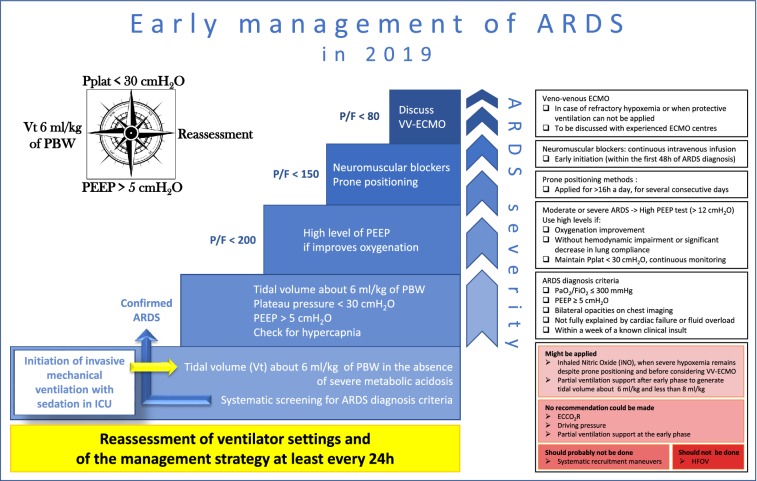
Fifteen recommendations and a therapeutic algorithm regarding the management of acute respiratory distress syndrome (ARDS) at the early phase in adults are proposed. The Grade of Recommendation Assessment, Development and Evaluation (GRADE) methodology has been followed. Four recommendations (low tidal volume, plateau pressure limitation, no oscillatory ventilation, and prone position) had a high level of proof (GRADE 1 + or 1 -); four (high positive end-expiratory pressure [PEEP] in moderate and severe ARDS, muscle relaxants, recruitment maneuvers, and venovenous extracorporeal membrane oxygenation [ECMO]) a low level of proof (GRADE 2 + or 2 -); seven (surveillance, tidal volume for non ARDS mechanically ventilated patients, tidal volume limitation in the presence of low plateau pressure, PEEP > 5 cmH2O, high PEEP in the absence of deleterious effect, pressure mode allowing spontaneous ventilation after the acute phase, and nitric oxide) corresponded to a level of proof that did not allow use of the GRADE classification and were expert opinions. Lastly, for three aspects of ARDS management (driving pressure, early spontaneous ventilation, and extracorporeal carbon dioxide removal), the experts concluded that no sound recommendation was possible given current knowledge. The recommendations and the therapeutic algorithm were approved by the experts with strong agreement.
Overview
The claims and statistics of this paper haven’t been checked yet.
Free: it reads the open-access text and checks the first 5 claims that cite a source we can check. Create a free account to check every claim.
Integrity signals
Registry
Cites
Statistics
Figures
Verification
Claims the paper makes
The claims and statistics of this paper haven’t been checked yet.
Free: it reads the open-access text and checks the first 5 claims that cite a source we can check. Create a free account to check every claim.
Claims other papers make about this one
Each is checked against this paper’s own text: does it say what the citing paper says it does?
In the citing paper
“A recent systematic review which included five RCTs also identified a strong relationship between plateau pressure and mortality [434].”
From Surviving sepsis campaign: international guidelines for management of sepsis and septic shock 2021 (2021) · cites this paper as [434]
Self-check
Percentages, sums and reported differences re-computed from the paper’s own numbers.
The self-check needs the paper’s full text.
Citations
Cites
(2000) · New England Journal of Medicine · doi:10.1056/nejm200005043421801 · Cited by 12,941
Chen, Y., Wang, L., Kang, Q., Zhang, X., Yu, G., Wan, X., Wang, J., & Zhu, K. (2017) · Cellular Physiology and Biochemistry · doi:10.1159/000477308 · Cited by 10,679
Acute Respiratory Distress Syndrome: The Berlin Definition
(2012) · JAMA · doi:10.1001/jama.2012.5669 · Cited by 8,731
Bellani, G., Laffey, J. G., Pham, T., Fan, E., Brochard, L., Esteban, A., Gattinoni, L., van Haren, F., Larsson, A., McAuley, D. F., et al. (2016) · JAMA · doi:10.1001/jama.2016.0291 · Cited by 5,766 · cited 10×
“Plateau pressure was measured in only 40% of ARDS patients [2].”
BackgroundMethodInfluentialSelf-citationProne positioning in severe acute respiratory distress syndrome.
Guérin, C., Reignier, J., Richard, J.-C., Beuret, P., Gacouin, A., Boulain, T., Mercier, E., Badet, M., Mercat, A., Baudin, O., et al. (2013) · New England Journal of Medicine · doi:10.1056/nejmoa1214103 · Cited by 4,040
Self-citationEffect of a protective-ventilation strategy on mortality in the acute respiratory distress syndrome.
Amato, M. B. P., Barbas, C. S. V., Medeiros, D. M., Magaldi, R. B., Schettino, G. P., Lorenzi-Filho, G., Kairalla, R. A., Deheinzelin, D., Munoz, C., Oliveira, R., et al. (1998) · New England Journal of Medicine · doi:10.1056/nejm199802053380602 · Cited by 3,654
Peek, G. J., Mugford, M., Tiruvoipati, R., Wilson, A., Allen, E., Thalanany, M. M., Hibbert, C. L., Truesdale, A., Clemens, F., Cooper, N., et al. (2009) · The Lancet · doi:10.1016/s0140-6736(09)61069-2 · Cited by 3,395
Functional Disability 5 Years after Acute Respiratory Distress Syndrome
Herridge, M. S., Tansey, C. M., Matté, A., Tomlinson, G., Diaz-Granados, N., Cooper, A., Guest, C. B., Mazer, C. D., Mehta, S., Stewart, T. E., et al. (2011) · New England Journal of Medicine · doi:10.1056/nejmoa1011802 · Cited by 2,847
Driving pressure and survival in the acute respiratory distress syndrome.
Amato, M. B. P., Meade, M. O., Slutsky, A. S., Brochard, L., Costa, E. L. V., Schoenfeld, D. A., Stewart, T. E., Briel, M., Talmor, D., Mercat, A., et al. (2015) · New England Journal of Medicine · doi:10.1056/nejmsa1410639 · Cited by 2,801
Self-citation(2004) · New England Journal of Medicine · doi:10.1056/nejmoa032193 · Cited by 2,565
Research works printed but not linked: 1
- Cavalcanti AB Suzumura EA Laranjeira LN Paisani DM Damiani LP Guimaraes HP Effect of lung recruitment and titrated positive end-expiratory pressure (PEEP) vs low PEEP on mortality in patients with acute respiratory distress syndrome: a randomized clinical trial JAMA 2017 318 14 1335 1345 10.1001/jama.2017.14171 28973363 PMC5710484 · DOI · Paper page
Cited by
Items 101–200 of 761
Hypercapnia promotes microglial pyroptosis via inhibiting mitophagy in hypoxemic adult rats
Ding, H., Li, Y., Li, X., Liu, X., Wang, K., Wen, M., Jiang, W., & Zeng, H. (2020) · CNS Neuroscience & Therapeutics · doi:10.1111/cns.13435 · Cited by 38
Combes, A., Brodie, D., Aïssaoui, N., Bein, T., Capellier, G., Dalton, H. J., Diehl, J., Kluge, S., McAuley, D. F., Schmidt, M., et al. (2022) · Intensive Care Medicine · doi:10.1007/s00134-022-06796-w · Cited by 39
Self-citationGrasso, S., Mirabella, L., Murgolo, F., Mussi, R. D., Pisani, L., Dalfino, L., Spadaro, S., Rauseo, M., Lamanna, A., & Cinnella, G. (2020) · Critical Care Medicine · doi:10.1097/ccm.0000000000004640 · Cited by 35
“, > 12 cm H 2 O) in moderate to severe ARDS (13).”
BackgroundLim, E. Y., Lee, S., Shin, H. S., & Kim, G.-D. (2023) · Antioxidants · doi:10.3390/antiox12112016 · Cited by 46
“…Care Medicine and Intensive Care Society [42], The French Society of Intensive Card Medicine (Soci é t é de R é animation de Langue Française) [43], The ATS, the European Society of Intensive Care Medicine [44], the Korean Society of Critical Care Medicine and Korean Academy of Tuberculosis…”
BackgroundZayat, R., Kalverkamp, S., Grottke, O., Durak, K., Dreher, M., Autschbach, R., Marx, G., Marx, N., Spillner, J. W., & Kersten, A. (2020) · Artificial Organs · doi:10.1111/aor.13873 · Cited by 37
“2 million deaths as of November 1, 2020 [1].”
BackgroundLearning During Crisis: The Impact of COVID-19 on Hospital-Acquired Pressure Injury Incidence
Polancich, S., Hall, A. G., Miltner, R. S., Poe, T. L., Enogela, E. M., Montgomery, A. P., & Patrician, P. A. (2021) · Journal for Healthcare Quality · doi:10.1097/jhq.0000000000000301 · Cited by 35
“The benefits of prone positioning for respiratory patients includes better aeration of the lungs, an important consideration for the respiratory distress experienced with COVID-19.(28-32) Although proning is beneficial for oxygenation, it is a challenge for mitigating the risk for pressure injury development.”
BackgroundRezoagli, E., McNicholas, B., Madotto, F., Pham, T. O., Bellani, G., & Laffey, J. G. (2022) · Annals of Intensive Care · doi:10.1186/s13613-022-01015-7 · Cited by 40
“It should be acknowledged that the LUNG SAFE study unveiled that a significant proportion of patients did not receive protective mechanical ventilation, PEEP levels stratified by ARDS severity [6] and widely available adjuncts such as neuromuscular blockade and prone position [10] despite guidelines recommendations [1…”
BackgroundShi, R., Ayed, S., Moretto, F., Azzolina, D., Vita, N. D., Gavelli, F., Carelli, S., Pavot, A., Lai, C., Monnet, X., et al. (2022) · Critical Care · doi:10.1186/s13054-022-04087-w · Cited by 41
Manrique, S., Claverías, L., Magret, M., Masclans, J. R., Bodí, M. A., Trefler, S., Canadell, L., Dı́az, E., Solé‐Violán, J., Bisbal-Andrés, E., et al. (2023) · BMC Anesthesiology · doi:10.1186/s12871-023-02081-5 · Cited by 34
“Delayed intubation in ARDS patients has been reported to increase mortality, so ARDS guidelines recommend early recognition of acute respiratory failure (ARF) and intubation [2].”
BackgroundPulmonary barotrauma in mechanically ventilated coronavirus disease 2019 patients: A case series
Edwards, J.-A., Breitman, I., Bienstock, J., Badami, A., Kovatch, I., Dresner, L., & Schwartzman, A. (2020) · Annals of Medicine and Surgery · doi:10.1016/j.amsu.2020.11.054 · Cited by 34
Marquis, K. M., Hammer, M. M., Steinbrecher, K. L., Henry, T. S., Lin, C., Shifren, A., & Raptis, C. A. (2023) · Radiographics · doi:10.1148/rg.220176 · Cited by 33
Buchko, M. T., Boroumand, N., Cheng, J. C., Hirji, A. S., Halloran, K. M., Freed, D. H., & Nagendran, J. (2020) · Nature Communications · doi:10.1038/s41467-020-19581-4 · Cited by 32
Comparative Study of Acute Lung Injury in COVID-19 and Non-COVID-19 Patients
Zhang, J., Huang, X., Ding, D., Zhang, J., Xu, L., Hu, Z., Xu, W., & Tao, Z. (2021) · Frontiers in Medicine · doi:10.3389/fmed.2021.666629 · Cited by 36
Zerbib, Y., Lambour, A., Maizel, J., Kontar, L., Cagny, B. D., Soupison, T., Bradier, T., Slama, M., & Brault, C. (2022) · Critical Care · doi:10.1186/s13054-021-03876-z · Cited by 33
S3-Leitlinie Sepsis – Prävention, Diagnose, Therapie und Nachsorge – Update 2025
Brunkhorst, F. M., Adamzik, M., Axer, H., Bauer, M. W., Bode, C., Bone, H.-G., Brenner, T., Bucher, M., David, S., Dietrich, M., et al. (2025) · Medizinische Klinik - Intensivmedizin und Notfallmedizin · doi:10.1007/s00063-025-01317-1 · Cited by 47
Diagnosis and Management of Acute Respiratory Distress Syndrome in a Time of COVID-19
Kassirian, S., Taneja, R., & Mehta, S. (2020) · Diagnostics · doi:10.3390/diagnostics10121053 · Cited by 32
“These include short courses of neuromuscular blockade-induced paralysis, and specific recruitment manoeuvres [91,97,98].”
BackgroundSklienka, P., Frelich, M., & Burša, F. (2023) · Journal of Personalized Medicine · doi:10.3390/jpm13040593 · Cited by 31
“Lung-protective ventilatory strategies based on low tidal volumes, reduced pressures delivered by the ventilator (tidal volume (Vt) ≤ 6 mL/kg of predicted body weight (PBW); plateau pressure ≤ 30 cmH2O; driving pressure (∆Paw) ≤ 15 cmH2O), and optimization of positive end-expiratory pressure (PEEP) were associated wit…”
BackgroundBullen, E. C., Teijeiro‐Paradis, R., & Fan, E. (2020) · CHEST Journal · doi:10.1016/j.chest.2020.04.016 · Cited by 33
Acute Respiratory Distress Syndrome in Pregnancy
Pandya, S. T., & Sai Krishna, J. (2022) · Indian Journal of Critical Care Medicine · doi:10.5005/jp-journals-10071-24036 · Cited by 37
“Indian J Chest Dis Allied Sci 2009;51(2):115–117.”
Dessap, A. M., Papazian, L., Schaller, M., Nseir, S., Mégarbane, B., Haudebourg, L., Timsit, J., Teboul, J., Kuteifan, K., Gainnier, M., et al. (2023) · Annals of Intensive Care · doi:10.1186/s13613-023-01150-9 · Cited by 32
“This position is documented in the latest guidelines published by the French Intensive Care Society [2].”
MethodResultSelf-citationHemodynamic Effects of Ketamine Compared With Propofol or Dexmedetomidine as Continuous ICU Sedation
Atchley, E., Tesoro, E. P., Meyer, R., Bauer, A., Pulver, M., & Benken, S. T. (2021) · Annals of Pharmacotherapy · doi:10.1177/10600280211051028 · Cited by 29
Pharmacological management of COVID-19 patients with ARDS (CARDS): A narrative review
Matera, M. G., Rogliani, P., Calzetta, L., & Cazzola, M. (2020) · Respiratory Medicine · doi:10.1016/j.rmed.2020.106114 · Cited by 30
Between-trial heterogeneity in ARDS research
Juschten, J., Tuinman, P. R., Guo, T., Juffermans, N. P., Schultz, M. J., Loer, S. A., Girbes, A. R. J., & de Grooth, H. (2021) · Intensive Care Medicine · doi:10.1007/s00134-021-06370-w · Cited by 31
Haudebourg, A.-F., Tuffet, S., Perier, F., Razazi, K., de Prost, N., Dessap, A. M., & Carteaux, G. (2022) · Critical Care · doi:10.1186/s13054-022-04054-5 · Cited by 29
“As ARDS patients are characterized by a dramatical decrease in aerated lung volume, lowering the tidal volume (VT) down to 6 ml/kg of predicted body weight (PBW) has been shown more than 20 years ago to improve their survival [3] and has become the cornerstone of lung protective ventilation [4].”
BackgroundSchmid, B., Griesel, M., Fischer, A.-L., Romero, C. S., Metzendorf, M., Weibel, S., & Fichtner, F. (2022) · Journal of Clinical Medicine · doi:10.3390/jcm11020391 · Cited by 28
Terrier, C. L., Sigaud, F., Lebbah, S., Desmedt, L., Hajage, D., Guérin, C., Pugin, J., Primmaz, S., Terzi, N., COVID-ICU Group on behalf of the REVA Network and the COVID-ICU Investigators, et al. (2022) · Critical Care · doi:10.1186/s13054-022-03949-7 · Cited by 30
“Interestingly, our study highlights that prone positioning was not always used according to international guidelines [7, 22].”
InfluentialSelf-citationBachoumas, K., Levrat, A., Thuaut, A. L., Rouleau, S., Groyer, S., Dupont, H., Rooze, P., Eisenmann, N., Trampont, T., Bohé, J., et al. (2020) · Annals of Intensive Care · doi:10.1186/s13613-020-00733-0 · Cited by 27
Taboada, M., González, M., Álvarez, A., González, I., García, J., Eiras, M., Vieito, M. D., Naveira, A., Otero, P., Campaña, O., et al. (2020) · Anesthesia & Analgesia · doi:10.1213/ane.0000000000005239 · Cited by 30
Acute Hyperglycemia Aggravates Lung Injury via Activation of the SGK1–NKCC1 Pathway
Wu, C., Huang, K., Peng, C., & Lan, C. (2020) · International Journal of Molecular Sciences · doi:10.3390/ijms21134803 · Cited by 26
“Acute lung injury (ALI) is characterized by poor pulmonary gas exchange, hypoxemia, and frequently results in significant morbidity and mortality in intensive care units (ICUs) [1].”
Sensory interventions to relieve dyspnoea in critically ill mechanically ventilated patients
Bureau, C., Nierat, M., Decavèle, M., Rivals, I., Dangers, L., Beurton, A., Virolle, S., Déléris, R., Delemazure, J., Mayaux, J., et al. (2023) · European Respiratory Journal · doi:10.1183/13993003.02215-2022 · Cited by 26
Dyspnoea in acutely ill mechanically ventilated adult patients: an ERS/ESICM statement
Demoule, A., Decavèle, M., Antonelli, M. M., Camporota, L., Abroug, F., Adler, D., Azoulay, É., Başoğlu, M., Campbell, M., Grasselli, G., et al. (2024) · European Respiratory Journal · doi:10.1183/13993003.00347-2023 · Cited by 32
Barthélémy, R., Beaucoté, V., Bordier, R., Collet, M., Gall, A. L., Hong, A., de Roquetaillade, C., Gayat, É., Mebazaa, A., & Chousterman, B. G. (2020) · British Journal of Anaesthesia · doi:10.1016/j.bja.2020.10.026 · Cited by 25
“Patients were managed according to our previously described local protocol(10) based on the latest guidelines.(1) The PEEP trial protocol is described in the Supplementary data.”
Melani, A. S., Croce, S., Cassai, L., Montuori, G., Fabbri, G., Messina, M., Viani, M., & Bargagli, E. (2023) · Pulmonary Therapy · doi:10.1007/s41030-023-00227-x · Cited by 29
“Guideline (reference) SCCM/ESICM [20] BTS/ICM/ICSGDG [21] JPCG [23] SRLF [22]”
Manrique, S., Ruíz-Botella, M., Murillo, N., Canelles, S., Victoria, I., Samper, M., Plans, O., Claverías, L., Magret, M., Gordo, F., et al. (2024) · European journal of medical research · doi:10.1186/s40001-024-02082-1 · Cited by 24
Sang, L., Zheng, X., Zhao, Z., Zhong, M., Jiang, L., Huang, Y., Liu, X., Li, Y., & Zhang, D. (2021) · Frontiers in Medicine · doi:10.3389/fmed.2020.603943 · Cited by 24
Clinical care for severe acute respiratory infection: toolkit: COVID-19 adaptation
Paraguassu, É. C., & Lacerda, J. D. P. (2022) · Brazilian Journal of Implantology and Health Sciences · doi:10.36557/2674-8169.2022v4n3p48-330 · Cited by 24
Lascarrou, J.-B., Gaultier, A., Soumagne, T., Serck, N., Sauneuf, B., Piagnerelli, M., Ly, A., Lejeune, F., Lefebvre, L., Hraiech, S., et al. (2021) · Frontiers in Medicine · doi:10.3389/fmed.2021.632933 · Cited by 23
Yamamoto, R., Okazaki, S. R., Fujita, Y., Seki, N., Kokei, Y., Sekine, S., Wada, S., Norisue, Y., & Narita, C. (2022) · Scientific Reports · doi:10.1038/s41598-022-13224-y · Cited by 27
Robba, C., Camporota, L., & Citerio, G. (2023) · Intensive Care Medicine · doi:10.1007/s00134-023-07043-6 · Cited by 23
“A consensus of experts [14] provided fifteen recommendations, and a therapeutic algorithm for managing ARDS, recommending the use of low tidal volume, plateau pressure limitation, and PEEP > 5 cmH2O as initial management.”
BackgroundKang, Z.-Y., Huang, Q.-Y., Zhen, N.-X., Xuan, N., Zhou, Q., Zhao, J., Cui, W., Zhang, Z., & Tian, B. (2024) · Frontiers in Immunology · doi:10.3389/fimmu.2024.1382449 · Cited by 30
Mortality Prediction Using SaO2/FiO2 Ratio Based on eICU Database Analysis
Patel, S., Singh, G., Zarbiv, S., Ghiassi, K., & Rachoin, J.-S. (2021) · Critical Care Research and Practice · doi:10.1155/2021/6672603 · Cited by 30
“Most cutoffs for ARDS interventions are based on the P/F ratio [2,3].”
BackgroundGuérin, C., Terzi, N., Galerneau, L.-M., Mezidi, M., Yonis, H., Baboi, L., Kreitmann, L., Turbil, E., Cour, M., Argaud, L., et al. (2020) · Journal of Applied Physiology · doi:10.1152/japplphysiol.00059.2020 · Cited by 22
Self-citationBarthélémy, R., Blot, P.-L., Tiepolo, A., Gall, A. L., Mayeur, C., Gaugain, S., Morisson, L., Gayat, É., Mebazaa, A., & Chousterman, B. G. (2020) · CHEST Journal · doi:10.1016/j.chest.2020.05.573 · Cited by 22
Right-sided heart failure in acute respiratory distress syndrome
Yogeswaran, A., Kremer, N., Janetzko, P., Schäfer, S., Rako, Z. A., Vadász, I., Hecker, M., & Tello, K. (2025) · European Respiratory Review · doi:10.1183/16000617.0060-2025 · Cited by 21
“Consequently, current guidelines recommend exhausting conventional treatment strategies, including the prevention and management of ACP, before considering ECMO therapy [94, 95].”
Ventilatory targets following brain injury
Taran, S., Wahlster, S., & Robba, C. (2023) · Current Opinion in Critical Care · doi:10.1097/mcc.0000000000001018 · Cited by 26
“Moreover, whereas targets of mechanical ventilation are well defined in patients with acute respiratory distress syndrome (ARDS) without ABI [4,5], brain-injured patients were largely excluded from landmark ARDS trials [6–9].”
BackgroundMethodSun, X., Liu, Y., Li, N., You, D., & Zhao, Y. (2020) · Medicine · doi:10.1097/md.0000000000018586 · Cited by 24
“An increase in the permeability of the membrane was found with the recruitment of neutrophils and other inflammation factors, which resulted in the pulmonary edema.([30]) Some studies suggested that the pathogenesis of ARDS may also be associated with systemic inflammatory response syndrome (SIRS).”
Zhang, Y., Zhu, S., Yuan, Z., Li, Q., Ding, R., Bao, X., Zhen, T., Fu, Z., Fu, H., Xing, K., et al. (2020) · BMC Cancer · doi:10.1186/s12885-020-07626-2 · Cited by 23
Akoumianaki, E., Jonkman, A. H., Sklar, M. C., Georgopoulos, D., & Brochard, L. J. (2021) · Annals of Intensive Care · doi:10.1186/s13613-021-00897-3 · Cited by 25
“Concurrently, existing evidence suggests that v-v ECMO might have a mortality benefit in a very small portion of patients: those with very severe hypoxemia (PaO2/FiO2 < 80 mmHg), who receive injurious mechanical ventilation settings and in whom all conservative strategies such as lung protective ventilation, repeated…”
BackgroundSelf-citationImpact of Airway Humidification Strategy in Mechanically Ventilated COVID-19 Patients
Lavoie-Bérard, C.-A., Lefebvre, J.-C., Bouchard, P.-A., Simon, M., & Lellouche, F. (2021) · Respiratory Care · doi:10.4187/respcare.09314 · Cited by 20
“17 However, in the COVID-19 population, the choice of humidification system is still unclear because HME and HH have each advantages and drawbacks.”
Is COVID-19 different from other causes of acute respiratory distress syndrome?
Beloncle, F. (2023) · Journal of Intensive Medicine · doi:10.1016/j.jointm.2023.02.003 · Cited by 22
Dechamps, M., Poortere, J. D., Martin, M., Gatto, L., Daumerie, A., Bouzin, C., Octave, M., Ginion, A., Robaux, V., Pirotton, L., et al. (2022) · Frontiers in Medicine · doi:10.3389/fmed.2021.780750 · Cited by 22
Beyls, C., Bohbot, Y., Huette, P., Booz, T., Daumin, C., Arab, O. A., & Mahjoub, Y. (2021) · Journal of Cardiothoracic and Vascular Anesthesia · doi:10.1053/j.jvca.2021.01.025 · Cited by 19
Bottiroli, M., Calini, A., Pinciroli, R., Mueller, A., Siragusa, A., Anelli, C., Urman, R. D., Nozari, A., Berra, L. M., Mondino, M. G., et al. (2021) · BMC Anesthesiology · doi:10.1186/s12871-021-01376-9 · Cited by 19
Benghanem, S., Cariou, A., Diehl, J., Marchi, A., Charpentier, J., Augy, J.-L., Hauw‐Berlemont, C., Gavaret, M., Pène, F., Mira, J. P., et al. (2022) · Critical Care Medicine · doi:10.1097/ccm.0000000000005491 · Cited by 23
“07) Sedatives/opioids cumulative dose (mg/kg) Midazolam 12 (8–18) 29 (15–42) Propofol 23 (2–40) 40 (13–95) Midazolam and propofol (midazolam equivalent) 13 (8–20) 32 (20–48) Sufentanil 17 (10–26) 42 (30–73) Sedatives/opioids duration (d) 4 (3–7) 9 (6–17) Clinical Assessment Richmond Agitation-Sedation Scale score –4 (…”
BackgroundMethodHigh risk and low prevalence diseases: Acute chest syndrome in sickle cell disease
Koehl, J. L., Koyfman, A., Hayes, B. D., & Long, B. (2022) · The American Journal of Emergency Medicine · doi:10.1016/j.ajem.2022.06.018 · Cited by 31
Wu, W., Wang, Y., Tang, J., Yu, M. Z., Yuan, J., & Zhang, G. (2022) · Computer Methods and Programs in Biomedicine · doi:10.1016/j.cmpb.2022.107328 · Cited by 21
Li, R., Wu, Y., Zhang, H., Wang, A., Zhao, X., Yuan, S., Yang, L., Zou, X., Shang, Y., & Zhao, Z. (2023) · Critical Care · doi:10.1186/s13054-023-04469-8 · Cited by 19
“Patients were deeply sedated and, if necessary, paralyzed to abrogate spontaneous breathing if PaO2/FiO2 < 150 mmHg, whereas spontaneous breathing was permitted in patients with PaO2/FiO2 ≥ 150 mmHg, respiratory rate less than 35 bpm, and no significant patient-ventilator asynchrony [8, 9].”
BackgroundOthman, F. M., Alsagami, N. S., Alharbi, R., Almuammer, Y. I., Alshahrani, S., & Ismaeil, T. (2021) · Annals of Thoracic Medicine · doi:10.4103/atm.atm_475_20 · Cited by 19
“[1] In the clinical progression of ARDS, refractory hypoxemia is the most important pathophysiological feature.[2,3] A core aspect of treating ARDS is to recruit poorly ventilated lung areas by providing active and adequate oxygenation.”
BackgroundLaghlam, D., Charpentier, J., Hamou, Z. A., Nguyen, L. S., Pène, F., Cariou, A., Mira, J. P., & Jozwiak, M. (2022) · Frontiers in Medicine · doi:10.3389/fmed.2021.810393 · Cited by 21
Geospatial Access to Extracorporeal Membrane Oxygenation in the United States
Gottula, A. L., Wyk, H. V., Qi, M., Vogelsong, M. A., Shaw, C. R., Tonna, J. E., Johnson, N. J., Condella, A. L., Bartos, J. A., Berrocal, V. J., et al. (2025) · Critical Care Medicine · doi:10.1097/ccm.0000000000006607 · Cited by 19
Use of Almitrine and Inhaled Nitric Oxide in ARDS Due to COVID-19
Laghlam, D., Rahoual, G., Malvy, J., Estagnasié, P., Brusset, A., & Squara, P. (2021) · Frontiers in Medicine · doi:10.3389/fmed.2021.655763 · Cited by 20
“As almitrine and iNO are actually recommended in ARDS patients in cases of refractory hypoxemia despite PP (22), it should be interesting to investigate their effects in PP.”
BackgroundXia, T., Hu, R., Shao, C.-J., Feng, Y., Yang, X.-L., Xie, Y., Shi, J., Li, J., & Li, X. (2023) · Cytokine · doi:10.1016/j.cyto.2022.156114 · Cited by 18
Manual Prone Positioning in Adults: Reducing the Risk of Harm Through Evidence-Based Practices
Morata, L., Vollman, K. M., Rechter, J. L., & Cox, J. (2023) · Critical Care Nurse · doi:10.4037/ccn2023174 · Cited by 21
Keller, K., Farmakis, I. T., Valerio, L., Koelmel, S., Wild, J., Barco, S., Schmidt, F. P., Espinola–Klein, C., Konstantinides, S., Münzel, T. F., et al. (2023) · Frontiers in Public Health · doi:10.3389/fpubh.2023.1113793 · Cited by 22
Formenti, P., Miori, S., Galimberti, A., & Umbrello, M. (2023) · Diagnostics · doi:10.3390/diagnostics13061157 · Cited by 19
“Lastly, we did not record data on the previous use of corticosteroids or neuromuscular blocking agents, which are frequently used in patients with moderate/severe ARDS [33].”
InfluentialXu, H., Nie, X., Deng, W., Zhou, H., Huang, D., & Wang, Z. (2023) · Journal of Biochemical and Molecular Toxicology · doi:10.1002/jbt.23568 · Cited by 18
Wang, D., Xiao, L.-X., Deng, X., & Deng, W. (2024) · Frontiers in Medicine · doi:10.3389/fmed.2023.1207534 · Cited by 21
“Seven patients (PaO 2 /FIO 2 ratio 150 mmHg) were performed prone position ventilation with an average of 4.6 days as recommended previously (19).”
BackgroundMethodInfluentialBuckley, M. S., Agarwal, S., Garcia-Orr, R., Saggar, R., & MacLaren, R. (2020) · Journal of Intensive Care Medicine · doi:10.1177/0885066620906800 · Cited by 18
Poor, A. D., Acquah, S. O., Wells, C. M., Sevillano, M., Strother, C. G., Oldenburg, G., & Hsieh, S.-J. J. (2020) · American Journal of Critical Care · doi:10.4037/ajcc2020992 · Cited by 19
Ding, H., Liu, X., Li, X., Wen, M., Li, Y., Han, Y., Huang, L., Liu, M., & Zeng, H. (2020) · International Journal of Molecular Medicine · doi:10.3892/ijmm.2020.4604 · Cited by 21
“Low tidal volume ventilation is routinely applied in clinical practice to correct hypoxemia, which aims to reduce the risk of ventilator-induced lung injury (2).”
Nijbroek, S. G. L. H., Hol, L., Ivanov, D., Schultz, M. J., Paulus, F., & Neto, A. S. (2022) · Journal of Critical Care · doi:10.1016/j.jcrc.2022.154047 · Cited by 18
“Even guidelines show discrepancies in recommendations [5,27,28].”
Bassi, G. L., GIBBONS, K. S., Suen, J. Y., Dalton, H. J., White, N. M., Corley, A., Shrapnel, S., Hinton, S. R., Forsyth, S. J., Laffey, J. G., et al. (2022) · Critical Care · doi:10.1186/s13054-022-03983-5 · Cited by 21
“Yet, in the French/Belgian study, prone positioning was applied in over 90% and ECMO in 15% of the patients, in line with French expert consensus guidelines recommendations [51] and evidence in favor of the aforementioned interventions in COVID-19 patients [42, 50, 52].”
Lee, H., Kim, J., Choi, W.-I., Choi, W.-I., Joh, J.-S., Park, J., & Kim, J. (2022) · European journal of medical research · doi:10.1186/s40001-022-00953-z · Cited by 24
Battaglini, D., Iavarone, I. G., Robba, C., Ball, L., Silva, P. L., & Rocco, P. R. M. (2023) · Expert Review of Medical Devices · doi:10.1080/17434440.2023.2255521 · Cited by 18
“Recent guidelines tolerate the use of V T >6 mL/kg PBW in cases of obstinate hypercapnia to optimize gas exchange [16].”
MethodCOVID-19-related ARDS: one disease, two trajectories, and several unanswered questions
Lascarrou, J.-B. (2021) · The Lancet Respiratory Medicine · doi:10.1016/s2213-2600(21)00381-7 · Cited by 17
Hamou, Z. A., Levy, N., Charpentier, J., Mira, J. P., Jamme, M., & Jozwiak, M. (2022) · Respiratory Research · doi:10.1186/s12931-022-02231-2 · Cited by 18
“Neuromuscular blocker agents and prone positioning sessions were used according to current recommendations for nonCOVID-19 patients with acute respiratory distress syndrome [21].”
MethodThe use of induced hypothermia in extracorporeal membrane oxygenation: A narrative review
Moreau, A., Lévy, B., Annoni, F., Lorusso, R., Su, F., Belliato, M., & Taccone, F. S. (2023) · Resuscitation Plus · doi:10.1016/j.resplu.2023.100360 · Cited by 17
Pape, M. L., Besnard, C., Acatrinei, C. A., Guinard, J., Boutrot, M., Genève, C., Boulain, T., & Barbier, F. (2022) · Annals of Intensive Care · doi:10.1186/s13613-022-00998-7 · Cited by 22
“First, that the study was conducted in two ICUs of a single hospital may restrain its external validity; however, patients were managed according to current standards of care [20] and the epidemiological features of ARDS and VAP were concordant with those reported elsewhere [2, 11, 12, 40–43].”
MethodResultZhang, L., Yan, X., Li, X., Huang, Y., Wang, X., Lin, J., Zhang, H., Liu, Z., & Guo, Q. (2025) · ACS Nano · doi:10.1021/acsnano.5c07062 · Cited by 15
COVID-19 pandemic: overview of protective-ventilation strategy in ARDS patients
Higny, J., Feye, F., & Forêt, F. (2020) · Acta Clinica Belgica · doi:10.1080/17843286.2020.1761162 · Cited by 16
“(PaO2/FiO2 < 80 mmHg) despite optimal protective ventilation strategies [16].”
BackgroundEstablishment of a novel miniature veno‐venous extracorporeal membrane oxygenation model in the rat
Fujii, Y., Sumikura, H., & Nagahama, D. (2020) · Artificial Organs · doi:10.1111/aor.13769 · Cited by 15
Non-invasive Respiratory Support in COVID-19: A Narrative Review
Luján, M., Catalán, J. S., Mediano, O., & Egea, C. (2022) · Frontiers in Medicine · doi:10.3389/fmed.2021.788190 · Cited by 17
Nguyen, L. S., Helias, M., Raia, L., Nicolas, E., Jaubert, P., Benghanem, S., Hamou, Z. A., Dupland, P., Charpentier, J., Pène, F., et al. (2022) · Scientific Reports · doi:10.1038/s41598-021-02634-z · Cited by 15
Self-citationPellet, P.-L., Stevic, N., Degivry, F., Louis, B., Argaud, L., Guérin, C., & Cour, M. (2024) · Annals of Intensive Care · doi:10.1186/s13613-024-01245-x · Cited by 15
“Stemming from the landmark ARMA trial, the primary goal of protective invasive mechanical ventilation (IMV) in acute respriatory distress syndrome (ARDS) is to limit excessive stress and strain applied to the lung [1–3].”
BackgroundSelf-citationWei, X., Wang, Z., Liao, X., Guo, W., Qin, T., & Wang, S.-H. (2020) · Frontiers in Pharmacology · doi:10.3389/fphar.2019.01637 · Cited by 15
Zabolotskikh, I. B., Кirov, М. Y., Лебединский, К. М., Николаевич, П. Д., Avdeev, S. N., Andreenko, A. A., Arsentev, L. V., Афончиков, В. С., Игоревич, А. И., Belkin, A. A., et al. (2020) · Annals of critical care · doi:10.21320/1818-474x-2020-s1-9-120 · Cited by 17
Muenster, S., Zarragoikoetxea, I., Moscatelli, A., Balcells, J., Gaudard, P., Pouard, P., Marczin, N., & Janssens, S. P. (2024) · Frontiers in Cardiovascular Medicine · doi:10.3389/fcvm.2024.1374635 · Cited by 25
Lessons from COVID-19 in the management of acute respiratory failure
Crimi, C., Murphy, P. B., Patout, M., Catalán, J. S., & Winck, J. C. (2023) · Breathe · doi:10.1183/20734735.0035-2023 · Cited by 14
Wiedemann, D., Bernardi, M. H., Distelmaier, K., Goliasch, G., Hengstenberg, C., Hermann, A., Holzer, M. S., Höetzenecker, K., Klepetko, W., Láng, G., et al. (2020) · Wiener klinische Wochenschrift · doi:10.1007/s00508-020-01708-8 · Cited by 14
Petit, M., Dessap, A. M., Masi, P., Legras, A., Vignon, P., & Vieillard‐Baron, A. (2021) · Critical Care · doi:10.1186/s13054-021-03646-x · Cited by 14
“To the Editor, The Acute Respiratory Distress Syndrome (ARDS) is still associated with high mortality [1], despite application of recent guidelines [2, 3].”
BackgroundSelf-citationPellegrini, M., Larina, A., Mourtos, E., Frithiof, R., Lipcsey, M., Hultström, M., Segelsjö, M., Hansen, T., & Perchiazzi, G. (2021) · Critical Care · doi:10.1186/s13054-021-03685-4 · Cited by 14
“This can be easily explained by the fact that more severe forms of SARS-CoV2 related acute respiratory failure are more likely in need of pronation [40] and more often undergo muscle relaxation as standard of care [41].”
BackgroundLee, H., Kim, J., Choi, W.-I., Choi, W.-I., Joh, J.-S., Park, J., & Kim, J. (2022) · European journal of medical research · doi:10.1186/s40001-022-00841-6 · Cited by 14
Zabolotskikh, I. B., Кirov, М. Y., Лебединский, К. М., Николаевич, П. Д., Avdeev, S. N., Andreenko, A. A., Arsentev, L. V., Афончиков, В. С., Игоревич, А. И., Belkin, A. A., et al. (2021) · Annals of critical care · doi:10.21320/1818-474x-2021-s1-9-143 · Cited by 14
Modeling Patient Risk for Hospital-Acquired Pressure Injuries During COVID-19
Montgomery, A. P., Patrician, P. A., Hall, A. G., Miltner, R. S., Enogela, E. M., & Polancich, S. (2021) · Journal of Nursing Care Quality · doi:10.1097/ncq.0000000000000602 · Cited by 13
“With mechanical ventilation, patients are exposed to tubes and drains known to increase the risk for device-related pressure injuries, the necessity for proning or placing the patient in a position that increases the risk for upper-body pressure injuries (specifically face and neck).(12,15) Health care provider workfl…”
BackgroundAlhumaid, S., Mutair, A. S. A., Alghazal, H. A., Alhaddad, A. J., Al-Helal, H., Salman, S. A. A., Alali, J., Almahmoud, S. A., Alhejy, Z. M., Albagshi, A. A., et al. (2021) · European journal of medical research · doi:10.1186/s40001-021-00618-3 · Cited by 14
RetractedThevathasan, T., Füreder, L. M., Donker, D. W., Nix, C., Wurster, T. H., Knie, W., Girke, G., Harbi, A. S. A., Landmesser, U., & Skurk, C. (2022) · Frontiers in Cardiovascular Medicine · doi:10.3389/fcvm.2022.1045601 · Cited by 13
Pharmacological management of adult patients with acute respiratory distress syndrome
Matera, M. G., Rogliani, P., Bianco, A., & Cazzola, M. (2020) · Expert Opinion on Pharmacotherapy · doi:10.1080/14656566.2020.1801636 · Cited by 13
Fujii, Y., Abe, T., & Ikegami, K. (2021) · Membranes · doi:10.3390/membranes11040283 · Cited by 13
Manejo del paciente con sedación difícil en el ámbito de la Medicina Intensiva
Carmona, S. A., & Sánchez, M. G. (2020) · Medicina Intensiva · doi:10.1016/j.medin.2019.12.018 · Cited by 13
Zabolotskikh, I. B., Кirov, М. Y., Лебединский, К. М., Николаевич, П. Д., Avdeev, S. N., Andreenko, A. A., Arsentev, L. V., Афончиков, В. С., Игоревич, А. И., Belkin, A. A., et al. (2022) · Annals of critical care · doi:10.21320/1818-474x-2022-1-5-140 · Cited by 14
Metadata
- Authors
- Papazian, L., Aubron, C., Brochard, L., Chiche, J.-D., Combes, A., Dreyfuss, D., Forel, J.-M., Guérin, C., Jaber, S., Mekontso-Dessap, A., Mercat, A., Richard, J.-C., Roux, D., Vieillard-Baron, A., & Faure, H.
- Affiliations
- Assistance Publique Hôpitaux de Marseille (FR)
- Centre Hospitalier Régional Universitaire de Brest (FR)
- University of Toronto (CA)
- Hôpital Cochin (FR)
- Assistance Publique – Hôpitaux de Paris (FR)
- Hôpital Louis-Mourier (FR)
- Hôpital de la Croix-Rousse (FR)
- Inserm (FR)
- Centre Hospitalier Universitaire d'Angers (FR)
- Centre de Recherche en Acquisition et Traitement de l'Image pour la Santé (FR)
- Centre hospitalier Robert-Ballanger (FR)
- Corresponding author
- Papazian, Laurent
- ORCID
- Venue
- Annals of Intensive Care
- Publisher
- Elsevier BV
- Published
- 2019
- Volume
- 9
- Issue
- 1
- Pages
- 69
- ISSN
- 2110-5820 (ISSN-L)
- PMC
- PMC6565761
- OpenAlex
- W2953390211
- Cited by
- 761
- References
- 146
- Citations by year
- 2026: 33 · 2025: 60 · 2024: 86 · 2023: 128 · 2022: 159 · 2021: 152 · 2020: 131 · 2019: 12
- FWCI
- 19.11
- Type
- journal article
- Language
- en
- Open access
- gold
- doi.org
- Licence
- cc-by
- www.elsevier.com/tdm/userlicense/1.0/ (tdm)
- www.elsevier.com/legal/tdmrep-license (tdm)
- creativecommons.org/licenses/by-nc-nd/4.0/ (vor, 2514 d)
- Locations
- Annals of Intensive Care (publishedVersion, cc-by)
- PubMed Central (publishedVersion, cc-by)
- PubMed (publishedVersion)
- TSpace (University of Toronto) (submittedVersion, cc-by)
- HAL (submittedVersion, other-oa)
- DOAJ (DOAJ: Directory of Open Access Journals) (submittedVersion, cc-by-sa)
- Funders
- Société de Réanimation de Langue Française
- Topics
- Health Sciences › Medicine › Pulmonary and Respiratory Medicine › Respiratory Support and Mechanisms
- Health Sciences › Medicine › Pulmonary and Respiratory Medicine › Neonatal Respiratory Health Research
- Health Sciences › Medicine › Anesthesiology and Pain Medicine › Airway Management and Intubation Techniques
- Keywords
- acute respiratory distress syndrome, mechanical ventilation, low tidal volume ventilation, plateau pressure, positive end-expiratory pressure, prone positioning, oscillatory ventilation, muscle relaxants, recruitment maneuvers, veno-venous extracorporeal membrane oxygenation, nitric oxide, driving pressure, spontaneous breathing, extracorporeal carbon dioxide removal, treatment algorithm
About these checks
Registry, retraction, Cites and statistics results are computed, not judged, with one exception: a printed reference that no index lists is read once by a model before it counts as a citation error. Claims are extracted by a model and kept only when their quote appears verbatim in the text; each cited source is then checked, with a model’s help, for whether it says what the claim relies on. Those verdicts can be wrong — read the claim’s quote and the cited source before relying on one.
Statistics and arithmetic are recomputed, not judged.
Confidence bands are shown only for fields calibrated on our annotated test set. None is calibrated yet, so no band is shown.
What counts as a claim ›How we measure confidence ›How we check this ›
Are you an author, or do you see a problem with this page? Request a review
Data sources
Bibliographic data: Semantic Scholar, OpenAlex, Crossref.
Contains information from the Semantic Scholar Academic Graph Datasets, made available under the ODC Attribution License (ODC-BY 1.0).
Semantic Scholar’s data is described in: Kinney, R., et al. (2023). The Semantic Scholar Open Data Platform. arXiv:2301.10140.
