

Formal guidelines: Management of acute respiratory distress syndrome.
Open accessThe DOI matches its Crossref record; 146 of the 146 references it cites were found in a registry or an index.
Abstract
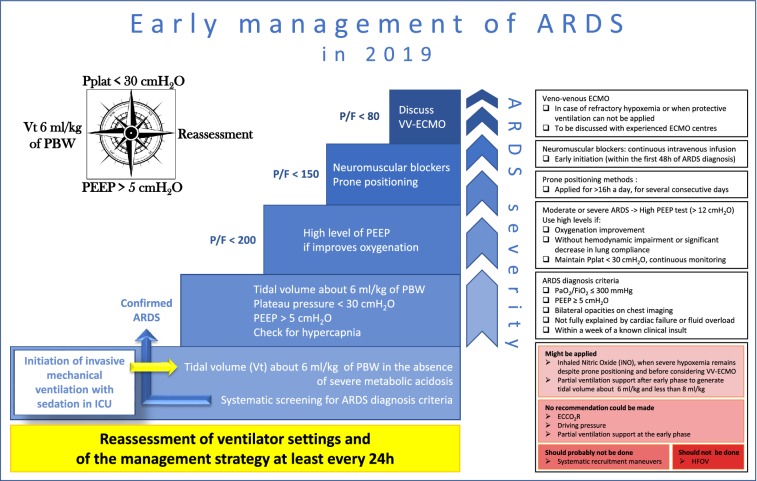
Fifteen recommendations and a therapeutic algorithm regarding the management of acute respiratory distress syndrome (ARDS) at the early phase in adults are proposed. The Grade of Recommendation Assessment, Development and Evaluation (GRADE) methodology has been followed. Four recommendations (low tidal volume, plateau pressure limitation, no oscillatory ventilation, and prone position) had a high level of proof (GRADE 1 + or 1 -); four (high positive end-expiratory pressure [PEEP] in moderate and severe ARDS, muscle relaxants, recruitment maneuvers, and venovenous extracorporeal membrane oxygenation [ECMO]) a low level of proof (GRADE 2 + or 2 -); seven (surveillance, tidal volume for non ARDS mechanically ventilated patients, tidal volume limitation in the presence of low plateau pressure, PEEP > 5 cmH2O, high PEEP in the absence of deleterious effect, pressure mode allowing spontaneous ventilation after the acute phase, and nitric oxide) corresponded to a level of proof that did not allow use of the GRADE classification and were expert opinions. Lastly, for three aspects of ARDS management (driving pressure, early spontaneous ventilation, and extracorporeal carbon dioxide removal), the experts concluded that no sound recommendation was possible given current knowledge. The recommendations and the therapeutic algorithm were approved by the experts with strong agreement.
Overview
The claims and statistics of this paper haven’t been checked yet.
Free: it reads the open-access text and checks the first 5 claims that cite a source we can check. Create a free account to check every claim.
Integrity signals
Registry
Cites
Statistics
Figures
Verification
Claims the paper makes
The claims and statistics of this paper haven’t been checked yet.
Free: it reads the open-access text and checks the first 5 claims that cite a source we can check. Create a free account to check every claim.
Claims other papers make about this one
Each is checked against this paper’s own text: does it say what the citing paper says it does?
In the citing paper
“A recent systematic review which included five RCTs also identified a strong relationship between plateau pressure and mortality [434].”
From Surviving sepsis campaign: international guidelines for management of sepsis and septic shock 2021 (2021) · cites this paper as [434]
Self-check
Percentages, sums and reported differences re-computed from the paper’s own numbers.
The self-check needs the paper’s full text.
Citations
Cites
(2000) · New England Journal of Medicine · doi:10.1056/nejm200005043421801 · Cited by 12,941
Chen, Y., Wang, L., Kang, Q., Zhang, X., Yu, G., Wan, X., Wang, J., & Zhu, K. (2017) · Cellular Physiology and Biochemistry · doi:10.1159/000477308 · Cited by 10,679
Acute Respiratory Distress Syndrome: The Berlin Definition
(2012) · JAMA · doi:10.1001/jama.2012.5669 · Cited by 8,731
Bellani, G., Laffey, J. G., Pham, T., Fan, E., Brochard, L., Esteban, A., Gattinoni, L., van Haren, F., Larsson, A., McAuley, D. F., et al. (2016) · JAMA · doi:10.1001/jama.2016.0291 · Cited by 5,766 · cited 10×
“Plateau pressure was measured in only 40% of ARDS patients [2].”
BackgroundMethodInfluentialSelf-citationProne positioning in severe acute respiratory distress syndrome.
Guérin, C., Reignier, J., Richard, J.-C., Beuret, P., Gacouin, A., Boulain, T., Mercier, E., Badet, M., Mercat, A., Baudin, O., et al. (2013) · New England Journal of Medicine · doi:10.1056/nejmoa1214103 · Cited by 4,040
Self-citationEffect of a protective-ventilation strategy on mortality in the acute respiratory distress syndrome.
Amato, M. B. P., Barbas, C. S. V., Medeiros, D. M., Magaldi, R. B., Schettino, G. P., Lorenzi-Filho, G., Kairalla, R. A., Deheinzelin, D., Munoz, C., Oliveira, R., et al. (1998) · New England Journal of Medicine · doi:10.1056/nejm199802053380602 · Cited by 3,654
Peek, G. J., Mugford, M., Tiruvoipati, R., Wilson, A., Allen, E., Thalanany, M. M., Hibbert, C. L., Truesdale, A., Clemens, F., Cooper, N., et al. (2009) · The Lancet · doi:10.1016/s0140-6736(09)61069-2 · Cited by 3,395
Functional Disability 5 Years after Acute Respiratory Distress Syndrome
Herridge, M. S., Tansey, C. M., Matté, A., Tomlinson, G., Diaz-Granados, N., Cooper, A., Guest, C. B., Mazer, C. D., Mehta, S., Stewart, T. E., et al. (2011) · New England Journal of Medicine · doi:10.1056/nejmoa1011802 · Cited by 2,847
Driving pressure and survival in the acute respiratory distress syndrome.
Amato, M. B. P., Meade, M. O., Slutsky, A. S., Brochard, L., Costa, E. L. V., Schoenfeld, D. A., Stewart, T. E., Briel, M., Talmor, D., Mercat, A., et al. (2015) · New England Journal of Medicine · doi:10.1056/nejmsa1410639 · Cited by 2,801
Self-citation(2004) · New England Journal of Medicine · doi:10.1056/nejmoa032193 · Cited by 2,565
Research works printed but not linked: 1
- Cavalcanti AB Suzumura EA Laranjeira LN Paisani DM Damiani LP Guimaraes HP Effect of lung recruitment and titrated positive end-expiratory pressure (PEEP) vs low PEEP on mortality in patients with acute respiratory distress syndrome: a randomized clinical trial JAMA 2017 318 14 1335 1345 10.1001/jama.2017.14171 28973363 PMC5710484 · DOI · Paper page
Cited by
Items 701–761 of 761
Rezoagli, E., McNicholas, B. A., Madotto, F., Pham, T. O., Bellani, G., & Laffey, J. G. (2022) · Figshare · doi:10.6084/m9.figshare.19808913
Regli, A., Ahmadi‐Noorbakhsh, S., Musk, G. C., Reese, D. J., Herrmann, P., Firth, M. J., & Pillow, J. J. (2021) · Figshare · doi:10.6084/m9.figshare.16735684
Villa, G., Romagnoli, S., De Rosa, S., Greco, M., Resta, M. V., Pomarè Montin, D., Prato, F., Patera, F., Ferrari, F., Rotondo, G., et al. (2020) · Figshare · doi:10.6084/m9.figshare.13083329
Saccheri, C., Morand, L., Juston, M., Doyen, D., Hyvernat, H., Lombardi, R., Devanlay, R., Panicucci, É., Dellamonica, J., & Jozwiak, M. (2023) · Figshare · doi:10.6084/m9.figshare.22602676
Additional file 1 of Duration of prone position sessions: a prospective cohort study
Jochmans, S., Mazerand, S., Chelly, J., Pourcine, F., Sy, O., Thieulot-Rolin, N., Ellrodt, O., Rochettes, E. M. D., Michaud, G., Serbource‐Goguel, J., et al. (2020) · Figshare · doi:10.6084/m9.figshare.12365243
Richard, J., Yonis, H., Bitker, L., Roche, S., Wallet, F., Dupuis, C., Serrier, H., Argaud, L., Thiéry, G., Delannoy, B., et al. (2021) · Figshare · doi:10.6084/m9.figshare.16786747
Self-citationCharbit, J., Courvalin, E., Dagod, G., Deras, P., Laumon, T., Girard, M., Maury, C., Weber, H., & Capdevila, X. (2022) · Figshare · doi:10.6084/m9.figshare.19445377
Tseng, H.-Y., Chen, C.-L., Lin, Y.-C., Chuang, M.-C., Hsu, W.-H., Hsiao, W.-Y., Chen, T.-M., Wang, M.-T., Huang, W.-C., Chen, C., et al. (2022) · Figshare · doi:10.6084/m9.figshare.20545711
Ibarra-Estrada, M. Á., Li, J., Pavlov, I., Perez, Y., Roca, O., Tavernier, E., McNicholas, B., Vines, D. L., Marín-Rosales, M., Vargas-Obieta, A., et al. (2022) · Figshare · doi:10.6084/m9.figshare.19445944
Richard, J., Yonis, H., Bitker, L., Roche, S., Wallet, F., Dupuis, C., Serrier, H., Argaud, L., Thiéry, G., Delannoy, B., et al. (2021) · Figshare · doi:10.6084/m9.figshare.16786741
Self-citationRazazi, K., Arrestier, R., Haudebourg, A. F., Benelli, B., Carteaux, G., Decousser, J., Fourati, S., Woerther, P., Schlemmer, F., Charles‐Nelson, A., et al. (2020) · Figshare · doi:10.6084/m9.figshare.13466983
Nasa, P., Azoulay, É., Khanna, A. K., Jain, R., Gupta, S., Javeri, Y., Juneja, D., Rangappa, P., Sundararajan, K., Alhazzani, W. A., et al. (2021) · Figshare · doi:10.6084/m9.figshare.14228486
Self-citationBagate, F., Tuffet, S., Masi, P., Perier, F., Razazi, K., de Prost, N., Carteaux, G., Payen, D. M., & Dessap, A. M. (2020) · Figshare · doi:10.6084/m9.figshare.13191973
Richard, J., Yonis, H., Bitker, L., Roche, S., Wallet, F., Dupuis, C., Serrier, H., Argaud, L., Thiéry, G., Delannoy, B., et al. (2021) · Figshare · doi:10.6084/m9.figshare.16786750
Self-citationPellegrini, M., Larina, A., Mourtos, E., Frithiof, R., Lipcsey, M., Hultström, M., Segelsjö, M., Hansen, T., & Perchiazzi, G. (2021) · Figshare · doi:10.6084/m9.figshare.15110056
Richard, J., Yonis, H., Bitker, L., Roche, S., Wallet, F., Dupuis, C., Serrier, H., Argaud, L., Thiéry, G., Delannoy, B., et al. (2021) · Figshare · doi:10.6084/m9.figshare.16786732
Self-citationTerrier, C. L., Sigaud, F., Lebbah, S., Desmedt, L. K. C., Hajage, D., Guérin, C., Pugin, J., Primmaz, S., & Terzi, N. (2022) · Figshare · doi:10.6084/m9.figshare.19418325
Self-citationWalter, T., Zucman, N., Mullaert, J., Thiry, I., Gernez, C., Roux, D., & Ricard, J.-D. (2022) · Figshare · doi:10.6084/m9.figshare.20278937
Self-citationNasa, P., Azoulay, É., Khanna, A. K., Jain, R., Gupta, S., Javeri, Y., Juneja, D., Rangappa, P., Sundararajan, K., Alhazzani, W. A., et al. (2021) · Figshare · doi:10.6084/m9.figshare.14228471
Self-citationRazazi, K., Arrestier, R., Haudebourg, A. F., Benelli, B., Carteaux, G., Decousser, J., Fourati, S., Woerther, P., Schlemmer, F., Charles‐Nelson, A., et al. (2020) · Figshare · doi:10.6084/m9.figshare.13466991
Richard, J., Yonis, H., Bitker, L., Roche, S., Wallet, F., Dupuis, C., Serrier, H., Argaud, L., Thiéry, G., Delannoy, B., et al. (2021) · Figshare · doi:10.6084/m9.figshare.16786756
Self-citationLee, H.-J., Kim, J., Choi, M., Choi, W.-I., Joh, J., Park, J., & Kim, J. (2022) · Figshare · doi:10.6084/m9.figshare.21501228
Bagate, F., Tuffet, S., Masi, P., Perier, F., Razazi, K., de Prost, N., Carteaux, G., Payen, D. M., & Dessap, A. M. (2020) · Figshare · doi:10.6084/m9.figshare.13191976
Richard, J., Yonis, H., Bitker, L., Roche, S., Wallet, F., Dupuis, C., Serrier, H., Argaud, L., Thiéry, G., Delannoy, B., et al. (2021) · Figshare · doi:10.6084/m9.figshare.16786738
Self-citationBagate, F., Tuffet, S., Masi, P., Perier, F., Razazi, K., de Prost, N., Carteaux, G., Payen, D. M., & Dessap, A. M. (2020) · Figshare · doi:10.6084/m9.figshare.13191979
Richard, J., Yonis, H., Bitker, L., Roche, S., Wallet, F., Dupuis, C., Serrier, H., Argaud, L., Thiéry, G., Delannoy, B., et al. (2021) · Figshare · doi:10.6084/m9.figshare.16786735
Self-citationZhou, Y., Cheng, J., Zhu, S., Dong, M., Lv, Y., Jing, X., & Kang, Y. (2024) · Figshare · doi:10.6084/m9.figshare.25893774
Vastrad, B. M., Pattanashetti, S., & Vastrad, C. M. (2026) · Research Square · doi:10.21203/rs.3.rs-8461507/v1
Acute respiratory distress syndrome in the pediatric patient
Reyes, S., Abril-Molina, A., Montero-Yéboles, R., & Alapont, V. M. I. (2026) · Medicina Intensiva (English Edition) · doi:10.1016/j.medine.2025.502350 · Cited by 3
Zhang, X., & Chen, H. (2026) · Systematic Reviews · doi:10.1186/s13643-026-03115-y
“Current management primarily relies on supportive measures, including lung-protective ventilation with low tidal volumes, appropriate positive end-expiratory pressure (PEEP) levels, limitation of plateau pressure ( 30 cmH ₂ O), prone positioning, and conservative fluid management strategies [4, 5].”
Xu, L., Xie, L., & Wang, H. (2026) · Frontiers in Physiology · doi:10.3389/fphys.2026.1739744 · Cited by 1
Aspects techniques et pratiques de la ventilation mécanique
Delemazure, J. (2026) · Encyclopédie médico-chirurgicale. Pneumologie · doi:10.1016/s1155-195x(25)47766-4
Sherrin, S., Kaur, J., Taneja, V., Mustafa, W., Garg, K. A., & Kunal, K. (2026) · Cureus · doi:10.7759/cureus.105631
Garza, F. P., Gamir, C. S., del Pino, C. S., & Poveda, M. L. (2025) · Conocimiento Enfermero · doi:10.60108/ce.376
Esin, A., Utku, T., Demirkıran, O., Ürkmez, S., & Dikmen, Y. (2026) · Phoenix Medical Journal · doi:10.38175/phnx.1749197
Schaible, T. (2026) · IntechOpen eBooks · doi:10.5772/intechopen.1014849
Giménez, M. L., Steinberg, E., & Garegnani, L. (2026) · medRxiv · doi:10.64898/2026.04.30.26352166
Morton, S., Irwin, A., Kissel, K. A., Jewers, D., Dhillon, P. P., Morrissey, J., Loroff, N., Knight, G., Cashen, D., Zuege, D. J., et al. (2026) · Canadian Journal of Anesthesia/Journal canadien d anesthésie · doi:10.1007/s12630-026-03127-1
Xue, Y., Chen, S.-X., Chen, G.-R., Lin, W., Yu, X.-F., Lin, H., & Chen, R. (2026) · Frontiers in Medicine · doi:10.3389/fmed.2026.1758229
The Impact of Patient Positioning on the Compromised Respiratory System
Harris, B., Oeckler, R. A., Collino, F., Thapa, S., Narenda, D. P., & Cortes-Puentes, G. A. (2026) · Respiratory Care · doi:10.1177/19433654261454953
Uguet, J., Vacheron, C., Bonnet, M., Caillet, A., Bertreau, E., de Marignan, D., Fort, R., Gerbaud-Coulas, C., Iordache, A., Izaute, G., et al. (2026) · Journal of Intensive Care · doi:10.1186/s40560-026-00895-2
“To mitigate these harmful effects, various ventilatory adjustments have been proposed, such as transiently increasing FiO 2 , maintaining or adapting PEEP, and modifying the ventilator mode; however, no clear consensus has emerged on the optimal parameters to use during the procedure [13, 14].”
Hussein, A. A. R. M., Mahmoud, S. A., Abdelnasser, M. G., Ahmed, M. G., & Hashem, S. (2026) · Egyptian Journal of Bronchology · doi:10.1186/s43168-026-00617-0
“Prone positioning is standard care for intubated patients with moderate to severe acute respiratory distress syndrome (ARDS), offering the physiological benefits of improving lung heterogeneity and aeration, which ultimately lead to improved survival [1].”
Puchongmart, C., Shotelersuk, V., Sivakumar, N., Sodsri, T., Thiravetyan, B., Bueso, A., Singh, T., & NUGENT, K. M. (2026) · The American Journal of the Medical Sciences · doi:10.1016/j.amjms.2026.07.013
Ventilación mecánica invasiva en COVID-19
Hernández‐Cardenas, C. M., Nicolás-Martínez, E. L., Lugo-Goytia, G., Balam-Lara, I., Osuna‐Padilla, I. A., Emeterio-Alcázar, J. G., Cadeza‐Aguilar, J. D., Arroyo-Hernández, L. J., & Rodríguez‐Llamazares, S. (2026) · NCT Neumología y Cirugía de Tórax · doi:10.24875/nct.m26000063
Lellouche, F., Brochard, L. J., Ricard, J.-D., Goodfellow, L. T., & Branson, R. D. (2026) · CHEST Critical Care · doi:10.1016/j.chstcc.2026.100306
Self-citationVentilation assistée contrôlée en volume
Beloncle, F. (2025) · Elsevier eBooks · doi:10.1016/b978-2-294-78737-9.00008-1
Syndrome de détresse respiratoire aiguë
Demoule, A., Beduneau, G., Coudroy, R., Carteaux, G., Frat, J., Piquilloud, L., Beloncle, F., Roch, A., Assouline, B., Bitker, L., et al. (2025) · Elsevier eBooks · doi:10.1016/b978-2-294-78737-9.00028-7
Self-citationAlbertse, J., Coetzee, I., & Lubbe, I. (2026) · Trends in Nursing · doi:10.4102/tin.v6i1.40
Abbas, H., & Ahmed, A. (2026) · Springer eBooks · doi:10.1007/978-3-032-28643-7_2
Wang, Z., Cao, L., Zhao, Z., Zhao, M., Lu, Y., Zhu, Y., Xie, W., Li, P., Liu, S., Li, X., et al. (2026) · Materials Today Bio · doi:10.1016/j.mtbio.2026.103583
“First-line interventions, encompassing corticosteroids, anti-inflammatory agents, and antioxidants such as N-acetylcysteine (NAC) [4], have shown modest therapeutic benefits while frequently eliciting considerable adverse effects [5].”
Feasibility of Prone Positioning in Patients With Obesity and Acute Respiratory Distress Syndrome
Lee, C., Paxitzis, A., Mehkri, O., Kokoczka, L. M., Huang, S., Wang, X., Giovanni, S. P., Mireles‐Cabodevila, E., Krishnan, S., & Duggal, A. (2026) · American Journal of Critical Care · doi:10.4037/ajcc2026929
Gupta, A., Mittal, S., & Khatri, V. (2026) · Indian Journal of ECMO · doi:10.5005/jaypee-journals-11011-0104
Prone Positioning: Turning Hypoxia Around
Kramer, D., & Hilton, R. (2026) · Springer eBooks · doi:10.1007/978-3-032-18934-9_28
Volatile anesthetic sedation in acute respiratory distress syndrome
O’Gara, B., Boncyk, C. S., Müller-Wirtz, L. M., Molano-Franco, D., Kotani, Y., Landoni, G., Jerath, A., L’Her, E., Bellgardt, M., Becher, T., et al. (2026) · Intensive Care Medicine · doi:10.1007/s00134-026-08613-0
Xu, Z., Liang, Y., Zhou, Y., Xue, Y., Liu, Y., Chen, H., & Chen, Y. (2026) · Respiratory Medicine · doi:10.1016/j.rmed.2026.109201
Mechanical ventilation in acute brain injury
Ratibondi, L., Newcombe, V., & Samanta, R. J. (2026) · Breathe · doi:10.1183/20734735.0340-2025
“However, their role in brain injury patients remains contentious (figure 2) [4].”
Eraky, A. M., Chazhikattu, A., Crum, J. M., & Simmons, J. (2026) · Medical Sciences · doi:10.3390/medsci14060694
“This ‘right ventricle-protective’ strategy includes limiting plateau and, in particular, driving pressures; individualized PEEP to balance alveolar recruitment against overdistension; avoiding severe hypoxemia and hypercapnic acidosis; and early prone positioning [91,93,96,97].”
InfluentialMechanical ventilation in COVID-19
Hernández‐Cardenas, C. M., Nicolás-Martínez, E. L., Lugo-Goytia, G., Balam-Lara, I., Osuna‐Padilla, I. A., Emeterio-Alcázar, J. G., Cadeza‐Aguilar, J. D., Arroyo-Hernández, L. J., & Rodríguez‐Llamazares, S. (2026) · NCT Neumología y Cirugía de Tórax (English Edition) · doi:10.24875/ncte.m26000035
Metadata
- Authors
- Papazian, L., Aubron, C., Brochard, L., Chiche, J.-D., Combes, A., Dreyfuss, D., Forel, J.-M., Guérin, C., Jaber, S., Mekontso-Dessap, A., Mercat, A., Richard, J.-C., Roux, D., Vieillard-Baron, A., & Faure, H.
- Affiliations
- Assistance Publique Hôpitaux de Marseille (FR)
- Centre Hospitalier Régional Universitaire de Brest (FR)
- University of Toronto (CA)
- Hôpital Cochin (FR)
- Assistance Publique – Hôpitaux de Paris (FR)
- Hôpital Louis-Mourier (FR)
- Hôpital de la Croix-Rousse (FR)
- Inserm (FR)
- Centre Hospitalier Universitaire d'Angers (FR)
- Centre de Recherche en Acquisition et Traitement de l'Image pour la Santé (FR)
- Centre hospitalier Robert-Ballanger (FR)
- Corresponding author
- Papazian, Laurent
- ORCID
- Venue
- Annals of Intensive Care
- Publisher
- Elsevier BV
- Published
- 2019
- Volume
- 9
- Issue
- 1
- Pages
- 69
- ISSN
- 2110-5820 (ISSN-L)
- PMC
- PMC6565761
- OpenAlex
- W2953390211
- Cited by
- 761
- References
- 146
- Citations by year
- 2026: 33 · 2025: 60 · 2024: 86 · 2023: 128 · 2022: 159 · 2021: 152 · 2020: 131 · 2019: 12
- FWCI
- 19.11
- Type
- journal article
- Language
- en
- Open access
- gold
- doi.org
- Licence
- cc-by
- www.elsevier.com/tdm/userlicense/1.0/ (tdm)
- www.elsevier.com/legal/tdmrep-license (tdm)
- creativecommons.org/licenses/by-nc-nd/4.0/ (vor, 2514 d)
- Locations
- Annals of Intensive Care (publishedVersion, cc-by)
- PubMed Central (publishedVersion, cc-by)
- PubMed (publishedVersion)
- TSpace (University of Toronto) (submittedVersion, cc-by)
- HAL (submittedVersion, other-oa)
- DOAJ (DOAJ: Directory of Open Access Journals) (submittedVersion, cc-by-sa)
- Funders
- Société de Réanimation de Langue Française
- Topics
- Health Sciences › Medicine › Pulmonary and Respiratory Medicine › Respiratory Support and Mechanisms
- Health Sciences › Medicine › Pulmonary and Respiratory Medicine › Neonatal Respiratory Health Research
- Health Sciences › Medicine › Anesthesiology and Pain Medicine › Airway Management and Intubation Techniques
- Keywords
- acute respiratory distress syndrome, mechanical ventilation, low tidal volume ventilation, plateau pressure, positive end-expiratory pressure, prone positioning, oscillatory ventilation, muscle relaxants, recruitment maneuvers, veno-venous extracorporeal membrane oxygenation, nitric oxide, driving pressure, spontaneous breathing, extracorporeal carbon dioxide removal, treatment algorithm
About these checks
Registry, retraction, Cites and statistics results are computed, not judged, with one exception: a printed reference that no index lists is read once by a model before it counts as a citation error. Claims are extracted by a model and kept only when their quote appears verbatim in the text; each cited source is then checked, with a model’s help, for whether it says what the claim relies on. Those verdicts can be wrong — read the claim’s quote and the cited source before relying on one.
Statistics and arithmetic are recomputed, not judged.
Confidence bands are shown only for fields calibrated on our annotated test set. None is calibrated yet, so no band is shown.
What counts as a claim ›How we measure confidence ›How we check this ›
Are you an author, or do you see a problem with this page? Request a review
Data sources
Bibliographic data: Semantic Scholar, OpenAlex, Crossref.
Contains information from the Semantic Scholar Academic Graph Datasets, made available under the ODC Attribution License (ODC-BY 1.0).
Semantic Scholar’s data is described in: Kinney, R., et al. (2023). The Semantic Scholar Open Data Platform. arXiv:2301.10140.
