

Formal guidelines: Management of acute respiratory distress syndrome.
Open accessThe DOI matches its Crossref record; 146 of the 146 references it cites were found in a registry or an index.
Abstract
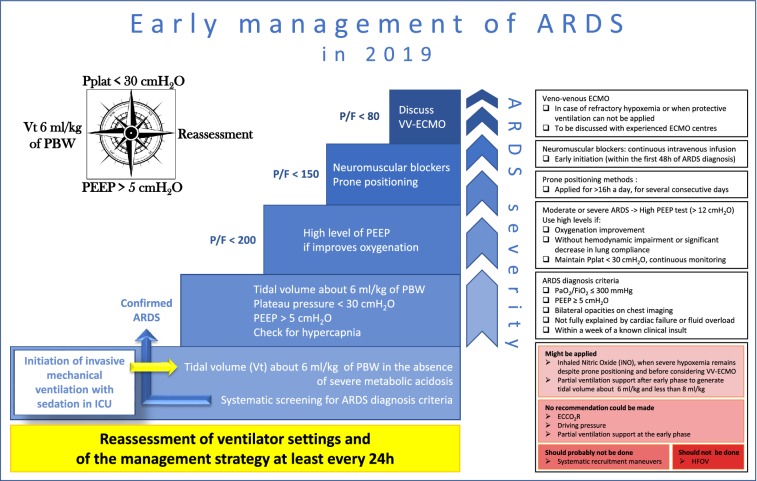
Fifteen recommendations and a therapeutic algorithm regarding the management of acute respiratory distress syndrome (ARDS) at the early phase in adults are proposed. The Grade of Recommendation Assessment, Development and Evaluation (GRADE) methodology has been followed. Four recommendations (low tidal volume, plateau pressure limitation, no oscillatory ventilation, and prone position) had a high level of proof (GRADE 1 + or 1 -); four (high positive end-expiratory pressure [PEEP] in moderate and severe ARDS, muscle relaxants, recruitment maneuvers, and venovenous extracorporeal membrane oxygenation [ECMO]) a low level of proof (GRADE 2 + or 2 -); seven (surveillance, tidal volume for non ARDS mechanically ventilated patients, tidal volume limitation in the presence of low plateau pressure, PEEP > 5 cmH2O, high PEEP in the absence of deleterious effect, pressure mode allowing spontaneous ventilation after the acute phase, and nitric oxide) corresponded to a level of proof that did not allow use of the GRADE classification and were expert opinions. Lastly, for three aspects of ARDS management (driving pressure, early spontaneous ventilation, and extracorporeal carbon dioxide removal), the experts concluded that no sound recommendation was possible given current knowledge. The recommendations and the therapeutic algorithm were approved by the experts with strong agreement.
Overview
The claims and statistics of this paper haven’t been checked yet.
Free: it reads the open-access text and checks the first 5 claims that cite a source we can check. Create a free account to check every claim.
Integrity signals
Registry
Cites
Statistics
Figures
Verification
Claims the paper makes
The claims and statistics of this paper haven’t been checked yet.
Free: it reads the open-access text and checks the first 5 claims that cite a source we can check. Create a free account to check every claim.
Claims other papers make about this one
Each is checked against this paper’s own text: does it say what the citing paper says it does?
In the citing paper
“A recent systematic review which included five RCTs also identified a strong relationship between plateau pressure and mortality [434].”
From Surviving sepsis campaign: international guidelines for management of sepsis and septic shock 2021 (2021) · cites this paper as [434]
Self-check
Percentages, sums and reported differences re-computed from the paper’s own numbers.
The self-check needs the paper’s full text.
Citations
Cites
(2000) · New England Journal of Medicine · doi:10.1056/nejm200005043421801 · Cited by 12,941
Chen, Y., Wang, L., Kang, Q., Zhang, X., Yu, G., Wan, X., Wang, J., & Zhu, K. (2017) · Cellular Physiology and Biochemistry · doi:10.1159/000477308 · Cited by 10,679
Acute Respiratory Distress Syndrome: The Berlin Definition
(2012) · JAMA · doi:10.1001/jama.2012.5669 · Cited by 8,731
Bellani, G., Laffey, J. G., Pham, T., Fan, E., Brochard, L., Esteban, A., Gattinoni, L., van Haren, F., Larsson, A., McAuley, D. F., et al. (2016) · JAMA · doi:10.1001/jama.2016.0291 · Cited by 5,766 · cited 10×
“Plateau pressure was measured in only 40% of ARDS patients [2].”
BackgroundMethodInfluentialSelf-citationProne positioning in severe acute respiratory distress syndrome.
Guérin, C., Reignier, J., Richard, J.-C., Beuret, P., Gacouin, A., Boulain, T., Mercier, E., Badet, M., Mercat, A., Baudin, O., et al. (2013) · New England Journal of Medicine · doi:10.1056/nejmoa1214103 · Cited by 4,040
Self-citationEffect of a protective-ventilation strategy on mortality in the acute respiratory distress syndrome.
Amato, M. B. P., Barbas, C. S. V., Medeiros, D. M., Magaldi, R. B., Schettino, G. P., Lorenzi-Filho, G., Kairalla, R. A., Deheinzelin, D., Munoz, C., Oliveira, R., et al. (1998) · New England Journal of Medicine · doi:10.1056/nejm199802053380602 · Cited by 3,654
Peek, G. J., Mugford, M., Tiruvoipati, R., Wilson, A., Allen, E., Thalanany, M. M., Hibbert, C. L., Truesdale, A., Clemens, F., Cooper, N., et al. (2009) · The Lancet · doi:10.1016/s0140-6736(09)61069-2 · Cited by 3,395
Functional Disability 5 Years after Acute Respiratory Distress Syndrome
Herridge, M. S., Tansey, C. M., Matté, A., Tomlinson, G., Diaz-Granados, N., Cooper, A., Guest, C. B., Mazer, C. D., Mehta, S., Stewart, T. E., et al. (2011) · New England Journal of Medicine · doi:10.1056/nejmoa1011802 · Cited by 2,847
Driving pressure and survival in the acute respiratory distress syndrome.
Amato, M. B. P., Meade, M. O., Slutsky, A. S., Brochard, L., Costa, E. L. V., Schoenfeld, D. A., Stewart, T. E., Briel, M., Talmor, D., Mercat, A., et al. (2015) · New England Journal of Medicine · doi:10.1056/nejmsa1410639 · Cited by 2,801
Self-citation(2004) · New England Journal of Medicine · doi:10.1056/nejmoa032193 · Cited by 2,565
Research works printed but not linked: 1
- Cavalcanti AB Suzumura EA Laranjeira LN Paisani DM Damiani LP Guimaraes HP Effect of lung recruitment and titrated positive end-expiratory pressure (PEEP) vs low PEEP on mortality in patients with acute respiratory distress syndrome: a randomized clinical trial JAMA 2017 318 14 1335 1345 10.1001/jama.2017.14171 28973363 PMC5710484 · DOI · Paper page
Cited by
Items 501–600 of 761
Gonzalez, J., Ching, C. V., Ortiz, P., Buxó, M., & Sirvent, J. M. (2021) · Revista Médica de Trujillo · doi:10.17268/rmt.2020.v16i01.07 · Cited by 1
Covid-19-related vs Covid-19-unrelated Acute Respiratory Distress Syndrome - Key Differences
Maheshwarappa, H. M., Chakraborty, M., Joseph, A. T. J., Chacko, S. P., & Ramya, B. M. (2021) · Indian Journal of Respiratory Care · doi:10.4103/ijrc.ijrc_106_20 · Cited by 1
Diagnostic et traitement du syndrome de détresse respiratoire aiguë
Fernando, S. M., Ferreyro, B. L., Urner, M., Munshi, L., & Fan, E. (2021) · Canadian Medical Association Journal · doi:10.1503/cmaj.202661-f · Cited by 7
Ahmed, I. A., Grifith, C., Lipshutz, S., Weinstein, D., & Hallur, R. (2021) · Cureus · doi:10.7759/cureus.16766 · Cited by 1
How Medical Conditions Affect the Weaning of Mechanical Ventilation
Wawrzeniak, I. C., Moura, K. B. D. A., & Pacheco, E. C. (2021) · IntechOpen eBooks · doi:10.5772/intechopen.100332 · Cited by 1
Voicu, S., Lacoste-Palasset, T., Malissin, I., Bekhit, S., Cauchois, E., Dahmani, S., Saib, M., Grant, C., Naïm, G., M’Rad, A., et al. (2021) · Journal of Personalized Medicine · doi:10.3390/jpm11121359 · Cited by 1
Mendes, J. J., Paiva, J. A., Gonzalez, F. A., Mergulhão, P., Froes, F., Roncon, R., & Gouveia, J. (2021) · PubMed Central · doi:10.5935/0103-507x.0103-507x-rbti-20210080 · Cited by 9
“The recommendations made are based on international recommendations(145) for typical ARDS (not associated with COVID-19), which systematically reduces morbidity and mortality in this population: a classic ventilation strategy based on the ARDS Network protocol (tidal volume of 4 - 6mL/kg of ideal body weight with a li…”
MethodMembrana de circulación extracorpórea en enfermedad por coronavirus (COVID-19)
Bisso, I. C., Garbarini, M., Lockhart, C., Villarroel, S. D., Chas, J. G., Kotowicz, V., Román, E. S., & Heras, M. L. (2022) · Revista de la Facultad de Ciencias Médicas de Córdoba · doi:10.31053/1853.0605.v79.n1.29337 · Cited by 1
“Se aplicaron dos ciclos de ventilación en decúbito prono sin alcanzar una mejoría significativa de la oxigenación, por lo que se decidió su canulación((9,10)), con mejoría del estado clínico y buena evolución.”
BackgroundNguyen, M., Kabbout, V., Berthoud, V., Gounot, I., Dransart-Raye, O., Douguet, C., Bouchot, O., Morgant, M., Bouhemad, B., & Guinot, P. (2022) · Canadian Journal of Anesthesia/Journal canadien d anesthésie · doi:10.1007/s12630-022-02259-4 · Cited by 1
“5, 18 Finally, the observed improvement in survival rates may be linked to enhanced management of patients under vvECMO (improved respiratory management and/or improved vvECMO management).”
Continuously protracted infusion of cisatracurium besilate in patients with ARDS
Yuan, Z., Pan, L., Wang, Y., & Wang, W. (2022) · Annals of Medicine and Surgery · doi:10.1016/j.amsu.2022.103718 · Cited by 3
Guérin, C. (2022) · Springer eBooks · doi:10.1007/978-3-030-93401-9_29 · Cited by 1
Self-citationWhat Works in a Patient With Acute Respiratory Distress Syndrome?
Steinhorn, R., & Fitzsimons, M. G. (2022) · Elsevier eBooks · doi:10.1016/b978-0-323-77846-6.00055-0 · Cited by 1
The Effect of Inspiratory Effort on Circuit Compensation for Volume-Targeted Modes
Liu, P., & Chatburn, R. L. (2022) · Respiratory Care · doi:10.4187/respcare.09729 · Cited by 1
Prognostic value of the novel P/FPE index to classify ARDS severity: A cohort study
Martos-Benítez, F. D., Muguercia, R. E., Orama-Requejo, V., & del Toro-Simoni, T. (2022) · Medicina Intensiva (English Edition) · doi:10.1016/j.medine.2022.06.023 · Cited by 3
Hemodynamic and mechanical ventilation approach in patients with COVID-19
Carrillo-Esper, R., Pérez-Calatayud, Á. A., Zepeda, E. M., Briones‐Garduño, J. C., Díaz-Carrillo, A., Mejía-Gómez, L. J., Lomeli-Teran, M., Ayala-León, M., Carrillo-Esper, R., Zamora-Gómez, S., et al. (2026) · Cirugía y Cirujanos (English Edition) · doi:10.24875/cirue.m23000211 · Cited by 1
Impact of public health and social measures for COVID-19 control on infectious disease epidemiology
(2024) · Frontiers research topics · doi:10.3389/978-2-8325-4895-0 · Cited by 1
Extracorporeal Membrane Oxygenation and Inflammation in COVID-19
Supady, A., Bode, C., & Duerschmied, D. (2020) · ASAIO Journal · doi:10.1097/mat.0000000000001328 · Cited by 1
Neuromuscular Blocking Agents for ARDS: Incentive for Personalized Medicine
Torbic, H., Krishnan, S., & Duggal, A. (2021) · Respiratory Care · doi:10.4187/respcare.08963 · Cited by 1
The First Day in ARDS Care: Your First Steps Should Be Your Best
Mireles‐Cabodevila, E., Duggal, A., & Krishnan, S. (2021) · Respiratory Care · doi:10.4187/respcare.09495 · Cited by 1
“Guidance exists in the evidence that surrounds, and application of, these strategies, 10-12 yet the translation at the bedside remains challenging.”
Ding, H., Li, X., Liu, X., Wang, K.-R., Li, Y., Wen, M., & Zeng, H. (2019) · doi:10.21203/rs.2.17155/v1 · Cited by 1
Wang, Z., Zhou, Z., Zheng, J., Cong, Z., & Zhu, X. D. (2020) · Research Square · doi:10.21203/rs.3.rs-127680/v1 · Cited by 1
“Although ARDS treatments have been reviewed, [8,9] only one bibliometric analysis has examined the trends in topics, authors, and research institutions.”
BackgroundPost‐Transplant Phase: Issues in the Early Postoperative Period
Mackintosh, J. A., & Hopkins, P. M.-A. (2023) · Wiley eBooks · doi:10.1002/9781119633884.ch89 · Cited by 1
Papazian, L., Hraiech, S., Cazenave, L., & Forel, J.-M. (2019) · Anesthésie & Réanimation · doi:10.1016/j.anrea.2019.07.003
Self-citationvan Koppenhagen, L., & Vuylsteke, A. (2020) · Journal of Cardiothoracic and Vascular Anesthesia · doi:10.1053/j.jvca.2019.12.039
Álvarez, A. A., & Gómez, C. A. R. (2019) · Medicina Crítica · doi:10.35366/91603
Kurniawan, A., & Zulfariansyah, A. (2020) · Jurnal Neuroanestesi Indonesia · doi:10.24244/jni.v9i2.245 · Cited by 1
Chest Physiotherapy in COVID-19
Chandramouli, E. (2020) · Journal of Medical Science And clinical Research · doi:10.18535/jmscr/v8i7.96
Cosmetic Ventilators (Co-V) for COVID-19
Malani, A. S. (2020) · Indian Journal of Critical Care Medicine · doi:10.5005/jp-journals-10071-23436
The Way Forward in the Post-COVID WorldPreprint
Rothschild, D. M. (2020) · SSRN Electronic Journal · doi:10.2139/ssrn.3613999
“The low tidal volume, plateau pressure limitation, no oscillatory ventilation, and prone position have been evidenced as high proof [34] .”
BackgroundDistrés respiratorio en Covid-19: epidemiología, fisiopatología y su manejo ventilatorio
Piedrahita, M. A. D., Guaraca, F. A. S., & Calderón, E. J. M. (2020) · Mediciencias UTA (Impresa)/Mediciencias UTA (En línea) · doi:10.31243/mdc.uta.v4i4.376.2020
Singh, K., & Maurice, N. (2020) · Caribbean Medical Journal · doi:10.48107/cmj.2020.08.006
Wang, Z., Zhou, Z.-C., Zheng, J., Cong, Z., & Zhu, X. D. (2020) · Research Square · doi:10.21203/rs.3.rs-128479/v1
Bauchlage auch bei nicht intubierten Patienten mit Lungenversagen sinnvoll?
Budweiser, S. (2020) · Pneumo News · doi:10.1007/s15033-020-1930-2
“Neben der protektiven Beatmung mit niedrigen Tidalvolumina und Anwendung eines niedrigen Plateaudrucks wird die Bauchlage bei Patienten mit beatmungspflichtigen moderatem bis schwerem ARDS mit hohem Empfehlungsgrad versehen [1].”
BackgroundCurrent Methods of Treatment in Critical COVID-19 Patients
Balık, Y., & Ekinci, O. (2021) · Hamidiye Medical Journal · doi:10.4274/hamidiyemedj.galenos.2021.47966
ERS International Congress 2020: highlights from the Thoracic Surgery and Transplantation Assembly
Esendagli, D. R., Shah, U. B., Batıhan, G., Magouliotis, D. E., Meloni, F., Vos, R., Elia, S., & Hellemons, M. E. (2021) · ERJ Open Research · doi:10.1183/23120541.00743-2020
“patients with PaO2:FIO2 ratio <80mmHg [19].”
Prise en charge du traumatisme thoracique en 2020
Carrié, C., & Biais, M. (2021) · Anesthésie & Réanimation · doi:10.1016/j.anrea.2021.02.004
Mungan, İ., & Turan, S. (2020) · Iberoamerican Journal of Medicine · doi:10.53986/ibjm.2020.0013
Posición prona: cada día más común en paciente despierto hospitalizado por COVID-19
Villanueva-Valverde, F. (2021) · Revista Hispanoamericana de Ciencias de la Salud · doi:10.56239/rhcs.2020.64.456
Houck, E. L., Musulin, S. E., Vanetten, C. L., & Applegate, J. R. (2021) · Journal of the American Veterinary Medical Association · doi:10.2460/javma.258.11.1193
Medición del ratio reclutamiento/insuflación en pacientes con síndrome de distrés respiratorio agudo
Steinberg, E. (2021) · Argentinian Journal of Respiratory & Physical Therapy · doi:10.58172/ajrpt.v3i1.169
高, 春. (2021) · Advances in Clinical Medicine · doi:10.12677/acm.2021.116376
Aggressive alveolar recruitment in ARDS: More shadows than lights
Lomeli, M., Cenzano, L. D., Torres, L., Chavarría, U., Poblano, M., Tendillo, F. J., Blanch, L. L., & Mancebo, J. (2021) · Medicina Intensiva (English Edition) · doi:10.1016/j.medine.2021.06.003 · Cited by 2
Weaver, L., Bates, D. G., & Camporota, L. (2021) · medRxiv · doi:10.1101/2021.11.15.21266157
“Positive end expiratory pressure (PEEP) is routinely used as part of lung protective ventilation strategies in the treatment of acute respiratory distress syndrome (ARDS), [1,2].”
BackgroundAn ARDS Severity Recognition Model based on XGBoost
Zhang, H., Ding, R., Zhang, Q., Fang, M., Zhang, G., & Yu, N. (2021) · Journal of Physics Conference Series · doi:10.1088/1742-6596/2138/1/012009
“Studies have shown that in recent years, the hospital mortality rate of ARDS patients is as high as 45% [2, 3], and the mortality rate increases with its severity.”
BackgroundLarsen, R., & Mathes, A. (2021) · Springer eBooks · doi:10.1007/978-3-662-63440-0_15
Koçan, S., Kazancıoğlu, L., DEMİREL, Y., & Altınsoy, C. (2021) · Sakarya Medical Journal · doi:10.31832/smj.927439
Ge, H., Pan, Q., Zhou, Y., Qian, Y., Zhang, Z., Fang, L., Ning, G., & Heunks, L. M. A. (2022) · Research Square · doi:10.21203/rs.3.rs-1322548/v1
Surfactant Protein-D: The Potential ARDS Biomarker And Its Role In COVID-19
Agustama, A., Veterini, A. S., & Utariani, A. (2022) · International Journal Of Scientific Advances · doi:10.51542/ijscia.v3i1.10
“The Berlin criteria uses the PaO2/FiO2 ratio to differentiate mild ARDS (200 PaO2/FiO2≤300 mmHg), moderate ARDS (100 PaO2/FiO2≤200 mmHg), and severe ARDS (PaO2/FiO2 100 mmHg) (Papazian et al., 2019).”
MethodAşar, S. (2021) · Respiratory Care · doi:10.4187/respcare.08833
A year in review in Minerva Anestesiologica 2021. Critical care
CAVALIERE, F., BIANCOFIORE, G., BIGNAMI, E., ROBERTIS, E. D., GIANNINI, A., GRASSO, S., PIASTRA, M., SCOLLETTA, S., TACCONE, F. S., & Terragni, P. (2022) · Minerva Anestesiologica · doi:10.23736/s0375-9393.21.16409-0
Bullen, E. C., Teijeiro‐Paradis, R., & Fan, E. (2021) · CHEST Journal · doi:10.1016/j.chest.2020.12.025
Steinhorn, R., & Fitzsimons, M. G. (2022) · Springer eBooks · doi:10.1007/978-3-030-92750-9_39
Bahloul, M., Kharrat, S., Chtara, K., Chelly, H., Hamida, C. B., & Bouaziz, M. (2022) · Acute and Critical Care · doi:10.4266/acc.2022.00199
“According to formal guidelines [4], prone positioning is recommended for at least 16 consecutive hours in ARDS patients with a PaO2/FIO2 ratio < 150 mm Hg to reduce mortality (grade 1+).”
BackgroundMethodWeaver, L., Bates, D. G., & Camporota, L. (2022) · Annual update in intensive care and emergency medicine · doi:10.1007/978-3-030-93433-0_8
Persistent Critical Illness in Newborns
Golomidov, A. V., Grigoryev, E. V., Moses, V. G., & Мозес, К. Б. (2022) · Messenger of Anesthesiology and Resuscitation · doi:10.21292/2078-5658-2022-19-2-74-83
Mechanical ventilation: Past and present
Rialp, G. (2020) · Medicina Intensiva (English Edition) · doi:10.1016/j.medine.2020.08.004
Right-Ventricle Protective Ventilation
Bois, A., Géri, G., & Vieillard‐Baron, A. (2021) · Elsevier eBooks · doi:10.1016/b978-0-08-102723-3.00208-0
Self-citationDing, H., Li, X., Liu, X., Wang, K.-R., Li, Y., Wen, M., & Zeng, H. (2019) · Research Square · doi:10.21203/rs.2.19794/v1
“Acute respiratory distress syndrome (ARDS) is a common critical disease in intensive care units (ICUs)[1, 2].”
BackgroundThe efficiency of prone positioning in a COPD female patient with acute respiratory failure
Płaszewska‐Żywko, L., & Trybała, M. (2021) · Problemy Pielęgniarstwa · doi:10.5114/ppiel.2021.113791
“The prone position (PP) is now recommended for patients with severe or moderate-to-severe ARDS receiving invasive mechanical ventilation [2].”
Sung, P., Li, Y., & Yip, H. (2020) · Critical Care Medicine · doi:10.1097/ccm.0000000000004540
In-depth review of cardiopulmonary support in COVID-19 patients with heart failure
Raffaello, W. M., Huang, I., Siswanto, B. B., & Pranata, R. (2021) · World Journal of Cardiology · doi:10.4330/wjc.v13.i8.299
ICU tracheotomies in patients with COVID-19: a lesson learned for future viral pandemic
Gradys, A., Szrama, J., Nogal, P., Małgorzata, W., & Kusza, K. (2022) · European Archives of Oto-Rhino-Laryngology · doi:10.1007/s00405-022-07360-4
“Half [2] of the patients suffered from severe surgical site infection after the surgical tracheotomy and malpositioning of the tube requiring surgical handling, while in the percutaneous group only one minor stomal infection occurred and was treated with antibiotics alone.”
BackgroundCuanto menos no es más para todos
Solà, M. B., & Subirá, C. (2022) · Medicina Intensiva · doi:10.1016/j.medin.2022.06.001
Serrano, A. C., Calzada, A. S., Sánchez, J. S. A., Gutiérrez, R. C., & Hernández-Sánchez, N. (2022) · Medicina Crítica · doi:10.35366/105790
Two Venovenous Extracorporeal Membrane Oxygenation for One Gunshot
Pot, L., Porto, A., Saux, A. L., Bichon, A., Cauchois, E., Gainnier, M., Carvelli, J., & Bourenne, J. (2022) · Case Reports in Critical Care · doi:10.1155/2022/1070830 · Cited by 2
“Thus, the current therapeutic algorithm regarding the management of moderate and severe ARDS is not accurate for trauma patients, especially for those presenting brain or spinal injuries [8].”
BackgroundEuliano, N. R., Stephan, P., Michalopoulos, K., Gentile, M. A., Layon, A. J., & Gabrielli, A. (2022) · Medical Devices Evidence and Research · doi:10.2147/mder.s372333
“Lung-protective mechanical ventilation (LPV) is a strategy aiming to reduce the incidence of ventilator-induced lung injury.1–3 Perioperative use of LPV has also shown benefits in patients without preexisting lung impairment, suggesting a role in reducing pulmonary complications and length of stay.4,5 LPV focuses on r…”
Kömürcü, Ö., Dost, B., Unal, N., & Ülger, F. (2022) · Nigerian Journal of Clinical Practice · doi:10.4103/njcp.njcp_205_22
Gómez-González, M. N., Torres, V. G., Correa, C. J., & Carrillo, P. L. G. (2022) · International Journal of Medical Science and Clinical Research Studies · doi:10.47191/ijmscrs/v2-i8-19
Interventions to Optimize Survival and Recovery in Patients with ARDS
Tracy, M. F. (2022) · AACN Advanced Critical Care · doi:10.4037/aacnacc2022908
Prevalence, early predictors, and outcomes of ARDS in the neuro-ICU: a prospective cohort studyPreprint
Wang, R.-H., Lu, A., Li, H., Ma, Z., Wu, S., Lu, H., Huang, Y., Wang, L., & Yuan, F. (2022) · Research Square · doi:10.21203/rs.3.rs-2053575/v1
Air leaks in COVID-19 pneumonia
Kayhan, O., Demirkıran, O., Ürkmez, S., & Dikmen, Y. (2022) · Turkish Journal of Thoracic and Cardiovascular Surgery · doi:10.5606/tgkdc.dergisi.2022.20763
“These recommendations are to limit the plateau pressure to 30 cmH2O, the driving pressure to 15 cmH2O, and the tidal volume to 6 mL/kg (ideal body weight).[13] These limitations are also recommended for COVID-19 patients.”
BackgroundSecuring Endotracheal Tubes During Prone Positioning
Seckel, M. A., & Mitchell, D. A. (2022) · Critical Care Nurse · doi:10.4037/ccn2022354
Faisabilité et place du décubitus ventral chez le patient non intubé de réanimation
Ehrmann, S., Perez, Y., Pasquet, A., Thepenier, M., & Guervilly, C. (2022) · Médecine Intensive Réanimation · doi:10.37051/mir-00129
Solà, M. B., & Cuyàs, C. S. (2022) · Medicina Intensiva (English Edition) · doi:10.1016/j.medine.2022.06.021
Shortened Automatic Lung Recruitment Maneuvers in an In Vivo Model of Neonatal ARDS
Moreno, V. G., Gutiérrez-Martínez, A., Zueras, C. S., Santos-González, M., Romero, A., & Fernandez, F. (2022) · Respiratory Care · doi:10.4187/respcare.10438
Gerikienė, V., & Kazragytė, I. (2022) · Health Sciences · doi:10.35988/sm-hs.2022.264 · Cited by 1
“Ši padėtis ligos pradžioje gerina oksigenaciją, mažina su dirbtine plaučių ventiliacija susijusių komplikacijų skaičių, gerina pacientų išgyvenamumo ir mažina mirtingumo rodiklius [2,4,16-18].”
BackgroundAn Educational Video Demonstration of How to Prone a Critically Ill Intubated Patient
Houten, C. T. V., Carey, M. C., Lent, D., Panico, J., Casaverde, R., Cooper, K., DeRienzo, V. E., Easton, L. M., Lexer, N. L., & Snios, K. J. (2022) · Journal of Visualized Experiments · doi:10.3791/63797
Palliative Sedation Therapy: A Case Report
Willard, E. G., & Wiencek, C. A. (2022) · Critical Care Nurse · doi:10.4037/ccn2022377
Prone Position During Mechanical Ventilation
Pérez‐Nieto, O. R., Sánchez, C., & Zamarrón-López, E. I. (2022) · Springer eBooks · doi:10.1007/978-3-031-14138-6_12
The use of extracorporeal life support systems in patients with acute respiratory insufficiency
Belliato, M. (2023) · Research Publications (Maastricht University) · doi:10.26481/dis.20230119mb · Cited by 1
El neumomediastino como complicación de la neumonía por SARS-CoV-2
Zevallos-Villegas, A., Laorden, D., Cano-Sanz, E., Saiz-Lou, E. M., Hernández-Núñez, J., Tinedo, J. R. T., Ortega-Fraile, M. Á., Lorente-González, M., Suarez-Ortiz, M., Landete, P., et al. (2022) · Revista de Patología Respiratoria · doi:10.24875/rpr.22000015
History of Extracorporeal Life Support: From Cardiopulmonary Bypass Towards ECMO
Camboni, D., & Schmid, Ç. (2023) · Springer eBooks · doi:10.1007/978-3-031-20260-5_1
Application of Prone Position Ventilation in Clinical Treatment of Patients with COVID-19
Meng, W., Ying, C., & Kun, T. (2023) · Journal of Medical & Clinical Nursing · doi:10.47363/jmcn/2023(4)159
Escribano-Santana, I., Martínez‐Gimeno, M. L., & Herráiz-Bermejo, L. (2023) · Enfermería Intensiva (English ed ) · doi:10.1016/j.enfie.2022.05.001
Boonyasurak, S., Wongtirawit, N., & Tongyoo, S. (2023) · Journal of Critical and Intensive Care · doi:10.37678/dcybd.2023.3247
Hemodynamic Implications of Prone Positioning in Patients with ARDS
Lai, C., Monnet, X., & Teboul, J. (2023) · Annual update in intensive care and emergency medicine · doi:10.1007/978-3-031-23005-9_12
Impact of Humidification Strategy During Lung (and Heart)-Protective Ventilation
Lellouche, F. (2023) · Springer eBooks · doi:10.1007/978-3-031-23953-3_8
Research Progress and Future Prospects of the Awake Prone Positioning
周, 锡. (2023) · Nursing Science · doi:10.12677/ns.2023.122015
Silva, J. V., Peixoto, A. A., Reis, R., & Araújo, V. N. (2023) · Revista de Medicina da UFC · doi:10.20513/2447-6595.2023v63n1e43496p1-4
A REVIEW OF THE PRONE POSITION IN ACUTE RESPIRATORY FAILURE DUE TO COVID-19
Figueiredo, D. V., Fontella, J., Rodrigues, R. M., & Cabral, D. B. (2023) · International Journal of Health Science · doi:10.22533/at.ed.1593342310056
Berlot, G., Moro, E., Zio, S., Zanchi, S., Randino, A., & Tomasini, A. (2023) · Gastrointestinal Disorders · doi:10.3390/gidisord5020019
Larsen, R., & Mathes, A. (2023) · Springer eBooks · doi:10.1007/978-3-662-64536-9_26
ARDS with septic shock managed successfully using a multidisciplinary approach: A case report
Rizvi, Z., Dubey, M., Mustahsin, M., & Srivastava, A. (2023) · Indian Journal of Case Reports · doi:10.32677/ijcr.v9i5.4000
L’histoire du syndrome de détresse respiratoire aigüe : de Laennec au COVID-19
Brault, C., & Brochard, L. J. (2023) · Médecine Intensive Réanimation · doi:10.37051/mir-00162 · Cited by 1
Self-citationSÍNDROME DA ANGÚSTIA RESPIRATÓRIA AGUDA: UMA REVISÃO BIBLIOGRÁFICA
de Almeida, H. A., Sousa, A. V. D. S., Faleiro, L. F., de Sousa, W. M., Teixeira, D. F., de Oliveira, B. F., Ferreira, L. J., Souza, A. M., & Leite, C. Q. (2023) · Revista Foco · doi:10.54751/revistafoco.v16n6-192
López, M. I. R., & Sánchez, M. L. (2023) · Springer eBooks · doi:10.1007/978-3-031-29673-4_19
Ziegenfuß, T. (2023) · Springer eBooks · doi:10.1007/978-3-662-64542-0_14
Garduño-López, J., Amezcua-Gutiérrez, M. A., Gasca-Aldama, J. C., & Velasco, G. R. (2023) · Acta Colombiana de Cuidado Intensivo · doi:10.1016/j.acci.2023.07.005
Özek, N. Ş. (2023) · Black Sea Journal of Engineering and Science · doi:10.34248/bsengineering.1327211
Management of Acute Respiratory Distress Syndrome
Eroğlu, S. A., & Yıldız, T. (2023) · Springer eBooks · doi:10.1007/978-3-031-22483-6_103-1
Metadata
- Authors
- Papazian, L., Aubron, C., Brochard, L., Chiche, J.-D., Combes, A., Dreyfuss, D., Forel, J.-M., Guérin, C., Jaber, S., Mekontso-Dessap, A., Mercat, A., Richard, J.-C., Roux, D., Vieillard-Baron, A., & Faure, H.
- Affiliations
- Assistance Publique Hôpitaux de Marseille (FR)
- Centre Hospitalier Régional Universitaire de Brest (FR)
- University of Toronto (CA)
- Hôpital Cochin (FR)
- Assistance Publique – Hôpitaux de Paris (FR)
- Hôpital Louis-Mourier (FR)
- Hôpital de la Croix-Rousse (FR)
- Inserm (FR)
- Centre Hospitalier Universitaire d'Angers (FR)
- Centre de Recherche en Acquisition et Traitement de l'Image pour la Santé (FR)
- Centre hospitalier Robert-Ballanger (FR)
- Corresponding author
- Papazian, Laurent
- ORCID
- Venue
- Annals of Intensive Care
- Publisher
- Elsevier BV
- Published
- 2019
- Volume
- 9
- Issue
- 1
- Pages
- 69
- ISSN
- 2110-5820 (ISSN-L)
- PMC
- PMC6565761
- OpenAlex
- W2953390211
- Cited by
- 761
- References
- 146
- Citations by year
- 2026: 33 · 2025: 60 · 2024: 86 · 2023: 128 · 2022: 159 · 2021: 152 · 2020: 131 · 2019: 12
- FWCI
- 19.11
- Type
- journal article
- Language
- en
- Open access
- gold
- doi.org
- Licence
- cc-by
- www.elsevier.com/tdm/userlicense/1.0/ (tdm)
- www.elsevier.com/legal/tdmrep-license (tdm)
- creativecommons.org/licenses/by-nc-nd/4.0/ (vor, 2514 d)
- Locations
- Annals of Intensive Care (publishedVersion, cc-by)
- PubMed Central (publishedVersion, cc-by)
- PubMed (publishedVersion)
- TSpace (University of Toronto) (submittedVersion, cc-by)
- HAL (submittedVersion, other-oa)
- DOAJ (DOAJ: Directory of Open Access Journals) (submittedVersion, cc-by-sa)
- Funders
- Société de Réanimation de Langue Française
- Topics
- Health Sciences › Medicine › Pulmonary and Respiratory Medicine › Respiratory Support and Mechanisms
- Health Sciences › Medicine › Pulmonary and Respiratory Medicine › Neonatal Respiratory Health Research
- Health Sciences › Medicine › Anesthesiology and Pain Medicine › Airway Management and Intubation Techniques
- Keywords
- acute respiratory distress syndrome, mechanical ventilation, low tidal volume ventilation, plateau pressure, positive end-expiratory pressure, prone positioning, oscillatory ventilation, muscle relaxants, recruitment maneuvers, veno-venous extracorporeal membrane oxygenation, nitric oxide, driving pressure, spontaneous breathing, extracorporeal carbon dioxide removal, treatment algorithm
About these checks
Registry, retraction, Cites and statistics results are computed, not judged, with one exception: a printed reference that no index lists is read once by a model before it counts as a citation error. Claims are extracted by a model and kept only when their quote appears verbatim in the text; each cited source is then checked, with a model’s help, for whether it says what the claim relies on. Those verdicts can be wrong — read the claim’s quote and the cited source before relying on one.
Statistics and arithmetic are recomputed, not judged.
Confidence bands are shown only for fields calibrated on our annotated test set. None is calibrated yet, so no band is shown.
What counts as a claim ›How we measure confidence ›How we check this ›
Are you an author, or do you see a problem with this page? Request a review
Data sources
Bibliographic data: Semantic Scholar, OpenAlex, Crossref.
Contains information from the Semantic Scholar Academic Graph Datasets, made available under the ODC Attribution License (ODC-BY 1.0).
Semantic Scholar’s data is described in: Kinney, R., et al. (2023). The Semantic Scholar Open Data Platform. arXiv:2301.10140.
