

Formal guidelines: Management of acute respiratory distress syndrome.
Open accessThe DOI matches its Crossref record; 146 of the 146 references it cites were found in a registry or an index.
Abstract
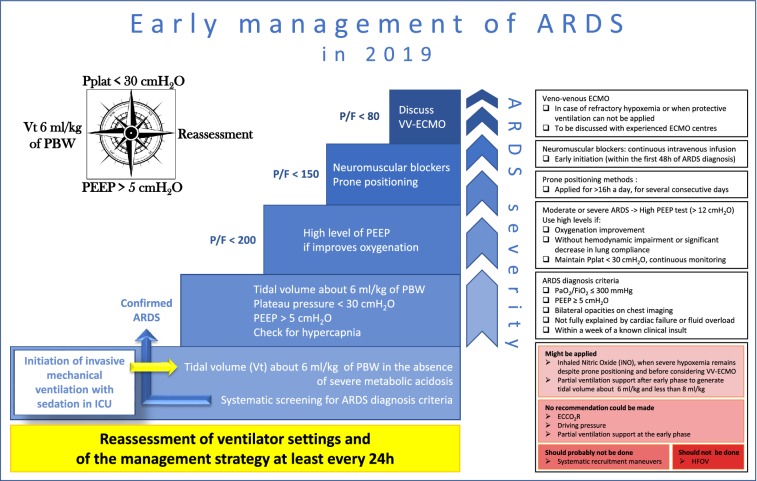
Fifteen recommendations and a therapeutic algorithm regarding the management of acute respiratory distress syndrome (ARDS) at the early phase in adults are proposed. The Grade of Recommendation Assessment, Development and Evaluation (GRADE) methodology has been followed. Four recommendations (low tidal volume, plateau pressure limitation, no oscillatory ventilation, and prone position) had a high level of proof (GRADE 1 + or 1 -); four (high positive end-expiratory pressure [PEEP] in moderate and severe ARDS, muscle relaxants, recruitment maneuvers, and venovenous extracorporeal membrane oxygenation [ECMO]) a low level of proof (GRADE 2 + or 2 -); seven (surveillance, tidal volume for non ARDS mechanically ventilated patients, tidal volume limitation in the presence of low plateau pressure, PEEP > 5 cmH2O, high PEEP in the absence of deleterious effect, pressure mode allowing spontaneous ventilation after the acute phase, and nitric oxide) corresponded to a level of proof that did not allow use of the GRADE classification and were expert opinions. Lastly, for three aspects of ARDS management (driving pressure, early spontaneous ventilation, and extracorporeal carbon dioxide removal), the experts concluded that no sound recommendation was possible given current knowledge. The recommendations and the therapeutic algorithm were approved by the experts with strong agreement.
Overview
The claims and statistics of this paper haven’t been checked yet.
Free: it reads the open-access text and checks the first 5 claims that cite a source we can check. Create a free account to check every claim.
Integrity signals
Registry
Cites
Statistics
Figures
Verification
Claims the paper makes
The claims and statistics of this paper haven’t been checked yet.
Free: it reads the open-access text and checks the first 5 claims that cite a source we can check. Create a free account to check every claim.
Claims other papers make about this one
Each is checked against this paper’s own text: does it say what the citing paper says it does?
In the citing paper
“A recent systematic review which included five RCTs also identified a strong relationship between plateau pressure and mortality [434].”
From Surviving sepsis campaign: international guidelines for management of sepsis and septic shock 2021 (2021) · cites this paper as [434]
Self-check
Percentages, sums and reported differences re-computed from the paper’s own numbers.
The self-check needs the paper’s full text.
Citations
Cites
(2000) · New England Journal of Medicine · doi:10.1056/nejm200005043421801 · Cited by 12,941
Chen, Y., Wang, L., Kang, Q., Zhang, X., Yu, G., Wan, X., Wang, J., & Zhu, K. (2017) · Cellular Physiology and Biochemistry · doi:10.1159/000477308 · Cited by 10,679
Acute Respiratory Distress Syndrome: The Berlin Definition
(2012) · JAMA · doi:10.1001/jama.2012.5669 · Cited by 8,731
Bellani, G., Laffey, J. G., Pham, T., Fan, E., Brochard, L., Esteban, A., Gattinoni, L., van Haren, F., Larsson, A., McAuley, D. F., et al. (2016) · JAMA · doi:10.1001/jama.2016.0291 · Cited by 5,766 · cited 10×
“Plateau pressure was measured in only 40% of ARDS patients [2].”
BackgroundMethodInfluentialSelf-citationProne positioning in severe acute respiratory distress syndrome.
Guérin, C., Reignier, J., Richard, J.-C., Beuret, P., Gacouin, A., Boulain, T., Mercier, E., Badet, M., Mercat, A., Baudin, O., et al. (2013) · New England Journal of Medicine · doi:10.1056/nejmoa1214103 · Cited by 4,040
Self-citationEffect of a protective-ventilation strategy on mortality in the acute respiratory distress syndrome.
Amato, M. B. P., Barbas, C. S. V., Medeiros, D. M., Magaldi, R. B., Schettino, G. P., Lorenzi-Filho, G., Kairalla, R. A., Deheinzelin, D., Munoz, C., Oliveira, R., et al. (1998) · New England Journal of Medicine · doi:10.1056/nejm199802053380602 · Cited by 3,654
Peek, G. J., Mugford, M., Tiruvoipati, R., Wilson, A., Allen, E., Thalanany, M. M., Hibbert, C. L., Truesdale, A., Clemens, F., Cooper, N., et al. (2009) · The Lancet · doi:10.1016/s0140-6736(09)61069-2 · Cited by 3,395
Functional Disability 5 Years after Acute Respiratory Distress Syndrome
Herridge, M. S., Tansey, C. M., Matté, A., Tomlinson, G., Diaz-Granados, N., Cooper, A., Guest, C. B., Mazer, C. D., Mehta, S., Stewart, T. E., et al. (2011) · New England Journal of Medicine · doi:10.1056/nejmoa1011802 · Cited by 2,847
Driving pressure and survival in the acute respiratory distress syndrome.
Amato, M. B. P., Meade, M. O., Slutsky, A. S., Brochard, L., Costa, E. L. V., Schoenfeld, D. A., Stewart, T. E., Briel, M., Talmor, D., Mercat, A., et al. (2015) · New England Journal of Medicine · doi:10.1056/nejmsa1410639 · Cited by 2,801
Self-citation(2004) · New England Journal of Medicine · doi:10.1056/nejmoa032193 · Cited by 2,565
Research works printed but not linked: 1
- Cavalcanti AB Suzumura EA Laranjeira LN Paisani DM Damiani LP Guimaraes HP Effect of lung recruitment and titrated positive end-expiratory pressure (PEEP) vs low PEEP on mortality in patients with acute respiratory distress syndrome: a randomized clinical trial JAMA 2017 318 14 1335 1345 10.1001/jama.2017.14171 28973363 PMC5710484 · DOI · Paper page
Cited by
Items 301–400 of 761
Neuromuscular Blockade Applicability in Early Acute Respiratory Distress Syndrome
Hurford, W. E. (2020) · Anesthesiology · doi:10.1097/aln.0000000000003180 · Cited by 10
Should we continue searching for the single best PEEP?
Depta, F., Zdravković, M., & Gentile, M. A. (2022) · Intensive Care Medicine Experimental · doi:10.1186/s40635-022-00438-7 · Cited by 6
“Despite numerous studies trying to answer the ‘PEEP question’, there are often conflicting opinions when it comes to recommendations based on clinical trials [1].”
BackgroundDepta, F., Gentile, M. A., Kallet, R. H., Firment, P., Leškanič, J., Rybár, D., Török, P., & Zdravković, M. (2022) · Journal of Critical Care · doi:10.1016/j.jcrc.2022.154174 · Cited by 6
Catheterization Without Supination—A Series of 36 Prone Position Internal Jugular Vein Cannulations
Lussier, B. L., Pham, D., Ratti, G. A., Patel, J. D., Mitchell, B. C., & Chen, C. (2022) · Critical Care Explorations · doi:10.1097/cce.0000000000000831 · Cited by 6
Mechanical ventilation post‐bilateral lung transplantation: A scoping review
Morgan, S., Åneman, A., & Nair, P. (2023) · Acta Anaesthesiologica Scandinavica · doi:10.1111/aas.14219 · Cited by 6
“Multiple international consensus guidelines recommend lower tidal volume (6–8 mL/kg PBW) and plateau pressure limitation (<30 cmH2O) as the LPV targets with the best supporting evidence.(1,27,28) The contribution of Pplat limitation to the mortality benefit of lower tidal volume ventilation is clearly demonstrated in…”
BackgroundMarshall, G., Sanguinet, J., Batra, S., Foreman, M. J., Peruchini, J., Lopez, S., Guzman, R. D., Rivera, N., Hightower, T., Malone, C., et al. (2023) · American Journal of Infection Control · doi:10.1016/j.ajic.2023.06.013 · Cited by 6
“If a PEEP greater than 12 cmH2O is needed for multiple days in a row, then when weaning PEEP, the baseline should not be reduced by more than two cmH2O every 24 hours.(10) The application of PEEP improves gas exchange and lung function.”
BackgroundRollinson, T. C., McDonald, L. A., Rose, J., Eastwood, G. M., Costa‐Pinto, R., Modra, L. J., Maeda, A., Bacolas, Z., Anstey, J. R., Bates, S., et al. (2023) · Acta Anaesthesiologica Scandinavica · doi:10.1111/aas.14356 · Cited by 6
“26,27 Routinely collected clinical, biological data and outcomes were retrieved retrospectively from medical records.”
MethodInvasive Mechanical Ventilation of COVID-19 ARDS Patients
Singh, V. A., Sasidharan, S., Naseer, A., Singh-Dhillon, H., Manalikuzhiyil, B., Singh, S., Sinha, D., Kaur-Dhillon, G., & Singh, S. (2021) · Revista Peruana de Investigación en Salud · doi:10.35839/repis.5.2.930 · Cited by 6
Carbonic Anhydrase IX and Hypoxia Promote Rat Pulmonary Endothelial Cell Survival during Infection
Lee, J., Stevens, R. P., Kash, M., ALEXEYEV, M. F., Balczon, R., Zhou, C., Renema, P., Koloteva, A., Kozhukhar, N., Pastukh, V., et al. (2021) · American Journal of Respiratory Cell and Molecular Biology · doi:10.1165/rcmb.2020-0537oc · Cited by 7
“In the in vivo setting, the context of hypoxia becomes muchmore diverse and complicated, such as in ARDS and sepsis, in which target organ tissue hypoxia can be secondary to altered gas contents and/or compromised perfusion (49).”
BackgroundInfluentialDickel, S., Grimm, C., Popp, M., Struwe, C., Sachkova, A., Golinski, M., Seeber, C., Fichtner, F., Heise, D., Kranke, P., et al. (2021) · Journal of Clinical Medicine · doi:10.3390/jcm10153363 · Cited by 7
“Evidence suggests that NMBA administration should then be planned in such a way that early spontaneous breathing can be established [37].”
BackgroundWeaning Analgosedation in Patients Requiring Prolonged Mechanical Ventilation
Taylor, S. P., Hammer, J. M., & Taylor, B. (2021) · Journal of Intensive Care Medicine · doi:10.1177/08850666211048779 · Cited by 6
“However, some patients with severe acute respiratory distress syndrome (ARDS) receive deeper sedation to facilitate oxygenation, allow lung-protective low tidal volume ventilation and reduce ventilatory dysynchrony.(4) These patients may be under-represented in trials supporting guidelines for minimal sedation, leavin…”
BackgroundBoffi, A., Ravenel, M., Lupieri, E., Schneider, A. G., Liaudet, L., González, M., Chiche, J., & Piquilloud, L. (2022) · Respiratory Research · doi:10.1186/s12931-022-02247-8 · Cited by 7
Self-citationProne positioning of nonintubated patients with acute hypoxemic respiratory failure
Li, J., Roca, O., & Ehrmann, S. (2022) · Current Opinion in Critical Care · doi:10.1097/mcc.0000000000001009 · Cited by 7
“e prone positioning has been recommended for intubated patients with acute respiratory distress syndrome (ARDS) [2].”
BackgroundInfluentialA primer on proning in the emergency department
McGurk, K., Riveros, T., Johnson, N. J., & Dyer, S. (2020) · Journal of the American College of Emergency Physicians Open · doi:10.1002/emp2.12175 · Cited by 6
Louis, G., Belveyre, T., Goetz, C., Gibot, S., Dunand, P., Conrad, M., Gaci, R., Gette, S., Ouamara, N., Perez, P., et al. (2022) · Frontiers in Medicine · doi:10.3389/fmed.2022.828402 · Cited by 8
Juan, E. P., Maqueda-Palau, M., Feliu-Roig, C., Gómez-Arroyo, J. M., Sáez-Romero, D., & Ortiz-Monjo, A. (2023) · Enfermería Intensiva · doi:10.1016/j.enfi.2022.12.001 · Cited by 7
“Mujer 75 (30,4%) 9 (29%) 5 (16,4%) 35 (37,7%) 26 (28%) IMC Mediana (RIC) 30,7 (27-34,2) 30,8 (27-34,5) 30,4 (27-33,6) 30,9 (27-34,5) 30,4 (27-34) 0,046”
Diagnosis and Management of Acute Respiratory Distress Syndrome: A Systematic Review
Ghabashi, A., Towairqi, A. S., Emam, M. A., Farran, M. H., & Alayyafi, Y. A. (2023) · Journal Of Biochemical Technology · doi:10.51847/3sksqbiipc · Cited by 5
Tanios, M. A., Wu, T., Nguyen, H. M., Smith, L. H., Mahidhara, R. S., & Devlin, J. W. (2024) · BMJ Open Respiratory Research · doi:10.1136/bmjresp-2024-002439 · Cited by 5
“However, it should be used with caution and not prioritised until further studies confirm its benefits.”
Rollinson, T. C., McDonald, L. A., Rose, J., Eastwood, G. M., Costa‐Pinto, R., Modra, L. J., Maeda, A., Bacolas, Z., Anstey, J. R., Bates, S., et al. (2024) · Australian Critical Care · doi:10.1016/j.aucc.2024.09.002 · Cited by 6
DiBridge, J. N., Rivosecchi, R. M., McVerry, B. J., Lamberty, P. E., Donahoe, M. P., & Groetzinger, L. M. (2021) · Journal of Critical Care · doi:10.1016/j.jcrc.2021.07.012 · Cited by 5
“[10-12] Utilization and dosing of CIS in ARDS remains controversial.”
BackgroundPostextubation Stridor in Severe COVID-19
Abdallah, G. A., Ferré, A., Gros, A., Simon, C., Bruneel, F., Marque‐Juillet, S., Legriel, S., & Paul, M. (2022) · Respiratory Care · doi:10.4187/respcare.09527 · Cited by 5
Deitos, J., Lima, R. B. H., Pereira, D. M., & Seki, K. L. M. (2022) · Research Society and Development · doi:10.33448/rsd-v11i4.27046 · Cited by 9
Duff, A.-M., Lambe, G., Donlon, N. E., Donohoe, C. L., Brady, A., & Reynolds, J. V. (2022) · Diseases of the Esophagus · doi:10.1093/dote/doac017 · Cited by 5
Guérin, C., Cour, M., & Argaud, L. (2022) · Seminars in Respiratory and Critical Care Medicine · doi:10.1055/s-0042-1744304 · Cited by 6
Self-citationProne positioning in ARDS patients supported with VV ECMO, what we should explore?
Zhang, H., Liu, Z., Shu, H., Yu, Y., Yang, X., Li, R., Xu, J., Zou, X., & Shang, Y. (2022) · Journal of Intensive Care · doi:10.1186/s40560-022-00640-5 · Cited by 5
“Prone positioning (PP) has been proved to reduce mortality in patients with moderate to severe ARDS [4, 5].”
BackgroundThe Use of Extracorporeal Membrane Oxygenation for Burns: A Systematic Review and Meta-Analysis
Ng, E. S. T., Ling, R. R., Mitra, S., Tan, C. S., MacLaren, G., & Ramanathan, K. R. (2022) · ASAIO Journal · doi:10.1097/mat.0000000000001839 · Cited by 7
Efecto de la duración del decúbito prono en pacientes con SDRA durante la pandemia por SARS-CoV-2
de Miguel-Balsa, E., Blasco-Ruso, T., Gómez-Medrano, N., Mirabet-Guijarro, M., Martínez-Pérez, A., & Alcalá-López, A. (2023) · Medicina Intensiva · doi:10.1016/j.medin.2023.03.002 · Cited by 5
“Días de BNM 2 (0-2) 3 (3-5) 10,5 (5-19) < 0,0001”
InfluentialAng, C. Y. S., Chiew, Y. S., Wang, X., & Nor, M. B. M. (2022) · IEEE-EMBS Conference on Biomedical Engineering and Sciences · doi:10.1109/iecbes54088.2022.10079532 · Cited by 5
“The identified respiratory parameters are also checked to see if they are within safe ranges as described in lung protective strategies and existing studies: 1) 4 < VT (ml/kg predicted body weight) < 8 [1]; 2) PPlat < 30 cmH2O [1]; 3) PIP < 40 cmH2O [22]; 4) ∆ < 14 cmH2O [22]; 5) PEEP > 5 cmH2O [2]; 6) MP < 17 J/min.”
BackgroundInfluentialEffect of the duration of prone position in ARDS patients during the SARS-CoV-2 pandemic
de Miguel-Balsa, E., Blasco-Ruso, T., Gómez-Medrano, N., Mirabet-Guijarro, M., Martínez-Pérez, A., & Alcalá-López, A. (2023) · Medicina Intensiva (English Edition) · doi:10.1016/j.medine.2023.03.011 · Cited by 6
Advancing ICU patient care with a Real-Time predictive model for mechanical Power to mitigate VILI
Ruíz-Botella, M., Manrique, S., Gómez, J. M., & Bodí, M. A. (2024) · International Journal of Medical Informatics · doi:10.1016/j.ijmedinf.2024.105511 · Cited by 5
Terrier, C. L., Walter, T., Lebbah, S., Hajage, D., Sigaud, F., Guérin, C., Desmedt, L., Primmaz, S., Joussellin, V., Badia, C. D., et al. (2024) · Annals of Intensive Care · doi:10.1186/s13613-024-01340-z · Cited by 5
Self-citationLu, Y., Li, W., Qi, S., Cheng, K., & Wu, H. (2024) · Frontiers in Medicine · doi:10.3389/fmed.2024.1365864 · Cited by 6
Vuillermoz, A., Lefranc, M., Prouvez, N., Brault, C., Zerbib, Y., Schmitt, M., Forel, J.-M., Tutour, M. L., Lesimple, A., Mercat, A., et al. (2024) · Annals of Intensive Care · doi:10.1186/s13613-024-01351-w · Cited by 5
Self-citationIsolated Lung Perfusion in the Management of Acute Respiratory Distress Syndrome
Haywood, N. S., Byler, M. R., Zhang, A. Y., Roeser, M. E., Kron, I. L., & Laubach, V. E. (2020) · International Journal of Molecular Sciences · doi:10.3390/ijms21186820 · Cited by 7
“Recent guidelines suggest consideration of venovenous ECMO in severe ARDS when PaO2/FiO2 < 80 mmHg despite optimal ARDS treatment, including neuromuscular blockade, high positive end expiratory pressure (PEEP), and prone positioning [18].”
BackgroundShimoda, T., Sekino, M., Higashijima, U., Matsumoto, S., Sato, S., Yano, R., Egashira, T., Araki, H., Iwasaki, N., Suzumura, M., et al. (2021) · Medicine · doi:10.1097/md.0000000000027199 · Cited by 5
“report of a negative impact of hypercapnia on the prognosis of patients with ARDS, the removal of the mechanical dead space was recommended in recent reviews and guidelines([28,29]); however, it may still be an intervention that is not commonly implemented.”
BackgroundSaccheri, C., Morand, L., Juston, M., Doyen, D., Hyvernat, H., Lombardi, R., Devanlay, R., Panicucci, É., Dellamonica, J., & Jozwiak, M. (2023) · Respiratory Research · doi:10.1186/s12931-022-02308-y · Cited by 5
“Neuromuscular blocker agents and prone positioning were used according to current recommendations in non-COVID-19 patients with ARDS [16].”
MethodInfluentialAdvances in pulmonary management and weaning from ECLS
Thatch, K. A., & Kays, D. W. (2023) · Seminars in Pediatric Surgery · doi:10.1016/j.sempedsurg.2023.151329 · Cited by 5
Role of RIPK1 in the pathogenesis of acute respiratory distress syndrome
ZHAO, X., MAGO, E., & Weng, D. (2023) · Biocell · doi:10.32604/biocell.2023.030570 · Cited by 6
Posición prono en pacientes con síndrome de insuficiencia respiratoria progresiva aguda por COVID-19
Moreno, F. J. G., Khouri, L. S., Guzmán, C. I. O., Valente-Acosta, B., Sánchez, J. S. A., & Granillo, J. F. (2020) · Medicina Crítica · doi:10.35366/93283 · Cited by 12
Gardner, L. (2020) · Patient Safety · doi:10.33940/data/2020.12.1 · Cited by 5
Richard, J., Yonis, H., Bitker, L., Roche, S., Wallet, F., Dupuis, C., Serrier, H., Argaud, L., Thiéry, G., Delannoy, B., et al. (2021) · Trials · doi:10.1186/s13063-021-05665-z · Cited by 5
“, VT 6mL kg PBW, PEEP set using the PEEP-FiO2 table of the low PEEP arm of the ALVEOLI trial [10], aiming for a plateau pressure < 30 cmH2O), as this strategy reflects a standard of care according to the national [11] and international guidelines [12].”
MethodSelf-citationDecrease Dead Space Prior to Calling the ECMO!
Lellouche, F. (2021) · CHEST Journal · doi:10.1016/j.chest.2020.11.067 · Cited by 5
Use of an EHR to inform an administrative data algorithm to categorize inpatient COVID-19 severityPreprint
Garry, E. M., Weckstein, A. R., Quinto, K., Lasky, T., Chakravarty, A. G., Leonard, S., Vititoe, S. E., Easthausen, I. J., Rassen, J. A., & Gatto, N. M. (2021) · medRxiv · doi:10.1101/2021.10.04.21264513 · Cited by 6
(2023) · Signa Vitae · doi:10.22514/sv.2023.026 · Cited by 4
“There are multiple key components when delivering protective ventilation with sufficient positive end-expiratory pressure (PEEP) representing a cornerstone of strategies [2].”
BackgroundGe, G., Wu, B., Xu, D., Liu, Q., Xie, Q., Yang, M., Feng, Y., Mai, S., & Shan, M. (2025) · Nursing in Critical Care · doi:10.1111/nicc.70036 · Cited by 4
Liu, R., Li, Y., Li, B., Liu, S., Tong, M., & Ma, Q. (2025) · BMC Cardiovascular Disorders · doi:10.1186/s12872-025-04967-3 · Cited by 4
Biuzzi, C., Modica, E., Filippis, N. D., Pizzirani, D., Galgani, B., Chiaro, A. D., Marianello, D., Franchi, F., Taccone, F. S., & Scolletta, S. (2025) · Diagnostics · doi:10.3390/diagnostics15151930 · Cited by 9
“Moreover, maintaining a plateau pressure below 30 cm H 2 O and a driving pressure below 15 cm H 2 O is equally important to prevent alveolar overdisten-sion [21,22].”
Poirot, L., Wangueu, L. T., Breteau, I., Petit, M., Schmidt, M., Bavozet, F., COVID ICU Group on behalf of the REVA Network and the COVID-ICU Investigators, Mercat, A., Asfar, P., Beloncle, F., et al. (2025) · Journal of Intensive Care · doi:10.1186/s40560-025-00831-w · Cited by 4
Self-citationRecommendations for Mechanical Ventilation During General Anesthesia for Trauma Surgery
Blaine, K. (2022) · Current anesthesiology reports · doi:10.1007/s40140-021-00512-y · Cited by 4
The roles of sodium-potassium-chloride cotransporter isoform-1 in acute lung injury
Hsieh, P., Wu, Y.-K., Kuo, C., Lee, Y., Yang, M., & Lan, C. (2022) · Tzu Chi Medical Journal · doi:10.4103/tcmj.tcmj_50_21 · Cited by 4
“The pathophysiological features of ALI include acute lung inflammation accompanied by pulmonary microvascular hyperpermeability and pulmonary edema [1].”
BackgroundInfluentialAtelectasis in one lung ventilation: the good, the bad, and the ugly: a narrative review
Bussières, J. S., & Marques, E. (2022) · Current Challenges in Thoracic Surgery · doi:10.21037/ccts-21-26 · Cited by 5
Muñoz-Arcos, V. E., Alvarez, I., Chavarro, P. A., & Luna, E. C. W. (2023) · Fisioterapia · doi:10.1016/j.ft.2023.03.123 · Cited by 4
Kim, S. H., & Kim, K. H. (2023) · Surgery · doi:10.1016/j.surg.2023.05.020 · Cited by 4
Prone Positioning and Molecular Biomarkers in COVID and Non-COVID ARDS: A Narrative Review
Spadaro, S., Jimenez-Santana, J. D., Rosa, R. L., Spinazzola, G., Navarro, P. A., Volta, C. A., & Scaramuzzo, G. (2024) · Journal of Clinical Medicine · doi:10.3390/jcm13020317 · Cited by 4
“Ultra-protective ventilation and minimization of lung injury could potentially mediate the effects of vv-ECMO on lung parenchyma [7,20].”
BackgroundGiraldo‐Cadavid, L. F., Echeverry, J. M., Varón-Vega, F. A., Bastidas, A., Ramírez-Jaime, A., Cardona, A. F., Vega, C. J. L., Serrano-Mayorga, C. C., Garay, D. A., Rincón, D. N., et al. (2024) · Heliyon · doi:10.1016/j.heliyon.2024.e30671 · Cited by 4
“The lung protection protocol for volume-controlled ventilation has extensive support in the scientific literature due to its efficacy and safety [25 – 29].”
BackgroundHigh-Flow Oxygen: Respiratory Mechanics in Lung Alveoli of Patients After Acute Respiratory Failure
Prieto, A. N., Chang, C. L., de Miguel, M. D. P. C., Ormaechea, M. I. F., Chacón, M. D. L. Á. Z., Hiscock, L. J., Romero, G. P.-B., Rodríguez‐Nieto, M. J., & Heili-Frades, S. B. (2024) · Open Respiratory Archives · doi:10.1016/j.opresp.2024.100335 · Cited by 4
Bąkowski, W., Śmiechowicz, J., Dragan, B., Goździk, W., & Adamik, B. (2024) · Pathogens · doi:10.3390/pathogens13090778 · Cited by 4
“…for V-V ECMO therapy were based on current guidelines and included persistent hypoxemia with PaO 2 /FiO 2 < 150 mmHg and/or respiratory acidosis with pH < 7.25 and PaCO 2 > 60 mmHg despite conventional ARDS therapy, protective lung ventilation, muscle relaxants, and the prone positioning [19].”
MethodInfluentialLai, C., Shi, R., Jelinski, L., Lardet, F., Fasan, M., Ayed, S., Belotti, H., Biard, N., Guérin, L., Fage, N., et al. (2024) · Annals of Intensive Care · doi:10.1186/s13613-024-01375-2 · Cited by 5
“PP sessions were performed as previously described and recommended [3].”
BackgroundMethodHeinrich, M. A., Maier, L. S., Müller, T. M., Lubnow, M., & Dietl, A. (2025) · European Heart Journal - Case Reports · doi:10.1093/ehjcr/ytaf059 · Cited by 4
“14,15 Though iNO does not improve mortality in meta-analysis, 16 it increases the PaO 2 /FiO 2 ratio and reduces physiologic dead space fraction within 24 h of application.”
Rubio, R. D. C. (2021) · Acta Colombiana de Cuidado Intensivo · doi:10.1016/j.acci.2020.12.003 · Cited by 6
Awake Self–Prone Positioning and the Evidence
Seckel, M. A. (2021) · Critical Care Nurse · doi:10.4037/ccn2021719 · Cited by 4
Chang, K., Hu, H., Chiu, L., Chan, M.-C., Liang, S., Yang, K., Chen, W., Fang, W., Chen, Y., Sheu, C., et al. (2021) · Journal of the Formosan Medical Association · doi:10.1016/j.jfma.2021.10.007 · Cited by 5
“By contrast, the mortality rate of the ECMO group in our study was higher (30- and 60-day mortality rates were 36% and 60%, respectively) than that reported in the EOLIA study (60- day mortality rate was 35%)16 or other studies including patients with influenza.29,30 These differences are potentially attributable to d…”
BackgroundInfluentialUgajin, M., Kani, H., & Hattori, H. (2021) · Medicina · doi:10.3390/medicina57101094 · Cited by 4
“However, in our institute, both low tidal volume and plateau pressure less than 30 cm H2O were generally applied to mechanical ventilation setting in order to avoid ventilator-induced lung injury [16].”
BackgroundImproving delivery of low tidal volume ventilation in 10 ICUs
Donadee, C., Cohen-Melamed, M. H., Delgado, E., & Gunn, S. R. (2022) · BMJ Open Quality · doi:10.1136/bmjoq-2021-001343 · Cited by 5
Partitioning Mechanical Ventilator Duration in COVID-19–related Acute Respiratory Distress Syndrome
Gendreau, S., Benelli, B., Delière, M., Tuffet, S., de Prost, N., Razazi, K., Carteaux, G., & Dessap, A. M. (2022) · American Journal of Respiratory and Critical Care Medicine · doi:10.1164/rccm.202108-1963le · Cited by 5
“Patients with ARDS receivedMV following a standardized protective ventilation strategy, as well as rescue therapies following the national guidelines (5).”
MethodTime-Controlled Adaptive Ventilation Does Not Induce Hemodynamic Impairment in a Swine ARDS Model
Lescroart, M., Péquignot, B., Bitker, L., Pina, H., Tran, N., Hébert, J., Richard, J., Lévy, B., & Koszutski, M. (2022) · Frontiers in Medicine · doi:10.3389/fmed.2022.883950 · Cited by 5
Self-citationCurrent Practice Review in the Management of Acute Respiratory Distress Syndrome
Chudow, M. B., Condeni, M. S., Dhar, S., Heavner, M. S., Nei, A. M., & Bissell, B. D. (2022) · Journal of Pharmacy Practice · doi:10.1177/08971900221108713 · Cited by 4
“4,65 Given the low prevalence of prone positioning in practice despite the strong data supporting its use, employing protocols to automate the process may provide a more standardized and consistent approach to proning on an institutional level.”
BackgroundInfluentialPrognostic value of the novel P/FPE index to classify ARDS severity: A cohort study
Martos-Benítez, F. D., Muguercia, R. E., Orama-Requejo, V., & del Toro-Simoni, T. (2022) · Medicina Intensiva · doi:10.1016/j.medin.2022.06.006 · Cited by 4
Righi, N. C., Plentz, R. D. M., Marchi, P. T. R. D., Brambatti, K. R., Garlet, A. B., Mesquita, J., de Oliveira, A. P., & Schardong, J. (2022) · Fisioterapia e Pesquisa · doi:10.1590/1809-2950/21021229022022en · Cited by 5
Sun, Q., Li, X., Lin, Z., Jiang, W., Luo, Y., & Huang, W.-Z. (2019) · Journal of Thoracic Disease · doi:10.21037/jtd.2019.09.77 · Cited by 4
“The following formula were used to calculate respiratory parameters, where endinspiratory occlusion (EIO) and end-expiratory occlusion (EEO) are end-inspiratory and end-expiratory occlusion, respectively, ∆P(driving pressure) = Pplat – PEEPT; PL-EIO = Pplat – Pes-EIO; PL-EEO = PEEPT – Pes-EEO and ΔPL = PL-EIO – PLEEO…”
BackgroundInfluentialZhang, S., Zhang, L., Long, K., Gao, P., Zhang, C., Ding, P., Chen, J., Zhang, X., & Lin, Q. (2020) · Medicine · doi:10.1097/md.0000000000020341 · Cited by 4
Singh, V. A., Sasidharan, S., Nasser, A., & Dhillon, H. (2021) · MRIMS Journal of Health Sciences · doi:10.4103/mjhs.mjhs_5_21 · Cited by 4
In-depth review of cardiopulmonary support in COVID-19 patients with heart failure
Raffaello, W. M., Huang, I., Siswanto, B. B., & Pranata, R. (2021) · World Journal of Cardiology · doi:10.4330/wjc.v13.i8.298 · Cited by 4
Programmed Multi-Level Ventilation: A Strategy for Ventilating Non-Homogenous Lungs
Depta, F., Török, P., Reeves, V., & Gentile, M. A. (2021) · Medical Devices Evidence and Research · doi:10.2147/mder.s329352 · Cited by 5
“decreased lung compliance, and increased intrapulmonary shunt and increased dead space.(2) Although research in the field of ARDS has progressed immensely for the past”
BackgroundMapping global trends in research of stem cell therapy for COVID-19: A bibliometric analysis
Zhang, X., Cai, J., Chen, L., Yang, Q., Tian, H., Wu, J., Ji, Z., Zheng, D., Li, Z., & Chen, Y. (2022) · Frontiers in Public Health · doi:10.3389/fpubh.2022.1016237 · Cited by 4
Alveolar mechanics: A new concept in respiratory monitoring
Daoud, E. G., & Franck, C. L. (2022) · Journal of Mechanical Ventilation · doi:10.53097/jmv.10065 · Cited by 4
Personalized medicine targeting different ARDS phenotypes: The future of pharmacotherapy for ARDS?
Blanchard, F., James, A., Assefi, M., Kapandji, N., & Constantin, J. (2023) · Expert Review of Respiratory Medicine · doi:10.1080/17476348.2023.2176302 · Cited by 5
“nitric oxide only in severe refractory ARDS prior to venovenous-ECMO cannulation [85].”
BackgroundCoirier, V., Delamaire, F., Chauvin, P., Kerjouan, M., Léderlin, M., Maamar, A., & Jouneau, S. (2023) · Respiratory Medicine Case Reports · doi:10.1016/j.rmcr.2023.101825 · Cited by 4
Wu, Y., Sun, H., Qin, L., Zhang, X., Zhou, H., Wang, Y., Wang, L., Li, M., Liu, J., & Zhang, J. (2023) · Frontiers in Pharmacology · doi:10.3389/fphar.2023.1149659 · Cited by 4
“However, the high lethality of ARDS (Bellani et al., 2016; Abe et al., 2018; Papazian et al., 2019) still urges researchers to explore more effective solutions.”
BackgroundInfluentialMiyake, N., Igarashi, Y., Nakae, R., Mizobuchi, T., Masuno, T., & Yokobori, S. (2023) · BMC Pulmonary Medicine · doi:10.1186/s12890-023-02549-7 · Cited by 4
“Fourteen patients (13%) developed ALS within 30 days of starting ventilator management, and the median onset date was 14 [12-18] days after starting ventilator management.”
BackgroundMeunier, É., Vega, M. A., Adam, D., Privé, A., Nezhady, M. A. M., Lahaie, I., Quiniou, C., Chemtob, S., & Brochiero, E. (2024) · Experimental Physiology · doi:10.1113/ep091682 · Cited by 4
Management of acute respiratory failure
Slattery, M., Vasques, F., Srivastava, S. A., & Camporota, L. (2020) · Medicine · doi:10.1016/j.mpmed.2020.03.010 · Cited by 4
Ventilación mecánica: pasado y presente
Rialp, G. (2020) · Medicina Intensiva · doi:10.1016/j.medin.2020.08.012 · Cited by 4
Vega, M. L., Nava, S., Hill, N. S., & Pisani, L. (2025) · European Journal of Internal Medicine · doi:10.1016/j.ejim.2025.04.018 · Cited by 3
Hohmann, F. B., Midega, T. D., Treml, R. E., Galindo, V. B., Veiga, G., Machado, I., Kraft, M. R., Custódio, S. S. F., Paolinelli, E., Galdino, F., et al. (2025) · BMC Pulmonary Medicine · doi:10.1186/s12890-025-03773-z · Cited by 3
“…with hypoxemic respiratory failure who progress to OTI will have higher mortality [21, 23], which is one of the reasons for the extreme importance of their monitoring in relation to method failure, whether through tidal volume in patients using NIV or ROX Index in patients using HFNC [2, 24].”
Gottula, A. L., Gillespie, L. E., Lauria, M., Shaw, C. R., Purington, E. K., Bernardoni, B., Cathers, A., Kolbet, K., Rudolph, M., Lucchini, A., et al. (2025) · ASAIO Journal · doi:10.1097/mat.0000000000002515 · Cited by 3
Recurrent Malignant Pleural Effusion Management
Wright, M., Nguyen, P., Backer, E., Goitein, L., & Feller-Kopman, D. J. (2025) · CHEST Pulmonary · doi:10.1016/j.chpulm.2025.100227 · Cited by 3
Giani, M., Guervilly, C., & Foti, G. (2022) · Springer eBooks · doi:10.1007/978-3-030-93401-9_30 · Cited by 3
Addison, J. D., Daley, M. J., Curran, M., & Hodge, E. K. (2022) · Journal of Pharmacy Practice · doi:10.1177/08971900221131420 · Cited by 3
“4 Adequate sedation plays a critical role in managing patients undergoing CI NMBA to prevent awareness while under paralysis and post-traumatic stress disorder which can affect long-term morbidity.”
BackgroundYork, J., & NUGENT, K. M. (2023) · The Southwest Respiratory and Critical Care Chronicles · doi:10.12746/swrccc.v11i47.1167 · Cited by 3
Torbic, H., Bulgarelli, L., Deliberato, R. O., & Duggal, A. (2023) · Journal of Pharmacy Practice · doi:10.1177/08971900231185392 · Cited by 3
Chen, X., Cao, P., Xiao, Y., & Liu, S. (2023) · Frontiers in Physiology · doi:10.3389/fphys.2023.1152723 · Cited by 4
Respiratory Effects of Maximal Lung Recruitment Maneuvers Using Single-Breath Estimation in ARDS
Lhermitte, A., Pugliesi, E., Cerasuolo, D., Delcampe, A., Cabart, A., du Cheyron, D., Hanouz, J., & Daubin, C. (2024) · Respiratory Care · doi:10.4187/respcare.11948 · Cited by 3
“13 The subjects were ventilated through volume controlled ventilation with a V T of 6 mL/kg of predicted body weight, PEEP > 5 cm H 2 O with respect to a maximum plateau pressure of 28–30 cm H 2 O, and a driving pressure 15 cm H 2 O.”
Liang, H., Deng, Q., Ye, W., Jiang, Z., Zhang, B., Zhang, J., Jiang, M., & Xu, Y. (2024) · BMC Pulmonary Medicine · doi:10.1186/s12890-024-03349-3 · Cited by 6
“Prone position ventilation (PPV) has been evaluated as a key strategy in managing severe ARDS patients [12, 13].”
Qin, Z., Zhao, X., Meng, Y., Wu, Y., Qian, J., Yin, M., Wen, H., Hu, J., & Tang, Z. (2025) · BMJ Open · doi:10.1136/bmjopen-2024-092069 · Cited by 4
Wawrzeniak, I. C., Victorino, J. A., Pacheco, E. C., Alcala, G., Amato, M. B. P., & Vieira, S. R. R. (2025) · Respiratory Care · doi:10.1089/respcare.12304 · Cited by 3
“10,21 However, our study did not show that the use of the P aO 2 /F IO 2 was an useful early or good parameter to evaluate mechanical ventilation weaning (Table 2; Supplementary Figure E2 in Supplementary Data).”
Gupta, E., Carey, K. A., McDermott, L., Cavarocchi, N. C., Hirose, H., & Baram, M. (2020) · World Journal of Cardiovascular Surgery · doi:10.4236/wjcs.2020.101001 · Cited by 3
“Current ARDS ventilatory strategies revolve around reducing inflammation caused by ventilators [4].”
BackgroundБрыгин, П. А., Zhuravel, S. V., Troitskiy, D. A., & Utkina, I. I. (2020) · Transplantologiya The Russian Journal of Transplantation · doi:10.23873/2074-0506-2020-12-3-220-230 · Cited by 4
“Руководства по ЭКМО [14–17], протоколы исследований [7, 9] и рекомендации по лечению ОРДС [18] содержат в разделе «показания к ЭКМО» отношение PaO 2 / FiO 2 , отражающее тяжесть гипоксемии и являющееся наиболее распространенным и простым в использовании критерием оценки тяжести легочного повреждения.”
Escribano-Santana, I., Martínez‐Gimeno, M. L., & Herráiz-Bermejo, L. (2022) · Enfermería Intensiva · doi:10.1016/j.enfi.2022.05.001 · Cited by 3
Roubík, K., Ort, V., Horáková, L., & Walzel, Š. (2023) · Scientific Reports · doi:10.1038/s41598-023-34300-x · Cited by 3
Metadata
- Authors
- Papazian, L., Aubron, C., Brochard, L., Chiche, J.-D., Combes, A., Dreyfuss, D., Forel, J.-M., Guérin, C., Jaber, S., Mekontso-Dessap, A., Mercat, A., Richard, J.-C., Roux, D., Vieillard-Baron, A., & Faure, H.
- Affiliations
- Assistance Publique Hôpitaux de Marseille (FR)
- Centre Hospitalier Régional Universitaire de Brest (FR)
- University of Toronto (CA)
- Hôpital Cochin (FR)
- Assistance Publique – Hôpitaux de Paris (FR)
- Hôpital Louis-Mourier (FR)
- Hôpital de la Croix-Rousse (FR)
- Inserm (FR)
- Centre Hospitalier Universitaire d'Angers (FR)
- Centre de Recherche en Acquisition et Traitement de l'Image pour la Santé (FR)
- Centre hospitalier Robert-Ballanger (FR)
- Corresponding author
- Papazian, Laurent
- ORCID
- Venue
- Annals of Intensive Care
- Publisher
- Elsevier BV
- Published
- 2019
- Volume
- 9
- Issue
- 1
- Pages
- 69
- ISSN
- 2110-5820 (ISSN-L)
- PMC
- PMC6565761
- OpenAlex
- W2953390211
- Cited by
- 761
- References
- 146
- Citations by year
- 2026: 33 · 2025: 60 · 2024: 86 · 2023: 128 · 2022: 159 · 2021: 152 · 2020: 131 · 2019: 12
- FWCI
- 19.11
- Type
- journal article
- Language
- en
- Open access
- gold
- doi.org
- Licence
- cc-by
- www.elsevier.com/tdm/userlicense/1.0/ (tdm)
- www.elsevier.com/legal/tdmrep-license (tdm)
- creativecommons.org/licenses/by-nc-nd/4.0/ (vor, 2514 d)
- Locations
- Annals of Intensive Care (publishedVersion, cc-by)
- PubMed Central (publishedVersion, cc-by)
- PubMed (publishedVersion)
- TSpace (University of Toronto) (submittedVersion, cc-by)
- HAL (submittedVersion, other-oa)
- DOAJ (DOAJ: Directory of Open Access Journals) (submittedVersion, cc-by-sa)
- Funders
- Société de Réanimation de Langue Française
- Topics
- Health Sciences › Medicine › Pulmonary and Respiratory Medicine › Respiratory Support and Mechanisms
- Health Sciences › Medicine › Pulmonary and Respiratory Medicine › Neonatal Respiratory Health Research
- Health Sciences › Medicine › Anesthesiology and Pain Medicine › Airway Management and Intubation Techniques
- Keywords
- acute respiratory distress syndrome, mechanical ventilation, low tidal volume ventilation, plateau pressure, positive end-expiratory pressure, prone positioning, oscillatory ventilation, muscle relaxants, recruitment maneuvers, veno-venous extracorporeal membrane oxygenation, nitric oxide, driving pressure, spontaneous breathing, extracorporeal carbon dioxide removal, treatment algorithm
About these checks
Registry, retraction, Cites and statistics results are computed, not judged, with one exception: a printed reference that no index lists is read once by a model before it counts as a citation error. Claims are extracted by a model and kept only when their quote appears verbatim in the text; each cited source is then checked, with a model’s help, for whether it says what the claim relies on. Those verdicts can be wrong — read the claim’s quote and the cited source before relying on one.
Statistics and arithmetic are recomputed, not judged.
Confidence bands are shown only for fields calibrated on our annotated test set. None is calibrated yet, so no band is shown.
What counts as a claim ›How we measure confidence ›How we check this ›
Are you an author, or do you see a problem with this page? Request a review
Data sources
Bibliographic data: Semantic Scholar, OpenAlex, Crossref.
Contains information from the Semantic Scholar Academic Graph Datasets, made available under the ODC Attribution License (ODC-BY 1.0).
Semantic Scholar’s data is described in: Kinney, R., et al. (2023). The Semantic Scholar Open Data Platform. arXiv:2301.10140.
