

Formal guidelines: Management of acute respiratory distress syndrome.
Open accessThe DOI matches its Crossref record; 146 of the 146 references it cites were found in a registry or an index.
Abstract
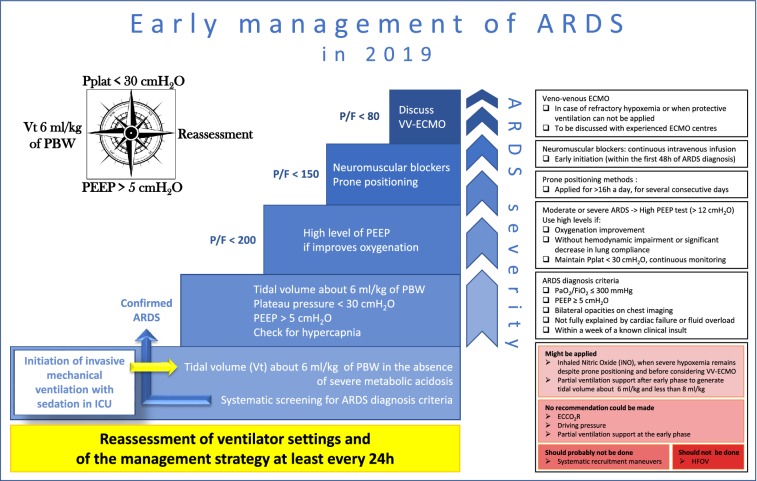
Fifteen recommendations and a therapeutic algorithm regarding the management of acute respiratory distress syndrome (ARDS) at the early phase in adults are proposed. The Grade of Recommendation Assessment, Development and Evaluation (GRADE) methodology has been followed. Four recommendations (low tidal volume, plateau pressure limitation, no oscillatory ventilation, and prone position) had a high level of proof (GRADE 1 + or 1 -); four (high positive end-expiratory pressure [PEEP] in moderate and severe ARDS, muscle relaxants, recruitment maneuvers, and venovenous extracorporeal membrane oxygenation [ECMO]) a low level of proof (GRADE 2 + or 2 -); seven (surveillance, tidal volume for non ARDS mechanically ventilated patients, tidal volume limitation in the presence of low plateau pressure, PEEP > 5 cmH2O, high PEEP in the absence of deleterious effect, pressure mode allowing spontaneous ventilation after the acute phase, and nitric oxide) corresponded to a level of proof that did not allow use of the GRADE classification and were expert opinions. Lastly, for three aspects of ARDS management (driving pressure, early spontaneous ventilation, and extracorporeal carbon dioxide removal), the experts concluded that no sound recommendation was possible given current knowledge. The recommendations and the therapeutic algorithm were approved by the experts with strong agreement.
Overview
The claims and statistics of this paper haven’t been checked yet.
Free: it reads the open-access text and checks the first 5 claims that cite a source we can check. Create a free account to check every claim.
Integrity signals
Registry
Cites
Statistics
Figures
Verification
Claims the paper makes
The claims and statistics of this paper haven’t been checked yet.
Free: it reads the open-access text and checks the first 5 claims that cite a source we can check. Create a free account to check every claim.
Claims other papers make about this one
Each is checked against this paper’s own text: does it say what the citing paper says it does?
In the citing paper
“A recent systematic review which included five RCTs also identified a strong relationship between plateau pressure and mortality [434].”
From Surviving sepsis campaign: international guidelines for management of sepsis and septic shock 2021 (2021) · cites this paper as [434]
Self-check
Percentages, sums and reported differences re-computed from the paper’s own numbers.
The self-check needs the paper’s full text.
Citations
Cites
(2000) · New England Journal of Medicine · doi:10.1056/nejm200005043421801 · Cited by 12,941
Chen, Y., Wang, L., Kang, Q., Zhang, X., Yu, G., Wan, X., Wang, J., & Zhu, K. (2017) · Cellular Physiology and Biochemistry · doi:10.1159/000477308 · Cited by 10,679
Acute Respiratory Distress Syndrome: The Berlin Definition
(2012) · JAMA · doi:10.1001/jama.2012.5669 · Cited by 8,731
Bellani, G., Laffey, J. G., Pham, T., Fan, E., Brochard, L., Esteban, A., Gattinoni, L., van Haren, F., Larsson, A., McAuley, D. F., et al. (2016) · JAMA · doi:10.1001/jama.2016.0291 · Cited by 5,766 · cited 10×
“Plateau pressure was measured in only 40% of ARDS patients [2].”
BackgroundMethodInfluentialSelf-citationProne positioning in severe acute respiratory distress syndrome.
Guérin, C., Reignier, J., Richard, J.-C., Beuret, P., Gacouin, A., Boulain, T., Mercier, E., Badet, M., Mercat, A., Baudin, O., et al. (2013) · New England Journal of Medicine · doi:10.1056/nejmoa1214103 · Cited by 4,040
Self-citationEffect of a protective-ventilation strategy on mortality in the acute respiratory distress syndrome.
Amato, M. B. P., Barbas, C. S. V., Medeiros, D. M., Magaldi, R. B., Schettino, G. P., Lorenzi-Filho, G., Kairalla, R. A., Deheinzelin, D., Munoz, C., Oliveira, R., et al. (1998) · New England Journal of Medicine · doi:10.1056/nejm199802053380602 · Cited by 3,654
Peek, G. J., Mugford, M., Tiruvoipati, R., Wilson, A., Allen, E., Thalanany, M. M., Hibbert, C. L., Truesdale, A., Clemens, F., Cooper, N., et al. (2009) · The Lancet · doi:10.1016/s0140-6736(09)61069-2 · Cited by 3,395
Functional Disability 5 Years after Acute Respiratory Distress Syndrome
Herridge, M. S., Tansey, C. M., Matté, A., Tomlinson, G., Diaz-Granados, N., Cooper, A., Guest, C. B., Mazer, C. D., Mehta, S., Stewart, T. E., et al. (2011) · New England Journal of Medicine · doi:10.1056/nejmoa1011802 · Cited by 2,847
Driving pressure and survival in the acute respiratory distress syndrome.
Amato, M. B. P., Meade, M. O., Slutsky, A. S., Brochard, L., Costa, E. L. V., Schoenfeld, D. A., Stewart, T. E., Briel, M., Talmor, D., Mercat, A., et al. (2015) · New England Journal of Medicine · doi:10.1056/nejmsa1410639 · Cited by 2,801
Self-citation(2004) · New England Journal of Medicine · doi:10.1056/nejmoa032193 · Cited by 2,565
Research works printed but not linked: 1
- Cavalcanti AB Suzumura EA Laranjeira LN Paisani DM Damiani LP Guimaraes HP Effect of lung recruitment and titrated positive end-expiratory pressure (PEEP) vs low PEEP on mortality in patients with acute respiratory distress syndrome: a randomized clinical trial JAMA 2017 318 14 1335 1345 10.1001/jama.2017.14171 28973363 PMC5710484 · DOI · Paper page
Cited by
Items 401–500 of 761
Li, W., Chen, C., Hu, D., Sun, F., Zhang, G., Zhang, Z., Dong, Y., Lv, J., Mei, Y., & Chen, X. (2023) · Frontiers in Cardiovascular Medicine · doi:10.3389/fcvm.2023.1092653 · Cited by 3
Haoutar, M., Pinero, D. P., Yonis, H., Cesaréo, E., Mezidi, M., Peguet, O., Tazarourte, K., Pozzi, M., Dubien, P.-Y., Richard, J., et al. (2023) · BMC Emergency Medicine · doi:10.1186/s12873-023-00901-y · Cited by 3
“Patients’ management after transport in the referral ICU followed the French and international ARDS recommendations, and is described in terms of ventilatory and VV-ECMO management (settings, weaning) in Supplemental Methods 3 [11, 12].”
MethodSelf-citationBarbarot, N., Tinelli, A., Fillâtre, P., Débarre, M., Magalhaes, É., Massart, N., Wallois, J., Legay, F., & Mari, A. (2023) · Journal of Critical Care · doi:10.1016/j.jcrc.2023.154505 · Cited by 3
Wang, Z., Zhou, Y., Zhu, M., Wang, F., Zhou, Y., He, Y., & Luo, F. (2024) · European journal of medical research · doi:10.1186/s40001-024-01868-7 · Cited by 4
“The durations mostly occurred for 12 h [11, 16] and were extended to 16–18 h when necessary [15, 17].”
BackgroundMethodAlzahrani, H. A., Corcione, N., Alghamdi, S. M., Alhindi, A. O., Albishi, O. A., Mawlawi, M. M., Nofal, W. O., Ali, S. M., Al-Badrani, S., AlJuaid, M. A., et al. (2025) · World Journal of Critical Care Medicine · doi:10.5492/wjccm.v14.i2.101377 · Cited by 5
Management of the difficult to sedate patient in the Intensive Care Setting
Carmona, S. A., & Sánchez, M. G. (2021) · Medicina Intensiva (English Edition) · doi:10.1016/j.medine.2021.06.004 · Cited by 3
“In order to avoid the development of tolerance to sedatives, it is advisable to define a daily sedation target, avoid the administration of doses higher than the recommended maximum dose (Table 2)(3,7) and, in patients with RASS ≤ −4, manage MV asynchrony / disadaptation through point or continued neuromuscular block…”
Prone Positioning for Acute Respiratory Distress Syndrome in Adults
Valesky, W. W., & Chow, L. S. N. (2020) · Academic Emergency Medicine · doi:10.1111/acem.13948 · Cited by 3
Bioética en la ventilación mecánica invasiva: enfermedades crónicas/terminales
Rubio, R. D. C. (2020) · Acta Colombiana de Cuidado Intensivo · doi:10.1016/j.acci.2020.01.003 · Cited by 3
Wiedemann, D., Bernardi, M. H., Distelmaier, K., Goliasch, G., Hengstenberg, C., Hermann, A., Holzer, M. S., Höetzenecker, K., Klepetko, W., Láng, G., et al. (2020) · Wiener klinisches Magazin · doi:10.1007/s00740-020-00349-x · Cited by 3
Mazeraud, A., Gonçalves, B., Aegerter, P., Mancusi, L., Rieu, C., Bozza, F. A., Sylla, K., Siami, S., & Sharshar, T. (2021) · Trials · doi:10.1186/s13063-021-05118-7 · Cited by 3
“Participating centers are following the French clinical guidelines for the management of ARDS [27].”
BackgroundBuckley, M. S., Mendez, A., Radosevich, J. J., Agarwal, S., & MacLaren, R. (2022) · American Journal of Health-System Pharmacy · doi:10.1093/ajhp/zxac192 · Cited by 3
Baek, M. S., Kim, J. H., Lim, Y., & Kwon, Y. S. (2022) · PLoS ONE · doi:10.1371/journal.pone.0277503 · Cited by 3
“According to recent guidelines and clinical studies, the use of NMBs for up to 48 h is recommended [3,18,24,30,31].”
MethodBersot, C. D. A., Linhares, R. M., Pereira, J. E. G., & Galhardo, C. (2020) · Trends in Anaesthesia and Critical Care · doi:10.1016/j.tacc.2020.06.006 · Cited by 3
Lim, S. Y., Cho, Y., Kim, D. J., Kim, J. S., Jheon, S., Chung, J. H., & Lee, J. H. (2020) · Membranes · doi:10.3390/membranes10120379 · Cited by 3
“Low tidal volume to prevent overdistention has been accepted as a standard ventilation strategy after a 22% reduction in mortality was observed in patients with acute respiratory distress syndrome (ARDS) whose VT had been reduced [4].”
BackgroundInfluentialPredicted body weight: A rose by any other name
Erstad, B. L. (2021) · American Journal of Health-System Pharmacy · doi:10.1093/ajhp/zxab013 · Cited by 3
Mechanical ventilation in SARS-CoV-2 patients: state of art
Reyes, D. Á., García-Pasichana, B. D., Gutierrez, G. S., Gómez, J. F., Piedrahita, D. R. E., Mejía, J. C. G., & Flórez, M. A. (2021) · Colombian Journal of Anesthesiology · doi:10.5554/22562087.e971 · Cited by 7
“(37) In cases of de-recruitment (due to endotracheal aspiration, disconnection) or refractory hypoxemia, despite optimizing therapy, alveolar recruitment maneuvers could be performed.”
BackgroundMethodMori, H., Huq, M. A., Islam, M. M., & Takeyama, N. (2021) · European Journal of Inflammation · doi:10.1177/20587392211062386 · Cited by 3
“Despite significant advances in mechanical ventilation aimed to better protect the lungs, ARDS remains difficult to prevent, reduce, or treat effectively.(3) Recent research has identified a novel antibacterial strategy: neutrophil extracellular traps (NETs), which localize to and eliminate pathogens.”
BackgroundERS International Congress 2022: highlights from the Respiratory Intensive Care Assembly
Valentin, S., Padilla, D. E. L., Nolasco, S., Ranilović, D., Guillamat‐Prats, R., Marín, T., Ho, S., Tang, S., Papadopoulou, E., Malone, J., et al. (2023) · ERJ Open Research · doi:10.1183/23120541.00532-2022 · Cited by 3
Schiaroli, E., Gidari, A., Brachelente, G., Bastianelli, S., Villa, A., Ferri, C., & Francisci, D. (2021) · Archives of Medical Science · doi:10.5114/aoms/130374 · Cited by 3
“However, only a small number of infected people progress to severe and critical forms with ARDS, multiple organ failure and death and, up to now, differences in pathogenesis between asymptomatic, mild and severe illnesses in COVID-19 patients are unknown, although age and comorbidities are factors associated with a mo…”
MethodInfluentialNeuromuscular blocking agents as part of lung-protective strategy in severe ARDS patients
Papazian, L., Hraiech, S., Cazenave, L., & Forel, J.-M. (2019) · Anaesthesia Critical Care & Pain Medicine · doi:10.1016/j.accpm.2019.07.002 · Cited by 3
Self-citationWhen hope meets reality: the challenges of awake proning in unmonitored settings
Luján, M., & Catalán, J. S. (2024) · Journal of Thoracic Disease · doi:10.21037/jtd-23-1588 · Cited by 3
Hu, W., Zhang, S., He, Z., Zhou, Y., Wang, Z., Zhang, Y., Zang, B., Zhao, W., & Chao, Y. (2022) · Frontiers in Medicine · doi:10.3389/fmed.2022.906903 · Cited by 2
sRAGE as a Prognostic Biomarker in ARDS: Insights from a Clinical Cohort Study
Andrijević, A., Batranović, U., Nedeljkov, D., Gavrilović, S., Carapic, V., Milic, S., Matijašević, J., & Andrijević, I. (2025) · Medicina · doi:10.3390/medicina61020229 · Cited by 2
“ARDS can be triggered by numerous causes, with effective management of the underlying cause being critical for improving patient outcomes [4].”
Lellouche, F., Cyr, L.-A., & Bouchard, P.-A. (2025) · Respiratory Care · doi:10.1089/respcare.12987 · Cited by 2
Fédun, Y., Campillo‐Gimenez, B., Delbove, A., Goepp, A., Lebas, E., Sevin, F. D., Mateos, F., Huntzinger, J., Launey, Y., & Reizine, F. (2025) · American Journal of Critical Care · doi:10.4037/ajcc2025879 · Cited by 2
Huang, S.-T., Yu, K.-H., Ma, X.-B., Sun, Y., Huang, Z.-Y., Chen, D., Li, H., & Liu, L. (2025) · BMC Pulmonary Medicine · doi:10.1186/s12890-025-03856-x · Cited by 3
“Although the trajectory modeling was based on the first 24 h of mechanical ventilation, previous studies have emphasized the importance of early mechanical ventilation strategies in affecting long-term outcomes in ARDS, even when complications emerge later during ICU stay [14, 46].”
Guo, Y., Huo, L., & Zhang, Z. (2025) · Frontiers in Physiology · doi:10.3389/fphys.2025.1650078 · Cited by 3
Wei, X., Chen, X., Chen, H., & Chen, J. (2025) · BMC Nursing · doi:10.1186/s12912-025-03900-5 · Cited by 2
“The extent to which medical staff understand the principles of PPV, master its operational procedures, recognize operation-related risks, and implement preventive measures will influence clinical practice [10–12].”
Zhang, M. W., Xu, Y., & Xu, P. (2026) · BMC Pulmonary Medicine · doi:10.1186/s12890-026-04245-8 · Cited by 2
“Mechanical ventilation strategies followed a moderately lung-protective approach, with tidal volumes of 5–8 mL/kg predicted body weight, PEEP > 3 cm H₂O, and ventilator settings adjusted to maintain normocapnia and plateau pressures below 25 cm H₂O, accompanied by rapid weaning protocols [12].”
Refaat, M. M. A., Elkafrawy, L. A., Elkabarity, R. H., & Hafez, A. F. (2022) · Egyptian Journal of Anaesthesia · doi:10.1080/11101849.2022.2109826 · Cited by 2
Blot, P.-L., de Roquetaillade, C., Deniau, B., Gaugain, S., Kindermans, M., Julian, N., Dorze, M. L., Mebazaa, A., Chousterman, B. G., & Barthélémy, R. (2022) · Minerva Anestesiologica · doi:10.23736/s0375-9393.22.16736-2 · Cited by 4
Singh, S. J., Fonseca, A. J., & Rajyaguru, S. (2023) · International Journal of Critical Illness and Injury Science · doi:10.4103/ijciis.ijciis_66_22 · Cited by 2
“…(1) low‑tidal volume <6 ml/kg of predicted body weight (PBW), [2,5] (2) high PEEP >5 cm of water, [2] (3) plateau pressure (Pplat) 30 cm of water, [2,5] (4) driving pressure 15 cm of water, [8] (5) ARDS net protocol of either low FIO2 with high PEEP or high FIO2 with low PEEP, [5] and (6) prone…”
InfluentialCOVID-19: A Possible Cause of Spontaneous Pneumoperitoneum
Ramos, P. V., Oliveira, A. M., Simas, Â., & Cruz, M. R. V. (2023) · The Journal of Critical Care Medicine · doi:10.2478/jccm-2023-0018 · Cited by 2
Ware, L. R., Kim, C. S., Szumita, P. M., & DeGrado, J. R. (2023) · Annals of Pharmacotherapy · doi:10.1177/10600280231194539 · Cited by 2
“5,6 NO is specified as the inhaled pulmonary vasodilator to be considered for rescue therapy, and guidelines do not address the use of iEPO in COVID-19-associated ARDS or non-COVID-19 ARDS. iNO has been found to transiently improve oxygenation in critically ill patients with ARDS, however, it has…”
BackgroundLi, F., Yan, W., Dong, W., Chen, Z., & Chen, Z. (2024) · Biology Direct · doi:10.1186/s13062-024-00491-0 · Cited by 4
“7B), indicating its potential The therapeutic management of ARDS faces substantial challenges, primarily due to the complexities involved in mitigating inflammatory responses [3–6].”
BackgroundLoudet, C., Sarubbio, M. G., Meschini, M. J., Becerra, J. V., Mazzoleni, M. A., Aramendi, V., Barbieri, A., Colavita, C., Cerri, G., Pacho, S., et al. (2025) · Medicina Intensiva · doi:10.1016/j.medin.2025.502223 · Cited by 2
Support respiratoire au cours de la pneumonie Covid-19
Mercat, A., Demiselle, J., & Beloncle, F. (2021) · Médecine Intensive Réanimation · doi:10.37051/mir-00068 · Cited by 2
Self-citationGuerrero Toapanta, F. M., & Herrera Parra, Y. D. C. (2021) · Revista Médica-Científica CAMbios HECAM · doi:10.36015/cambios.v20.n1.2021.636 · Cited by 3
Hardjo, S., Haworth, M. D., Croton, C., Purcell, S. L., & Goodwin, W. (2023) · Frontiers in Veterinary Science · doi:10.3389/fvets.2023.1129462 · Cited by 2
Ventilatory Management of Patients with Acute Respiratory Distress Syndrome Due to SARS-CoV-2
Jacquier, M., Labruyère, M., Ecarnot, F., Roudaut, J.-B., Andreu, P., Voizeux, P., Save, Q., Pedri, R., Rigaud, J., & Quenot, J. (2023) · Journal of Clinical Medicine · doi:10.3390/jcm12247509 · Cited by 2
“…strategy is most frequently employed, using tidal volumes of 4–7 mL/kg of predicted body weight, and a target plateau pressure ≤ 30 cm of H 2 O and driving pressure (plateau pressure—total PEEP) ≤ 15 cm of H 2 O are recommended with a view to limiting ventilator-induced lung injury [41,42].”
MethodKravchenko, I. V., Геренг, Е. А., Podoksenov, Y. K., Tyo, M. A., Serebryakova, O. N., Byankina, M. A., Gorokhova, A. V., Kozlov, B. N., Васильевич, М. И., & Олегович, К. Н. (2024) · PULMONOLOGIYA · doi:10.18093/0869-0189-2024-34-3-385-394 · Cited by 2
Vincendeau, M., Klein, T., Groubatch, F., Tran, N., Kimmoun, A., & Lévy, B. (2024) · Intensive Care Medicine Experimental · doi:10.1186/s40635-024-00655-2 · Cited by 2
Jha, A., Vasques, F., Sanderson, B., Daly, K., Glover, G. W., Ioannou, N., Wyncoll, D. L. A., Sherren, P. B., Langrish, C., Meadows, C. I. S., et al. (2020) · Journal of the Intensive Care Society · doi:10.1177/1751143720928895 · Cited by 2
Indications for Proning in Acute Respiratory Distress Syndrome: Expanding the Horizon!
Sharma, V. (2020) · Indian Journal of Critical Care Medicine · doi:10.5005/jp-journals-10071-23480 · Cited by 2
Implementing Prone Positioning in Your Unit: What Do You Need to Know?
Vollman, K. M. (2020) · Connect The World of Critical Care Nursing · doi:10.1891/wfccn-d-20-00027 · Cited by 2
Burey, J., Guitard, P., Girard, N., Cassiau, F., Veber, B., & Clavier, T. (2021) · Nursing in Critical Care · doi:10.1111/nicc.12630 · Cited by 2
Sanz-Moncusí, M., Rosselló-Sancho, J., & Garcia-Alamino, J. M. (2021) · Intensive and Critical Care Nursing · doi:10.1016/j.iccn.2021.103061 · Cited by 2
“Lateral positioning helped to improve oxygenation and to maintain pronation for periods close to those proposed in clinical guidelines in sedated patients (Papazian et al., 2019).”
The eSpiro Ventilator: An Open-Source Response to a Worldwide Pandemic
Terzi, N., Rastello, F., Déhan, C., Roux, M., Sigaud, F., Rigault, G., Fromentin, C., Farrugia, A., & Guérin, C. (2021) · Journal of Clinical Medicine · doi:10.3390/jcm10112336 · Cited by 2
“These implementations are in accordance with the recommendations to safely deliver mechanical ventilation, especially to COVID-19 patients [8].”
MethodResultSelf-citationSmith, J., Coetzee, A. R., & van Zyl, J. M. (2020) · Journal of Respiratory Diseases and Medicine · doi:10.15761/jrdm.1000126 · Cited by 2
“However, the importance of containing the inflation pressure and driving pressure, in order to protect the lung, has recently been repeatedly emphasized [64-66].”
BackgroundCE: A Prone Positioning Protocol for Awake, Nonintubated Patients with COVID-19
Joseph, B., Mackinson, L. G., Sokol‐Hessner, L., Law, A. C., & DeSanto‐Madeya, S. (2021) · AJN American Journal of Nursing · doi:10.1097/01.naj.0000794108.07908.54 · Cited by 2
“Anaesth Crit Care Pain Med 2020;39(5):581-3.”
MethodMaine, R. G., Strassle, P. D., Orleans, B., Bryant, M. K., Raff, L., Reid, T. D. S., & Charles, A. G. (2021) · The American Surgeon · doi:10.1177/00031348211063530 · Cited by 2
“ECMO therapy is limited to tertiary and quaternary care centers, as it requires specialized skills and technology employed by a multidisciplinary team.(8,10,13) With ECMO reserved for the most severe ARDS cases, mortality for patients treated with ECMO is also high, 36-78%.”
BackgroundMethodGranados-Bolivar, M. E., Quesada-Caballero, M., Suleiman‐Martos, N., Romero‐Béjar, J. L., Albendín‐García, L., la Fuente, G. A. C., & Caballero-Vázquez, A. (2022) · Medicina · doi:10.3390/medicina58060726 · Cited by 2
Aplicaciones e implicaciones de la pausa al final de la inspiración en ventilación mecánica
Pérez‐Nieto, O. R., López-Fermín, J., Guerrero-Gutiérrez, M. A., Martínez, D. E., Deloya-Tomás, E., Díaz, J. S. S., Soriano-Orozco, R., Villaseñor, L. A. M., Martínez-Camacho, M. Á., Gómez-González, A., et al. (2022) · Medicina Crítica · doi:10.35366/109173 · Cited by 2
DeMellow, J. M., Dhillon, H., Bhattacharyya, M., Pacitto, D., & Kozik, T. M. (2023) · Journal of Wound Ostomy and Continence Nursing · doi:10.1097/won.0000000000000976 · Cited by 2
Masi, P., Bagate, F., Tuffet, S., Piscitelli, M., Folliguet, T. A., Razazi, K., de Prost, N., Carteaux, G., & Dessap, A. M. (2023) · Annals of Intensive Care · doi:10.1186/s13613-023-01138-5 · Cited by 2
“Background In patients with refractory acute respiratory distress syndrome (ARDS), venovenous extracorporeal membrane oxygenation (VV-ECMO) [1] provides lung-protective ventilation, improves gas exchange, and maintains arterial partial pressure of carbon dioxide (PaCO2) and oxygen (PaO2) stable by adjusting the rates…”
BackgroundEvidence-Based Considerations for the Design of an Open-Source Ventilator: A Systematic Review
Dave, C. V., Sivajohan, A., Basmaji, J., & Slessarev, M. (2022) · Critical Care Explorations · doi:10.1097/cce.0000000000000723 · Cited by 2
“Interestingly, the guidelines that made strong recommendation for higher PEEP were the ones that did not conduct an independent meta-analysis for this specific question (12, 14, 16, 17, 20).”
BackgroundInfluentialSafe Inspiratory Pressures Threshold in Lung Recruitment Maneuvers: An In Vivo Neonatal ARDS Model
Martínez, A. G., Moreno, V. G., Santos, M., Mingote, Á., González‐Pizarro, P., & Fernandez, F. (2022) · Respiratory Care · doi:10.4187/respcare.09739 · Cited by 2
“12,13 Performance of lung recruitment maneuvers might have adverse events.”
Development of prone positioning and skin damage prevention digital education: the PRONEtect project
Fourie, A., Ahtiala, M. H., Black, J. M., Campos, H. M. H., Coyer, F. M., Gefen, A., LeBlanc, K. A., Smet, S., Vollman, K. M., Walsh, Y., et al. (2023) · Journal of Wound Care · doi:10.12968/jowc.2023.32.9.570 · Cited by 2
Management of Severe ARDS: New Strategies and Ongoing Challenges
Ratano, D., & Fan, E. (2020) · Respiratory Care · doi:10.4187/respcare.07763 · Cited by 2
Lower V t and Prone Position: Quo Vadis?
Guérin, C., & Mancebo, J. (2021) · American Journal of Respiratory and Critical Care Medicine · doi:10.1164/rccm.202101-0156ed · Cited by 3
“The basic tenet of mechanical ventilation in patients with ARDS is to protect the lung by using low VT and positive end-expiratory pressure (PEEP) (2, 3).”
BackgroundInfluentialSelf-citationOne Guideline May Not Fit All: Tailored Evidence May Improve Critical Care Delivery
Secunda, K. E., & Hart, J. L. (2022) · Annals of the American Thoracic Society · doi:10.1513/annalsats.202205-399ed · Cited by 2
Instrumental Dead Space in Mechanical Ventilation: A Physiological Determinant Hiding in Plain Sight
Lellouche, F. (2026) · Respiratory Care · doi:10.1177/19433654261437787 · Cited by 2
“24 In a study conducted in subjects with ARDS, switching from HME to HH without modifying ventilator settings reduced P aCO 2 from 46 to 40 mm Hg. 7 Furthermore, V T could subsequently be reduced from 520 mL to 440 mL while maintaining P aCO 2 , resulting in a decrease in plateau pressure from 25…”
Aisa-Álvarez, A., Rojas-Gomez, C. A., & Camarena-Alejo, G. (2020) · International Journal of Critical Care and Emergency Medicine · doi:10.23937/2474-3674/1510098 · Cited by 1
Nie, X., Lou, L., Xu, H., Xiong, W., & Wang, Z. (2023) · Brazilian Journal of Pharmaceutical Sciences · doi:10.1590/s2175-97902023e21461 · Cited by 1
Peep setting: let us come back to physiology
Piquilloud, L. (2024) · Current Opinion in Critical Care · doi:10.1097/mcc.0000000000001129 · Cited by 3
Arnoux, A., Murris, J., Béchet, S., Jung, C., Auchabie, J., Dupeyrat, J., Anguel, N., Asfar, P., Badie, J. C., Carpentier, D., et al. (2024) · BMJ Open · doi:10.1136/bmjopen-2022-069430 · Cited by 2
Self-citationZhang, T., Mosier, J. M., Campbell, E. S., & Subbian, V. (2024) · IISE Transactions on Healthcare Systems Engineering · doi:10.1080/24725579.2024.2335988 · Cited by 1
“…studies (Antonelli et al., 2007; Azoulay et al., 2008; Davidson et al., 2016; Howell & Davis, 2018; Nava & Hill, 2020; Ozyilmaz et al., 2014; Papazian et al., 2019; Peck & Hibbert, 2019; Pisani et al., 2016; Rochwerg et al., 2017) aimed at facilitating ARF management related decision-making…”
Neuromuscular Blockade in Adult Respiratory Distress Syndrome
Burns, K. E. A., & Myatra, S. N. (2024) · Clinics in Chest Medicine · doi:10.1016/j.ccm.2024.08.008 · Cited by 1
Rodriguez, Y., Thomachot, A., Deniel, G., Mezidi, M., Chauvelot, L., Yonis, H., Richard, J., & Bitker, L. (2025) · Annals of Intensive Care · doi:10.1186/s13613-025-01525-0 · Cited by 3
“…and ventilatory optimization; or a PaO 2 /FiO 2 ratio < 80 mmHg during 8 h or more despite NMB, prone positioning and ventilatory optimization; or a pH < 7.15 despite an increase in VT > 8 ml.kg − 1 PBW with a RR of 35 min − 1 and a P PLAT < 28 cmH 2 O after dead space minimization and NMB [14].”
InfluentialSelf-citationVoisin, T., Girault, A., Vega, M. A., Meunier, É., Chebli, J., Privé, A., Adam, D., & Brochiero, E. (2025) · International Journal of Molecular Sciences · doi:10.3390/ijms26157632 · Cited by 1
“Despite improvements in the supportive management of ARDS patients over the past decades, particularly with respect to lung protective ventilation, fluid management, prone positioning, and/or venovenous extracorporeal membrane oxygenation (ECMO) [3,4], mortality rates remain unacceptably high (35–45”
Changes in right heart load in patients with ARDS and the benefits of prone ventilation
Du, X., Guo, T., Pei, S., Yue, Y., & Xie, K. (2025) · The American Journal of the Medical Sciences · doi:10.1016/j.amjms.2025.08.007 · Cited by 1
Mirus, M., Heubner, L., Brückner, M., Birkner, T., Güldner, A., Rand, A., Menk, M., Petrick, P. L., Harb, H., & Spieth, P. M. (2025) · Frontiers in Medicine · doi:10.3389/fmed.2025.1662239 · Cited by 2
Dan, L., & Yu-qian, M. (2025) · Frontiers in Pediatrics · doi:10.3389/fped.2025.1676151 · Cited by 1
“Studies have shown that prone positioning ventilation significantly improves the oxygenation index in pediatric patients with ARDS (7, 8).”
Maier, A., Kolar, R., Shible, A. A., Roberts, O., Westlake, E., Merritt, T., Hauser, P., Hung, J., & Collier, T. E. (2025) · Annals of Pharmacotherapy · doi:10.1177/10600280251388441 · Cited by 1
Síndrome de distrés respiratorio agudo en el paciente crítico pediátrico
Reyes-Domínguez, S., Abril-Molina, A., Montero-Yéboles, R., & Alapont, V. M. I. (2025) · Medicina Intensiva · doi:10.1016/j.medin.2025.502350 · Cited by 1
Yao, Y., Guo, W., Tian, Y., Zeng, L., Xia, X., Wang, Z., Gao, J., Li, M., Zhang, F., & Xu, D. (2026) · International Immunopharmacology · doi:10.1016/j.intimp.2026.117210 · Cited by 1
Penaud, V., Duburcq, T., Bureau, C., Gandonnière, C. S., Arrestier, R., Henri, S., Dres, M., Jacquier, S., de Prost, N., Giraud, R., et al. (2023) · Journal of Intensive Care Medicine · doi:10.1177/08850666231195755 · Cited by 1
Self-citationWen, D., Yang, X., Liang, Z., Yan, F., He, H., & Wan, L. (2023) · Heliyon · doi:10.1016/j.heliyon.2023.e19633 · Cited by 1
Schousboe, P., Uslu, B., Schousboe, A., Nebrich, L., Wiese, L., Verder, H., Scoutaris, N., Verder, P., & Nielsen, H. B. (2025) · Diagnostics · doi:10.3390/diagnostics15070847 · Cited by 1
“These patients were admitted to the ICU for the treatment of ARDS that needed mechanical ventilation, as defined by the most recent Berlin Criteria [17] and international guidelines [18].”
Delaunay, E., Poussard, N., Gourjon, G., Frouin, A., Ducq, P., Vico, L., Moschietto, S., Larcher, R., & Pradel, G. (2025) · Science Progress · doi:10.1177/00368504251335850 · Cited by 1
Bian, Y., Huang, Q.-R., Zheng, Y., Xu, T., Xu, J.-F., Xiong, J., Shang, W.-W., Guo, C., Zhang, Y.-Q., He, M., et al. (2025) · Shock · doi:10.1097/shk.0000000000002649 · Cited by 1
“Current guidelines recommend applying PP over 12 or 16 h per day in the management of moderate to severe ARDS patients (2,3).”
Chang, W.-H., Hu, T.-Y., & Kuo, L. (2025) · Diseases · doi:10.3390/diseases13120382 · Cited by 1
“Future research should focus on prospective, multicenter trials examining hemoad-sorption in narrowly defined patient populations, with mechanistic endpoints such as cytokine clearance and microbial eradication [16,18,25].”
He, H., Xu, S., Yang, Q., Zheng, X., Liu, Y., Xuan, L., Gu, Z., Zhong, M., & Ju, M. (2025) · BMC Pulmonary Medicine · doi:10.1186/s12890-025-03842-3 · Cited by 1
“Prone positioning was typically maintained for at least 16 h per cycle, and the number of cycles was determined by the clinical response and resolution of hypoxemia [17].”
Abate, S. M., Kebede, M., Hailu, S., Adamu, Y., Mantefardo, B., Meno, A., & Lafebo, L. (2026) · Scientific Reports · doi:10.1038/s41598-026-41413-6 · Cited by 1
Wang, C., Liu, Y., Xu, W., & Hong, H. (2026) · The Clinical Respiratory Journal · doi:10.1111/crj.70189 · Cited by 1
Elsonbaty, A. (2026) · Journal of Cardiothoracic and Vascular Anesthesia · doi:10.1053/j.jvca.2026.05.062 · Cited by 1
Reclutamiento alveolar agresivo en el SDRA: más sombras que luces
Lomeli, M., Cenzano, L. D., Torres, L., Chavarría, U., Poblano, M., Tendillo, F. J., Blanch, L. L., & Mancebo, J. (2020) · Medicina Intensiva · doi:10.1016/j.medin.2020.03.008 · Cited by 2
Morillo, D. J. C., & López, J. R. U. (2020) · Revista Médica-Científica CAMbios HECAM · doi:10.36015/preprint2020002 · Cited by 1
Recirculation in Extracorporeal Membrane Oxygenation: The Warning Comes From the Cannula
Descamps, R., Mombrun, M., Valette, X., & du Cheyron, D. (2021) · ASAIO Journal · doi:10.1097/mat.0000000000001298 · Cited by 1
Zhou, Y., Holets, S. R., Li, M., Meyer, T. J., Rangel, L. J., Oeckler, R. A., & Bohman, J. K. (2021) · Respiratory Care · doi:10.4187/respcare.08584 · Cited by 1
Regli, A., Ahmadi‐Noorbakhsh, S., Musk, G. C., Reese, D. J., Herrmann, P., Firth, M. J., & Pillow, J. J. (2021) · Intensive Care Medicine Experimental · doi:10.1186/s40635-021-00416-5 · Cited by 1
Prone position effect in intensive care patients with SARS-COV-2 pneumonia
Oliveira, S. M. R., Ferreira, A. M. D. S., Silva, P. J. V., Pinto, C. S. S., Campello, M. G. C., & Carvalho, A. A. D. S. (2023) · Open Medicine · doi:10.1515/med-2023-0735 · Cited by 1
Zhou, Y., Cheng, J., Zhu, S., Dong, M., Lv, Y., Jing, X., & Kang, Y. M. (2024) · BMC Pulmonary Medicine · doi:10.1186/s12890-024-03065-y · Cited by 1
“…and a PaO 2 :FiO 2 ratio of 150 mmHg during invasive mechanical ventilation for at least 12h), clinicians may consider implementing adjuvant interventions for hypoxemia at their discretion, such as prone positioning, neuromuscular blockade, or inhalation of nitric oxide, in both groups [34].”
BackgroundPetitjeans, F., Longrois, D., GHIGNONE, M., & Quintin, L. (2024) · The Journal of Critical Care Medicine · doi:10.2478/jccm-2024-0035 · Cited by 1
“Current management [26] is associated with circulatory disturbances, ventilator-associated pneumonia, excessive sedation, delirium, muscle weakness, immuno-paralysis, etc.”
Chen, X., Zhou, J., Xu, L., Chen, L., Mao, P., & Yang, X. (2019) · Pteridines · doi:10.1515/pteridines-2019-0021 · Cited by 1
“Acute respiratory distress syndrome (ARDS) is an inflammation syndrome that can be caused by severe trauma, infection, shock and non-cardiogenic disease [1-4].”
BackgroundLari, F., Giostra, F., & Guerrini, S. (2020) · Emergency Care Journal · doi:10.4081/ecj.2020.9127 · Cited by 1
Síndrome de dificultad respiratoria aguda en el contexto de la pandemia por COVID-19
Moreno‐Bedoya, S., Yepes, D., & Arias‐Botero, J. H. (2020) · CES Medicina · doi:10.21615/cesmedicina.34.covid-19.10 · Cited by 2
Abordaje hemodinámico y ventilatorio en pacientes con COVID-19
Carrillo-Esper, R., Pérez-Calatayud, A. A., Zepeda, E. M., Garduño, J. C. B., Díaz, J. S. S., Mejía-Gómez, L. J., Lomeli-Teran, M., Ayala-León, M., Carrillo-Esper, R., Zamora-Gómez, S., et al. (2020) · Cirugía y Cirujanos · doi:10.24875/ciru.20000301 · Cited by 12
Sy, E. J., Rao, J., Zacharias, S., Ronco, J. J., & Lee, J. S. (2021) · Case Reports in Critical Care · doi:10.1155/2021/6678080 · Cited by 1
“According to several international critical care societies, the management of traditional patients with severe ARDS includes the use of low tidal volume (VT) ventilation at 4-8mL/kg predicted body weight (PBW) to prevent ventilator-induced lung injury (VILI), prone positioning, neuromuscular blockade, and venovenous e…”
BackgroundInfluentialКоrsunov, V. А., Georgiyants, M. A., & Skoryk, V. (2021) · EUREKA Health Sciences · doi:10.21303/2504-5679.2021.001622 · Cited by 1
“In studies published including patients with ARDS, the liberal type of infusion was associated with prolonged ventilation, stay in ICU, and increased mortality [10, 11].”
Background
Metadata
- Authors
- Papazian, L., Aubron, C., Brochard, L., Chiche, J.-D., Combes, A., Dreyfuss, D., Forel, J.-M., Guérin, C., Jaber, S., Mekontso-Dessap, A., Mercat, A., Richard, J.-C., Roux, D., Vieillard-Baron, A., & Faure, H.
- Affiliations
- Assistance Publique Hôpitaux de Marseille (FR)
- Centre Hospitalier Régional Universitaire de Brest (FR)
- University of Toronto (CA)
- Hôpital Cochin (FR)
- Assistance Publique – Hôpitaux de Paris (FR)
- Hôpital Louis-Mourier (FR)
- Hôpital de la Croix-Rousse (FR)
- Inserm (FR)
- Centre Hospitalier Universitaire d'Angers (FR)
- Centre de Recherche en Acquisition et Traitement de l'Image pour la Santé (FR)
- Centre hospitalier Robert-Ballanger (FR)
- Corresponding author
- Papazian, Laurent
- ORCID
- Venue
- Annals of Intensive Care
- Publisher
- Elsevier BV
- Published
- 2019
- Volume
- 9
- Issue
- 1
- Pages
- 69
- ISSN
- 2110-5820 (ISSN-L)
- PMC
- PMC6565761
- OpenAlex
- W2953390211
- Cited by
- 761
- References
- 146
- Citations by year
- 2026: 33 · 2025: 60 · 2024: 86 · 2023: 128 · 2022: 159 · 2021: 152 · 2020: 131 · 2019: 12
- FWCI
- 19.11
- Type
- journal article
- Language
- en
- Open access
- gold
- doi.org
- Licence
- cc-by
- www.elsevier.com/tdm/userlicense/1.0/ (tdm)
- www.elsevier.com/legal/tdmrep-license (tdm)
- creativecommons.org/licenses/by-nc-nd/4.0/ (vor, 2514 d)
- Locations
- Annals of Intensive Care (publishedVersion, cc-by)
- PubMed Central (publishedVersion, cc-by)
- PubMed (publishedVersion)
- TSpace (University of Toronto) (submittedVersion, cc-by)
- HAL (submittedVersion, other-oa)
- DOAJ (DOAJ: Directory of Open Access Journals) (submittedVersion, cc-by-sa)
- Funders
- Société de Réanimation de Langue Française
- Topics
- Health Sciences › Medicine › Pulmonary and Respiratory Medicine › Respiratory Support and Mechanisms
- Health Sciences › Medicine › Pulmonary and Respiratory Medicine › Neonatal Respiratory Health Research
- Health Sciences › Medicine › Anesthesiology and Pain Medicine › Airway Management and Intubation Techniques
- Keywords
- acute respiratory distress syndrome, mechanical ventilation, low tidal volume ventilation, plateau pressure, positive end-expiratory pressure, prone positioning, oscillatory ventilation, muscle relaxants, recruitment maneuvers, veno-venous extracorporeal membrane oxygenation, nitric oxide, driving pressure, spontaneous breathing, extracorporeal carbon dioxide removal, treatment algorithm
About these checks
Registry, retraction, Cites and statistics results are computed, not judged, with one exception: a printed reference that no index lists is read once by a model before it counts as a citation error. Claims are extracted by a model and kept only when their quote appears verbatim in the text; each cited source is then checked, with a model’s help, for whether it says what the claim relies on. Those verdicts can be wrong — read the claim’s quote and the cited source before relying on one.
Statistics and arithmetic are recomputed, not judged.
Confidence bands are shown only for fields calibrated on our annotated test set. None is calibrated yet, so no band is shown.
What counts as a claim ›How we measure confidence ›How we check this ›
Are you an author, or do you see a problem with this page? Request a review
Data sources
Bibliographic data: Semantic Scholar, OpenAlex, Crossref.
Contains information from the Semantic Scholar Academic Graph Datasets, made available under the ODC Attribution License (ODC-BY 1.0).
Semantic Scholar’s data is described in: Kinney, R., et al. (2023). The Semantic Scholar Open Data Platform. arXiv:2301.10140.
