

Formal guidelines: Management of acute respiratory distress syndrome.
Open accessThe DOI matches its Crossref record; 146 of the 146 references it cites were found in a registry or an index.
Abstract
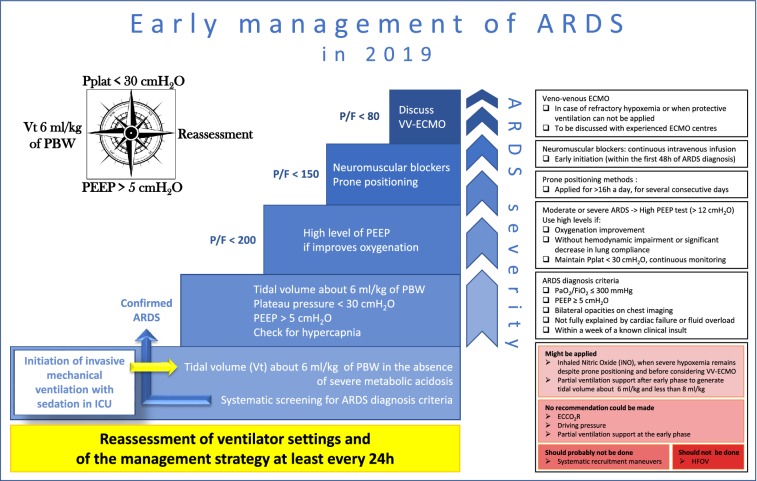
Fifteen recommendations and a therapeutic algorithm regarding the management of acute respiratory distress syndrome (ARDS) at the early phase in adults are proposed. The Grade of Recommendation Assessment, Development and Evaluation (GRADE) methodology has been followed. Four recommendations (low tidal volume, plateau pressure limitation, no oscillatory ventilation, and prone position) had a high level of proof (GRADE 1 + or 1 -); four (high positive end-expiratory pressure [PEEP] in moderate and severe ARDS, muscle relaxants, recruitment maneuvers, and venovenous extracorporeal membrane oxygenation [ECMO]) a low level of proof (GRADE 2 + or 2 -); seven (surveillance, tidal volume for non ARDS mechanically ventilated patients, tidal volume limitation in the presence of low plateau pressure, PEEP > 5 cmH2O, high PEEP in the absence of deleterious effect, pressure mode allowing spontaneous ventilation after the acute phase, and nitric oxide) corresponded to a level of proof that did not allow use of the GRADE classification and were expert opinions. Lastly, for three aspects of ARDS management (driving pressure, early spontaneous ventilation, and extracorporeal carbon dioxide removal), the experts concluded that no sound recommendation was possible given current knowledge. The recommendations and the therapeutic algorithm were approved by the experts with strong agreement.
Overview
The claims and statistics of this paper haven’t been checked yet.
Free: it reads the open-access text and checks the first 5 claims that cite a source we can check. Create a free account to check every claim.
Integrity signals
Registry
Cites
Statistics
Figures
Verification
Claims the paper makes
The claims and statistics of this paper haven’t been checked yet.
Free: it reads the open-access text and checks the first 5 claims that cite a source we can check. Create a free account to check every claim.
Claims other papers make about this one
Each is checked against this paper’s own text: does it say what the citing paper says it does?
In the citing paper
“A recent systematic review which included five RCTs also identified a strong relationship between plateau pressure and mortality [434].”
From Surviving sepsis campaign: international guidelines for management of sepsis and septic shock 2021 (2021) · cites this paper as [434]
Self-check
Percentages, sums and reported differences re-computed from the paper’s own numbers.
The self-check needs the paper’s full text.
Citations
Cites
(2000) · New England Journal of Medicine · doi:10.1056/nejm200005043421801 · Cited by 12,941
Chen, Y., Wang, L., Kang, Q., Zhang, X., Yu, G., Wan, X., Wang, J., & Zhu, K. (2017) · Cellular Physiology and Biochemistry · doi:10.1159/000477308 · Cited by 10,679
Acute Respiratory Distress Syndrome: The Berlin Definition
(2012) · JAMA · doi:10.1001/jama.2012.5669 · Cited by 8,731
Bellani, G., Laffey, J. G., Pham, T., Fan, E., Brochard, L., Esteban, A., Gattinoni, L., van Haren, F., Larsson, A., McAuley, D. F., et al. (2016) · JAMA · doi:10.1001/jama.2016.0291 · Cited by 5,766 · cited 10×
“Plateau pressure was measured in only 40% of ARDS patients [2].”
BackgroundMethodInfluentialSelf-citationProne positioning in severe acute respiratory distress syndrome.
Guérin, C., Reignier, J., Richard, J.-C., Beuret, P., Gacouin, A., Boulain, T., Mercier, E., Badet, M., Mercat, A., Baudin, O., et al. (2013) · New England Journal of Medicine · doi:10.1056/nejmoa1214103 · Cited by 4,040
Self-citationEffect of a protective-ventilation strategy on mortality in the acute respiratory distress syndrome.
Amato, M. B. P., Barbas, C. S. V., Medeiros, D. M., Magaldi, R. B., Schettino, G. P., Lorenzi-Filho, G., Kairalla, R. A., Deheinzelin, D., Munoz, C., Oliveira, R., et al. (1998) · New England Journal of Medicine · doi:10.1056/nejm199802053380602 · Cited by 3,654
Peek, G. J., Mugford, M., Tiruvoipati, R., Wilson, A., Allen, E., Thalanany, M. M., Hibbert, C. L., Truesdale, A., Clemens, F., Cooper, N., et al. (2009) · The Lancet · doi:10.1016/s0140-6736(09)61069-2 · Cited by 3,395
Functional Disability 5 Years after Acute Respiratory Distress Syndrome
Herridge, M. S., Tansey, C. M., Matté, A., Tomlinson, G., Diaz-Granados, N., Cooper, A., Guest, C. B., Mazer, C. D., Mehta, S., Stewart, T. E., et al. (2011) · New England Journal of Medicine · doi:10.1056/nejmoa1011802 · Cited by 2,847
Driving pressure and survival in the acute respiratory distress syndrome.
Amato, M. B. P., Meade, M. O., Slutsky, A. S., Brochard, L., Costa, E. L. V., Schoenfeld, D. A., Stewart, T. E., Briel, M., Talmor, D., Mercat, A., et al. (2015) · New England Journal of Medicine · doi:10.1056/nejmsa1410639 · Cited by 2,801
Self-citation(2004) · New England Journal of Medicine · doi:10.1056/nejmoa032193 · Cited by 2,565
Research works printed but not linked: 1
- Cavalcanti AB Suzumura EA Laranjeira LN Paisani DM Damiani LP Guimaraes HP Effect of lung recruitment and titrated positive end-expiratory pressure (PEEP) vs low PEEP on mortality in patients with acute respiratory distress syndrome: a randomized clinical trial JAMA 2017 318 14 1335 1345 10.1001/jama.2017.14171 28973363 PMC5710484 · DOI · Paper page
Cited by
Items 201–300 of 761
A Comprehensive Review of the Management of Acute Respiratory Distress Syndrome
Ajibowo, A. O., Kolawole, O. A., Sadia, H., Amedu, O. S., Chaudhry, H. A., Hussaini, H., Hambolu, E., Khan, T., Kauser, H., & Khan, A. (2022) · Cureus · doi:10.7759/cureus.30669 · Cited by 15
“Mechanical ventilation to minimize ventilator-induced lung injury (VILI) and management of refractory hypoxemia are the keystones in the supportive management of ARDS [12].”
BackgroundVieillard‐Baron, A., Boissier, F., & Pesenti, A. M. (2023) · Intensive Care Medicine · doi:10.1007/s00134-023-07001-2 · Cited by 18
“A more recent guideline recommended avoidance of excessively high a positive end-expiratory pressure (PEEP) when it induces hemodynamic worsening [3].”
BackgroundSelf-citationZheng, Z., Chang, Z., Chen, Y., Li, J., Huang, T., Huang, Y., Fan, Z., & Gao, J. (2022) · Annals of Translational Medicine · doi:10.21037/atm-22-1737 · Cited by 14
“Acute respiratory distress syndrome (ARDS) is a relatively common and life-threatening clinical syndrome characterized by acute respiratory failure, hypoxemia, and non-hydrostatic pulmonary edema (1,2).”
Hoppe, K., Khan, E., Meybohm, P., & Riese, T. (2023) · Critical Care · doi:10.1186/s13054-023-04375-z · Cited by 16
Sedation-Ventilation Interaction in Acute Hypoxemic Respiratory Failure
Dianti, J., Morris, I. S., Bassi, T. G., Fan, E., Slutsky, A. S., Brochard, L. J., Ferguson, N. D., & Goligher, E. C. (2024) · CHEST Critical Care · doi:10.1016/j.chstcc.2024.100067 · Cited by 12
Self-citationKim, J., Seo, D., Yoo, S.-Y., Lee, H.-J., Kim, J., Yeom, J. E., Lee, J., Park, W., Hong, K. S., & Lee, W. (2025) · Nano Convergence · doi:10.1186/s40580-025-00475-4 · Cited by 14
Extracorporeal Membrane Oxygenation in the Awake or Extubated Patient
Cuttone, G., Via, L. L., Misseri, G., Martucci, G., Sorbello, M., Patroniti, N. A., & Pappalardo, F. (2025) · Journal of Cardiothoracic and Vascular Anesthesia · doi:10.1053/j.jvca.2025.05.021 · Cited by 13
Zheng, Z., Jiang, L., Zhang, S., Guervilly, C., Zhang, M., Feng, X., & Ding, J. (2020) · Respiratory Research · doi:10.1186/s12931-020-1287-4 · Cited by 14
Use of Venovenous Extracorporeal Membrane Oxygenation in Critically-Ill Patients With COVID-19
Jozwiak, M., Chiche, J., Charpentier, J., Hamou, Z. A., Jaubert, P., Benghanem, S., Dupland, P., Gavaud, A., Pène, F., Cariou, A., et al. (2020) · Frontiers in Medicine · doi:10.3389/fmed.2020.614569 · Cited by 13
Self-citationTransforming a paediatric ICU to an adult ICU for severe Covid-19: lessons learned
Chomton, M., Marsac, L., Dehò, A., Maroni, A., Geslain, G., Frannais-Haverland, K., Abdallah, L., Armier, H., Assaker, R., Atger, L., et al. (2021) · European Journal of Pediatrics · doi:10.1007/s00431-021-03992-6 · Cited by 12
“Based on ARDS and Covid-19 ARDS management guidelines [5, 7, 11], a specific medical protocol was written to specify the main rules for ventilator settings, antibiotic treatment, antiviral agents, sedative and analgesic drugs, nutrition, and anticoagulation.”
BackgroundMethodTransfusion-related respiratory complications in intensive care: A diagnosis challenge
Aubron, C., Hourmant, B., Menguy, J., & Sparrow, R. L. (2021) · Transfusion Clinique et Biologique · doi:10.1016/j.tracli.2021.09.007 · Cited by 12
Self-citationManagement of COVID-19 Patients in the Emergency Department
Pantazopoulos, I. N., Tsikrika, S., Kolokytha, S., Manos, E., & Porpodis, Κ. (2021) · Journal of Personalized Medicine · doi:10.3390/jpm11100961 · Cited by 15
“As disease severity may vary from asymptomatic to severe acute respiratory distress syndrome (ARDS), the severity of illness should be identified among with features that recognize patients that are most at risk for clinical deterioration [7].”
BackgroundInfluentialde Marignan, D., Vacheron, C., Ader, F., Lecocq, M., Richard, J., Frobert, É., Casalegno, J., Couray‐Targe, S., Argaud, L., Rimmele, T. R., et al. (2022) · European Journal of Anaesthesiology · doi:10.1097/eja.0000000000001672 · Cited by 13
Self-citationAng, C. Y. S., Chiew, Y. S., Wang, X., Nor, M. B. M., Cove, M. E., & Chase, J. G. (2022) · Computers in Biology and Medicine · doi:10.1016/j.compbiomed.2022.106275 · Cited by 13
Chen, X., Zhou, Y., Zhou, X., Su, P., & Yi, J. (2023) · Nursing in Critical Care · doi:10.1111/nicc.12908 · Cited by 17
Mechanical Power during Veno-Venous Extracorporeal Membrane Oxygenation Initiation: A Pilot-Study
Belliato, M., Epis, F., Cremascoli, L., Ferrari, F., Quattrone, M. G., Fisser, C., Malfertheiner, M. V., Taccone, F. S., Nardo, M. D., Broman, L. M., et al. (2021) · Membranes · doi:10.3390/membranes11010030 · Cited by 12
“The comparison of MV parameters between ICU non-survivors and survivors was limited to the first quartile of ECMO length for each patient, because this period requires the maximal effort to optimize lung protection and to limit VILI [6,47].”
BackgroundMethodKadry, R., Adil, M. S., Sikora, A. N., & Somanath, P. R. (2021) · BioScience Trends · doi:10.5582/bst.2020.03399 · Cited by 12
“NMBA, particularly cisatracurium, is recommended by the guidelines for severe ARDS and is thought to improve mortality by optimizing pulmonary airflow mechanics and oxygenation (3,5).”
BackgroundEarly spontaneous breathing for acute respiratory distress syndrome in individuals with COVID-19
Hohmann, F., Wedekind, L., Grundeis, F., Dickel, S., Frank, J., Golinski, M., Griesel, M., Grimm, C., Herchenhahn, C., Kramer, A., et al. (2022) · Cochrane Database of Systematic Reviews · doi:10.1002/14651858.cd015077 · Cited by 12
Evaluation of the Humidification Performances of New Generation of Heated Wire Humidifiers
Lellouche, F., Rousseau, E., & Bouchard, P.-A. (2023) · Respiratory Care · doi:10.4187/respcare.11352 · Cited by 11
“…strategy in many situations and heated humidifier to reduce dead space during protective mechanical ventilation with low tidal volumes ( # 6 mL/kg predicted body weight as recommended 3,27 ) and in the case of HME contraindications such as the presence of hypothermia or bloody secretions.”
Gandomi, A., Wu, P., Clement, D. R., Xing, J., Aviv, R., Federbush, M., Yuan, Z., Jing, Y., Wei, G., & Hajizadeh, N. (2024) · BMC Medical Informatics and Decision Making · doi:10.1186/s12911-024-02573-5 · Cited by 11
“Early diagnosis of ARDS enables timely implementation of protective lung ventilation strategies and adjunctive measures [11], leading to lower mortality rates [8, 12, 13].”
BackgroundTseng, H.-Y., Chen, C., Lin, Y.-C., Chuang, M., Hsu, W., Hsiao, W. Y., Chen, T.-M., Wang, M.-T., Huang, W., Chen, C., et al. (2022) · Critical Care · doi:10.1186/s13054-022-04091-0 · Cited by 14
“Despite the ongoing discussions about the key index of ventilator’s setting, the concept of lung protective strategies, such as low tidal volume (approximately 6 mL/ kg predicted body weight) and limited plateau pressure ( 30 cmH 2 O), has become a standard of care in ARDS management [2].”
BackgroundInfluentialGoličnik, A., Živanović, I., Gorjup, V., & Berden, J. (2023) · Journal of Intensive Care Medicine · doi:10.1177/08850666231157286 · Cited by 12
“Days from hospital admission to cannulation 5 (2-10) 10 (5-14) 2 (1-5) 4 (2-7) <.”
Giri, J. P., Al‐Lohedan, H. A., Mohammad, F., Soleiman, A. A., Chadge, R., Mahatme, C., Sunheriya, N., Giri, P. J., Mutyarapwar, D., & Dhapke, S. (2023) · Bioengineering · doi:10.3390/bioengineering10040418 · Cited by 11
“…a condition that can arise in mechanically ventilated patients as a result of a combination of excessive pressure (barotrauma), excessive volume (volutrauma), repeated alveolar opening and shutting (atelectrauma), inflammatory mediator release from the lung (biotrauma) and oxygen toxicity [12–20].”
BackgroundPrognostic value of respiratory compliance course on mortality in COVID-19 patients with vv-ECMO
Valentin, S., Amalric, M., Granier, G., Péquignot, B., Guervilly, C., Duarte, K., Girerd, N., Lévy, B., Dunand, P., Koszutski, M., et al. (2023) · Annals of Intensive Care · doi:10.1186/s13613-023-01152-7 · Cited by 12
“Similarly, recommendations on protective mechanical ventilation in ARDS patients were also far better respected, whereas patients presented a critical respiratory state [23].”
BackgroundOxygenation target in acute respiratory distress syndrome
Capellier, G., Barrot, L., & Winizewski, H. (2023) · Journal of Intensive Medicine · doi:10.1016/j.jointm.2023.03.002 · Cited by 12
Hsu, P.-C., Lin, Y.-T., Kao, K., Peng, C., Sheu, C., Liang, S., Chan, M.-C., Wang, H., Chen, Y., Chen, W., et al. (2024) · Respiratory Research · doi:10.1186/s12931-023-02648-3 · Cited by 13
“There are formal guidelines that recommend continuous infusion of NMBAs for less 48 h [44] and evaluation daily by specialized physicians for ongoing use.”
BackgroundGiani, M., Redaelli, S., Siragusa, A., Fumagalli, B., Rona, R., & Foti, G. (2021) · Membranes · doi:10.3390/membranes11030172 · Cited by 13
Cheong, I., Castro, V. O., Gómez, R. A., Merlo, P. M., & Tamagnone, F. M. (2022) · The International Journal of Cardiovascular Imaging · doi:10.1007/s10554-022-02659-z · Cited by 11
“Current guidelines recommend prone positioning for a prolonged period of time in adult patients with ARDS and deep hypoxemia [2, 3].”
BackgroundRajdev, K., Farr, L. A., Saeed, M. A., Hooten, R., Baus, J., & Boer, B. (2020) · Journal of Investigative Medicine High Impact Case Reports · doi:10.1177/2324709620957778 · Cited by 12
Umbrello, M., Lassola, S., Sanna, A., Pace, R., Magnoni, S., & Miori, S. (2022) · Critical Care · doi:10.1186/s13054-022-04141-7 · Cited by 10
“This is in line with the available literature of both COVID-19 and non-COVID-19 patients [3, 33, 34] and confirms how prone positioning is the standard of care in patients with moderate-severe forms of ARDS [35, 36].”
ResultPhoophiboon, V., Owattanapanich, N., Owattanapanich, W., & Schellenberg, M. A. (2023) · BMC Pulmonary Medicine · doi:10.1186/s12890-023-02805-w · Cited by 11
“Consequently, there are alternative methods proposed to help improve outcomes, including prone positioning [27].”
MethodCoppola, S., Catozzi, G., Pozzi, T., Monte, A., Besana, G., Depedri, L., & Chiumello, D. (2025) · Critical Care · doi:10.1186/s13054-025-05459-8 · Cited by 11
Delivering evidence-based critical care for mechanically ventilated patients with COVID-19
Salluh, J. I., Ramos, F. J. D. S., & Chiche, J. (2020) · The Lancet Respiratory Medicine · doi:10.1016/s2213-2600(20)30266-6 · Cited by 11
Self-citationFavre, P. A., de Molliens, L., Petit, L., Biais, M., & Carrié, C. (2020) · The American Journal of Emergency Medicine · doi:10.1016/j.ajem.2020.09.050 · Cited by 10
Ethgen, O., GOLDSTEIN, J. P., Harenski, K., Dessap, A. M., Morimont, P., Quintel, M., & Combes, A. (2021) · Journal of Critical Care · doi:10.1016/j.jcrc.2021.01.014 · Cited by 10
“LPV with Vt ≈ 6 mL/kg PBW and Pplat ≈ 20–30 cm H2O + ECCO2R initiated for patients with PaCO2 > 55 mmHg under LPV before starting ECCO2R [23,24]; (3).”
BackgroundSelf-citationSequelae of traumatic rib fractures: management in the Emergency Department
Gavelli, F., Patrucco, F., Daverio, M., Vita, N. D., Bellan, M., Rena, O., Balbo, P. E., Avanzi, G. C., & Castello, L. M. (2020) · Minerva Respiratory Medicine · doi:10.23736/s0026-4954.19.01863-7 · Cited by 10
Serck, N., Piagnerelli, M., Augy, J. L., Annoni, F., Ottavy, G., Courcelle, R., Carbutti, G., Lejeune, F., Vinsonneau, C., Sauneuf, B., et al. (2023) · BMC Anesthesiology · doi:10.1186/s12871-023-02093-1 · Cited by 11
“Protective ventilation strategies that limit ventilation volumes and pressures are recommended to avoid these complications, notably in patients with ARDS [6].”
BackgroundPérez, J., Accoce, M., Dorado, J. H., Gilgado, D. I., Navarro, E., Cardoso, G. P., Telías, I., Rodríguez, P., & Brochard, L. J. (2023) · Critical Care Explorations · doi:10.1097/cce.0000000000000968 · Cited by 10
Self-citationGe, H., Zhang, A., Teng, Y., & Li, H. (2024) · Frontiers in Pediatrics · doi:10.3389/fped.2024.1344709 · Cited by 10
Charbit, J., Deras, P., Courvalin, E., Laumon, T., Dagod, G., Martinez, O., & Capdevila, X. (2021) · Artificial Organs · doi:10.1111/aor.13916 · Cited by 10
Clinical characteristics and outcomes of critically ill COVID-19 patients in Sfax, Tunisia
Bahloul, M., Kharrat, S., Chtara, K., Hafdhi, M., Turki, O., Baccouche, N., Ammar, R., Kallel, N., Hsairi, M., Chakroun-Walha, O., et al. (2021) · Acute and Critical Care · doi:10.4266/acc.2021.00129 · Cited by 10
“According to arterial oxygen tension (PaO2)/fractional inspired oxygen (FiO2) ratio, ARDS was classified as mild (200< PaO2/FiO2 ≤300 mm Hg), moderate (100< PaO2/FiO2 ≤200 mm Hg), or severe (PaO2/FiO2 ≤100 mmHg) [15].”
BackgroundResultInfluentialKwizera, A., Kateete, D. P., Ssenyonga, R., Nakiyingi, L., Nakibuuka, J., Namata, C., Mwanje, A. K., Okello, E., Kabatoro, D., Kiwanuka, N., et al. (2021) · Annals of the American Thoracic Society · doi:10.1513/annalsats.202103-270rl · Cited by 10
Nasrullah, A., Virk, S. T., SHAH, A. A., Jacobs, M. W., Hamza, A., Sheikh, A. B., Javed, A., Butt, M. A., & Sangli, S. S. (2022) · Life · doi:10.3390/life12111766 · Cited by 11
Yan, Y., Bao, J., Cai, S., Zhong, X., Geng, B., Liang, J., Deng, Z., Chen, Z., Qin, Z.-S., Hu, H., et al. (2025) · Journal of Intensive Care · doi:10.1186/s40560-025-00795-x · Cited by 11
“Patients were divided into two groups based on the duration of their first prone session: ≥ 16 h (prolonged prone positioning, PPP) or 16 h (standard prone positioning, SPP) [11, 13, 22].”
Synopsis of Clinical Acute Respiratory Distress Syndrome (ARDS)
Mane, A., & Isaac, N. (2021) · Advances in experimental medicine and biology · doi:10.1007/978-3-030-68748-9_16 · Cited by 9
COVID-19 Lessons Learned: Prone Positioning With and Without Invasive Ventilation
Scott, J. B., Weiss, T. T., & Li, J. (2022) · Respiratory Care · doi:10.4187/respcare.10141 · Cited by 9
“14,15 As the global COVID-19 pandemic evolved, PP was also recommended for patients with COVID-19–induced severe hypoxemic respiratory failure.”
Maamar, A., Liard, C., Doucet, W., Reizine, F., Painvin, B., Delamaire, F., Coirier, V., Quelven, Q., Guillot, P., Lesouhaitier, M., et al. (2022) · Virology Journal · doi:10.1186/s12985-022-01868-1 · Cited by 11
“All ARDS patients in both groups received protective ventilation according to published guidelines [22], especially: assist-control mode, initial tidal volume targeted at 6 mL per kilogram of predicted body weight, titration of positive end-expiratory pressure (PEEP) level and endinspiratory pressure measured at least…”
MethodBurzyńska, M., Uryga, A., Kasprowicz, M., Czosnyka, M., Goździk, W., & Robba, C. (2023) · Neurocritical Care · doi:10.1007/s12028-023-01700-w · Cited by 9
“VV ECMO support was initiated in cases of severe hypoxic respiratory failure or carbon dioxide retention despite conventional management, including lungprotective mechanical ventilation, prone positioning, and neuromuscular blockade according to local protocols and current guidelines [10].”
MethodKenny, J. S. (2023) · Frontiers in Physiology · doi:10.3389/fphys.2023.1230654 · Cited by 9
“Guidelines currently recommend prone position for patients with ARDS and a partial pressure-to-fraction of inspired oxygen (PaO2/FiO2) ratio of not more than 150 mmHg (Papazian et al., 2019).”
BackgroundBattaglini, D., Robba, C., Pelosi, P. P., & Rocco, P. R. M. (2022) · Expert Opinion on Emerging Drugs · doi:10.1080/14728214.2022.2105833 · Cited by 11
“Therefore, recent evidence suggests using PEEP levels >12 cmH2O only in selected cases, and recruitment maneuvers only as a rescue strategy [24,25].”
BackgroundLuján, M., Gómez, C. C., Peñuelas, Ó., Ferrando, C., Heili-Frades, S. B., Perales, J. M. C., Mas, A., Catalán, J. S., Mediano, O., Roca, O., et al. (2024) · Archivos de Bronconeumología · doi:10.1016/j.arbres.2024.02.017 · Cited by 12
“60,61 Since the publication of the PROSEVA study, it should be 62 favors lung recruitment, improving homogeneity and reducing lung stress and strain.”
BackgroundMesland, J.-B., Carlier, E., François, B., Serck, N., Gérard, L., Briat, C., Piagnerelli, M., Laterre, P., & On Behalf Of The Covcorvap Collaboration Group (2022) · Microorganisms · doi:10.3390/microorganisms10050984 · Cited by 10
“Management of ARDS and VAP prevention care bundle were conducted in line with current guidelines [13,14].”
MethodInstrumental dead space in ventilator management
Lellouche, F., Grieco, D. L., Maggiore, S. M., & Antonelli, M. M. (2021) · The Lancet Respiratory Medicine · doi:10.1016/s2213-2600(21)00024-2 · Cited by 9
Haudebourg, A.-F., Chantelot, L., Nemlaghi, S., Haudebourg, L., Labedade, P., Boujelben, M. A., Voiriot, G., Dessap, A. M., Fartoukh, M. S., & Carteaux, G. (2025) · Annals of Intensive Care · doi:10.1186/s13613-025-01484-6 · Cited by 8
“Ventilation strategies during the early phase of ARDS have been extensively studied, leading to updated recommendations [2–4].”
Awake Self–Prone Positioning: Implementation During the COVID-19 Pandemic
Allicock, K. A., Coyne, D., Garton, A. N., Hare, E. C., & Seckel, M. A. (2021) · Critical Care Nurse · doi:10.4037/ccn2021153 · Cited by 8
Guérin, C., Bayat, S., Noury, N., Cour, M., Argaud, L., Louis, B., & Terzi, N. (2021) · Journal of Applied Physiology · doi:10.1152/japplphysiol.00104.2021 · Cited by 9
Self-citationAlexandre, A. R., Rocha, F. R., Landeiro, L., Mota, P., Jones, J., & Gomes, J. A. (2021) · Critical Care Explorations · doi:10.1097/cce.0000000000000422 · Cited by 9
“Survival improved with ventilator adjustments that lead to decreases in driving pressure (ideally below 13–15 cm H2O) (18) limiting lung overstress and overstrain.”
BackgroundMethodInfluentialBastin, M. L. T., Smith, R. R., Bissell, B. D., Wolf, H. N., Wiegand, A. M., Cavagnini, M. E., Ahmad, Y., & Flannery, A. H. (2021) · Journal of Critical Care · doi:10.1016/j.jcrc.2021.05.011 · Cited by 8
Redko, O., Dovgalyuk, A., Довбуш, А. В., Небесна, З. М., Yakubyshyna, L. V., & Krynytska, І. (2021) · Cell and Organ Transplantology · doi:10.22494/cot.v9i2.130 · Cited by 10
Lung Mechanics Over the Century: From Bench to Bedside and Back to Bench
Biselli, P., Lopes, F. D. T. Q. D. S., Righetti, R. F., Moriya, H. T., Tiberio, I. F. L. C., & Martins, M. A. (2022) · Frontiers in Physiology · doi:10.3389/fphys.2022.817263 · Cited by 10
“Although ARDS guidelines advised against the use of targets of driving pressure (Papazian et al., 2019), this measurement integrates the concepts of disease severity (lung compliance) and ventilator management (tidal volume).”
BackgroundMethodInfluentialPain in critically ill COVID-19 patients: An Italian retrospective study
Petrucci, E., Cofini, V., Pizzi, B., Cascella, M., Marrocco, G., Ceccaroni, G., Necozione, S., Vittori, A., & Marinangeli, F. (2022) · Open Medicine · doi:10.1515/med-2022-0600 · Cited by 8
“Commonly administered sedative agents (SAs) and neuromuscular blocking agents (NMBAs) used for patient comfort and lung-protective ventilation have been recognized as risk factors of these syndromes [7,8].”
BackgroundPathogenesis, Prognosis and Outcomes of Multiple Organ Failure in Newborns (Review)
Golomidov, A. V., Grigoryev, E. V., Moses, V. G., & Мозес, К. Б. (2022) · General Reanimatology · doi:10.15360/1813-9779-2022-6-37-49 · Cited by 10
Woolger, C., Rollinson, T. C., Oliphant, F., Ross, K., Ryan, B., Bacolas, Z., Burleigh, S., Jameson, S., McDonald, L. A., Rose, J., et al. (2024) · Intensive and Critical Care Nursing · doi:10.1016/j.iccn.2024.103623 · Cited by 8
Wang, R., Tang, X., Li, X., Li, Y., Liu, Y., Li, T., Zhao, Y. Q., Wang, L., Li, H., Li, M., et al. (2024) · Annals of Intensive Care · doi:10.1186/s13613-024-01365-4 · Cited by 8
“PP became standard care after the PROSEVA trial was published [2] and was used even more after the coronavirus disease 2019 (COVID-19) pandemic began [3].”
MethodDing, H., Zhang, S., Li, Z., Zeng, J., & Zeng, H. (2024) · Cytokine · doi:10.1016/j.cyto.2024.156806 · Cited by 8
SARS-CoV-2: recommendations for treatment in intensive care medicine
Köstenberger, M., Hasibeder, W. R., Dankl, D., Germann, R., Hörmann, C., Joannidis, M., Markstaller, K., Müller-Muttonen, S.-O., Neuwersch-Sommeregger, S., Schaden, E., et al. (2020) · Wiener klinische Wochenschrift · doi:10.1007/s00508-020-01734-6 · Cited by 10
Jirak, P., Shomanova, Z., Larbig, R. K., Dankl, D., Frank, N., Seelmaier, C., Butkiene, D., Lichtenauer, M., Mirna, M., Strohmer, B., et al. (2021) · European Heart Journal · doi:10.1093/eurheartj/ehab724.0287 · Cited by 8
Neto, A. S., TOMLINSON, G. A., Sahetya, S. K., Ball, L., Nichol, A., Hodgson, C. L., Cavalcanti, A. B., Briel, M., de Abreu, M. G., Pelosi, P. P., et al. (2021) · Critical Care and Resuscitation · doi:10.51893/2021.2.oa4 · Cited by 12
Herranz, L. B., da Silveira, J. G., Trocado, L. F. L., Alvaraes, A. L., & Fittipaldi, J. (2021) · The Journal of Critical Care Medicine · doi:10.2478/jccm-2021-0033 · Cited by 8
“Studies in refractory hypoxemia among patients with severe acute respiratory distress syndrome (ARDS) suggest that iNO may be allied to other ventilatory strategies as a bridge to clinical improvement [2, 3].”
COVID-19 : Prise en charge aux soins intensifs
Krähenbühl, M., Oddo, M., Piquilloud, L., & Pantet, O. (2020) · JMIG · doi:10.53738/revmed.2020.16.691.0863 · Cited by 12
Ugalde, D., Medel, J. N., Mercado, P., Pairumani, R., Eisen, D., Petruska, E., Montoya, J., Morales, F., Araya, C., & Valenzuela, E. D. (2022) · Journal of Ultrasound · doi:10.1007/s40477-022-00652-9 · Cited by 8
“Covid-19 pandemic has imposed a work overload on healthcare staff in intensive care units (ICUs) with patients with severe respiratory failure and high mortality rates [3–6] many of them requiring prone position as recommended in acute respiratory distress syndrome (ARDS) guidelines [7].”
BackgroundLiou, J., Doherty, D., Gillin, T., Emberger, J. S., Yi, Y., Cardenas, L., Benninghoff, M. G., Vest, M. T., & Deitchman, A. R. (2022) · Critical Care Explorations · doi:10.1097/cce.0000000000000690 · Cited by 8
“Continuous renal replacement therapy 2 (7)”
Beyls, C., Daumin, C., Hermida, A., Booz, T., Ghesquières, T., Crombet, M., Martín, N. L.-S., Huette, P., Jounieaux, V., Dupont, H., et al. (2022) · Journal of Clinical Medicine · doi:10.3390/jcm11092625 · Cited by 8
“During TEE examination, all patients were sedated and paralyzed in accordance with ARDS management guidelines [13].”
MethodIncidence of pressure ulcers due to prone position in patients admitted to the ICU for Covid-19
Juan, E. P., Maqueda-Palau, M., Feliu-Roig, C., Gómez-Arroyo, J. M., Sáez-Romero, D., & Ortiz-Monjo, A. (2023) · Enfermería Intensiva (English ed ) · doi:10.1016/j.enfie.2022.12.001 · Cited by 10
Fumagalli, B., Giani, M., Bombino, M., Fumagalli, D., Merelli, M., Chiesa, G. B., Rona, R., Bellani, G., Rezoagli, E., & Foti, G. (2024) · ASAIO Journal · doi:10.1097/mat.0000000000002285 · Cited by 7
“4,6 This approach aims to reduce the duration of sedation and muscular paralysis.”
Vedrenne‐Cloquet, M., Petit, M., Khirani, S., Charron, C., Khraiche, D., Panaioli, E., Habib, M., Renolleau, S., Fauroux, B., & Vieillard‐Baron, A. (2024) · Intensive Care Medicine Experimental · doi:10.1186/s40635-024-00671-2 · Cited by 9
Self-citationSweeney, D. A., & Malhotra, A. (2021) · Current Opinion in Critical Care · doi:10.1097/mcc.0000000000000863 · Cited by 7
Charbit, J., Courvalin, E., Dagod, G., Deras, P., Laumon, T., Girard, M., Maury, C., Weber, H., & Capdevila, X. (2022) · Intensive Care Medicine Experimental · doi:10.1186/s40635-022-00434-x · Cited by 8
Mutair, A. S. A., Alhumaid, S., Layqah, L. A., Shamou, J. Z., Ahmed, G. Y., Chagla, H. H., Alsalman, K., Alnasser, F. M., Koritala, T., Alhuqbani, W. N., et al. (2022) · COVID · doi:10.3390/covid2080081 · Cited by 7
Cai, Z.-Y., Xu, B., Zhang, W., Peng, H.-W., Xu, Q., Yu, H.-B., Chu, Q.-G., & Zhou, S.-S. (2022) · World Journal of Clinical Cases · doi:10.12998/wjcc.v10.i30.11122 · Cited by 7
RIP1 Kinase Inactivation Protects Against LPS-Induced Acute Respiratory Distress Syndrome in Mice
Mago, E., Zhao, X., Zhang, W., Shao, Q., Li, P., Huang, S., Ding, X., Liu, H., Sun, T., He, F., et al. (2024) · International Immunopharmacology · doi:10.1016/j.intimp.2024.112060 · Cited by 7
Extended Prone Position and 90-Day Mortality in Mechanically Ventilated Patients With COVID-19
Estrella-Alonso, A., Silva, J. A., Fernández-Tobar, R., Marian-Crespo, C., Santaquiteria-Torres, V. R. D., Jiménez-Puente, G., Arroyo‐Espliguero, R., Viana-Llamas, M. C., Ramírez-Cervantes, K. L., & Quintana‐Díaz, M. (2024) · Respiratory Care · doi:10.4187/respcare.11622 · Cited by 9
“6,23 However, the ultimate decision to initiate PP was left to the discretion of the attending intensivist.”
On the feasibility of a robotic probe manipulator for echocardiography in the prone position
Gifari, M. W., Machino‐Ohtsuka, T., Machino, T., Hassan, M., & Suzuki, K. (2024) · Frontiers in Robotics and AI · doi:10.3389/frobt.2024.1474077 · Cited by 7
Parhar, K. K. S., Zjadewicz, K., Knight, G., Soo, A., Boyd, J. M., Zuege, D. J., Niven, D. J., Doig, C. J., & Stelfox, H. T. (2021) · Critical Care Explorations · doi:10.1097/cce.0000000000000428 · Cited by 7
“For example, although several guidelines exist for the management of ARDS, most of these guidelines address only certain aspects of ARDS management (Table 4) and do not address team member roles or timing of diagnostics and therapeutics (9, 10, 15, 16).”
BackgroundOh, W., Jayaraman, P., Sawant, A. S., Chan, L., Levin, M. A., Charney, A. W., Kovatch, P., Glicksberg, B. S., & Nadkarni, G. N. (2021) · Journal of the American Medical Informatics Association · doi:10.1093/jamia/ocab252 · Cited by 8
Abman, S. H., Fox, N. R., Malik, M. I., Kelkar, S. S., Corman, S. L., Rege, S., Bhaloo, J., Shah, R., Shei, R., Saporito, D., et al. (2022) · Drugs in Context · doi:10.7573/dic.2022-1-4 · Cited by 7
Resende, M. H. F., Yarnell, C. J., D'Souza, R. D., Lapinsky, S. E., Nam, A., Shah, V. S., Whittle, W. L., Wright, J. K., & Naimark, D. M. J. (2022) · American Journal of Obstetrics & Gynecology MFM · doi:10.1016/j.ajogmf.2022.100697 · Cited by 12
Dilken, O., Rezoagli, E., Dumanlı, G. Y., Ürkmez, S., Demirkıran, O., & Dikmen, Y. (2022) · Frontiers in Medicine · doi:10.3389/fmed.2022.1056766 · Cited by 9
Aslam, T. N., Klitgaard, T., Ahlstedt, C., Andersen, F. H., Chew, M. S., Collet, M. O., Cronhjort, M., Estrup, S., Fossum, O. K., Frisvold, S. K., et al. (2023) · Acta Anaesthesiologica Scandinavica · doi:10.1111/aas.14317 · Cited by 7
Yan, Y., Geng, B., Liang, J., Wen, Y., Bao, J., Zhong, X., Chen, M., Liu, L., Duan, J., Zeng, Z., et al. (2024) · Intensive and Critical Care Nursing · doi:10.1016/j.iccn.2024.103804 · Cited by 9
Multiobjective optimization challenges in perioperative anesthesia: A review
Brennan, M. M., Hagan, J. D., Giordano, C. R., Loftus, T. J., Price, C. E., Aytuğ, H., & Tighe, P. J. (2020) · Surgery · doi:10.1016/j.surg.2020.11.005 · Cited by 9
Krieger, J. A., McGuire, F., Risa, E. L., Longino, A. A., Coppess, S. M., Riveros, T., Hebert, C., Town, J. A., Bhatraju, P. K., & Johnson, N. J. (2021) · Journal of the American College of Emergency Physicians Open · doi:10.1002/emp2.12350 · Cited by 7
Computed tomography after severe COVID-19 pneumonia: findings at 6 months and beyond
Poitevineau, T., Chassagnon, G., Bouam, S., Jaubert, P., Cheurfa, C., Regard, L., Canniff, E., Dinh‐Xuan, A. T., & Revel, M. (2021) · ERJ Open Research · doi:10.1183/23120541.00488-2021 · Cited by 7
“Management of ARDS was standardised, in accordance with the guidelines from the French Intensive Care Society [14].”
MethodTen questions ICU specialists should address when managing cardiogenic acute pulmonary oedema
Aïssaoui, N., Hamzaoui, O., & Price, S. (2022) · Intensive Care Medicine · doi:10.1007/s00134-022-06639-8 · Cited by 7
“Indeed, there is a potential overlap between ARDS and APE since ARDS definition includes “Respiratory failure not completely explained by excessive volume loading or cardiac failure” [3].”
BackgroundZbiral, M., Weber, M., König, S., Kraft, F., Ullrich, R., & Krenn, K. (2023) · Frontiers in Medicine · doi:10.3389/fmed.2023.1088709 · Cited by 7
Management of Hantavirus Cardiopulmonary Syndrome in Critical Care Transport: A Review
Essex, K., Mullen, J., Lauria, M., & Braude, D. A. (2023) · Air Medical Journal · doi:10.1016/j.amj.2023.07.011 · Cited by 6
Hsu, C.-W., Liu, S.-M., Yang, C.-Y., Sun, S., Kuo, S., & Chu, K.-A. (2025) · Journal of Clinical Medicine · doi:10.3390/jcm14207261 · Cited by 6
Manual Prone Positioning in Adults: Reducing the Risk of Harm Through Evidence-Based Practices
Morata, L., Vollman, K. M., Rechter, J. L., & Cox, J. (2023) · Critical Care Nurse · doi:10.4037/ccn2023201 · Cited by 10
Optimal Prone Position Duration in Patients With ARDS Due to COVID-19: The Omelette Pilot Trial
de la Fuente, I. S., Morales, A. M., Calahorro, R. M., Valiente, E. Á., Griffith, M. S., Alves, S. C., Collado, Z. M., de Aledo, A. L. G., Badía, I. M., Fernández, M. G., et al. (2024) · Respiratory Care · doi:10.4187/respcare.11192 · Cited by 6
“13,14 Albeit, according to epidemiologic studies PP is used in 20% of patients suffering from severe ARDS.”
Xie, K., Jing, H., Guan, S.-N., Kong, X., Ji, W., Du, C., Jia, M., & Wang, H. (2024) · European journal of medical research · doi:10.1186/s40001-024-01837-0 · Cited by 6
“According to the formal management guidelines of ARDS [45], severe cases of ARDS with PaO 2 /FiO 2 80 mmHg and/or dangerous MV, despite optimization of ARDS management including high PEEP, neuromuscular blocking agents and prone positioning, should probably be considered for venovenous ECMO.”
Method
Metadata
- Authors
- Papazian, L., Aubron, C., Brochard, L., Chiche, J.-D., Combes, A., Dreyfuss, D., Forel, J.-M., Guérin, C., Jaber, S., Mekontso-Dessap, A., Mercat, A., Richard, J.-C., Roux, D., Vieillard-Baron, A., & Faure, H.
- Affiliations
- Assistance Publique Hôpitaux de Marseille (FR)
- Centre Hospitalier Régional Universitaire de Brest (FR)
- University of Toronto (CA)
- Hôpital Cochin (FR)
- Assistance Publique – Hôpitaux de Paris (FR)
- Hôpital Louis-Mourier (FR)
- Hôpital de la Croix-Rousse (FR)
- Inserm (FR)
- Centre Hospitalier Universitaire d'Angers (FR)
- Centre de Recherche en Acquisition et Traitement de l'Image pour la Santé (FR)
- Centre hospitalier Robert-Ballanger (FR)
- Corresponding author
- Papazian, Laurent
- ORCID
- Venue
- Annals of Intensive Care
- Publisher
- Elsevier BV
- Published
- 2019
- Volume
- 9
- Issue
- 1
- Pages
- 69
- ISSN
- 2110-5820 (ISSN-L)
- PMC
- PMC6565761
- OpenAlex
- W2953390211
- Cited by
- 761
- References
- 146
- Citations by year
- 2026: 33 · 2025: 60 · 2024: 86 · 2023: 128 · 2022: 159 · 2021: 152 · 2020: 131 · 2019: 12
- FWCI
- 19.11
- Type
- journal article
- Language
- en
- Open access
- gold
- doi.org
- Licence
- cc-by
- www.elsevier.com/tdm/userlicense/1.0/ (tdm)
- www.elsevier.com/legal/tdmrep-license (tdm)
- creativecommons.org/licenses/by-nc-nd/4.0/ (vor, 2514 d)
- Locations
- Annals of Intensive Care (publishedVersion, cc-by)
- PubMed Central (publishedVersion, cc-by)
- PubMed (publishedVersion)
- TSpace (University of Toronto) (submittedVersion, cc-by)
- HAL (submittedVersion, other-oa)
- DOAJ (DOAJ: Directory of Open Access Journals) (submittedVersion, cc-by-sa)
- Funders
- Société de Réanimation de Langue Française
- Topics
- Health Sciences › Medicine › Pulmonary and Respiratory Medicine › Respiratory Support and Mechanisms
- Health Sciences › Medicine › Pulmonary and Respiratory Medicine › Neonatal Respiratory Health Research
- Health Sciences › Medicine › Anesthesiology and Pain Medicine › Airway Management and Intubation Techniques
- Keywords
- acute respiratory distress syndrome, mechanical ventilation, low tidal volume ventilation, plateau pressure, positive end-expiratory pressure, prone positioning, oscillatory ventilation, muscle relaxants, recruitment maneuvers, veno-venous extracorporeal membrane oxygenation, nitric oxide, driving pressure, spontaneous breathing, extracorporeal carbon dioxide removal, treatment algorithm
About these checks
Registry, retraction, Cites and statistics results are computed, not judged, with one exception: a printed reference that no index lists is read once by a model before it counts as a citation error. Claims are extracted by a model and kept only when their quote appears verbatim in the text; each cited source is then checked, with a model’s help, for whether it says what the claim relies on. Those verdicts can be wrong — read the claim’s quote and the cited source before relying on one.
Statistics and arithmetic are recomputed, not judged.
Confidence bands are shown only for fields calibrated on our annotated test set. None is calibrated yet, so no band is shown.
What counts as a claim ›How we measure confidence ›How we check this ›
Are you an author, or do you see a problem with this page? Request a review
Data sources
Bibliographic data: Semantic Scholar, OpenAlex, Crossref.
Contains information from the Semantic Scholar Academic Graph Datasets, made available under the ODC Attribution License (ODC-BY 1.0).
Semantic Scholar’s data is described in: Kinney, R., et al. (2023). The Semantic Scholar Open Data Platform. arXiv:2301.10140.
