

Formal guidelines: Management of acute respiratory distress syndrome.
Open accessThe DOI matches its Crossref record; 146 of the 146 references it cites were found in a registry or an index.
Abstract
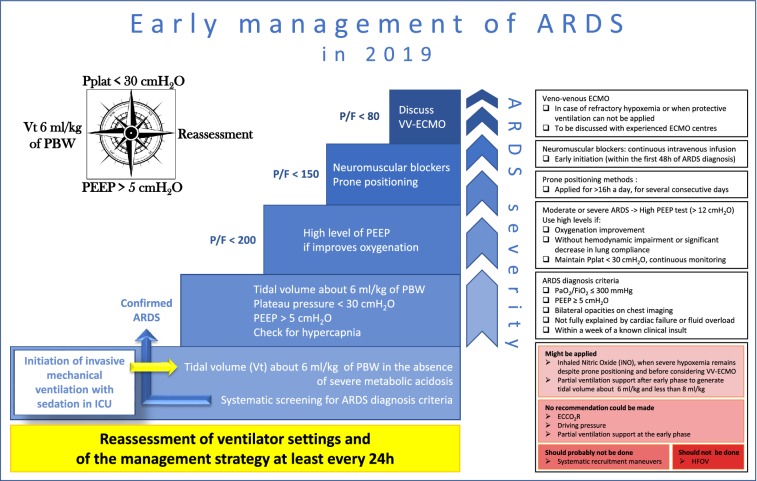
Fifteen recommendations and a therapeutic algorithm regarding the management of acute respiratory distress syndrome (ARDS) at the early phase in adults are proposed. The Grade of Recommendation Assessment, Development and Evaluation (GRADE) methodology has been followed. Four recommendations (low tidal volume, plateau pressure limitation, no oscillatory ventilation, and prone position) had a high level of proof (GRADE 1 + or 1 -); four (high positive end-expiratory pressure [PEEP] in moderate and severe ARDS, muscle relaxants, recruitment maneuvers, and venovenous extracorporeal membrane oxygenation [ECMO]) a low level of proof (GRADE 2 + or 2 -); seven (surveillance, tidal volume for non ARDS mechanically ventilated patients, tidal volume limitation in the presence of low plateau pressure, PEEP > 5 cmH2O, high PEEP in the absence of deleterious effect, pressure mode allowing spontaneous ventilation after the acute phase, and nitric oxide) corresponded to a level of proof that did not allow use of the GRADE classification and were expert opinions. Lastly, for three aspects of ARDS management (driving pressure, early spontaneous ventilation, and extracorporeal carbon dioxide removal), the experts concluded that no sound recommendation was possible given current knowledge. The recommendations and the therapeutic algorithm were approved by the experts with strong agreement.
Overview
The claims and statistics of this paper haven’t been checked yet.
Free: it reads the open-access text and checks the first 5 claims that cite a source we can check. Create a free account to check every claim.
Integrity signals
Registry
Cites
Statistics
Figures
Verification
Claims the paper makes
The claims and statistics of this paper haven’t been checked yet.
Free: it reads the open-access text and checks the first 5 claims that cite a source we can check. Create a free account to check every claim.
Claims other papers make about this one
Each is checked against this paper’s own text: does it say what the citing paper says it does?
In the citing paper
“A recent systematic review which included five RCTs also identified a strong relationship between plateau pressure and mortality [434].”
From Surviving sepsis campaign: international guidelines for management of sepsis and septic shock 2021 (2021) · cites this paper as [434]
Self-check
Percentages, sums and reported differences re-computed from the paper’s own numbers.
The self-check needs the paper’s full text.
Citations
Cites
(2000) · New England Journal of Medicine · doi:10.1056/nejm200005043421801 · Cited by 12,941
Chen, Y., Wang, L., Kang, Q., Zhang, X., Yu, G., Wan, X., Wang, J., & Zhu, K. (2017) · Cellular Physiology and Biochemistry · doi:10.1159/000477308 · Cited by 10,679
Acute Respiratory Distress Syndrome: The Berlin Definition
(2012) · JAMA · doi:10.1001/jama.2012.5669 · Cited by 8,731
Bellani, G., Laffey, J. G., Pham, T., Fan, E., Brochard, L., Esteban, A., Gattinoni, L., van Haren, F., Larsson, A., McAuley, D. F., et al. (2016) · JAMA · doi:10.1001/jama.2016.0291 · Cited by 5,766 · cited 10×
“Plateau pressure was measured in only 40% of ARDS patients [2].”
BackgroundMethodInfluentialSelf-citationProne positioning in severe acute respiratory distress syndrome.
Guérin, C., Reignier, J., Richard, J.-C., Beuret, P., Gacouin, A., Boulain, T., Mercier, E., Badet, M., Mercat, A., Baudin, O., et al. (2013) · New England Journal of Medicine · doi:10.1056/nejmoa1214103 · Cited by 4,040
Self-citationEffect of a protective-ventilation strategy on mortality in the acute respiratory distress syndrome.
Amato, M. B. P., Barbas, C. S. V., Medeiros, D. M., Magaldi, R. B., Schettino, G. P., Lorenzi-Filho, G., Kairalla, R. A., Deheinzelin, D., Munoz, C., Oliveira, R., et al. (1998) · New England Journal of Medicine · doi:10.1056/nejm199802053380602 · Cited by 3,654
Peek, G. J., Mugford, M., Tiruvoipati, R., Wilson, A., Allen, E., Thalanany, M. M., Hibbert, C. L., Truesdale, A., Clemens, F., Cooper, N., et al. (2009) · The Lancet · doi:10.1016/s0140-6736(09)61069-2 · Cited by 3,395
Functional Disability 5 Years after Acute Respiratory Distress Syndrome
Herridge, M. S., Tansey, C. M., Matté, A., Tomlinson, G., Diaz-Granados, N., Cooper, A., Guest, C. B., Mazer, C. D., Mehta, S., Stewart, T. E., et al. (2011) · New England Journal of Medicine · doi:10.1056/nejmoa1011802 · Cited by 2,847
Driving pressure and survival in the acute respiratory distress syndrome.
Amato, M. B. P., Meade, M. O., Slutsky, A. S., Brochard, L., Costa, E. L. V., Schoenfeld, D. A., Stewart, T. E., Briel, M., Talmor, D., Mercat, A., et al. (2015) · New England Journal of Medicine · doi:10.1056/nejmsa1410639 · Cited by 2,801
Self-citation(2004) · New England Journal of Medicine · doi:10.1056/nejmoa032193 · Cited by 2,565
Neuromuscular Blockers in Early Acute Respiratory Distress Syndrome
Papazian, L., Forel, J.-M., Gacouin, A., Penot-Ragon, C., Perrin, G., Loundou, A., Jaber, S., Arnal, J.-M., Perez, D., Seghboyan, J.-M., et al. (2010) · New England Journal of Medicine · doi:10.1056/nejmoa1005372 · Cited by 2,432
Self-citationExtracorporeal Membrane Oxygenation for Severe Acute Respiratory Distress Syndrome
Combes, A., Hajage, D., Capellier, G., Demoule, A., Lavoué, S., Guervilly, C., Da Silva, D., Zafrani, L., Tirot, P., Veber, B., et al. (2018) · New England Journal of Medicine · doi:10.1056/nejmoa1800385 · Cited by 2,380
Self-citationVentilator-induced Lung Injury: Lessons from Experimental Studies
DREYFUSS, D., & SAUMON, G. (1998) · American Journal of Respiratory and Critical Care Medicine · doi:10.1164/ajrccm.157.1.9604014 · Cited by 2,297
Self-citationVentilator-Induced Lung Injury
Slutsky, A. S., & Ranieri, V. M. (2013) · New England Journal of Medicine · doi:10.1056/nejmra1208707 · Cited by 2,211
Inhaled Nitric Oxide for the Adult Respiratory Distress Syndrome
Rossaint, R., Falke, K. J., Lopez, F., Slama, K., Pison, U., & Zapol, W. M. (1993) · New England Journal of Medicine · doi:10.1056/nejm199302113280605 · Cited by 1,811
Lung recruitment in patients with the acute respiratory distress syndrome.
Gattinoni, L., Caironi, P., Cressoni, M., Chiumello, D., Ranieri, V. M., Quintel, M., Russo, S., Patroniti, N., Cornejo, R., & Bugedo, G. (2006) · New England Journal of Medicine · doi:10.1056/nejmoa052052 · Cited by 1,548
Acute Respiratory Distress Syndrome: Advances in Diagnosis and Treatment
Fan, E., Brodie, D., & Slutsky, A. S. (2018) · JAMA · doi:10.1001/jama.2017.21907 · Cited by 1,470
Briel, M., Meade, M., Mercat, A., Brower, R. G., Talmor, D., Walter, S. D., Slutsky, A. S., Pullenayegum, E., Zhou, Q., Cook, D., et al. (2010) · JAMA · doi:10.1001/jama.2010.218 · Cited by 1,467
Self-citationMeade, M. O., Cook, D. J., Guyatt, G. H., Slutsky, A. S., Arabi, Y. M., Cooper, D. J., Davies, A. R., Hand, L. E., Zhou, Q., Thabane, L., et al. (2008) · JAMA · doi:10.1001/jama.299.6.637 · Cited by 1,370
Mercat, A., Richard, J.-C. M., Vielle, B., Jaber, S., Osman, D., Diehl, J.-L., Lefrant, J.-Y., Prat, G., Richecoeur, J., Nieszkowska, A., et al. (2008) · JAMA · doi:10.1001/jama.299.6.646 · Cited by 1,344
Self-citationMechanical Ventilation to Minimize Progression of Lung Injury in Acute Respiratory Failure
Brochard, L., Slutsky, A., & Pesenti, A. (2017) · American Journal of Respiratory and Critical Care Medicine · doi:10.1164/rccm.201605-1081cp · Cited by 1,274
Self-citationInhaled nitric oxide. A selective pulmonary vasodilator reversing hypoxic pulmonary vasoconstriction
Frostell, C., Fratacci, M. D., Wain, J. C., Jones, R., & Zapol, W. M. (1991) · Circulation · doi:10.1161/01.cir.83.6.2038 · Cited by 1,128
Writing Group for the Alveolar Recruitment for Acute Respiratory Distress Syndrome Trial (ART) Investigators, Cavalcanti, A. B., Suzumura, É. A., Laranjeira, L. N., Paisani, D. D. M., Damiani, L. P., Guimarães, H. P., Romano, E. R., Regenga, M. D. M., Taniguchi, L. N. T., et al. (2017) · JAMA · doi:10.1001/jama.2017.14171 · Cited by 1,018
Hh, W., & Tierney, D. F. (1974) · PubMed · doi:10.1164/arrd.1974.110.5.556 · Cited by 941 · cited 1×
“Even if VILI was initially observed on application of a high plateau pressure with a high tidal volume [16], there is less lung injury with the same high plateau pressure when the tidal volume is reduced by means of thoracic stiffness [13], a situation encountered in the very obese.”
BackgroundHickling, K. G., Henderson, S. J., & Jackson, R. (1990) · Intensive Care Medicine · doi:10.1007/bf01735174 · Cited by 933
Patient-ventilator asynchrony during assisted mechanical ventilation
Thille, A. W., Rodriguez, P., Cabello, B., Lellouche, F., & Brochard, L. (2006) · Intensive Care Medicine · doi:10.1007/s00134-006-0301-8 · Cited by 930 · cited 1×
“The interaction can be more complex and responsible for patient-ventilator asynchrony, which in some cases increases tidal volume and may worsen the prognosis [94, 95].”
BackgroundSelf-citationStewart, T. E., Meade, M. O., Cook, D. J., Granton, J. T., Hodder, R. V., Lapinsky, S. E., Mazer, C. D., McLean, R. F., Rogovein, T. S., Schouten, B. D., et al. (1998) · New England Journal of Medicine · doi:10.1056/nejm199802053380603 · Cited by 888 · cited 1×
“Five controlled and randomized studies compared a strategy of low tidal volume and limited plateau pressure with a strategy using higher tidal volume and plateau pressure [17, 18, 20, 21, 30].”
BackgroundHigh-Frequency Oscillation in Early Acute Respiratory Distress Syndrome
Ferguson, N. D., Cook, D. J., Guyatt, G. H., Mehta, S., Hand, L., Austin, P., Zhou, Q., Matte, A., Walter, S. D., Lamontagne, F., et al. (2013) · New England Journal of Medicine · doi:10.1056/nejmoa1215554 · Cited by 874
Noah, M. A., Peek, G. J., Finney, S. J., Griffiths, M. J., Harrison, D. A., Grieve, R., Sadique, M. Z., Sekhon, J. S., McAuley, D. F., Firmin, R. K., et al. (2011) · JAMA · doi:10.1001/jama.2011.1471 · Cited by 836
BROCHARD, L., ROUDOT-THORAVAL, F., ROUPIE, E., DELCLAUX, C., CHASTRE, J., FERNANDEZ-MONDÉJAR, E., CLÉMENTI, E., MANCEBO, J., FACTOR, P., MATAMIS, D., et al. (1998) · American Journal of Respiratory and Critical Care Medicine · doi:10.1164/ajrccm.158.6.9801044 · Cited by 800 · cited 2×
“Five controlled and randomized studies compared a strategy of low tidal volume and limited plateau pressure with a strategy using higher tidal volume and plateau pressure [17, 18, 20, 21, 30].”
BackgroundSelf-citationLung Stress and Strain during Mechanical Ventilation for Acute Respiratory Distress Syndrome
Chiumello, D., Carlesso, E., Cadringher, P., Caironi, P., Valenza, F., Polli, F., Tallarini, F., Cozzi, P., Cressoni, M., Colombo, A., et al. (2008) · American Journal of Respiratory and Critical Care Medicine · doi:10.1164/rccm.200710-1589oc · Cited by 777 · cited 1×
“In a given patient, plateau pressure is an imperfect reflection of lung distension [28].”
BackgroundDellinger, R. P., Zimmerman, J. L., Taylor, R. W., Straube, R. C., Hauser, D. L., Criner, G. J., Davis, K., Hyers, T. M., & Papadakos, P. (1998) · Critical Care Medicine · doi:10.1097/00003246-199801000-00011 · Cited by 771
Villar, J., Kacmarek, R. M., Pérez-Méndez, L., & Aguirre-Jaime, A. (2006) · Critical Care Medicine · doi:10.1097/01.ccm.0000215598.84885.01 · Cited by 711
High-Frequency Oscillation for Acute Respiratory Distress Syndrome
Young, D., Lamb, S. E., Shah, S., MacKenzie, I., Tunnicliffe, W., Lall, R., Rowan, K., & Cuthbertson, B. H. (2013) · New England Journal of Medicine · doi:10.1056/nejmoa1215716 · Cited by 652
PUTENSEN, C., ZECH, S., WRIGGE, H., ZINSERLING, J., STÜBER, F., VON SPIEGEL, T., & MUTZ, N. (2001) · American Journal of Respiratory and Critical Care Medicine · doi:10.1164/ajrccm.164.1.2001078 · Cited by 638
Derdak, S., Mehta, S., Stewart, T. E., Smith, T., Rogers, M., Buchman, T. G., Carlin, B., Lowson, S., Granton, J., & Respirator, T. M. O. V. F. A. (2002) · American Journal of Respiratory and Critical Care Medicine · doi:10.1164/rccm.2108052 · Cited by 624
Prone Position for Acute Respiratory Distress Syndrome. A Systematic Review and Meta-Analysis
Munshi, L., Del Sorbo, L., Adhikari, N. K. J., Hodgson, C. L., Wunsch, H., Meade, M. O., Uleryk, E., Mancebo, J., Pesenti, A., Ranieri, V. M., et al. (2017) · Annals of the American Thoracic Society · doi:10.1513/annalsats.201704-343ot · Cited by 601
on behalf of the ALIEN Network, Villar, J., Blanco, J., Añón, J. M., Santos-Bouza, A., Blanch, L., Ambrós, A., Gandía, F., Carriedo, D., Mosteiro, F., et al. (2011) · Intensive Care Medicine · doi:10.1007/s00134-011-2380-4 · Cited by 588
Terragni, P. P., Del Sorbo, L., Mascia, L., Urbino, R., Martin, E. L., Birocco, A., Faggiano, C., Quintel, M., Gattinoni, L., & Ranieri, V. M. (2009) · Anesthesiology · doi:10.1097/aln.0b013e3181b764d2 · Cited by 577
Brower, R. G., Shanholtz, C. B., Fessler, H. E., Shade, D. M., White, P., Wiener, C. M., Teeter, J. G., Dodd-o, J. M., Almog, Y., & Piantadosi, S. (1999) · Critical Care Medicine · doi:10.1097/00003246-199908000-00015 · Cited by 575
Bein, T., Weber-Carstens, S., Goldmann, A., Müller, T., Staudinger, T., Brederlau, J., Muellenbach, R., Dembinski, R., Graf, B. M., Wewalka, M., et al. (2013) · Intensive Care Medicine · doi:10.1007/s00134-012-2787-6 · Cited by 575
Spontaneous Effort Causes Occult Pendelluft during Mechanical Ventilation
Yoshida, T., Torsani, V., Gomes, S., De Santis, R. R., Beraldo, M. A., Costa, E. L. V., Tucci, M. R., Zin, W. A., Kavanagh, B. P., & Amato, M. B. P. (2013) · American Journal of Respiratory and Critical Care Medicine · doi:10.1164/rccm.201303-0539oc · Cited by 575 · cited 4×
“The importance of SV depends on the intensity of the breathing efforts and on the impedance of the respiratory system [91].”
BackgroundInfluentialA Multicenter Trial of Prolonged Prone Ventilation in Severe Acute Respiratory Distress Syndrome
Mancebo, J., Fernández, R., Blanch, L., Rialp, G., Gordo, F., Ferrer, M., Rodríguez, F., Garro, P., Ricart, P., Vallverdú, I., et al. (2006) · American Journal of Respiratory and Critical Care Medicine · doi:10.1164/rccm.200503-353oc · Cited by 565
Slutsky, A. S. (1993) · Chest · doi:10.1378/chest.104.6.1833 · Cited by 563
Taccone, P., Pesenti, A., Latini, R., Polli, F., Vagginelli, F., Mietto, C., Caspani, L., Raimondi, F., Bordone, G., Iapichino, G., et al. (2009) · JAMA · doi:10.1001/jama.2009.1614 · Cited by 561
Self-citationMekontso Dessap, A., Boissier, F., Charron, C., Bégot, E., Repessé, X., Legras, A., Brun-Buisson, C., Vignon, P., & Vieillard-Baron, A. (2016) · Intensive Care Medicine · doi:10.1007/s00134-015-4141-2 · Cited by 550
Self-citationTaylor, R. W. (2004) · JAMA · doi:10.1001/jama.291.13.1603 · Cited by 547
Asynchronies during mechanical ventilation are associated with mortality
Blanch, L., Villagra, A., Sales, B., Montanya, J., Lucangelo, U., Luján, M., García-Esquirol, O., Chacón, E., Estruga, A., Oliva, J. C., et al. (2015) · Intensive Care Medicine · doi:10.1007/s00134-015-3692-6 · Cited by 539 · cited 1×
“The interaction can be more complex and responsible for patient-ventilator asynchrony, which in some cases increases tidal volume and may worsen the prognosis [94, 95].”
BackgroundGoligher, E. C., Tomlinson, G., Hajage, D., Wijeysundera, D. N., Fan, E., Jüni, P., Brodie, D., Slutsky, A. S., & Combes, A. (2018) · JAMA · doi:10.1001/jama.2018.14276 · Cited by 534
Self-citationReversibility of Lung Collapse and Hypoxemia in Early Acute Respiratory Distress Syndrome
Borges, J. B., Okamoto, V. N., Matos, G. F. J., Caramez, M. P. R., Arantes, P. R., Barros, F., Souza, C. E., Victorino, J. A., Kacmarek, R. M., Barbas, C. S. V., et al. (2006) · American Journal of Respiratory and Critical Care Medicine · doi:10.1164/rccm.200506-976oc · Cited by 516 · cited 1×
“The recruitment maneuver, by the application of a transiently high airway pressure, is intended to expand the collapsed lung so as to increase the number of alveolar units participating in gas exchange [71].”
BackgroundTidal Volume Reduction in Patients with Acute Lung Injury When Plateau Pressures Are Not High
Hager, D. N., Krishnan, J. A., Hayden, D. L., & Brower, R. G. (2005) · American Journal of Respiratory and Critical Care Medicine · doi:10.1164/rccm.200501-048cp · Cited by 509
Pham, T., Combes, A., Rozé, H., Chevret, S., Mercat, A., Roch, A., Mourvillier, B., Ara-Somohano, C., Bastien, O., Zogheib, E., et al. (2013) · American Journal of Respiratory and Critical Care Medicine · doi:10.1164/rccm.201205-0815oc · Cited by 500
Self-citationNitric oxide in the human respiratory cycle
McMahon, T. J., Moon, R. E., Luschinger, B. P., Carraway, M. S., Stone, A. E., Stolp, B. W., Gow, A. J., Pawloski, J. R., Watke, P., Singel, D. J., et al. (2002) · Nature Medicine · doi:10.1038/nm718 · Cited by 469
Inhalation of nitric oxide in acute lung injury: results of a European multicentre study
Lundin, S., Mang, H., Smithies, M., Stenqvist, O., Frostell, C., & for the European Study Group of Inhaled Nitric Oxide (1999) · Intensive Care Medicine · doi:10.1007/s001340050982 · Cited by 434 · cited 1×
“Furthermore, a risk of renal toxicity has been described in a clinical trial [136] and in a recent meta-analysis [132].”
BackgroundForel, J.-M., Roch, A., Marin, V., Michelet, P., Demory, D., Blache, J.-L., Perrin, G., Gainnier, M., Bongrand, P., & Papazian, L. (2006) · Critical Care Medicine · doi:10.1097/01.ccm.0000239435.87433.0d · Cited by 400
Self-citationInhaled Nitric Oxide Therapy in Adults
Griffiths, M. J. D., & Evans, T. W. (2005) · New England Journal of Medicine · doi:10.1056/nejmra051884 · Cited by 398
Laffey, J. G., Bellani, G., Pham, T., Fan, E., Madotto, F., Bajwa, E. K., Brochard, L., Clarkson, K., Esteban, A., Gattinoni, L., et al. (2016) · Intensive Care Medicine · doi:10.1007/s00134-016-4571-5 · Cited by 378
Self-citationLung Inhomogeneity in Patients with Acute Respiratory Distress Syndrome
Cressoni, M., Cadringher, P., Chiurazzi, C., Amini, M., Gallazzi, E., Marino, A., Brioni, M., Carlesso, E., Chiumello, D., Quintel, M., et al. (2014) · American Journal of Respiratory and Critical Care Medicine · doi:10.1164/rccm.201308-1567oc · Cited by 352 · cited 1×
“High-quality CT scan studies and physiological studies have revealed that lung lesions are unequally distributed, the injury or atelectasis coexisting with aerated alveoli of close-to-normal structure [9].”
BackgroundGainnier, M., Roch, A., Forel, J.-M., Thirion, X., Arnal, J.-M., Donati, S., & Papazian, L. (2004) · Critical Care Medicine · doi:10.1097/01.ccm.0000104114.72614.bc · Cited by 349
Self-citationA new pumpless extracorporeal interventional lung assist in critical hypoxemia/hypercapnia*
Bein, T., Weber, F., Philipp, A., Prasser, C., Pfeifer, M., Schmid, F.-X., Butz, B., Birnbaum, D., Taeger, K., & Schlitt, H. J. (2006) · Critical Care Medicine · doi:10.1097/01.ccm.0000215111.85483.bd · Cited by 345
The Toxicology of Inhaled Nitric Oxide
Weinberger, B. (2001) · Toxicological Sciences · doi:10.1093/toxsci/59.1.5 · Cited by 341
High-Frequency Oscillation in Early Acute Respiratory Distress Syndrome
Ferguson, N. D., Cook, D. J., Guyatt, G. H., Mehta, S., Hand, L., Austin, P., Zhou, Q., Matte, A., Walter, S. D., Lamontagne, F., et al. (2013) · Survey of Anesthesiology · doi:10.1097/sa.0b013e3182aa9180 · Cited by 329
Recruitment Maneuvers for Acute Lung Injury
Fan, E., Wilcox, M. E., Brower, R. G., Stewart, T. E., Mehta, S., Lapinsky, S. E., Meade, M. O., & Ferguson, N. D. (2008) · American Journal of Respiratory and Critical Care Medicine · doi:10.1164/rccm.200802-335oc · Cited by 328
High-frequency oscillatory ventilation for adult respiratory distress syndrome-A pilot study
Fort, P., Farmer, C., Westerman, J., Johannigman, J., Beninati, W., Dolan, S., & Derdak, S. (1997) · Critical Care Medicine · doi:10.1097/00003246-199706000-00008 · Cited by 319
Inhaled nitric oxide for acute respiratory distress syndrome (ARDS) in children and adults
Gebistorf, F., Karam, O., Wetterslev, J., & Afshari, A. (2016) · Cochrane Database of Systematic Reviews · doi:10.1002/14651858.cd002787.pub3 · Cited by 298 · cited 3×
“Furthermore, a risk of renal toxicity has been described in a clinical trial [136] and in a recent meta-analysis [132].”
BackgroundMethodLi, G., Malinchoc, M., Cartin-Ceba, R., Venkata, C. V., Kor, D. J., Peters, S. G., Hubmayr, R. D., & Gajic, O. (2011) · American Journal of Respiratory and Critical Care Medicine · doi:10.1164/rccm.201003-0436oc · Cited by 293
Inhaled Nitric Oxide in Acute Respiratory Distress Syndrome: A Pilot Randomized Controlled Study
TRONCY, E., COLLET, J.-P., SHAPIRO, S., GUIMOND, J.-G., BLAIR, L., DUCRUET, T., FRANCOEUR, M., CHARBONNEAU, M., & BLAISE, G. (1998) · American Journal of Respiratory and Critical Care Medicine · doi:10.1164/ajrccm.157.5.9707090 · Cited by 293
Kacmarek, R. M., Villar, J., Sulemanji, D., Montiel, R., Ferrando, C., Blanco, J., Koh, Y., Soler, J. A., Martínez, D., Hernández, M., et al. (2016) · Critical Care Medicine · doi:10.1097/ccm.0000000000001383 · Cited by 288
Inhaled Nitric Oxide Versus Conventional Therapy: Effect on Oxygenation in ARDS
MICHAEL, J. R., BARTON, R. G., SAFFLE, J. R., MONE, M., MARKEWITZ, B. A., HILLIER, K., ELSTAD, M. R., CAMPBELL, E. J., TROYER, B. E., WHATLEY, R. E., et al. (1998) · American Journal of Respiratory and Critical Care Medicine · doi:10.1164/ajrccm.157.5.96-10089 · Cited by 285
The future of mechanical ventilation: lessons from the present and the past
Gattinoni, L., Marini, J. J., Collino, F., Maiolo, G., Rapetti, F., Tonetti, T., Vasques, F., & Quintel, M. (2017) · Critical Care · doi:10.1186/s13054-017-1750-x · Cited by 279
on behalf of the investigators of the Acurasys and Proseva trials, Guérin, C., Papazian, L., Reignier, J., Ayzac, L., Loundou, A., & Forel, J.-M. (2016) · Critical Care · doi:10.1186/s13054-016-1556-2 · Cited by 266
Self-citationNeedham, D. M., Yang, T., Dinglas, V. D., Mendez-Tellez, P. A., Shanholtz, C., Sevransky, J. E., Brower, R. G., Pronovost, P. J., & Colantuoni, E. (2015) · American Journal of Respiratory and Critical Care Medicine · doi:10.1164/rccm.201409-1598oc · Cited by 255
Gattinoni, L., Carlesso, E., Taccone, P., Polli, F., Guérin, C., & Mancebo, J. (2010) · PubMed · Cited by 253
Self-citationAlhazzani, W., Alshahrani, M., Jaeschke, R., Forel, J. M., Papazian, L., Sevransky, J., & Meade, M. O. (2013) · Critical Care · doi:10.1186/cc12557 · Cited by 250
Self-citationZhou, Y., Jin, X., Lv, Y., Wang, P., Yang, Y., Liang, G., Wang, B., & Kang, Y. (2017) · Intensive Care Medicine · doi:10.1007/s00134-017-4912-z · Cited by 250
Bollen, C. W., van Well, G. T. J., Sherry, T., Beale, R. J., Shah, S., Findlay, G., Monchi, M., Chiche, J.-D., Weiler, N., Uiterwaal, C. S., et al. (2005) · Critical Care · doi:10.1186/cc3737 · Cited by 249
Self-citationSud, S., Sud, M., Friedrich, J. O., Meade, M. O., Ferguson, N. D., Wunsch, H., & Adhikari, N. K. J. (2010) · BMJ · doi:10.1136/bmj.c2327 · Cited by 246
Gerlach, H., Pappert, D., Lewandowski, K., Rossaint, R., & Falke, K. J. (1993) · Intensive Care Medicine · doi:10.1007/bf01711084 · Cited by 246
MAGGIORE, S. M., JONSON, B., RICHARD, J.-C., JABER, S., LEMAIRE, F., & BROCHARD, L. (2001) · American Journal of Respiratory and Critical Care Medicine · doi:10.1164/ajrccm.164.5.2006071 · Cited by 237 · cited 1×
“Individually, the effect of high PEEP in terms of recruitment cannot be assessed from changes in respiratory system compliance [45, 47].”
BackgroundSelf-citationNin, N., Muriel, A., Peñuelas, O., Brochard, L., Lorente, J. A., Ferguson, N. D., Raymondos, K., Ríos, F., Violi, D. A., Thille, A. W., et al. (2017) · Intensive Care Medicine · doi:10.1007/s00134-016-4611-1 · Cited by 233
Self-citationSahetya, S. K., Goligher, E. C., & Brower, R. G. (2017) · American Journal of Respiratory and Critical Care Medicine · doi:10.1164/rccm.201610-2035ci · Cited by 223
Lessard, M. R., Guérot, E., Lorino, H., Lemaire, F., & Brochard, L. (1994) · Anesthesiology · doi:10.1097/00000542-199405000-00006 · Cited by 219 · cited 1×
“When total PEEP is constant, the effects of intrinsic PEEP are, during ARDS, identical to those of external PEEP [42, 43].”
BackgroundSelf-citationGerlach, H., Keh, D., Semmerow, A., Busch, T., Lewandowski, K., Pappert, D. M., Rossaint, R., & Falke, K. J. (2003) · American Journal of Respiratory and Critical Care Medicine · doi:10.1164/rccm.2108121 · Cited by 203
Goligher, E. C., Kavanagh, B. P., Rubenfeld, G. D., Adhikari, N. K. J., Pinto, R., Fan, E., Brochard, L. J., Granton, J. T., Mercat, A., Marie Richard, J.-C., et al. (2014) · American Journal of Respiratory and Critical Care Medicine · doi:10.1164/rccm.201404-0688oc · Cited by 194 · cited 1×
“A post hoc analysis of 2 randomized trials shows that, in patients in whom randomization led to increased PEEP, in-hospital mortality was lower for greater increases in the PaO2/FiO2 ratio after increase of PEEP [46].”
MethodSelf-citationHodgson, C. L., Tuxen, D. V., Davies, A. R., Bailey, M. J., Higgins, A. M., Holland, A. E., Keating, J. L., Pilcher, D. V., Westbrook, A. J., Cooper, D. J., et al. (2011) · Critical Care · doi:10.1186/cc10249 · Cited by 187
Schmitt, J.-M., Vieillard-Baron, A., Augarde, R., Prin, S., Page, B., & Jardin, F. (2001) · Critical Care Medicine · doi:10.1097/00003246-200106000-00012 · Cited by 176
Self-citationFougères, E., Teboul, J.-L., Richard, C., Osman, D., Chemla, D., & Monnet, X. (2010) · Critical Care Medicine · doi:10.1097/ccm.0b013e3181c587fd · Cited by 176
Prone positioning in acute respiratory distress syndrome: a multicenter randomized clinical trial
Fernandez, R., Trenchs, X., Klamburg, J., Castedo, J., Serrano, J. M., Besso, G., Tirapu, J. P., Santos, A., Mas, A., Parraga, M., et al. (2008) · Intensive Care Medicine · doi:10.1007/s00134-008-1119-3 · Cited by 175
Fanelli, V., Ranieri, M. V., Mancebo, J., Moerer, O., Quintel, M., Morley, S., Moran, I., Parrilla, F., Costamagna, A., Gaudiosi, M., et al. (2016) · Critical Care · doi:10.1186/s13054-016-1211-y · Cited by 174 · cited 1×
“The effect of ECCO2R on PaO2 in ARDS patients is inconstant, some studies reporting an improvement [119–122] and many others no significant effect [112, 114, 115, 117, 118, 124, 125].”
ResultSelf-citationPrimary Pulmonary Sporotrichosis: A Case Report
Mehta, A., Budev, M. M., Ranes, J., & Shrestha, R. (2004) · Chest · doi:10.1378/chest.126.2.518 · Cited by 167
Biological activity of nitric oxide in the plasmatic compartment
Wang, X., Tanus-Santos, J. E., Reiter, C. D., Dejam, A., Shiva, S., Smith, R. D., Hogg, N., & Gladwin, M. T. (2004) · Proceedings of the National Academy of Sciences · doi:10.1073/pnas.0402201101 · Cited by 164
Zimmermann, M., Bein, T., Arlt, M., Philipp, A., Rupprecht, L., Mueller, T., Lubnow, M., Graf, B. M., & Schlitt, H. J. (2009) · Critical Care · doi:10.1186/cc7703 · Cited by 145
Prone Positioning Improves Oxygenation in Post-Traumatic Lung Injury—A Prospective Randomized Trial
Voggenreiter, G., Aufmkolk, M., Stiletto, R. J., Baacke, M. G., Waydhas, C., Ose, C., Bock, E., Gotzen, L., Obertacke, U., & Nast-Kolb, D. (2005) · The Journal of Trauma: Injury, Infection, and Critical Care · doi:10.1097/01.ta.0000179952.95921.49 · Cited by 144
Almarakbi, W. A., Fawzi, H., & Alhashemi, J. A. (2009) · British Journal of Anaesthesia · doi:10.1093/bja/aep084 · Cited by 140
Guervilly, C., Bisbal, M., Forel, J. M., Mechati, M., Lehingue, S., Bourenne, J., Perrin, G., Rambaud, R., Adda, M., Hraiech, S., et al. (2017) · Intensive Care Medicine · doi:10.1007/s00134-016-4653-4 · Cited by 131
Self-citationVillar, J., Martín-Rodríguez, C., Domínguez-Berrot, A. M., Fernández, L., Ferrando, C., Soler, J. A., Díaz-Lamas, A. M., González-Higueras, E., Nogales, L., Ambrós, A., et al. (2017) · Critical Care Medicine · doi:10.1097/ccm.0000000000002330 · Cited by 127
Schreiter, D., Reske, A., Stichert, B., Seiwerts, M., Bohm, S. H., Kloeppel, R., & Josten, C. (2004) · Critical Care Medicine · doi:10.1097/01.ccm.0000120050.85798.38 · Cited by 126
Walkey, A. J., Goligher, E. C., Del Sorbo, L., Hodgson, C. L., Adhikari, N. K. J., Wunsch, H., Meade, M. O., Uleryk, E., Hess, D., Talmor, D. S., et al. (2017) · Annals of the American Thoracic Society · doi:10.1513/annalsats.201704-337ot · Cited by 124
The prognostic significance of passing a daily screen of weaning parameters
Ely, E. W., Baker, A. M., Evans, G. W., & Haponik, E. F. (1999) · Intensive Care Medicine · doi:10.1007/s001340050906 · Cited by 122
Mercat, A., Graïni, L., Teboul, J., Lenique, F., & Richard, C. (1993) · CHEST Journal · doi:10.1378/chest.104.3.871 · Cited by 122
Self-citationJONG, A. D., Cossic, J., Verzilli, D., Monet, C., Carr, J., Conseil, M., Monnin, M., Cissé, M. F., Belafia, F., Molinari, N., et al. (2018) · Intensive Care Medicine · doi:10.1007/s00134-018-5241-6 · Cited by 115
Self-citationSchmidt, M., Jaber, S., Zogheib, E. H., Godet, T., Capellier, G., & Combes, A. (2018) · Critical Care · doi:10.1186/s13054-018-2038-5 · Cited by 111 · cited 1×
“The effect of ECCO2R on PaO2 in ARDS patients is inconstant, some studies reporting an improvement [119–122] and many others no significant effect [112, 114, 115, 117, 118, 124, 125].”
Self-citationHuh, J. W., Jung, H., Choi, H. S., Hong, S.-B., Lim, C.-M., & Koh, Y. (2009) · Critical Care · doi:10.1186/cc7725 · Cited by 105
High-Frequency Oscillatory Ventilation in Adults
Mehta, S., Granton, J. T., MacDonald, R. J., Bowman, D., Matte-Martyn, A., Bachman, T. E., Smith, T. S., & Stewart, T. E. (2004) · CHEST Journal · doi:10.1016/s0012-3692(15)31165-x · Cited by 104
Burns, K. E. A., Adhikari, N. K. J., Slutsky, A. S., Guyatt, G. H., Villar, J., Zhang, H., Zhou, Q., Cook, D. J., Stewart, T. E., & Meade, M. O. (2011) · PLoS ONE · doi:10.1371/journal.pone.0014623 · Cited by 100
Meade, M. O., Young, D., Hanna, S., Zhou, Q. X., Bachman, T. E., Bollen, C. W., Slutsky, A. S., Lamb, S. E., Adhikari, N. K. J., Mentzelopoulos, S. D., et al. (2017) · American Journal of Respiratory and Critical Care Medicine · doi:10.1164/rccm.201609-1938oc · Cited by 97 · cited 1×
“A recent meta-analysis of individual data suggests that HFOV may improve survival in patients with more severe hypoxemia [66].”
MethodAtelectasis and Shunting During Spontaneous Ventilation in Anesthetized Patients
BENDIXEN, H. H., Bullwinkel, B., Hedley‐Whyte, J., & Layer, M. (1964) · Anesthesiology · doi:10.1097/00000542-196405000-00006 · Cited by 95
Chan, M.-C., Hsu, J.-Y., Liu, H.-H., Lee, Y.-L., Pong, S.-C., Chang, L.-Y., Kuo, B. I.-T., & Wu, C.-L. (2007) · Journal of the Formosan Medical Association · doi:10.1016/s0929-6646(08)60032-7 · Cited by 92
Guervilly, C., Forel, J.-M., Hraiech, S., Demory, D., Allardet-Servent, J., Adda, M., Barreau-Baumstark, K., Castanier, M., Papazian, L., & Roch, A. (2012) · Critical Care Medicine · doi:10.1097/ccm.0b013e3182451b4a · Cited by 86
Self-citationRittayamai, N., Beloncle, F., Goligher, E. C., Chen, L., Mancebo, J., Richard, J.-C., & Brochard, L. J. (2017) · Annals of Intensive Care · doi:10.1186/s13613-017-0324-z · Cited by 84
Self-citationFörster, C., Schriewer, J., John, S., Eckardt, K., & Willam, C. (2013) · Critical Care · doi:10.1186/cc12833 · Cited by 81
Ruan, S., Huang, T., Wu, H., Wu, H., Yu, C., & Lai, M. (2015) · Critical Care · doi:10.1186/s13054-015-0880-2 · Cited by 81
Villar, J., Pérez‐Méndez, L., Basaldúa, S., Blanco, J., Aguilar, G., Toral, D., Zavala, E., Romera, M. A., Díaz, G. G., del Nogal, F., et al. (2011) · Respiratory Care · doi:10.4187/respcare.00811 · Cited by 76 · cited 1×
“A high plateau pressure is an independent mortality risk factor, as it reflects either great severity (associated with poor lung compliance) or inadequate mechanical ventilation [27].”
BackgroundAllardet-Servent, J., Castanier, M., Signouret, T., Soundaravelou, R., Lepidi, A., & Seghboyan, J.-M. (2015) · Critical Care Medicine · doi:10.1097/ccm.0000000000001296 · Cited by 76 · cited 1×
“The effect of ECCO2R on PaO2 in ARDS patients is inconstant, some studies reporting an improvement [119–122] and many others no significant effect [112, 114, 115, 117, 118, 124, 125].”
ResultExtra-pulmonary effects of inhaled nitric oxide in swine with and without phenylephrine
Troncy, É., Francoeur, M., Salazkin, I., Yang, F., Charbonneau, M., Leclerc, G., Vinay, P., & Blaise, G. A. (1997) · British Journal of Anaesthesia · doi:10.1093/bja/79.5.631 · Cited by 74
Caironi, P., Carlesso, E., Cressoni, M., Chiumello, D., Moerer, O., Chiurazzi, C., Brioni, M., Bottino, N., Lazzerini, M., Bugedo, G. J., et al. (2014) · Critical Care Medicine · doi:10.1097/ccm.0000000000000770 · Cited by 74
Sud, S., Sud, M. K., Friedrich, J. O., Wunsch, H., Meade, M. O., Ferguson, N. D., & Adhikari, N. K. J. (2013) · Cochrane Database of Systematic Reviews · doi:10.1002/14651858.cd004085.pub3 · Cited by 71
Potentially harmful effects of inspiratory synchronization during pressure preset ventilation
Richard, J. C. M., Lyazidi, A., Akoumianaki, E., Mortaza, S., Cordioli, R. L., Lefebvre, J.-C., Rey, N., Piquilloud, L., Papa, G. F. S., Mercat, A., et al. (2013) · Intensive Care Medicine · doi:10.1007/s00134-013-3032-7 · Cited by 67
Self-citationHuang, D. T., Angus, D. C., Moss, M., Thompson, B. T., Ferguson, N. D., Ginde, A., Gong, M. N., Gundel, S., Hayden, D. L., Hite, R. D., et al. (2017) · Annals of the American Thoracic Society · doi:10.1513/annalsats.201608-629ot · Cited by 64
Chen, L., Chen, G., Shore, K., Shklar, O., Martins, C., Devenyi, B., Lindsay, P., McPhail, H., Lanys, A., Soliman, I., et al. (2017) · Critical Care · doi:10.1186/s13054-017-1671-8 · Cited by 63
Self-citationFeasibility of very high-frequency ventilation in adults with acute respiratory distress syndrome*
Fessler, H., Hager, D. N., & Brower, R. G. (2008) · Critical Care Medicine · doi:10.1097/01.ccm.0b013e318168fcab · Cited by 60
Sottile, P. D., Kiser, T. H., Burnham, E. L., Ho, P. M., Allen, R. R., Vandivier, R. W., & Moss, M. (2017) · American Journal of Respiratory and Critical Care Medicine · doi:10.1164/rccm.201706-1132oc · Cited by 59
High-Frequency Oscillatory Ventilation in Adults With ARDS
Sklar, M. C., Fan, E., & Goligher, E. C. (2017) · CHEST Journal · doi:10.1016/j.chest.2017.06.025 · Cited by 58
How to prevent ventilator-induced lung injury?
de Prost, N., & Dreyfuss, D. (2012) · PubMed · Cited by 49
Self-citationXi, X., Jiang, L., & Zhu, B. (2010) · PubMed · Cited by 48
Extracorporeal CO2 removal in critically ill patients: a systematic review
Taccone, F. S., ECLS", O. B. O. E. W. ". O. E. A., Malfertheiner, M. V., Ferrari, F., Nardo, M. D., Swol, J., Broman, L. M., Vercaemst, L., Barrett, N. A., Pappalardo, F., et al. (2017) · Minerva Anestesiologica · doi:10.23736/s0375-9393.17.11835-3 · Cited by 45 · cited 1×
“Lastly, ECCO2R is associated with a wide range of complications (bleeding, thrombosis, and infections) that should be balanced against its potential benefits [126].”
BackgroundDaily use of extracorporeal CO2 removal in a critical care unit: indications and results
Winiszewski, H., Aptel, F., Belon, F., Belin, N., Chaignat, C., Patry, C., Clermont, C., David, E., Navellou, J.-C., Labro, G., et al. (2018) · Journal of Intensive Care · doi:10.1186/s40560-018-0304-x · Cited by 45
A novel pump-driven veno-venous gas exchange system during extracorporeal CO2-removal
Hermann, A., Riss, K. C., Schellongowski, P., Bojic, A., Wohlfarth, P., Robak, O., Sperr, W. R., & Staudinger, T. (2015) · Intensive Care Medicine · doi:10.1007/s00134-015-3957-0 · Cited by 44
Gu, X., Wu, G., Yao, Y.-W., Shi, D.-H., & Song, Y. (2014) · Critical Care · doi:10.1186/cc13900 · Cited by 44
Park, K. J., Lee, Y. J., Oh, Y. J., Lee, K. S., Sheen, S. S., & Hwang, S. C. (2003) · Yonsei Medical Journal · doi:10.3349/ymj.2003.44.2.219 · Cited by 41
Munoz‐Bendix, C., Beseoglu, K., & Kram, R. (2015) · Critical Care · doi:10.1186/s13054-015-1088-1 · Cited by 39
Recruitment maneuvers in acute respiratory distress syndrome
Constantin, J., Godet, T., Jabaudon, M., Bazin, J.-É., & Futier, E. (2017) · Annals of Translational Medicine · doi:10.21037/atm.2017.07.09 · Cited by 39
Nobel award stirs up debate on nitric oxide breakthrough
Howlett, R. (1998) · Nature · doi:10.1038/27019 · Cited by 34 · cited 1×
“Initially considered as a pollutant, nitric oxide (NO) is a ubiquitous, odorless and colorless gas whose properties were demonstrated by Furchgott, Ignarro, Murad, and Moncada in work that was rewarded by a Nobel Prize [127].”
BackgroundCamporota, L., Sherry, T., Smith, J., Lei, K., McLuckie, A., & Beale, R. (2013) · Critical Care · doi:10.1186/cc12550 · Cited by 32
Pumpless extracorporeal lung assist using an arterio-venous shunt. Applications and limitations.
Liebold, A., Philipp, A., Kaiser, M., Merk, J., Fx, S., & Birnbaum, D. E. (2002) · PubMed · Cited by 32
Weber‐Carstens, S., Bercker, S., Hommel, M., Deja, M., MacGuill, M., Dreykluft, C., & Kaisers, U. X. (2009) · Intensive Care Medicine · doi:10.1007/s00134-009-1426-3 · Cited by 30
High-frequency oscillation in adults: A utilization review*
Adhikari, N. K. J., Bashir, A., Lamontagne, F., Mehta, S., Ferguson, N. D., Zhou, Q. X., Hand, L. E., Czarnecka, K., Cook, D. J., Granton, J. T., et al. (2011) · Critical Care Medicine · doi:10.1097/ccm.0b013e318226675e · Cited by 26
Jabaudon, M., Godet, T., Futier, E., Bazin, J.-É., Sapin, V., Roszyk, L., Pereira, B., & Constantin, J. (2017) · Anaesthesia Critical Care & Pain Medicine · doi:10.1016/j.accpm.2017.02.006 · Cited by 26
How to monitor a recruitment maneuver at the bedside
Godet, T., Constantin, J., Jaber, S., & Futier, E. (2015) · Current Opinion in Critical Care · doi:10.1097/mcc.0000000000000195 · Cited by 25
Self-citationGuerin, C., Gaillard, S., Lemasson, S., Ayzac, L., Girard, R., Beuret, P., Palmier, B., Le, Q. V., Sirodot, M., Rosselli, S., et al. (2004) · JAMA · doi:10.1001/jama.292.19.2379 · Cited by 24
Nierhaus, A., Frings, D. P., Braune, S. A., Baumann, H.-J., Schneider, C. P., Wittenburg, B., & Kluge, S. (2011) · PubMed · Cited by 21
Mentzelopoulos, S. D., Malachias, S., Kokkoris, S., Roussos, C., & Zakynthinos, S. G. (2010) · Intensive Care Medicine · doi:10.1007/s00134-010-1822-8 · Cited by 21
Comparison of Cisatracurium Versus Atracurium in Early ARDS
Moore, L., Kramer, C. J., Delcoix-Lopes, S., & Modrykamien, A. M. (2017) · Respiratory Care · doi:10.4187/respcare.05102 · Cited by 19 · cited 1×
“In a retrospective study, cisatracurium was not superior to atracurium [89].”
BackgroundUnderstanding high-frequency oscillation: lessons from the animal kingdom
Ferguson, N. D., Villar, J., & Slutsky, A. S. (2007) · Intensive Care Medicine · doi:10.1007/s00134-007-0706-z · Cited by 17
Klapsing, P., Moerer, O., Wende, C., Herrmann, P., Quintel, M., Bleckmann, A., & Heuer, J. F. (2018) · Critical Care · doi:10.1186/s13054-018-2028-7 · Cited by 12
Yang, G., Wang, C., & Ning, R. (2011) · PubMed · Cited by 10
Research works printed but not linked: 1
- Cavalcanti AB Suzumura EA Laranjeira LN Paisani DM Damiani LP Guimaraes HP Effect of lung recruitment and titrated positive end-expiratory pressure (PEEP) vs low PEEP on mortality in patients with acute respiratory distress syndrome: a randomized clinical trial JAMA 2017 318 14 1335 1345 10.1001/jama.2017.14171 28973363 PMC5710484 · DOI · Paper page
Cited by
Surviving sepsis campaign: international guidelines for management of sepsis and septic shock 2021
Evans, L., Rhodes, A., Alhazzani, W., Antonelli, M., Coopersmith, C. M., French, C., Machado, F. R., Mcintyre, L., Ostermann, M., Prescott, H. C., et al. (2021) · Intensive Care Medicine · doi:10.1007/s00134-021-06506-y · Cited by 5,082
Surviving Sepsis Campaign: International Guidelines for Management of Sepsis and Septic Shock 2021.
Evans, L., Rhodes, A., Alhazzani, W., Antonelli, M., Coopersmith, C. M., French, C., Machado, F. R., Mcintyre, L., Ostermann, M., Prescott, H. C., et al. (2021) · Critical Care Medicine · doi:10.1097/ccm.0000000000005337 · Cited by 2,935
Alhazzani, W., Møller, M. H., Arabi, Y. M., Loeb, M., Gong, M. N., Fan, E., Oczkowski, S., Levy, M. M., Derde, L., Dzierba, A., et al. (2020) · Intensive Care Medicine · doi:10.1007/s00134-020-06022-5 · Cited by 2,105
“Several professional societies have issued recommendations on the use of NMBAs in ARDS [100, [120] [121] [122] [123] .”
Alhazzani, W., Møller, M. H., Arabi, Y. M., Loeb, M., Gong, M. N., Fan, E., Oczkowski, S., Levy, M. M., Derde, L., Dzierba, A., et al. (2020) · Critical Care Medicine · doi:10.1097/ccm.0000000000004363 · Cited by 1,565
“Accordingly, we used, as sources of indirect evidence, data on Middle East Respiratory Syndrome Coronavirus (MERS-CoV), Severe Acute Respiratory Syndrome (SARS), and other coronaviruses; in the same way, we considered, as indirect evidence, published data on supportive care in the ICU from studies on influenza and oth…”
2019 Novel coronavirus: where we are and what we know
Cheng, Z. J., & Shan, J. (2020) · Infection · doi:10.1007/s15010-020-01401-y · Cited by 629
“The low tidal volume, plateau pressure limitation, no oscillatory ventilation, and prone position has been evidenced as high-proof (32).”
Background
Metadata
- Authors
- Papazian, L., Aubron, C., Brochard, L., Chiche, J.-D., Combes, A., Dreyfuss, D., Forel, J.-M., Guérin, C., Jaber, S., Mekontso-Dessap, A., Mercat, A., Richard, J.-C., Roux, D., Vieillard-Baron, A., & Faure, H.
- Affiliations
- Assistance Publique Hôpitaux de Marseille (FR)
- Centre Hospitalier Régional Universitaire de Brest (FR)
- University of Toronto (CA)
- Hôpital Cochin (FR)
- Assistance Publique – Hôpitaux de Paris (FR)
- Hôpital Louis-Mourier (FR)
- Hôpital de la Croix-Rousse (FR)
- Inserm (FR)
- Centre Hospitalier Universitaire d'Angers (FR)
- Centre de Recherche en Acquisition et Traitement de l'Image pour la Santé (FR)
- Centre hospitalier Robert-Ballanger (FR)
- Corresponding author
- Papazian, Laurent
- ORCID
- Venue
- Annals of Intensive Care
- Publisher
- Elsevier BV
- Published
- 2019
- Volume
- 9
- Issue
- 1
- Pages
- 69
- ISSN
- 2110-5820 (ISSN-L)
- PMC
- PMC6565761
- OpenAlex
- W2953390211
- Cited by
- 761
- References
- 146
- Citations by year
- 2026: 33 · 2025: 60 · 2024: 86 · 2023: 128 · 2022: 159 · 2021: 152 · 2020: 131 · 2019: 12
- FWCI
- 19.11
- Type
- journal article
- Language
- en
- Open access
- gold
- doi.org
- Licence
- cc-by
- www.elsevier.com/tdm/userlicense/1.0/ (tdm)
- www.elsevier.com/legal/tdmrep-license (tdm)
- creativecommons.org/licenses/by-nc-nd/4.0/ (vor, 2514 d)
- Locations
- Annals of Intensive Care (publishedVersion, cc-by)
- PubMed Central (publishedVersion, cc-by)
- PubMed (publishedVersion)
- TSpace (University of Toronto) (submittedVersion, cc-by)
- HAL (submittedVersion, other-oa)
- DOAJ (DOAJ: Directory of Open Access Journals) (submittedVersion, cc-by-sa)
- Funders
- Société de Réanimation de Langue Française
- Topics
- Health Sciences › Medicine › Pulmonary and Respiratory Medicine › Respiratory Support and Mechanisms
- Health Sciences › Medicine › Pulmonary and Respiratory Medicine › Neonatal Respiratory Health Research
- Health Sciences › Medicine › Anesthesiology and Pain Medicine › Airway Management and Intubation Techniques
- Keywords
- acute respiratory distress syndrome, mechanical ventilation, low tidal volume ventilation, plateau pressure, positive end-expiratory pressure, prone positioning, oscillatory ventilation, muscle relaxants, recruitment maneuvers, veno-venous extracorporeal membrane oxygenation, nitric oxide, driving pressure, spontaneous breathing, extracorporeal carbon dioxide removal, treatment algorithm
About these checks
Registry, retraction, Cites and statistics results are computed, not judged, with one exception: a printed reference that no index lists is read once by a model before it counts as a citation error. Claims are extracted by a model and kept only when their quote appears verbatim in the text; each cited source is then checked, with a model’s help, for whether it says what the claim relies on. Those verdicts can be wrong — read the claim’s quote and the cited source before relying on one.
Statistics and arithmetic are recomputed, not judged.
Confidence bands are shown only for fields calibrated on our annotated test set. None is calibrated yet, so no band is shown.
What counts as a claim ›How we measure confidence ›How we check this ›
Are you an author, or do you see a problem with this page? Request a review
Data sources
Bibliographic data: Semantic Scholar, OpenAlex, Crossref.
Contains information from the Semantic Scholar Academic Graph Datasets, made available under the ODC Attribution License (ODC-BY 1.0).
Semantic Scholar’s data is described in: Kinney, R., et al. (2023). The Semantic Scholar Open Data Platform. arXiv:2301.10140.
