

Optimal database combinations for literature searches in systematic reviews: a prospective exploratory study
Open accessThe DOI matches its Crossref record; 27 of the 27 references it cites were found in a registry or an index; 3 of the 22 sources its claims cite were checked for support.
Abstract
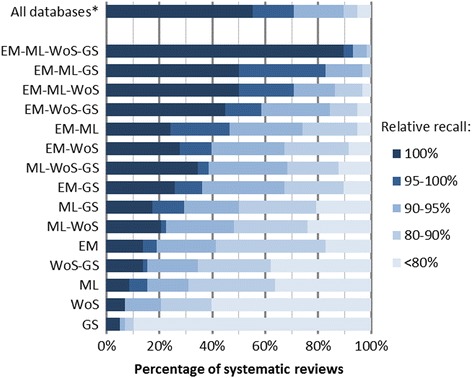
BACKGROUND: Within systematic reviews, when searching for relevant references, it is advisable to use multiple databases. However, searching databases is laborious and time-consuming, as syntax of search strategies are database specific. We aimed to determine the optimal combination of databases needed to conduct efficient searches in systematic reviews and whether the current practice in published reviews is appropriate. While previous studies determined the coverage of databases, we analyzed the actual retrieval from the original searches for systematic reviews. METHODS: Since May 2013, the first author prospectively recorded results from systematic review searches that he performed at his institution. PubMed was used to identify systematic reviews published using our search strategy results. For each published systematic review, we extracted the references of the included studies. Using the prospectively recorded results and the studies included in the publications, we calculated recall, precision, and number needed to read for single databases and databases in combination. We assessed the frequency at which databases and combinations would achieve varying levels of recall (i.e., 95%). For a sample of 200 recently published systematic reviews, we calculated how many had used enough databases to ensure 95% recall. RESULTS: A total of 58 published systematic reviews were included, totaling 1746 relevant references identified by our database searches, while 84 included references had been retrieved by other search methods. Sixteen percent of the included references (291 articles) were only found in a single database; Embase produced the most unique references (n = 132). The combination of Embase, MEDLINE, Web of Science Core Collection, and Google Scholar performed best, achieving an overall recall of 98.3 and 100% recall in 72% of systematic reviews. We estimate that 60% of published systematic reviews do not retrieve 95% of all available relevant references as many fail to search important databases. Other specialized databases, such as CINAHL or PsycINFO, add unique references to some reviews where the topic of the review is related to the focus of the database. CONCLUSIONS: Optimal searches in systematic reviews should search at least Embase, MEDLINE, Web of Science, and Google Scholar as a minimum requirement to guarantee adequate and efficient coverage.
Overview
CoChat Summary
TL;DR
This prospective exploratory study analyzed actual database retrieval for 58 published systematic reviews and found that searching Embase, MEDLINE, Web of Science Core Collection, and Google Scholar together achieved the best recall. The authors estimate that many published systematic reviews fail to retrieve 95% of relevant references because they omit key databases.
Key findings
- Among 1,746 relevant references identified by database searches, 292 (17%) were found by only one database; Embase retrieved the most unique references (n = 132), followed by MEDLINE, Web of Science, and Google Scholar.
- The combination of Embase, MEDLINE, Web of Science Core Collection, and Google Scholar achieved an overall recall of 98.3% and retrieved all included references in 72% of the studied systematic reviews.
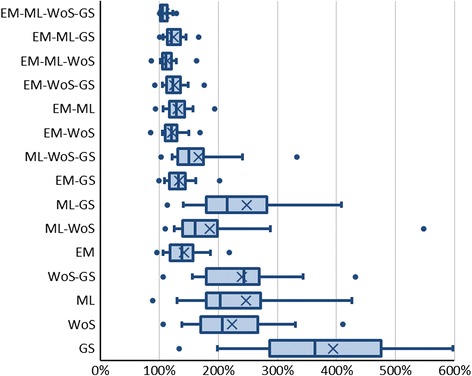
- Searching only Embase produced an average number needed to read (NNR) of 57, whereas the optimal four-database combination had an NNR of 73.
- In a sample of 200 recent systematic reviews, 97% searched MEDLINE, 61% searched Embase, 35% searched Web of Science, and only 10% used Google Scholar; the authors estimate that 60% of published systematic reviews do not retrieve 95% of all available relevant references.
Methods
- Since May 2013, the first author prospectively recorded results from systematic review searches performed at Erasmus MC; PubMed was searched in July 2016 for reviews published since 2014 with Erasmus MC first authors, yielding 58 included reviews.
- Included reviews had documented search strategies and results and had used at least Embase, MEDLINE, Cochrane CENTRAL, Web of Science, and Google Scholar; included references were extracted and located in original EndNote libraries to determine which database retrieved them.
- Recall, precision, and number needed to read were calculated for single databases and combinations in Excel; a separate sample of 200 recent PubMed systematic reviews was analyzed to assess current database selection practice.
Limitations
- The authors state they did not investigate whether missing references changed review conclusions, and because the finding that Web of Science and Google Scholar improve recall is novel, they cannot conclude whether it is due to their dataset or is generalizable.
- The authors note that all searches were performed by one experienced biomedical information specialist, that searcher skill strongly affects search effectiveness, and that their searches still missed some relevant references; they also state that Scopus as a replacement for Embase or Web of Science remains uncertain.
- The text makes evident additional constraints: the study is exploratory, based at a single institution, and relies on a relatively small set of 58 systematic reviews, with specialized databases such as CINAHL and PsycINFO used only when topic-appropriate.
Model-written summary. Check it against the paper before relying on it.
Integrity signals
Registry
Cites
Statistics
Figures

Verification
Claims the paper makes
2 Valid · 1 Not valid · 6 Not checked · 91 Own results and interpretations
A result the paper reports from its own data — it cites no other source for it, so there is none to check. The quote shows it is in the paper.
In the paper
“Using that combination, 93% of the systematic reviews in our study obtained levels of recall that could be considered acceptable (> 95%).”
§ Optimal database combinations for literature searches in systematic reviews: a prospective exploratory study > Discussion
plainstates a cause- Asserted: passes — The authors put it forward as true.
- Checkable: passes — It can be checked against evidence.
- Load-bearing: passes — The paper’s conclusions depend on it.
- Based: passes — The paper gives a reason why it holds.
A result the paper reports from its own data — it cites no other source for it, so there is none to check. The quote shows it is in the paper.
In the paper
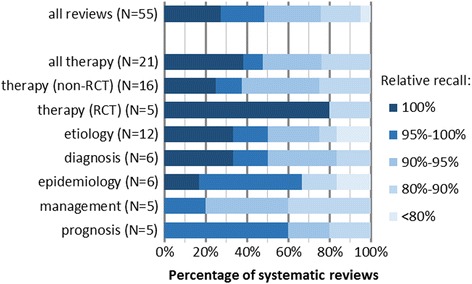
“For all but one domain, the traditional combination of Embase, MEDLINE, and Cochrane CENTRAL did not retrieve enough included references.”
§ Optimal database combinations for literature searches in systematic reviews: a prospective exploratory study > Results > Differences between domains of reviews
plain- Asserted: passes — The authors put it forward as true.
- Checkable: passes — It can be checked against evidence.
- Load-bearing: passes — The paper’s conclusions depend on it.
- Based: passes — The paper gives a reason why it holds.
A result the paper reports from its own data — it cites no other source for it, so there is none to check. The quote shows it is in the paper.
In the paper
“Embase was searched in 61% and Web of Science in 35%, and Google Scholar was only used in 10% of all reviews.”
§ Optimal database combinations for literature searches in systematic reviews: a prospective exploratory study > Results > Status of current practice of database selection
plain- Asserted: passes — The authors put it forward as true.
- Checkable: passes — It can be checked against evidence.
- Load-bearing: unclear — It is unclear whether the paper’s conclusions depend on it.
- Based: passes — The paper gives a reason why it holds.
A result the paper reports from its own data — it cites no other source for it, so there is none to check. The quote shows it is in the paper.
In the paper
“Of the five reviews that included only RCTs, four reached 100% recall if MEDLINE, Web of Science, and Google Scholar combined were complemented with Cochrane CENTRAL.”
§ Optimal database combinations for literature searches in systematic reviews: a prospective exploratory study > Discussion
plainstates a cause- Asserted: passes — The authors put it forward as true.
- Checkable: passes — It can be checked against evidence.
- Load-bearing: passes — The paper’s conclusions depend on it.
- Based: passes — The paper gives a reason why it holds.
A result the paper reports from its own data — it cites no other source for it, so there is none to check. The quote shows it is in the paper.
In the paper
“Based on our findings, this combination achieves acceptable recall about half the time (47%).”
§ Optimal database combinations for literature searches in systematic reviews: a prospective exploratory study > Results > Status of current practice of database selection
plainstates a cause- Asserted: passes — The authors put it forward as true.
- Checkable: passes — It can be checked against evidence.
- Load-bearing: passes — The paper’s conclusions depend on it.
- Based: passes — The paper gives a reason why it holds.
51 more claims
Create a free account to see all 100 claims and every source verdict.
- Probably not a substantial claim. 26
- It may state two separate claims as one. 24
- The quote only partly states this claim. 2
Claims other papers make about this one
Each is checked against this paper’s own text: does it say what the citing paper says it does?
The source backs part of the claim, not all of it — or backs it for a different population, condition or comparison.
In the citing paper
“although deduplication of references is essential to ensure the quality of SRs, there is currently no universal method to do so”
From Reducing systematic review burden using Deduklick: a novel, automated, reliable, and explainable deduplication algorithm to foster medical research (2022) · cites this paper as [5]
Experimental — accuracy not yet measuredThe source backs part of the claim, not all of it — or backs it for a different population, condition or comparison.
In the citing paper
“Although this database is one of the largest academic databases, offers extensive multidisciplinary coverage, and is widely used in bibliometric analyses, relevant publications indexed elsewhere or published in regional and non-indexed outlets may not have been captured [130].”
From Toward Holistic Aging in Lebanon: A Mapping of Gerontology and Geriatrics Research Trends, Gaps, and Future Directions (2026) · cites this paper as [130]
Experimental — accuracy not yet measuredThe source backs part of the claim, not all of it — or backs it for a different population, condition or comparison.
In the citing paper
“Meanwhile, others are highly specialized (e.g., PubMed, Medline, Compendix, etc.), which makes them unsuitable for more inclusive tasks, in particular, for the wide scope analysis and evaluation of multidisciplinary units [42,43].”
From Web of Science (WoS) and Scopus: The Titans of Bibliographic Information in Today’s Academic World (2021) · cites this paper as [43]
Experimental — accuracy not yet measuredThe source backs part of the claim, not all of it — or backs it for a different population, condition or comparison.
In the citing paper
“These databases are widely used in review studies and the majority of them are included in the optimal database combination search19 which guarantee an adequate and efficient coverage of the scientific literature.”
From Occupational therapy interventions for adults with severe mental illness: a scoping review (2021) · cites this paper as [19]
Experimental — accuracy not yet measuredThe cited source says what the claim attributes to it.
In the citing paper
“These differences have led to recommendations that systematic review teams search multiple databases to maximize the likelihood of finding relevant studies [6, 39, 40].”
From PRISMA-S: an extension to the PRISMA Statement for Reporting Literature Searches in Systematic Reviews (2021) · cites this paper as [40]
5 more claims about this paper
Create a free account to see every claim other papers make about this one.
Self-check
Percentages, sums and reported differences re-computed from the paper’s own numbers.
Each contradiction between two passages listed here was confirmed by an independent check.
Rated minor: it would not touch a result — a value no result rests on, a p-value that stays on the same side of the significance level, or a conflict that is clerical, resolved elsewhere in the paper, or outside its own findings.
In the paper
§ Optimal database combinations for literature searches in systematic reviews: a prospective exploratory study > Abstract > Results
“Sixteen percent of the included references (291 articles) were only found in a single database;”
§ Optimal database combinations for literature searches in systematic reviews: a prospective exploratory study > Results > Unique references per database
“A total of 292 (17%) references were found by only one database.”
Citations
Cites
Cochrane Handbook for Systematic Reviews of Interventions Version 5.0.1. The Cochrane Collaboration
Higgins, J. P. T., Green, S. R., & Higgins, J. P. T. (2008) · Cited by 7,171
A systematic approach to searching: an efficient and complete method to develop literature searches
Bramer, W. M., De Jonge, G. B., Rethlefsen, M. L., Mast, F., & Kleijnen, J. (2018) · Journal of the Medical Library Association · doi:10.5195/jmla.2018.283 · Cited by 863
Self-citationComparing two sampling methods to engage hard-to-reach communities in research priority setting
Valerio, M. A., Rodriguez, N., Winkler, P., Lopez, J., Dennison, M., Liang, Y., & Turner, B. J. (2016) · BMC Medical Research Methodology · doi:10.1186/s12874-016-0242-z · Cited by 543
Rethlefsen, M. L., Farrell, A. M., Osterhaus Trzasko, L. C., & Brigham, T. J. (2015) · Journal of Clinical Epidemiology · doi:10.1016/j.jclinepi.2014.11.025 · Cited by 331
Self-citationSystematic reviews need systematic searchers.
(2005) · Europe PMC (PubMed Central) · Cited by 257
Bramer, W. M., Giustini, D., & Kramer, B. M. R. (2016) · Systematic Reviews · doi:10.1186/s13643-016-0215-7 · Cited by 202
Self-citationHalladay, C. W., Trikalinos, T. A., Schmid, I. T., Schmid, C. H., & Dahabreh, I. J. (2015) · Journal of Clinical Epidemiology · doi:10.1016/j.jclinepi.2014.12.017 · Cited by 166 · cited 1×
“Prior research on database importance for systematic reviews has looked primarily at whether included references could have theoretically been found in a certain database, but most have been unable to ascertain whether the researchers actually found the articles in those databases [10, 12, 16, 17, 26].”
BackgroundSearching multiple databases for systematic reviews: added value or diminishing returns?
Stevinson, C., & Lawlor, D. A. (2004) · Complementary Therapies in Medicine · doi:10.1016/j.ctim.2004.09.003 · Cited by 143
Bramer, W. M., Giustini, D., Kramer, B. M., & Anderson, P. (2013) · Systematic Reviews · doi:10.1186/2046-4053-2-115 · Cited by 139 · cited 1×
“Nevertheless others have concluded that a single database is not sufficient to retrieve all references for systematic reviews [18, 19].”
BackgroundSelf-citationSearching one or two databases was insufficient for meta-analysis of observational studies
Lemeshow, A. R., Blum, R. E., Berlin, J. A., Stoto, M. A., & Colditz, G. A. (2005) · Journal of Clinical Epidemiology · doi:10.1016/j.jclinepi.2005.03.004 · Cited by 137
Cited by
Items 1,201–1,300 of 2,083
van Toorn, G., Kirby, E. R., Hamilton, M., et al. (2024) · Ageing and Society · doi:10.1017/s0144686x23000788 · Cited by 3
Allogmanny, S., Stefoska‐Needham, A., & Probst, Y. (2024) · Disability and Rehabilitation · doi:10.1080/09638288.2024.2377821 · Cited by 5
“To efficiently identify all relevant sources, this review followed a comprehensive literature search plan comprising six search strategies, adapted from previous methods [23–25].”
Rodda, S. N., Bijker, R., Merkouris, S., Landon, J., Hawker, C. O., & Dowling, N. A. (2024) · Current Addiction Reports · doi:10.1007/s40429-024-00594-8 · Cited by 8
Forsyth, F., Deaton, C., Kalra, P. R., Green, M., Harrison, M., Tavares, S., Dirksen, A., Kuhn, I. L., Farquharson, B., & Austin, R. C. (2024) · European Journal of Cardiovascular Nursing · doi:10.1093/eurjcn/zvae119 · Cited by 4
“Searches were performed in six bibliographic databases based on the recommendations from Bramer et al. 42 [MEDLINE (via Ovid), Embase (via OVID), EMCARE (via Ovid), CINAHL (via EBSCO), Cochrane Library, and Web of Science].”
What Are the Publication Rates for Orthopaedic and Sports Physical Therapy Conference Abstracts?
Smith, M. P., Borgehammar, J., Young, J. L., & Rhon, D. I. (2023) · JOSPT open. · doi:10.2519/josptopen.2023.0005 · Cited by 3
Embeddings for Efficient Literature Screening: A Primer for Life Science Investigators
Galli, C., Cusano, C., Guizzardi, S., Donos, N., & Calciolari, E. (2024) · Metrics · doi:10.3390/metrics1010001 · Cited by 9
“To conduct reviews of the literature, however, online databases must be queried [3,4], usually with keyword-based approaches, i.e., searching for entries that include one or more desired keywords in their text, usually in their title or abstract [5].”
Alshahrani, S. (2024) · Journal of Global Mobility The Home of Expatriate Management Research · doi:10.1108/jgm-02-2024-0010 · Cited by 5
Gould, D. J., Cui, H., Ma, N., CHALKIADIS, G. A., Davidson, A. J., Graham, H. K., & Rutz, E. (2024) · Systematic Reviews · doi:10.1186/s13643-024-02734-7 · Cited by 4
“The primary search strategy was constructed in line with guidelines on optimal database searching [37] and in conjunction with an experienced librarian.”
Rougeaux, E., Vázquez‐Vázquez, A., Busert, L. K., Fewtrell, M. S., & Wells, J. C. K. (2025) · Social Science & Medicine · doi:10.1016/j.socscimed.2025.117899 · Cited by 9
Vireque, A. A., Stolakis, V., Berteli, T. S., Bertero, M. T., & Kofinas, J. D. (2025) · Journal of Assisted Reproduction and Genetics · doi:10.1007/s10815-025-03498-2 · Cited by 4
“It is essential, therefore, to adapt search strategies to each database because the syntax of search strategies is database-specific [13].”
InfluentialWoo, H., Lee, S.-U., Yun, D., Jeong, S., Cho, H., & Kim, Y.-S. (2025) · European Journal of Pediatrics · doi:10.1007/s00431-025-06285-4 · Cited by 4
Ismail, A., Jaalouk, K., Kotaich, J., Tarhini, Y., Sadier, N. S., & Abbas, L. A. (2025) · Scientific Reports · doi:10.1038/s41598-025-07076-5 · Cited by 4
“A comprehensive electronic search strategy was conducted in May 2023 across several databases, including PubMed, PsycINFO, Embase, and Google Scholar 32 .”
Psychological Transdiagnostic Processes in Mild Traumatic Brain Injury Recovery: A Scoping Review
Courchesne, C., Nair, M. A., Gelineau, M., McCloskey, L., Faulkner, J. W., & Cairncross, M. (2025) · Archives of Physical Medicine and Rehabilitation · doi:10.1016/j.apmr.2025.07.014 · Cited by 3
Peng, P., Liu, Y., Li, S. X., Namkung, J. M., Chow, J. C., & Lin, L. (2025) · Educational Psychology Review · doi:10.1007/s10648-025-10057-9 · Cited by 10
“Our search targeted the abstract field because searching within abstracts is often recommended for yielding accurate yet manageable results (Bramer et al., 2017).”
Comprehensive overview of Decision-Fusion technique in healthcare: a scoping review protocol
Nazari, E., Pour, R., & Tabesh, H. (2018) · Iranian Journal of Medical Informatics · doi:10.24200/ijmi.v7i0.164 · Cited by 3
Low-value clinical practices in adult traumatic brain injury: an umbrella review protocol
Tardif, P., Moore, L., Lauzier, F., Farhat, I., Archambault, P. M., Lamontagne, F., Chassé, M., Stelfox, H. T., Gabbe, B. J., Lecky, F. E., et al. (2019) · BMJ Open · doi:10.1136/bmjopen-2019-031747 · Cited by 3
Reading and interpreting reviews for health professionals: a practical review
Antonelli, M., Firenzuoli, F., Salvarani, C., Gensini, G. F., & Donelli, D. (2020) · Internal and Emergency Medicine · doi:10.1007/s11739-020-02334-y · Cited by 4
Sartorius, B. K. D., Legge, H., & Pullan, R. L. (2020) · Systematic Reviews · doi:10.1186/s13643-020-01384-9 · Cited by 5
Tran, N., Tran, M., Elgabalawy, E., et al. (2020) · Journal of Pediatric Nursing · doi:10.1016/j.pedn.2020.08.016 · Cited by 3
A Model for Predicting the Class of Illicit Drug Suspects and Offenders
Atsa’am, D. D., Balogun, O. S., Agjei, R. O., Devine, S. N. O., Akingbade, T. J., & Omotehinwa, T. O. (2021) · Journal of Drug Issues · doi:10.1177/00220426211049358 · Cited by 3
Movement Disorders Induced by SARS-CoV-2 Infection: Protocol for a Scoping Review
Roşca, E. C., Vastag, Z., Phokaewvarangkul, O., & Sringean, J. (2022) · Journal of Clinical Medicine · doi:10.3390/jcm11040923 · Cited by 4
Tian, S. (2021) · Obesity Reviews · doi:10.1111/obr.13233 · Cited by 4
Animal-assisted activities in the classroom for students with emotional and behavioral disorders
Knowles, C., Shannon, E. N., & Lind, J. R. (2021) · Children and Youth Services Review · doi:10.1016/j.childyouth.2021.106290 · Cited by 4
Noninvasive Genetics Knowledge from the Brown Bear Populations to Assist Biodiversity Conservation
Baciu, I., Fedorca, A., & Ionescu, G. (2022) · Diversity · doi:10.3390/d14020121 · Cited by 5
How many sources are needed? the effects of bibliographic databases on systematic review outcomes
Keller, C., Heck, T., & Rittberger, M. (2022) · ACM/IEEE Joint Conference on Digital Libraries · doi:10.1145/3529372.3530933 · Cited by 6
Allen, J. (2022) · International Journal of Medical Students · doi:10.5195/ijms.2022.1363 · Cited by 6
Particles-based Medicated Wound Dressings: A Comprehensive Review
Ahmed, K. K., & Wongrakpanich, A. (2022) · Therapeutic Delivery · doi:10.4155/tde-2022-0049 · Cited by 3
Byrne, D., Fahey, T. P., & Moriarty, F. (2020) · HRB Open Research · doi:10.12688/hrbopenres.12951.1 · Cited by 4
Hadler‐Olsen, E., & Wirsing, A. M. (2019) · British Journal of Cancer · doi:10.1038/s41416-019-0460-3 · Cited by 3
Cadogan, E., Murphy, M. F., Lionetti, F., & Setti, A. (2022) · PsyArXiv (OSF Preprints) · doi:10.31234/osf.io/edy7k · Cited by 8
Sandinirwan, I., Leo, H., Muslim, B., Hasanah, H., & Karina, P. P. (2023) · Medical Journal of Indonesia · doi:10.13181/mji.oa.237071 · Cited by 3
“To ensure comprehensive coverage and achieve optimal outcomes in the systematic review, we followed the recommendations of Bramer et al. 11 Only the articles published in English between January 2000 and March 2023 were included.”
MethodMenezes, I., Curi, H. T., & Jurdi, A. P. S. (2024) · Cadernos Brasileiros de Terapia Ocupacional · doi:10.1590/2526-8910.ctoar278236232 · Cited by 3
Holt, J., Bhar, S. S., Schofield, P. E., Koder, D., Owen, P. J., Seitz, D. P., & Bhowmik, J. (2024) · Systematic Reviews · doi:10.1186/s13643-024-02516-1 · Cited by 3
“The databases were selected based on guidance from Bramer et al. [19] regarding optimal database combinations for literature searches in systematic reviews.”
MethodAbdel-Wahab, M. S., Abboud, D. G., & Adawy, N. Y. E. (2024) · Journal of Art, Design, and Music · doi:10.55554/2785-9649.1037 · Cited by 4
Endoscopic therapy for gastrointestinal angiodysplasia
Alhamid, A. A. H., Aljarad, Z., Chaar, A., et al. (2024) · Cochrane Database of Systematic Reviews · doi:10.1002/14651858.cd014582 · Cited by 2
Appraising eHealth Investment for Africa: Scoping Review and Development of a Framework
Broomhead, S. C., Mars, M., & Scott, R. E. (2024) · International Journal of Environmental Research and Public Health · doi:10.3390/ijerph21101277 · Cited by 3
“…the observation of Haddaway et al. [61] that “Systematic reviews typically screen the first 50 to 100 search records within Google Scholar”, and was as recommended by Bramer et al. [62] for situations when the number of potential references from traditional database searches is expected to be low.”
BackgroundBrglez, K., Čuček, M., Kober, A. A., & Lukman, R. K. (2024) · Clean Technologies and Environmental Policy · doi:10.1007/s10098-024-03062-z · Cited by 5
“The search was carried out using the Web of Science (WoS) database, known for its extensive coverage of recognized journals and daily updates (Bramer et al. 2017).”
Ribeiro, D. A. D. S., de Araújo, A. C., do Nascimento, P. K. D. S. B., da Rocha, I. M. G., & de Rezende, A. A. (2024) · PLoS ONE · doi:10.1371/journal.pone.0314971 · Cited by 2
Weight and Procedural Abortion Complications: A Systematic Review
McMahon, H. V., Moss, R. A., Pearce, N., Sehgal, S., He, Z., Kriete, M., Julian, Z., Redd, S. K., & Rice, W. S. (2025) · Obstetrics and Gynecology · doi:10.1097/aog.0000000000005821 · Cited by 3
“51 54 Searching these five databases produced 409 results.”
Southern, J., Ramis, M., Carey, M., Osborne, S. R., & Martin, N. I. (2025) · JBI Evidence Synthesis · doi:10.11124/jbies-24-00245 · Cited by 2
Dupin, J.-J., Pascal, A., & Godé, C. (2025) · Advances in business information systems and analytics book series · doi:10.4018/979-8-3693-6045-3.ch005 · Cited by 4
Metadiscourse studies in written L2 English in the MENA region: A systematic review of literature
Benraiss, K., Ahmed, A., & Rezk, L. M. (2025) · Social Sciences & Humanities Open · doi:10.1016/j.ssaho.2025.101426 · Cited by 4
Erazo, G., Benalcázar, C., Esparza, D. E. I., et al. (2025) · Data & Metadata · doi:10.56294/dm2025762 · Cited by 2
AI-Driven Personalization and Recommendations for Web Design Resources
Supolia, M. (2025) · INTERANTIONAL JOURNAL OF SCIENTIFIC RESEARCH IN ENGINEERING AND MANAGEMENT · doi:10.55041/ijsrem44812 · Cited by 2
Buntins, K., Bedenlier, S., & Zawacki‐Richter, O. (2025) · Learning Media and Technology · doi:10.1080/17439884.2025.2495602 · Cited by 4
“As Wanyama, McQuaid, and Kittler (2022) show, the databases Scopus, Web of Science and EBSCO provide different retrieval results in the searches conducted – making it indispensable to peruse more than one database, if the aim of the search is to be thorough and comprehensive (Bramer et al. 2017).”
Armstrong, C., & Duke, G. (2025) · Critical Care Nurse · doi:10.4037/ccn2025646 · Cited by 3
Simulated Learning Experiences in Global Speech-Language Pathology Programs: A Scoping Review
Watermeyer, J., Coutts, K. A., & Nattrass, R. (2025) · American Journal of Speech-Language Pathology · doi:10.1044/2025_ajslp-24-00393 · Cited by 3
Digital Interventions for Anxiety and Depressive Symptoms in Adolescence: Systematic Review
Kuberka, P., Johnston, M., Shafran, R., Pike, K. C., & Yardley, L. (2025) · Journal of Adolescent Health · doi:10.1016/j.jadohealth.2025.05.021 · Cited by 7
“…searches were conducted between September and October 2023 in 6 databases (PubMed, PsycINFO, Web of Science, Embase, MEDLINE, Google Scholar) [47] and were speci fi ed by population (e.g., adolescen * , youth, teen * ), intervention (e.g., “ automated intervention, ” “ early intervention, ”…”
Kern, M. R., Neumann, C., Bosompim, B., Ann, D., Kurniawan, A. L., Dlamini, N., Nabukeera, S., Machanyangwa, S., Tewahido, D., Shinde, S., et al. (2025) · BMJ Open · doi:10.1136/bmjopen-2024-094209 · Cited by 2
Santos, B., Bettin, B. P. C., & de Almeida, R. M. M. (2025) · Neuroscience & Biobehavioral Reviews · doi:10.1016/j.neubiorev.2025.106323 · Cited by 7
Validation of Telehealth Outcome Categories for Patient Safety: Systematic Literature Review
Palojoki, S., Lehtonen, L., & Vuokko, R. (2025) · JMIR Medical Informatics · doi:10.2196/75486 · Cited by 7
Collado, L. T., Ojeda-Belokon, C., Moreno-Morente, G., Gabucio, L. M. C., & de la Hera, M. G. (2025) · Nutrients · doi:10.3390/nu17172747 · Cited by 4
“We followed the recommendations of Bramer et al. [24] to carry out our search in four multidisciplinary databases, PubMed, EMBASE, Scopus, and Web of Science, and one psychology-specific database, PsycINFO.”
van Amsterdam, J., Nabben, T., & van den Brink, W. (2025) · International Journal of Drug Policy · doi:10.1016/j.drugpo.2025.104971 · Cited by 2
Casanova, A., Rodríguez, C., Ferreira, R. A., & Miranda, I. (2025) · Applied Neuropsychology Child · doi:10.1080/21622965.2025.2552198 · Cited by 4
Díaz, C. J. Á., Velásquez‐Rimachi, V., Morán‐Mariños, C., Nieto-Gutiérrez, W., Torres-Balarezo, P., Quispe‐Vicuña, C., Huerta-Rosario, M., & Mezones‐Holguín, E. (2025) · Value in Health Regional Issues · doi:10.1016/j.vhri.2025.101496 · Cited by 2
Nicholls, T., & Kelly, K. (2025) · Applied Neuropsychology Adult · doi:10.1080/23279095.2025.2570780 · Cited by 3
Ang, W. N., Ng, S. X., Rahman, S. U. F., & He, H. G. (2025) · European Journal of Oncology Nursing · doi:10.1016/j.ejon.2025.103006 · Cited by 2
Gupta, S., Babu, P., Haldar, D., Bag, S., Zaidi, I., & Goel, S. (2025) · Cancer Epidemiology · doi:10.1016/j.canep.2025.102926 · Cited by 2
Ibrahim, H., Saini, B., & Pace, J. (2025) · Currents in Pharmacy Teaching and Learning · doi:10.1016/j.cptl.2025.102507 · Cited by 3
Barakat, N., Brunelin, J., Cailhol, L., Saint-Amant, A., Paoletti, L. M., Poulet, E., Neige, C., & Vallet, W. (2025) · Psychological Medicine · doi:10.1017/s0033291725102195 · Cited by 5
Mapping inequities in global vaccine sentiment research
Balsamo, D., Offeddu, V., Aghamohammadi, Z., Chiavenna, C., Leone, L. P., D’Agnese, E., Sharma, D., Torbica, A., Shayegh, S., Andreu-Pérez, J., et al. (2025) · BMJ Global Health · doi:10.1136/bmjgh-2024-018587 · Cited by 10
“bibliometric methods 8 10–12 and merging information on country-specific epidemiological and economic factors as well as direction of research, we investigated patterns and drivers shaping the global research efforts on PSV.”
InfluentialAmare, F., Mirkazemi, C., Peterson, G. M., & Bezabhe, W. M. M. (2025) · GeroScience · doi:10.1007/s11357-025-01957-3 · Cited by 3
“A comprehensive literature search was conducted from database inception to December 13, 2024, in MEDLINE, Embase, CINAHL, PsycINFO, Cochrane Central Register of Controlled Trials (CENTRAL) and Google Scholar (first 200 relevant references) [38].”
Paterson, C. C., Christina, J., Brown, S., Hargreaves, J., Blanchard, G., Kimberley, R., Loft, N., Button, E., Chan, R. J., Yates, P. M., et al. (2025) · Seminars in Oncology Nursing · doi:10.1016/j.soncn.2025.152053 · Cited by 2
Rebuttal to Winn et al. (2024) ’s “Redefining searching in non-medical sciences systematic reviews”
Lipke, L., Monnin, J., & Fonseca, C. (2025) · Journal of Librarianship and Information Science · doi:10.1177/09610006251387675 · Cited by 2
Peng, Y., Ahmad, M. A., Xie, Y., Xu, Z., & Chai, S. C. (2025) · PeerJ · doi:10.7717/peerj.20455 · Cited by 2
“To maximize completeness and reduce the risk of missing relevant studies, reference lists of included systematic reviews were manually screened for additional eligible articles ( Bramer et al., 2017 ).”
Märk, S., & Situm, M. (2025) · De Gruyter eBooks · doi:10.1515/9783110790344-001 · Cited by 2
Huang, Z.-Y., Liu, X.-L., Li, T., & Luo, C.-H. (2026) · Frontiers in Oncology · doi:10.3389/fonc.2025.1729177 · Cited by 6
Freeman, R., & Molinos, J. G. (2026) · Biodiversity and Conservation · doi:10.1007/s10531-025-03243-2 · Cited by 2
“Different studies have shown the importance of using several databases to avoid platform-related content and publication bias when conducting systematic literature reviews (e.g., Atkinson and Cipriani 2018; Bramer et al. 2017; Ferreira et al. 2022 ).”
Saving the split: An umbrella review on therapeutic approaches for cracked tooth syndrome
Kaur, S., Puzhankara, L., Shenoy, N., Sandya Kini, K., & Singhal, D. (2026) · Journal of Conservative Dentistry and Endodontics · doi:10.4103/jcde.jcde_796_25 · Cited by 2
“[22] All the publications dated till June 15, 2025 were searched.”
Onyeso, O. K., Scott, D. R. M., Alumona, C. J., Kalu, M. E., Adandom, I. I., Akinrolie, O., Onyeso, K. M., Odole, A. C., Victor, J. M., Doan, J. B., et al. (2026) · BMC Geriatrics · doi:10.1186/s12877-026-06984-z · Cited by 3
“Following Bramer and colleagues’ recommendation on electronic databases combination [31], MEDLINE (Ovid), EMBASE (Ovid), Web of Science, AgeLine (EBSCO), SPORTDiscus (EBSCO), and CINAHL (EBSCO) were searched from inception to 27 November 2023 by a health sciences librarian (DRS).”
InfluentialAlumona, C. J., Scott, D. R. M., Aladejebi, T., Kalu, M. E., Onyeso, O. K., Odole, A. C., Vogelsang, L., Singleton, J. F., & Awosoga, O. (2026) · International Journal of Behavioral Nutrition and Physical Activity · doi:10.1186/s12966-026-01877-1 · Cited by 8
“Following the recommendation of an optimal database combination [39], we searched the MEDLINE, APA Psy-cINFO, Web of Science, CINAHL, and Global Health databases from inception to 10 January 2025.”
Tucker, R. C., Taylor, P. J., & Robinson, S. J. (2026) · Neuroscience & Biobehavioral Reviews · doi:10.1016/j.neubiorev.2026.106585 · Cited by 3
Srisurapanont, M., Suttajit, S., Likhitsathian, S., Suradom, C., & Maneeton, B. (2026) · The International Journal of Psychiatry in Medicine · doi:10.1177/00912174261422822 · Cited by 4
Emery, C. V., Lawal, O., & Brooke, J. M. (2026) · Journal of Correctional Health Care · doi:10.1177/10783458251411092 · Cited by 2
“All searches were performed on February 4, 2025, across four databases (CINAHL, PsycINFO, MEDLINE, and Web of Science) to retrieve a comprehensive evidence base for this systematic review (Bramer et al., 2017).”
Otaru, S., & Carpenter, D. O. (2026) · Environmental Research · doi:10.1016/j.envres.2026.123992 · Cited by 4
Javed, M. S., El-Khoury, R., Taha, A., & Reagu, S. M. (2026) · BMC Psychiatry · doi:10.1186/s12888-025-07382-2 · Cited by 2
“Recommendations were employed based on Bramer et al.’s approach to database selection, found to retrieve 98.3% of all possible results [19].”
InfluentialPeterson, A., Bou-Nehme, C., & Grace, B. (2026) · The Lancet Obstetrics Gynaecology & Women s Health · doi:10.1016/s3050-5038(26)00006-3 · Cited by 5
Diversity and Culture in Social Robotics: A Scoping Review
Saettone, L., Sgorbissa, A., & Recchiuto, C. T. (2026) · International Journal of Social Robotics · doi:10.1007/s12369-026-01387-x · Cited by 4
Roper, C., Aminone, V. T., Abedin, M., Fletcher, L., Harden, L., Stewart, J., & Faruque, F. (2026) · Environmental Pollution · doi:10.1016/j.envpol.2026.127978 · Cited by 4
Wastewater as Sentinel for Emerging Viral Diseases in Livestock: A Systematic Review
Shaha, M., Das, A., Saha, J., Rahaman, M. M., Gupta, M. D., Talukder, S., & Sarker, S. (2026) · Viruses · doi:10.3390/v18030385 · Cited by 2
Bentegeac, R., Guellec, B. L., Leblanc, V., Lenain, R., Dauchet, L., Gauthier, V., Gerard, E., Chazard, E., Amouyel, P., Aymes, E., et al. (2026) · Research Synthesis Methods · doi:10.1017/rsm.2026.10079 · Cited by 8
“…level in SRs (although acceptable thresholds remain context-dependent), 23,24 and 80% a pragmatic threshold for exploratory or rapid review contexts 25 —(iii) the number of articles screened, and (iv) precision, defined as the proportion of included gold-standard articles among all screened records.”
Health Literacy Interventions and Outcomes in Patients With Atrial Fibrillation
Lathlean, T. J. H., Kieu, D., Franke, K. B., O’Callaghan, N. J., Boyd, M. A., & Mahajan, R. (2026) · JACC Advances · doi:10.1016/j.jacadv.2026.102667 · Cited by 3
Psychedelic Experiences and Finitude in Serious Illness: A Qualitative Synthesis
Garcia, A. C. M., Isidoro, G. M., & Silva, C. D. P. (2026) · Journal of Pain and Symptom Management · doi:10.1016/j.jpainsymman.2026.03.012 · Cited by 3
Driscoll, A., Fucaloro, S. P., Mulvey, M., Berhane, M., Bragg, J. T., Krivicich, L. M., & Salzler, M. J. (2026) · Arthroscopy The Journal of Arthroscopic and Related Surgery · doi:10.1002/arj.70162 · Cited by 3
Boutros, M.-B. F., Hajj, C. E., Montes, G. M., & Jawad, D. (2026) · Journal of Engineering Design and Technology · doi:10.1108/jedt-10-2025-0614 · Cited by 3
Mapping the neural patterns of verbal repetition: an activation likelihood estimation meta-analysis
Awana, A., Berthier, M. L., Torres‐Prioris, M. J., & López-Barroso, D. (2026) · Brain Structure and Function · doi:10.1007/s00429-026-03119-3 · Cited by 2
“These databases were chosen based on research into the optimal database combination for literature searches in systematic reviews (Bramer et al. 2017; Gusenbauer and Haddaway 2020).”
Peters, S. T., Rutten, J. J. S., van Kooij, Y. E., Selles, R. W., Slijper, H. P., Hand-Wrist Study Group, & Wouters, R. M. (2026) · Quality of Life Research · doi:10.1007/s11136-026-04314-9 · Cited by 3
“We did this because, unlike other databases, Google Scholar searches the full text of articles, potentially identifying relevant studies that may not appear in database searches [ 29 ].”
Abbasi, E. (2026) · Biosensors and Biomolecular Electronics · doi:10.1186/s44510-026-00007-2 · Cited by 4
“Reference lists of key papers and seminal reviews were also hand-searched to identify additional studies that may not have been captured by electronic searches [68, 98].”
Global prevalence of impostor phenomenon in medical students: A systematic review and meta-analysis
Vera-Ponce, V. J., Huaman-Vega, C. H., Zuzunaga-Montoya, F. E., Uceda, C. I. G., León‐Figueroa, D. A., Rivera-Lozada, O., Aguirre-Milachay, E., Carrillo, C. I. G. D., & Valladares-Garrido, M. J. (2026) · PLoS ONE · doi:10.1371/journal.pone.0351713 · Cited by 4
“Previous methodological work supports the high retrieval value of combining biomedical databases with multidisciplinary citation databases, although omission of a discipline-specific psychology database remains a limitation [13].”
Prehospital osmotherapy in isolated traumatic brain injury: a systematic review
Williams, G. V. (2021) · Journal of Paramedic Practice · doi:10.12968/jpar.2021.13.3.114 · Cited by 2
Carter, N., Chahal, P., & Chattopadhyay, K. (2021) · JBI Evidence Synthesis · doi:10.11124/jbies-21-00062 · Cited by 6
Hurtubise, K., Brousselle, A., Noel, M. E., Caldwell, K., Rayner, L., Dawson, M., Rasic, N. F., & Camden, C. (2022) · Pain Practice · doi:10.1111/papr.13171 · Cited by 2
Sandinirwan, I., Muslim, B., Leo, H., Hasanah, H., & Karina, P. P. (2023) · Paediatrica Indonesiana · doi:10.14238/pi63.2.2023.102-18 · Cited by 9
Damascena, N. P., Machado, C. E. P., Silva, M. C., et al. (2023) · Morphologie · doi:10.1016/j.morpho.2023.04.002 · Cited by 2
Vasudevan, S., Piazza, A., & Carr, M. (2023) · International Conference on Business Analytics for Technology and Security (ICBATS) · doi:10.1109/icbats57792.2023.10111127 · Cited by 6
Coffey, N., O’Leary, F., Roberts, A., Plant, B. J., & Hayes, M. (2023) · Nutrition and Healthy Aging · doi:10.3233/nha-220171 · Cited by 2
Majid, O. W. (2023) · Journal of Evidence Based Dental Practice · doi:10.1016/j.jebdp.2023.101923 · Cited by 2
Is Burning Mouth Syndrome Associated with Extraoral Dryness? A Systematic Review
Le, K., DosSantos, M. F. H., & Gazerani, P. (2023) · Journal of Clinical Medicine · doi:10.3390/jcm12206525 · Cited by 3
Chingwaro, L. (2023) · International Journal of Research Publications · doi:10.47119/ijrp10013811220235738 · Cited by 3
Lanter, L., Rutsch, N., Kreuzer, S., Albers, C. E., Obid, P., Henssler, J. F., Torbahn, G., Müller, M., & Bigdon, S. F. (2023) · BMJ Open · doi:10.1136/bmjopen-2023-078972 · Cited by 3
“We will search the following databases for a comprehensive and sensitive search strategy: MEDLINE (via OvidSP), EMBASE (via OvidSP), Google Scholar and Web of Science as advised by Bramer et al 21”
Method
Metadata
- Authors
- Bramer, W. M., Rethlefsen, M. L., Kleijnen, J., & Franco, O. H.
- Affiliations
- Erasmus MC (NL)
- University of Utah (US)
- Maastricht University (NL)
- Corresponding author
- Bramer, Wichor M.
- Venue
- Systematic Reviews
- Published
- 2017-12
- Volume
- 6
- Issue
- 1
- Pages
- 245-245
- ISSN
- 2046-4053 (ISSN-L)
- PMC
- PMC5718002
- OpenAlex
- W2774587119
- Cited by
- 2,114
- References
- 27
- Citations by year
- 2026: 373 · 2025: 411 · 2024: 332 · 2023: 292 · 2022: 252 · 2021: 231 · 2020: 145 · 2019: 64 · 2018: 12 · 2017: 2
- FWCI
- 14.94
- Type
- journal article
- Language
- en
- Open access
- gold
- doi.org
- Licence
- cc-by
- creativecommons.org/licenses/by/4.0/ (tdm)
- creativecommons.org/licenses/by/4.0/ (vor, 5 d)
- Locations
- Systematic Reviews (publishedVersion, cc-by)
- Europe PMC (PubMed Central) (publishedVersion, cc-by)
- PubMed Central (publishedVersion, cc-by)
- PubMed (publishedVersion)
- Research Publications (Maastricht University) (publishedVersion, cc-by)
- EUR Research Repository (Erasmus University Rotterdam) (publishedVersion, other-oa)
- EUR Research Repository (Erasmus University Rotterdam) (submittedVersion, other-oa)
- RePub (Erasmus University Rotterdam) (submittedVersion, other-oa)
- DOAJ (DOAJ: Directory of Open Access Journals) (submittedVersion, cc-by-sa)
- Research Publications (Maastricht University) (submittedVersion, other-oa)
- Funders
- National Center for Advancing Translational Sciences (UL1TR001067)
- Topics
- Social Sciences › Decision Sciences › Statistics, Probability and Uncertainty › Meta-analysis and systematic reviews
- Social Sciences › Library and Information Sciences › scientometrics and bibliometrics research
- Physical Sciences › Computer Science › Information Systems › Information Retrieval and Search Behavior
- Keywords
- literature search strategies, search recall, search precision, database coverage, Embase, MEDLINE, Web of Science, Google Scholar, CINAHL, PsycINFO, number needed to read
- MeSH terms
- Humans, Prospective Studies, Review Literature as Topic, Databases, Bibliographic, Information Storage and Retrieval
About these checks
Registry, retraction, Cites and statistics results are computed, not judged, with one exception: a printed reference that no index lists is read once by a model before it counts as a citation error. Claims are extracted by a model and kept only when their quote appears verbatim in the text; each cited source is then checked, with a model’s help, for whether it says what the claim relies on. Those verdicts can be wrong — read the claim’s quote and the cited source before relying on one.
A language model drew the claims from the paper on 2026-09-29, under version 3 of the claim definition (model deepseek-v4.1-flash, prompt extract-v3).
A second model labelled each claim on 2026-09-29 (model jev-1.13-20260917, definition revision gold-guideline-v0.2).
Statistics and arithmetic are recomputed, not judged.
Confidence bands are shown only for fields calibrated on our annotated test set. None is calibrated yet, so no band is shown.
What counts as a claim ›How we measure confidence ›How we check this ›
Are you an author, or do you see a problem with this page? Request a review
Data sources
Bibliographic data: Semantic Scholar, OpenAlex, Crossref.
Contains information from the Semantic Scholar Academic Graph Datasets, made available under the ODC Attribution License (ODC-BY 1.0).
Semantic Scholar’s data is described in: Kinney, R., et al. (2023). The Semantic Scholar Open Data Platform. arXiv:2301.10140.
