

Optimal database combinations for literature searches in systematic reviews: a prospective exploratory study
Open accessThe DOI matches its Crossref record; 27 of the 27 references it cites were found in a registry or an index; 3 of the 22 sources its claims cite were checked for support.
Abstract
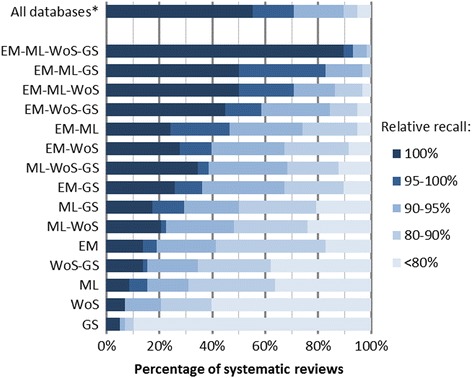
BACKGROUND: Within systematic reviews, when searching for relevant references, it is advisable to use multiple databases. However, searching databases is laborious and time-consuming, as syntax of search strategies are database specific. We aimed to determine the optimal combination of databases needed to conduct efficient searches in systematic reviews and whether the current practice in published reviews is appropriate. While previous studies determined the coverage of databases, we analyzed the actual retrieval from the original searches for systematic reviews. METHODS: Since May 2013, the first author prospectively recorded results from systematic review searches that he performed at his institution. PubMed was used to identify systematic reviews published using our search strategy results. For each published systematic review, we extracted the references of the included studies. Using the prospectively recorded results and the studies included in the publications, we calculated recall, precision, and number needed to read for single databases and databases in combination. We assessed the frequency at which databases and combinations would achieve varying levels of recall (i.e., 95%). For a sample of 200 recently published systematic reviews, we calculated how many had used enough databases to ensure 95% recall. RESULTS: A total of 58 published systematic reviews were included, totaling 1746 relevant references identified by our database searches, while 84 included references had been retrieved by other search methods. Sixteen percent of the included references (291 articles) were only found in a single database; Embase produced the most unique references (n = 132). The combination of Embase, MEDLINE, Web of Science Core Collection, and Google Scholar performed best, achieving an overall recall of 98.3 and 100% recall in 72% of systematic reviews. We estimate that 60% of published systematic reviews do not retrieve 95% of all available relevant references as many fail to search important databases. Other specialized databases, such as CINAHL or PsycINFO, add unique references to some reviews where the topic of the review is related to the focus of the database. CONCLUSIONS: Optimal searches in systematic reviews should search at least Embase, MEDLINE, Web of Science, and Google Scholar as a minimum requirement to guarantee adequate and efficient coverage.
Overview
CoChat Summary
TL;DR
This prospective exploratory study analyzed actual database retrieval for 58 published systematic reviews and found that searching Embase, MEDLINE, Web of Science Core Collection, and Google Scholar together achieved the best recall. The authors estimate that many published systematic reviews fail to retrieve 95% of relevant references because they omit key databases.
Key findings
- Among 1,746 relevant references identified by database searches, 292 (17%) were found by only one database; Embase retrieved the most unique references (n = 132), followed by MEDLINE, Web of Science, and Google Scholar.
- The combination of Embase, MEDLINE, Web of Science Core Collection, and Google Scholar achieved an overall recall of 98.3% and retrieved all included references in 72% of the studied systematic reviews.
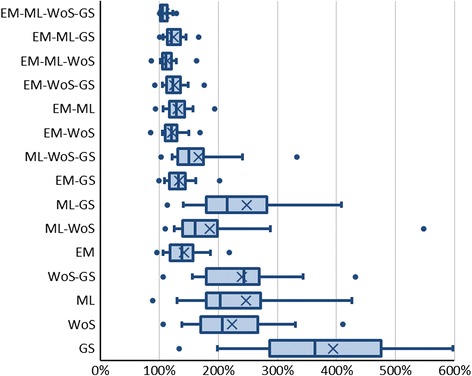
- Searching only Embase produced an average number needed to read (NNR) of 57, whereas the optimal four-database combination had an NNR of 73.
- In a sample of 200 recent systematic reviews, 97% searched MEDLINE, 61% searched Embase, 35% searched Web of Science, and only 10% used Google Scholar; the authors estimate that 60% of published systematic reviews do not retrieve 95% of all available relevant references.
Methods
- Since May 2013, the first author prospectively recorded results from systematic review searches performed at Erasmus MC; PubMed was searched in July 2016 for reviews published since 2014 with Erasmus MC first authors, yielding 58 included reviews.
- Included reviews had documented search strategies and results and had used at least Embase, MEDLINE, Cochrane CENTRAL, Web of Science, and Google Scholar; included references were extracted and located in original EndNote libraries to determine which database retrieved them.
- Recall, precision, and number needed to read were calculated for single databases and combinations in Excel; a separate sample of 200 recent PubMed systematic reviews was analyzed to assess current database selection practice.
Limitations
- The authors state they did not investigate whether missing references changed review conclusions, and because the finding that Web of Science and Google Scholar improve recall is novel, they cannot conclude whether it is due to their dataset or is generalizable.
- The authors note that all searches were performed by one experienced biomedical information specialist, that searcher skill strongly affects search effectiveness, and that their searches still missed some relevant references; they also state that Scopus as a replacement for Embase or Web of Science remains uncertain.
- The text makes evident additional constraints: the study is exploratory, based at a single institution, and relies on a relatively small set of 58 systematic reviews, with specialized databases such as CINAHL and PsycINFO used only when topic-appropriate.
Model-written summary. Check it against the paper before relying on it.
Integrity signals
Registry
Cites
Statistics
Figures

Verification
Claims the paper makes
2 Valid · 1 Not valid · 6 Not checked · 91 Own results and interpretations
A result the paper reports from its own data — it cites no other source for it, so there is none to check. The quote shows it is in the paper.
In the paper
“Using that combination, 93% of the systematic reviews in our study obtained levels of recall that could be considered acceptable (> 95%).”
§ Optimal database combinations for literature searches in systematic reviews: a prospective exploratory study > Discussion
plainstates a cause- Asserted: passes — The authors put it forward as true.
- Checkable: passes — It can be checked against evidence.
- Load-bearing: passes — The paper’s conclusions depend on it.
- Based: passes — The paper gives a reason why it holds.
A result the paper reports from its own data — it cites no other source for it, so there is none to check. The quote shows it is in the paper.
In the paper
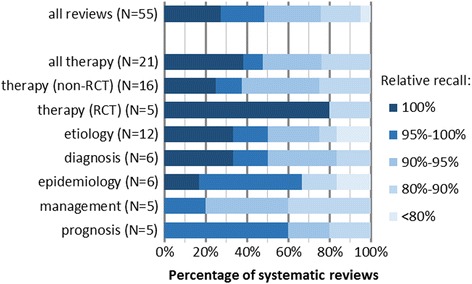
“For all but one domain, the traditional combination of Embase, MEDLINE, and Cochrane CENTRAL did not retrieve enough included references.”
§ Optimal database combinations for literature searches in systematic reviews: a prospective exploratory study > Results > Differences between domains of reviews
plain- Asserted: passes — The authors put it forward as true.
- Checkable: passes — It can be checked against evidence.
- Load-bearing: passes — The paper’s conclusions depend on it.
- Based: passes — The paper gives a reason why it holds.
A result the paper reports from its own data — it cites no other source for it, so there is none to check. The quote shows it is in the paper.
In the paper
“Embase was searched in 61% and Web of Science in 35%, and Google Scholar was only used in 10% of all reviews.”
§ Optimal database combinations for literature searches in systematic reviews: a prospective exploratory study > Results > Status of current practice of database selection
plain- Asserted: passes — The authors put it forward as true.
- Checkable: passes — It can be checked against evidence.
- Load-bearing: unclear — It is unclear whether the paper’s conclusions depend on it.
- Based: passes — The paper gives a reason why it holds.
A result the paper reports from its own data — it cites no other source for it, so there is none to check. The quote shows it is in the paper.
In the paper
“Of the five reviews that included only RCTs, four reached 100% recall if MEDLINE, Web of Science, and Google Scholar combined were complemented with Cochrane CENTRAL.”
§ Optimal database combinations for literature searches in systematic reviews: a prospective exploratory study > Discussion
plainstates a cause- Asserted: passes — The authors put it forward as true.
- Checkable: passes — It can be checked against evidence.
- Load-bearing: passes — The paper’s conclusions depend on it.
- Based: passes — The paper gives a reason why it holds.
A result the paper reports from its own data — it cites no other source for it, so there is none to check. The quote shows it is in the paper.
In the paper
“Based on our findings, this combination achieves acceptable recall about half the time (47%).”
§ Optimal database combinations for literature searches in systematic reviews: a prospective exploratory study > Results > Status of current practice of database selection
plainstates a cause- Asserted: passes — The authors put it forward as true.
- Checkable: passes — It can be checked against evidence.
- Load-bearing: passes — The paper’s conclusions depend on it.
- Based: passes — The paper gives a reason why it holds.
51 more claims
Create a free account to see all 100 claims and every source verdict.
- Probably not a substantial claim. 26
- It may state two separate claims as one. 24
- The quote only partly states this claim. 2
Claims other papers make about this one
Each is checked against this paper’s own text: does it say what the citing paper says it does?
The source backs part of the claim, not all of it — or backs it for a different population, condition or comparison.
In the citing paper
“although deduplication of references is essential to ensure the quality of SRs, there is currently no universal method to do so”
From Reducing systematic review burden using Deduklick: a novel, automated, reliable, and explainable deduplication algorithm to foster medical research (2022) · cites this paper as [5]
Experimental — accuracy not yet measuredThe source backs part of the claim, not all of it — or backs it for a different population, condition or comparison.
In the citing paper
“Although this database is one of the largest academic databases, offers extensive multidisciplinary coverage, and is widely used in bibliometric analyses, relevant publications indexed elsewhere or published in regional and non-indexed outlets may not have been captured [130].”
From Toward Holistic Aging in Lebanon: A Mapping of Gerontology and Geriatrics Research Trends, Gaps, and Future Directions (2026) · cites this paper as [130]
Experimental — accuracy not yet measuredThe source backs part of the claim, not all of it — or backs it for a different population, condition or comparison.
In the citing paper
“Meanwhile, others are highly specialized (e.g., PubMed, Medline, Compendix, etc.), which makes them unsuitable for more inclusive tasks, in particular, for the wide scope analysis and evaluation of multidisciplinary units [42,43].”
From Web of Science (WoS) and Scopus: The Titans of Bibliographic Information in Today’s Academic World (2021) · cites this paper as [43]
Experimental — accuracy not yet measuredThe source backs part of the claim, not all of it — or backs it for a different population, condition or comparison.
In the citing paper
“These databases are widely used in review studies and the majority of them are included in the optimal database combination search19 which guarantee an adequate and efficient coverage of the scientific literature.”
From Occupational therapy interventions for adults with severe mental illness: a scoping review (2021) · cites this paper as [19]
Experimental — accuracy not yet measuredThe cited source says what the claim attributes to it.
In the citing paper
“These differences have led to recommendations that systematic review teams search multiple databases to maximize the likelihood of finding relevant studies [6, 39, 40].”
From PRISMA-S: an extension to the PRISMA Statement for Reporting Literature Searches in Systematic Reviews (2021) · cites this paper as [40]
5 more claims about this paper
Create a free account to see every claim other papers make about this one.
Self-check
Percentages, sums and reported differences re-computed from the paper’s own numbers.
Each contradiction between two passages listed here was confirmed by an independent check.
Rated minor: it would not touch a result — a value no result rests on, a p-value that stays on the same side of the significance level, or a conflict that is clerical, resolved elsewhere in the paper, or outside its own findings.
In the paper
§ Optimal database combinations for literature searches in systematic reviews: a prospective exploratory study > Abstract > Results
“Sixteen percent of the included references (291 articles) were only found in a single database;”
§ Optimal database combinations for literature searches in systematic reviews: a prospective exploratory study > Results > Unique references per database
“A total of 292 (17%) references were found by only one database.”
Citations
Cites
Cochrane Handbook for Systematic Reviews of Interventions Version 5.0.1. The Cochrane Collaboration
Higgins, J. P. T., Green, S. R., & Higgins, J. P. T. (2008) · Cited by 7,171
A systematic approach to searching: an efficient and complete method to develop literature searches
Bramer, W. M., De Jonge, G. B., Rethlefsen, M. L., Mast, F., & Kleijnen, J. (2018) · Journal of the Medical Library Association · doi:10.5195/jmla.2018.283 · Cited by 863
Self-citationComparing two sampling methods to engage hard-to-reach communities in research priority setting
Valerio, M. A., Rodriguez, N., Winkler, P., Lopez, J., Dennison, M., Liang, Y., & Turner, B. J. (2016) · BMC Medical Research Methodology · doi:10.1186/s12874-016-0242-z · Cited by 543
Rethlefsen, M. L., Farrell, A. M., Osterhaus Trzasko, L. C., & Brigham, T. J. (2015) · Journal of Clinical Epidemiology · doi:10.1016/j.jclinepi.2014.11.025 · Cited by 331
Self-citationSystematic reviews need systematic searchers.
(2005) · Europe PMC (PubMed Central) · Cited by 257
Bramer, W. M., Giustini, D., & Kramer, B. M. R. (2016) · Systematic Reviews · doi:10.1186/s13643-016-0215-7 · Cited by 202
Self-citationHalladay, C. W., Trikalinos, T. A., Schmid, I. T., Schmid, C. H., & Dahabreh, I. J. (2015) · Journal of Clinical Epidemiology · doi:10.1016/j.jclinepi.2014.12.017 · Cited by 166 · cited 1×
“Prior research on database importance for systematic reviews has looked primarily at whether included references could have theoretically been found in a certain database, but most have been unable to ascertain whether the researchers actually found the articles in those databases [10, 12, 16, 17, 26].”
BackgroundSearching multiple databases for systematic reviews: added value or diminishing returns?
Stevinson, C., & Lawlor, D. A. (2004) · Complementary Therapies in Medicine · doi:10.1016/j.ctim.2004.09.003 · Cited by 143
Bramer, W. M., Giustini, D., Kramer, B. M., & Anderson, P. (2013) · Systematic Reviews · doi:10.1186/2046-4053-2-115 · Cited by 139 · cited 1×
“Nevertheless others have concluded that a single database is not sufficient to retrieve all references for systematic reviews [18, 19].”
BackgroundSelf-citationSearching one or two databases was insufficient for meta-analysis of observational studies
Lemeshow, A. R., Blum, R. E., Berlin, J. A., Stoto, M. A., & Colditz, G. A. (2005) · Journal of Clinical Epidemiology · doi:10.1016/j.jclinepi.2005.03.004 · Cited by 137
Cited by
Items 1,501–1,600 of 2,083
Valeeva, F. V., Khasanova, K. B., Валерьевна, В. Е., Киселева, Т. А., & Рамилевна, И. Д. (2023) · Aspirantskiy Vestnik Povolzhiya · doi:10.55531/2072-2354.2023.23.1.47-56 · Cited by 1
Arumugam, V., MacDermid, J. C., Walton, D. M., & Grewal, R. S. (2023) · Healthcare · doi:10.3390/healthcare11121728 · Cited by 2
Grillo, R., Borba, A. M., da Silva, Y. S., Brozoski, M. A., Miloro, M., & Naclério‐Homem, M. D. G. (2023) · Oral Surgery Oral Medicine Oral Pathology and Oral Radiology · doi:10.1016/j.oooo.2023.07.018 · Cited by 1
Out-of-hospital care for postpartum haemorrhage: a scoping review protocol
Soh, R., Silvestri, L., Pearce, A., & Pearce, J. (2023) · International Paramedic Practice · doi:10.12968/ippr.2023.13.3.51 · Cited by 1
Yastıoğlu, S. (2023) · Sosyal Mucit Academic Review · doi:10.54733/smar.1345501 · Cited by 4
Arévalo-Romero, C. A., Costa‐Cordella, S., & Rojas‐Líbano, D. (2023) · Journal of Cognitive Psychology · doi:10.1080/20445911.2023.2260050 · Cited by 1
Análise de conceito advocacia em saúde sob a ótica do método evolucionário
Farias, O. D. O., Fontenele, M. G. M., Lima, F. E. T., Galvão, M. T. G., da Silva, V. M., & Lopes, M. V. D. O. (2023) · Revista da Escola de Enfermagem da USP · doi:10.1590/1980-220x-reeusp-2023-0170pt · Cited by 2
Quistgaard, M., Myklebust, O. L. P., Aure, T., Austin, S. F., Berring, L. L., Vernal, D. L., & Storebø, O. J. (2023) · BMJ Open · doi:10.1136/bmjopen-2023-073901 · Cited by 2
“46 A limitation of the scoping review is the language restriction, where only publications written in English, or the Scandinavian languages will be included.”
BackgroundMethodA systematic scoping review of how people with ME/CFS use the internet
Shortland, D. L., Fazil, Q., Lavis, A., & Hallett, N. (2024) · Fatigue Biomedicine Health & Behavior · doi:10.1080/21641846.2024.2303887 · Cited by 3
“Pham et al reported only 22.38% of studies included an element of quality assessment [43].”
BackgroundInfluentialLAN network architecture design at Nurul Jalal Islamic Boarding School, North Jakarta
Sitanggang, A. S., Syafariani, R. F., Hasti, N., Sari, F. W., & Pasya, D. (2024) · International Journal of Advances in Applied Sciences · doi:10.11591/ijaas.v13.i1.pp123-133 · Cited by 2
The Impact of Military Tobacco Control Policy: A Systematic Review
bin Hashim, M. A., Sebri, K. F. B., Hanim, M. F. M., Anwar, D. S. B., Radzi, N. A. M., Fuad, A. F. B. A., & Sabri, B. A. M. (2024) · Military Medicine · doi:10.1093/milmed/usad507 · Cited by 1
Menezes, I., Curi, H. T., & Jurdi, A. P. S. (2024) · Cadernos Brasileiros de Terapia Ocupacional · doi:10.1590/2526-8910.ctoar278236231 · Cited by 1
Hooley, C., Adams, D. R., Ng, W. Y., Wendt, C. L. E., & Dennis, C. B. (2024) · Discover Mental Health · doi:10.1007/s44192-024-00068-3 · Cited by 2
“We searched for articles in five different databases: Medline, Embase, Web of Science Core Collections, CINAHL, and PsycINFO [34].”
MethodRosendo, G. B. O., Padovam, J. C., Ferreira, R. L. U., Oliveira, A. G., Barbosa, F., & Pedrosa, L. F. C. (2024) · MethodsX · doi:10.1016/j.mex.2024.102752 · Cited by 1
Obtaining Consent for Research on Risky Behaviours Among Adolescents in Canada: A Scoping Review
MacNeill, L., MacNeill, A. L., Doucet, S. A., Luke, A., & Goudreau, A. (2024) · Journal of Empirical Research on Human Research Ethics · doi:10.1177/15562646241253953 · Cited by 2
“Google Scholar orders listings by their relevance to the search topic; therefore, only the fi rst 200 results were screened for this review, which is in line with other recent reviews (Bramer et al., 2017; Haddaway et al., 2015).”
Result75 years’ journey of malaria publications in English: what and where?
Deora, N., Kar, S., Pande, V., & Sinha, A. (2024) · Malaria Journal · doi:10.1186/s12936-024-04992-1 · Cited by 3
“As EMB has additional focus and relevance to clinical sciences, its addition to SCO and WOS adds more depth to clinical literature search [23, 27].”
BackgroundMethodInfluentialÇavdar, F. A., & Mustafaoğlu, R. (2024) · doi:10.5152/6913 · Cited by 1
Budak, M. İ. (2024) · doi:10.5152/6914 · Cited by 1
Bilimsel Araştırma Makalesinde Tartışma Bölümü Yazımı
Güzeldere, H. K. B. (2024) · doi:10.5152/6910 · Cited by 1
Bilimsel Araştırma Makalesinde Bulgular Bölümü Yazımı
Gülüstan, F. (2024) · doi:10.5152/6909 · Cited by 1
Mutua, M. N., Harding, A. J. E., & Pulford, J. (2024) · International Journal of Qualitative Methods · doi:10.1177/16094069241260138 · Cited by 1
“The search strategy will include electronic database searches including Embase, Scopus, PubMed, Google Scholar, Web of Science and Global Health which have been deemed as the minimum threshold for systematic reviews by Bramer et al. (2017).”
Sugita, S., Hata, K., Kodaiarasu, K., Takamatsu, N., Kimura, K., Miller, C., Gonzalez, L., Umemoto, I., Murayama, K., Nakao, T., et al. (2024) · Psychiatry and Clinical Neurosciences Reports · doi:10.1002/pcn5.223 · Cited by 2
Ismail, Y., Shiner, N., & Tucker, R. (2024) · Journal of medical imaging and radiation sciences · doi:10.1016/j.jmir.2024.101439 · Cited by 5
Taques, F. H., & Nepomuceno, T. C. C. (2024) · Policing An International Journal · doi:10.1108/pijpsm-10-2023-0140 · Cited by 2
Nonato, N. D. S., Nunes, L. S., Martins, A. W. S., Pinhal, D., Domingues, W. B., Bellido-Quispe, D. K., Remião, M. H., & Campos, V. F. (2024) · Plasmid · doi:10.1016/j.plasmid.2024.102731 · Cited by 1
A Brief Review of Bibliometric Analysis Use in Marketing Studies
Terán-Yépez, E., Pérez, M. S., López, C. S., & Carrillo, M. B. M. (2024) · Springer proceedings in business and economics · doi:10.1007/978-3-031-70488-8_1 · Cited by 9
Calisaya-Madariaga, I. G. (2024) · Journal of the Neurological Sciences · doi:10.1016/j.jns.2024.123317 · Cited by 1
Haley, F., Andrews, J. A., & Moghaddam, N. G. (2024) · Journal of Technology in Behavioral Science · doi:10.1007/s41347-024-00457-z · Cited by 3
“These databases were selected based on their demonstrated effectiveness in achieving comprehensive literature search recall (Bramer et al., 2017).”
Khanyile, S. S., Young, M. E. M., Malema, M. J., & Leach, L. L. (2024) · African Journal for Physical Activity and Health Sciences (AJPHES) · doi:10.37597/ajphes.2024.30.4.12 · Cited by 3
Burmen, B., Brennan, E., Samaila, M. M., Bell, A., Vente, C., & Mayigane, L. N. (2025) · Frontiers in Public Health · doi:10.3389/fpubh.2024.1458867 · Cited by 3
Kimani, T. K., & Nzengya, D. M. (2025) · African Multidisciplinary Journal of Research · doi:10.71064/spu.amjr.1.1.2025.355 · Cited by 1
“In addition, EBSCOhost provides access to peer-reviewed articles, enhancing the credibility and reliability of the sources being reviewed (Bramer et al., 2017).”
Romantic Adult Attachment Among Couples and the Experience of Prenatal Stress: A Systematic Review
Downes, N., Maguet, C., & van der Waerden, J. E. B. (2025) · Marriage & Family Review · doi:10.1080/01494929.2025.2496788 · Cited by 1
Pancreatic Cancer Risk Assessment Tools in Primary Care: A Mixed Methods Systematic Review
Claridge, H., Cooke, E. A., Thomas, S. A., Greenwood, N., & Lemańska, A. (2025) · Journal of Gastrointestinal Cancer · doi:10.1007/s12029-025-01229-5 · Cited by 4
Flynn, T. J., Jennings, B. M., Wright, D. W., Vigfússon, Ý., Evans, D. D., Hertzberg, V., Burns, E. J., & Yeager, K. A. (2025) · PLoS ONE · doi:10.1371/journal.pone.0325315 · Cited by 2
Craquelin, M., Azogui‐Lévy, S., Lombrail, P., Tenenbaum, A., & Marquillier, T. (2025) · Journal of Interprofessional Care · doi:10.1080/13561820.2025.2529384 · Cited by 2
“The choice of these databases was based on an article by Bramer (2017) on the optimal combination of databases (Bramer et al., 2017).”
HIV status and the risk of typhoid fever and iNTS: A systematic review and meta-analysis
Johnston, P. I., Chisala, W., Hinchcliffe, A., Mhango, C., Jambo, N., Cooper, M., Shahi, F., Gordon, M. A., & Darton, T. C. (2025) · Journal of Infection · doi:10.1016/j.jinf.2025.106572 · Cited by 3
Pre-registration student nurse placement hours, competency, and outcomes: A systematic review
Kenny, A. J., Knight, K., Garrow, A. L., Leigh, J., & Roberts, D. (2025) · Nurse Education Today · doi:10.1016/j.nedt.2025.106851 · Cited by 3
An integrative review of barriers to actionable intersectionality in cancer research
Yap, C.-Y., & Chua, H.-K. (2025) · Discover Public Health · doi:10.1186/s12982-025-01176-3 · Cited by 3
“The search was conducted across selected databases—EMBASE, Web of Science, PubMed, and Google Scholar (first 100 results)—following the optimal database combinations recommended by Bramer et al. [45].”
Gignoux, E., Mougeot, J., Cadellans-Arróniz, A., & Édouard, P. (2026) · BMJ Open Sport & Exercise Medicine · doi:10.1136/bmjsem-2026-003237
Cranston, N., Buckley, P., Rose, L., Loy, J., & Randle, H. (2026) · PLoS ONE · doi:10.1371/journal.pone.0352182 · Cited by 1
“…Veterinary Information Services (IVIS), SciQuest, and Science Direct will be searched, and the first 200 references (sorted by relevance) identified in Google Scholar will be included, as relevance declines rapidly, and this approach is recommended to balance sensitivity with feasibility [53,55].”
Faggion, C. M., & Hagenfeld, D. (2019) · Journal of Dentistry · doi:10.1016/j.jdent.2019.05.029 · Cited by 1
Acute Exercise and Creativity: Embodied Cognition Approaches
Frith, E. (2019) · Cited by 2
Elbow angle generation during activities of daily living using a submovement prediction model
Naghibi, S. S., Fallah, A., Maleki, A., & Ghassemi, F. (2020) · Biological Cybernetics · doi:10.1007/s00422-020-00834-w · Cited by 3
Prophylactic antiemetics for adults receiving intravenous opioids in the acute care setting
Gottlieb, M. A., Carlson, J. N., & Peksa, G. D. (2021) · Cochrane Database of Systematic Reviews · doi:10.1002/14651858.cd013860 · Cited by 1
Evaluating and optimizing the search process for systematic reviews
Mathisen, M. (2021) · NVA (Nasjonalt vitenarkiv) · Cited by 5
Chow, R., & Simone, C. B. (2022) · International Journal of Radiation Oncology*Biology*Physics · doi:10.1016/j.ijrobp.2022.01.004 · Cited by 1
Potměšilová, P., Potměšíl, M., & Marečková, J. (2022) · Campbell Systematic Reviews · doi:10.1002/cl2.1261 · Cited by 1
Online Literature Searching for Research Projects in Pharmaceutical Sciences
Saharan, V. A., Banerjee, S., Dobhal, S., Sarangi, M. K., & Singh, A. (2022) · Springer eBooks · doi:10.1007/978-981-16-5180-9_14 · Cited by 1
Mutebi, J., Kareyo, M., Umezuruike, C., & Paul, A. (2022) · Journal of Computer and Communications · doi:10.4236/jcc.2022.108004 · Cited by 4
Comparison of Databases for Complex Evidence Syntheses on Education for the Health Professions
Schaefer, N., & Morgan‐Daniel, J. (2023) · Medical Reference Services Quarterly · doi:10.1080/02763869.2023.2215105 · Cited by 1
Ridawanty, R., Pratidina, N. B., & Primarti, R. S. (2023) · DENTA · doi:10.30649/denta.v17i2.3 · Cited by 3
Bukari, C., Kheni, N. A., Boateng, I., et al. (2023) · Journal of Service Science and Management · doi:10.4236/jssm.2023.165027 · Cited by 1
An Overview of Lung Injury in Covid-19: Evaluating the Impact of Re-Exposure and Emerging Variants
Yadav, E. (2023) · Open Access Journal of Pulmonary & Respiratory Sciences · doi:10.23880/oajprs-16000161
Relationship between teachers’ interpersonal style and student outcomes in physical education
Vasconcellos, D. (2019) · Research Bank (Australian Catholic University) · doi:10.26199/5de0581eb8d7b · Cited by 1
Complexity In The Context of Palliative Care: A Scoping ReviewPreprint
Ohinata, H., Aoyama, M., & Miyashita, M. (2021) · Research Square · doi:10.21203/rs.3.rs-969011/v1 · Cited by 1
Justesen, T. F., Freyberg, J., & Schultz, A. N. Ø. (2020) · Research Square · doi:10.21203/rs.3.rs-104619/v1 · Cited by 1
Zhao, J., Liu, J., Love, P. E. D., et al. (2022) · SSRN Electronic Journal · doi:10.2139/ssrn.4054282 · Cited by 1
Comment on “Determinants of malnutrition among children: A systematic review”
Keikha, M., & Kelishadi, R. (2022) · Nutrition · doi:10.1016/j.nut.2022.111722 · Cited by 1
Caulfield, K. A., Fleischmann, H. H., George, M. S., & McTeague, L. M. (2022) · Journal of Psychiatric Research · doi:10.1016/j.jpsychires.2022.08.021 · Cited by 1
França, T. F. A., Segura, I. A., Dias, N. M., Miranda, M. C., & Pompéia, S. (2022) · PsyArXiv (OSF Preprints) · doi:10.31234/osf.io/e2kjb · Cited by 2
Antibiotic Treatment Duration for Bacterial Infections - A Systematic Review and Critical AppraisalPreprint
Mo, Y., Tan, W. C., & Cooper, B. S. (2022) · medRxiv · doi:10.1101/2022.12.11.22283311 · Cited by 1
Sze, K. Y. P. (2022) · Research Square · doi:10.21203/rs.3.rs-2410410/v1 · Cited by 1
Current Challenges and Future Directions in the Management of Inflammatory Breast Cancer: A ReviewPreprint
Izzo, P., Izzo, L., Polistena, A., Sibio, S., Pisanelli, M. C., Crocetti, D., Meloni, P., Cello, P. D., Intinis, C. D., & Izzo, S. (2023) · Preprints.org · doi:10.20944/preprints202307.1462.v1 · Cited by 1
Computational Perspectives on Behaviour in Anorexia Nervosa: A Systematic ReviewPreprint
Radzikowska, M., Pike, A. C., & Hall-McMaster, S. (2023) · PsyArXiv (OSF Preprints) · doi:10.31234/osf.io/wq4cz · Cited by 2
Mahrishi, M., Abbas, A., Hosseini, S., et al. (2024) · SSRN Electronic Journal · doi:10.2139/ssrn.4743399 · Cited by 1
Mills, F., Drury, J., Hall, C. E., Weston, D., Symons, C., Amlôt, R., & Carter, H. (2024) · Qeios · doi:10.32388/8ovfv1 · Cited by 1
Galli, C., Cusano, C., Guizzardi, S., Donos, N., & Calciolari, E. (2024) · Preprints.org · doi:10.20944/preprints202408.1823.v1 · Cited by 1
Caputo, A. (2025) · SSRN Electronic Journal · doi:10.2139/ssrn.5164449 · Cited by 3
Cognitive Impairment in Paediatric PCNS: A Systematic Review and Meta-analysisPreprint
Falcone, L., Riddell, N., & Murphy, M. (2025) · medRxiv · doi:10.1101/2025.05.29.25328543 · Cited by 2
Ratis, R. C., Torres, G. A., Serbena, D. R., dos Santos, F. S., Bonini, J. S., & Boldt, A. B. W. (2025) · Research Square · doi:10.21203/rs.3.rs-6762423/v1 · Cited by 1
Hailesilassie, M. B., & Tegegne, H. R. (2025) · Research Square · doi:10.21203/rs.3.rs-7845029/v1 · Cited by 2
Aifuobhokhan, J., Agbarakwe, C. A., Oduguwa, D. O., Oseni, O. A., Eleweke, C., Johnson, B. T., & Opawoye, P. O. (2025) · Research Square · doi:10.21203/rs.3.rs-8097974/v1 · Cited by 2
Mahfouz, M., & Alzaben, E. (2026) · medRxiv · doi:10.64898/2026.02.21.26346646 · Cited by 1
Ye, R., Sibia, N., Bernuy, A. Z., Zhu, T., Nobre, C., Pammer‐Schindler, V., & Liut, M. (2026) · ACM International Conference on Intelligent User Interfaces (IUI) · doi:10.1145/3742413.3789079 · Cited by 2
“The resulting cognitive load not only makes the process laborious but discourages the exploration and refinement essential for high-quality reviews [7, 19].”
Galvañ, J., Distefano, G., Echeverria, I., Aymerich, C., Abregú-Crespo, R., Lorente, M. M. A., Cruz, N., López-Larriba, L., Moreno, D. M., Parellada, M., et al. (2026) · Research Square · doi:10.21203/rs.3.rs-9601341/v1 · Cited by 1
“The combined search strategy applied across these three databases has demonstrated high sensitivity in validation exercises, retrieving approximately 96% of reference set of known eligible studies (31).”
Gionfriddo, M. R. (2018) · BMC Medicine · doi:10.1186/s12916-018-1160-1
Authors reply to comment on axial SpA recommendations
Tam, L., Lau, C., & the APLAR Axial Spondyloarthritis Recommendations Working Group (2019) · International Journal of Rheumatic Diseases · doi:10.1111/1756-185x.13643
Long-term efficacy of psychotherapy in major depression: protocol of a network meta-analysis
Vieira, P. M., & Cunha, C. A. C. (2019) · The Psychologist Practice & Research Journal · doi:10.33525/pprj.v2i1.35
Shadbolt, C., Gould, D. J., Camacho, X., Knight, J., Rele, S., Thuraisingam, S., Zhang, Y., Dowsey, M. M., & Choong, P. (2020) · BMJ Open · doi:10.1136/bmjopen-2019-035377
Comments on “Chromogranin A in the Follow-up of Gastroenteropancreatic Neuroendocrine Neoplasms
Zhang, K., & Tang, Q. (2020) · Pancreas · doi:10.1097/mpa.0000000000001638
A Taxonomy of User-Generated Content (UGC) Applications
Nguyen, T. T. T., & Tripathi, A. (2020) · Lecture notes in business information processing · doi:10.1007/978-3-030-67781-7_16 · Cited by 4
Dinas, P. C., Domanović, D., Koutedakis, Y., Hadjichristodoulou, C. S., Stefanidis, I., Papadopoulou, K. Κ., DIMAS, K. S., Perivoliotis, K., Tepetes, K., & Flouris, A. D. (2021) · JMIR Research Protocols · doi:10.2196/25674
Lex, J. R., Edwards, T. C., Packer, T., Jones, G. G., & Ravi, B. (2021) · The Journal of Arthroplasty · doi:10.1016/j.arth.2021.01.011
Jayakumar, S., Jennings, S., Halvorsrud, K., Clesse, C., de Carvalho, L. A., & Bhui, K. S. (2021) · doi:10.31234/osf.io/v42mn
Semi-Automated Identification of Biomedical Literature: A Proof of Concept StudyPreprint
Adam, G. P., Pappas, D., Papageorgiou, H., et al. (2021) · Research Square · doi:10.21203/rs.3.rs-560637/v1
Critical Appraisal of Systematic Reviews and Meta-Analyses
Patole, S. (2021) · Springer eBooks · doi:10.1007/978-3-030-71921-0_12
The Impact of the COVID-19 Pandemic on the Professional Lives of Women Academics: a Scoping ReviewPreprint
O’Hara, L., AlNajjarb, B. F., Hassan, D. A., Jayyousi-Alsalim, G. A., Rahim, H. F. A., Zolezzi, M., Daher‐Nashif, S., & Kane, T. (2021) · Research Square · doi:10.21203/rs.3.rs-698104/v1
Prediction Models for Tuberculosis Treatment Outcomes
Peetluk, L. S. (2021)
Celebrity Positive WOM and the Impact on Tourist Perceptions: COVID-19 and the Case of Portugal
Almeida, I. (2021) · Emerald Group Publishing Limited eBooks · doi:10.1108/978-1-80071-070-220211012
Kang, H. (2021) · NVA (Nasjonalt vitenarkiv)
Verpaele, A., Tonnard, P., & Ghiasloo, M. (2021) · Aesthetic Plastic Surgery · doi:10.1007/s00266-021-02572-1
Houston, L. (2020) · Research Online (University of Wollongong)
The Effect of Opioid Blockade on Pain in Healthy Humans: A Systematic Review and Meta-Analysis
Jensen, E. N. (2021) · NVA (Nasjonalt vitenarkiv)
Mooney, V. (2021) · Journal of Investigative Psychology and Offender Profiling · doi:10.1002/jip.1580 · Cited by 7
Casals, G., Carrera, M., Domínguez, J. A., et al. (2021) · Journal of Minimally Invasive Gynecology · doi:10.1016/j.jmig.2021.10.009
Metadata
- Authors
- Bramer, W. M., Rethlefsen, M. L., Kleijnen, J., & Franco, O. H.
- Affiliations
- Erasmus MC (NL)
- University of Utah (US)
- Maastricht University (NL)
- Corresponding author
- Bramer, Wichor M.
- Venue
- Systematic Reviews
- Published
- 2017-12
- Volume
- 6
- Issue
- 1
- Pages
- 245-245
- ISSN
- 2046-4053 (ISSN-L)
- PMC
- PMC5718002
- OpenAlex
- W2774587119
- Cited by
- 2,114
- References
- 27
- Citations by year
- 2026: 373 · 2025: 411 · 2024: 332 · 2023: 292 · 2022: 252 · 2021: 231 · 2020: 145 · 2019: 64 · 2018: 12 · 2017: 2
- FWCI
- 14.94
- Type
- journal article
- Language
- en
- Open access
- gold
- doi.org
- Licence
- cc-by
- creativecommons.org/licenses/by/4.0/ (tdm)
- creativecommons.org/licenses/by/4.0/ (vor, 5 d)
- Locations
- Systematic Reviews (publishedVersion, cc-by)
- Europe PMC (PubMed Central) (publishedVersion, cc-by)
- PubMed Central (publishedVersion, cc-by)
- PubMed (publishedVersion)
- Research Publications (Maastricht University) (publishedVersion, cc-by)
- EUR Research Repository (Erasmus University Rotterdam) (publishedVersion, other-oa)
- EUR Research Repository (Erasmus University Rotterdam) (submittedVersion, other-oa)
- RePub (Erasmus University Rotterdam) (submittedVersion, other-oa)
- DOAJ (DOAJ: Directory of Open Access Journals) (submittedVersion, cc-by-sa)
- Research Publications (Maastricht University) (submittedVersion, other-oa)
- Funders
- National Center for Advancing Translational Sciences (UL1TR001067)
- Topics
- Social Sciences › Decision Sciences › Statistics, Probability and Uncertainty › Meta-analysis and systematic reviews
- Social Sciences › Library and Information Sciences › scientometrics and bibliometrics research
- Physical Sciences › Computer Science › Information Systems › Information Retrieval and Search Behavior
- Keywords
- literature search strategies, search recall, search precision, database coverage, Embase, MEDLINE, Web of Science, Google Scholar, CINAHL, PsycINFO, number needed to read
- MeSH terms
- Humans, Prospective Studies, Review Literature as Topic, Databases, Bibliographic, Information Storage and Retrieval
About these checks
Registry, retraction, Cites and statistics results are computed, not judged, with one exception: a printed reference that no index lists is read once by a model before it counts as a citation error. Claims are extracted by a model and kept only when their quote appears verbatim in the text; each cited source is then checked, with a model’s help, for whether it says what the claim relies on. Those verdicts can be wrong — read the claim’s quote and the cited source before relying on one.
A language model drew the claims from the paper on 2026-09-29, under version 3 of the claim definition (model deepseek-v4.1-flash, prompt extract-v3).
A second model labelled each claim on 2026-09-29 (model jev-1.13-20260917, definition revision gold-guideline-v0.2).
Statistics and arithmetic are recomputed, not judged.
Confidence bands are shown only for fields calibrated on our annotated test set. None is calibrated yet, so no band is shown.
What counts as a claim ›How we measure confidence ›How we check this ›
Are you an author, or do you see a problem with this page? Request a review
Data sources
Bibliographic data: Semantic Scholar, OpenAlex, Crossref.
Contains information from the Semantic Scholar Academic Graph Datasets, made available under the ODC Attribution License (ODC-BY 1.0).
Semantic Scholar’s data is described in: Kinney, R., et al. (2023). The Semantic Scholar Open Data Platform. arXiv:2301.10140.
