

Optimal database combinations for literature searches in systematic reviews: a prospective exploratory study
Open accessThe DOI matches its Crossref record; 27 of the 27 references it cites were found in a registry or an index; 3 of the 22 sources its claims cite were checked for support.
Abstract
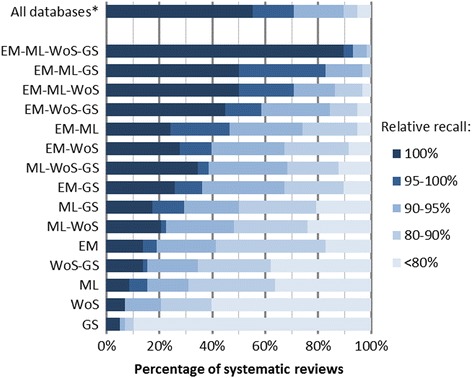
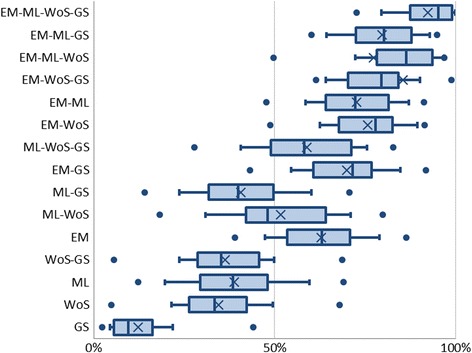
BACKGROUND: Within systematic reviews, when searching for relevant references, it is advisable to use multiple databases. However, searching databases is laborious and time-consuming, as syntax of search strategies are database specific. We aimed to determine the optimal combination of databases needed to conduct efficient searches in systematic reviews and whether the current practice in published reviews is appropriate. While previous studies determined the coverage of databases, we analyzed the actual retrieval from the original searches for systematic reviews. METHODS: Since May 2013, the first author prospectively recorded results from systematic review searches that he performed at his institution. PubMed was used to identify systematic reviews published using our search strategy results. For each published systematic review, we extracted the references of the included studies. Using the prospectively recorded results and the studies included in the publications, we calculated recall, precision, and number needed to read for single databases and databases in combination. We assessed the frequency at which databases and combinations would achieve varying levels of recall (i.e., 95%). For a sample of 200 recently published systematic reviews, we calculated how many had used enough databases to ensure 95% recall. RESULTS: A total of 58 published systematic reviews were included, totaling 1746 relevant references identified by our database searches, while 84 included references had been retrieved by other search methods. Sixteen percent of the included references (291 articles) were only found in a single database; Embase produced the most unique references (n = 132). The combination of Embase, MEDLINE, Web of Science Core Collection, and Google Scholar performed best, achieving an overall recall of 98.3 and 100% recall in 72% of systematic reviews. We estimate that 60% of published systematic reviews do not retrieve 95% of all available relevant references as many fail to search important databases. Other specialized databases, such as CINAHL or PsycINFO, add unique references to some reviews where the topic of the review is related to the focus of the database. CONCLUSIONS: Optimal searches in systematic reviews should search at least Embase, MEDLINE, Web of Science, and Google Scholar as a minimum requirement to guarantee adequate and efficient coverage.
Overview
CoChat Summary
TL;DR
This prospective exploratory study analyzed actual database retrieval for 58 published systematic reviews and found that searching Embase, MEDLINE, Web of Science Core Collection, and Google Scholar together achieved the best recall. The authors estimate that many published systematic reviews fail to retrieve 95% of relevant references because they omit key databases.
Key findings
- Among 1,746 relevant references identified by database searches, 292 (17%) were found by only one database; Embase retrieved the most unique references (n = 132), followed by MEDLINE, Web of Science, and Google Scholar.
- The combination of Embase, MEDLINE, Web of Science Core Collection, and Google Scholar achieved an overall recall of 98.3% and retrieved all included references in 72% of the studied systematic reviews.
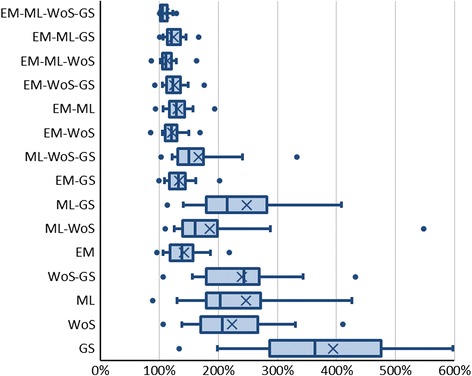
- Searching only Embase produced an average number needed to read (NNR) of 57, whereas the optimal four-database combination had an NNR of 73.
- In a sample of 200 recent systematic reviews, 97% searched MEDLINE, 61% searched Embase, 35% searched Web of Science, and only 10% used Google Scholar; the authors estimate that 60% of published systematic reviews do not retrieve 95% of all available relevant references.
Methods
- Since May 2013, the first author prospectively recorded results from systematic review searches performed at Erasmus MC; PubMed was searched in July 2016 for reviews published since 2014 with Erasmus MC first authors, yielding 58 included reviews.
- Included reviews had documented search strategies and results and had used at least Embase, MEDLINE, Cochrane CENTRAL, Web of Science, and Google Scholar; included references were extracted and located in original EndNote libraries to determine which database retrieved them.
- Recall, precision, and number needed to read were calculated for single databases and combinations in Excel; a separate sample of 200 recent PubMed systematic reviews was analyzed to assess current database selection practice.
Limitations
- The authors state they did not investigate whether missing references changed review conclusions, and because the finding that Web of Science and Google Scholar improve recall is novel, they cannot conclude whether it is due to their dataset or is generalizable.
- The authors note that all searches were performed by one experienced biomedical information specialist, that searcher skill strongly affects search effectiveness, and that their searches still missed some relevant references; they also state that Scopus as a replacement for Embase or Web of Science remains uncertain.
- The text makes evident additional constraints: the study is exploratory, based at a single institution, and relies on a relatively small set of 58 systematic reviews, with specialized databases such as CINAHL and PsycINFO used only when topic-appropriate.
Model-written summary. Check it against the paper before relying on it.
Integrity signals
Registry
Cites
Statistics
Figures

Verification
Claims the paper makes
2 Valid · 1 Not valid · 6 Not checked · 91 Own results and interpretations
A result the paper reports from its own data — it cites no other source for it, so there is none to check. The quote shows it is in the paper.
In the paper
“Using that combination, 93% of the systematic reviews in our study obtained levels of recall that could be considered acceptable (> 95%).”
§ Optimal database combinations for literature searches in systematic reviews: a prospective exploratory study > Discussion
plainstates a cause- Asserted: passes — The authors put it forward as true.
- Checkable: passes — It can be checked against evidence.
- Load-bearing: passes — The paper’s conclusions depend on it.
- Based: passes — The paper gives a reason why it holds.
A result the paper reports from its own data — it cites no other source for it, so there is none to check. The quote shows it is in the paper.
In the paper
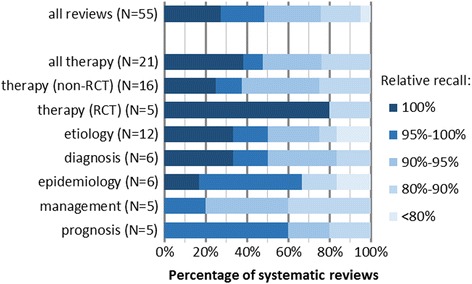
“For all but one domain, the traditional combination of Embase, MEDLINE, and Cochrane CENTRAL did not retrieve enough included references.”
§ Optimal database combinations for literature searches in systematic reviews: a prospective exploratory study > Results > Differences between domains of reviews
plain- Asserted: passes — The authors put it forward as true.
- Checkable: passes — It can be checked against evidence.
- Load-bearing: passes — The paper’s conclusions depend on it.
- Based: passes — The paper gives a reason why it holds.
A result the paper reports from its own data — it cites no other source for it, so there is none to check. The quote shows it is in the paper.
In the paper
“Embase was searched in 61% and Web of Science in 35%, and Google Scholar was only used in 10% of all reviews.”
§ Optimal database combinations for literature searches in systematic reviews: a prospective exploratory study > Results > Status of current practice of database selection
plain- Asserted: passes — The authors put it forward as true.
- Checkable: passes — It can be checked against evidence.
- Load-bearing: unclear — It is unclear whether the paper’s conclusions depend on it.
- Based: passes — The paper gives a reason why it holds.
A result the paper reports from its own data — it cites no other source for it, so there is none to check. The quote shows it is in the paper.
In the paper
“Of the five reviews that included only RCTs, four reached 100% recall if MEDLINE, Web of Science, and Google Scholar combined were complemented with Cochrane CENTRAL.”
§ Optimal database combinations for literature searches in systematic reviews: a prospective exploratory study > Discussion
plainstates a cause- Asserted: passes — The authors put it forward as true.
- Checkable: passes — It can be checked against evidence.
- Load-bearing: passes — The paper’s conclusions depend on it.
- Based: passes — The paper gives a reason why it holds.
A result the paper reports from its own data — it cites no other source for it, so there is none to check. The quote shows it is in the paper.
In the paper
“Based on our findings, this combination achieves acceptable recall about half the time (47%).”
§ Optimal database combinations for literature searches in systematic reviews: a prospective exploratory study > Results > Status of current practice of database selection
plainstates a cause- Asserted: passes — The authors put it forward as true.
- Checkable: passes — It can be checked against evidence.
- Load-bearing: passes — The paper’s conclusions depend on it.
- Based: passes — The paper gives a reason why it holds.
51 more claims
Create a free account to see all 100 claims and every source verdict.
- Probably not a substantial claim. 26
- It may state two separate claims as one. 24
- The quote only partly states this claim. 2
Claims other papers make about this one
Each is checked against this paper’s own text: does it say what the citing paper says it does?
The source backs part of the claim, not all of it — or backs it for a different population, condition or comparison.
In the citing paper
“although deduplication of references is essential to ensure the quality of SRs, there is currently no universal method to do so”
From Reducing systematic review burden using Deduklick: a novel, automated, reliable, and explainable deduplication algorithm to foster medical research (2022) · cites this paper as [5]
Experimental — accuracy not yet measuredThe source backs part of the claim, not all of it — or backs it for a different population, condition or comparison.
In the citing paper
“Although this database is one of the largest academic databases, offers extensive multidisciplinary coverage, and is widely used in bibliometric analyses, relevant publications indexed elsewhere or published in regional and non-indexed outlets may not have been captured [130].”
From Toward Holistic Aging in Lebanon: A Mapping of Gerontology and Geriatrics Research Trends, Gaps, and Future Directions (2026) · cites this paper as [130]
Experimental — accuracy not yet measuredThe source backs part of the claim, not all of it — or backs it for a different population, condition or comparison.
In the citing paper
“Meanwhile, others are highly specialized (e.g., PubMed, Medline, Compendix, etc.), which makes them unsuitable for more inclusive tasks, in particular, for the wide scope analysis and evaluation of multidisciplinary units [42,43].”
From Web of Science (WoS) and Scopus: The Titans of Bibliographic Information in Today’s Academic World (2021) · cites this paper as [43]
Experimental — accuracy not yet measuredThe source backs part of the claim, not all of it — or backs it for a different population, condition or comparison.
In the citing paper
“These databases are widely used in review studies and the majority of them are included in the optimal database combination search19 which guarantee an adequate and efficient coverage of the scientific literature.”
From Occupational therapy interventions for adults with severe mental illness: a scoping review (2021) · cites this paper as [19]
Experimental — accuracy not yet measuredThe cited source says what the claim attributes to it.
In the citing paper
“These differences have led to recommendations that systematic review teams search multiple databases to maximize the likelihood of finding relevant studies [6, 39, 40].”
From PRISMA-S: an extension to the PRISMA Statement for Reporting Literature Searches in Systematic Reviews (2021) · cites this paper as [40]
5 more claims about this paper
Create a free account to see every claim other papers make about this one.
Self-check
Percentages, sums and reported differences re-computed from the paper’s own numbers.
Each contradiction between two passages listed here was confirmed by an independent check.
Rated minor: it would not touch a result — a value no result rests on, a p-value that stays on the same side of the significance level, or a conflict that is clerical, resolved elsewhere in the paper, or outside its own findings.
In the paper
§ Optimal database combinations for literature searches in systematic reviews: a prospective exploratory study > Abstract > Results
“Sixteen percent of the included references (291 articles) were only found in a single database;”
§ Optimal database combinations for literature searches in systematic reviews: a prospective exploratory study > Results > Unique references per database
“A total of 292 (17%) references were found by only one database.”
Citations
Cites
Cochrane Handbook for Systematic Reviews of Interventions Version 5.0.1. The Cochrane Collaboration
Higgins, J. P. T., Green, S. R., & Higgins, J. P. T. (2008) · Cited by 7,171
A systematic approach to searching: an efficient and complete method to develop literature searches
Bramer, W. M., De Jonge, G. B., Rethlefsen, M. L., Mast, F., & Kleijnen, J. (2018) · Journal of the Medical Library Association · doi:10.5195/jmla.2018.283 · Cited by 863
Self-citationComparing two sampling methods to engage hard-to-reach communities in research priority setting
Valerio, M. A., Rodriguez, N., Winkler, P., Lopez, J., Dennison, M., Liang, Y., & Turner, B. J. (2016) · BMC Medical Research Methodology · doi:10.1186/s12874-016-0242-z · Cited by 543
Rethlefsen, M. L., Farrell, A. M., Osterhaus Trzasko, L. C., & Brigham, T. J. (2015) · Journal of Clinical Epidemiology · doi:10.1016/j.jclinepi.2014.11.025 · Cited by 331
Self-citationSystematic reviews need systematic searchers.
(2005) · Europe PMC (PubMed Central) · Cited by 257
Bramer, W. M., Giustini, D., & Kramer, B. M. R. (2016) · Systematic Reviews · doi:10.1186/s13643-016-0215-7 · Cited by 202
Self-citationHalladay, C. W., Trikalinos, T. A., Schmid, I. T., Schmid, C. H., & Dahabreh, I. J. (2015) · Journal of Clinical Epidemiology · doi:10.1016/j.jclinepi.2014.12.017 · Cited by 166 · cited 1×
“Prior research on database importance for systematic reviews has looked primarily at whether included references could have theoretically been found in a certain database, but most have been unable to ascertain whether the researchers actually found the articles in those databases [10, 12, 16, 17, 26].”
BackgroundSearching multiple databases for systematic reviews: added value or diminishing returns?
Stevinson, C., & Lawlor, D. A. (2004) · Complementary Therapies in Medicine · doi:10.1016/j.ctim.2004.09.003 · Cited by 143
Bramer, W. M., Giustini, D., Kramer, B. M., & Anderson, P. (2013) · Systematic Reviews · doi:10.1186/2046-4053-2-115 · Cited by 139 · cited 1×
“Nevertheless others have concluded that a single database is not sufficient to retrieve all references for systematic reviews [18, 19].”
BackgroundSelf-citationSearching one or two databases was insufficient for meta-analysis of observational studies
Lemeshow, A. R., Blum, R. E., Berlin, J. A., Stoto, M. A., & Colditz, G. A. (2005) · Journal of Clinical Epidemiology · doi:10.1016/j.jclinepi.2005.03.004 · Cited by 137
Cited by
Items 1,401–1,500 of 2,083
Mercurio, M., Cofano, E., Cosentino, O., Corona, K., Mocini, F., Rossi, U. G., Galasso, O., Gasparini, G., & Cerciello, S. (2025) · Journal of Experimental Orthopaedics · doi:10.1002/jeo2.70326 · Cited by 2
“First, only English studies were considered, potentially contributing to publication bias; moreover, although four recommended databases were used for the search, we cannot exclude the possibility that additional articles could have been found by searching other databases [5].”
The impact of Evidence-Based Pharmacy on the quality of pharmaceutical care: A survey study
Ratajczak, P., Jacieczko, B., Kędziora, B., Kopciuch, D., Paczkowska, A., Zaprutko, T., & Kus, K. (2025) · PLoS ONE · doi:10.1371/journal.pone.0329016 · Cited by 5
“Therefore, according to many guidelines (e.g., for secondary research), it is recommended to use multiple sources to gain a comprehensive view of the issue [25,26].”
Tavares, S., Reisberg, A., Belsey, D., Henley, A., & Downey, L. E. (2025) · PLoS ONE · doi:10.1371/journal.pone.0328016 · Cited by 1
“Searches were conducted in seven databases based on the recommendations from Bramer et al [18]; CINAHL (EBSCO), EMBASE (Ovid), MEDLINE (Ovid), PsycINFO (Ovid), Global Health (Ovid), HMIC (Health Management Information Consortium) (Ovid).”
de Araújo, A. C., do Nascimento, P. K. D. S. B., de Medeiros, M. C. S., Bortolin, R. H., Cobucci, R. N., & de Rezende, A. A. (2025) · Nutrients · doi:10.3390/nu17152535 · Cited by 1
Trends and Future Directions in Mitigating Silica Exposure in Construction: A Systematic Review
Kalatehjari, R., Rotimi, F. E., Sachinthaka, R., & Moshood, T. D. (2025) · Buildings · doi:10.3390/buildings15162924 · Cited by 5
Lisik, D., Shah, S. A., Basna, R., Dinh, D.-T., Browne, R. P., Andrews, J. L., Wallace, M. L., Ezugwu, A. E.-S., Marušić, A., Tran, D., et al. (2025) · BMJ Open · doi:10.1136/bmjopen-2025-099609 · Cited by 2
“41 From each database, papers from the past 10 years will be assessed.”
Occupational Therapy Interventions in Mental Health During Lockdown: A Scoping Review
Gabucio, L. M. C., Moreno-Morente, G., Collado, L. T., & de la Hera, M. G. (2025) · Healthcare · doi:10.3390/healthcare13172136 · Cited by 1
“On 8 March 2025, six databases were consulted following the recommendations of Bramer et al. [26]: PubMed, Embase, Scopus, PsycINFO, OTSeeker, and Web of Science.”
Technologies for Reflective Assessment in Knowledge Building Communities: A Systematic Review
Rodríguez-Chirino, P., Gutiérrez-Braojos, C., Martínez-Gámez, M., & Rodríguez-Domínguez, C. (2025) · Information · doi:10.3390/info16090762 · Cited by 1
Shinde, P. K., Subramanian, M., Vittala, K. R. P., Thangam, D., Ellikkal, A., Chavadi, C. A., Ravindran, K., & Manoharan, S. (2025) · IGI Global eBooks · doi:10.4018/979-8-3373-2048-9.ch002 · Cited by 1
Variable Dilation Angle Models in Rocks, a Review
Arzúa, J., Ibarra-González, D., & Martínez-Bautista, E. (2025) · Applied Sciences · doi:10.3390/app15189872 · Cited by 1
Structural Barriers and the Future of AI in Global Health: Lessons From Eradicable Diseases
Hailu, K. T., & Haddad, R. R. (2025) · Cureus · doi:10.7759/cureus.92061 · Cited by 2
“Peer-reviewed literature was identified through searches of PubMed, Web of Science, and Scopus using combinations of keywords, including eradication, diseases of poverty, global health equity, artificial intelligence, health governance, and low-and middle-income countries [14].”
Conceptualizing L2 Teachers’ Blended Assessment Literacy (L2TBAL): A Scoping Review
Su, X., Lee, I., & Wang, D. (2025) · International Journal of Applied Linguistics · doi:10.1111/ijal.70002 · Cited by 8
Cheng, L. J., Cheng, J. Y., Chern, C. W. J., Liew, H. M., Tay, S. P., Ja'Affar, M. H. B., Wu, X. V., Wang, W., & He, H. G. (2025) · International Journal of Nursing Studies · doi:10.1016/j.ijnurstu.2025.105213 · Cited by 3
Costs of mental health care resource use in people with obesity: A systematic review
de Graef, N., Gouveia, A. M., Paulus, A. T. G., van der Putten, I. M., Frew, E. J., & Pokhilenko, I. (2025) · PLoS ONE · doi:10.1371/journal.pone.0333123 · Cited by 1
“These databases were selected as they provided adequate and efficient coverage of the topic for this review [39,41,42].”
Intraperitoneal chemotherapy for gastric cancer
Mu, M., Cai, Z., Hu, J., Liu, X., Zhang, B., Chen, Z., Hu, J.-K., & Yang, K. (2025) · Cochrane Database of Systematic Reviews · doi:10.1002/14651858.cd015698.pub2 · Cited by 1
AI ‐Augmented Search for Systematic Reviews: A Comparative Analysis
Lookingbill, V., Khandelwal, V., Roy, K., Garimella, R., Surana, H., & Sheth, A. (2025) · Proceedings of the Association for Information Science and Technology · doi:10.1002/pra2.1290 · Cited by 2
“…focused on PubMed as the Cochrane Handbook for Systematic Reviews of Interventions recommends searching MEDLINE (a bibliographic database commonly accessed through PubMed) (Higgins et al., 2019), and nearly all systematic reviews in the health sciences conduct a search in it (Bramer et al., 2017).”
Ng, J. S. L., & Lukeš, M. (2025) · Review of Managerial Science · doi:10.1007/s11846-025-00942-6 · Cited by 1
“As recommended by Bramer et al. ( 2017 ) and Kraus et al. ( 2020 ), we conducted a similar search in EBSCO’s databases, yielding 232 articles (including 121 overlaps with the WoSCC search results).”
Schreiner, G., Driscoll, A., Mejia, J., Fucaloro, S. P., Krivicich, L. M., & Salzler, M. J. (2025) · Journal of Clinical Orthopaedics and Trauma · doi:10.1016/j.jcot.2025.103245 · Cited by 1
Khalid, G. M., Muhammad, M. S., Bello, M. A., Bello, M. A., Bendicho‐Lavilla, C., Goyanes, Á., & Basit, A. W. (2025) · International Journal of Pharmaceutics · doi:10.1016/j.ijpharm.2025.126347 · Cited by 2
A Network-Based Quantitative Analysis of the Societal Impacts of Assistive Technology
de Jesus, P. A. C., Lourenço, J. W., Canciglieri, O., et al. (2025) · Technologies · doi:10.3390/technologies13110506 · Cited by 1
“Furthermore, it is not possible to state which databases should be consulted for systematic reviews; therefore, it is recommended to use at least two to make the search more comprehensive [14–16].”
Pasara, M. T. (2025) · Advances in African economic, social and political development · doi:10.1007/978-3-032-00525-0_4 · Cited by 2
Xiong, W., Yin, H., Gao, L. S., & Liang, S. (2025) · Journal of Multidisciplinary Healthcare · doi:10.2147/jmdh.s537261 · Cited by 1
“18 The inclusion criteria were: 1.”
Measurement tools to assess the obesogenic environment in neighborhood: a scoping review
Pumsutas, Y., Kosiyaporn, H., Cetthakrikul, N., Nasueb, S., Thiphong, J., Sathitsorot, M., & Waleewong, O. (2025) · BMC Public Health · doi:10.1186/s12889-025-25390-5 · Cited by 2
“Both databases index a variety of journals focused on environmental health including urban health, based on their journal listings [12, 13], and capture more than 95% of relevant literature [14].”
Wiradinata, W., Aditya, M. R., Subali, A. D., Lestari, H., Hardani, R. B., & Mukti, N. H. (2025) · European Journal of Pediatrics · doi:10.1007/s00431-025-06657-w · Cited by 1
“This decision followed published methodological guidance, as previous studies have demonstrated that nearly all relevant articles are captured within this range, with little additional yield beyond 200 [10].”
Hammert, W. B., Kataoka, R., Yamada, Y., Sallberg, R. W., Kang, A., Buckner, S., & Loenneke, J. (2025) · Sports Medicine · doi:10.1007/s40279-025-02370-8 · Cited by 1
“Indeed, it has been shown that the benefit of adding more databases diminishes significantly after the first few major databases are searched (i.e., the number of additional unique relevant studies identified beyond a core set of databases was minimal) [47].”
Etxeberría, I., García-Pena, F. M., Azabal, M., & Pillemer, K. A. (2025) · The Gerontologist · doi:10.1093/geront/gnaf300 · Cited by 3
Physiotherapy management of multiple sclerosis
Learmonth, Y. C. (2025) · Journal of physiotherapy · doi:10.1016/j.jphys.2025.11.008 · Cited by 4
Hygrothermal performance of composite masonry units with embedded insulation: a systematic review
Caruso, L., & Dinh, L. N. (2025) · Elsevier eBooks · doi:10.1016/b978-0-443-40389-7.00008-4 · Cited by 1
Acim, B., Izouaouen, Z., Kharmoum, N., & Ziti, S. (2025) · IEEE Access · doi:10.1109/access.2025.3647279 · Cited by 1
Interprofessional undergraduate breastfeeding education: a scoping review
Lehane, E. A., Fleming, A., Hanley, E., O’Donovan, R., Mulcahy, H., Ward, S., Cogan, L., Murphy, M., Long, A., & Leahy‐Warren, P. (2025) · International Breastfeeding Journal · doi:10.1186/s13006-025-00755-z · Cited by 3
“This approach is consistent with established guidance for grey literature searching [27, 28].”
Sepúlveda, G., Vega, R., & del Río, F. (2025) · Applied Neuropsychology Adult · doi:10.1080/23279095.2025.2608106 · Cited by 1
Monden, M., Hassanin, R., Sackeyfio, H., & Wolf, F. (2025) · Applied Sciences · doi:10.3390/app16010261 · Cited by 2
Michels, R. E., Delnoij, D. M. J., Bramer, W. M., & de Graaff, B. (2025) · Health Economics Policy and Law · doi:10.1017/s1744133125100339 · Cited by 1
“We conducted a search on May 2, 2024, on Embase.com, Medline Ovid, Web of Science, Scopus, CINAHL (EBSCOhost), and One Business (ProQuest) (Bramer et al. , 2018; Bramer et al. , 2017).”
Self-citationPereira, A. C. (2025) · STUDIES IN ENGINEERING AND EXACT SCIENCES · doi:10.54021/seesv6n2-031 · Cited by 1
Chua, S. K. K., Tan, A. K. S., Koh, D. T. S., Soong, J., Lee, K. H., & Razak, H. R. B. A. (2026) · Singapore Medical Journal · doi:10.4103/singaporemedj.smj-2025-047 · Cited by 1
Sharkiya, S. H., & Ohana, I. (2026) · International Journal of Africa Nursing Sciences · doi:10.1016/j.ijans.2026.100984 · Cited by 3
Ahmed, A., & Shazo, S. (2026) · Evidence-Based Dentistry · doi:10.1038/s41432-025-01201-z · Cited by 1
Cost Analysis of the OSCE: Scoping Review
Colonhese, M., Lima, S. F., Negri, E. C., Girão, F. B., Giovanazzi, R. S. D., & Júnior, G. A. P. (2026) · Simulation in Healthcare The Journal of the Society for Simulation in Healthcare · doi:10.1097/sih.0000000000000910 · Cited by 2
Dapari, R., Rahim, H., Dom, N. C., & Noor, M. I. M. (2025) · Malaysian Journal of Medicine and Health Sciences · doi:10.47836/mjmhs.21.5.22 · Cited by 1
Beyond Boolean: A dual-model framework for organizing English learner research literature
Ghimire, N. (2026) · Social Sciences & Humanities Open · doi:10.1016/j.ssaho.2026.102518 · Cited by 1
Radiotherapy for Neovascular Age-Related Macular Degeneration: A Systematic Review and Meta-Analysis
Lei, Y., Yang, J., Li, Y., Xiao, B., Lai, D., & Qiu, Q. (2026) · Current Eye Research · doi:10.1080/02713683.2026.2621179 · Cited by 1
Exploring Online Sexual Harassment in Adolescent Populations: A PRISMA Review
Thompson, R., Turner, K., & Allely, C. S. (2026) · Sexuality Research and Social Policy · doi:10.1007/s13178-026-01285-x · Cited by 1
Liu, H., Hamid, A. H. A., & Alias, B. S. (2026) · Multidisciplinary Reviews · doi:10.31893/multirev.2026381 · Cited by 2
“To address this limitation, the present study adopted the recommendations of Bramer et al. (2017), who emphasized the use of multiple databases to maximize the inclusion of relevant publications.”
Bafail, D. A. (2026) · Diseases · doi:10.3390/diseases14020062 · Cited by 2
“Web of Science was searched from database inception to 31 August 2025 [15,16].”
Chained Prompting for Better Systematic Review Search Strategies
Nasser, F., Trad, F. S., Mohanna, A., Fuleihan, G. E., & Chehab, A. (2025) · International Conference on Foundation and Large Language Models (FLLM) · doi:10.1109/fllm67465.2025.11391048 · Cited by 1
“In recent years, LS has become increasingly systematic, necessitating the use of professional search strategies (SS), which are frequently developed through librarian-mediated search services [5].”
The tumour microenvironment in paediatric rhabdomyosarcomas: a systematic review
Richards, M., Putnam, C., Underwood, T., & Walters, Z. S. (2025) · Carcinogenesis · doi:10.1093/carcin/bgag011 · Cited by 1
Gao, Y., Qi, L., & Tongwu, Y. U. (2026) · Frontiers in Public Health · doi:10.3389/fpubh.2026.1743075 · Cited by 4
Lazzari, C. G., Crawford, P., Ashmore, A., & Kotera, Y. (2026) · Systematic Reviews · doi:10.1186/s13643-026-03093-1 · Cited by 2
Dworski, K., Tulski, M., Woźniak, S., et al. (2026) · Journal of Clinical Medicine · doi:10.3390/jcm15051724 · Cited by 1
“We also only reviewed the first 200 results after sorting them by relevance, because this allows for an efficiency similar to that of searching major medical databases in comparison to reviewing all results [10].”
Sebastião, R., Fonseca, P., Sousa, M., Machado, L. J., Sousa, F., Carvalho, D., Sacco, I. D. C. N., & Vilas-Boas, J. P. (2026) · Clinical Biomechanics · doi:10.1016/j.clinbiomech.2026.106806 · Cited by 3
Amaral, T. D. S., Souza, S. O., de Matos, M. A. D., Meireles, G. O. A. B., de Paula, C. R., & de Matos, M. A. (2026) · Revista da Escola de Enfermagem da USP · doi:10.1590/1980-220x-reeusp-2025-0358en · Cited by 1
“Only the first 200 relevant publications available on Google Scholar were considered (29) .”
Metformin Use and Risk of Glaucoma: A Systematic Review and Meta-Analysis
Abdelaal, A., Serhan, H. A. A., Alsaadi, M., Aboujabal, K., Rustam, Z., Talaparthy, T., Adelpour, M., Khouri, A. S., & Elhusseiny, A. M. (2026) · American Journal of Ophthalmology · doi:10.1016/j.ajo.2026.03.010 · Cited by 1
A Systematic Study of Mathematical Modeling for Sustainable Community-Based Disaster Risk Management
Sukono, Susanti, D., Nahar, J., Ghazali, P. L., Surya, H. A., Ibrahim, R. A., Azahra, A. S., & Sambas, A. (2026) · Sustainability · doi:10.3390/su18062711 · Cited by 1
Christodoulou, A. M., Zakopoulou, V., Tsamis, K. I., & Voniati, L. (2026) · Applied Neuropsychology Child · doi:10.1080/21622965.2026.2643348 · Cited by 1
Rethinking Food Waste in Aged Care: A Systematic Review Framing Food Waste as an Ecosystem Issue
Piere, E., O'Kane, P., & Mirosa, M. (2026) · Australian Journal on Ageing · doi:10.1111/ajag.70151 · Cited by 2
“The CABI database was specifically included because of its focus on nutrition and food science, potentially identifying unique references that may not be found in the larger, interdisciplinary databases [32].”
Teplov, R., Salihu, D., Väätänen, J., & Settles, A. M. (2026) · International Business Review · doi:10.1016/j.ibusrev.2026.102588 · Cited by 5
Machine learning for medication error detection: a scoping review protocol
Hêche, F., Yazdani, A., Ferdowsi, S., Kabak, R., Mu, G., & Teodoro, D. (2026) · BMJ Open · doi:10.1136/bmjopen-2025-109192 · Cited by 2
Gezmu, A. A., Tesfaye, A. W., & Coates, A. R. M. (2026) · Antibiotics · doi:10.3390/antibiotics15040356 · Cited by 1
Adandom, H. C., Nwankwo, H. C., Adandom, I. I., Akinrolie, O., Scott, D. R. M., Odole, A. C., Cook, L. L., Shan, G., & Awosoga, O. (2026) · Health Science Reports · doi:10.1002/hsr2.72138 · Cited by 1
Structural and functional brain alterations in patients with hyperacusis: MRI systematic review
Alkahtani, R., Elbeltagy, R., Hamd, Z. Y., & Hassan, A. B. A. (2026) · Frontiers in Human Neuroscience · doi:10.3389/fnhum.2026.1785826 · Cited by 1
“Both controlled vocabulary of MeSH and accessible terms were employed to ensure the comprehensive findings of relevant studies (Cumpston et al., 2019; Bramer et al., 2017; Yong et al., 2017).”
Which biosecurity measures are specific to free-range poultry? Insights from a scoping review
Delpont, M., Mahmood, Q., Sánchez‐Cano, A., et al. (2026) · Veterinary Research · doi:10.1186/s13567-026-01742-w · Cited by 1
“To identify relevant documents, four databases with high recall in biomedical research [19] were searched: Agricola (EBSCO interface) and Web of Science (WoS) (Clarivate interface) available via Baylor University (USA), and Sco-pus (Elsevier interface) and Medline (PubMed interface) available via…”
RSL: FATORES QUE CONTRIBUEM PARA A RETENÇÃO DE EMPREGADOS DA GERAÇÃO Z
Pollon, V. C. Z., & Teixeira, M. L. M. (2026) · Revista Multidisciplinar do Nordeste Mineiro · doi:10.66104/mbf79m33 · Cited by 1
Artificial intelligence assimilation shapes sustainable performance through dynamic capabilities
Zhang, M., & Dong, W. (2026) · Scientific Reports · doi:10.1038/s41598-026-46291-6 · Cited by 12
Ai-based interventions for adolescent mental health: a systematic review
Saputra, R., Hayati, I. R., Lidyawati, Y., Oktasari, M., & Noviza, N. (2026) · Journal of Behavioral and Cognitive Therapy · doi:10.1016/j.jbct.2026.100595 · Cited by 3
Consumers’ perception of native advertising on social media – A systematic literature review
Hübner, M., Henseler, J., & Thalmann, J. (2026) · Journal of Marketing Communications · doi:10.1080/13527266.2026.2648839 · Cited by 4
Firearm Exposure, Health Risk Behaviors, and Health Outcomes in Rural Youth: An Integrative Review
Heitz, C. M., Stansfield, R., Semenza, D. C., & Ayres, C. G. (2026) · Trauma Violence & Abuse · doi:10.1177/15248380261439136 · Cited by 1
Sikhosana, P., & Mashalaba, Y. B. (2026) · Frontiers in Sustainable Resource Management · doi:10.3389/fsrma.2026.1772880 · Cited by 1
Do startup incubators enhance new venture performance? Evidence from a meta-analysis
Seitz, N., Buratti, M., Lehmann, E. E., & Eberle, N. (2026) · Review of Managerial Science · doi:10.1007/s11846-026-01017-w · Cited by 6
The Use of Intra-Articular Hydrogel in Knee Osteoarthritis: A Systematic Review
Tan, A. K. S., Vijay Vengkat Samynathan, C., Dh, M., Yung, A., Koh, D., Soong, J., Lee, K. H., & Razak, H. R. B. A. (2026) · Cartilage · doi:10.1177/19476035261439778 · Cited by 1
Geremew, Y. M., & Kleynhans, C. I. (2026) · Administrative Sciences · doi:10.3390/admsci16050196 · Cited by 3
Zhang, Y.-Z., Yang, B. Y., Jiang, C.-H., Guo, Y.-X., Lai, X., Zhang, W.-Q., & Zhang, H. (2026) · Journal of Pain Research · doi:10.2147/jpr.s599315 · Cited by 3
From Contextual Diversity to Theoretical Patterns: A Concept Analysis of Care in Music Education
Xiang-ming, Z., Angelo, E., & Kibirige, R. M. (2026) · International Journal of Music Education · doi:10.1177/02557614261441347 · Cited by 1
葛, 玲., & Sun, Y. (2026) · Frontiers in Psychology · doi:10.3389/fpsyg.2026.1786104 · Cited by 1
“First, the search was conducted across four electronic databases, namely, PubMed, Scopus, Web of Science Core Collection, and SPORTDiscus, as they provided sufficient coverage of the relevant literature.”
Verma, V., Harshitha, D., Ghoshal, A., Mathias, E. G., Rao, K. S., Damani, A., Iyengar, A., Vasudeva Bhat, K., & Salins, N. S. (2026) · Pediatric Research · doi:10.1038/s41390-026-05036-x · Cited by 1
Satyaprakash, S. A., Gupta, N. K., Singh, S. P., Gupta, R. K., & Singh, S. P. (2026) · Journal of Neurotrauma · doi:10.1177/08977151261449702 · Cited by 1
Kromhout, L. E. (2026) · Journal of Neonatal Nursing · doi:10.1016/j.jnn.2026.101882 · Cited by 1
Barriers and Facilitators to the 3 Sides of Extended Reality-Rehabilitation Adoption: Scoping Review
Baltissen, L., Stienstra, M., Denoo, L., & Knoben, J. (2026) · Journal of Medical Internet Research · doi:10.2196/80055 · Cited by 2
“To ensure adequate and efficient database coverage for published academic papers, we searched Scopus, Embase, Web of Science, and PubMed from October 31, 2024, to January 20, 2026 [25].”
Luketić, D., & Diković, M. (2026) · Trends in Higher Education · doi:10.3390/higheredu5020045 · Cited by 6
“The known limitations of Google Scholar are indexing transparency, ranking volatility and limited Boolean operator support [34,35].”
Martinez-Navarro, O., & Martínez‐Martínez, C. (2026) · Journal of Public Health · doi:10.1007/s10389-026-02797-x · Cited by 3
Tarnanidis, T. K., Papathanasiou, J., Mareschal, B., Vlachopoulou, M., Manda, V. K., & Sousa, B. (2026) · Journal of Marketing Analytics · doi:10.1057/s41270-026-00486-y · Cited by 1
Warren, T., van der Weegen, W., Kool, R. B., Hoogendoorn, M., & Timmers, T. (2026) · International Journal of Medical Informatics · doi:10.1016/j.ijmedinf.2026.106525 · Cited by 2
The effects of government interventions on housing market: A meta-study of empirical literature
Kholodilin, K. A. (2026) · Journal of Housing Economics · doi:10.1016/j.jhe.2026.102155 · Cited by 1
Ismail, N., Ayub, A. F. M., & Zhang, T. (2026) · Cogent Education · doi:10.1080/2331186x.2026.2673624 · Cited by 1
Río, M. Á. M. D., & Cornejo, V. M. R. (2026) · Innovation The European Journal of Social Science Research · doi:10.1080/13511610.2026.2677779 · Cited by 3
Gorzka, J., Burda, I. M., & Nyka, L. (2026) · Sustainability · doi:10.3390/su18125966 · Cited by 3
Kabdraisova, A. Z., Umbetova, A. K., Kairalapova, G., Litvinenko, Y. A., Sassykova, L. R., Yelibayeva, N. S., Burasheva, G. S., Berganayeva, A. E., Assylkhanov, Z. S., Dauletova, M. D., et al. (2026) · Molecules · doi:10.3390/molecules31122162 · Cited by 4
Toniolo, J., Dessi, F. A., Choki, B., Adou, C., Parenté, A., Blanquet, V., Bakiri, Z., Herault, É., Erazo, A., Auditeau, E., et al. (2026) · European Journal of Integrative Medicine · doi:10.1016/j.eujim.2026.102698 · Cited by 2
Stockner, M., Convertino, G., Cambedda, S., & Mazzoni, G. A. L. (2026) · Computers in Human Behavior Artificial Humans · doi:10.1016/j.chbah.2026.100332 · Cited by 3
Murugan, Y., Shrivastav, V. N., & Akurathi, H. K. (2026) · BMC Pulmonary Medicine · doi:10.1186/s12890-026-04452-3 · Cited by 3
“A comprehensive systematic literature search was conducted across eight electronic databases including PubMed/MEDLINE, Embase, Web of Science, Scopus, and the Cochrane Library from inception to December 2024 [16].”
An assessment of commonly grown agroforestry trees across the tropics: A scoping review
William, A., Löhr, K., Sieber, S., & Temperton, V. M. (2026) · Trees Forests and People · doi:10.1016/j.tfp.2026.101394 · Cited by 2
Chodri, S., Haghighi, A., & Zolfagharinia, H. (2026) · Journal of Advanced Transportation · doi:10.1155/atr/8047513 · Cited by 1
Ho, Y.-S., & Christidis, N. (2026) · Frontiers in Aging Neuroscience · doi:10.3389/fnagi.2026.1903685 · Cited by 1
“A more restrictive search may reduce the inclusion of peripheral records but may also exclude potentially relevant publications, reflecting the well-recognized trade-off between precision and recall in information retrieval and literature searching (Falagas et al., 2008; Bramer et al., 2017).”
Sathish, S., & Lau, S. (2026) · Educational Research Review · doi:10.1016/j.edurev.2026.100820 · Cited by 2
Recent Advances in AI for Automated ICD Coding: A Systematic Literature Review
Khalid, A. R., Ali, H., Fathima, K., Carole, K. S., & Kim, H.-C. (2026) · Journal of Medical Systems · doi:10.1007/s10916-026-02429-7 · Cited by 6
“In the same way, Google Scholar and Mendeley were included to capture grey literature and broader scholarly outputs [20, 32, 33].”
Ortiz, H. A. D. L. B., Chamorro-Lange, C., Parizotto, N. A., & Liebano, R. E. (2026) · International Journal of Environmental Research and Public Health · doi:10.3390/ijerph23070919 · Cited by 1
“Nevertheless, this systematic review was conducted in accordance with PRISMA 2020 recommendations and included a comprehensive search strategy across eight major electronic databases [26,29], strengthening the methodological rigor of the evidence synthesis.”
Tan, A. K. S., Ting, C. S., He, Y., et al. (2026) · Journal of Minimally Invasive Spine Surgery and Technique · doi:10.21182/jmisst.2026.03412 · Cited by 1
Focused Search of the Literature
Marcos, F. Á. (2019) · European Journal of Vascular and Endovascular Surgery · doi:10.1016/j.ejvs.2019.03.038 · Cited by 1
Manlapaz, D., Maya, A. C., Sicat, Z. M. V., et al. (2021) · Physical Therapy Reviews · doi:10.1080/10833196.2021.1957640 · Cited by 1
Ahmed, R., Shadis, A., & Ahmed, R. (2022) · International Journal of Audiology · doi:10.1080/14992027.2021.2018511 · Cited by 6
Surface electromyography‐based biofeedback and knee rehabilitation: A review of the literature
Armshaw, B. P., Vaidya, M., & Mehta, S. (2022) · Behavioral Interventions · doi:10.1002/bin.1907 · Cited by 1
Metadata
- Authors
- Bramer, W. M., Rethlefsen, M. L., Kleijnen, J., & Franco, O. H.
- Affiliations
- Erasmus MC (NL)
- University of Utah (US)
- Maastricht University (NL)
- Corresponding author
- Bramer, Wichor M.
- Venue
- Systematic Reviews
- Published
- 2017-12
- Volume
- 6
- Issue
- 1
- Pages
- 245-245
- ISSN
- 2046-4053 (ISSN-L)
- PMC
- PMC5718002
- OpenAlex
- W2774587119
- Cited by
- 2,114
- References
- 27
- Citations by year
- 2026: 373 · 2025: 411 · 2024: 332 · 2023: 292 · 2022: 252 · 2021: 231 · 2020: 145 · 2019: 64 · 2018: 12 · 2017: 2
- FWCI
- 14.94
- Type
- journal article
- Language
- en
- Open access
- gold
- doi.org
- Licence
- cc-by
- creativecommons.org/licenses/by/4.0/ (tdm)
- creativecommons.org/licenses/by/4.0/ (vor, 5 d)
- Locations
- Systematic Reviews (publishedVersion, cc-by)
- Europe PMC (PubMed Central) (publishedVersion, cc-by)
- PubMed Central (publishedVersion, cc-by)
- PubMed (publishedVersion)
- Research Publications (Maastricht University) (publishedVersion, cc-by)
- EUR Research Repository (Erasmus University Rotterdam) (publishedVersion, other-oa)
- EUR Research Repository (Erasmus University Rotterdam) (submittedVersion, other-oa)
- RePub (Erasmus University Rotterdam) (submittedVersion, other-oa)
- DOAJ (DOAJ: Directory of Open Access Journals) (submittedVersion, cc-by-sa)
- Research Publications (Maastricht University) (submittedVersion, other-oa)
- Funders
- National Center for Advancing Translational Sciences (UL1TR001067)
- Topics
- Social Sciences › Decision Sciences › Statistics, Probability and Uncertainty › Meta-analysis and systematic reviews
- Social Sciences › Library and Information Sciences › scientometrics and bibliometrics research
- Physical Sciences › Computer Science › Information Systems › Information Retrieval and Search Behavior
- Keywords
- literature search strategies, search recall, search precision, database coverage, Embase, MEDLINE, Web of Science, Google Scholar, CINAHL, PsycINFO, number needed to read
- MeSH terms
- Humans, Prospective Studies, Review Literature as Topic, Databases, Bibliographic, Information Storage and Retrieval
About these checks
Registry, retraction, Cites and statistics results are computed, not judged, with one exception: a printed reference that no index lists is read once by a model before it counts as a citation error. Claims are extracted by a model and kept only when their quote appears verbatim in the text; each cited source is then checked, with a model’s help, for whether it says what the claim relies on. Those verdicts can be wrong — read the claim’s quote and the cited source before relying on one.
A language model drew the claims from the paper on 2026-09-29, under version 3 of the claim definition (model deepseek-v4.1-flash, prompt extract-v3).
A second model labelled each claim on 2026-09-29 (model jev-1.13-20260917, definition revision gold-guideline-v0.2).
Statistics and arithmetic are recomputed, not judged.
Confidence bands are shown only for fields calibrated on our annotated test set. None is calibrated yet, so no band is shown.
What counts as a claim ›How we measure confidence ›How we check this ›
Are you an author, or do you see a problem with this page? Request a review
Data sources
Bibliographic data: Semantic Scholar, OpenAlex, Crossref.
Contains information from the Semantic Scholar Academic Graph Datasets, made available under the ODC Attribution License (ODC-BY 1.0).
Semantic Scholar’s data is described in: Kinney, R., et al. (2023). The Semantic Scholar Open Data Platform. arXiv:2301.10140.
