

Optimal database combinations for literature searches in systematic reviews: a prospective exploratory study
Open accessThe DOI matches its Crossref record; 27 of the 27 references it cites were found in a registry or an index; 3 of the 22 sources its claims cite were checked for support.
Abstract
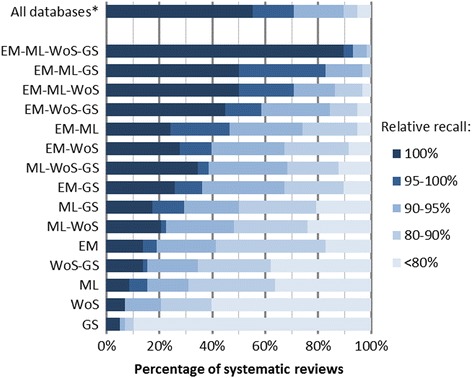
BACKGROUND: Within systematic reviews, when searching for relevant references, it is advisable to use multiple databases. However, searching databases is laborious and time-consuming, as syntax of search strategies are database specific. We aimed to determine the optimal combination of databases needed to conduct efficient searches in systematic reviews and whether the current practice in published reviews is appropriate. While previous studies determined the coverage of databases, we analyzed the actual retrieval from the original searches for systematic reviews. METHODS: Since May 2013, the first author prospectively recorded results from systematic review searches that he performed at his institution. PubMed was used to identify systematic reviews published using our search strategy results. For each published systematic review, we extracted the references of the included studies. Using the prospectively recorded results and the studies included in the publications, we calculated recall, precision, and number needed to read for single databases and databases in combination. We assessed the frequency at which databases and combinations would achieve varying levels of recall (i.e., 95%). For a sample of 200 recently published systematic reviews, we calculated how many had used enough databases to ensure 95% recall. RESULTS: A total of 58 published systematic reviews were included, totaling 1746 relevant references identified by our database searches, while 84 included references had been retrieved by other search methods. Sixteen percent of the included references (291 articles) were only found in a single database; Embase produced the most unique references (n = 132). The combination of Embase, MEDLINE, Web of Science Core Collection, and Google Scholar performed best, achieving an overall recall of 98.3 and 100% recall in 72% of systematic reviews. We estimate that 60% of published systematic reviews do not retrieve 95% of all available relevant references as many fail to search important databases. Other specialized databases, such as CINAHL or PsycINFO, add unique references to some reviews where the topic of the review is related to the focus of the database. CONCLUSIONS: Optimal searches in systematic reviews should search at least Embase, MEDLINE, Web of Science, and Google Scholar as a minimum requirement to guarantee adequate and efficient coverage.
Overview
CoChat Summary
TL;DR
This prospective exploratory study analyzed actual database retrieval for 58 published systematic reviews and found that searching Embase, MEDLINE, Web of Science Core Collection, and Google Scholar together achieved the best recall. The authors estimate that many published systematic reviews fail to retrieve 95% of relevant references because they omit key databases.
Key findings
- Among 1,746 relevant references identified by database searches, 292 (17%) were found by only one database; Embase retrieved the most unique references (n = 132), followed by MEDLINE, Web of Science, and Google Scholar.
- The combination of Embase, MEDLINE, Web of Science Core Collection, and Google Scholar achieved an overall recall of 98.3% and retrieved all included references in 72% of the studied systematic reviews.
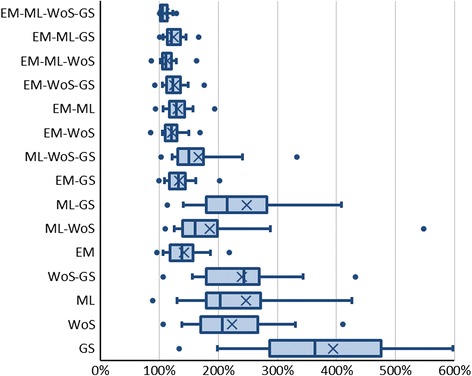
- Searching only Embase produced an average number needed to read (NNR) of 57, whereas the optimal four-database combination had an NNR of 73.
- In a sample of 200 recent systematic reviews, 97% searched MEDLINE, 61% searched Embase, 35% searched Web of Science, and only 10% used Google Scholar; the authors estimate that 60% of published systematic reviews do not retrieve 95% of all available relevant references.
Methods
- Since May 2013, the first author prospectively recorded results from systematic review searches performed at Erasmus MC; PubMed was searched in July 2016 for reviews published since 2014 with Erasmus MC first authors, yielding 58 included reviews.
- Included reviews had documented search strategies and results and had used at least Embase, MEDLINE, Cochrane CENTRAL, Web of Science, and Google Scholar; included references were extracted and located in original EndNote libraries to determine which database retrieved them.
- Recall, precision, and number needed to read were calculated for single databases and combinations in Excel; a separate sample of 200 recent PubMed systematic reviews was analyzed to assess current database selection practice.
Limitations
- The authors state they did not investigate whether missing references changed review conclusions, and because the finding that Web of Science and Google Scholar improve recall is novel, they cannot conclude whether it is due to their dataset or is generalizable.
- The authors note that all searches were performed by one experienced biomedical information specialist, that searcher skill strongly affects search effectiveness, and that their searches still missed some relevant references; they also state that Scopus as a replacement for Embase or Web of Science remains uncertain.
- The text makes evident additional constraints: the study is exploratory, based at a single institution, and relies on a relatively small set of 58 systematic reviews, with specialized databases such as CINAHL and PsycINFO used only when topic-appropriate.
Model-written summary. Check it against the paper before relying on it.
Integrity signals
Registry
Cites
Statistics
Figures

Verification
Claims the paper makes
2 Valid · 1 Not valid · 6 Not checked · 91 Own results and interpretations
A result the paper reports from its own data — it cites no other source for it, so there is none to check. The quote shows it is in the paper.
In the paper
“Using that combination, 93% of the systematic reviews in our study obtained levels of recall that could be considered acceptable (> 95%).”
§ Optimal database combinations for literature searches in systematic reviews: a prospective exploratory study > Discussion
plainstates a cause- Asserted: passes — The authors put it forward as true.
- Checkable: passes — It can be checked against evidence.
- Load-bearing: passes — The paper’s conclusions depend on it.
- Based: passes — The paper gives a reason why it holds.
A result the paper reports from its own data — it cites no other source for it, so there is none to check. The quote shows it is in the paper.
In the paper
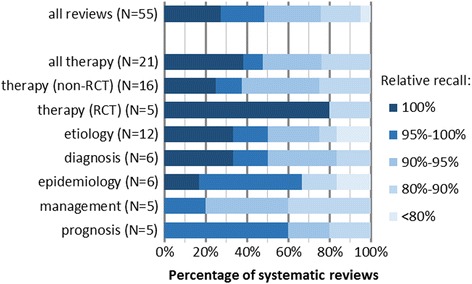
“For all but one domain, the traditional combination of Embase, MEDLINE, and Cochrane CENTRAL did not retrieve enough included references.”
§ Optimal database combinations for literature searches in systematic reviews: a prospective exploratory study > Results > Differences between domains of reviews
plain- Asserted: passes — The authors put it forward as true.
- Checkable: passes — It can be checked against evidence.
- Load-bearing: passes — The paper’s conclusions depend on it.
- Based: passes — The paper gives a reason why it holds.
A result the paper reports from its own data — it cites no other source for it, so there is none to check. The quote shows it is in the paper.
In the paper
“Embase was searched in 61% and Web of Science in 35%, and Google Scholar was only used in 10% of all reviews.”
§ Optimal database combinations for literature searches in systematic reviews: a prospective exploratory study > Results > Status of current practice of database selection
plain- Asserted: passes — The authors put it forward as true.
- Checkable: passes — It can be checked against evidence.
- Load-bearing: unclear — It is unclear whether the paper’s conclusions depend on it.
- Based: passes — The paper gives a reason why it holds.
A result the paper reports from its own data — it cites no other source for it, so there is none to check. The quote shows it is in the paper.
In the paper
“Of the five reviews that included only RCTs, four reached 100% recall if MEDLINE, Web of Science, and Google Scholar combined were complemented with Cochrane CENTRAL.”
§ Optimal database combinations for literature searches in systematic reviews: a prospective exploratory study > Discussion
plainstates a cause- Asserted: passes — The authors put it forward as true.
- Checkable: passes — It can be checked against evidence.
- Load-bearing: passes — The paper’s conclusions depend on it.
- Based: passes — The paper gives a reason why it holds.
A result the paper reports from its own data — it cites no other source for it, so there is none to check. The quote shows it is in the paper.
In the paper
“Based on our findings, this combination achieves acceptable recall about half the time (47%).”
§ Optimal database combinations for literature searches in systematic reviews: a prospective exploratory study > Results > Status of current practice of database selection
plainstates a cause- Asserted: passes — The authors put it forward as true.
- Checkable: passes — It can be checked against evidence.
- Load-bearing: passes — The paper’s conclusions depend on it.
- Based: passes — The paper gives a reason why it holds.
51 more claims
Create a free account to see all 100 claims and every source verdict.
- Probably not a substantial claim. 26
- It may state two separate claims as one. 24
- The quote only partly states this claim. 2
Claims other papers make about this one
Each is checked against this paper’s own text: does it say what the citing paper says it does?
The source backs part of the claim, not all of it — or backs it for a different population, condition or comparison.
In the citing paper
“although deduplication of references is essential to ensure the quality of SRs, there is currently no universal method to do so”
From Reducing systematic review burden using Deduklick: a novel, automated, reliable, and explainable deduplication algorithm to foster medical research (2022) · cites this paper as [5]
Experimental — accuracy not yet measuredThe source backs part of the claim, not all of it — or backs it for a different population, condition or comparison.
In the citing paper
“Although this database is one of the largest academic databases, offers extensive multidisciplinary coverage, and is widely used in bibliometric analyses, relevant publications indexed elsewhere or published in regional and non-indexed outlets may not have been captured [130].”
From Toward Holistic Aging in Lebanon: A Mapping of Gerontology and Geriatrics Research Trends, Gaps, and Future Directions (2026) · cites this paper as [130]
Experimental — accuracy not yet measuredThe source backs part of the claim, not all of it — or backs it for a different population, condition or comparison.
In the citing paper
“Meanwhile, others are highly specialized (e.g., PubMed, Medline, Compendix, etc.), which makes them unsuitable for more inclusive tasks, in particular, for the wide scope analysis and evaluation of multidisciplinary units [42,43].”
From Web of Science (WoS) and Scopus: The Titans of Bibliographic Information in Today’s Academic World (2021) · cites this paper as [43]
Experimental — accuracy not yet measuredThe source backs part of the claim, not all of it — or backs it for a different population, condition or comparison.
In the citing paper
“These databases are widely used in review studies and the majority of them are included in the optimal database combination search19 which guarantee an adequate and efficient coverage of the scientific literature.”
From Occupational therapy interventions for adults with severe mental illness: a scoping review (2021) · cites this paper as [19]
Experimental — accuracy not yet measuredThe cited source says what the claim attributes to it.
In the citing paper
“These differences have led to recommendations that systematic review teams search multiple databases to maximize the likelihood of finding relevant studies [6, 39, 40].”
From PRISMA-S: an extension to the PRISMA Statement for Reporting Literature Searches in Systematic Reviews (2021) · cites this paper as [40]
5 more claims about this paper
Create a free account to see every claim other papers make about this one.
Self-check
Percentages, sums and reported differences re-computed from the paper’s own numbers.
Each contradiction between two passages listed here was confirmed by an independent check.
Rated minor: it would not touch a result — a value no result rests on, a p-value that stays on the same side of the significance level, or a conflict that is clerical, resolved elsewhere in the paper, or outside its own findings.
In the paper
§ Optimal database combinations for literature searches in systematic reviews: a prospective exploratory study > Abstract > Results
“Sixteen percent of the included references (291 articles) were only found in a single database;”
§ Optimal database combinations for literature searches in systematic reviews: a prospective exploratory study > Results > Unique references per database
“A total of 292 (17%) references were found by only one database.”
Citations
Cites
Cochrane Handbook for Systematic Reviews of Interventions Version 5.0.1. The Cochrane Collaboration
Higgins, J. P. T., Green, S. R., & Higgins, J. P. T. (2008) · Cited by 7,171
A systematic approach to searching: an efficient and complete method to develop literature searches
Bramer, W. M., De Jonge, G. B., Rethlefsen, M. L., Mast, F., & Kleijnen, J. (2018) · Journal of the Medical Library Association · doi:10.5195/jmla.2018.283 · Cited by 863
Self-citationComparing two sampling methods to engage hard-to-reach communities in research priority setting
Valerio, M. A., Rodriguez, N., Winkler, P., Lopez, J., Dennison, M., Liang, Y., & Turner, B. J. (2016) · BMC Medical Research Methodology · doi:10.1186/s12874-016-0242-z · Cited by 543
Rethlefsen, M. L., Farrell, A. M., Osterhaus Trzasko, L. C., & Brigham, T. J. (2015) · Journal of Clinical Epidemiology · doi:10.1016/j.jclinepi.2014.11.025 · Cited by 331
Self-citationSystematic reviews need systematic searchers.
(2005) · Europe PMC (PubMed Central) · Cited by 257
Bramer, W. M., Giustini, D., & Kramer, B. M. R. (2016) · Systematic Reviews · doi:10.1186/s13643-016-0215-7 · Cited by 202
Self-citationHalladay, C. W., Trikalinos, T. A., Schmid, I. T., Schmid, C. H., & Dahabreh, I. J. (2015) · Journal of Clinical Epidemiology · doi:10.1016/j.jclinepi.2014.12.017 · Cited by 166 · cited 1×
“Prior research on database importance for systematic reviews has looked primarily at whether included references could have theoretically been found in a certain database, but most have been unable to ascertain whether the researchers actually found the articles in those databases [10, 12, 16, 17, 26].”
BackgroundSearching multiple databases for systematic reviews: added value or diminishing returns?
Stevinson, C., & Lawlor, D. A. (2004) · Complementary Therapies in Medicine · doi:10.1016/j.ctim.2004.09.003 · Cited by 143
Bramer, W. M., Giustini, D., Kramer, B. M., & Anderson, P. (2013) · Systematic Reviews · doi:10.1186/2046-4053-2-115 · Cited by 139 · cited 1×
“Nevertheless others have concluded that a single database is not sufficient to retrieve all references for systematic reviews [18, 19].”
BackgroundSelf-citationSearching one or two databases was insufficient for meta-analysis of observational studies
Lemeshow, A. R., Blum, R. E., Berlin, J. A., Stoto, M. A., & Colditz, G. A. (2005) · Journal of Clinical Epidemiology · doi:10.1016/j.jclinepi.2005.03.004 · Cited by 137
Cited by
Items 1,001–1,100 of 2,083
Luffi, O. S., Dianta, C. V., Viscardi, S., & Ulloa-Inostroza, E. M. (2024) · Medical Science Educator · doi:10.1007/s40670-024-02056-2 · Cited by 6
“To do this, the Boolean operator “AND” was used in eight databases: SciELO, PubMed, CUIDEN, Scopus, Web Of Science (WOS), CINAHL (EBSCO), Redalyc, and Dialnet [19, 20].”
Mittal, S., Yadav, S., Srivastava, R., Sahni, S., & Kumar, H. (2024) · Acta Psychologica · doi:10.1016/j.actpsy.2024.104348 · Cited by 9
Nursing Quality Indicators in Emergency Nursing: A Scoping Review
Mustonen, M., Ameel, M., Ritmala, M., & Leino‐Kilpi, H. (2024) · Journal of Nursing Care Quality · doi:10.1097/ncq.0000000000000790 · Cited by 9
“29 Recognizing patients’ belongings as a NQI is important, reflecting care quality and enhancing satisfaction.”
InfluentialNg, Y. X., Chang, C., Tan, C. Y., & He, H. G. (2024) · Midwifery · doi:10.1016/j.midw.2024.104184 · Cited by 6
Hatoum, A. H., & Burton, A. L. (2024) · Mental Health Science · doi:10.1002/mhs2.92 · Cited by 5
Ziconotide and psychosis: from a case report to a scoping review
Peraire, M., Gimeno-Vergara, R., Pick-Martin, J., Boscá, M., & Echeverria, I. (2024) · Frontiers in Molecular Neuroscience · doi:10.3389/fnmol.2024.1412855 · Cited by 7
Burke, E. P., Harkins, P., & Arumugasamy, M. (2024) · Cureus · doi:10.7759/cureus.73855 · Cited by 5
Al-Hendawi, M., Hussein, E., & Ismail, F. (2024) · Societies · doi:10.3390/soc14110243 · Cited by 10
Humphrey, E., Burston, A., McInnes, E., Cheng, H., Musgrave‐Takeda, M., & Wan, C. S. (2024) · Journal of Clinical Nursing · doi:10.1111/jocn.17443 · Cited by 10
Belloni, S., Magon, A., Giacon, C., Savioni, F., Conte, G., Caruso, R., & Arrigoni, C. (2024) · Current Oncology · doi:10.3390/curroncol31120577 · Cited by 6
Smith, J. V., Howard, M., Menezes, M., Burroughs, C., Pappagianopoulos, J. E., Sastri, V., Brunt, S., Miller, C. R., Parenchuk, A., Kuhn, J., et al. (2025) · Autism Research · doi:10.1002/aur.70014 · Cited by 8
Romero‐Martínez, Á., Sarrate‐Costa, C., & Moya‐Albiol, L. (2025) · Journal of Psychiatric Research · doi:10.1016/j.jpsychires.2025.03.058 · Cited by 5
Precision, Prediction and Progress: A New Era in Pharmacology
Singh, J. P., Gaur, V., & Dubey, P. (2025) · doi:10.38124/ijisrt/25apr1322 · Cited by 7
Ackah, J. A., Li, X., Zeng, H., & Chen, X. (2025) · Behavioral and Brain Functions · doi:10.1186/s12993-025-00274-1 · Cited by 6
“According to Bramer and colleagues [48], this combination ensures an optimal search outcome.”
Gupta, V. S., Hayes, D., Hsu, S. C., Tonna, J. E., Rycus, P. T., Bridges, B. C., Diaban, F., Bosma, K. J., Bhatt, J., Sakla, N. M., et al. (2021) · Critical Care Medicine · doi:10.1097/ccm.0000000000005299 · Cited by 6
Alshargi, O., Jatau, A. I., & Sha’aban, A. (2021) · Malaysian Journal of Pharmaceutical Sciences · doi:10.21315/mjps2021.19.2.10 · Cited by 5
(2022) · Biointerface Research in Applied Chemistry · doi:10.33263/briac131.075 · Cited by 7
Huong, V. T. L., Hamers, R. L., Limato, R., Limmathurotsakul, D., Karkey, A., Ashley, E. D., Anderson, D. J., Patel, P., Patel, T. S., Lessa, F. C., et al. (2022) · BMJ Open · doi:10.1136/bmjopen-2022-061286 · Cited by 5
Evolution of African Oral and Maxillofacial Literature Through Years: A Bibliometric Analysis
Grillo, R., Lucamba, A., Sohal, K. S., et al. (2023) · Journal of Maxillofacial and Oral Surgery · doi:10.1007/s12663-023-01941-4 · Cited by 5
Methods for Generating and Evaluating Synthetic Longitudinal Patient Data: A Systematic Review
Perkonoja, K., Auranen, K. J., & Virta, J. (2025) · Journal of Healthcare Informatics Research · doi:10.1007/s41666-025-00223-7 · Cited by 23
Akunna, G. G., & Lucyann, C. A. (2023) · Studies in Social Science & Humanities · doi:10.56397/sssh.2023.10.06 · Cited by 14
Tol, S., de Haan, G. A., Postuma, E. M. J. L., Jansen, J. L., & Heutink, J. (2024) · Neuropsychology Review · doi:10.1007/s11065-024-09636-4 · Cited by 9
“The addition of Google Scholar as a database has been suggested in previous studies (Bramer et al., 2017; Haddaway et al., 2015) and also resulted in one additional included record in the current review.”
Carter, N., Nalbant, G., Chahal, P., & Chattopadhyay, K. (2024) · JBI Evidence Synthesis · doi:10.11124/jbies-23-00273 · Cited by 15
Interventions to promote medication adherence among children with epilepsy: An integrative review
Kangwal, C., Thato, R., Ua-Kit, N., & Visudtibhan, A. (2024) · Journal of Pediatric Nursing · doi:10.1016/j.pedn.2024.06.015 · Cited by 5
Identifications of Similarity Metrics for Patients With Cancer: Protocol for a Scoping Review
Manuilova, I., Bossenz, J., Weise, A. B., Boehm, D., Strantz, C., Unberath, P., Reimer, N., Metzger, P., Pauli, T., Werle, S. D., et al. (2024) · JMIR Research Protocols · doi:10.2196/58705 · Cited by 9
“This approach ensures reproducibility and transparency of the review, facilitating detailed analysis of existing evidence and identification of research gaps in the field [14,16].”
BackgroundACTIVE, ACTUATED, AND ASSISTIVE: A SCOPING REVIEW OF EXOSKELETONS FOR THE HANDS AND WRISTS
Galbert, A., & Buis, A. W. P. (2024) · Canadian Prosthetics & Orthotics Journal · doi:10.33137/cpoj.v7i1.43827 · Cited by 11
Alhalabi, M. M., & Almokdad, R. (2024) · European Journal of Gastroenterology & Hepatology · doi:10.1097/meg.0000000000002863 · Cited by 5
“The first search (up to 15 January 2024) and subsequent search (19 June 2024) were conducted in PubMed, Google Scholar [20,21], Cochrane Central Register of Controlled Trials, and clinicaltrials.gov.”
Vireque, A. A., Stolakis, V., Berteli, T. S., Bertero, M. C., & Kofinas, J. D. (2025) · Systematic Reviews · doi:10.1186/s13643-025-02846-8 · Cited by 6
“…the following electronic bibliographic databases: PubMed (MEDLINE), Embase, Cochrane Central Register of Controlled Trials (CENTRAL), Sco-pus, Google Scholar, and Web of Science (science and social science citation index) according to expert recommendations [37] for biomedical systematic reviews.”
Jalloh, M. A., Barnett, M. J., & Ip, E. J. (2020) · American Journal of Men s Health · doi:10.1177/1557988320936900 · Cited by 7
Noone, C., Warner, N. Z., Byrne, M., Durand, H., Lavoie, K., McGuire, B. E., McSharry, J., Meade, O., Morrissey, E. C., Molloy, G. J., et al. (2020) · HRB Open Research · doi:10.12688/hrbopenres.13099.2 · Cited by 6
Cost of Revision Total Knee Replacement: A Protocol for Systematic Review and Meta-Analysis
Okafor, C. E., Nghiem, S. H., Vertullo, C. J., et al. (2020) · PharmacoEconomics - Open · doi:10.1007/s41669-020-00242-7 · Cited by 5
Rele, S., Shadbolt, C., Schilling, C. G., Taylor, N. F., Dowsey, M. M., & Choong, P. (2021) · JMIR Research Protocols · doi:10.2196/25581 · Cited by 6
Pereira, F. D. O., Teixeira, A. P. D. C., & de Medeiros, F. D. (2021) · Applied Microbiology and Biotechnology · doi:10.1007/s00253-021-11530-5 · Cited by 6
Grygorowicz, M., Wiernicka, M., & Wiernicka, M. (2021) · International Journal of Environmental Research and Public Health · doi:10.3390/ijerph182211901 · Cited by 6
Trinh, M., Kalloniatis, M., & Nivison‐Smith, L. (2021) · Ophthalmic and Physiological Optics · doi:10.1111/opo.12919 · Cited by 4
The Management of Urinary Tract Infections during the COVID-19 Pandemic: What Do We Need to Know?
Cai, T., Tascini, C., Novelli, A., Anceschi, U., Bonkat, G., Wagenlehner, F., & Johansen, T. E. B. (2022) · Uro · doi:10.3390/uro2010008 · Cited by 8
Pocock, H., Deakin, C. D., Lall, R., Smith, C. M., & Perkins, G. D. (2022) · Resuscitation Plus · doi:10.1016/j.resplu.2022.100232 · Cited by 6
Sindhughosa, D. A., Somia, I. K. A., Merati, K. T. P., & Suryana, K. (2022) · The Open AIDS Journal · doi:10.2174/18746136-v16-e2204120 · Cited by 8
Speckemeier, C. (2022) · Journal of Public Health · doi:10.1007/s10389-022-01743-x · Cited by 7
Belt, R. V., Rahimi, K., & Cai, Y. S. (2022) · BMJ Open · doi:10.1136/bmjopen-2022-061361 · Cited by 6
Patients’ and psychiatrists’ perspectives on clozapine treatment—a scoping review protocol
Jakobsen, M. I., Storebø, O. J., Austin, S. F., Nielsen, J., & Simonsen, E. H. (2021) · BMJ Open · doi:10.1136/bmjopen-2021-054308 · Cited by 5
Carius, B. M., & Long, B. (2022) · Journal of Emergency Medicine · doi:10.1016/j.jemermed.2021.10.034 · Cited by 6
Biswal, P., Sahoo, C. K., & Mishra, N. (2024) · Evaluation and Program Planning · doi:10.1016/j.evalprogplan.2024.102530 · Cited by 9
Ren, Z., Chen, Y., Li, Y., Fan, P., Liu, Z., & Shen, B. (2025) · JMIR Pediatrics and Parenting · doi:10.2196/65826 · Cited by 5
“A subject-specific librarian, along with researchers ZR and YC, developed a search strategy without language restrictions, which was used to conduct a comprehensive search in PubMed, Embase, Cochrane Library, Ovid, and Medline [29], covering records from the earliest available to the latest date.”
AlBurno, H., Schneider, F., de Vries, H., Mohannadi, D. A., Jongen, S., & Mercken, L. A. G. (2025) · Health Psychology Report · doi:10.5114/hpr/194439 · Cited by 4
Gassasse, Z., Khan, I., Mok, E., Asick, A. M., Tan, A. J., Sheikh, A., Sinha, I. P., Davies, G. A., Whittaker, H., Kallis, C., et al. (2025) · The Lancet Regional Health - Europe · doi:10.1016/j.lanepe.2025.101367 · Cited by 8
“20,21 A preliminary search was conducted on Embase and MEDLINE on March 7, 2024, to validate the concept and prevent redundancy in research efforts.”
Lakkadghatwala, R., Wilson, A., Sabhaney, V. J., Gottlieb, M. A., Shen, Y., Pawliuk, C., Ahn, J. S., & Kim, D. J. (2025) · The American Journal of Emergency Medicine · doi:10.1016/j.ajem.2025.07.049 · Cited by 6
Ortiz, H. A. D. L. B., Parizotto, N. A., von Schauensee, M. M., & Liebano, R. E. (2025) · Journal of Integrative and Complementary Medicine · doi:10.1177/27683605251360940 · Cited by 5
“In conducting this SR, the authors followed the PRISMA guidelines, 20 registered the protocol in PROSPERO, and performed an extensive search across seven electronic databases, 21 ensuring transparency and reproducibility.”
Tomescu‐Stachie, S., Merwood, A., Sivyer, K., Caisley, S. N., & Al‐Abbadey, M. (2025) · Health Psychology Review · doi:10.1080/17437199.2025.2525409 · Cited by 7
“…such as Google and Google Scholar, limiting results to the first 200 relevant references, following guidance on optimal database combinations (Bramer et al., 2017); the limitation to the first 200 results was implemented to balance the inclusion of relevant sources with the need to manage…”
Okeke, A. N. (2025) · Thunderbird International Business Review · doi:10.1002/tie.70045 · Cited by 7
Laser-Assisted Drug Delivery for Hypertrophic Scar Treatment: A Scoping Review
Shilova, M., Plummer, K., Ware, R. S., Kimble, R. M., Clark, J. M., Cho, E., Lucinda, M., Kimble, L., Meikle, B., Lauren, K., et al. (2025) · Journal of Burn Care & Research · doi:10.1093/jbcr/iraf167 · Cited by 4
“30 After removing duplicates, papers were screened separately by 2 authors, and disputes were resolved in consultation with a senior author (Figure 2 and Supplementary File 2).”
Shikuku, D. N., Bar‐Zeev, S., & Ameh, C. (2025) · BMC Medical Education · doi:10.1186/s12909-025-07877-2 · Cited by 12
“A search of electronic bibliographic databases: MEDLINE, CINAHL, Global Health, PubMed and Liver-pool School of Tropical Medicine library database – DISCOVER – that offers database combinations with access to 11 other major databases (including EBSCO host), was performed [48].”
Physical environment and loneliness across cultures: A scoping review
Cai, Y., & Wilson, J. P. (2025) · Health & Place · doi:10.1016/j.healthplace.2025.103553 · Cited by 4
Prevalence of negative emotional eating in middle-aged adults: a systematic review and meta-analysis
Sze, K. Y. P., Donkor, E., Yang, Z., & Kim, J. H. (2025) · Journal of Eating Disorders · doi:10.1186/s40337-025-01476-8 · Cited by 6
“The inclusion of PsycINFO allowed for targeted retrieval of studies in behavioral sciences and mental health, which are pertinent to negative EE [25].”
Deragon, V., Baati, Y., Trudelle, L., Merabtine, A., Chapman, N., Picone, D. S., & Goupil, R. (2025) · Journal of the American Heart Association · doi:10.1161/jaha.125.042797 · Cited by 5
Dawoud, A., & Abdalbagi, M. (2025) · Plant Biotechnology Persa · doi:10.61882/pbp.7.4.12 · Cited by 7
Mental health among farmers in Germany: a scoping review
Heming, M., Scheepers, L., Schmidt-Stiedenroth, K., & Angerer, P. (2025) · Frontiers in Public Health · doi:10.3389/fpubh.2025.1701468 · Cited by 8
“The search conducted in September 2024 yielded a total of 440 records/hits: 240 results were found in Web of Science and from the search in Google Scholar we used only the first 200 hits, as recommended (30, 31).”
Afshar, P. P., Ali, E. S. A., Dehghan, F., & Dehghan, M. (2025) · BMC Geriatrics · doi:10.1186/s12877-025-06764-1 · Cited by 4
Rani, K., Hari, A., Bygari, S. R., et al. (2026) · Diagnostic Microbiology and Infectious Disease · doi:10.1016/j.diagmicrobio.2026.117296 · Cited by 4
Niu, B., & Dobretsov, R. Y. (2026) · Sensors · doi:10.3390/s26030964 · Cited by 5
“The search was conducted using topic-term combinations (Table 2) that covered core phrases such as “autonomous vehicle”, “self-driving/driverless”, “path planning”, and “trajectory tracking”, together with their synonyms, connected by Boolean operators (AND/OR) [40].”
Édouard, P., Tsukahara, Y., Mann, R. H., Neve, N. D., Timpka, T., Iatropoulos, S., Blanco, D., Dandrieux, P., Jacobsson, J., Mosser, C., et al. (2026) · British Journal of Sports Medicine · doi:10.1136/bjsports-2025-110541 · Cited by 9
“We did not use the Scopus database for the electronic search, as it was not suggested in the optimal database combinations by Bramer et al. 20 We extended inclusion criteria to studies published in Japanese, since the coauthors team included a native Japanese speaker.”
Emerging mechanisms of microplastic-induced skin diseases: a perspective from the gut–skin axis
Zhang, X., Zheng, P., Yang, M., Huang, Y., Liu, E., Liu, A., Zhang, H., & Guo, J. (2026) · Journal of Translational Medicine · doi:10.1186/s12967-025-07300-w · Cited by 11
Sorrilha, F. B., Mazzei, L. G., Lopes, L. C., Barberato-Filho, S., Castro, J., Castro, A., Vélez, C. M., & Bergamaschi, C. D. C. (2021) · International Urogynecology Journal · doi:10.1007/s00192-021-04729-7 · Cited by 4
Alves, L. F., Vasconcellos, F. J. S., & Nogueira, B. M. (2022) · Empirical Software Engineering · doi:10.1007/s10664-021-10084-4 · Cited by 4
Implication of Land Regularization in Accessing Credits from Financial Institutions in Tanzania
Mbilinyi, J. J., Kaswamila, A., & Assenga, E. A. (2022) · Current Urban Studies · doi:10.4236/cus.2022.104032 · Cited by 4
Choy, C. C., McAdow, M. E., Rosenberg, J., Grimshaw, A. A., & Martinez‐Brockman, J. L. (2024) · PLoS ONE · doi:10.1371/journal.pone.0298927 · Cited by 5
Effect of paternity leave or fathers’ parental leave on infant health: a systematic review protocol
Nick, J. M., Şahin, S., Roberts, L. R., Hatton, A., & Cafferky, B. M. (2025) · JBI Evidence Synthesis · doi:10.11124/jbies-24-00046 · Cited by 6
van Alem, J. L. L., Frielink, N., & Embregts, P. J. C. M. (2025) · Journal of Intellectual Disability Research · doi:10.1111/jir.13211 · Cited by 12
Siriaporn, N., de Nazelle, A. J., & Vuillemin, A. (2025) · BMC Public Health · doi:10.1186/s12889-025-22131-6 · Cited by 8
“Following the recommendations of Bramer et al. [19] for biomedical and health-related literature, we searched Embase, Medline, Web of Science, and the first 200 literatures on Google Scholar, supplemented with subject-specific databases, PsychINFO and Transport Database.”
Malinowski, P. K., Pozo‐Kaderman, C., Muriel, A. C., Hanania, J. W., Pirl, W. F., Dorste, A., Rotman, C., Jankauskaite, G., Joyce, E. K., & Morris, S. E. (2025) · Psycho-Oncology · doi:10.1002/pon.70105 · Cited by 5
“Results were exported and de‐duplicated in EndNote using the validated method by Bramer et al. [28] Results were then imported to Covidence systematic review software (Veritas Health Innovation, Melbourne, Australia).”
Vedamuttu, M., Hood, M., Eastgate, L., & Bialocerkowski, A. (2025) · Physiotherapy Theory and Practice · doi:10.1080/09593985.2025.2478091 · Cited by 10
“The first 200 hits were exported as recommended by Bramer, Rethlefsen, Kleijnen, and Franco (2017).”
Imaduddin, M., & Eilks, I. (2025) · Environmental Science and Pollution Research · doi:10.1007/s11356-025-36485-2 · Cited by 11
Bamber, R. W., Stavroulakis, T., McDermott, C. J., & Carlton, J. (2025) · Quality of Life Research · doi:10.1007/s11136-025-04012-y · Cited by 6
“…Medica Database [Embase], Cumulative Index to Nursing and Allied Health Literature [CINAHL], the Cochrane Database of System - atic Reviews, the Cochrane Central Register of Controlled Trials [CENTRAL] and Google Scholar), utilising specific database combinations for systematic reviews [28].”
Abbasi, H., Allogmanny, S., Khoshdooz, S., Asgarzadeh, A., & Probst, Y. (2025) · Neuroscience · doi:10.1016/j.neuroscience.2025.07.046 · Cited by 4
Health of Black children and youth in Canada: a scoping review
Alumona, C. J., Maduforo, A. N., Awosoga, O., Johnson, N. A., Scott, S. D., McClurg, C. E., Alaazi, D. A., & Salami, B. O. (2025) · BMC Public Health · doi:10.1186/s12889-025-24474-6 · Cited by 9
“Following the Bramer and colleagues’ [12] recommendation of combining databases, we searched multiple databases to ensure a thorough review of literature in diverse fields, including health, social sciences, psychology, and community studies.”
Tourist decision-making under adverse weather conditions: a synthesis and future agenda
de Souza-Neto, V. R., Moyle, B., Jiang, Y., & Lohmann, G. (2025) · Tourism Recreation Research · doi:10.1080/02508281.2025.2545801 · Cited by 8
“WoS has been shown to improve the recall of relevant information, especially when the research topic is either highly specific or interdisciplinary (Bramer et al., 2017), such as in the case of tourist decision-making in adverse weather conditions.”
Supporting systematic review workflows in computing: a functional evaluation of electronic databases
Kurdi, G. R. (2025) · Journal of Documentation · doi:10.1108/jd-05-2025-0128 · Cited by 4
Geelhoed, E. A., Bloom, D. E., Bock, C., Flatau, P., Mandzufas, J., Li, I. W., & CROSS, D. S. (2022) · Australian Economic Review · doi:10.1111/1467-8462.12452 · Cited by 9
Big data in ophthalmology: a systematic review of public databases for ophthalmic research
Lin, J. C. H., Ghauri, S. Y., Lee, M. J., et al. (2023) · Eye · doi:10.1038/s41433-023-02446-7 · Cited by 4
Prognostic models for clinical outcomes in patients with venous leg ulcers: A systematic review
Veličković, V. M., Macmillan, T., Kottner, J., Crompton, A., Munro, I., Paine, A., Savović, J., Spelman, T. D., Clark, M., Smit, H. J., et al. (2023) · Journal of Vascular Surgery Venous and Lymphatic Disorders · doi:10.1016/j.jvsv.2023.06.017 · Cited by 5
Quality of life and sexuality with penile prosthesis: a systematic review and pooled analysis
Manfredi, C., on behalf of YAU Working Group Sexual and Reproductive Health, Russo, G. I., Capogrosso, P., Falcone, M., Capece, M., Sokolakis, I., Verze, P., Salonia, A., Tsambarlis, P. N., et al. (2023) · Minerva Urology and Nephrology · doi:10.23736/s2724-6051.23.05466-6 · Cited by 5
Psychometric properties of self-report measures of eating disorder cognitions: a systematic review
Hatoum, A. H., Burton, A. L., Berry, S. L., & Abbott, M. J. (2023) · Journal of Eating Disorders · doi:10.1186/s40337-023-00947-0 · Cited by 8
A review of US nationally representative data sources of child and adolescent anxiety
Parodi, K. B., Barnes, E. D., Green, J. G., Holt, M. K., & Grills, A. E. (2024) · Journal of Mood and Anxiety Disorders · doi:10.1016/j.xjmad.2024.100047 · Cited by 5
Carvalho, A. S., Broekema, B., Fernandes, Ó. B., Klazinga, N., & Kringos, D. S. (2024) · BMC Emergency Medicine · doi:10.1186/s12873-024-00938-7 · Cited by 4
“These two databases retrieve the most unique references in systematic reviews [40].”
BackgroundCost‐effectiveness analysis of individual‐level obesity treatment in paediatrics: A scoping review
Dhillon, A., Mayer, M., Kysh, L., Fox, D. S., Hegedus, E., & Vidmar, A. P. (2024) · Pediatric Obesity · doi:10.1111/ijpo.13100 · Cited by 5
Bru-Luna, L. M., Vilar, M. M., Merino‐Soto, C., Segovia, J. L., Garduño‐Espinosa, J., & Toledano‐Toledano, F. (2024) · BMC Psychology · doi:10.1186/s40359-024-01716-7 · Cited by 14
Picone, D. S., Côté, N., Corney, R. A., Sharman, J. E., Agharazii, M., & Goupil, R. (2024) · Journal of Hypertension · doi:10.1097/hjh.0000000000003770 · Cited by 4
Barriers to and facilitators of paediatric medical device innovation: a scoping review protocol
Kysh, L., Zapotoczny, G., Manzanete, L., Carey, M., Shah, P., Joseph, F. D., Kempf, H., Sikder, A. T., Finkel, J. C., Thekkedath, U. R., et al. (2024) · BMJ Open · doi:10.1136/bmjopen-2023-081541 · Cited by 5
Smith, F., Howie, L., Malsingh, J., O’Mant, A., Shakespeare, S., & Tunney, K. (2024) · Physical Therapy Reviews · doi:10.1080/10833196.2024.2367814 · Cited by 5
Goense, C. J. D., Doan, T.-H. P., Kpokiri, E. E., Evers, Y. J., Estcourt, C. S., Crutzen, R., Klausner, J. D., Tang, W., Baraitser, P., Hoebe, C. J. P. A., et al. (2024) · AIDS and Behavior · doi:10.1007/s10461-024-04415-x · Cited by 8
“PubMed, Embase, PsycINFO, and Cochrane Central Register of Controlled Trials (CENTRAL) were searched [18].”
Георгиевна, К. С., Radionov, D. S., Игоревна, Ш. Н., Kotsyubinskaya, Y. V., Yarygina, Y. V., Андреевна, Б. А., Сивакова, Н. А., Андреевна, С. Д., Yakunina, O. N., Andrianova, A. E., et al. (2024) · Consortium Psychiatricum · doi:10.17816/cp15560 · Cited by 5
“The choice of specific databases, as well as their number, was based on existing recommendations [108– 110], as well as their availability to the authors of this study.”
Lee, S., Ahn, S., Patel, P., & Myers, N. D. (2025) · Obesity Reviews · doi:10.1111/obr.13898 · Cited by 7
“53,54 A literature search from 2010 to 2024 was conducted consistent with recent review studies on eHealth interventions to promote physical activity in other populations.”
Uğurlu, B. S. (2025) · Reading Psychology · doi:10.1080/02702711.2025.2453195 · Cited by 6
“The combination of these databases balances comprehensiveness with practicality, following best practices for evidence synthesis to provide a thorough overview of DR interventions in diverse educational contexts (Bramer et al., 2017; Gusenbauer & Haddaway, 2020).”
Leyvraz, M., Jendly, M., Ortega, N., da Costa, B. R., & Chioléro, A. (2025) · BMJ Nutrition Prevention & Health · doi:10.1136/bmjnph-2024-001016 · Cited by 7
Copley, D. M., Manias, E., Watkins, V. J., & Hutchinson, A. M. (2025) · Health Expectations · doi:10.1111/hex.70252 · Cited by 7
“Bramer et al. [33] found the use of EMBASE and Medline had the highest search yield.”
Exploring non-medical prescribing for patients with mental illness: a scoping review
Alsaeed, B. A., Hall, J., & Keers, R. N. (2025) · BMC Psychiatry · doi:10.1186/s12888-025-06938-6 · Cited by 4
“These are key databases known to provide comprehensive coverage of the medical and allied health care professional literature [29, 30].”
Measuring emotion beliefs: a systematic review
Peter, S., Oliver, B. R., Kabo, H. R., Raynaud, A. V., Wiggers, M., & Somerville, M. P. (2025) · Cognition & Emotion · doi:10.1080/02699931.2025.2526676 · Cited by 6
“Based on methodological recommendations (Bramer et al., 2017) and a review of previous systematic reviews in the field (Hong & Kangas, 2022; Moltrecht et al., 2021; Somerville et al., 2023), the following databases were chosen for a comprehensive search: Embase, MEDLINE, Web of Science, and…”
Littlewood, A., & Kloukos, D. (2019) · American Journal of Orthodontics and Dentofacial Orthopedics · doi:10.1016/j.ajodo.2018.12.005 · Cited by 4
Shabbir, M., Akeroyd, M. A., & Hall, D. A. (2021) · Progress in brain research · doi:10.1016/bs.pbr.2021.01.027 · Cited by 7
Pharmacist Provided Spirometry Services: A Scoping Review
Valentino, A. S., Eddy, E., Woods, Z., et al. (2021) · Integrated Pharmacy Research and Practice · doi:10.2147/iprp.s248705 · Cited by 4
Metadata
- Authors
- Bramer, W. M., Rethlefsen, M. L., Kleijnen, J., & Franco, O. H.
- Affiliations
- Erasmus MC (NL)
- University of Utah (US)
- Maastricht University (NL)
- Corresponding author
- Bramer, Wichor M.
- Venue
- Systematic Reviews
- Published
- 2017-12
- Volume
- 6
- Issue
- 1
- Pages
- 245-245
- ISSN
- 2046-4053 (ISSN-L)
- PMC
- PMC5718002
- OpenAlex
- W2774587119
- Cited by
- 2,114
- References
- 27
- Citations by year
- 2026: 373 · 2025: 411 · 2024: 332 · 2023: 292 · 2022: 252 · 2021: 231 · 2020: 145 · 2019: 64 · 2018: 12 · 2017: 2
- FWCI
- 14.94
- Type
- journal article
- Language
- en
- Open access
- gold
- doi.org
- Licence
- cc-by
- creativecommons.org/licenses/by/4.0/ (tdm)
- creativecommons.org/licenses/by/4.0/ (vor, 5 d)
- Locations
- Systematic Reviews (publishedVersion, cc-by)
- Europe PMC (PubMed Central) (publishedVersion, cc-by)
- PubMed Central (publishedVersion, cc-by)
- PubMed (publishedVersion)
- Research Publications (Maastricht University) (publishedVersion, cc-by)
- EUR Research Repository (Erasmus University Rotterdam) (publishedVersion, other-oa)
- EUR Research Repository (Erasmus University Rotterdam) (submittedVersion, other-oa)
- RePub (Erasmus University Rotterdam) (submittedVersion, other-oa)
- DOAJ (DOAJ: Directory of Open Access Journals) (submittedVersion, cc-by-sa)
- Research Publications (Maastricht University) (submittedVersion, other-oa)
- Funders
- National Center for Advancing Translational Sciences (UL1TR001067)
- Topics
- Social Sciences › Decision Sciences › Statistics, Probability and Uncertainty › Meta-analysis and systematic reviews
- Social Sciences › Library and Information Sciences › scientometrics and bibliometrics research
- Physical Sciences › Computer Science › Information Systems › Information Retrieval and Search Behavior
- Keywords
- literature search strategies, search recall, search precision, database coverage, Embase, MEDLINE, Web of Science, Google Scholar, CINAHL, PsycINFO, number needed to read
- MeSH terms
- Humans, Prospective Studies, Review Literature as Topic, Databases, Bibliographic, Information Storage and Retrieval
About these checks
Registry, retraction, Cites and statistics results are computed, not judged, with one exception: a printed reference that no index lists is read once by a model before it counts as a citation error. Claims are extracted by a model and kept only when their quote appears verbatim in the text; each cited source is then checked, with a model’s help, for whether it says what the claim relies on. Those verdicts can be wrong — read the claim’s quote and the cited source before relying on one.
A language model drew the claims from the paper on 2026-09-29, under version 3 of the claim definition (model deepseek-v4.1-flash, prompt extract-v3).
A second model labelled each claim on 2026-09-29 (model jev-1.13-20260917, definition revision gold-guideline-v0.2).
Statistics and arithmetic are recomputed, not judged.
Confidence bands are shown only for fields calibrated on our annotated test set. None is calibrated yet, so no band is shown.
What counts as a claim ›How we measure confidence ›How we check this ›
Are you an author, or do you see a problem with this page? Request a review
Data sources
Bibliographic data: Semantic Scholar, OpenAlex, Crossref.
Contains information from the Semantic Scholar Academic Graph Datasets, made available under the ODC Attribution License (ODC-BY 1.0).
Semantic Scholar’s data is described in: Kinney, R., et al. (2023). The Semantic Scholar Open Data Platform. arXiv:2301.10140.
