

Optimal database combinations for literature searches in systematic reviews: a prospective exploratory study
Open accessThe DOI matches its Crossref record; 27 of the 27 references it cites were found in a registry or an index; 3 of the 22 sources its claims cite were checked for support.
Abstract
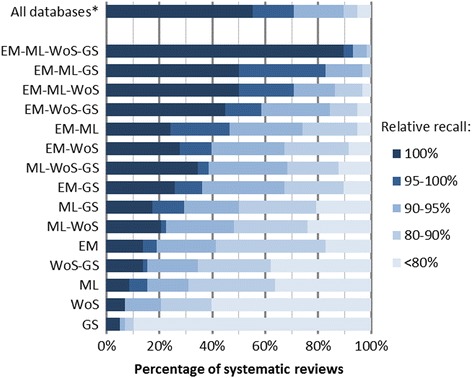
BACKGROUND: Within systematic reviews, when searching for relevant references, it is advisable to use multiple databases. However, searching databases is laborious and time-consuming, as syntax of search strategies are database specific. We aimed to determine the optimal combination of databases needed to conduct efficient searches in systematic reviews and whether the current practice in published reviews is appropriate. While previous studies determined the coverage of databases, we analyzed the actual retrieval from the original searches for systematic reviews. METHODS: Since May 2013, the first author prospectively recorded results from systematic review searches that he performed at his institution. PubMed was used to identify systematic reviews published using our search strategy results. For each published systematic review, we extracted the references of the included studies. Using the prospectively recorded results and the studies included in the publications, we calculated recall, precision, and number needed to read for single databases and databases in combination. We assessed the frequency at which databases and combinations would achieve varying levels of recall (i.e., 95%). For a sample of 200 recently published systematic reviews, we calculated how many had used enough databases to ensure 95% recall. RESULTS: A total of 58 published systematic reviews were included, totaling 1746 relevant references identified by our database searches, while 84 included references had been retrieved by other search methods. Sixteen percent of the included references (291 articles) were only found in a single database; Embase produced the most unique references (n = 132). The combination of Embase, MEDLINE, Web of Science Core Collection, and Google Scholar performed best, achieving an overall recall of 98.3 and 100% recall in 72% of systematic reviews. We estimate that 60% of published systematic reviews do not retrieve 95% of all available relevant references as many fail to search important databases. Other specialized databases, such as CINAHL or PsycINFO, add unique references to some reviews where the topic of the review is related to the focus of the database. CONCLUSIONS: Optimal searches in systematic reviews should search at least Embase, MEDLINE, Web of Science, and Google Scholar as a minimum requirement to guarantee adequate and efficient coverage.
Overview
CoChat Summary
TL;DR
This prospective exploratory study analyzed actual database retrieval for 58 published systematic reviews and found that searching Embase, MEDLINE, Web of Science Core Collection, and Google Scholar together achieved the best recall. The authors estimate that many published systematic reviews fail to retrieve 95% of relevant references because they omit key databases.
Key findings
- Among 1,746 relevant references identified by database searches, 292 (17%) were found by only one database; Embase retrieved the most unique references (n = 132), followed by MEDLINE, Web of Science, and Google Scholar.
- The combination of Embase, MEDLINE, Web of Science Core Collection, and Google Scholar achieved an overall recall of 98.3% and retrieved all included references in 72% of the studied systematic reviews.
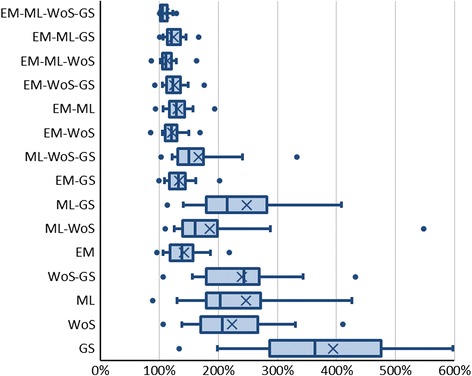
- Searching only Embase produced an average number needed to read (NNR) of 57, whereas the optimal four-database combination had an NNR of 73.
- In a sample of 200 recent systematic reviews, 97% searched MEDLINE, 61% searched Embase, 35% searched Web of Science, and only 10% used Google Scholar; the authors estimate that 60% of published systematic reviews do not retrieve 95% of all available relevant references.
Methods
- Since May 2013, the first author prospectively recorded results from systematic review searches performed at Erasmus MC; PubMed was searched in July 2016 for reviews published since 2014 with Erasmus MC first authors, yielding 58 included reviews.
- Included reviews had documented search strategies and results and had used at least Embase, MEDLINE, Cochrane CENTRAL, Web of Science, and Google Scholar; included references were extracted and located in original EndNote libraries to determine which database retrieved them.
- Recall, precision, and number needed to read were calculated for single databases and combinations in Excel; a separate sample of 200 recent PubMed systematic reviews was analyzed to assess current database selection practice.
Limitations
- The authors state they did not investigate whether missing references changed review conclusions, and because the finding that Web of Science and Google Scholar improve recall is novel, they cannot conclude whether it is due to their dataset or is generalizable.
- The authors note that all searches were performed by one experienced biomedical information specialist, that searcher skill strongly affects search effectiveness, and that their searches still missed some relevant references; they also state that Scopus as a replacement for Embase or Web of Science remains uncertain.
- The text makes evident additional constraints: the study is exploratory, based at a single institution, and relies on a relatively small set of 58 systematic reviews, with specialized databases such as CINAHL and PsycINFO used only when topic-appropriate.
Model-written summary. Check it against the paper before relying on it.
Integrity signals
Registry
Cites
Statistics
Figures

Verification
Claims the paper makes
2 Valid · 1 Not valid · 6 Not checked · 91 Own results and interpretations
A result the paper reports from its own data — it cites no other source for it, so there is none to check. The quote shows it is in the paper.
In the paper
“Using that combination, 93% of the systematic reviews in our study obtained levels of recall that could be considered acceptable (> 95%).”
§ Optimal database combinations for literature searches in systematic reviews: a prospective exploratory study > Discussion
plainstates a cause- Asserted: passes — The authors put it forward as true.
- Checkable: passes — It can be checked against evidence.
- Load-bearing: passes — The paper’s conclusions depend on it.
- Based: passes — The paper gives a reason why it holds.
A result the paper reports from its own data — it cites no other source for it, so there is none to check. The quote shows it is in the paper.
In the paper
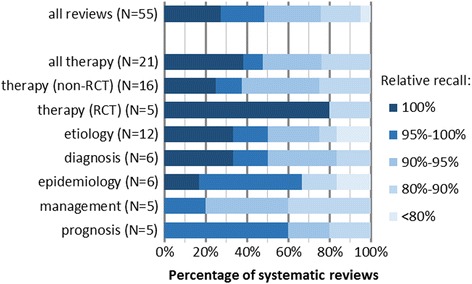
“For all but one domain, the traditional combination of Embase, MEDLINE, and Cochrane CENTRAL did not retrieve enough included references.”
§ Optimal database combinations for literature searches in systematic reviews: a prospective exploratory study > Results > Differences between domains of reviews
plain- Asserted: passes — The authors put it forward as true.
- Checkable: passes — It can be checked against evidence.
- Load-bearing: passes — The paper’s conclusions depend on it.
- Based: passes — The paper gives a reason why it holds.
A result the paper reports from its own data — it cites no other source for it, so there is none to check. The quote shows it is in the paper.
In the paper
“Embase was searched in 61% and Web of Science in 35%, and Google Scholar was only used in 10% of all reviews.”
§ Optimal database combinations for literature searches in systematic reviews: a prospective exploratory study > Results > Status of current practice of database selection
plain- Asserted: passes — The authors put it forward as true.
- Checkable: passes — It can be checked against evidence.
- Load-bearing: unclear — It is unclear whether the paper’s conclusions depend on it.
- Based: passes — The paper gives a reason why it holds.
A result the paper reports from its own data — it cites no other source for it, so there is none to check. The quote shows it is in the paper.
In the paper
“Of the five reviews that included only RCTs, four reached 100% recall if MEDLINE, Web of Science, and Google Scholar combined were complemented with Cochrane CENTRAL.”
§ Optimal database combinations for literature searches in systematic reviews: a prospective exploratory study > Discussion
plainstates a cause- Asserted: passes — The authors put it forward as true.
- Checkable: passes — It can be checked against evidence.
- Load-bearing: passes — The paper’s conclusions depend on it.
- Based: passes — The paper gives a reason why it holds.
A result the paper reports from its own data — it cites no other source for it, so there is none to check. The quote shows it is in the paper.
In the paper
“Based on our findings, this combination achieves acceptable recall about half the time (47%).”
§ Optimal database combinations for literature searches in systematic reviews: a prospective exploratory study > Results > Status of current practice of database selection
plainstates a cause- Asserted: passes — The authors put it forward as true.
- Checkable: passes — It can be checked against evidence.
- Load-bearing: passes — The paper’s conclusions depend on it.
- Based: passes — The paper gives a reason why it holds.
51 more claims
Create a free account to see all 100 claims and every source verdict.
- Probably not a substantial claim. 26
- It may state two separate claims as one. 24
- The quote only partly states this claim. 2
Claims other papers make about this one
Each is checked against this paper’s own text: does it say what the citing paper says it does?
The source backs part of the claim, not all of it — or backs it for a different population, condition or comparison.
In the citing paper
“although deduplication of references is essential to ensure the quality of SRs, there is currently no universal method to do so”
From Reducing systematic review burden using Deduklick: a novel, automated, reliable, and explainable deduplication algorithm to foster medical research (2022) · cites this paper as [5]
Experimental — accuracy not yet measuredThe source backs part of the claim, not all of it — or backs it for a different population, condition or comparison.
In the citing paper
“Although this database is one of the largest academic databases, offers extensive multidisciplinary coverage, and is widely used in bibliometric analyses, relevant publications indexed elsewhere or published in regional and non-indexed outlets may not have been captured [130].”
From Toward Holistic Aging in Lebanon: A Mapping of Gerontology and Geriatrics Research Trends, Gaps, and Future Directions (2026) · cites this paper as [130]
Experimental — accuracy not yet measuredThe source backs part of the claim, not all of it — or backs it for a different population, condition or comparison.
In the citing paper
“Meanwhile, others are highly specialized (e.g., PubMed, Medline, Compendix, etc.), which makes them unsuitable for more inclusive tasks, in particular, for the wide scope analysis and evaluation of multidisciplinary units [42,43].”
From Web of Science (WoS) and Scopus: The Titans of Bibliographic Information in Today’s Academic World (2021) · cites this paper as [43]
Experimental — accuracy not yet measuredThe source backs part of the claim, not all of it — or backs it for a different population, condition or comparison.
In the citing paper
“These databases are widely used in review studies and the majority of them are included in the optimal database combination search19 which guarantee an adequate and efficient coverage of the scientific literature.”
From Occupational therapy interventions for adults with severe mental illness: a scoping review (2021) · cites this paper as [19]
Experimental — accuracy not yet measuredThe cited source says what the claim attributes to it.
In the citing paper
“These differences have led to recommendations that systematic review teams search multiple databases to maximize the likelihood of finding relevant studies [6, 39, 40].”
From PRISMA-S: an extension to the PRISMA Statement for Reporting Literature Searches in Systematic Reviews (2021) · cites this paper as [40]
5 more claims about this paper
Create a free account to see every claim other papers make about this one.
Self-check
Percentages, sums and reported differences re-computed from the paper’s own numbers.
Each contradiction between two passages listed here was confirmed by an independent check.
Rated minor: it would not touch a result — a value no result rests on, a p-value that stays on the same side of the significance level, or a conflict that is clerical, resolved elsewhere in the paper, or outside its own findings.
In the paper
§ Optimal database combinations for literature searches in systematic reviews: a prospective exploratory study > Abstract > Results
“Sixteen percent of the included references (291 articles) were only found in a single database;”
§ Optimal database combinations for literature searches in systematic reviews: a prospective exploratory study > Results > Unique references per database
“A total of 292 (17%) references were found by only one database.”
Citations
Cites
Cochrane Handbook for Systematic Reviews of Interventions Version 5.0.1. The Cochrane Collaboration
Higgins, J. P. T., Green, S. R., & Higgins, J. P. T. (2008) · Cited by 7,171
A systematic approach to searching: an efficient and complete method to develop literature searches
Bramer, W. M., De Jonge, G. B., Rethlefsen, M. L., Mast, F., & Kleijnen, J. (2018) · Journal of the Medical Library Association · doi:10.5195/jmla.2018.283 · Cited by 863
Self-citationComparing two sampling methods to engage hard-to-reach communities in research priority setting
Valerio, M. A., Rodriguez, N., Winkler, P., Lopez, J., Dennison, M., Liang, Y., & Turner, B. J. (2016) · BMC Medical Research Methodology · doi:10.1186/s12874-016-0242-z · Cited by 543
Rethlefsen, M. L., Farrell, A. M., Osterhaus Trzasko, L. C., & Brigham, T. J. (2015) · Journal of Clinical Epidemiology · doi:10.1016/j.jclinepi.2014.11.025 · Cited by 331
Self-citationSystematic reviews need systematic searchers.
(2005) · Europe PMC (PubMed Central) · Cited by 257
Bramer, W. M., Giustini, D., & Kramer, B. M. R. (2016) · Systematic Reviews · doi:10.1186/s13643-016-0215-7 · Cited by 202
Self-citationHalladay, C. W., Trikalinos, T. A., Schmid, I. T., Schmid, C. H., & Dahabreh, I. J. (2015) · Journal of Clinical Epidemiology · doi:10.1016/j.jclinepi.2014.12.017 · Cited by 166 · cited 1×
“Prior research on database importance for systematic reviews has looked primarily at whether included references could have theoretically been found in a certain database, but most have been unable to ascertain whether the researchers actually found the articles in those databases [10, 12, 16, 17, 26].”
BackgroundSearching multiple databases for systematic reviews: added value or diminishing returns?
Stevinson, C., & Lawlor, D. A. (2004) · Complementary Therapies in Medicine · doi:10.1016/j.ctim.2004.09.003 · Cited by 143
Bramer, W. M., Giustini, D., Kramer, B. M., & Anderson, P. (2013) · Systematic Reviews · doi:10.1186/2046-4053-2-115 · Cited by 139 · cited 1×
“Nevertheless others have concluded that a single database is not sufficient to retrieve all references for systematic reviews [18, 19].”
BackgroundSelf-citationSearching one or two databases was insufficient for meta-analysis of observational studies
Lemeshow, A. R., Blum, R. E., Berlin, J. A., Stoto, M. A., & Colditz, G. A. (2005) · Journal of Clinical Epidemiology · doi:10.1016/j.jclinepi.2005.03.004 · Cited by 137
Cited by
Items 1,701–1,800 of 2,083
Systematic Review on Sustainable Healthcare Practices: A Bibliometric Approach
Urkude, S. V., & Sahoo, D. (2024) · Communications in computer and information science · doi:10.1007/978-3-031-71481-8_6 · Cited by 2
Molero, P., Lorenzi, F. D., Gędek, A., Strater, C., Popescu, E., Ortuño, F., van der Does, W. A. J., Martínez‐González, M. Á., & Molendijk, M. L. (2024) · SSRN Electronic Journal · doi:10.2139/ssrn.4997927
Determinants of knowledge transfer activities among university researchers: a systematic review
Houari, F. E., & Fakhreddine, M. O. I. (2024) · Journal of Science and Technology Policy Management · doi:10.1108/jstpm-03-2024-0092 · Cited by 4
Scherer, J. N., Oliveira, G. R., Machado, F. M. R., Gomes, C. F., & Ornell, F. R. (2024) · Journal of Psychoactive Drugs · doi:10.1080/02791072.2024.2421921
“Searches were carried out in PubMed, Google Scholar, PsycInfo, and Embase databases, due their great capacity of literature coverage (Bramer et al. 2017 Education’ OR ”Health Communication” OR “”Health Promotion” OR “Psychoeducation” OR “Prevention”).””
Rethlefsen, M. L. (2024) · Research Publications (Maastricht University) · doi:10.26481/dis.20250121mr
Self-citationKavuma, D., Obuku, E. A., Namisango, E., Kansiime, R., Niyonzima, N., Kinengyere, A. A., Kasasa, S., Makumbi, F. E., Kafeero, H. M., & Nuwaha, F. (2024) · Research Square · doi:10.21203/rs.3.rs-5626478/v1
Global Trends of Research on Red Mud Utilization as an Adsorbent: A Bibliometric Analysis
Sutrisno, H., Trihadiningrum, Y., Ekaputri, J. J., et al. (2024) · IOP Conference Series Earth and Environmental Science · doi:10.1088/1755-1315/1425/1/012002
Out-of-hospital care of patients experiencing CPR-induced consciousness: a scoping review
Silvestri, L., Soh, R., Newton, A., & Pearce, J. (2024) · International Paramedic Practice · doi:10.12968/ippr.2024.0003
Patients Report Better Outcomes Following Reduction of Tibial Plateau Fractures: A Systematic ReviewPreprint
Kitchen, D. S., Ricci, S., Abrahams, J. M., et al. (2025) · medRxiv · doi:10.1101/2025.01.08.25320009
Does age of ADHD medication initiation predict long-term risk of anxiety? A scoping review
Fletcher, M., Ledbetter, L., Alonso, P., Ansah, O. O., Short, O., & Reuter‐Rice, K. (2025) · PLOS mental health. · doi:10.1371/journal.pmen.0000230
Kossioris, A., Kandarakis, S., Doumazos, S., & Petrou, P. (2025) · F1000Research · doi:10.12688/f1000research.160468.1
Molina, T. C., Martinez, W. D., Pereira, V. A., Lima, A. R. D. A., Brienze, V. M. S., dos Santos, E. R., Severino, V., Borge, C., & André, J. C. (2025) · MethodsX · doi:10.1016/j.mex.2025.103161
Cheng, H., & Hill, J. E. (2025) · British Journal of Cardiac Nursing · doi:10.12968/bjca.2024.0068
“Previous recommendations for healthcare-related subjects suggest that at a minimum, essential databases such as Embase, MEDLINE, Web of Science, and Google Scholar should be included for comprehensive searches (Bramer et al. 2017).”
Microorganisms for Enhancing Glutathione Levels: A Scoping Review
Креккер, Л. Г., Колосова, Е. В., Donskaya, G. A., et al. (2024) · FOOD METAENGINEERING · doi:10.37442/fme.2024.4.61
Anjum, R., Mustamil, N. M., & Tey, L. S. (2025) · Journal of the Knowledge Economy · doi:10.1007/s13132-024-02507-6 · Cited by 18
“The authors are advised to use more than one database to cover most articles (Wichor et al., 2017).”
Mairghani, M., James, S., Mehta, R., Bhatia, D., James, O., Jabakhanji, S. B., McCaffrey, J., Walsh, K. R., Clyne, B., & Gregg, E. W. (2025) · HRB Open Research · doi:10.12688/hrbopenres.13978.1
Boscarello, T., Boparai, R., Samson, N., Rodriguez, A., Knoblauch, T., Vanier, C. H., & Snyder, T. H. (2025) · PLoS ONE · doi:10.1371/journal.pone.0307339 · Cited by 1
Critical Appraisal of Advancements in Guided Surgical Endodontics: A Scoping Review
Ardila, C. M., Pineda‐Vélez, E., & Yadalam, P. K. (2025) · Australian Endodontic Journal · doi:10.1111/aej.12919 · Cited by 1
Kritische Betrachtung von systematischen Reviews und Metaanalysen
Deichsel, A., Laky, B., Ackermann, J., Münch, L. N., Mathis, D. T., Eggeling, L., Merkely, G., Wafaisade, A., Kittl, C., Schüttler, K. F., et al. (2025) · Arthroskopie · doi:10.1007/s00142-025-00759-1
Mapping the Evidence on Compassion Skills in Applied Behavior Analysis: Protocol for Scoping Review
Aleixo, D. N. L., de Souza, D. J. M., de Carvalho, S. R. P. V. T., Furlani, M. R., Martins, C. C., dos Santos, E. R., Menezes, J. D. D. S., da Silva, M. Q., Lopes, S. M. M., Rodrigues, M. S., et al. (2025) · JMIR Research Protocols · doi:10.2196/66399
“Specifically: • Embase and PubMed were chosen for their extensive coverage of biomedical literature, including behavioral interventions [15].”
Kagondu, J. K. (2023) · African Multidisciplinary Journal of Research · doi:10.71064/spu.amjr.8.1.217
Wang, Y., Huang, M., & Gong, Y. (2025) · Journal of Diabetes Research · doi:10.1155/jdr/3494697 · Cited by 2
“We performed an extensive search across multiple electronic databases, such as Web of Science, Scopus, PubMed, MEDLINE, Embase, and Google Scholar [21], until March 20, 2024.”
Zhang, Y., You, T., & Li, S. (2025) · Inflammatory Bowel Diseases · doi:10.1093/ibd/izae311
Carrillo, B., Rubinos-Cuadrado, M., Parellada-Martin, J., Palacios-López, A., Carrillo-Rubinos, B., Canillas, F., Cortés, J. J. B., & Gómez‐Pavón, J. (2025) · doi:10.2196/preprints.75215
Jin, W., Zhang, Y., Pang, S., Yao, D., & Huang, Y. (2025) · Systematic Reviews · doi:10.1186/s13643-025-02826-y
“CINAHL Plus is important for systematic reviews in nursing and allied health, often used for TCM searches [80–83].”
Exploring the effects of delivering CPR on nurses’ mental health and well-being
Fitzpatrick, G. (2025) · Emergency Nurse · doi:10.7748/en.2025.e2231 · Cited by 4
Wang, X. (2025) · Research Square · doi:10.21203/rs.3.rs-6551928/v1 · Cited by 1
Ammanuel, S. G., Sylla, K., Luu, C. P., Mohis, M. M., & Schmidt, B. T. (2025) · World Neurosurgery X · doi:10.1016/j.wnsx.2025.100478
Electra, J., Theodoraliu, E., Lazarus, G., Lestari, Y. D., & Djatikusumo, A. (2025) · International Ophthalmology · doi:10.1007/s10792-025-03531-4 · Cited by 1
“Additionally, we also searched Scopus as an extra source, given the relatively low number of retrieved records [11].”
InfluentialOsuoha, C. B., Njoku-Obi, T., Igiri, V. C., Dozie, U. W., & David, C. I. (2025) · African Journal of Biology and Medical Research · doi:10.52589/ajbmr-y0whetdv
Skews, R., & Marley, J. (2025) · International Journal of Urological Nursing · doi:10.1111/ijun.70015
Carrillo, B., Rubinos-Cuadrado, M., Parellada-Martin, J., Palacios-López, A., Carrillo-Rubinos, B., Canillas, F., Cortés, J. J. B., & Gómez‐Pavón, J. (2025) · JMIR Formative Research · doi:10.2196/75215
Maguvhe, M. O., & Maseko, N. T. (2025) · Acta Educationis Generalis · doi:10.2478/atd-2025-0018
Cooper, C., & Papadopoulos, K. (2025) · Journal of Bodywork and Movement Therapies · doi:10.1016/j.jbmt.2025.05.048 · Cited by 1
Artificial Intelligence and Large Language Model Powered Literature Review Services
Musleh, A. M., & AlRyalat, S. A. (2025) · High Yield Medical Reviews · doi:10.59707/hymrpsey7778
Periode Pelatihan Fisik untuk Atlet Elit: Konsep Saat Ini dan Arah Masa Depan
Sahabuddin (2025) · Mutiara Jurnal Ilmiah Multidisiplin Indonesia · doi:10.61404/jimi.v3i2.387 · Cited by 1
Trends and insights in the use of MR enterography for Crohn’s disease: a bibliometric analysis
Motasim, N., Ijaz, M. T., Mukhtar, H., Zaheer, I., NAWAZ, H. S., Masood, A., Zahoor, A., Rasool, M., & Ijaz, N. (2025) · Abdominal Radiology · doi:10.1007/s00261-025-04972-2
Spatial and spatio-temporal analysis for malaria hotspot identification: a scoping review protocol
Monteiro, G. M., Sonounameto, R. C., Djogbénou, L., & Sedda, L. (2025) · BMJ Open · doi:10.1136/bmjopen-2025-101375 · Cited by 2
Pachanov, A., Muente, C., Hirt, J., & Pieper, D. (2025) · Research Synthesis Methods · doi:10.1017/rsm.2025.10016
“15 Therefore, we aimed to translate our filter for use in the Embase database (via the Ovid interface).”
Indravathy, K., & Rahim, N. A. (2024) · IEEE Technology & Engineering Management Conference - Asia Pacific (TEMSCON-ASPAC) · doi:10.1109/temscon-aspac62480.2024.11024840 · Cited by 2
“A Systematic Literature Review (SLR) generally reviews the literature comprehensively, using referencing databases like PubMed, SCOPUS, and Web of Science (WoS) [33, 34].”
Abdelaal, A., & Ahmed, Z. (2025) · Cureus · doi:10.7759/cureus.87016
“Although the inclusion of Google Scholar would have provided the widest coverage of studies, the combination of MEDLINE, Embase, and Web of Science alone covered 95.9% of all possible studies published, which was deemed sufficient [23].”
InfluentialPharmacological Interventions for Managing Acute Geriatric Pain and Delirium: A Systematic Review
Zeng, C., & Liu, F. (2025) · Psychogeriatrics · doi:10.1111/psyg.70066
Whish‐Wilson, G. A., Edbrooke, L., Granger, C. L., Kinnersly, E. G., da Silva, A. A., Sloan, E., Truong, D., Yi, M., & Parry, S. M. (2025) · Supportive Care in Cancer · doi:10.1007/s00520-025-09687-0 · Cited by 2
“The search strategy was optimised for each respective database before being applied to electronic databases EMBASE (Ovid), MEDLINE (Ovid), PsycINFO (Ovid), CINAHL (EBSCO), Cochrane Library, Scopus, PEDro, and Web of Science from inception (Tables S3-S10)[20].”
InfluentialS, F. G. A., Krishnan, A., Sharma, S., Tewari, N., Kumar, V., Chawla, A., Pandey, S., & Logani, A. (2025) · Journal of Endodontics · doi:10.1016/j.joen.2025.07.005
Culturally Relevant Coparenting Interventions for Diverse Families: A Scoping Review
Dua, I., Grant, P. E., Demy, J., & Prime, H. (2025) · Clinical Child and Family Psychology Review · doi:10.1007/s10567-025-00536-4
“MEDLINE was chosen due to its extensive coverage of literature on topics related to health care and life sciences (Dunn et al., 2017), whereas PsycINFO was included for its focus on behavioral sciences, psychological phenomena, and mental health (Bramer et al., 2017; Eady et al., 2008).”
Almutairi, W. M. (2025) · Journal of Advanced Trends in Medical Research · doi:10.4103/atmr.atmr_25_25
MAP-DyS: An Interactive Framework for Mapping Analytic Decision Pathways in Subtyping ResearchPreprint
Leung, A. Y., Kristanto, D., Gießing, C., Ioannidis, J. P. A., Hildebrandt, A., & Schmalz, X. (2025) · medRxiv · doi:10.1101/2025.07.23.25332032
“We selected these databases according to their broad coverage and search efficiency [43], ensuring representation across key fields in which dyslexia subtyping studies are published, including psychology, behavioural sciences, education, and biomedicine.”
An Introduction to Systematic Review and Meta-Analysis for Pediatric Research
Chen, S., & Anderson, M. P. (2025) · The Journal of Pediatrics · doi:10.1016/j.jpeds.2025.114726
Methodological Considerations on the systematic review of dementia care during COVID-19
dos Santos, K. D. A. (2025) · Dementia & Neuropsychologia · doi:10.1590/1980-5764-dn-2025-0309
Management of Finger Felons and Paronychia: A Narrative Review
Gottlieb, M. A., & Long, B. (2025) · Journal of Emergency Medicine · doi:10.1016/j.jemermed.2025.07.054
García, C. A. A. (2025) · Contemporary Readings in Law and Social Justice · doi:10.52783/crlsj.565
Viaña, J. N. M., Steward, B. A., & Ong, D. S. (2025) · medRxiv · doi:10.1101/2025.08.08.25333336
Assessment tools for the risk of pressure injury in children: A systematic review
Dessi, F. A., Valeille, J., Béloni, P., & Toniolo, J. (2025) · International Journal of Nursing Studies Advances · doi:10.1016/j.ijnsa.2025.100410
“The search strategy was informed by the recommendations of Bramer et al. (2017) regarding optimal database combinations for systematic reviews.”
Pastor, R. M. C., Truax, F. N., Şahin, S., Donnelly, J., Nick, J. M., & Tamares, S. (2025) · doi:10.2196/preprints.82245
Neale, C. J., & Soundy, A. (2025) · medRxiv · doi:10.1101/2025.08.14.25333667
Toma, M. J., & Milner‐Bolotin, M. (2025) · Future in Educational Research · doi:10.1002/fer3.70012 · Cited by 2
The Influence of Light Wavelength on HPA Axis Function in Non-human Animals: A Meta-analysisPreprint
Robertson-Dixon, I., Murphy, M., & Riddell, N. (2025) · SSRN Electronic Journal · doi:10.2139/ssrn.5431414
Vo, A. T., Fang, L., Yang, L., Urquhart, R., Yi, Y., & Wang, P. (2025) · BMJ Open · doi:10.1136/bmjopen-2025-102788 · Cited by 1
“This eligibility criterion will allow us to provide a comprehensive review of instruments used to evaluate health system literacy across a wide range of populations.”
Montero, J. A. (2025) · American Journal of Therapeutics · doi:10.1097/mjt.0000000000002059
Kretschmer, L. W., & Wilke, J. (2025) · Sports Medicine - Open · doi:10.1186/s40798-026-01030-z
“MEDLINE and Web of Science were chosen as they are among the databases providing most unique hits [23] and Google Scholar was added to complement the title and abstract searches of the two databases by an algorithm screening full texts.”
Alférez-Pastor, M., Rodríguez-Ferrer, J. M., León, A. M., & Aguilar-Parra, J. M. (2025) · Review Journal of Autism and Developmental Disorders · doi:10.1007/s40489-025-00523-z · Cited by 1
Turnbull, R., Perera, D., Heng, H. W. F., & Semciw, A. I. (2025) · European Journal of Physiotherapy · doi:10.1080/21679169.2025.2558785 · Cited by 1
Chérif, H., Romdhane, H. B., Rejeb, S. B., Debiche, S., Charfi, M., Yangui, F., Bouassida, I., Mokaddem, S., & Charfi, M. R. (2025) · Future Science OA · doi:10.1080/20565623.2025.2567163
A systematic literature review of tacit knowledge in organizations in the past decade
Setiono, A., Suroso, A., & Darmawati, D. (2025) · Multidisciplinary Reviews · doi:10.31893/multirev.2026124 · Cited by 6
A scoping review on palliative care communication in the South African setting
de Lange, S., & Watermeyer, J. (2025) · Patient Education and Counseling · doi:10.1016/j.pec.2025.109378
The Tumour Microenvironment in Paediatric Rhabdomyosarcomas: A Systematic ReviewPreprint
Richards, M., Putnam, C., Underwood, T., et al. (2025) · Research Square · doi:10.21203/rs.3.rs-7796884/v1
The Implications of a Land Value Tax on Urban Agglomeration Dynamics: efficiency and equityPreprint
Fiorentino, S., & Moogan, A. (2025) · SSRN Electronic Journal · doi:10.2139/ssrn.5588585
Mapping experiences and their dimensions: A systematic literature review
Hallmann, K., Sander, K., & Zehrer, A. (2025) · Journal of Leisure Research · doi:10.1080/00222216.2025.2567293
“Research has revealed that a combination of databases is fruitful (Bramer et al., 2017; Hiebl, 2023)—though the choice of databases should be made based on the disciplines being investigated.”
Litchfield, H. D., Gill, B., Irwin, J. D., Tucker, P., Fenesi, B., & Burke, S. M. (2025) · Review of Educational Research · doi:10.3102/00346543251367772
“…of the phenomenon of interest ( education ) and context ( COVID-19 In line with recommended database selection practices for systematic reviews (Bramer et al., 2017), eight electronic databases deemed relevant to the topic areas (i.e., CINAHL, EMBASE, MEDLINE, PsycINFO, Scopus, ERIC, the…”
Luo, X., Xiong, J., Liang, S., Jiang, Z., Chen, H., Han, Y., Daiko, H., Wang, I., Leng, X., & Zhu, Y. (2025) · Esophagus · doi:10.1007/s10388-025-01159-y
“After completing the initial search, all references were imported into EndNote software [17].”
Ramírez‐Pérez, L., & Moreno-Morales, N. (2025) · Healthcare · doi:10.3390/healthcare13212766
Sangal, L., Sood, V., Haar, K., Moyana, T. S., Jinnai, Y., & Rijal, S. (2025) · Research Square · doi:10.21203/rs.3.rs-7998434/v1
Chu, C., Bloch, S., & Yardley, S. J. (2025) · BMJ Open · doi:10.1136/bmjopen-2025-099088 · Cited by 1
“The search strategy will then be adapted to search the following databases 25 : MEDLINE (Ovid), Excerpta Medica Database (EMBASE) (Ovid), PsycInfo (Ovid), Cumulative Index to Nursing and Allied Health Literature (CINAHL) Plus (EBSCOhost) and Web of Science Core.”
Voi, S., Nolte, L., Twist, J., Pipkin, A., Ward, L., & Dodgers, S. (2025) · International Journal of Transgender Health · doi:10.1080/26895269.2025.2568029
Alhalabi, M. M., & Alshiekh, H. A. (2025) · BMJ Open · doi:10.1136/bmjopen-2024-098671 · Cited by 2
“We thank the reviewer for this critical point, we add to data extraction this “A predefined, hierarchical process will be used to resolve disagreements between the two independent reviewers during study selection and data extraction.”
Samal, J., & Singh, H. (2025) · Indian Journal of Respiratory Care · doi:10.5005/jp-journals-11010-1195
Vireque, A. A., Berteli, T. S., Stolakis, V., Bertero, M. T., & Kofinas, J. D. (2025) · Acta Obstetricia Et Gynecologica Scandinavica · doi:10.1111/aogs.70075 · Cited by 2
Tyler, D. C., Cross, J. G., & DeFrain, E. (2025) · Journal of Electronic Resources Librarianship · doi:10.1080/1941126x.2025.2581378 · Cited by 1
“…on systematic reviews has suggested that relying on a single database would be an inadequate strategy for a comprehensive review of the literature (Bramer et al., 2017; Greenhalgh & Peacock, 2005; Harari et al., 2020; Hopewell et al., 2002; Matthews et al., 1999; Stevinson & Lawlor, 2004; Taylor…”
Devam, M. O. D. I., Gould, D. J., Ye, K., Graham, H. K., & Rutz, E. (2025) · Systematic Reviews · doi:10.1186/s13643-025-02985-y · Cited by 3
“On July 6th 2024, an electronic search was performed in line with prior literature on optimal search strategy development [18].”
The spread of mind: psychological contagion in theory and critique
Houran, J., Dagnall, N., Sapkota, R. P., & Lange, R. (2025) · Frontiers in Psychology · doi:10.3389/fpsyg.2025.1631927 · Cited by 6
Effect of Yoga and Meditation on Human Gut Microbiota: A Systematic Review
Math, R. K., Javaregowda, P. K., & Patil, S. G. (2025) · International Journal of Yoga · doi:10.4103/ijoy.ijoy_15_25
“Searches were conducted until November 2023 in four electronic databases: SCOPUS, PubMed, Google Scholar, and Cochrane Controlled Registry of Trials (CENTRAL) to find relevant studies [15] published in English.”
Jamil, M. F. A., Noor, J. M., Hamid, N. A., Chong, E. G. M., Ling, J. N., Subramaniam, S., Lai, W. H., & Muhamad, N. A. (2025) · BMJ Open · doi:10.1136/bmjopen-2025-107237
“15 18 The review will address the following primary questions.”
Dementia in forensic mental health settings: a scoping review
Roper, B. J., MacRae, R., Taylor, J., & Douglas‐Smith, N. (2025) · Journal of Forensic Psychiatry and Psychology · doi:10.1080/14789949.2025.2594455
“Whilst attempts were made to identify all relevant literature by searching a range of databases, including key databases optimal for systematic reviews (Bramer et al., 2017), it is possible that some studies may have been missed.”
Kavuma, D., Obuku, E. A., Namisango, E., Niyonzima, N., Kinengyere, A. A., Kasasa, S., Makumbi, F. E., Kansiime, R., Kafeero, H. M., & Nuwaha, F. (2025) · Psychology Health & Medicine · doi:10.1080/13548506.2025.2587255 · Cited by 1
“…of adult patients with cancer were identified through searches in the various electronic databases that are known to produce optimal and efficient searches for systematic reviews and meta-analyses (Bramer et al., 2017) that included Ovid MEDLINE (PubMed), EmBASE, APA PsycINFO and Web of Science.”
Putra, T. B., Valiant, L. R., & Magdalena, Y. (2025) · International Conference on Information Management and Technology (ICIMTech) · doi:10.1109/icimtech67074.2025.11265351
“Determining the relevance of documents used for the research was based on the set inclusion and exclusion criteria tailored to the objective of the study, and the selected papers were organized and analyzed in Microsoft Excel to enhance classification and comparison [16].”
The influence of light wavelength on HPA axis function in non-human animals: A meta-analysis
Robertson-Dixon, I., Murphy, M., & Riddell, N. (2025) · Comparative Biochemistry and Physiology Part A Molecular & Integrative Physiology · doi:10.1016/j.cbpa.2025.111961
Advancing social marketing research: evidence from Brazil
da Veiga, C. R. P., Silva, N. A., Drummond‐Lage, A. P., de Miranda, W. D., Su, Z., & da Veiga, C. P. (2025) · Journal of Social Marketing · doi:10.1108/jsocm-10-2024-0259
Loneliness in spinal cord injury: A systematic review and comparison with the general population
O’Donnell, L. M. C., Dorstyn, D., & Barclay, L. (2025) · Journal of Spinal Cord Medicine · doi:10.1080/10790268.2025.2593074
“Moreover, we adopted the optimal combination of databases for our primary search to ensure comprehensive coverage (69).”
Diet and depression risk: Addressing methodological reflections
Molero, P., Lorenzi, F. D., Gędek, A., Strater, C., Popescu, E., Ortuño, F., van der Does, W. A. J., Martínez‐González, M. Á., & Molendijk, M. L. (2025) · Personalized Medicine in Psychiatry · doi:10.1016/j.pmip.2025.100175
Šehović, E., Urru, S., Chiorino, G., & Doebler, P. (2022) · Figshare · doi:10.6084/m9.figshare.20047290
Venning, A., Oswald, T. K., Stevenson, J., Tepper, N., Azadi, L., Lawn, S., & Redpath, P. (2021) · Figshare · doi:10.6084/m9.figshare.17084210
Carvalho, A. S., Fernandes, Ó. B., de Lange, M., Lingsma, H. F., Klazinga, N., & Kringos, D. S. (2022) · Figshare · doi:10.6084/m9.figshare.20098495
Wattanapisit, A., Tuangratananon, T., & Wattanapisit, S. (2020) · Figshare · doi:10.6084/m9.figshare.13203417
Bose, A., Ahmed, S., Cheng, Y., & Gonzalez, A. S. (2024) · Figshare · doi:10.6084/m9.figshare.26672862
Onyeso, O. K., Odole, A. C., Scott, D. R. M., Akinrolie, O., Kalu, M. E., & Awosoga, O. A. (2023) · Figshare · doi:10.6084/m9.figshare.22598524
Ravalihasy, A., Kardaś-Słoma, L., Yazdanpanah, Y., & Ridde, V. (2022) · Figshare · doi:10.6084/m9.figshare.19728167
Bose, A., Ahmed, S., Cheng, Y., & Gonzalez, A. S. (2024) · Figshare · doi:10.6084/m9.figshare.26672859
Bru-Luna, L. M., Martí-Vilar, M., Merino-Soto, C., Segovia, J. L., Garduño‐Espinosa, J., & Toledano‐Toledano, F. (2024) · Figshare · doi:10.6084/m9.figshare.26709155
Mittly, V., Farkas-Kirov, C., Zana, Á., Szabó, K., Ónodi-Szabó, V., & Purebl, G. (2023) · Figshare · doi:10.6084/m9.figshare.24634543
Cronin, M., McLoughlin, K., Foley, T., & McGilloway, S. (2024) · Figshare · doi:10.6084/m9.figshare.26636220
Metadata
- Authors
- Bramer, W. M., Rethlefsen, M. L., Kleijnen, J., & Franco, O. H.
- Affiliations
- Erasmus MC (NL)
- University of Utah (US)
- Maastricht University (NL)
- Corresponding author
- Bramer, Wichor M.
- Venue
- Systematic Reviews
- Published
- 2017-12
- Volume
- 6
- Issue
- 1
- Pages
- 245-245
- ISSN
- 2046-4053 (ISSN-L)
- PMC
- PMC5718002
- OpenAlex
- W2774587119
- Cited by
- 2,114
- References
- 27
- Citations by year
- 2026: 373 · 2025: 411 · 2024: 332 · 2023: 292 · 2022: 252 · 2021: 231 · 2020: 145 · 2019: 64 · 2018: 12 · 2017: 2
- FWCI
- 14.94
- Type
- journal article
- Language
- en
- Open access
- gold
- doi.org
- Licence
- cc-by
- creativecommons.org/licenses/by/4.0/ (tdm)
- creativecommons.org/licenses/by/4.0/ (vor, 5 d)
- Locations
- Systematic Reviews (publishedVersion, cc-by)
- Europe PMC (PubMed Central) (publishedVersion, cc-by)
- PubMed Central (publishedVersion, cc-by)
- PubMed (publishedVersion)
- Research Publications (Maastricht University) (publishedVersion, cc-by)
- EUR Research Repository (Erasmus University Rotterdam) (publishedVersion, other-oa)
- EUR Research Repository (Erasmus University Rotterdam) (submittedVersion, other-oa)
- RePub (Erasmus University Rotterdam) (submittedVersion, other-oa)
- DOAJ (DOAJ: Directory of Open Access Journals) (submittedVersion, cc-by-sa)
- Research Publications (Maastricht University) (submittedVersion, other-oa)
- Funders
- National Center for Advancing Translational Sciences (UL1TR001067)
- Topics
- Social Sciences › Decision Sciences › Statistics, Probability and Uncertainty › Meta-analysis and systematic reviews
- Social Sciences › Library and Information Sciences › scientometrics and bibliometrics research
- Physical Sciences › Computer Science › Information Systems › Information Retrieval and Search Behavior
- Keywords
- literature search strategies, search recall, search precision, database coverage, Embase, MEDLINE, Web of Science, Google Scholar, CINAHL, PsycINFO, number needed to read
- MeSH terms
- Humans, Prospective Studies, Review Literature as Topic, Databases, Bibliographic, Information Storage and Retrieval
About these checks
Registry, retraction, Cites and statistics results are computed, not judged, with one exception: a printed reference that no index lists is read once by a model before it counts as a citation error. Claims are extracted by a model and kept only when their quote appears verbatim in the text; each cited source is then checked, with a model’s help, for whether it says what the claim relies on. Those verdicts can be wrong — read the claim’s quote and the cited source before relying on one.
A language model drew the claims from the paper on 2026-09-29, under version 3 of the claim definition (model deepseek-v4.1-flash, prompt extract-v3).
A second model labelled each claim on 2026-09-29 (model jev-1.13-20260917, definition revision gold-guideline-v0.2).
Statistics and arithmetic are recomputed, not judged.
Confidence bands are shown only for fields calibrated on our annotated test set. None is calibrated yet, so no band is shown.
What counts as a claim ›How we measure confidence ›How we check this ›
Are you an author, or do you see a problem with this page? Request a review
Data sources
Bibliographic data: Semantic Scholar, OpenAlex, Crossref.
Contains information from the Semantic Scholar Academic Graph Datasets, made available under the ODC Attribution License (ODC-BY 1.0).
Semantic Scholar’s data is described in: Kinney, R., et al. (2023). The Semantic Scholar Open Data Platform. arXiv:2301.10140.
