

Optimal database combinations for literature searches in systematic reviews: a prospective exploratory study
Open accessThe DOI matches its Crossref record; 27 of the 27 references it cites were found in a registry or an index; 3 of the 22 sources its claims cite were checked for support.
Abstract
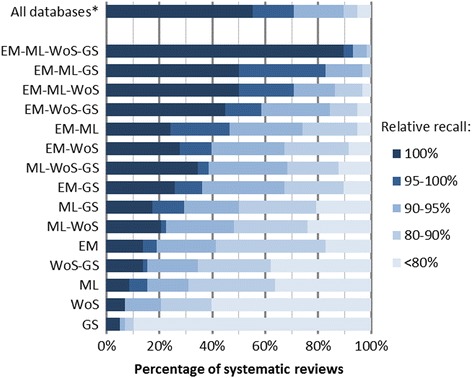
BACKGROUND: Within systematic reviews, when searching for relevant references, it is advisable to use multiple databases. However, searching databases is laborious and time-consuming, as syntax of search strategies are database specific. We aimed to determine the optimal combination of databases needed to conduct efficient searches in systematic reviews and whether the current practice in published reviews is appropriate. While previous studies determined the coverage of databases, we analyzed the actual retrieval from the original searches for systematic reviews. METHODS: Since May 2013, the first author prospectively recorded results from systematic review searches that he performed at his institution. PubMed was used to identify systematic reviews published using our search strategy results. For each published systematic review, we extracted the references of the included studies. Using the prospectively recorded results and the studies included in the publications, we calculated recall, precision, and number needed to read for single databases and databases in combination. We assessed the frequency at which databases and combinations would achieve varying levels of recall (i.e., 95%). For a sample of 200 recently published systematic reviews, we calculated how many had used enough databases to ensure 95% recall. RESULTS: A total of 58 published systematic reviews were included, totaling 1746 relevant references identified by our database searches, while 84 included references had been retrieved by other search methods. Sixteen percent of the included references (291 articles) were only found in a single database; Embase produced the most unique references (n = 132). The combination of Embase, MEDLINE, Web of Science Core Collection, and Google Scholar performed best, achieving an overall recall of 98.3 and 100% recall in 72% of systematic reviews. We estimate that 60% of published systematic reviews do not retrieve 95% of all available relevant references as many fail to search important databases. Other specialized databases, such as CINAHL or PsycINFO, add unique references to some reviews where the topic of the review is related to the focus of the database. CONCLUSIONS: Optimal searches in systematic reviews should search at least Embase, MEDLINE, Web of Science, and Google Scholar as a minimum requirement to guarantee adequate and efficient coverage.
Overview
CoChat Summary
TL;DR
This prospective exploratory study analyzed actual database retrieval for 58 published systematic reviews and found that searching Embase, MEDLINE, Web of Science Core Collection, and Google Scholar together achieved the best recall. The authors estimate that many published systematic reviews fail to retrieve 95% of relevant references because they omit key databases.
Key findings
- Among 1,746 relevant references identified by database searches, 292 (17%) were found by only one database; Embase retrieved the most unique references (n = 132), followed by MEDLINE, Web of Science, and Google Scholar.
- The combination of Embase, MEDLINE, Web of Science Core Collection, and Google Scholar achieved an overall recall of 98.3% and retrieved all included references in 72% of the studied systematic reviews.
- Searching only Embase produced an average number needed to read (NNR) of 57, whereas the optimal four-database combination had an NNR of 73.
- In a sample of 200 recent systematic reviews, 97% searched MEDLINE, 61% searched Embase, 35% searched Web of Science, and only 10% used Google Scholar; the authors estimate that 60% of published systematic reviews do not retrieve 95% of all available relevant references.
Methods
- Since May 2013, the first author prospectively recorded results from systematic review searches performed at Erasmus MC; PubMed was searched in July 2016 for reviews published since 2014 with Erasmus MC first authors, yielding 58 included reviews.
- Included reviews had documented search strategies and results and had used at least Embase, MEDLINE, Cochrane CENTRAL, Web of Science, and Google Scholar; included references were extracted and located in original EndNote libraries to determine which database retrieved them.
- Recall, precision, and number needed to read were calculated for single databases and combinations in Excel; a separate sample of 200 recent PubMed systematic reviews was analyzed to assess current database selection practice.
Limitations
- The authors state they did not investigate whether missing references changed review conclusions, and because the finding that Web of Science and Google Scholar improve recall is novel, they cannot conclude whether it is due to their dataset or is generalizable.
- The authors note that all searches were performed by one experienced biomedical information specialist, that searcher skill strongly affects search effectiveness, and that their searches still missed some relevant references; they also state that Scopus as a replacement for Embase or Web of Science remains uncertain.
- The text makes evident additional constraints: the study is exploratory, based at a single institution, and relies on a relatively small set of 58 systematic reviews, with specialized databases such as CINAHL and PsycINFO used only when topic-appropriate.
Model-written summary. Check it against the paper before relying on it.
Integrity signals
Registry
Cites
Statistics
Figures

Verification
Claims the paper makes
2 Valid · 1 Not valid · 6 Not checked · 91 Own results and interpretations
A result the paper reports from its own data — it cites no other source for it, so there is none to check. The quote shows it is in the paper.
In the paper
“Using that combination, 93% of the systematic reviews in our study obtained levels of recall that could be considered acceptable (> 95%).”
§ Optimal database combinations for literature searches in systematic reviews: a prospective exploratory study > Discussion
plainstates a cause- Asserted: passes — The authors put it forward as true.
- Checkable: passes — It can be checked against evidence.
- Load-bearing: passes — The paper’s conclusions depend on it.
- Based: passes — The paper gives a reason why it holds.
A result the paper reports from its own data — it cites no other source for it, so there is none to check. The quote shows it is in the paper.
In the paper
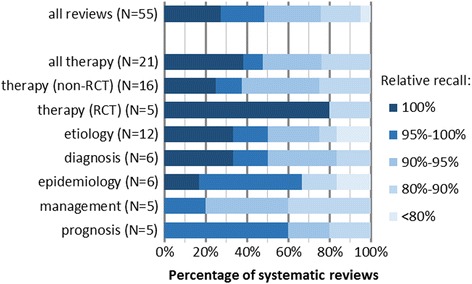
“For all but one domain, the traditional combination of Embase, MEDLINE, and Cochrane CENTRAL did not retrieve enough included references.”
§ Optimal database combinations for literature searches in systematic reviews: a prospective exploratory study > Results > Differences between domains of reviews
plain- Asserted: passes — The authors put it forward as true.
- Checkable: passes — It can be checked against evidence.
- Load-bearing: passes — The paper’s conclusions depend on it.
- Based: passes — The paper gives a reason why it holds.
A result the paper reports from its own data — it cites no other source for it, so there is none to check. The quote shows it is in the paper.
In the paper
“Embase was searched in 61% and Web of Science in 35%, and Google Scholar was only used in 10% of all reviews.”
§ Optimal database combinations for literature searches in systematic reviews: a prospective exploratory study > Results > Status of current practice of database selection
plain- Asserted: passes — The authors put it forward as true.
- Checkable: passes — It can be checked against evidence.
- Load-bearing: unclear — It is unclear whether the paper’s conclusions depend on it.
- Based: passes — The paper gives a reason why it holds.
A result the paper reports from its own data — it cites no other source for it, so there is none to check. The quote shows it is in the paper.
In the paper
“Of the five reviews that included only RCTs, four reached 100% recall if MEDLINE, Web of Science, and Google Scholar combined were complemented with Cochrane CENTRAL.”
§ Optimal database combinations for literature searches in systematic reviews: a prospective exploratory study > Discussion
plainstates a cause- Asserted: passes — The authors put it forward as true.
- Checkable: passes — It can be checked against evidence.
- Load-bearing: passes — The paper’s conclusions depend on it.
- Based: passes — The paper gives a reason why it holds.
A result the paper reports from its own data — it cites no other source for it, so there is none to check. The quote shows it is in the paper.
In the paper
“Based on our findings, this combination achieves acceptable recall about half the time (47%).”
§ Optimal database combinations for literature searches in systematic reviews: a prospective exploratory study > Results > Status of current practice of database selection
plainstates a cause- Asserted: passes — The authors put it forward as true.
- Checkable: passes — It can be checked against evidence.
- Load-bearing: passes — The paper’s conclusions depend on it.
- Based: passes — The paper gives a reason why it holds.
51 more claims
Create a free account to see all 100 claims and every source verdict.
- Probably not a substantial claim. 26
- It may state two separate claims as one. 24
- The quote only partly states this claim. 2
Claims other papers make about this one
Each is checked against this paper’s own text: does it say what the citing paper says it does?
The source backs part of the claim, not all of it — or backs it for a different population, condition or comparison.
In the citing paper
“although deduplication of references is essential to ensure the quality of SRs, there is currently no universal method to do so”
From Reducing systematic review burden using Deduklick: a novel, automated, reliable, and explainable deduplication algorithm to foster medical research (2022) · cites this paper as [5]
Experimental — accuracy not yet measuredThe source backs part of the claim, not all of it — or backs it for a different population, condition or comparison.
In the citing paper
“Although this database is one of the largest academic databases, offers extensive multidisciplinary coverage, and is widely used in bibliometric analyses, relevant publications indexed elsewhere or published in regional and non-indexed outlets may not have been captured [130].”
From Toward Holistic Aging in Lebanon: A Mapping of Gerontology and Geriatrics Research Trends, Gaps, and Future Directions (2026) · cites this paper as [130]
Experimental — accuracy not yet measuredThe source backs part of the claim, not all of it — or backs it for a different population, condition or comparison.
In the citing paper
“Meanwhile, others are highly specialized (e.g., PubMed, Medline, Compendix, etc.), which makes them unsuitable for more inclusive tasks, in particular, for the wide scope analysis and evaluation of multidisciplinary units [42,43].”
From Web of Science (WoS) and Scopus: The Titans of Bibliographic Information in Today’s Academic World (2021) · cites this paper as [43]
Experimental — accuracy not yet measuredThe source backs part of the claim, not all of it — or backs it for a different population, condition or comparison.
In the citing paper
“These databases are widely used in review studies and the majority of them are included in the optimal database combination search19 which guarantee an adequate and efficient coverage of the scientific literature.”
From Occupational therapy interventions for adults with severe mental illness: a scoping review (2021) · cites this paper as [19]
Experimental — accuracy not yet measuredThe cited source says what the claim attributes to it.
In the citing paper
“These differences have led to recommendations that systematic review teams search multiple databases to maximize the likelihood of finding relevant studies [6, 39, 40].”
From PRISMA-S: an extension to the PRISMA Statement for Reporting Literature Searches in Systematic Reviews (2021) · cites this paper as [40]
5 more claims about this paper
Create a free account to see every claim other papers make about this one.
Self-check
Percentages, sums and reported differences re-computed from the paper’s own numbers.
Each contradiction between two passages listed here was confirmed by an independent check.
Rated minor: it would not touch a result — a value no result rests on, a p-value that stays on the same side of the significance level, or a conflict that is clerical, resolved elsewhere in the paper, or outside its own findings.
In the paper
§ Optimal database combinations for literature searches in systematic reviews: a prospective exploratory study > Abstract > Results
“Sixteen percent of the included references (291 articles) were only found in a single database;”
§ Optimal database combinations for literature searches in systematic reviews: a prospective exploratory study > Results > Unique references per database
“A total of 292 (17%) references were found by only one database.”
Citations
Cites
Cochrane Handbook for Systematic Reviews of Interventions Version 5.0.1. The Cochrane Collaboration
Higgins, J. P. T., Green, S. R., & Higgins, J. P. T. (2008) · Cited by 7,171
A systematic approach to searching: an efficient and complete method to develop literature searches
Bramer, W. M., De Jonge, G. B., Rethlefsen, M. L., Mast, F., & Kleijnen, J. (2018) · Journal of the Medical Library Association · doi:10.5195/jmla.2018.283 · Cited by 863
Self-citationComparing two sampling methods to engage hard-to-reach communities in research priority setting
Valerio, M. A., Rodriguez, N., Winkler, P., Lopez, J., Dennison, M., Liang, Y., & Turner, B. J. (2016) · BMC Medical Research Methodology · doi:10.1186/s12874-016-0242-z · Cited by 543
Rethlefsen, M. L., Farrell, A. M., Osterhaus Trzasko, L. C., & Brigham, T. J. (2015) · Journal of Clinical Epidemiology · doi:10.1016/j.jclinepi.2014.11.025 · Cited by 331
Self-citationSystematic reviews need systematic searchers.
(2005) · Europe PMC (PubMed Central) · Cited by 257
Bramer, W. M., Giustini, D., & Kramer, B. M. R. (2016) · Systematic Reviews · doi:10.1186/s13643-016-0215-7 · Cited by 202
Self-citationHalladay, C. W., Trikalinos, T. A., Schmid, I. T., Schmid, C. H., & Dahabreh, I. J. (2015) · Journal of Clinical Epidemiology · doi:10.1016/j.jclinepi.2014.12.017 · Cited by 166 · cited 1×
“Prior research on database importance for systematic reviews has looked primarily at whether included references could have theoretically been found in a certain database, but most have been unable to ascertain whether the researchers actually found the articles in those databases [10, 12, 16, 17, 26].”
BackgroundSearching multiple databases for systematic reviews: added value or diminishing returns?
Stevinson, C., & Lawlor, D. A. (2004) · Complementary Therapies in Medicine · doi:10.1016/j.ctim.2004.09.003 · Cited by 143
Bramer, W. M., Giustini, D., Kramer, B. M., & Anderson, P. (2013) · Systematic Reviews · doi:10.1186/2046-4053-2-115 · Cited by 139 · cited 1×
“Nevertheless others have concluded that a single database is not sufficient to retrieve all references for systematic reviews [18, 19].”
BackgroundSelf-citationSearching one or two databases was insufficient for meta-analysis of observational studies
Lemeshow, A. R., Blum, R. E., Berlin, J. A., Stoto, M. A., & Colditz, G. A. (2005) · Journal of Clinical Epidemiology · doi:10.1016/j.jclinepi.2005.03.004 · Cited by 137
Cited by
Items 1,901–2,000 of 2,083
Muskens, M. M. P. A., van Ee, E., & Lansu, T. A. M. (2026) · Trauma Violence & Abuse · doi:10.1177/15248380261429512
Dankoob, V., Shahinfar, H., Ostevari, A., Norouziasl, R., Mohieddin, N., Esmaeili, F., Rafiei, F., & Shab‐Bidar, S. (2026) · Diabetes Research and Clinical Practice · doi:10.1016/j.diabres.2026.113260
Dantas, C., Neto, E. M. C., Koch, E. B. D. A., & Roque, F. O. (2026) · Journal of Ethnobiology and Ethnomedicine · doi:10.1186/s13002-026-00884-7 · Cited by 1
“These platforms collectively provide extensive coverage of environmental sciences, ethnobiology, anthropology, and socioecological research, and are widely used in systematic reviews [12].”
Gebhardt, A., Bye, R. A., & Coxon, K. (2026) · Australian Occupational Therapy Journal · doi:10.1111/1440-1630.70088 · Cited by 1
“Bramer et al. (2017) in their study on optimal data-base combinations limited Google Scholar results to the first 200 references as sorted by relevance ranking, and this approach was adopted for this search.”
Reynolds, L. M., Arend, R. C., & Griffin, R. L. (2026) · Cancers · doi:10.3390/cancers18081252
Wiradinata, W., & Qhabibi, F. R. (2026) · The Egyptian Heart Journal · doi:10.1186/s43044-026-00730-x
“A search was conducted from March 2nd to March 14th, 2025 across three electronic databases: PubMed, Scien-ceDirect, and Google Scholar [12].”
Kuruvilla, M. V., Blazely, A., So, M., & Green, A. (2026) · Frontiers in Psychology · doi:10.3389/fpsyg.2026.1798682
“For Google Scholar, only the first 200 records – sorted by relevance – were included in the full list of identified records; this is a number that has been identified to generate a 95% recall of relevant papers (Bramer et al., 2017).”
Bettazzi, B., Salvestrini, V., Banini, M., Ruggieri, O., Palomba, A., Galli, I. C., Livi, L., Bonomo, P., & Becherini, C. (2026) · Current Oncology · doi:10.3390/curroncol33050239 · Cited by 1
“Keywords utilized included “hypofractionated radiotherapy,” “immunotherapy,” “checkpoint inhibitors,” “HNSCC,” “elderly patients,” “platinum-unfit,” “sequential therapy,” and “elderly cancer treatment” [28,29].”
Tao, Z., Ke, K., & Zhu, L. (2026) · Future Microbiology · doi:10.1080/17460913.2026.2661505 · Cited by 1
A systematic review of grounded theory studies in library and information science research
Sewwandi, H. K. I., Goulding, A., & Lilley, S. (2026) · Journal of Documentation · doi:10.1108/jd-06-2025-0169 · Cited by 1
Oluç, F. E., Koçak, U. Z., Krohn, L. M., & Thorborg, K. (2026) · Research in Sports Medicine · doi:10.1080/15438627.2026.2661671 · Cited by 1
“However, we achieved extensive coverage of the literature with this approach during our preliminary searches, which has also been supported by previous reviews showing that up to 95% of relevant papers can be retrieved with this approach (Bramer et al., 2017).”
InfluentialDebt financing in entrepreneurship: a systematic literature review
Ribeiro, C., & Serrasqueiro, Z. (2026) · Journal of Small Business and Enterprise Development · doi:10.1108/jsbed-06-2025-0361 · Cited by 1
Touch-Based Therapies in Dementia Care: A Systematic Review and Narrative Synthesis
Mitchell, B., Harkess-Murphy, E., Douglas‐Smith, N., & Cheyne, J. D. (2026) · Dementia · doi:10.1177/14713012261445473
Opening new doors: a realist review on return to work with a new employer for sick-listed employees
Klerkx, M.-L., van Hees, S., Hutting, N., de Rijk, A. E., & Oomens, S. P. C. J. (2026) · Disability and Rehabilitation · doi:10.1080/09638288.2026.2660004
Stefanik, Z., Ścierski, P., Dobrzyński, M., Stefanik, N., Hupsch-Antonowicz, M., & Wiench, R. (2026) · Journal of Functional Biomaterials · doi:10.3390/jfb17050216
“The antifungal efficacy of selenium-based interventions appears consistent across different denture substrates, including conventional PMMA and additively manufactured resins [19,23–30].”
InfluentialButtifant, E., Allogmanny, S., & Probst, Y. (2026) · Journal of Human Nutrition and Dietetics · doi:10.1111/jhn.70250
Ghiba, M. T. A., Eifan, S. A., Alhetheel, A., & Hanif, A. (2026) · Journal of Nature and Science of Medicine · doi:10.4103/jnsm.jnsm_86_26
Addressing oral health inequalities in individuals with learning disabilities
Shah, N., & Hill, J. E. (2026) · British Journal of Neuroscience Nursing · doi:10.12968/bjnn.2025.0014
Klerings, I., Dobrescu, A. I., Nußbaumer-Streit, B., Sharifan, A., Neubauer-Bruckner, C., & Gartlehner, G. (2026) · BMC Medical Research Methodology · doi:10.1186/s12874-026-02870-9 · Cited by 1
“Appropriate search strategies in any of these databases will likely identify the majority of eligible RCTs, but to achieve the highest possible recall, a combination of databases and supplementary search methods (e.g., reference-list checking) is usually necessary [7, 10, 11].”
Prevalence of tuberculosis infection among pregnant women: a systematic review protocol
Mandeville, P., Nick, J. M., Truax, F. N., Şahin, S., & Sehgal, G. (2026) · JBI Evidence Synthesis · doi:10.11124/jbies-25-00114
Direct involvement of paramedics in pressure ulcer care and identification
Morley, L., Thorrington, V., & Ryder, F. (2026) · Journal of Paramedic Practice · doi:10.12968/jpar.2025.0090
Birhanu, T. E., Vlahu‐Gjorgievska, E., & Win, K. T. (2026) · BMC Medical Informatics and Decision Making · doi:10.1186/s12911-026-03554-6
“The databases were selected to ensure comprehensive coverage of the literature across databases, and are recognized for indexing high-quality peer-reviewed studies [16, 17].”
Monkaresi, M.-P., Mehrabi, M. R., & Bagheri, K. P. (2026) · Jundishapur Journal of Natural Pharmaceutical Products · doi:10.5812/jjnpp-169757
Automated progress monitoring in pipeline construction: a systematic review
Khan, M. H. F., Alaloul, W. S., Musarat, M. A., & Qureshi, A. H. (2026) · Journal of Civil Engineering and Management · doi:10.3846/jcem.2025.24800
Mizuno, A., Pollo, P., Lagisz, M., Soma, M., & Nakagawa, S. (2026) · Animal Behaviour · doi:10.1016/j.anbehav.2025.123448
Sari, D., Sunjaya, D. K., Sari, P., & Hilmanto, D. (2026) · Nutrition and Dietary Supplements · doi:10.2147/nds.s575328
Potter, M., & Smith, A. (2026) · The Ultrasound Journal · doi:10.5826/tuj.2026.18171
“Embase provides high sensitivity and retrieval yield, considered essential for medically oriented searches, whilst PubMed provides additional biomedical content and complementary indexing (22, 25-28).”
Menegussi, J. M., de Oliveira, L. B. R., Costa, K. B., et al. (2026) · Interface - Comunicação Saúde Educação · doi:10.1590/interface.250437
Trust and expatriation: An integrative review of the literature and a research agenda
Ridgway, M., Kougiannou, N. K., Stefanidis, A., & Brewster, C. J. (2026) · European Management Review · doi:10.1111/emre.70080
Urban agriculture and the Water–Energy–Food Nexus for sustainable and resilient cities
Mena-Barragán, E. P., Toledo, L., Cuestas-Caza, J., & Salazar, O. V. (2026) · Frontiers in Sustainability · doi:10.3389/frsus.2026.1767643 · Cited by 1
Krivicich, L. M., Driscoll, A., Hayes-Lattin, M., et al. (2026) · The American Journal of Sports Medicine · doi:10.1177/03635465261443978
Conceptual Insights and Research Avenues in Digital Health for the Ageing Population
Spena, T. R., Russo, S. P., & Mele, C. (2026) · Journal of Population Ageing · doi:10.1007/s12062-026-09566-4
Large language models accelerate the acquisition of mycotoxin-degrading enzyme information
Gao, L., Chen, H., Ding, X., Huang, S., Ma, Q., Nussio, L. G., Ni, K., Yang, F., & Xu, G. (2026) · Genomics Communications · doi:10.48130/gcomm-0026-0010
Raballo, A., Poletti, M., & Preti, A. (2026) · European Archives of Psychiatry and Clinical Neuroscience · doi:10.1007/s00406-026-02267-1 · Cited by 1
“Although extending the search to additional databases such as Embase or PsycINFO might have identified some further European or psychology-focused studies, evidence suggests that the incremental yield beyond MEDLINE is generally modest [ 39 , 40 ].”
Librarian Support for STEM Graduate Students: Engaging with Systematic Reviews
Dawson, C. E. B. (2026) · Science & Technology Libraries · doi:10.1080/0194262x.2026.2678872
Jones, B., & Jones, L. (2026) · BMC Psychology · doi:10.1186/s40359-026-04894-8
“Due to the high volume of results, ranking instability, and lack of advanced filtering options in Google Scholar, only the first 200 results (sorted by relevance) were screened, consistent with best practice recommendations [99–101].”
An assessment of Zimbabwe's post-independence land reforms
Paradza, P. (2026) · Land Use Policy · doi:10.1016/j.landusepol.2026.108109
Delforge, E., Boissière, J., Guerrero--Méral, A., Dine, G., Laplaud, D. A., & Daussin, F. (2026) · Research Square · doi:10.21203/rs.3.rs-9243563/v1
Santer, M., Miller, S., Fraser, S., Francis, N. A., Lown, M. T., Becque, T., Tenters, F., Hanna, L., & Müller, I. (2026) · British Journal of General Practice · doi:10.3399/bjgp.2026.0055 · Cited by 1
Canfield, M., Dimova, E. D., Samuels, I., Monaghan, E., McVie, S., Webber, M., & Hughes, E. (2026) · Community Mental Health Journal · doi:10.1007/s10597-026-01665-y
Kayda, I., Lechiile, K., Kinshella, M. W., Bone, J. N., Lavoie, P. M., & Goldfarb, D. A. (2026) · Virology Journal · doi:10.1186/s12985-026-03206-1
Suter, P., Büchi, A. E., Roa‐Díaz, Z. M., & Funke-Chambour, M. (2026) · BMJ Open Respiratory Research · doi:10.1136/bmjresp-2025-004035 · Cited by 1
“Short-term response was defined as outcomes assessed during hospitalisation or within the first 6 months, whereas long-term outcomes were defined as those assessed beyond 6 months.”
Chalghaf, N., Chokri, I., Dhahbi, W., Ceylan, H. İ., Ștefănică, V., Guelmami, N., & Dergaa, I. (2026) · Frontiers in Psychology · doi:10.3389/fpsyg.2026.1705694
“The scope encompassed studies examining alexithymia, emotional processing difficulties, emotional awareness deficits, or related constructs in individuals with Down syndrome (DS), autism spectrum disorder (ASD), or dual diagnosis (DS-ASD) presentations (Cooper C. et al., 2018; Bramer et al., 2017).”
Clarifying the concept of visual load: a systematic review
Wang, X., & Yu, R. (2026) · Ergonomics · doi:10.1080/00140139.2026.2678470
Concerns about methodology and inference in Davigo and colleagues’ review of heated tobacco products
Miguel, R. T. D., & Steffensen, I. (2026) · Inhalation Toxicology · doi:10.1080/08958378.2026.2683422
“The review, which is based only on a single database, describes searching, screening, and study inclusion, but does not provide enough procedural detail necessary for independent assessment of how the final evidence base was constructed (Bramer et al. 2017; Page et al. 2021; Ewald et al. 2022).”
Bahramifar, A., & Vahedian‐Azimi, A. (2026) · International Journal of Nursing Studies Advances · doi:10.1016/j.ijnsa.2026.100583
“These databases were selected to provide multidisciplinary coverage across medicine, nursing, and the psychosocial sciences, aiming to capture the necessary conceptual breadth (Bramer et al., 2017).”
Ramos, A., Roy, J., Lathière, T., Gagnon, M., Guémann, M., & Meidinger, P. (2026) · International Journal of Qualitative Methods · doi:10.1177/16094069261455293
Cano, M., Fuster‐Casanovas, A., Segur-Ferrer, J., Riu, M. D., Aymerich, M., & Carrión, C. (2026) · doi:10.2196/preprints.103341
Ortiz, H. A. D. L. B., Parizotto, N. A., Chamorro-Lange, C., & Liebano, R. E. (2026) · Chiropractic & Manual Therapies · doi:10.1186/s12998-026-00653-z
Boicu, D. G., Bitere-Popa, O. R., Cozma, S. R., Diac, M. M., Scripcaru, A., Martu, C. M., Olariu, R., Iațentiuc, I. M., & Iliescu, D. B. (2026) · Medicina · doi:10.3390/medicina62061164
Keller, A. M., Wills, O. C., Karahalios, A., & Marck, C. H. (2026) · Multiple Sclerosis and Related Disorders · doi:10.1016/j.msard.2026.107328 · Cited by 1
Current Landscape of Clinical Interventions for Trigeminal Neuralgia: A Scoping Review
Mateos-Romero, M., Gabucio, L. M. C., Puelles, E., Quiñones, S., & Andreu‐Cervera, A. (2026) · Pain Management Nursing · doi:10.1016/j.pmn.2026.05.025 · Cited by 1
Mello, A. T., Scandolara, D. H., de Oliveira, J. M. D., Rampinelli, V. P. C., Pompermaier, J. P. L., Hoffmann, F. M., Fantonelli, M. D. S., Celuppi, I. C., Hammes, J. F., Cunha, C. L., et al. (2026) · JAMIA Open · doi:10.1093/jamiaopen/ooag100
Why do recycling interventions fail? A systematic literature review
Heikkinen, S., Isomäki, K., & Salakka-Kontunen, T. (2026) · Sustainable Environment · doi:10.1080/27658511.2026.2679811
Hänig, T., & Petzold, T. (2026) · Zeitschrift für Evidenz Fortbildung und Qualität im Gesundheitswesen · doi:10.1016/j.zefq.2026.04.006
Amir‐Behghadami, M., & Ghanbari-Homaie, S. (2026) · BMJ Open · doi:10.1136/bmjopen-2026-116434
“To counter publication bias, grey literature will be explored via Google Scholar and ClinicalTrials. gov, guided by evidence-based retrieval approaches outlined by Bramer et al 25 Electronic searches will be augmented by hand-screening bibliographies of selected studies to capture any overlooked work.”
Ali, K., & Anagnostou, G. (2026) · Advances in Physical Education · doi:10.4236/ape.2026.163003
García-Sánchez, J.-R., Gago-Valiente, F.-J., Arana-Rodríguez, A., & Moreno-Sanchez, E. (2026) · Psychiatry International · doi:10.3390/psychiatryint7040146
“…the databases used (WOS, Scopus and MEDLINE) have been identified as the optimal combination for systematic reviews, with a retrieval rate of 98.3% [33], PsycINFO specifically indexes empirical literature in behavioral sciences and mental health [70], and therefore its inclusion in future reviews…”
InfluentialThe role of assistive technology in supporting university students with visual impairments
Iatraki, G., Agorastos, E., Πλησιώτη, Ε., & Soulis, S. (2026) · Assistive Technology · doi:10.1080/10400435.2026.2696383 · Cited by 3
Kuş, M. A. (2026) · Balıkesır Health Sciences Journal · doi:10.53424/balikesirsbd.1935766
A multilevel meta-analysis of student evaluations of teaching and academic achievement
KÜRŞAD, M. Ş., Dibek, M. İ., & Erdoğan, T. (2026) · Studies In Educational Evaluation · doi:10.1016/j.stueduc.2026.101644 · Cited by 1
Kopacki, F., Jaskot, D., Szczeblewska, W., Swiech, J., Kamrowska, M., Apanasewicz, K., Marzec, J., Kita, N., Sztenc, N., & Broniszewska, P. (2026) · International Journal of Innovative Technologies in Social Science · doi:10.31435/ijitss.2(50).2026.5465
Scholarly Skills Series: How to Succeed in Writing Case Reports
Lal, A. A., Taylor, E. P., Kavalieratos, D., et al. (2026) · Journal of Palliative Medicine · doi:10.1177/10966218261465073
Wang, X. (2026) · Transactions in Urban Data Science and Technology · doi:10.1177/27541231261459663
“The full-text documents retrieved through these processes comprehensively addressed the research questions and demonstrated substantial scholarly value (Bramer et al., 2017).”
Lv, S., Russell, B. S., Francis-Edoziuno, C. C., & Mas, M. (2026) · Mindfulness · doi:10.1007/s12671-026-02935-2
The implications of a land value tax on urban agglomeration dynamics: Efficiency and equity
Moogan, A., & Fiorentino, S. (2026) · Cities · doi:10.1016/j.cities.2026.107294 · Cited by 1
Chemical mixtures of pesticides: A review of the recent findings with the zebrafish model
Domenico, K. D., Lacchetti, I., Carere, M., Cristiano, W., & Mancini, L. (2026) · Journal of Hazardous Materials · doi:10.1016/j.jhazmat.2026.142952 · Cited by 2
Alkhyat, A., Hallett, N., Maghrabi, W. H., & Topping, A. E. (2026) · International Journal of Nursing Studies Advances · doi:10.1016/j.ijnsa.2026.100630 · Cited by 1
“Also, a Google Scholar search was performed of the first 200 relevant references (Bramer et al., 2017).”
Nair, A., Suvarna, S., Karkera, S., Shettigar, A., Neenu, M. K., Maity, S., Pai, V., & Prabhu, P. P. (2026) · Beni-Suef University Journal of Basic and Applied Sciences · doi:10.1186/s43088-026-00805-3 · Cited by 1
“PubMed (MEDLINE) [17], Scopus, and Web of Science [18] were searched for publications from January 1990 to December 2025.”
Anderson, J., Rossi, M., & Clark, W. (2025) · International Journal of Pharmaceutical and Phytopharmacological Research · doi:10.51847/6jtpi8neii
Imaduddin, M., & Eilks, I. (2026) · Environmental Science Advances · doi:10.1039/d6va00034g
Zantvoort, K., Brouwer, S., Schlicker, N., Mross, P. M., Jerrentrup, A., Hirsch, M. C., & Russ, P. G. (2026) · Frontiers in Digital Health · doi:10.21203/rs.3.rs-10003720/v1
Gibson, B. N., Marzolini, C., Khoo, S., Janetzki, J. L., Hopper, I., Liew, D. F. L., Dalli, L. L., Gašević, D., Cataldo-Miranda, P., Koh, J. W., et al. (2026) · Research Square · doi:10.21203/rs.3.rs-10349189/v1
Dark Side of Human Resource Analytics: A Systematic Integrative Review
Mukuze, K. (2026) · Journal of Management Sciences Innovation and Technology · doi:10.63726/jmsit.v2i2.516
Nisa, B. (2026) · Cadernos de Educação Tecnologia e Sociedade · doi:10.14571/brajets.v19.n2.419-432
“The use of multiple databases is recommended to enhance coverage and reduce publication bias in review studies (Bramer et al., 2017).”
Atkins, B., Smith, C., Bhattacharya, D., & Scott, S. (2026) · Behavioral Sciences · doi:10.3390/bs16071251
“These databases provide strong complementary coverage of health, nursing, allied health and behavioural science research (Bramer et al., 2017).”
The reins of the midbrain: Task-based habenula function in healthy humans
Surroca-López, A., Medina-Osuna, F., Steward, T., & Soriano‐Mas, C. (2026) · Neuroscience & Biobehavioral Reviews · doi:10.1016/j.neubiorev.2026.106889 · Cited by 1
A scoping review and systems thinking synthesis of scale-up frameworks
Hooley, C., Marçal, K. E., Barlow, K., & Vogel, M. T. (2026) · BMC Health Services Research · doi:10.1186/s12913-026-15107-8
“We developed a search strategy combining terms from our previous work and other reviews e.g. [25]. and executed the search in various databases in June 2020, November 2021, and March 2025 [26].”
Clinical Text De-Identification Beyond PHI Detection: A Scoping Review
Sariyar, M. (2026) · J — Multidisciplinary Scientific Journal · doi:10.3390/j9030022
Feng, H., Li, Y., Xie, Z., Wang, Y., & Wang, Z. (2026) · Journal of Sports Sciences · doi:10.1080/02640414.2026.2705713
“Four major electronic databases were systematically searched: PubMed, Web of Science, Embase, and Cochrane Library, with the search period spanning from 1 January 2000 to 15 March 2025 to ensure adequate research coverage and sufficient literature volume (Bramer et al., 2017).”
Karrout, R. H., Mustafa, S., Zghaier, L., et al. (2026) · Euroasian Journal of Hepato-Gastroenterology · doi:10.5005/jp-journals-10018-1518
Abhijeet Patnaik, S. V. (2026) · International Journal of Biosciences (IJB) · doi:10.12692/ijb/28.6.216-272
Kpenou, F. C., Han, J. H., Fadel, M., Vo, T., Ju, H. J., Aarbaoui, T. E., Griffiths, C. E. M., Lim, H. W., French, L. E., Flohr, C., et al. (2026) · Journal of Investigative Dermatology · doi:10.1016/j.jid.2026.07.017
Eshun, I. (2026) · Journal of Aging and Health · doi:10.1177/08982643261474654
Islam, R., Emad, G. R., & Sheikh, W. (2026) · Sustainability · doi:10.3390/su18157776 · Cited by 2
Osijirin, A. N., Sada, S. M., Egbeh, F. N., Ezeagwu, P. C., Umah, D. N., & Anumaka, C. I. (2026) · Research Square · doi:10.21203/rs.3.rs-10534067/v1
He, Z., Fu, L., & Guardigli, L. (2026) · Journal of Environmental Psychology · doi:10.1016/j.jenvp.2026.103167
Virupakshappa, D., Sharanesha, R. B., Abushanan, A., Alghamdi, S. A., Alagla, M., & Alotaibi, F. F. (2026) · Data · doi:10.3390/data11080193
Beyond emergencies: shifting identities and expectations
Delport, S., Judd, J. A., Baldwin, A., & Byrne, A. (2026) · Journal of Paramedic Practice · doi:10.12968/jpar.2025.0127
Mawindo, B., Ngoma, C., Mekonnen, Z. A., & Zwi, A. B. (2026) · F1000Research · doi:10.12688/f1000research.187618.1
Tsoukatos, K., Thomaidis, S., Tzaferi, E. I., & Αντωνιάδου, Μ. (2026) · Hygiene · doi:10.3390/hygiene6030049
“The electronic databases PubMed and Scopus were searched initially because of their broad coverage of biomedical, dental, and health services research [26,27].”
Guo, Y., Samarasinghe, D. A. S., Shahzad, W. M., Reddy, R., & Guan, Z. (2026) · Frontiers in Built Environment · doi:10.3389/fbuil.2026.1868534 · Cited by 1
Romero‐Martínez, Á. (2026) · Research Square · doi:10.21203/rs.3.rs-10599376/v1
Zhang, C., Pang, L., Zhu, Z., Wang, J., & Huang, C. (2026) · Frontiers in Immunology · doi:10.3389/fimmu.2026.1916679
“…biomedical studies indexed only in MEDLINE/PubMed, Embase, regional databases or non-English sources may have been missed; fi ndings should be interpreted as a Web of Science Core Collection/Scopus-based priority-coded map rather than a fully exhaustive biomedical systematic review (75, 76).”
Hssain, A. A., Hassan, I. F., Vahedian‐Azimi, A., Alhalaiqa, F., Bahramnezhad, F., Rahimi‐Bashar, F., Arabfard, M., Blot, S. I., & Cortegiani, A. (2026) · Intensive and Critical Care Nursing · doi:10.1016/j.iccn.2026.104480
An Integrated Product Service System Framework for On-Site Digital Human Guide Systems
Liu, Z., Zhu, T., Wang, F., Yan, J., Xiong, W., Osmani, M., & Demian, P. (2026) · Systems · doi:10.3390/systems14080964
Wang, Y., Thoo, A. C., Sarker, M., & Zheng, L. (2026) · SAGE Open · doi:10.1177/21582440261478998 · Cited by 1
Pagkou, A., & Vlami, A. (2026) · Springer proceedings in business and economics · doi:10.1007/978-3-032-17545-8_11
O'Leary, J., Dunne, A., & O'Brien, S. (2025) · Archives of Pharmacy Practice · doi:10.51847/sgqoul1mc5
Metadata
- Authors
- Bramer, W. M., Rethlefsen, M. L., Kleijnen, J., & Franco, O. H.
- Affiliations
- Erasmus MC (NL)
- University of Utah (US)
- Maastricht University (NL)
- Corresponding author
- Bramer, Wichor M.
- Venue
- Systematic Reviews
- Published
- 2017-12
- Volume
- 6
- Issue
- 1
- Pages
- 245-245
- ISSN
- 2046-4053 (ISSN-L)
- PMC
- PMC5718002
- OpenAlex
- W2774587119
- Cited by
- 2,114
- References
- 27
- Citations by year
- 2026: 373 · 2025: 411 · 2024: 332 · 2023: 292 · 2022: 252 · 2021: 231 · 2020: 145 · 2019: 64 · 2018: 12 · 2017: 2
- FWCI
- 14.94
- Type
- journal article
- Language
- en
- Open access
- gold
- doi.org
- Licence
- cc-by
- creativecommons.org/licenses/by/4.0/ (tdm)
- creativecommons.org/licenses/by/4.0/ (vor, 5 d)
- Locations
- Systematic Reviews (publishedVersion, cc-by)
- Europe PMC (PubMed Central) (publishedVersion, cc-by)
- PubMed Central (publishedVersion, cc-by)
- PubMed (publishedVersion)
- Research Publications (Maastricht University) (publishedVersion, cc-by)
- EUR Research Repository (Erasmus University Rotterdam) (publishedVersion, other-oa)
- EUR Research Repository (Erasmus University Rotterdam) (submittedVersion, other-oa)
- RePub (Erasmus University Rotterdam) (submittedVersion, other-oa)
- DOAJ (DOAJ: Directory of Open Access Journals) (submittedVersion, cc-by-sa)
- Research Publications (Maastricht University) (submittedVersion, other-oa)
- Funders
- National Center for Advancing Translational Sciences (UL1TR001067)
- Topics
- Social Sciences › Decision Sciences › Statistics, Probability and Uncertainty › Meta-analysis and systematic reviews
- Social Sciences › Library and Information Sciences › scientometrics and bibliometrics research
- Physical Sciences › Computer Science › Information Systems › Information Retrieval and Search Behavior
- Keywords
- literature search strategies, search recall, search precision, database coverage, Embase, MEDLINE, Web of Science, Google Scholar, CINAHL, PsycINFO, number needed to read
- MeSH terms
- Humans, Prospective Studies, Review Literature as Topic, Databases, Bibliographic, Information Storage and Retrieval
About these checks
Registry, retraction, Cites and statistics results are computed, not judged, with one exception: a printed reference that no index lists is read once by a model before it counts as a citation error. Claims are extracted by a model and kept only when their quote appears verbatim in the text; each cited source is then checked, with a model’s help, for whether it says what the claim relies on. Those verdicts can be wrong — read the claim’s quote and the cited source before relying on one.
A language model drew the claims from the paper on 2026-09-29, under version 3 of the claim definition (model deepseek-v4.1-flash, prompt extract-v3).
A second model labelled each claim on 2026-09-29 (model jev-1.13-20260917, definition revision gold-guideline-v0.2).
Statistics and arithmetic are recomputed, not judged.
Confidence bands are shown only for fields calibrated on our annotated test set. None is calibrated yet, so no band is shown.
What counts as a claim ›How we measure confidence ›How we check this ›
Are you an author, or do you see a problem with this page? Request a review
Data sources
Bibliographic data: Semantic Scholar, OpenAlex, Crossref.
Contains information from the Semantic Scholar Academic Graph Datasets, made available under the ODC Attribution License (ODC-BY 1.0).
Semantic Scholar’s data is described in: Kinney, R., et al. (2023). The Semantic Scholar Open Data Platform. arXiv:2301.10140.
