

Marine microplastics as vectors of major ocean pollutants and its hazards to the marine ecosystem and humans
Open accessThe DOI matches its Crossref record; 304 of the 304 references it cites were found in a registry or an index.
Abstract
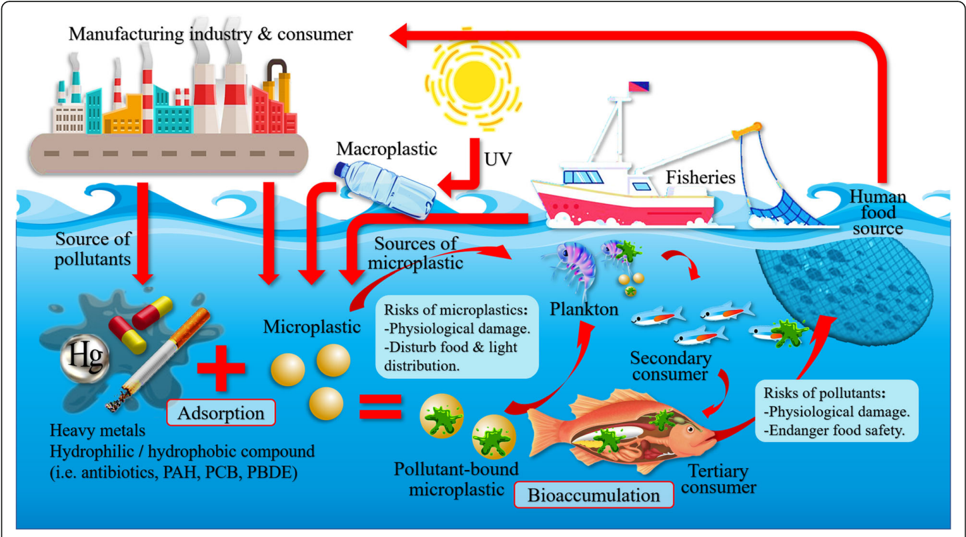
Microplastic pollutes water, land, air, and groundwater environments not only visually but also ecologically for plants, animals, and humans. Microplastic has been reported to act as vectors by sorbing pollutants and contributing to the bioaccumulation of pollutants, particularly in marine ecosystems, organisms, and subsequently food webs. The inevitable exposure of microplastic to humans emphasises the need to review the potential effects, exposure pathways, and toxicity of microplastic toward human health. Therefore, this review was aimed to reveal the risks of pollutant sorption and bioaccumulation by microplastic toward humans, as well as the dominant types of pollutants sorbed by microplastic, and the types of pollutants that are bioaccumulated by microplastic in the living organisms of the marine ecosystem. The possible factors influencing the sorption and bioaccumulation of pollutants by microplastic in marine ecosystems were also reviewed. The review also revealed the prevailing types of microplastic, abundance of microplastic, and geographical distribution of microplastic in the aquatic environment globally. The literature review revealed that microplastic characteristics, chemical interactions, and water properties played a role in the sorption of pollutants by microplastic. The evidence of microplastic posing a direct medical threat to humans is still lacking albeit substantial literature has reported the health hazards of microplastic-associated monomers, additives, and pollutants. This review recommends future research on the existing knowledge gaps in microplastic research, which include the toxicity of microplastic, particularly to humans, as well as the factors influencing the sorption and bioaccumulation of pollutants by microplastic.
Overview
The claims and statistics of this paper haven’t been checked yet.
Free: it reads the open-access text and checks the first 5 claims that cite a source we can check. Create a free account to check every claim.
Integrity signals
Registry
Cites
Statistics
Figures
Verification
Claims the paper makes
The claims and statistics of this paper haven’t been checked yet.
Free: it reads the open-access text and checks the first 5 claims that cite a source we can check. Create a free account to check every claim.
Claims other papers make about this one
Each is checked against this paper’s own text: does it say what the citing paper says it does?
The source backs part of the claim, not all of it — or backs it for a different population, condition or comparison.
In the citing paper
“MPs have been shown to act as a major vector for chemical contami nation, and, as DEHP is lipophilic, MPs have the potential to promote its concentration, distribution and persistence within the marine environ ment (Amelia et al., 2021; Ye et al., 2020).”
From Trophic transfer of polyester microfibres across a multi-level marine food web. (2025) · cites this paper as Amelia et al., 2021
Experimental — accuracy not yet measuredThe source backs part of the claim, not all of it — or backs it for a different population, condition or comparison.
In the citing paper
“MPs have been shown to act as a major vector for chemical contami nation, and, as DEHP is lipophilic, MPs have the potential to promote its concentration, distribution and persistence within the marine environ ment (Amelia et al., 2021; Ye et al., 2020).”
From Trophic transfer of polyester microfibres across a multi-level marine food web. (2025) · cites this paper as Amelia et al., 2021
Experimental — accuracy not yet measured
Self-check
Percentages, sums and reported differences re-computed from the paper’s own numbers.
The self-check needs the paper’s full text.
Citations
Cites
1 retracted
Yu, F., Yang, C., Zhu, Z., Bai, X., & Ma, J. (2019) · Science of The Total Environment · doi:10.1016/j.scitotenv.2019.133643 · Cited by 737 · cited 5×
“Microplastic is a ubiquitous occurrence in terrestrial, freshwater, and marine environments (Yu et al. 2019a).”
BackgroundInfluentialRetractedPlastic waste inputs from land into the ocean
Jambeck, J. R., Geyer, R., Wilcox, C., Siegler, T. R., Perryman, M., Andrady, A., Narayan, R., & Law, K. L. (2015) · Science · doi:10.1126/science.1260352 · Cited by 13,163 · cited 2×
“7 million metric tons entering the ocean in 2010 (Jambeck et al. 2015).”
BackgroundInfluentialMicroplastics in the marine environment
Andrady, A. L. (2011) · Marine Pollution Bulletin · doi:10.1016/j.marpolbul.2011.05.030 · Cited by 8,105 · cited 1×
“The fragmentation of larger plastic in the environment is caused by chemical (e.g. photolysis, hydrolysis, and thermal), mechanical (e.g. abrasion), and biological (e.g. bacteria and fungi) degradation (Andrady 2011; Ivleva et al. 2017).”
BackgroundMicroplastics as contaminants in the marine environment: A review
Cole, M., Lindeque, P., Halsband, C., & Galloway, T. S. (2011) · Marine Pollution Bulletin · doi:10.1016/j.marpolbul.2011.09.025 · Cited by 6,023 · cited 1×
“Other than this, ingested microplastic that is excreted along with faecal matter can alter the density and sinking velocity of the latter, which is an important food source, hence interrupting the normal pattern of food distribution for other marine organisms (Cole et al. 2011, 2016).”
BackgroundThe Physical Impacts of Microplastics on Marine Organisms: A Review
Wright, S. L., Thompson, R. C., & Galloway, T. S. (2013) · Environmental Pollution · doi:10.1016/j.envpol.2013.02.031 · Cited by 4,524 · cited 3×
“Ingested microplastic is transferred throughout the food web, driving increasing concerns about the threats to aquatic biota (Betts 2008; Wright et al. 2013a).”
BackgroundHorton, A. A., Walton, A., Spurgeon, D. J., Lahive, E., & Svendsen, C. (2017) · Science of The Total Environment · doi:10.1016/j.scitotenv.2017.01.190 · Cited by 3,756 · cited 4×
“Microplastic can accumulate and pose hazards in marine ecosystems and organisms (Guzzetti et al. 2018; Horton et al. 2017).”
BackgroundInfluentialPlastic and Human Health: A Micro Issue?
Wright, S. L., & Kelly, F. J. (2017) · Environmental Science & Technology · doi:10.1021/acs.est.7b00423 · Cited by 3,413 · cited 3×
“Based on the abundances observed, it was estimated that Chinese shellfish consumers could be exposed to 100,000 microplastics each year (Wright and Kelly 2017).”
BackgroundLife in the “plastisphere”: microbial communities on plastic marine debris
Zettler, E. R., Mincer, T. J., & Amaral-Zettler, L. A. (2013) · Environmental Science & Technology · doi:10.1021/es401288x · Cited by 3,368 · cited 1×
“…transport pathogens and release plasticizers or additives, microplastic can sorb and desorb and, hence, bioaccumulate quantitatively more toxic pollutants because of the larger ratio of the surface area to the volume of the microplastic (Avio et al. 2017; Zettler et al. 2013; Teuten et al. 2009).”
BackgroundA bacterium that degrades and assimilates poly(ethylene terephthalate)
Yoshida, S., Hiraga, K., Takehana, T., Taniguchi, I., Yamaji, H., Maeda, Y., Toyohara, K., Miyamoto, K., Kimura, Y., & Oda, K. (2016) · Science · doi:10.1126/science.aad6359 · Cited by 3,367 · cited 1×
“…(PS), and polylactic acid (PLA), showed adhesion, colonisation, and damage by the associated bacterial and fungal strains, for example Aspergillus flavus (Auta et al. 2018; Kim et al. 2017a; Mohan et al. 2016; Paco et al. 2017; Devi et al. 2015; Uscategui et al. 2016; Yoshida et al. 2016).”
BackgroundPlastics, the environment and human health: current consensus and future trends
Thompson, R. C., Moore, C. J., vom Saal, F. S., & Swan, S. H. (2009) · Philosophical Transactions of the Royal Society B: Biological Sciences · doi:10.1098/rstb.2009.0053 · Cited by 3,032 · cited 1×
“…monomers, and additives in microplastic are POP and EDC that have been detected in the human body in a higher amount than expected by gut exposure, indicating substance introduction via other possible routes (Galloway 2015; Koelmans et al. 2016; Thompson et al. 2009; Vethaak and Leslie 2016).”
Background
Research works printed but not linked: 4
- Neufeld L, Stassen F, Sheppard R, Gilman T (2016) The new plastics economy - rethinking the future of plastics. World economic forum, Ellen MacArthur Foundation, McKinsey & Company http://www.ellenmacarthurfoundation. org/publications
- Ogonowski M, Wenman V, Danielsson S, Gorokhova E (2017) Ingested microplastic is not correlated to HOC concentrations in Baltic Sea herring. CEST [internet]. Rhodes, Greece
- PlasticsEurope (2017) Plastics -the facts 2017. An analysis of European plastics production, demand and waste data. PlasticsEurope Retrieved from https:// www.plasticseurope.org/en/resources/publications/274-plastics-facts-2017 Accessed on 17 August 2020
- PlasticsEurope (2019) Plastics -the facts 2019. An analysis of European plastics production, demand and waste data. PlasticsEurope Retrieved from https:// www.plasticseurope.org/en/resources/publications/1804-plastics-facts-2019 Accessed on 17 August 2020
Cited by
Items 301–400 of 694
de Paula, M. S., Schuab, J. M., Pelletier, É., Soubaneh, Y. D., Langlois, V., & da Costa, M. B. (2025) · The Science of The Total Environment · doi:10.1016/j.scitotenv.2025.178374 · Cited by 11
Turning the tide on microplastic pollution: Leveraging the potential of geopolymers for mitigation
Madirisha, M. M., Ikotun, B. D., & Onyari, E. K. (2025) · Environmental Research · doi:10.1016/j.envres.2025.121182 · Cited by 10
Lu, H., Ni, Z., Ou, Y., Zhao, M., & Wang, Y. (2025) · Journal of Environmental Management · doi:10.1016/j.jenvman.2025.124736 · Cited by 12
Machine learning models for forecasting microplastic dynamics in China’s coastal waters
Li, J., Jiang, Z., Shu, L., Li, X., Wang, C., & Zhang, H. (2025) · Journal of Hazardous Materials · doi:10.1016/j.jhazmat.2025.138797 · Cited by 12
Kim, T. T., Bao, T. T., Trinh, N. N., Thoa, L. T. K., Phung, N. K., & Bay, N. T. (2025) · Water Air & Soil Pollution · doi:10.1007/s11270-025-08311-5 · Cited by 10
“Moreover, they are easily ingested by marine organisms and accumulate in the food chain, eventually affecting humans (Amelia et al., 2021; Xu et al., 2020a, b).”
Hanif, M. A., Ibrahim, N., Azhari, A. W., Dahalan, F. A., Hasan, M., Lutpi, N. A., Othman, N., & Isa, M. H. (2026) · International Journal of Environmental Science and Technology · doi:10.1007/s13762-026-07100-9 · Cited by 10
“These accumulated plastics may carry adsorbed contaminants, including heavy metals, pathogens, and organic pollutants, facilitating their transfer to higher trophic levels (Amelia et al. 2021).”
Lee, H. S., Jung, S., Lee, S., Kim, Y. T., & Lee, J. (2023) · Korean Journal of Chemical Engineering · doi:10.1007/s11814-023-1461-8 · Cited by 10
The Impact of Fast Fashion on Marine Plastic Pollution
Narisu, H. (2023) · Current World Environment · doi:10.12944/cwe.18.1.9 · Cited by 11
Microplastics in Sandy Beaches of Puerto Vallarta in the Pacific Coast of Mexico
Mejia-Estrella, I. A., Peña-Montes, C., Peláez, L. A. P., del Real-Olvera, J., & Sulbarán-Rangel, B. (2023) · Sustainability · doi:10.3390/su152115259 · Cited by 10
Rajeswari, I. T., Govindarajulu, B., & Priyanka, R. N. (2023) · Environmental Nanotechnology Monitoring & Management · doi:10.1016/j.enmm.2023.100898 · Cited by 10
Olubusoye, B. S., Oni, P., Owusu, F., Adekoya, O., Ongwech, A., Odogwu, D. A., Awolesi, O., Oje, A., & Arwenyo, B. (2023) · Open Journal of Ecology · doi:10.4236/oje.2023.1312057 · Cited by 11
Microplastics in the Ecosystem: A Systematic Review of the Methods for Their Detection and Removal
Rubiños, S., Grados, J., Medina-Collana, J. T., Chávez, E. N., Huarcaya-Gonzales, E., Rocha, V. E., Grados, H., & Neyra, M. R. (2023) · International Journal of Ecology · doi:10.1155/2023/8826716 · Cited by 13
Ardusso, M. G., Severini, M. D. F., Abasto, B., Prieto, G., Rimondino, G. N., Malanca, F. E., & Buzzi, N. S. (2024) · Marine Pollution Bulletin · doi:10.1016/j.marpolbul.2024.117027 · Cited by 12
Microplastics contamination in natural sea turtle nests at Redang Island, Malaysia
Khalid, A. A., Razak, N. I. A., Anuar, S. T., Ibrahim, Y. S., Rusli, M. U., & Jaafar, M. (2024) · Marine Pollution Bulletin · doi:10.1016/j.marpolbul.2024.117412 · Cited by 10
García-Agüero, A. I., Castillo‐Díaz, F. J., Ureña, L. J. B., & Camacho‐Ferre, F. (2024) · Equilibrium Quarterly Journal of Economics and Economic Policy · doi:10.24136/eq.3295 · Cited by 10
“Microplastics are elements that can interact with the lipid membranes of cells (Bochicchio et al ., 2017) or act as vectors for pollutants (Amelia et al ., 2021).”
Filho, C. A. D. F. (2025) · Environmental Science and Pollution Research · doi:10.1007/s11356-024-35865-4 · Cited by 12
“With the presence of these pollut-ants, the polymers’ surfaces adsorpt metal ions and organic pollutants from the surrounding waters, becoming vectors of contaminants (Amelia et al. 2021).”
Wakkaf, T., Zrelli, R. B. E., Yacoubi, L., Kedzierski, M., Lin, Y., Mansour, L. A., Bruzaud, S., & Rabaoui, L. J. (2022) · Environmental Science and Pollution Research · doi:10.1007/s11356-022-21129-6 · Cited by 10
“According to PlasticsEurope (2020), world production of plastics reached 368 million metric tons annually in 2019, and global production continued to expand in spite of increased awareness campaigns and efforts to mitigate plastic pollution (Amelia et al. 2021).”
BackgroundLumeno, S. S., Warouw, F. F., Kembuan, D. R. E., & Ratu, R. (2022) · INDONESIAN JOURNAL OF URBAN AND ENVIRONMENTAL TECHNOLOGY · doi:10.25105/urbanenvirotech.v5i3.14450 · Cited by 10
Trophic transfer of polyester microfibres across a multi-level marine food web.
Miller, M. E., Motti, C. A., Snekkevik, V. K., Vickers, K., Kennedy, H., Bastin, L., Hamann, M., & Kroon, F. J. (2025) · Marine Pollution Bulletin · doi:10.1016/j.marpolbul.2025.118590 · Cited by 9
Ezgeta-Balić, D., & Balić, N. (2024) · Mediterranean Marine Science · doi:10.12681/mms.35378 · Cited by 9
Plastic Analysis with a Plasmonic Nano-Gold Sensor Coated with Plastic-Binding Peptides
Gagné, F., Gauthier, M., & André, C. (2024) · Journal of Xenobiotics · doi:10.3390/jox14020040 · Cited by 9
“Moreover, since plastics degrade slowly, it is estimated that 710 million metric tons of plastic will found their way into the oceans by 2040 [4].”
BackgroundMicroplastics: understanding the interaction with the food web and potential health hazards
Parmar, R., Thakur, S., Singh, A. K., Rajesh, P., Singh, A. K., & Rajpoot, S. (2025) · Journal of Environmental Engineering and Science · doi:10.1680/jenes.24.00085 · Cited by 10
Báez‐Flores, M. E., Tiznado‐Hernández, M. E., Gracia-Valenzuela, M. H., & Troncoso‐Rojas, R. (2025) · Microorganisms · doi:10.3390/microorganisms13061246 · Cited by 10
“The MPs (100 nm to 5 mm) and nanoplastics (1 to 100 nm) [23] accumulated in the seas are vectors for major ocean pollutants and participate in their bioaccumulation in the marine environment and food webs [36,37].”
Chen, H., Shen, X., Lin, J., Huang, Q., Zhao, L. P., Zhu, R., Li, L., Liu, Z., & Zhao, C. (2025) · Critical Reviews in Food Science and Nutrition · doi:10.1080/10408398.2025.2538550 · Cited by 13
“These environmental factors not only affect the physical properties of MPs but also mediate their interactions between the surface of MPs and pollutants through chemical bonding, thereby influencing their adsorption capacity (Amelia et al. 2021).”
Izlal, S., Arif, M. S., Rahman, S., & Rhidoy, M. O. I. (2025) · Environmental Monitoring and Assessment · doi:10.1007/s10661-025-14433-4 · Cited by 9
“Another typical shape of MPs is the fragments of larger goods, like beverage cans, empty jars, packing, and office debris (Amelia et al., 2021).”
Methods for the detection and quantification of micro- and nano-plastic particles in the environment
Ilyas, A., & Webster, R. D. (2026) · TrAC Trends in Analytical Chemistry · doi:10.1016/j.trac.2026.118682 · Cited by 9
Munir, M., Subechi, M., Nurmanjaya, A., Prasetya, K. E., Rindiyantono, F., Chairuman, C., Pratama, C., Yanto, Y., Pujiyanto, A., Setiawan, H., et al. (2024) · Marine Pollution Bulletin · doi:10.1016/j.marpolbul.2024.116283 · Cited by 9
Mohan, P., & Hamid, F. S. (2024) · Marine Pollution Bulletin · doi:10.1016/j.marpolbul.2024.116654 · Cited by 9
Ortiz, C. R., Müller, L., Borges, L. D. V., Pinto, L. A. D. A., Cadaval, T. R. S., Tesser, M. B., Pedrosa, V. F., Romano, L. A., Wasielesky, W., & Ventura‐Lima, J. (2024) · Marine Environmental Research · doi:10.1016/j.marenvres.2024.106747 · Cited by 9
Maliwan, T., Quyen, D. T. T., Nguyen, C. M., Teo, W. K., & Hu, J. (2025) · Chemosphere · doi:10.1016/j.chemosphere.2025.144171 · Cited by 9
Li, C., Shi, L., Liu, T., Dong, K., Ren, W., & Zhang, Y. (2025) · Environmental Geochemistry and Health · doi:10.1007/s10653-025-02430-y · Cited by 9
“In the aquatic environment, MPs mainly exist in the form of fibers and fragments (Amelia et al., 2021).”
Sanabila, A. I., Hadi, M. I., & Zummah, A. (2022) · Al-Hayat Journal of Biology and Applied Biology · doi:10.21580/ah.v5i1.12295 · Cited by 12
“If fish accidentally ingest microplastics, they will have them infiltrate digestive organs and absorb them into their body (Amelia et al., 2021).”
BackgroundKapukotuwa, G. R., Jayasena, N., Weerakoon, K. C., Abayasekara, C. L., & Rajakaruna, R. S. (2025) · ACS ES&T Water · doi:10.1021/acsestwater.4c00936 · Cited by 8
Plastic pollution in brackish waters: Macroalgae as collectors of plastic debris
Fabrizi, F., Spagnuolo, D., Bottari, T., Mghili, B., Branca, C., Punzo, E., Mazurkiewicz, M., Nibali, V. C., Genovese, G., D’Angelo, G., et al. (2025) · Journal of Hazardous Materials · doi:10.1016/j.jhazmat.2025.139114 · Cited by 8
Moura, C., Silva, D., Espincho, F., Rodrigues, S. M., Pereira, R., Almeida, C. M. R., Ramos, S., & Freitas, V. (2025) · Environments · doi:10.3390/environments12080254 · Cited by 9
“Moreover, MPs can act as vectors for adsorbed pollutants and pathogens, exacerbating their environmental and toxicological impacts [11–13].”
Mahmud, F., Roy, H., Bhuiyan, M. M. K., & Islam, M. S. (2025) · Environmental Science Advances · doi:10.1039/d5va00118h · Cited by 13
Wang, J., Pan, M., & Liu, Z. (2025) · Environmental Pollution · doi:10.1016/j.envpol.2025.127385 · Cited by 8
Microplastics and Health: A Review on Environmental Exposure, Toxicokinetics and Biological Effects
Rathee, V., Ahlawat, Y. K., Singh, R., Bhardwaj, J. K., Kaur, A., Kumar, S., Sharma, P., Choudhary, R., Didwania, N., Kumar, D., et al. (2026) · Sustainability · doi:10.3390/su18073527 · Cited by 8
Rinaldis, G. D., Pastorino, P., Scirocco, T., Sacchetti, C., Anselmi, S., Provenza, F., Renzi, M., & Specchiulli, A. (2024) · Toxics · doi:10.3390/toxics12060429 · Cited by 8
“Beyond direct harm, MPs present a potential threat as vectors for contaminants and new pathogens, exacerbating the negative effects on both the environment and natural biota [5,6].”
BackgroundMicroplastic Pollution: Challenges, Ameliorating Strategies and Governance Policies
Sharma, B., Kour, D., Bassi, A., Gusain, M., Sharma, A., Kaur, T., Basu, A., Kumari, S., Khan, S. S., & Yadav, A. N. (2025) · Water Air & Soil Pollution · doi:10.1007/s11270-025-08220-7 · Cited by 9
Kim, N., Kim, B., & Lee, E. (2022) · 대한환경공학회지 · doi:10.4491/ksee.2022.44.11.453 · Cited by 10
Alberto, R. P., Paz-Alberto, A. M., Ponce, C. D., & Mata, K. J. E. (2022) · American Journal of Climate Change · doi:10.4236/ajcc.2022.114017 · Cited by 8
Sun, L., Wu, J., Chen, M., Wang, T., Shang, Z., Liu, J., Huang, M., & Wu, P. (2023) · The Science of The Total Environment · doi:10.1016/j.scitotenv.2023.165928 · Cited by 11
Microplastics in aquatic environments: a review of recent advances
Fish, K. E., Clarizia, L., & Meegoda, J. N. (2023) · Journal of Environmental Engineering and Science · doi:10.1680/jenes.23.00018 · Cited by 8
Adsorption Behavior and Interaction of Micro-Nanoplastics in Soils and Aquatic Environment
Salimkumar, A. V., Cleetus, M. C. K., Ehigie, J. O., Onogbosele, C. O., Nisha, P., Kumar, B. S., Prabhakaran, M. P., & Rejish Kumar, V. J. (2024) · Springer eBooks · doi:10.1007/978-3-031-51967-3_11 · Cited by 11
Provenza, F., Anselmi, S., Bentivoglio, T., Pastorino, P., Prearo, M., Barceló, ., Scirocco, T., Specchiulli, A., & Renzi, M. (2025) · Journal of Hazardous Materials · doi:10.1016/j.jhazmat.2025.137776 · Cited by 7
Xu, Y., Xiao, S., Xu, Q., Peng, B.-Y., Yang, L., Chen, J., Zhou, X., Wu, W., & Zhang, Y. (2025) · Chemical Engineering Journal · doi:10.1016/j.cej.2025.168859 · Cited by 11
Huang, Y., Holmer, M., Xu, C., Liu, M., Masqué, P., Serrano, Ó., Hu, J., Effiong, K. S., Tang, T., Zhu, J., et al. (2025) · Environmental Science & Technology · doi:10.1021/acs.est.5c10702 · Cited by 7
Microplastic Concentration in Mediterranean Commercial Fish: A Systematic Review
Manolaki, S. M., Dimitriou, P. D., Lampa, M., Karakassis, I., & Papageorgiou, N. (2025) · Microplastics · doi:10.3390/microplastics4040100 · Cited by 7
“MPs have been proven to be a vector for major pollutants in the marine environment [6].”
Liu, Z., Cai, J., Guo, Y., Li, J., Wei, L., Zhang, X., Liu, W., Zhang, T., Liu, P., & Jia, H. (2026) · Journal of Hazardous Materials · doi:10.1016/j.jhazmat.2026.141043 · Cited by 8
Chauhan, A. S., Chen, C., & Dong, C. (2026) · Reviews in Environmental Science and Bio/Technology · doi:10.1007/s11157-025-09759-x · Cited by 8
“Key threats, such as hydrocarbons and HMs have caused significant ecological imbalance and harming marine life (Amelia et al. 2021).”
Cheng, X., Tang, X., Yue, K., Tang, S., Lu, T., & Li, Y. (2026) · Journal of Hazardous Materials · doi:10.1016/j.jhazmat.2026.141295 · Cited by 7
Plastic–contaminant interactions in the semi-enclosed Black Sea basin
Aytan, Ü., Pasli, S., Minaz, M., Canlı, O., & Güzel, B. (2026) · Environmental Research · doi:10.1016/j.envres.2026.124482 · Cited by 7
Ahmad, F., Sun, C., Muhammad, A., & Shao, Y. (2026) · Environmental Pollution · doi:10.1016/j.envpol.2026.128128 · Cited by 7
Self-citationHaroon, M., Khan, W. U., Munir, B., Ahmad, S. R., Rehman, A., Akram, W., Munir, A., Sardar, R., & Yasin, N. A. (2025) · Chemosphere · doi:10.1016/j.chemosphere.2024.144060 · Cited by 7
Microplastic Exposure for Pinnipeds (Pinnipedia): A Rapid Review
Vainberg, A., & Abakumov, E. V. (2025) · Ecologies · doi:10.3390/ecologies6020026 · Cited by 7
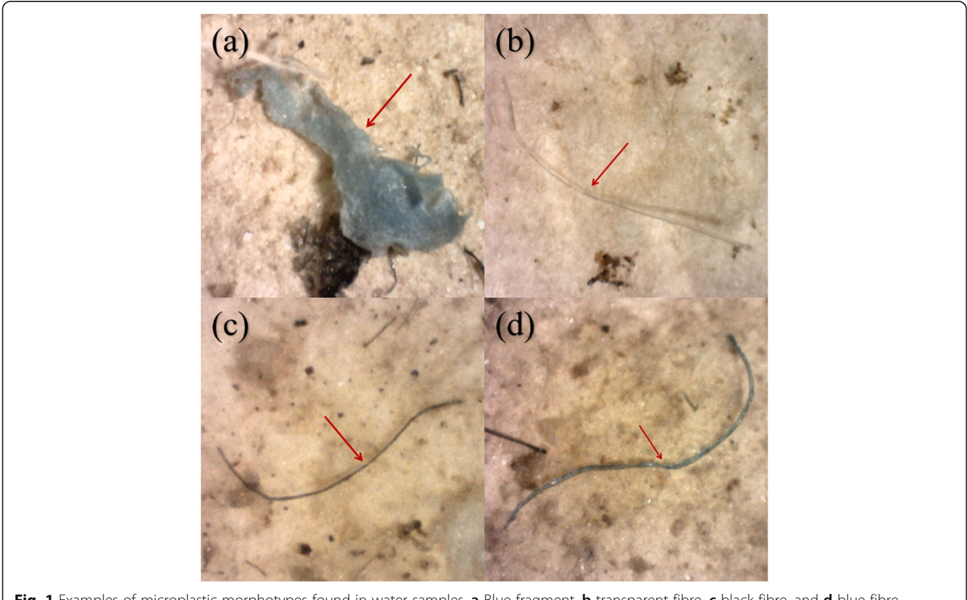
“Given the potential for airborne contamination, many authors implemented additional contamination control measures, such as exposing a petri dish containing a filter to the same conditions as the samples to test for the presence of polymer particles, including negative controls or blanks to assess…”
Sridharan, M., Harikrishnan, S., Nathan, D. S., Gopakumar, G., & Natarajan, T. (2025) · Water Air & Soil Pollution · doi:10.1007/s11270-025-08412-1 · Cited by 8
“Endo et al. (2013) studied that the beach environment is favourable for weathering of MPs. Blue-coloured MPs might have been derived from fishing nets, packaging, and textile products (Amelia et al., 2021).”
Ferreira, A. T. D. S., Wetter, N. U., Ribeiro, M. C. H., Esteves, L. S., Dias, A. G., Grohmann, C. H., Kuznetsova, M., de Freitas, A. Z., de Oliveira, R. C., & Siegle, E. (2024) · Marine Pollution Bulletin · doi:10.1016/j.marpolbul.2024.117025 · Cited by 10
Direct µ-FTIR analysis of microplastics deposited on silicon in indoor air environments
Li, R., Wontor, K., Olubusoye, B. S., Brewer, J. S., & Cizdziel, J. V. (2025) · npj Emerging Contaminants · doi:10.1038/s44454-025-00009-x · Cited by 6
Singh, P., & Shivashankar, M. (2026) · Chemical Engineering Journal Advances · doi:10.1016/j.ceja.2026.101042 · Cited by 8
Oladeji, R. D., Azeez, L. A., Agbaogun, B. K., Shakirat, M.-L., Oladejo, A. A., Aremu, H. K., Busari, H. K., Awolola, O. S., & Hammed, A. (2024) · Cleaner Water · doi:10.1016/j.clwat.2024.100059 · Cited by 9
Senathirajah, K., Kandaiah, R., Panneerselvan, L., Young, K. R. L., & Thavamani, P. (2025) · Cambridge Prisms Plastics · doi:10.1017/plc.2025.6 · Cited by 7
“…to adverselyand materiallyaffect health anddisrupt ecosystemfunction and services (Savoca et al., 2016; Beaumont et al., 2019; Triebskorn et al., 2019; Qian et al., 2020; Amelia et al., 2021; Lozano et al., 2021; Senathirajah et al., 2021; Kutralam-Muniasamy et al., 2022; Land-rigan et al., 2023).”
Distribution and Risk Assessment of Microplastics in the Basin of the Pearl River, China
Wu, F., Wang, J., Jiang, S., Wang, D., Hu, S., & Chen, J. (2025) · Water Air & Soil Pollution · doi:10.1007/s11270-025-07980-6 · Cited by 6
“This observation agrees with previous studies, such as the Yangtze River in China, the Bohai Sea in China, the Levant Basin, and the San Francisco Bay in California, USA (Amelia et al., 2021; Dong et al., 2022b; Kazour et al., 2019; Zhao et al., 2014; Zheng et al., 2019).”
Huang, Y., Yu, S., Zheng, Z., Xiao, X., Zhu, Z., Deng, L., Wei, H., Liang, J., Chen, S., & Holmer, M. (2025) · Frontiers in Marine Science · doi:10.3389/fmars.2025.1593776 · Cited by 6
Leitner, L., Schneider, R., Steiner, T., Stenzel, M. H., Freitag, R., & Greiner, A. (2022) · Macromolecular Chemistry and Physics · doi:10.1002/macp.202100431 · Cited by 6
Nguyen, N. T., Oanh, L. T. K., & Thien, N. D. (2024) · IOP Conference Series Earth and Environmental Science · doi:10.1088/1755-1315/1349/1/012012 · Cited by 7
Dreyer, S., Marcu, D., Keyser, S., Bennett, M., Maree, L., Koeppel, K. N., Abernethy, D., & Petrik, L. F. (2024) · Marine Pollution Bulletin · doi:10.1016/j.marpolbul.2024.116688 · Cited by 6
Bhattacharjee, S., Ghosh, P. K., Basu, S., Mukherjee, T., Mandal, B., Sinha, P., & Mukherjee, A. (2025) · Environmental Research · doi:10.1016/j.envres.2025.121218 · Cited by 6
Ormaniec, P., & Baczynski, T. P. (2025) · Desalination and Water Treatment · doi:10.1016/j.dwt.2025.101132 · Cited by 6
Mikroplastiklerin Deniz Ortamı ve Sucul Canlılara Etkisi
Kenan, İ., & TEKSOY, A. (2022) · Bilecik Şeyh Edebali Üniversitesi Fen Bilimleri Dergisi · doi:10.35193/bseufbd.1074246 · Cited by 12
Occurrence of microplastics and nanoplastics in marine environment
Manojkumar, Y., Gopal, B., Sumanth, C., Pilli, S., Tyagi, R. D., & Pandey, A. (2022) · Elsevier eBooks · doi:10.1016/b978-0-323-99908-3.00010-5 · Cited by 9
Matskiv, T., Martyniuk, V., Khoma, V., Yunko, K., Orlova-Hudim, K., Gnatyshyna, L. L., Geffard, A., Ladeiro, M. P., & Stoliar, O. B. (2023) · Comparative Biochemistry and Physiology Part C Toxicology & Pharmacology · doi:10.1016/j.cbpc.2023.109803 · Cited by 6
Nakayama, H., Fukuda, A., & Shimaoka, T. (2024) · Journal of Material Cycles and Waste Management · doi:10.1007/s10163-024-01895-w · Cited by 5
Moreri, G. B., & Zhang, Y. (2024) · European Journal of Theoretical and Applied Sciences · doi:10.59324/ejtas.2024.2(3).42 · Cited by 6
Microplastics: Environmental Presence and Ecological Impact
Wheatley, M. C. (2024) · Premier journal of environmental science. · doi:10.70389/pjes.100010 · Cited by 13
Pedà, C., Malara, D., Longo, F., Laface, F., Battaglia, P., Berti, C., Consoli, P., Ponte, G., Andrews, P. L. R., Greco, S., et al. (2025) · Marine Pollution Bulletin · doi:10.1016/j.marpolbul.2025.117780 · Cited by 5
Microplastics in surface waters surrounding a touristic beach at the Gulf of California, Mexico
Sánchez‐Paz, A., Encinas-García, T., Ávila-Félix, L., & Mendoza-Cano, F. (2025) · International Journal of Environmental Health Research · doi:10.1080/09603123.2025.2483356 · Cited by 7
“MPs are also potential carriers of pathogens that may eventually reach marine species and humans (Amelia et al. 2021).”
Yunko, K., Martyniuk, V., Gnatyshyna, L. L., Khoma, V., Matskiv, T., Tulaidan, H., Mykhalyuk, O., Karitonas, R., Gylytė, B., Manusadžianas, L., et al. (2025) · Environmental Toxicology and Pharmacology · doi:10.1016/j.etap.2025.104682 · Cited by 5
Agbozu, I. E., Okorodo, E. I., & Tesi, G. O. (2025) · Toxicological & Environmental Chemistry Reviews · doi:10.1080/02772248.2025.2515399 · Cited by 6
“In a rapidly changing world where plastic pollution threatens both natural ecosystems and human well-being, this research offers a unique opportunity to address a pressing environmental issue (Amelia et al. 2021; Kehinde, 2022).”
García-Valle, G., Torralba-Calleja, E., Ciurana, F. M., Campoy, F. J., Ricart, J., Pirriera, M. D., & Martínez-Navas, S. (2025) · MTS/IEEE OCEANS Conference (OCEANS) · doi:10.1109/oceans58557.2025.11104700 · Cited by 5
“These particles also serve as vectors for other pollutants, worsening toxicity and negative effects, not only to marine and coastal ecosystems but also to human health [4].”
Modeling river and urban related microplastic pollution off the southern United States
Zhou, X., Xiao, S., Ramirez, M., & Bracco, A. (2025) · npj Emerging Contaminants · doi:10.1038/s44454-025-00011-3 · Cited by 7
“Theseincludephysicaldisturbancessuchasentanglementcausedbylarge-sizedMPs 82 , as well as complex biological and chemical interactions.”
Mojiri, A., Zhou, J. L., KarimiDermani, B., Vakili, M., & Rezania, S. (2025) · International Biodeterioration & Biodegradation · doi:10.1016/j.ibiod.2025.106194 · Cited by 5
Anik, A. H., Oishy, M. N., Murshed, M. F., Abdullah, R. B., & Khan, M. R. (2025) · Journal of Hazardous Materials Plastics · doi:10.1016/j.hazmp.2025.100002 · Cited by 22
Nguyen, X., Hoang, T.-D., Nguyen-Nhat, N.-T., Nguyen, Q.-H., Nguyen, X.-T., Nguyen, T.-H., Truong, S. H. T., Nguyen, M.-N. T., & Dao, V.-H. (2025) · Foods · doi:10.3390/foods14203518 · Cited by 6
“Recent evidence indicates that microplastics act as effective vectors, adsorbing PEAs from surrounding waters and transporting them across ecosystem [8].”
Riera, R., Vasconcelos, J., Baden, S. P., Martínez, A., & Infantes, E. (2025) · PLoS ONE · doi:10.1371/journal.pone.0334934 · Cited by 5
Li, Y., Ni, Y., Dong, C., Zhang, J., Guo, H., Zhu, S., Du, C., Qi, Y., Wei, Z., Han, Y., et al. (2025) · Environmental Pollution · doi:10.1016/j.envpol.2025.127390 · Cited by 6
Removal of microplastics from wastewater: various methods and functional coating materials
Tiwari, B., & Arya, R. K. (2026) · Reviews in Chemical Engineering · doi:10.1515/revce-2025-0062 · Cited by 6
Shape dependence of the release rate of chemicals from plastic microparticles
Frazzetto, R., & Frezzato, D. (2022) · Environmental Science and Pollution Research · doi:10.1007/s11356-022-21440-2 · Cited by 6
“Regarding the indirect threats in aquatic environments, microplastics have been early addressed as possible vectors of pollutants1 and as source of toxic additives released in the hosting medium (Mato et al. 2001; Teuten et al. 2007; Amelia et al. 2021), a matter still under intense study and debate (Koelmans et al.”
BackgroundMicroplastic Pollution in Seawater: A Review Study
Upendra, S., & Kaur, J. (2023) · Nature Environment and Pollution Technology · doi:10.46488/nept.2023.v22i03.050 · Cited by 9
“According to reports, microplastic can operate as a vector for pollutants by absorbing them and aiding in their bioaccumulation, particularly in marine environments, organisms & consequently, food webs (Amelia et al. 2021)”
BackgroundNizam, N., Mohanasunthar, S., Azmi, A. A., Anuar, S. T., Ibrahim, Y. S., & Khalik, W. M. A. W. M. (2023) · Sains Malaysiana · doi:10.17576/jsm-2023-5208-03 · Cited by 5
“This specific surface area plays a crucial role in their ability to adsorb pollutants, transfer them to organisms, and support microbial growth (Amelia et al. 2021; Ma et al. 2019).”
BackgroundSelf-citationMa, H., Kao, J., Kao, R., Chiang, N., & Cho, C.-C. (2024) · Environmental Science and Pollution Research · doi:10.1007/s11356-024-31876-3 · Cited by 5
Mgbemena, N., Mgbo, V., Princewill, V., Ndukwe, G. I., Das, R. R., & Ilechukwu, I. (2024) · Substantia · doi:10.36253/substantia-2661 · Cited by 6
Polystyrene Microplastics Degradation by Microbial Consortium From Jakarta Bay
Yolanda, D. M., Anggiani, M., Agung, M. U. K., Anggraeni, S. R., & Afianti, N. F. (2024) · Environmental Quality Management · doi:10.1002/tqem.22291 · Cited by 7
Aras, S., Yakut, Ş. M., & Dulkadiroğlu, H. (2024) · Ecohydrology · doi:10.1002/eco.2725 · Cited by 5
“The consumption of muscle tissue by humans at the top of the food chain can result in adverse health effects, compromise food safety and disrupt the structure of the food chain over time (Meng, Kelly, and Wright 2020; Xu et al. 2020; Alak, Köktürk, and Atamanalp 2021; Amelia et al. 2021).”
Microplastic Occurrence in Different Fish Organs from Two Coastal Waters in Java Sea, Indonesia
Dwiyitno, D., Barokah, G. R., Hidayah, I., Januar, H. I., & Wibowo, S. T. (2024) · SQUALEN Bulletin of Marine and Fisheries Postharvest and Biotechnology · doi:10.15578/squalen.941 · Cited by 5
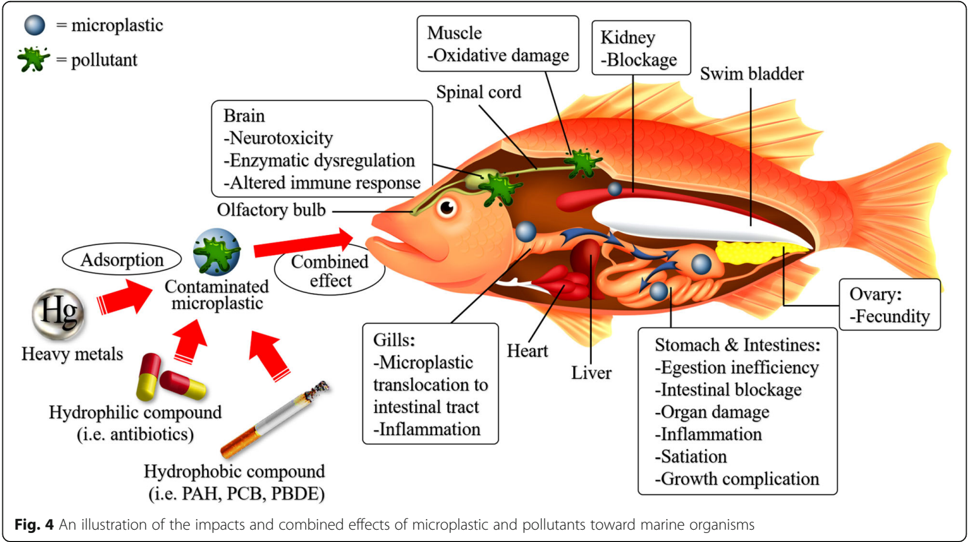
“Accumulation of MP in fish organs could be vulnerable due to the possible acute toxicity to fish, such as neurotoxicity, oxidative stress, energy-related damages, intestinal blockage, reproductive toxicity, and immune response changes (Amelia et al., 2021; Barboza et al., 2018; Gao et al., 2023).”
BackgroundHassen, W., Danioux, A., Oueslati, A., Santana‐Rodríguez, J. J., Sire, O., Sédrati, M., & Mansour, H. B. (2024) · Microbial Pathogenesis · doi:10.1016/j.micpath.2024.107193 · Cited by 5
Sesay, R. E. V., Azizi, M. I., Rahmani, B., & Rajendra, P. (2024) · Asian Journal of Environment & Ecology · doi:10.9734/ajee/2024/v23i12636 · Cited by 5
Dal, E. K., & Kılıç, R. (2024) · Research Square · doi:10.21203/rs.3.rs-3890356/v1 · Cited by 6
Upadhyay, P., Patel, V., Gurjar, T., Ladumor, R., Kottayi, M., Doshi, A., Salunke, A., & Pandya, P. (2025) · Marine Pollution Bulletin · doi:10.1016/j.marpolbul.2025.118700 · Cited by 8
Fe’ao, S., Drova, E., Matoto, V., Afu, S., Kautoke, P., Fatongiatau, V., Botleng, J. V., Varea, R., Dehm, J. B., Morris, C. W., et al. (2025) · Discover Oceans · doi:10.1007/s44289-025-00095-0 · Cited by 4
Metadata
- Authors
- Amelia, T. S. M., Khalik, W. M. A. W. M., Ong, M. C., Shao, Y. T., Pan, H.-J., & Bhubalan, K.
- Affiliations
- Universiti Malaysia Terengganu (MY)
- National Taiwan Ocean University (TW)
- Corresponding author
- Shao, Yi Ta
- Pan, Hui-Juan
- Bhubalan, Kesaven
- ORCID
- Venue
- Progress in Earth and Planetary Science
- Published
- 2021-01-22
- Volume
- 8
- Issue
- 1
- ISSN
- 2197-4284 (ISSN-L)
- OpenAlex
- W3165321398
- Cited by
- 641
- References
- 304
- Citations by year
- 2026: 113 · 2025: 160 · 2024: 133 · 2023: 117 · 2022: 90 · 2021: 28
- FWCI
- 22.82
- Type
- journal article
- Language
- en
- Open access
- gold
- doi.org
- Licence
- cc-by
- creativecommons.org/licenses/by/4.0 (tdm)
- creativecommons.org/licenses/by/4.0 (vor)
- Locations
- Progress in Earth and Planetary Science (publishedVersion, cc-by)
- DOAJ (DOAJ: Directory of Open Access Journals) (submittedVersion, cc-by-sa)
- Greater South Information System
- Funders
- Ministry of Science and Technology, Taiwan (MOST109-2621-M019-001)
- Universiti Malaysia Terengganu (55193/1)
- Topics
- Physical Sciences › Environmental Science › Pollution › Microplastics and Plastic Pollution
- Physical Sciences › Environmental Science › Health, Toxicology and Mutagenesis › Environmental Toxicology and Ecotoxicology
- Physical Sciences › Environmental Science › Pollution › Pharmaceutical and Antibiotic Environmental Impacts
- Keywords
- marine microplastics, pollutant sorption, bioaccumulation, human health risk, polymer additives, food webs, exposure pathways, microplastic distribution, microplastic toxicity
About these checks
Registry, retraction, Cites and statistics results are computed, not judged, with one exception: a printed reference that no index lists is read once by a model before it counts as a citation error. Claims are extracted by a model and kept only when their quote appears verbatim in the text; each cited source is then checked, with a model’s help, for whether it says what the claim relies on. Those verdicts can be wrong — read the claim’s quote and the cited source before relying on one.
Statistics and arithmetic are recomputed, not judged.
Confidence bands are shown only for fields calibrated on our annotated test set. None is calibrated yet, so no band is shown.
What counts as a claim ›How we measure confidence ›How we check this ›
Are you an author, or do you see a problem with this page? Request a review
Data sources
Bibliographic data: Semantic Scholar, OpenAlex, Crossref.
Contains information from the Semantic Scholar Academic Graph Datasets, made available under the ODC Attribution License (ODC-BY 1.0).
Semantic Scholar’s data is described in: Kinney, R., et al. (2023). The Semantic Scholar Open Data Platform. arXiv:2301.10140.
