

Optimisation of complex health interventions prior to a randomised controlled trial: a scoping review of strategies used
Open accessThe DOI matches its Crossref record; 54 of the 56 references it cites were found in a registry or an index; 70 of the 153 sources its claims cite were checked for support.
Abstract
BACKGROUND: Many complex intervention trials fail to show an intervention effect. Although this may be due to genuine ineffectiveness, it may also be the result of sub-optimal intervention design, implementation failure or a combination of these. Given current financial constraints and the pressure to reduce waste and increase value in health services research, pre-trial strategies are needed to reduce the likelihood of design or implementation failure and to maximise the intervention's potential for effectiveness. In this scoping review, we aimed to identify and synthesise the available evidence relating to the strategies and methods used to 'optimise' complex interventions at the pre-trial stage. METHODS: We searched MEDLINE, CINAHL, AMED, PsycINFO and ProQuest Nursing & Allied Health Source for papers published between January 2000 and March 2015. We included intervention development and optimisation studies that explored potential intervention weaknesses and limitations before moving to a definitive randomised controlled trial (RCT). Two reviewers independently applied selection criteria and systematically extracted information relating to the following: study characteristics; intervention under development; framework used to guide the development process; areas of focus of the optimisation process, methods used and outcomes of the optimisation process. Data were tabulated and summarised in a narrative format. RESULTS: We screened 3968 titles and 231 abstracts for eligibility. Eighty-nine full-text papers were retrieved; 27 studies met our selection criteria. Optimisation strategies were used for a range of reasons: to explore the feasibility and acceptability of the intervention to patients and healthcare professionals; to estimate the effectiveness and cost-effectiveness of different combinations of intervention components; and to identify potential barriers to implementation. Methods varied widely across studies, from interviews and focus groups to economic modelling and probability analysis. CONCLUSIONS: The review identifies a range of optimisation strategies currently used. Although a preliminary classification of these strategies can be proposed, a series of questions remain as to which methods to use for different interventions and how to determine when the intervention is ready or 'optimised enough' to be tested in a RCT. Future research should explore potential answers to the questions raised, to guide researchers in the development and evaluation of more effective interventions.
Overview
CoChat Summary
TL;DR
This scoping review maps pre-trial strategies used to optimise complex health interventions before a definitive RCT. It identifies 27 studies using varied methods, proposes a preliminary classification of optimisation strategies, and highlights unresolved questions about which methods to use and when an intervention is “optimised enough” to proceed.
Key findings
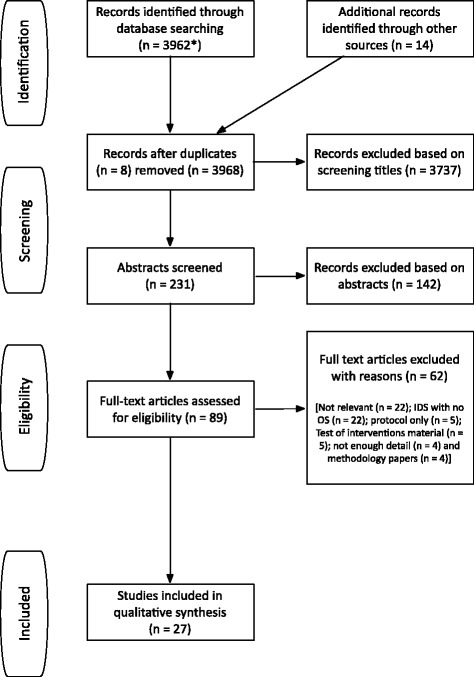
- From 3968 titles, 231 abstracts and 89 full texts, 27 studies met inclusion criteria; most were from the UK (n = 19, 70.4%) and published from 2011 onwards (n = 17, 63.0%).
- Optimisation focused on acceptability/feasibility to stakeholders in 14 studies, preliminary effect or long-term impact in 7 studies, and more than one element in 6 studies; methods ranged from interviews and focus groups to factorial experiments, economic modelling and probability analysis.
- 17 of 27 studies used the MRC 2000 framework, the 2008 version or a combination; 2 used intervention mapping, 2 used MOST, 2 used intervention modelling, 1 used new mHealth guidelines, and the remaining studies did not specify a framework.
- 16 studies refined the intervention and then tested it in pilot studies or full-scale RCTs; 2 studies were discouraged from moving to full-scale RCT because the intervention did not show expected potential effectiveness, and outcome data were unavailable for 2 studies.
Methods
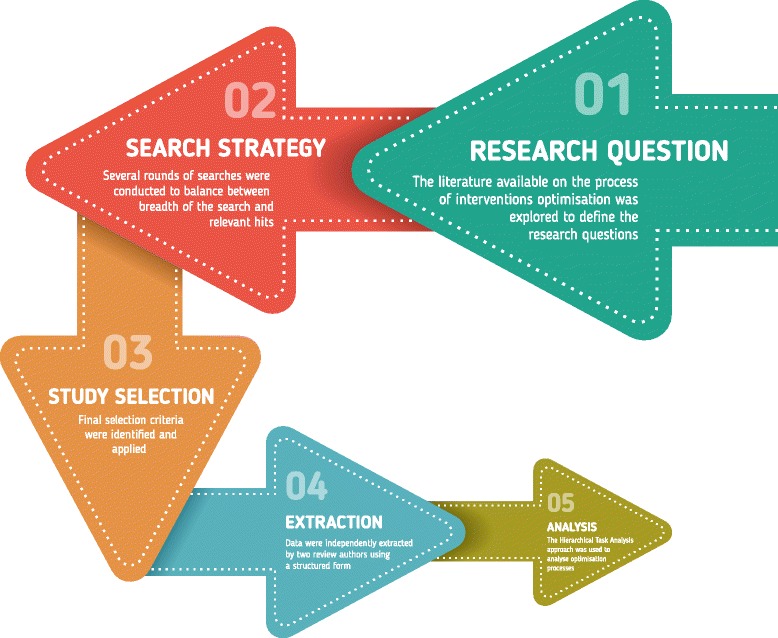
- Scoping review following Arksey and O’Malley’s iterative stages, with searches of MEDLINE, CINAHL, AMED, The Cochrane Methodology Register, PsycINFO and ProQuest Nursing & Allied Health Source for English-language papers published 1 January 2000 to 31 March 2015, plus hand-searching.
- Included pre-trial intervention development, pilot or feasibility studies of complex multicomponent interventions that explicitly referred to optimisation or fitted the review’s definition; excluded complementary and alternative medicines, optimisation of trial parameters, conference abstracts/posters, study protocols and methodological papers with no empirical data.
- Two reviewers independently applied selection criteria and extracted data; hierarchical task analysis was used to decompose each study by aim/area of focus, methods and outcome, with results summarised narratively.
Limitations
- Stated by the authors: the scoping review does not aim to be exhaustive, and other optimisation strategies may exist that were not captured; terminology and core concepts around “optimisation” lack consensus.
- Stated by the authors: not all included studies clearly reported optimisation objectives, the level of methodological detail varied widely, and there were conflicting reports about the added value of stakeholder involvement.
- Evident from the text: no quality assessment of included studies was performed, consistent with the paper’s note that scoping reviews generally do not apply quality filters unless specified; the English-language and 2000–2015 limits may also restrict coverage.
Model-written summary. Check it against the paper before relying on it.
Integrity signals
Registry
Cites
Statistics
Figures
Verification
Claims the paper makes
18 Valid · 0 Not valid · 22 Not checked · 54 Own results and interpretations
The sources with a verdict support this claim; the rest weren’t checked yet, have no full text we could read, or their verdicts aren’t rated yet.
In the paper
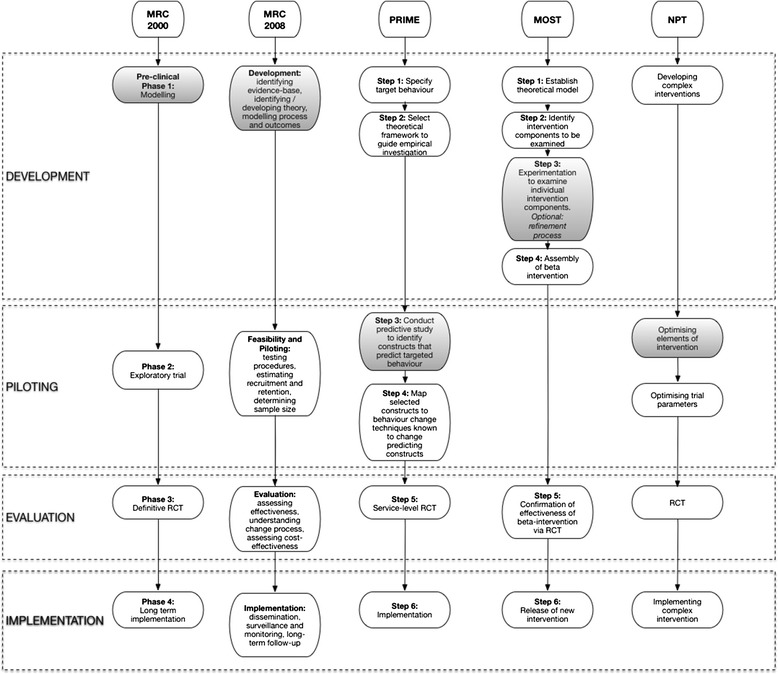
“Alternative approaches to CHI optimisation include strategies proposed by the MRC framework 2000 [1] and 2008 [3], the normalisation process theory (NPT) [11, 12] and the process modelling in implementation research (PRIME) approach [13].”
§ Optimisation of complex health interventions prior to a randomised controlled trial: a scoping review of strategies used > Background
What the sources say
- Not checked yetcites [1] Campbell M Fitzpatrick R Haines A Kinmonth AL Sandercock P Spiegelhalter D Frameworks for design and evaluation of complex interventions to improve health BMJ. 2000 321 694 6 10.1136/bmj.321.7262.694 10987780 PMC1118564 source
- Not checked yetcites [3] Craig P Dieppe P Macintyre S Health P Unit S Michie S Developing and evaluating complex interventions: new guidance BMJ [Internet] 2008 337 October 979 83 PMC2769032 18824488
- Not checked yetcites [11] May C Finch T Mair F Ballini L Dowrick C Eccles M Understanding the implementation of complex interventions in health care: the normalization process model BMC Health Serv Res [Internet] 2007 7 148 1 7 PMC2089069 17880693
- Supportedcites [12] Murray E Treweek S Pope C MacFarlane A Ballini L Dowrick C Normalisation process theory: a framework for developing, evaluating and implementing complex interventions BMC Med [Internet]. 2010 8 63 10.1186/1741-7015-8-63 20961442 PMC2978112 source
The citation [11,12] is attached to the normalisation process theory (NPT) element only, so the judged attribution is that NPT is an alternative approach to optimising complex interventions. Our copy is the NPT framework paper itself: the Abstract describes NPT as 'a sensitising tool, enabling researchers to think through issues of implementation while designing a complex intervention and its evaluation' and as offering 'a consistent framework that can be used to describe, assess and enhance implementation potential', and a dedicated section is titled 'Use of NPT to optimise evaluation of a complex intervention' (with worked examples such as ImPACT and the WISE trial). The MRC 2000/2008 and PRIME elements of the sentence carry separate citations and are not attributed to this source. (LLM, conf=0.90)
plain- Asserted: passes — The authors put it forward as true.
- Checkable: passes — It can be checked against evidence.
- Load-bearing: unclear — It is unclear whether the paper’s conclusions depend on it.
- Based: passes — The paper gives a reason why it holds.
The sources with a verdict support this claim; the rest weren’t checked yet, have no full text we could read, or their verdicts aren’t rated yet.
In the paper
“Fourteen studies explored the acceptability and/or feasibility of the intervention to different stakeholders, including providers, recipients or policy makers and service commissioners [27, 29–32, 34, 36, 37, 39, 40, 42, 43, 47, 48].”
§ Optimisation of complex health interventions prior to a randomised controlled trial: a scoping review of strategies used > Results > Areas of focus of optimisation processes
What the sources say
- Supportedcites [27] Gray CM Hunt K Mutrie N Anderson AS Leishman J Dalgarno L Football Fans in Training: the development and optimization of an intervention delivered through professional sports clubs to help men lose weight, become more active and adopt healthier eating habits BMC Public Health [Internet]. 2013 13 1 232 10.1186/1471-2458-13-232 23496915 PMC3621078 source
The Methods (Phase 2 programme optimization) describe interviews and focus groups assessing the intervention’s acceptability with participants and coaches. The Results report participation by both groups. This supports citing the paper as one of the studies examining acceptability among recipients and providers; the count of fourteen is the citing review’s grouping, not a finding attributed to this individual paper. (LLM, conf=0.91)
- Supportedcites [29] Palmer J Bozas G Stephens A Johnson M Avery G O Toole L Developing a complex intervention for the outpatient management of incidentally diagnosed pulmonary embolism in cancer patients BMC Health Serv Res [Internet]. 2013 13 1 235 10.1186/1472-6963-13-235 23806053 PMC3718646 source
The Methods (Phase 1, page unavailable) describe consulting the personnel responsible for implementing the intervention. The Results and discussion (Phase 2 pilot, page unavailable) examine practical implementation problems and how the working group addressed them. This supports citing the paper as one study exploring feasibility for providers; the sentence’s count of fourteen studies is not a claim about this paper alone. (LLM, conf=0.86)
- Supportedcites [30] Barley EA Haddad M Simmonds R Fortune Z Walters P Murray J The UPBEAT depression and coronary heart disease programme: using the UK Medical Research Council framework to design a nurse-led complex intervention for use in primary care BMC Fam Pract [Internet]. 2012 13 119 10.1186/1471-2296-13-119 23234253 PMC3538052 source
The Methods (Phase 1: Informative studies; page unavailable) describe interviews with practice nurses and GPs about preferences for the proposed intervention. The Results (Phase 3: Modelling of the intervention; page unavailable) report patients’ reactions to its delivery and components. This supports citing the paper as one study exploring the intervention’s acceptability or feasibility with providers and recipients; the fourteen-study count refers to the citing paper’s group of sources, not to this paper alone. (LLM, conf=0.88)
- Not checked yetcites [31] Kirkevold M Bronken AB Martinsen R Kvigne K Promoting psychosocial well-being following a stroke: Developing a theoretically and empirically sound complex intervention Int J Nurs Stud [Internet] 2012 49 4 386 97 10.1016/j.ijnurstu.2011.10.006 22051438 source
- Supportedcites [32] Smith SM Murchie P Devereux G Johnston M Lee AJ Macleod U Developing a complex intervention to reduce time to presentation with symptoms of lung cancer Br J Gen Pract J R Coll Gen Pract [Internet] 2012 62 602 e605 15 10.3399/bjgp12X654579 PMC3426599 22947581 source
The Summary (p. e606) says this study explored the intervention with GPs, high-risk patients, and patients with lung cancer, then refined it in response. The Strengths and limitations section (p. e606) also describes consultations with patients and professionals about its potential strengths and weaknesses. This supports including the paper among studies exploring acceptability or feasibility with providers and recipients; the sentence does not require every cited study to have consulted policy makers or commissioners. (LLM, conf=0.92)
- Not checked yetcites [34] Farquhar MC Ewing G Booth S Using mixed methods to develop and evaluate complex interventions in palliative care research Palliat Med [Internet] 2011 25 8 748 57 10.1177/0269216311417919 21807749 source
- Not checked yetcites [36] Redfern J Rudd AD Wolfe CD McKevitt C Stop stroke: development of an innovative intervention to improve risk factor management after stroke Patient Educ Couns [Internet] 2008 72 2 201 9 10.1016/j.pec.2008.03.006 18440753 source
- Supportedcites [37] Murchie P Hannaford PC Wyke S Nicolson MC Campbell NC Designing an integrated follow-up programme for people treated for cutaneous malignant melanoma: a practical application of the MRC framework for the design and evaluation of complex interventions to improve health Fam Pract [Internet] 2007 24 3 283 92 10.1093/fampra/cmm006 17449893 source
The Operationalization exercise (p. 3) says the authors piloted the intervention to assess feasibility and interviewed participating patients and GPs about their experiences. The Operationalization (prepiloting) exercise (p. 5) reports the GPs’ approval and patients’ satisfaction. The citation identifies this paper as one of the fourteen studies; it does not attribute the count of fourteen to this paper alone. (LLM, conf=0.92)
- Not checked yetcites [39] Robinson L Francis J James P Tindle N Greenwell K Rodgers H Caring for carers of people with stroke: developing a complex intervention following the Medical Research Council framework Clin Rehabil [Internet] 2005 19 5 560 71 10.1191/0269215505cr787oa 16119413 source
- Not checked yetcites [40] Byng R Jones R Mental Health Link: the development and formative evaluation of a complex intervention to improve shared care for patients with long-term mental illness J Eval Clin Pract [Internet] 2004 10 1 27 36 10.1111/j.1365-2753.2003.00439.x 14731149 source
plain- Asserted: passes — The authors put it forward as true.
- Checkable: passes — It can be checked against evidence.
- Load-bearing: unclear — It is unclear whether the paper’s conclusions depend on it.
- Based: passes — The paper gives a reason why it holds.
- Supported
The sources with a verdict support this claim; the rest weren’t checked yet, have no full text we could read, or their verdicts aren’t rated yet.
In the paper
“In addition, two studies followed the intervention modelling process [45, 46]”
§ Optimisation of complex health interventions prior to a randomised controlled trial: a scoping review of strategies used > Results > Guidelines or frameworks used to guide the intervention development process
What the sources say
- Not checked yetcites [45] Treweek S, Bonetti D, Maclennan G, Barnett K, Eccles MP, Jones C, et al. Paper-based and web-based intervention modeling experiments identified the same predictors of general practitioners’ antibiotic-prescribing behavior. J Clin Epidemiol [Internet]. Elsevier Inc. 2014;67(3):296–304. 24388292
- Supportedcites [46] Hrisos S Eccles M Johnston M Francis J Kaner EFS Steen N An intervention modelling experiment to change GPs’ intentions to implement evidence-based practice: using theory-based interventions to promote GP management of upper respiratory tract infection without prescribing antibiotics #2 BMC Health Serv Res [Internet]. 2008 8 10 10.1186/1472-6963-8-10 18194526 PMC2262061 source
The Conclusion says that this paper and its partner paper used a systematic approach describing an intervention modelling process. The Background also states that this study applied that process, supporting its identification as one of the two cited studies. (LLM, conf=0.92)
plain- Asserted: passes — The authors put it forward as true.
- Checkable: passes — It can be checked against evidence.
- Load-bearing: unclear — It is unclear whether the paper’s conclusions depend on it.
- Based: passes — The paper gives a reason why it holds.
The cited sources support only part of this claim — read each source’s verdict below.
In the paper
“Seven studies were a preliminary investigation of the effect of the intervention or a combination of its components on proxy or final outcomes and intervention long-term impact [10, 24, 44–46, 49, 50].”
§ Optimisation of complex health interventions prior to a randomised controlled trial: a scoping review of strategies used > Results > Areas of focus of optimisation processes
What the sources say
- Partly supportedcites [10] Collins LM Murphy SA Nair VN Strecher VJ A strategy for optimizing and evaluating behavioral interventions Ann Behav Med A Publ Soc Behav Med [Internet] 2005 30 1 65 73 10.1207/s15324796abm3001_8 16097907 sourceExperimental — accuracy not yet measured
The Screening Phase and Open Questions and Challenges sections describe preliminary testing of intervention components and the use of proximal outcomes. The Confirming Phase section describes evaluating the intervention’s ultimate outcome. The paper does not identify the seven studies in the citing sentence or establish that they investigated long-term impact. (LLM, conf=0.82)
- Not checked yetcites [24] Ettema RG a Hoogendoorn ME Kalkman CJ Schuurmans MJ Development of a nursing intervention to prepare frail older patients for cardiac surgery (the PREDOCS programme), following phase one of the guidelines of the Medical Research Council Eur J Cardiovasc Nurs [Internet] 2014 13 6 494 505 10.1177/1474515113511715 24186065 source
- Partly supportedcites [44] Collins LM Baker TB Mermelstein RJ Piper ME Jorenby DE Smith SS The multiphase optimization strategy for engineering effective tobacco use interventions Ann Behav Med [Internet] 2011 41 2 208 26 10.1007/s12160-010-9253-x PMC3053423 21132416 sourceExperimental — accuracy not yet measured
The ‘Choosing outcome variables’ section describes plans to assess intervention components using short-term outcomes and the assembled intervention using long-term outcomes. But Step 5 describes the effectiveness RCT as something the authors will conduct, not a completed investigation of long-term impact. The paper therefore supports the types of outcomes described, but not its characterization as a study that had investigated those effects. (LLM, conf=0.84)
- Not checked yetcites [45] Treweek S, Bonetti D, Maclennan G, Barnett K, Eccles MP, Jones C, et al. Paper-based and web-based intervention modeling experiments identified the same predictors of general practitioners’ antibiotic-prescribing behavior. J Clin Epidemiol [Internet]. Elsevier Inc. 2014;67(3):296–304. 24388292
- Partly supportedcites [46] Hrisos S Eccles M Johnston M Francis J Kaner EFS Steen N An intervention modelling experiment to change GPs’ intentions to implement evidence-based practice: using theory-based interventions to promote GP management of upper respiratory tract infection without prescribing antibiotics #2 BMC Health Serv Res [Internet]. 2008 8 10 10.1186/1472-6963-8-10 18194526 PMC2262061 sourceExperimental — accuracy not yet measured
The Results report effects of the interventions on GPs’ behavioural intention and simulated behaviour. The Discussion > Strength and limitations identifies these as proxy measures used before a service-level assessment. The paper therefore fits the description of a preliminary intervention investigation, but it does not report a long-term impact assessment. (LLM, conf=0.87)
- Partly supportedcites [49] Schaefer DR Adams J Haas SA Social networks and smoking: exploring the effects of peer influence and smoker popularity through simulations Health Educ Behav [Internet]. 2013 40 1 Suppl 24S 32 10.1177/1090198113493091 24084397 PMC4587387 sourceExperimental — accuracy not yet measured
The Discussion describes a preliminary simulation of hypothetical intervention scenarios, including the combined effects of changing peer influence and smoker popularity on smoking outcomes. The Methods measure outcomes at a simulated second time point; they do not establish the long-term impact of an intervention. The paper also cannot substantiate the citing document’s count of seven studies. (LLM, conf=0.82)
- Not checked yetcites [50] Eldridge S Spencer A Cryer C Parsons S Underwood M Feder G Why modelling a complex intervention is an important precursor to trial design: lessons from studying an intervention to reduce falls-related injuries in older people J Health Serv Res Policy [Internet] 2005 10 3 133 42 10.1258/1355819054338942 16053589 source
plain- Asserted: passes — The authors put it forward as true.
- Checkable: passes — It can be checked against evidence.
- Load-bearing: unclear — It is unclear whether the paper’s conclusions depend on it.
- Based: passes — The paper gives a reason why it holds.
- Partly supported
The sources with a verdict support this claim; the rest weren’t checked yet, have no full text we could read, or their verdicts aren’t rated yet.
In the paper
“Two studies adopted the intervention mapping framework [41] developed by Bartholomew and colleagues in 1998 [42, 43]”
§ Optimisation of complex health interventions prior to a randomised controlled trial: a scoping review of strategies used > Results > Guidelines or frameworks used to guide the intervention development process
What the sources say
- Not checked yetcites [41] Bartholomew LK Parcel GS Kok G Intervention mapping: a process for developing theory and evidence-based health education programs Heal Educ Behav [Internet] 1998 25 5 545 63 10.1177/109019819802500502 9768376 source
- Supportedcites [42] Munir F Kalawsky K Wallis DJ Donaldson-Feilder E Using intervention mapping to develop a work-related guidance tool for those affected by cancer BMC Public Health [Internet]. 2013 13 6 10.1186/1471-2458-13-6 23289708 PMC3585779 source
The Background (p.1) states 'An intervention mapping (IM) protocol [33] was used to design the tool', and the Methods section confirms the authors applied IM's steps (using steps one to four) to develop the work-related guidance tool; the Abstract concludes 'Intervention Mapping is a valuable protocol for designing complex guidance tools'. So this paper is indeed one of the included studies that adopted the intervention mapping framework, which is the part citation [41] is offered for. The further attribution of the framework's development to 'Bartholomew and colleagues in 1998' is carried by separate citations [42,43] and is not judged here (our copy credits IM to Bartholomew et al. 2001 and van Oostrom et al. 2007 in its reference list). (LLM, conf=0.88)
- Supportedcites [43] Vonk Noordegraaf A Huirne JAF Pittens CA van Mechelen W Broerse JEW Brölmann HAM eHealth program to empower patients in returning to normal activities and work after gynecological surgery: intervention mapping as a useful method for development J Med Internet Res [Internet] 2012 14 5 e124 10.2196/jmir.1915 PMC3510728 23086834 source
The Methods section (p. 1, 'Methods') states outright that intervention mapping was used to tailor the eHealth intervention, and lists its six steps; the title itself frames IM as the development method, and Step 3 (p. 1) cites the IM book/reference for the required theoretical framework. The 'developed by Bartholomew and colleagues in 1998' portion is carried by the citing paper's separate references [42, 43], not by this source, so only the adoption of the IM framework is judged here — and our copy supports that directly. (LLM, conf=0.90)
plain- Asserted: passes — The authors put it forward as true.
- Checkable: passes — It can be checked against evidence.
- Load-bearing: unclear — It is unclear whether the paper’s conclusions depend on it.
- Based: passes — The paper gives a reason why it holds.
34 more claims · 8 with their cited sources checked
Create a free account to see all 94 claims and to verify the 83 references still open.
- It may state two separate claims as one. 33
- Probably not a substantial claim. 37
- The quote only partly states this claim. 1
Claims other papers make about this one
Each is checked against this paper’s own text: does it say what the citing paper says it does?
The source backs part of the claim, not all of it — or backs it for a different population, condition or comparison.
In the citing paper
“However, given the differences between implementation trials and conventional clinical or public health efficacy trials, the field of implementation science has identified the need for nuanced guidance [14–16, 19, 20].”
From Guidance for conducting feasibility and pilot studies for implementation trials (2020) · cites this paper as [14]
Experimental — accuracy not yet measuredThe source backs part of the claim, not all of it — or backs it for a different population, condition or comparison.
In the citing paper
“Several sources recommended a range of stakeholders (e.g. intervention providers, intervention recipients, public representatives as well as practitioners who might use the evidence produced by the full trial) be involved in the planning and running of the exploratory study to ensure exploratory studies reflect the realities of intervention setting [15, 28, 31, 32, 39, 40].”
From Exploratory studies to decide whether and how to proceed with full-scale evaluations of public health interventions: a systematic review of guidance (2018) · cites this paper as [31]
Experimental — accuracy not yet measuredThe source backs part of the claim, not all of it — or backs it for a different population, condition or comparison.
In the citing paper
“With the latter, the design can change during the course of the study, which is useful for making changes to the intervention, as well as the future evaluation design [6, 13, 15, 31].”
From Exploratory studies to decide whether and how to proceed with full-scale evaluations of public health interventions: a systematic review of guidance (2018) · cites this paper as [31]
Experimental — accuracy not yet measuredThe source backs part of the claim, not all of it — or backs it for a different population, condition or comparison.
In the citing paper
“In implementation research, feasibility and pilot studies perform the same functions as those for intervention trials, however with a focus on developing or refining implementation strategies, refining research methods for an implementation intervention trial, or undertake preliminary testing of implementation strategies [14, 15].”
From Guidance for conducting feasibility and pilot studies for implementation trials (2020) · cites this paper as [14]
Experimental — accuracy not yet measuredThe source backs part of the claim, not all of it — or backs it for a different population, condition or comparison.
In the citing paper
“Intensive involvement of participants trough codedesign activities such as feedback questionnaires, feedback rounds and interviews moreover ensures the revision of the intervention prototype will be in accordance to patients’ needs and preferences (157).”
From Developing a mechanism-based therapy for acute psychiatric inpatients with psychotic symptoms: an Intervention Mapping approach (2023) · cites this paper as [157]
Experimental — accuracy not yet measured
4 more claims about this paper
Create a free account to see every claim other papers make about this one.
Self-check
Percentages, sums and reported differences re-computed from the paper’s own numbers.
Each contradiction between two passages listed here was confirmed by an independent check.
Rated minor: it would not touch a result — a value no result rests on, a p-value that stays on the same side of the significance level, or a conflict that is clerical, resolved elsewhere in the paper, or outside its own findings.
In the paper
§ Optimisation of complex health interventions prior to a randomised controlled trial: a scoping review of strategies used > Results > Methods adopted
“the optimisation studies conducted by Barley [30] and Byng and Jones [47]”
§ Optimisation of complex health interventions prior to a randomised controlled trial: a scoping review of strategies used > Results > Studies identified
“| Whittaker et al. 2012 [47] | New Zealand | Mobile health intervention to prevent the onset of depression in adolescents (MEMO) |”
Rated minor: it would not touch a result — a value no result rests on, a p-value that stays on the same side of the significance level, or a conflict that is clerical, resolved elsewhere in the paper, or outside its own findings.
In the paper
§ Optimisation of complex health interventions prior to a randomised controlled trial: a scoping review of strategies used > Results > Types of intervention
“cancer [29, 32, 33, 37, 42]”
§ Optimisation of complex health interventions prior to a randomised controlled trial: a scoping review of strategies used > Results > Studies identified
“| Burr et al. 2011 [33] | UK | Glaucoma screening intervention |”
Citations
Cites
Scoping studies: towards a methodological framework
Arksey, H., & O'Malley, L. (2005) · International Journal of Social Research Methodology · doi:10.1080/1364557032000119616 · Cited by 36,742
Scoping studies: advancing the methodology
Levac, D., Colquhoun, H., & O'Brien, K. K. (2010) · Implementation Science · doi:10.1186/1748-5908-5-69 · Cited by 15,268 · cited 1×
“Selection criteria Pre-defined Can be developed post hoc using an iterative approach [16, 18]”
MethodDeveloping and evaluating complex interventions: the new Medical Research Council guidance
Craig, P., Dieppe, P., Macintyre, S., Michie, S., Nazareth, I., & Petticrew, M. (2008) · BMJ · doi:10.1136/bmj.a1655 · Cited by 10,995
How we design feasibility studies
Bowen, D. J., Kreuter, M., Spring, B., Cofta-Woerpel, L., Linnan, L., Weiner, D., Bakken, S., Kaplan, C. P., Squiers, L., Fabrizio, C., et al. (2009) · American Journal of Preventive Medicine · doi:10.1016/j.amepre.2009.02.002 · Cited by 4,021 · cited 1×
“Thus, for the purpose of this paper, the term areas of focus was used to identify the different objectives and more generally the areas addressed by each optimisation process included [21].”
MethodFramework for design and evaluation of complex interventions to improve health
Campbell, M. (2000) · BMJ · doi:10.1136/bmj.321.7262.694 · Cited by 3,474
Design and analysis of pilot studies: recommendations for good practice
Lancaster, G. A., Dodd, S., & Williamson, P. R. (2004) · Journal of Evaluation in Clinical Practice · doi:10.1111/j..2002.384.doc.x · Cited by 2,572 · cited 1×
“Although there is strong emphasis in the literature on the need for clear objectives for any study, such as pilot and feasibility studies [20], not all the included studies clearly reported the objectives of the optimisation studies conducted.”
BackgroundDeveloping and Evaluating Complex Interventions: New Guidance
Craig, P., Dieppe, P. A., MacIntyre, S., Michie, S., Nazareth, I., & Petticrew, M. P. (2006) · UCL Discovery (University College London) · Cited by 1,989
Daudt, H. M., van Mossel, C., & Scott, S. J. (2013) · BMC Medical Research Methodology · doi:10.1186/1471-2288-13-48 · Cited by 1,891 · cited 1×
“familiarity with the literature [17, 18].”
What is a pilot or feasibility study? A review of current practice and editorial policy
Arain, M., Campbell, M. J., Cooper, C. L., & Lancaster, G. A. (2010) · BMC Medical Research Methodology · doi:10.1186/1471-2288-10-67 · Cited by 1,483 · cited 1×
“Existing frameworks differ in the language and terminology used, and there is a lack of clarity over the specific purpose and scope of each proposed stage of work to be conducted before the full-scale RCT [14].”
BackgroundMurray, E., Treweek, S., Pope, C., MacFarlane, A., Ballini, L., Dowrick, C., Finch, T., Kennedy, A., Mair, F., O'Donnell, C., et al. (2010) · BMC Medicine · doi:10.1186/1741-7015-8-63 · Cited by 1,478
Designing and evaluating complex interventions to improve health care
Campbell, N. C., Murray, E., Darbyshire, J., Emery, J., Farmer, A., Griffiths, F., Guthrie, B., Lester, H., Wilson, P., & Kinmonth, A. L. (2007) · BMJ · doi:10.1136/bmj.39108.379965.be · Cited by 1,331
'Scoping the scope' of a cochrane review
Armstrong, R., Hall, B. J., Doyle, J., & Waters, E. (2011) · Journal of Public Health · doi:10.1093/pubmed/fdr015 · Cited by 1,260 · cited 1×
“[19].”
The Joanna Briggs Institute reviewers' manual 2015: methodology for JBI scoping reviews
Peters, M. D. J., Godfrey, C. M., McInerney, P. A., Soares, C. B., Khalil, H., & Parker, D. (2015) · Cited by 1,135
Intervention Mapping: A Process for Developing Theory and Evidence-Based Health Education Programs
Bartholomew, L. K., Parcel, G. S., & Kok, G. (1998) · Health Education & Behavior · doi:10.1177/109019819802500502 · Cited by 1,102
Criteria for evaluating evidence on public health interventions
Rychetnik, L., Frommer, M., Hawe, P., & Shiell, A. (2002) · Journal of Epidemiology and Community Health · doi:10.1136/jech.56.2.119 · Cited by 1,042 · cited 1×
“Randomised controlled trials (RCTs) are historically recognised as the ‘gold standard’ methodology in the evaluation of interventions and they have a long record of successful application in determining a causal relationship between an intervention and its putative outcomes [6].”
BackgroundMay, C., Finch, T., Mair, F., Ballini, L., Dowrick, C., Eccles, M., Gask, L., MacFarlane, A., Murray, E., Rapley, T., et al. (2007) · BMC Health Services Research · doi:10.1186/1472-6963-7-148 · Cited by 768 · cited 3×
“Alternative approaches to CHI optimisation include strategies proposed by the MRC framework 2000 [1] and 2008 [3], the normalisation process theory (NPT) [11, 12]”
A strategy for optimizing and evaluating behavioral interventions
Collins, L. M., Murphy, S. A., Nair, V. N., & Strecher, V. J. (2005) · Annals of Behavioral Medicine · doi:10.1207/s15324796abm3001_8 · Cited by 492
Can We Systematically Review Studies That Evaluate Complex Interventions?
Shepperd, S., Lewin, S., Straus, S., Clarke, M., Eccles, M. P., Fitzpatrick, R., Wong, G., & Sheikh, A. (2009) · PLoS Medicine · doi:10.1371/journal.pmed.1000086 · Cited by 408 · cited 1×
“linear or obvious, and they are influenced by several factors [2].”
BackgroundThe Multiphase Optimization Strategy for Engineering Effective Tobacco Use Interventions
Collins, L. M., Baker, T. B., Mermelstein, R. J., Piper, M. E., Jorenby, D. E., Smith, S. S., Christiansen, B. A., Schlam, T. R., Cook, J. W., & Fiore, M. C. (2011) · Annals of Behavioral Medicine · doi:10.1007/s12160-010-9253-x · Cited by 300 · cited 6×
“The interventions reported across the review varied widely and included a few targeting behavioural change at the individual patient level, such as weight reduction [27] and smoking cessation programs [10, 44, 49], or at the level of healthcare professionals, such as interventions targeting general practitioners to re…”
BackgroundMethodInfluentialWells, M., Williams, B., Treweek, S., Coyle, J., & Taylor, J. (2012) · Trials · doi:10.1186/1745-6215-13-95 · Cited by 297 · cited 1×
“in which interventions are implemented [3–5].”
Self-citationA Development and Evaluation Process for mHealth Interventions: Examples From New Zealand
Whittaker, R., Merry, S., Dorey, E., & Maddison, R. (2012) · Journal of Health Communication · doi:10.1080/10810730.2011.649103 · Cited by 263 · cited 9×
“[30] and Byng and Jones [47], where focus groups with patients and healthcare professionals were run to explore the potential acceptability and feasibility of the proposed intervention to patients and practitioners.”
BackgroundMethodResultInfluentialGray, C. M., Hunt, K., Mutrie, N., Anderson, A. S., Leishman, J., Dalgarno, L., & Wyke, S. (2013) · BMC Public Health · doi:10.1186/1471-2458-13-232 · Cited by 154 · cited 6×
“The interventions reported across the review varied widely and included a few targeting behavioural change at the individual patient level, such as weight reduction [27] and smoking cessation programs [10, 44, 49], or at the level of healthcare professionals, such as interventions targeting general practitioners to re…”
BackgroundMethodInfluentialWalker, A. E., Grimshaw, J., Johnston, M., Pitts, N., Steen, N., & Eccles, M. (2003) · BMC Health Services Research · doi:10.1186/1472-6963-3-22 · Cited by 133
Using mixed methods to develop and evaluate complex interventions in palliative care research
Farquhar, M. C., Ewing, G., & Booth, S. (2011) · Palliative Medicine · doi:10.1177/0269216311417919 · Cited by 133 · cited 5×
“Several studies employed well-established qualitative methods including interviews or focus groups with providers and recipients or relevant stakeholders [26, 30, 32, 34, 39, 47, 48] and observations and consensus processes including researchers, patients and clinical experts [31].”
BackgroundMethodInfluentialSchaefer, D. R., adams, J., & Haas, S. A. (2013) · Health Education & Behavior · doi:10.1177/1090198113493091 · Cited by 102 · cited 4×
“A number of studies adopted quantitative methods such as fractional factorial experiments [10, 44], economic modelling [33], small uncontrolled pilot studies (with no control group) [25, 29, 38], experimental 2 × 2 randomised controlled trials [45, 46], probability models [49, 50] and evaluation questionnaires [43].”
InfluentialBOOTH, S., FARQUHAR, M., GYSELS, M., BAUSEWEIN, C., & HIGGINSON, I. J. (2006) · Palliative and Supportive Care · doi:10.1017/s1478951506060366 · Cited by 92
Using intervention mapping to develop a work-related guidance tool for those affected by cancer
Munir, F., Kalawsky, K., Wallis, D. J., & Donaldson-Feilder, E. (2013) · BMC Public Health · doi:10.1186/1471-2458-13-6 · Cited by 83
(2000) · CRC Press eBooks · doi:10.1201/9781482289275 · Cited by 80
A methodology for describing and decomposing complex psychosocial and behavioral interventions.
Czaja, S. J., Schulz, R., Lee, C. C., & Belle, S. H. (2003) · Psychology and Aging · doi:10.1037/0882-7974.18.3.385 · Cited by 74
Lovell, K., Bower, P., Richards, D., Barkham, M., Sibbald, B., Roberts, C., Davies, L., Rogers, A., Gellatly, J., & Hennessy, S. (2008) · BMC Psychiatry · doi:10.1186/1471-244x-8-91 · Cited by 73 · cited 5×
“inpatient, outpatient clinics and homebased settings) and targeted a wide range of conditions, such as mental health conditions [28, 30, 35, 40, 47], stroke [31, 36, 39], cancer [29, 32, 33, 37, 42] and other chronic illnesses [25, 34, 38].”
BackgroundMethodInfluentialHrisos, S., Eccles, M., Johnston, M., Francis, J., Kaner, E. F., Steen, N., & Grimshaw, J. (2008) · BMC Health Services Research · doi:10.1186/1472-6963-8-10 · Cited by 63
Kirkevold, M., Bronken, B. A., Martinsen, R., & Kvigne, K. (2012) · International Journal of Nursing Studies · doi:10.1016/j.ijnurstu.2011.10.006 · Cited by 62 · cited 4×
“Several studies employed well-established qualitative methods including interviews or focus groups with providers and recipients or relevant stakeholders [26, 30, 32, 34, 39, 47, 48] and observations and consensus processes including researchers, patients and clinical experts [31].”
BackgroundMethodInfluentialRobinson, L., Francis, J., James, P., Tindle, N., Greenwell, K., & Rodgers, H. (2005) · Clinical Rehabilitation · doi:10.1191/0269215505cr787oa · Cited by 58 · cited 5×
“Several studies employed well-established qualitative methods including interviews or focus groups with providers and recipients or relevant stakeholders [26, 30, 32, 34, 39, 47, 48] and observations and consensus processes including researchers, patients and clinical experts [31].”
BackgroundMethodInfluentialClyne, B., Bradley, M. C., Hughes, C. M., Clear, D., McDonnell, R., Williams, D., Fahey, T., & Smith, S. M. (2013) · BMC Health Services Research · doi:10.1186/1472-6963-13-307 · Cited by 58 · cited 1×
“…questionnaires to course facilitators and participants, and participants interviews (n = 13) Findings supported the development of a definitive RCT Clyne et al. 2013 [26] Ireland OPTI-SCRIPT intervention to decrease potentially inappropriate prescribing (PIP) in older people MRC framework 2000…”
BackgroundEldridge, S., Spencer, A., Cryer, C., Parsons, S., Underwood, M., & Feder, G. (2005) · Journal of Health Services Research & Policy · doi:10.1258/1355819054338942 · Cited by 58
Vonk Noordegraaf, A., Huirne, J. A. F., Pittens, C. A., van Mechelen, W., Broerse, J. E. W., Brölmann, H. A. M., & Anema, J. R. (2012) · Journal of Medical Internet Research · doi:10.2196/jmir.1915 · Cited by 54 · cited 6×
“A number of studies adopted quantitative methods such as fractional factorial experiments [10, 44], economic modelling [33], small uncontrolled pilot studies (with no control group) [25, 29, 38], experimental 2 × 2 randomised controlled trials [45, 46], probability models [49, 50] and evaluation questionnaires [43].”
BackgroundMethodInfluentialEconomic Evaluation of Complex Health and Social Care Interventions
Byford, S., & Sefton, T. (2003) · National Institute Economic Review · doi:10.1177/002795010300100114 · Cited by 47
Complex intervention development for diabetes self‐management
Sturt, J., Whitlock, S., & Hearnshaw, H. (2006) · Journal of Advanced Nursing · doi:10.1111/j.1365-2648.2006.03819.x · Cited by 45
Murchie, P., Hannaford, P. C., Wyke, S., Nicolson, M. C., & Campbell, N. C. (2007) · Family Practice · doi:10.1093/fampra/cmm006 · Cited by 35 · cited 4×
“2007 [37] UK Follow-up programme for people treated for cutaneous malignant melanoma MRC framework 2000 Seek patients and GPs’ views on feasibility, desirability, benefits and components of the programme; assess feasibility and identify problems or deficiencies Steering group consultations, semi-structured interviews…”
BackgroundMethodInfluentialRedfern, J., Rudd, A. D., Wolfe, C. D. A., & McKevitt, C. (2008) · Patient Education and Counseling · doi:10.1016/j.pec.2008.03.006 · Cited by 34 · cited 4×
“2013 [42] UK Work-related guidance tool for people with/recovering from cancer Intervention mapping [36] Obtain consensus on the questions included in the guidance tool (a list of 43 questions was previously developed) and to which healthcare professional these should be asked, and test feasibility of the intervention…”
BackgroundMethodInfluentialGrant, A. M., Guthrie, B., & Dreischulte, T. (2014) · BMJ Open · doi:10.1136/bmjopen-2013-004153 · Cited by 32
Byng, R., & Jones, R. (2004) · Journal of Evaluation in Clinical Practice · doi:10.1111/j.1365-2753.2003.00439.x · Cited by 31 · cited 3×
“Byng and Jones 2004 [40] UK Mental Health Link, an intervention to improve shared care for patients with long-term mental illness MRC framework 2000 Critique the proposed intervention and evaluate practitioners’ perceptions of the different components of the intervention Multi-method iterative design, including focus…”
BackgroundDeveloping a complex intervention to reduce time to presentation with symptoms of lung cancer
Smith, S. M., Murchie, P., Devereux, G., Johnston, M., Lee, A. J., Macleod, U., Nicolson, M. C., Powell, R., Ritchie, L. D., Wyke, S., et al. (2012) · British Journal of General Practice · doi:10.3399/bjgp12x654579 · Cited by 29 · cited 6×
“Several studies employed well-established qualitative methods including interviews or focus groups with providers and recipients or relevant stakeholders [26, 30, 32, 34, 39, 47, 48] and observations and consensus processes including researchers, patients and clinical experts [31].”
BackgroundMethodInfluentialLewis, C., Roberts, N., Vick, T., & Bisson, J. I. (2013) · Depression and Anxiety · doi:10.1002/da.22128 · Cited by 28 · cited 6×
“inpatient, outpatient clinics and homebased settings) and targeted a wide range of conditions, such as mental health conditions [28, 30, 35, 40, 47], stroke [31, 36, 39], cancer [29, 32, 33, 37, 42] and other chronic illnesses [25, 34, 38].”
BackgroundMethodInfluentialCarnes, D., Homer, K., Underwood, M., Pincus, T., Rahman, A., & Taylor, S. J. C. (2013) · BMJ Open · doi:10.1136/bmjopen-2013-003534 · Cited by 26 · cited 5×
“inpatient, outpatient clinics and homebased settings) and targeted a wide range of conditions, such as mental health conditions [28, 30, 35, 40, 47], stroke [31, 36, 39], cancer [29, 32, 33, 37, 42] and other chronic illnesses [25, 34, 38].”
BackgroundMethodInfluentialThe Glaucoma screening Platform Study group (2011) · BMC Medical Research Methodology · doi:10.1186/1471-2288-11-54 · Cited by 25
Ettema, R. G., Hoogendoorn, M. E., Kalkman, C. J., & Schuurmans, M. J. (2014) · European Journal of Cardiovascular Nursing · doi:10.1177/1474515113511715 · Cited by 21
Barley, E. A., Haddad, M., Simmonds, R., Fortune, Z., Walters, P., Murray, J., Rose, D., & Tylee, A. (2012) · BMC Family Practice · doi:10.1186/1471-2296-13-119 · Cited by 19 · cited 8×
“[30] and Byng and Jones [47], where focus groups with patients and healthcare professionals were run to explore the potential acceptability and feasibility of the proposed intervention to patients and practitioners.”
BackgroundMethodInfluentialModelling process and outcomes in complex interventions
Sermeus, W. (2015) · doi:10.4324/9780203794982-23 · Cited by 19
Economic evaluation of complex health and social care interventions
Byford, S., & Sefton, T. (2003) · National Institute Economic Review · doi:10.1177/00279501031861010 · Cited by 15
Treweek, S., Ricketts, I. W., Francis, J., Eccles, M., Bonetti, D., Pitts, N. B., MacLennan, G., Sullivan, F., Jones, C., Weal, M., et al. (2011) · Implementation Science · doi:10.1186/1748-5908-6-16 · Cited by 14
Treweek, S. P., Bonetti, D. L., MacLennan, G., Barnett, K. N., Eccles, M., Jones, C., Pitts, N. B., Ricketts, I. W., Sullivan, F., Weal, M. J., et al. (2014) · Journal of Clinical Epidemiology · doi:10.1016/j.jclinepi.2013.09.015 · Cited by 14
Palmer, J., Bozas, G., Stephens, A., Johnson, M., Avery, G., O’Toole, L., & Maraveyas, A. (2013) · BMC Health Services Research · doi:10.1186/1472-6963-13-235 · Cited by 11
Treweek, S., & Sullivan, F. (2006) · BMC Medical Research Methodology · doi:10.1186/1471-2288-6-28 · Cited by 7
Cited by
Taxonomy of approaches to developing interventions to improve health: a systematic methods overview
O’Cathain, A., Croot, L., Sworn, K., Duncan, E., Rousseau, N., Turner, K., Yardley, L., & Hoddinott, P. (2019) · Pilot and Feasibility Studies · doi:10.1186/s40814-019-0425-6 · Cited by 576
Guidelines for reporting non-randomised pilot and feasibility studies
Lancaster, G. A., & Thabane, L. (2019) · Pilot and Feasibility Studies · doi:10.1186/s40814-019-0499-1 · Cited by 527
Guidance for conducting feasibility and pilot studies for implementation trials
Pearson, N., Naylor, P.-J., Ashe, M. C., Fernandez, M., Yoong, S. L., & Wolfenden, L. (2020) · Pilot and Feasibility Studies · doi:10.1186/s40814-020-00634-w · Cited by 475
Hallingberg, B., Turley, R., Segrott, J., Wight, D., Craig, P., Moore, L., Murphy, S., Robling, M., Simpson, S. A., & Moore, G. (2018) · Pilot and Feasibility Studies · doi:10.1186/s40814-018-0290-8 · Cited by 248
Kasparian, N. A., Kan, J. M., Sood, E., Wray, J., Pincus, H. A., & Newburger, J. W. (2019) · Early Human Development · doi:10.1016/j.earlhumdev.2019.104837 · Cited by 131
Metadata
- Authors
- Levati, S., Campbell, P., Frost, R., Dougall, N., Wells, M., Donaldson, C., & Hagen, S.
- Affiliations
- Glasgow Caledonian University (GB)
- University of Stirling (GB)
- Corresponding author
- Levati, Sara
- ORCID
- Venue
- Pilot and Feasibility Studies
- Published
- 2016-03-15
- Volume
- 2
- Issue
- 1
- Pages
- 17-17
- ISSN
- 2055-5784 (ISSN-L)
- PMC
- PMC5153688
- OpenAlex
- W2302517145
- Cited by
- 101
- References
- 56
- Citations by year
- 2026: 4 · 2025: 8 · 2024: 7 · 2023: 10 · 2022: 11 · 2021: 12 · 2020: 20 · 2019: 14 · 2018: 11 · 2017: 3 · 2016: 1
- FWCI
- 1.85
- Type
- journal article
- Language
- en
- Open access
- gold
- doi.org
- Licence
- cc-by
- Locations
- Pilot and Feasibility Studies (publishedVersion, cc-by)
- PubMed Central (publishedVersion, cc-by)
- PubMed (publishedVersion)
- ResearchOnline (Glasgow Caledonian University) (acceptedVersion, cc-by)
- Edinburgh Napier Research Repository (Edinburgh Napier University) (submittedVersion, cc-by)
- Stirling Online Research Repository (University of Stirling) (submittedVersion, cc-by)
- UCL Discovery (University College London) (submittedVersion)
- Research Output (Edinburgh Napier University) (submittedVersion, cc-by)
- Topics
- Health Sciences › Health Professions › General Health Professions › Health Policy Implementation Science
- Social Sciences › Sociology and Political Science › Delphi Technique in Research
- Social Sciences › Public Administration › Evaluation and Performance Assessment
- Keywords
- complex interventions, intervention optimization, intervention design, implementation barriers, feasibility and acceptability, cost-effectiveness, intervention components, randomized controlled trials
About these checks
Registry, retraction, Cites and statistics results are computed, not judged, with one exception: a printed reference that no index lists is read once by a model before it counts as a citation error. Claims are extracted by a model and kept only when their quote appears verbatim in the text; each cited source is then checked, with a model’s help, for whether it says what the claim relies on. Those verdicts can be wrong — read the claim’s quote and the cited source before relying on one.
The claim verdicts this report counts are experimental: their accuracy is not yet measured.
A language model drew the claims from the paper on 2026-09-30, under version 3 of the claim definition (model deepseek-v4.1-flash, prompt extract-v3).
A second model labelled each claim on 2026-09-30 (model jev-1.13-20260917, definition revision gold-guideline-v0.2).
Cited sources are checked with a language model’s help (qwen3.8-omni-flash and gpt-6-sol).
Statistics and arithmetic are recomputed, not judged.
Confidence bands are shown only for fields calibrated on our annotated test set. None is calibrated yet, so no band is shown.
What counts as a claim ›How we measure confidence ›How we check this ›
Are you an author, or do you see a problem with this page? Request a review
Data sources
Bibliographic data: Semantic Scholar, OpenAlex, Crossref.
Contains information from the Semantic Scholar Academic Graph Datasets, made available under the ODC Attribution License (ODC-BY 1.0).
Semantic Scholar’s data is described in: Kinney, R., et al. (2023). The Semantic Scholar Open Data Platform. arXiv:2301.10140.
