

SANRA—a scale for the quality assessment of narrative review articles
Open accessThe DOI matches its Crossref record; 12 of the 13 references it cites were found in a registry or an index; 4 of the 12 sources its claims cite were checked for support.
Abstract
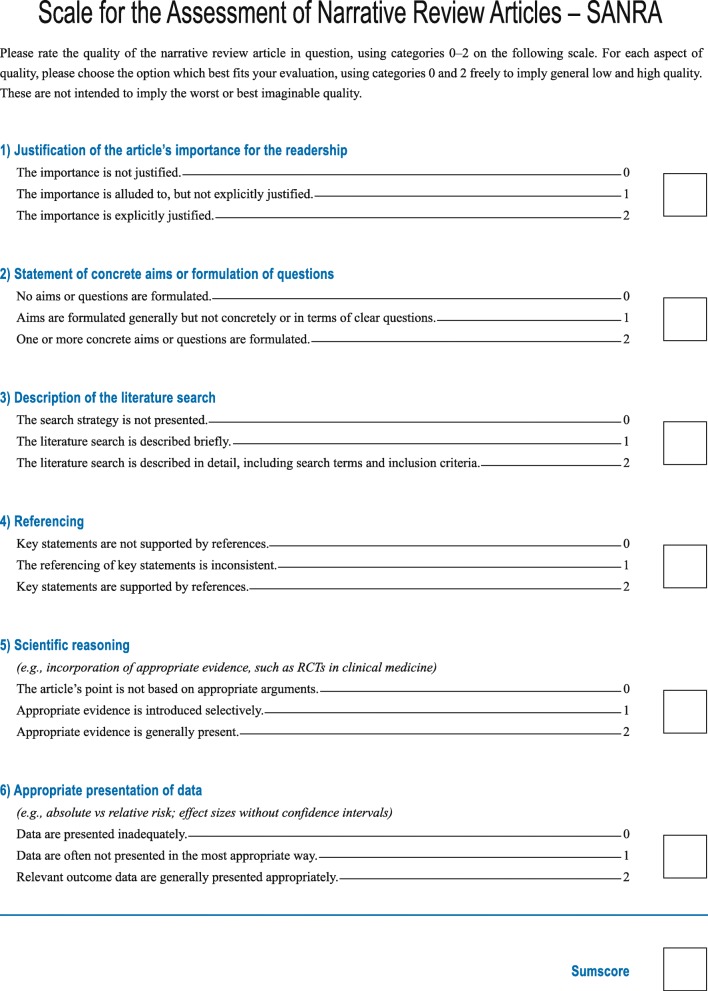
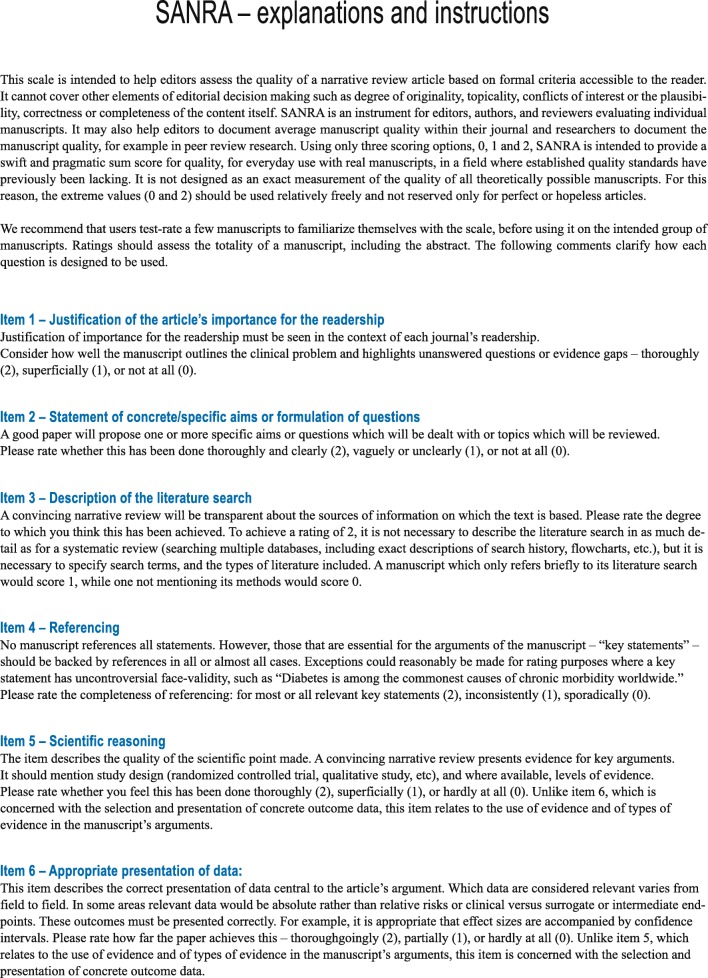
BACKGROUND: Narrative reviews are the commonest type of articles in the medical literature. However, unlike systematic reviews and randomized controlled trials (RCT) articles, for which formal instruments exist to evaluate quality, there is currently no instrument available to assess the quality of narrative reviews. In response to this gap, we developed SANRA, the Scale for the Assessment of Narrative Review Articles. METHODS: A team of three experienced journal editors modified or deleted items in an earlier SANRA version based on face validity, item-total correlations, and reliability scores from previous tests. We deleted an item which addressed a manuscript's writing and accessibility due to poor inter-rater reliability. The six items which form the revised scale are rated from 0 (low standard) to 2 (high standard) and cover the following topics: explanation of (1) the importance and (2) the aims of the review, (3) literature search and (4) referencing and presentation of (5) evidence level and (6) relevant endpoint data. For all items, we developed anchor definitions and examples to guide users in filling out the form. The revised scale was tested by the same editors (blinded to each other's ratings) in a group of 30 consecutive non-systematic review manuscripts submitted to a general medical journal. RESULTS: Raters confirmed that completing the scale is feasible in everyday editorial work. The mean sum score across all 30 manuscripts was 6.0 out of 12 possible points (SD 2.6, range 1-12). Corrected item-total correlations ranged from 0.33 (item 3) to 0.58 (item 6), and Cronbach's alpha was 0.68 (internal consistency). The intra-class correlation coefficient (average measure) was 0.77 [95% CI 0.57, 0.88] (inter-rater reliability). Raters often disagreed on items 1 and 4. CONCLUSIONS: SANRA's feasibility, inter-rater reliability, homogeneity of items, and internal consistency are sufficient for a scale of six items. Further field testing, particularly of validity, is desirable. We recommend rater training based on the "explanations and instructions" document provided with SANRA. In editorial decision-making, SANRA may complement journal-specific evaluation of manuscripts-pertaining to, e.g., audience, originality or difficulty-and may contribute to improving the standard of non-systematic reviews.
Overview
CoChat Summary
TL;DR
SANRA is a six-item, 0–2 scale (maximum 12) for assessing the quality of narrative review articles, developed and field-tested by three journal editors. In 30 consecutive non-systematic review manuscripts, it showed feasible use, sufficient internal consistency and inter-rater reliability, and a modest association with editorial acceptance.
Key findings
- Across 30 manuscripts (90 ratings), the mean SANRA sum score was 6.0 out of 12 (SD 2.6, range 1–12, median 6).
- Internal consistency was Cronbach’s alpha 0.68; corrected item-total correlations ranged from 0.33 (item 3) to 0.58 (item 6).
- Inter-rater reliability was an intra-class correlation coefficient (average measure) of 0.77 [95% CI 0.57, 0.88]; raters often disagreed on items 1 and 4.
- Average SANRA scores were modestly associated with editorial acceptance (mean 6.6, SD 1.9, n = 17) versus rejection (mean 5.1, SD 2.1, n = 13), point biserial correlation 0.37 (t = 2.09, df 28; two-sided p = 0.046).
Methods
- SANRA was developed between 2010 and 2017 by three experienced editors at Deutsches Ärzteblatt; the revised six-item version deleted an item on writing and accessibility due to poor inter-rater reliability.
- The revised scale was tested on 30 consecutive non-systematic review manuscripts submitted to Deutsches Ärzteblatt in 2015; three editor-raters scored them independently and blinded to each other’s ratings.
- Analyses included descriptive statistics, Cronbach’s alpha, corrected item-total correlations, average-measure intra-class correlation using a two-way random effects model (consistency definition), and a post hoc point biserial correlation between SANRA sum scores and acceptance/rejection.
Limitations
- The paper states the main limitation is sample size: 30 manuscripts was a compromise between representativeness, power, and feasibility, and took about 6 months to sample.
- The authors state that the scale’s authors were also the test-raters, so inter-rater reliability may be lower in groups less familiar with SANRA; the study also did not assess test-retest reliability, and results are study-specific.
- The paper acknowledges restricted content validity because SANRA is limited to six items and is a critical appraisal tool rather than a reporting guideline; criterion validity evidence is post hoc and weak, and no established cut-offs exist for comparing manuscripts across settings.
Model-written summary. Check it against the paper before relying on it.
Integrity signals
Registry
Cites
Statistics
Figures
Verification
Claims the paper makes
3 Valid · 0 Not valid · 5 Not checked · 27 Own results and interpretations
The cited sources support only part of this claim — read each source’s verdict below.
In the paper
“Bastian et al. found that they constitute the largest share of all text types in medicine and they concluded that they “remain the staple of medical literature” [1].”
- Also stated in: § Background · plain
“Narrative reviews are the commonest type of articles in the medical literature.”
§ SANRA—a scale for the quality assessment of narrative review articles > Background
What the sources say
- Partly supportedcites [1] Bastian H Glasziou P Chalmers I Seventy-five trials and eleven systematic reviews a day: how will we ever keep up? PLoS Med 2010 7 9 e1000326 10.1371/journal.pmed.1000326 20877712 PMC2943439 sourceExperimental — accuracy not yet measured
In “How Close Are We to Archie Cochrane’s Goal?” and the Summary Points (pages unavailable), the paper calls non-systematic narrative reviews the staple of medical literature synthesis. It does not say they constitute the largest share of all medical text types; that extends a claim about literature synthesis to medical literature as a whole. (LLM, conf=0.88)
plain- Asserted: passes — The authors put it forward as true.
- Checkable: passes — It can be checked against evidence.
- Load-bearing: unclear — It is unclear whether the paper’s conclusions depend on it.
- Based: passes — The paper gives a reason why it holds.
- Also stated in: § Background · plain
The sources with a verdict support this claim; the rest weren’t checked yet, have no full text we could read, or their verdicts aren’t rated yet.
In the paper
“non-systematic reviews or narrative reviews have been widely criticized as unreliable [1, 4].”
§ SANRA—a scale for the quality assessment of narrative review articles > Background
What the sources say
- Supportedcites [1] Bastian H Glasziou P Chalmers I Seventy-five trials and eleven systematic reviews a day: how will we ever keep up? PLoS Med 2010 7 9 e1000326 10.1371/journal.pmed.1000326 20877712 PMC2943439 source
In “How Close Are We to Archie Cochrane’s Goal?”, the paper describes reviews not conducted systematically as having great potential for error and calls them less reliable forms of information. Box 1 also says that articles and textbooks had highlighted the risk of bias and chance in reviews. Together, these passages support the broad characterization that narrative reviews have been criticized as unreliable; page numbers are not provided in our copy. (LLM, conf=0.89)
- Not checked — no full text of the sourcecites [4] Mulrow CD The medical review article: state of the science Ann Intern Med 1987 106 485 488 10.7326/0003-4819-106-3-485 3813259 source
plain- Asserted: passes — The authors put it forward as true.
- Checkable: passes — It can be checked against evidence.
- Load-bearing: passes — The paper’s conclusions depend on it.
- Based: passes — The paper gives a reason why it holds.
- Supported
A result the paper reports from its own data — it cites no other source for it, so there is none to check. The quote shows it is in the paper.
In the paper
“Cronbach’s alpha was 0.68 (internal consistency).”
- Also stated in: § Results · plain
“The scale’s internal consistency, measured as Cronbach’s alpha, was 0.68.”
§ SANRA—a scale for the quality assessment of narrative review articles > Abstract > Results
plainn = 90- Asserted: passes — The authors put it forward as true.
- Checkable: passes — It can be checked against evidence.
- Load-bearing: passes — The paper’s conclusions depend on it.
- Based: passes — The paper gives a reason why it holds.
- Also stated in: § Results · plain
A result the paper reports from its own data — it cites no other source for it, so there is none to check. The quote shows it is in the paper.
In the paper
“Raters often disagreed on items 1 and 4.”
- Also stated in: § Results · plain
“Disagreements most often occurred with regard to items 1 and 4.”
§ SANRA—a scale for the quality assessment of narrative review articles > Abstract > Results
plain- Asserted: passes — The authors put it forward as true.
- Checkable: passes — It can be checked against evidence.
- Load-bearing: unclear — It is unclear whether the paper’s conclusions depend on it.
- Based: passes — The paper gives a reason why it holds.
- Also stated in: § Results · plain
A result the paper reports from its own data — it cites no other source for it, so there is none to check. The quote shows it is in the paper.
In the paper
“The intra-class correlation coefficient (average measure) was 0.77 [95% CI 0.57, 0.88] (inter-rater reliability).”
- Also stated in: § Results · plain
“The intra-class correlation coefficient (average measure) amounted to 0.77 [95% CI 0.57, 0.88; F 4.3; df 29, 58].”
§ SANRA—a scale for the quality assessment of narrative review articles > Abstract > Results
plain- Asserted: passes — The authors put it forward as true.
- Checkable: passes — It can be checked against evidence.
- Load-bearing: passes — The paper’s conclusions depend on it.
- Based: passes — The paper gives a reason why it holds.
- Also stated in: § Results · plain
14 more claims
Create a free account to see all 35 claims and to verify the 3 references still open.
- Probably not a substantial claim. 11
- It may state two separate claims as one. 11
Claims other papers make about this one
Each is checked against this paper’s own text: does it say what the citing paper says it does?
The source backs part of the claim, not all of it — or backs it for a different population, condition or comparison.
In the citing paper
“The review was conducted and reported in accordance with the principles of the Scale for the Assessment of Narrative Review Articles (SANRA), which provides a validated framework for ensuring methodological transparency, scientific rigor, and balanced interpretation in narrative reviews [ 19 ].”
From Paracetamol: A History of Assumptions, Errors, and Evidence Reversals in Pain Management (2026) · cites this paper as [19]
Experimental — accuracy not yet measuredThe source backs part of the claim, not all of it — or backs it for a different population, condition or comparison.
In the citing paper
“As a narrative review, the present work does not include an aggregated quantitative assessment and is more exposed to selection subjectivity than a registered systematic review [124,125].”
From Berberine-Drug Interactions: Mechanisms, Clinical Relevance and Risk Stratification-A Narrative Review (2026) · cites this paper as [124]
Experimental — accuracy not yet measuredThe cited source says what the claim attributes to it.
In the citing paper
“This work is designed as a structured narrative review, with transparent reporting of the documentation strategy, guided by the quality criteria of the Scale for the Assessment of Narrative Review Articles (SANRA) [124].”
From Berberine-Drug Interactions: Mechanisms, Clinical Relevance and Risk Stratification-A Narrative Review (2026) · cites this paper as [124]
The cited source says what the claim attributes to it.
In the citing paper
“we used the following:-Cochrane Risk of Bias 2 (RoB 2) [29] and PEDRO scale tools for RCTs.-AMSTAR 2 [30] checklist for systematic review.-SANRA (Scale for the Assessment of Narrative Review Articles) [31] for narrative reviews.-JBI Checklist for Text and Opinion [32] for expert opinion papers.”
From Pelvic Floor Muscle Training Following Surgery for Pelvic Organ Prolapse: Recommendation from Scientific Literature (2026) · cites this paper as [31]
The cited source says what the claim attributes to it.
In the citing paper
“Data analysis employed a narrative and thematic synthesis methodology,adhering to the SANRA guidelines for narrative reviews (32).”
From Ethical issues in multi-agent AI systems for healthcare: a narrative review (2026) · cites this paper as [32]
12 more claims about this paper
Create a free account to see every claim other papers make about this one.
Citations
Cites
Shea, B. J., Reeves, B. C., Wells, G., Thuku, M., Hamel, C., Moran, J., Moher, D., Tugwell, P., Welch, V., Kristjansson, E., et al. (2017) · BMJ · doi:10.1136/bmj.j4008 · Cited by 10,636 · cited 2×
“Critical appraisal tools have been developed for systematic reviews (e.g., AMSTAR 2 [A MeaSurement Tool to Assess Systematic Reviews] [7]) and papers on RCTs (e.g., the CASP [Critical Appraisal Skills Program] checklist for randomized trials [8]) and other types of medical studies.”
BackgroundStreiner, D. L., & Norman, G. R. (2008) · doi:10.1093/acprof:oso/9780199231881.001.0001 · Cited by 2,631
Critical appraisal skills programme
Singh, J. (2013) · Journal of Pharmacology and Pharmacotherapeutics · doi:10.4103/0976-500x.107697 · Cited by 2,556
Guidelines for Reporting Reliability and Agreement Studies (GRRAS) were proposed
Kottner, J., Audigé, L., Brorson, S., Donner, A., Gajewski, B. J., Hróbjartsson, A., Roberts, C., Shoukri, M., & Streiner, D. L. (2011) · Journal of Clinical Epidemiology · doi:10.1016/j.jclinepi.2010.03.002 · Cited by 2,174
The Mass Production of Redundant, Misleading, and Conflicted Systematic Reviews and Meta‐analyses
IOANNIDIS, J. P. A. (2016) · The Milbank Quarterly · doi:10.1111/1468-0009.12210 · Cited by 1,483 · cited 1×
“While systematic reviews are not per se superior articles and while certain systematic reviews have been criticized lately [3], non-systematic reviews or narrative reviews have”
BackgroundSeventy-five trials and eleven systematic reviews a day: how will we ever keep up?
Bastian, H., Glasziou, P., & Chalmers, I. (2010) · PLoS Medicine · doi:10.1371/journal.pmed.1000326 · Cited by 1,188 · cited 2×
“found that they constitute the largest share of all text types in medicine and they concluded that they “remain the staple of medical literature” [1].”
BackgroundThe Medical Review Article: State of the Science
MULROW, C. D. (1987) · Annals of Internal Medicine · doi:10.7326/0003-4819-106-3-485 · Cited by 856 · cited 1×
“been widely criticized as unreliable [1, 4].”
Writing a narrative biomedical review: considerations for authors, peer reviewers, and editors
Gasparyan, A. Y., Ayvazyan, L., Blackmore, H., & Kitas, G. D. (2011) · Rheumatology International · doi:10.1007/s00296-011-1999-3 · Cited by 694 · cited 1×
“[13], for example, have provided guidance for writing narrative reviews, and Byrne [14] as well as Pautasso [15] has written, from different angles, thoughtful editorials on improving narrative reviews and presented lists of key features of writing a good review—lists that naturally overlap with SANRA items (e.”
BackgroundTen Simple Rules for Writing a Literature Review
Pautasso, M. (2013) · PLoS Computational Biology · doi:10.1371/journal.pcbi.1003149 · Cited by 272 · cited 3×
“[13], for example, have provided guidance for writing narrative reviews, and Byrne [14] as well as Pautasso [15] has written, from different angles, thoughtful editorials on improving narrative reviews and presented lists of key features of writing a good review—lists that naturally overlap with SANRA items (e.”
BackgroundImproving the peer review of narrative literature reviews
Byrne, J. A. (2016) · Research Integrity and Peer Review · doi:10.1186/s41073-016-0019-2 · Cited by 159 · cited 3×
“[13], for example, have provided guidance for writing narrative reviews, and Byrne [14] as well as Pautasso [15] has written, from different angles, thoughtful editorials on improving narrative reviews and presented lists of key features of writing a good review—lists that naturally overlap with SANRA items (e.”
Background
Research works printed but not linked: 3
- Higgins JPT, Green S. (eds.). Cochrane Handbook for Systematic Reviews and Interventions. Version 5.1.0. The Cochrane Collaboration 2011, section 1.2.2., www.handbook.cochrane.org, retrieved on Oct 31, 2018.
- Baethge C Mertens S Goldbeck-Wood S Development of a quality score for the assessment of non-systematic review articles (SANRA) Poster, Seventh International Congress on Peer Review and Biomedical Publication 2013 USA Chicago, Illinois
- Baethge C Goldbeck-Wood S Mertens S A scale for the assessment of non-systematic review articles (SANRA) Poster, Eighth International Congress on Peer and Biomedical Publication 2017 USA Chicago, Illinois
Cited by
Items 2,201–2,300 of 4,334
Statins in the treatment of oral diseases
Suski, P., Bis, E., Tokarczuk, O. D., Siwek, M., & Thum-Tyzo, K. (2025) · Pomeranian Journal of Life Sciences · doi:10.21164/pomjlifesci.1078 · Cited by 1
Jara, D. M. R., Gómez, M. E. D., Silva, C. A. C., Barrios, M. I. H., & Antolinez, V. P. (2024) · Revista colombiana de radiología · doi:10.53903/01212095.332
“Para la búsqueda se utilizaron términos de vocabulario controlado como MeSH y términos libres.”
Tomar, M., Dwivedi, S., & Darwhekar, G. (2025) · Premier Journal of Biomedical Science · doi:10.70389/pjs.100185
Naturopathic approaches to managing patients with chronic pain
Taye, W.-R. (2025) · Cross Connect (Southern Cross University) · doi:10.25918/thesis.540 · Cited by 1
Žafran, M., Žiberna, L., Martelanc, M., & Albreht, A. (2025) · Repository of the University of Ljubljana (University of Ljubljana)
Zali, S. M. I. R. M., Atil, A., Rahim, S. S. S. A., & Taib, N. M. (2025) · Borneo Epidemiology Journal · doi:10.51200/bej.v6i1.6416
Juma, I. Z., Oguntoye, O., Sankar, G., Weber, J., Qureshi, B., & Amanyi-Enegela, J. A. (2025) · Healthcare · doi:10.3390/healthcare14010027 · Cited by 2
“…through initiatives such as the NTD Inclusion Score Card (NISC), which serves as a tool for NTD organisations to assess and enhance their inclusivity practices by identifying gaps and fostering accountability, aiming to improve the effectiveness and relevance of NTD interventions [77,78].”
Política pública basada en evidencias, concepto y dimensiones: revisión de alcance
Machado, J. A. L., Morales, D. I. E., Alvídrez-Labrado, A., & Cárdenas, A. Z. (2025) · Hospital medicine and clinical management · doi:10.24875/hmcm.25000028
Yıldırım, D. İ., & Marakoğlu, K. (2025) · International Journal of Traditional and Complementary Medicine Research · doi:10.53811/ijtcmr.1723790
Dursun, N., & Hoşten, G. (2025) · Sabuncuoglu Serefeddin Health Sciences · doi:10.55895/sshs.1816274
Developing and Validating a Competency Framework for Non-clinical Simulation Operations Specialists
Jagannathan, A., Al-Bayati, R., Clarke, K. M., Micallef, J., Willett, T. G., Wattie, N., & Dubrowski, A. (2025) · Cureus · doi:10.7759/cureus.100408
Letter: Letter to the Editor: Response to Swartz et al.
Heller, L. D. (2025) · Journal of Palliative Medicine · doi:10.1177/10966218251404402
Netto, F. A. C. S., El-Menyar, A. A., Alahmad, M., Al‐Ishaq, F., Kloub, A. G., Afifi, I., Abdelrahman, H., Rizoli, S. B., & Althani, H. (2025) · Panamerican Journal of Trauma Critical Care & Emergency Surgery · doi:10.5005/jp-journals-10030-1501
Vascular Pain: A Narrative Review on Venous Leg Ulcers
Varrassi, G., Leoni, M. L. G., Farì, G., Caruso, A., Al-Alwany, A. A., Tran, Y. V., & Pham, P. V. (2025) · Journal of the Faculty of Medicine Baghdad · doi:10.32007/jfacmedbaghdad3236
Segment Reporting Systematic Review: An ADO-TCM Framework Approach
Matias, R., Vilela, D. R., Castro, G., Penela, D., & Lopes, A. I. (2026) · Lecture notes in networks and systems · doi:10.1007/978-3-032-12888-1_26
Tong, B., Stewart, G. M., Mohammadieh, A. M., Lee, C., & Cistulli, P. A. (2026) · Expert Review of Medical Devices · doi:10.1080/17434440.2025.2612116
“This short review was conducted according to the recommendations on the quality assessment of narrative reviews [33].”
Short foot exercises for flatfoot therapy: Status and prospects
Yang, H., Liu, C., Yao, K., Yang, J., Wang, Y., Sun, C., Li, P., & Dong, H. (2026) · Science Progress · doi:10.1177/00368504251410796
“It is guided by the Scale for the Assessment of Narrative Review Articles (SANRA) 19 to ensure methodological quality and rigor.”
Hodgetts, C. J. (2026) · Murdoch University Research Portal · doi:10.60867/00000043
Azmi, A., Lui, E., Wierenga, F., & Mendis, N. (2026) · University of Toronto Medical Journal · doi:10.33137/utmj.v103i1.46172
ASSOCIAÇÃO ENTRE OBESIDADE E DOENÇAS CARDIOVASCULARES
de Freitas, A. K. M., Peixoto, D. R., Bessa, P. S., Gil, A. W. D. O., & Regis, J. D. F. (2025) · Saúde com · doi:10.22481/rsc.v16i4.18262
Redox-Guided medication review
Martinc, B. (2025) · International Journal of Therapeutic Innovation. · doi:10.55522/ijti.v3i6.0130
Challenges in orthodontic treatment of patients after childhood cancer disease – a literature review
Maciejewska, J., & Racka-Pilszak, B. (2025) · European Journal of Translational and Clinical Medicine · doi:10.31373/ejtcm/208477
“Skeletal system • Bone atrophy [13] • Osteoradionecrosis [13] • Pathological fractures [13] 7.”
InfluentialEl-Mardi, A., Mahdi, T. A. S. A., Ansar, A., & Fahal, A. H. (2026) · Sudan Journal of Medical Sciences · doi:10.18502/sjms.v20i4.18088
“This narrative review was conducted and reported in accordance with the SANRA (Scale for the Assessment of Narrative Review Articles) checklist, a quality assessment tool for non-systematic reviews [10].”
Lazzeroni, M., Lentini, M., Maruca, A., Capaccio, P., Lechien, J. R., Pecorino, B., Chiofalo, B., Scibilia, G., Maira, S., Scollo, P., et al. (2026) · Reproductive Medicine · doi:10.3390/reprodmed7010004
“This narrative review was conducted in accordance with the SANRA (Scale for the Assessment of Narrative Review Articles) guidelines, which provide a structured framework to enhance transparency, methodological rigour, and reproducibility in narrative reviews [13].”
Effectiveness of Myrrh in dentistry, A narrative review
Abdulrida, D. F., & Othman, D. A. (2026) · Journal Port Science Research · doi:10.36371/port.2026.1.5
Muhigwa, A., & Kalenzaga, S. (2026) · Aging and Health Research · doi:10.1016/j.ahr.2026.100300
Assessment of Clinician- and Patient-Reported Outcomes After Mohs Micrographic Surgery
Vetsiou, E., McNeill, C., Matin, R., Abbott, R., & Wernham, A. G. H. (2026) · Dermatologic Surgery · doi:10.1097/dss.0000000000005016
INTERNATIONAL GUIDELINES ON PERIOPERATIVE MANAGEMENT OF GLP-1 RECEPTOR AGONISTS: A NARRATIVE REVIEW
Grela, K., Grygorowicz, A., Baran, K., Ględa, M., Szyszka, M., Radecka, W., Kozak, W., Szreiber, A., Nowacka, K., Jabłoński, K., et al. (2025) · International Journal of Innovative Technologies in Social Science · doi:10.31435/ijitss.4(48).2025.4724
Tarín, J. J., García‐Pérez, M. Á., & Cano, A. (2026) · Reproductive Biology and Endocrinology · doi:10.1186/s12958-025-01515-8
“This narrative non-systematic review was conducted in compliance with the Scale for the Assessment of Narrative Review Articles – SANRA guidelines [25].”
High-risk cutaneous squamous cell carcinoma: a review of current evidence and emerging standards
Petrelli, F., Cin, E. D., Carioli, D., Gasparini, A., Bramati, C., Spada, D., Nardone, M., & Capriotti, V. (2026) · The Journal of Laryngology & Otology · doi:10.1017/s0022215126104332
Barriers to Accessing Vascular Surgery in Northern, Rural, and Remote Canadian Communities
Laor, B., Elrakhawy, K., Poirier, P., Blanchette, V., Pace, R., Ades, M., Anand, S. S., Martin, C., & Drudi, L. M. (2026) · CJC Open · doi:10.1016/j.cjco.2026.01.004
Patty, J. (2026) · Journal of Education Method and Learning Strategy · doi:10.59653/jemls.v4i01.2125 · Cited by 1
“Instead, studies were examined through critical reading, which aligns with narrative reviews' emphasis on interpretation and scholarly judgment over standardized assessment (Baethge et al., 2019; Sukhera, 2022).”
Perez, K. C., Zarovniaeva, V., Anwar, S., Sandhu, S., Kazmi, S., & Mohammed, L. (2026) · Journal For International Medical Graduates · doi:10.56570/jrrtev89
“Narrative reviews were assessed using the SANRA scale [12].”
Soydemir, H., Gauld, C., Desroches, M., Pignon, B., & Depannemaecker, D. (2026) · Dialogues in Clinical Neuroscience · doi:10.1080/19585969.2026.2724875
“this work was conducted in accordance with SAnRA guidelines (Baethge et al. 2019), ensuring transparency in article selection and synthesis.”
Güney, G., Delara, R., Yi, J., Erdemoğlu, E., & Butler, K. A. (2026) · Cancers · doi:10.3390/cancers18030375
“This narrative review was conducted using established principles for high-quality narrative synthesis, with careful attention to transparent study selection, critical appraisal, and balanced interpretation of the available literature in alignment with the SANRA criteria [26].”
Caron-Roy, S., Fournier, B., Kteily-Hawa, R., Sommerfeldt, S., & Mamadzhanov, A. (2025) · Forum qualitative Sozialforschung · doi:10.17169/fqs-27.1.4440
Microbiota oral canina (canis lupus familiaris) y su relación con enfermedades periodontales
Loor, E. M. A., & Mendoza, M. M. G. (2025) · Revista Suplemento CICA Multidisciplinario · doi:10.56124/scicam.v9i20.001
Knechtle, B., Andrade, M. S., Leite, L. B., Forte, P. M., Nikolaidis, P. Τ., Chlíbková, D., Weiss, K., Rosemann, T. J., & Đurić, S. (2026) · Sport Sciences for Health · doi:10.1007/s11332-026-01652-6
“This narrative review was conducted according to structured guidelines to ensure quality and transparency regarding the Scale for the Assessment of Narrative Review Articles (SANRA) [24].”
Suliman, A., & SeedAhmed, L. (2026) · International Journal of Surgery · doi:10.1097/js9.0000000000004356
Oral hygiene and cancer risk: emerging evidence and public health perspectives
Sun, G., Cheng, H., & Yin, M. (2026) · Discover Oncology · doi:10.1007/s12672-026-04527-x
“This study is a SANRA-guided narrative review designed to synthesize epidemiologic evidence, biological mechanisms, and public-health implications linking oral hygiene to cancer risk [8].”
Holistic insights into uncertainty-based modeling approaches for open pit mine planning
Avane, S., Aghdamigargari, M., Anani, A., & Adewuyi, S. O. (2026) · International Journal of Mining Reclamation and Environment · doi:10.1080/17480930.2025.2603319
“The following Quality Assessment (QA) questions served as a reference for the chosen papers’ quality [19]: ● QA 1 .”
Anticipation and prevention of real risks of virtual environments in psychiatry
Marloth, M., DEANE‐DRUMMOND, C. E., Kellmeyer, P., Latoschik, M. E., Chandler, J. A., Meynen, G., & Vogeley, K. T. (2026) · npj Digital Medicine · doi:10.1038/s41746-026-02348-4
“…(2) statement of concrete aims or formulations of questions, (3) description of the literature search, (4) referencing, (5) scienti fi c reasoning, (6) appropriate presentation of data ” 16 We argue that we are ful fi lling these aforementioned basic requirements as requested for a narrative review.”
Evidence syntheses: choosing an approach
Giroux, C. M., Mak, S., Ataman, R., & Thomas, A. (2023) · Wiley eBooks · doi:10.1002/9781394391646.ch8
Private event medical services at major incidents: missed opportunities? Part 2
Clowes, H. C. (2026) · Journal of Paramedic Practice · doi:10.12968/jpar.2025.0056
Are university students prone to fake news? A critical narrative review and explanatory model
Mendoza, K. K. R., Ley, D. D. M., Arteaga, M. A. M., & García, C. R. (2026) · TransAmerica review : · doi:10.62910/transame26001
“Although this was not a systematic review, we applied quality criteria recommended for narrative reviews (clarity of objective, process transparency, coherence of synthesis, and critical use of evidence) using the SANRA scale as an editorial guide (Baethge et al., 2019).”
Hafedh, S. M. B. (2026) · Research Square · doi:10.21203/rs.3.rs-8734323/v1
Medical Educator Portfolios as The Curriculum Vitae of Educationists: A Comprehensive Review
Mohamed, S. (2026) · Health Professions Education · doi:10.55890/2452-3011.1386 · Cited by 1
“Reporting was structured and appraised following the Scale for the Assessment of Narrative Review Articles (SANRA) guidelines [25].”
CLOSTRIDIUM PILIFORME: ANIMAL INFECTION AND ITS POTENTIAL ZOONOTIC RISK
Penha, J. C. Q., Ferreira, C., de Brito, S. G., Abboud, R. D. S., & Cruz, A. (2025) · Enciclopédia Biosfera · doi:10.18677/encibio_2025b4
Pelvic floor dysfunction in women with deep infiltrating endometriosis: from bench to bedside
Iavazzo, N., Molitierno, R., Vinci, D., Ravo, M., Caniglia, F. M., Carotenuto, A., Fatigati, M., Maggiacomo, I., Vitale, C., Narciso, G., et al. (2025) · Italian Journal of Gynaecology and Obstetrics · doi:10.36129/jog.2025.234
Gallardo, C., Alvarez, F., Bruna, M., Alfaro, S., Severino, N., & Kattan, E. (2026) · Nursing in Critical Care · doi:10.1111/nicc.70385
Teodoro, P., Fernandes, R. M., Ribeiro, I., & Ferreira-da-Silva, R. (2026) · Frontiers in Pharmacology · doi:10.3389/fphar.2025.1719963
Janu, J., & Haryani, R. (2025) · Sehat Rakyat Jurnal Kesehatan Masyarakat · doi:10.54259/sehatrakyat.v4i3.5320 · Cited by 1
Delfiani, B. P., Suhartini, Azis, R., Eppang, Y., & Besse Aismaria, A. M. (2026) · Jurnal Pendidikan dan Teknologi Kesehatan · doi:10.56467/jptk.v9i1.553
Sandoval, J. L. F., Villegas, J. R. E., de Guadalajara, U., & Tovar, J. S. (2026) · Journal of Behavior and Feeding · doi:10.32870/jbf.v5i10.112
la Cruz-Concepción, C. S. D. (2025) · Pedagogical Constellation · doi:10.69821/constellations.v4i2.150
Taha, M. A., Mohammed, E. A., & Nori, W. (2026) · The Open Public Health Journal · doi:10.2174/0118749445425571251104012328
The systemic impact of acute exacerbations of COPD requiring hospitalisation: a narrative review
Mills, G., Kibbler, J., Latimer, L. E., McAuley, H., Steer, J., & Greening, N. J. (2026) · ERJ Open Research · doi:10.1183/23120541.01725-2025
“Adverse cardiovascular events and AECOPD A remarkable 28 out of every 100 hospitalisations with AECOPD are followed by an adverse cardiovascular (CV) event [7].”
Bhat, N., Iqbal, M., & Paul, F. A. (2026) · Journal of Religion and Health · doi:10.1007/s10943-026-02588-4
Hammerschmidt‐Snidarich, S. M., & Lee, S. S. (2026) · Educational communications and technology: issues and innovations · doi:10.1007/978-3-032-06823-1_14
Health Governance Review Volume 31, Issue 1
Ibragimova, I. (2026) · International Journal of Health Governance · doi:10.1108/ijhg-03-2026-177
Sacconi, R., Scarinci, F., Grassi, M. O., Covello, G., Giudice, G. L., Siena, E. D., Cacace, V., Gallinaro, V., & dell’Omo, R. (2026) · Ophthalmology and Therapy · doi:10.1007/s40123-026-01324-1
“This narrative review has been written in compliance with the standards recommended for this type of article [32].”
Gonçalves, B., Sime, C., Harkess-Murphy, E., Cund, A., & Lusher, J. M. (2026) · Health & Social Care in the Community · doi:10.1155/hsc/3485242
Blockchain Technology in E Commerce: Enhancing Security and Transparency in Digital Transaction
Srinivas, D., Preeti, C. M., Tirumala, P., Ghodichor, N., Dayalan, P., & Soni, M. (2025) · World Conference on Cutting-Edge Science and Technology (WCCEST) · doi:10.1109/wccest66994.2025.11389873
“Researchers preferred this strategy over a thorough literature review (SLR), which is the best method when the selection requirements and data extraction and synthesis methodologies are well-defined, because of the topic's uniqueness [13].”
Hernández, M. C. P. (2025) · Revista Científica PSIMONART · doi:10.63262/aw8b2r77
Protein Acylation Modifications in Sleep Disorders: Mechanisms and Therapeutic Potential
Lian, X., Li, X., Wang, X., Lu, X., Zhang, M., Ren, L., Yuan, M., Chen, D., Ai, B., & Zhang, H. (2026) · Journal of Molecular Neuroscience · doi:10.1007/s12031-026-02495-z
“The review was conducted in accordance with the SANRA (Scale for the Assessment of Narrative Review Articles) guidelines (Baethge et al. 2019) to ensure methodological rigor and transparency.”
Peri-implantitis as a potential risk factor for peri-implant oral malignancy
Lee, Y., Müstakim, K. R., Eo, M. Y., Cho, Y. J., & Kim, S. M. (2026) · 대한구강악안면외과학회지 · doi:10.5125/jkaoms.2026.52.1.27
“(Table 1) Instead of Preferred Reporting Items for Systematic reviews and Meta-Analyses (PRISMA) and other standard criteria, we applied Scale for the Assessment of Narrative Review Articles (SANRA) for a high-quality review process 7 .”
Lu, G., Tong, W., Zhu, K., Liu, Q., Tan, H., 肖德龙, Pan, J., & Zhang, H. (2026) · Complementary Therapies in Medicine · doi:10.1016/j.ctim.2026.103337
Características de un programa de gestión de riesgos psicosociales en el trabajo
Llantoy, I. H. H. (2025) · Universidad Peruana Cayetano Heredia Institutional Repository
Duarte, J. P. F., de Oliveira, A. A. C., dos Santos, L., SANTOS, F. D. R. P., Meira, S. S., & Roriz, B. C. (2026) · Revista de Medicina · doi:10.11606/issn.1679-9836.v105i1e-240397
Lins, A. D. M. C., Brandão, D. V. D. O., Martins, F. M. S., Silva, A. M., Bomjardim, H. D. A., & Salvarani, F. M. (2026) · Pathogens · doi:10.3390/pathogens15030273
“This work constitutes a structured narrative synthesis guided by transparency principles derived from SANRA [21], but it was not designed as a formal scoping review under PRISMA-ScR methodology [22].”
Development of a Fidelity Instrument for Delivering the Alert Program ® for Self-Regulation
Blackwell, D., Lane, A. E., Philpott‐Robinson, K., & Lane, S. J. (2026) · OTJR Occupational Therapy Journal of Research · doi:10.1177/15394492261422638 · Cited by 1
Banerjee, S., & Semenenko, E. (2023) · GLOBAL JOURNAL OF MEDICAL STUDENTS · doi:10.25259/gjms.2023.3.1.18
Artos, E. E. B., Loor, C. A. C., Pérez, J. M. M., Velasco, B. M., & Brito, E. J. F. (2026) · Andes pediatrica · doi:10.32641/andespediatr.v97i2.5861
Raising Concern of Substance Abuse among Adolescents in India: A Narrative Review
Vrinda Sankar, K. (2024) · doi:10.26634/djhm.1.1.20224
Nishibe, T., Kano, M., Fukuda, S., Koizumi, J., Nishibe, M., & Dardik, A. (2026) · Annals of Vascular Surgery · doi:10.1016/j.avsg.2026.02.051
di Visconte, M. S., Sarnari, S., Monaco, D. L., Brillantino, A., Marano, L., Talento, P., & Guttadauro, A. (2026) · Frontiers in Surgery · doi:10.3389/fsurg.2026.1771037
Survase, M. R., & Parida, D. (2026) · International Ayurvedic Medical Journal · doi:10.46607/iamj3314022026
Banfi, P., DIMABUYU-FRANCISCO, M., Nicolini, A., Compalati, E., Lax, A., Volpato, E., Garuti, G., LEONARDI, G., Bach, & Solidoro, P. (2026) · Panminerva Medica · doi:10.23736/s0031-0808.26.05313-9
Krupa, P., & Pántya, P. (2026) · Applied Sciences · doi:10.3390/app16062733
Giudice, A. L., Malgioglio, A., Maniaci, A., Mantia, I. L., Bianchi, A., & Cocuzza, S. G. (2026) · Diagnostics · doi:10.3390/diagnostics16060843
Stanimirova, D., Petrova, G. I., & Mitkova, Z. E. (2026) · Pharmacy · doi:10.3390/pharmacy14020047 · Cited by 3
“Narrative reviews were assessed with the SANRA checklist for reporting quality [13] and were not evaluated for risk of bias.”
Perfluorohexyloctane ophthalmic solution for the treatment of dry eye disease: a narrative review
Cavet, M. E., Vittitow, J. L., & Borchman, D. (2026) · Expert Review of Ophthalmology · doi:10.1080/17469899.2026.2639461
Relationship Between the Level of Physical Performance and the Rate of Biological Ageing (Review)
Сверчков, В. В., & Быков, Е. В. (2026) · Journal of Medical and Biological Research · doi:10.37482/2687-1491-z278
Javier, M.-C. E., Marina, C.-A. L., & Juliana, M.-C. S. (2026) · Journal of Hunger & Environmental Nutrition · doi:10.1080/19320248.2026.2635390
Afeto, Ciência e Sociedade: Uma Revisão Narrativa sobre a Neurobiologia do Amor Romântico
Félix, G. D. S., Longatto, L., Silva, O. A., de Freitas, R. L., & Medeiros, P. (2026) · Cadernos de Psicologia · doi:10.9788/cp2026.1-01
Ayesha, A. D., Ahlan, A. R., & Ibrahim, N. M. (2026) · International Journal of Research and Innovation in Applied Science · doi:10.51584/ijrias.2026.110200065
Забокова-Билбилова, Е. (2025) · Directory of Open access Books (OAPEN Foundation)
Approaches to Occipital Neuralgia Treatment: A Systematic Review and Case Examples
Nguyen, A. T., Galiano, R. D., & Ellis, M. F. (2026) · Plastic & Reconstructive Surgery Global Open · doi:10.1097/gox.0000000000007551
Management of Propofol Infusion Pain: An Easy Task for Anesthetists
Ismail, M. I. A., Al-Husinat, L., Mar'ey, O., Obeidat, A., Bakkar, A., Manasrah, Q., & Ismail, I. M. I. (2026) · Anesthesiology Research and Practice · doi:10.1155/anrp/9950452
Nursing-Led Interventions to Enhance Post-Bariatric Quality of Life: A Literature Review
Garcia, J. F. J. L., Sorrenti, A., Carioni, C., Neglia, M., & Accardi, R. (2026) · Interdisciplinary Journal of Nursing and Health · doi:10.82051/ijnh-2026-260
Literature Discovery and Synthesis With AI: Narrative, Scoping, and Systematic Reviews
(2026) · Advances in computational intelligence and robotics book series · doi:10.4018/979-8-3373-9340-7.ch003
Cardiotoxicity Challenges in Nanomaterial: Risk Assessment, Mechanisms, and Mitigation Strategies
Li, Z., Liu, L., Zhang, P., Wen, Z., Jia, Y., & Liao, X. (2026) · International Journal of Nanomedicine · doi:10.2147/ijn.s595349 · Cited by 2
“26 While this review follows a narrative synthesis approach, we employed a systematic and transparent literature search and screening process to enhance methodological rigor, minimize selection bias, and ensure reproducibility.”
Neuraxial ultrasound training for nurse anesthesia residents
Salwen, R., Dahan, N., & Specht, D. M. (2026) · iDEA - Drexel University Institutional Repository · doi:10.17918/00011292
Elbow Varus posteromedial rotatory instability: Reflections from a multidimensional perspective
Han, S., Dong, P., Zhao, J., Liu, Y., Yin, Y., & Yu, B. (2026) · Science Progress · doi:10.1177/00368504261436105
“5 Relevant English literature was retrieved using databases such as PubMed and Web of Science, with a search strategy that combined terms related to VPMRI and keywords associated with coronoid process fractures as well as medial and lateral collateral ligaments.”
Drones and Africa’s Health Challenges: A Narrative Review
Moletsane, R. I. (2026) · Procedia Computer Science · doi:10.1016/j.procs.2026.03.097
Yadav, A., Mahajon, B., Galib, R., & Ravishankar, B. (2026) · International Journal of Ayurveda Research · doi:10.4103/ijar.ijar_390_25
Metadata
- Authors
- Baethge, C., Goldbeck-Wood, S., & Mertens, S.
- Affiliations
- University of Cologne (DE)
- BMJ Group (United Kingdom) (GB)
- Corresponding author
- Baethge, Christopher
- ORCID
- Baethge, Christopher
- Venue
- Research Integrity and Peer Review
- Published
- 2019-03-26
- Volume
- 4
- Issue
- 1
- Pages
- 5-5
- ISSN
- 2058-8615 (ISSN-L)
- PMC
- PMC6434870
- OpenAlex
- W2922577842
- Semantic Scholar
- ea7f35b3069b53791c3b746c5c4b3c72a83a526b
- Cited by
- 3,469
- References
- 13
- Citations by year
- 2026: 1823 · 2025: 551 · 2024: 379 · 2023: 309 · 2022: 218 · 2021: 152 · 2020: 32 · 2019: 4
- FWCI
- 20.57
- Type
- journal article
- Language
- en
- Open access
- gold
- doi.org
- Licence
- cc-by
- creativecommons.org/licenses/by/4.0/ (tdm)
- Locations
- Research Integrity and Peer Review (publishedVersion, cc-by)
- Europe PMC (PubMed Central) (publishedVersion, other-oa)
- PubMed Central (publishedVersion, cc-by)
- PubMed (publishedVersion)
- Kölner Universitäts PublikationsServer (Universität zu Köln) (publishedVersion)
- DOAJ (DOAJ: Directory of Open Access Journals) (submittedVersion, cc-by-sa)
- Topics
- Social Sciences › Decision Sciences › Statistics, Probability and Uncertainty › Meta-analysis and systematic reviews
- Social Sciences › Library and Information Sciences › Academic Writing and Publishing
- Social Sciences › Library and Information Sciences › scientometrics and bibliometrics research
- Keywords
- quality assessment scale, manuscript review, inter-rater reliability, level of evidence, scale development
About these checks
Registry, retraction, Cites and statistics results are computed, not judged, with one exception: a printed reference that no index lists is read once by a model before it counts as a citation error. Claims are extracted by a model and kept only when their quote appears verbatim in the text; each cited source is then checked, with a model’s help, for whether it says what the claim relies on. Those verdicts can be wrong — read the claim’s quote and the cited source before relying on one.
The claim verdicts this report counts are experimental: their accuracy is not yet measured.
A language model drew the claims from the paper on 2026-11-10, under version 3 of the claim definition (model deepseek-v4.1-flash, prompt extract-v3).
A second model labelled each claim on 2026-11-10 (model jev-1.13-20260917, definition revision gold-guideline-v0.2).
Cited sources are checked with a language model’s help (gpt-6-sol).
Statistics and arithmetic are recomputed, not judged.
Confidence bands are shown only for fields calibrated on our annotated test set. None is calibrated yet, so no band is shown.
What counts as a claim ›How we measure confidence ›How we check this ›
Are you an author, or do you see a problem with this page? Request a review
Data sources
Bibliographic data: Semantic Scholar, OpenAlex, Crossref.
Contains information from the Semantic Scholar Academic Graph Datasets, made available under the ODC Attribution License (ODC-BY 1.0).
Semantic Scholar’s data is described in: Kinney, R., et al. (2023). The Semantic Scholar Open Data Platform. arXiv:2301.10140.
