

SANRA—a scale for the quality assessment of narrative review articles
Open accessThe DOI matches its Crossref record; 12 of the 13 references it cites were found in a registry or an index; 4 of the 12 sources its claims cite were checked for support.
Abstract
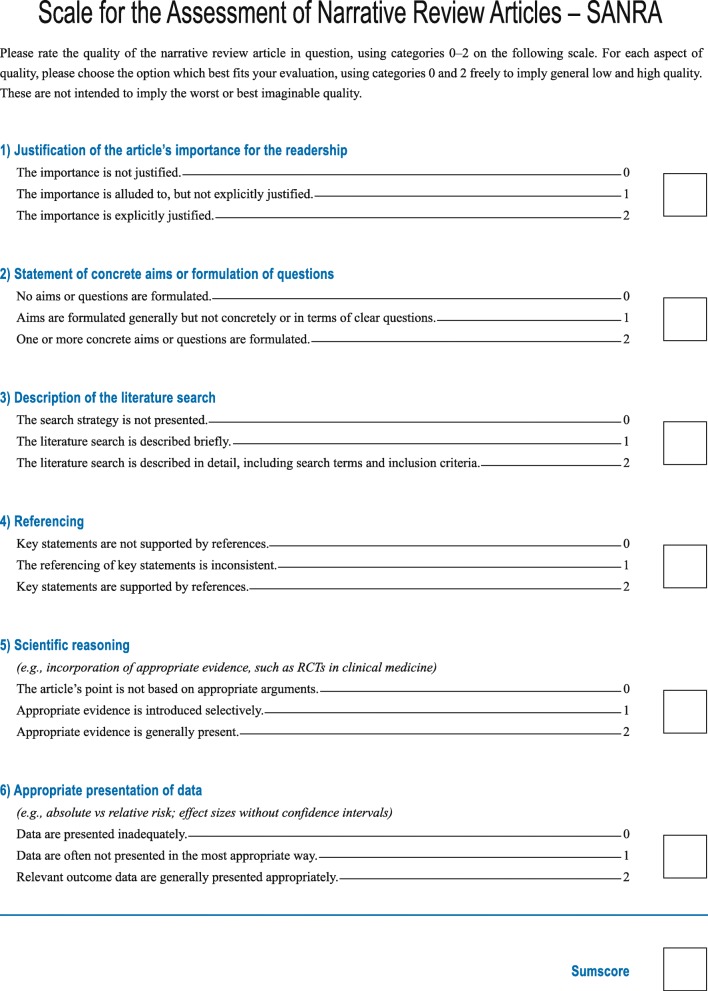
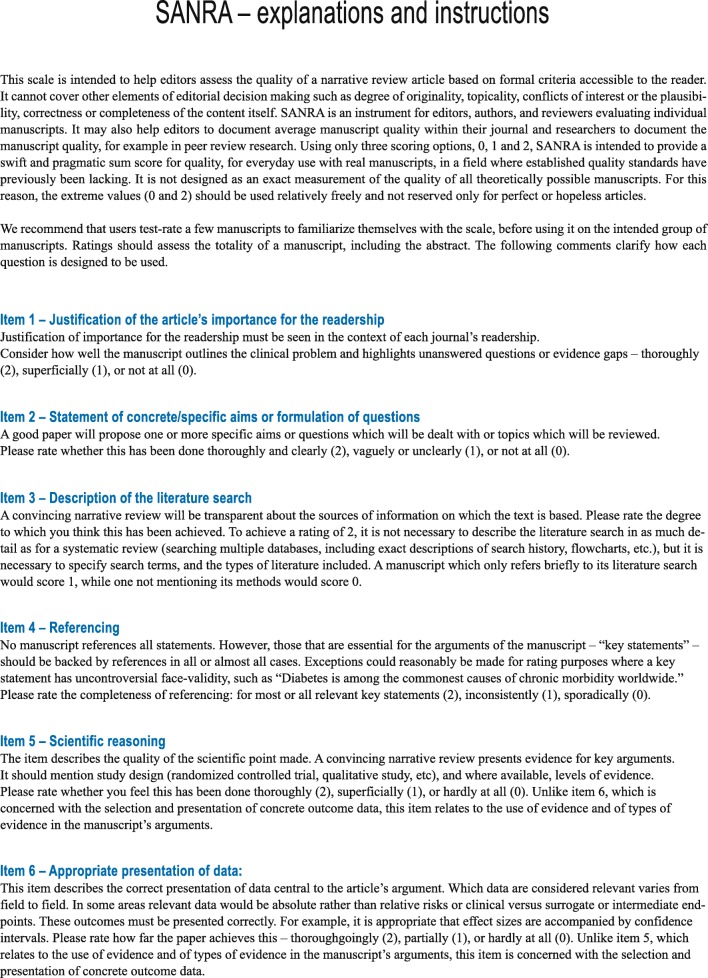
BACKGROUND: Narrative reviews are the commonest type of articles in the medical literature. However, unlike systematic reviews and randomized controlled trials (RCT) articles, for which formal instruments exist to evaluate quality, there is currently no instrument available to assess the quality of narrative reviews. In response to this gap, we developed SANRA, the Scale for the Assessment of Narrative Review Articles. METHODS: A team of three experienced journal editors modified or deleted items in an earlier SANRA version based on face validity, item-total correlations, and reliability scores from previous tests. We deleted an item which addressed a manuscript's writing and accessibility due to poor inter-rater reliability. The six items which form the revised scale are rated from 0 (low standard) to 2 (high standard) and cover the following topics: explanation of (1) the importance and (2) the aims of the review, (3) literature search and (4) referencing and presentation of (5) evidence level and (6) relevant endpoint data. For all items, we developed anchor definitions and examples to guide users in filling out the form. The revised scale was tested by the same editors (blinded to each other's ratings) in a group of 30 consecutive non-systematic review manuscripts submitted to a general medical journal. RESULTS: Raters confirmed that completing the scale is feasible in everyday editorial work. The mean sum score across all 30 manuscripts was 6.0 out of 12 possible points (SD 2.6, range 1-12). Corrected item-total correlations ranged from 0.33 (item 3) to 0.58 (item 6), and Cronbach's alpha was 0.68 (internal consistency). The intra-class correlation coefficient (average measure) was 0.77 [95% CI 0.57, 0.88] (inter-rater reliability). Raters often disagreed on items 1 and 4. CONCLUSIONS: SANRA's feasibility, inter-rater reliability, homogeneity of items, and internal consistency are sufficient for a scale of six items. Further field testing, particularly of validity, is desirable. We recommend rater training based on the "explanations and instructions" document provided with SANRA. In editorial decision-making, SANRA may complement journal-specific evaluation of manuscripts-pertaining to, e.g., audience, originality or difficulty-and may contribute to improving the standard of non-systematic reviews.
Overview
CoChat Summary
TL;DR
SANRA is a six-item, 0–2 scale (maximum 12) for assessing the quality of narrative review articles, developed and field-tested by three journal editors. In 30 consecutive non-systematic review manuscripts, it showed feasible use, sufficient internal consistency and inter-rater reliability, and a modest association with editorial acceptance.
Key findings
- Across 30 manuscripts (90 ratings), the mean SANRA sum score was 6.0 out of 12 (SD 2.6, range 1–12, median 6).
- Internal consistency was Cronbach’s alpha 0.68; corrected item-total correlations ranged from 0.33 (item 3) to 0.58 (item 6).
- Inter-rater reliability was an intra-class correlation coefficient (average measure) of 0.77 [95% CI 0.57, 0.88]; raters often disagreed on items 1 and 4.
- Average SANRA scores were modestly associated with editorial acceptance (mean 6.6, SD 1.9, n = 17) versus rejection (mean 5.1, SD 2.1, n = 13), point biserial correlation 0.37 (t = 2.09, df 28; two-sided p = 0.046).
Methods
- SANRA was developed between 2010 and 2017 by three experienced editors at Deutsches Ärzteblatt; the revised six-item version deleted an item on writing and accessibility due to poor inter-rater reliability.
- The revised scale was tested on 30 consecutive non-systematic review manuscripts submitted to Deutsches Ärzteblatt in 2015; three editor-raters scored them independently and blinded to each other’s ratings.
- Analyses included descriptive statistics, Cronbach’s alpha, corrected item-total correlations, average-measure intra-class correlation using a two-way random effects model (consistency definition), and a post hoc point biserial correlation between SANRA sum scores and acceptance/rejection.
Limitations
- The paper states the main limitation is sample size: 30 manuscripts was a compromise between representativeness, power, and feasibility, and took about 6 months to sample.
- The authors state that the scale’s authors were also the test-raters, so inter-rater reliability may be lower in groups less familiar with SANRA; the study also did not assess test-retest reliability, and results are study-specific.
- The paper acknowledges restricted content validity because SANRA is limited to six items and is a critical appraisal tool rather than a reporting guideline; criterion validity evidence is post hoc and weak, and no established cut-offs exist for comparing manuscripts across settings.
Model-written summary. Check it against the paper before relying on it.
Integrity signals
Registry
Cites
Statistics
Figures
Verification
Claims the paper makes
3 Valid · 0 Not valid · 5 Not checked · 27 Own results and interpretations
The cited sources support only part of this claim — read each source’s verdict below.
In the paper
“Bastian et al. found that they constitute the largest share of all text types in medicine and they concluded that they “remain the staple of medical literature” [1].”
- Also stated in: § Background · plain
“Narrative reviews are the commonest type of articles in the medical literature.”
§ SANRA—a scale for the quality assessment of narrative review articles > Background
What the sources say
- Partly supportedcites [1] Bastian H Glasziou P Chalmers I Seventy-five trials and eleven systematic reviews a day: how will we ever keep up? PLoS Med 2010 7 9 e1000326 10.1371/journal.pmed.1000326 20877712 PMC2943439 sourceExperimental — accuracy not yet measured
In “How Close Are We to Archie Cochrane’s Goal?” and the Summary Points (pages unavailable), the paper calls non-systematic narrative reviews the staple of medical literature synthesis. It does not say they constitute the largest share of all medical text types; that extends a claim about literature synthesis to medical literature as a whole. (LLM, conf=0.88)
plain- Asserted: passes — The authors put it forward as true.
- Checkable: passes — It can be checked against evidence.
- Load-bearing: unclear — It is unclear whether the paper’s conclusions depend on it.
- Based: passes — The paper gives a reason why it holds.
- Also stated in: § Background · plain
The sources with a verdict support this claim; the rest weren’t checked yet, have no full text we could read, or their verdicts aren’t rated yet.
In the paper
“non-systematic reviews or narrative reviews have been widely criticized as unreliable [1, 4].”
§ SANRA—a scale for the quality assessment of narrative review articles > Background
What the sources say
- Supportedcites [1] Bastian H Glasziou P Chalmers I Seventy-five trials and eleven systematic reviews a day: how will we ever keep up? PLoS Med 2010 7 9 e1000326 10.1371/journal.pmed.1000326 20877712 PMC2943439 source
In “How Close Are We to Archie Cochrane’s Goal?”, the paper describes reviews not conducted systematically as having great potential for error and calls them less reliable forms of information. Box 1 also says that articles and textbooks had highlighted the risk of bias and chance in reviews. Together, these passages support the broad characterization that narrative reviews have been criticized as unreliable; page numbers are not provided in our copy. (LLM, conf=0.89)
- Not checked — no full text of the sourcecites [4] Mulrow CD The medical review article: state of the science Ann Intern Med 1987 106 485 488 10.7326/0003-4819-106-3-485 3813259 source
plain- Asserted: passes — The authors put it forward as true.
- Checkable: passes — It can be checked against evidence.
- Load-bearing: passes — The paper’s conclusions depend on it.
- Based: passes — The paper gives a reason why it holds.
- Supported
A result the paper reports from its own data — it cites no other source for it, so there is none to check. The quote shows it is in the paper.
In the paper
“Cronbach’s alpha was 0.68 (internal consistency).”
- Also stated in: § Results · plain
“The scale’s internal consistency, measured as Cronbach’s alpha, was 0.68.”
§ SANRA—a scale for the quality assessment of narrative review articles > Abstract > Results
plainn = 90- Asserted: passes — The authors put it forward as true.
- Checkable: passes — It can be checked against evidence.
- Load-bearing: passes — The paper’s conclusions depend on it.
- Based: passes — The paper gives a reason why it holds.
- Also stated in: § Results · plain
A result the paper reports from its own data — it cites no other source for it, so there is none to check. The quote shows it is in the paper.
In the paper
“Raters often disagreed on items 1 and 4.”
- Also stated in: § Results · plain
“Disagreements most often occurred with regard to items 1 and 4.”
§ SANRA—a scale for the quality assessment of narrative review articles > Abstract > Results
plain- Asserted: passes — The authors put it forward as true.
- Checkable: passes — It can be checked against evidence.
- Load-bearing: unclear — It is unclear whether the paper’s conclusions depend on it.
- Based: passes — The paper gives a reason why it holds.
- Also stated in: § Results · plain
A result the paper reports from its own data — it cites no other source for it, so there is none to check. The quote shows it is in the paper.
In the paper
“The intra-class correlation coefficient (average measure) was 0.77 [95% CI 0.57, 0.88] (inter-rater reliability).”
- Also stated in: § Results · plain
“The intra-class correlation coefficient (average measure) amounted to 0.77 [95% CI 0.57, 0.88; F 4.3; df 29, 58].”
§ SANRA—a scale for the quality assessment of narrative review articles > Abstract > Results
plain- Asserted: passes — The authors put it forward as true.
- Checkable: passes — It can be checked against evidence.
- Load-bearing: passes — The paper’s conclusions depend on it.
- Based: passes — The paper gives a reason why it holds.
- Also stated in: § Results · plain
14 more claims
Create a free account to see all 35 claims and to verify the 3 references still open.
- Probably not a substantial claim. 11
- It may state two separate claims as one. 11
Claims other papers make about this one
Each is checked against this paper’s own text: does it say what the citing paper says it does?
The source backs part of the claim, not all of it — or backs it for a different population, condition or comparison.
In the citing paper
“The review was conducted and reported in accordance with the principles of the Scale for the Assessment of Narrative Review Articles (SANRA), which provides a validated framework for ensuring methodological transparency, scientific rigor, and balanced interpretation in narrative reviews [ 19 ].”
From Paracetamol: A History of Assumptions, Errors, and Evidence Reversals in Pain Management (2026) · cites this paper as [19]
Experimental — accuracy not yet measuredThe source backs part of the claim, not all of it — or backs it for a different population, condition or comparison.
In the citing paper
“As a narrative review, the present work does not include an aggregated quantitative assessment and is more exposed to selection subjectivity than a registered systematic review [124,125].”
From Berberine-Drug Interactions: Mechanisms, Clinical Relevance and Risk Stratification-A Narrative Review (2026) · cites this paper as [124]
Experimental — accuracy not yet measuredThe cited source says what the claim attributes to it.
In the citing paper
“This work is designed as a structured narrative review, with transparent reporting of the documentation strategy, guided by the quality criteria of the Scale for the Assessment of Narrative Review Articles (SANRA) [124].”
From Berberine-Drug Interactions: Mechanisms, Clinical Relevance and Risk Stratification-A Narrative Review (2026) · cites this paper as [124]
The cited source says what the claim attributes to it.
In the citing paper
“we used the following:-Cochrane Risk of Bias 2 (RoB 2) [29] and PEDRO scale tools for RCTs.-AMSTAR 2 [30] checklist for systematic review.-SANRA (Scale for the Assessment of Narrative Review Articles) [31] for narrative reviews.-JBI Checklist for Text and Opinion [32] for expert opinion papers.”
From Pelvic Floor Muscle Training Following Surgery for Pelvic Organ Prolapse: Recommendation from Scientific Literature (2026) · cites this paper as [31]
The cited source says what the claim attributes to it.
In the citing paper
“Data analysis employed a narrative and thematic synthesis methodology,adhering to the SANRA guidelines for narrative reviews (32).”
From Ethical issues in multi-agent AI systems for healthcare: a narrative review (2026) · cites this paper as [32]
12 more claims about this paper
Create a free account to see every claim other papers make about this one.
Citations
Cites
Shea, B. J., Reeves, B. C., Wells, G., Thuku, M., Hamel, C., Moran, J., Moher, D., Tugwell, P., Welch, V., Kristjansson, E., et al. (2017) · BMJ · doi:10.1136/bmj.j4008 · Cited by 10,636 · cited 2×
“Critical appraisal tools have been developed for systematic reviews (e.g., AMSTAR 2 [A MeaSurement Tool to Assess Systematic Reviews] [7]) and papers on RCTs (e.g., the CASP [Critical Appraisal Skills Program] checklist for randomized trials [8]) and other types of medical studies.”
BackgroundStreiner, D. L., & Norman, G. R. (2008) · doi:10.1093/acprof:oso/9780199231881.001.0001 · Cited by 2,631
Critical appraisal skills programme
Singh, J. (2013) · Journal of Pharmacology and Pharmacotherapeutics · doi:10.4103/0976-500x.107697 · Cited by 2,556
Guidelines for Reporting Reliability and Agreement Studies (GRRAS) were proposed
Kottner, J., Audigé, L., Brorson, S., Donner, A., Gajewski, B. J., Hróbjartsson, A., Roberts, C., Shoukri, M., & Streiner, D. L. (2011) · Journal of Clinical Epidemiology · doi:10.1016/j.jclinepi.2010.03.002 · Cited by 2,174
The Mass Production of Redundant, Misleading, and Conflicted Systematic Reviews and Meta‐analyses
IOANNIDIS, J. P. A. (2016) · The Milbank Quarterly · doi:10.1111/1468-0009.12210 · Cited by 1,483 · cited 1×
“While systematic reviews are not per se superior articles and while certain systematic reviews have been criticized lately [3], non-systematic reviews or narrative reviews have”
BackgroundSeventy-five trials and eleven systematic reviews a day: how will we ever keep up?
Bastian, H., Glasziou, P., & Chalmers, I. (2010) · PLoS Medicine · doi:10.1371/journal.pmed.1000326 · Cited by 1,188 · cited 2×
“found that they constitute the largest share of all text types in medicine and they concluded that they “remain the staple of medical literature” [1].”
BackgroundThe Medical Review Article: State of the Science
MULROW, C. D. (1987) · Annals of Internal Medicine · doi:10.7326/0003-4819-106-3-485 · Cited by 856 · cited 1×
“been widely criticized as unreliable [1, 4].”
Writing a narrative biomedical review: considerations for authors, peer reviewers, and editors
Gasparyan, A. Y., Ayvazyan, L., Blackmore, H., & Kitas, G. D. (2011) · Rheumatology International · doi:10.1007/s00296-011-1999-3 · Cited by 694 · cited 1×
“[13], for example, have provided guidance for writing narrative reviews, and Byrne [14] as well as Pautasso [15] has written, from different angles, thoughtful editorials on improving narrative reviews and presented lists of key features of writing a good review—lists that naturally overlap with SANRA items (e.”
BackgroundTen Simple Rules for Writing a Literature Review
Pautasso, M. (2013) · PLoS Computational Biology · doi:10.1371/journal.pcbi.1003149 · Cited by 272 · cited 3×
“[13], for example, have provided guidance for writing narrative reviews, and Byrne [14] as well as Pautasso [15] has written, from different angles, thoughtful editorials on improving narrative reviews and presented lists of key features of writing a good review—lists that naturally overlap with SANRA items (e.”
BackgroundImproving the peer review of narrative literature reviews
Byrne, J. A. (2016) · Research Integrity and Peer Review · doi:10.1186/s41073-016-0019-2 · Cited by 159 · cited 3×
“[13], for example, have provided guidance for writing narrative reviews, and Byrne [14] as well as Pautasso [15] has written, from different angles, thoughtful editorials on improving narrative reviews and presented lists of key features of writing a good review—lists that naturally overlap with SANRA items (e.”
Background
Research works printed but not linked: 3
- Higgins JPT, Green S. (eds.). Cochrane Handbook for Systematic Reviews and Interventions. Version 5.1.0. The Cochrane Collaboration 2011, section 1.2.2., www.handbook.cochrane.org, retrieved on Oct 31, 2018.
- Baethge C Mertens S Goldbeck-Wood S Development of a quality score for the assessment of non-systematic review articles (SANRA) Poster, Seventh International Congress on Peer Review and Biomedical Publication 2013 USA Chicago, Illinois
- Baethge C Goldbeck-Wood S Mertens S A scale for the assessment of non-systematic review articles (SANRA) Poster, Eighth International Congress on Peer and Biomedical Publication 2017 USA Chicago, Illinois
Cited by
Items 2,601–2,700 of 4,334
Bagheri, K., Reid, A., Daley, D. N., Eriksson, E. A., Kolski, M. C., & Sherrier, M. C. (2026) · Journal of International Medical Research · doi:10.1177/03000605261466001
“35 This narrative review addresses current gaps by summarizing abdominal wall anatomy and function, the sequelae of ICN injury, and neurorehabilitation principles relevant to recovery.”
Зыкина, С. А., Turizhanova, А. К., Salpagarov, I. R., Polyakova, D. A., Temiev, A. A., Goyal, К., Нигматуллина, К. Р., Kolesova, F. I., Chotchaeva, А. D., Permyakova, А. R., et al. (2026) · FARMAKOEKONOMIKA Modern Pharmacoeconomics and Pharmacoepidemiology · doi:10.17749/2070-4909/farmakoekonomika.2026.383
Pediatric Psoriasis: Comorbidities, Treatment Challenges and Unmet Needs
Hernández-Santacana, M., Balado-Simó, P., Mansilla‐Polo, M., & Riera‐Monroig, J. (2026) · Dermatology and Therapy · doi:10.1007/s13555-026-01846-3
“The review was conducted in accord‑ ance with the recommendations of the Scale for the Assessment of Narrative Review Articles (SANRA) [13].”
Reytor-González, C., Campuzano-Donoso, M., Aguirre-Munizaga, M., Oentiono, O. Y., Jiménez, Montalván, M., & Simancas‐Racines, D. (2026) · Frontiers in Public Health · doi:10.3389/fpubh.2026.1847218
“The reporting of this narrative review was informed by general principles for transparent narrative reviews, including clear justification of scope, search approach, referencing, and synthesis (21).”
Jourani, S., Ayral, P.-A., Vignal, M., & Josselin, D. (2026) · Journal of Hydrology Regional Studies · doi:10.1016/j.ejrh.2026.103715 · Cited by 2
Atoui, Z., Fakhri, A., Malhotra, A., & Tang, Y. (2026) · Journal of Addictive Diseases · doi:10.1080/10550887.2026.2695127
Lim, E., Cheng, N. C. L., & Lim, C. E. D. (2026) · Infectious Disease Reports · doi:10.3390/idr18040069
Zeinali, P., & Zeinali, N. (2026) · Research Square · doi:10.21203/rs.3.rs-10248376/v1
Kumagai, Y., Kudo, N., Suda, T., Narita, Y., & Yoshioka, M. (2026) · Psychiatry International · doi:10.3390/psychiatryint7040149
Netto, F. A. C. S., El-Menyar, A. A., Alahmad, M., Al‐Ishaq, F., Kloub, A. G., Afif, I. N. I., Abdelrahman, H., Rizoli, S. B., & Al-Thani, H. A. S. (2026) · Journal of emergency medicine, trauma & acute care · doi:10.5339/jemtac.2026.31
Bioética clínica para médicos del sector rural colombiano
Ovalle, J. L. V. (2025) · Revista Colombiana de Bioética · doi:10.18270/rcb.5035
Mallilah, B. P., Thobias, N. R., Naisikye, K. M., Mmanda, C. L., & Mselle, G. (2026) · Journal of Medical Imaging and Interventional Radiology · doi:10.1007/s44326-026-00109-x
McKnight, G., Spreadborough, P. J., Sharrock, A. E., Stansfield, T. J., O’Reilly, D. J., Tai, N. R. M., Stannard, A., Bowley, D. M., & Naumann, D. N. (2026) · BMJ Military Health · doi:10.1136/military-2026-003281
Ariffin, A., Farouk, A. F. A., & Ismail, I. (2026) · International Journal of Research and Innovation in Social Science · doi:10.47772/ijriss.2026.100600905
El Plomo y la Salud Mental en Estudiantes Universitarios de Arte: Una Revisión Bibliográfica
Licona, M. E. V., Mora, M. H. Y., & Quispe, Y. C. Q. (2026) · Innovación Integral · doi:10.70577/x5pyq510
Zaidi, A. R. Z., Elhassan, H., Syed, A. M., Waseem, N., Muhammed, A., Fida, L., Fathima, S., Taha, I., Tannous, G., Irshad, S., et al. (2026) · Frontiers in Psychiatry · doi:10.3389/fpsyt.2026.1846370
Pinnelli, V. B. K., Surendra Babu, T., Jayashankar, C. A., Kandi, V., Madhu, M. T., Sam, K. T., Manish, G. R., Divyadharshini, M. S., Sucharitha, A. S., Bhupathiraju, P., et al. (2026) · Cureus · doi:10.7759/cureus.112246 · Cited by 2
Contemporary extracorporeal cardiopulmonary resuscitation programs for cardiac arrest
Bugo, S., Bottussi, A., Ursoleo, J. D., Antonini, M. V., Cordella, E., Aprile, M., Garcia, S. I., Elmadhoun, O., Wieruszewski, E. D., Swol, J., et al. (2026) · Frontiers in Cardiovascular Medicine · doi:10.3389/fcvm.2026.1761019
“This review followed the Scale for the Assessment of Narrative Review Articles (SANRA) (20) and applied the SPIDER (Sample, Phenomenon of Interest, Design, Evaluation, and Research type) framework (21) to formulate the research question: what are the characteristics of contemporary ECPR programs, including selection c…”
Effects of Prediabetes on Bone Metabolism and Healing in Orthognathic Surgery: A Narrative Review
Siriwechadaruk, S., Powcharoen, W., Tripuwabhrut, K., & Imerb, N. (2026) · European Journal of Dentistry · doi:10.1055/s-0046-1820502
“The review process was guided by the Scale for the Assessment of Narrative Review Articles (SANRA) criteria, 14 which evaluates narrative reviews across six domains: relevance of the article, clarity of aims, description of the literature search, appropriate referencing, scien-ti fi c reasoning, and…”
Media portrayals of female terrorists: a narrative review using ambivalent sexism theory
Şimşek, Y. (2026) · Jurnal Studi Komunikasi (Indonesian Journal of Communications Studies) · doi:10.25139/jsk.v10i1.10715
Teck, T. S., Thevasenabathy, S., Senathirajah, A. R. B. S., Hai, S. T., Sonar, P., & Fahim, S. M. (2026) · Discover Global Society · doi:10.1007/s44282-026-00488-2
“Each retained source was appraised against four criteria adapted from SANRA [2] and from the broader literature on evidence-informed management knowledge [41]: (i) clarity of theoretical framing or methodological design; (ii) appropriateness of the evidence to the claims advanced; (iii)…”
InfluentialGerònimo, M. D. P. A., Cotrina, N. D. P., Melgarejo, L. I. L., & Martinez, I. A. Q. (2025) · Revista Cuidado y Salud Pública · doi:10.53684/csp.v5i2.160
Metastasis to the adrenal glands: An update
Yu, J.-R., Tan, T. H. M., Rao, A. D., Balasubramaniam, S., & Shelat, V. G. (2026) · World Journal of Clinical Oncology · doi:10.5306/wjco.122037
Rivera, M. Á. O., Lopez, S., & Barzallo, D. (2026) · Innovación Integral · doi:10.70577/8f366527
Chudecka, K., Chylewski, M., Kędzierska, A., Lamorski, J., Szubert, I., Suchecka, J., Nesterak, W., Józwa, K., Stępień, G., & Przewoźna, U. (2026) · International Journal of Innovative Technologies in Social Science · doi:10.31435/ijitss.2(50).2026.5867
Treating addiction with an addictive drug: the ketamine paradox revisited
Hakami, A. Y. (2026) · Frontiers in Psychiatry · doi:10.3389/fpsyt.2026.1866092
“The methodological framework diagram for this structured narrative review (outlined in Figure 1) was conducted according to (46) and checked against six Scale for the Assessment of Narrative Review Articles (SANRA) quality items: (1) relevance and rationale for the narrative review, (2) literature…”
Unravelling the Essential Role of Podocyte Senescence in Chronic Kidney Disease
Sulistyoningrum, E., Arfian, N., & Susilowati, R. (2026) · Nusantara Science and Technology Proceedings · doi:10.11594/stp.2026.5611
“The manuscript was prepared according to the Scale for the Assessment of Narrative Review Articles (SANRA) criteria (Baethge et al., 2019).”
Roche, B., Pelet, H., Caignol, H., Hoteit, B., Michot, A., Pinsolle, V., & Delgove, A. (2026) · Journal of Hand and Microsurgery · doi:10.1016/j.jham.2026.100486
Schouten, J. C., Bramer, W. M., Scholten-Peeters, G. G. M., Huygen, F. J. P. M., & Tiemensma, J. (2026) · JBI Evidence Synthesis · doi:10.11124/jbies-26-00010
Li, Y., Ma, Y., & Wang, X. (2026) · Buildings · doi:10.3390/buildings16142725 · Cited by 1
Deng, H., Yonghong, W., Yan, M., & Wei, L. (2026) · Journal of International Medical Research · doi:10.1177/03000605261458669
“25”
Jayaram Krishna, M., & Sumith Kumar, M. (2026) · INTERNATIONAL JOURNAL OF RESEARCH AND ANALYTICAL REVIEWS · doi:10.56975/ijrar.v13i2.336417
Patel, J., Gill, G., Kanterman, N. E., Sarup, V., Gupta, S., & Sanghvi, H. A. (2026) · doi:10.2196/preprints.106509
Deb, D., Malhotra, S., Arya, A. K., & Ajanya, A. K. (2026) · Journal of Perioperative Practice · doi:10.1177/17504589261462315
Teledermatology to Support Preventive Care and Healthy Aging in Primary Care
Frazier, W. T., & Kistler, C. E. (2026) · Current Geriatrics Reports · doi:10.1007/s13670-026-00465-2
“This article is intended as a narrative review of emerging evidence rather than a formal systematic review [19].”
Metric Anatomy of Pain: A Critical Analysis of Assessment Tools in Algological Practice
Quintero, J. J. V., Aceituno, H., Santiago, L. M.-D., Vela-Poveda, J., & Vásconez-Fabre, J. (2026) · Cureus · doi:10.7759/cureus.112532
“The narrative-interpretive component followed the recommendations of the Scale for the Assessment of Narrative Review Articles (SANRA) [10], and the identification, selection, and characterization of instruments followed the principles of Preferred Reporting Items for Systematic Reviews and…”
Comparison of workers’ compensation systems in Singapore and Japan
Chua, K. L., Tan, A. K. W., Mori, K., Nagano, C., Horie, S., & Koh, D. S. Q. (2026) · Journal of Occupational Health · doi:10.1093/joccuh/uiag038
Artificial Intelligence in Medical Education : Global Trends, Opportunities, and Risks
Tran, H., & Nishida, K. (2026) · Institutional Repositories DataBase (IRDB)
Cervical Collar in Adult Trauma: Evidence, Controversies, and Clinical Decision-Making
Besharaty, S., Sheikhalishahi, S., & Jafarinasab, H. (2026) · Orthopedic Research and Reviews · doi:10.2147/orr.s621602
Popa, E., Popa, A. E., Boancă, M., Poroch, V., Hatneanu, A. M., Slănină, A. M., Ungureanu, M. I., Dramba, T., Petroaie, A. D., Bacușcă, A. I., et al. (2026) · International Journal of Molecular Sciences · doi:10.3390/ijms27146200
Macwan, N. S., & Desai, S. (2026) · Cureus · doi:10.7759/cureus.112567
“The six items in the scale analyze the construct of the narrative review, thereby improving the quality of the review [27,28].”
The role of early diagenesis in shaping marine sediment records: a review
Karahanlı, E. (2026) · Arabian Journal of Geosciences · doi:10.1007/s12517-026-12557-6
“…organic-matter mineralization, sulfate reduction, sulfate-methane transition zones, alka - linity production, Fe–Mn cycling, redox-sensitive element mobility, silica/silicate diagenesis, benthic fluxes, or reactive transport modeling (Baethge et al. 2019; Page et al. 2021; Tricco et al. 2018).”
Suicide prevention in primary health care among socially vulnerable populations: a narrative review
Zhamaliyeva, L. M., Baspakova, A. M., Abitova, A. Z., Merkys, G., Bubelienė, D., Suleimenova, R., & Ablakimova, N. (2026) · Frontiers in Public Health · doi:10.3389/fpubh.2026.1905954
“This narrative review was conducted in accordance with the SANRA (Scale for the Assessment of Narrative Review Articles) guidelines, which provide a framework for improving the methodological quality and transparency of narrative reviews (10).”
Sventekova, A., Kubatka, P., Slaninová, I., Nykodýmová, D., Hornakova, L., Trbolova, A., Goncharenko, V., Šmejkal, K., & Golubnitschaja, O. (2026) · The EPMA Journal · doi:10.1007/s13167-026-00463-6
“SANRA does not require the same level of search reporting as a systematic review, but it does expect a narrative review to make clear where its information comes from and how the literature was handled [ 15 ].”
Arauna, D., Navarrete, S., García-García, F. J., Tapia, R., Guadalupe‐Grau, A., Sepúlveda, M., Villalobos, V., Palomo, I., & Eduardo Fuentes, Q. (2026) · Thrombosis Research · doi:10.1016/j.thromres.2026.109774
AlQutub, R., Hasan, H., Papandreou, D., Mohamad, M. N., Stojanovska, L., Dhaheri, A. S. A., & Ismail, L. C. (2026) · Women s Health · doi:10.1177/17455057261468642
“This narrative review was conducted in accordance with the SANRA 2.0 (Scale for the Assessment of Narrative Review Articles) 22 recommendations to ensure transparent and high-quality reporting.”
InfluentialDaka, A., Babamusta, I., Isufaj, V., Malo, A., Ferhati, E., & Sorra, M. (2026) · Albanian Journal of Natural and Technical Sciences · doi:10.67537/ajnts3101010
Strategies to retain and advance diverse surgical trainees: a narrative review
Nataliansyah, M. M., Lawson, G. E., Madramootoo, S., & Clarke, C. N. (2026) · Global Surgical Education - Journal of the Association for Surgical Education · doi:10.1007/s44186-026-00554-y
“…methodological quality, the review adhered to the Scale for the Assessment of Narrative Review Articles (SANRA), which guided the clarity of the research aim, comprehensiveness of the literature search, justification of study selection, quality of synthesis, and appropriate referencing [ 29].”
Li, Z., Cao, T., Wang, J., Zhu, S., Jia, Y. R., Wan, K., Li, C., & Yang, Y. (2026) · Chinese Neurosurgical Journal · doi:10.1186/s41016-026-00441-x
“Narrative reviews like this one also carry inherent selection-bias risks [51], and systematic reviews of neuromodulation in DoC have similarly noted that even the most promising interventions lack the evidence level required for definitive recommendations [36].”
Kyriazis, D., Tentolouris, A., Eleftheriadou, I., Manganas, K., Tzeravini, E., & Tentolouris, N. (2026) · Science Progress · doi:10.1177/00368504261465748 · Cited by 1
Shetty, G., Khadka, P., Khatri, D., Hada, R. P., Chhetri, Y., Paudel, S., & Karki, S. (2026) · Health Services Insights · doi:10.1177/11786329261469677
Beyond the instrument: a systematic review on the technological expansion of acoustic performance
Travasso, R., & Ramírez, A. (2026) · Journal of New Music Research · doi:10.1080/09298215.2026.2701790
Ribeiro, A. C. P., Simonato, L. E., Carrera, M., Brandão, T. B., Martins, M. D., & Sollecito, T. P. (2026) · Cancers · doi:10.3390/cancers18142248
Onco-nephrology in kidney transplant recipients: challenges and evolving strategies
Alfieri, C., Simeoni, M., Naro, M. D., Mattinzoli, D., Ikehata, M., Armelloni, S., Molinari, P., Maggi, M., Mella, A., Regalia, A. L., et al. (2026) · Frontiers in Immunology · doi:10.3389/fimmu.2026.1778752
“Additional references were identi fi ed through manual review of the bibliographies of selected articles (3).”
Amniotic Biologics for Knee Osteoarthritis: Promise, Evidence, and Unmet Needs—A Narrative Review
Chen, K.-H., Wu, W., Lee, R., Yao, T.-K., Peng, C.-H., Lin, W.-Y., & Yeh, K. (2026) · Biomedicines · doi:10.3390/biomedicines14071572
“…this synthesis is subject to the methodological constraints of this format, including the absence of formal effect size pooling and the potential for author interpretation bias; these limitations were mitigated through a structured four-database search strategy and SANRA-guided reporting [22].”
Hirotaki, K., Oyoshi, H., Motegi, K., Motegi, A., Ito, M., & Zenda, S. (2026) · Cancers · doi:10.3390/cancers18142249
“This narrative review was structured with reference to published quality-assessment principles for narrative review articles [11].”
Beyond the pump: integrating the heart’s endocrine function into early medical education
Malsawmzuali, J., Adel, F., Pawlina, W., & Kattil, P. K. (2026) · Medical Education Online · doi:10.1080/10872981.2026.2704285
“…hormones, atrial natriuretic peptides (ANP) and B-type natriuretic peptides (BNP) provide especially useful examples for medical learners because they review importance, clear aims, description of the literature search, referencing, and scientific reasoning, as a quality guide during revision [30].”
Wong, M. N.-K., & Chan, C. C. H. (2026) · Neurorehabilitation · doi:10.1177/10538135261464191
“This narrative review followed the Scale for the Assessment of Narrative Review Articles (SANRA; Baethge et al., 2019), which covers six aspects: review rationale, concrete research questions, literature search description, use of references to support statements, scienti fi c presentation, and use…”
Upper limb prostheses: a narrative review of hand, wrist, and elbow devices
Fricano, A., Viva, M. G., Vetrano, M., Paoloni, M., Giannicola, G., Agostini, F., Galeoto, G., Nusca, S. M., Panuccio, F., Gennarelli, I., et al. (2026) · Frontiers in Rehabilitation Sciences · doi:10.3389/fresc.2026.1845424
“This narrative review was conducted in accordance with established methodological frameworks for narrative reviews (18) and reported in line with the Scale for the Assessment of Narrative Review Articles (SANRA) (19).”
UTI, Delirium, and Dementia: A Conceptual Bioinformatics Framework for Clinical Attribution
Carpenter, R. E., & Krouse, A. R. (2026) · International Journal on Bioinformatics & Biosciences · doi:10.5121/ijbb.2026.16201
da Conceição, V. M., & Dantas, R. A. S. (2026) · Revista Brasileira de Cancerologia · doi:10.32635/2176-9745.rbc.2026v72n1.5420es
Sieusahai, J. K. (2026) · Frontiers in Public Health · doi:10.3389/fpubh.2026.1899615
“This narrative review was conducted in accordance with SANRA guidelines [Baethge et al. (15)].”
Sala‐González, N., Chekhun, S., Fina, C., Vilaseca, M., Rossylna, O., Boix, R., Burgos, B. B., & Comet, J. (2026) · Cancers · doi:10.3390/cancers18142269
“This study was conducted as a structured narrative review with a systematic search strategy, following the SANRA framework for narrative review quality assessment [12].”
The use of Image and Performance-Enhancing Drugs (IPED) in behavioural addictions
Corazza, O., Burkauskas, J., Luca, I. D., Zandonai, T., Szabó, A., Jiménez‐Múrcia, S., Fernández‐Aranda, F., Kun, B., Jennings, T. L., Gleason, N., et al. (2026) · Journal of Behavioral Addictions · doi:10.1556/2006.2025.00163
“…these constraints indicate that the present synthesis should be regarded as hypothesis-generating and interpretive rather than de fi nitive, and they underscore the need for targeted longitudinal, experimental, and mixed-methods research (Baethge et al., 2019; Ferrari, 2015; Grant & Booth, 2009).”
Upadhyay, D. T., Das, G., & Rai, A. (2026) · Journal on musculoskeletal ultrasound in pain medicine. · doi:10.4103/jmupm.jmupm_7_26
Sieusahai, J. K. (2026) · Frontiers in Public Health · doi:10.3389/fpubh.2026.1884564
“This narrative review was conducted in accordance with the Scale for the Assessment of Narrative Review Articles (SANRA) guidelines (14).”
InfluentialAbscess Formation in Dromedary Camels (Camelus dromedarius): A Review
Sadan, M. A. (2026) · Austral journal of veterinary sciences · doi:10.4206/ajvs.58.10
“This review was conducted in accordance with the Scale for the Assessment of Narrative Review Articles (SANRA) proposed by Baethge et al. (2019), ensuring methodological transparency, structured synthesis, and scientific rigor.”
Sakhi, H., Hascoët, S., Belli, E., & Cohen, S. (2026) · Journal of Cardiovascular Development and Disease · doi:10.3390/jcdd13070333
“This narrative review was conducted according to the SANRA recommendations for the quality assessment of narrative reviews [12].”
Hausmeister, I. K., & Jazbec, J. (2026) · Children · doi:10.3390/children13070928
Miscia, M., Cipriani, L., Conci, N., Violante, T., Notarangelo, L., Vicenti, R., Cortese, F., Maletta, M., Doglioli, M., Raffone, A., et al. (2026) · Journal of Clinical Medicine · doi:10.3390/jcm15145549
“This focused narrative review was structured with reference to the SANRA scale for narrative reviews to improve transparency and methodological consistency [40].”
Pinares, J., Stefano, D. L., Angelakopoulos, N., & Joe, A.-G. (2026) · Forensic Science International · doi:10.1016/j.forsciint.2026.113069
Ibarra‐Salce, R., Doval-Caballero, J. L. E., Uribe-Cortés, D., Eugenio-Ponce, G. D., Ibarra-Salce, M., Jaime-Leal, O., & García-Sáenz, M. R. (2026) · Metabolites · doi:10.3390/metabo16070500 · Cited by 1
Alwan, M. H., & Saeed, J. A. M. (2026) · Odovtos - International Journal of Dental Sciences · doi:10.15517/3aetrn30
“The review adheres to the Scale for the Assessment of Narrative Review Articles (SANRA) criteria to ensure transparency, scholarly rigour and the methodological reproducibility (14).”
Astolfi, M., Vittori, E., Benivegna, D., Alvedro‐Ruiz, P., Andresen‐Lorca, B., Heredia‐Alcalde, I., Sánchez‐García, A., Zappia, E., & Marcasciano, M. (2026) · Journal of Aesthetic Medicine · doi:10.3390/jaestheticmed2030015
“In the VYC-20L midface trial (N = 235, mean total volume 6.65 mL), satisfaction with facial appearance declined from 89.8% at 6 months to 75.8% at 2 years despite persistence of volumetric correction [31].”
InfluentialShahabinejad, E., Soflaei-Shahrbabak, F., Shoa, M. G., Azhdarimoghaddam, A., Mozafar, M., Yektaee-Rad, P., Monajemi, S., ghanouni, S., Qiu, S., & Askari, M. K. (2026) · American Journal of Cardiovascular Drugs · doi:10.1007/s40256-026-00810-y
“This narrative review was structured following the Scale for the Assessment of Narrative Review Articles (SANRA) guidelines to ensure a transparent and justified synthesis of the literature on AI applications for ADR detection in cardiovascular medicine [17].”
Martínez-García, M., Gutiérrez-Esparza, G. O., Borges-Yáñez, S. A., & Lemus, E. H. (2026) · Dentistry Journal · doi:10.3390/dj14070443
“We followed the methodological principles outlined in the Scale for the Assessment of Narrative Review Articles (SANRA) guidelines [51].”
Sakusic, A., lee, J., Kenneth, R. S., Ortoleva, J. P., Martin, N. J., Vollmer, N. J., Ramanujan, K. S., Wieruszewski, P. M., Ursoleo, J. D., Ding, Y., et al. (2026) · Brain Circulation · doi:10.4103/bc.bc_37_26
Effect of therapeutic exercise on chronic pain in elderly: a narrative review
Llanten, J. U., Jara-Aceituno, S., & Cigarroa, I. (2026) · Physiotherapy Quarterly · doi:10.5114/pq/217521
“To ensure the methodological rigour of this narrative review, the SANRA (Scale for the Assessment of Narrative Review Articles) scale was applied [13].”
Tscholl, D. W., Flint, A. R., Agnihotri, K., Ebensperger, M., Silis, J., Turnbull, Z. A., Massoth, G., Velten, M., Pütz, P., Piekarski, F., et al. (2026) · doi:10.2196/preprints.107330
Liao, X., Morgan, P., Duan, Y., Levinger, P., & Hill, K. (2026) · Advances in Integrative Medicine · doi:10.1016/j.aimed.2026.100692
Hasan, S. S., Mustafa, R. M., Ghafoor, D. D., Mustafa, A. J., Hama, H. A., Masud, N., Hussain, R. A., Ismael, A., & Qader, R. (2026) · Journal of Applied Toxicology · doi:10.1002/jat.70356
Linking Parenting Styles and Socio-Emotional Learning of Adolescents: A Critical Review
Deb, M., Pati, B. B., & Pradhan, J. S. (2026) · Asian Journal of Education and Social Studies · doi:10.9734/ajess/2026/v52i73206
Manasis, V., Thamnopoulos, I., Afthinos, Y. D., Manoli, A. E., & Gdonteli, K. (2026) · Managing Sport and Leisure · doi:10.1080/23750472.2026.2704781
Velázquez, J. S. M., Arias‐Rico, J., Chávez, O. R. F., & Sánchez, M. G. (2026) · LATAM Revista Latinoamericana de Ciencias Sociales y Humanidades · doi:10.56712/latam.v7i4.6218
Katende, G., Asiimwe, J. B., Grace, A., Nambozi, G., Muwema, M., & Nimwesigwa, C. (2026) · International Journal of Africa Nursing Sciences · doi:10.1016/j.ijans.2026.101146
Advancing Equity in Breast Cancer Care Through Patient and Public Involvement and Engagement
Maselli, D., & Costi, S. (2026) · Cancer Control · doi:10.1177/10732748261460119 · Cited by 1
Ferreira, D. B. B., de Oliveira, R. C., de Morais, T. C., Ferreira, F. B. B., Fe, C. S. D. M., de Souza, A. M. A., & Campos, A. C. M. C. (2026) · Debates em Psiquiatria · doi:10.25118/2763-9037.2026.v16.1599
Subclinical Cardiac Remodeling in Borderline Hypertension: The Role of Advanced Imaging
Gaprindashvili, T., Agladze, R., Botchorishvili, I., & Pagava, Z. (2026) · Cureus · doi:10.7759/cureus.112935
“This narrative review was carried out and reported according to the quality criteria of SANRA (Scale for the Assessment of Narrative Review Articles) [12].”
Colchicine in coronary disease: why it works in chronic care but not in the cath lab
Weng, S., Ding, C., Lin, J., & Chai, D. (2026) · European journal of medical research · doi:10.1186/s40001-026-04689-y
“Because the purpose of this article was interpretative synthesis, no formal risk-of-bias scoring or quantitative meta-analysis was performed [13, 14].”
Vicente-Herrero, M. T., de la Torre, M. V. R.-I., Capdevila-García, L., López-González, A. A., Martín, C. N. M., & Bistuer, M. R.-F. (2026) · Medicina de Familia SEMERGEN · doi:10.1016/j.semerg.2026.102815
Sufentanil in Intensive Care: A Narrative Review
Jm, L. G., Navarro, P., Mingote, Á., & Cardinal‐Fernández, P. (2026) · Journal of Clinical Medicine · doi:10.3390/jcm15145684
“In accordance with the SANRA benchmarks, this review maintains a clear clinical aim, an explicit selection process, appropriate referencing, sound scientific reasoning, and a balanced interpretation of the evidence [9].”
Reed, M. A. (2026) · International Journal of Sexual Health · doi:10.1080/19317611.2026.2704787
Carvente, C. T., de Toledo, C. F., & de Toledo, C. F. (2026) · Arquivos de Gastroenterologia · doi:10.1590/s0004-2803.24612025-099
“…guidelines regarding the definition of high-risk criteria and the safety of active surveillance for low-risk lesions, while simultaneously highlighting the emerging role of molecular biomarkers, radiomics, and AI in constructing more refined risk models (4-9, 12, 13, 15-17, 20-22, 24, 25, 28) .”
Rho, J. S., Kang, S. G., Kim, S., & Song, S.-W. (2026) · Journal of Clinical Medicine · doi:10.3390/jcm15145649
“This limitation was ex‑ plicitly considered in the light of published quality‑assessment guidance for narrative reviews [53].”
Beyond Carrier Design: Fabrication Method as the Hidden Driver of NSAID Nanomedicine Performance
Pauna, A.-M. R., Mititelu-Tarțău, L., Koush, A. A., Vasluianu, R.-I., Ashkar, J. A., Stan, R. T., Radu, V., Moraru, M. C., Popa, C. G., Gavril, R. F., et al. (2026) · Pharmaceutics · doi:10.3390/pharmaceutics18070877
“…as a proxy for colloidal stability; (v) in vitro release behavior and associated kinetic modeling; (vi) batch-to-batch reproducibility; and (vii) scalability and process throughput, including the level of maturity toward continuous manufacturing and GMP compatible implementation [9,29–31].”
Sguinzi, R., Lagger, M., Maillard, É., Widmer, L., Fingerhut, A. L., Adamina, M., Toso, C., & Leo, B. (2026) · Annals of Surgery Open · doi:10.1097/as9.0000000000000701
“19 Relevant studies were identified through comprehensive searches of CENTRAL and PubMed, selected to prioritize clinically oriented literature on patient-specific 3D applications in pancreatic surgery.”
Egom, E. E. A. (2026) · Psychiatry Research Communications · doi:10.1016/j.psycom.2026.100271
Chen, X., Yuan, Y., Zhong, Y., Huang, Y., Ouyang, S., Xue, Q., Qin, Y., Hu, X., Huang, Y. Q., & Cao, J. (2026) · Science Progress · doi:10.1177/00368504261471976
“21”
Metadata
- Authors
- Baethge, C., Goldbeck-Wood, S., & Mertens, S.
- Affiliations
- University of Cologne (DE)
- BMJ Group (United Kingdom) (GB)
- Corresponding author
- Baethge, Christopher
- ORCID
- Baethge, Christopher
- Venue
- Research Integrity and Peer Review
- Published
- 2019-03-26
- Volume
- 4
- Issue
- 1
- Pages
- 5-5
- ISSN
- 2058-8615 (ISSN-L)
- PMC
- PMC6434870
- OpenAlex
- W2922577842
- Semantic Scholar
- ea7f35b3069b53791c3b746c5c4b3c72a83a526b
- Cited by
- 3,469
- References
- 13
- Citations by year
- 2026: 1823 · 2025: 551 · 2024: 379 · 2023: 309 · 2022: 218 · 2021: 152 · 2020: 32 · 2019: 4
- FWCI
- 20.57
- Type
- journal article
- Language
- en
- Open access
- gold
- doi.org
- Licence
- cc-by
- creativecommons.org/licenses/by/4.0/ (tdm)
- Locations
- Research Integrity and Peer Review (publishedVersion, cc-by)
- Europe PMC (PubMed Central) (publishedVersion, other-oa)
- PubMed Central (publishedVersion, cc-by)
- PubMed (publishedVersion)
- Kölner Universitäts PublikationsServer (Universität zu Köln) (publishedVersion)
- DOAJ (DOAJ: Directory of Open Access Journals) (submittedVersion, cc-by-sa)
- Topics
- Social Sciences › Decision Sciences › Statistics, Probability and Uncertainty › Meta-analysis and systematic reviews
- Social Sciences › Library and Information Sciences › Academic Writing and Publishing
- Social Sciences › Library and Information Sciences › scientometrics and bibliometrics research
- Keywords
- quality assessment scale, manuscript review, inter-rater reliability, level of evidence, scale development
About these checks
Registry, retraction, Cites and statistics results are computed, not judged, with one exception: a printed reference that no index lists is read once by a model before it counts as a citation error. Claims are extracted by a model and kept only when their quote appears verbatim in the text; each cited source is then checked, with a model’s help, for whether it says what the claim relies on. Those verdicts can be wrong — read the claim’s quote and the cited source before relying on one.
The claim verdicts this report counts are experimental: their accuracy is not yet measured.
A language model drew the claims from the paper on 2026-11-10, under version 3 of the claim definition (model deepseek-v4.1-flash, prompt extract-v3).
A second model labelled each claim on 2026-11-10 (model jev-1.13-20260917, definition revision gold-guideline-v0.2).
Cited sources are checked with a language model’s help (gpt-6-sol).
Statistics and arithmetic are recomputed, not judged.
Confidence bands are shown only for fields calibrated on our annotated test set. None is calibrated yet, so no band is shown.
What counts as a claim ›How we measure confidence ›How we check this ›
Are you an author, or do you see a problem with this page? Request a review
Data sources
Bibliographic data: Semantic Scholar, OpenAlex, Crossref.
Contains information from the Semantic Scholar Academic Graph Datasets, made available under the ODC Attribution License (ODC-BY 1.0).
Semantic Scholar’s data is described in: Kinney, R., et al. (2023). The Semantic Scholar Open Data Platform. arXiv:2301.10140.
