

SANRA—a scale for the quality assessment of narrative review articles
Open accessThe DOI matches its Crossref record; 12 of the 13 references it cites were found in a registry or an index; 4 of the 12 sources its claims cite were checked for support.
Abstract
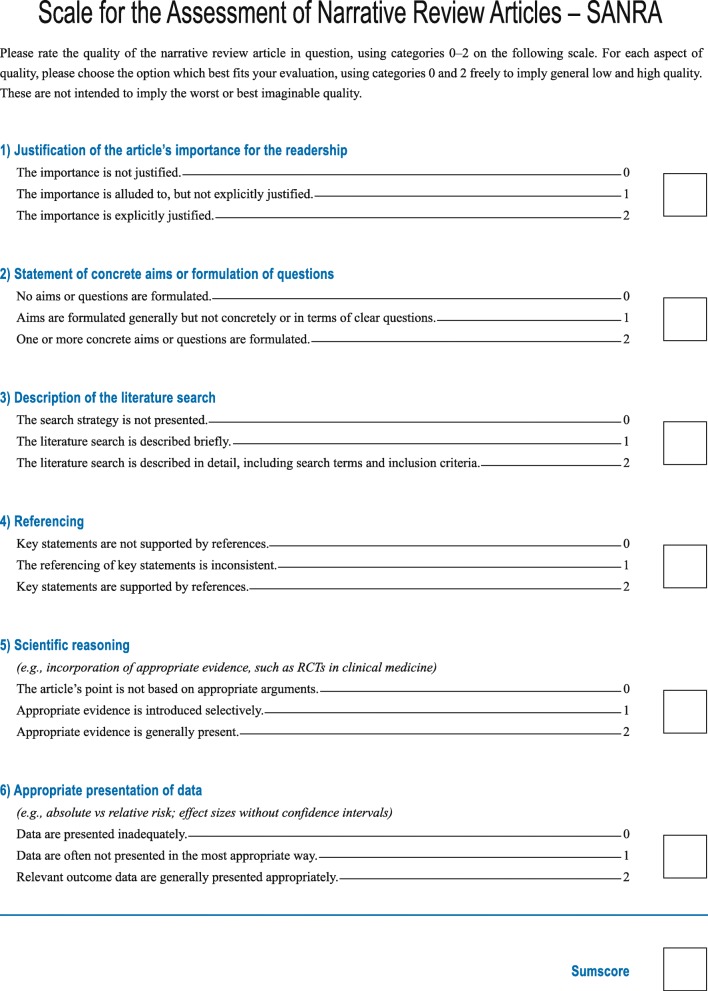
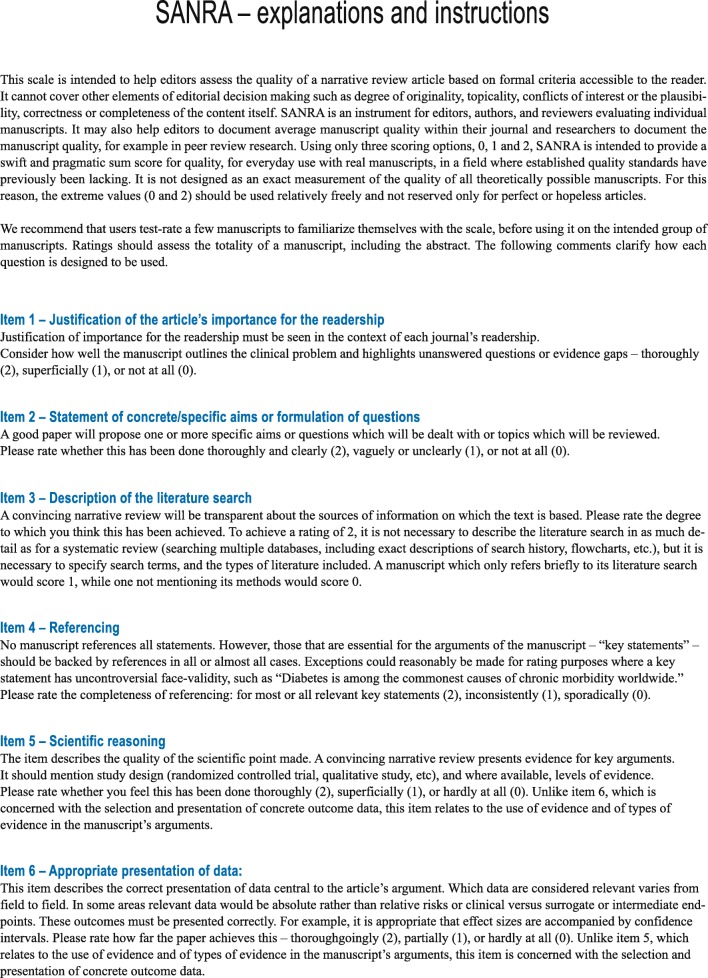
BACKGROUND: Narrative reviews are the commonest type of articles in the medical literature. However, unlike systematic reviews and randomized controlled trials (RCT) articles, for which formal instruments exist to evaluate quality, there is currently no instrument available to assess the quality of narrative reviews. In response to this gap, we developed SANRA, the Scale for the Assessment of Narrative Review Articles. METHODS: A team of three experienced journal editors modified or deleted items in an earlier SANRA version based on face validity, item-total correlations, and reliability scores from previous tests. We deleted an item which addressed a manuscript's writing and accessibility due to poor inter-rater reliability. The six items which form the revised scale are rated from 0 (low standard) to 2 (high standard) and cover the following topics: explanation of (1) the importance and (2) the aims of the review, (3) literature search and (4) referencing and presentation of (5) evidence level and (6) relevant endpoint data. For all items, we developed anchor definitions and examples to guide users in filling out the form. The revised scale was tested by the same editors (blinded to each other's ratings) in a group of 30 consecutive non-systematic review manuscripts submitted to a general medical journal. RESULTS: Raters confirmed that completing the scale is feasible in everyday editorial work. The mean sum score across all 30 manuscripts was 6.0 out of 12 possible points (SD 2.6, range 1-12). Corrected item-total correlations ranged from 0.33 (item 3) to 0.58 (item 6), and Cronbach's alpha was 0.68 (internal consistency). The intra-class correlation coefficient (average measure) was 0.77 [95% CI 0.57, 0.88] (inter-rater reliability). Raters often disagreed on items 1 and 4. CONCLUSIONS: SANRA's feasibility, inter-rater reliability, homogeneity of items, and internal consistency are sufficient for a scale of six items. Further field testing, particularly of validity, is desirable. We recommend rater training based on the "explanations and instructions" document provided with SANRA. In editorial decision-making, SANRA may complement journal-specific evaluation of manuscripts-pertaining to, e.g., audience, originality or difficulty-and may contribute to improving the standard of non-systematic reviews.
Overview
CoChat Summary
TL;DR
SANRA is a six-item, 0–2 scale (maximum 12) for assessing the quality of narrative review articles, developed and field-tested by three journal editors. In 30 consecutive non-systematic review manuscripts, it showed feasible use, sufficient internal consistency and inter-rater reliability, and a modest association with editorial acceptance.
Key findings
- Across 30 manuscripts (90 ratings), the mean SANRA sum score was 6.0 out of 12 (SD 2.6, range 1–12, median 6).
- Internal consistency was Cronbach’s alpha 0.68; corrected item-total correlations ranged from 0.33 (item 3) to 0.58 (item 6).
- Inter-rater reliability was an intra-class correlation coefficient (average measure) of 0.77 [95% CI 0.57, 0.88]; raters often disagreed on items 1 and 4.
- Average SANRA scores were modestly associated with editorial acceptance (mean 6.6, SD 1.9, n = 17) versus rejection (mean 5.1, SD 2.1, n = 13), point biserial correlation 0.37 (t = 2.09, df 28; two-sided p = 0.046).
Methods
- SANRA was developed between 2010 and 2017 by three experienced editors at Deutsches Ärzteblatt; the revised six-item version deleted an item on writing and accessibility due to poor inter-rater reliability.
- The revised scale was tested on 30 consecutive non-systematic review manuscripts submitted to Deutsches Ärzteblatt in 2015; three editor-raters scored them independently and blinded to each other’s ratings.
- Analyses included descriptive statistics, Cronbach’s alpha, corrected item-total correlations, average-measure intra-class correlation using a two-way random effects model (consistency definition), and a post hoc point biserial correlation between SANRA sum scores and acceptance/rejection.
Limitations
- The paper states the main limitation is sample size: 30 manuscripts was a compromise between representativeness, power, and feasibility, and took about 6 months to sample.
- The authors state that the scale’s authors were also the test-raters, so inter-rater reliability may be lower in groups less familiar with SANRA; the study also did not assess test-retest reliability, and results are study-specific.
- The paper acknowledges restricted content validity because SANRA is limited to six items and is a critical appraisal tool rather than a reporting guideline; criterion validity evidence is post hoc and weak, and no established cut-offs exist for comparing manuscripts across settings.
Model-written summary. Check it against the paper before relying on it.
Integrity signals
Registry
Cites
Statistics
Figures
Verification
Claims the paper makes
3 Valid · 0 Not valid · 5 Not checked · 27 Own results and interpretations
The cited sources support only part of this claim — read each source’s verdict below.
In the paper
“Bastian et al. found that they constitute the largest share of all text types in medicine and they concluded that they “remain the staple of medical literature” [1].”
- Also stated in: § Background · plain
“Narrative reviews are the commonest type of articles in the medical literature.”
§ SANRA—a scale for the quality assessment of narrative review articles > Background
What the sources say
- Partly supportedcites [1] Bastian H Glasziou P Chalmers I Seventy-five trials and eleven systematic reviews a day: how will we ever keep up? PLoS Med 2010 7 9 e1000326 10.1371/journal.pmed.1000326 20877712 PMC2943439 sourceExperimental — accuracy not yet measured
In “How Close Are We to Archie Cochrane’s Goal?” and the Summary Points (pages unavailable), the paper calls non-systematic narrative reviews the staple of medical literature synthesis. It does not say they constitute the largest share of all medical text types; that extends a claim about literature synthesis to medical literature as a whole. (LLM, conf=0.88)
plain- Asserted: passes — The authors put it forward as true.
- Checkable: passes — It can be checked against evidence.
- Load-bearing: unclear — It is unclear whether the paper’s conclusions depend on it.
- Based: passes — The paper gives a reason why it holds.
- Also stated in: § Background · plain
The sources with a verdict support this claim; the rest weren’t checked yet, have no full text we could read, or their verdicts aren’t rated yet.
In the paper
“non-systematic reviews or narrative reviews have been widely criticized as unreliable [1, 4].”
§ SANRA—a scale for the quality assessment of narrative review articles > Background
What the sources say
- Supportedcites [1] Bastian H Glasziou P Chalmers I Seventy-five trials and eleven systematic reviews a day: how will we ever keep up? PLoS Med 2010 7 9 e1000326 10.1371/journal.pmed.1000326 20877712 PMC2943439 source
In “How Close Are We to Archie Cochrane’s Goal?”, the paper describes reviews not conducted systematically as having great potential for error and calls them less reliable forms of information. Box 1 also says that articles and textbooks had highlighted the risk of bias and chance in reviews. Together, these passages support the broad characterization that narrative reviews have been criticized as unreliable; page numbers are not provided in our copy. (LLM, conf=0.89)
- Not checked — no full text of the sourcecites [4] Mulrow CD The medical review article: state of the science Ann Intern Med 1987 106 485 488 10.7326/0003-4819-106-3-485 3813259 source
plain- Asserted: passes — The authors put it forward as true.
- Checkable: passes — It can be checked against evidence.
- Load-bearing: passes — The paper’s conclusions depend on it.
- Based: passes — The paper gives a reason why it holds.
- Supported
A result the paper reports from its own data — it cites no other source for it, so there is none to check. The quote shows it is in the paper.
In the paper
“Cronbach’s alpha was 0.68 (internal consistency).”
- Also stated in: § Results · plain
“The scale’s internal consistency, measured as Cronbach’s alpha, was 0.68.”
§ SANRA—a scale for the quality assessment of narrative review articles > Abstract > Results
plainn = 90- Asserted: passes — The authors put it forward as true.
- Checkable: passes — It can be checked against evidence.
- Load-bearing: passes — The paper’s conclusions depend on it.
- Based: passes — The paper gives a reason why it holds.
- Also stated in: § Results · plain
A result the paper reports from its own data — it cites no other source for it, so there is none to check. The quote shows it is in the paper.
In the paper
“Raters often disagreed on items 1 and 4.”
- Also stated in: § Results · plain
“Disagreements most often occurred with regard to items 1 and 4.”
§ SANRA—a scale for the quality assessment of narrative review articles > Abstract > Results
plain- Asserted: passes — The authors put it forward as true.
- Checkable: passes — It can be checked against evidence.
- Load-bearing: unclear — It is unclear whether the paper’s conclusions depend on it.
- Based: passes — The paper gives a reason why it holds.
- Also stated in: § Results · plain
A result the paper reports from its own data — it cites no other source for it, so there is none to check. The quote shows it is in the paper.
In the paper
“The intra-class correlation coefficient (average measure) was 0.77 [95% CI 0.57, 0.88] (inter-rater reliability).”
- Also stated in: § Results · plain
“The intra-class correlation coefficient (average measure) amounted to 0.77 [95% CI 0.57, 0.88; F 4.3; df 29, 58].”
§ SANRA—a scale for the quality assessment of narrative review articles > Abstract > Results
plain- Asserted: passes — The authors put it forward as true.
- Checkable: passes — It can be checked against evidence.
- Load-bearing: passes — The paper’s conclusions depend on it.
- Based: passes — The paper gives a reason why it holds.
- Also stated in: § Results · plain
14 more claims
Create a free account to see all 35 claims and to verify the 3 references still open.
- Probably not a substantial claim. 11
- It may state two separate claims as one. 11
Claims other papers make about this one
Each is checked against this paper’s own text: does it say what the citing paper says it does?
The source backs part of the claim, not all of it — or backs it for a different population, condition or comparison.
In the citing paper
“The review was conducted and reported in accordance with the principles of the Scale for the Assessment of Narrative Review Articles (SANRA), which provides a validated framework for ensuring methodological transparency, scientific rigor, and balanced interpretation in narrative reviews [ 19 ].”
From Paracetamol: A History of Assumptions, Errors, and Evidence Reversals in Pain Management (2026) · cites this paper as [19]
Experimental — accuracy not yet measuredThe source backs part of the claim, not all of it — or backs it for a different population, condition or comparison.
In the citing paper
“As a narrative review, the present work does not include an aggregated quantitative assessment and is more exposed to selection subjectivity than a registered systematic review [124,125].”
From Berberine-Drug Interactions: Mechanisms, Clinical Relevance and Risk Stratification-A Narrative Review (2026) · cites this paper as [124]
Experimental — accuracy not yet measuredThe cited source says what the claim attributes to it.
In the citing paper
“This work is designed as a structured narrative review, with transparent reporting of the documentation strategy, guided by the quality criteria of the Scale for the Assessment of Narrative Review Articles (SANRA) [124].”
From Berberine-Drug Interactions: Mechanisms, Clinical Relevance and Risk Stratification-A Narrative Review (2026) · cites this paper as [124]
The cited source says what the claim attributes to it.
In the citing paper
“we used the following:-Cochrane Risk of Bias 2 (RoB 2) [29] and PEDRO scale tools for RCTs.-AMSTAR 2 [30] checklist for systematic review.-SANRA (Scale for the Assessment of Narrative Review Articles) [31] for narrative reviews.-JBI Checklist for Text and Opinion [32] for expert opinion papers.”
From Pelvic Floor Muscle Training Following Surgery for Pelvic Organ Prolapse: Recommendation from Scientific Literature (2026) · cites this paper as [31]
The cited source says what the claim attributes to it.
In the citing paper
“Data analysis employed a narrative and thematic synthesis methodology,adhering to the SANRA guidelines for narrative reviews (32).”
From Ethical issues in multi-agent AI systems for healthcare: a narrative review (2026) · cites this paper as [32]
12 more claims about this paper
Create a free account to see every claim other papers make about this one.
Citations
Cites
Shea, B. J., Reeves, B. C., Wells, G., Thuku, M., Hamel, C., Moran, J., Moher, D., Tugwell, P., Welch, V., Kristjansson, E., et al. (2017) · BMJ · doi:10.1136/bmj.j4008 · Cited by 10,636 · cited 2×
“Critical appraisal tools have been developed for systematic reviews (e.g., AMSTAR 2 [A MeaSurement Tool to Assess Systematic Reviews] [7]) and papers on RCTs (e.g., the CASP [Critical Appraisal Skills Program] checklist for randomized trials [8]) and other types of medical studies.”
BackgroundStreiner, D. L., & Norman, G. R. (2008) · doi:10.1093/acprof:oso/9780199231881.001.0001 · Cited by 2,631
Critical appraisal skills programme
Singh, J. (2013) · Journal of Pharmacology and Pharmacotherapeutics · doi:10.4103/0976-500x.107697 · Cited by 2,556
Guidelines for Reporting Reliability and Agreement Studies (GRRAS) were proposed
Kottner, J., Audigé, L., Brorson, S., Donner, A., Gajewski, B. J., Hróbjartsson, A., Roberts, C., Shoukri, M., & Streiner, D. L. (2011) · Journal of Clinical Epidemiology · doi:10.1016/j.jclinepi.2010.03.002 · Cited by 2,174
The Mass Production of Redundant, Misleading, and Conflicted Systematic Reviews and Meta‐analyses
IOANNIDIS, J. P. A. (2016) · The Milbank Quarterly · doi:10.1111/1468-0009.12210 · Cited by 1,483 · cited 1×
“While systematic reviews are not per se superior articles and while certain systematic reviews have been criticized lately [3], non-systematic reviews or narrative reviews have”
BackgroundSeventy-five trials and eleven systematic reviews a day: how will we ever keep up?
Bastian, H., Glasziou, P., & Chalmers, I. (2010) · PLoS Medicine · doi:10.1371/journal.pmed.1000326 · Cited by 1,188 · cited 2×
“found that they constitute the largest share of all text types in medicine and they concluded that they “remain the staple of medical literature” [1].”
BackgroundThe Medical Review Article: State of the Science
MULROW, C. D. (1987) · Annals of Internal Medicine · doi:10.7326/0003-4819-106-3-485 · Cited by 856 · cited 1×
“been widely criticized as unreliable [1, 4].”
Writing a narrative biomedical review: considerations for authors, peer reviewers, and editors
Gasparyan, A. Y., Ayvazyan, L., Blackmore, H., & Kitas, G. D. (2011) · Rheumatology International · doi:10.1007/s00296-011-1999-3 · Cited by 694 · cited 1×
“[13], for example, have provided guidance for writing narrative reviews, and Byrne [14] as well as Pautasso [15] has written, from different angles, thoughtful editorials on improving narrative reviews and presented lists of key features of writing a good review—lists that naturally overlap with SANRA items (e.”
BackgroundTen Simple Rules for Writing a Literature Review
Pautasso, M. (2013) · PLoS Computational Biology · doi:10.1371/journal.pcbi.1003149 · Cited by 272 · cited 3×
“[13], for example, have provided guidance for writing narrative reviews, and Byrne [14] as well as Pautasso [15] has written, from different angles, thoughtful editorials on improving narrative reviews and presented lists of key features of writing a good review—lists that naturally overlap with SANRA items (e.”
BackgroundImproving the peer review of narrative literature reviews
Byrne, J. A. (2016) · Research Integrity and Peer Review · doi:10.1186/s41073-016-0019-2 · Cited by 159 · cited 3×
“[13], for example, have provided guidance for writing narrative reviews, and Byrne [14] as well as Pautasso [15] has written, from different angles, thoughtful editorials on improving narrative reviews and presented lists of key features of writing a good review—lists that naturally overlap with SANRA items (e.”
Background
Research works printed but not linked: 3
- Higgins JPT, Green S. (eds.). Cochrane Handbook for Systematic Reviews and Interventions. Version 5.1.0. The Cochrane Collaboration 2011, section 1.2.2., www.handbook.cochrane.org, retrieved on Oct 31, 2018.
- Baethge C Mertens S Goldbeck-Wood S Development of a quality score for the assessment of non-systematic review articles (SANRA) Poster, Seventh International Congress on Peer Review and Biomedical Publication 2013 USA Chicago, Illinois
- Baethge C Goldbeck-Wood S Mertens S A scale for the assessment of non-systematic review articles (SANRA) Poster, Eighth International Congress on Peer and Biomedical Publication 2017 USA Chicago, Illinois
Cited by
Items 1,801–1,900 of 4,334
Zhang, T., & Zhang, H. (2026) · Critical Reviews in Oncology/Hematology · doi:10.1016/j.critrevonc.2026.105519 · Cited by 1
Hyperferritinemia: Pathophysiology, Etiologies, and Diagnostic Approach
Kim, Y., Landry, T. C., Seifer, L. V., Lavasseur, C. M., Martens, K. L., & Shatzel, J. J. (2026) · European Journal Of Haematology · doi:10.1111/ejh.70285 · Cited by 1
Zuo, Z., Li, Y., & Zeng, Y. (2026) · Cancer Control · doi:10.1177/10732748261476277 · Cited by 1
“43 Second, although the search strategy was expanded and documented, relevant studies may still have been missed, particularly very recent articles, non-English reports, or studies indexed only in local databases.”
InfluentialBaghdadı, Z. D. (2026) · Children · doi:10.3390/children13081053 · Cited by 1
“The manuscript was structured according to the SANRA reporting domains [17].”
Şakrak-Ekin, G., Ekin, Y., Akbulut, O., & Celik, T. (2026) · Sustainability · doi:10.3390/su18168037 · Cited by 1
“The justification and reporting adequacy of the narrative review have been checked against SANRA principles [15].”
Spasic, D. M., Spasić, S. D., Nikolić‐Kokić, A., & Miljević, Č. (2026) · International Journal of Molecular Sciences · doi:10.3390/ijms27167105 · Cited by 1
“Reporting and structure were self-audited against the six SANRA domains: justification of the review’s importance, statement of aims, description of the literature search, referencing, presentation of evidence levels, and presentation of relevant endpoint data [8].”
Mixed malaria infections: A critical review and Detect-Characterise-Act surveillance framework
Igwe, M. C., & Alum, E. U. (2026) · Current Research in Parasitology and Vector-Borne Diseases · doi:10.1016/j.crpvbd.2026.100425 · Cited by 1
“…the Assessment of Narrative Review Articles (SANRA), particularly its domains relating to justification of the review ’ s importance, statement of aims, description of the literature search, appropriate referencing, scientific reasoning, and presentation of relevant evidence (Baethge et al., 2019).”
Johnson, D. A., Feghali, E., Elfadil, O. M., Varayil, J. E., Mundi, M. S., & Hurt, R. T. (2026) · Nutrients · doi:10.3390/nu18162613 · Cited by 1
“…that narrative and systematic reviews serve complementary purposes, and that narrative reviews may draw on purposively selected influential literature, methodological diversity, and expert background knowledge when the rationale, scope, and interpretive boundaries are made transparent [42–46].”
Alshammari, A. A. A., & Mani, V. (2026) · Food and Chemical Toxicology · doi:10.1016/j.fct.2026.116335 · Cited by 1
Nemes, J. E. (2026) · International Journal of Inclusive Education · doi:10.1080/13603116.2026.2715639 · Cited by 1
Högberg, J., Wernbom, M., & Senorski, E. H. (2026) · Science Progress · doi:10.1177/00368504261461371 · Cited by 1
“5 Due to the broad scope of the present study, a narrative review design was considered appropriate.”
Vitamin D as a candidate host susceptibility factor in sugar-driven oral dysbiosis
Turaliyeva, M., Akimbekov, N. S., Digel, I., Yerezhepov, A. Y., & Razzaque, M. S. (2026) · Frontiers in Oral Health · doi:10.3389/froh.2026.1850800 · Cited by 1
“These frameworks supported transparency but do not imply that the manuscript is a PRISMA 2020 systematic review with meta-analysis or a fully registered scoping review (44, 45).”
Fonza, D. D., Claudio, G. D., Colantuono, G., PERSICHINI, L., Cerulo, N., Sangregorio, B., Buonsenso, A., Fiorilli, G., Calcagno, G., & di Cagno, A. (2026) · Journal of Functional Morphology and Kinesiology · doi:10.3390/jfmk11030315 · Cited by 1
“To reconcile these two aspects, the review was guided by SANRA (Scale for the Assessment of Narrative Review Articles) framework [16] for the overall structure and interpretive approach, while selected reporting elements of PRISMA 2020—namely a structured search strategy, predefined eligibility…”
Marano, G., Paris, I., Traversi, G., Mazza, O., Rotondaro, S., D’Angelo, T., Fuso, P., Chieffo, D. P. R., Franceschini, G., & Mazza, M. (2026) · Medicina · doi:10.3390/medicina62081551 · Cited by 1
Ohaiba, M. M., Arifayan, S. O., Oladimeji, A. O., Ogundipe, A. T., Okobi, O. E., & Okobi, E. K. (2026) · Journal of Advances in Medicine and Medical Research · doi:10.9734/jammr/2026/v38i96189 · Cited by 1
Wang, Q., Zhao, D., Hu, J. P., Chen, C., Ma, T., Liu, X., Yang, J. Y., & Kang, P. (2026) · Journal of Nursing Management · doi:10.1155/jonm/1182729 · Cited by 1
Díaz, M. J. F., & Rubial-Bernárdez, F. (2026) · Public Health · doi:10.1016/j.puhe.2026.106448 · Cited by 1
Jiang, H., Zhang, R., Ding, S., Zhen, Y., Qi, C., Jin, M., & Wang, L. (2026) · Journal of International Medical Research · doi:10.1177/03000605261472952 · Cited by 1
Zhang, J., Shu, Q.-P., Tang, Y., Liu, H., Zhang, C., Chen, X., & Li, S. (2026) · Antioxidants · doi:10.3390/antiox15081025 · Cited by 1
“…for the assessment of narrative review articles, with particular attention to justification of the review’s importance, clear statement of aims, transparent description of the literature search, appropriate referencing, scientific reasoning, and balanced presentation of endpoint data [21].”
How Gut Microbiota Influence Healthy Aging: Overview of Reviews
Todmal, T. G., Bibi, R., Cangelosi, G., Panella, M., & Masini, A. (2026) · Geriatrics · doi:10.3390/geriatrics11040107 · Cited by 1
“T) assessed the quality of included studies using the Scale for the Assessment of Narrative Review Articles (SANRA) [18].”
Love, R. J., Sheridan, J., Funk, C., & Young, J.-L. (2026) · Pain and Therapy · doi:10.1007/s40122-026-00880-5 · Cited by 1
“This etiological review was conducted in accord‑ ance with the Scale for the Assessment of Narra‑ tive Review Articles (SANRA) guidelines to ensure methodological transparency, critical appraisal, and high‑quality synthesis of mechanistic evi‑ dence [15].”
Biological and Targeted Therapies in the Multidisciplinary Management of Gastrointestinal Cancers
Kos, M., Bojarski, K., Czosnek, M., Śnieżyński, J., Wilczyński, B., Mertowska, P., Grywalska, E., & Mertowski, S. (2026) · Cancers · doi:10.3390/cancers18162675 · Cited by 1
Li, H., Wei, Z., Cao, Z., Jumaybayi, A., & Shatar, R. (2026) · IEEE Access · doi:10.1109/access.2026.3724656 · Cited by 1
“…this article is a structured narrative review, the synthesis emphasizes clarity of purpose, justified source selection, balanced evidence representation, and critical interpretation rather than exhaustive bibliometric coverage, consistent with quality criteria for narrative review articles [67].”
Motion as Medicine: Physical Activity, Joint Sensitivity, and Pain Management—A Narrative Review
Labusca, L. S., Puha, B., Dmour, B.-A., Onu, I., Tîrnovanu, M. C., Tîrnovanu, Ș.-D., & Dmour, A. (2026) · Medical Sciences · doi:10.3390/medsci14040495 · Cited by 1
“…and reporting quality of the review was evaluated with reference to the Scale for the Assessment of Narrative Review Articles (SANRA) [7], including justification of the review, clarity of aims, transparency of the literature search, appropriate referencing, scientific reasoning, and…”
Toro, M. D., Avitabile, A., Amato, R., Rusciano, D., & Gagliano, C. (2026) · Antioxidants · doi:10.3390/antiox15081034 · Cited by 1
“Its purpose is to organize the mechanistic and clinical literature into a critical translational framework aligned with SANRA principles [8].”
Mechanisms Influencing Maximum Joint Range of Motion and Stiffness: A Narrative Review
Lima, C. D., & Blazevich, A. J. (2026) · Sports Medicine · doi:10.1007/s40279-026-02491-8 · Cited by 1
“The review was conducted in accordance with the Scale for the Assessment of Narrative Review Articles (SANRA) reporting recommendations [6].”
Yoon, Y., Hwang, J., Kim, J. Y., Kim, K.-T., Yang, C.-M., Park, R., Shim, J., Lee, J., Kim, S., Kim, Y., et al. (2026) · Nutrients · doi:10.3390/nu18162736 · Cited by 1
“The aim was not to perform a quantitative synthesis of a single clinical endpoint, but to integrate mechanistic, epidemiological, interventional, and guideline-based evidence across musculoskeletal and extra-skeletal domains [13,14].”
Clinical myths in dental bleaching: an evidence-based structured narrative review
Reis, A., Maran, B. M., Cordeiro, D. C. F., Barbosa, L. M. M., Terra, R. M. O., Loguércio, A. D., & Favoreto, M. W. (2026) · Brazilian Oral Research · doi:10.1590/1807-3107bor-2026.vol40suppl1062 · Cited by 1
“The following sections discuss ten clinical recommendations commonly disseminated in dental bleaching and examine whether they are supported by consistent, clinically meaningful, and methodologically reliable evidence (Figure 1).”
Exploring the Clinical Transformation of circRNA as a Biomarker in Breast Cancer
Ma, X., Du, J., & Li, D. (2026) · Cancer Control · doi:10.1177/10732748261481227 · Cited by 1
“13 We begin by dissecting the biological foundations and functional mechanisms of circRNAs, emphasizing areas of consensus and controversy.”
Munteanu, I. M., Jianu, A. M., Tudose, R. C., Rusu, M. C., Vrapciu, A. D., Triantafyllou, G., Piagkou, M., & Brezean, I. (2026) · Diagnostics · doi:10.3390/diagnostics16172724 · Cited by 1
“…assembled as a structured narrative synthesis rather than de novo measurement, and were prepared in accordance with the quality criteria of the Scale for the Assessment of Narrative Review Articles (SANRA) [13], particularly its items on the description of the literature search and referencing.”
Banala, M., Ezuddin, S., Foley, M., & Kuker, R. A. (2026) · Frontiers in Nuclear Medicine · doi:10.3389/fnume.2026.1935247 · Cited by 1
“The Scale for the Assessment of Narrative Review Articles (SANRA) domains structured reporting of the review question, search, referencing, reasoning, and presentation and were not used as a study-level risk-of-bias instrument (23).”
Lathiya, P. N., Patel, P. J., Mangukiya, R., Goti, H. S., Parmar, V. J., & Kulkarni, A. P. (2026) · Cureus · doi:10.7759/cureus.115269 · Cited by 3
“The Scale for the Assessment of Narrative Review Articles (SANRA) was used as a general reporting framework [16]; Preferred Reporting Items for Systematic Reviews and Meta-Analyses (PRISMA) and Joanna Briggs Institute (JBI) systematic review procedures were not applied.”
Torales, J. C., O’Higgins, M. G., Barrios, I., Sequera, G., Estigarribia, G., Castaldelli-Maia, J. M., & Ventriglio, A. (2026) · International Review of Psychiatry · doi:10.1080/09540261.2026.2722686 · Cited by 1
Broul, M., Dubský, M., Hujová, A., & Liegertová, M. (2026) · Andrology · doi:10.1111/andr.70366 · Cited by 1
Visconti, M. A., Bornstein, M. M., Santos‐Silva, A. R., Martins, M. D., & Oliveira, M. L. (2026) · Brazilian Oral Research · doi:10.1590/1807-3107bor-2026.vol40suppl1058 · Cited by 2
Stoian, M., Stoian, A., Bănescu, C. V., Bândilă, S. R., Danilesco, A., Finta, H., & Azamfirei, L. (2026) · Nutrients · doi:10.3390/nu18172840 · Cited by 2
“Priority was given to high-quality randomized trials, contemporary meta-analyses, and international clinical practice guidelines, while areas of conflicting or limited evidence were explicitly acknowledged throughout the review [21].”
Khormali, A., Soghli, N., & Miguez, P. A. (2026) · Periodontology 2000 · doi:10.1111/prd.70078 · Cited by 2
Yang, C., Song, X., Sun, H., Chen, M., & Zhu, X. (2026) · Frontiers in Immunology · doi:10.3389/fimmu.2026.1947595 · Cited by 1
The state of vestibular neurology: Diagnostic challenges and emerging opportunities
Kaski, D. N., & Ibitoye, R. T. (2026) · Science Progress · doi:10.1177/00368504261484700 · Cited by 1
Lesala, M. E., & Mukumba, P. (2026) · Energies · doi:10.3390/en19174157 · Cited by 1
Constanta, P. D., Endres, L. M., Maghiar, L., Maghiar, T.-A., Ganea, M., Nagy, C., Moisa, C., Ciavoi, G., Cicalău, G. I. P., Frenț, O. D., et al. (2026) · Pharmaceutics · doi:10.3390/pharmaceutics18091111 · Cited by 1
“…justification of the topic, a clearly stated aim, a described literature search, referencing of specific statements, scientific reasoning, and appropriate presentation of data [19]; SANRA is a quality-assessment scale for narrative reviews rather than a reporting guideline equivalent to PRISMA.”
Alkasasbeh, W. J., Al–Nawaiseh, S. J., Shorman, D. A., Orhan, B. E., Grivas, G. V., & Alrahahleh, W. A. (2026) · Cogent Education · doi:10.1080/2331186x.2026.2722756 · Cited by 1
Lopes, L. E. D. M., Dantas, M. R. T., de Souza, J. B. F., Costa, F. F., Oliveira, L. S. D. S., Alves, V. G. D. S., Batista, L. C. B., Dantas, I. S. B., & Costa, L. L. D. M. (2026) · Applied Veterinary Research · doi:10.31893/avr.2026005 · Cited by 1
“In addition, the methodological guidance proposed for narrative reviews in biomedical sciences was used to strengthen consistency, interpretability, and academic robustness (Baethge et al., 2019).”
Chen, Y., Luo, W., Lu, J., & Wu, W. (2026) · Frontiers in Immunology · doi:10.3389/fimmu.2026.1931149 · Cited by 1
“This approach helps distinguish clinical indications from mechanistic plausibility and hypothesis-generating nanoplatform-based fi ndings (8).”
Belalcázar, P. (2026) · Ciencia y Educación · doi:10.5281/zenodo.22728008 · Cited by 1
Islam, M. A., Rahman, S., Islam, M. S., Rony, S. A., Gunawan, A., Pandey, H. O., Islam, M. T., Rahman, A. K. M. A., Khan, M. A. H. N. A., Villena, J., et al. (2026) · Viruses · doi:10.3390/v18091007 · Cited by 1
“Instead, the objective was to provide an integrative and interdisciplinary synthesis of the available evidence and identify key research gaps [20].”
The Glial Coupling in the Developing Brain: Astrocytes, Oligodendrocytes and Myelin Formation
Canepa, M., Santucci, C., Mariano, D., Mangini, S., Calandrino, A., Gagliardi, L., Petretto, A., Striano, P., & Ramenghi, L. A. (2026) · Metabolites · doi:10.3390/metabo16100774 · Cited by 1
“The reporting of this narrative review was informed by the SANRA checklist for reporting narrative reviews [13].”
Neamțu, A.-A., Barna, R. A., Vigdorovits, A., Hotinceanu, I. A., Muresan, M. M., Paşcalău, A. V., & Pop, O.-L. (2026) · Cancers · doi:10.3390/cancers18182974 · Cited by 2
Mokbel, K., Abu-Gheida, I. H., Venkataraman, J., & Al-Shamsi, H. O. (2026) · Cancers · doi:10.3390/cancers18182986 · Cited by 1
“This was an expert-led narrative review following the SANRA framework [33], not a systematic review; no protocol was registered, and the search below, while structured, does not follow PRISMA methodology or report a formal screening flow.”
Yoon, A. J.-S., Hor, J. K. L., & Kim, K. (2026) · Sleep And Breathing · doi:10.1007/s11325-026-03809-6 · Cited by 1
“The methodology for this narrative review was structured in alignment with the Scale for the Assessment of Narrative Review Articles (SANRA) framework [7].”
Akulov, Z. A., Berikkhanov, Z. G. M., Sukhanova, M. A., Niskova, V., Tarabrin, E. А., Nikolaev, A., Razumovsky, V. S., Shestakov, A. I., Kotelnikov, A., Ivanova, M. Y., et al. (2026) · Healthcare · doi:10.3390/healthcare14183064 · Cited by 1
“SANRA was used only as an editorial check of the rationale, aims, search description, referencing, argumentation and presentation of evidence [17].”
Menna, F., Meduri, A., Luca, L. D., Baldascino, A., Lupo, S., & Vingolo, E. M. (2026) · Biomedicines · doi:10.3390/biomedicines14102173 · Cited by 1
“This is a narrative review, structured with reference to the SANRA scale for the assessment of narrative review articles [6].”
ÜNSAL, G., Karadag, A. S., & Hoenig, L. J. (2026) · Clinics in Dermatology · doi:10.1016/j.clindermatol.2026.09.032 · Cited by 1
Morfaki, C. (2026) · Hospitals · doi:10.3390/hospitals3040019 · Cited by 1
Kalil, J. A., Adam, R. A., Meti, N., & Metrakos, P. P. (2026) · Cancers · doi:10.3390/cancers18193165 · Cited by 1
“The methodological quality of this review was assessed using the Scale for the Assessment of Narrative Review Articles (SANRA) [21].”
Abordaje del dolor de hombro en atención primaria
Barbosa-Murillo, D. A., Parra-Saldarriaga, J., Viveros-Delgado, M. J., Capacho, M. M. M., Pérez-Sánchez, P. P., Morales-Ceballos, L. X., & Sánchez‐Duque, J. A. (2026) · Atención Familiar · doi:10.22201/fm.14058871p.2026.4.96932 · Cited by 1
Algorithmic Mood Management and Somatic Digital Fatigue among Kazakhstani University Students
Batyrkhanova, A., Sakhariyanov, A., Yerzhanov, Y., Aripzhanova, U., & Malik, G. (2026) · International journal of body, mind and culture · doi:10.61838/ijbmc.v13i7.1573 · Cited by 1
Alkhattab, O. R., & Bokhary, A. (2026) · Diagnostics · doi:10.3390/diagnostics16193225 · Cited by 1
“This review follows SANRA, the six-item scale for assessing the quality of narrative reviews [13].”
The impact of microplastics on the human reproductive system: a narrative review
Giezen, R. B., Matarneh, L. A., AlDhamin, D., Haroun, R., Alameh, W., & Hamze, H. (2026) · International Journal of Impotence Research · doi:10.1038/s41443-026-01374-w · Cited by 1
Blockchain and Internet of Medical Things for Resilient Healthcare
Grezia, G. D., Clemente, A., Dugheri, S., Mattei, V., Gili, A., Mari, E., Urraro, F., Mucci, N., & Baldassarre, A. (2026) · Bioengineering · doi:10.3390/bioengineering13101173 · Cited by 1
Ikoona, E. N., Namulemo, L., Kayita, G. L., Sakwa, R., Vandi, M. A., & Sahr, F. (2026) · Journal of Interventional Epidemiology and Public Health · doi:10.37432/jieph-d-26-00297 · Cited by 1
(Bran), R. S. S., Condriuc, I. P. S., Haba, R. M., Sescu, V. A., Mogoş, R. A., Costea, C. F., & Cărăuleanu, A. (2026) · Journal of Clinical Medicine · doi:10.3390/jcm15208111 · Cited by 1
“The six items of the Scale for the Assessment of Narrative Review Articles (SANRA) [32] were used as a checklist during drafting and methodological review, and Supplementary Table S5 shows where each item is addressed.”
Gomes, C. A., Jabed, M. I. K., Ahammad, T., Mandal, S., Hassan, S., Sejan, M. K., Ponduru, P. S., Bhuiyan, M. M., & Jamali, M. L. (2025) · Frontiers in Computer Science and Artificial Intelligence · doi:10.32996/jcsts.2025.4.4.10 · Cited by 10
Muchsam, Y., Respati, G., Yuda, M. S., & Maulana, M. A. (2025) · E-Bisnis Jurnal Ilmiah Ekonomi dan Bisnis · doi:10.51903/e-bisnis.v18i2.2602 · Cited by 12
Fleming, G. (2020) · UEL Research Repository (University of East London) · doi:10.15123/uel.88852 · Cited by 2
Priapism, a symptom of claudication of the cauda equina in spinal stenosis
Barbaro, K., & Midgley, J. (2021) · Musculoskeletal Science and Practice · doi:10.1016/j.msksp.2021.102337 · Cited by 1
New Ambient Assisted Living Technology: A Narrative Review
Constantinou, C. S., Gurung, T., Motamedian, H., Mavromoustakis, C. X., & Mastorakis, G. N. (2021) · Internet of things · doi:10.1007/978-3-030-76493-7_16 · Cited by 2
Tooth autotransplantation: review of the relevant procedural aspects for the clinical success
Heranin, S. (2022) · Ukrainian Dental Journal · doi:10.56569/udj.1.1.2022.5-19 · Cited by 1
“for case studies and case series [29], AMSTAR 2 for systematic review [30], and SANRA for narrative review [31]).”
BackgroundMethodThe postgraduate literature review: Turning your chapter into a scholarly publication
Walker, W. M., Efstathiou, N., & Vollam, S. (2022) · Nursing in Critical Care · doi:10.1111/nicc.12853 · Cited by 1
Sofro, Z. M., Wasityastuti, W., Wibowo, R. A., Sabirin, R. M., Siswanto, S., Setiawan, J., & Agustiningsih, D. (2022) · Journal of the Medical Sciences (Berkala Ilmu Kedokteran) · doi:10.19106/jmedsci005404202210 · Cited by 1
de Melo, S. C. S., & Vieira, F. S. (2022) · Revista CEFAC · doi:10.1590/1982-0216/20222437321s · Cited by 1
What to do when it is breech? A state-of-the-art review on management of breech presentation
Azimirad, A. (2023) · World Journal of Obstetrics and Gynecology · doi:10.5317/wjog.v12.i1.1 · Cited by 1
Shahid, S., Cabra‐Bautista, G., & Flórez, I. D. (2023) · PLoS ONE · doi:10.1371/journal.pone.0280597 · Cited by 1
“When authors support their recommendations on case series or cross-sectional studies, we will assess their quality with the JBI (Joanna Briggs Institute) tool [47, 48], and if narrative reviews are used, we will assess them with SANRA (Scale for the quality assessment of narrative reviews) [49].”
MethodArgenis, G., & Juárez, S. (2023) · European Scientific Journal ESJ · doi:10.19044/esj.2023.v19n6p176 · Cited by 1
Digital Clinical Trials-Institutional Challenges in Dental Research
Varma, S. R., Nambiar, M. K., Hashim, R., & Alsaegh, M. A. (2023) · Research Journal of Pharmacy and Technology · doi:10.52711/0974-360x.2023.00047 · Cited by 1
Older age, kidney concordant diseases and the dilemma of adherence to guidelines: A narrative review
Alsalemi, N., Lafrance, J., & Sadowski, C. A. (2023) · Research in Social and Administrative Pharmacy · doi:10.1016/j.sapharm.2023.04.115 · Cited by 1
Bernardes, R. A., Santos‐Costa, P., de Almeida, I. F., Paiva-Santos, F., Parola, V. S. D. O., Neves, H. L., Correia, N. M. C., & Cruz, A. (2023) · RevSALUS - Revista Científica da Rede Académica das Ciências da Saúde da Lusofonia · doi:10.51126/revsalus.v5i1.489 · Cited by 1
Destandau’s Approach to the Cervical and Thoracic Spine
Kaushal, M., & Kaushal, M. (2023) · Journal of Minimally Invasive Spine Surgery and Technique · doi:10.21182/jmisst.2023.00626 · Cited by 1
Acute venous problems: Integrating medical, surgical, and interventional treatments
Bissacco, D., Mandigers, T. J., Romagnoli, S., Aprea, T., Lomazzi, C., D’Alessio, I., Ascenti, V., Ierardi, A. M., Domanin, M., Tolva, V., et al. (2023) · Seminars in Vascular Surgery · doi:10.1053/j.semvascsurg.2023.04.013 · Cited by 2
Helle, T., Brandt, Å., & Larsen, S. M. (2023) · British Journal of Occupational Therapy · doi:10.1177/03080226231184989 · Cited by 2
“…review (Green et al., 2006) was conducted to generate narrative syntheses of primary research based on a systematic search according to key method publications (e.g. PRISMA guidelines (Page et al., 2021) and quality assessment criteria of narrative review publications (Baethge et al., 2019)).”
MethodKnowledge and awareness of early stroke signs: an analytical review
Alruzayhi, I., Alhussain, A., Aljammaz, A., Alhamri, A. A., & Alrashoud, B. M. (2023) · THE NEW ARMENIAN MEDICAL JOURNAL · doi:10.56936/18290825-2023.17.4-10 · Cited by 1
Análise crítica da curadoria de dados na prevenção da violência contra a mulher
Tsunoda, D. F., Guimarães, A. J. R., & Carvalho, A. V. (2023) · Workshop de Informação, Dados e Tecnologia (WIDAT) · doi:10.22477/vi.widat.02 · Cited by 1
Said, S. M., Aman, A. B., Hassan, M. R., & Dastane, O. (2023) · The Journal of Comparative Asian Development · doi:10.4018/jcad.315650 · Cited by 1
“The scale includes components like the justification of the article’s significance, a statement of objectives, a description of literature research, citations, scientific reasoning, and an adequate presentation of facts (Baethge et al., 2019).”
BackgroundResponse to Comment on: “Low Cardiorespiratory Fitness Post-COVID-19: A Narrative Review”
Schwendinger, F., Knaier, R., Radtke, T., & Schmidt‐Trucksäss, A. (2023) · Sports Medicine · doi:10.1007/s40279-023-01922-0 · Cited by 1
“By employing, for instance, the Scale for the Assessment of Narrative Review Articles (SANRA) [10], our narrative review can be regarded as of high quality.”
The Use of Autopsy as a Teaching Tool in Medicine
Cezillo, M. V. B., Uwagoya, R., & de Lima, H. G. (2023) · Acta Scientific Gastrointestinal Disorders · doi:10.31080/asgis.2023.06.0584 · Cited by 1
Hysteroscopy and weight loss in treatment of endometrial cancer: case report and literature review
Gallo, A., D’Alisa, R., Sardo, A. D. S., Guerra, S., Berardi, G., Vitale, S. G., Palumbo, M., Cretella, P., Angioni, S. L., Bifulco, G., et al. (2023) · Minimally Invasive Therapy & Allied Technologies · doi:10.1080/13645706.2023.2294993 · Cited by 1
Herbal Medicine and COVID-19: An Umbrella Review
Oakes, K., Saunders, P., Lloyd, I., Turner, T., Gruska, J., Gibbs, B., Gleitzman, S., Portella, C. F. S., Friend, J. L., Graham, K., et al. (2023) · CAND Journal · doi:10.54434/candj.161 · Cited by 1
Carter, T., O'Brien, C., Akinbode, T., & Lloyd, I. (2023) · CAND Journal · doi:10.54434/candj.163 · Cited by 1
Diet and Nutritional Factors in the Prevention and Treatment of COVID-19: An Umbrella Review
Murphy, M., Aucoin, M., & Barbaro, D. (2023) · CAND Journal · doi:10.54434/candj.159 · Cited by 1
The Role of Minerals in COVID-19: An Umbrella Review
Venter, C. V. D., Konn, C., Doherty, M., & Purdy, R. (2023) · CAND Journal · doi:10.54434/candj.164 · Cited by 1
La bioequivalencia en los medicamentos bioterapeúticos
Trujillo, D. P. M. (2023) · Acta neurológica colombiana · doi:10.22379/anc.v39i4.1212 · Cited by 1
COVID-19 Vaccine Hesitancy and Self-reported Adverse Effects: A Narrative Review
Noh, N., & Karuppannan, M. (2023) · Malaysian Journal of Medicine and Health Sciences · doi:10.47836/mjmhs.19.s12.10 · Cited by 1
Health 4.0 in the medical sector: a narrative review
Júnior, A. C., Dias, E. M., Scoton, M. L. R. P. D., & Branco, B. H. M. (2024) · Revista da Associação Médica Brasileira · doi:10.1590/1806-9282.20231149 · Cited by 1
Therapeutics Uses of Psychedelics in patients with psychiatric disorders A Systematic Review
Nawaz, S., Althwanay, A. M., AlEdani, E. M., Kaur, H., Kasapoglu, M., Yadavalli, R., & Yu, A. K. (2024) · Journal For International Medical Graduates · doi:10.56570/jimgs.v1i1.155 · Cited by 1
Emerging pharmacotherapy for the treatment of cannabis use disorder
Shamabadi, A., Bahri, R. A., Karimi, H., Heidari, E., & Akhondzadeh, S. (2024) · Expert Opinion on Pharmacotherapy · doi:10.1080/14656566.2024.2353638 · Cited by 1
“In this regard, this study reviewed emerging medications in the treatment of CUD, considering the Scale for the Assessment of Narrative Review Articles (SANRA) [16].”
MethodChen, K., Teng, X., Zhou, N., & Cheng, W. (2024) · International Journal of Surgery · doi:10.1097/js9.0000000000001676 · Cited by 2
Braz, L. G., Bráz, J. R. C., Tiradentes, T. A. A., Porto, D. D. S. M., Beserra, C. M., Vane, L. A., do Nascimento, P., Módolo, N. S. P., & Braz, M. G. (2024) · Brazilian Journal of Anesthesiology (English Edition) · doi:10.1016/j.bjane.2024.844519 · Cited by 4
“15 Ethical approval was not necessary because we conducted a narrative review.”
Psychose et suicide : comment se développent-ils conjointement ? Une revue narrative
Sicotte, R., Abdel‐Baki, A., Séguin, J. R., & Iyer, S. N. (2024) · Annales Médico-psychologiques revue psychiatrique · doi:10.1016/j.amp.2024.04.011 · Cited by 2
Montagnani, E., Bradley, H., & Smith, B. A. (2024) · Journal of Visual Impairment & Blindness · doi:10.1177/0145482x241255961 · Cited by 1
“A six-item Scale for the Assessment of Narrative Review Articles[19] was used to conduct the review according to standardized quality measures (Baethge et al., 2019; Montagnani et al., 2021).”
Metadata
- Authors
- Baethge, C., Goldbeck-Wood, S., & Mertens, S.
- Affiliations
- University of Cologne (DE)
- BMJ Group (United Kingdom) (GB)
- Corresponding author
- Baethge, Christopher
- ORCID
- Baethge, Christopher
- Venue
- Research Integrity and Peer Review
- Published
- 2019-03-26
- Volume
- 4
- Issue
- 1
- Pages
- 5-5
- ISSN
- 2058-8615 (ISSN-L)
- PMC
- PMC6434870
- OpenAlex
- W2922577842
- Semantic Scholar
- ea7f35b3069b53791c3b746c5c4b3c72a83a526b
- Cited by
- 3,469
- References
- 13
- Citations by year
- 2026: 1823 · 2025: 551 · 2024: 379 · 2023: 309 · 2022: 218 · 2021: 152 · 2020: 32 · 2019: 4
- FWCI
- 20.57
- Type
- journal article
- Language
- en
- Open access
- gold
- doi.org
- Licence
- cc-by
- creativecommons.org/licenses/by/4.0/ (tdm)
- Locations
- Research Integrity and Peer Review (publishedVersion, cc-by)
- Europe PMC (PubMed Central) (publishedVersion, other-oa)
- PubMed Central (publishedVersion, cc-by)
- PubMed (publishedVersion)
- Kölner Universitäts PublikationsServer (Universität zu Köln) (publishedVersion)
- DOAJ (DOAJ: Directory of Open Access Journals) (submittedVersion, cc-by-sa)
- Topics
- Social Sciences › Decision Sciences › Statistics, Probability and Uncertainty › Meta-analysis and systematic reviews
- Social Sciences › Library and Information Sciences › Academic Writing and Publishing
- Social Sciences › Library and Information Sciences › scientometrics and bibliometrics research
- Keywords
- quality assessment scale, manuscript review, inter-rater reliability, level of evidence, scale development
About these checks
Registry, retraction, Cites and statistics results are computed, not judged, with one exception: a printed reference that no index lists is read once by a model before it counts as a citation error. Claims are extracted by a model and kept only when their quote appears verbatim in the text; each cited source is then checked, with a model’s help, for whether it says what the claim relies on. Those verdicts can be wrong — read the claim’s quote and the cited source before relying on one.
The claim verdicts this report counts are experimental: their accuracy is not yet measured.
A language model drew the claims from the paper on 2026-11-10, under version 3 of the claim definition (model deepseek-v4.1-flash, prompt extract-v3).
A second model labelled each claim on 2026-11-10 (model jev-1.13-20260917, definition revision gold-guideline-v0.2).
Cited sources are checked with a language model’s help (gpt-6-sol).
Statistics and arithmetic are recomputed, not judged.
Confidence bands are shown only for fields calibrated on our annotated test set. None is calibrated yet, so no band is shown.
What counts as a claim ›How we measure confidence ›How we check this ›
Are you an author, or do you see a problem with this page? Request a review
Data sources
Bibliographic data: Semantic Scholar, OpenAlex, Crossref.
Contains information from the Semantic Scholar Academic Graph Datasets, made available under the ODC Attribution License (ODC-BY 1.0).
Semantic Scholar’s data is described in: Kinney, R., et al. (2023). The Semantic Scholar Open Data Platform. arXiv:2301.10140.
