

SANRA—a scale for the quality assessment of narrative review articles
Open accessThe DOI matches its Crossref record; 12 of the 13 references it cites were found in a registry or an index; 4 of the 12 sources its claims cite were checked for support.
Abstract
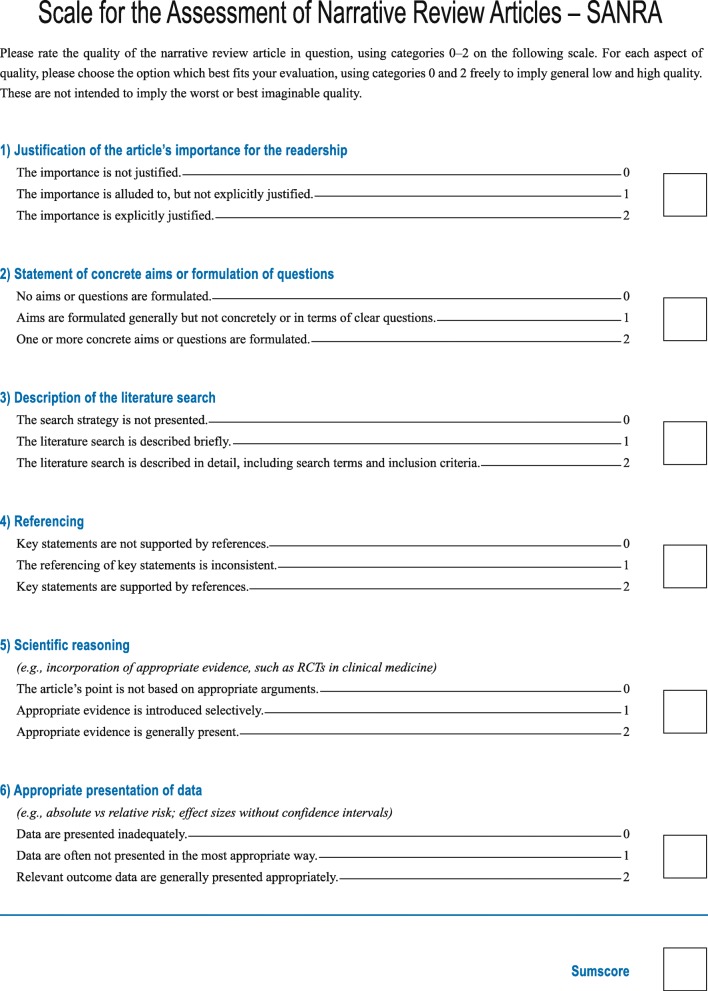
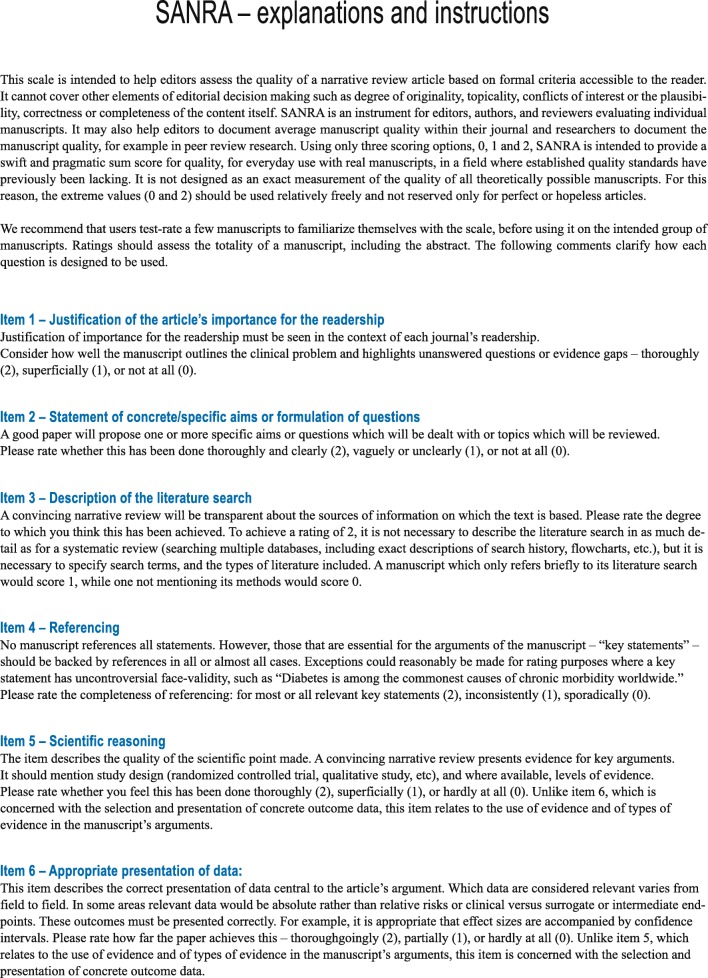
BACKGROUND: Narrative reviews are the commonest type of articles in the medical literature. However, unlike systematic reviews and randomized controlled trials (RCT) articles, for which formal instruments exist to evaluate quality, there is currently no instrument available to assess the quality of narrative reviews. In response to this gap, we developed SANRA, the Scale for the Assessment of Narrative Review Articles. METHODS: A team of three experienced journal editors modified or deleted items in an earlier SANRA version based on face validity, item-total correlations, and reliability scores from previous tests. We deleted an item which addressed a manuscript's writing and accessibility due to poor inter-rater reliability. The six items which form the revised scale are rated from 0 (low standard) to 2 (high standard) and cover the following topics: explanation of (1) the importance and (2) the aims of the review, (3) literature search and (4) referencing and presentation of (5) evidence level and (6) relevant endpoint data. For all items, we developed anchor definitions and examples to guide users in filling out the form. The revised scale was tested by the same editors (blinded to each other's ratings) in a group of 30 consecutive non-systematic review manuscripts submitted to a general medical journal. RESULTS: Raters confirmed that completing the scale is feasible in everyday editorial work. The mean sum score across all 30 manuscripts was 6.0 out of 12 possible points (SD 2.6, range 1-12). Corrected item-total correlations ranged from 0.33 (item 3) to 0.58 (item 6), and Cronbach's alpha was 0.68 (internal consistency). The intra-class correlation coefficient (average measure) was 0.77 [95% CI 0.57, 0.88] (inter-rater reliability). Raters often disagreed on items 1 and 4. CONCLUSIONS: SANRA's feasibility, inter-rater reliability, homogeneity of items, and internal consistency are sufficient for a scale of six items. Further field testing, particularly of validity, is desirable. We recommend rater training based on the "explanations and instructions" document provided with SANRA. In editorial decision-making, SANRA may complement journal-specific evaluation of manuscripts-pertaining to, e.g., audience, originality or difficulty-and may contribute to improving the standard of non-systematic reviews.
Overview
CoChat Summary
TL;DR
SANRA is a six-item, 0–2 scale (maximum 12) for assessing the quality of narrative review articles, developed and field-tested by three journal editors. In 30 consecutive non-systematic review manuscripts, it showed feasible use, sufficient internal consistency and inter-rater reliability, and a modest association with editorial acceptance.
Key findings
- Across 30 manuscripts (90 ratings), the mean SANRA sum score was 6.0 out of 12 (SD 2.6, range 1–12, median 6).
- Internal consistency was Cronbach’s alpha 0.68; corrected item-total correlations ranged from 0.33 (item 3) to 0.58 (item 6).
- Inter-rater reliability was an intra-class correlation coefficient (average measure) of 0.77 [95% CI 0.57, 0.88]; raters often disagreed on items 1 and 4.
- Average SANRA scores were modestly associated with editorial acceptance (mean 6.6, SD 1.9, n = 17) versus rejection (mean 5.1, SD 2.1, n = 13), point biserial correlation 0.37 (t = 2.09, df 28; two-sided p = 0.046).
Methods
- SANRA was developed between 2010 and 2017 by three experienced editors at Deutsches Ärzteblatt; the revised six-item version deleted an item on writing and accessibility due to poor inter-rater reliability.
- The revised scale was tested on 30 consecutive non-systematic review manuscripts submitted to Deutsches Ärzteblatt in 2015; three editor-raters scored them independently and blinded to each other’s ratings.
- Analyses included descriptive statistics, Cronbach’s alpha, corrected item-total correlations, average-measure intra-class correlation using a two-way random effects model (consistency definition), and a post hoc point biserial correlation between SANRA sum scores and acceptance/rejection.
Limitations
- The paper states the main limitation is sample size: 30 manuscripts was a compromise between representativeness, power, and feasibility, and took about 6 months to sample.
- The authors state that the scale’s authors were also the test-raters, so inter-rater reliability may be lower in groups less familiar with SANRA; the study also did not assess test-retest reliability, and results are study-specific.
- The paper acknowledges restricted content validity because SANRA is limited to six items and is a critical appraisal tool rather than a reporting guideline; criterion validity evidence is post hoc and weak, and no established cut-offs exist for comparing manuscripts across settings.
Model-written summary. Check it against the paper before relying on it.
Integrity signals
Registry
Cites
Statistics
Figures
Verification
Claims the paper makes
3 Valid · 0 Not valid · 5 Not checked · 27 Own results and interpretations
The cited sources support only part of this claim — read each source’s verdict below.
In the paper
“Bastian et al. found that they constitute the largest share of all text types in medicine and they concluded that they “remain the staple of medical literature” [1].”
- Also stated in: § Background · plain
“Narrative reviews are the commonest type of articles in the medical literature.”
§ SANRA—a scale for the quality assessment of narrative review articles > Background
What the sources say
- Partly supportedcites [1] Bastian H Glasziou P Chalmers I Seventy-five trials and eleven systematic reviews a day: how will we ever keep up? PLoS Med 2010 7 9 e1000326 10.1371/journal.pmed.1000326 20877712 PMC2943439 sourceExperimental — accuracy not yet measured
In “How Close Are We to Archie Cochrane’s Goal?” and the Summary Points (pages unavailable), the paper calls non-systematic narrative reviews the staple of medical literature synthesis. It does not say they constitute the largest share of all medical text types; that extends a claim about literature synthesis to medical literature as a whole. (LLM, conf=0.88)
plain- Asserted: passes — The authors put it forward as true.
- Checkable: passes — It can be checked against evidence.
- Load-bearing: unclear — It is unclear whether the paper’s conclusions depend on it.
- Based: passes — The paper gives a reason why it holds.
- Also stated in: § Background · plain
The sources with a verdict support this claim; the rest weren’t checked yet, have no full text we could read, or their verdicts aren’t rated yet.
In the paper
“non-systematic reviews or narrative reviews have been widely criticized as unreliable [1, 4].”
§ SANRA—a scale for the quality assessment of narrative review articles > Background
What the sources say
- Supportedcites [1] Bastian H Glasziou P Chalmers I Seventy-five trials and eleven systematic reviews a day: how will we ever keep up? PLoS Med 2010 7 9 e1000326 10.1371/journal.pmed.1000326 20877712 PMC2943439 source
In “How Close Are We to Archie Cochrane’s Goal?”, the paper describes reviews not conducted systematically as having great potential for error and calls them less reliable forms of information. Box 1 also says that articles and textbooks had highlighted the risk of bias and chance in reviews. Together, these passages support the broad characterization that narrative reviews have been criticized as unreliable; page numbers are not provided in our copy. (LLM, conf=0.89)
- Not checked — no full text of the sourcecites [4] Mulrow CD The medical review article: state of the science Ann Intern Med 1987 106 485 488 10.7326/0003-4819-106-3-485 3813259 source
plain- Asserted: passes — The authors put it forward as true.
- Checkable: passes — It can be checked against evidence.
- Load-bearing: passes — The paper’s conclusions depend on it.
- Based: passes — The paper gives a reason why it holds.
- Supported
A result the paper reports from its own data — it cites no other source for it, so there is none to check. The quote shows it is in the paper.
In the paper
“Cronbach’s alpha was 0.68 (internal consistency).”
- Also stated in: § Results · plain
“The scale’s internal consistency, measured as Cronbach’s alpha, was 0.68.”
§ SANRA—a scale for the quality assessment of narrative review articles > Abstract > Results
plainn = 90- Asserted: passes — The authors put it forward as true.
- Checkable: passes — It can be checked against evidence.
- Load-bearing: passes — The paper’s conclusions depend on it.
- Based: passes — The paper gives a reason why it holds.
- Also stated in: § Results · plain
A result the paper reports from its own data — it cites no other source for it, so there is none to check. The quote shows it is in the paper.
In the paper
“Raters often disagreed on items 1 and 4.”
- Also stated in: § Results · plain
“Disagreements most often occurred with regard to items 1 and 4.”
§ SANRA—a scale for the quality assessment of narrative review articles > Abstract > Results
plain- Asserted: passes — The authors put it forward as true.
- Checkable: passes — It can be checked against evidence.
- Load-bearing: unclear — It is unclear whether the paper’s conclusions depend on it.
- Based: passes — The paper gives a reason why it holds.
- Also stated in: § Results · plain
A result the paper reports from its own data — it cites no other source for it, so there is none to check. The quote shows it is in the paper.
In the paper
“The intra-class correlation coefficient (average measure) was 0.77 [95% CI 0.57, 0.88] (inter-rater reliability).”
- Also stated in: § Results · plain
“The intra-class correlation coefficient (average measure) amounted to 0.77 [95% CI 0.57, 0.88; F 4.3; df 29, 58].”
§ SANRA—a scale for the quality assessment of narrative review articles > Abstract > Results
plain- Asserted: passes — The authors put it forward as true.
- Checkable: passes — It can be checked against evidence.
- Load-bearing: passes — The paper’s conclusions depend on it.
- Based: passes — The paper gives a reason why it holds.
- Also stated in: § Results · plain
14 more claims
Create a free account to see all 35 claims and to verify the 3 references still open.
- Probably not a substantial claim. 11
- It may state two separate claims as one. 11
Claims other papers make about this one
Each is checked against this paper’s own text: does it say what the citing paper says it does?
The source backs part of the claim, not all of it — or backs it for a different population, condition or comparison.
In the citing paper
“The review was conducted and reported in accordance with the principles of the Scale for the Assessment of Narrative Review Articles (SANRA), which provides a validated framework for ensuring methodological transparency, scientific rigor, and balanced interpretation in narrative reviews [ 19 ].”
From Paracetamol: A History of Assumptions, Errors, and Evidence Reversals in Pain Management (2026) · cites this paper as [19]
Experimental — accuracy not yet measuredThe source backs part of the claim, not all of it — or backs it for a different population, condition or comparison.
In the citing paper
“As a narrative review, the present work does not include an aggregated quantitative assessment and is more exposed to selection subjectivity than a registered systematic review [124,125].”
From Berberine-Drug Interactions: Mechanisms, Clinical Relevance and Risk Stratification-A Narrative Review (2026) · cites this paper as [124]
Experimental — accuracy not yet measuredThe cited source says what the claim attributes to it.
In the citing paper
“This work is designed as a structured narrative review, with transparent reporting of the documentation strategy, guided by the quality criteria of the Scale for the Assessment of Narrative Review Articles (SANRA) [124].”
From Berberine-Drug Interactions: Mechanisms, Clinical Relevance and Risk Stratification-A Narrative Review (2026) · cites this paper as [124]
The cited source says what the claim attributes to it.
In the citing paper
“we used the following:-Cochrane Risk of Bias 2 (RoB 2) [29] and PEDRO scale tools for RCTs.-AMSTAR 2 [30] checklist for systematic review.-SANRA (Scale for the Assessment of Narrative Review Articles) [31] for narrative reviews.-JBI Checklist for Text and Opinion [32] for expert opinion papers.”
From Pelvic Floor Muscle Training Following Surgery for Pelvic Organ Prolapse: Recommendation from Scientific Literature (2026) · cites this paper as [31]
The cited source says what the claim attributes to it.
In the citing paper
“Data analysis employed a narrative and thematic synthesis methodology,adhering to the SANRA guidelines for narrative reviews (32).”
From Ethical issues in multi-agent AI systems for healthcare: a narrative review (2026) · cites this paper as [32]
12 more claims about this paper
Create a free account to see every claim other papers make about this one.
Citations
Cites
Shea, B. J., Reeves, B. C., Wells, G., Thuku, M., Hamel, C., Moran, J., Moher, D., Tugwell, P., Welch, V., Kristjansson, E., et al. (2017) · BMJ · doi:10.1136/bmj.j4008 · Cited by 10,636 · cited 2×
“Critical appraisal tools have been developed for systematic reviews (e.g., AMSTAR 2 [A MeaSurement Tool to Assess Systematic Reviews] [7]) and papers on RCTs (e.g., the CASP [Critical Appraisal Skills Program] checklist for randomized trials [8]) and other types of medical studies.”
BackgroundStreiner, D. L., & Norman, G. R. (2008) · doi:10.1093/acprof:oso/9780199231881.001.0001 · Cited by 2,631
Critical appraisal skills programme
Singh, J. (2013) · Journal of Pharmacology and Pharmacotherapeutics · doi:10.4103/0976-500x.107697 · Cited by 2,556
Guidelines for Reporting Reliability and Agreement Studies (GRRAS) were proposed
Kottner, J., Audigé, L., Brorson, S., Donner, A., Gajewski, B. J., Hróbjartsson, A., Roberts, C., Shoukri, M., & Streiner, D. L. (2011) · Journal of Clinical Epidemiology · doi:10.1016/j.jclinepi.2010.03.002 · Cited by 2,174
The Mass Production of Redundant, Misleading, and Conflicted Systematic Reviews and Meta‐analyses
IOANNIDIS, J. P. A. (2016) · The Milbank Quarterly · doi:10.1111/1468-0009.12210 · Cited by 1,483 · cited 1×
“While systematic reviews are not per se superior articles and while certain systematic reviews have been criticized lately [3], non-systematic reviews or narrative reviews have”
BackgroundSeventy-five trials and eleven systematic reviews a day: how will we ever keep up?
Bastian, H., Glasziou, P., & Chalmers, I. (2010) · PLoS Medicine · doi:10.1371/journal.pmed.1000326 · Cited by 1,188 · cited 2×
“found that they constitute the largest share of all text types in medicine and they concluded that they “remain the staple of medical literature” [1].”
BackgroundThe Medical Review Article: State of the Science
MULROW, C. D. (1987) · Annals of Internal Medicine · doi:10.7326/0003-4819-106-3-485 · Cited by 856 · cited 1×
“been widely criticized as unreliable [1, 4].”
Writing a narrative biomedical review: considerations for authors, peer reviewers, and editors
Gasparyan, A. Y., Ayvazyan, L., Blackmore, H., & Kitas, G. D. (2011) · Rheumatology International · doi:10.1007/s00296-011-1999-3 · Cited by 694 · cited 1×
“[13], for example, have provided guidance for writing narrative reviews, and Byrne [14] as well as Pautasso [15] has written, from different angles, thoughtful editorials on improving narrative reviews and presented lists of key features of writing a good review—lists that naturally overlap with SANRA items (e.”
BackgroundTen Simple Rules for Writing a Literature Review
Pautasso, M. (2013) · PLoS Computational Biology · doi:10.1371/journal.pcbi.1003149 · Cited by 272 · cited 3×
“[13], for example, have provided guidance for writing narrative reviews, and Byrne [14] as well as Pautasso [15] has written, from different angles, thoughtful editorials on improving narrative reviews and presented lists of key features of writing a good review—lists that naturally overlap with SANRA items (e.”
BackgroundImproving the peer review of narrative literature reviews
Byrne, J. A. (2016) · Research Integrity and Peer Review · doi:10.1186/s41073-016-0019-2 · Cited by 159 · cited 3×
“[13], for example, have provided guidance for writing narrative reviews, and Byrne [14] as well as Pautasso [15] has written, from different angles, thoughtful editorials on improving narrative reviews and presented lists of key features of writing a good review—lists that naturally overlap with SANRA items (e.”
Background
Research works printed but not linked: 3
- Higgins JPT, Green S. (eds.). Cochrane Handbook for Systematic Reviews and Interventions. Version 5.1.0. The Cochrane Collaboration 2011, section 1.2.2., www.handbook.cochrane.org, retrieved on Oct 31, 2018.
- Baethge C Mertens S Goldbeck-Wood S Development of a quality score for the assessment of non-systematic review articles (SANRA) Poster, Seventh International Congress on Peer Review and Biomedical Publication 2013 USA Chicago, Illinois
- Baethge C Goldbeck-Wood S Mertens S A scale for the assessment of non-systematic review articles (SANRA) Poster, Eighth International Congress on Peer and Biomedical Publication 2017 USA Chicago, Illinois
Cited by
Items 1,701–1,800 of 4,334
Blank, L., Khorsandi, J., England-Kennedy, E. S., Banerjee, S. K., Kopera-Frye, K., Sagaribay, R., Khubchandani, J., & Batra, K. (2026) · Brain Sciences · doi:10.3390/brainsci16050522 · Cited by 2
Ceinos, R., Dubois, M., Attal, J., Vigouroux, F., Flottes, Y., Fasham, T., Dursun, E., Pélissier, B., D’Agostino, M. A., & François, P. (2026) · BDJ Open · doi:10.1038/s41405-026-00446-9 · Cited by 1
“In accordance with the SANRA recommendations for narrative reviews [21], this clinical-oriented narrative review aims to synthesize current evidence on light-curing units, focusing on their radiometric performance, clinical decision-making, and emerging optical functionalities relevant to…”
Burtovaja, N., Burtovojs, S., Dekhtyar, Y., Hauser, R. A., & Ribickis, L. (2026) · Bioengineering · doi:10.3390/bioengineering13050584 · Cited by 1
“…or meta-analysis would be poorly suited to the main objective of the present work, which is not to pool homogeneous effect estimates for a single intervention or outcome, but to synthesize translationally relevant evidence across modalities, levels of measurement, and validation paradigms [25–28].”
Fayad, M. I., Moussa, R., Abdel-Gawwad, E. A., Laithy, A., Mahmoud, E. E., Shon, A. A., Hassan, S. M., eldain, A. K., Al-Wakeel, B., & Helal, M. A. (2026) · Cureus · doi:10.7759/cureus.109416 · Cited by 1
Recent advancements and clinical translation of cinnamaldehyde derivatives in therapeutics
Shakir, S. U., Khan, S. A., Ullah, M., Khan, A., Khan, N. R., & Khan, I. (2026) · Drug Development and Industrial Pharmacy · doi:10.1080/03639045.2026.2678494 · Cited by 1
“Modified PRiSMA permits organized reporting without suggesting quantitative synthesis, following published guidance for narrative reviews [23].”
Nikolov, N. N., Yambolov, S. N., Grigorov, R., & Yankov, Y. G. (2026) · Cureus · doi:10.7759/cureus.109529 · Cited by 1
“…trials, Risk Of Bias In Non-randomized Studies of Interventions (ROBINS-I) [43] for non-randomized trials, Scale for the Assessment of Narrative Review Articles (SANRA) [44] for narrative reviews, and A MeaSurement Tool to Assess Systematic Reviews 2 (AMSTAR 2) [45] for systematic reviews.”
Hudson, É., Lessard‐Deschênes, C., Michaud, A.-A. D., & Goulet, M. (2026) · International Journal of Mental Health Nursing · doi:10.1111/inm.70273 · Cited by 1
Virtual cell: Current perspectives and future prospects
Li, J., Zhang, H., Zhang, W., Li, N., Zhao, F., & Shen, G. (2026) · Journal of International Medical Research · doi:10.1177/03000605261425080 · Cited by 2
“11 Despite the promising progress, the field of VC is currently facing a critical transition phase.”
The Role of Natural Anthelmintics in Small Ruminant Health: A Global Narrative Review
Mahayri, T. M., Serra, A., Dessì, F., Demontis, M. P., Varoni, M. V., Moniello, G., & Garippa, G. (2026) · Animals · doi:10.3390/ani16111653 · Cited by 2
“This narrative review was conducted between October 2025 and February 2026, following structured principles for transparent and reproducible literature synthesis in accordance with the SANRA recommendations [12].”
Dutra, M. J., Bezerra, H. K. F., Adorno-Farías, D., Morales, S., Rucatti, G. G., Schuch, L. F., Ávila, I. M., Molina‐Berríos, A., Sandoval, J. J., Tarquínio, S. B. C., et al. (2026) · Cancer Epidemiology · doi:10.1016/j.canep.2026.103121 · Cited by 1
Sasin, D., Rybczynski, B., Maj, B. W., Chwaszcz, J., Pruc, M., Niewiadomska, I., & Szarpak, Ł. (2026) · Journal of Clinical Medicine · doi:10.3390/jcm15114223 · Cited by 1
“…conducted in accordance with the principles of the Scale for the Assessment of Narrative Review Articles (SANRA), with an emphasis on a clearly defined rationale, explicit aims, transparent literature search, appropriate referencing, scientific reasoning, and balanced presentation of evidence [33].”
Salido-Guadarrama, I., Cruz-Orozco, O., Camacho‐Arroyo, I., Quintero, J. C., Silvestri-Tomassoni, J. R., Sánchez-Ramírez, B., & Rodríguez‐Dorantes, M. (2026) · International Journal of Molecular Sciences · doi:10.3390/ijms27114888 · Cited by 1
“…imaging or persistent symptoms [35,46] Universal laparoscopy with systematic peritoneal inspection and biopsy; histological confirmation required [9,24] Rationale for reference standard design Selective laparoscopy mirrors contemporary guidelines; ethical and feasible in large cohorts [35]…”
InfluentialSuzuki, K., Ooki, A., Shinozaki, E., Toyokawa, E., Yoshikawa, K., Shiozawa, M., Maeda, S., Yamaguchi, K., & Osumi, H. (2026) · Cancer Control · doi:10.1177/10732748261458456 · Cited by 2
Narodova, E. A. (2026) · Biology · doi:10.3390/biology15110850 · Cited by 3
“The SANRA framework was used as a reporting-oriented self-assessment tool rather than as a formal scoring instrument for included studies [18].”
Otogenic Lateral Sinus Thrombosis: Controversies and Current Management Strategies
Bizdu-Branovici, A. M., Gherasie, L.-M., Zica, M. D., Rusescu, A., Ioniță, I., Hainăroșie, R., & Zainea, V. (2026) · Medicina · doi:10.3390/medicina62061093 · Cited by 1
“SANRA was not used as a risk of bias instrument for individual observational studies because the tool was developed to assess narrative review quality rather than primary study validity [7].”
An, Z.-L., Wang, Z., Zhao, W.-H., Peng, L.-J., & Gao, E.-M. (2026) · Stem Cell Reviews and Reports · doi:10.1007/s12015-026-11168-8 · Cited by 1
“The review was also informed by SANRA principles for narrative reviews to enhance transparency [ 64 ].”
The State of the Art in Chronic Prurigo Nodularis
Serra‐Baldrich, E., Flórez, Á., Manresa, M. J., de Frutos, F. J. O., Pereyra-Rodríguez, J.-J., Pérez, B., & Figueras, I. G. (2026) · Dermatology and Therapy · doi:10.1007/s13555-026-01804-z · Cited by 1
“However, we describe the search process to enhance transparency and adhere to the princi‑ ples of the Scale for the Assessment of Narrative Review Articles (SANRA) [18].”
Context-responsive psychiatry in low-resource settings: A narrative review and evidence synthesis
Wattanakul, S., Konyushok, M., Rattanachai, A., Thanakorn, N., Srisuwan, S., Suwanrat, M., Chankaew, P., Pongsawat, R., Siriwat, A., Siriphan, K., et al. (2026) · International Journal of Science and Research Archive · doi:10.30574/ijsra.2026.19.3.1250 · Cited by 1
Gut microbiome-derived metabolites as predictors of bariatric surgery outcomes
Alum, E. U., Emeruwa, A. C., Obasi, D. C., Okoroh, P. N., Aniokete, U. C., Akwari, A. A., Uzor, S., Eji, M. O., & Amadi, E. B. (2026) · Clinica Chimica Acta · doi:10.1016/j.cca.2026.121153 · Cited by 1
Ghoreishizadeh, M., Farajzadeh, M. A., Barazandeh, S., & Mogaddam, M. R. A. (2026) · Critical Reviews in Analytical Chemistry · doi:10.1080/10408347.2026.2678517 · Cited by 2
Al-Shamsi, H. O., Abdelwahed, N., Abdelwahab, S. İ., Hussein, M. M., Abyad, A. M., Rafii, S., Jaafar, H., Otsmane, S., Jabbar, D. A., Abdellatif, H., et al. (2026) · Diagnostics · doi:10.3390/diagnostics16121790 · Cited by 1
“This review was conducted and reported in accordance with the SANRA recommendations for narrative reviews [23].”
Hailu, K. T., Abriha, F. N., Duguma, Y. M., Haddad, R. R., Liyew, T., & Kasagga, A. (2026) · Cureus · doi:10.7759/cureus.110657 · Cited by 2
Zhou, Y., & Jiang, T. (2026) · Frontiers in Neuroscience · doi:10.3389/fnins.2026.1854892 · Cited by 1
Irikefe, P. O., Ullah, I., Falahat, M., Rahman, S. U., Kee, D. M. H., & Akpowene, T. O. (2026) · Asian Education and Development Studies · doi:10.1108/aeds-02-2026-0086 · Cited by 2
Narrative Reviews in Contemporary Medical Literature: An Overview of Current Role and Relevance
Bethiun, S., Ananth, R. C. N., Philip, S., Shiamala, J., Maheswaran, T., Ilayaraja, V., & Sivaguru, K. (2026) · Cureus · doi:10.7759/cureus.110705 · Cited by 2
“The SANRA, with its six-item structure addressing the explanation of importance, aims, literature search, referencing, scientific reasoning, and presentation of relevant endpoint data, represents an important step toward standardizing narrative review quality assessment [4].”
InfluentialPise, K. H., Chavan, S., & Gurav, Y. K. (2026) · Discover Public Health · doi:10.1186/s12982-026-02269-3 · Cited by 1
“In this narrative policy review we have incorporated a structured search methodology to improve transparency and reproducibility, as is recommended by the Scale for the Assessment of Narrative Review Articles (SANRA) [12] framework.”
Vasios, G. K., Gialeli, M., Antasouras, G., & Giaginis, C. (2026) · Nutrients · doi:10.3390/nu18121925 · Cited by 2
Broul, M., Hujová, A., Liegertová, M., Banýrová, J., Vostrý, M., & Daďová, K. (2026) · International Journal of Nursing Studies Advances · doi:10.1016/j.ijnsa.2026.100601 · Cited by 1
“The review and reporting approach was aligned with the Scale for the Assessment of Narrative Review Articles to improve clarity of the aim, search description, referencing, scientific reasoning and evidence handling (Baethge et al., 2019).”
Tomaselli, A., Luca, A., Lentini, M., Lechien, J. R., Mollame, F., Caranti, A., Vicini, C., Lazzeroni, M., Capaccio, P., Iannella, G., et al. (2026) · Neurology International · doi:10.3390/neurolint18060117 · Cited by 1
“To ensure methodological rigour and transparency, we conducted this narrative review in accordance with the Scale for the Assessment of Narrative Review Articles (SANRA) [14].”
Lima, C. D. S., & Lannes, S. C. D. S. (2026) · Journal of Texture Studies · doi:10.1111/jtxs.70094 · Cited by 1
Women living with diabetes: Overlooked and under‐recognised, the psychosocial impact
Forde, R., Forbes, A., Adams, D., Celik, A., Davidsen, E., de Wit, M., Hadjiconstantinou, M., Hashim, R., Munda, A., Nefs, G., et al. (2026) · Diabetic Medicine · doi:10.1111/dme.70389 · Cited by 1
“13,14 This review aims to provide a comprehensive understanding of the unique challenges faced by women living with diabetes and to identify critical gaps in the evidence base to inform future research, policy, and clinical care (Table 1).”
Killoughery, I. T., Alexander, J., & Yiannaki, C. (2026) · International Journal of Sports Science & Coaching · doi:10.1177/17479541261456104 · Cited by 1
Weng, S., Ding, C., Zhang, H., Lai, Y., Zhuang, W., & Chai, D. (2026) · Molecular Biology Reports · doi:10.1007/s11033-026-12140-y · Cited by 1
“This search strategy was intended for a narrative rather than systematic review, in accordance with SANRA principles [ 9].”
Dominikowski, A., Rękoś, Z., Olejarz, M., Szczepanek‐Parulska, E., Domin, R., & Ruchała, M. (2026) · Frontiers in Endocrinology · doi:10.3389/fendo.2026.1822475 · Cited by 1
“…support transparency of narrative-review quality, compliance with the SANRA tool was self-assessed by the authors across the six SANRA domains; the full domain-by-domain assessment with brief justi fi cations and pointers to the relevant manuscript sections is provided as Supplementary Table 1 (32).”
Shuaibu, A., Juma, N. S., & Shuaibu, A. (2026) · Food Biophysics · doi:10.1007/s11483-026-10170-4 · Cited by 1
“Studies were prioritized for inclusion when they reported data or concepts directly relevant to structured”
Social psychological dimensions of physical activity: a state-of-the-art review of reviews
Rhodes, R. E., McKinnon, K., Barton, J., & Beauchamp, M. R. (2026) · Health Psychology Review · doi:10.1080/17437199.2026.2681583 · Cited by 1
Bereda, G. (2026) · Neuropsychopharmacology Reports · doi:10.1002/npr2.70141 · Cited by 1
“The methodological quality of the included studies was assessed using the Scale for the Assessment of Narrative Review Articles (SANRA) [13].”
Lucki, M., Lucka, E., Mitkowski, P. P., & Lesiak, M. (2026) · Cells · doi:10.3390/cells15131132 · Cited by 1
“Of the 69 cited references, one publication referred to the SANRA methodology and was not included in evidence grading [19].”
Impact of Moderate Wine Consumption on Type 2 Diabetes
Giacosa, A., Masip, J., Fradera, U., Estruch, R., & Rondanelli, M. (2026) · Nutrients · doi:10.3390/nu18122006 · Cited by 1
“Study selection was performed in accordance with the SANRA (Scale for the Assessment of Narrative Review Articles) guidelines [12–15].”
Community pharmacists and telepharmacy: a narrative review of key barriers and facilitators
Hareem, A., Stevens, J. E., Park, J. S., Stupans, I., Hsu, T., & Wang, K. (2026) · Journal of Pharmacy Practice and Research · doi:10.1002/jppr.70068 · Cited by 1
Brookman, R., Christensen, J., Maurice, O. R., Aghaei, M., Cass, A. S., Monzaviyan, S., Shatnawi, E., Carter, M., Tran, J., McIlwain, N., et al. (2026) · Journal of Alzheimer s Disease · doi:10.1177/13872877261459125 · Cited by 1
Chen, S. Y., Liu, Q., & Hong, Z. (2026) · Frontiers in Sports and Active Living · doi:10.3389/fspor.2026.1849255 · Cited by 1
“This scope-limited application is consistent with structured narrative review methodology (22).”
InfluentialProteomic landscapes of post-COVID condition: biomarkers and translational pathways
Bansal, A. (2026) · Frontiers in Immunology · doi:10.3389/fimmu.2026.1783192 · Cited by 1
“The Scale for the Assessment of Narrative Review Articles (SANRA) was used as a reporting guide to improve clarity and structure (6); however, no formal risk − of − bias assessment or quantitative synthesis was performed, consistent with the scope of a rapid narrative review.”
Obando-Rodríguez, J. S., Vieira-Serna, S., Peralta, J., Rodríguez, J., Estrada, E. E., López-Saldarriaga, L., Levin, G., & Pareja, R. (2026) · Cancers · doi:10.3390/cancers18132058 · Cited by 1
“…the SANRA (Scale for the Assessment of Narrative Review Articles) quality criteria, ensuring a clear statement of importance and aims, transparent description of the literature search, appropriate referencing, explicit presentation of evidence levels, and reporting of relevant endpoint data [23].”
McManus, S., Pendergast, D., & Kanasa, H. (2026) · Frontiers in Sustainable Food Systems · doi:10.3389/fsufs.2026.1813035 · Cited by 2
The fundamentals of the design of organized practice in team sports
Petiot, G. H., Coutinho, D., Farrokh, D., Olthof, S. B. H., & Clemente, F. M. (2026) · Team Sports Studies · doi:10.1016/j.tss.2026.100009 · Cited by 2
Oftebro, I., Olsen, B., Enger, M. M., Hassellund, S. S., & Solberg, L. B. (2026) · Injury · doi:10.1016/j.injury.2026.113480 · Cited by 1
Molla, A., Bebie, M., Solomou, A. D., & Skoufogianni, E. (2026) · Sustainability · doi:10.3390/su18136586 · Cited by 2
Zhang, Z., & Zhou, Y. (2026) · Frontiers in Aging Neuroscience · doi:10.3389/fnagi.2026.1831208 · Cited by 1
“The reporting approach was informed by principles from PRISMA-ScR and SANRA for transparent literature identification and narrative evidence synthesis (Tricco et al., 2018; Baethge et al., 2019).”
Dias, A., & Cainé, L. (2026) · Journal of Forensic and Legal Medicine · doi:10.1016/j.jflm.2026.103200 · Cited by 3
Patient-centred education for ketamine and esketamine therapies in mood disorders
Kachlik, Z., Cubała, W. J., & Walaszek, M. (2026) · Therapeutic Advances in Psychopharmacology · doi:10.1177/20451253261456405 · Cited by 1
“32 Importantly, existing safety-focused instruments such as the KSET provide robust frameworks for adverse-event monitoring 11 but do not address broader psychoeducational domains, including expectation management, visit preparation, family involvement or substance misuse counselling.”
Emergency department medical care during civil unrest: a narrative review
Carenzo, L., Leuci, L., Dünser, M. W., Granholm, F., Rehn, M., Hüser, C., Ranse, J., Park, C., Tin, D., & Caviglia, M. (2026) · Scandinavian Journal of Trauma Resuscitation and Emergency Medicine · doi:10.1186/s13049-026-01656-8 · Cited by 1
“This article is a narrative review [19, 20], developed and reported in accordance with the Scale for the Assessment of Narrative Review Articles (SANRA) [21].”
Moumen, A., & Koutaya, A. (2026) · International Journal of Accounting, Finance, Auditing, Management and Economics · doi:10.5281/zenodo.21207683 · Cited by 1
Mechanisms of resveratrol in cartilage injury repair and protection: A review
Li, S., Wang, W., & a, L. J. (2026) · Journal of International Medical Research · doi:10.1177/03000605261464885 · Cited by 1
Tinland, J., & de Montgolfier, S. (2026) · SSM - Qualitative Research in Health · doi:10.1016/j.ssmqr.2026.100822 · Cited by 1
Papaneophytou, C. P., & Petrou, C. C. (2026) · Frontiers in Bioscience-Landmark · doi:10.31083/fbl49369 · Cited by 1
Biology of regeneration in earthworms: mechanisms, factors and molecular insights. A review
Kumar, A., Mahato, A., Haider, S., Hembram, D., Soren, L., Mandal, C., Hansdah, A. K., & Priya, S. (2026) · Romanian Journal of Ecology & Environmental Chemistry · doi:10.21698/rjeec.2026.109 · Cited by 1
Gong, Y., Freitas, E. N. D. A., & Cabrera, V. E. (2026) · Sustainability · doi:10.3390/su18136900 · Cited by 1
“…explicit inclusion criteria, and a complete inventory of included external literature and worked examples via Appendix A Tables A1 and A2 [80,82]—and use a narrative-review quality lens (e.g., explicit rationale, structured synthesis, and balanced limitations) to support readability and rigor [81].”
Kobayashi, H. (2026) · Reproductive Biology and Endocrinology · doi:10.1186/s12958-026-01588-z · Cited by 2
“This narrative review was conducted and reported with consideration of the reporting standards of the Scale for the Assessment of Narrative Review Articles (SANRA) [27].”
Aetiology of early implant failure: a scoping review
Scoffier, J., Pontens, C., Catros, S., & l’Alzit, F. R. (2026) · Clinical Oral Investigations · doi:10.1007/s00784-026-06992-8 · Cited by 1
“The narrative reviews included [ 26, 27] were assessed using the Scale for the Assessment of Narrative Review Articles (SANRA) [ 28].”
Boone, D. L., Borges, V., & Ferraz, H. B. (2026) · Parkinsonism & Related Disorders · doi:10.1016/j.parkreldis.2026.108420 · Cited by 1
Suitability of sedative usage in patients undergoing cardiovascular surgery
Martin, N. J., Brinkman, H. M., Ellis, S., Nabzdyk, C. S., Ortoleva, J. P., Wittwer, E. D., Ursoleo, J. D., Wieruszewski, P. M., & Monaco, F. (2026) · Expert Review of Cardiovascular Therapy · doi:10.1080/14779072.2026.2703069 · Cited by 1
“This narrative review was conducted in adherence to the Scale for the Assessment of Narrative Review Articles (SANRA) [13].”
Leone, R., Rosa, A., Ricciardi, W., & Gualano, M. R. (2026) · Societies · doi:10.3390/soc16070215 · Cited by 1
“To support transparent reporting, the review was prepared with reference to the recommendations of the SANRA (Scale for the Assessment of Narrative Review Articles) framework [7].”
Zhang, K., Fan, Y., & Wang, Y. (2026) · Journal of International Medical Research · doi:10.1177/03000605261465295 · Cited by 1
Rusu, M., Dincă, V., Tudose, R., & Bănică, D. (2026) · Annals of Anatomy - Anatomischer Anzeiger · doi:10.1016/j.aanat.2026.152884 · Cited by 1
Oral Adverse Effects of Semaglutide Therapy: A Narrative Review
Al-Zawawi, A. S. (2026) · Journal of International Society of Preventive and Community Dentistry · doi:10.4103/jispcd.jispcd_5_26 · Cited by 1
“[18] The literature search was conducted on November 15, 2025.”
Šantić, R., Martinovic, L., Kumrić, M., Pavlović, N., Martinović, D., Jukić, L., Pogorelić, Z., & Božić, J. (2026) · Journal of Cardiovascular Development and Disease · doi:10.3390/jcdd13070321 · Cited by 1
“…prepared with attention to the Scale for the Assessment of Narrative Review Articles (SANRA), particularly regarding justification of the article’s importance, clarity of aims, description of the literature search, referencing, scientific reasoning, and appropriate presentation of evidence [43].”
Xu, Z. Y., Lian, H., & Ren, X. (2026) · Frontiers in Medicine · doi:10.3389/fmed.2026.1873520 · Cited by 1
“This article uses a narrative review approach because its purpose is conceptual synthesis and curriculum model development rather than pooled effect estimation (15, 16).”
InfluentialClemente‐Suárez, V. J., Sancho-Haro, E. S., Yáñez-Sepúlveda, R., Tornero-Aguilera, J. F., & Martín-Rodríguez, A. (2026) · Nutrients · doi:10.3390/nu18142291 · Cited by 1
“…was synthesised without quantitative pooling, the SWiM (Synthesis Without Meta-analysis) framework [28] was used as a reporting guide, and the SANRA scale for the quality of narrative reviews [29] was applied internally to support reporting transparency rather than as an external quality warrant.”
Cortesi, A., Tzanetakou, I. P., Giannakou, K., Tzanetakou, A. B. , & Hadjimbei, E. (2026) · Frontiers in Aging · doi:10.3389/fragi.2026.1872170 · Cited by 1
“A brief methods description is retained for transparency, to describe the databases searched, the terms used, and the prioritisation criteria applied, consistent with best practice in narrative reviews (Baethge et al., 2019).”
Gherbon, A.-M.-C., Frandeș, M., Roman, D., Gherbon, A., Goguta, L. M., Timar, R. Z., & Albai, O. (2026) · Journal of Clinical Medicine · doi:10.3390/jcm15145510 · Cited by 1
“…on the bidirectional relationship between MetS and periodontitis, using the SANRA (Scale for the Assessment of Narrative Review Articles) framework [13], with a focus on shared pathophysiological mechanisms, epidemiological evidence, interventional outcomes, and interdisciplinary clinical…”
Oleanolic acid as an adjunct in type 2 diabetes mellitus
Günther, A., Bednarczyk–Cwynar, B., & Malinowski, M. (2026) · Journal of Clinical and Translational Research · doi:10.36922/jctr026220050 · Cited by 1
Yoon, Y., Hwang, J., Yang, C. C.-K., Moon, M., Lee, J.-J., Lam, K. H. S., de Castro, J. C., Suryadi, T., Suhaimi, A., & Lee, J.-J. (2026) · International Journal of Molecular Sciences · doi:10.3390/ijms27146287 · Cited by 1
“This article was designed as a narrative review rather than a systematic review or meta-analysis [36].”
Rehabilitation in Kienböck Disease: A Narrative Review of Current Concepts
Tenev, D., Hochbein, B., Enev, G., Cherkezov, N., Adolf, J., & Dimitrov, N. (2026) · Journal of Clinical Medicine · doi:10.3390/jcm15145590 · Cited by 2
“We follow SANRA [22] and Ferrari’s narrative-review playbook [23], with selected PRISMA 2020 transparency elements [24], although PRISMA does not formally apply here. https://doi.org/10.3390/jcm15145590 integrity.”
InfluentialClarifying Proprioceptive Training: A Narrative Review
Cardenas, N. E. H., Ascuntar-Viteri, J. D., Quintero, J. D., Ospina-Jimenez, J. S., Rodriguez-Hernandez, A. F., Alvarez-Londoño, E., Velez, J. F., Ortiz, J. A. G., Gomez-Ramirez, M., & Rojas-Jaramillo, A. (2026) · Journal of Functional Morphology and Kinesiology · doi:10.3390/jfmk11030279 · Cited by 2
When Doing Nothing Feels Safer: A Multilevel Framework for Therapeutic Inertia in Psychiatry
Cuevas, C. D. L. (2026) · Healthcare · doi:10.3390/healthcare14142212 · Cited by 1
“The reporting of the review was informed by the quality domains of the Scale for the Assessment of Narrative Review Articles (SANRA) [21].”
Prasad, P., Amin, M., Sari, E. F., Annamma, L. M., Jayaraj, K. N., Yasothkumar, D., & Ahmed, M. (2026) · Frontiers in Dental Medicine · doi:10.3389/fdmed.2026.1874590 · Cited by 1
“(Figure 1) Given the heterogeneity of the included studies, the findings were synthesized narratively (35, 36).”
Basch, L., Gopu, A., Welp, H., Mukarram, M., Imokhai, P. O., Huynh, K., Amin, S., & Jacobs, R. (2026) · Cureus · doi:10.7759/cureus.113304 · Cited by 1
“…a narrative review and is reported in accordance with the Scale for the Assessment of Narrative Review Articles guidance for nonsystematic reviews [15]; it is not a systematic review and does not follow Preferred Reporting Items for Systematic reviews and Meta-Analyses reporting or include a…”
Antimicrobial Management of Severe Chlamydia psittaci Pneumonia in Adults: A Narrative Review
shao, L., Lv, G., Yuan, Y., Xu, C., Tai, H., & Li, Y. (2026) · Infection and Drug Resistance · doi:10.2147/idr.s625008 · Cited by 1
Henry, J., Long, K. N. G., & VanderWeele, T. J. (2026) · Journal of Religion and Health · doi:10.1007/s10943-026-02743-x · Cited by 1
Zhao, M., Ma, X., Shi, W., & Sun, Y. (2026) · Life Sciences · doi:10.1016/j.lfs.2026.124600 · Cited by 1
Barriers and Facilitators to Naloxone Access for Adolescents: A Narrative Review
Ramos, C. R., Krause, K. H., Joseph, V., Beinenson, D., Patton, S. C., Torrey, K., Chaubey, M., Mathias, J. E., Cummings, J. R., & Welsh, J. W. (2026) · Substance Use Research and Treatment · doi:10.1177/29768357261472425 · Cited by 1
Sharma, N. (2026) · Cureus · doi:10.7759/cureus.113441 · Cited by 1
Onan, D., Kodounis, M., Pellesi, L., Waliszewska‐Prosół, M., & Martelletti, P. (2026) · Pain and Therapy · doi:10.1007/s40122-026-00871-6 · Cited by 2
“Since this study is a narrative review, the Scale for the Assessment of Narrative Review Articles (SANRA) was used for its quality assessment [32] (Supple‑ mentary Material 2).”
Lygouras, D., Tsinakos, A. A., Seimenis, I., & Vadikolias, K. (2026) · Multimodal Technologies and Interaction · doi:10.3390/mti10080081 · Cited by 1
“…this study is a narrative review, the reporting and methodological transparency were informed by principles described in Scale for the Assessment of Narrative Review Articles (SANRA) [34], particularly regarding clarity of literature search description, inclusion criteria, and structured synthesis.”
Otepova, G. D., Khoshraftar, M., Tazhbenova, S., Aitmaganbet, P., Yermukhanova, L. S., Nogayeva, M. G., & Afshar, A. (2026) · Journal of Clinical Medicine · doi:10.3390/jcm15155904 · Cited by 1
“Consequently, the search should be regarded as transparent but not exhaustive, and omission and selection bias remain possible [26].”
Beyond hypothermia: mechanisms of death, rescue, and prevention in cold water immersion
Leuci, L., Melau, J., Messina, A., Tipton, M., & Carenzo, L. (2026) · Journal of Applied Physiology · doi:10.1152/japplphysiol.00578.2026 · Cited by 3
Zhang, T., Chen, T., Zhang, B., & Tang, X. (2026) · Frontiers in Cell and Developmental Biology · doi:10.3389/fcell.2026.1847333 · Cited by 1
“This article is a non-systematic, narrative review prepared in line with the Scale for the Assessment of Narrative Review Articles (SANRA) (Baethge et al., 2019).”
Gasca, K. G. H. (2026) · Journal of Robotic Surgery · doi:10.1007/s11701-026-03749-z · Cited by 1
“The Scale for the Assessment of Narrative Review Articles (SANRA) informed the transparency of reporting but was not used to imply systematic-review methodology or exhaustive reproducibility [10].”
GLIGA, F., ȘTEF, M., Gabriel Nicolae, M. A. N. U., DRAGOŞ, P. F., GHERDAN, J.-M., & Marinău, M. A. (2026) · Geosport for Society · doi:10.30892/gss.2502-152 · Cited by 1
Diagnosing soil bioremediation failure: evidence-weighted pathways from mechanism to field closure
Mrozik, A., Piotrowska‐Seget, Z., & Cycoń, M. (2026) · Frontiers in Bioengineering and Biotechnology · doi:10.3389/fbioe.2026.1897329 · Cited by 1
“The review follows SANRA principles for critical narrative quality and selected PRISMA 2020 reporting elements for transparency, without claiming PRISMA compliance (Baethge et al., 2019; Page et al., 2021; Gonot-Schoupinsky et al., 2022).”
Microbiota and Methylglyoxal-Derived AGEs: Implications in Ageing and Age-Related Disease
Tombolesi, N., Francini, E., Pazmay, G. V. B., Fortunato, C., Marchegiani, F., Olivieri, F., Fumarola, S., Maniscalco, R., & Matacchione, G. (2026) · Life · doi:10.3390/life16081265 · Cited by 1
Basil, B., Okoro, N. I., Mba, I. N., & Myke-Mbata, B. K. (2026) · Frontiers in Health Services · doi:10.3389/frhs.2026.1850576 · Cited by 1
Zeigler, Z., Havenar, J. M., Smith, E., Tang, L., Marthaler, C., & Gardner, K. (2026) · Healthcare · doi:10.3390/healthcare14152345 · Cited by 1
“This narrative review was conducted in accordance with the Scale for the Assessment of Narrative Review Articles (SANRA) guidelines [24], with attention paid to the foundational elements of rigor for narrative reviews described by Sukhera [25].”
Chen, Y., Gui, H., Liu, M., Liu, S., Liu, C., & Xue, Y. (2026) · Metabolites · doi:10.3390/metabo16080547 · Cited by 1
“Its conduct and reporting were informed by the Scale for the Assessment of Narrative Review Articles (SANRA) domains of justification, aims, search description, referencing, scientific reasoning and presentation of relevant data [42].”
Dhahbi, W., Chamari, K., Dergaa, I., Trabelsi, K., Gaddas, M., Ammar, A., BaHammam, A. S., & Saad, H. B. (2026) · Nature and Science of Sleep · doi:10.2147/nss.s621788 · Cited by 1
“28”
Coșovanu, E. T., Coșovanu, E. O., Ionescu, S. G., Asaftei, A., Dămian, C., Asaftei-Titianu, G.-S., Donos, M. A., Petroaie, A. D., Ioniuc, I. K., Petriș, O. R., et al. (2026) · Acta Microbiologica Hellenica · doi:10.3390/amh71030028 · Cited by 2
Sun, S., Peng, X., Liu, Y., & Jia, D. (2026) · Frontiers in Public Health · doi:10.3389/fpubh.2026.1901314 · Cited by 1
“The review was informed by the Scale for the Assessment of Narrative Review Articles (SANRA), particularly its emphasis on justification of importance, explicit aims, transparent literature identification, appropriate referencing, scientific reasoning, and balanced presentation (47, 48).”
Assistência à saúde para a população transgênero no Brasil:
Laguna, G. G. D. C., Santos, L. D. D. S., & dos Santos, A. M. (2026) · Cadernos de Gênero e Diversidade · doi:10.9771/cgd.v12i2.54981 · Cited by 1
Chacon, T., Zuluaga-López, Ó. H., Sandoval-Llanos, G. M., Posada, M. C. P., & Herrera-Serna, B. Y. (2026) · Biomedicines · doi:10.3390/biomedicines14091916 · Cited by 1
“…by the Scale for the Assessment of Narrative Review Articles (SANRA), which structures a narrative review around the justification of its importance, the statement of its aims, the description of the literature search, referencing, scientific reasoning, and the presentation of relevant data [1].”
Metadata
- Authors
- Baethge, C., Goldbeck-Wood, S., & Mertens, S.
- Affiliations
- University of Cologne (DE)
- BMJ Group (United Kingdom) (GB)
- Corresponding author
- Baethge, Christopher
- ORCID
- Baethge, Christopher
- Venue
- Research Integrity and Peer Review
- Published
- 2019-03-26
- Volume
- 4
- Issue
- 1
- Pages
- 5-5
- ISSN
- 2058-8615 (ISSN-L)
- PMC
- PMC6434870
- OpenAlex
- W2922577842
- Semantic Scholar
- ea7f35b3069b53791c3b746c5c4b3c72a83a526b
- Cited by
- 3,469
- References
- 13
- Citations by year
- 2026: 1823 · 2025: 551 · 2024: 379 · 2023: 309 · 2022: 218 · 2021: 152 · 2020: 32 · 2019: 4
- FWCI
- 20.57
- Type
- journal article
- Language
- en
- Open access
- gold
- doi.org
- Licence
- cc-by
- creativecommons.org/licenses/by/4.0/ (tdm)
- Locations
- Research Integrity and Peer Review (publishedVersion, cc-by)
- Europe PMC (PubMed Central) (publishedVersion, other-oa)
- PubMed Central (publishedVersion, cc-by)
- PubMed (publishedVersion)
- Kölner Universitäts PublikationsServer (Universität zu Köln) (publishedVersion)
- DOAJ (DOAJ: Directory of Open Access Journals) (submittedVersion, cc-by-sa)
- Topics
- Social Sciences › Decision Sciences › Statistics, Probability and Uncertainty › Meta-analysis and systematic reviews
- Social Sciences › Library and Information Sciences › Academic Writing and Publishing
- Social Sciences › Library and Information Sciences › scientometrics and bibliometrics research
- Keywords
- quality assessment scale, manuscript review, inter-rater reliability, level of evidence, scale development
About these checks
Registry, retraction, Cites and statistics results are computed, not judged, with one exception: a printed reference that no index lists is read once by a model before it counts as a citation error. Claims are extracted by a model and kept only when their quote appears verbatim in the text; each cited source is then checked, with a model’s help, for whether it says what the claim relies on. Those verdicts can be wrong — read the claim’s quote and the cited source before relying on one.
The claim verdicts this report counts are experimental: their accuracy is not yet measured.
A language model drew the claims from the paper on 2026-11-10, under version 3 of the claim definition (model deepseek-v4.1-flash, prompt extract-v3).
A second model labelled each claim on 2026-11-10 (model jev-1.13-20260917, definition revision gold-guideline-v0.2).
Cited sources are checked with a language model’s help (gpt-6-sol).
Statistics and arithmetic are recomputed, not judged.
Confidence bands are shown only for fields calibrated on our annotated test set. None is calibrated yet, so no band is shown.
What counts as a claim ›How we measure confidence ›How we check this ›
Are you an author, or do you see a problem with this page? Request a review
Data sources
Bibliographic data: Semantic Scholar, OpenAlex, Crossref.
Contains information from the Semantic Scholar Academic Graph Datasets, made available under the ODC Attribution License (ODC-BY 1.0).
Semantic Scholar’s data is described in: Kinney, R., et al. (2023). The Semantic Scholar Open Data Platform. arXiv:2301.10140.
