

SANRA—a scale for the quality assessment of narrative review articles
Open accessThe DOI matches its Crossref record; 12 of the 13 references it cites were found in a registry or an index; 4 of the 12 sources its claims cite were checked for support.
Abstract
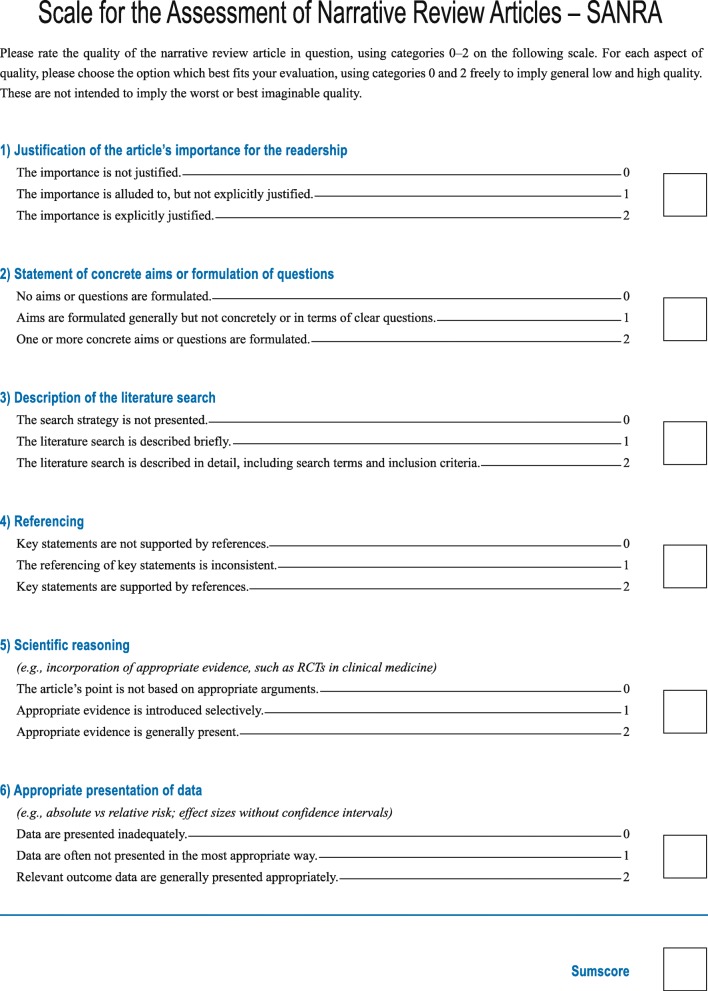
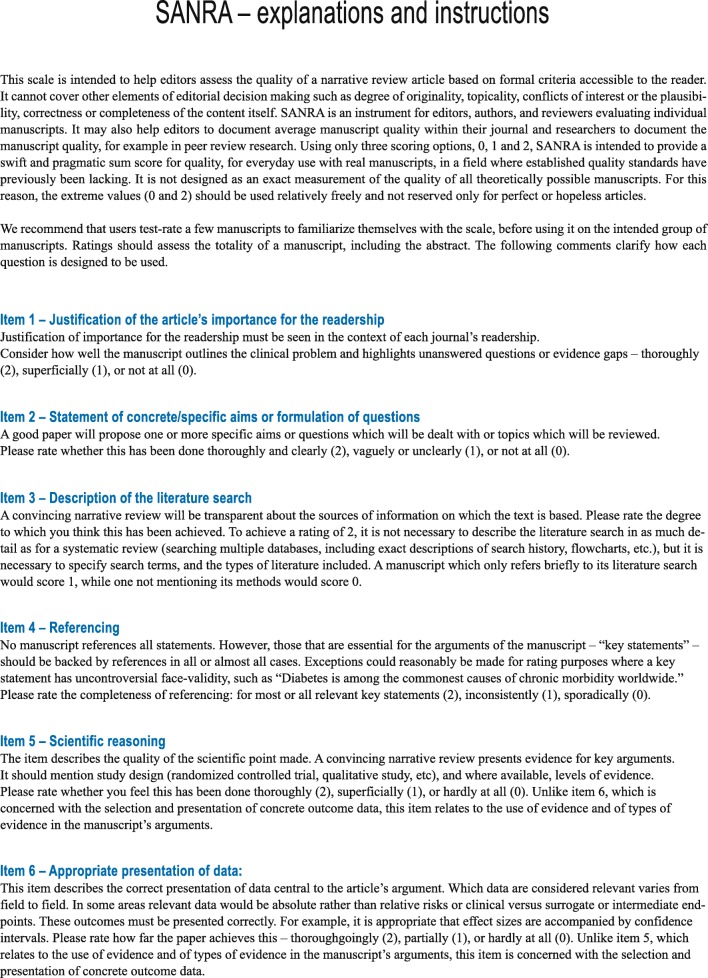
BACKGROUND: Narrative reviews are the commonest type of articles in the medical literature. However, unlike systematic reviews and randomized controlled trials (RCT) articles, for which formal instruments exist to evaluate quality, there is currently no instrument available to assess the quality of narrative reviews. In response to this gap, we developed SANRA, the Scale for the Assessment of Narrative Review Articles. METHODS: A team of three experienced journal editors modified or deleted items in an earlier SANRA version based on face validity, item-total correlations, and reliability scores from previous tests. We deleted an item which addressed a manuscript's writing and accessibility due to poor inter-rater reliability. The six items which form the revised scale are rated from 0 (low standard) to 2 (high standard) and cover the following topics: explanation of (1) the importance and (2) the aims of the review, (3) literature search and (4) referencing and presentation of (5) evidence level and (6) relevant endpoint data. For all items, we developed anchor definitions and examples to guide users in filling out the form. The revised scale was tested by the same editors (blinded to each other's ratings) in a group of 30 consecutive non-systematic review manuscripts submitted to a general medical journal. RESULTS: Raters confirmed that completing the scale is feasible in everyday editorial work. The mean sum score across all 30 manuscripts was 6.0 out of 12 possible points (SD 2.6, range 1-12). Corrected item-total correlations ranged from 0.33 (item 3) to 0.58 (item 6), and Cronbach's alpha was 0.68 (internal consistency). The intra-class correlation coefficient (average measure) was 0.77 [95% CI 0.57, 0.88] (inter-rater reliability). Raters often disagreed on items 1 and 4. CONCLUSIONS: SANRA's feasibility, inter-rater reliability, homogeneity of items, and internal consistency are sufficient for a scale of six items. Further field testing, particularly of validity, is desirable. We recommend rater training based on the "explanations and instructions" document provided with SANRA. In editorial decision-making, SANRA may complement journal-specific evaluation of manuscripts-pertaining to, e.g., audience, originality or difficulty-and may contribute to improving the standard of non-systematic reviews.
Overview
CoChat Summary
TL;DR
SANRA is a six-item, 0–2 scale (maximum 12) for assessing the quality of narrative review articles, developed and field-tested by three journal editors. In 30 consecutive non-systematic review manuscripts, it showed feasible use, sufficient internal consistency and inter-rater reliability, and a modest association with editorial acceptance.
Key findings
- Across 30 manuscripts (90 ratings), the mean SANRA sum score was 6.0 out of 12 (SD 2.6, range 1–12, median 6).
- Internal consistency was Cronbach’s alpha 0.68; corrected item-total correlations ranged from 0.33 (item 3) to 0.58 (item 6).
- Inter-rater reliability was an intra-class correlation coefficient (average measure) of 0.77 [95% CI 0.57, 0.88]; raters often disagreed on items 1 and 4.
- Average SANRA scores were modestly associated with editorial acceptance (mean 6.6, SD 1.9, n = 17) versus rejection (mean 5.1, SD 2.1, n = 13), point biserial correlation 0.37 (t = 2.09, df 28; two-sided p = 0.046).
Methods
- SANRA was developed between 2010 and 2017 by three experienced editors at Deutsches Ärzteblatt; the revised six-item version deleted an item on writing and accessibility due to poor inter-rater reliability.
- The revised scale was tested on 30 consecutive non-systematic review manuscripts submitted to Deutsches Ärzteblatt in 2015; three editor-raters scored them independently and blinded to each other’s ratings.
- Analyses included descriptive statistics, Cronbach’s alpha, corrected item-total correlations, average-measure intra-class correlation using a two-way random effects model (consistency definition), and a post hoc point biserial correlation between SANRA sum scores and acceptance/rejection.
Limitations
- The paper states the main limitation is sample size: 30 manuscripts was a compromise between representativeness, power, and feasibility, and took about 6 months to sample.
- The authors state that the scale’s authors were also the test-raters, so inter-rater reliability may be lower in groups less familiar with SANRA; the study also did not assess test-retest reliability, and results are study-specific.
- The paper acknowledges restricted content validity because SANRA is limited to six items and is a critical appraisal tool rather than a reporting guideline; criterion validity evidence is post hoc and weak, and no established cut-offs exist for comparing manuscripts across settings.
Model-written summary. Check it against the paper before relying on it.
Integrity signals
Registry
Cites
Statistics
Figures
Verification
Claims the paper makes
3 Valid · 0 Not valid · 5 Not checked · 27 Own results and interpretations
The cited sources support only part of this claim — read each source’s verdict below.
In the paper
“Bastian et al. found that they constitute the largest share of all text types in medicine and they concluded that they “remain the staple of medical literature” [1].”
- Also stated in: § Background · plain
“Narrative reviews are the commonest type of articles in the medical literature.”
§ SANRA—a scale for the quality assessment of narrative review articles > Background
What the sources say
- Partly supportedcites [1] Bastian H Glasziou P Chalmers I Seventy-five trials and eleven systematic reviews a day: how will we ever keep up? PLoS Med 2010 7 9 e1000326 10.1371/journal.pmed.1000326 20877712 PMC2943439 sourceExperimental — accuracy not yet measured
In “How Close Are We to Archie Cochrane’s Goal?” and the Summary Points (pages unavailable), the paper calls non-systematic narrative reviews the staple of medical literature synthesis. It does not say they constitute the largest share of all medical text types; that extends a claim about literature synthesis to medical literature as a whole. (LLM, conf=0.88)
plain- Asserted: passes — The authors put it forward as true.
- Checkable: passes — It can be checked against evidence.
- Load-bearing: unclear — It is unclear whether the paper’s conclusions depend on it.
- Based: passes — The paper gives a reason why it holds.
- Also stated in: § Background · plain
The sources with a verdict support this claim; the rest weren’t checked yet, have no full text we could read, or their verdicts aren’t rated yet.
In the paper
“non-systematic reviews or narrative reviews have been widely criticized as unreliable [1, 4].”
§ SANRA—a scale for the quality assessment of narrative review articles > Background
What the sources say
- Supportedcites [1] Bastian H Glasziou P Chalmers I Seventy-five trials and eleven systematic reviews a day: how will we ever keep up? PLoS Med 2010 7 9 e1000326 10.1371/journal.pmed.1000326 20877712 PMC2943439 source
In “How Close Are We to Archie Cochrane’s Goal?”, the paper describes reviews not conducted systematically as having great potential for error and calls them less reliable forms of information. Box 1 also says that articles and textbooks had highlighted the risk of bias and chance in reviews. Together, these passages support the broad characterization that narrative reviews have been criticized as unreliable; page numbers are not provided in our copy. (LLM, conf=0.89)
- Not checked — no full text of the sourcecites [4] Mulrow CD The medical review article: state of the science Ann Intern Med 1987 106 485 488 10.7326/0003-4819-106-3-485 3813259 source
plain- Asserted: passes — The authors put it forward as true.
- Checkable: passes — It can be checked against evidence.
- Load-bearing: passes — The paper’s conclusions depend on it.
- Based: passes — The paper gives a reason why it holds.
- Supported
A result the paper reports from its own data — it cites no other source for it, so there is none to check. The quote shows it is in the paper.
In the paper
“Cronbach’s alpha was 0.68 (internal consistency).”
- Also stated in: § Results · plain
“The scale’s internal consistency, measured as Cronbach’s alpha, was 0.68.”
§ SANRA—a scale for the quality assessment of narrative review articles > Abstract > Results
plainn = 90- Asserted: passes — The authors put it forward as true.
- Checkable: passes — It can be checked against evidence.
- Load-bearing: passes — The paper’s conclusions depend on it.
- Based: passes — The paper gives a reason why it holds.
- Also stated in: § Results · plain
A result the paper reports from its own data — it cites no other source for it, so there is none to check. The quote shows it is in the paper.
In the paper
“Raters often disagreed on items 1 and 4.”
- Also stated in: § Results · plain
“Disagreements most often occurred with regard to items 1 and 4.”
§ SANRA—a scale for the quality assessment of narrative review articles > Abstract > Results
plain- Asserted: passes — The authors put it forward as true.
- Checkable: passes — It can be checked against evidence.
- Load-bearing: unclear — It is unclear whether the paper’s conclusions depend on it.
- Based: passes — The paper gives a reason why it holds.
- Also stated in: § Results · plain
A result the paper reports from its own data — it cites no other source for it, so there is none to check. The quote shows it is in the paper.
In the paper
“The intra-class correlation coefficient (average measure) was 0.77 [95% CI 0.57, 0.88] (inter-rater reliability).”
- Also stated in: § Results · plain
“The intra-class correlation coefficient (average measure) amounted to 0.77 [95% CI 0.57, 0.88; F 4.3; df 29, 58].”
§ SANRA—a scale for the quality assessment of narrative review articles > Abstract > Results
plain- Asserted: passes — The authors put it forward as true.
- Checkable: passes — It can be checked against evidence.
- Load-bearing: passes — The paper’s conclusions depend on it.
- Based: passes — The paper gives a reason why it holds.
- Also stated in: § Results · plain
14 more claims
Create a free account to see all 35 claims and to verify the 3 references still open.
- Probably not a substantial claim. 11
- It may state two separate claims as one. 11
Claims other papers make about this one
Each is checked against this paper’s own text: does it say what the citing paper says it does?
The source backs part of the claim, not all of it — or backs it for a different population, condition or comparison.
In the citing paper
“The review was conducted and reported in accordance with the principles of the Scale for the Assessment of Narrative Review Articles (SANRA), which provides a validated framework for ensuring methodological transparency, scientific rigor, and balanced interpretation in narrative reviews [ 19 ].”
From Paracetamol: A History of Assumptions, Errors, and Evidence Reversals in Pain Management (2026) · cites this paper as [19]
Experimental — accuracy not yet measuredThe source backs part of the claim, not all of it — or backs it for a different population, condition or comparison.
In the citing paper
“As a narrative review, the present work does not include an aggregated quantitative assessment and is more exposed to selection subjectivity than a registered systematic review [124,125].”
From Berberine-Drug Interactions: Mechanisms, Clinical Relevance and Risk Stratification-A Narrative Review (2026) · cites this paper as [124]
Experimental — accuracy not yet measuredThe cited source says what the claim attributes to it.
In the citing paper
“This work is designed as a structured narrative review, with transparent reporting of the documentation strategy, guided by the quality criteria of the Scale for the Assessment of Narrative Review Articles (SANRA) [124].”
From Berberine-Drug Interactions: Mechanisms, Clinical Relevance and Risk Stratification-A Narrative Review (2026) · cites this paper as [124]
The cited source says what the claim attributes to it.
In the citing paper
“we used the following:-Cochrane Risk of Bias 2 (RoB 2) [29] and PEDRO scale tools for RCTs.-AMSTAR 2 [30] checklist for systematic review.-SANRA (Scale for the Assessment of Narrative Review Articles) [31] for narrative reviews.-JBI Checklist for Text and Opinion [32] for expert opinion papers.”
From Pelvic Floor Muscle Training Following Surgery for Pelvic Organ Prolapse: Recommendation from Scientific Literature (2026) · cites this paper as [31]
The cited source says what the claim attributes to it.
In the citing paper
“Data analysis employed a narrative and thematic synthesis methodology,adhering to the SANRA guidelines for narrative reviews (32).”
From Ethical issues in multi-agent AI systems for healthcare: a narrative review (2026) · cites this paper as [32]
12 more claims about this paper
Create a free account to see every claim other papers make about this one.
Citations
Cites
Shea, B. J., Reeves, B. C., Wells, G., Thuku, M., Hamel, C., Moran, J., Moher, D., Tugwell, P., Welch, V., Kristjansson, E., et al. (2017) · BMJ · doi:10.1136/bmj.j4008 · Cited by 10,636 · cited 2×
“Critical appraisal tools have been developed for systematic reviews (e.g., AMSTAR 2 [A MeaSurement Tool to Assess Systematic Reviews] [7]) and papers on RCTs (e.g., the CASP [Critical Appraisal Skills Program] checklist for randomized trials [8]) and other types of medical studies.”
BackgroundStreiner, D. L., & Norman, G. R. (2008) · doi:10.1093/acprof:oso/9780199231881.001.0001 · Cited by 2,631
Critical appraisal skills programme
Singh, J. (2013) · Journal of Pharmacology and Pharmacotherapeutics · doi:10.4103/0976-500x.107697 · Cited by 2,556
Guidelines for Reporting Reliability and Agreement Studies (GRRAS) were proposed
Kottner, J., Audigé, L., Brorson, S., Donner, A., Gajewski, B. J., Hróbjartsson, A., Roberts, C., Shoukri, M., & Streiner, D. L. (2011) · Journal of Clinical Epidemiology · doi:10.1016/j.jclinepi.2010.03.002 · Cited by 2,174
The Mass Production of Redundant, Misleading, and Conflicted Systematic Reviews and Meta‐analyses
IOANNIDIS, J. P. A. (2016) · The Milbank Quarterly · doi:10.1111/1468-0009.12210 · Cited by 1,483 · cited 1×
“While systematic reviews are not per se superior articles and while certain systematic reviews have been criticized lately [3], non-systematic reviews or narrative reviews have”
BackgroundSeventy-five trials and eleven systematic reviews a day: how will we ever keep up?
Bastian, H., Glasziou, P., & Chalmers, I. (2010) · PLoS Medicine · doi:10.1371/journal.pmed.1000326 · Cited by 1,188 · cited 2×
“found that they constitute the largest share of all text types in medicine and they concluded that they “remain the staple of medical literature” [1].”
BackgroundThe Medical Review Article: State of the Science
MULROW, C. D. (1987) · Annals of Internal Medicine · doi:10.7326/0003-4819-106-3-485 · Cited by 856 · cited 1×
“been widely criticized as unreliable [1, 4].”
Writing a narrative biomedical review: considerations for authors, peer reviewers, and editors
Gasparyan, A. Y., Ayvazyan, L., Blackmore, H., & Kitas, G. D. (2011) · Rheumatology International · doi:10.1007/s00296-011-1999-3 · Cited by 694 · cited 1×
“[13], for example, have provided guidance for writing narrative reviews, and Byrne [14] as well as Pautasso [15] has written, from different angles, thoughtful editorials on improving narrative reviews and presented lists of key features of writing a good review—lists that naturally overlap with SANRA items (e.”
BackgroundTen Simple Rules for Writing a Literature Review
Pautasso, M. (2013) · PLoS Computational Biology · doi:10.1371/journal.pcbi.1003149 · Cited by 272 · cited 3×
“[13], for example, have provided guidance for writing narrative reviews, and Byrne [14] as well as Pautasso [15] has written, from different angles, thoughtful editorials on improving narrative reviews and presented lists of key features of writing a good review—lists that naturally overlap with SANRA items (e.”
BackgroundImproving the peer review of narrative literature reviews
Byrne, J. A. (2016) · Research Integrity and Peer Review · doi:10.1186/s41073-016-0019-2 · Cited by 159 · cited 3×
“[13], for example, have provided guidance for writing narrative reviews, and Byrne [14] as well as Pautasso [15] has written, from different angles, thoughtful editorials on improving narrative reviews and presented lists of key features of writing a good review—lists that naturally overlap with SANRA items (e.”
Background
Research works printed but not linked: 3
- Higgins JPT, Green S. (eds.). Cochrane Handbook for Systematic Reviews and Interventions. Version 5.1.0. The Cochrane Collaboration 2011, section 1.2.2., www.handbook.cochrane.org, retrieved on Oct 31, 2018.
- Baethge C Mertens S Goldbeck-Wood S Development of a quality score for the assessment of non-systematic review articles (SANRA) Poster, Seventh International Congress on Peer Review and Biomedical Publication 2013 USA Chicago, Illinois
- Baethge C Goldbeck-Wood S Mertens S A scale for the assessment of non-systematic review articles (SANRA) Poster, Eighth International Congress on Peer and Biomedical Publication 2017 USA Chicago, Illinois
Cited by
Items 1,901–2,000 of 4,334
Todisco, M. C., Santamaria, C., Zanella, E., & Arcadi, P. (2024) · Dissertation Nursing · doi:10.54103/dn/22339 · Cited by 1
From caution to guidance: a narrative review of CrossFit during pregnancy
Schlegel, P. (2024) · Human Movement · doi:10.5114/hm/186687 · Cited by 1
“A total of 1458 sources were identified, and from these, 67 were included in the review. the procedure for creating the review was according to SANRA – a scale for the quality assessment of narrative review articles [29]. the quality of this narrative review was rated at 10 (SANRA scale 0–12).”
MethodChanges in Haematological Parameters and Lipid Profiles in Diabetes Mellitus: A Literature Review
Mbah, J. I., Bwititi, P., Gyawali, P., & Nwose, E. U. (2024) · Cureus · doi:10.7759/cureus.64201 · Cited by 4
“The first section is the narrative review of the concepts of haematological parameters and lipid profiles in diabetes, which followed the Scale for Assessment of Narrative Review Articles (SANRA) [16].”
BackgroundLee, Y. (2024) · 대한치과의사협회지 · doi:10.22974/jkda.2024.62.4.001 · Cited by 1
Eeles, E. M., Tran, D. D., Ward, S., Teodorczuk, A., Ray, J., Miller, T., & Dissanayaka, N. N. (2024) · Age and Ageing · doi:10.1093/ageing/afae144 · Cited by 1
Promotion and Prevention of Oral Cancer in the Digital Era
Jaber, M. A., & Elameen, E. M. (2024) · Advances in medical technologies and clinical practice book series · doi:10.4018/979-8-3693-3872-8.ch011 · Cited by 1
Javeriana, P. U., Salazar‐Londoño, S., Pérez-Foucrier, V., Javeriana, P. U., Tengonó-Guarín, M. J., Javeriana, P. U., Franky-Escobar, I., Javeriana, P. U., Iragorri, A. M., & Javeriana, P. U. (2024) · IATREIA · doi:10.17533/udea.iatreia.294 · Cited by 1
Stoeklé, H., Beuzeboc, P., Payet, T., Hervé, C., & Bennouna, J. (2024) · European Journal of Clinical Investigation · doi:10.1111/eci.14315 · Cited by 1
Autocriticismo e Medo da Autocompaixão no Trabalho: uma Revisão Narrativa
Souza, F. L. X., Teodoro, M. L. M., & Amorim, S. M. (2024) · Revista Psicologia Organizações e Trabalho · doi:10.5935/rpot/2024.24882 · Cited by 1
“Com o objetivo de se adotar uma conduta minimamente transparente e consistente para a pesquisa, conduziu-se uma revisão de literatura narrativa observando-se os critérios SANRA, que avaliam a qualidade de tais estudos (Baethge et al., 2019).”
Ryan, G. S., Jackson, J. E., & Haider, S. (2024) · Health Informatics Journal · doi:10.1177/14604582241285756 · Cited by 1
Gangavarapu, R. R., Mahmud, S. A., Manandhar, A., Sabir, G., Abdelhady, H. A., Abakar, A. O., & Nassar, S. T. (2024) · Cureus · doi:10.7759/cureus.71333 · Cited by 2
“Table 6 presents a comprehensive analysis of the quality of review articles using the SANRA 2 checklist [18].”
MethodBozas, A., & Fotoulaki, M. (2024) · Open Health · doi:10.1515/ohe-2023-0047 · Cited by 1
Kuroda, M., Ahmed, M. K., Kuroda, K., & Lane, S. D. (2024) · Asian Bioethics Review · doi:10.1007/s41649-024-00310-8 · Cited by 5
“Based on a narrative review design, this review followed the narrative methodological framework, which other researchers have widely used (Green et al. 2006; Ferrari 2015; Baethge et al. 2019; Kuipers et al. 2022).”
Nowak, K., Wingralek, Z. J., Banaszek, A., & Próchnicki, M. (2024) · Psychiatria i Psychologia Kliniczna · doi:10.15557/pipk.2024.0019 · Cited by 1
Challenges of Motherhood for Anesthesiologists: A Scoping Review
Mergler, B. D., Patel, R. U., Iyer, S., Chae, R. S., Gluch, J. I., Mergler, R. J., Vail, E. A., & Duffy, C. C. (2024) · A&A Practice · doi:10.1213/xaa.0000000000001876 · Cited by 1
Sarango, A. C., Escobar, J. M. C., & Villacís, S. I. C. (2023) · QhaliKay Revista de Ciencias de la Salud · doi:10.33936/qkrcs.v7i1.5398 · Cited by 1
The Open Abdomen: A Comprehensive Narrative Review of the Life-Threatening Condition for 2024
Brincat, S. D., & Lunevičius, R. (2025) · IntechOpen eBooks · doi:10.5772/intechopen.1008568 · Cited by 1
BOROZAN, D.-T., & Safta-Zecheria, L. (2025) · Revista de Pedagogie - Journal of Pedagogy · doi:10.26755/revped/2024.2/95 · Cited by 1
Wuyts, S. C. M., Moor, J. D., Jochmans, K., Cortoos, P., Vandervorst, F., Steurbaut, S., Dupont, A. G., & Cornu, P. (2025) · British Journal of Clinical Pharmacology · doi:10.1002/bcp.70007 · Cited by 1
Dzhus, O., & Lobur, M. (2025) · Computer Design Systems Theory and Practice · doi:10.23939/cds2025.01.146 · Cited by 1
A narrative review on the role of adipose-derived stem cells in periodontal regeneration
Jafrani, A., Mehmood, H., Shaikh, M. S., Lone, M. A., Fareed, M. A., & Zafar, M. S. (2025) · Journal of Dentistry · doi:10.1016/j.jdent.2025.105801 · Cited by 1
Ebrahimi, M., Pike-Bowles, A., & Choudhury, K. (2025) · Organization and Human Capital Development · doi:10.31098/orcadev.v4i1.3241 · Cited by 2
“While systematic reviews are preferred and optimal for answering narrow and highly focused research questions (Sukhera, 2022), narrative reviews are better suited to exploring broader topics and providing an overview of diverse perspectives (Baethge et al., 2019).”
When Two Worlds Collide: Navigating Diabetes in Cystic Fibrosis
Ahmad, W., Khan, J., Hashmat, A., Khan, A., Ahmad, A., Dildar, J., Sikander, M., Ahmad, S., Zakir, S., Raza, S. S., et al. (2025) · Cureus · doi:10.7759/cureus.84110 · Cited by 2
“This was done using strategies developed through consulting team members and published literature on the subject of biomedical reviews using the Scale for the Assessment of Narrative Review Articles (SANRA) scale [7].”
Weight-Bearing Approaches After Neck of Femur Fractures: A Narrative Review of Evidence and Outcomes
Patel, N., & Chaudhari, M. (2025) · Cureus · doi:10.7759/cureus.84932 · Cited by 1
Use of digital technologies to promote sexual health in young adults: a narrative review
da Cunha-Oliveira, A. C. G. D. P., Gómez‐Cantarino, S., Santos, D., Oliveira, B. F. P., Marinho, B., Ribeiro, C. D., Rodrigues, F., Gomes, J., Menino, E., & Reis, R. K. (2025) · Revista Brasileira de Enfermagem · doi:10.1590/0034-7167-2023-0434 · Cited by 1
Gallbladder and Bile Ducts: Anatomical Structures and Clinical Associations for 2025
Lunevičius, R. (2025) · IntechOpen eBooks · doi:10.5772/intechopen.1011304 · Cited by 1
Non-hormonal strategies for treating genitourinary syndrome of menopause: a concise review
Molitierno, R., Vinci, D., Iavazzo, N., Ravo, M., Caniglia, F. M., Carotenuto, A., Fatigati, M., Maggiacomo, I., Vitale, C., Narciso, G., et al. (2025) · Italian Journal of Gynaecology and Obstetrics · doi:10.36129/jog.2025.232 · Cited by 1
Chronic atrophic gastritis and dyspepsia: a forgotten link?
Sbarigia, C., Carabotti, M., Corsetti, M., & Annibale, B. (2025) · Expert Review of Gastroenterology & Hepatology · doi:10.1080/17474124.2025.2550524 · Cited by 1
“A narrative review was conducted according to the SANRA scale [16].”
Biological Effects of Music Therapy in End-of-Life Care: A Narrative Review
Terzoni, S., Vita, A., Ferrara, P., Sacchini, F., Cangelosi, G., Mancin, S., Petrelli, F., Lopane, D., Milani, A., Parozzi, M., et al. (2025) · Medicina · doi:10.3390/medicina61091690 · Cited by 2
“To ensure quality and possible reproducibility, the review followed the Scale for the Assessment of Narrative Review Articles (SANRA) guidelines (Supplementary File S1) [25].”
García‐Sanz, P., Aguilera-Cobos, L., Rosario-Lozano, M. P., & Blasco‐Amaro, J. A. (2025) · doi:10.52766/tnol4288 · Cited by 1
Peinado, V., Viniegra, C., & Valiente, C. (2025) · Revista de Psicoterapia · doi:10.5944/rdp.v36i132.46046 · Cited by 1
“Esta revisión narrativa se diseñó siguiendo las recomendaciones de la Scale for the Assessment of Narrative Review Articles (SANRA; Baethge et al., 2019) que pretende garantizar claridad, transparencia y rigor en la síntesis de la evidencia.”
Dolenc, K., & Boh, A. (2025) · Applied Sciences · doi:10.3390/app16010380 · Cited by 1
Depth of anesthesia monitoring: Current evidence, clinical impact, and future directions
Yu, H., Gao, B., & Li, Y. (2026) · Journal of International Medical Research · doi:10.1177/03000605261457781 · Cited by 1
“10”
Cosenza, G., Fiore, M., Giurazza, R., Pota, V., Coppolino, F., Sansone, P., & Pace, M. C. (2026) · Journal of Clinical Medicine · doi:10.3390/jcm15176915 · Cited by 1
“This narrative review was informed by the general principles of the Scale for the Assessment of Narrative Review Articles (SANRA) [20] (Table S1), rather than by the PRISMA or PRISMA-ScR reporting standards developed specifically for systematic and scoping reviews.”
Exhaled breath analysis: the road towards its clinical implementation
Stavropoulos, G. (2023) · Research Publications (Maastricht University) · doi:10.26481/dis.20230525gs · Cited by 1
GiLE Journal of Skills Development
(2023) · GiLE Journal of Skills Development · doi:10.52398/gjsd · Cited by 1
Varrassi, G., Paladini, A., Corno, C., Coaccioli, S., Finco, G., Tiso, D., & Fornasari, D. (2024) · Preprints.org · doi:10.20944/preprints202403.0174.v1 · Cited by 1
Appraised evidence and decision making in clinical practicePreprint
Leliopoulou, C., Stroumpouki, T., Stafylarakis, E., & Collins, L. (2024) · medRxiv · doi:10.1101/2024.11.15.24317373 · Cited by 1
Khalifah, A. M., & Alafaleg, R. (2025) · Research Square · doi:10.21203/rs.3.rs-6498214/v1 · Cited by 2
Bo, Y. (2025) · medRxiv · doi:10.1101/2025.05.12.25327369 · Cited by 1
“This narrative review was evaluated using the Scale for the Assessment of Narrative Review Articles (SANRA)(21).”
Artificial Intelligence in Thyroid Surgery: A new Frontier in Precision Endocrine CarePreprint
Manani, C., & Papavramidis, T. S. (2025) · Preprints.org · doi:10.20944/preprints202506.0882.v1 · Cited by 3
Vascular Pain: A Narrative Review on Venous Leg UlcersPreprint
Leoni, M. L. G., Farì, G., Al-Alwany, A. A., Guillen, M. R., & Varrassi, G. (2025) · Preprints.org · doi:10.20944/preprints202509.0686.v1 · Cited by 1
Dietary counselling of children with food allergy
Eisenblätter, J. (2023) · PEARL (University of Plymouth) · doi:10.24382/2665 · Cited by 4
Effectivity of Hands-on Near-peer teaching in Scientific Writing for Indian Medical StudentsPreprint
Puri, O., Unnithan, V., Kumar, P., Reddy, A. P., Pahuja, V., Ganla, A., Paul, A., Vaghela, G., Bhatia, M. K., Khurana, N., et al. (2022) · Research Square · doi:10.21203/rs.3.rs-1792414/v1 · Cited by 1
Mahfouz, M., & Alzaben, E. (2026) · Research Square · doi:10.21203/rs.3.rs-8908887/v1 · Cited by 1
Paracetamol: A History of Assumptions, Errors, and Evidence Reversals in Pain Management
Nicolas, J., Leoni, M. L. G., Van Tran, Y., Van Phong, P., Farì, G., Puttini, P. S., Kaye, A. D., & Varrassi, G. (2026) · Current Pain and Headache Reports · doi:10.1007/s11916-026-01553-w
Chen, J., & Chen, B. (2026) · Frontiers in Public Health · doi:10.3389/fpubh.2026.1976572
“This Mini Review was guided by the Scale for the Assessment of Narrative Review Articles (SANRA) framework, with particular attention to the justification of the review topic, clarity of aims, transparent description of literature selection, appropriate referencing, and scientific reasoning (16).”
Tripi, D., Giantesani, M., Arena, J. F., & Ferracuti, S. (2026) · Frontiers in Psychiatry · doi:10.3389/fpsyt.2026.1835123
“The methodological approach was informed by the Scale for the Assessment of Narrative Review Articles (SANRA) (24), which was used to enhance transparency, internal consistency, and scienti fi c rigor of the narrative synthesis.”
Epelde, F. (2026) · Hospitals · doi:10.3390/hospitals3030015
“No dedicated EQUATOR checklist was identified for a Perspective or conceptual framework article; therefore, SANRA was used as a quality and structural aid for the narrative synthesis component, without claiming that the article is a systematic review [39].”
Skrabic, R., Kumric, M., Santic, R., Skrabic, I., Pavlovic, N., Rusic, D., & Bozic, J. (2026) · Frontiers in Nutrition · doi:10.3389/fnut.2026.1875074
“This article is presented as a SANRA-informed critical narrative review rather than a systematic review or meta-analysis (25).”
Research co-design in health: an overview of reviewsPreprint
Slattery, P., Saeri, A. K., & Bragge, P. (2019) · OSF Preprints (OSF Preprints) · doi:10.31219/osf.io/q5tyk
The development of a nutrition education programme for parental feeding styles and practices
Brown, M. J. (2020) · UWC Research Repository (University of the Western Cape)
Nursing Interventions on Adolescent and Childhood Depression in Primary Care: A Literature Review
Ichinose, A., & Fong, Y. Y. D. (2020) · Theseus (Ammattikorkeakoulujen)
Lernen und Lehren – Erkenntnisse und Empfehlungen zwischen Mythos, Pathos und Logos
Brandl, W. (2021) · HiBiFo – Haushalt in Bildung & Forschung · doi:10.3224/hibifo.v10i2.01
A importância da triagem para Transtorno do Espectro Autista na Atenção Primária
Souto, R. R., Alves, A. M. P., de Lima, C. N., Pereira, C. A. A. A., & Paulo, M. R. (2021) · Editora COLAB eBooks · doi:10.51781/9786586920178820
Deficiência Intelectual: perspectivas e desafios na Saúde Pública
Souto, R. R., Júnior, D. D. B., Silva, M. A. M. V., Gonçalves, M. I. M., & da Paixão, M. R. S. (2021) · Editora COLAB eBooks · doi:10.51781/97865869201782840
Nunes, E. P., Silva, L. P., Botelho, A., & Carvalho, W. (2021) · Editora COLAB eBooks · doi:10.51781/97865869201789110122
O cuidado da pessoa com deficiência na Atenção Primária à Saúde
de Souza, I. G., & Pereira, B. B. (2021) · Editora COLAB eBooks · doi:10.51781/9786586920178137147
Hesitação e negação à vacina da COVID-19: uma revisão sistemática
Gomes, M. G. M., & Pereira, B. B. (2021) · Editora COLAB eBooks · doi:10.51781/97865869201786575
Racismo como determinante social de saúde: uma revisão sistemática
Silva, V. C. T., Pestana, B. A. D., Oliveira, M. E. S., MELO, G. M. F. D., & Silva, M. A. (2021) · Editora COLAB eBooks · doi:10.51781/9786586920178162174
Revisões em Saúde Coletiva: tendências, recorrências e lacunas
Pestana, B. A. D., SOUZA, I. G., & PERISSATO, I. L. (2021) · Editora COLAB eBooks · doi:10.51781/9786586920178
A música terapêutica sob ótica da Enfermagem: uma revisão integrativa de literatura
Magalhães, B. S., Lourenço, K. C. D., Lima, E. G., Rabelo, I. V., & Duarte, P. R. A. (2021) · Editora COLAB eBooks · doi:10.51781/978658692017897109
Os desafios diagnósticos e terapêuticos dos erros inatos do metabolismo na Saúde Coletiva
Souto, R. R., de Lima, C. N., Oliveira, C. R., Paulo, M. R., & Santos, N. Q. S. (2021) · Editora COLAB eBooks · doi:10.51781/97865869201785264
Doenças Raras: reflexões e perspectivas sobre as políticas públicas no Brasil
Souto, R. R., Alves, A. M. P., de Lima, C. N., Pereira, C. A. A. A., & Paulo, M. R. (2021) · Editora COLAB eBooks · doi:10.51781/97865869201784151
Mayer, A. F., Naback, R. D. N., Lamana, S. B., & Oliveira, S. (2021) · Editora COLAB eBooks · doi:10.51781/97865869201788696
Comunicação de más notícias no contexto da atenção em saúde: uma revisão integrativa
Gallego, P. B., Gomes, L. R. S., & Peres, R. S. (2021) · Editora COLAB eBooks · doi:10.51781/9786586920178123136
Abordagem da toxoplasmose em gestantes na Atenção Primária
Nunes, M. P. C., Marques, K. A., & Santos, N. Q. S. (2021) · Editora COLAB eBooks · doi:10.51781/97865869201782127
Acesso à saúde da pessoa com deficiência
Almeida, F. T., Ivancko, G. M., SOUZA, I. G., & Pereira, T. (2021) · Editora COLAB eBooks · doi:10.51781/97865869201787685
Manjarrez, C. D. R., & Martínez, X. G. S. (2021) · RECIMUNDO · doi:10.26820/recimundo/5.(3).sep.2021.346-358
Cox, C. (2021) · Bournemouth University Research Online (Bournemouth University)
The crisis of representation in the refugee resettlement sector in New Zealand
Jasperse, M. (2021) · Otago University Research Archive (University of Otago) · Cited by 2
Ali, M., Mishra, R. K., & Anand, K. (1970) · PubMed
Webber, C., Wilkinson, K., Duncan, L. G., & McGeown, S. P. (2021) · OSF Preprints (OSF Preprints) · doi:10.31219/osf.io/4mxvt · Cited by 1
Krówczyńska, D. (2022) · Journal of Education Health and Sport · doi:10.12775/jehs.2022.12.04.001 · Cited by 1
Evidence-Based Practice in Osteopathy: Contribution to Develop Better Professionals
Frias, A., & da Costa, A. C. F. (2022) · Advances in medical education, research, and ethics (AMERE) book series · doi:10.4018/978-1-7998-9578-7.ch017
JSE 36:1 Spring 2022 Whole Issue PDF
Erickson, K. E. (2022) · Journal of Scientific Exploration · doi:10.31275/20222613
Narrative Review of Loudness Perception Measures in Children
Gustafson, S. J., Newsome, E., & Flores, A. N. (2022) · Ear and Hearing · doi:10.1097/aud.0000000000001243
“Procedure Common in medical literature, narrative reviews are comprehensive syntheses of previously published research that often identify new study areas not yet addressed (Green et al. 2006; Ferrari 2015; Baethge et al. 2019).”
BackgroundClassification of thoracolumbar fractures: A Narrative review
Chhabra, H. S., & Manghwani, J. (2022) · Journal of Clinical Orthopaedics · doi:10.13107/jcorth.2022.v07i01.479
The Role of Pelvic Exenteration in the Management of Locally Advanced Prostate Cancer
Farkouh, A., Heidar, N. F. A., Dobbs, R. W., Abu-Gheida, I. H., Bulbul, M. A., & Shahait, M. (2022) · Société Internationale d’Urologie Journal · doi:10.48083/kgmi7850
Yazdani, A. (2022) · Queensland University of Technology · doi:10.5204/thesis.eprints.235134
Home-based Pediatric Palliative Care: A Narrative Review
Uligraff, D. K., & Sitorus, T. O. (2022) · Jurnal Keperawatan Komprehensif · doi:10.33755/jkk.v8i4.421
Mulinacci, G., & Carbone, M. (2022) · Hot topics in acute care surgery and trauma · doi:10.1007/978-3-031-13818-8_1
Effects of Exercise on Vascular Toxicity Associated with Breast Cancer Treatment: A Narrative Review
Pera, M. L. D., & Speretta, G. F. F. (2022) · Current Vascular Pharmacology · doi:10.2174/1570161121666221228141150
The Potential Effects and Role of Vitamin C on COVID-19 Infection and Progression: A Review
Kaur, J., & Tyagi, S. (2023) · Indian Journal of Medical Biochemistry · doi:10.5005/jp-journals-10054-0207
Howard, K., Quinn, H., & Thomson, M. (2020) · Educational Psychology in Scotland · doi:10.53841/bpsepis.2020.20.1.40
Völker, J. S. D., Micluția, I., & Hanga, A.-M. (2023) · Current Psychiatry Research and Reviews · doi:10.2174/2666082219666230116100934
Rombaut, J., Coryn, N., Salihi, R. R., & Tummers, P. (2023) · Tijdschrift voor Geneeskunde · doi:10.47671/tvg.78.22.148
Borowicz, W., Szczepańska, M., & Rosińćzuk, J. (2023) · Journal of Education Health and Sport · doi:10.12775/jehs.2023.13.04.010
Homętowska, H. (2023) · Journal of Education Health and Sport · doi:10.12775/jehs.2023.13.04.020
Larki, M., Sharifi, F., Manouchehri, E., & Roudsari, R. L. (2023) · Current Women s Health Reviews · doi:10.2174/1573404820666230217115141 · Cited by 1
Restorative Treatment Considerations for Black Triangle: A Case Series
Yusof, H. M., & Hayei, N. A. A. (2023) · European Journal of General Dentistry · doi:10.1055/s-0043-1768047
Saquisili-Morales, M. D., & Guerrero-Alvarado, D. E. (2023) · MQRInvestigar · doi:10.56048/mqr20225.7.2.2023.662-673
Psychotropic Deprescribing in the Geriatric Population: A Review
Prasad, S., Katta, M. R., & Sarangi, A. (2023) · Medical Research Archives · doi:10.18103/mra.v11i4.3756
Martins, F. K., Miranda, M. E. K., Viana, B. F., Tourinho, P. M., Taddei, U. T., & Bunn, P. D. S. (2023) · Coleção Meira Mattos · doi:10.52781/cmm.a102
Fatima, U., Sheikh, A., Puvvada, C. S., Soomro, F. H., Haridi, H. A. O. M., Gonzalez, N. A., Dayo, S. M., & Yu, A. K. (2023) · Journal For International Medical Graduates · doi:10.56570/jimgs.v2i1.96
Athanasopoulou, S. G., Leeds, S., & Auerbach, M. A. (2024) · Pediatric Emergency Care · doi:10.1097/pec.0000000000003003 · Cited by 1
Kenny, D., Nguyen, K., Friesen, L., Breig, Z., & Comans, T. A. (2023) · Health & Social Care in the Community · doi:10.1155/2023/4157055
“Te narrative review was assessed using the SANRA (scale for quality assessment of narrative review articles) [21], and the remaining papers were critiqued with the MMAT (mixed methods appraisal tool) [22].”
MethodVol. 4, N.º 2, Jul-Dez 2023 - "Inovações com impacto na Radiologia"
Editorial, C. (2023) · ROENTGEN-Revista Científica das Técnicas Radiológicas · doi:10.46885/roentgen.v4i2.117
Metadata
- Authors
- Baethge, C., Goldbeck-Wood, S., & Mertens, S.
- Affiliations
- University of Cologne (DE)
- BMJ Group (United Kingdom) (GB)
- Corresponding author
- Baethge, Christopher
- ORCID
- Baethge, Christopher
- Venue
- Research Integrity and Peer Review
- Published
- 2019-03-26
- Volume
- 4
- Issue
- 1
- Pages
- 5-5
- ISSN
- 2058-8615 (ISSN-L)
- PMC
- PMC6434870
- OpenAlex
- W2922577842
- Semantic Scholar
- ea7f35b3069b53791c3b746c5c4b3c72a83a526b
- Cited by
- 3,469
- References
- 13
- Citations by year
- 2026: 1823 · 2025: 551 · 2024: 379 · 2023: 309 · 2022: 218 · 2021: 152 · 2020: 32 · 2019: 4
- FWCI
- 20.57
- Type
- journal article
- Language
- en
- Open access
- gold
- doi.org
- Licence
- cc-by
- creativecommons.org/licenses/by/4.0/ (tdm)
- Locations
- Research Integrity and Peer Review (publishedVersion, cc-by)
- Europe PMC (PubMed Central) (publishedVersion, other-oa)
- PubMed Central (publishedVersion, cc-by)
- PubMed (publishedVersion)
- Kölner Universitäts PublikationsServer (Universität zu Köln) (publishedVersion)
- DOAJ (DOAJ: Directory of Open Access Journals) (submittedVersion, cc-by-sa)
- Topics
- Social Sciences › Decision Sciences › Statistics, Probability and Uncertainty › Meta-analysis and systematic reviews
- Social Sciences › Library and Information Sciences › Academic Writing and Publishing
- Social Sciences › Library and Information Sciences › scientometrics and bibliometrics research
- Keywords
- quality assessment scale, manuscript review, inter-rater reliability, level of evidence, scale development
About these checks
Registry, retraction, Cites and statistics results are computed, not judged, with one exception: a printed reference that no index lists is read once by a model before it counts as a citation error. Claims are extracted by a model and kept only when their quote appears verbatim in the text; each cited source is then checked, with a model’s help, for whether it says what the claim relies on. Those verdicts can be wrong — read the claim’s quote and the cited source before relying on one.
The claim verdicts this report counts are experimental: their accuracy is not yet measured.
A language model drew the claims from the paper on 2026-11-10, under version 3 of the claim definition (model deepseek-v4.1-flash, prompt extract-v3).
A second model labelled each claim on 2026-11-10 (model jev-1.13-20260917, definition revision gold-guideline-v0.2).
Cited sources are checked with a language model’s help (gpt-6-sol).
Statistics and arithmetic are recomputed, not judged.
Confidence bands are shown only for fields calibrated on our annotated test set. None is calibrated yet, so no band is shown.
What counts as a claim ›How we measure confidence ›How we check this ›
Are you an author, or do you see a problem with this page? Request a review
Data sources
Bibliographic data: Semantic Scholar, OpenAlex, Crossref.
Contains information from the Semantic Scholar Academic Graph Datasets, made available under the ODC Attribution License (ODC-BY 1.0).
Semantic Scholar’s data is described in: Kinney, R., et al. (2023). The Semantic Scholar Open Data Platform. arXiv:2301.10140.
