

SANRA—a scale for the quality assessment of narrative review articles
Open accessThe DOI matches its Crossref record; 12 of the 13 references it cites were found in a registry or an index; 4 of the 12 sources its claims cite were checked for support.
Abstract
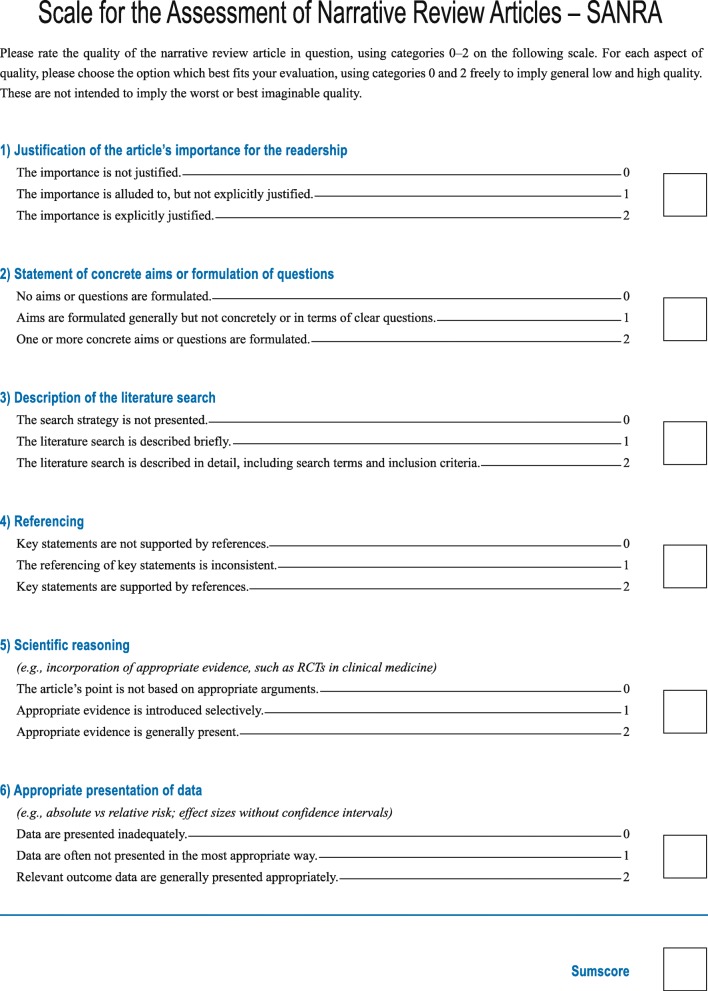
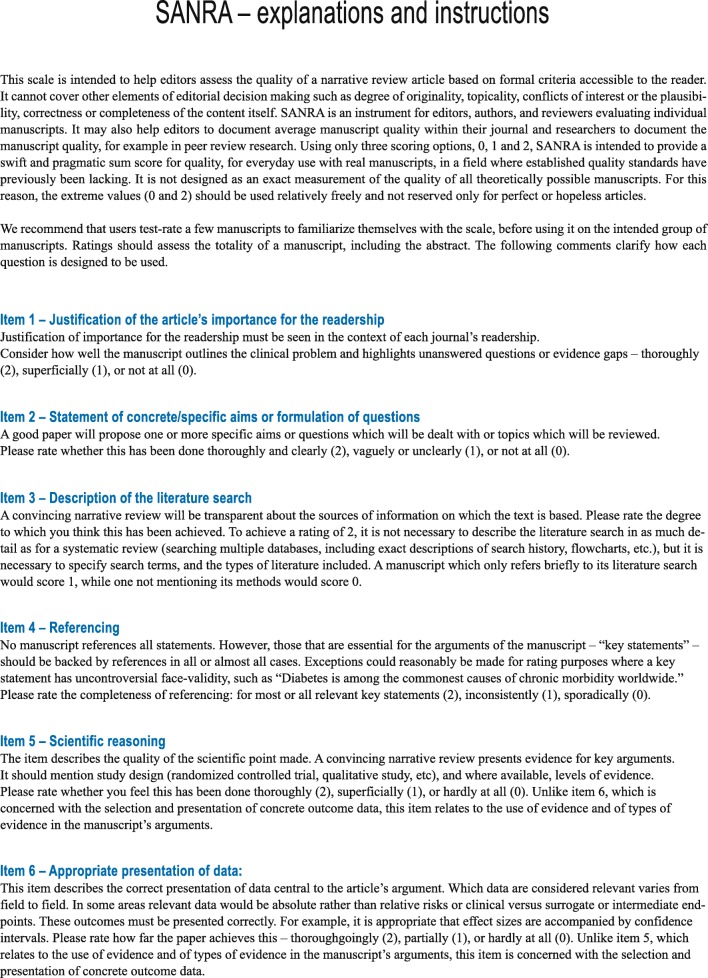
BACKGROUND: Narrative reviews are the commonest type of articles in the medical literature. However, unlike systematic reviews and randomized controlled trials (RCT) articles, for which formal instruments exist to evaluate quality, there is currently no instrument available to assess the quality of narrative reviews. In response to this gap, we developed SANRA, the Scale for the Assessment of Narrative Review Articles. METHODS: A team of three experienced journal editors modified or deleted items in an earlier SANRA version based on face validity, item-total correlations, and reliability scores from previous tests. We deleted an item which addressed a manuscript's writing and accessibility due to poor inter-rater reliability. The six items which form the revised scale are rated from 0 (low standard) to 2 (high standard) and cover the following topics: explanation of (1) the importance and (2) the aims of the review, (3) literature search and (4) referencing and presentation of (5) evidence level and (6) relevant endpoint data. For all items, we developed anchor definitions and examples to guide users in filling out the form. The revised scale was tested by the same editors (blinded to each other's ratings) in a group of 30 consecutive non-systematic review manuscripts submitted to a general medical journal. RESULTS: Raters confirmed that completing the scale is feasible in everyday editorial work. The mean sum score across all 30 manuscripts was 6.0 out of 12 possible points (SD 2.6, range 1-12). Corrected item-total correlations ranged from 0.33 (item 3) to 0.58 (item 6), and Cronbach's alpha was 0.68 (internal consistency). The intra-class correlation coefficient (average measure) was 0.77 [95% CI 0.57, 0.88] (inter-rater reliability). Raters often disagreed on items 1 and 4. CONCLUSIONS: SANRA's feasibility, inter-rater reliability, homogeneity of items, and internal consistency are sufficient for a scale of six items. Further field testing, particularly of validity, is desirable. We recommend rater training based on the "explanations and instructions" document provided with SANRA. In editorial decision-making, SANRA may complement journal-specific evaluation of manuscripts-pertaining to, e.g., audience, originality or difficulty-and may contribute to improving the standard of non-systematic reviews.
Overview
CoChat Summary
TL;DR
SANRA is a six-item, 0–2 scale (maximum 12) for assessing the quality of narrative review articles, developed and field-tested by three journal editors. In 30 consecutive non-systematic review manuscripts, it showed feasible use, sufficient internal consistency and inter-rater reliability, and a modest association with editorial acceptance.
Key findings
- Across 30 manuscripts (90 ratings), the mean SANRA sum score was 6.0 out of 12 (SD 2.6, range 1–12, median 6).
- Internal consistency was Cronbach’s alpha 0.68; corrected item-total correlations ranged from 0.33 (item 3) to 0.58 (item 6).
- Inter-rater reliability was an intra-class correlation coefficient (average measure) of 0.77 [95% CI 0.57, 0.88]; raters often disagreed on items 1 and 4.
- Average SANRA scores were modestly associated with editorial acceptance (mean 6.6, SD 1.9, n = 17) versus rejection (mean 5.1, SD 2.1, n = 13), point biserial correlation 0.37 (t = 2.09, df 28; two-sided p = 0.046).
Methods
- SANRA was developed between 2010 and 2017 by three experienced editors at Deutsches Ärzteblatt; the revised six-item version deleted an item on writing and accessibility due to poor inter-rater reliability.
- The revised scale was tested on 30 consecutive non-systematic review manuscripts submitted to Deutsches Ärzteblatt in 2015; three editor-raters scored them independently and blinded to each other’s ratings.
- Analyses included descriptive statistics, Cronbach’s alpha, corrected item-total correlations, average-measure intra-class correlation using a two-way random effects model (consistency definition), and a post hoc point biserial correlation between SANRA sum scores and acceptance/rejection.
Limitations
- The paper states the main limitation is sample size: 30 manuscripts was a compromise between representativeness, power, and feasibility, and took about 6 months to sample.
- The authors state that the scale’s authors were also the test-raters, so inter-rater reliability may be lower in groups less familiar with SANRA; the study also did not assess test-retest reliability, and results are study-specific.
- The paper acknowledges restricted content validity because SANRA is limited to six items and is a critical appraisal tool rather than a reporting guideline; criterion validity evidence is post hoc and weak, and no established cut-offs exist for comparing manuscripts across settings.
Model-written summary. Check it against the paper before relying on it.
Integrity signals
Registry
Cites
Statistics
Figures
Verification
Claims the paper makes
3 Valid · 0 Not valid · 5 Not checked · 27 Own results and interpretations
The cited sources support only part of this claim — read each source’s verdict below.
In the paper
“Bastian et al. found that they constitute the largest share of all text types in medicine and they concluded that they “remain the staple of medical literature” [1].”
- Also stated in: § Background · plain
“Narrative reviews are the commonest type of articles in the medical literature.”
§ SANRA—a scale for the quality assessment of narrative review articles > Background
What the sources say
- Partly supportedcites [1] Bastian H Glasziou P Chalmers I Seventy-five trials and eleven systematic reviews a day: how will we ever keep up? PLoS Med 2010 7 9 e1000326 10.1371/journal.pmed.1000326 20877712 PMC2943439 sourceExperimental — accuracy not yet measured
In “How Close Are We to Archie Cochrane’s Goal?” and the Summary Points (pages unavailable), the paper calls non-systematic narrative reviews the staple of medical literature synthesis. It does not say they constitute the largest share of all medical text types; that extends a claim about literature synthesis to medical literature as a whole. (LLM, conf=0.88)
plain- Asserted: passes — The authors put it forward as true.
- Checkable: passes — It can be checked against evidence.
- Load-bearing: unclear — It is unclear whether the paper’s conclusions depend on it.
- Based: passes — The paper gives a reason why it holds.
- Also stated in: § Background · plain
The sources with a verdict support this claim; the rest weren’t checked yet, have no full text we could read, or their verdicts aren’t rated yet.
In the paper
“non-systematic reviews or narrative reviews have been widely criticized as unreliable [1, 4].”
§ SANRA—a scale for the quality assessment of narrative review articles > Background
What the sources say
- Supportedcites [1] Bastian H Glasziou P Chalmers I Seventy-five trials and eleven systematic reviews a day: how will we ever keep up? PLoS Med 2010 7 9 e1000326 10.1371/journal.pmed.1000326 20877712 PMC2943439 source
In “How Close Are We to Archie Cochrane’s Goal?”, the paper describes reviews not conducted systematically as having great potential for error and calls them less reliable forms of information. Box 1 also says that articles and textbooks had highlighted the risk of bias and chance in reviews. Together, these passages support the broad characterization that narrative reviews have been criticized as unreliable; page numbers are not provided in our copy. (LLM, conf=0.89)
- Not checked — no full text of the sourcecites [4] Mulrow CD The medical review article: state of the science Ann Intern Med 1987 106 485 488 10.7326/0003-4819-106-3-485 3813259 source
plain- Asserted: passes — The authors put it forward as true.
- Checkable: passes — It can be checked against evidence.
- Load-bearing: passes — The paper’s conclusions depend on it.
- Based: passes — The paper gives a reason why it holds.
- Supported
A result the paper reports from its own data — it cites no other source for it, so there is none to check. The quote shows it is in the paper.
In the paper
“Cronbach’s alpha was 0.68 (internal consistency).”
- Also stated in: § Results · plain
“The scale’s internal consistency, measured as Cronbach’s alpha, was 0.68.”
§ SANRA—a scale for the quality assessment of narrative review articles > Abstract > Results
plainn = 90- Asserted: passes — The authors put it forward as true.
- Checkable: passes — It can be checked against evidence.
- Load-bearing: passes — The paper’s conclusions depend on it.
- Based: passes — The paper gives a reason why it holds.
- Also stated in: § Results · plain
A result the paper reports from its own data — it cites no other source for it, so there is none to check. The quote shows it is in the paper.
In the paper
“Raters often disagreed on items 1 and 4.”
- Also stated in: § Results · plain
“Disagreements most often occurred with regard to items 1 and 4.”
§ SANRA—a scale for the quality assessment of narrative review articles > Abstract > Results
plain- Asserted: passes — The authors put it forward as true.
- Checkable: passes — It can be checked against evidence.
- Load-bearing: unclear — It is unclear whether the paper’s conclusions depend on it.
- Based: passes — The paper gives a reason why it holds.
- Also stated in: § Results · plain
A result the paper reports from its own data — it cites no other source for it, so there is none to check. The quote shows it is in the paper.
In the paper
“The intra-class correlation coefficient (average measure) was 0.77 [95% CI 0.57, 0.88] (inter-rater reliability).”
- Also stated in: § Results · plain
“The intra-class correlation coefficient (average measure) amounted to 0.77 [95% CI 0.57, 0.88; F 4.3; df 29, 58].”
§ SANRA—a scale for the quality assessment of narrative review articles > Abstract > Results
plain- Asserted: passes — The authors put it forward as true.
- Checkable: passes — It can be checked against evidence.
- Load-bearing: passes — The paper’s conclusions depend on it.
- Based: passes — The paper gives a reason why it holds.
- Also stated in: § Results · plain
14 more claims
Create a free account to see all 35 claims and to verify the 3 references still open.
- Probably not a substantial claim. 11
- It may state two separate claims as one. 11
Claims other papers make about this one
Each is checked against this paper’s own text: does it say what the citing paper says it does?
The source backs part of the claim, not all of it — or backs it for a different population, condition or comparison.
In the citing paper
“The review was conducted and reported in accordance with the principles of the Scale for the Assessment of Narrative Review Articles (SANRA), which provides a validated framework for ensuring methodological transparency, scientific rigor, and balanced interpretation in narrative reviews [ 19 ].”
From Paracetamol: A History of Assumptions, Errors, and Evidence Reversals in Pain Management (2026) · cites this paper as [19]
Experimental — accuracy not yet measuredThe source backs part of the claim, not all of it — or backs it for a different population, condition or comparison.
In the citing paper
“As a narrative review, the present work does not include an aggregated quantitative assessment and is more exposed to selection subjectivity than a registered systematic review [124,125].”
From Berberine-Drug Interactions: Mechanisms, Clinical Relevance and Risk Stratification-A Narrative Review (2026) · cites this paper as [124]
Experimental — accuracy not yet measuredThe cited source says what the claim attributes to it.
In the citing paper
“This work is designed as a structured narrative review, with transparent reporting of the documentation strategy, guided by the quality criteria of the Scale for the Assessment of Narrative Review Articles (SANRA) [124].”
From Berberine-Drug Interactions: Mechanisms, Clinical Relevance and Risk Stratification-A Narrative Review (2026) · cites this paper as [124]
The cited source says what the claim attributes to it.
In the citing paper
“we used the following:-Cochrane Risk of Bias 2 (RoB 2) [29] and PEDRO scale tools for RCTs.-AMSTAR 2 [30] checklist for systematic review.-SANRA (Scale for the Assessment of Narrative Review Articles) [31] for narrative reviews.-JBI Checklist for Text and Opinion [32] for expert opinion papers.”
From Pelvic Floor Muscle Training Following Surgery for Pelvic Organ Prolapse: Recommendation from Scientific Literature (2026) · cites this paper as [31]
The cited source says what the claim attributes to it.
In the citing paper
“Data analysis employed a narrative and thematic synthesis methodology,adhering to the SANRA guidelines for narrative reviews (32).”
From Ethical issues in multi-agent AI systems for healthcare: a narrative review (2026) · cites this paper as [32]
12 more claims about this paper
Create a free account to see every claim other papers make about this one.
Citations
Cites
Shea, B. J., Reeves, B. C., Wells, G., Thuku, M., Hamel, C., Moran, J., Moher, D., Tugwell, P., Welch, V., Kristjansson, E., et al. (2017) · BMJ · doi:10.1136/bmj.j4008 · Cited by 10,636 · cited 2×
“Critical appraisal tools have been developed for systematic reviews (e.g., AMSTAR 2 [A MeaSurement Tool to Assess Systematic Reviews] [7]) and papers on RCTs (e.g., the CASP [Critical Appraisal Skills Program] checklist for randomized trials [8]) and other types of medical studies.”
BackgroundStreiner, D. L., & Norman, G. R. (2008) · doi:10.1093/acprof:oso/9780199231881.001.0001 · Cited by 2,631
Critical appraisal skills programme
Singh, J. (2013) · Journal of Pharmacology and Pharmacotherapeutics · doi:10.4103/0976-500x.107697 · Cited by 2,556
Guidelines for Reporting Reliability and Agreement Studies (GRRAS) were proposed
Kottner, J., Audigé, L., Brorson, S., Donner, A., Gajewski, B. J., Hróbjartsson, A., Roberts, C., Shoukri, M., & Streiner, D. L. (2011) · Journal of Clinical Epidemiology · doi:10.1016/j.jclinepi.2010.03.002 · Cited by 2,174
The Mass Production of Redundant, Misleading, and Conflicted Systematic Reviews and Meta‐analyses
IOANNIDIS, J. P. A. (2016) · The Milbank Quarterly · doi:10.1111/1468-0009.12210 · Cited by 1,483 · cited 1×
“While systematic reviews are not per se superior articles and while certain systematic reviews have been criticized lately [3], non-systematic reviews or narrative reviews have”
BackgroundSeventy-five trials and eleven systematic reviews a day: how will we ever keep up?
Bastian, H., Glasziou, P., & Chalmers, I. (2010) · PLoS Medicine · doi:10.1371/journal.pmed.1000326 · Cited by 1,188 · cited 2×
“found that they constitute the largest share of all text types in medicine and they concluded that they “remain the staple of medical literature” [1].”
BackgroundThe Medical Review Article: State of the Science
MULROW, C. D. (1987) · Annals of Internal Medicine · doi:10.7326/0003-4819-106-3-485 · Cited by 856 · cited 1×
“been widely criticized as unreliable [1, 4].”
Writing a narrative biomedical review: considerations for authors, peer reviewers, and editors
Gasparyan, A. Y., Ayvazyan, L., Blackmore, H., & Kitas, G. D. (2011) · Rheumatology International · doi:10.1007/s00296-011-1999-3 · Cited by 694 · cited 1×
“[13], for example, have provided guidance for writing narrative reviews, and Byrne [14] as well as Pautasso [15] has written, from different angles, thoughtful editorials on improving narrative reviews and presented lists of key features of writing a good review—lists that naturally overlap with SANRA items (e.”
BackgroundTen Simple Rules for Writing a Literature Review
Pautasso, M. (2013) · PLoS Computational Biology · doi:10.1371/journal.pcbi.1003149 · Cited by 272 · cited 3×
“[13], for example, have provided guidance for writing narrative reviews, and Byrne [14] as well as Pautasso [15] has written, from different angles, thoughtful editorials on improving narrative reviews and presented lists of key features of writing a good review—lists that naturally overlap with SANRA items (e.”
BackgroundImproving the peer review of narrative literature reviews
Byrne, J. A. (2016) · Research Integrity and Peer Review · doi:10.1186/s41073-016-0019-2 · Cited by 159 · cited 3×
“[13], for example, have provided guidance for writing narrative reviews, and Byrne [14] as well as Pautasso [15] has written, from different angles, thoughtful editorials on improving narrative reviews and presented lists of key features of writing a good review—lists that naturally overlap with SANRA items (e.”
Background
Research works printed but not linked: 3
- Higgins JPT, Green S. (eds.). Cochrane Handbook for Systematic Reviews and Interventions. Version 5.1.0. The Cochrane Collaboration 2011, section 1.2.2., www.handbook.cochrane.org, retrieved on Oct 31, 2018.
- Baethge C Mertens S Goldbeck-Wood S Development of a quality score for the assessment of non-systematic review articles (SANRA) Poster, Seventh International Congress on Peer Review and Biomedical Publication 2013 USA Chicago, Illinois
- Baethge C Goldbeck-Wood S Mertens S A scale for the assessment of non-systematic review articles (SANRA) Poster, Eighth International Congress on Peer and Biomedical Publication 2017 USA Chicago, Illinois
Cited by
Items 2,301–2,400 of 4,334
Fonseca, S. J. P., Padilla, F. M. A., Rodríguez, N., Jiménez, G. A., Soto, J. I. C., & Rojas, N. R. (2026) · Cureus · doi:10.7759/cureus.105829
“…burden, frailty, functional status, and anesthetic practices across institutions, a narrative interpretative synthesis was selected over quantitative pooling to integrate physiological, pharmacological, surgical, and perioperative considerations into a clinically applicable framework [5].”
InfluentialPrion diseases: current understanding of pathogenesis, diagnosis, and treatment (narrative review)
Detkov, A. S., Pavlutin, K. A., Михайловна, Ч. Е., Khasanova, N. M., & Grjibovski, A. M. (2026) · Бюллетень Восточно-Сибирского научного центра Сибирского отделения Российской академии медицинских наук · doi:10.29413/abs.2026-11.1.2
Douma, G., Goossens, P. H., Satink, T., Jurrius, K. H. M., Graff, M. J. L., Koester, L., & Vrijhoef, H. J. (2026) · BMC Family Practice · doi:10.1186/s12875-026-03281-x
“…and methodological rigour, the review was structured in accordance with the SANRA (Scale for the Assessment of Narrative Review Articles) criteria [15], which emphasise clarity of objectives, relevance of the topic, adequacy of the literature search, appropriate referencing, and coherence of…”
Ciarloni, A., Salvio, G., Bordoni, M., Giacchetti, G., & Balercia, G. (2026) · Biomedicines · doi:10.3390/biomedicines14040778
“We adhered to the principles of the SANRA assessment scale (Scale for the Assessment of Non-Systematic Review Articles) [51] to strengthen consistency and transparency of the paper.”
Sela, Y., Grinberg, K., & Gannot, R. N. (2026) · Healthcare · doi:10.3390/healthcare14070878
“This approach is consistent with published methodological guidance for narrative reviews and with quality principles reflected in the SANRA framework [6,7].”
Aufazhafarin, N. T., Saputra, P. B. T., Widiarti, W., Putra, R. M., Luthfah, N., Budiarto, R. M., Putranto, J. N. E., Multazam, C. E. C. Z., & Alkaff, F. F. (2026) · Catheterization and Cardiovascular Interventions · doi:10.1002/ccd.70573
Leoni, M. L. G., & Varrassi, G. (2026) · Preprints.org · doi:10.20944/preprints202603.2357.v1
Sharma, Y., Obidigbo, B., & Nwankwo, I. (2026) · Cureus · doi:10.7759/cureus.106315 · Cited by 1
“The reporting approach was informed by established guidance for narrative reviews, including the Scale for the Assessment of Narrative Review Articles (SANRA) and published recommendations on narrative synthesis and scholarly writing [8-10].”
The RhoA/ROCK pathway in vascular dysfunction and inflammation: Mechanisms and therapeutic targeting
Singh, K., Jain, D., Tripathi, A. K., Begum, T., Muztaba, M., Khan, S. S., Gupta, J. K., Noman, A. A., Sharma, M. C., & Sharma, P. D. (2026) · European Journal of Inflammation · doi:10.1177/1721727x261441093
Seeing the invisible: Three-dimensional liver modeling from simulation to the scalpel
Chooklin, S., & Chuklin, S. S. (2026) · Annals of Hepato-Biliary-Pancreatic Surgery · doi:10.14701/ahbps.26-027
“Our reporting followed Scale for the Assessment of Narrative Review Articles (SANRA) recommendations for narrative review quality [11].”
Caouette, S. E., & Allard, É. (2026) · Cahiers francophones de soins palliatifs · doi:10.7202/1123840ar
Aortic stenosis and sleep disordered breathing: The effects of interventional management
Plaitis, A., Dimitriadis, K. S., Adamopoulou, E., Pyrpyris, N., Beneki, E., Dris, E., Mavromoustakou, K., Cholidou, K. G., Trakada, G., Konstantinidis, D., et al. (2026) · Science Progress · doi:10.1177/00368504261439772
INTEGRATING YOGA AND MINDFULNESS IN PERFORMING ARTS EDUCATION
Patil, S., Raikwar, R., Bhan, S., Karthick, A., Kariveliparambil, A., & Chanakar, V. (2026) · ShodhKosh Journal of Visual and Performing Arts · doi:10.29121/shodhkosh.v7.i3s.2026.7436
Widomska, K., Bernad, M., Bender, A., Walczak, P., Niewęgłowska, M., Szymulewicz, B., Dąbrowski, K., Łukaszewicz, J., Krazińska, O., Gałach, M., et al. (2026) · Quality in Sport · doi:10.12775/qs.2026.54.70155
Nakpanom, W. (2026) · International Journal of Advanced Research · doi:10.21474/ijar01/22980
Maksymowicz-Jaroszuk, J., Minarowski, Ł., & Mróz, R. M. (2026) · Cancers · doi:10.3390/cancers18071167
“As this is a narrative review, a PRISMA flow diagram and formal risk-of-bias assessment were not applied; however, the search strategy and selection rationale are reported in accordance with the recommendations of the SANRA (Scale for the Assessment of Narrative Review Articles) checklist [24].”
Community-based peer education as a tool for the prevention of breast cancer: a narrative review
Oduyemi, R. O., Ndikom, C. M., Alao, G. O., Ojo, I. O., Ajayi, F. A., Ajibade, D., Suleiman, A., Gbadamosi, H. A., & Akingbade, O. (2026) · ecancermedicalscience · doi:10.3332/ecancer.2026.2108
“Group discussions [17, 21, 22, 23], virtual sessions [13, 27], focus groups [28], house-to-house visits [26] and teaching sessions [16, 22, 24] were all employed to engage participants and facilitate knowledge transfer.”
InfluentialBeresescu, G. F., Ion, R. M., Crișan, A.-S., & Bors, A. (2026) · Biomedicines · doi:10.3390/biomedicines14040838
“Because the goal was explanatory synthesis rather than exhaustive effect estimation, no PRISMA flow diagram or quantitative pooled analysis was undertaken [36–39].”
Lupon, E. L. (2024) · theses.fr (ABES) · doi:10.70675/666f26b0za90fz470azb51aza2b5dd62d8a7
Sortwell, A., Diezmann, C. M., Ramírez‐Campillo, R., & Murphy, A. J. (2026) · Applied Sciences · doi:10.3390/app16083654 · Cited by 1
Angelopoulou, T., & Bobetsis, Y. A. (2026) · Journal of Clinical Medicine · doi:10.3390/jcm15082828
“This literature review was conducted in accordance with the quality assessment criteria defined by the Scale for the Assessment of Narrative Review Articles (SANRA) guidelines [63].”
Pulmonary arterial hypertension: Focused therapeutic update
Smith, Z., Kelly, B. A., Wu, S., Raymond-Forde, S., & Coons, J. C. (2026) · American Journal of Health-System Pharmacy · doi:10.1093/ajhp/zxag102
Mostofa, N., Dexter, F., & Titler, S. S. (2026) · Perioperative Care and Operating Room Management · doi:10.1016/j.pcorm.2026.100654
Electronic medical records in primary health care
Monteiro, N. C. P. J. (2026) · Portuguese National Funding Agency for Science, Research and Technology (RCAAP Project by FCT)
Lifestyle Medicine Perspectives from Nursing in Community Care Setting: A Narrative Review
Sacchini, F., Scerbo, F., Kowalcze, K. E., Pantanetti, P., Russotto, S., Enache, O., Mancin, S., Nguyen, C. T. T., Lopane, D., Marfella, F., et al. (2026) · Nursing Reports · doi:10.3390/nursrep16040128
“This study adopts a narrative review design [33,34] and follows the Scale for the Evaluation of Narrative Review Articles (SANRA) to ensure quality accuracy, clarity, and scientific rigor (Checklist in Supplementary File S1).”
The Adjunctive Role of Probiotics in Periodontal Therapy: A Narrative Review
de Campos, N., Martinez, C. D. J. H., Loomer, P. M., Buischi, Y. D. P., & Hernandes, A. C. P. (2026) · Applied Sciences · doi:10.3390/app16083753
Safety considerations and adverse events associated with exercise across medical disciplines
Soliman, A. R., Maghraby, G. G., Faris, F., Abouzeid, A., Ahmed, R. M., Fahmy, E. M., Hegazy, M., Saleh, A. A., Abdelghaffar, S., & Shaltout, I. (2026) · The Egyptian Journal of Internal Medicine · doi:10.1186/s43162-026-00623-0
Galárraga-Vinueza, M. E., Cha, J., Tavelli, L., & Feres, M. (2026) · Journal of Periodontology · doi:10.1002/jper.70113
Castillo, R. L., Jofré‐Saldía, E., Cáceres-Vergara, D., Renard, G. M., & Figueroa, E. G. (2026) · Biomedicines · doi:10.3390/biomedicines14040875
“This narrative review was structured in accordance with the SANRA (Scale for the Assessment of Narrative Review Articles) framework to ensure methodological transparency and scientific rigor in the selection and synthesis of the evidence [24].”
Fonseca, S. J. P., Padilla, F. M. A., Rodríguez, N., Rojas, N. R., Soto, J. I. C., & Jiménez, G. A. (2026) · Cureus · doi:10.7759/cureus.106968
“Given the clinical heterogeneity of this patient population, the variability in cardiovascular risk profiles, and differences in anesthetic techniques and ophthalmic procedures, a narrative interpretative synthesis was selected over quantitative pooling [6].”
Potenziale und Perspektiven von Advanced Practice Midwifery in Deutschland: eine Delphi-Studie
Märkl, O., Michel‐Schuldt, M., & Fried, K. (2026) · Zeitschrift für Hebammenwissenschaft · doi:10.1007/s44476-026-00040-w · Cited by 1
The Role of Blood–Brain Barrier in Brain Cancer: From Pathophysiology to Therapeutic Approaches
Masri, D. E., Tlayss, M., Masri, L. E., Shehade, H., Achcar, J. A., Baroud, T., Zakhem, T. A., Masri, J. E., & Abou-Kheir, W. G. (2026) · Cancer Control · doi:10.1177/10732748261443870 · Cited by 1
“4 Considering the above-mentioned points, this narrative review, guided by the Scale for the Assessment of Narrative Review Articles (SANRA), 5 embarks on a detailed exploration of this complex barrier, where it deconstructs the structure and function of the BBB, analyze its implications for drug…”
Allergic Chronic Rhinosinusitis: Myth, Misnomer, or Missing Endotype?
Konstantinou, G. Ν., & Petalas, K. (2026) · Allergies · doi:10.3390/allergies6020014
“In line with recommendations for higher-quality narrative reviews, we therefore aimed to make the search strategy, scope, and interpretive framework explicit, while not claiming the comprehensiveness or formal risk-of-bias workflow of a systematic review [13,14].”
Miao, W., Liu, X., Wang, M., Zeng, H., Liu, X., Liang, S., & Wang, W. (2026) · Frontiers in Surgery · doi:10.3389/fsurg.2026.1786014
Festa, R. R., Jofré‐Saldía, E., Jannas-Vela, S., & Casado, A. (2026) · International Journal of Sports Science & Coaching · doi:10.1177/17479541261440466
“This review was written according to the SANRA narrative review assessment scale 36 and is structured around key domains relevant to its scope, including exercise physiology, training methodology, and endurance performance, with a particular focus on long-distance triathlon.”
Козлова, Т. В., & Зуев, А. А. (2026) · Russian journal of neurosurgery · doi:10.63769/1683-3295-2026-28-1-119-129
Walsh, Ó., Comiskey, C., Kelly, P., Eustace‐Cook, J., & Hollywood, E. (2026) · International Journal of Addiction Nursing · doi:10.1097/jan.0000000000000684
Gilbert, J., Reichert, S. M., Cadieux, T., & Senior, P. A. (2026) · Canadian Journal of Diabetes · doi:10.1016/j.jcjd.2026.04.007
Mjuza, L., Maimela, C., Nekhumbe, A., Ramatsokotla, S., Duah, E., & Mashamba-Thompson, T. P. (2026) · Advances in Public Health · doi:10.1155/adph/9824199
Burning Mouth Syndrome: Review of Current and Emerging Therapeutic Strategies
Burdo, P., Pasqualone, R., FERATI, A., Sozzi, M., Meuli, C., & Varvara, G. (2026) · Oral · doi:10.3390/oral6020046
“To conduct this narrative review, the authors followed the SANRA (Scale for the quality Assessment of Narrative Review Articles) guidelines [26].”
Unterholzer, F., & Notte, M. L. (2026) · Journal of Emergency Medicine · doi:10.1016/j.jemermed.2026.04.016
Zinner Syndrome: A Narrative Review of Imaging Findings with an Illustrative Case Report
Schiau, C., Pintican, R. M., Manolé, S., Roman, A., Dulgheriu, I.-T., Donci, D. D., Popa, L. E., Ciurea, A. I., & Bene, I. (2026) · Diagnostics · doi:10.3390/diagnostics16081228
“This study was designed as a structured narrative review, conducted in accordance with the principles outlined in the SANRA (Scale for the Assessment of Narrative Review Articles) guidelines [9].”
Checkpoint Inhibitor Therapy in Gynecologic Clear Cell Carcinoma: A Narrative Review
Garg, R., Singhal, S., & Goodman, A. (2026) · Journal of Cancer Therapy · doi:10.4236/jct.2026.174021
Calculated Risks: Evaluating the Internal and Systemic Drivers of Academic Dishonesty
Zapanta-Ribu, M. S. C. (2026) · Psychology and Education A Multidisciplinary Journal · doi:10.70838/pemj.550207
MUSIC THERAPY AS AN IMPORTANT TOOL FOR THE TREATMENT OF PATIENTS WITH ALZHEIMER’S DISEASE
Rodrigues, M. V. C. P. C., de Morais, J. W., Costa, B. S., Azevedo, S. D., LEITE, V. B., Leal, Y. I., LIMA, J. V. D. F., Carvalho, L. P. R. D., Silva, K. C. D. P., & Virmond, M. D. C. L. (2026) · International Seven Journal of Multidisciplinary · doi:10.56238/isevmjv5n2-036
Baldin, A. V., Bautista-Pérez, I. J., Sierra, M. G. P., & Briceño-Suárez, M. (2026) · Cureus · doi:10.7759/cureus.107427
“…and editorial quality, the review was structured according to the principles of the Scale for the Assessment of Narrative Review Articles (SANRA) [17], with explicit attention to the clinical relevance of the topic, the definition of the review aims, the transparency of the search strategy, the…”
Fonseca, S. J. P., Padilla, F. M. A., Rodríguez, N., Rojas, N. R., Soto, J. I. C., & Jiménez, G. A. (2026) · Cureus · doi:10.7759/cureus.107481
“The objective was to provide a structured synthesis capable of supporting multidisciplinary perioperative decision-making in high-risk patients undergoing ophthalmic surgery [10].”
THE RELATIONSHIP BETWEEN ESG SCORES, RISK, AND BANK PERFORMANCE: A NARRATIVE LITERATURE REVIEW
Teneta‐Skwiercz, D. (2025) · Scientific Papers of Silesian University of Technology Organization and Management Series · doi:10.29119/1641-3466.2025.241.31
Varrassi, G., Tran, Y. V., Pham, P. V., Al-Alwany, A. A., Myrcik, D., Caruso, A., & Leoni, M. L. G. (2026) · Brain & Heart · doi:10.36922/bh026050005
Vizheh, M., Lamprell, K., Sheriff, S., Cormack, M., Braithwaite, J., Ludlow, K., Mills, C., & Long, J. C. (2026) · BMJ Open · doi:10.1136/bmjopen-2025-101271
Beniwal, S. S., Gorva, S., Baweja, T., Caroicar, Y. S., da Costa, R. E. A. R., Mwaanga, C., Rawat, A., Kumar, A., Moncada, J., & Kotaich, J. (2026) · Annals of Medicine and Surgery · doi:10.1097/ms9.0000000000005003
“The review is structured following the Scale for the Assessment of Narrative Review Articles (SANRA) framework [ 17 ] .”
Yoon, T.-H. (2026) · Journal of Exercise Rehabilitation · doi:10.12965/jer.2652112.056 · Cited by 2
“Instead, methodological rigor was evaluated descriptively by considering study design characteristics, the clarity of intervention descriptions, and whether validated outcome measures were employed (Baethge et al., 2019).”
Infective endocarditis and precision medicine: A narrative review
Casallas-Barrera, J. O., Gómez, L. M. C., Ochoa, P. A. C., & Buitrago-Bernal, R. (2026) · Science Progress · doi:10.1177/00368504261433083
“7 Through a systematic evaluation of relevant academic sources, it aims to provide a comprehensive and evidence-based overview of current research on IE.”
Tilano, D. S. R., López, R. N. A., & Ávalos, S. V. (2026) · Repositorio UNIREMINGTON
Challenging memory tests in early Alzheimer’s disease: From research to clinical practice
Horáková, H., Mazancová, A. F., & Vyhnálek, M. (2026) · Neuroscience & Biobehavioral Reviews · doi:10.1016/j.neubiorev.2026.106701
Metodiev, Y., Brodbelt, A., Kennedy, N., Johnston, H., Haden, N., Maclennan, K., Whitworth, M. K., & Broom, M. A. (2026) · International Journal of Obstetric Anesthesia · doi:10.1016/j.ijoa.2026.105189
Ferretti, A., Riva, A., Perilli, L., Parisi, P., & Striano, P. (2026) · Expert Opinion on Drug Safety · doi:10.1080/14740338.2026.2666178
“The methodological quality and transparency of this narrative review were assessed according to the SANRA (Scale for the Assessment of Narrative Review Articles) criteria [10].”
Nair, A. M., Rao, B. E., Kondaveeti, S. S., Kumar, A. V. A., Jayasinghe, R. D., Ramshankar, V., & Venugopal, D. C. (2026) · Journal of International Society of Preventive and Community Dentistry · doi:10.4103/jispcd.jispcd_187_25 · Cited by 2
“[13]”
Brace Dose in Scoliosis: Measurement, Monitoring, and Clinical Decision-Making—A Narrative Review
Besharaty, S., Sheikhalishahi, S., & Jafarinasab, H. (2026) · Orthopedic Research and Reviews · doi:10.2147/orr.s608929
“…of Narrative Review Articles (SANRA) to guide rigor in defining the rationale, scope, transparency, referencing, and clinical interpretability of the review, 23 and we described key search and selection elements to improve methodological clarity without conducting or claiming a systematic review.”
Alzuria, I. B. (2026) · American Journal of Medical and Clinical Research & Reviews · doi:10.58372/2835-6276.1386
Public health consequences of Gaza war 2023–2025: a narrative review
Alshurafa, A. A., Alshawwa, K., Abdul‐Hafez, H. A., & Abushawish, A. (2026) · Discover Social Science and Health · doi:10.1007/s44155-026-00414-6
“The review follows the principles proposed by Ferrari (2015) for writing narrative literature reviews and aligns with the SANRA (Scale for the Assessment of Narrative Review Articles) criteria to ensure clarity, transparency, and scientific rigor [11, 12].”
Dea’a, M., & Santi, S. R. (2026) · Ibn Sina Journal of Medical Science Health & Pharmacy · doi:10.64440/ibnsina/sina0019
Zhang, Y., Tang, L., Chong, M.-C., Sun, X., & Jiang, M. (2026) · Frontiers in Medicine · doi:10.3389/fmed.2026.1791714
“Narrative and critical reviews were evaluated using the SANRA instrument (21).”
A framework for playful social-housing neighborhoods in Saudi Arabia and the Arabian Gulf
Bahreldin, I. Z., Alamoudi, M., & Hegazy, I. (2026) · Frontiers in Built Environment · doi:10.3389/fbuil.2026.1776516
Hereditary cancer syndromes with gynecological cancer risk: focus on prevention strategies
Duranti, S., Iacobelli, V., Trozzi, R., Camarda, F., Panfili, A., Fagotti, A., Fanfani, F., Marchetti, C., & Nero, C. (2026) · Frontiers in Oncology · doi:10.3389/fonc.2026.1811964
“Methodological quality and relevance were assessed qualitatively using principles derived from the Scale for the Assessment of Narrative Review Articles (SANRA) (4), focusing on: justi fi cation of review design, transparency of literature search, scienti fi c reasoning, appropriate referencing, and balanced interpretat…”
Emerging therapies for type 1 diabetes: Immunotherapy and gene editing advances
Zhao, M., & Yao, Z. (2026) · Journal of International Medical Research · doi:10.1177/03000605261440833
“19 This review focuses on therapeutic advances reported between 2023 and early 2025.”
GLIM criteria for the diagnosis of malnutrition in patients with cirrhosis: A narrative review
Santos, B. C., Limón‐Miró, A. T., Tandon, P., Correia, M. I. T. D., Prado, C. M. M., González, M. C., & Anastácio, L. R. (2026) · Journal of Parenteral and Enteral Nutrition · doi:10.1002/jpen.70095
“17 The literature search was performed between May and August 2024, and updated between December 2024 and January 2025, in the databases PubMed and EMBASE, using the following search terms: ( “ GLIM ” OR “ Global Leadership Initiative on Malnutrition ” ) AND ( “ cirrhosis ” OR “ liver transplant ”…”
Sellars, P., Bennett, A., Crone, D., Mercer, J., & Clayton, D. (2026) · Mental Health Science · doi:10.1002/mhs2.70045
Rehabilitation in ICU-Acquired Weakness: An Evidence-Based Narrative Review
Mishra, S., Tripathi, A., Singh, Y. V., Prakash, V., Gogia, V. S., Kumar, H., Tiwari, A., Arif, M., Kumar, S., Bhadu, S., et al. (2026) · Cureus · doi:10.7759/cureus.107933
“This narrative review was conducted in accordance with the Scale for the Assessment of Narrative Review Articles (SANRA) criteria [12].”
Oliveira, J. S., Keim, K. S., Evans, R., Kurasch, J., Jahansouz, C., Teigen, L. M., & Lin, A. (2026) · Gut Microbes Reports · doi:10.1080/29933935.2026.2665578
“38 This review also has limitations, such as the abstract screening was conducted by a single reviewer, which may introduce selection bias.”
Ζαπάντης, Δ. Ν. (2026) · University of Thessaly Institutional Repository (University of Thessaly)
Pinzi, M., Fagiolini, A. M., Gualtieri, G., Rescalli, M. B., Pierini, C., Santangelo, A., Patrizio, B., & Cuomo, A. (2026) · Medicina · doi:10.3390/medicina62050841
“The review was planned and reported in line with good-practice recommendations for narrative reviews and the SANRA framework, with additional attention to methodological transparency in relation to the search strategy, eligibility criteria, and narrative synthesis process [12].”
Sel, E. K., Avkan-Oğuz, V., & Gelal, A. (2026) · Developments and Experiments in Health and Medicine · doi:10.18614/dehm.1830589
Management of Post-Dural Puncture Headache in Postpartum Women: A Clinical and Therapeutic Update
Monge, P. R. D., Gómez, E. Z., & Rivero, L. C. C. (2026) · Cureus · doi:10.7759/cureus.107980
Alum, E. U., Uti, D. E., Ugwu, O. P.-C., Okon, M. B., Aggad, W. S., Almohaimeed, H. M., Bainsal, N., Shukla, S. K., & Ealla, K. K. R. (2026) · Current Microbiology · doi:10.1007/s00284-026-04940-z
Targeting the immunological synapse in multiple myeloma
Sumei, L., & Bahmani, F. (2026) · Discover Oncology · doi:10.1007/s12672-026-05125-7
“…correlates that define how the myeloma niche deranges synaptic function, and we explicitly distinguish mechanistic, translational, and clinical evidence throughout the review so that preclinical modeling is presented as biologically informative but not equivalent to clinical efficacy data [38, 39].”
The Down Low Among Latino Men Who Have Sex With Men: A Review and Theoretical Analysis
Head, K. R. (2026) · Cureus · doi:10.7759/cureus.108108
“This narrative review was conducted in alignment with the Scale for the Assessment of Narrative Review Articles (SANRA) [25].”
Marzano, L. A., Presa, F., Villaboni, S., Bonisoli, G. L., & Friso, S. (2026) · Internal and Emergency Medicine · doi:10.1007/s11739-026-04377-z
“1, 2 The predefined research question addressed the potential association between medial arterial calcification and lower-extremity osteomyelitis, with particular emphasis on systemic sclerosis, chronic ischemia, and microvascular dysfunction, and explored potential mechanistic pathways, diagnostic…”
Evolving Principles for Oral Squamous Cell Carcinoma Screening Programs
Santos‐Silva, A. R., Epstein, J. B., Kowalski, L. P., Esteves-Pereira, T. C., Ribeiro, A. C. P., Martins, M. L., Lopes, M. A., & Sollecito, T. P. (2026) · Cancers · doi:10.3390/cancers18091462
“This review follows the Scale for the Assessment of Narrative Review Articles (SANRA) principles [4].”
Sepehry, A. A., Schultz, I. Z., Cohen, D. A., Greer, S. C., & Stewart, A. (2026) · Psychological Injury and Law · doi:10.1007/s12207-026-09563-0
“This review adhere to the Scale for the Assessment of Nar - rative Review Articles (SANRA) (Baethge et al., 2019), a validated methodological tool to evaluate the quality of narrative reviews, where (A) the importance of the topic is clearly justified, (B) the aim of the study is explicitly and concretely articulated;…”
Poszwa, D., Dynowska, Z., Bluszcz, M., Muszkiet, Z., Rysak, A., Janota, A., Roczniak, P., Bar, M., & Galicka, Z. (2026) · Archiv Euromedica · doi:10.35630/2026/16/iss.2.21
Smirnova, D., Klibus, M., & Sabeļņikovs, O. (2026) · Medicina · doi:10.3390/medicina62050879
“This narrative review was prepared in accordance with SANRA principles for narrative reviews [28].”
Ito, Y., & Inaba, H. (2026) · Resuscitation Plus · doi:10.1016/j.resplu.2026.101353
Elmezughi, S. O., Abdelmaula, K., & Sherif, F. M. (2026) · Iberoamerican Journal of Medicine · doi:10.53986/ibjm.2026.0008
“This narrative review was conducted according to the Scale for the Assessment of Narrative Review Articles (SANRA) guidelines, recommended for non-systematic reviews synthesizing heterogeneous evidence and contextual insights rather than perform quantitative pooling [12, 13].”
Darzi, R. E., Ashy, C., Khrayzat, A., Chahine, S., Tawil, A. N., & Temraz, S. (2026) · Journal of Hepatocellular Carcinoma · doi:10.2147/jhc.s597439
Alshahrani, D. S. S., Khawaji, A. M., Abutawil, N. E. M., Sahli, A. A. M., Qarn, H. Y. A., Alsaaid, F. S. A., Sufiany, W. M. M., Dahal, A. A.-A., Sharahili, M. A., Bosely, M. A. A., et al. (2024) · Saudi Journal of Medicine and Public Health · doi:10.64483/202412703
Saramak, K., Dunalska, A., Śmiłowska, K., Śliwiński, W., Abusrair, A. H., Gluščević, S. V., Schmitt, S., Müller‐Vahl, K., & Szejko, N. (2026) · Brain Sciences · doi:10.3390/brainsci16050453
Manuka Honey in Craniofacial Wound Management: A Narrative Review
Kang, D. (2026) · Journal of Craniofacial Surgery · doi:10.1097/scs.0000000000012854
Xu, X., Guo, J., Hu, R., Yuan, W., & Sun, L. G. (2026) · Science Progress · doi:10.1177/00368504261448599
Multidisciplinary Strategies for Tailored Anesthesia Management in Children Undergoing Radiotherapy
Palmese, S., Gammaldi, R., Vittori, A., & Cascella, M. (2026) · Children · doi:10.3390/children13050587
“This narrative review was conducted in accordance with the SANRA (Scale for the Assessment of Narrative Review Articles) recommendations to improve methodological transparency and scientific rigor [4].”
Bilcu, R.-V., Ciubotaru, A., Ignat, B. E., Covali, R. A., Socolov-Mihaita, S. A., Constantinescu, V., Schreiner, T. G., & Cuciureanu, D. I. (2026) · Balneo and PRM Research Journal · doi:10.12680/balneo.2026.955
Dimeas, I. E., Miziou, A., Mitchell, P., Daniil, Z. D., & McCarthy, C. (2026) · Therapeutic Advances in Respiratory Disease · doi:10.1177/17534666261446877
Ávila, J. J. I., Mera-Flores, I. P., & Flores, R. R. M. (2025) · Revista Ecuatoriana de Pediatría · doi:10.52011/revsepec/e336
Sinaga, N., & Sirait, L. (2026) · Health & Medical Sciences · doi:10.47134/phms.v3i3.631
Diabetes and Gastroparesis: New Concepts and Insights
Leto, G., Crispino, P., Viceconti, A., & Camardo, V. (2026) · Diabetology · doi:10.3390/diabetology7050093
Kim, J.-H. (2026) · 대한지역사회영양학회지 · doi:10.5720/kjcn.2026.00129
“In light of these considerations, the present study applied a narrative review methodology [12] with three principal aims: (1) to examine the nutritional status and key nutritional challenges of Korean adolescents and young adults from integrated life-course and behavioral science perspectives; (2)…”
InfluentialKulesza, E. M., Mikolajczyk, J., Joniec, A., Fajferek, T., Pierzchała, W., & Pietrzyk, B. (2026) · Annales Academiae Medicae Silesiensis · doi:10.18794/aams/218630
“A narrative literature review was conducted in accordance with the SANRA guidelines [9] for narrative reviews, by searching two leading medical databases: PubMed (MEDLINE) and Embase.”
Savasta, S., Comisi, F. F., Fiumicelli, E., Dell’Isola, G. B., Pasquale, G. D., Mangano, G. D., Zagaroli, L., Salpietro, V., & Verrotti, A. (2026) · Human Mutation · doi:10.1155/humu/3764750
Metadata
- Authors
- Baethge, C., Goldbeck-Wood, S., & Mertens, S.
- Affiliations
- University of Cologne (DE)
- BMJ Group (United Kingdom) (GB)
- Corresponding author
- Baethge, Christopher
- ORCID
- Baethge, Christopher
- Venue
- Research Integrity and Peer Review
- Published
- 2019-03-26
- Volume
- 4
- Issue
- 1
- Pages
- 5-5
- ISSN
- 2058-8615 (ISSN-L)
- PMC
- PMC6434870
- OpenAlex
- W2922577842
- Semantic Scholar
- ea7f35b3069b53791c3b746c5c4b3c72a83a526b
- Cited by
- 3,469
- References
- 13
- Citations by year
- 2026: 1823 · 2025: 551 · 2024: 379 · 2023: 309 · 2022: 218 · 2021: 152 · 2020: 32 · 2019: 4
- FWCI
- 20.57
- Type
- journal article
- Language
- en
- Open access
- gold
- doi.org
- Licence
- cc-by
- creativecommons.org/licenses/by/4.0/ (tdm)
- Locations
- Research Integrity and Peer Review (publishedVersion, cc-by)
- Europe PMC (PubMed Central) (publishedVersion, other-oa)
- PubMed Central (publishedVersion, cc-by)
- PubMed (publishedVersion)
- Kölner Universitäts PublikationsServer (Universität zu Köln) (publishedVersion)
- DOAJ (DOAJ: Directory of Open Access Journals) (submittedVersion, cc-by-sa)
- Topics
- Social Sciences › Decision Sciences › Statistics, Probability and Uncertainty › Meta-analysis and systematic reviews
- Social Sciences › Library and Information Sciences › Academic Writing and Publishing
- Social Sciences › Library and Information Sciences › scientometrics and bibliometrics research
- Keywords
- quality assessment scale, manuscript review, inter-rater reliability, level of evidence, scale development
About these checks
Registry, retraction, Cites and statistics results are computed, not judged, with one exception: a printed reference that no index lists is read once by a model before it counts as a citation error. Claims are extracted by a model and kept only when their quote appears verbatim in the text; each cited source is then checked, with a model’s help, for whether it says what the claim relies on. Those verdicts can be wrong — read the claim’s quote and the cited source before relying on one.
The claim verdicts this report counts are experimental: their accuracy is not yet measured.
A language model drew the claims from the paper on 2026-11-10, under version 3 of the claim definition (model deepseek-v4.1-flash, prompt extract-v3).
A second model labelled each claim on 2026-11-10 (model jev-1.13-20260917, definition revision gold-guideline-v0.2).
Cited sources are checked with a language model’s help (gpt-6-sol).
Statistics and arithmetic are recomputed, not judged.
Confidence bands are shown only for fields calibrated on our annotated test set. None is calibrated yet, so no band is shown.
What counts as a claim ›How we measure confidence ›How we check this ›
Are you an author, or do you see a problem with this page? Request a review
Data sources
Bibliographic data: Semantic Scholar, OpenAlex, Crossref.
Contains information from the Semantic Scholar Academic Graph Datasets, made available under the ODC Attribution License (ODC-BY 1.0).
Semantic Scholar’s data is described in: Kinney, R., et al. (2023). The Semantic Scholar Open Data Platform. arXiv:2301.10140.
