

SANRA—a scale for the quality assessment of narrative review articles
Open accessThe DOI matches its Crossref record; 12 of the 13 references it cites were found in a registry or an index; 4 of the 12 sources its claims cite were checked for support.
Abstract
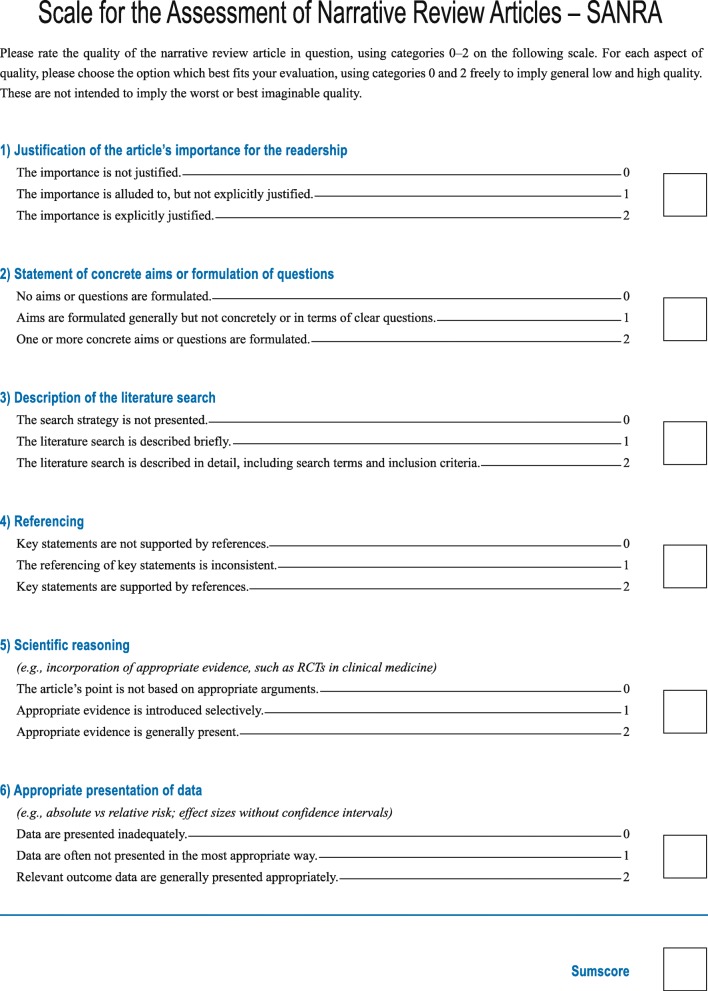
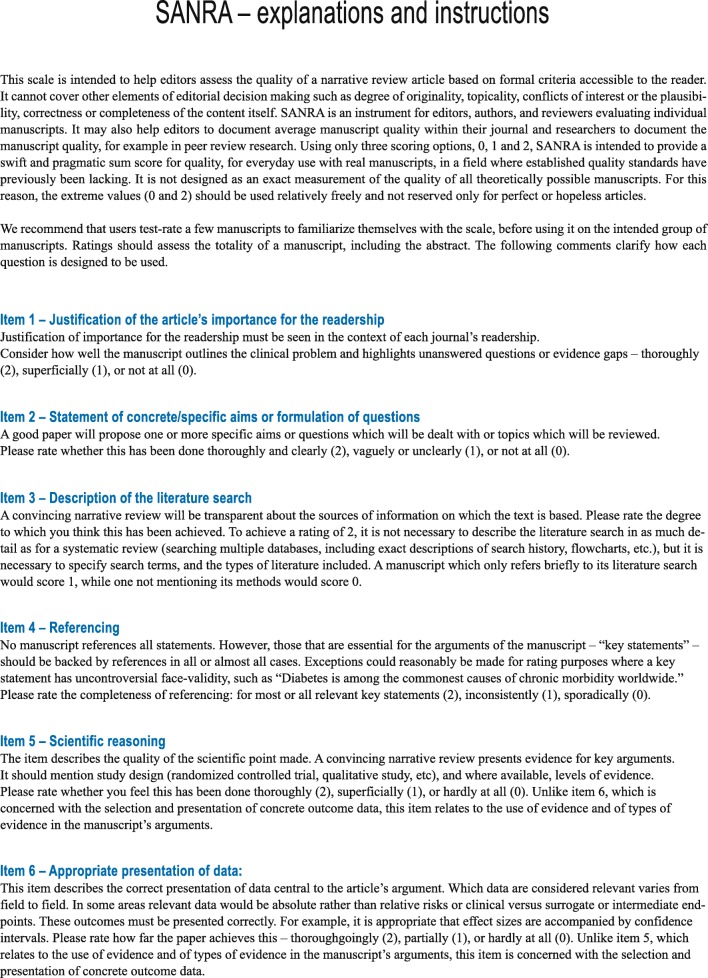
BACKGROUND: Narrative reviews are the commonest type of articles in the medical literature. However, unlike systematic reviews and randomized controlled trials (RCT) articles, for which formal instruments exist to evaluate quality, there is currently no instrument available to assess the quality of narrative reviews. In response to this gap, we developed SANRA, the Scale for the Assessment of Narrative Review Articles. METHODS: A team of three experienced journal editors modified or deleted items in an earlier SANRA version based on face validity, item-total correlations, and reliability scores from previous tests. We deleted an item which addressed a manuscript's writing and accessibility due to poor inter-rater reliability. The six items which form the revised scale are rated from 0 (low standard) to 2 (high standard) and cover the following topics: explanation of (1) the importance and (2) the aims of the review, (3) literature search and (4) referencing and presentation of (5) evidence level and (6) relevant endpoint data. For all items, we developed anchor definitions and examples to guide users in filling out the form. The revised scale was tested by the same editors (blinded to each other's ratings) in a group of 30 consecutive non-systematic review manuscripts submitted to a general medical journal. RESULTS: Raters confirmed that completing the scale is feasible in everyday editorial work. The mean sum score across all 30 manuscripts was 6.0 out of 12 possible points (SD 2.6, range 1-12). Corrected item-total correlations ranged from 0.33 (item 3) to 0.58 (item 6), and Cronbach's alpha was 0.68 (internal consistency). The intra-class correlation coefficient (average measure) was 0.77 [95% CI 0.57, 0.88] (inter-rater reliability). Raters often disagreed on items 1 and 4. CONCLUSIONS: SANRA's feasibility, inter-rater reliability, homogeneity of items, and internal consistency are sufficient for a scale of six items. Further field testing, particularly of validity, is desirable. We recommend rater training based on the "explanations and instructions" document provided with SANRA. In editorial decision-making, SANRA may complement journal-specific evaluation of manuscripts-pertaining to, e.g., audience, originality or difficulty-and may contribute to improving the standard of non-systematic reviews.
Overview
CoChat Summary
TL;DR
SANRA is a six-item, 0–2 scale (maximum 12) for assessing the quality of narrative review articles, developed and field-tested by three journal editors. In 30 consecutive non-systematic review manuscripts, it showed feasible use, sufficient internal consistency and inter-rater reliability, and a modest association with editorial acceptance.
Key findings
- Across 30 manuscripts (90 ratings), the mean SANRA sum score was 6.0 out of 12 (SD 2.6, range 1–12, median 6).
- Internal consistency was Cronbach’s alpha 0.68; corrected item-total correlations ranged from 0.33 (item 3) to 0.58 (item 6).
- Inter-rater reliability was an intra-class correlation coefficient (average measure) of 0.77 [95% CI 0.57, 0.88]; raters often disagreed on items 1 and 4.
- Average SANRA scores were modestly associated with editorial acceptance (mean 6.6, SD 1.9, n = 17) versus rejection (mean 5.1, SD 2.1, n = 13), point biserial correlation 0.37 (t = 2.09, df 28; two-sided p = 0.046).
Methods
- SANRA was developed between 2010 and 2017 by three experienced editors at Deutsches Ärzteblatt; the revised six-item version deleted an item on writing and accessibility due to poor inter-rater reliability.
- The revised scale was tested on 30 consecutive non-systematic review manuscripts submitted to Deutsches Ärzteblatt in 2015; three editor-raters scored them independently and blinded to each other’s ratings.
- Analyses included descriptive statistics, Cronbach’s alpha, corrected item-total correlations, average-measure intra-class correlation using a two-way random effects model (consistency definition), and a post hoc point biserial correlation between SANRA sum scores and acceptance/rejection.
Limitations
- The paper states the main limitation is sample size: 30 manuscripts was a compromise between representativeness, power, and feasibility, and took about 6 months to sample.
- The authors state that the scale’s authors were also the test-raters, so inter-rater reliability may be lower in groups less familiar with SANRA; the study also did not assess test-retest reliability, and results are study-specific.
- The paper acknowledges restricted content validity because SANRA is limited to six items and is a critical appraisal tool rather than a reporting guideline; criterion validity evidence is post hoc and weak, and no established cut-offs exist for comparing manuscripts across settings.
Model-written summary. Check it against the paper before relying on it.
Integrity signals
Registry
Cites
Statistics
Figures
Verification
Claims the paper makes
3 Valid · 0 Not valid · 5 Not checked · 27 Own results and interpretations
The cited sources support only part of this claim — read each source’s verdict below.
In the paper
“Bastian et al. found that they constitute the largest share of all text types in medicine and they concluded that they “remain the staple of medical literature” [1].”
- Also stated in: § Background · plain
“Narrative reviews are the commonest type of articles in the medical literature.”
§ SANRA—a scale for the quality assessment of narrative review articles > Background
What the sources say
- Partly supportedcites [1] Bastian H Glasziou P Chalmers I Seventy-five trials and eleven systematic reviews a day: how will we ever keep up? PLoS Med 2010 7 9 e1000326 10.1371/journal.pmed.1000326 20877712 PMC2943439 sourceExperimental — accuracy not yet measured
In “How Close Are We to Archie Cochrane’s Goal?” and the Summary Points (pages unavailable), the paper calls non-systematic narrative reviews the staple of medical literature synthesis. It does not say they constitute the largest share of all medical text types; that extends a claim about literature synthesis to medical literature as a whole. (LLM, conf=0.88)
plain- Asserted: passes — The authors put it forward as true.
- Checkable: passes — It can be checked against evidence.
- Load-bearing: unclear — It is unclear whether the paper’s conclusions depend on it.
- Based: passes — The paper gives a reason why it holds.
- Also stated in: § Background · plain
The sources with a verdict support this claim; the rest weren’t checked yet, have no full text we could read, or their verdicts aren’t rated yet.
In the paper
“non-systematic reviews or narrative reviews have been widely criticized as unreliable [1, 4].”
§ SANRA—a scale for the quality assessment of narrative review articles > Background
What the sources say
- Supportedcites [1] Bastian H Glasziou P Chalmers I Seventy-five trials and eleven systematic reviews a day: how will we ever keep up? PLoS Med 2010 7 9 e1000326 10.1371/journal.pmed.1000326 20877712 PMC2943439 source
In “How Close Are We to Archie Cochrane’s Goal?”, the paper describes reviews not conducted systematically as having great potential for error and calls them less reliable forms of information. Box 1 also says that articles and textbooks had highlighted the risk of bias and chance in reviews. Together, these passages support the broad characterization that narrative reviews have been criticized as unreliable; page numbers are not provided in our copy. (LLM, conf=0.89)
- Not checked — no full text of the sourcecites [4] Mulrow CD The medical review article: state of the science Ann Intern Med 1987 106 485 488 10.7326/0003-4819-106-3-485 3813259 source
plain- Asserted: passes — The authors put it forward as true.
- Checkable: passes — It can be checked against evidence.
- Load-bearing: passes — The paper’s conclusions depend on it.
- Based: passes — The paper gives a reason why it holds.
- Supported
A result the paper reports from its own data — it cites no other source for it, so there is none to check. The quote shows it is in the paper.
In the paper
“Cronbach’s alpha was 0.68 (internal consistency).”
- Also stated in: § Results · plain
“The scale’s internal consistency, measured as Cronbach’s alpha, was 0.68.”
§ SANRA—a scale for the quality assessment of narrative review articles > Abstract > Results
plainn = 90- Asserted: passes — The authors put it forward as true.
- Checkable: passes — It can be checked against evidence.
- Load-bearing: passes — The paper’s conclusions depend on it.
- Based: passes — The paper gives a reason why it holds.
- Also stated in: § Results · plain
A result the paper reports from its own data — it cites no other source for it, so there is none to check. The quote shows it is in the paper.
In the paper
“Raters often disagreed on items 1 and 4.”
- Also stated in: § Results · plain
“Disagreements most often occurred with regard to items 1 and 4.”
§ SANRA—a scale for the quality assessment of narrative review articles > Abstract > Results
plain- Asserted: passes — The authors put it forward as true.
- Checkable: passes — It can be checked against evidence.
- Load-bearing: unclear — It is unclear whether the paper’s conclusions depend on it.
- Based: passes — The paper gives a reason why it holds.
- Also stated in: § Results · plain
A result the paper reports from its own data — it cites no other source for it, so there is none to check. The quote shows it is in the paper.
In the paper
“The intra-class correlation coefficient (average measure) was 0.77 [95% CI 0.57, 0.88] (inter-rater reliability).”
- Also stated in: § Results · plain
“The intra-class correlation coefficient (average measure) amounted to 0.77 [95% CI 0.57, 0.88; F 4.3; df 29, 58].”
§ SANRA—a scale for the quality assessment of narrative review articles > Abstract > Results
plain- Asserted: passes — The authors put it forward as true.
- Checkable: passes — It can be checked against evidence.
- Load-bearing: passes — The paper’s conclusions depend on it.
- Based: passes — The paper gives a reason why it holds.
- Also stated in: § Results · plain
14 more claims
Create a free account to see all 35 claims and to verify the 3 references still open.
- Probably not a substantial claim. 11
- It may state two separate claims as one. 11
Claims other papers make about this one
Each is checked against this paper’s own text: does it say what the citing paper says it does?
The source backs part of the claim, not all of it — or backs it for a different population, condition or comparison.
In the citing paper
“The review was conducted and reported in accordance with the principles of the Scale for the Assessment of Narrative Review Articles (SANRA), which provides a validated framework for ensuring methodological transparency, scientific rigor, and balanced interpretation in narrative reviews [ 19 ].”
From Paracetamol: A History of Assumptions, Errors, and Evidence Reversals in Pain Management (2026) · cites this paper as [19]
Experimental — accuracy not yet measuredThe source backs part of the claim, not all of it — or backs it for a different population, condition or comparison.
In the citing paper
“As a narrative review, the present work does not include an aggregated quantitative assessment and is more exposed to selection subjectivity than a registered systematic review [124,125].”
From Berberine-Drug Interactions: Mechanisms, Clinical Relevance and Risk Stratification-A Narrative Review (2026) · cites this paper as [124]
Experimental — accuracy not yet measuredThe cited source says what the claim attributes to it.
In the citing paper
“This work is designed as a structured narrative review, with transparent reporting of the documentation strategy, guided by the quality criteria of the Scale for the Assessment of Narrative Review Articles (SANRA) [124].”
From Berberine-Drug Interactions: Mechanisms, Clinical Relevance and Risk Stratification-A Narrative Review (2026) · cites this paper as [124]
The cited source says what the claim attributes to it.
In the citing paper
“we used the following:-Cochrane Risk of Bias 2 (RoB 2) [29] and PEDRO scale tools for RCTs.-AMSTAR 2 [30] checklist for systematic review.-SANRA (Scale for the Assessment of Narrative Review Articles) [31] for narrative reviews.-JBI Checklist for Text and Opinion [32] for expert opinion papers.”
From Pelvic Floor Muscle Training Following Surgery for Pelvic Organ Prolapse: Recommendation from Scientific Literature (2026) · cites this paper as [31]
The cited source says what the claim attributes to it.
In the citing paper
“Data analysis employed a narrative and thematic synthesis methodology,adhering to the SANRA guidelines for narrative reviews (32).”
From Ethical issues in multi-agent AI systems for healthcare: a narrative review (2026) · cites this paper as [32]
12 more claims about this paper
Create a free account to see every claim other papers make about this one.
Citations
Cites
Shea, B. J., Reeves, B. C., Wells, G., Thuku, M., Hamel, C., Moran, J., Moher, D., Tugwell, P., Welch, V., Kristjansson, E., et al. (2017) · BMJ · doi:10.1136/bmj.j4008 · Cited by 10,636 · cited 2×
“Critical appraisal tools have been developed for systematic reviews (e.g., AMSTAR 2 [A MeaSurement Tool to Assess Systematic Reviews] [7]) and papers on RCTs (e.g., the CASP [Critical Appraisal Skills Program] checklist for randomized trials [8]) and other types of medical studies.”
BackgroundStreiner, D. L., & Norman, G. R. (2008) · doi:10.1093/acprof:oso/9780199231881.001.0001 · Cited by 2,631
Critical appraisal skills programme
Singh, J. (2013) · Journal of Pharmacology and Pharmacotherapeutics · doi:10.4103/0976-500x.107697 · Cited by 2,556
Guidelines for Reporting Reliability and Agreement Studies (GRRAS) were proposed
Kottner, J., Audigé, L., Brorson, S., Donner, A., Gajewski, B. J., Hróbjartsson, A., Roberts, C., Shoukri, M., & Streiner, D. L. (2011) · Journal of Clinical Epidemiology · doi:10.1016/j.jclinepi.2010.03.002 · Cited by 2,174
The Mass Production of Redundant, Misleading, and Conflicted Systematic Reviews and Meta‐analyses
IOANNIDIS, J. P. A. (2016) · The Milbank Quarterly · doi:10.1111/1468-0009.12210 · Cited by 1,483 · cited 1×
“While systematic reviews are not per se superior articles and while certain systematic reviews have been criticized lately [3], non-systematic reviews or narrative reviews have”
BackgroundSeventy-five trials and eleven systematic reviews a day: how will we ever keep up?
Bastian, H., Glasziou, P., & Chalmers, I. (2010) · PLoS Medicine · doi:10.1371/journal.pmed.1000326 · Cited by 1,188 · cited 2×
“found that they constitute the largest share of all text types in medicine and they concluded that they “remain the staple of medical literature” [1].”
BackgroundThe Medical Review Article: State of the Science
MULROW, C. D. (1987) · Annals of Internal Medicine · doi:10.7326/0003-4819-106-3-485 · Cited by 856 · cited 1×
“been widely criticized as unreliable [1, 4].”
Writing a narrative biomedical review: considerations for authors, peer reviewers, and editors
Gasparyan, A. Y., Ayvazyan, L., Blackmore, H., & Kitas, G. D. (2011) · Rheumatology International · doi:10.1007/s00296-011-1999-3 · Cited by 694 · cited 1×
“[13], for example, have provided guidance for writing narrative reviews, and Byrne [14] as well as Pautasso [15] has written, from different angles, thoughtful editorials on improving narrative reviews and presented lists of key features of writing a good review—lists that naturally overlap with SANRA items (e.”
BackgroundTen Simple Rules for Writing a Literature Review
Pautasso, M. (2013) · PLoS Computational Biology · doi:10.1371/journal.pcbi.1003149 · Cited by 272 · cited 3×
“[13], for example, have provided guidance for writing narrative reviews, and Byrne [14] as well as Pautasso [15] has written, from different angles, thoughtful editorials on improving narrative reviews and presented lists of key features of writing a good review—lists that naturally overlap with SANRA items (e.”
BackgroundImproving the peer review of narrative literature reviews
Byrne, J. A. (2016) · Research Integrity and Peer Review · doi:10.1186/s41073-016-0019-2 · Cited by 159 · cited 3×
“[13], for example, have provided guidance for writing narrative reviews, and Byrne [14] as well as Pautasso [15] has written, from different angles, thoughtful editorials on improving narrative reviews and presented lists of key features of writing a good review—lists that naturally overlap with SANRA items (e.”
Background
Research works printed but not linked: 3
- Higgins JPT, Green S. (eds.). Cochrane Handbook for Systematic Reviews and Interventions. Version 5.1.0. The Cochrane Collaboration 2011, section 1.2.2., www.handbook.cochrane.org, retrieved on Oct 31, 2018.
- Baethge C Mertens S Goldbeck-Wood S Development of a quality score for the assessment of non-systematic review articles (SANRA) Poster, Seventh International Congress on Peer Review and Biomedical Publication 2013 USA Chicago, Illinois
- Baethge C Goldbeck-Wood S Mertens S A scale for the assessment of non-systematic review articles (SANRA) Poster, Eighth International Congress on Peer and Biomedical Publication 2017 USA Chicago, Illinois
Cited by
Research co-design in health: a rapid overview of reviews
Slattery, P., Saeri, A. K., & Bragge, P. (2020) · Health Research Policy and Systems · doi:10.1186/s12961-020-0528-9 · Cited by 1,313
Use of Delphi in health sciences research: A narrative review
Shang, Z. (2023) · Medicine · doi:10.1097/md.0000000000032829 · Cited by 657
“This paper adheres to the criteria set by the SANRA, scale for the quality assessment of narrative review articles.[12] A narrative literature search was conducted using keywords in the Pubmed, Medline and CINAHL databases, as well as Google Scholar, ranging from 2011 to 2021.”
MethodAlGerafi, M. A. M., Zhou, Y., Oubibi, M., & Wijaya, T. T. (2023) · Electronics · doi:10.3390/electronics12183953 · Cited by 373
A Narrative Review on Sarcopenia in Type 2 Diabetes Mellitus: Prevalence and Associated Factors
Izzo, A., Massimino, E., Riccardi, G., & Della Pepa, G. (2021) · Nutrients · doi:10.3390/nu13010183 · Cited by 418
Alfei, S., Schito, G. C., Schito, A. M., & Zuccari, G. (2024) · International Journal of Molecular Sciences · doi:10.3390/ijms25137182 · Cited by 302
Aydin, S., Emre, E., Ugur, K., Aydin, M. A., Sahin, İ., Cinar, V., & Akbulut, T. (2025) · Journal of International Medical Research · doi:10.1177/03000605251315913 · Cited by 195
Multi-Morbidity and Polypharmacy in Older People: Challenges and Opportunities for Clinical Practice
Aggarwal, P., Woolford, S. J., & Patel, H. P. (2020) · Geriatrics · doi:10.3390/geriatrics5040085 · Cited by 231
“We applied the principles from the Scale for the Assessment of Narrative Review Articles (SANRA) to this manuscript.”
MethodInfluentialDigital Interventions on Healthy Lifestyle Management: Systematic Review
Chatterjee, A., Prinz, A., Gerdes, M., & Martinez, S. (2021) · Journal of Medical Internet Research · doi:10.2196/26931 · Cited by 194
“Subsequently, for article selection, we used the Scale for the Assessment of Narrative Review Articles (SANRA) scaling [29].”
MethodVitamin D and Metabolic Dysfunction-Associated Fatty Liver Disease (MAFLD): An Update
Barchetta, I., Cimini, F. A., & Cavallo, M. G. (2020) · Nutrients · doi:10.3390/nu12113302 · Cited by 186
“The reporting of this study conforms to the Scale for Assessment of Narrative Review Articles (SANRA) guidelines, a brief critical appraisal for the assessment of nonsystematic articles [24].”
MethodZheng, Y., Wang, S., Wu, J., & Wang, Y. (2023) · Journal of Translational Medicine · doi:10.1186/s12967-023-04367-1 · Cited by 179
Invasive candidiasis: current clinical challenges and unmet needs in adult populations
Soriano, A., Honore, P. M., Puerta-Alcalde, P., Garcia-Vidal, C., Pagotto, A., Gonçalves-Bradley, D. C., & Verweij, P. E. (2023) · Journal of Antimicrobial Chemotherapy · doi:10.1093/jac/dkad139 · Cited by 190
Laurindo, L. F., Santos, A. R. D. O. D., Carvalho, A. C. A. D., Bechara, M. D., Guiguer, E. L., Goulart, R. D. A., Vargas Sinatora, R., Araújo, A. C., & Barbalho, S. M. (2023) · Metabolites · doi:10.3390/metabo13010096 · Cited by 166
Campanozzi, L. L., Gibelli, F., Bailo, P., Nittari, G., Sirignano, A., & Ricci, G. (2023) · Frontiers in Public Health · doi:10.3389/fpubh.2023.1109323 · Cited by 201
“Quality evaluation SANRA (Scale for the Assessment of Narrative Review Articles) (13) was employed for a quality check of the selected studies.”
MethodThe role of extended reality technology in healthcare education: Towards a learner-centred approach
Logeswaran, A., Munsch, C., Chong, Y. J., Ralph, N., & McCrossnan, J. (2020) · Future Healthcare Journal · doi:10.7861/fhj.2020-0112 · Cited by 183
“26,27 While systematic reviews remain the gold standard in answering a specific question, narrative reviews have proven to be effective in answering broader research topics.”
BackgroundMethodShaw, J., Brewer, L. C., & Veinot, T. (2021) · JMIR Formative Research · doi:10.2196/23233 · Cited by 165
Curbing plastic consumption: A review of single-use plastic behaviour change interventions
Borg, K., Lennox, A., Kaufman, S., Tull, F., Prime, R., Rogers, L., & Dunstan, E. (2022) · Journal of Cleaner Production · doi:10.1016/j.jclepro.2022.131077 · Cited by 169
Identifying and Managing Malnutrition, Frailty and Sarcopenia in the Community: A Narrative Review
Roberts, S., Collins, P. F., & Rattray, M. (2021) · Nutrients · doi:10.3390/nu13072316 · Cited by 167
“The six items of the scale for quality assessment of narrative review articles (SANRA) were used as a guide to inform our methodological approach and to report the findings [7].”
MethodTFOS Lifestyle Report: Impact of environmental conditions on the ocular surface
Alves, M., Asbell, P. A., Doğru, M., Giannaccare, G., Grau, A. E., Gregory, D. G., Kim, D. H., Marini, M. C., Ngo, W., Nowińska, A., et al. (2023) · The Ocular Surface · doi:10.1016/j.jtos.2023.04.007 · Cited by 174
Hossain, M. S., Noman, A. A., Mamun, S. A. A., & Mosabbir, A. A. (2023) · Tropical Medicine and Health · doi:10.1186/s41182-023-00528-6 · Cited by 183
Cavaleri, D., Moretti, F., Bartoccetti, A., Mauro, S., Crocamo, C., Carrà, G., & Bartoli, F. (2023) · Neuroscience & Biobehavioral Reviews · doi:10.1016/j.neubiorev.2023.105159 · Cited by 146
Epidural analgesia in labor: A narrative review
Halliday, L., Nelson, S. M., & Kearns, R. J. (2022) · International Journal of Gynecology & Obstetrics · doi:10.1002/ijgo.14175 · Cited by 177
Challenging the Myth of the Digital Native: A Narrative Review
Reid, L., Button, D., & Brommeyer, M. (2023) · Nursing Reports · doi:10.3390/nursrep13020052 · Cited by 185
The impacts associated with having ADHD: an umbrella review
French, B., Nalbant, G., Wright, H., Sayal, K., Daley, D., Groom, M. J., Cassidy, S., & Hall, C. L. (2024) · Frontiers in Psychiatry · doi:10.3389/fpsyt.2024.1343314 · Cited by 144
“The remaining 21 literature or narrative reviews were scored on the Scale for the Assessment of Narrative Review Articles (SANRA, 69) as it was not appropriate to score these on the systematic review checklist.”
BackgroundSquires, R. A., Crawford, C., Marcondes, M., & Whitley, N. T. (2024) · Journal of Small Animal Practice · doi:10.1111/jsap.13718 · Cited by 168
“Given the remarkable breadth of material to be covered in a single document, a narrative review format has once again been adopted as the only one suitable to the task (Baethge et al., 2019).”
BackgroundImpact of systemic health on treatment outcomes in endodontics
Segura-Egea, J. J., Cabanillas‐Balsera, D., Martín-González, J., & Cintra, L. T. Â. (2022) · International Endodontic Journal · doi:10.1111/iej.13789 · Cited by 161
What is the role of eco-labels for a circular economy? A rapid review of the literature
Meis-Harris, J., Klemm, C., Kaufman, S., Curtis, J., Borg, K., & Bragge, P. (2021) · Journal of Cleaner Production · doi:10.1016/j.jclepro.2021.127134 · Cited by 116
A review of parallel kinematic machine tools: Design, modeling, and applications
Russo, M., Zhang, D., Liu, X.-J., & Xie, Z. (2024) · International Journal of Machine Tools and Manufacture · doi:10.1016/j.ijmachtools.2024.104118 · Cited by 136
“[10,11].”
Assistive Technologies in Dementia Care: An Updated Analysis of the Literature
Pappadà, A., Chattat, R., Chirico, I., Valente, M., & Ottoboni, G. (2021) · Frontiers in Psychology · doi:10.3389/fpsyg.2021.644587 · Cited by 131
“At first, we assessed the quality of the included systematic reviews through either the AMSTAR tool guidance for the systematic reviews (Shea et al., 2009) or the SANRA scale for the non-systematic reviews (Baethge et al., 2019; Tables 3 , 4 , respectively).”
BackgroundMethodPhysiological Effect of Ghrelin on Body Systems
Akalu, Y., Molla, M. D., Dessie, G., & Ayelign, B. (2020) · International Journal of Endocrinology · doi:10.1155/2020/1385138 · Cited by 147
“All papers selected for inclusion in the review were appraised by independent investigators using a scale for the assessment of nonsystematic review articles (SANRA) [57].”
MethodStress adaptation and resilience of academics in higher education
Ross, P. M., Scanes, E., & Locke, W. (2023) · Asia Pacific Education Review · doi:10.1007/s12564-023-09829-1 · Cited by 176
“The decision to use this form of review was intentional, as it allowed a summary of the literature in a way that is not explicitly systematic (Baethge et al., 2019; Green et al., 2006).”
Ultra-Processed Food, Reward System and Childhood Obesity
Calcaterra, V., Cena, H., Rossi, V., Santero, S., Bianchi, A., & Zuccotti, G. (2023) · Children · doi:10.3390/children10050804 · Cited by 158
“We developed a narrative review of the literature [14,15] on the topic of UPFs, reward systems, and childhood obesity.”
MethodMonterubbianesi, R., Tosco, V., Vitiello, F., Orilisi, G., Fraccastoro, F., Putignano, A., & Orsini, G. (2022) · Applied Sciences · doi:10.3390/app12020877 · Cited by 147
Falls among Older Adults: Screening, Identification, Rehabilitation, and Management
Giovannini, S., Brau, F., Galluzzo, V., Santagada, D. A., Loreti, C., Biscotti, L., Laudisio, A., Zuccalà, G., & Bernabei, R. (2022) · Applied Sciences · doi:10.3390/app12157934 · Cited by 149
“This review conforms to the Scale for Assessment of Narrative Review Articles (SANRA) guidelines [12].”
MethodStephan, B. C. M., Cochrane, L., Kafadar, A. H., Brain, J., Burton, E., MYERS, B. J., Brayne, C., Naheed, A., Anstey, K. J., Ashor, A. W., et al. (2024) · The Lancet Healthy Longevity · doi:10.1016/s2666-7568(24)00061-8 · Cited by 140
Oral Health and Older Adults: A Narrative Review
Lipsky, M. S., Singh, T., Zakeri, G., & Hung, M. (2024) · Dentistry Journal · doi:10.3390/dj12020030 · Cited by 163
“For the guiding principles of this review, we used a critical appraisal tool called SANRA (Scale for the Assessment of Narrative Review Articles) to control for the quality of the review process regarding findings in this manuscript [12].”
MethodMaternity Blues: A Narrative Review
Tosto, V., Ceccobelli, M., Lucarini, E., Tortorella, A. A. V., Gerli, S., Parazzini, F., & Favilli, A. (2023) · Journal of Personalized Medicine · doi:10.3390/jpm13010154 · Cited by 144
“The review was reported and qualitatively assessed following the SANRA, the Scale for the Assessment of Narrative Review Articles [5].”
MethodRodrigues, N. G., Han, C. Q. Y., Su, Y., Klainin‐Yobas, P., & Wu, X. V. (2022) · Journal of Advanced Nursing · doi:10.1111/jan.15063 · Cited by 112
“SANRA, the Scale for the Assessment of Narrative Review Articles, was used to assess the quality of the included narrative reviews (Baethge et al., 2019).”
MethodPhysical Activity Maintenance: A Critical Narrative Review and Directions for Future Research
Rhodes, R. E., & Sui, W. (2021) · Frontiers in Psychology · doi:10.3389/fpsyg.2021.725671 · Cited by 136
Anoikis-Associated Lung Cancer Metastasis: Mechanisms and Therapies
Wang, J., Luo, Z., Lin, L., Sui, X., Yu, L., Xu, C., Zhang, R., Zhao, Z., Zhu, Q., An, B., et al. (2022) · Cancers · doi:10.3390/cancers14194791 · Cited by 126
Osteoarthritis: a narrative review of molecular approaches to disease management
Salman, L. A., Ahmed, G., Dakin, S. G., Kendrick, B. J. L., & Price, A. J. (2023) · Arthritis Research & Therapy · doi:10.1186/s13075-023-03006-w · Cited by 131
“Additionally, this narrative review was conducted in line with the Scale for the Assessment of Narrative Review Articles (SANRA) quality assessment tool [19].”
MethodAging populations and expenditures on health
Kallestrup‐Lamb, M., Marin, A. O. K., Menon, S., & Søgaard, J. (2024) · The Journal of the Economics of Ageing · doi:10.1016/j.jeoa.2024.100518 · Cited by 128
New Horizons: Epidemiology of Obesity, Diabetes Mellitus, and Cancer Prognosis
Harborg, S., Kjærgaard, K. A., Thomsen, R. W., Borgquist, S., Cronin-Fenton, D. P., & Hjorth, C. F. (2023) · The Journal of Clinical Endocrinology & Metabolism · doi:10.1210/clinem/dgad450 · Cited by 124
Massimino, E., Izzo, A., Riccardi, G., & Della Pepa, G. (2021) · Cells · doi:10.3390/cells10081958 · Cited by 102
“Literature probing for this narrative review [51] was conducted by searching PubMed database for articles published during the last 20 years (2001–2021), considering that the majority of glucose-lowering drugs has been approved in the last twenty years; however, we also considered, if available, the most relevant stud…”
MethodFactors influencing the visual deliciousness / eye-appeal of food
Spence, C. J., Motoki, K., & Petit, O. (2022) · Food Quality and Preference · doi:10.1016/j.foodqual.2022.104672 · Cited by 120
Maraveas, C., Konar, D., Michopoulos, D. K., Arvanitis, K. G., & Peppas, K. P. (2024) · Computers and Electronics in Agriculture · doi:10.1016/j.compag.2024.108680 · Cited by 115
Lanctôt, K. L., Ismail, Z., Bawa, K. K., Cummings, J. L., Husain, M., Mortby, M. E., & Robert, P. H. (2023) · International Journal of Geriatric Psychiatry · doi:10.1002/gps.5882 · Cited by 115
Moseley, G. L., Leake, H. B., Beetsma, A. J., Watson, J. A., Butler, D. S., van der Mee, A., Stinson, J., Harvie, D. S., Palermo, T. M., Meeus, M., et al. (2023) · Journal of Pain · doi:10.1016/j.jpain.2023.11.008 · Cited by 118
Strategies and tactics to reduce the impact of healthcare on climate change: systematic review
Braithwaite, J., Smith, C. L., Leask, E., Wijekulasuriya, S., Brooke-Cowden, K., Fisher, G., Patel, R., Pagano, L., Rahimi‐Ardabili, H., Spanos, S., et al. (2024) · BMJ · doi:10.1136/bmj-2024-081284 · Cited by 121
Husain, L., Greenhalgh, T., Hughes, G., Finlay, T. M. D., & Wherton, J. P. (2022) · Journal of Medical Internet Research · doi:10.2196/42358 · Cited by 105
“Third, we took note of methodological guidance from a group of journal editors in the health care field [45], who developed a structured critical appraisal tool (SANRA [Scale for the Assessment of Narrative Review Articles]).”
Nursing skills required across natural and man‐made disasters: A scoping review
Su, Y., Wu, X. V., Ogawa, N., Yuki, M., Hu, Y., & Yang, Y. W. (2022) · Journal of Advanced Nursing · doi:10.1111/jan.15337 · Cited by 90
“In addition, narrative review articles were evaluated using a scale for the quality assessment of narrative review articles ([SANRA] Baethge et al., 2019).”
MethodThe impact of gender and sex in psoriasis: What to be aware of when treating women with psoriasis
Guillet, C., Seeli, C., Meienberger, N., Maul, L. V., & Maul, J. (2022) · International Journal of Women’s Dermatology · doi:10.1097/jw9.0000000000000010 · Cited by 102
Pinto, D., Alshahrani, M., Chapurlat, R. D., Chevalley, T., Dennison, E. M., Camargos, B. M., Παπαϊωάννου, Α., Silverman, S. L., Kaux, J., Lane, N. E., et al. (2022) · Osteoporosis International · doi:10.1007/s00198-021-06240-7 · Cited by 93
“Narrative reviews are ideally suited to this task [12].”
BackgroundCARDA: Guiding document analyses in health professions education research
Cleland, J., MacLeod, A., & Ellaway, R. (2022) · Medical Education · doi:10.1111/medu.14964 · Cited by 94
The impact of decentralisation on health systems: a systematic review of reviews
Sapkota, S., Dhakal, A., Rushton, S., van Teijlingen, E., Marahatta, S. B., Balen, J., & Lee, A. C. (2023) · BMJ Global Health · doi:10.1136/bmjgh-2023-013317 · Cited by 96
“Following assessment, we scored CASP checklist items (yes=2; can’t tell=1; no=0) and categorised systematic reviews with scores 16–20 as ‘high’, 11–15 as ‘medium’ and 0–10 as ‘low’ quality.”
MethodCancer across the ages: a narrative review of caregiver burden for patients of all ages
Junkins, C. C., Kent, E., Litzelman, K., Bevans, M., Cannady, R. S., & Rosenberg, A. R. (2020) · Journal of Psychosocial Oncology · doi:10.1080/07347332.2020.1796887 · Cited by 69
Rheumatic heart disease anno 2020: Impacts of gender and migration on epidemiology and management
Mutagaywa, R., Wind, A. M., Kamuhabwa, A., Cramer, M. J., Chillo, P., & Chamuleau, S. A. J. (2020) · European Journal of Clinical Investigation · doi:10.1111/eci.13374 · Cited by 78
Golanska, P., Saczuk, K., Domarecka, M., Kuć, J., & Łukomska−Szymańska, M. (2021) · International Journal of Environmental Research and Public Health · doi:10.3390/ijerph18157807 · Cited by 96
“The review complies with the recommendations of the Scale for the Assessment of Narrative Review Articles (SANRA) [5].”
MethodZhao, J., Xu, L., Jin, D., Xin, Y., Tian, L., Wang, T., Zhao, D., Wang, Z., & Wang, J. (2022) · Biomolecules · doi:10.3390/biom12101410 · Cited by 78
“Finally, we organized the tables, wrote the text, and made figures to summarize the application of RA anticancer effects according to the SANRA and previously literature review [14,15].”
MethodEl-Tallawy, S. N., Pergolizzi, J. V., Vasiliu-Feltes, I., Ahmed, R. S., LeQuang, J. A., Alzahrani, T., Varrassi, G., Awaleh, F. I., Alsubaie, A. T., & Nagiub, M. S. (2024) · Pain and Therapy · doi:10.1007/s40122-024-00620-7 · Cited by 76
“The SANRA (Scale for the Assessment of Narrative Review Articles) format for reporting narrative review has been used to evaluate the quality of the manuscript [16].”
MethodEstimating Risk of Antidepressant Withdrawal from a Review of Published Data
Horowitz, M. A., Framer, A., Hengartner, M. P., Sørensen, A., & Taylor, D. (2023) · CNS Drugs · doi:10.1007/s40263-022-00960-y · Cited by 76
The Influence of Parents on Emotion Regulation in Middle Childhood: A Systematic Review
Raeymaecker, K. D., & Dhar, M. (2022) · Children · doi:10.3390/children9081200 · Cited by 85
“This reduced the maximum score of the SANRA to 10.”
MethodInfluentialThe Role of Cold Atmospheric Plasma in Wound Healing Processes in Critically Ill Patients
Bolgeo, T., Maconi, A., Gardalini, M., Gatti, D., Matteo, R. D., Lapidari, M., Longhitano, Y., Savioli, G., Piccioni, A., & Zanza, C. (2023) · Journal of Personalized Medicine · doi:10.3390/jpm13050736 · Cited by 84
“It involves 6 stages: (1) justify the importance of the review; (2) state the specific purposes or pose research questions; (3) describe the adopted research strategy; (4) attribute references to the summarized statements; (5) demonstrate scientific reasoning in the discussion; and (6) report data appropriately [27].”
BackgroundThe Epidemiology of Syphilis Worldwide in the Last Decade
Rosset, F., Celoria, V., Delmonte, S., Mastorino, L., Sciamarrelli, N., Boskovic, S., Ribero, S., & Quaglino, P. (2025) · Journal of Clinical Medicine · doi:10.3390/jcm14155308 · Cited by 97
“The review follows general principles outlined in the SANRA (Scale for the Assessment of Narrative Review Articles) checklist, including clarity of aims, relevance of included studies, and critical discussion of findings [13–15].”
Imposter syndrome in doctors beyond training: a narrative review
Freeman, J., & Peisah, C. (2021) · Australasian Psychiatry · doi:10.1177/10398562211036121 · Cited by 84
Writing and appraising narrative reviews
Sarkar, S., & Bhatia, G. (2021) · The Journal of Clinical and Scientific Research · doi:10.4103/jcsr.jcsr_1_21 · Cited by 77
Muscle ultrasound and its application to point-of-care ultrasonography: a narrative review
Nagae, M., Umegaki, H., Yoshiko, A., & Fujita, K. (2022) · Annals of Medicine · doi:10.1080/07853890.2022.2157871 · Cited by 83
Mechanism and physical activities in bone-skeletal muscle crosstalk
Zhao, Z., Yan, K., Guan, Q., Guo, Q., & Zhao, C. (2024) · Frontiers in Endocrinology · doi:10.3389/fendo.2023.1287972 · Cited by 95
Fröberg, A., & Lundvall, S. (2021) · Sustainability · doi:10.3390/su132111900 · Cited by 81
Radoš, S. N., Akik, B. K., Žutić, M., Muñoz, M. D. L. F. R., Uriko, K., Motrico, E., Moreno-Peral, P., Apter, G., & den Berg, M. P. L. (2024) · Comprehensive Psychiatry · doi:10.1016/j.comppsych.2024.152456 · Cited by 91
Miler, J. A., Carver, H., Masterton, W., Parkes, T., Maden, M., Jones, L., & Sumnall, H. R. (2021) · PLoS ONE · doi:10.1371/journal.pone.0254729 · Cited by 79
Antel, R., Rahimi, S. A., Guadagno, E., Harley, J. M., & Poenaru, D. (2022) · Patient Education and Counseling · doi:10.1016/j.pec.2022.06.006 · Cited by 81
Płudowski, P., Grant, W. B., Karras, S. Ν., Zittermann, A., & Pilz, S. (2024) · Nutrients · doi:10.3390/nu16030391 · Cited by 90
“The sixth SANRA topic, i.e., “Appropriate presentation of data,” is addressed by presenting data of clinically relevant endpoints and including e ff ect sizes for some major fi ndings [29].”
BackgroundMethodA Narrative Review: The Effect and Importance of Carotenoids on Aging and Aging-Related Diseases
Bakac, E. R., Percin, E., Bayır, A. G., & Dadak, A. M. (2023) · International Journal of Molecular Sciences · doi:10.3390/ijms242015199 · Cited by 78
“This narrative review conforms to the Scale for the Assessment of Narrative Review Articles (SANRA) guidelines [124].”
MethodTamascelli, N., Campari, A., Parhizkar, T., & Paltrinieri, N. (2024) · Journal of Loss Prevention in the Process Industries · doi:10.1016/j.jlp.2024.105343 · Cited by 81
The Implications of Zinc Therapy in Combating the COVID-19 Global Pandemic
Samad, N., Sodunke, T. E., Abubakar, A. R., Jahan, I., Sharma, P., Islam, S., Dutta, S., & Haque, M. (2021) · Journal of Inflammation Research · doi:10.2147/jir.s295377 · Cited by 73
The Utility of Myotonometry in Musculoskeletal Rehabilitation and Human Performance Programming
McGowen, J. M., Hoppes, C. W., Forsse, J. S., Albin, S. R., Abt, J. P., & Koppenhaver, S. L. (2022) · Journal of Athletic Training · doi:10.4085/616.21 · Cited by 69
Delgado, S. R., Faissner, S., Linker, R. A., & Rammohan, K. W. (2023) · Journal of Neurology · doi:10.1007/s00415-023-12007-3 · Cited by 76
“This review adhered to the Scale for the Assessment of Narrative Review best practice guideline for the development of narrative reviews [45].”
MethodThe positive and negative aspects of parentification: An integrated review
Masiran, R., Ibrahim, N., Awang, H., & Lim, P. Y. (2023) · Children and Youth Services Review · doi:10.1016/j.childyouth.2022.106709 · Cited by 66
Watrowski, R., Kostov, S. G., & Alkatout, İ. (2021) · Videosurgery and Other Miniinvasive Techniques · doi:10.5114/wiitm.2021.108800 · Cited by 85
“We adhered to the quality standards for narrative reviews, as defined by experts [29] and quantified by “SANRA – a scale for the quality assessment of narrative review articles” [30].”
MethodDeep, P. D., & Chen, Y. (2025) · Societies · doi:10.3390/soc15090247 · Cited by 65
“To ensure the methodological rigor of the review, the study selection process followed the SANRA (Scale for the Assessment of Narrative Review Articles) guidelines [27], ensuring that only high-quality studies were included.”
Janjua, O. S., Shaikh, M. S., Fareed, M. A., Qureshi, S. M., Khan, M. I., Hashem, D., & Zafar, M. S. (2021) · Journal of Fungi · doi:10.3390/jof8010044 · Cited by 72
TFOS Lifestyle Report Executive Summary: A Lifestyle Epidemic - Ocular Surface Disease
Craig, J. P., Alves, M., Wolffsohn, J. S., Downie, L. E., Efron, N., Galor, A., Gomes, J. Á. P., Jones, L., Markoulli, M. P., Stapleton, F. J., et al. (2023) · The Ocular Surface · doi:10.1016/j.jtos.2023.08.009 · Cited by 63
Passet-Wittig, J., & Greil, A. L. (2021) · Social Science & Medicine · doi:10.1016/j.socscimed.2021.113782 · Cited by 62
Vernal Keratoconjunctivitis: A Systematic Review
Bruschi, G., Ghiglioni, D. G., Cozzi, L., Osnaghi, S. G., Viola, F., & Marchisio, P. (2023) · Clinical Reviews in Allergy & Immunology · doi:10.1007/s12016-023-08970-4 · Cited by 73
Resposta a necessidades em saúde mental de estudantes universitários: uma revisão rápida
Gaiotto, E. M. G., Trapé, C. A., Campos, C. M. S., Fujimori, E., Carrer, F. C. D. A., Nichiata, L. Y. I., Cordeiro, L., de Bortoli, M. C., Yonekura, T., Toma, T. S., et al. (2021) · Revista de Saúde Pública · doi:10.11606/s1518-8787.2021055003363 · Cited by 81
Sabé, M., Sulstarova, A., Glangetas, A., Pieri, M. D., Mallet, L., Curtis, L., Richard-Lepouriel, H., Penzenstadler, L. E., Seragnoli, F., Thorens, G., et al. (2024) · Molecular Psychiatry · doi:10.1038/s41380-024-02800-5 · Cited by 72
“We utilized the AMSTAR-2 scale for systematic reviews [28], the SANRA scale for reviews [29], the Cochrane Risk-Of-Bias tool for RCTs (RoB 2) [30], and Risk Of Bias In Non-randomized Studies of Interventions tool (ROBINS-I) for non-randomized studies [31].”
Quarenghi, M., Capelli, S., Galligani, G., Giana, A., Preatoni, G., & Quarenghi, R. T. (2025) · Journal of Clinical Medicine · doi:10.3390/jcm14113791 · Cited by 67
“The present narrative review was organized through the “Narrative Review Checklist”, which is provided by the Academy of Nutrition and Dietetics [33,34].”
Cava, E., Padua, E., Campaci, D., Bernardi, M., Muthanna, F. M. S., Caprio, M., & Lombardo, M. (2024) · Healthcare · doi:10.3390/healthcare12020246 · Cited by 74
“The review was conducted using multiple databases including PubMed, Scopus, and Google Scholar, and adheres to the Scale for the Assessment of Narrative Review Articles (SANRA) guidelines [25].”
MethodAbaza, A., Sid Idris, F., Anis Shaikh, H., Vahora, I., Moparthi, K. P., Al Rushaidi, M. T., Muddam, M. R., Obajeun, O. A., Jaramillo, A. P., & Khan, S. (2023) · Cureus · doi:10.7759/cureus.44582 · Cited by 59
Climate change and health of the urban poor: The role of environmental justice
Chaudhry, D. (2023) · The Journal of Climate Change and Health · doi:10.1016/j.joclim.2023.100277 · Cited by 83
“Narrative review articles were assessed using the Scale for the Assessment of Narrative Review Articles (SANRA) criteria (Table A.1) [12].”
Simpson, E. L., Brown, R. D., Sillence, E., Coventry, L., Lloyd, K. C., Gibbs, J., Tariq, S., & Durrant, A. C. (2021) · Frontiers in Public Health · doi:10.3389/fpubh.2021.641424 · Cited by 64
“Narrative Review Narrative reviews are fast becoming the most common form of literature review across multiple disciplines (22).”
BackgroundNew determinants of mental health: the role of noise pollution. A narrative review
Tortorella, A. A. V., Menculini, G., Moretti, P., Attademo, L., Balducci, P. M., Bernardini, F., Cirimbilli, F., Chieppa, A. G., Ghiandai, N., & Erfurth, A. (2022) · International Review of Psychiatry · doi:10.1080/09540261.2022.2095200 · Cited by 60
“For improving the narrative review methodology, we followed the Scale for the Assessment of Narrative Review Articles (SANRA) items (Baethge et al., 2019).”
MethodManagement of Endoleaks After Elective Infrarenal Aortic Endovascular Aneurysm Repair
Cifuentes, S., Mendes, B. C., Tabiei, A., Scali, S. T., Oderich, G. S., & DeMartino, R. R. (2023) · JAMA Surgery · doi:10.1001/jamasurg.2023.2934 · Cited by 58
Armed conflict, a neglected determinant of childhood vaccination: some children are left behind
Ngo, N. V., Pemunta, N. V., Muluh, N. E., Adedze, M., Basil, N., & Agwale, S. M. (2019) · Human Vaccines & Immunotherapeutics · doi:10.1080/21645515.2019.1688043 · Cited by 66
Prescription of therapeutic exercise in migraine, an evidence-based clinical practice guideline
Touche, R. L., Fierro‐Marrero, J., Sánchez-Ruíz, I., de Rivera-Romero, B. R., Cabrera-López, C. D., Lara, S. L., Requejo-Salinas, N., Fernández, F. A. C., Elizagaray-García, I., Fernández‐Carnero, J., et al. (2023) · The Journal of Headache and Pain · doi:10.1186/s10194-023-01571-8 · Cited by 68
Pensgaard, A. M., Sundgot-Borgen, J., Edwards, C., Jacobsen, A. U., & Mountjoy, M. (2023) · British Journal of Sports Medicine · doi:10.1136/bjsports-2023-106867 · Cited by 56
Alzola, P., Pardo, C. C., Bermejo‐Pareja, F., Sánchez‐Benavides, G., Peña‐Casanova, J., Puertas‐Martín, V., Fernández‐Calvo, B., & Contador, I. (2024) · Journal of Clinical Medicine · doi:10.3390/jcm13123442 · Cited by 68
“This review is in accordance with the Scale for the Assessment of Narrative Review Articles (SANRA) [33].”
BackgroundMethodEvaluating Phthalates and Bisphenol in Foods: Risks for Precocious Puberty and Early-Onset Obesity
Calcaterra, V., Cena, H., Loperfido, F., Rossi, V., Grazi, R., Quatrale, A. E., Giuseppe, R. D., Manuelli, M. C., & Zuccotti, G. (2024) · Nutrients · doi:10.3390/nu16162732 · Cited by 62
“We conducted a narrative review [18,19] to discuss the role of diet in exposure to phthalates and bisphenol and to investigate how their presence in foods may be a risk factor for the development of PP and early-onset obesity.”
MethodDeep, P. D., Chen, Y., Ghosh, N., & Rahaman, M. S. (2024) · Education Sciences · doi:10.3390/educsci15010033 · Cited by 71
Bennell, C., Jenkins, B., Blaskovits, B., Semple, T., Khanizadeh, A., Brown, A. S., & Jones, N. J. (2022) · Frontiers in Psychology · doi:10.3389/fpsyg.2022.818009 · Cited by 62
Metadata
- Authors
- Baethge, C., Goldbeck-Wood, S., & Mertens, S.
- Affiliations
- University of Cologne (DE)
- BMJ Group (United Kingdom) (GB)
- Corresponding author
- Baethge, Christopher
- ORCID
- Baethge, Christopher
- Venue
- Research Integrity and Peer Review
- Published
- 2019-03-26
- Volume
- 4
- Issue
- 1
- Pages
- 5-5
- ISSN
- 2058-8615 (ISSN-L)
- PMC
- PMC6434870
- OpenAlex
- W2922577842
- Semantic Scholar
- ea7f35b3069b53791c3b746c5c4b3c72a83a526b
- Cited by
- 3,469
- References
- 13
- Citations by year
- 2026: 1823 · 2025: 551 · 2024: 379 · 2023: 309 · 2022: 218 · 2021: 152 · 2020: 32 · 2019: 4
- FWCI
- 20.57
- Type
- journal article
- Language
- en
- Open access
- gold
- doi.org
- Licence
- cc-by
- creativecommons.org/licenses/by/4.0/ (tdm)
- Locations
- Research Integrity and Peer Review (publishedVersion, cc-by)
- Europe PMC (PubMed Central) (publishedVersion, other-oa)
- PubMed Central (publishedVersion, cc-by)
- PubMed (publishedVersion)
- Kölner Universitäts PublikationsServer (Universität zu Köln) (publishedVersion)
- DOAJ (DOAJ: Directory of Open Access Journals) (submittedVersion, cc-by-sa)
- Topics
- Social Sciences › Decision Sciences › Statistics, Probability and Uncertainty › Meta-analysis and systematic reviews
- Social Sciences › Library and Information Sciences › Academic Writing and Publishing
- Social Sciences › Library and Information Sciences › scientometrics and bibliometrics research
- Keywords
- quality assessment scale, manuscript review, inter-rater reliability, level of evidence, scale development
About these checks
Registry, retraction, Cites and statistics results are computed, not judged, with one exception: a printed reference that no index lists is read once by a model before it counts as a citation error. Claims are extracted by a model and kept only when their quote appears verbatim in the text; each cited source is then checked, with a model’s help, for whether it says what the claim relies on. Those verdicts can be wrong — read the claim’s quote and the cited source before relying on one.
The claim verdicts this report counts are experimental: their accuracy is not yet measured.
A language model drew the claims from the paper on 2026-11-10, under version 3 of the claim definition (model deepseek-v4.1-flash, prompt extract-v3).
A second model labelled each claim on 2026-11-10 (model jev-1.13-20260917, definition revision gold-guideline-v0.2).
Cited sources are checked with a language model’s help (gpt-6-sol).
Statistics and arithmetic are recomputed, not judged.
Confidence bands are shown only for fields calibrated on our annotated test set. None is calibrated yet, so no band is shown.
What counts as a claim ›How we measure confidence ›How we check this ›
Are you an author, or do you see a problem with this page? Request a review
Data sources
Bibliographic data: Semantic Scholar, OpenAlex, Crossref.
Contains information from the Semantic Scholar Academic Graph Datasets, made available under the ODC Attribution License (ODC-BY 1.0).
Semantic Scholar’s data is described in: Kinney, R., et al. (2023). The Semantic Scholar Open Data Platform. arXiv:2301.10140.
