

SANRA—a scale for the quality assessment of narrative review articles
Open accessThe DOI matches its Crossref record; 12 of the 13 references it cites were found in a registry or an index; 4 of the 12 sources its claims cite were checked for support.
Abstract
BACKGROUND: Narrative reviews are the commonest type of articles in the medical literature. However, unlike systematic reviews and randomized controlled trials (RCT) articles, for which formal instruments exist to evaluate quality, there is currently no instrument available to assess the quality of narrative reviews. In response to this gap, we developed SANRA, the Scale for the Assessment of Narrative Review Articles. METHODS: A team of three experienced journal editors modified or deleted items in an earlier SANRA version based on face validity, item-total correlations, and reliability scores from previous tests. We deleted an item which addressed a manuscript's writing and accessibility due to poor inter-rater reliability. The six items which form the revised scale are rated from 0 (low standard) to 2 (high standard) and cover the following topics: explanation of (1) the importance and (2) the aims of the review, (3) literature search and (4) referencing and presentation of (5) evidence level and (6) relevant endpoint data. For all items, we developed anchor definitions and examples to guide users in filling out the form. The revised scale was tested by the same editors (blinded to each other's ratings) in a group of 30 consecutive non-systematic review manuscripts submitted to a general medical journal. RESULTS: Raters confirmed that completing the scale is feasible in everyday editorial work. The mean sum score across all 30 manuscripts was 6.0 out of 12 possible points (SD 2.6, range 1-12). Corrected item-total correlations ranged from 0.33 (item 3) to 0.58 (item 6), and Cronbach's alpha was 0.68 (internal consistency). The intra-class correlation coefficient (average measure) was 0.77 [95% CI 0.57, 0.88] (inter-rater reliability). Raters often disagreed on items 1 and 4. CONCLUSIONS: SANRA's feasibility, inter-rater reliability, homogeneity of items, and internal consistency are sufficient for a scale of six items. Further field testing, particularly of validity, is desirable. We recommend rater training based on the "explanations and instructions" document provided with SANRA. In editorial decision-making, SANRA may complement journal-specific evaluation of manuscripts-pertaining to, e.g., audience, originality or difficulty-and may contribute to improving the standard of non-systematic reviews.
Overview
CoChat Summary
TL;DR
SANRA is a six-item, 0–2 scale (maximum 12) for assessing the quality of narrative review articles, developed and field-tested by three journal editors. In 30 consecutive non-systematic review manuscripts, it showed feasible use, sufficient internal consistency and inter-rater reliability, and a modest association with editorial acceptance.
Key findings
- Across 30 manuscripts (90 ratings), the mean SANRA sum score was 6.0 out of 12 (SD 2.6, range 1–12, median 6).
- Internal consistency was Cronbach’s alpha 0.68; corrected item-total correlations ranged from 0.33 (item 3) to 0.58 (item 6).
- Inter-rater reliability was an intra-class correlation coefficient (average measure) of 0.77 [95% CI 0.57, 0.88]; raters often disagreed on items 1 and 4.
- Average SANRA scores were modestly associated with editorial acceptance (mean 6.6, SD 1.9, n = 17) versus rejection (mean 5.1, SD 2.1, n = 13), point biserial correlation 0.37 (t = 2.09, df 28; two-sided p = 0.046).
Methods
- SANRA was developed between 2010 and 2017 by three experienced editors at Deutsches Ärzteblatt; the revised six-item version deleted an item on writing and accessibility due to poor inter-rater reliability.
- The revised scale was tested on 30 consecutive non-systematic review manuscripts submitted to Deutsches Ärzteblatt in 2015; three editor-raters scored them independently and blinded to each other’s ratings.
- Analyses included descriptive statistics, Cronbach’s alpha, corrected item-total correlations, average-measure intra-class correlation using a two-way random effects model (consistency definition), and a post hoc point biserial correlation between SANRA sum scores and acceptance/rejection.
Limitations
- The paper states the main limitation is sample size: 30 manuscripts was a compromise between representativeness, power, and feasibility, and took about 6 months to sample.
- The authors state that the scale’s authors were also the test-raters, so inter-rater reliability may be lower in groups less familiar with SANRA; the study also did not assess test-retest reliability, and results are study-specific.
- The paper acknowledges restricted content validity because SANRA is limited to six items and is a critical appraisal tool rather than a reporting guideline; criterion validity evidence is post hoc and weak, and no established cut-offs exist for comparing manuscripts across settings.
Model-written summary. Check it against the paper before relying on it.
Integrity signals
Registry
Cites
Statistics
Figures
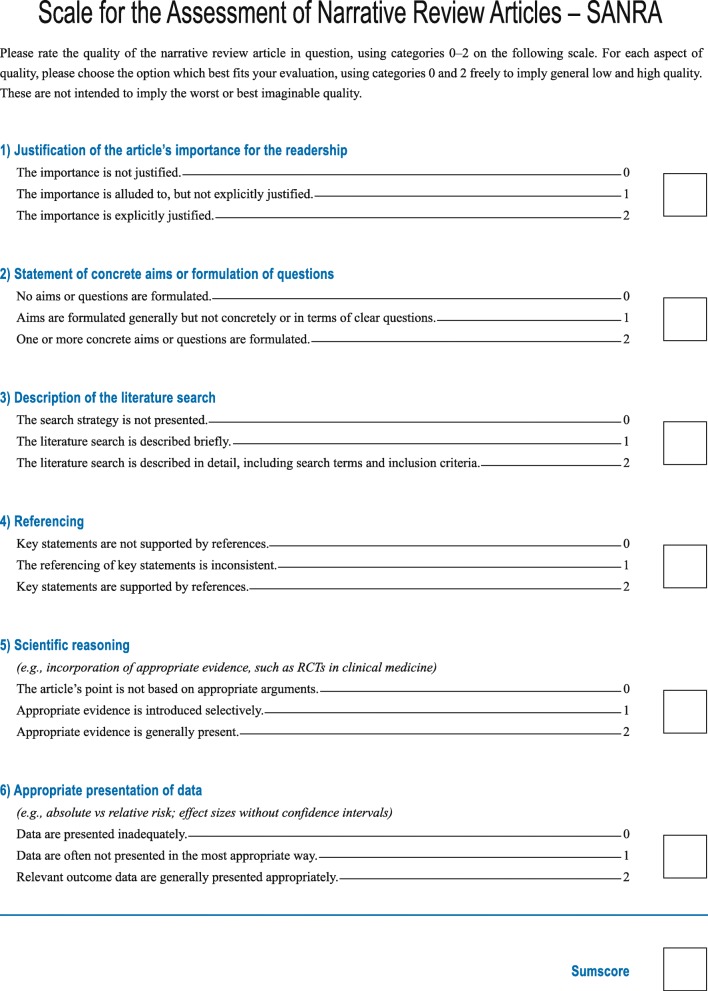
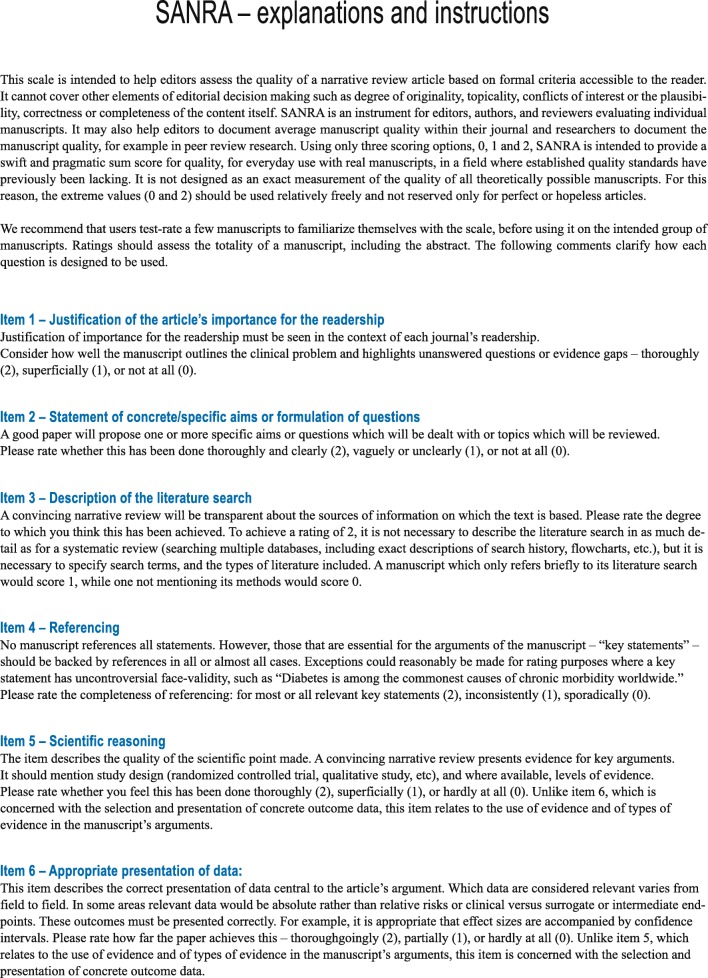
Verification
Claims the paper makes
3 Valid · 0 Not valid · 5 Not checked · 27 Own results and interpretations
The cited sources support only part of this claim — read each source’s verdict below.
In the paper
“Bastian et al. found that they constitute the largest share of all text types in medicine and they concluded that they “remain the staple of medical literature” [1].”
- Also stated in: § Background · plain
“Narrative reviews are the commonest type of articles in the medical literature.”
§ SANRA—a scale for the quality assessment of narrative review articles > Background
What the sources say
- Partly supportedcites [1] Bastian H Glasziou P Chalmers I Seventy-five trials and eleven systematic reviews a day: how will we ever keep up? PLoS Med 2010 7 9 e1000326 10.1371/journal.pmed.1000326 20877712 PMC2943439 sourceExperimental — accuracy not yet measured
In “How Close Are We to Archie Cochrane’s Goal?” and the Summary Points (pages unavailable), the paper calls non-systematic narrative reviews the staple of medical literature synthesis. It does not say they constitute the largest share of all medical text types; that extends a claim about literature synthesis to medical literature as a whole. (LLM, conf=0.88)
plain- Asserted: passes — The authors put it forward as true.
- Checkable: passes — It can be checked against evidence.
- Load-bearing: unclear — It is unclear whether the paper’s conclusions depend on it.
- Based: passes — The paper gives a reason why it holds.
- Also stated in: § Background · plain
The sources with a verdict support this claim; the rest weren’t checked yet, have no full text we could read, or their verdicts aren’t rated yet.
In the paper
“non-systematic reviews or narrative reviews have been widely criticized as unreliable [1, 4].”
§ SANRA—a scale for the quality assessment of narrative review articles > Background
What the sources say
- Supportedcites [1] Bastian H Glasziou P Chalmers I Seventy-five trials and eleven systematic reviews a day: how will we ever keep up? PLoS Med 2010 7 9 e1000326 10.1371/journal.pmed.1000326 20877712 PMC2943439 source
In “How Close Are We to Archie Cochrane’s Goal?”, the paper describes reviews not conducted systematically as having great potential for error and calls them less reliable forms of information. Box 1 also says that articles and textbooks had highlighted the risk of bias and chance in reviews. Together, these passages support the broad characterization that narrative reviews have been criticized as unreliable; page numbers are not provided in our copy. (LLM, conf=0.89)
- Not checked — no full text of the sourcecites [4] Mulrow CD The medical review article: state of the science Ann Intern Med 1987 106 485 488 10.7326/0003-4819-106-3-485 3813259 source
plain- Asserted: passes — The authors put it forward as true.
- Checkable: passes — It can be checked against evidence.
- Load-bearing: passes — The paper’s conclusions depend on it.
- Based: passes — The paper gives a reason why it holds.
- Supported
A result the paper reports from its own data — it cites no other source for it, so there is none to check. The quote shows it is in the paper.
In the paper
“Cronbach’s alpha was 0.68 (internal consistency).”
- Also stated in: § Results · plain
“The scale’s internal consistency, measured as Cronbach’s alpha, was 0.68.”
§ SANRA—a scale for the quality assessment of narrative review articles > Abstract > Results
plainn = 90- Asserted: passes — The authors put it forward as true.
- Checkable: passes — It can be checked against evidence.
- Load-bearing: passes — The paper’s conclusions depend on it.
- Based: passes — The paper gives a reason why it holds.
- Also stated in: § Results · plain
A result the paper reports from its own data — it cites no other source for it, so there is none to check. The quote shows it is in the paper.
In the paper
“Raters often disagreed on items 1 and 4.”
- Also stated in: § Results · plain
“Disagreements most often occurred with regard to items 1 and 4.”
§ SANRA—a scale for the quality assessment of narrative review articles > Abstract > Results
plain- Asserted: passes — The authors put it forward as true.
- Checkable: passes — It can be checked against evidence.
- Load-bearing: unclear — It is unclear whether the paper’s conclusions depend on it.
- Based: passes — The paper gives a reason why it holds.
- Also stated in: § Results · plain
A result the paper reports from its own data — it cites no other source for it, so there is none to check. The quote shows it is in the paper.
In the paper
“The intra-class correlation coefficient (average measure) was 0.77 [95% CI 0.57, 0.88] (inter-rater reliability).”
- Also stated in: § Results · plain
“The intra-class correlation coefficient (average measure) amounted to 0.77 [95% CI 0.57, 0.88; F 4.3; df 29, 58].”
§ SANRA—a scale for the quality assessment of narrative review articles > Abstract > Results
plain- Asserted: passes — The authors put it forward as true.
- Checkable: passes — It can be checked against evidence.
- Load-bearing: passes — The paper’s conclusions depend on it.
- Based: passes — The paper gives a reason why it holds.
- Also stated in: § Results · plain
14 more claims
Create a free account to see all 35 claims and to verify the 3 references still open.
- Probably not a substantial claim. 11
- It may state two separate claims as one. 11
Claims other papers make about this one
Each is checked against this paper’s own text: does it say what the citing paper says it does?
The source backs part of the claim, not all of it — or backs it for a different population, condition or comparison.
In the citing paper
“The review was conducted and reported in accordance with the principles of the Scale for the Assessment of Narrative Review Articles (SANRA), which provides a validated framework for ensuring methodological transparency, scientific rigor, and balanced interpretation in narrative reviews [ 19 ].”
From Paracetamol: A History of Assumptions, Errors, and Evidence Reversals in Pain Management (2026) · cites this paper as [19]
Experimental — accuracy not yet measuredThe source backs part of the claim, not all of it — or backs it for a different population, condition or comparison.
In the citing paper
“As a narrative review, the present work does not include an aggregated quantitative assessment and is more exposed to selection subjectivity than a registered systematic review [124,125].”
From Berberine-Drug Interactions: Mechanisms, Clinical Relevance and Risk Stratification-A Narrative Review (2026) · cites this paper as [124]
Experimental — accuracy not yet measuredThe cited source says what the claim attributes to it.
In the citing paper
“This work is designed as a structured narrative review, with transparent reporting of the documentation strategy, guided by the quality criteria of the Scale for the Assessment of Narrative Review Articles (SANRA) [124].”
From Berberine-Drug Interactions: Mechanisms, Clinical Relevance and Risk Stratification-A Narrative Review (2026) · cites this paper as [124]
The cited source says what the claim attributes to it.
In the citing paper
“we used the following:-Cochrane Risk of Bias 2 (RoB 2) [29] and PEDRO scale tools for RCTs.-AMSTAR 2 [30] checklist for systematic review.-SANRA (Scale for the Assessment of Narrative Review Articles) [31] for narrative reviews.-JBI Checklist for Text and Opinion [32] for expert opinion papers.”
From Pelvic Floor Muscle Training Following Surgery for Pelvic Organ Prolapse: Recommendation from Scientific Literature (2026) · cites this paper as [31]
The cited source says what the claim attributes to it.
In the citing paper
“Data analysis employed a narrative and thematic synthesis methodology,adhering to the SANRA guidelines for narrative reviews (32).”
From Ethical issues in multi-agent AI systems for healthcare: a narrative review (2026) · cites this paper as [32]
12 more claims about this paper
Create a free account to see every claim other papers make about this one.
Citations
Cites
Shea, B. J., Reeves, B. C., Wells, G., Thuku, M., Hamel, C., Moran, J., Moher, D., Tugwell, P., Welch, V., Kristjansson, E., et al. (2017) · BMJ · doi:10.1136/bmj.j4008 · Cited by 10,636 · cited 2×
“Critical appraisal tools have been developed for systematic reviews (e.g., AMSTAR 2 [A MeaSurement Tool to Assess Systematic Reviews] [7]) and papers on RCTs (e.g., the CASP [Critical Appraisal Skills Program] checklist for randomized trials [8]) and other types of medical studies.”
BackgroundStreiner, D. L., & Norman, G. R. (2008) · doi:10.1093/acprof:oso/9780199231881.001.0001 · Cited by 2,631
Critical appraisal skills programme
Singh, J. (2013) · Journal of Pharmacology and Pharmacotherapeutics · doi:10.4103/0976-500x.107697 · Cited by 2,556
Guidelines for Reporting Reliability and Agreement Studies (GRRAS) were proposed
Kottner, J., Audigé, L., Brorson, S., Donner, A., Gajewski, B. J., Hróbjartsson, A., Roberts, C., Shoukri, M., & Streiner, D. L. (2011) · Journal of Clinical Epidemiology · doi:10.1016/j.jclinepi.2010.03.002 · Cited by 2,174
The Mass Production of Redundant, Misleading, and Conflicted Systematic Reviews and Meta‐analyses
IOANNIDIS, J. P. A. (2016) · The Milbank Quarterly · doi:10.1111/1468-0009.12210 · Cited by 1,483 · cited 1×
“While systematic reviews are not per se superior articles and while certain systematic reviews have been criticized lately [3], non-systematic reviews or narrative reviews have”
BackgroundSeventy-five trials and eleven systematic reviews a day: how will we ever keep up?
Bastian, H., Glasziou, P., & Chalmers, I. (2010) · PLoS Medicine · doi:10.1371/journal.pmed.1000326 · Cited by 1,188 · cited 2×
“found that they constitute the largest share of all text types in medicine and they concluded that they “remain the staple of medical literature” [1].”
BackgroundThe Medical Review Article: State of the Science
MULROW, C. D. (1987) · Annals of Internal Medicine · doi:10.7326/0003-4819-106-3-485 · Cited by 856 · cited 1×
“been widely criticized as unreliable [1, 4].”
Writing a narrative biomedical review: considerations for authors, peer reviewers, and editors
Gasparyan, A. Y., Ayvazyan, L., Blackmore, H., & Kitas, G. D. (2011) · Rheumatology International · doi:10.1007/s00296-011-1999-3 · Cited by 694 · cited 1×
“[13], for example, have provided guidance for writing narrative reviews, and Byrne [14] as well as Pautasso [15] has written, from different angles, thoughtful editorials on improving narrative reviews and presented lists of key features of writing a good review—lists that naturally overlap with SANRA items (e.”
BackgroundTen Simple Rules for Writing a Literature Review
Pautasso, M. (2013) · PLoS Computational Biology · doi:10.1371/journal.pcbi.1003149 · Cited by 272 · cited 3×
“[13], for example, have provided guidance for writing narrative reviews, and Byrne [14] as well as Pautasso [15] has written, from different angles, thoughtful editorials on improving narrative reviews and presented lists of key features of writing a good review—lists that naturally overlap with SANRA items (e.”
BackgroundImproving the peer review of narrative literature reviews
Byrne, J. A. (2016) · Research Integrity and Peer Review · doi:10.1186/s41073-016-0019-2 · Cited by 159 · cited 3×
“[13], for example, have provided guidance for writing narrative reviews, and Byrne [14] as well as Pautasso [15] has written, from different angles, thoughtful editorials on improving narrative reviews and presented lists of key features of writing a good review—lists that naturally overlap with SANRA items (e.”
Background
Research works printed but not linked: 3
- Higgins JPT, Green S. (eds.). Cochrane Handbook for Systematic Reviews and Interventions. Version 5.1.0. The Cochrane Collaboration 2011, section 1.2.2., www.handbook.cochrane.org, retrieved on Oct 31, 2018.
- Baethge C Mertens S Goldbeck-Wood S Development of a quality score for the assessment of non-systematic review articles (SANRA) Poster, Seventh International Congress on Peer Review and Biomedical Publication 2013 USA Chicago, Illinois
- Baethge C Goldbeck-Wood S Mertens S A scale for the assessment of non-systematic review articles (SANRA) Poster, Eighth International Congress on Peer and Biomedical Publication 2017 USA Chicago, Illinois
Cited by
Items 2,701–2,800 of 4,334
Tsnobiladze, M. (2026) · Health Policy Economics and Sociology · doi:10.52340/healthecosoc.2026.10.02.10
Priyanto, P., & Sutrisni, S. T. (2026) · Proceeding International Collaborative Conference on Multidisciplinary Science · doi:10.70062/iccms.v3i1.247
Can AI assist in reducing diagnostic error? A narrative review
Scott, I. A. (2026) · Diagnosis · doi:10.1515/dx-2026-0021
“The review adheres in full to the Scale for the Assessment of Narrative Review Articles (SANRA) framework (see Supplement S2) [24].”
Nappi, F., & Digne, F. (2026) · Bioengineering · doi:10.3390/bioengineering13070845
Venkatesan, A., Srinivasan, R., Vacha, S., Stevenson, A., Dhillon, A., Das, A., Konduru, K., & Sharma, G. (2026) · Journal of Cardiothoracic and Vascular Anesthesia · doi:10.1053/j.jvca.2026.07.043
From G tolerance to physiological state monitoring: mechanisms and adaptive protection
Wang, X., Wu, H., Yang, X. Y., Wu, Z. W., Zhao, Y., Bao, J., & Liu, Z. (2026) · Frontiers in Physiology · doi:10.3389/fphys.2026.1883478
“…conclusions were interpreted along a causal chain linking external +Gz loading, cardiovascular compensation, cerebral perfusion pressure, cerebral oxygenation, neural network integrity, and behavioral or operational impairment (Grant and Booth, 2009; Ferrari, 2015; Baethge et al., 2019).”
Vittori, A., Fabio, C. D., Mascilini, I., Francia, E., Pescatore, S., Cecchetti, C., Marchetti, G., Marinangeli, F., Capitello, T. G., & Cascella, M. (2026) · Healthcare · doi:10.3390/healthcare14142228
“This review was conducted in accordance with the Scale for the Assessment of Narrative Review Articles (SANRA) standard [17].”
Heller myotomy for esophageal achalasia: risk factors for reintervention – a narrative review
Vittori, A., Salvador, R., Provenzano, L., & Zaninotto, G. (2026) · Expert Review of Gastroenterology & Hepatology · doi:10.1080/17474124.2026.2706855
Azhar, L. E., Alsaieedi, A., AlEissa, M. M., Baroom, H. A., Alghoraibi, A. H., Alzahrani, K. S., & Azhar, E. I. (2026) · Frontiers in Public Health · doi:10.3389/fpubh.2026.1853635
“The approach was guided by principles for transparent narrative reviews, including a clear objective, explicit search concepts, balanced evidence selection, critical synthesis, and adequate referencing (18).”
Nabila, N., & Nugraha, S. E. (2026) · World Journal of Biology Pharmacy and Health Sciences · doi:10.30574/wjbphs.2026.27.1.0399
Buitrago, C. A. M., & Acosta-Murillo, N. R. (2026) · Cureus · doi:10.7759/cureus.113201
“This limitation is particularly relevant during shock, perioperative instability, and vasoactive-drug titration, when an increase in arterial pressure or stroke volume may occur without a corresponding improvement in mechanical efficiency [26].”
Relative Energy Deficiency in Sport (REDs) and Body Composition
Godley, M., Fink, D., Saupe, T., Edelmers, E., Pļaviņa, L., & Pilmane, M. (2026) · Sports · doi:10.3390/sports14080314
“Because the review is narrative rather than systematic, no formal PRISMA compliance is claimed; the reporting of the narrative itself was guided by the six SANRA criteria [24], which informed the description of the search, the referencing, and the presentation of evidence.”
Cancer Risk Profile of the Levonorgestrel-Releasing Intrauterine Device: A Narrative Review
Akgör, U., Temiz, B. E., Ege, H. V., Ellis, L. B., Bowden, S. J., Kyrgiou, M., Arbyn, M., Preti, M., Chatzistamatiou, Κ., Razumova, Z., et al. (2026) · Cancers · doi:10.3390/cancers18152374
“The manuscript was structured in accordance with recommendations for narrative reviews and follows principles outlined in the Scale for the Assessment of Narrative Review Articles (SANRA) framework to enhance methodological transparency and reporting quality [10].”
Matsumoto, K. (2026) · Higher Brain Function Research · doi:10.2496/hbfr.46.75
Boeuf, M. (2026) · La Revue de l Ostéopathie · doi:10.65071/rev.osteo2026.01.32.02
Lee, C. G. (2026) · Annals of Occupational and Environmental Medicine · doi:10.35371/aoem.2026.38.e20
“59,97 As a narrative review, this analysis is inherently prone to selective citation, 11 and it is important to consider the author's perspective in occupational medicine when evaluating the interpretations presented.”
Lesson Planning as Reflective Pedagogy: A Narrative Review
Talukdar, M. A. R., Trisha, B. J., & Hossen, M. (2026) · Journal of Critical Studies in language and literature · doi:10.46809/jcsll.v7i4.456
“This two-phase design is consistent with the iterative logic of narrative reviewing as described by Green et al. (2006) and meets SANRA criteria for scientific reasoning transparency (Baethge et al., 2019).”
Bouassalo, M. K. M., Dabo, P. S., Konate, Y. N., & Djeredou, B. K. (2026) · International Journal of Prosthodontics and Restorative Dentistry · doi:10.5005/jp-journals-10019-1538
Perez, K., Stanczak, A., Nafday, R., Bohnenblust, E. R., DeWalt, K., Derdemezi, J., & Kuza, C. M. (2026) · Trends in Anaesthesia and Critical Care · doi:10.1016/j.tacc.2026.101687
Burnett, A. L. “. (2026) · Therapeutic Advances in Urology · doi:10.1177/17562872261468106 · Cited by 1
Gyamfi, J., & Harley, J. K. (2026) · Cureus Journal of Business and Economics. · doi:10.7759/s44404-026-00179-w
Orso, D., Saro, R., & Rocca, G. D. (2026) · Journal of Clinical Medicine · doi:10.3390/jcm15155789
“This review was prepared in accordance with the principles proposed by the Scale for the Assessment of Narrative Review Articles (SANRA), with particular attention to transparency of literature identification, balanced interpretation of evidence, and clear definition of the review objectives [14].”
Shukla, V. V., & Shukla, Y. (2026) · International Journal of Research and Review · doi:10.52403/ijrr.20260742
Ollawa, C., Upeh, E. R., Akanegbu, U. E., & Meertens, R. M. (2026) · Radiography · doi:10.1016/j.radi.2026.103521
Quorum sensing in chosen oral bacteria: A narrative review
Mikołajczyk, K., Banaszczyk, A., & Frej−Mądrzak, M. (2026) · Dental and Medical Problems · doi:10.17219/dmp/193204
García-Sáenz, M. R., Ramírez-Renteria, C., Saucedo, R., Valencia‐Ortega, J., López-Juárez, N., & Ferreira‐Hermosillo, A. (2026) · Journal of Ovarian Research · doi:10.1186/s13048-026-02210-x
“The structure and critical interpretation of this review were guided by the Scale for the Assessment of Narrative Review Articles (SANRA) [59].”
Mishabi, M. A., Avizhgan, M., & Shahram, S. (2026) · BMC Medical Education · doi:10.1186/s12909-026-09919-9
“…Appraisal Tool (MMAT) [50] at three levels of assessment (Yes, No, Can’t tell), the Scale for the Assessment of Narrative Review Articles (SANRA) [51] at three levels of assessment (2 (High), 1 (Medium), 0 (Low)), the Joanna Briggs Institute Critical Appraisal tools (JBI) [52, 53] at four levels…”
Elassra, O. A. Y., Shetty, S., Hans, A., Ali, O., Ali, S. K. S., Khan, H., & Buch, M. H. (2026) · Cureus · doi:10.7759/cureus.113360
“The methodological quality of the included studies was assessed using the QUADAS 2 (Quality Assessment of Diagnostic Accuracy Studies 2) tool for diagnostic accuracy studies and the SANRA (Scale for the Assessment of Narrative Review Articles) checklist for review-based articles [8,9].”
Barker, H., Khan, H. A., & Mohideen, M. (2026) · SSRN Electronic Journal · doi:10.2139/ssrn.7137041
Giglio, M., Corriero, A., Frassanito, L., Bignami, E. G., Puntillo, F., & Tritapepe, L. (2026) · Journal of Anesthesia Analgesia and Critical Care · doi:10.1186/s44158-026-00431-6
“This is a narrative review developed in accordance with the Scale for the Assessment of Narrative Review Articles (SANRA) [14].”
Adase, E., Pramanik, A., & Koech, G. J. (2026) · Journal of Stored Products Research · doi:10.1016/j.jspr.2026.103188
Open-source health technologies for epidemiological research and public health surveillance
Sarıyer, R. M. (2026) · Annals of Epidemiology · doi:10.1016/j.annepidem.2026.110250
Qu, H.-L., Song, W.-L., Wang, L., & Zhang, X.-B. (2026) · Neurocritical Care · doi:10.1007/s12028-026-02598-w
Kumar, A., Dwivedi, A. D., Chouksey, G., & Joseph, L. (2026) · Journal of Applied Dentistry and Oral Sciences · doi:10.1177/30497418261466484
“The review methodology was designed in accordance with the principles of the Scale for the Assessment of Narrative Review Articles (SANRA), 4 with emphasis on transparency of literature search, justification of article selection, evidence synthesis, and critical interpretation of findings.”
The gut mycobiome and metabolic dysfunction in type 2 diabetes mellitus
Rathod, L., Tiwari, A., & Sarma, D. K. (2026) · Diabetes Research and Clinical Practice · doi:10.1016/j.diabres.2026.113456 · Cited by 1
Szabó, B. G., Korózs, D., Bator, M., Jeszenszky, K., Lakatos, Gopcsa, L., Reményi, P., & Sinkó, J. (2026) · Clinical Pharmacology & Therapeutics · doi:10.1002/cpt.70408
“8”
High-Intensity Exercise Performance as a Complex Adaptive System: An Integrative Review
Alkasasbeh, W. J., Amawi, A. T., & Grivas, G. V. (2026) · Muscles · doi:10.3390/muscles5030053 · Cited by 1
“This study was conducted as an integrative narrative review and prepared in accordance with the Scale for the Assessment of Narrative Review Articles (SANRA), which provides methodological guidance for conducting and reporting high-quality narrative reviews [27].”
An overview of current and emerging strategies for phantom limb pain
Cascella, M., Simone, M. D., Vittori, A., Fasolino, S., & İaconetta, G. (2026) · Expert Review of Neurotherapeutics · doi:10.1080/14737175.2026.2709803
“…to the SANRA (Scale for the Assessment of Narrative Review Articles) recommendations, including justification of the topic relevance, explicit objectives, transparent literature search description, balanced presentation of evidence, and critical discussion of the available literature [11].”
Guidelines for ultrasound in aesthetic medicine: a narrative review
Catalano, O., Leggieri, C., & Scarpa, A. M. (2026) · Journal of Ultrasound · doi:10.1007/s40477-026-01206-z
“This narrative review was conducted according to the Scale for the Assessment of Narrative Review Articles (SANRA) guidelines to ensure a structured and comprehensive synthesis of the literature [8].”
Dental Caries in Older Adults: A Narrative Review for Non-Dental Providers
Lipsky, M. S., Romero, L., Cohen, O., Dhasi, S., Overman, L., & Hung, M. (2026) · International Journal of Environmental Research and Public Health · doi:10.3390/ijerph23080965
“…(1) justification of the review’s relevance, (2) clear articulation of its objectives, (3) thorough description of the literature search strategy, (4) targeted and appropriate referencing, (5) sound scientific reasoning, and (6) comprehensive presentation of relevant data and conclusions [19].”
ElSaafin, M., Stoica, A. M., Mariş, M., Cosarca, A., Bereșescu, L., Elsaafin, A., Păcurar, M., & But, V. M. (2026) · Journal of Functional Biomaterials · doi:10.3390/jfb17080360
“The reporting logic followed PRISMA-ScR and contemporary methodological guidance for scoping reviews; PRISMA 2020 was used to structure the search-flow reporting, while narrative-review quality concepts were used only as secondary safeguards for clarity and reasoning [44–50].”
Rethinking Preoperative MRSA/MSSA Screening Through Molecular Triage
Carpenter, R. E., & Whitlock, G. (2026) · Diagnostics · doi:10.3390/diagnostics16152348
“Narrative reviews are useful when the literature spans heterogeneous study designs, populations, mechanisms, and implementation contexts, particularly when the purpose is conceptual integration rather than quantitative effect estimation [14–16].”
Tupu, A. E., Tudor, S. S., Tudor, I. M., Ștefan, C. S., Munteanu, A. E., & Nechita, A. (2026) · Diagnostics · doi:10.3390/diagnostics16152355
“As a narrative and integrative synthesis, it did not apply formal risk-of-bias scoring or quantitative pooling, and its reporting quality, while structured according to recognized criteria [15], reflects qualitative appraisal rather than meta-analysis.”
Alpizar-Rojas, M., Jaromirski-Segura, H., Herrera-Jiménez, L. G., Castro-Gamboa, J. A., Mora-Jiménez, J., Arguedas‐Chacón, S., & Zavaleta‐Monestel, E. (2026) · Cureus · doi:10.7759/cureus.113457
Zawadzki, D., Libergal, N., Nowak, J., Grzanka, H., Mikołajczyk, M., Kisiała, M., Tulski, M., Krajewski, W. R., Szydełko, T., & Małkiewicz, B. (2026) · Cancers · doi:10.3390/cancers18152394
“The review was prepared with reference to the SANRA (Scale for the Assessment of Narrative Review Articles) checklist in order to improve transparency, consistency, and reporting quality [16].”
Harada, Y. (2026) · Cureus Journal of AI-Augmented Research · doi:10.7759/s44568-026-00185-3
Bhide, R., & Singh, H. (2026) · Cureus · doi:10.7759/cureus.113519
“The revised structure follows the Scale for the Assessment of Narrative Review Articles (SANRA), particularly its requirements for a clear rationale, a focused objective, a described literature search, appropriate referencing, scientific reasoning, and presentation of relevant endpoint data [6].”
Total intravenous anesthesia in kidney transplantation: A narrative review
Rangganata, E., Brigard, J. C. D., Prionas, A., Habib, N., & Papalois, V. E. (2026) · World Journal of Transplantation · doi:10.5500/wjt.121739
Regelmann, E.-M., Seibert, K., Pöhner, J., & Stanze, H. (2026) · Zeitschrift für Palliativmedizin · doi:10.1055/a-2863-6456
“…zum Einsatz: (nurs* OR “ advanced practice nurse ” ) AND (experience OR reports OR perception) OR ( “ task sharing ” OR “ delegation of medical practice ” OR “ taking on responsibility “ OR “ decision-making autonomy ” ) AND ( “ Palliative Care ” OR “ special outpatient palliative care…”
Socioeconomic conditions and health of Polish women: a historical and contemporary perspective
Kotowska, A., & Lachowicz, S. (2026) · Journal of Health Inequalities · doi:10.5114/jhi.2026.163389
Taylorizm’den Dijital Taylorizm’e: Algoritmik Yönetim Çağında Disiplin Mantığının Yeniden Üretimi
Küçükyiğit, A. T., & Burak, E. (2026) · İstanbul Üniversitesi Sosyoloji Dergisi / İstanbul University Journal of Sociology · doi:10.26650/sj.2025.46.1.1036
Karcıoğlu, U. B. (2026) · International Journal of Health Management and Tourism · doi:10.31201/ijhmt.1940489
Artificial Intelligence in Psychiatric Graduate Medical Education
Khan, M., Edgcomb, J. B., Heldt, J. P., Yang, Y., DeBonis, K., Richards, M., & Khalsa, S. S. (2026) · Academic Psychiatry · doi:10.1007/s40596-026-02406-9
From Form to Ratification: Reassessing AI “Communication” After the Facebook Chatbot Episode
Yıldız, T. (2026) · İstanbul Üniversitesi Sosyoloji Dergisi / İstanbul University Journal of Sociology · doi:10.26650/sj.2025.46.1.1019
Murshed, M. A., & Tabassum, U. A. (2026) · Asian Journal of Education and Social Studies · doi:10.9734/ajess/2026/v52i83228
Patel, Y., Patel, R., & Raval, R. (2026) · Cureus · doi:10.7759/cureus.113509
“A narrative review was conducted in accordance with the Scale for the Assessment of Narrative Review Articles (SANRA) criteria [8].”
Prognostic factors in paediatric-onset multiple sclerosis: a narrative review
Achille, M., Copetti, M., Guerra, T., Ferri, C., Iaffaldano, P., D’Alfonso, S., Pugliatti, M., Palumbi, R., & Simone, M. (2026) · Journal of Neurology · doi:10.1007/s00415-026-14029-z
“This is a narrative review, reported in line with the SANRA guidance for narrative review articles [15].”
van Amsterdam, J., & van den Brink, W. (2026) · European Addiction Research · doi:10.1159/000553048
“Using the six items of the SANRA scale, the Scale for the Assessment of Narrative Review Articles [75], a sum score across all manuscripts of 10.5 points was obtained.”
InfluentialEEG-CBF integration in calf slaughter neurophysiology: a narrative review
Varrassi, G., Tran, Y. V., Phạm, V. P., Al-Alwany, A. A., Myrcik, D., Farì, G., Cimini, N., & Leoni, M. L. G. (2026) · Advancements in health research. · doi:10.4081/ahr.2026.140
“Finally, as a narrative synthesis, even when structured according to SANRA principles, this review does not meet the methodological rigor of a systematic review or meta-analysis and may be influenced by publication bias.”
InfluentialLucas, L. Q., Rodriguez, K. C. C., Ramirez, A. D. V., Mendoza, J. A. Z., & Ponce, J. (2026) · Arcana Scientific Journal · doi:10.65305/asj.v4n1.2026.89
Salman, A., & Salman, M. A. (2026) · World Journal of Translational Medicine · doi:10.5528/wjtm.125559
Thongsriratch, S., Thongseiratch, T., Pairoh, S., & Khantee, P. (2026) · Vaccines · doi:10.3390/vaccines14080664
“Transparency was informed by the Scale for the Assessment of Narrative Review Articles (SANRA) [12].”
Abhijeet Patnaik, S. V. (2026) · International Journal of Biosciences (IJB) · doi:10.12692/ijb/28.6.216-272
Ginkgo biloba Leaf Extracts in Global Dementia and Mild Cognitive Impairment Guidelines. A Review
Pfuhlmann, K., Koch, A. K., & Langhorst, J. (2026) · Planta Medica · doi:10.1055/a-2895-5345
Cuidados de Enfermería en Procedimientos Mínimamente Invasivos de Medicina Estética
Miranda, C. L. P., Sánchez-Vargas, I., Arias‐Rico, J., Santos-Romero, Y., & Romero, Y. S. (2026) · Estudios y Perspectivas Revista Científica y Académica · doi:10.61384/r.c.a..v6i3.2021
Aljabry, M. S., & Alotaibi, G. (2026) · Journal of Clinical Medicine · doi:10.3390/jcm15155946
“The article is structured in accordance with SANRA (the Scale for the Assessment of Narrative Review Articles), the reporting instrument developed for non-systematic reviews, rather than PRISMA [16].”
Diaz, S. A. C. (2026) · Revista Saluta · doi:10.37594/saluta.v1i14.2023
Bouya, M. S., Hamdani, Z., & Bouhabba, N. (2026) · Maternal-Fetal Medicine · doi:10.1097/fm9.0000000000000372
AI-Driven Drug Delivery Systems for Herbal Therapeutics: A New Era in Phytopharmaceutical Research
Rajde, D., Meena, A. K., Sumegha, S., Gautam, J., & singh, S. (2026) · International Journal of Drug Delivery Technology · doi:10.25258/ijddt.16.71s.167
“Reporting was informed by the SANRA principles for narrative reviews, particularly justification of importance, statement of aims, description of literature searching, scientific reasoning and appropriate presentation of endpoint data [11].”
Zaidi, A. R. Z., Mahevish, R., Faroog, Z., Khaled, R. K., AlYousef, M. K., & Alghalyini, B. (2026) · Frontiers in Medicine · doi:10.3389/fmed.2026.1870375
“2 Methods: narrative review approach This is a narrative review prepared in line with the Scale for the Assessment of Narrative Review Articles (SANRA), which Baethge et al. (28) developed to provide a parsimonious quality framework for non-systematic syntheses.”
Kotheeranurak, V., Kim, J.-S. L., Han, I., Kim, H. S., Ultarnpatumros, T., Puinongpo, C., Quillo-Olvera, J., Jiang, L., Siepe, C. J., Limthongkul, W., et al. (2026) · Neurospine · doi:10.14245/ns.26520624.0312
dos Santos, J. V. F., Licciardi, L. B., Fitz, G. A. M., Francisco, L. S., & Bercial, J. V. (2026) · Revista Tópicos · doi:10.70773/revistatopicos/785209425
Lin, T. K., & Bonyani, A. (2026) · Conflict and Health · doi:10.1186/s13031-026-00825-x
“Since JBI does not provide an appraisal tool for narrative reviews, we used the Scale for the Assessment of Narrative Review Articles (SANRA) for quality assessment of the narrative review reporting quantitative data [22].”
Low Back Pain as a Nursing Education Priority
Sanchis‐Gimeno, J. A., Valenzuela‐Fuenzalida, J. J., Zuld, A., Orellana‐Donoso, M., & Granite, G. (2026) · International Medical Education · doi:10.3390/ime5030072
“…strengthen trans-parency for a narrative review, the revised manuscript reports the evidence-identification strategy, selection logic, synthesis process, and limitations in line with the principles of clear aims, the literature-search description, and balanced referencing emphasised by SANRA [20].”
Filice, M. R., Ulivieri, D., & Cavaliere, B. (2026) · Dissertation Nursing · doi:10.54103/dn/31595
Cao, Y., Tang, Y., Deng, L., Liu, X., Feng, Z., & Gao, Y. (2026) · Journal of Advanced Nursing · doi:10.1111/jan.70691 · Cited by 1
Role of Cardiac Imaging in the Evaluation of Rheumatoid Arthiritis: A Systematic Analysis
Panicker, S. S., Danduboyina, A., Borra, S. R., Panicker, S. S., & Panjiyar, B. K. (2026) · Cureus · doi:10.7759/cureus.113747
“To avoid any confusion in the classification, we utilized the scale for the assessment of narrative review articles (SANRA) [16] to evaluate the article's quality (Table 3 ).”
InfluentialLabate, A. M., Cimino, E., Giacomelli, L., Ettori, S., Oladeji, O. A., & Agosti, B. (2026) · Endocrines · doi:10.3390/endocrines7030040 · Cited by 1
“The manuscript was prepared with reference to SANRA, the Scale for the Assessment of Narrative Review Articles, which covers justification of the importance of the topic, statement of aims, description of the literature search, referencing, scientific reasoning, and presentation of data [21].”
Dissanayake, M., Wardhaugh, E., Hand, C., Moodie, S., & Sibbald, S. L. (2026) · Journal of Interprofessional Care · doi:10.1080/13561820.2026.2707572
Aslan, A., & Aslan, G. I. (2026) · International Journal of Research and Innovation in Applied Science · doi:10.51584/ijrias.2026.11070026
Štamfelj, I. (2026) · Dental Anthropology Journal · doi:10.26575/daj.v39i2.404
Nugroho, L., & Melzatia, S. (2026) · DergiPark (Istanbul University)
Actividad física, sedentarismo y calidad de vida en universitarios: Una revisión narrativa
Jiménez, A. M. F., Tristancho-Celis, M. C., & Aguirre-Loaiza, H. (2026) · Sportis Scientific Journal of School Sport Physical Education and Psychomotricity · doi:10.55040/85d6b961
Serrano-Pinzón, M., Afshar, S., Wensel, J. N., Manikantan, A. V., Matiytsiv, N., Hita, A., Zilani, A., Saha, A., Pierre, A., Joseph, A., et al. (2026) · Cureus · doi:10.7759/cureus.113797
“This is a narrative review, reported according to the Scale for the Assessment of Narrative Review Articles (SANRA) rather than a systematic-review checklist, since no meta-analysis or formal risk-of-bias assessment of individual studies was performed [11].”
Esfahani, S. S., Mahdinia, E., Dehkhodaei, S., Oumali, N. A., Taherkhani, S., & Rafaiee, R. (2026) · Pain Management · doi:10.1080/17581869.2026.2713532
Professional Character as A Foundation for Hospitality 4.0 Service Excellence
Handayani, D. S., Suryadi, A., & Wahyudin, D. (2026) · Tourism Scientific Journal · doi:10.32659/tsj.v11i2.704
“The appraisal was informed by principles for evaluating narrative reviews, including SANRA, and methodological guidance for conceptual research (Baethge et al., 2019; Byrne, 2016; Jaakkola, 2020).”
Bašković, M., Lacković, M., Buzuk, J., Dujić, B., Jurić, D., Jurković, K., Pehar, K., Vuković, S., & Krakar, M. B. (2026) · Healthcare · doi:10.3390/healthcare14152367
“Its conduct and reporting follow the Scale for the Assessment of Narrative Review Articles (SANRA), which addresses justification of the importance of the topic, statement of aims, description of the literature search, referencing, and the presentation of evidence and data [13].”
Park, J., Kim, T. W., Chang, M. J., & Kang, S. (2026) · Knee Surgery and Related Research · doi:10.1186/s43019-026-00336-2
“This narrative review was conducted in accordance with the scale for the assessment of narrative review articles (SANRA) recommendations [6].”
An overview of immunohistochemistry: Evidence and personal experience
Aydın, S., Aydın, S., Uğur, K., Şahin, İ., Emre, E., Gencer, S. Y., & Aksoy, A. (2026) · Journal of International Medical Research · doi:10.1177/03000605261469824
Vaira, L. A., Qadeer, H., Maglitto, F., Consorti, G., Cirignaco, G., Salzano, G., & RIU, G. D. (2026) · Journal of Personalized Medicine · doi:10.3390/jpm16080413
“The review was informed by the Scale for the Assessment of Narrative Review Articles framework [19] and was not intended as a formal systematic review or meta-analysis.”
Three-Dimensional Soft Tissue Reconstructive Planning in Orthoplastic Oncology: A Systematic Review
Dagi, A. F., Jones, N., Yu, Y., Tyler, W., & Bogue, J. T. (2026) · Cureus · doi:10.7759/cureus.113884
“Quality assessment of the included reviews was conducted using a hybrid approach combining elements from the Measurement Tool to Assess Systematic Reviews 2 (AMSTAR-2) and the Scale for the Assessment of Narrative Review Articles (SANRA) [5,6].”
Yadegari, M., Bonyani, A., Mitchell, A., Blair, A., Bonnell, R., Lin, T. K., & Carpenter, C. (2026) · BMC Public Health · doi:10.1186/s12889-026-28810-2
“For narrative reviews, we used the Scale for the Assessment of Narrative Review Articles (SANRA) to assess quality [36].”
Lopez-Escamez, J. A., Xu, M., Zhang, Q., & Tsang, B. K.-T. (2026) · Journal of International Medical Research · doi:10.1177/03000605261473157
Figueroa-Laverde, J. S., Wiesner, N. D. F., Baron, D. A. O., Pacheco, J. A. C., Lora, A. F. M., & Achagua, E. F. B. (2026) · Cuidado y Ocupación Humana · doi:10.24054/coh.v15i2.4558
Laverde-Albarracín, C., Ledesma, B., Ortega, F., Nogales‐Delgado, S., Naranjo-Silva, S., Banegas, D. P. P., Bósquez, S. M. P., & Guerra, D. A. F. (2026) · Energies · doi:10.3390/en19153632 · Cited by 1
Gut Microbiome and ADHD: A Narrative Review of Clinical Evidence and Practice Implications
Sadowska, K., & Hart, K. H. (2026) · Journal of Human Nutrition and Dietetics · doi:10.1111/jhn.70327
“This narrative review was conducted following the SANRA (Scale for the Assessment of Narrative Review Articles) guidelines to enhance methodological transparency and quality [16].”
Singh, A., Sharma, S., Paul, F. A., & Kalyani, V. (2026) · Frontiers in Psychology · doi:10.3389/fpsyg.2026.1805339
“This narrative review was conducted following the Scale for the Assessment of Narrative Review Articles (SANRA) framework that emphasizes scientific reasoning, transparency, methodological clarity, and balanced interpretation in narrative synthesis (Baethge et al., 2019).”
Çolak, İ., Nas, İ., Akçay, B., Çetinkaya, İ., Dereli̇, E. E., & Çolak, T. K. (2026) · Healthcare · doi:10.3390/healthcare14152332
“This approach is consistent with published methodological recommendations for narrative reviews and with the quality principles emphasized in the Scale for the Assessment of Narrative Review Articles (SANRA) framework [8].”
Anderson, I., MacLeod, K. C., Holm, C., & Mensah, S. A. (2026) · Inflammation Journal · doi:10.3390/inflammj1010003
“This narrative review was conducted in accordance with SANRA (Scale for the Assessment of Narrative Review Articles) guidelines [24].”
Metadata
- Authors
- Baethge, C., Goldbeck-Wood, S., & Mertens, S.
- Affiliations
- University of Cologne (DE)
- BMJ Group (United Kingdom) (GB)
- Corresponding author
- Baethge, Christopher
- ORCID
- Baethge, Christopher
- Venue
- Research Integrity and Peer Review
- Published
- 2019-03-26
- Volume
- 4
- Issue
- 1
- Pages
- 5-5
- ISSN
- 2058-8615 (ISSN-L)
- PMC
- PMC6434870
- OpenAlex
- W2922577842
- Semantic Scholar
- ea7f35b3069b53791c3b746c5c4b3c72a83a526b
- Cited by
- 3,469
- References
- 13
- Citations by year
- 2026: 1823 · 2025: 551 · 2024: 379 · 2023: 309 · 2022: 218 · 2021: 152 · 2020: 32 · 2019: 4
- FWCI
- 20.57
- Type
- journal article
- Language
- en
- Open access
- gold
- doi.org
- Licence
- cc-by
- creativecommons.org/licenses/by/4.0/ (tdm)
- Locations
- Research Integrity and Peer Review (publishedVersion, cc-by)
- Europe PMC (PubMed Central) (publishedVersion, other-oa)
- PubMed Central (publishedVersion, cc-by)
- PubMed (publishedVersion)
- Kölner Universitäts PublikationsServer (Universität zu Köln) (publishedVersion)
- DOAJ (DOAJ: Directory of Open Access Journals) (submittedVersion, cc-by-sa)
- Topics
- Social Sciences › Decision Sciences › Statistics, Probability and Uncertainty › Meta-analysis and systematic reviews
- Social Sciences › Library and Information Sciences › Academic Writing and Publishing
- Social Sciences › Library and Information Sciences › scientometrics and bibliometrics research
- Keywords
- quality assessment scale, manuscript review, inter-rater reliability, level of evidence, scale development
About these checks
Registry, retraction, Cites and statistics results are computed, not judged, with one exception: a printed reference that no index lists is read once by a model before it counts as a citation error. Claims are extracted by a model and kept only when their quote appears verbatim in the text; each cited source is then checked, with a model’s help, for whether it says what the claim relies on. Those verdicts can be wrong — read the claim’s quote and the cited source before relying on one.
The claim verdicts this report counts are experimental: their accuracy is not yet measured.
A language model drew the claims from the paper on 2026-11-10, under version 3 of the claim definition (model deepseek-v4.1-flash, prompt extract-v3).
A second model labelled each claim on 2026-11-10 (model jev-1.13-20260917, definition revision gold-guideline-v0.2).
Cited sources are checked with a language model’s help (gpt-6-sol).
Statistics and arithmetic are recomputed, not judged.
Confidence bands are shown only for fields calibrated on our annotated test set. None is calibrated yet, so no band is shown.
What counts as a claim ›How we measure confidence ›How we check this ›
Are you an author, or do you see a problem with this page? Request a review
Data sources
Bibliographic data: Semantic Scholar, OpenAlex, Crossref.
Contains information from the Semantic Scholar Academic Graph Datasets, made available under the ODC Attribution License (ODC-BY 1.0).
Semantic Scholar’s data is described in: Kinney, R., et al. (2023). The Semantic Scholar Open Data Platform. arXiv:2301.10140.
