

SANRA—a scale for the quality assessment of narrative review articles
Open accessThe DOI matches its Crossref record; 12 of the 13 references it cites were found in a registry or an index; 4 of the 12 sources its claims cite were checked for support.
Abstract
BACKGROUND: Narrative reviews are the commonest type of articles in the medical literature. However, unlike systematic reviews and randomized controlled trials (RCT) articles, for which formal instruments exist to evaluate quality, there is currently no instrument available to assess the quality of narrative reviews. In response to this gap, we developed SANRA, the Scale for the Assessment of Narrative Review Articles. METHODS: A team of three experienced journal editors modified or deleted items in an earlier SANRA version based on face validity, item-total correlations, and reliability scores from previous tests. We deleted an item which addressed a manuscript's writing and accessibility due to poor inter-rater reliability. The six items which form the revised scale are rated from 0 (low standard) to 2 (high standard) and cover the following topics: explanation of (1) the importance and (2) the aims of the review, (3) literature search and (4) referencing and presentation of (5) evidence level and (6) relevant endpoint data. For all items, we developed anchor definitions and examples to guide users in filling out the form. The revised scale was tested by the same editors (blinded to each other's ratings) in a group of 30 consecutive non-systematic review manuscripts submitted to a general medical journal. RESULTS: Raters confirmed that completing the scale is feasible in everyday editorial work. The mean sum score across all 30 manuscripts was 6.0 out of 12 possible points (SD 2.6, range 1-12). Corrected item-total correlations ranged from 0.33 (item 3) to 0.58 (item 6), and Cronbach's alpha was 0.68 (internal consistency). The intra-class correlation coefficient (average measure) was 0.77 [95% CI 0.57, 0.88] (inter-rater reliability). Raters often disagreed on items 1 and 4. CONCLUSIONS: SANRA's feasibility, inter-rater reliability, homogeneity of items, and internal consistency are sufficient for a scale of six items. Further field testing, particularly of validity, is desirable. We recommend rater training based on the "explanations and instructions" document provided with SANRA. In editorial decision-making, SANRA may complement journal-specific evaluation of manuscripts-pertaining to, e.g., audience, originality or difficulty-and may contribute to improving the standard of non-systematic reviews.
Overview
CoChat Summary
TL;DR
SANRA is a six-item, 0–2 scale (maximum 12) for assessing the quality of narrative review articles, developed and field-tested by three journal editors. In 30 consecutive non-systematic review manuscripts, it showed feasible use, sufficient internal consistency and inter-rater reliability, and a modest association with editorial acceptance.
Key findings
- Across 30 manuscripts (90 ratings), the mean SANRA sum score was 6.0 out of 12 (SD 2.6, range 1–12, median 6).
- Internal consistency was Cronbach’s alpha 0.68; corrected item-total correlations ranged from 0.33 (item 3) to 0.58 (item 6).
- Inter-rater reliability was an intra-class correlation coefficient (average measure) of 0.77 [95% CI 0.57, 0.88]; raters often disagreed on items 1 and 4.
- Average SANRA scores were modestly associated with editorial acceptance (mean 6.6, SD 1.9, n = 17) versus rejection (mean 5.1, SD 2.1, n = 13), point biserial correlation 0.37 (t = 2.09, df 28; two-sided p = 0.046).
Methods
- SANRA was developed between 2010 and 2017 by three experienced editors at Deutsches Ärzteblatt; the revised six-item version deleted an item on writing and accessibility due to poor inter-rater reliability.
- The revised scale was tested on 30 consecutive non-systematic review manuscripts submitted to Deutsches Ärzteblatt in 2015; three editor-raters scored them independently and blinded to each other’s ratings.
- Analyses included descriptive statistics, Cronbach’s alpha, corrected item-total correlations, average-measure intra-class correlation using a two-way random effects model (consistency definition), and a post hoc point biserial correlation between SANRA sum scores and acceptance/rejection.
Limitations
- The paper states the main limitation is sample size: 30 manuscripts was a compromise between representativeness, power, and feasibility, and took about 6 months to sample.
- The authors state that the scale’s authors were also the test-raters, so inter-rater reliability may be lower in groups less familiar with SANRA; the study also did not assess test-retest reliability, and results are study-specific.
- The paper acknowledges restricted content validity because SANRA is limited to six items and is a critical appraisal tool rather than a reporting guideline; criterion validity evidence is post hoc and weak, and no established cut-offs exist for comparing manuscripts across settings.
Model-written summary. Check it against the paper before relying on it.
Integrity signals
Registry
Cites
Statistics
Figures
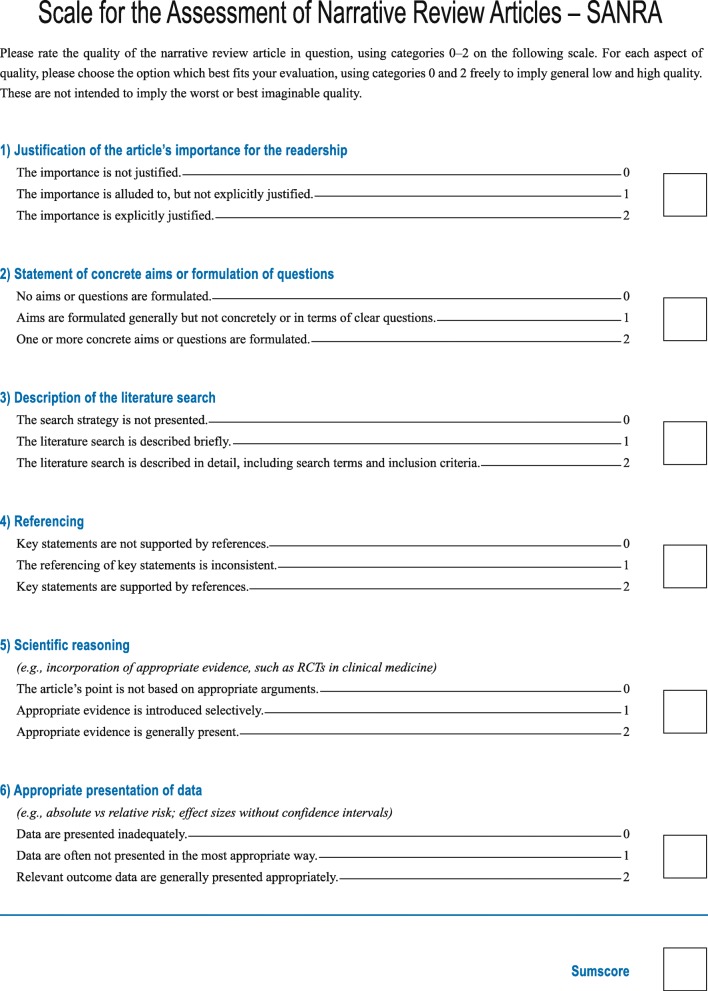
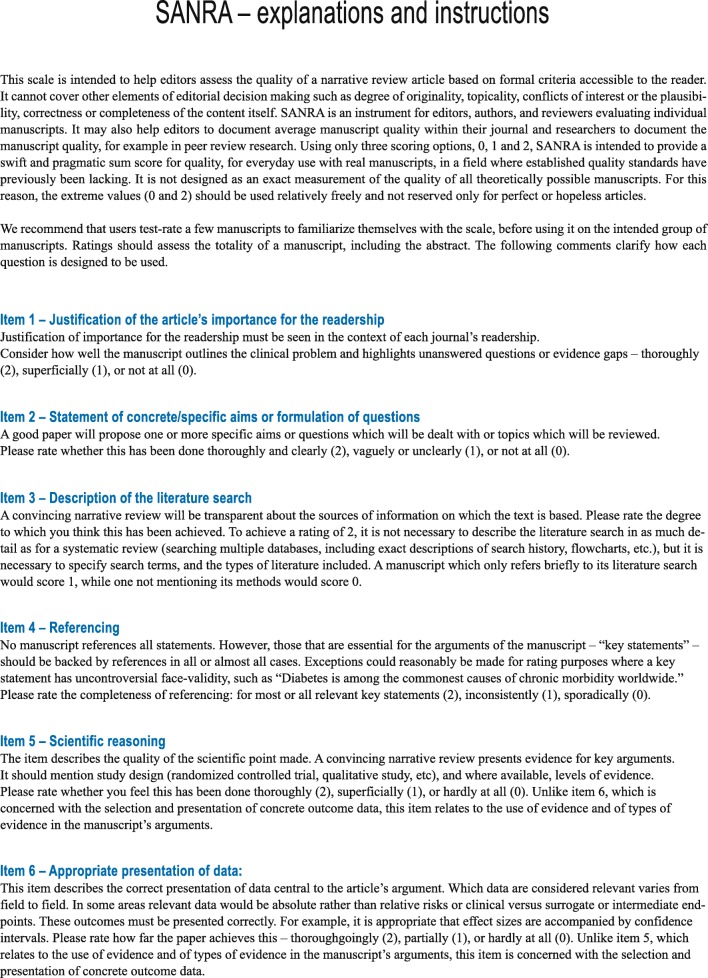
Verification
Claims the paper makes
3 Valid · 0 Not valid · 5 Not checked · 27 Own results and interpretations
The cited sources support only part of this claim — read each source’s verdict below.
In the paper
“Bastian et al. found that they constitute the largest share of all text types in medicine and they concluded that they “remain the staple of medical literature” [1].”
- Also stated in: § Background · plain
“Narrative reviews are the commonest type of articles in the medical literature.”
§ SANRA—a scale for the quality assessment of narrative review articles > Background
What the sources say
- Partly supportedcites [1] Bastian H Glasziou P Chalmers I Seventy-five trials and eleven systematic reviews a day: how will we ever keep up? PLoS Med 2010 7 9 e1000326 10.1371/journal.pmed.1000326 20877712 PMC2943439 sourceExperimental — accuracy not yet measured
In “How Close Are We to Archie Cochrane’s Goal?” and the Summary Points (pages unavailable), the paper calls non-systematic narrative reviews the staple of medical literature synthesis. It does not say they constitute the largest share of all medical text types; that extends a claim about literature synthesis to medical literature as a whole. (LLM, conf=0.88)
plain- Asserted: passes — The authors put it forward as true.
- Checkable: passes — It can be checked against evidence.
- Load-bearing: unclear — It is unclear whether the paper’s conclusions depend on it.
- Based: passes — The paper gives a reason why it holds.
- Also stated in: § Background · plain
The sources with a verdict support this claim; the rest weren’t checked yet, have no full text we could read, or their verdicts aren’t rated yet.
In the paper
“non-systematic reviews or narrative reviews have been widely criticized as unreliable [1, 4].”
§ SANRA—a scale for the quality assessment of narrative review articles > Background
What the sources say
- Supportedcites [1] Bastian H Glasziou P Chalmers I Seventy-five trials and eleven systematic reviews a day: how will we ever keep up? PLoS Med 2010 7 9 e1000326 10.1371/journal.pmed.1000326 20877712 PMC2943439 source
In “How Close Are We to Archie Cochrane’s Goal?”, the paper describes reviews not conducted systematically as having great potential for error and calls them less reliable forms of information. Box 1 also says that articles and textbooks had highlighted the risk of bias and chance in reviews. Together, these passages support the broad characterization that narrative reviews have been criticized as unreliable; page numbers are not provided in our copy. (LLM, conf=0.89)
- Not checked — no full text of the sourcecites [4] Mulrow CD The medical review article: state of the science Ann Intern Med 1987 106 485 488 10.7326/0003-4819-106-3-485 3813259 source
plain- Asserted: passes — The authors put it forward as true.
- Checkable: passes — It can be checked against evidence.
- Load-bearing: passes — The paper’s conclusions depend on it.
- Based: passes — The paper gives a reason why it holds.
- Supported
A result the paper reports from its own data — it cites no other source for it, so there is none to check. The quote shows it is in the paper.
In the paper
“Cronbach’s alpha was 0.68 (internal consistency).”
- Also stated in: § Results · plain
“The scale’s internal consistency, measured as Cronbach’s alpha, was 0.68.”
§ SANRA—a scale for the quality assessment of narrative review articles > Abstract > Results
plainn = 90- Asserted: passes — The authors put it forward as true.
- Checkable: passes — It can be checked against evidence.
- Load-bearing: passes — The paper’s conclusions depend on it.
- Based: passes — The paper gives a reason why it holds.
- Also stated in: § Results · plain
A result the paper reports from its own data — it cites no other source for it, so there is none to check. The quote shows it is in the paper.
In the paper
“Raters often disagreed on items 1 and 4.”
- Also stated in: § Results · plain
“Disagreements most often occurred with regard to items 1 and 4.”
§ SANRA—a scale for the quality assessment of narrative review articles > Abstract > Results
plain- Asserted: passes — The authors put it forward as true.
- Checkable: passes — It can be checked against evidence.
- Load-bearing: unclear — It is unclear whether the paper’s conclusions depend on it.
- Based: passes — The paper gives a reason why it holds.
- Also stated in: § Results · plain
A result the paper reports from its own data — it cites no other source for it, so there is none to check. The quote shows it is in the paper.
In the paper
“The intra-class correlation coefficient (average measure) was 0.77 [95% CI 0.57, 0.88] (inter-rater reliability).”
- Also stated in: § Results · plain
“The intra-class correlation coefficient (average measure) amounted to 0.77 [95% CI 0.57, 0.88; F 4.3; df 29, 58].”
§ SANRA—a scale for the quality assessment of narrative review articles > Abstract > Results
plain- Asserted: passes — The authors put it forward as true.
- Checkable: passes — It can be checked against evidence.
- Load-bearing: passes — The paper’s conclusions depend on it.
- Based: passes — The paper gives a reason why it holds.
- Also stated in: § Results · plain
14 more claims
Create a free account to see all 35 claims and to verify the 3 references still open.
- Probably not a substantial claim. 11
- It may state two separate claims as one. 11
Claims other papers make about this one
Each is checked against this paper’s own text: does it say what the citing paper says it does?
The source backs part of the claim, not all of it — or backs it for a different population, condition or comparison.
In the citing paper
“The review was conducted and reported in accordance with the principles of the Scale for the Assessment of Narrative Review Articles (SANRA), which provides a validated framework for ensuring methodological transparency, scientific rigor, and balanced interpretation in narrative reviews [ 19 ].”
From Paracetamol: A History of Assumptions, Errors, and Evidence Reversals in Pain Management (2026) · cites this paper as [19]
Experimental — accuracy not yet measuredThe source backs part of the claim, not all of it — or backs it for a different population, condition or comparison.
In the citing paper
“As a narrative review, the present work does not include an aggregated quantitative assessment and is more exposed to selection subjectivity than a registered systematic review [124,125].”
From Berberine-Drug Interactions: Mechanisms, Clinical Relevance and Risk Stratification-A Narrative Review (2026) · cites this paper as [124]
Experimental — accuracy not yet measuredThe cited source says what the claim attributes to it.
In the citing paper
“This work is designed as a structured narrative review, with transparent reporting of the documentation strategy, guided by the quality criteria of the Scale for the Assessment of Narrative Review Articles (SANRA) [124].”
From Berberine-Drug Interactions: Mechanisms, Clinical Relevance and Risk Stratification-A Narrative Review (2026) · cites this paper as [124]
The cited source says what the claim attributes to it.
In the citing paper
“we used the following:-Cochrane Risk of Bias 2 (RoB 2) [29] and PEDRO scale tools for RCTs.-AMSTAR 2 [30] checklist for systematic review.-SANRA (Scale for the Assessment of Narrative Review Articles) [31] for narrative reviews.-JBI Checklist for Text and Opinion [32] for expert opinion papers.”
From Pelvic Floor Muscle Training Following Surgery for Pelvic Organ Prolapse: Recommendation from Scientific Literature (2026) · cites this paper as [31]
The cited source says what the claim attributes to it.
In the citing paper
“Data analysis employed a narrative and thematic synthesis methodology,adhering to the SANRA guidelines for narrative reviews (32).”
From Ethical issues in multi-agent AI systems for healthcare: a narrative review (2026) · cites this paper as [32]
12 more claims about this paper
Create a free account to see every claim other papers make about this one.
Citations
Cites
Shea, B. J., Reeves, B. C., Wells, G., Thuku, M., Hamel, C., Moran, J., Moher, D., Tugwell, P., Welch, V., Kristjansson, E., et al. (2017) · BMJ · doi:10.1136/bmj.j4008 · Cited by 10,636 · cited 2×
“Critical appraisal tools have been developed for systematic reviews (e.g., AMSTAR 2 [A MeaSurement Tool to Assess Systematic Reviews] [7]) and papers on RCTs (e.g., the CASP [Critical Appraisal Skills Program] checklist for randomized trials [8]) and other types of medical studies.”
BackgroundStreiner, D. L., & Norman, G. R. (2008) · doi:10.1093/acprof:oso/9780199231881.001.0001 · Cited by 2,631
Critical appraisal skills programme
Singh, J. (2013) · Journal of Pharmacology and Pharmacotherapeutics · doi:10.4103/0976-500x.107697 · Cited by 2,556
Guidelines for Reporting Reliability and Agreement Studies (GRRAS) were proposed
Kottner, J., Audigé, L., Brorson, S., Donner, A., Gajewski, B. J., Hróbjartsson, A., Roberts, C., Shoukri, M., & Streiner, D. L. (2011) · Journal of Clinical Epidemiology · doi:10.1016/j.jclinepi.2010.03.002 · Cited by 2,174
The Mass Production of Redundant, Misleading, and Conflicted Systematic Reviews and Meta‐analyses
IOANNIDIS, J. P. A. (2016) · The Milbank Quarterly · doi:10.1111/1468-0009.12210 · Cited by 1,483 · cited 1×
“While systematic reviews are not per se superior articles and while certain systematic reviews have been criticized lately [3], non-systematic reviews or narrative reviews have”
BackgroundSeventy-five trials and eleven systematic reviews a day: how will we ever keep up?
Bastian, H., Glasziou, P., & Chalmers, I. (2010) · PLoS Medicine · doi:10.1371/journal.pmed.1000326 · Cited by 1,188 · cited 2×
“found that they constitute the largest share of all text types in medicine and they concluded that they “remain the staple of medical literature” [1].”
BackgroundThe Medical Review Article: State of the Science
MULROW, C. D. (1987) · Annals of Internal Medicine · doi:10.7326/0003-4819-106-3-485 · Cited by 856 · cited 1×
“been widely criticized as unreliable [1, 4].”
Writing a narrative biomedical review: considerations for authors, peer reviewers, and editors
Gasparyan, A. Y., Ayvazyan, L., Blackmore, H., & Kitas, G. D. (2011) · Rheumatology International · doi:10.1007/s00296-011-1999-3 · Cited by 694 · cited 1×
“[13], for example, have provided guidance for writing narrative reviews, and Byrne [14] as well as Pautasso [15] has written, from different angles, thoughtful editorials on improving narrative reviews and presented lists of key features of writing a good review—lists that naturally overlap with SANRA items (e.”
BackgroundTen Simple Rules for Writing a Literature Review
Pautasso, M. (2013) · PLoS Computational Biology · doi:10.1371/journal.pcbi.1003149 · Cited by 272 · cited 3×
“[13], for example, have provided guidance for writing narrative reviews, and Byrne [14] as well as Pautasso [15] has written, from different angles, thoughtful editorials on improving narrative reviews and presented lists of key features of writing a good review—lists that naturally overlap with SANRA items (e.”
BackgroundImproving the peer review of narrative literature reviews
Byrne, J. A. (2016) · Research Integrity and Peer Review · doi:10.1186/s41073-016-0019-2 · Cited by 159 · cited 3×
“[13], for example, have provided guidance for writing narrative reviews, and Byrne [14] as well as Pautasso [15] has written, from different angles, thoughtful editorials on improving narrative reviews and presented lists of key features of writing a good review—lists that naturally overlap with SANRA items (e.”
Background
Research works printed but not linked: 3
- Higgins JPT, Green S. (eds.). Cochrane Handbook for Systematic Reviews and Interventions. Version 5.1.0. The Cochrane Collaboration 2011, section 1.2.2., www.handbook.cochrane.org, retrieved on Oct 31, 2018.
- Baethge C Mertens S Goldbeck-Wood S Development of a quality score for the assessment of non-systematic review articles (SANRA) Poster, Seventh International Congress on Peer Review and Biomedical Publication 2013 USA Chicago, Illinois
- Baethge C Goldbeck-Wood S Mertens S A scale for the assessment of non-systematic review articles (SANRA) Poster, Eighth International Congress on Peer and Biomedical Publication 2017 USA Chicago, Illinois
Cited by
Items 2,801–2,900 of 4,334
Stratégies de prévention de la violence conjugale
Lachapelle, M., & Moreau, C. (2026) · doi:10.64490/cxbd9175
Online Toxicity: Birthed from Polarization, Raised by Platforms
Giannouli, I., & Karadimitriou, A. (2026) · Platforms · doi:10.3390/platforms4030016
Medeiros, R. D. O., de Araújo, J. F., Urzagaste, C. H. V., Maschietto, A. C. B., Zanchetta, I. D. M., Silva, I. A. R. C. B., de Oliveira, K. B., Netto, M. L. D. S., Guerreiro, P. H. D. A., Scherer, K. G., et al. (2026) · Journal of Law and Sustainable Development · doi:10.54901/rcj.v14n2-288
Lucki, M., Iwańczyk, S., Lucka, E., Grygier, M., Mitkowski, P. P., & Lesiak, M. (2026) · International Journal of Molecular Sciences · doi:10.3390/ijms27156999
“This narrative review was prepared in accordance with the SANRA (Scale for the Assessment of Narrative Review Articles) recommendations [33].”
Pietraszek, P., Reysner, T., Kluzik, A., Perek, A., Marszałek-Buko, J., Bartkowska‐Śniatkowska, A., Wieczorowska–Tobis, K., & Domagalska, M. (2026) · Journal of Clinical Medicine · doi:10.3390/jcm15156071
“SANRA [26] was therefore used as the most directly applicable quality-assessment framework.”
InfluentialMagnesium and kidney stones: a concise narrative review
Scoglio, M., Bargagli, M., & Fuster, D. G. (2026) · Clinical Kidney Journal · doi:10.1093/ckj/sfag248 · Cited by 1
“The quality and structure of this narrative review were guided by the Scale for the Assessment of Narrative Review Articles (SANRA) [ 7 ].”
Yang, L., & Wang, X. (2026) · Frontiers in Public Health · doi:10.3389/fpubh.2026.1888001
“The reporting and appraisal of this narrative review were guided by the SANRA principles for narrative review articles, including justification of the article’s importance, statement of aims, literature-search description, appropriate referencing, scientific reasoning, and balanced presentation (18).”
Aranha, A. R. F., Picado, B. S., Rodrigues, C. M. A., Mateus, É. M. D. S., Martins, S. C. R., & Rua, V. R. M. (2026) · doi:10.22533/at.ed.476262807
Syndrome of the trephined: from pathophysiology to cranioplasty - an updated narrative review
Popoola, O. I., Okon, I. I., Maidan, A., Kasimieh, O., Lucero‐Prisno, D. E., Razouqi, Y., Arsal, S. A., Iqbal, U., & Chaurasia, B. K. (2026) · Brain and Spine · doi:10.1016/j.bas.2026.106252
“This narrative review was prepared in accordance with the Scale for the Assessment of Narrative Review Articles (SANRA) recommendations for transparent reporting of narrative reviews and, where applicable (Baethge et al., 2019).”
Ibrahim, F. M., & Shahrour, G. (2026) · Discover Public Health · doi:10.1186/s12982-026-02620-8
“First, the review followed SANRA principles and narrative-review guidance emphasizing a transparent, purposive, best-evidence search rather than the exhaustive protocol expected of a systematic review [18, 23].”
Salto-Campuzano, D. A. D., García-Chehab, C. M., Campuzano-Donoso, M., Reytor-González, C., & Simancas-Racines, D. (2026) · Frontiers in Cardiovascular Medicine · doi:10.3389/fcvm.2026.1907009
“…reference to reporting principles reflected in the Scale for the Assessment of Narrative Review Articles (SANRA), particularly justification of the review’s importance, clear statement of aims, description of the literature-search approach, appropriate referencing, and scientific reasoning (18).”
Sethumadhavan, K., Sekar, M., & Srivenkateswaran, K. (2026) · Cureus · doi:10.7759/cureus.113912
Messina, A., Motarajji, S. E., Chimenti, C., Valloreo, F., Masturzo, B., & Leo, L. (2026) · Women · doi:10.3390/women6030052
“…from major international scientific societies, including the Canadian Fertility and Andrology Society (CFAS) and the American Society for Reproductive Medicine (ASRM), provide the methodological and clinical framework supporting current evidence-based practice in infertility management [7–10].”
Prendergast, N., Boakye, P. N., Borges, A., Ahmed, E., Calver, J., Oliver, M., & Reid, K. (2026) · International Journal of Nursing Studies Advances · doi:10.1016/j.ijnsa.2026.100645
“The screening adhered to the SANRA (the Scale for the Assessment of Narrative Review Articles) scale, providing a transparent methodology that minimized bias and strengthened the reliability of the narrative review's findings (Baethge et al., 2019).”
Illumination systems in vitreoretinal surgery: a comparative review of safety and efficacy
Lupo, M., Lebet, S., Rescalli, A., Micalizzi, S., Govetto, A., Oliva, P., & Romano, M. R. (2026) · International Journal of Retina and Vitreous · doi:10.1186/s40942-026-00918-y
dos Santos, J. V. F., Fitz, G. A. M., Francisco, L. S., & Silva, A. C. S. (2026) · Revista Tópicos. · doi:10.70773/revistatopicos/785913961
Lungu, I.-D., Ilie, A. C., Ștefăniu, R., Albişteanu, S.-M., Turcu, A.-M., Grigoraș, G., Constantinescu, D.-G., Pîslaru, A. I., & Alexa, I. D. (2026) · Journal of Clinical Medicine · doi:10.3390/jcm15156101
“This narrative review was conducted and reported in accordance with the SANRA (Scale for the Assessment of Narrative Review Articles) recommendations [1].”
Reyes, P. E. B., Moscoso, M. V. A., & Narea, M. B. C. (2026) · Revista Politécnica de la Ciencia · doi:10.56519/0msyry42
Elechi, U. S., & Tarawallie, M. A. (2026) · Digital Health · doi:10.1177/20552076261475767
S100A9 as a Candidate Molecular Bridge in Hepato–Ocular Crosstalk
Wang, P., Li, Y., Xia, B., Lin, Y., Tuo, Q., Lin, L., & Peng, Q. (2026) · Biology · doi:10.3390/biology15151306
“This SANRA-informed article is a structured narrative and hypothesis-generating review rather than a systematic review [38].”
Ristanović, L., Stojiljković, S., Čuk, I., Weiss, K., Rosemann, T. J., & Knechtle, B. (2026) · Medicina · doi:10.3390/medicina62081503
“The conduct and reporting of the review were informed by published methodological guidance for narrative literature reviews [82,83] and by the Scale for the Assessment of Narrative Review Articles (SANRA) [84].”
Mihai, E. E., Ciobanu, I., Teodorescu, M., MARIN, A. G., Maharatna, K., & Berteanu, M. (2026) · Frontiers in Psychiatry · doi:10.3389/fpsyt.2026.1859969
“The review methodology was informed by recommendations for high-quality narrative reviews, including transparent reporting of the search strategy, structured evidence synthesis, and critical interpretation, as re fl ected in the SANRA framework (12).”
Ohaka, R. U., Akinyemi, A. D., & Okonkwo, U. U. (2026) · Journal of Computers and Applications · doi:10.58613/jca221
Wiśniewski, J., & Marcinkowska, A. B. (2026) · Palliative Medicine in Practice · doi:10.5603/pmp.113310
Ahamed, M. M. M. (2026) · Asian Journal of Agricultural Extension Economics & Sociology · doi:10.9734/ajaees/2026/v44i82995
Torres, J. Y., Guillen, H. F., Leyton, H. J. B., Sánchez, P. A. A., & Orrala, F. E. C. (2026) · Salud Medicina e Innovación Journal · doi:10.70577/atxhqv93
BARRIER-ORIENTED SKIN CARE DURING TOPICAL ACNE THERAPY: A NARRATIVE REVIEW FOR ESTHETICIANS
Syveniuk, A. (2026) · Jurnal Tata Rias · doi:10.26740/jtr.v15n2.81509
Sorrow, Unpermitted: A Narrative Review of Grief in Chronic Liver Disease
Bimman, R., Dalvi, A., Bizup, G., Marshall, B., Mullins, B., Scherrer, A., Lavallee, J. M., Armstrong, M. E., Munroe, W., Mason, N., et al. (2026) · Journal of Social Work in End-of-Life & Palliative Care · doi:10.1080/15524256.2026.2710138
“Baethge et al. (2019) recommend that authors apply this scale not only in evaluating narrative reviews, but also in developing them, in the interest of enhancing the quality of such work.”
InfluentialAbu‐Owaimer, F. M., Abu-Dawas, S., Abu-Owaimer, L., & Thaher, A. A. (2026) · Research Square · doi:10.21203/rs.3.rs-10502616/v1
Waghe, S. D., Yawatkar, T., Ubhale, D., Arora, J., & Dalvi, N. (2026) · Genetics and Molecular Research · doi:10.4238/5af04762
Evolving organisational models in urban orthopaedic practice in India: A structured narrative review
Yelavarthi, R., & Vattipalli, R. C. (2026) · Journal of orthopaedic surgery · doi:10.1177/10225536261476473
“14,15,18,20 Greater interpretive weight was assigned to systematic reviews, registry studies, observational research, national reports, and consensus statements where available, while conceptual and perspective articles were used primarily to provide organisational context and identify emerging…”
Aderoju, R. O., Falowo, M., Anisere, O., & Olagboye, O. (2026) · International Journal of Research and Innovation in Applied Science · doi:10.51584/ijrias.2026.11070099
Zhang, X., Jiang, Y., Wei, X., Wang, S., Zhang, X., Hu, S., & Shi, L. (2026) · Nature and Science of Sleep · doi:10.2147/nss.s611573
“47,48 A formal systematic review was not undertaken because the aim was not to provide an exhaustive pooled estimate of treatment efficacy, but to develop a clinically interpretable evidence hierarchy across direct OSA trials, indirect obesity trials, and mechanistic physiology.”
Compassion-based interventions for suicidal ideation: a narrative review of available evidence
Bernal, A. M. B., Rodrigues, W. D. S., Souza, F. L. X., Almeida, J. E. V. D., Teodoro, M. L. M., & Matos, M. (2026) · Revista Brasileira de Psicoterapia · doi:10.5935/2318-040420250004
Balamurugan, E., Solomon, S. G., Srivastava, M., Katru, U., Ranjan, S., Gore, V. S., Kalyani, B., Saleem, S., Priya, J. S. S., & Sharma, T. C. (2026) · International Journal of Advance Research in Nursing · doi:10.33545/nursing.2026.v9.i8.a.765
Rahali, Y., Dennison, C. A., Thapar, A., & Thapar, A. K. (2026) · European Child & Adolescent Psychiatry · doi:10.1007/s00787-026-03156-7
“Our work was formulated and written against the Scale for the Assessment of Narrative Review Articles (SANRA) [13 ].”
Fieraru, S., Iancu, A., Ciubară, A., & Dragomir, L. (2026) · Romanian Journal of Psychiatry & Psychotherapy · doi:10.37897/rjpp.2026.2.3
Cybersecurity of Healthcare : Socio-technical Analysis and Solutions
Ewoh, P. (2025) · Osuva (University of Vaasa)
Poulios, E., Papadopoulou, S. Κ., Psara, E., Tasoulas, D., & Giaginis, C. (2026) · Pharmaceuticals · doi:10.3390/ph19081244
Yang, J., Dong, J., Yang, H., Wu, C.-C., & Su, C.-H. (2026) · Nutrients · doi:10.3390/nu18162590
“Consistent with recommendations for improving the quality and transparency of narrative reviews, the literature search and selection process was structured to clarify the scope, rationale, and evidentiary basis of the review [19,20].”
Mazurek, M., Domagała, Z., & Matkowski, R. (2026) · Journal of Clinical Medicine · doi:10.3390/jcm15166154
“The Scale for the Assessment of Narrative Review Articles checklist (SANRA) was used to structure the manuscript [15].”
Kalantar, R., Dodangeh, S., Khalagi, K., & Larijani, B. A. (2026) · Journal of Diabetes & Metabolic Disorders · doi:10.1007/s40200-026-02030-2
“The review was aligned with the SANRA framework for narrative reviews [18].”
Gusmão, C. T. P., Neves, M. S. S. E., Miguel, H. J. D., Gusmão, J. N. F. M., & Ribeiro, H. L. (2026) · Anesthesia Research · doi:10.3390/anesthres3030023
Garg, A. (2026) · International Journal of Creative and Open Research in Engineering and Management · doi:10.55041/ijcope.v2i8.056
PELE DE TILÁPIA NA REPARAÇÃO TECIDUAL VETERINÁRIA
Teixeira, G. C., Amorim, M. C. C., & LIMA, I. (2026) · Revista Brasileira de Engenharia de Pesca · doi:10.18817/repesca.v17i1.4640
What is the pediatric sport framework, and how can it be applied in professional practice?
Cabral, B. G. D. A. T., de Assis, G. G., Jaggers, J. R., Baxter-Jones, A. D. G., Murawska‐Ciałowicz, E., Pinto, V. C. M., Mendes, M. I. B. D. S., Santos, J. H. S., Dantas, P. M. S., & de Almeida‐Neto, P. F. (2026) · Sport Sciences for Health · doi:10.1007/s11332-026-01873-9
Comisi, F. F., Pasquale, G. D., Comisi, A. M., Mangano, G. D., Pavone, P., Ferretti, A., Salpietro, V., Parisi, P., & Spalice, A. (2026) · Neurogenetics · doi:10.1007/s10048-026-00920-4
“The review was structured to meet the Scale for the Assessment of Narrative Review Articles (SANRA) quality criteria [18], qualitatively integrating clinical, molecular, and functional evidence.”
Chapala, S., Munnur, R., Gibson, J. G., Iyengar, K. P., Mehta, J. S., & Botchu, R. (2026) · Postgraduate Medical Journal · doi:10.1093/postmj/qgag108
Metabolic Determinants of Weight-Loss Quality During and After Incretin-Based Therapies in Obesity
Luna, M., Rodrigues, B., & Ramalho, A. (2026) · Clinical Nutrition Open Science · doi:10.1016/j.nutos.2026.100711
Farì, G., Longo, S. C., Pitruzzella, M., Quarta, F., Megna, M., Ranieri, M., Tommasa, S. D., Leoni, M. L. G., Varrassi, G., Agostini, F., et al. (2026) · OBM Neurobiology · doi:10.21926/obm.neurobiol.2603343
Narrative review on Marburg virus disease aetiopathogenesis and management
Bansal, A., Ekanger, C. T., Dahl, E. H., & Blomberg, B. (2026) · Discover Viruses. · doi:10.1007/s44370-026-00055-y
Energy Drinks and Arrhythmias in Adolescents and Young Adults: A Narrative Review of the Last Decade
Constantinou, A., Kogias, C., Emmanouilidou-Fotoulaki, E., Kotanidou, E. P., Giannopoulos, A., Antachopoulos, C., Galli‐Τsinopoulou, A., & Kavga, M. (2026) · Medicina · doi:10.3390/medicina62081533
Won, H. J., & Choi, A. (2026) · Plants · doi:10.3390/plants15162423 · Cited by 1
Appropriateness over Numbers: Pharmacological Burden and Scalable Medication Review in Older Adults
Pstrągowski, M., Hachlica, D., & Izbicki, Ł. (2026) · Geriatrics · doi:10.3390/geriatrics11040100
“The review was self-assessed against the Scale for the Assessment of Narrative Review Articles (SANRA) [19], and the completed form is provided as the Supplementary Materials.”
Nonaka, T., Hashimoto, S., Tominaga, T., Yamashita, M., Katayama, H., Takamura, Y., Yamaguchi, S., 足立利幸, Inoue, Y., & Matsumoto, K. (2026) · International Journal of Medical Robotics and Computer Assisted Surgery · doi:10.1002/rcs.70219
“To ensure a structured and transparent approach, this narrative review was prepared with reference to the Scale for the Assessment of Narrative Review Articles (SANRA) guidelines [12].”
Features of Artificial Intelligence Driven Pioneer Hospitals: Insights from Radiology
Goodarzi, M., Torabi, M., Safdari, R., Ahmadi, M., Elmi, S., Golmahi, F., Mortezaie, S., Nezari, P., Souraki, M. A., Shantia, S., et al. (2026) · Iranian Journal of Radiology · doi:10.5812/iranjradiol-166577
“This study was a narrative review performed according to SANRA guidelines (38).”
Smoking-related stigma as a barrier to participation in lung cancer screening
Theuns, C., Wessels-Balke, E., Clarke, Q. F., Arshad, A., Gerris, A., Hal, G. F. V., Lepeleire, J. D., van Meerbeeck, J. P., & Snoeckx, A. (2026) · European Journal of Cancer Prevention · doi:10.1097/cej.0000000000001032
Wiedermann, C. J., Wiedermann, A., & Reismann, H. (2026) · Journal of Medical Education and Family Medicine · doi:10.62425/jmefm.1850362
Podocyte dysfunction in kidney diseases: Mechanisms and therapeutic advances
Ismayilova, S., Mutlu, O., Bayramova, J., & Berdeli, A. (2026) · Science Progress · doi:10.1177/00368504261475956
Soberano, J. I. D., & Montayre, J. (2026) · International Journal of Nursing Studies Advances · doi:10.1016/j.ijnsa.2026.100655
“This study was conducted as a narrative review with scoping elements informed by the Scale for the Assessment of Narrative Review Articles to enhance rigor and transparency (Baethge et al., 2019).”
Novak, I., Nielsen, J. B., Byrne, R., Hoei‐Hansen, C. E., Gengaroli, J., Lind, K., Mitchell, J., Namara, M. M., Ritterband‐Rosenbaum, A., & Morgan, C. (2026) · Science Progress · doi:10.1177/00368504261478184
Ubaidillah, N. (2026) · The ASEAN Journal of Military and Preventive Medicine · doi:10.47353/ajmpm.v3i2.57
Neto, J. C. D. M., Amorim, A. A., de Miranda, L. R., & Macedo, T. M. M. (2026) · Research Society and Development · doi:10.33448/rsd-v15i8.51518
Gao, T., & Zhao, B. (2026) · Journal of International Medical Research · doi:10.1177/03000605261475124
“42 An overview of ESWT in pain management within musculoskeletal rehabilitation is summarized in Table 1, and the evidence for each clinical application is strati fi ed by study type and level of evidence in Table 2.”
Li, O. M., Li, Y., & Li, S. X. T. (2026) · Cureus · doi:10.7759/cureus.114354
“The manuscript was instead prepared against the SANRA criteria for the quality of narrative review articles [13].”
SPIROCERCOSIS IN WILDLIFE: INSIGHTS FOR CONSERVATION
Pienaar, A., der Merwe, L. V., & Clift, S. J. (2026) · Journal of Wildlife Diseases · doi:10.7589/jwd-d-25-00190
Human Milk, Protein Adequacy, and Neurodevelopment in Preterm Infants: A Narrative Review
Mizuno, K. (2026) · Children · doi:10.3390/children13101317
“The findings were interpreted according to study design and evidentiary strength, consistent with the emphasis on scientific reasoning and appropriate presentation of evidence in the Scale for the Assessment of Narrative Review Articles (SANRA) [32].”
Ye, F., Chen, R., Xu, S., Liu, H., & Xu, J. (2026) · Translational Stroke Research · doi:10.1007/s12975-026-01478-x
Arslanparcasi, H. F. (2026) · INTERNATIONAL JOURNAL OF HEALTH & MEDICAL RESEARCH · doi:10.58806/ijhmr.2026.v5i8n07
Touati, A. (2026) · Expert Review of Anti-infective Therapy · doi:10.1080/14787210.2026.2718192
Vasconcelos, A. R., Dias, D. D., Souza, A. C. R., de Abreu-Silva, E. O., Marcadenti, A., & Name, J. J. (2026) · Nutrients · doi:10.3390/nu18162622
“This narrative review was conducted in accordance with current methodological recommendations and reporting principles for high-quality narrative reviews [11,12].”
Wang, S., Wang, Y., Kang, X., Fu, J., Ding, L., Zhou, H., & Fu, Y. (2026) · Frontiers in Pediatrics · doi:10.3389/fped.2026.1915085
“Finally, the review was conducted in accordance with SANRA guidelines, ensuring transparent reporting (24).”
Krulec, A., Veljković, B., Jevšnik, M., & Vukasović, T. (2026) · Sustainability · doi:10.3390/su18168192
Asimakopoulos, T., Psychari, I., Rekatsina, M., & Kefalopoulou, Z. M. (2026) · The Journal of Headache and Pain · doi:10.1186/s10194-026-02416-w
Qian, L., Khan, A., & Latif, A. B. A. (2026) · International Journal of Research and Innovation in Social Science · doi:10.47772/ijriss.2026.100700722
Wang, C., Sansone, A., Zhu, D., Cheng, S., Zhang, Y., Colonnello, E., Bellia, G., Pitrè, C., & Jannini, E. A. (2026) · Sexual Medicine · doi:10.1093/sexmed/qfag070
REALIDADE VIRTUAL E REABILITAÇÃO DA MARCHA NA DOENÇA DE PARKINSON: REVISÃO NARRATIVA
Paula, M. D. S., Bezerra, J. C. P., Vale, R. G. D. S., Dantas, K. B. A., Corrêa, A. F., Thedim, T. D. C., Nilo, M. C. D. S. S., Meira, R. L., Ramos, N. S., & Dantas, E. H. M. (2026) · Cognitus Interdisciplinary Journal · doi:10.71248/r0bqw436
Mampel, J. V., Mampel-Ariño, M., Vicente-Mampel, C., Belda-Antolí, M., Martínez-Soler, M., & Alonso-Martín, M. (2026) · Frontiers in Pain Research · doi:10.3389/fpain.2026.1928053
“Crucially, the formulation, structural design, and reporting quality of this narrative review were strictly aligned with the Scale for the Assessment of Narrative Review Articles (SANRA) checklist to ensure methodological rigor and minimize potential reporting bias (39).”
Tawhari, I. H., Yamani, F. N., Alotaibi, M. E., Aldosari, M. A., Hennawy, H. M. E., & Tawhari, M. H. (2026) · Frontiers in Immunology · doi:10.3389/fimmu.2026.1909238
“This narrative review was structured according to SANRA criteria: the purpose was explicitly de fi ned, a focused literature search was performed, referencing was prioritized, scienti fi c reasoning and balance were emphasized, and uncertainty was made explicit (23).”
Shqair, S. S. A. A. R., Hayek, M. F., Zabin, L. M., Marie, M., Qaddumi, J. A. S., Qadous, S. G., & Sarhan, A. L. (2026) · Depression and Anxiety · doi:10.1155/da/4692841
“Planning and reporting were informed by the scale for the assessment of narrative review articles (SANRA), including clarity of aims, transparent description of the targeted search, explicit selection logic, scienti fi c reasoning, and appropriate presentation [37].”
Neuromodulation in African Health Systems: Barriers, Opportunities, and Future Directions
Aderinto, N. (2026) · Neuromodulation Technology at the Neural Interface · doi:10.1016/j.neurom.2026.08.001
When headache meets visual disturbance: An evidence-based review of common and critical entities
Jiao, S., & Han, X. (2026) · Science Progress · doi:10.1177/00368504261477665
“We have consulted the SANRA (Scale for the Assessment of Narrative Review Articles) guidelines 4 during the preparation of our manuscript.”
Gedik, G., & Sütcü, S. T. (2026) · Adıyaman üniversitesi sosyal bilimler enstitüsü dergisi/Adıyaman üniversitesi sosyal bilimler enstitisü dergisi · doi:10.14520/adyusbd.1904435
Liu, Y.-C., Yu, C.-H., Yen, H., & Chen, I.-H. (2026) · Journal of Clinical Medicine · doi:10.3390/jcm15166241
“It is narrative rather than systematic: study selection was purposive and unblinded, no risk-of-bias instrument was applied, and no quantitative synthesis was attempted, so selection bias in favor of frequently cited and recent work cannot be excluded [31].”
Çalışır, A., Şahin, M., Türkoğlu, F., Şener, S., Duyan, A. G., & Alptekin, H. (2026) · Updates in Surgery · doi:10.1007/s13304-026-02802-8
Gaudino, R., Antoniazzi, F., Zaffanello, M., Pietrobelli, A., Zoller, T., Lanzafame, R., & Piacentini, G. (2026) · Frontiers in Endocrinology · doi:10.3389/fendo.2026.1804285
“Different review formats serve different methodological purposes, and narrative reviews may be appropriate for conceptual synthesis, provided that the rationale, evidence base, and limits of inference are transparently presented (11, 12).”
Trasca, E.-T., Rădulescu, D., Ciupeanu-Călugăru, E. D., Mercuţ, R., Băleanu, V. D., Căluianu, E. I., Vieru, A.-M., & Radulescu, P.-M. (2026) · Life · doi:10.3390/life16081320
“We conducted a critical narrative review informed by the Scale for the Assessment of Narrative Review Articles (SANRA) and by principles of critical interpretive synthesis [24,25].”
Caglayan, L., Sempels, M., Lauwens, L., & Daisne, J. (2026) · Cancer/Radiothérapie · doi:10.1016/j.canrad.2026.104859
Djordjevic, J. Z., Fekonja, Z., & Strnad, M. (2026) · Healthcare · doi:10.3390/healthcare14162502
“As this was a narrative review in accordance with the article by Gasparyan et al. [7] and the Scale for the Assessment of Narrative Review Articles (SANRA) principles [8], no formal protocol registration, duplicate screening, standardized risk-of-bias assessment, or meta-analysis was performed.”
A Bottleneck-First Framework for Diversity-Constrained Genetic Gain in Annual Self-Pollinated Crops
Çoşkun, Ö. F. (2026) · Diversity · doi:10.3390/d18080482
“Literature selection and interpretation were conducted by one author, which remains a source of possible selection and language bias [30].”
Department of Metabolic and Bariatric Surgery in the Era of Social Media
Yang, J., Li, X., Tang, Q., Wu, X., Chen, X., & Li, C. (2026) · Journal of Surgery · doi:10.11648/j.js.20261404.11
Khoza‐Shangase, K. (2026) · Frontiers in Audiology and Otology · doi:10.3389/fauot.2026.1902064
“Because SANRA was specifically developed to evaluate narrative review methodology, it was applied only to narrative review articles included in this synthesis.”
InfluentialDabour, Z. K. (2026) · Journal of Advanced Nursing · doi:10.1111/jan.70723
Alum, E. U., Obasi, D. C., Uzor, S., Eji, M. O., Amadi, E. B., Emeruwa, A. C., Akwari, A. A., Okoroh, P. N., Aniokete, U. C., Alum, B. N., et al. (2026) · Obesity Medicine · doi:10.1016/j.obmed.2026.100738
Seleção de dispositivos médicos em reabilitação respiratória
Silva, L. (2026) · Revista Portuguesa de Enfermagem de Reabilitação · doi:10.33194/rper.2026.45356
Senadheera, P., Silva, B., Jayasena, H., & Niriella, M. A. (2026) · Current Medical Research and Opinion · doi:10.1080/03007995.2026.2716974
“This narrative review was conducted and reported with reference to the SANRA (Scale for the Assessment of Narrative Review Articles) framework 14 .”
Ebrian, O. H., Allositandi, Y. A., Purwadhi, P., & Widjaja, Y. R. (2026) · Indonesian Journal of Innovation Multidisipliner Research · doi:10.69693/ijim.v4i3.2061
“Hasil sintesis disajikan secara deskriptif untuk memberikan gambaran komprehensif mengenai hubungan antara manajemen strategis dan transformasi digital dalam konteks pelayanan kesehatan (Baethge et al., 2019).”
Zhang, X., Han, X., Hu, S., & Shi, L. (2026) · Frontiers in Physiology · doi:10.3389/fphys.2026.1889633
“Reporting was guided by SANRA principles for clarity, rationale, search transparency, and balanced evidence presentation (Baethge et al., 2019).”
Metadata
- Authors
- Baethge, C., Goldbeck-Wood, S., & Mertens, S.
- Affiliations
- University of Cologne (DE)
- BMJ Group (United Kingdom) (GB)
- Corresponding author
- Baethge, Christopher
- ORCID
- Baethge, Christopher
- Venue
- Research Integrity and Peer Review
- Published
- 2019-03-26
- Volume
- 4
- Issue
- 1
- Pages
- 5-5
- ISSN
- 2058-8615 (ISSN-L)
- PMC
- PMC6434870
- OpenAlex
- W2922577842
- Semantic Scholar
- ea7f35b3069b53791c3b746c5c4b3c72a83a526b
- Cited by
- 3,469
- References
- 13
- Citations by year
- 2026: 1823 · 2025: 551 · 2024: 379 · 2023: 309 · 2022: 218 · 2021: 152 · 2020: 32 · 2019: 4
- FWCI
- 20.57
- Type
- journal article
- Language
- en
- Open access
- gold
- doi.org
- Licence
- cc-by
- creativecommons.org/licenses/by/4.0/ (tdm)
- Locations
- Research Integrity and Peer Review (publishedVersion, cc-by)
- Europe PMC (PubMed Central) (publishedVersion, other-oa)
- PubMed Central (publishedVersion, cc-by)
- PubMed (publishedVersion)
- Kölner Universitäts PublikationsServer (Universität zu Köln) (publishedVersion)
- DOAJ (DOAJ: Directory of Open Access Journals) (submittedVersion, cc-by-sa)
- Topics
- Social Sciences › Decision Sciences › Statistics, Probability and Uncertainty › Meta-analysis and systematic reviews
- Social Sciences › Library and Information Sciences › Academic Writing and Publishing
- Social Sciences › Library and Information Sciences › scientometrics and bibliometrics research
- Keywords
- quality assessment scale, manuscript review, inter-rater reliability, level of evidence, scale development
About these checks
Registry, retraction, Cites and statistics results are computed, not judged, with one exception: a printed reference that no index lists is read once by a model before it counts as a citation error. Claims are extracted by a model and kept only when their quote appears verbatim in the text; each cited source is then checked, with a model’s help, for whether it says what the claim relies on. Those verdicts can be wrong — read the claim’s quote and the cited source before relying on one.
The claim verdicts this report counts are experimental: their accuracy is not yet measured.
A language model drew the claims from the paper on 2026-11-10, under version 3 of the claim definition (model deepseek-v4.1-flash, prompt extract-v3).
A second model labelled each claim on 2026-11-10 (model jev-1.13-20260917, definition revision gold-guideline-v0.2).
Cited sources are checked with a language model’s help (gpt-6-sol).
Statistics and arithmetic are recomputed, not judged.
Confidence bands are shown only for fields calibrated on our annotated test set. None is calibrated yet, so no band is shown.
What counts as a claim ›How we measure confidence ›How we check this ›
Are you an author, or do you see a problem with this page? Request a review
Data sources
Bibliographic data: Semantic Scholar, OpenAlex, Crossref.
Contains information from the Semantic Scholar Academic Graph Datasets, made available under the ODC Attribution License (ODC-BY 1.0).
Semantic Scholar’s data is described in: Kinney, R., et al. (2023). The Semantic Scholar Open Data Platform. arXiv:2301.10140.
