

SANRA—a scale for the quality assessment of narrative review articles
Open accessThe DOI matches its Crossref record; 12 of the 13 references it cites were found in a registry or an index; 4 of the 12 sources its claims cite were checked for support.
Abstract
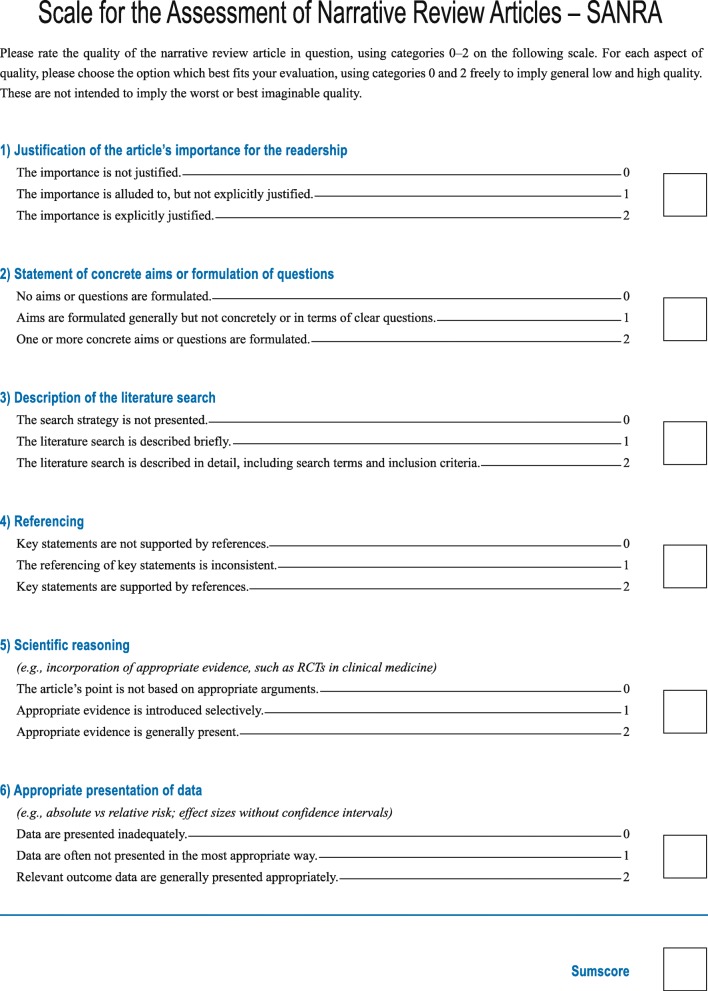
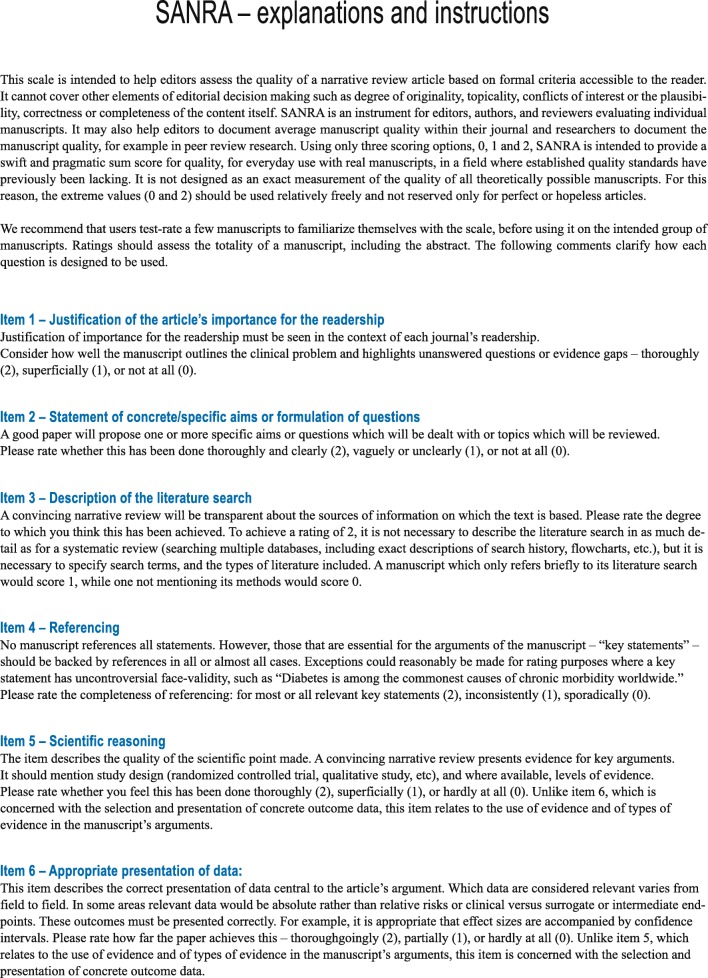
BACKGROUND: Narrative reviews are the commonest type of articles in the medical literature. However, unlike systematic reviews and randomized controlled trials (RCT) articles, for which formal instruments exist to evaluate quality, there is currently no instrument available to assess the quality of narrative reviews. In response to this gap, we developed SANRA, the Scale for the Assessment of Narrative Review Articles. METHODS: A team of three experienced journal editors modified or deleted items in an earlier SANRA version based on face validity, item-total correlations, and reliability scores from previous tests. We deleted an item which addressed a manuscript's writing and accessibility due to poor inter-rater reliability. The six items which form the revised scale are rated from 0 (low standard) to 2 (high standard) and cover the following topics: explanation of (1) the importance and (2) the aims of the review, (3) literature search and (4) referencing and presentation of (5) evidence level and (6) relevant endpoint data. For all items, we developed anchor definitions and examples to guide users in filling out the form. The revised scale was tested by the same editors (blinded to each other's ratings) in a group of 30 consecutive non-systematic review manuscripts submitted to a general medical journal. RESULTS: Raters confirmed that completing the scale is feasible in everyday editorial work. The mean sum score across all 30 manuscripts was 6.0 out of 12 possible points (SD 2.6, range 1-12). Corrected item-total correlations ranged from 0.33 (item 3) to 0.58 (item 6), and Cronbach's alpha was 0.68 (internal consistency). The intra-class correlation coefficient (average measure) was 0.77 [95% CI 0.57, 0.88] (inter-rater reliability). Raters often disagreed on items 1 and 4. CONCLUSIONS: SANRA's feasibility, inter-rater reliability, homogeneity of items, and internal consistency are sufficient for a scale of six items. Further field testing, particularly of validity, is desirable. We recommend rater training based on the "explanations and instructions" document provided with SANRA. In editorial decision-making, SANRA may complement journal-specific evaluation of manuscripts-pertaining to, e.g., audience, originality or difficulty-and may contribute to improving the standard of non-systematic reviews.
Overview
CoChat Summary
TL;DR
SANRA is a six-item, 0–2 scale (maximum 12) for assessing the quality of narrative review articles, developed and field-tested by three journal editors. In 30 consecutive non-systematic review manuscripts, it showed feasible use, sufficient internal consistency and inter-rater reliability, and a modest association with editorial acceptance.
Key findings
- Across 30 manuscripts (90 ratings), the mean SANRA sum score was 6.0 out of 12 (SD 2.6, range 1–12, median 6).
- Internal consistency was Cronbach’s alpha 0.68; corrected item-total correlations ranged from 0.33 (item 3) to 0.58 (item 6).
- Inter-rater reliability was an intra-class correlation coefficient (average measure) of 0.77 [95% CI 0.57, 0.88]; raters often disagreed on items 1 and 4.
- Average SANRA scores were modestly associated with editorial acceptance (mean 6.6, SD 1.9, n = 17) versus rejection (mean 5.1, SD 2.1, n = 13), point biserial correlation 0.37 (t = 2.09, df 28; two-sided p = 0.046).
Methods
- SANRA was developed between 2010 and 2017 by three experienced editors at Deutsches Ärzteblatt; the revised six-item version deleted an item on writing and accessibility due to poor inter-rater reliability.
- The revised scale was tested on 30 consecutive non-systematic review manuscripts submitted to Deutsches Ärzteblatt in 2015; three editor-raters scored them independently and blinded to each other’s ratings.
- Analyses included descriptive statistics, Cronbach’s alpha, corrected item-total correlations, average-measure intra-class correlation using a two-way random effects model (consistency definition), and a post hoc point biserial correlation between SANRA sum scores and acceptance/rejection.
Limitations
- The paper states the main limitation is sample size: 30 manuscripts was a compromise between representativeness, power, and feasibility, and took about 6 months to sample.
- The authors state that the scale’s authors were also the test-raters, so inter-rater reliability may be lower in groups less familiar with SANRA; the study also did not assess test-retest reliability, and results are study-specific.
- The paper acknowledges restricted content validity because SANRA is limited to six items and is a critical appraisal tool rather than a reporting guideline; criterion validity evidence is post hoc and weak, and no established cut-offs exist for comparing manuscripts across settings.
Model-written summary. Check it against the paper before relying on it.
Integrity signals
Registry
Cites
Statistics
Figures
Verification
Claims the paper makes
3 Valid · 0 Not valid · 5 Not checked · 27 Own results and interpretations
The cited sources support only part of this claim — read each source’s verdict below.
In the paper
“Bastian et al. found that they constitute the largest share of all text types in medicine and they concluded that they “remain the staple of medical literature” [1].”
- Also stated in: § Background · plain
“Narrative reviews are the commonest type of articles in the medical literature.”
§ SANRA—a scale for the quality assessment of narrative review articles > Background
What the sources say
- Partly supportedcites [1] Bastian H Glasziou P Chalmers I Seventy-five trials and eleven systematic reviews a day: how will we ever keep up? PLoS Med 2010 7 9 e1000326 10.1371/journal.pmed.1000326 20877712 PMC2943439 sourceExperimental — accuracy not yet measured
In “How Close Are We to Archie Cochrane’s Goal?” and the Summary Points (pages unavailable), the paper calls non-systematic narrative reviews the staple of medical literature synthesis. It does not say they constitute the largest share of all medical text types; that extends a claim about literature synthesis to medical literature as a whole. (LLM, conf=0.88)
plain- Asserted: passes — The authors put it forward as true.
- Checkable: passes — It can be checked against evidence.
- Load-bearing: unclear — It is unclear whether the paper’s conclusions depend on it.
- Based: passes — The paper gives a reason why it holds.
- Also stated in: § Background · plain
The sources with a verdict support this claim; the rest weren’t checked yet, have no full text we could read, or their verdicts aren’t rated yet.
In the paper
“non-systematic reviews or narrative reviews have been widely criticized as unreliable [1, 4].”
§ SANRA—a scale for the quality assessment of narrative review articles > Background
What the sources say
- Supportedcites [1] Bastian H Glasziou P Chalmers I Seventy-five trials and eleven systematic reviews a day: how will we ever keep up? PLoS Med 2010 7 9 e1000326 10.1371/journal.pmed.1000326 20877712 PMC2943439 source
In “How Close Are We to Archie Cochrane’s Goal?”, the paper describes reviews not conducted systematically as having great potential for error and calls them less reliable forms of information. Box 1 also says that articles and textbooks had highlighted the risk of bias and chance in reviews. Together, these passages support the broad characterization that narrative reviews have been criticized as unreliable; page numbers are not provided in our copy. (LLM, conf=0.89)
- Not checked — no full text of the sourcecites [4] Mulrow CD The medical review article: state of the science Ann Intern Med 1987 106 485 488 10.7326/0003-4819-106-3-485 3813259 source
plain- Asserted: passes — The authors put it forward as true.
- Checkable: passes — It can be checked against evidence.
- Load-bearing: passes — The paper’s conclusions depend on it.
- Based: passes — The paper gives a reason why it holds.
- Supported
A result the paper reports from its own data — it cites no other source for it, so there is none to check. The quote shows it is in the paper.
In the paper
“Cronbach’s alpha was 0.68 (internal consistency).”
- Also stated in: § Results · plain
“The scale’s internal consistency, measured as Cronbach’s alpha, was 0.68.”
§ SANRA—a scale for the quality assessment of narrative review articles > Abstract > Results
plainn = 90- Asserted: passes — The authors put it forward as true.
- Checkable: passes — It can be checked against evidence.
- Load-bearing: passes — The paper’s conclusions depend on it.
- Based: passes — The paper gives a reason why it holds.
- Also stated in: § Results · plain
A result the paper reports from its own data — it cites no other source for it, so there is none to check. The quote shows it is in the paper.
In the paper
“Raters often disagreed on items 1 and 4.”
- Also stated in: § Results · plain
“Disagreements most often occurred with regard to items 1 and 4.”
§ SANRA—a scale for the quality assessment of narrative review articles > Abstract > Results
plain- Asserted: passes — The authors put it forward as true.
- Checkable: passes — It can be checked against evidence.
- Load-bearing: unclear — It is unclear whether the paper’s conclusions depend on it.
- Based: passes — The paper gives a reason why it holds.
- Also stated in: § Results · plain
A result the paper reports from its own data — it cites no other source for it, so there is none to check. The quote shows it is in the paper.
In the paper
“The intra-class correlation coefficient (average measure) was 0.77 [95% CI 0.57, 0.88] (inter-rater reliability).”
- Also stated in: § Results · plain
“The intra-class correlation coefficient (average measure) amounted to 0.77 [95% CI 0.57, 0.88; F 4.3; df 29, 58].”
§ SANRA—a scale for the quality assessment of narrative review articles > Abstract > Results
plain- Asserted: passes — The authors put it forward as true.
- Checkable: passes — It can be checked against evidence.
- Load-bearing: passes — The paper’s conclusions depend on it.
- Based: passes — The paper gives a reason why it holds.
- Also stated in: § Results · plain
14 more claims
Create a free account to see all 35 claims and to verify the 3 references still open.
- Probably not a substantial claim. 11
- It may state two separate claims as one. 11
Claims other papers make about this one
Each is checked against this paper’s own text: does it say what the citing paper says it does?
The source backs part of the claim, not all of it — or backs it for a different population, condition or comparison.
In the citing paper
“The review was conducted and reported in accordance with the principles of the Scale for the Assessment of Narrative Review Articles (SANRA), which provides a validated framework for ensuring methodological transparency, scientific rigor, and balanced interpretation in narrative reviews [ 19 ].”
From Paracetamol: A History of Assumptions, Errors, and Evidence Reversals in Pain Management (2026) · cites this paper as [19]
Experimental — accuracy not yet measuredThe source backs part of the claim, not all of it — or backs it for a different population, condition or comparison.
In the citing paper
“As a narrative review, the present work does not include an aggregated quantitative assessment and is more exposed to selection subjectivity than a registered systematic review [124,125].”
From Berberine-Drug Interactions: Mechanisms, Clinical Relevance and Risk Stratification-A Narrative Review (2026) · cites this paper as [124]
Experimental — accuracy not yet measuredThe cited source says what the claim attributes to it.
In the citing paper
“This work is designed as a structured narrative review, with transparent reporting of the documentation strategy, guided by the quality criteria of the Scale for the Assessment of Narrative Review Articles (SANRA) [124].”
From Berberine-Drug Interactions: Mechanisms, Clinical Relevance and Risk Stratification-A Narrative Review (2026) · cites this paper as [124]
The cited source says what the claim attributes to it.
In the citing paper
“we used the following:-Cochrane Risk of Bias 2 (RoB 2) [29] and PEDRO scale tools for RCTs.-AMSTAR 2 [30] checklist for systematic review.-SANRA (Scale for the Assessment of Narrative Review Articles) [31] for narrative reviews.-JBI Checklist for Text and Opinion [32] for expert opinion papers.”
From Pelvic Floor Muscle Training Following Surgery for Pelvic Organ Prolapse: Recommendation from Scientific Literature (2026) · cites this paper as [31]
The cited source says what the claim attributes to it.
In the citing paper
“Data analysis employed a narrative and thematic synthesis methodology,adhering to the SANRA guidelines for narrative reviews (32).”
From Ethical issues in multi-agent AI systems for healthcare: a narrative review (2026) · cites this paper as [32]
12 more claims about this paper
Create a free account to see every claim other papers make about this one.
Citations
Cites
Shea, B. J., Reeves, B. C., Wells, G., Thuku, M., Hamel, C., Moran, J., Moher, D., Tugwell, P., Welch, V., Kristjansson, E., et al. (2017) · BMJ · doi:10.1136/bmj.j4008 · Cited by 10,636 · cited 2×
“Critical appraisal tools have been developed for systematic reviews (e.g., AMSTAR 2 [A MeaSurement Tool to Assess Systematic Reviews] [7]) and papers on RCTs (e.g., the CASP [Critical Appraisal Skills Program] checklist for randomized trials [8]) and other types of medical studies.”
BackgroundStreiner, D. L., & Norman, G. R. (2008) · doi:10.1093/acprof:oso/9780199231881.001.0001 · Cited by 2,631
Critical appraisal skills programme
Singh, J. (2013) · Journal of Pharmacology and Pharmacotherapeutics · doi:10.4103/0976-500x.107697 · Cited by 2,556
Guidelines for Reporting Reliability and Agreement Studies (GRRAS) were proposed
Kottner, J., Audigé, L., Brorson, S., Donner, A., Gajewski, B. J., Hróbjartsson, A., Roberts, C., Shoukri, M., & Streiner, D. L. (2011) · Journal of Clinical Epidemiology · doi:10.1016/j.jclinepi.2010.03.002 · Cited by 2,174
The Mass Production of Redundant, Misleading, and Conflicted Systematic Reviews and Meta‐analyses
IOANNIDIS, J. P. A. (2016) · The Milbank Quarterly · doi:10.1111/1468-0009.12210 · Cited by 1,483 · cited 1×
“While systematic reviews are not per se superior articles and while certain systematic reviews have been criticized lately [3], non-systematic reviews or narrative reviews have”
BackgroundSeventy-five trials and eleven systematic reviews a day: how will we ever keep up?
Bastian, H., Glasziou, P., & Chalmers, I. (2010) · PLoS Medicine · doi:10.1371/journal.pmed.1000326 · Cited by 1,188 · cited 2×
“found that they constitute the largest share of all text types in medicine and they concluded that they “remain the staple of medical literature” [1].”
BackgroundThe Medical Review Article: State of the Science
MULROW, C. D. (1987) · Annals of Internal Medicine · doi:10.7326/0003-4819-106-3-485 · Cited by 856 · cited 1×
“been widely criticized as unreliable [1, 4].”
Writing a narrative biomedical review: considerations for authors, peer reviewers, and editors
Gasparyan, A. Y., Ayvazyan, L., Blackmore, H., & Kitas, G. D. (2011) · Rheumatology International · doi:10.1007/s00296-011-1999-3 · Cited by 694 · cited 1×
“[13], for example, have provided guidance for writing narrative reviews, and Byrne [14] as well as Pautasso [15] has written, from different angles, thoughtful editorials on improving narrative reviews and presented lists of key features of writing a good review—lists that naturally overlap with SANRA items (e.”
BackgroundTen Simple Rules for Writing a Literature Review
Pautasso, M. (2013) · PLoS Computational Biology · doi:10.1371/journal.pcbi.1003149 · Cited by 272 · cited 3×
“[13], for example, have provided guidance for writing narrative reviews, and Byrne [14] as well as Pautasso [15] has written, from different angles, thoughtful editorials on improving narrative reviews and presented lists of key features of writing a good review—lists that naturally overlap with SANRA items (e.”
BackgroundImproving the peer review of narrative literature reviews
Byrne, J. A. (2016) · Research Integrity and Peer Review · doi:10.1186/s41073-016-0019-2 · Cited by 159 · cited 3×
“[13], for example, have provided guidance for writing narrative reviews, and Byrne [14] as well as Pautasso [15] has written, from different angles, thoughtful editorials on improving narrative reviews and presented lists of key features of writing a good review—lists that naturally overlap with SANRA items (e.”
Background
Research works printed but not linked: 3
- Higgins JPT, Green S. (eds.). Cochrane Handbook for Systematic Reviews and Interventions. Version 5.1.0. The Cochrane Collaboration 2011, section 1.2.2., www.handbook.cochrane.org, retrieved on Oct 31, 2018.
- Baethge C Mertens S Goldbeck-Wood S Development of a quality score for the assessment of non-systematic review articles (SANRA) Poster, Seventh International Congress on Peer Review and Biomedical Publication 2013 USA Chicago, Illinois
- Baethge C Goldbeck-Wood S Mertens S A scale for the assessment of non-systematic review articles (SANRA) Poster, Eighth International Congress on Peer and Biomedical Publication 2017 USA Chicago, Illinois
Cited by
Items 2,901–3,000 of 4,334
Gutiérrez-Sandoval, R., Gutiérrez-Castro, F., Muñoz-Godoy, N., Rivadeneira, I., Lagos, A., Iturra, J., Krakowiak, F., Muñoz, Í., Peña-Vargas, C., & Toledo, A. (2026) · Medicina · doi:10.3390/medicina62101964
“The synthesis was designed for framework construction rather than pooled treatment-effect estimation [11].”
Islam, S., Zia, S. A., Mirza, S., Rahman, M. M., Shafi, M. A. A., Hasan, M. H., & Mamun, A. A. (2026) · Therapeutic Advances in Infectious Disease · doi:10.1177/20499361261473798
Raj, B., Jena, S., & Pradhan, J. S. (2026) · Asian Journal of Education and Social Studies · doi:10.9734/ajess/2026/v52i83261
Aldana, E. M., Aragón‐Benedí, C., & Aldecoa, C. (2026) · Frontiers in Medicine · doi:10.3389/fmed.2026.1906375
“As this is a narrative review, no formal risk-of-bias assessment nor the PRISMA framework was applied; instead, the quality and transparency of the process were structured in accordance with the SANRA recommendations (Scale for the Assessment of Narrative Review Articles) (19), and the robustness of each source was gr…”
Bokhari, S. A., Osman, A. A., Elnoor, M., Alnor, M. A., & Javaid, S. F. (2026) · JMIR Mental Health · doi:10.2196/102927
“The completed SANRA checklist is provided in Checklist 1 [13].”
Systemic barriers and strategies for typhoid conjugate vaccine introduction in Nigeria
ASHIKENI, D., Ngwai, Y. B., Ishaleku, D., Akyala, A. I., Agwale, J. M., & Umar, A. U. (2026) · Discover Public Health · doi:10.1186/s12982-026-02714-3
“While not exhaustive, our search prioritized conceptual saturation and inclusion of contradictory findings to ensure balanced synthesis [30, 31].”
Umbilical Cord Stump Care and the Use of Chlorhexidine: A Narrative Review
Oyedeji, Y. O., Oyedeji, O. E., Olajide, A. O., Fijabiyi, M. O., & Olatubi, M. I. (2026) · Nigerian Journal of Medicine · doi:10.4103/njm.njm_35_26
Chliapnikov, P., & Bernstein, M. (2026) · Diagnostics · doi:10.3390/diagnostics16162572
“The reporting approach was informed by principles for the transparent presentation of narrative reviews [17].”
Narkedamalli, R., Duncan, H. F., Varghese, J., & Ballal, N. V. (2026) · International Endodontic Journal · doi:10.1111/iej.70257
Jayasingh, N. S., Memon, S. A., S, S. K., Thomas, G. G., Raiyani, P. R., Jha, H., & Kathi, S. B. (2026) · Cureus · doi:10.7759/cureus.114510
“Occupational exposures also contribute to preventable injury and disease, making workplace prevention, exposure reduction, ergonomic measures, and policy interventions essential [15].”
Mechanism‐Informed Pharmacotherapy Optimization and Deprescribing: A Redox–Mitochondrial Framework
Martinc, B. (2026) · Pharmacology Research & Perspectives · doi:10.1002/prp2.70313
“Given the known variability in methodological rigor among narrative reviews, formal quality criteria for narrative synthesis were also considered to support structured argumentation and methodological transparency [15].”
Weber, L., Janssen, S., Richter, J., & Fischer, E. (2025) · Archives of Pharmacy Practice · doi:10.51847/y20jhx7z1e
Cândido, B. M. (2026) · Discover Soil. · doi:10.1007/s44378-026-00298-7
“…literature on critical and structured reviews, which emphasizes transparent literature identification, explicit analytical scope, and internally consistent interpretive logic without implying the exhaustiveness or protocol-driven reporting structure of a systematic review [2, 19, 42].”
Social determinants and equity across the gastric cancer continuum in Vietnam: a narrative review
Dong, H. D., Tran, T. N., & Giang, N. V. (2026) · Clinical & Translational Oncology · doi:10.1007/s12094-026-04545-9
Karakurt, H., Yunak, M., Sarı, F. A., & Kökçe, A. (2026) · OSMANGAZİ JOURNAL OF MEDICINE · doi:10.20515/otd.1963013
Saparbay, Y., Orazymbetov, Y., Razbekova, A., Aitaliyev, S., & Uazhanov, M. (2026) · Journal of Clinical Medicine of Kazakhstan · doi:10.23950/jcmk/19045
Innocenzi, C., Goglia, M., Reitano, E., Pavone, M., Fiorenza, G., Orsi, M., Querleu, D., Giménez, M., Silecchia, G., Bizzarri, N., et al. (2026) · Medicina · doi:10.3390/medicina62081571
“The methodology aligns with the SANRA (Scale for the Assessment of Narrative Review Articles) criteria [10].”
Chandipwisa, C., Masango, N. E., Killo, A. O., Zenda, T., Olojo, M. O., & Shimilimo, A. (2026) · Annales Academiae Medicae Silesiensis · doi:10.18794/aams/225382 · Cited by 1
Kisiała, M., Czyczerska, Z., Kowalski, J., Grzelczak, W., Sobala, M., Karwacki, J., Tulski, M., Zawadzki, D., Patrzałek, P., Skowron, I., et al. (2026) · Cancers · doi:10.3390/cancers18162645 · Cited by 1
“We prepared this pragmatic narrative review in accordance with the Scale for the Assessment of Narrative Review Articles (SANRA) checklist [6].”
Kyamulabi, A., Caicedo, M. B., & Frank, E. (2026) · Journal of Child Sexual Abuse · doi:10.1080/10538712.2026.2711250
“Given the inclusion of review articles, we adapted the SANRA (Scale for the Assessment of Narrative Review Articles) tool to assess the quality of included studies (Baethge et al., 2019).”
Alum, E. U., Gulumbe, B. H., Edeh, F. O., Ainebyoona, C., Uti, D. E., Ugwu, O. P.-C., Alum, B. N., Okon, M. B., Aja, P. M., Manjula, V. S., et al. (2026) · Expert Review of Anti-infective Therapy · doi:10.1080/14787210.2026.2720593
Corneal opacity assessment using deep learning, multimodal fusion and explainable AI: A review
Ghadage, S., & Kolhar, S. (2026) · Intelligence-Based Medicine · doi:10.1016/j.ibmed.2026.100452
Din, R. M. U., Zhang, X., Eman, S., Saleh, A. A., Abdulrahman, M. Y., Husien, H. M., Rehman, S. U., Guo, X., Chen, N., & Wang, M. (2026) · Toxins · doi:10.3390/toxins18080352
Role of CXCR4 PET Imaging for the Evaluation of Gliomas: A Comprehensive Literature Review
Dondi, F., Bellini, P., Cossandi, M., Rinaldi, R., Camoni, L., Tomasoni, F., Statuto, M., Viganò, G. L., & Bertagna, F. (2026) · Cancers · doi:10.3390/cancers18162657
“…domains include justification of the topic’s relevance, a clear definition of the review objectives, a transparent description of the literature search strategy, sound scientific reasoning, a critical appraisal of the available evidence, and comprehensive reporting of relevant outcome data [75].”
Benecka, A., Kawka-Bryk, I., Wróblewska, O., Majewski, J., Witaszczyk, M., Hałabuda, Z., Jędryka, M., & Paczyna, J. (2026) · Quality in Sport · doi:10.12775/qs.2026.69.74394
Scars that shape us: the lasting impact of ACEs on adult intimacy and parenting
Attiah, N. A. K., & Ackah, M. A. A. (2026) · Current Psychology · doi:10.1007/s12144-026-09922-9
“…across diverse outcomes rather than to achieve exhaustive study inclusion, as narrative reviews are designed to identify broad patterns, contextualize findings, and generate conceptual understanding rather than systematically include every available study (Baethge et al., 2019; Green et al., 2006).”
Avaiya, K., Avaiya, K., Hidad, A. G., Hammadeh, B. M., Kikhia, A., & Sabet, C. J. (2026) · Ocular Immunology and Inflammation · doi:10.1080/09273948.2026.2715439
Can video head impulse testing aid differential assessment of suspected vestibular migraine attacks?
Wang, Y., Zhang, Y., & Zhang, D. (2026) · Frontiers in Neurology · doi:10.3389/fneur.2026.1926662
Chen, H.-L., Zou, S., & Zheng, L.-L. (2026) · Journal of Craniofacial Surgery · doi:10.1097/scs.0000000000013277
Lippi, L., Turco, A., Picco, M. R., Moalli, S., Nascimben, M., Rimondini, L., Alessandro de, S. I. R. E., & Invernizzi, M. (2026) · Applied Sciences · doi:10.3390/app16168186
Pyari, M. S., Guo, K., & Kargas, N. (2026) · Animals · doi:10.3390/ani16162557
“The completed manuscript was subsequently self-appraised https://doi.org/10.3390/ani16162557 using the Scale for the Assessment of Narrative Review Articles (SANRA) [33].”
InfluentialChen, J., Hiscock, N., Clarke, A. L., Crouch, S. R., Abbott, T. E. F., Cowie, B., & Phan, T. D. (2026) · ANZ Journal of Surgery · doi:10.1111/ans.70921
Zavaleta‐Monestel, E., Herrera-Jiménez, L. G., González-Aguilar, K., Mora-Jiménez, J., & González, R. M. (2026) · Cureus · doi:10.7759/cureus.114673
The optimal approach to the primary treatment of uveal melanoma: a narrative review
Deja, A., Żurowska, E., Milecki, P., & Rospond‐Kubiak, I. (2026) · Reports of Practical Oncology & Radiotherapy · doi:10.5603/rpor.113324
MARZOUGUI, M., & Batrich, H. (2020) · International Journal of Accounting, Finance, Auditing, Management and Economics · doi:10.5281/zenodo.21985072
Cenaj, S., & Llanaj, E. (2026) · Healthcare · doi:10.3390/healthcare14162597
“This article is a structured narrative review [21–23] that integrates regulatory, clinical, pharmacovigilance, medication-safety and pharmacoepidemiological material to clarify boundaries, identify evidence gaps and generate testable propositions.”
Kılıç, B., Ünal, D., Aslan, C., & Nalbant, K. (2026) · The Turkish Journal of Pediatrics · doi:10.24953/turkjpediatr.2026.7909
“21 The eligibility of studies was determined based on predefined criteria.”
Almsaudi, M. H. E., & Rather, L. J. (2026) · Frontiers in Sustainability · doi:10.3389/frsus.2026.1824117
Nour, A. M., Boukind, A., Izadi, L., Satish, K., Iskeirjeh, S., & Badran, S. M. (2026) · Annals of Plastic Surgery · doi:10.1097/sap.0000000000004838
Anatomical Variants of the Cervical Spine and Sports-Related Injury in Athletes: A Narrative Review
Sanchis‐Gimeno, J. A., Bruna-Mejías, A., Orellana‐Donoso, M., Valenzuela‐Fuenzalida, J. J., Oyanedel-Amaro, G., & León-Rojas, J. E. (2026) · Sports · doi:10.3390/sports14080355
Alduraibi, A. A., AlNahari, A. S., Alzahrani, R. K., Alhathlol, H., & Alrehaili, O. A. (2026) · Journal of Spine Practice (JSP) · doi:10.18502/jsp.v5i3.21010
Zych-Krekora, K., Sylwestrzak, O., & Krekora, M. (2026) · Journal of Clinical Medicine · doi:10.3390/jcm15166390
“…the high standards of transparency required by high-impact biomedical journals, we adopted reporting principles consistent with the SANRA recommendations ( Scale for the Assessment of Narrative Review Articles ) [34], although a formal PRISMA protocol is not required for this type of publication.”
Azevedo, R. B. A., & Dusek, P. M. (2026) · Revista de Geopolítica · doi:10.56238/revgeov17n8-151
Uncaria gambir in Dermatology: Phytochemistry, Therapeutic Evidence, and Translational Challenges
Rahmaddiansyah, R., & Rusti, S. (2026) · Inovasi Kesehatan Global · doi:10.62383/ikg.v3i3.3362
Alsharhan, S., & Aljubran, H. J. (2026) · Frontiers in Surgery · doi:10.3389/fsurg.2026.1933488
“The review was conducted according to the Scale for the Assessment of Narrative Review Articles (SANRA) principles to enhance methodological rigor (25).”
Cosma, C., Molnár, D., Botoncea, M., Nicolescu, C. L., Molnar, C., & Butiurcă, V. O. (2026) · Medicina · doi:10.3390/medicina62091705
“…was informed by the Scale for the Assessment of Narrative Review Articles (SANRA), particularly its requirements concerning justification of the review objective, transparency of the literature search, appropriate referencing, scientific reasoning, and presentation of relevant endpoint data [42].”
Louka, P., Pitsillides, A. A., Koumas, M., Papacharalambous, C., Sophocleous, A., & Zanos, P. (2026) · The International Journal of Neuropsychopharmacology · doi:10.1093/ijnp/pyag044
“The reporting nevertheless follows the transparency principles expected for narrative reviews, including those reflected in the SANRA framework 26 and broader EQUATOR Network guidance.”
Wu, L., Huang, L., & Li, J. (2026) · Journal of International Medical Research · doi:10.1177/03000605261476145
“11 To ensure a comprehensive and reproducible collection of relevant evidence, a systematic literature search was performed across three primary electronic databases: PubMed, Web of Science, and Embase.”
Xu, X., Wu, T., & Wei, K. (2026) · Echocardiography · doi:10.1111/echo.70589
“The Scale for the Assessment of Narrative Review Articles (SANRA) was applied after drafting as a six-domain completeness appraisal covering justification of importance, aims, search description, referencing, scientific reasoning, and presentation of endpoint data [ 12 ].”
de Souza, C. (2026) · Veterinary Immunology and Immunopathology · doi:10.1016/j.vetimm.2026.111195
Ding, Y., Zhu, M., Shu, J., Zhou, G., Jin, R., Chen, M., Zhang, R., & Chang, F. (2026) · Science Progress · doi:10.1177/00368504261480981
Șerban, R.-C., Mituț-Velișcu, A., Dumitra, A., Marica, L., Popescu, C., Costache, A. C., Teona, Ș., Riza, A., Dîrnu, R., Pluta, I. D., et al. (2026) · Healthcare · doi:10.3390/healthcare14162623
Diaz, V. J. (2026) · Journal of PeriAnesthesia Nursing · doi:10.1016/j.jopan.2026.06.006
Metformin and Hypertensive Disorders of Pregnancy: A Phenotype-Based Focused Narrative Review
Ivanović, K., Dugalić, S., Gojnić-Dugalić, M., & Milinčić, M. (2026) · Journal of Clinical Medicine · doi:10.3390/jcm15166423
“The methodological structure and reporting were informed by principles used in the Scale for the Assessment of Narrative Review Articles (SANRA) [11].”
Lau, B., Lewis, T. L., Ray, R., & Humphrey, J. (2026) · The Foot · doi:10.1016/j.foot.2026.102288
Elmi, A. H., & Ibrahim, R. K. (2026) · Tropical Medicine and Health · doi:10.1186/s41182-026-01059-6
“This approach enabled the integration of evidence from heterogeneous sources and facilitated a comprehensive examination of major themes, challenges, and priorities relevant to WASH across African settings [17, 18].”
Čajić, E., Rešić, S., Omerović, M., & Korda, E. (2026) · Asian Journal of Education and Social Studies · doi:10.9734/ajess/2026/v52i83270
Metformin Exposure in Pregnancy and Fetal Programming: A Focused Review of Contemporary Evidence
Gojnić-Dugalić, M., Dugalić, S., Milinčić, M., & Ivanović, K. (2026) · Biomedicines · doi:10.3390/biomedicines14081867
Wong, C. L., Teo, C. T., Teo, K. S. H., Thong, C. Z. Y., Hong, E. J., & Loh, W. N. H. (2026) · Canadian Journal of Anesthesia/Journal canadien d anesthésie · doi:10.1007/s12630-026-03188-2
“18 Drugs commonly involved in drug-laced vaping and their features”
Insights into Metabolically Healthy Obesity—A Narrative Review
Roșca, O.-R., & Tudoran, C. (2026) · Journal of Clinical Medicine · doi:10.3390/jcm15166446
“Individual item scores are presented in Supplementary Table S1 [19].”
BMAL1-Mediated Circadian Regulation of Oocyte Quality and IVF Outcomes
Voros, C., Ζαγοριανάκου, Ν., Makrydimas, S., Chatzinikolaou, F., Papadimas, G. K., Koulakmanidis, A.-M., Thomakos, N., Antsaklis, P. G., Daskalakis, G., & Makrydimas, G. (2026) · Genes · doi:10.3390/genes17080981
“As this is a narrative rather than a systematic review, records were not tracked through a formal PRISMA-style flow [11]; the final synthesis draws on 74 primary research and review articles.”
Singh, S. K., Syed, S., Bhatt, D., & Haile, D. A. (2026) · Qeios · doi:10.32388/28d74o.2
Resolving Cattle GWAS Loci: Current Progress, Persistent Challenges and Future Directions
Mussayeva, A. S., & Samarina, L. S. (2026) · Current Issues in Molecular Biology · doi:10.3390/cimb48080852
“The design followed SANRA quality domains, including a stated question, a documented search and evidence-based reasoning; relevant PRISMA-S reporting elements were adapted for the search description [48,49].”
Lawa, K. I. (2026) · Asian Journal of Education and Social Studies · doi:10.9734/ajess/2026/v52i83276
Čajić, E., Rešić, S., Omerović, M., & Korda, E. (2026) · Asian Journal of Education and Social Studies · doi:10.9734/ajess/2026/v52i83275
Faiz, M., & Vernanda, S. (2026) · Enigma in Economics · doi:10.61996/economy.v4i1.131
Leonardi, G., Bonanno, F., Alito, A., Cucinotta, F., Lombardo, C., Dio, A. D., Sposito, F., Cucinotta, C., Garofalo, A., & Portaro, S. (2026) · Journal of Clinical Medicine · doi:10.3390/jcm15166489
“To enhance methodological transparency and rigour, the organisation, reporting and interpretation of the results were guided by the Scale for the Assessment of Narrative Review Articles (SANRA) [28].”
Oliveira, L. A. S., Filho, N. N. C., Valladão, V. D. C. S., Mendes, L. H., & Zanella, F. A. (2026) · Cureus · doi:10.7759/cureus.114938
“This narrative review was structured according to the domains of the Scale for the Assessment of Narrative Review Articles (SANRA), which were used to guide the synthesis and reporting [22].”
Scherkamp, D., Wachenfeld-Teschner, V., Rabe, L., Adrego, F. D. S., Freund, G., Kroh, A., Schenk, A., Beier, J. P., & Boos, A. M. (2026) · Adipocyte · doi:10.1080/21623945.2026.2719267
Li, Y., Yang, Y., Zhao, L., Bian, Z., & Zhang, Z. (2026) · Bioengineering · doi:10.3390/bioengineering13080947
“To support transparency, the objective, information sources, selection criteria, and basis for scientific reasoning are reported in accordance with established quality domains for narrative reviews [28].”
Fascial tissue and osteoarthritis: from biology to clinical implications
BONOMI, S., Giannuzzi, D., Scaglione, A., Capolongo, V., Castelli, L., Paolucci, T., Giovannini, S., Ronconi, G., Via, A. G., Oliva, F., et al. (2026) · Muscles Ligaments and Tendons Journal · doi:10.32098/mltj_2026_7053
“This narrative review was conducted in accordance with the recommendations of the Scale for the Assessment of Narrative Review Articles (SANRA [19] ) and aims to provide an interpretive synthesis of the literature on fascial biology, mechanotransduction, the effects of immobilization on connective…”
Flórez, J. M. P., Rincón, E. H. H., Moya, D. J., & Lizeth Alexandra Chavarro, A. (2026) · Global Health Promotion · doi:10.1177/17579759251357598
Ultra-processed food as consumer guidance: a demand-side narrative review
Louie, J. C. Y. (2026) · Trends in Food Science & Technology · doi:10.1016/j.tifs.2026.106024
Malik, A., & Fatmawati, A. (2026) · Enigma in Economics · doi:10.61996/economy.v4i1.130
“We follow the Scale for the Assessment of Narrative Review Articles (SANRA) for reporting quality, 15 and — although a narrative review is not a systematic review — we adopt the transparency conventions of the PRISMA 2020 statement for documenting how sources were identified, screened and retained.”
Erdil, B., & Özden, S. (2026) · DergiPark (Istanbul University)
Yoon, Y., Hwang, J., Sung, D., Lee, J., Kim, S., Kim, Y., de Castro, J. C., Suryadi, T., Suhaimi, A., & Lam, K. H. S. (2026) · Journal of Pain Research · doi:10.2147/jpr.s636396
Teibo, J. O., Akinlade, A. R., Adu-Fokuo, D., Ogunseitan, A., Song, G., Bedell, F., Oladoyinbo, C. B., & Ashing, K. T. (2026) · Cancer Control · doi:10.1177/10732748261471207
“…synthesis of evidence via literature search of notable databases is guided by the Scale for the Assessment of Narrative Review Articles (SANRA) 4 and aims to synthesize existing evidence on cancer survivorship in West Africa, emphasizing the importance of multi-sectoral strategies that…”
Luyiga, S., & Alum, E. U. (2026) · Environmental Challenges · doi:10.1016/j.envc.2026.101631
Serpa, J. J. V., & Verbel, C. R. V. (2026) · Ibero Ciencias - Revista Científica y Académica · doi:10.63371/ic.v5.n3.a1519
Matuja, S. S., Mankoo, A. S., Nicholls, J. K., Panerai, R. B., Pattinson, K. T. S., Okell, T. W., Watkins, C. L., Parry‐Jones, A., Robinson, T. G., & Minhas, J. S. (2026) · Cerebrovascular Diseases · doi:10.1159/ced/accag011
Liu, T., Zhao, P., Wu, X., Rong, Y., & Li, M. (2026) · Journal of Evaluation in Clinical Practice · doi:10.1111/jep.70568
AUTOIMMUNE EPILEPSY: THE UNDERESTIMATED DIAGNOSIS - FROM RED FLAGS TO IMMUNOTHERAPY
Skrzypek, S., Żmuda, O., Skórka, N., Skórka, K., Niczyporuk, J., Wójtowicz, B., Okoń, P., Skrzypek, W., & Chrościńska–Krawczyk, M. (2026) · International Journal of Innovative Technologies in Social Science · doi:10.31435/ijitss.3(51).2026.6515
“This is a critical narrative review; the literature selection reflects the authors' clinical judgement and is structured according to SANRA principles [10].”
Suparyono, E. I., Setyosarı, P., & Utama, C. (2026) · Didaktika Jurnal Kependidikan · doi:10.58230/27454312.4186
“Untuk menjaga keterlacakan prosedur, proses telaah diselaraskan dengan prinsip SANRA ( Scale for the Assessment of Narrative Review Articles ), terutama pada aspek justifikasi tujuan, strategi pencarian, argumentasi ilmiah, dan transparansi sintesis (Baethge et al., 2019).”
Judice, F. S. D. A. (2026) · Debates em Psiquiatria · doi:10.25118/2763-9037.2026.v16.1634
Li, Y., Jia, S., Wu, T., Cheng, J., Ma, H., & Li, H. (2026) · Behavioral Sciences · doi:10.3390/bs16091464
“…quality principles for rigorous narrative reviews, including clarity of scope, transparency of literature identification and selection, and explicit differentiation between stronger and more tentative forms of evidence (Baethge et al., 2019; Ferrari, 2015; Gasparyan et al., 2011; Sukhera, 2022).”
Martinovic, L., Šantić, R., Kumrić, M., Vilović, M., Martinović, D., & Božić, J. (2026) · Biomedicines · doi:10.3390/biomedicines14091883
“We conducted a critical narrative review, with reporting informed by the Scale for the Assessment of Narrative Review Articles (SANRA), to integrate clinical, translational, and mechanistic evidence across tests that differ in biological source, intended use, and validation stage [13].”
Botulinum Toxin in Children and Adolescents—A Comprehensive Review of Clinical Applications
Bašković, M., Čižmek, V. N., Buzuk, J., Dujić, B., Jurić, D., Jurković, K., Pehar, K., & Vuković, S. (2026) · Toxins · doi:10.3390/toxins18090360
Torales, J. C., Sequera, G., Estigarribia, G., Barrios, I., Caycho-Rodríguez, T., Ventriglio, A., & Castaldelli-Maia, J. M. (2026) · Middle East Current Psychiatry · doi:10.1186/s43045-026-00668-5
“Narrative reviews are particularly appropriate when a topic spans multiple disciplines, includes diverse forms of evidence, and requires conceptual integration rather than quantitative aggregation [21–23].”
Eye-Tracking in Bipolar Disorder: A Methodology-Focused Narrative Review
Oruc, E. B., Koparal, B., Jacobs, J. B., Shaikh, A. G., & Gao, K. (2026) · Medicina · doi:10.3390/medicina62091626
“The Scale for the Assessment of Narrative Review Articles (SANRA) was used to self-appraise the completeness and transparency of narrative-review reporting [17].”
Nassor, M., Chaudhry, S., Zahin, F., Roy, S., Odei, K. P. K., Nkrumah-Boateng, P. A., & Wireko, A. A. (2026) · Molecular Brain · doi:10.1186/s13041-026-01344-9
Pathogenesis of Warthin’s Tumors: A Critical Synthesis of the Evidence
Cramer, J. D., & Lonardo, F. (2026) · Head and Neck Pathology · doi:10.1007/s12105-026-01961-9
“Reporting follows the Scale for the Assessment of Narrative Review Articles (SANRA) [17].”
The Healer’s Wound: Personal Injury, Identity, and Ethical Responsibility in Orthopedic Surgery
Salem-Hernández, J., Quinones, R. A. C., Salem-Hernández, S. A., Ramírez, N., Fernandez-Soltero, R., & Bossolo-Flores, J. (2026) · Cureus · doi:10.7759/cureus.115092
“We drafted the review with reference to the six domains of the Scale for the Assessment of Narrative Review Articles, which cover statement of importance and aims, description of the literature search, referencing, presentation of evidence, and appropriateness of data use [20].”
Kodatskiy, D. S., Marshalov, D. V., Sofronov, K. A., Sholin, I. Y., & Валерьевич, К. М. (2026) · Russian Journal of Anesthesiology and Reanimatology · doi:10.17116/anaesthesiology202604196
Łysoniewski, W., Polek, N., Sikorska, M., Marcysiak, A., Mruzek, T., Kiełbasiewicz, M., Zawadzka, K., & Mularczyk, P. (2026) · International Journal of Innovative Technologies in Social Science · doi:10.31435/ijitss.2(50).2026.5749
Khoshraftar, M., Karimi, Z., Yermukhanova, L. S., Nurbakyt, A. N., & Afshar, A. (2026) · Healthcare · doi:10.3390/healthcare14172697
“The focused mini-review format was selected because the question spans heterogeneous rehabilitation populations and theoretical constructs and requires critical conceptual synthesis within a concise article [39,40].”
Influential
Metadata
- Authors
- Baethge, C., Goldbeck-Wood, S., & Mertens, S.
- Affiliations
- University of Cologne (DE)
- BMJ Group (United Kingdom) (GB)
- Corresponding author
- Baethge, Christopher
- ORCID
- Baethge, Christopher
- Venue
- Research Integrity and Peer Review
- Published
- 2019-03-26
- Volume
- 4
- Issue
- 1
- Pages
- 5-5
- ISSN
- 2058-8615 (ISSN-L)
- PMC
- PMC6434870
- OpenAlex
- W2922577842
- Semantic Scholar
- ea7f35b3069b53791c3b746c5c4b3c72a83a526b
- Cited by
- 3,469
- References
- 13
- Citations by year
- 2026: 1823 · 2025: 551 · 2024: 379 · 2023: 309 · 2022: 218 · 2021: 152 · 2020: 32 · 2019: 4
- FWCI
- 20.57
- Type
- journal article
- Language
- en
- Open access
- gold
- doi.org
- Licence
- cc-by
- creativecommons.org/licenses/by/4.0/ (tdm)
- Locations
- Research Integrity and Peer Review (publishedVersion, cc-by)
- Europe PMC (PubMed Central) (publishedVersion, other-oa)
- PubMed Central (publishedVersion, cc-by)
- PubMed (publishedVersion)
- Kölner Universitäts PublikationsServer (Universität zu Köln) (publishedVersion)
- DOAJ (DOAJ: Directory of Open Access Journals) (submittedVersion, cc-by-sa)
- Topics
- Social Sciences › Decision Sciences › Statistics, Probability and Uncertainty › Meta-analysis and systematic reviews
- Social Sciences › Library and Information Sciences › Academic Writing and Publishing
- Social Sciences › Library and Information Sciences › scientometrics and bibliometrics research
- Keywords
- quality assessment scale, manuscript review, inter-rater reliability, level of evidence, scale development
About these checks
Registry, retraction, Cites and statistics results are computed, not judged, with one exception: a printed reference that no index lists is read once by a model before it counts as a citation error. Claims are extracted by a model and kept only when their quote appears verbatim in the text; each cited source is then checked, with a model’s help, for whether it says what the claim relies on. Those verdicts can be wrong — read the claim’s quote and the cited source before relying on one.
The claim verdicts this report counts are experimental: their accuracy is not yet measured.
A language model drew the claims from the paper on 2026-11-10, under version 3 of the claim definition (model deepseek-v4.1-flash, prompt extract-v3).
A second model labelled each claim on 2026-11-10 (model jev-1.13-20260917, definition revision gold-guideline-v0.2).
Cited sources are checked with a language model’s help (gpt-6-sol).
Statistics and arithmetic are recomputed, not judged.
Confidence bands are shown only for fields calibrated on our annotated test set. None is calibrated yet, so no band is shown.
What counts as a claim ›How we measure confidence ›How we check this ›
Are you an author, or do you see a problem with this page? Request a review
Data sources
Bibliographic data: Semantic Scholar, OpenAlex, Crossref.
Contains information from the Semantic Scholar Academic Graph Datasets, made available under the ODC Attribution License (ODC-BY 1.0).
Semantic Scholar’s data is described in: Kinney, R., et al. (2023). The Semantic Scholar Open Data Platform. arXiv:2301.10140.
