

SANRA—a scale for the quality assessment of narrative review articles
Open accessThe DOI matches its Crossref record; 12 of the 13 references it cites were found in a registry or an index; 4 of the 12 sources its claims cite were checked for support.
Abstract
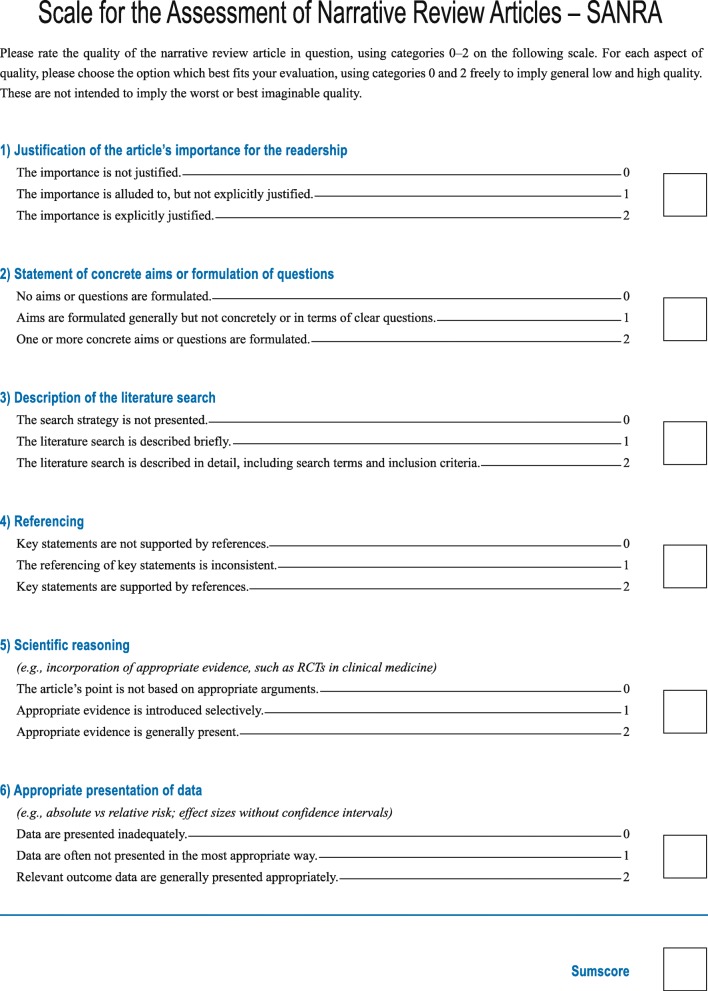
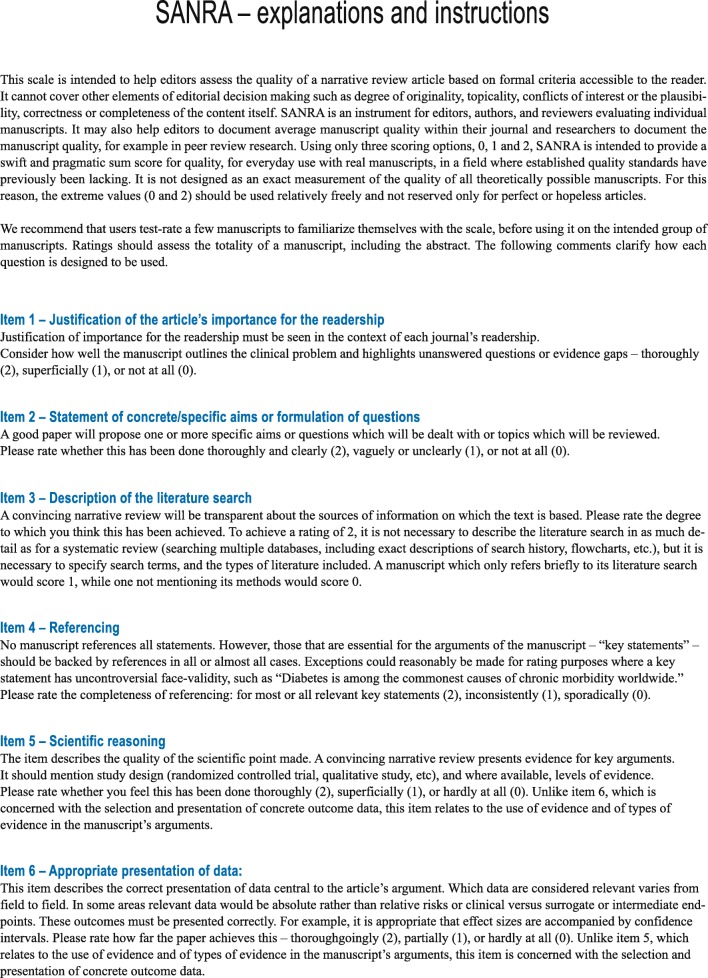
BACKGROUND: Narrative reviews are the commonest type of articles in the medical literature. However, unlike systematic reviews and randomized controlled trials (RCT) articles, for which formal instruments exist to evaluate quality, there is currently no instrument available to assess the quality of narrative reviews. In response to this gap, we developed SANRA, the Scale for the Assessment of Narrative Review Articles. METHODS: A team of three experienced journal editors modified or deleted items in an earlier SANRA version based on face validity, item-total correlations, and reliability scores from previous tests. We deleted an item which addressed a manuscript's writing and accessibility due to poor inter-rater reliability. The six items which form the revised scale are rated from 0 (low standard) to 2 (high standard) and cover the following topics: explanation of (1) the importance and (2) the aims of the review, (3) literature search and (4) referencing and presentation of (5) evidence level and (6) relevant endpoint data. For all items, we developed anchor definitions and examples to guide users in filling out the form. The revised scale was tested by the same editors (blinded to each other's ratings) in a group of 30 consecutive non-systematic review manuscripts submitted to a general medical journal. RESULTS: Raters confirmed that completing the scale is feasible in everyday editorial work. The mean sum score across all 30 manuscripts was 6.0 out of 12 possible points (SD 2.6, range 1-12). Corrected item-total correlations ranged from 0.33 (item 3) to 0.58 (item 6), and Cronbach's alpha was 0.68 (internal consistency). The intra-class correlation coefficient (average measure) was 0.77 [95% CI 0.57, 0.88] (inter-rater reliability). Raters often disagreed on items 1 and 4. CONCLUSIONS: SANRA's feasibility, inter-rater reliability, homogeneity of items, and internal consistency are sufficient for a scale of six items. Further field testing, particularly of validity, is desirable. We recommend rater training based on the "explanations and instructions" document provided with SANRA. In editorial decision-making, SANRA may complement journal-specific evaluation of manuscripts-pertaining to, e.g., audience, originality or difficulty-and may contribute to improving the standard of non-systematic reviews.
Overview
CoChat Summary
TL;DR
SANRA is a six-item, 0–2 scale (maximum 12) for assessing the quality of narrative review articles, developed and field-tested by three journal editors. In 30 consecutive non-systematic review manuscripts, it showed feasible use, sufficient internal consistency and inter-rater reliability, and a modest association with editorial acceptance.
Key findings
- Across 30 manuscripts (90 ratings), the mean SANRA sum score was 6.0 out of 12 (SD 2.6, range 1–12, median 6).
- Internal consistency was Cronbach’s alpha 0.68; corrected item-total correlations ranged from 0.33 (item 3) to 0.58 (item 6).
- Inter-rater reliability was an intra-class correlation coefficient (average measure) of 0.77 [95% CI 0.57, 0.88]; raters often disagreed on items 1 and 4.
- Average SANRA scores were modestly associated with editorial acceptance (mean 6.6, SD 1.9, n = 17) versus rejection (mean 5.1, SD 2.1, n = 13), point biserial correlation 0.37 (t = 2.09, df 28; two-sided p = 0.046).
Methods
- SANRA was developed between 2010 and 2017 by three experienced editors at Deutsches Ärzteblatt; the revised six-item version deleted an item on writing and accessibility due to poor inter-rater reliability.
- The revised scale was tested on 30 consecutive non-systematic review manuscripts submitted to Deutsches Ärzteblatt in 2015; three editor-raters scored them independently and blinded to each other’s ratings.
- Analyses included descriptive statistics, Cronbach’s alpha, corrected item-total correlations, average-measure intra-class correlation using a two-way random effects model (consistency definition), and a post hoc point biserial correlation between SANRA sum scores and acceptance/rejection.
Limitations
- The paper states the main limitation is sample size: 30 manuscripts was a compromise between representativeness, power, and feasibility, and took about 6 months to sample.
- The authors state that the scale’s authors were also the test-raters, so inter-rater reliability may be lower in groups less familiar with SANRA; the study also did not assess test-retest reliability, and results are study-specific.
- The paper acknowledges restricted content validity because SANRA is limited to six items and is a critical appraisal tool rather than a reporting guideline; criterion validity evidence is post hoc and weak, and no established cut-offs exist for comparing manuscripts across settings.
Model-written summary. Check it against the paper before relying on it.
Integrity signals
Registry
Cites
Statistics
Figures
Verification
Claims the paper makes
3 Valid · 0 Not valid · 5 Not checked · 27 Own results and interpretations
The cited sources support only part of this claim — read each source’s verdict below.
In the paper
“Bastian et al. found that they constitute the largest share of all text types in medicine and they concluded that they “remain the staple of medical literature” [1].”
- Also stated in: § Background · plain
“Narrative reviews are the commonest type of articles in the medical literature.”
§ SANRA—a scale for the quality assessment of narrative review articles > Background
What the sources say
- Partly supportedcites [1] Bastian H Glasziou P Chalmers I Seventy-five trials and eleven systematic reviews a day: how will we ever keep up? PLoS Med 2010 7 9 e1000326 10.1371/journal.pmed.1000326 20877712 PMC2943439 sourceExperimental — accuracy not yet measured
In “How Close Are We to Archie Cochrane’s Goal?” and the Summary Points (pages unavailable), the paper calls non-systematic narrative reviews the staple of medical literature synthesis. It does not say they constitute the largest share of all medical text types; that extends a claim about literature synthesis to medical literature as a whole. (LLM, conf=0.88)
plain- Asserted: passes — The authors put it forward as true.
- Checkable: passes — It can be checked against evidence.
- Load-bearing: unclear — It is unclear whether the paper’s conclusions depend on it.
- Based: passes — The paper gives a reason why it holds.
- Also stated in: § Background · plain
The sources with a verdict support this claim; the rest weren’t checked yet, have no full text we could read, or their verdicts aren’t rated yet.
In the paper
“non-systematic reviews or narrative reviews have been widely criticized as unreliable [1, 4].”
§ SANRA—a scale for the quality assessment of narrative review articles > Background
What the sources say
- Supportedcites [1] Bastian H Glasziou P Chalmers I Seventy-five trials and eleven systematic reviews a day: how will we ever keep up? PLoS Med 2010 7 9 e1000326 10.1371/journal.pmed.1000326 20877712 PMC2943439 source
In “How Close Are We to Archie Cochrane’s Goal?”, the paper describes reviews not conducted systematically as having great potential for error and calls them less reliable forms of information. Box 1 also says that articles and textbooks had highlighted the risk of bias and chance in reviews. Together, these passages support the broad characterization that narrative reviews have been criticized as unreliable; page numbers are not provided in our copy. (LLM, conf=0.89)
- Not checked — no full text of the sourcecites [4] Mulrow CD The medical review article: state of the science Ann Intern Med 1987 106 485 488 10.7326/0003-4819-106-3-485 3813259 source
plain- Asserted: passes — The authors put it forward as true.
- Checkable: passes — It can be checked against evidence.
- Load-bearing: passes — The paper’s conclusions depend on it.
- Based: passes — The paper gives a reason why it holds.
- Supported
A result the paper reports from its own data — it cites no other source for it, so there is none to check. The quote shows it is in the paper.
In the paper
“Cronbach’s alpha was 0.68 (internal consistency).”
- Also stated in: § Results · plain
“The scale’s internal consistency, measured as Cronbach’s alpha, was 0.68.”
§ SANRA—a scale for the quality assessment of narrative review articles > Abstract > Results
plainn = 90- Asserted: passes — The authors put it forward as true.
- Checkable: passes — It can be checked against evidence.
- Load-bearing: passes — The paper’s conclusions depend on it.
- Based: passes — The paper gives a reason why it holds.
- Also stated in: § Results · plain
A result the paper reports from its own data — it cites no other source for it, so there is none to check. The quote shows it is in the paper.
In the paper
“Raters often disagreed on items 1 and 4.”
- Also stated in: § Results · plain
“Disagreements most often occurred with regard to items 1 and 4.”
§ SANRA—a scale for the quality assessment of narrative review articles > Abstract > Results
plain- Asserted: passes — The authors put it forward as true.
- Checkable: passes — It can be checked against evidence.
- Load-bearing: unclear — It is unclear whether the paper’s conclusions depend on it.
- Based: passes — The paper gives a reason why it holds.
- Also stated in: § Results · plain
A result the paper reports from its own data — it cites no other source for it, so there is none to check. The quote shows it is in the paper.
In the paper
“The intra-class correlation coefficient (average measure) was 0.77 [95% CI 0.57, 0.88] (inter-rater reliability).”
- Also stated in: § Results · plain
“The intra-class correlation coefficient (average measure) amounted to 0.77 [95% CI 0.57, 0.88; F 4.3; df 29, 58].”
§ SANRA—a scale for the quality assessment of narrative review articles > Abstract > Results
plain- Asserted: passes — The authors put it forward as true.
- Checkable: passes — It can be checked against evidence.
- Load-bearing: passes — The paper’s conclusions depend on it.
- Based: passes — The paper gives a reason why it holds.
- Also stated in: § Results · plain
14 more claims
Create a free account to see all 35 claims and to verify the 3 references still open.
- Probably not a substantial claim. 11
- It may state two separate claims as one. 11
Claims other papers make about this one
Each is checked against this paper’s own text: does it say what the citing paper says it does?
The source backs part of the claim, not all of it — or backs it for a different population, condition or comparison.
In the citing paper
“The review was conducted and reported in accordance with the principles of the Scale for the Assessment of Narrative Review Articles (SANRA), which provides a validated framework for ensuring methodological transparency, scientific rigor, and balanced interpretation in narrative reviews [ 19 ].”
From Paracetamol: A History of Assumptions, Errors, and Evidence Reversals in Pain Management (2026) · cites this paper as [19]
Experimental — accuracy not yet measuredThe source backs part of the claim, not all of it — or backs it for a different population, condition or comparison.
In the citing paper
“As a narrative review, the present work does not include an aggregated quantitative assessment and is more exposed to selection subjectivity than a registered systematic review [124,125].”
From Berberine-Drug Interactions: Mechanisms, Clinical Relevance and Risk Stratification-A Narrative Review (2026) · cites this paper as [124]
Experimental — accuracy not yet measuredThe cited source says what the claim attributes to it.
In the citing paper
“This work is designed as a structured narrative review, with transparent reporting of the documentation strategy, guided by the quality criteria of the Scale for the Assessment of Narrative Review Articles (SANRA) [124].”
From Berberine-Drug Interactions: Mechanisms, Clinical Relevance and Risk Stratification-A Narrative Review (2026) · cites this paper as [124]
The cited source says what the claim attributes to it.
In the citing paper
“we used the following:-Cochrane Risk of Bias 2 (RoB 2) [29] and PEDRO scale tools for RCTs.-AMSTAR 2 [30] checklist for systematic review.-SANRA (Scale for the Assessment of Narrative Review Articles) [31] for narrative reviews.-JBI Checklist for Text and Opinion [32] for expert opinion papers.”
From Pelvic Floor Muscle Training Following Surgery for Pelvic Organ Prolapse: Recommendation from Scientific Literature (2026) · cites this paper as [31]
The cited source says what the claim attributes to it.
In the citing paper
“Data analysis employed a narrative and thematic synthesis methodology,adhering to the SANRA guidelines for narrative reviews (32).”
From Ethical issues in multi-agent AI systems for healthcare: a narrative review (2026) · cites this paper as [32]
12 more claims about this paper
Create a free account to see every claim other papers make about this one.
Citations
Cites
Shea, B. J., Reeves, B. C., Wells, G., Thuku, M., Hamel, C., Moran, J., Moher, D., Tugwell, P., Welch, V., Kristjansson, E., et al. (2017) · BMJ · doi:10.1136/bmj.j4008 · Cited by 10,636 · cited 2×
“Critical appraisal tools have been developed for systematic reviews (e.g., AMSTAR 2 [A MeaSurement Tool to Assess Systematic Reviews] [7]) and papers on RCTs (e.g., the CASP [Critical Appraisal Skills Program] checklist for randomized trials [8]) and other types of medical studies.”
BackgroundStreiner, D. L., & Norman, G. R. (2008) · doi:10.1093/acprof:oso/9780199231881.001.0001 · Cited by 2,631
Critical appraisal skills programme
Singh, J. (2013) · Journal of Pharmacology and Pharmacotherapeutics · doi:10.4103/0976-500x.107697 · Cited by 2,556
Guidelines for Reporting Reliability and Agreement Studies (GRRAS) were proposed
Kottner, J., Audigé, L., Brorson, S., Donner, A., Gajewski, B. J., Hróbjartsson, A., Roberts, C., Shoukri, M., & Streiner, D. L. (2011) · Journal of Clinical Epidemiology · doi:10.1016/j.jclinepi.2010.03.002 · Cited by 2,174
The Mass Production of Redundant, Misleading, and Conflicted Systematic Reviews and Meta‐analyses
IOANNIDIS, J. P. A. (2016) · The Milbank Quarterly · doi:10.1111/1468-0009.12210 · Cited by 1,483 · cited 1×
“While systematic reviews are not per se superior articles and while certain systematic reviews have been criticized lately [3], non-systematic reviews or narrative reviews have”
BackgroundSeventy-five trials and eleven systematic reviews a day: how will we ever keep up?
Bastian, H., Glasziou, P., & Chalmers, I. (2010) · PLoS Medicine · doi:10.1371/journal.pmed.1000326 · Cited by 1,188 · cited 2×
“found that they constitute the largest share of all text types in medicine and they concluded that they “remain the staple of medical literature” [1].”
BackgroundThe Medical Review Article: State of the Science
MULROW, C. D. (1987) · Annals of Internal Medicine · doi:10.7326/0003-4819-106-3-485 · Cited by 856 · cited 1×
“been widely criticized as unreliable [1, 4].”
Writing a narrative biomedical review: considerations for authors, peer reviewers, and editors
Gasparyan, A. Y., Ayvazyan, L., Blackmore, H., & Kitas, G. D. (2011) · Rheumatology International · doi:10.1007/s00296-011-1999-3 · Cited by 694 · cited 1×
“[13], for example, have provided guidance for writing narrative reviews, and Byrne [14] as well as Pautasso [15] has written, from different angles, thoughtful editorials on improving narrative reviews and presented lists of key features of writing a good review—lists that naturally overlap with SANRA items (e.”
BackgroundTen Simple Rules for Writing a Literature Review
Pautasso, M. (2013) · PLoS Computational Biology · doi:10.1371/journal.pcbi.1003149 · Cited by 272 · cited 3×
“[13], for example, have provided guidance for writing narrative reviews, and Byrne [14] as well as Pautasso [15] has written, from different angles, thoughtful editorials on improving narrative reviews and presented lists of key features of writing a good review—lists that naturally overlap with SANRA items (e.”
BackgroundImproving the peer review of narrative literature reviews
Byrne, J. A. (2016) · Research Integrity and Peer Review · doi:10.1186/s41073-016-0019-2 · Cited by 159 · cited 3×
“[13], for example, have provided guidance for writing narrative reviews, and Byrne [14] as well as Pautasso [15] has written, from different angles, thoughtful editorials on improving narrative reviews and presented lists of key features of writing a good review—lists that naturally overlap with SANRA items (e.”
Background
Research works printed but not linked: 3
- Higgins JPT, Green S. (eds.). Cochrane Handbook for Systematic Reviews and Interventions. Version 5.1.0. The Cochrane Collaboration 2011, section 1.2.2., www.handbook.cochrane.org, retrieved on Oct 31, 2018.
- Baethge C Mertens S Goldbeck-Wood S Development of a quality score for the assessment of non-systematic review articles (SANRA) Poster, Seventh International Congress on Peer Review and Biomedical Publication 2013 USA Chicago, Illinois
- Baethge C Goldbeck-Wood S Mertens S A scale for the assessment of non-systematic review articles (SANRA) Poster, Eighth International Congress on Peer and Biomedical Publication 2017 USA Chicago, Illinois
Cited by
Items 3,901–4,000 of 4,334
Mehta, S., Loomba, P., Musselmani, H., Ly, J., Nguyen, S., Niemann, A., Kolli, S., & Sant, D. (2026) · Frontiers in Medicine · doi:10.3389/fmed.2026.1928026
Wu, L., Tang, J., & Zhao, S. (2026) · Frontiers in Medicine · doi:10.3389/fmed.2026.1912838
Legriel, S. (2026) · Clinical Neurology and Neurosurgery · doi:10.1016/j.clineuro.2026.109675
Linking Microstructure to Cohesive Soil Erosion and Failure
Xu, J., & Wang, F. (2026) · Eng—Advances in Engineering · doi:10.3390/eng7100574
Lersten, A. K., & Dolan, C. B. (2026) · Frontiers in Public Health · doi:10.3389/fpubh.2026.1885854
“The methodological quality of each appraised source was evaluated using appraisal tools appropriate to its study design, including the Joanna Briggs Institute (JBI) Critical Appraisal Checklists, the Critical Appraisal Skills Programme (CASP) checklists, the Scale for the Assessment of Narrative Review Articles (SANRA…”
Faruq, M. F. R. A., Kaniasari, T. A., Nafi'a, Z. I., Syavinka, Z. N. A., & Faozi, E. (2026) · Healthy Tadulako Journal (Jurnal Kesehatan Tadulako) · doi:10.22487/hq49w318
Colavolpe, L., Blanca, D., Tarantini, P., & Mumoli, N. (2026) · Journal of Clinical Ultrasound · doi:10.1002/jcu.70443
Yadav, R., & Dutta, N. (2026) · Middle East Fertility Society Journal · doi:10.1186/s43043-026-00369-3
“Access to a Cu-IUD depends on trained personnel, service availability, cost, and acceptability [40, 42].”
Designing Public Buildings for Everyday Participation Among People with Social Anxiety
Li, P., & Sun, Y. (2026) · Buildings · doi:10.3390/buildings16204120
Abaidullah, M., Ji, Y., 黄, 勤., Scarpa, M., Li, J., Xiao, X., & Xu, D. (2026) · Frontiers in Immunology · doi:10.3389/fimmu.2026.1883529
Muui, C. W., & Madhu, U. (2026) · International Journal of experimental research and review · doi:10.52756/ijerr.2026.v51.008
“We followed the PRISMA 2020 statement (Page et al., 2021), adapted for a non-systematic review, for identification, screening and inclusion and assessed reporting completeness using the six items of the SANRA scale (Baethge et al., 2019).”
Hakami, M. A. (2026) · Diagnostics · doi:10.3390/diagnostics16203388
“The review was performed according to the six domains of the Scale for the Assessment of Narrative Review Articles (SANRA): importance, aims, search description, referencing, scientific reasoning, and presentation of relevant outcomes [6].”
Yadhushree, P., V, J, S. K., & Shetty, S. (2026) · JOURNAL OF ADVANCE AND FUTURE RESEARCH · doi:10.56975/jaafr.v4i10.515372
Resveratrol for Post-COVID-19 Cognitive Dysfunction: From Molecular Basis to Clinical Translation
Martínez‐Fierro, M. L., González-Delgado, S., Solis-Hernandez, I. A., Rocha-Pizaña, M. D. R., Mendez-Gonzalez, A. J., & Veloz, I. G. (2026) · Molecules · doi:10.3390/molecules31203747
Giannini, L., Gaffuri, F., Cattaneo, G., & Maspero, C. M. N. (2026) · Children · doi:10.3390/children13101425
Huang, Z., 任东彪, & Xu, D. (2026) · Clinical Therapeutics · doi:10.1016/j.clinthera.2026.09.014
Cirurgia da endometriose profunda e preservação da fertilidade: Revisão narrativa
Coelho, L. R. P., Ferreira, M. L. V., ALKIMIM, R. T., da Cruz, L. W., & Pirett, C. N. F. (2026) · Fisioterapia Brasil · doi:10.62827/fb.v27i10.1360
Kelly, S., O’Mullan, C., McDermott, L. J., & Schmidt, T. (2026) · Journal of Adult and Continuing Education · doi:10.1177/14779714261499023
Aliyev, J., Hajiyev, E., Eissa, B., Emadi, H., & Watson, M. (2026) · Clean Technologies · doi:10.3390/cleantechnol8050172
Preabilitação pré-operatória e mobilização pós-operatória em cirurgia abdominal: Revisão narrativa
Silva, V. A. M. D. C., Yoshimoto, N. H., Sato, M. G., da Cruz, L. W., & Matias, F. H. S. (2026) · Fisioterapia Brasil · doi:10.62827/fb.v27i10.1361
Sharata, E. E., Abdel-Samea, A. S., Reda, Y., Abdelnaser, M., Rofaeil, R. R., & Mohyeldin, R. H. (2026) · SN Comprehensive Clinical Medicine · doi:10.1007/s42399-026-02757-2
“Although this is a narrative rather than a systematic review, the literature underpinning it was identified through a defined and reproducible strategy, and the manuscript was prepared in accordance with the six domains of the Scale for the Assessment of Narrative Review Articles [ 7].”
Ciancarella, G., Ricci, P., Ricci, S., Ani, N. A., Tasegian, P., Miglino, A., & Ricci, L. (2026) · Pharmacy · doi:10.3390/pharmacy14070153
“It is not a systematic review, and no statistical pooling was performed; its reporting was guided by the Scale for the Assessment of Narrative Review Articles (SANRA) [16].”
Amin, A., Nawaz, T., fadili, M. E., & Rasdi, F. L. M. (2026) · Journal of drug targeting · doi:10.1080/1061186x.2026.2751938
Vosooghi, S., Ghamari, B. T., Kafiabadi, M. J., Zandi, R., Sadighi, M., Sabaghzadeh, A., Ebrahimpour, A., & Rad, S. B. (2026) · JSES Reviews Reports and Techniques · doi:10.1016/j.xrrt.2026.100908
Contractor, J. B., Bharti, L., Shah, I., Shah, S., Nimbalkar, S. M., Bajpai, A., Kumar, R., Mohan, V., Venkatesan, R., & Shah, P. (2026) · Children · doi:10.3390/children13101431
“The review was prepared with reference to the SANRA quality criteria for narrative reviews [16].”
Brain–Computer Interfaces for Cognitive Rehabilitation: A Narrative Review
Cantillo-Negrete, J., Rodríguez-García, M. E., Carrillo‐Mora, P., Méndez-Gómez, D. D., & Carino-Escobar, R. I. (2026) · Bioengineering · doi:10.3390/bioengineering13101224
“In accordance with the SANRA guidelines for narrative reviews, research articles in peer-reviewed journals published up to June 2026 were independently assessed by two researchers [69].”
Bagyinszky, E., & An, S. S. A. (2026) · Current Issues in Molecular Biology · doi:10.3390/cimb48101081
“The literature search covered publications available from January 1990 to 2026 August [24].”
InfluentialSîrbu, I., Năstasie, V., Custura, A. M., Radu, A., Stănescu, R., Tuţă, A. M., Binzaru-Ispas, D. C., Tănase, G., & Sîrbu, V. D. (2026) · Dentistry Journal · doi:10.3390/dj14100685
“Accordingly, the identified literature was qualitatively synthesized and critically interpreted within a narrative framework rather than evaluated according to systematic-or scoping-review methodology [17].”
Lesala, M. E., & Mukumba, P. (2026) · Challenges · doi:10.3390/challe17040042
Titsinides, S. (2026) · Indian Journal of Otolaryngology and Head & Neck Surgery · doi:10.1007/s12070-026-06877-y
Quality Indicators as Tools for Clinical Governance in Healthcare: A Narrative Review
Agkavanaki, A. M., Lagiou, A., & Bourazani, M. (2026) · Cureus · doi:10.7759/cureus.118226
Halftime Re–Warm-Up in Team Sports: Bridging the Gap Between Science and Dressing Room Reality
Bruno, J. (2026) · Strength and conditioning journal · doi:10.1519/ssc.0000000000001008
Tîrnovanu, V. G., Condriuc, I. P. S., Mogoş, R. A., Matasariu, D. R., Filipescu, A. G., Burac, M., Tîrnovanu, M. C., Socolov, D. G., & Cărăuleanu, A. (2026) · Journal of Clinical Medicine · doi:10.3390/jcm15208154
“Reporting was informed by the criteria of the Scale for the Assessment of Narrative Review Articles (SANRA) [18], and an item-by-item assessment of this review against them is provided in Supplementary Table S1.”
Alruwaili, R., Albelasi, A., & Alqahtani, M. Μ. (2026) · Journal of Clinical Medicine · doi:10.3390/jcm15208131
“This narrative review was prepared in accordance with the quality criteria of the Scale for the Assessment of Narrative Review Articles (SANRA) [30].”
AlDakheel, A., & Qadi, N. (2026) · Nutrients · doi:10.3390/nu18203436
“Reporting follows the domains of the Scale for the Assessment of Narrative Review Articles (SANRA): justification of importance, a concrete aim, description of information sources, appropriate referencing, scientific reasoning and presentation of endpoint data [34].”
Travieso, S. G., Ortiz, G. U., Viliod, M. C. D. L., & de Freitas, E. C. (2026) · ACS Nutrition Science · doi:10.1021/acsnutrsci.6c00069
Mixed-Methods Research: A Review of Foundations, Designs, and Integration
Saadat, U. (2026) · INTERNATIONAL JOURNAL OF MULTIDISCIPLINARY RESEARCH AND ANALYSIS · doi:10.47191/ijmra/v9-i10-21
Breastfeeding Interruption and Resumption: A Risk-Based Clinical Decision Framework
Petroaie, A. D., Cărăuleanu, A., Condriuc, I. P. S., Coșovanu, E. O., Coșovanu, E. T., Temneanu, O. R., Slănină, A. M., Popa, E., & Coman, A. E. (2026) · Journal of Clinical Medicine · doi:10.3390/jcm15208148
“The manuscript was prepared and critically appraised with reference to the six items of the Scale for the Assessment of Narrative Review Articles (SANRA) [15].”
Zhang, Y., Zhu, L., Xia, L., Cheng, H., Zhu, W., & Wang, H. (2026) · Neoplasia · doi:10.1016/j.neo.2026.101378
“The review was prepared with reference to the SANRA quality criteria [16].”
Sieusahai, J. K. (2026) · Frontiers in Psychology · doi:10.3389/fpsyg.2026.1913381
Suryaningrum, C. A., & Haksama, S. (2026) · Indonesian Journal of Innovation Multidisipliner Research · doi:10.69693/ijim.v4i4.3110
“To improve transparency, the search, selection, appraisal, and synthesis procedures are reported below, guided by the elements recommended for narrative reviews (Baethge et al., 2019), and the flow of records is shown in Figure 1.”
Liu, X., Mo, J., Sun, Z., Liu, M., & Yang, Z. (2026) · Frontiers in Nutrition · doi:10.3389/fnut.2026.1966858
Nursing Students’ Expectations of Effective Nurse Educators: A Narrative Review
Jayasena, S. A. (2026) · International Journal of Research and Innovation in Social Science · doi:10.47772/ijriss.2026.100900644
Nguyen, T. V. (2026) · Indonesian Journal of Modern Science and Technology
Candel, F. J., Matesanz, M., Muñoz‐Gómez, A., & del Pozo, J. L. (2026) · Journal of Antimicrobial Chemotherapy · doi:10.1093/jac/dkag353
Alenezi, Y. M. (2026) · Medicina · doi:10.3390/medicina62102037
“…and implementation-focused rather than to estimate a pooled effect, formal meta-analysis and systematic risk-of-bias scoring were not undertaken; reporting instead followed the general principles set out in the SANRA (Scale for the Assessment of Narrative Review Articles) framework [16].”
Early interventions in transition-age youth: a systematic review
Keiser, J., Zaina, G., Ben-Shaool, E., Fongaro, E., Reis, J. S., Purper‐Ouakil, D., Delvenne, V., Marchini, S., & Nicolis, H. (2026) · BMC Psychiatry · doi:10.1186/s12888-026-08778-4
Peripheral giant cell granuloma associated with dental prostheses: A case report
Aljabr, A. A., & Dobaian, K. S. (2026) · World Journal of Clinical Cases · doi:10.12998/wjcc.125577
Sánchez, J. D. (2026) · Frontiers in Digital Health · doi:10.3389/fdgth.2026.1949323
Integrating Evidence Generation and Commercialization in Digital Medicine: A Narrative Review
Lakhan, S. E. (2026) · Cureus · doi:10.7759/cureus.118294
FLEXIBLE METACOGNITION: FROM DIRECT ENGAGEMENT AND DISTANCING TO REGULATION AND REINTEGRATION
Maier, M. L. (2026) · BULETIN ŞTIINŢIFIC SERIA A Fascicula Pedagogie-Psihologie-Metodică · doi:10.37193/bs-ppm.26.07
de Freitas, E. M., Silva, A., & Esteves, A. M. (2026) · Pain Management · doi:10.1080/17581869.2026.2748285
León‐Figueroa, D. A., Acosta-Porzoliz, R. P. E., Cómina-Tamayo, M. J., Aguirre-Milachay, E., Vera-Ponce, V. J., & Valladares-Garrido, M. J. (2026) · International Journal of Medical Informatics · doi:10.1016/j.ijmedinf.2026.106771
Dumitru, C. N., Marcu, T., Dumitru, A. O., & Matei, M. N. (2026) · Pharmaceuticals · doi:10.3390/ph19101661
“This is a narrative synthesis, reported in accordance with the SANRA recommendations for narrative reviews [94].”
Franco, Ó. H., Trujillo-Cáceres, S. J., Verschuren, W. M. M., Correa, S. A. G., Bonfante, A. E. Z., & Valderrama, J. F., V (2026) · Maturitas · doi:10.1016/j.maturitas.2026.109162
Moumeni, I. N. (2026) · Frontiers in Rehabilitation Sciences · doi:10.3389/fresc.2026.1921614
Kantala, C., & Intra, P. (2026) · Journal of Electrostatics · doi:10.1016/j.elstat.2026.104403
Hefford, A., & Venugopal, A. (2026) · Seminars in Orthodontics · doi:10.1053/j.sodo.2026.10.002 · Cited by 1
Arslan, S. (2026) · JAND Global Reports · doi:10.1016/j.jaglob.2026.100033
Zanwar, A., Sahni, P., Arti, A., & Garg, J. (2026) · Cureus · doi:10.7759/cureus.118291
Chin Ptosis: Etiology, Classification, Diagnosis and Surgical Management—A Literature Review
Rolek, A., & Pokrowiecki, R. (2026) · Journal of Clinical Medicine · doi:10.3390/jcm15208175
Interpreting Autophagy–Lysosome Evidence in Hypertrophic Scars and Keloids: A Narrative Review
Chi, Y., Li, X., Gao, Y., Li, J., & Li, J. (2026) · Clinical Cosmetic and Investigational Dermatology · doi:10.2147/ccid.s648500
“20 It was not used to validate the four-domain framework.”
Xu, Z., Chen, W., & Lu, F. (2026) · Frontiers in Immunology · doi:10.3389/fimmu.2026.1928237
Síntesis de evidencia en salud: descripción y aplicaciones de los principales tipos de revisiones
Encina, F. C. (2026) · Andes pediatrica · doi:10.32641/andespediatr.v97i6.6170
Subclinical Hypothyroidism: Who Should Be Treated and Who Can Be Observed?
Mareh, M. M. (2026) · Cureus · doi:10.7759/cureus.118302
Crivei, I. C., Rațu, R. N., Veleşcu, I. D., Balint, A. B., Lipșa, F. D., Stoica, F., & Crivei, L. A. (2026) · Nutrients · doi:10.3390/nu18213461
The Interplay Between Oophorectomy and Alzheimer’s Disease: A Narrative Review
Xu, S., Fu, X., Zuo, L., & Wang, M. (2026) · Medicina · doi:10.3390/medicina62102043
“This review was written as a narrative review, with reference to the Scale for the Assessment of Narrative Review Articles (SANRA) to improve the transparency of the literature selection and reporting process [11].”
NIEDZIELA, K. J. (2026) · Environmental Medicine · doi:10.26444/ms/241461
Diaz, V. J., & Campbell, Y. N. (2026) · Clinical Simulation in Nursing · doi:10.1016/j.ecns.2026.102092
Updated Strategies to Address Flu Vaccine Hesitancy in the Elderly
Pires, C. M. B. F. (2026) · IGI Global eBooks · doi:10.4018/979-8-3373-9094-9.ch011
Cuello, M. A., Ibáñez, C., Bustos, M., Weiß, C., & Perez‐Cruz, P. E. (2026) · International Journal of Gynecology & Obstetrics · doi:10.1002/ijgo.71460
Tang, S.-J., Lin, Z.-H., Liang, C.-Y., Miao, Y., Gu, J., & Lin, S.-X. (2026) · World Journal of Gastrointestinal Surgery · doi:10.4240/wjgs.126127
Wagh, J. G., Lunkad, A., Jalindar, S., & Ghawate, V. B. (2022) · International Journal of Food and Nutritional Sciences · doi:10.69889/pvbrp934
“[6]”
Murphy, E., & Marshall, L. (2026) · FPOP Bulletin Psychology of Older People · doi:10.53841/bpsfpop.2026.1.176.85
A Review of Post-Quantum Cryptographic Approaches for Securing FHIR-Based Healthcare Data Exchange
Manga, İ., Yawachi, Y. A., & Bali, B. (2026) · International Journal of Research and Innovation in Applied Science · doi:10.51584/ijrias.2026.11090144
MELANOMA UVEAL: MUTAÇÕES NOS GENES GNAQ, GNA11 E BAP1 E SUAS IMPLICAÇÕES NA PROGRESSÃO TUMORAL
de Galiza, L. M., Junior, L. D. M. S., Pinheiro, M. D. N. S. M., Gonçalves, B. M., & Filho, L. L. L. (2026) · Revista Arte Ciência e Tecnologia · doi:10.29327/2405020.34.1-14
Nabila (2026) · Indonesian Journal of Medical Anthropology · doi:10.32734/ijma.v7i2.27437
“The review was prepared with reference to the Scale for the Assessment of Narrative Review Articles (SANRA), which emphasises a justified aim, a described literature search, appropriate referencing, scientific reasoning, and relevant presentation of data (Baethge et al., 2019).”
Condriuc, I. P. S., Popovici, R., Coșovanu, E. O., Mogos, R. A., Haba, R. M., Sescu, V. A., (Bran), R. S. S., Mogos, S. J., Buzdugă, C. M., & Cărăuleanu, A. (2026) · Metabolites · doi:10.3390/metabo16100799
Abuzaid, A. A. A. (2026) · Journal of Oncology Pharmacy Practice · doi:10.1177/10781552261498674
D’Urso, F., Basile, M. G., Falcone, E., & Angeloni, U. (2026) · Emergency Care and Medicine · doi:10.3390/ecm3040036
Salad, Y., & Omar, A. A. (2026) · Advances in Medical Education and Practice · doi:10.2147/amep.s633606
Siddiquee, T., Bhowmik, B., Moreira, N. C. D. V., Munir, S. B., Nasrin, H., Islam, T., Mahmud, F., Nesa, L. Q., Akhtar, S., Khan, S., et al. (2026) · Endocrinology Diabetes & Metabolism · doi:10.1002/edm2.70372
“This narrative review was conducted and reported in accordance with the Scale for the Assessment of Narrative Review Articles (SANRA) recommendations [18].”
Hossen, M. M. (2026) · Sustainability · doi:10.3390/su182110739
Pindo, J. M. O., Castillo, F. J., Azan, J. P. C., & Rivas, M. A. T. (2026) · Estudios y Perspectivas Revista Científica y Académica · doi:10.61384/r.c.a..v6i4.2133
Authentic E-Learning in Higher Education in the Post-COVID-19 Era: A Narrative Review
Zimba, Z. F., Mabvira, A., Agherdien, N., Pillay, R., Khosa, P., Malatji, H., Perumal, N., September, U., & Sithole, M. S. (2026) · Education Sciences · doi:10.3390/educsci16111778
Nohu, M. A. S., Mubarak, H., Duwila, Z., & Tajrin, A. (2026) · Journal of Stomatology Oral and Maxillofacial Surgery · doi:10.1016/j.jormas.2026.103056
Intranasal teeth: a narrative review of clinical features, diagnosis and management
Hu, S., Liu, Y., Gao, X., Zhao, H., Liu, G., Chen, C., Jin, X., Yang, Y., Ren, S., & Huang, X. (2026) · Frontiers in Surgery · doi:10.3389/fsurg.2026.1956628
Saini, A., Gupta, R., Gill, S., Mishra, A., Choudhary, P., & Kaushik, A. (2026) · Cureus · doi:10.7759/cureus.118409
Rodrigues, R. S., Fontenele, P. A., Rocha, J. C., & Setti, A. S. (2026) · Reproductive Sciences · doi:10.1007/s43032-026-02182-9
Sanabria, F. (2026) · Cureus · doi:10.7759/cureus.118440
“SANRA informed revision of the review's rationale, aims, search description, referencing, scientific reasoning, and presentation of relevant evidence [12].”
Kandrashina, S., Shvedov, M., & Sherstyukova, E. A. (2026) · Journal of Clinical Medicine · doi:10.3390/jcm15218222
Testosterone, Testosterone Replacement Therapy, and Cardiovascular Disease: A Contemporary Review
Maligireddy, A. R., Barua, S. T., & Barua, R. S. (2026) · Journal of the American Heart Association · doi:10.1161/jaha.126.054307
Bravo-Encarnación, G., Clemente-Villedas, I., Arias‐Rico, J., & Aguilar-Gutierrez, J. M. (2026) · Revista Foco · doi:10.54751/revistafoco.v19n10-063
Dari Kekebalan Kelompok ke Kekebalan Rapuh
Kuswandi, A., Ulfah, M., Nurhayati, T., Shaddiq, S., Sinulingga, S. R., & Ihsan, M. (2026) · JIKES Jurnal Ilmu Kesehatan · doi:10.71456/jik.v5i1.2984
Shateri, A. (2026) · Journal of Alzheimer s Disease · doi:10.1177/13872877261499713
Jin, Z., Zhu, J., Lu, B., Li, Y., & Chen, Y. (2026) · Frontiers in Pharmacology · doi:10.3389/fphar.2026.2001949
Mohseni, A., Mohseni, H., Pouyan, S., & Esmaeili, A. (2026) · European Journal of Plastic Surgery · doi:10.1007/s00238-026-02567-8
“Its preparation and reporting were guided by the Scale for the Assessment of Narrative Review Articles (SANRA) [ 7 ], which addresses justification of the topic, statement of aims, description of the literature search, referencing, scientific reasoning and presentation of data.”
Moghanian, A., Kızılkurtlu, A. A., Esfahani, M. N., Akpek, A., Marović, D., Safaee, S., & Haugen, H. J. (2026) · Dental Materials · doi:10.1016/j.dental.2026.10.007
Huang, J., Zhang, S., Zhang, D., Yang, T., Li, C., He, M., Wang, J., Song, T., Wang, X., Lu, Y., et al. (2026) · Science Progress · doi:10.1177/00368504261499190
Oloko-Oba, M., Esenogho, E., Aruleba, K., & Cameron, M. (2026) · AI · doi:10.3390/ai7110439
Metadata
- Authors
- Baethge, C., Goldbeck-Wood, S., & Mertens, S.
- Affiliations
- University of Cologne (DE)
- BMJ Group (United Kingdom) (GB)
- Corresponding author
- Baethge, Christopher
- ORCID
- Baethge, Christopher
- Venue
- Research Integrity and Peer Review
- Published
- 2019-03-26
- Volume
- 4
- Issue
- 1
- Pages
- 5-5
- ISSN
- 2058-8615 (ISSN-L)
- PMC
- PMC6434870
- OpenAlex
- W2922577842
- Semantic Scholar
- ea7f35b3069b53791c3b746c5c4b3c72a83a526b
- Cited by
- 3,469
- References
- 13
- Citations by year
- 2026: 1823 · 2025: 551 · 2024: 379 · 2023: 309 · 2022: 218 · 2021: 152 · 2020: 32 · 2019: 4
- FWCI
- 20.57
- Type
- journal article
- Language
- en
- Open access
- gold
- doi.org
- Licence
- cc-by
- creativecommons.org/licenses/by/4.0/ (tdm)
- Locations
- Research Integrity and Peer Review (publishedVersion, cc-by)
- Europe PMC (PubMed Central) (publishedVersion, other-oa)
- PubMed Central (publishedVersion, cc-by)
- PubMed (publishedVersion)
- Kölner Universitäts PublikationsServer (Universität zu Köln) (publishedVersion)
- DOAJ (DOAJ: Directory of Open Access Journals) (submittedVersion, cc-by-sa)
- Topics
- Social Sciences › Decision Sciences › Statistics, Probability and Uncertainty › Meta-analysis and systematic reviews
- Social Sciences › Library and Information Sciences › Academic Writing and Publishing
- Social Sciences › Library and Information Sciences › scientometrics and bibliometrics research
- Keywords
- quality assessment scale, manuscript review, inter-rater reliability, level of evidence, scale development
About these checks
Registry, retraction, Cites and statistics results are computed, not judged, with one exception: a printed reference that no index lists is read once by a model before it counts as a citation error. Claims are extracted by a model and kept only when their quote appears verbatim in the text; each cited source is then checked, with a model’s help, for whether it says what the claim relies on. Those verdicts can be wrong — read the claim’s quote and the cited source before relying on one.
The claim verdicts this report counts are experimental: their accuracy is not yet measured.
A language model drew the claims from the paper on 2026-11-10, under version 3 of the claim definition (model deepseek-v4.1-flash, prompt extract-v3).
A second model labelled each claim on 2026-11-10 (model jev-1.13-20260917, definition revision gold-guideline-v0.2).
Cited sources are checked with a language model’s help (gpt-6-sol).
Statistics and arithmetic are recomputed, not judged.
Confidence bands are shown only for fields calibrated on our annotated test set. None is calibrated yet, so no band is shown.
What counts as a claim ›How we measure confidence ›How we check this ›
Are you an author, or do you see a problem with this page? Request a review
Data sources
Bibliographic data: Semantic Scholar, OpenAlex, Crossref.
Contains information from the Semantic Scholar Academic Graph Datasets, made available under the ODC Attribution License (ODC-BY 1.0).
Semantic Scholar’s data is described in: Kinney, R., et al. (2023). The Semantic Scholar Open Data Platform. arXiv:2301.10140.
