

SANRA—a scale for the quality assessment of narrative review articles
Open accessThe DOI matches its Crossref record; 12 of the 13 references it cites were found in a registry or an index; 4 of the 12 sources its claims cite were checked for support.
Abstract
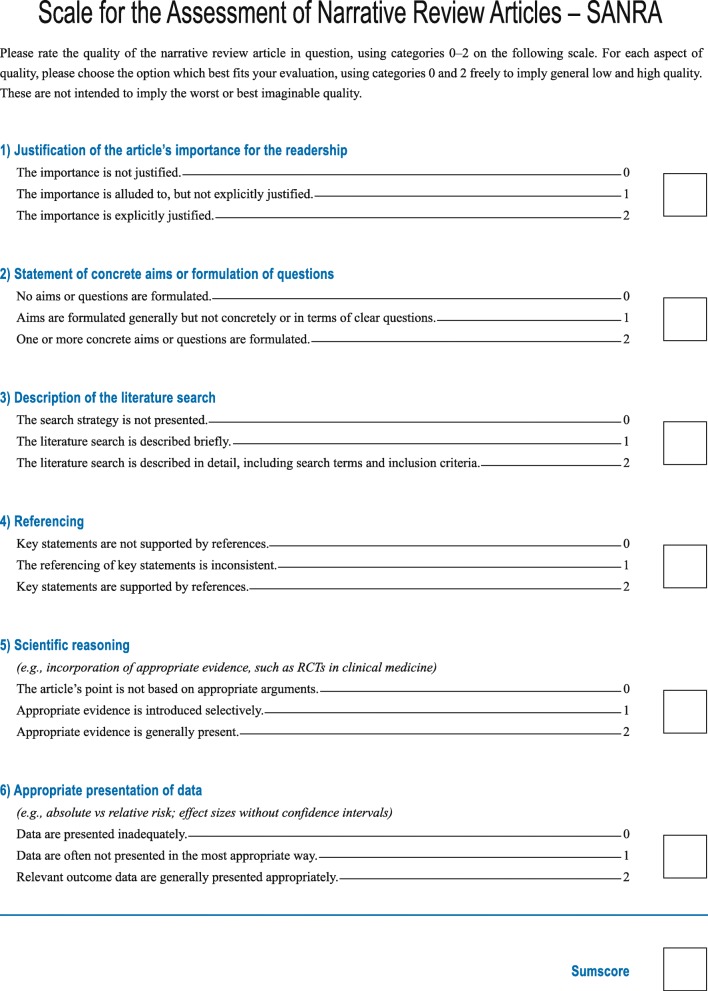
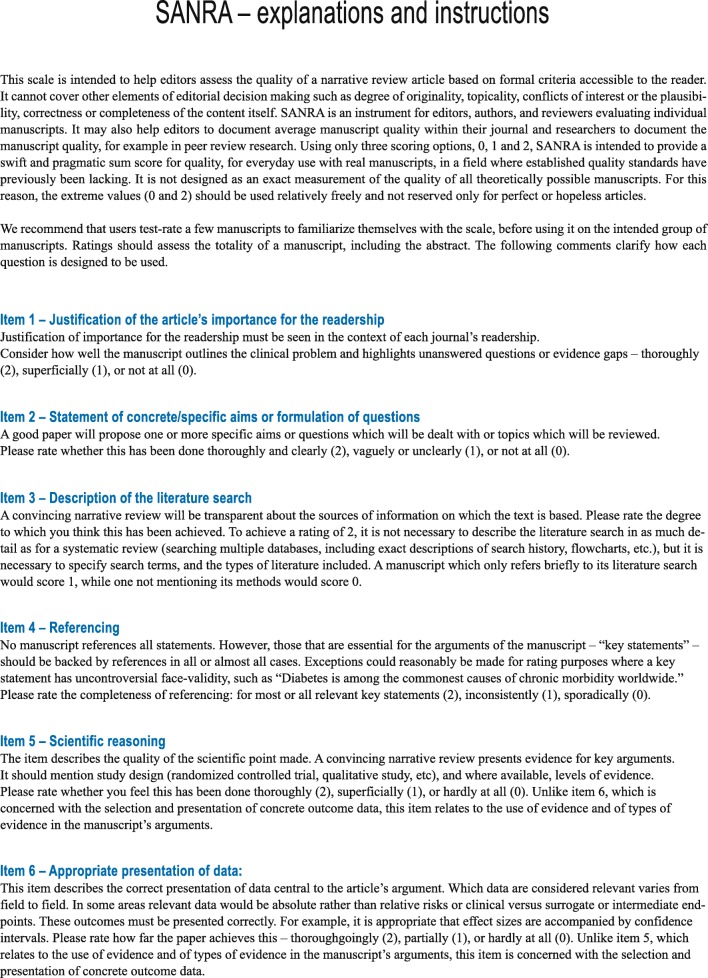
BACKGROUND: Narrative reviews are the commonest type of articles in the medical literature. However, unlike systematic reviews and randomized controlled trials (RCT) articles, for which formal instruments exist to evaluate quality, there is currently no instrument available to assess the quality of narrative reviews. In response to this gap, we developed SANRA, the Scale for the Assessment of Narrative Review Articles. METHODS: A team of three experienced journal editors modified or deleted items in an earlier SANRA version based on face validity, item-total correlations, and reliability scores from previous tests. We deleted an item which addressed a manuscript's writing and accessibility due to poor inter-rater reliability. The six items which form the revised scale are rated from 0 (low standard) to 2 (high standard) and cover the following topics: explanation of (1) the importance and (2) the aims of the review, (3) literature search and (4) referencing and presentation of (5) evidence level and (6) relevant endpoint data. For all items, we developed anchor definitions and examples to guide users in filling out the form. The revised scale was tested by the same editors (blinded to each other's ratings) in a group of 30 consecutive non-systematic review manuscripts submitted to a general medical journal. RESULTS: Raters confirmed that completing the scale is feasible in everyday editorial work. The mean sum score across all 30 manuscripts was 6.0 out of 12 possible points (SD 2.6, range 1-12). Corrected item-total correlations ranged from 0.33 (item 3) to 0.58 (item 6), and Cronbach's alpha was 0.68 (internal consistency). The intra-class correlation coefficient (average measure) was 0.77 [95% CI 0.57, 0.88] (inter-rater reliability). Raters often disagreed on items 1 and 4. CONCLUSIONS: SANRA's feasibility, inter-rater reliability, homogeneity of items, and internal consistency are sufficient for a scale of six items. Further field testing, particularly of validity, is desirable. We recommend rater training based on the "explanations and instructions" document provided with SANRA. In editorial decision-making, SANRA may complement journal-specific evaluation of manuscripts-pertaining to, e.g., audience, originality or difficulty-and may contribute to improving the standard of non-systematic reviews.
Overview
CoChat Summary
TL;DR
SANRA is a six-item, 0–2 scale (maximum 12) for assessing the quality of narrative review articles, developed and field-tested by three journal editors. In 30 consecutive non-systematic review manuscripts, it showed feasible use, sufficient internal consistency and inter-rater reliability, and a modest association with editorial acceptance.
Key findings
- Across 30 manuscripts (90 ratings), the mean SANRA sum score was 6.0 out of 12 (SD 2.6, range 1–12, median 6).
- Internal consistency was Cronbach’s alpha 0.68; corrected item-total correlations ranged from 0.33 (item 3) to 0.58 (item 6).
- Inter-rater reliability was an intra-class correlation coefficient (average measure) of 0.77 [95% CI 0.57, 0.88]; raters often disagreed on items 1 and 4.
- Average SANRA scores were modestly associated with editorial acceptance (mean 6.6, SD 1.9, n = 17) versus rejection (mean 5.1, SD 2.1, n = 13), point biserial correlation 0.37 (t = 2.09, df 28; two-sided p = 0.046).
Methods
- SANRA was developed between 2010 and 2017 by three experienced editors at Deutsches Ärzteblatt; the revised six-item version deleted an item on writing and accessibility due to poor inter-rater reliability.
- The revised scale was tested on 30 consecutive non-systematic review manuscripts submitted to Deutsches Ärzteblatt in 2015; three editor-raters scored them independently and blinded to each other’s ratings.
- Analyses included descriptive statistics, Cronbach’s alpha, corrected item-total correlations, average-measure intra-class correlation using a two-way random effects model (consistency definition), and a post hoc point biserial correlation between SANRA sum scores and acceptance/rejection.
Limitations
- The paper states the main limitation is sample size: 30 manuscripts was a compromise between representativeness, power, and feasibility, and took about 6 months to sample.
- The authors state that the scale’s authors were also the test-raters, so inter-rater reliability may be lower in groups less familiar with SANRA; the study also did not assess test-retest reliability, and results are study-specific.
- The paper acknowledges restricted content validity because SANRA is limited to six items and is a critical appraisal tool rather than a reporting guideline; criterion validity evidence is post hoc and weak, and no established cut-offs exist for comparing manuscripts across settings.
Model-written summary. Check it against the paper before relying on it.
Integrity signals
Registry
Cites
Statistics
Figures
Verification
Claims the paper makes
3 Valid · 0 Not valid · 5 Not checked · 27 Own results and interpretations
The cited sources support only part of this claim — read each source’s verdict below.
In the paper
“Bastian et al. found that they constitute the largest share of all text types in medicine and they concluded that they “remain the staple of medical literature” [1].”
- Also stated in: § Background · plain
“Narrative reviews are the commonest type of articles in the medical literature.”
§ SANRA—a scale for the quality assessment of narrative review articles > Background
What the sources say
- Partly supportedcites [1] Bastian H Glasziou P Chalmers I Seventy-five trials and eleven systematic reviews a day: how will we ever keep up? PLoS Med 2010 7 9 e1000326 10.1371/journal.pmed.1000326 20877712 PMC2943439 sourceExperimental — accuracy not yet measured
In “How Close Are We to Archie Cochrane’s Goal?” and the Summary Points (pages unavailable), the paper calls non-systematic narrative reviews the staple of medical literature synthesis. It does not say they constitute the largest share of all medical text types; that extends a claim about literature synthesis to medical literature as a whole. (LLM, conf=0.88)
plain- Asserted: passes — The authors put it forward as true.
- Checkable: passes — It can be checked against evidence.
- Load-bearing: unclear — It is unclear whether the paper’s conclusions depend on it.
- Based: passes — The paper gives a reason why it holds.
- Also stated in: § Background · plain
The sources with a verdict support this claim; the rest weren’t checked yet, have no full text we could read, or their verdicts aren’t rated yet.
In the paper
“non-systematic reviews or narrative reviews have been widely criticized as unreliable [1, 4].”
§ SANRA—a scale for the quality assessment of narrative review articles > Background
What the sources say
- Supportedcites [1] Bastian H Glasziou P Chalmers I Seventy-five trials and eleven systematic reviews a day: how will we ever keep up? PLoS Med 2010 7 9 e1000326 10.1371/journal.pmed.1000326 20877712 PMC2943439 source
In “How Close Are We to Archie Cochrane’s Goal?”, the paper describes reviews not conducted systematically as having great potential for error and calls them less reliable forms of information. Box 1 also says that articles and textbooks had highlighted the risk of bias and chance in reviews. Together, these passages support the broad characterization that narrative reviews have been criticized as unreliable; page numbers are not provided in our copy. (LLM, conf=0.89)
- Not checked — no full text of the sourcecites [4] Mulrow CD The medical review article: state of the science Ann Intern Med 1987 106 485 488 10.7326/0003-4819-106-3-485 3813259 source
plain- Asserted: passes — The authors put it forward as true.
- Checkable: passes — It can be checked against evidence.
- Load-bearing: passes — The paper’s conclusions depend on it.
- Based: passes — The paper gives a reason why it holds.
- Supported
A result the paper reports from its own data — it cites no other source for it, so there is none to check. The quote shows it is in the paper.
In the paper
“Cronbach’s alpha was 0.68 (internal consistency).”
- Also stated in: § Results · plain
“The scale’s internal consistency, measured as Cronbach’s alpha, was 0.68.”
§ SANRA—a scale for the quality assessment of narrative review articles > Abstract > Results
plainn = 90- Asserted: passes — The authors put it forward as true.
- Checkable: passes — It can be checked against evidence.
- Load-bearing: passes — The paper’s conclusions depend on it.
- Based: passes — The paper gives a reason why it holds.
- Also stated in: § Results · plain
A result the paper reports from its own data — it cites no other source for it, so there is none to check. The quote shows it is in the paper.
In the paper
“Raters often disagreed on items 1 and 4.”
- Also stated in: § Results · plain
“Disagreements most often occurred with regard to items 1 and 4.”
§ SANRA—a scale for the quality assessment of narrative review articles > Abstract > Results
plain- Asserted: passes — The authors put it forward as true.
- Checkable: passes — It can be checked against evidence.
- Load-bearing: unclear — It is unclear whether the paper’s conclusions depend on it.
- Based: passes — The paper gives a reason why it holds.
- Also stated in: § Results · plain
A result the paper reports from its own data — it cites no other source for it, so there is none to check. The quote shows it is in the paper.
In the paper
“The intra-class correlation coefficient (average measure) was 0.77 [95% CI 0.57, 0.88] (inter-rater reliability).”
- Also stated in: § Results · plain
“The intra-class correlation coefficient (average measure) amounted to 0.77 [95% CI 0.57, 0.88; F 4.3; df 29, 58].”
§ SANRA—a scale for the quality assessment of narrative review articles > Abstract > Results
plain- Asserted: passes — The authors put it forward as true.
- Checkable: passes — It can be checked against evidence.
- Load-bearing: passes — The paper’s conclusions depend on it.
- Based: passes — The paper gives a reason why it holds.
- Also stated in: § Results · plain
14 more claims
Create a free account to see all 35 claims and to verify the 3 references still open.
- Probably not a substantial claim. 11
- It may state two separate claims as one. 11
Claims other papers make about this one
Each is checked against this paper’s own text: does it say what the citing paper says it does?
The source backs part of the claim, not all of it — or backs it for a different population, condition or comparison.
In the citing paper
“The review was conducted and reported in accordance with the principles of the Scale for the Assessment of Narrative Review Articles (SANRA), which provides a validated framework for ensuring methodological transparency, scientific rigor, and balanced interpretation in narrative reviews [ 19 ].”
From Paracetamol: A History of Assumptions, Errors, and Evidence Reversals in Pain Management (2026) · cites this paper as [19]
Experimental — accuracy not yet measuredThe source backs part of the claim, not all of it — or backs it for a different population, condition or comparison.
In the citing paper
“As a narrative review, the present work does not include an aggregated quantitative assessment and is more exposed to selection subjectivity than a registered systematic review [124,125].”
From Berberine-Drug Interactions: Mechanisms, Clinical Relevance and Risk Stratification-A Narrative Review (2026) · cites this paper as [124]
Experimental — accuracy not yet measuredThe cited source says what the claim attributes to it.
In the citing paper
“This work is designed as a structured narrative review, with transparent reporting of the documentation strategy, guided by the quality criteria of the Scale for the Assessment of Narrative Review Articles (SANRA) [124].”
From Berberine-Drug Interactions: Mechanisms, Clinical Relevance and Risk Stratification-A Narrative Review (2026) · cites this paper as [124]
The cited source says what the claim attributes to it.
In the citing paper
“we used the following:-Cochrane Risk of Bias 2 (RoB 2) [29] and PEDRO scale tools for RCTs.-AMSTAR 2 [30] checklist for systematic review.-SANRA (Scale for the Assessment of Narrative Review Articles) [31] for narrative reviews.-JBI Checklist for Text and Opinion [32] for expert opinion papers.”
From Pelvic Floor Muscle Training Following Surgery for Pelvic Organ Prolapse: Recommendation from Scientific Literature (2026) · cites this paper as [31]
The cited source says what the claim attributes to it.
In the citing paper
“Data analysis employed a narrative and thematic synthesis methodology,adhering to the SANRA guidelines for narrative reviews (32).”
From Ethical issues in multi-agent AI systems for healthcare: a narrative review (2026) · cites this paper as [32]
12 more claims about this paper
Create a free account to see every claim other papers make about this one.
Citations
Cites
Shea, B. J., Reeves, B. C., Wells, G., Thuku, M., Hamel, C., Moran, J., Moher, D., Tugwell, P., Welch, V., Kristjansson, E., et al. (2017) · BMJ · doi:10.1136/bmj.j4008 · Cited by 10,636 · cited 2×
“Critical appraisal tools have been developed for systematic reviews (e.g., AMSTAR 2 [A MeaSurement Tool to Assess Systematic Reviews] [7]) and papers on RCTs (e.g., the CASP [Critical Appraisal Skills Program] checklist for randomized trials [8]) and other types of medical studies.”
BackgroundStreiner, D. L., & Norman, G. R. (2008) · doi:10.1093/acprof:oso/9780199231881.001.0001 · Cited by 2,631
Critical appraisal skills programme
Singh, J. (2013) · Journal of Pharmacology and Pharmacotherapeutics · doi:10.4103/0976-500x.107697 · Cited by 2,556
Guidelines for Reporting Reliability and Agreement Studies (GRRAS) were proposed
Kottner, J., Audigé, L., Brorson, S., Donner, A., Gajewski, B. J., Hróbjartsson, A., Roberts, C., Shoukri, M., & Streiner, D. L. (2011) · Journal of Clinical Epidemiology · doi:10.1016/j.jclinepi.2010.03.002 · Cited by 2,174
The Mass Production of Redundant, Misleading, and Conflicted Systematic Reviews and Meta‐analyses
IOANNIDIS, J. P. A. (2016) · The Milbank Quarterly · doi:10.1111/1468-0009.12210 · Cited by 1,483 · cited 1×
“While systematic reviews are not per se superior articles and while certain systematic reviews have been criticized lately [3], non-systematic reviews or narrative reviews have”
BackgroundSeventy-five trials and eleven systematic reviews a day: how will we ever keep up?
Bastian, H., Glasziou, P., & Chalmers, I. (2010) · PLoS Medicine · doi:10.1371/journal.pmed.1000326 · Cited by 1,188 · cited 2×
“found that they constitute the largest share of all text types in medicine and they concluded that they “remain the staple of medical literature” [1].”
BackgroundThe Medical Review Article: State of the Science
MULROW, C. D. (1987) · Annals of Internal Medicine · doi:10.7326/0003-4819-106-3-485 · Cited by 856 · cited 1×
“been widely criticized as unreliable [1, 4].”
Writing a narrative biomedical review: considerations for authors, peer reviewers, and editors
Gasparyan, A. Y., Ayvazyan, L., Blackmore, H., & Kitas, G. D. (2011) · Rheumatology International · doi:10.1007/s00296-011-1999-3 · Cited by 694 · cited 1×
“[13], for example, have provided guidance for writing narrative reviews, and Byrne [14] as well as Pautasso [15] has written, from different angles, thoughtful editorials on improving narrative reviews and presented lists of key features of writing a good review—lists that naturally overlap with SANRA items (e.”
BackgroundTen Simple Rules for Writing a Literature Review
Pautasso, M. (2013) · PLoS Computational Biology · doi:10.1371/journal.pcbi.1003149 · Cited by 272 · cited 3×
“[13], for example, have provided guidance for writing narrative reviews, and Byrne [14] as well as Pautasso [15] has written, from different angles, thoughtful editorials on improving narrative reviews and presented lists of key features of writing a good review—lists that naturally overlap with SANRA items (e.”
BackgroundImproving the peer review of narrative literature reviews
Byrne, J. A. (2016) · Research Integrity and Peer Review · doi:10.1186/s41073-016-0019-2 · Cited by 159 · cited 3×
“[13], for example, have provided guidance for writing narrative reviews, and Byrne [14] as well as Pautasso [15] has written, from different angles, thoughtful editorials on improving narrative reviews and presented lists of key features of writing a good review—lists that naturally overlap with SANRA items (e.”
Background
Research works printed but not linked: 3
- Higgins JPT, Green S. (eds.). Cochrane Handbook for Systematic Reviews and Interventions. Version 5.1.0. The Cochrane Collaboration 2011, section 1.2.2., www.handbook.cochrane.org, retrieved on Oct 31, 2018.
- Baethge C Mertens S Goldbeck-Wood S Development of a quality score for the assessment of non-systematic review articles (SANRA) Poster, Seventh International Congress on Peer Review and Biomedical Publication 2013 USA Chicago, Illinois
- Baethge C Goldbeck-Wood S Mertens S A scale for the assessment of non-systematic review articles (SANRA) Poster, Eighth International Congress on Peer and Biomedical Publication 2017 USA Chicago, Illinois
Cited by
Items 3,701–3,800 of 4,334
Muñoz-Ordóñez, J. J. (2026) · Revista Colombiana de Cirugía · doi:10.30944/20117582.3305
Métodos de anatomía patológica en el diagnóstico del cáncer de tiroides. Revisión narrativa
González, L. C., Montero-Molina, A. M., Rendón-Garro, D., & Tarifa-Acosta, D. (2026) · MedEst
Shruti, & Bala, K. (2026) · Reproductive Sciences · doi:10.1007/s43032-026-02220-6
Wiedermann, C. J. (2026) · Medical Ethics and Bioethics · doi:10.3390/meb1010003
“This narrative review adheres to the six components of the Scale for the Assessment of Narrative Review Articles (SANRA) [19] for its reporting.”
Mahmood, A. M., & Jabur, M. S. (2026) · Journal of Microbiological Sciences · doi:10.38211/jms.2026.05.239
“In keeping with the narrative design (Baethge et al ., 2019), no systematic search, formal risk-of-bias assessment or quantitative synthesis was performed, and the review was not registered in PROSPERO.”
Circulating tumor DNA as a tool for precision management in bladder cancer: A narrative review
Manivasagam, S. S., Sheikhsaran, F., Raman, J. D., & Aminsharifi, A. (2026) · Therapeutic Advances in Urology · doi:10.1177/17562872261493705
Marano, L., Barone, M., Özmen, M. M., Jovanović, B., Prete, F. P., Malerba, S., Inga-Zapata, E., Laïnas, P., Ruiz‐Úcar, E., Yap, M. A. C., et al. (2026) · Journal of Robotic Surgery · doi:10.1007/s11701-026-04035-8
“Reporting and self-appraisal were informed by the six domains of the Scale for the Assessment of Narrative Review Articles (SANRA), which is a critical-appraisal scale rather than a reporting guideline [5].”
Rivas, J. A. P., Suárez, S. R., Fernández, A. B., Quero, J. H., & Salvatierra, J. (2026) · Revista Clínica Española · doi:10.1016/j.rce.2026.502623
Al-Khaldi, M. R. (2026) · Journal of Family Medicine and Primary Care · doi:10.4103/jfmpc.jfmpc_369_26
“[18] Medical Subject Headings (MeSH) and Boolean operators were employed for primary searches, concentrating on titles, abstracts, and keywords.”
LL-37–MRGPRX2–Mast Cell Signaling in Rosacea: Current Evidence and Directions for Human Studies
Yin, H., & 卢益萍 (2026) · Clinical Cosmetic and Investigational Dermatology · doi:10.2147/ccid.s648503
Colour-Changing Hydrogels with Smartphone Assistance for Wound Monitoring and Bacterial Detection
Prasanna, S., Natrajan, J., Selvaraj, J., Anandharaj, S., Arun Kumar, R., & Vagu, E. S. V. (2026) · Journal of Pharmaceutical Innovation · doi:10.1007/s12247-026-11106-8
“Studies were categorized by hydrogel type, sensing mechanism, stimulus, colourimetric response, target of detection, therapeutic function, digital monitoring, and translational relevance [15, 17].”
Fonoff, E. T., Cardoso, I. B., & Santos, A. M. (2026) · Frontiers in Neurology · doi:10.3389/fneur.2026.1931318
“To ensure methodological rigor, transparency, and high-quality reporting in narrative syntheses, our literature search, evaluation, and data presentation adhered to the principles of the Scale for the Assessment of Narrative Review Articles (SANRA) guidelines (15).”
Christopher, E. (2026) · Considerations in Medicine · doi:10.1136/conmed-2026-000075
Alharbi, S. M., Amri, A. Y., Qahl, Z. M., Alhafaf, R. A., Alharbi, B. A., Alsufran, S. H., Mubarki, F. A., Huraysi, N. Y. H., Khasawi, M. A. H., & Aljouf, A. K. (2026) · European Journal of Prosthodontics and Restorative Dentistry · doi:10.1922/ejprd.v34i13s.2190
Mental health care users’ perceptions and experiences of the use of social networking sites
Andrews, C. (2022) · UWC Research Repository (University of the Western Cape)
Ningrum, I. Y., & Siregar, E. S. (2026) · Jurnal Intelek Insan Cendikia
Advanced detection technologies for economically motivated food adulteration: a narrative review
Mitra, A. (2026) · Nutrition & Food Science · doi:10.1108/nfs-05-2026-0256
Tharini, M. K., Chaturvedi, M. K., & Sharma, R. (2026) · Indian Journal of Community Medicine · doi:10.4103/ijcm.ijcm_813_25
Preissler, A. A. B., Clemente, F. M., & Schons, P. (2026) · Team Sports Studies · doi:10.1016/j.tss.2026.100020
Alalwan, T. A., & Perna, S. (2026) · Behavioural Brain Research · doi:10.1016/j.bbr.2026.116512
Circadian misalignment and low-grade inflammation: Failure of temporal gating by the molecular clock
Lee, Y., & Lee, H.-J. (2026) · Chronobiology International · doi:10.1080/07420528.2026.2743662
PSIQUIATRIA NUTRICIONAL NO BURNOUT: MICRONUTRIENTES, ESTRESSE CRÔNICO E FISIOLOGIA DO SONO
de Carvalho, G. P. (2026) · INTERNATIONAL BLEST SCIENTIFIC · doi:10.65671/mkt6yn81
Danış, F., & Kudu, E. (2026) · World Journal of Gastrointestinal Surgery · doi:10.4240/wjgs.125637
Mora-Boga, R., Recarey, M. E. D., Esterelles, L. G., Esteban, I. B., Ballesta, M. H., Buran, Ö., López, L. E., Henares, F. G., & Ortega, M. R. (2026) · Rehabilitación · doi:10.1016/j.rh.2026.101017
Szydlarska, D., Ciechomska, M. Z., Banaszkiewicz, Z., Brytan, M., Chałdaś-Majdańska, J., Brzozowska, M., & Śliwczyński, A. M. (2026) · Biomedicines · doi:10.3390/biomedicines14102273
“…the principles of the SANRA (Scale for the Assessment of Narrative Review Articles) framework, particularly explicit justification of the review, a clearly defined objective, description of the literature search, appropriate refer-encing, and critical rather than purely descriptive synthesis [8].”
Joshua, B. (2026) · Researchers Journal of Science and Technology · doi:10.83080/rejost.vol6no9.350
Molecular biomarkers in uterine sarcomas: a review of reviews with genomic data integration
Iacobelli, V., Romano, V., Anderson, G., Dababou, S., Gubitosa, M. T., Mastrogiovanni, S., Giovannetti, A., Mazza, T., Bruno, M., Sabetta, G., et al. (2026) · Gynecologic Oncology · doi:10.1016/j.ygyno.2026.09.016
Quick, J. D., Powell, L. E., Syal, A., Patel, N. N., Kamel, L., Brooks, A., Haider, S. A., Powell, T. A., & Buckley, M.-C. (2026) · Health Science Reports · doi:10.1002/hsr2.73353
“Recommendations were narrowed when the cited source did not directly support the population, wound type, product, or outcome described [31].”
Impacts des feux de forêt sur la qualité des sources d’approvisionnement en eau potable
Patey, G., & Huot, C. (2026) · doi:10.64490/mbqw9836
Tini, P., Donnini, F., Chibbaro, S., Ganau, M., Pinzi, M., Fagiolini, A. M., & Cuomo, A. (2026) · Psychiatry Research Neuroimaging · doi:10.1016/j.pscychresns.2026.112352
Chooklin, S., & Chuklin, S. S. (2026) · Journal of Inflammation Research · doi:10.2147/jir.s643664
Brogaard, E., & Thomsen, S. F. (2026) · Targets · doi:10.3390/targets4040033
EXERCINAS E PLACENTOCINAS: MECANISMOS, IMPACTO DO EXERCÍCIO NA SAÚDE MATERNO-FETAL
Lobo, H. N. C. D. C., Corrêa, H. D. L., & Campbell, C. S. G. (2026) · Fiep Bulletin - online · doi:10.16887/mgzbte97
Briard, M., & Baatout, S. (2026) · Frontiers in Space Technologies · doi:10.3389/frspt.2026.1967384
Sjögren’s disease and depression
Galindo-Donaire, J. R., Vázquez-Hernández, A. E., & Hernández‐Molina, G. (2026) · Journal of International Medical Research · doi:10.1177/03000605261494354
Leone, R., Ouattara, Y., Tognaccini, L., Ricciardi, W., & Gualano, M. R. (2026) · Health Policy OPEN · doi:10.1016/j.hpopen.2026.100187
“This is a critical, interpretive review conducted according to the principles set out by Grant and Booth [11] for the critical review type, and reported with attention to the transparency requirements of SANRA [12].”
Review, P. J. O. M. &. C. (2026) · Pakistan Journal of Medical & Cardiological Review · doi:10.5281/zenodo.23220174
Ibrahim, M. S., Zakariya, A., Hassan, H. F., Shu’aibu, U., Jalo, M. I., & SADIQ, A. I. (2026) · FUDMA Journal of Sciences · doi:10.33003/fjs-2026-1019-6075
Atuhaire, A., Nkalubo, C., Babirye, S., Nakyagaba, L., Nabunje, J., Ngwar, W. M. C., Olwit, G., Okema, J. N., Kuriakose, A., Rutkiewicz, A., et al. (2026) · F1000Research · doi:10.12688/f1000research.192075.1
Yu, P., Chen, H., Du, L., Zhu, H., Wang, X., & Qiu, X. (2026) · Interdisciplinary Neurosurgery · doi:10.1016/j.inat.2026.102390
Ciorica, G., DRAGOESCU-PETRICA, A., & Nistor, E. (2026) · Antioxidants · doi:10.3390/antiox15111436
Nasab, S. H., Bazmi, A., Hamsianetefagh, R., Tabak, Y., Ashkani, O., Mahboubizadeh, S., Çolak, M., & Şensoy, A. T. (2026) · Journal of Biomaterials Science Polymer Edition · doi:10.1080/09205063.2026.2743125
Strategies to enhance resilience among students in higher education: A critical narrative review
Gabriel, J. (2026) · Educational Research and Reviews · doi:10.5897/err2026.4536
Quaranta, V. N., Dragonieri, S., Manzetti, G. M., Tomasello, A., Benfante, A., Scichilone, N., Rogliani, P., & Carpagnano, G. E. (2026) · Journal of Clinical Medicine · doi:10.3390/jcm15197757
Bains, A., Janghu, S., & Chawla, P. (2026) · Food Bioscience · doi:10.1016/j.fbio.2026.110220
Mandal, P., & Gokani, V. (2026) · Surgeries · doi:10.3390/surgeries7040121
“This narrative review was conducted in accordance with the SANRA (Scale for the Assessment of Narrative Review Articles) reporting framework [12], through a structured search of PubMed (MEDLINE), Scopus, and Web of Science, supplemented by manual bibliography searches of relevant reviews and book…”
Molecular regulators: insights into diverse biological functions of long non-coding RNAs
Akram, F., Sahar, E., Fatima, T., Aftab, M. N., & Haq, I. U. (2026) · Human Gene · doi:10.1016/j.humgen.2026.201609
Nakajima, T., Nishibe, T., Iba, Y., Nakazawa, J., Shibata, T., Arihara, A., 石毛, 宏., & Miki, K. (2026) · Annals of Vascular Diseases · doi:10.3400/avd.ra.26-00128
“6) All cited references are indexed in PubMed.”
Capobianco, M., Zeppieri, M., Nicolosi, S. G., Castellino, N., Cappellani, F., Gattazzo, I., & Gagliano, C. (2026) · Vision · doi:10.3390/vision10040078
“It was not used as a reporting guideline or as an instrument for assessing risk of bias in the included studies [8].”
Sood, S. (2026) · Journal of Forensic Practice · doi:10.1108/jfp-04-2026-0046
Fakher, J. A., Tayoun, N., Khoury, M. E., Zalzaly, M., Deghel, Y. A., Natour, H., Matto, Y., Saab, P., Finianos, Y., Antoun, S., et al. (2026) · World Journal of Critical Care Medicine · doi:10.5492/wjccm.125752
Endometriosis and Adenomyosis: Mechanotransduction, Microenvironment, and Mechanisms Beyond Lesions
Kobayashi, H. (2026) · Reproductive Sciences · doi:10.1007/s43032-026-02237-x
dos Santos, G. H. S. (2026) · International Journal of Health Management Review · doi:10.47172/ijhmreview.v12i3.658
dos Santos, G. H. S. (2026) · International Journal of Health Management Review · doi:10.47172/ijhmreview.v12i3.656
Changjian, W., Furui, W., Yanyu, F., Yü, Y., & Wei, J. (2026) · Experimental Neurology · doi:10.1016/j.expneurol.2026.116058
dos Santos, G. H. S. (2026) · International Journal of Health Management Review · doi:10.47172/ijhmreview.v12i3.659
Barone, M., Selvaggi, F., Pasquale, V., Nusrath, S., Vashist, Y. K., & Marano, L. (2026) · Journal of Clinical Medicine · doi:10.3390/jcm15207802
“SANRA informed the emphasis on a clear rationale, transparent searching and scientific reasoning, without implying exhaustive coverage [4].”
Xu, N., & Lu, Y. W. (2026) · Foods · doi:10.3390/foods15203591
“Narrative-review quality principles support transparent objectives, source selection, reasoning, and endpoint reporting [7], while PRISMA addresses systematic reviews [8].”
Gilmore, S., & Moffett, L. (2026) · International Journal of Gynecology & Obstetrics · doi:10.1002/ijgo.71404
IMPRAM, O., Kılınç, G., Pirwani, N., & Szabó, A. (2026) · Addictive Behaviors Reports · doi:10.1016/j.abrep.2026.100757
“The SANRA guideline informed our self-audit of the narrative review (Baethge et al., 2019).”
Moon, S.-D., Kim, N., Jeon, S.-C., Hwang, S.-O., Han, B., Hwang, D., Kwon, E.-M., Lee, J.-S., Han, Y., & Kim, B. (2026) · Water · doi:10.3390/w18202501
dos Santos, G. H. S. (2026) · International Journal of Health Management Review · doi:10.47172/ijhmreview.v12i3.657
(2026) · International Journal of Drug Delivery Technology · doi:10.25258/ijddt.16.64s.40
Cannavò, L., Beretta, V., Petrolini, C., Raitano, V., SCARPA, E., Dell’Orto, V., Carloni, S., Albertini, M. C., & Perrone, S. (2026) · Oxidative Medicine and Cellular Longevity · doi:10.1155/omcl/8655644
Isufi, R., Isufi, A., Isufi, R., & Rana, M. (2026) · Journal of Clinical Medicine · doi:10.3390/jcm15207818
“Its reporting is informed by SANRA [17].”
Historical Consciousness and the Scope of the History Curriculum: A Critical Narrative Review
Issar, K., & Ranjan, A. (2026) · Asian Journal of Education and Social Studies · doi:10.9734/ajess/2026/v52i103399
Andonov, V., Velchov, V., Nikolov, Y., Cherkezov, N., Tenev, D., Dimitrov, M., Tsenkov, T., & Dimitrov, N. (2026) · Diagnostics · doi:10.3390/diagnostics16203285
“This is a narrative review conducted according to the Scale for the Assessment of Narrative Review Articles (SANRA) [26], with selected transparency elements adopted from systematic review practice.”
Tong, J., Song, L., Jin, J., Li, F., Huang, T., Ying, H., Zhu, J., Wang, J., & Zhuang, J. (2026) · Brain and Behavior · doi:10.1002/brb3.71832
“The reporting structure was informed by general principles for improving the transparency and quality of narrative reviews (Baethge et al. 2019 ).”
Terrado, E. M., Múñoz, J. P., Macarrilla, M. V., & Salillas, E. C. (2026) · Educación Química · doi:10.22201/fq.18708404e.2026.4.95000
Drzewiecka, J., Laskowska, K., Garbacz, K., Dąbek, K., Goc, A., Wiczuk, N., Jasielska, L., Kanadys, S., Siwko, M., & Satławska, K. (2026) · Quality in Sport · doi:10.12775/qs.2026.78.76510
Murthy, A. N., Samagani, A., Varun, H., & Nangineedi, M. (2026) · doi:10.68583/ijdep.v1i1.15
Turhal, S. N. (2026) · Journal of Optimal Zenith Sport Sciences · doi:10.70736/jozss.2539
Awaliyyah, U. A., Hasan, C. R., & Irawan, F. A. (2026) · Physical Education Learning Teaching and Assessment · doi:10.68536/pelta.v1i1.20
“…in the Scale for the Assessment of Narrative Review Articles (SANRA), particularly those concerning the justification and objectives of the review, literature search methods, referencing accuracy, scientific reasoning, and the appropriate presentation of supporting evidence (Baethge et al., 2019).”
Li, K., Xie, L., 李钰伶, Xiong, Y., & 艾耀伟 (2026) · Digestive Diseases and Sciences · doi:10.1007/s10620-026-10272-6
Liu, Y., Yang, J., Liang, D., & Tian, X. (2026) · International Journal of Nanomedicine · doi:10.2147/ijn.s637982
Yang, J., & Yu, Y. (2026) · Therapeutic Advances in Gastroenterology · doi:10.1177/17562848261496058
Semaglutide and Drug Craving: Emerging Perspectives in Addiction Psychiatry
Romeo, V. M. (2026) · JOURNAL OF MENTAL HEALTH AND CLINICAL PSYCHOLOGY · doi:10.29245/2578-2959/2026/3.1378
Senthilkumar, A. (2021) · Otago University Research Archive (University of Otago)
Vasileiou, I., Mantsos, E., Kofa, O., & Krokou, Z. (2026) · CLOK (University of Central Lancashire)
Edegbene, A. O., Yaagoubi, S. E., Schletterer, M., Mohammed, Y. M., Okolodo, O. S., Ovie, T. T. E., Omotosho, A. O., Abubakar, M. D., Eshiemokhai, O. C., Hamzat, A., et al. (2026) · Conservation · doi:10.3390/conservation6040122
Kadir, A. T. (. )., & Ijaya, Z. B. (. ). (2026) · Iconic Research and Engineering Journals · doi:10.64388/irev10i4-1723793
“The narrative review was designed, structured and written following the guidelines for a Scale for the Quality Assessment of Narrative Review Articles (SANRA) [27].”
Imaging and Management of Scoliosis-Related Low Back Pain in Adolescents and Adults
Pacella, G., Natella, R., Forte, F., Forte, A., Lorenzo, L. D., Reverchon, G., Bruno, M., Brunese, M., Arrigoni, F., Caiazzo, C., et al. (2026) · Diagnostics · doi:10.3390/diagnostics16203292
“…by the Scale for the Assessment of Narrative Review Articles (SANRA), including justification of the review’s importance, explicit statement of aims, description of the literature search, appropriate referencing of key statements, scientific reasoning, and presentation of relevant data [13].”
Seleke, B. (2026) · Social Sciences & Humanities Open · doi:10.1016/j.ssaho.2026.103746
Chang-sheng, L., Lan, F.-J., Liu, H.-S., qiang, H., & zong-ke, Z. (2026) · Archives of Orthopaedic and Trauma Surgery · doi:10.1007/s00402-026-06505-y
“The review was prepared with attention to the Scale for the Assessment of Narrative Review Articles (SANRA) [61].”
Transforming Clinical Data Security and Management through Blockchain
Merit, K. (2026) · Journal of Elecetrical Engineering and Renewable Energies Development · doi:10.66950/rp6wk212
“…architectures keep only transaction metadata, access logs, and cryptographic hashes on-chain while clinical content resides in off-chain encrypted stores; content-addressed off-chain storage such as IPFS with on-chain hash anchoring has been shown to relieve chain growth for EHR deployments [44].”
Hammi, N. B. E., Amessegher, F. Z., Eddaouri, K., & Mehdi, J. E. (2026) · Cureus · doi:10.7759/cureus.117795
Zhou, H., Yang, L., Sun, T., Chen, H., & Wang, J. (2026) · Journal of International Medical Research · doi:10.1177/03000605261496628
Bereda, G., Ahamad, J., & Awla, S. S. (2026) · Molecular Nutrition & Food Research · doi:10.1002/mnfr.70626 · Cited by 1
Rosmely, S., Susilawati, S., Dalilah, D., Hermansyah, H., & Prasasty, G. D. (2026) · Glosains Jurnal Sains Global Indonesia · doi:10.59784/glosains.v7i4.930
“This study was conducted as a narrative review guided by the Scale for the Assessment of Narrative Review Articles (SANRA) framework (Baethge et al., 2019), integrating three evidence domains: Candida albicans pathogenicity and host responses, the direct antifungal activity of Moringa oleifera ,…”
이상준, Joshi, R., & Cho, B. (2026) · Sensors · doi:10.3390/s26206456
“Its reporting is informed by the Scale for the Assessment of Narrative Review Articles (SANRA) [35] and the search-reporting and scoping-review extensions of the Preferred Reporting Items for Systematic Re-views and Meta-Analyses (PRISMA-S and PRISMA-ScR) [36,37].”
Rusu, M. C., Stancu, A. I., Tibacu, V. I., Vintilă, B., Tudose, R. C., & Dandoczi, C. A. (2026) · Anatomia · doi:10.3390/anatomia5040033
Cârstea, A.-E., Anton, I.-I., Ciocan, L. T., Vasilescu, V. G., Imre, M. M., Didilescu, A. C., Pițuru, S.-M., Barbosa, J. M., Ilici, R. R., Dimitriu, B. A., et al. (2026) · Journal of Functional Biomaterials · doi:10.3390/jfb17100513
Tavakoli, Y., Nejad, F. K., Varsani, K., Latifi, R., Poursalehian, M., Ismail, J., & Sershon, R. A. (2026) · Bioengineering · doi:10.3390/bioengineering13101182
“This review was designed as a structured narrative review meeting the criteria of the Scale for the Assessment of Narrative Review Articles (SANRA) [8].”
Silva, M. D. A., Licata, D. C., da Silva, J. M. S., & do Nascimento, R. S. (2026) · Revista fisio&terapia. · doi:10.69849/kb87ww32
Giannakopoulou, I., Ilia, S., Briassoulis, G. C., Raissaki, M., Kozana, A., Filippatos, F., Kakleas, K., & Miliaraki, M. (2026) · Clinical Nutrition ESPEN · doi:10.1016/j.clnesp.2026.105189
Kaweesi, N. C., & Nantege, A. (2026) · Therapeutic Advances in Infectious Disease · doi:10.1177/20499361261498076
Metadata
- Authors
- Baethge, C., Goldbeck-Wood, S., & Mertens, S.
- Affiliations
- University of Cologne (DE)
- BMJ Group (United Kingdom) (GB)
- Corresponding author
- Baethge, Christopher
- ORCID
- Baethge, Christopher
- Venue
- Research Integrity and Peer Review
- Published
- 2019-03-26
- Volume
- 4
- Issue
- 1
- Pages
- 5-5
- ISSN
- 2058-8615 (ISSN-L)
- PMC
- PMC6434870
- OpenAlex
- W2922577842
- Semantic Scholar
- ea7f35b3069b53791c3b746c5c4b3c72a83a526b
- Cited by
- 3,469
- References
- 13
- Citations by year
- 2026: 1823 · 2025: 551 · 2024: 379 · 2023: 309 · 2022: 218 · 2021: 152 · 2020: 32 · 2019: 4
- FWCI
- 20.57
- Type
- journal article
- Language
- en
- Open access
- gold
- doi.org
- Licence
- cc-by
- creativecommons.org/licenses/by/4.0/ (tdm)
- Locations
- Research Integrity and Peer Review (publishedVersion, cc-by)
- Europe PMC (PubMed Central) (publishedVersion, other-oa)
- PubMed Central (publishedVersion, cc-by)
- PubMed (publishedVersion)
- Kölner Universitäts PublikationsServer (Universität zu Köln) (publishedVersion)
- DOAJ (DOAJ: Directory of Open Access Journals) (submittedVersion, cc-by-sa)
- Topics
- Social Sciences › Decision Sciences › Statistics, Probability and Uncertainty › Meta-analysis and systematic reviews
- Social Sciences › Library and Information Sciences › Academic Writing and Publishing
- Social Sciences › Library and Information Sciences › scientometrics and bibliometrics research
- Keywords
- quality assessment scale, manuscript review, inter-rater reliability, level of evidence, scale development
About these checks
Registry, retraction, Cites and statistics results are computed, not judged, with one exception: a printed reference that no index lists is read once by a model before it counts as a citation error. Claims are extracted by a model and kept only when their quote appears verbatim in the text; each cited source is then checked, with a model’s help, for whether it says what the claim relies on. Those verdicts can be wrong — read the claim’s quote and the cited source before relying on one.
The claim verdicts this report counts are experimental: their accuracy is not yet measured.
A language model drew the claims from the paper on 2026-11-10, under version 3 of the claim definition (model deepseek-v4.1-flash, prompt extract-v3).
A second model labelled each claim on 2026-11-10 (model jev-1.13-20260917, definition revision gold-guideline-v0.2).
Cited sources are checked with a language model’s help (gpt-6-sol).
Statistics and arithmetic are recomputed, not judged.
Confidence bands are shown only for fields calibrated on our annotated test set. None is calibrated yet, so no band is shown.
What counts as a claim ›How we measure confidence ›How we check this ›
Are you an author, or do you see a problem with this page? Request a review
Data sources
Bibliographic data: Semantic Scholar, OpenAlex, Crossref.
Contains information from the Semantic Scholar Academic Graph Datasets, made available under the ODC Attribution License (ODC-BY 1.0).
Semantic Scholar’s data is described in: Kinney, R., et al. (2023). The Semantic Scholar Open Data Platform. arXiv:2301.10140.
