

SANRA—a scale for the quality assessment of narrative review articles
Open accessThe DOI matches its Crossref record; 12 of the 13 references it cites were found in a registry or an index; 4 of the 12 sources its claims cite were checked for support.
Abstract
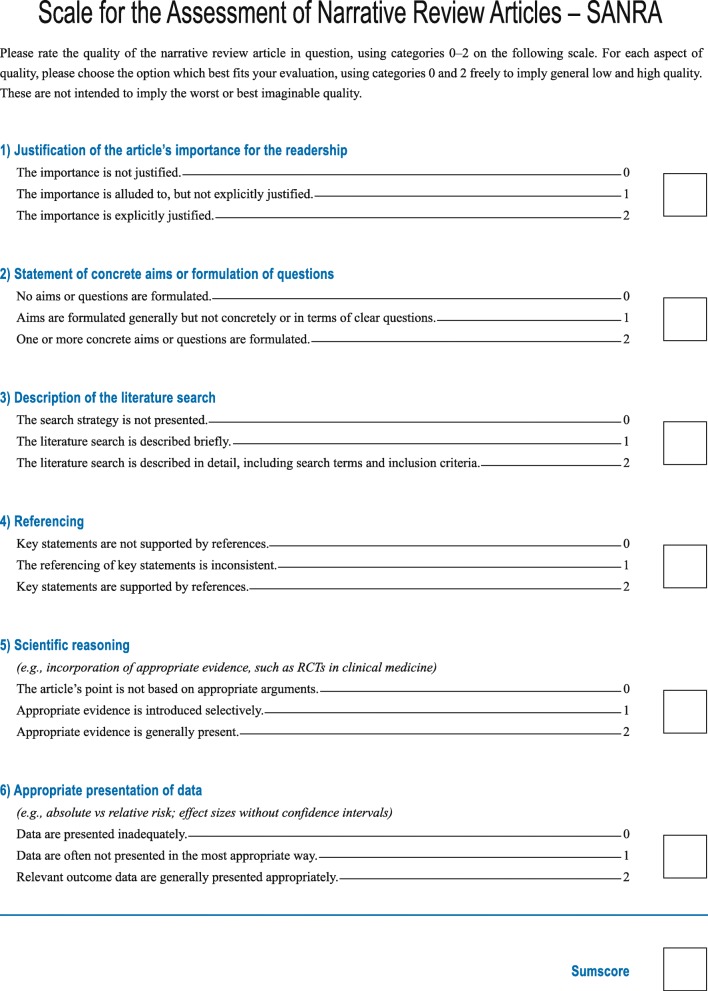
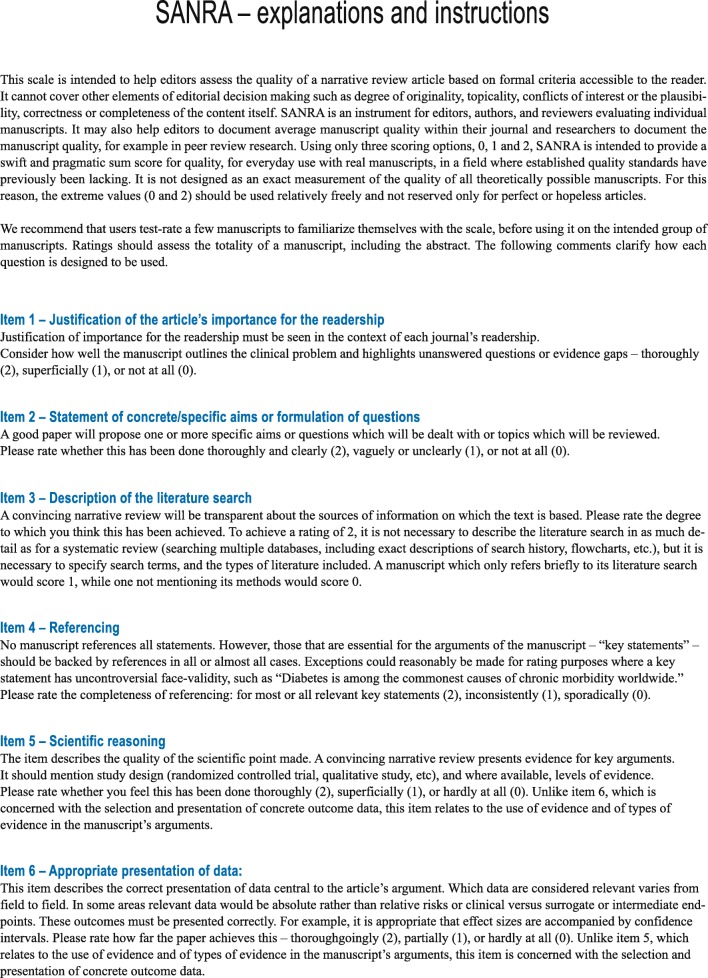
BACKGROUND: Narrative reviews are the commonest type of articles in the medical literature. However, unlike systematic reviews and randomized controlled trials (RCT) articles, for which formal instruments exist to evaluate quality, there is currently no instrument available to assess the quality of narrative reviews. In response to this gap, we developed SANRA, the Scale for the Assessment of Narrative Review Articles. METHODS: A team of three experienced journal editors modified or deleted items in an earlier SANRA version based on face validity, item-total correlations, and reliability scores from previous tests. We deleted an item which addressed a manuscript's writing and accessibility due to poor inter-rater reliability. The six items which form the revised scale are rated from 0 (low standard) to 2 (high standard) and cover the following topics: explanation of (1) the importance and (2) the aims of the review, (3) literature search and (4) referencing and presentation of (5) evidence level and (6) relevant endpoint data. For all items, we developed anchor definitions and examples to guide users in filling out the form. The revised scale was tested by the same editors (blinded to each other's ratings) in a group of 30 consecutive non-systematic review manuscripts submitted to a general medical journal. RESULTS: Raters confirmed that completing the scale is feasible in everyday editorial work. The mean sum score across all 30 manuscripts was 6.0 out of 12 possible points (SD 2.6, range 1-12). Corrected item-total correlations ranged from 0.33 (item 3) to 0.58 (item 6), and Cronbach's alpha was 0.68 (internal consistency). The intra-class correlation coefficient (average measure) was 0.77 [95% CI 0.57, 0.88] (inter-rater reliability). Raters often disagreed on items 1 and 4. CONCLUSIONS: SANRA's feasibility, inter-rater reliability, homogeneity of items, and internal consistency are sufficient for a scale of six items. Further field testing, particularly of validity, is desirable. We recommend rater training based on the "explanations and instructions" document provided with SANRA. In editorial decision-making, SANRA may complement journal-specific evaluation of manuscripts-pertaining to, e.g., audience, originality or difficulty-and may contribute to improving the standard of non-systematic reviews.
Overview
CoChat Summary
TL;DR
SANRA is a six-item, 0–2 scale (maximum 12) for assessing the quality of narrative review articles, developed and field-tested by three journal editors. In 30 consecutive non-systematic review manuscripts, it showed feasible use, sufficient internal consistency and inter-rater reliability, and a modest association with editorial acceptance.
Key findings
- Across 30 manuscripts (90 ratings), the mean SANRA sum score was 6.0 out of 12 (SD 2.6, range 1–12, median 6).
- Internal consistency was Cronbach’s alpha 0.68; corrected item-total correlations ranged from 0.33 (item 3) to 0.58 (item 6).
- Inter-rater reliability was an intra-class correlation coefficient (average measure) of 0.77 [95% CI 0.57, 0.88]; raters often disagreed on items 1 and 4.
- Average SANRA scores were modestly associated with editorial acceptance (mean 6.6, SD 1.9, n = 17) versus rejection (mean 5.1, SD 2.1, n = 13), point biserial correlation 0.37 (t = 2.09, df 28; two-sided p = 0.046).
Methods
- SANRA was developed between 2010 and 2017 by three experienced editors at Deutsches Ärzteblatt; the revised six-item version deleted an item on writing and accessibility due to poor inter-rater reliability.
- The revised scale was tested on 30 consecutive non-systematic review manuscripts submitted to Deutsches Ärzteblatt in 2015; three editor-raters scored them independently and blinded to each other’s ratings.
- Analyses included descriptive statistics, Cronbach’s alpha, corrected item-total correlations, average-measure intra-class correlation using a two-way random effects model (consistency definition), and a post hoc point biserial correlation between SANRA sum scores and acceptance/rejection.
Limitations
- The paper states the main limitation is sample size: 30 manuscripts was a compromise between representativeness, power, and feasibility, and took about 6 months to sample.
- The authors state that the scale’s authors were also the test-raters, so inter-rater reliability may be lower in groups less familiar with SANRA; the study also did not assess test-retest reliability, and results are study-specific.
- The paper acknowledges restricted content validity because SANRA is limited to six items and is a critical appraisal tool rather than a reporting guideline; criterion validity evidence is post hoc and weak, and no established cut-offs exist for comparing manuscripts across settings.
Model-written summary. Check it against the paper before relying on it.
Integrity signals
Registry
Cites
Statistics
Figures
Verification
Claims the paper makes
3 Valid · 0 Not valid · 5 Not checked · 27 Own results and interpretations
The cited sources support only part of this claim — read each source’s verdict below.
In the paper
“Bastian et al. found that they constitute the largest share of all text types in medicine and they concluded that they “remain the staple of medical literature” [1].”
- Also stated in: § Background · plain
“Narrative reviews are the commonest type of articles in the medical literature.”
§ SANRA—a scale for the quality assessment of narrative review articles > Background
What the sources say
- Partly supportedcites [1] Bastian H Glasziou P Chalmers I Seventy-five trials and eleven systematic reviews a day: how will we ever keep up? PLoS Med 2010 7 9 e1000326 10.1371/journal.pmed.1000326 20877712 PMC2943439 sourceExperimental — accuracy not yet measured
In “How Close Are We to Archie Cochrane’s Goal?” and the Summary Points (pages unavailable), the paper calls non-systematic narrative reviews the staple of medical literature synthesis. It does not say they constitute the largest share of all medical text types; that extends a claim about literature synthesis to medical literature as a whole. (LLM, conf=0.88)
plain- Asserted: passes — The authors put it forward as true.
- Checkable: passes — It can be checked against evidence.
- Load-bearing: unclear — It is unclear whether the paper’s conclusions depend on it.
- Based: passes — The paper gives a reason why it holds.
- Also stated in: § Background · plain
The sources with a verdict support this claim; the rest weren’t checked yet, have no full text we could read, or their verdicts aren’t rated yet.
In the paper
“non-systematic reviews or narrative reviews have been widely criticized as unreliable [1, 4].”
§ SANRA—a scale for the quality assessment of narrative review articles > Background
What the sources say
- Supportedcites [1] Bastian H Glasziou P Chalmers I Seventy-five trials and eleven systematic reviews a day: how will we ever keep up? PLoS Med 2010 7 9 e1000326 10.1371/journal.pmed.1000326 20877712 PMC2943439 source
In “How Close Are We to Archie Cochrane’s Goal?”, the paper describes reviews not conducted systematically as having great potential for error and calls them less reliable forms of information. Box 1 also says that articles and textbooks had highlighted the risk of bias and chance in reviews. Together, these passages support the broad characterization that narrative reviews have been criticized as unreliable; page numbers are not provided in our copy. (LLM, conf=0.89)
- Not checked — no full text of the sourcecites [4] Mulrow CD The medical review article: state of the science Ann Intern Med 1987 106 485 488 10.7326/0003-4819-106-3-485 3813259 source
plain- Asserted: passes — The authors put it forward as true.
- Checkable: passes — It can be checked against evidence.
- Load-bearing: passes — The paper’s conclusions depend on it.
- Based: passes — The paper gives a reason why it holds.
- Supported
A result the paper reports from its own data — it cites no other source for it, so there is none to check. The quote shows it is in the paper.
In the paper
“Cronbach’s alpha was 0.68 (internal consistency).”
- Also stated in: § Results · plain
“The scale’s internal consistency, measured as Cronbach’s alpha, was 0.68.”
§ SANRA—a scale for the quality assessment of narrative review articles > Abstract > Results
plainn = 90- Asserted: passes — The authors put it forward as true.
- Checkable: passes — It can be checked against evidence.
- Load-bearing: passes — The paper’s conclusions depend on it.
- Based: passes — The paper gives a reason why it holds.
- Also stated in: § Results · plain
A result the paper reports from its own data — it cites no other source for it, so there is none to check. The quote shows it is in the paper.
In the paper
“Raters often disagreed on items 1 and 4.”
- Also stated in: § Results · plain
“Disagreements most often occurred with regard to items 1 and 4.”
§ SANRA—a scale for the quality assessment of narrative review articles > Abstract > Results
plain- Asserted: passes — The authors put it forward as true.
- Checkable: passes — It can be checked against evidence.
- Load-bearing: unclear — It is unclear whether the paper’s conclusions depend on it.
- Based: passes — The paper gives a reason why it holds.
- Also stated in: § Results · plain
A result the paper reports from its own data — it cites no other source for it, so there is none to check. The quote shows it is in the paper.
In the paper
“The intra-class correlation coefficient (average measure) was 0.77 [95% CI 0.57, 0.88] (inter-rater reliability).”
- Also stated in: § Results · plain
“The intra-class correlation coefficient (average measure) amounted to 0.77 [95% CI 0.57, 0.88; F 4.3; df 29, 58].”
§ SANRA—a scale for the quality assessment of narrative review articles > Abstract > Results
plain- Asserted: passes — The authors put it forward as true.
- Checkable: passes — It can be checked against evidence.
- Load-bearing: passes — The paper’s conclusions depend on it.
- Based: passes — The paper gives a reason why it holds.
- Also stated in: § Results · plain
14 more claims
Create a free account to see all 35 claims and to verify the 3 references still open.
- Probably not a substantial claim. 11
- It may state two separate claims as one. 11
Claims other papers make about this one
Each is checked against this paper’s own text: does it say what the citing paper says it does?
The source backs part of the claim, not all of it — or backs it for a different population, condition or comparison.
In the citing paper
“The review was conducted and reported in accordance with the principles of the Scale for the Assessment of Narrative Review Articles (SANRA), which provides a validated framework for ensuring methodological transparency, scientific rigor, and balanced interpretation in narrative reviews [ 19 ].”
From Paracetamol: A History of Assumptions, Errors, and Evidence Reversals in Pain Management (2026) · cites this paper as [19]
Experimental — accuracy not yet measuredThe source backs part of the claim, not all of it — or backs it for a different population, condition or comparison.
In the citing paper
“As a narrative review, the present work does not include an aggregated quantitative assessment and is more exposed to selection subjectivity than a registered systematic review [124,125].”
From Berberine-Drug Interactions: Mechanisms, Clinical Relevance and Risk Stratification-A Narrative Review (2026) · cites this paper as [124]
Experimental — accuracy not yet measuredThe cited source says what the claim attributes to it.
In the citing paper
“This work is designed as a structured narrative review, with transparent reporting of the documentation strategy, guided by the quality criteria of the Scale for the Assessment of Narrative Review Articles (SANRA) [124].”
From Berberine-Drug Interactions: Mechanisms, Clinical Relevance and Risk Stratification-A Narrative Review (2026) · cites this paper as [124]
The cited source says what the claim attributes to it.
In the citing paper
“we used the following:-Cochrane Risk of Bias 2 (RoB 2) [29] and PEDRO scale tools for RCTs.-AMSTAR 2 [30] checklist for systematic review.-SANRA (Scale for the Assessment of Narrative Review Articles) [31] for narrative reviews.-JBI Checklist for Text and Opinion [32] for expert opinion papers.”
From Pelvic Floor Muscle Training Following Surgery for Pelvic Organ Prolapse: Recommendation from Scientific Literature (2026) · cites this paper as [31]
The cited source says what the claim attributes to it.
In the citing paper
“Data analysis employed a narrative and thematic synthesis methodology,adhering to the SANRA guidelines for narrative reviews (32).”
From Ethical issues in multi-agent AI systems for healthcare: a narrative review (2026) · cites this paper as [32]
12 more claims about this paper
Create a free account to see every claim other papers make about this one.
Citations
Cites
Shea, B. J., Reeves, B. C., Wells, G., Thuku, M., Hamel, C., Moran, J., Moher, D., Tugwell, P., Welch, V., Kristjansson, E., et al. (2017) · BMJ · doi:10.1136/bmj.j4008 · Cited by 10,636 · cited 2×
“Critical appraisal tools have been developed for systematic reviews (e.g., AMSTAR 2 [A MeaSurement Tool to Assess Systematic Reviews] [7]) and papers on RCTs (e.g., the CASP [Critical Appraisal Skills Program] checklist for randomized trials [8]) and other types of medical studies.”
BackgroundStreiner, D. L., & Norman, G. R. (2008) · doi:10.1093/acprof:oso/9780199231881.001.0001 · Cited by 2,631
Critical appraisal skills programme
Singh, J. (2013) · Journal of Pharmacology and Pharmacotherapeutics · doi:10.4103/0976-500x.107697 · Cited by 2,556
Guidelines for Reporting Reliability and Agreement Studies (GRRAS) were proposed
Kottner, J., Audigé, L., Brorson, S., Donner, A., Gajewski, B. J., Hróbjartsson, A., Roberts, C., Shoukri, M., & Streiner, D. L. (2011) · Journal of Clinical Epidemiology · doi:10.1016/j.jclinepi.2010.03.002 · Cited by 2,174
The Mass Production of Redundant, Misleading, and Conflicted Systematic Reviews and Meta‐analyses
IOANNIDIS, J. P. A. (2016) · The Milbank Quarterly · doi:10.1111/1468-0009.12210 · Cited by 1,483 · cited 1×
“While systematic reviews are not per se superior articles and while certain systematic reviews have been criticized lately [3], non-systematic reviews or narrative reviews have”
BackgroundSeventy-five trials and eleven systematic reviews a day: how will we ever keep up?
Bastian, H., Glasziou, P., & Chalmers, I. (2010) · PLoS Medicine · doi:10.1371/journal.pmed.1000326 · Cited by 1,188 · cited 2×
“found that they constitute the largest share of all text types in medicine and they concluded that they “remain the staple of medical literature” [1].”
BackgroundThe Medical Review Article: State of the Science
MULROW, C. D. (1987) · Annals of Internal Medicine · doi:10.7326/0003-4819-106-3-485 · Cited by 856 · cited 1×
“been widely criticized as unreliable [1, 4].”
Writing a narrative biomedical review: considerations for authors, peer reviewers, and editors
Gasparyan, A. Y., Ayvazyan, L., Blackmore, H., & Kitas, G. D. (2011) · Rheumatology International · doi:10.1007/s00296-011-1999-3 · Cited by 694 · cited 1×
“[13], for example, have provided guidance for writing narrative reviews, and Byrne [14] as well as Pautasso [15] has written, from different angles, thoughtful editorials on improving narrative reviews and presented lists of key features of writing a good review—lists that naturally overlap with SANRA items (e.”
BackgroundTen Simple Rules for Writing a Literature Review
Pautasso, M. (2013) · PLoS Computational Biology · doi:10.1371/journal.pcbi.1003149 · Cited by 272 · cited 3×
“[13], for example, have provided guidance for writing narrative reviews, and Byrne [14] as well as Pautasso [15] has written, from different angles, thoughtful editorials on improving narrative reviews and presented lists of key features of writing a good review—lists that naturally overlap with SANRA items (e.”
BackgroundImproving the peer review of narrative literature reviews
Byrne, J. A. (2016) · Research Integrity and Peer Review · doi:10.1186/s41073-016-0019-2 · Cited by 159 · cited 3×
“[13], for example, have provided guidance for writing narrative reviews, and Byrne [14] as well as Pautasso [15] has written, from different angles, thoughtful editorials on improving narrative reviews and presented lists of key features of writing a good review—lists that naturally overlap with SANRA items (e.”
Background
Research works printed but not linked: 3
- Higgins JPT, Green S. (eds.). Cochrane Handbook for Systematic Reviews and Interventions. Version 5.1.0. The Cochrane Collaboration 2011, section 1.2.2., www.handbook.cochrane.org, retrieved on Oct 31, 2018.
- Baethge C Mertens S Goldbeck-Wood S Development of a quality score for the assessment of non-systematic review articles (SANRA) Poster, Seventh International Congress on Peer Review and Biomedical Publication 2013 USA Chicago, Illinois
- Baethge C Goldbeck-Wood S Mertens S A scale for the assessment of non-systematic review articles (SANRA) Poster, Eighth International Congress on Peer and Biomedical Publication 2017 USA Chicago, Illinois
Cited by
Items 4,001–4,100 of 4,334
Social Determinants of Oral Health and Access to Dental Care in Southern India: A Narrative Review
Subramanian, M., & Thippeswamy, H. M. (2026) · Journal of Community Medicine and Health Solutions · doi:10.29328/journal.jcmhs.1001085
“Its conduct and reporting were informed by the Scale for the Assessment of Narrative Review Articles (SANRA), which addresses the importance and aims of a review, description of the literature search, referencing, scienti(cid:976)ic reasoning and presentation of relevant evidence [9].”
The Ross Procedure in Infective Endocarditis: An Underestimated Surgical Treatment in Somatic Growth
Nappi, F., & de Siena, P. M. (2026) · Medicina · doi:10.3390/medicina62112055
Mehrpour, O., Kinnan, M. R., Shirazi, F. “., & Brent, J. A. (2026) · Journal of Emergency Medicine · doi:10.1016/j.jemermed.2026.10.006
Armedi, R., & Putri, M. R. I. (2026) · SiRad Pelita Wawasan · doi:10.64728/sirad.v2i3.art12
Lins, L., & Canabarro, A. (2026) · Aquila · doi:10.61565/revista-aquila.i35.1066
Nwankwo, O., Wali, V., & Somtochukwu, M. M. (2026) · Medical Science and Discovery · doi:10.36472/msd.v13i10.1392
Vinueza, J. D. G. (2026) · Revista Científica Multidisciplinar G-nerando · doi:10.66473/rcmg.v7i2.1519
Nasb, M., Yang, D., Malik, T. H., Xu, D., Dayoub, L., Zhou, J., & Zhao, Y. (2026) · Neuroscience · doi:10.1016/j.neuroscience.2026.10.036
Bademkiran, E., & Bademkiran, P. (2026) · Journal of surgical education · doi:10.1016/j.jsurg.2026.104208
Current Applications of Robotic Surgery in Aortic Procedures: A Scoping Review
Filippini, D., Farres, H., Polania-Sandoval, C. A., & Erben, Y. (2026) · Vascular and Endovascular Surgery · doi:10.1177/15385744261501102
Wiasih (2026) · Didaktik Jurnal Ilmiah PGSD STKIP Subang · doi:10.36989/didaktik.v12i04.19765
Recognizing fibromyalgia-like pain phenotypes in lipedema: A narrative review
Fiengo, E., & Sbarbati, A. (2026) · Phlebology The Journal of Venous Disease · doi:10.1177/02683555261499760
Qu, J., Xie, Z., Xiang, J., Li, L., Chen, Y., Sheng, J., Li, Y., & Yang, K. (2026) · Journal of International Medical Research · doi:10.1177/03000605261500644
Tan, H. H. (2026) · The Asian Educational Therapist · doi:10.64663/aet.95
Ahmed, A., Meshanayagi, S. R., Horaira, A., & Nawaz, M. T. (2026) · Psychological Research and Intervention · doi:10.21831/pri.v9i1.102776
Raza, S. N. (2026) · American Heart Journal Plus Cardiology Research and Practice · doi:10.1016/j.ahjo.2026.100991
Замирович, Б. З., Юрьевна, А. А., & Рудольфович, А. Э. (2026) · Medical Education and Professional Development
Vulla, K. E., Maoni, M., & Ndolo, V. (2026) · Scientifica · doi:10.1155/sci5/9219293
“The reporting of this narrative review was guided by the Scale for the Assessment of Narrative Review Articles (SANRA), a framework developed specifcally to improve the quality and transparency of narrative reviews [17].”
Laidin, J., Sidek, N. Z. M., Ismail, S., & Ismail, N. A. (2026) · Advanced International Journal of Business Entrepreneurship and SMEs · doi:10.35631/aijbes.829101
Ntinopoulou, E., Patrikelis, P., Fasilis, T., Verentzioti, A., Alexoudi, A., Papasilekas, T., Κορφιάς, Σ., & Gatzonis, S. D. (2026) · Brain Sciences · doi:10.3390/brainsci16111153
Hastuti, F., & Handari, S. (2026) · Jurnal Obsesi Jurnal Pendidikan Anak Usia Dini · doi:10.31004/obsesi.v10i5.8819
The transformative impact of Open Science on medical research and healthcare: a view from Ukraine
Shevchuk, O. O., Levkiv, M. O., Berezko, O. L., Boitsaniuk, S. I., Kochan, O. V., Shulhai, A. H., & Korda, M. M. (2026) · Medicni perspektivi · doi:10.26641/2307-0404.2026.3.375443
Arazi, H., Hematabadi, A., Motevalli, M. S., Schauer, M., Pocecco, E., & Suzuki, K. (2026) · Antioxidants · doi:10.3390/antiox15111380
Li, Y., Zhang, H., 胡莉萍, & Wang, H. (2026) · International Journal of Women s Health · doi:10.2147/ijwh.s643435
Ausat, A. M. A., & Sutrisno, S. (2026) · Technology and Society Perspectives (TACIT) · doi:10.61100/tacit.v4i1.403
“…for the Assessment of Narrative Review Articles (SANRA), which identifies clear research objectives, transparent descriptions of literature searches, appropriate referencing, and scientific reasoning as fundamental criteria for evaluating the quality of narrative reviews (Baethge et al., 2019).”
Costa, A. H., da Silva, D. B., de Oliveira, M. K. C., Freitas, F. M. N. D. O., & dos Reis, D. S. (2026) · Derecho y cambio social. · doi:10.54899/dcs.v23i99.136
Artificial intelligence in pharmacogenomics: From data integration to clinical decision support
Fang, X., Ji, P.-Y., Mei, C., Zhu, X., Gong, W., & Wu, S. (2026) · Digital Health · doi:10.1177/20552076261501761
Chorya, H. P., Maity, M., Sachdeva, P., Chenna, V. B., Mareedu, T., Chandra, P., Fayaz, F., Younas, S., Mohammed, S., Bhasin, P. G., et al. (2026) · Therapeutic Advances in Hematology · doi:10.1177/20406207261497107
Norouzinia, R., & Myaneh, Z. T. (2026) · Advances in Medical Education and Practice · doi:10.2147/amep.s655209
Ntoto, M. M. (2026) · RSC Advances · doi:10.1039/d6ra06441h
Okur, S. (2026) · World Journal of Psychiatry · doi:10.5498/wjp.126282
Dong, X. A., & Hill, P. (2026) · AI · doi:10.3390/ai7110440 · Cited by 1
Жубаниязова, А., Арыстангалиевна, У. Г., Арыстангалиевна, Б. Г., & Tadevosyan, A. E. (2026) · Медицинский журнал Западного Казахстана · doi:10.4103/wkmj.wkmj_77_26
Zhu, Q., Liu, Y., & Song, Y. (2026) · Frontiers in Immunology · doi:10.3389/fimmu.2026.1942618
Nakazibwe, A., Babirye, S., Okema, J. N., Githinji, R. N., Mburugu, G. W., Mudenyo, R. M., Kitololo, M. M., Kamara, L. N., Bochaberi, I. O., Maiyo, K. K., et al. (2026) · F1000Research · doi:10.12688/f1000research.192469.1
Stefano, M., Girombelli, A., Formenti, P., & Vetrone, F. (2026) · Nutrients · doi:10.3390/nu18213516
Rawson, C. D., Ofori-Ntiamoah, G., Karsy, M. J., & Pahlevani, M. (2026) · Cancers · doi:10.3390/cancers18213443
Osborne, A., & Sesay, U. (2026) · Digital Health · doi:10.1177/20552076261501435
Postnatal Rat Root Dentin Histomorphometry: A Methodological Review
Alwan, M. H. (2026) · SN Comprehensive Clinical Medicine · doi:10.1007/s42399-026-02815-9
“The reporting of the narrative review was informed by the Scale for the Assessment of Narrative Review Articles (SANRA) [ 12], particularly its principles concerning clear review aims, transparent description of the literature search, appropriate referencing, and presentation of the level and…”
Fascioliasis in Kenya: a review
Magero, V. O., & Dida, G. O. (2026) · Frontiers in Veterinary Science · doi:10.3389/fvets.2026.1998426
“The literature identification and selection process was documented to improve transparency and reproducibility, consistent with recommended quality criteria for narrative reviews as per the SANRA (Scale for the Assessment of Narrative Review Articles) guidelines by Baethge et al. (27).”
InfluentialYang, T. Y. (2026) · Journal of Korean Critical Care Nursing · doi:10.34250/jkccn.2026.19.3.127
Alas‐Pineda, C., Ferrer, G., Pavón-Varela, D. J., Gaitán‐Zambrano, K., Coto-Tejeda, C., Medina-Mejía, J., & Cannon, M. L. (2026) · Healthcare · doi:10.3390/healthcare14213598
Pediatric cancer and ethical decision-making: Who speaks for the child?
Li, X., Zhang, H., & Zhang, J. (2026) · Journal of Pediatric Nursing · doi:10.1016/j.pedn.2026.10.017
Decision-Linked Multimodal Prediction in Non-Metastatic Rectal Adenocarcinoma
Mwazha, A., Kader, S., Naicker, N., Mhemedi, B., Mazibuko, Z., Mtembu, T., Mallum, A. A., Ramesar, R., & Kløverpris, H. N. (2026) · Current Oncology · doi:10.3390/curroncol33110650
Zhu, M., Aschenaki, Y., Zhang, X., Sali, R., Lin, Z., Dixon, C. M., & Zhang, D. Y. (2026) · BMJ Oncology · doi:10.1136/bmjonc-2026-001208
Kostro, A. M., Dzięcioł-Anikiej, Z., Sobas, M., Czyżewska, M., Chojnowski, J., Agnieszka, S., Romiński, D., Kopciewski, A., & Baumgart, M. (2026) · Journal of Clinical Medicine · doi:10.3390/jcm15218289
Stokłosa, I., Gorczyca, P. W., & Więckiewicz, G. (2026) · Sexes · doi:10.3390/sexes7040058
Louie, J. C. Y. (2026) · BMJ Nutrition Prevention & Health · doi:10.1136/bmjnph-2026-001717
Chen, C., Shan, W., Jingjing, H., Li, Y., Wang, Y., 黄杰春, & Yang, X. (2026) · Asia-Pacific Journal of Oncology Nursing · doi:10.1016/j.apjon.2026.101050
Britti, D. (2026) · Environmental Monitoring and Assessment · doi:10.1007/s10661-026-16026-1
“It is based on structured keyword selection, literature mapping, and critical synthesis informed by the SANRA quality criteria for narrative reviews, not on a systematic review, meta-analysis or PRISMA-reported scoping review (Baethge et al., 2019).”
de Salinas, L. A., Naharro‐Rodríguez, J., Garcia‐Mouronte, E., Centeno-Pons, M., de Miquel, P. B., & Fernández-Guarino, M. (2026) · Cosmetics · doi:10.3390/cosmetics13060289
Qahtan, S. A., Alsamadani, A. A., Ghurayba, F. M., Barwan, Z. A., Alzarmah, O. O., Bashawyah, B. O., Aldossary, M. M., Alshammari, W. F., Jehafy, M. A. A., & Al-Faifi, R. Y. (2026) · Acta Innovations · doi:10.62441/actainnovations.vi.2490
Qu, G., Zhou, X., Liu, C., Xu, Y., & Qi, S. (2026) · Current Oncology · doi:10.3390/curroncol33110645
Ovarian Hydrobursitis in Dromedary Camels: Current Understanding and Future Perspectives
Ali, A., Derar, D. R., & Allam, S. A. (2026) · Veterinary Sciences · doi:10.3390/vetsci13111150
Katona, O.-B., Azamfirei, L., Stoian, M., Reman, T. L., & Lazăr, A. E. (2026) · Diagnostics · doi:10.3390/diagnostics16213518
Chen, J., Zhou, L., Wang, Y., & Zhang, Y. (2026) · Journal of International Medical Research · doi:10.1177/03000605261500797
Chatzistavridis, P., Gkiouliava, A., Douma, A., & Theodoraki, K. A. (2026) · Journal of Clinical Medicine · doi:10.3390/jcm15218300
Khalifah, E. A., AlJohani, M. M., Alharbi, M. A., Alahmadi, B. H., Alzughaibi, A. A., Alolyan, N. J., Aziz, A. A., Aljohani, M. S., & Albalawi, L. J. (2026) · European Journal of Prosthodontics and Restorative Dentistry · doi:10.1922/ejprd.v34i13s.2281
Shi, L., Lu, J., Wei, B., & Zhou, P. (2026) · Lasers in Medical Science · doi:10.1007/s10103-026-05077-y
“…narrative reviews, including explicit review aims, transpar - ent literature-search description, appropriate referencing, appraisal of evidence level, and presentation of clinically relevant endpoint data [8]. could serve not only as an environmental factor but also as a therapeutic tool.”
Niazi, S. K. (2026) · Frontiers in Systems Biology · doi:10.3389/fsysb.2026.1940319
Kızılkurtlu, A. A., Çiftçi, F., & Yılmaz, Ö. (2026) · Pharmaceutics · doi:10.3390/pharmaceutics18111372
Chia, K. H. (2026) · International Journal of Nursing and Health Research · doi:10.66856/ijnhr.2026.8.4.8077
Kowsky, D. (2026) · Journal of Indian Dental Association · doi:10.33882/jida.15.ida-92
Towery, A., & Deshpande, G. (2026) · Frontiers in Dental Medicine · doi:10.3389/fdmed.2026.1868240
Turyan, K. V., & Sargsyan, A. (2026) · Sustainable Social Development · doi:10.23812/ssd8846
“Edo reports positive but regionally varying effects of digital transformation on financial development [17], while mainstream finance emphasizes information production, monitoring, capital allocation, payment, and risk sharing [17,18].”
InfluentialMelo, R. H., Joelsons, D., Guimarães, H. P., & Passos, R. D. H. (2026) · International Journal of Emergency Medicine · doi:10.1186/s12245-026-01419-3
“This narrative review was prepared with reference to the principles of the Scale for the Assessment of Narrative Review Articles (SANRA) [14].”
Vinod, A., Venkatesh, V., & John, G. M. (2026) · International Surgery Journal · doi:10.18203/2349-2902.isj20263881
Assessing Juridical Responsibility in Medical Practice in Romania: A Legal Medicine Perspective
Ion, F. A., Perpelea, A.-C., Bucur, O., & Curcă, G. C. (2026) · Social Sciences · doi:10.3390/socsci15110735
Beyond Time Saved: A Framework for Comprehensive Evaluation of AI Clinical Documentation
Ekstrom, V. S. M. (2026) · JMIR Medical Informatics · doi:10.2196/86091
“Reporting was guided by the Scale for the Assessment of Narrative Review Articles (SANRA) [21], and abstraction of implementation features drew on DECIDE-AI (Developmental and Exploratory Clinical Investigations of Decision Support Systems Driven by Artificial Intelligence) guidance for the…”
Freundlich, S. A., Bochiș, C.-F., & Juncar, M. (2026) · Journal of Functional Biomaterials · doi:10.3390/jfb17110542
Biologic Therapies in COPD: The Development Pipeline and the Unresolved Problem of Patient Selection
Mari, P., Ielo, S., Carriera, L., Vannini, G., Rosati, Y., Baglioni, S., Ojetti, V., Rícci, A., & Scala, R. (2026) · Biomedicines · doi:10.3390/biomedicines14112460
Hypercobalaminemia in Outpatient Practice
Radhwi, O. (2026) · Journal of Clinical Medicine · doi:10.3390/jcm15218301
Nutritional Impairment and Muscle Health in MASLD: The Potential Role of Eating Behaviors
Armașu, I., Ungureanu, M.-C., Gheorghe, L., Botnariu, G., Florescu, A.-F., Matei, A., Jari, I., Rusu, R. E., Cojocaru, E., Vasiliu, I., et al. (2026) · Journal of Clinical Medicine · doi:10.3390/jcm15218306
Ixtlahuac, J. G., Jima, M. J. A., Espinoza, C. I. L., Aguilar, E. F. S., Torres, B. E. P., & Burbano, Y. V. H. (2026) · Brazilian Journal of Health Review · doi:10.34119/bjhrv9n5-151
Almutiri, Y. S., Mubaraki, A. A., Alharbi, N. M., Almubaraki, A. S., Alqarni, A., Alshehri, F. A. H., Hasani, Y. M. A., & Alzhrani, A. M. (2026) · Acta Innovations · doi:10.62441/actainnovations.vi.2489
Jiang, M., & Li, J. (2026) · Current Breast Cancer Reports · doi:10.1007/s12609-026-00679-5
“We performed a structured narrative review guided by the Scale for the Assessment of Narrative Review Articles [ 18].”
Ao, W.-L., Liu, Z., Luo, A., Wang, J., Tang, J.-X., Xu, Z.-C., & Huang, H. (2026) · Sage Open Chronic Disease · doi:10.1177/27558428261501032
THE ROLE OF BREATHING TECHNIQUES AND SOMATIC SELF-REGULATION IN REDUCING STRESS AND MUSCLE TENSION
Мінчук, Р. (2026) · PSYCHOLOGICAL JOURNAL · doi:10.31108/1.2026.12.9.5
Rodriguez-Parras, P., Román-Ramos, P., Zambudio-Munuera, A., & Arrabal‐Polo, M. Á. (2026) · Journal of Clinical Medicine · doi:10.3390/jcm15218290
Lupçi, V., Shala, A. L., Lupçi, A., Bağcı, U., Salihu, M. B., & Kryeziu, T. L. (2026) · Pharmacia · doi:10.3897/pharmacia.73.e210129
“Reporting was guided by the Scale for the Assessment of Narrative Review Articles (SANRA) recommendations (Baethge et al. 2019).”
Fakri, A., Sekkal, M., Ababou, M., Jidal, M., Halhoul, Y., & Bensghir, M. (2026) · MedPeer publisher · doi:10.70780/medpeer.000qgxj
Dwinata, R. E., Alinda, M. D., & Widia, Y. (2026) · Magna Scientia Advanced Research and Reviews · doi:10.30574/msarr.2026.18.1.0206
Ilić, B. S. (2026) · Current Issues in Molecular Biology · doi:10.3390/cimb48111123
Role of artificial intelligence in irritable bowel syndrome: A narrative review
Issa, I. A., & Issa, T. (2026) · Artificial Intelligence in Gastroenterology · doi:10.35712/aig.127488
Rodríguez‐Hernández, A. G. (2026) · SAP Dentistry · doi:10.62486/dent2026276
Autonomous-Ready Bus Stops: An Integrative Evidence Map and Conceptual Research Architecture
Petrea, M., Boboc, R. G., Țârulescu, S., Voinea, G.-D., & Soica, A. O. (2026) · Future Transportation · doi:10.3390/futuretransp6060246
Kishore, M. N., & Navaneethan, C. (2026) · Frontiers in Artificial Intelligence · doi:10.3389/frai.2026.1983619
Bearden, D. J., Galanti, A. M., Rehim, E., Wheless, J. W., & Haidekker, P. M. (2026) · Epilepsy Research · doi:10.1016/j.eplepsyres.2026.107948
Kaur, A., Batista, L., Purewal, S. S., & Lisboa, H. M. (2026) · Inorganic Chemistry Communications · doi:10.1016/j.inoche.2026.117826
Rivera, J. C. R., & Espinoza, R. L. B. (2026) · Polo del Conocimiento · doi:10.23857/pc.v11i9.12703
Ronconi, G., Ariani, M., Alessandro de, S. I. R. E., & Ferrara, P. E. (2026) · Bioengineering · doi:10.3390/bioengineering13111276
Akram, U., Ali, F., & Maaz, M. (2026) · Insights (Bhalwal) International Journal of Humanities Management and Social Sciences · doi:10.68156/b3jcjt48
Jiang, S., & Zhao, H. (2026) · Frontiers in Psychology · doi:10.3389/fpsyg.2026.1961945
Galassi, L., Facchinetti, F., Ravini, M. L., & Banfı, C. (2026) · Annals of Vascular Surgery · doi:10.1016/j.avsg.2026.10.032
Fan, N., Gong, L., Tang, L., & Xue, Q. (2026) · Acta Odontologica Scandinavica · doi:10.2340/aos.v85.47067
“The Joanna Briggs Institute critical appraisal tools were applied to assess the methodological quality of the included studies [7].”
Elston, J. N., Lopes, N. M., & Pinto, H. (2026) · World Development Sustainability · doi:10.1016/j.wds.2026.100384
Metadata
- Authors
- Baethge, C., Goldbeck-Wood, S., & Mertens, S.
- Affiliations
- University of Cologne (DE)
- BMJ Group (United Kingdom) (GB)
- Corresponding author
- Baethge, Christopher
- ORCID
- Baethge, Christopher
- Venue
- Research Integrity and Peer Review
- Published
- 2019-03-26
- Volume
- 4
- Issue
- 1
- Pages
- 5-5
- ISSN
- 2058-8615 (ISSN-L)
- PMC
- PMC6434870
- OpenAlex
- W2922577842
- Semantic Scholar
- ea7f35b3069b53791c3b746c5c4b3c72a83a526b
- Cited by
- 3,469
- References
- 13
- Citations by year
- 2026: 1823 · 2025: 551 · 2024: 379 · 2023: 309 · 2022: 218 · 2021: 152 · 2020: 32 · 2019: 4
- FWCI
- 20.57
- Type
- journal article
- Language
- en
- Open access
- gold
- doi.org
- Licence
- cc-by
- creativecommons.org/licenses/by/4.0/ (tdm)
- Locations
- Research Integrity and Peer Review (publishedVersion, cc-by)
- Europe PMC (PubMed Central) (publishedVersion, other-oa)
- PubMed Central (publishedVersion, cc-by)
- PubMed (publishedVersion)
- Kölner Universitäts PublikationsServer (Universität zu Köln) (publishedVersion)
- DOAJ (DOAJ: Directory of Open Access Journals) (submittedVersion, cc-by-sa)
- Topics
- Social Sciences › Decision Sciences › Statistics, Probability and Uncertainty › Meta-analysis and systematic reviews
- Social Sciences › Library and Information Sciences › Academic Writing and Publishing
- Social Sciences › Library and Information Sciences › scientometrics and bibliometrics research
- Keywords
- quality assessment scale, manuscript review, inter-rater reliability, level of evidence, scale development
About these checks
Registry, retraction, Cites and statistics results are computed, not judged, with one exception: a printed reference that no index lists is read once by a model before it counts as a citation error. Claims are extracted by a model and kept only when their quote appears verbatim in the text; each cited source is then checked, with a model’s help, for whether it says what the claim relies on. Those verdicts can be wrong — read the claim’s quote and the cited source before relying on one.
The claim verdicts this report counts are experimental: their accuracy is not yet measured.
A language model drew the claims from the paper on 2026-11-10, under version 3 of the claim definition (model deepseek-v4.1-flash, prompt extract-v3).
A second model labelled each claim on 2026-11-10 (model jev-1.13-20260917, definition revision gold-guideline-v0.2).
Cited sources are checked with a language model’s help (gpt-6-sol).
Statistics and arithmetic are recomputed, not judged.
Confidence bands are shown only for fields calibrated on our annotated test set. None is calibrated yet, so no band is shown.
What counts as a claim ›How we measure confidence ›How we check this ›
Are you an author, or do you see a problem with this page? Request a review
Data sources
Bibliographic data: Semantic Scholar, OpenAlex, Crossref.
Contains information from the Semantic Scholar Academic Graph Datasets, made available under the ODC Attribution License (ODC-BY 1.0).
Semantic Scholar’s data is described in: Kinney, R., et al. (2023). The Semantic Scholar Open Data Platform. arXiv:2301.10140.
