

SANRA—a scale for the quality assessment of narrative review articles
Open accessThe DOI matches its Crossref record; 12 of the 13 references it cites were found in a registry or an index; 4 of the 12 sources its claims cite were checked for support.
Abstract
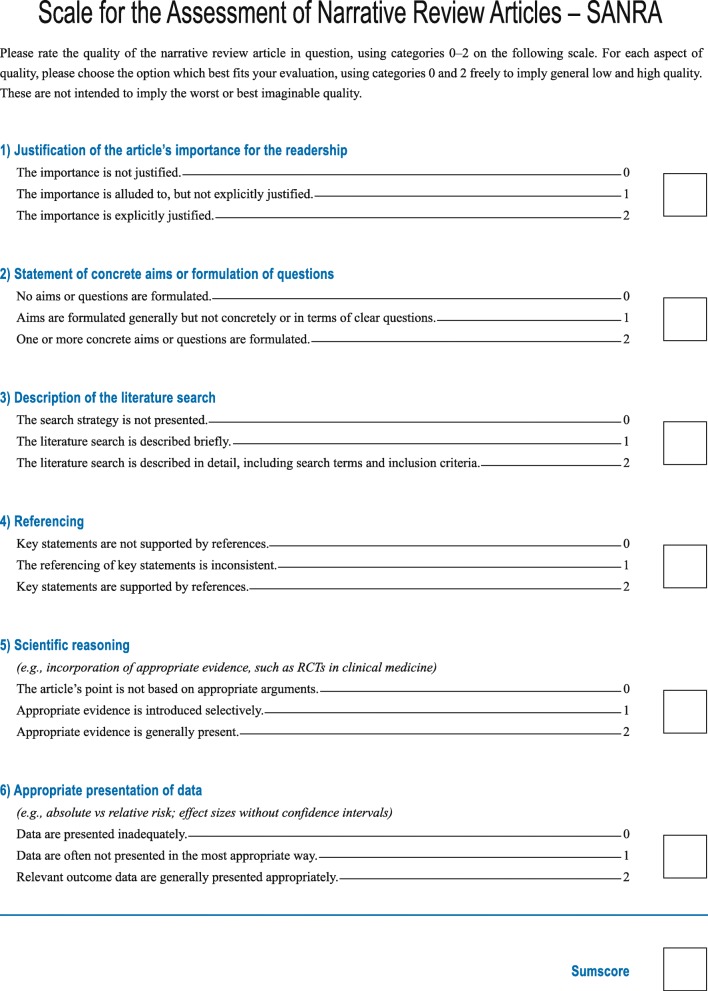
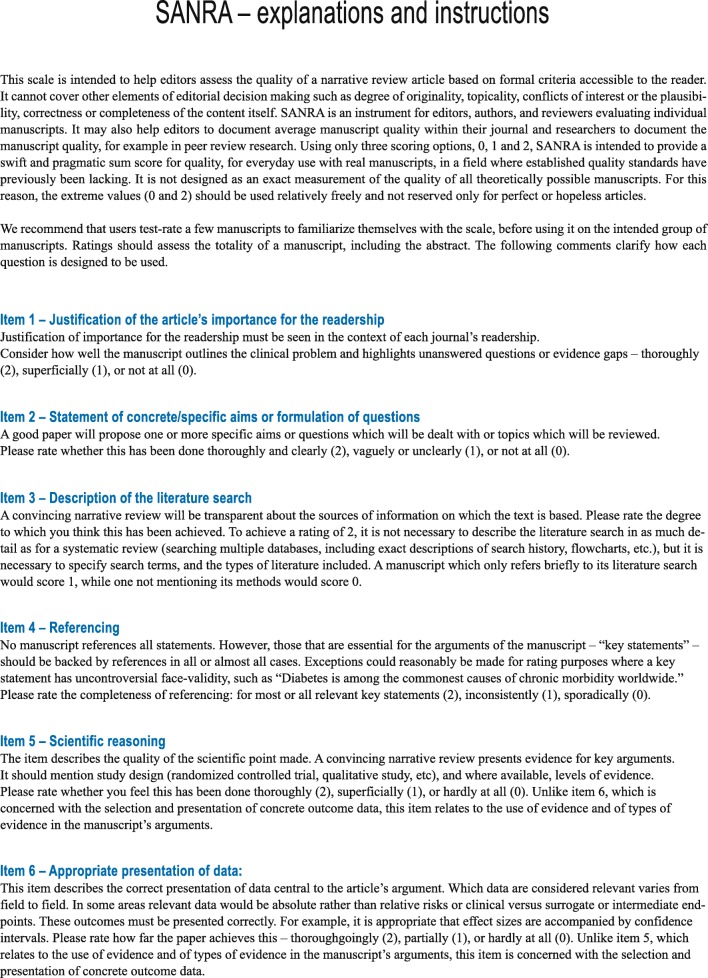
BACKGROUND: Narrative reviews are the commonest type of articles in the medical literature. However, unlike systematic reviews and randomized controlled trials (RCT) articles, for which formal instruments exist to evaluate quality, there is currently no instrument available to assess the quality of narrative reviews. In response to this gap, we developed SANRA, the Scale for the Assessment of Narrative Review Articles. METHODS: A team of three experienced journal editors modified or deleted items in an earlier SANRA version based on face validity, item-total correlations, and reliability scores from previous tests. We deleted an item which addressed a manuscript's writing and accessibility due to poor inter-rater reliability. The six items which form the revised scale are rated from 0 (low standard) to 2 (high standard) and cover the following topics: explanation of (1) the importance and (2) the aims of the review, (3) literature search and (4) referencing and presentation of (5) evidence level and (6) relevant endpoint data. For all items, we developed anchor definitions and examples to guide users in filling out the form. The revised scale was tested by the same editors (blinded to each other's ratings) in a group of 30 consecutive non-systematic review manuscripts submitted to a general medical journal. RESULTS: Raters confirmed that completing the scale is feasible in everyday editorial work. The mean sum score across all 30 manuscripts was 6.0 out of 12 possible points (SD 2.6, range 1-12). Corrected item-total correlations ranged from 0.33 (item 3) to 0.58 (item 6), and Cronbach's alpha was 0.68 (internal consistency). The intra-class correlation coefficient (average measure) was 0.77 [95% CI 0.57, 0.88] (inter-rater reliability). Raters often disagreed on items 1 and 4. CONCLUSIONS: SANRA's feasibility, inter-rater reliability, homogeneity of items, and internal consistency are sufficient for a scale of six items. Further field testing, particularly of validity, is desirable. We recommend rater training based on the "explanations and instructions" document provided with SANRA. In editorial decision-making, SANRA may complement journal-specific evaluation of manuscripts-pertaining to, e.g., audience, originality or difficulty-and may contribute to improving the standard of non-systematic reviews.
Overview
CoChat Summary
TL;DR
SANRA is a six-item, 0–2 scale (maximum 12) for assessing the quality of narrative review articles, developed and field-tested by three journal editors. In 30 consecutive non-systematic review manuscripts, it showed feasible use, sufficient internal consistency and inter-rater reliability, and a modest association with editorial acceptance.
Key findings
- Across 30 manuscripts (90 ratings), the mean SANRA sum score was 6.0 out of 12 (SD 2.6, range 1–12, median 6).
- Internal consistency was Cronbach’s alpha 0.68; corrected item-total correlations ranged from 0.33 (item 3) to 0.58 (item 6).
- Inter-rater reliability was an intra-class correlation coefficient (average measure) of 0.77 [95% CI 0.57, 0.88]; raters often disagreed on items 1 and 4.
- Average SANRA scores were modestly associated with editorial acceptance (mean 6.6, SD 1.9, n = 17) versus rejection (mean 5.1, SD 2.1, n = 13), point biserial correlation 0.37 (t = 2.09, df 28; two-sided p = 0.046).
Methods
- SANRA was developed between 2010 and 2017 by three experienced editors at Deutsches Ärzteblatt; the revised six-item version deleted an item on writing and accessibility due to poor inter-rater reliability.
- The revised scale was tested on 30 consecutive non-systematic review manuscripts submitted to Deutsches Ärzteblatt in 2015; three editor-raters scored them independently and blinded to each other’s ratings.
- Analyses included descriptive statistics, Cronbach’s alpha, corrected item-total correlations, average-measure intra-class correlation using a two-way random effects model (consistency definition), and a post hoc point biserial correlation between SANRA sum scores and acceptance/rejection.
Limitations
- The paper states the main limitation is sample size: 30 manuscripts was a compromise between representativeness, power, and feasibility, and took about 6 months to sample.
- The authors state that the scale’s authors were also the test-raters, so inter-rater reliability may be lower in groups less familiar with SANRA; the study also did not assess test-retest reliability, and results are study-specific.
- The paper acknowledges restricted content validity because SANRA is limited to six items and is a critical appraisal tool rather than a reporting guideline; criterion validity evidence is post hoc and weak, and no established cut-offs exist for comparing manuscripts across settings.
Model-written summary. Check it against the paper before relying on it.
Integrity signals
Registry
Cites
Statistics
Figures
Verification
Claims the paper makes
3 Valid · 0 Not valid · 5 Not checked · 27 Own results and interpretations
The cited sources support only part of this claim — read each source’s verdict below.
In the paper
“Bastian et al. found that they constitute the largest share of all text types in medicine and they concluded that they “remain the staple of medical literature” [1].”
- Also stated in: § Background · plain
“Narrative reviews are the commonest type of articles in the medical literature.”
§ SANRA—a scale for the quality assessment of narrative review articles > Background
What the sources say
- Partly supportedcites [1] Bastian H Glasziou P Chalmers I Seventy-five trials and eleven systematic reviews a day: how will we ever keep up? PLoS Med 2010 7 9 e1000326 10.1371/journal.pmed.1000326 20877712 PMC2943439 sourceExperimental — accuracy not yet measured
In “How Close Are We to Archie Cochrane’s Goal?” and the Summary Points (pages unavailable), the paper calls non-systematic narrative reviews the staple of medical literature synthesis. It does not say they constitute the largest share of all medical text types; that extends a claim about literature synthesis to medical literature as a whole. (LLM, conf=0.88)
plain- Asserted: passes — The authors put it forward as true.
- Checkable: passes — It can be checked against evidence.
- Load-bearing: unclear — It is unclear whether the paper’s conclusions depend on it.
- Based: passes — The paper gives a reason why it holds.
- Also stated in: § Background · plain
The sources with a verdict support this claim; the rest weren’t checked yet, have no full text we could read, or their verdicts aren’t rated yet.
In the paper
“non-systematic reviews or narrative reviews have been widely criticized as unreliable [1, 4].”
§ SANRA—a scale for the quality assessment of narrative review articles > Background
What the sources say
- Supportedcites [1] Bastian H Glasziou P Chalmers I Seventy-five trials and eleven systematic reviews a day: how will we ever keep up? PLoS Med 2010 7 9 e1000326 10.1371/journal.pmed.1000326 20877712 PMC2943439 source
In “How Close Are We to Archie Cochrane’s Goal?”, the paper describes reviews not conducted systematically as having great potential for error and calls them less reliable forms of information. Box 1 also says that articles and textbooks had highlighted the risk of bias and chance in reviews. Together, these passages support the broad characterization that narrative reviews have been criticized as unreliable; page numbers are not provided in our copy. (LLM, conf=0.89)
- Not checked — no full text of the sourcecites [4] Mulrow CD The medical review article: state of the science Ann Intern Med 1987 106 485 488 10.7326/0003-4819-106-3-485 3813259 source
plain- Asserted: passes — The authors put it forward as true.
- Checkable: passes — It can be checked against evidence.
- Load-bearing: passes — The paper’s conclusions depend on it.
- Based: passes — The paper gives a reason why it holds.
- Supported
A result the paper reports from its own data — it cites no other source for it, so there is none to check. The quote shows it is in the paper.
In the paper
“Cronbach’s alpha was 0.68 (internal consistency).”
- Also stated in: § Results · plain
“The scale’s internal consistency, measured as Cronbach’s alpha, was 0.68.”
§ SANRA—a scale for the quality assessment of narrative review articles > Abstract > Results
plainn = 90- Asserted: passes — The authors put it forward as true.
- Checkable: passes — It can be checked against evidence.
- Load-bearing: passes — The paper’s conclusions depend on it.
- Based: passes — The paper gives a reason why it holds.
- Also stated in: § Results · plain
A result the paper reports from its own data — it cites no other source for it, so there is none to check. The quote shows it is in the paper.
In the paper
“Raters often disagreed on items 1 and 4.”
- Also stated in: § Results · plain
“Disagreements most often occurred with regard to items 1 and 4.”
§ SANRA—a scale for the quality assessment of narrative review articles > Abstract > Results
plain- Asserted: passes — The authors put it forward as true.
- Checkable: passes — It can be checked against evidence.
- Load-bearing: unclear — It is unclear whether the paper’s conclusions depend on it.
- Based: passes — The paper gives a reason why it holds.
- Also stated in: § Results · plain
A result the paper reports from its own data — it cites no other source for it, so there is none to check. The quote shows it is in the paper.
In the paper
“The intra-class correlation coefficient (average measure) was 0.77 [95% CI 0.57, 0.88] (inter-rater reliability).”
- Also stated in: § Results · plain
“The intra-class correlation coefficient (average measure) amounted to 0.77 [95% CI 0.57, 0.88; F 4.3; df 29, 58].”
§ SANRA—a scale for the quality assessment of narrative review articles > Abstract > Results
plain- Asserted: passes — The authors put it forward as true.
- Checkable: passes — It can be checked against evidence.
- Load-bearing: passes — The paper’s conclusions depend on it.
- Based: passes — The paper gives a reason why it holds.
- Also stated in: § Results · plain
14 more claims
Create a free account to see all 35 claims and to verify the 3 references still open.
- Probably not a substantial claim. 11
- It may state two separate claims as one. 11
Claims other papers make about this one
Each is checked against this paper’s own text: does it say what the citing paper says it does?
The source backs part of the claim, not all of it — or backs it for a different population, condition or comparison.
In the citing paper
“The review was conducted and reported in accordance with the principles of the Scale for the Assessment of Narrative Review Articles (SANRA), which provides a validated framework for ensuring methodological transparency, scientific rigor, and balanced interpretation in narrative reviews [ 19 ].”
From Paracetamol: A History of Assumptions, Errors, and Evidence Reversals in Pain Management (2026) · cites this paper as [19]
Experimental — accuracy not yet measuredThe source backs part of the claim, not all of it — or backs it for a different population, condition or comparison.
In the citing paper
“As a narrative review, the present work does not include an aggregated quantitative assessment and is more exposed to selection subjectivity than a registered systematic review [124,125].”
From Berberine-Drug Interactions: Mechanisms, Clinical Relevance and Risk Stratification-A Narrative Review (2026) · cites this paper as [124]
Experimental — accuracy not yet measuredThe cited source says what the claim attributes to it.
In the citing paper
“This work is designed as a structured narrative review, with transparent reporting of the documentation strategy, guided by the quality criteria of the Scale for the Assessment of Narrative Review Articles (SANRA) [124].”
From Berberine-Drug Interactions: Mechanisms, Clinical Relevance and Risk Stratification-A Narrative Review (2026) · cites this paper as [124]
The cited source says what the claim attributes to it.
In the citing paper
“we used the following:-Cochrane Risk of Bias 2 (RoB 2) [29] and PEDRO scale tools for RCTs.-AMSTAR 2 [30] checklist for systematic review.-SANRA (Scale for the Assessment of Narrative Review Articles) [31] for narrative reviews.-JBI Checklist for Text and Opinion [32] for expert opinion papers.”
From Pelvic Floor Muscle Training Following Surgery for Pelvic Organ Prolapse: Recommendation from Scientific Literature (2026) · cites this paper as [31]
The cited source says what the claim attributes to it.
In the citing paper
“Data analysis employed a narrative and thematic synthesis methodology,adhering to the SANRA guidelines for narrative reviews (32).”
From Ethical issues in multi-agent AI systems for healthcare: a narrative review (2026) · cites this paper as [32]
12 more claims about this paper
Create a free account to see every claim other papers make about this one.
Citations
Cites
Shea, B. J., Reeves, B. C., Wells, G., Thuku, M., Hamel, C., Moran, J., Moher, D., Tugwell, P., Welch, V., Kristjansson, E., et al. (2017) · BMJ · doi:10.1136/bmj.j4008 · Cited by 10,636 · cited 2×
“Critical appraisal tools have been developed for systematic reviews (e.g., AMSTAR 2 [A MeaSurement Tool to Assess Systematic Reviews] [7]) and papers on RCTs (e.g., the CASP [Critical Appraisal Skills Program] checklist for randomized trials [8]) and other types of medical studies.”
BackgroundStreiner, D. L., & Norman, G. R. (2008) · doi:10.1093/acprof:oso/9780199231881.001.0001 · Cited by 2,631
Critical appraisal skills programme
Singh, J. (2013) · Journal of Pharmacology and Pharmacotherapeutics · doi:10.4103/0976-500x.107697 · Cited by 2,556
Guidelines for Reporting Reliability and Agreement Studies (GRRAS) were proposed
Kottner, J., Audigé, L., Brorson, S., Donner, A., Gajewski, B. J., Hróbjartsson, A., Roberts, C., Shoukri, M., & Streiner, D. L. (2011) · Journal of Clinical Epidemiology · doi:10.1016/j.jclinepi.2010.03.002 · Cited by 2,174
The Mass Production of Redundant, Misleading, and Conflicted Systematic Reviews and Meta‐analyses
IOANNIDIS, J. P. A. (2016) · The Milbank Quarterly · doi:10.1111/1468-0009.12210 · Cited by 1,483 · cited 1×
“While systematic reviews are not per se superior articles and while certain systematic reviews have been criticized lately [3], non-systematic reviews or narrative reviews have”
BackgroundSeventy-five trials and eleven systematic reviews a day: how will we ever keep up?
Bastian, H., Glasziou, P., & Chalmers, I. (2010) · PLoS Medicine · doi:10.1371/journal.pmed.1000326 · Cited by 1,188 · cited 2×
“found that they constitute the largest share of all text types in medicine and they concluded that they “remain the staple of medical literature” [1].”
BackgroundThe Medical Review Article: State of the Science
MULROW, C. D. (1987) · Annals of Internal Medicine · doi:10.7326/0003-4819-106-3-485 · Cited by 856 · cited 1×
“been widely criticized as unreliable [1, 4].”
Writing a narrative biomedical review: considerations for authors, peer reviewers, and editors
Gasparyan, A. Y., Ayvazyan, L., Blackmore, H., & Kitas, G. D. (2011) · Rheumatology International · doi:10.1007/s00296-011-1999-3 · Cited by 694 · cited 1×
“[13], for example, have provided guidance for writing narrative reviews, and Byrne [14] as well as Pautasso [15] has written, from different angles, thoughtful editorials on improving narrative reviews and presented lists of key features of writing a good review—lists that naturally overlap with SANRA items (e.”
BackgroundTen Simple Rules for Writing a Literature Review
Pautasso, M. (2013) · PLoS Computational Biology · doi:10.1371/journal.pcbi.1003149 · Cited by 272 · cited 3×
“[13], for example, have provided guidance for writing narrative reviews, and Byrne [14] as well as Pautasso [15] has written, from different angles, thoughtful editorials on improving narrative reviews and presented lists of key features of writing a good review—lists that naturally overlap with SANRA items (e.”
BackgroundImproving the peer review of narrative literature reviews
Byrne, J. A. (2016) · Research Integrity and Peer Review · doi:10.1186/s41073-016-0019-2 · Cited by 159 · cited 3×
“[13], for example, have provided guidance for writing narrative reviews, and Byrne [14] as well as Pautasso [15] has written, from different angles, thoughtful editorials on improving narrative reviews and presented lists of key features of writing a good review—lists that naturally overlap with SANRA items (e.”
Background
Research works printed but not linked: 3
- Higgins JPT, Green S. (eds.). Cochrane Handbook for Systematic Reviews and Interventions. Version 5.1.0. The Cochrane Collaboration 2011, section 1.2.2., www.handbook.cochrane.org, retrieved on Oct 31, 2018.
- Baethge C Mertens S Goldbeck-Wood S Development of a quality score for the assessment of non-systematic review articles (SANRA) Poster, Seventh International Congress on Peer Review and Biomedical Publication 2013 USA Chicago, Illinois
- Baethge C Goldbeck-Wood S Mertens S A scale for the assessment of non-systematic review articles (SANRA) Poster, Eighth International Congress on Peer and Biomedical Publication 2017 USA Chicago, Illinois
Cited by
Items 3,501–3,600 of 4,334
Lucip, Q. L. (2026) · Journal of Leadership for Basic and Higher Education · doi:10.66074/n7p9q3r6s1
Nursing leadership for sustainable endoscopy: a narrative review and practice framework
Zhang, P., 瞿津津, & Ge, C. (2026) · Frontiers in Medicine · doi:10.3389/fmed.2026.1954846
“The conduct and reporting of the review were informed by the Scale for the Assessment of Narrative Review Articles (SANRA) to improve clarity of the research question, search strategy, evidence selection, and synthesis process (21).”
Wang, X., Li, Y., & Yang, K. (2026) · OncoTargets and Therapy · doi:10.2147/ott.s645997 · Cited by 1
Liu, Z., & Ge, H. (2026) · Frontiers in Medicine · doi:10.3389/fmed.2026.1923817
“…5, 9). appraised with reference to the six quality domains of the Scale for the Assessment of Narrative Review Articles (SANRA): justification of the review, statement of aims, description of the literature search, referencing, scientific reasoning, and presentation of relevant endpoint data (50).”
Artos, E. E. B., Pérez, J. M. M., Brito, E. J. F., Mayorga, L. K. B., & Mendoza, C. F. Q. (2026) · Anales de la Facultad de Medicina · doi:10.25184/anfamed2026v13n2a18
Salientes, M. G. (2026) · Journal of Leadership for Basic and Higher Education · doi:10.66074/h4j1k8l5m2
Physical activity and improvement of physiological parameters by training
Reis, R. A. D. M., Arida, R. M., da Nobrega, A. C. L., Mattos, J. D., Freitas, H. R., Ramos, M. C. S., Fortunato, R. S., Matta, L., Ferreira, G. C., & Canetti, C. D. A. (2026) · Frontiers in Sports and Active Living · doi:10.3389/fspor.2026.1944574
Low, B. (2026) · SSRN Electronic Journal · doi:10.2139/ssrn.7525139
Yang, D., Hu, Y., Fu, H., Zhu, M., Zhang, H., & Li, M. (2026) · Frontiers in Bioengineering and Biotechnology · doi:10.3389/fbioe.2026.1952166
“Reporting was guided by the SANRA (Scale for the Assessment of Narrative Review Articles) guidelines (Baethge et al., 2019).”
Layered Mechanisms of Spinal Cord Stimulation for Chronic Pain: A Structured Narrative Review
Wiśniewski, J., Marcinkowska, A. B., Stogowski, P., Adamski, S., & Wasilewski, W. (2026) · Neuromodulation Technology at the Neural Interface · doi:10.1016/j.neurom.2026.09.012
Opala, K., Krowiński, J., & Grzegorczyk, J. (2026) · International Journal of Innovative Technologies in Social Science · doi:10.31435/ijitss.3(51).2026.6548
DIGITAL MONITORING OF ULTRAVIOLET EXPOSURE AS PART OF SKIN CANCER PREVENTION
О., К. Л. (2026) · Environment & Health · doi:10.32402/dovkil2026.03.121
An, R., Meng, B., & Lu, X. (2026) · Journal of International Medical Research · doi:10.1177/03000605261491422 · Cited by 1
“9 Its central contribution is a three-level translational framework, including risk prediction, decision support, and supervised automation, which organizes heterogeneous technologies based on their distance from clinical action and degree of algorithmic autonomy (Figure 1).”
Garcia, S. B. F., Souza, P. L. B., Brandão, R. D. P., Santos, P. D. S., Guimarães, T. R. P., Cavalcante, D. V., Oliveira, H. C. D., de Oliveira, M. S., Santos, M. G. A. D., Barbosa, L. S., et al. (2026) · Brazilian Journal of Implantology and Health Sciences · doi:10.36557/2674-8169.2026v8n9p1733-1743
A Risk Management Framework for Triadic Telemedicine (RMFTT): A Conceptual Development Study
Gamus, A., Chodick, G., Blachar, Y., & Shalom, T. (2026) · Healthcare · doi:10.3390/healthcare14213747
Guzmán, Z. M., Ibarra, I. J. S., Chel-Guerrero, L. D., Díaz, J. P. E., Pina-Canseco, M. D. S., Hernández, D. G., Perez-Campos, E. L., Cabrera-Fuentes, H. A., & Hernández‐Huerta, M. T. (2026) · Frontiers in Pharmacology · doi:10.3389/fphar.2026.1902225
“Methodological reporting was informed by the principles of the Scale for the Assessment of Narrative Review Articles (SANRA) (Baethge et al., 2019).”
Nguyen, C. H., & Truong, D. H. (2026) · Journal of Agriculture and Food Research · doi:10.1016/j.jafr.2026.103340
Rivera-Manhualaya, J., & Gonzales, G. F. (2026) · Sage Open Chronic Disease · doi:10.1177/27558428261488938
Imaging for Benign Gynecologic Conditions—Part 1
Salmeri, N., & Leonardi, M. (2026) · Obstetrics and Gynecology Clinics of North America · doi:10.1016/j.ogc.2026.08.007
Olawuyi, A. O., Adebayo, T. O., Ademosun, A. A., Adesina, T. B., Umeche, I. E., & Ogunwale, T. K. (2026) · FUDMA Journal of Sciences · doi:10.33003/fjs-2026-1017-5992
Yang, B., He, B., Gao, Y., Chen, H., & Yuan, X. (2026) · Frontiers in Public Health · doi:10.3389/fpubh.2026.1958834
“The Scale for the Assessment of Narrative Review Articles (SANRA) was used to inform the overall reporting, scientific reasoning, and presentation of the review (16).”
Vodarici, M.-E., Cernat, R. C., Dumea, E., Ioniţă, O.-E., Vișan, N.-M., Dumitrescu, P. A., Constantin, R., Cambrea, A. M., Mita, G., Panculescu, F. G., et al. (2026) · Antibiotics · doi:10.3390/antibiotics15111080
Quintero, J. J. V., Aceituno, H., Rico-Fernández, F., Vásconez-Fabre, J., Lopéz-Urdaneta, J., Cerezo-Prado, E., Villamediana-Rodríguez, J., Vela-Poveda, J., Santiago, L. M.-D., & Hazkour, A. (2026) · Cureus · doi:10.7759/cureus.117149
“This is a narrative (non-systematic) review, designed to satisfy the quality domains of the Scale for the Assessment of Narrative Review Articles (SANRA) [16].”
Clinical evidence and practice of moist wound healing in Hemorrhoidectomy: A narrative review
Hu, M.-Y., Ye, T., Bu, F., Feng, Y., Zhou, S.-C., Xu, J.-Y., Jin, X., Ni, H.-L., & Wang, J.-P. (2026) · Journal of Tissue Viability · doi:10.1016/j.jtv.2026.101056
McLeod, M., Blair, A., & Bacquer, D. D. (2026) · SSRN Electronic Journal · doi:10.2139/ssrn.7524663
Síndrome de Burnout em tempos de pandemia: Uma revisão narrativa
Silva, B. M. B. D. M., de MATOS, B. T. M. F., & Souza, J. C. (2026) · Research Society and Development · doi:10.33448/rsd-v15i9.51742
Aidarbekova, B. B. (2026) · Epidemiology and Health Data Insights · doi:10.63946/ehdi/19458
“Narrative, overview, and mini-review articles, for which the JBI systematic-review checklist was not appropriate, were appraised using SANRA domains [16].”
Kamecki, A., Wielogórska, A. M., Sarek, F., Józwik, K., Kucharczyk, S., Rak, Z., Ignatowska, Z., & Dzień, K. (2026) · International Journal of Innovative Technologies in Social Science · doi:10.31435/ijitss.3(51).2026.6449
Lin, P.-Y., Su, O. Y., Wu, W., Lee, R., Yao, T.-K., & Yeh, K. (2026) · Medicina · doi:10.3390/medicina62101894
“We followed the principles underlying the Scale for the Assessment of Narrative Review Articles (SANRA): justification of importance, a focused aim, description of the literature identification, explicit referencing, scientific reasoning, and presentation of relevant endpoint data [6–8].”
Li, O. M., Li, Y., & Li, S. X. T. (2026) · Cureus · doi:10.7759/cureus.117234
“…is a narrative review, not a systematic review, and it is reported with reference to the Scale for the Assessment of Narrative Review Articles (SANRA) criteria for narrative review quality rather than the Preferred Reporting Items for Systematic Reviews and Meta-Analyses (PRISMA) guidelines [16].”
Fuentes de evidencia no sistematizada en medicina
Márquez-Molina, J., & Nieto-Coronel, M. T. (2026) · doi:10.62486/978-9915-9928-3-9.ch17
Kozinszky, Z., Karo, Y. R., Jakó, M., Vincze, M. A., Sikovanyecz, J., Sikovanyecz, J., Tidrenczel, Z., Koppány, B., Gullo, G., Kaiser, L., et al. (2026) · Diagnostics · doi:10.3390/diagnostics16193188
“The review was conducted in accordance with the Scale for the Assessment of Narrative Review Articles (SANRA) recommendations [41].”
Cheers, G. M., Weimer, L. P., Finze, R., Wille, M., Savi, F. M., Mayer‐Wagner, S., Holzapfel, B. M., & Laubach, M. (2026) · Biomaterials · doi:10.1016/j.biomaterials.2026.124676
Supine versus prone percutaneous nephrolithotomy: A narrative and analytical review of technique
Sharma, G. R., Maheshwari, P. N., Mulawkar, P. M., & Gite, V. A. (2026) · Indian Journal of Urology · doi:10.4103/iju.iju_351_26
“[12]”
Hadi, M. A., & Falahuddin, Q. D. (2026) · Journal Medical Informatics Technology · doi:10.37034/medinftech.v4i3.167
“A small number of works from outside the region were retained where they supplied the theoretical apparatus used in the analysis, most notably the technology acceptance literature [20] and the methodological instruments [18], [19], [21].”
InfluentialAjibola, A. B. (2026) · AlterEconomics · doi:10.31063/altereconomics/2026.23-3.11 · Cited by 1
Li, H., Yu, X., & Li, W. (2026) · Journal of International Medical Research · doi:10.1177/03000605261491433
Sugar-Sweetened Beverage Taxes and Consumption Patterns: A Systematic Review of Global Evidence
Shukla, S., & Bahl, A. (2026) · Wah Academia Journal of Health and Nutrition · doi:10.63954/b7kct407
cieza, K. F. S., & Pérez, M. P. P. (2026) · ACTAS PERUANAS DE ANESTESIOLOGIA · doi:10.65016/wm22t104
“Se realizó una revisión narrativa evaluada según los criterios de calidad de la escala SANRA (Scale for the Assessment of Narrative Review Articles) [8], empleada aquí como herramienta de autoevaluación de la calidad del reporte y no como protocolo de conducción de la búsqueda bibliográfica.”
Auroprem, S. P., Ravichandran, R. S., Durai, S., Auro, N., Madhavan, S. L., & Selvam, H. (2026) · International Journal of Community Medicine and Public Health · doi:10.18203/2394-6040.ijcmph20263667
Ben-Shaool, E., Fongaro, E., Keiser, J., Zaina, G., Kristanto, P., Reis, J., Delvenne, V., Nicolis, H., Purper‐Ouakil, D., & Marchini, S. (2026) · JAACAP Open · doi:10.1016/j.jaacop.2026.09.007 · Cited by 1
Delgado, J., Toledo‐Chávarri, A., Torres‐Castaño, A., Ramos‐García, V., Sacks, A. A., Rivero‐Santana, A., Herrera‐Ramos, E., & Perestelo‐Pérez, L. (2026) · Online Journal of Public Health Informatics · doi:10.2196/94501
Sheeba, R., Murugananandan, N., Tamilselvan, Mandal, T., Israel Jeba Prab, D., Jamunarani, P., Ilakkiya, N., Padmapriya, N., Nithin Manly, S., Golda Sahaya Rani, R., et al. (2026) · International Journal of Research in Medical Sciences · doi:10.18203/2320-6012.ijrms20263573
Xiao, L.-J., Ma, X., & Shi, J.-Z. (2026) · Frontiers in Public Health · doi:10.3389/fpubh.2026.1961371
Pérez, M. P. P. (2026) · ACTAS PERUANAS DE ANESTESIOLOGIA · doi:10.65016/ehgmww63
Debortoli, C., Loridon, G., Rodriguez, T., Lerhe, B., Rios, O., Afota, F., & Savoldelli, C. (2026) · Journal of Stomatology Oral and Maxillofacial Surgery · doi:10.1016/j.jormas.2026.103014
Güeita‐Rodríguez, J., & Ogonowska-Słodownik, A. (2026) · Children · doi:10.3390/children13101327
“The review was developed in accordance with the Scale for the Assessment of Narrative Review Articles (SANRA) to enhance methodological transparency, reporting quality, and interpretative rigor [6].”
ДИФФЕРЕНЦИАЛЬНАЯ ДИАГНОСТИКА БОЛИ В ОБЛАСТИ ПЛЕЧЕВОГО СУСТАВА В ПРАКТИКЕ ВРАЧА ПЕРВИЧНОГО ЗВЕНА
Тебенева, П. А., & Мартемьянова, Е. Г. (2026) · Современные проблемы науки и образования · doi:10.17513/spno.34721
Khalil, E. A., Ali, M. M., Rehan, M. K., Eldaly, A. M. A. F., Ezzat, M. A., Elhadary, A., Ramadan, Y. A., Mohammed, W. A., Mohamed, M., Elkasaby, M. H., et al. (2026) · Cardiology in Review · doi:10.1097/crd.0000000000001481
Miazzi, R., Cestonaro, C., & Terranova, C. (2026) · Journal of Addictive Diseases · doi:10.1080/10550887.2026.2734452
Albert, O. M. (2026) · Progress in Biophysics and Molecular Biology · doi:10.1016/j.pbiomolbio.2026.101958
Hasanoff, S., Pollock, D., Kanukula, R., Holland, G., Saif-Ur-Rahman, K., Taneri, P. E., Valenzuela, C., Khalil, H., Ali, S., Stollery, L., et al. (2026) · SSRN Electronic Journal · doi:10.2139/ssrn.7537209
Apport des cures thermales dans la prise en charge des douleurs pelviennes chroniques
Blaise, L., Pierrez, M., Ebadi, G., & Danan, J.-L. (2026) · La Presse thermale et climatique · doi:10.3917/ptc.163.0164
Osman, N. H., Mohamed, D. O., Osman, H. M., Rage, A. N., Abdi, A. M., Iman, M. I., Moallim, A. A., Jimale, A. M., Ali, M. A., Ahmed, I. D., et al. (2026) · Frontiers in Health Services · doi:10.3389/frhs.2026.1934347
“The review was informed by the Scale for the Assessment of Narrative Review Articles (SANRA), particularly the requirements for a clear aim, transparent search description, appropriate referencing, scientific reasoning and presentation of relevant evidence (27).”
Carbonel, A. S., Pérez, M. P. P., & Moreno-Gonzales, R. (2026) · ACTAS PERUANAS DE ANESTESIOLOGIA · doi:10.65016/g9s81b54
Farmacología perinatal: implicaciones para la práctica anestésica
Pérez, P. T., Guajardo, R. G., Figueroa, R. A., & Soto, A. D. (2026) · ACTAS PERUANAS DE ANESTESIOLOGIA · doi:10.65016/a4fkbf15
BAYDİLİ, I., Taşçı, B., Doğan, Ş., & Tuncer, T. (2026) · Diagnostics · doi:10.3390/diagnostics16193182
Neuroinvasión por el virus del Oropouche y tormenta inmunológica: una revisión narrativa
Mendoza, E. M. V. (2026) · Acta Médica del Centro
A multiple-stressor syndrome approach to aquatic ecosystem management and restoration
Luyiga, S., & Alum, E. U. (2026) · KIU Journal of Health Sciences · doi:10.59568/kjhs-2026-6-1-06
Post-traumatic stress disorder: outline and updated insights focusing on occupational factors
Lewandrowski, L. S., Klingelhöfer, D., Brüggmann, D., & Groneberg, D. A. (2026) · Journal of Occupational Medicine and Toxicology · doi:10.1186/s12995-026-00530-8
Liu, G., Yang, J., Li, H., Deng, L., Jiang, L., Tan, Y., Zhu, J., Li, J., & Wang, Y. (2026) · Frontiers in Immunology · doi:10.3389/fimmu.2026.1916056
“Search reporting and critical appraisal were guided by the Scale for the Assessment of Narrative Review Articles (SANRA) recommendations for narrative reviews (34).”
de Souza, A. A. A., Vera, A. L. P. C., ANDRADE, A. D. S., Szabo, A., Sacchi, R., & Carbone, F. J. (2026) · doi:10.48209/978-65-5417-810-9
Ferreira, J. M., Oliveira, V. G. D. S., Lima, L. A., GERMANI, A. R. M., Montenegro, R. K. A., de Azevedo, J. K. D. M. P., da Fonseca, E. F., & Roma, J. (2026) · doi:10.48209/978-65-5417-810-b
As Tecnologias na Educação: Pesquisas, Contribuições, Transformações e Perspectivas Contemporâneas
MÜLLER, L., & Folmer, I. (2026) · doi:10.48209/978-65-5417-810-5
de Azevedo, T. C. M. B., Sousa, J. H. B., Pinheiro, J. A. D. M., & de Sousa, J. M. (2026) · doi:10.48209/978-65-5417-810-6
Wu, W. (2026) · Frontiers in Psychiatry · doi:10.3389/fpsyt.2026.1895581
“Because we employed a narrative design rather than a systematic approach, the literature search and subsequent synthesis are inherently more susceptible to selection bias (64).”
Pereira, I. M. D. S., dos Santos, F. D. A., Lima, L. D. S., Fontenele, J. D. C., Cavalcante, R. D. M., Nascimento, S. P., & Santos, M. A. (2026) · doi:10.48209/978-65-5417-810-1
Potencialidades da Gamificação no Processo de Ensino e Aprendizagem: Uma Análise Bibliográfica
Saggin, F. L., Cruz, D. D. S., da Silva, A. M., Licks, S. B. P., de Oliveira, R. Z., Fragoso, J. A. C., & dos Santos, S. F. (2026) · doi:10.48209/978-65-5417-810-g
Ensinar, observar e refletir com inteligência artificial
Machado, P. D. B. (2026) · doi:10.48209/978-65-5417-810-c
del Solar, C. I. Q., Rivas-Almonte, U. O., Ramírez, C. M. G., Hinostroza, M. A. B., & de la Cruz, J. R. B. (2026) · doi:10.48209/978-65-5417-810-a
Berikkhanov, Z. G. M., Resnina, K., Akulov, Z. A., Tarabrin, E. А., Shestakov, A., Razumovsky, V. S., Kotelnikov, A., Nikolaev, A., Ivanova, M. Y., Nourmahal, S., et al. (2026) · Diseases · doi:10.3390/diseases14100361
“During revision, we used the six domains of the Scale for the Assessment of Narrative Review Articles (SANRA) to appraise the review’s importance, aims, search description, referencing, scientific reasoning, and presentation of outcome data [26].”
Tian, T., Zhang, S., Yang, X., & Shi, R. (2026) · Frontiers in Medicine · doi:10.3389/fmed.2026.1947584
de Lima, J. V. R., & Cavalcanti, J. D. H. (2026) · doi:10.48209/978-65-5417-810-7
Miró, J., Miró, A., Ceniza-Bordallo, G., & Sanabria‐Mazo, J. P. (2026) · Pain Management · doi:10.1080/17581869.2026.2738449
Pappa, D., Giga, A., Anastasiou, N., Georgousopoulou, V., & Manomenidis, G. (2026) · Healthcare · doi:10.3390/healthcare14193227
Lifestyle Behaviours and Well-Being among Working Professional Students: A Narrative Review
Bhakare, S. S., & Aher, S. S. (2026) · International Journal of Physical Education Fitness and Sports · doi:10.54392/ijpefs2638
“The manuscript is reported against SANRA, the Scale for the Assessment of Narrative Review Articles, and the sub-sections below correspond to its items on justification, aims, description of the literature search and referencing (Baethge et al., 2019).”
Spagnolo, C. C., Campo, I., Fassi, E., Nucera, F., Ruggeri, P., Muscolino, P., Infurna, C., Ieni, A., Gregorc, V., Lazzari, C., et al. (2026) · Immunotherapy · doi:10.1080/1750743x.2026.2738337
Intrauterine adhesions: Adjunctive strategies beyond hysteroscopic lysis and reconstruction
Aksakal, E., Korkut, İ. U., Ertaş, S., Vitale, S. G., & Urman, B. (2026) · International Journal of Gynecology & Obstetrics · doi:10.1002/ijgo.71372
Ugwu, C. N., Ogenyi, F. C., Ugwu, J. N., Ugwu, O. P.-C., & Okon, M. B. (2026) · Frontiers in Food Science and Technology · doi:10.3389/frfst.2026.1974464
Jawad, S., Benkhadra, M., Saglio, G. N., Ghasoub, R. S., & Yassin, M. A. (2026) · Therapeutic Advances in Hematology · doi:10.1177/20406207261495830
Zayan, T. A., & Khafagy, H. A. (2026) · World Advances in Renal Medicine · doi:10.25259/warm_15_2026
Zayan, T. A., & Khafagy, H. A. (2026) · World Advances in Renal Medicine · doi:10.25259/warm_16_2026
Coman, A. I., Popa, M. F., Deacu, S., Neculai-Cândea, L. S., Cristian, M., & Radu, C. C. (2026) · Healthcare · doi:10.3390/healthcare14193262
“Reporting follows the Scale for the Assessment of Narrative Review Articles (SANRA) criteria [32].”
Bastos, L. N. (2026) · Revista JRG de Estudos Acadêmicos · doi:10.55892/jrg.v9i21.3797
Latifi, R., Tavakoli, Y., Nejad, F. K., Poursalehian, M., Ismail, J., & Sershon, R. A. (2026) · Antibiotics · doi:10.3390/antibiotics15100974
“The manuscript is in accordance with the Scale for the Assessment of Narrative Review Articles (SANRA) [3].”
Shiari, A., ALJUNDI, L., & Soubani, A. O. (2026) · Advances in respiratory medicine · doi:10.3390/arm94050071
“We label evidence as direct HCT evidence or extrapolated evidence and report study design rather than assigning an unvalidated quality grade [6].”
Gavril, S. T., Popovici, R. M., Solomon-Condriuc, I. P., Sescu, V. A., Haba, R. M., Mogoş, R. A., Costea, C. F., & Cărăuleanu, A. (2026) · Journal of Clinical Medicine · doi:10.3390/jcm15197631
“The review was structured with reference to the SANRA quality domains [33].”
Barberio, B., Varotto, B., D’Angelo, M., Tessari, L., Lecce, G. D., Pirro, P., Cesaroni, F., Cusano, S., Bertin, L., Zingone, F., et al. (2026) · Nutrients · doi:10.3390/nu18193263
“Final selection reflected the authors’ judgement of relevance to the clinical questions addressed, in keeping with the narrative format, and the general quality criteria proposed for narrative reviews were followed [7].”
Pongsapan, A. D., Rahmatillah, D. L., & Khan, K. (2026) · BERDIKARI · doi:10.52447/berdikari.v9i1.9072
Katsarou, D. V., Mantsos, E., Sofologi, M., Efthymiou, E., Argyriadis, A., Vasileiou, I., Kougioumtzis, G. Α., Theodoratou, M., & Megari, K. (2026) · Psychiatry International · doi:10.3390/psychiatryint7050220
“Consistent with recommendations for high-quality narrative reviews, the review question, search strategy, evidential priorities, and interpretative framework are described explicitly to enhance methodological transparency and minimise selection bias [18,19].”
Pasquetti, L., Pasqui, E., Cerbini, E., Anzaldi, M. G., Grasso, G., Gargiulo, B., Alba, G., & de DONATO, G. (2026) · Journal of Imaging · doi:10.3390/jimaging12100479
Metadata
- Authors
- Baethge, C., Goldbeck-Wood, S., & Mertens, S.
- Affiliations
- University of Cologne (DE)
- BMJ Group (United Kingdom) (GB)
- Corresponding author
- Baethge, Christopher
- ORCID
- Baethge, Christopher
- Venue
- Research Integrity and Peer Review
- Published
- 2019-03-26
- Volume
- 4
- Issue
- 1
- Pages
- 5-5
- ISSN
- 2058-8615 (ISSN-L)
- PMC
- PMC6434870
- OpenAlex
- W2922577842
- Semantic Scholar
- ea7f35b3069b53791c3b746c5c4b3c72a83a526b
- Cited by
- 3,469
- References
- 13
- Citations by year
- 2026: 1823 · 2025: 551 · 2024: 379 · 2023: 309 · 2022: 218 · 2021: 152 · 2020: 32 · 2019: 4
- FWCI
- 20.57
- Type
- journal article
- Language
- en
- Open access
- gold
- doi.org
- Licence
- cc-by
- creativecommons.org/licenses/by/4.0/ (tdm)
- Locations
- Research Integrity and Peer Review (publishedVersion, cc-by)
- Europe PMC (PubMed Central) (publishedVersion, other-oa)
- PubMed Central (publishedVersion, cc-by)
- PubMed (publishedVersion)
- Kölner Universitäts PublikationsServer (Universität zu Köln) (publishedVersion)
- DOAJ (DOAJ: Directory of Open Access Journals) (submittedVersion, cc-by-sa)
- Topics
- Social Sciences › Decision Sciences › Statistics, Probability and Uncertainty › Meta-analysis and systematic reviews
- Social Sciences › Library and Information Sciences › Academic Writing and Publishing
- Social Sciences › Library and Information Sciences › scientometrics and bibliometrics research
- Keywords
- quality assessment scale, manuscript review, inter-rater reliability, level of evidence, scale development
About these checks
Registry, retraction, Cites and statistics results are computed, not judged, with one exception: a printed reference that no index lists is read once by a model before it counts as a citation error. Claims are extracted by a model and kept only when their quote appears verbatim in the text; each cited source is then checked, with a model’s help, for whether it says what the claim relies on. Those verdicts can be wrong — read the claim’s quote and the cited source before relying on one.
The claim verdicts this report counts are experimental: their accuracy is not yet measured.
A language model drew the claims from the paper on 2026-11-10, under version 3 of the claim definition (model deepseek-v4.1-flash, prompt extract-v3).
A second model labelled each claim on 2026-11-10 (model jev-1.13-20260917, definition revision gold-guideline-v0.2).
Cited sources are checked with a language model’s help (gpt-6-sol).
Statistics and arithmetic are recomputed, not judged.
Confidence bands are shown only for fields calibrated on our annotated test set. None is calibrated yet, so no band is shown.
What counts as a claim ›How we measure confidence ›How we check this ›
Are you an author, or do you see a problem with this page? Request a review
Data sources
Bibliographic data: Semantic Scholar, OpenAlex, Crossref.
Contains information from the Semantic Scholar Academic Graph Datasets, made available under the ODC Attribution License (ODC-BY 1.0).
Semantic Scholar’s data is described in: Kinney, R., et al. (2023). The Semantic Scholar Open Data Platform. arXiv:2301.10140.
