

SANRA—a scale for the quality assessment of narrative review articles
Open accessThe DOI matches its Crossref record; 12 of the 13 references it cites were found in a registry or an index; 4 of the 12 sources its claims cite were checked for support.
Abstract
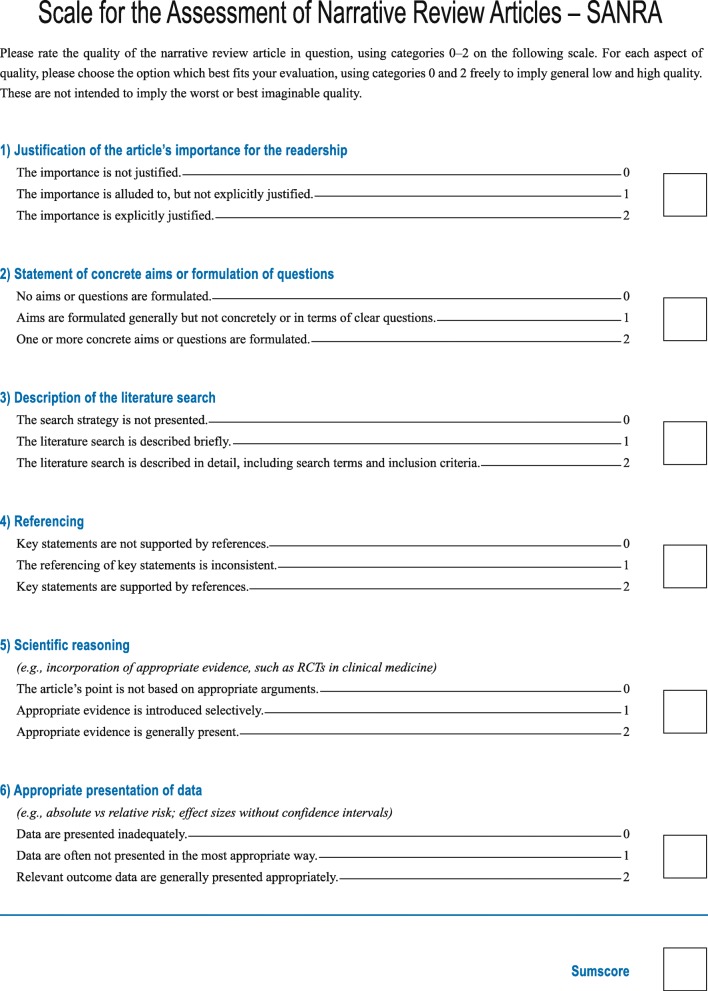
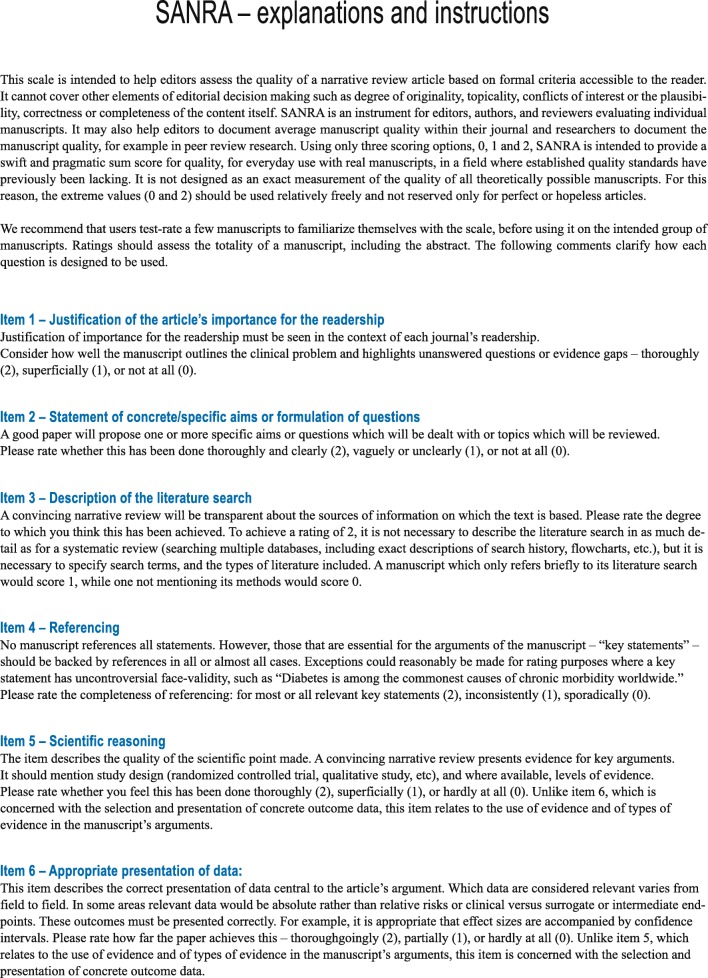
BACKGROUND: Narrative reviews are the commonest type of articles in the medical literature. However, unlike systematic reviews and randomized controlled trials (RCT) articles, for which formal instruments exist to evaluate quality, there is currently no instrument available to assess the quality of narrative reviews. In response to this gap, we developed SANRA, the Scale for the Assessment of Narrative Review Articles. METHODS: A team of three experienced journal editors modified or deleted items in an earlier SANRA version based on face validity, item-total correlations, and reliability scores from previous tests. We deleted an item which addressed a manuscript's writing and accessibility due to poor inter-rater reliability. The six items which form the revised scale are rated from 0 (low standard) to 2 (high standard) and cover the following topics: explanation of (1) the importance and (2) the aims of the review, (3) literature search and (4) referencing and presentation of (5) evidence level and (6) relevant endpoint data. For all items, we developed anchor definitions and examples to guide users in filling out the form. The revised scale was tested by the same editors (blinded to each other's ratings) in a group of 30 consecutive non-systematic review manuscripts submitted to a general medical journal. RESULTS: Raters confirmed that completing the scale is feasible in everyday editorial work. The mean sum score across all 30 manuscripts was 6.0 out of 12 possible points (SD 2.6, range 1-12). Corrected item-total correlations ranged from 0.33 (item 3) to 0.58 (item 6), and Cronbach's alpha was 0.68 (internal consistency). The intra-class correlation coefficient (average measure) was 0.77 [95% CI 0.57, 0.88] (inter-rater reliability). Raters often disagreed on items 1 and 4. CONCLUSIONS: SANRA's feasibility, inter-rater reliability, homogeneity of items, and internal consistency are sufficient for a scale of six items. Further field testing, particularly of validity, is desirable. We recommend rater training based on the "explanations and instructions" document provided with SANRA. In editorial decision-making, SANRA may complement journal-specific evaluation of manuscripts-pertaining to, e.g., audience, originality or difficulty-and may contribute to improving the standard of non-systematic reviews.
Overview
CoChat Summary
TL;DR
SANRA is a six-item, 0–2 scale (maximum 12) for assessing the quality of narrative review articles, developed and field-tested by three journal editors. In 30 consecutive non-systematic review manuscripts, it showed feasible use, sufficient internal consistency and inter-rater reliability, and a modest association with editorial acceptance.
Key findings
- Across 30 manuscripts (90 ratings), the mean SANRA sum score was 6.0 out of 12 (SD 2.6, range 1–12, median 6).
- Internal consistency was Cronbach’s alpha 0.68; corrected item-total correlations ranged from 0.33 (item 3) to 0.58 (item 6).
- Inter-rater reliability was an intra-class correlation coefficient (average measure) of 0.77 [95% CI 0.57, 0.88]; raters often disagreed on items 1 and 4.
- Average SANRA scores were modestly associated with editorial acceptance (mean 6.6, SD 1.9, n = 17) versus rejection (mean 5.1, SD 2.1, n = 13), point biserial correlation 0.37 (t = 2.09, df 28; two-sided p = 0.046).
Methods
- SANRA was developed between 2010 and 2017 by three experienced editors at Deutsches Ärzteblatt; the revised six-item version deleted an item on writing and accessibility due to poor inter-rater reliability.
- The revised scale was tested on 30 consecutive non-systematic review manuscripts submitted to Deutsches Ärzteblatt in 2015; three editor-raters scored them independently and blinded to each other’s ratings.
- Analyses included descriptive statistics, Cronbach’s alpha, corrected item-total correlations, average-measure intra-class correlation using a two-way random effects model (consistency definition), and a post hoc point biserial correlation between SANRA sum scores and acceptance/rejection.
Limitations
- The paper states the main limitation is sample size: 30 manuscripts was a compromise between representativeness, power, and feasibility, and took about 6 months to sample.
- The authors state that the scale’s authors were also the test-raters, so inter-rater reliability may be lower in groups less familiar with SANRA; the study also did not assess test-retest reliability, and results are study-specific.
- The paper acknowledges restricted content validity because SANRA is limited to six items and is a critical appraisal tool rather than a reporting guideline; criterion validity evidence is post hoc and weak, and no established cut-offs exist for comparing manuscripts across settings.
Model-written summary. Check it against the paper before relying on it.
Integrity signals
Registry
Cites
Statistics
Figures
Verification
Claims the paper makes
3 Valid · 0 Not valid · 5 Not checked · 27 Own results and interpretations
The cited sources support only part of this claim — read each source’s verdict below.
In the paper
“Bastian et al. found that they constitute the largest share of all text types in medicine and they concluded that they “remain the staple of medical literature” [1].”
- Also stated in: § Background · plain
“Narrative reviews are the commonest type of articles in the medical literature.”
§ SANRA—a scale for the quality assessment of narrative review articles > Background
What the sources say
- Partly supportedcites [1] Bastian H Glasziou P Chalmers I Seventy-five trials and eleven systematic reviews a day: how will we ever keep up? PLoS Med 2010 7 9 e1000326 10.1371/journal.pmed.1000326 20877712 PMC2943439 sourceExperimental — accuracy not yet measured
In “How Close Are We to Archie Cochrane’s Goal?” and the Summary Points (pages unavailable), the paper calls non-systematic narrative reviews the staple of medical literature synthesis. It does not say they constitute the largest share of all medical text types; that extends a claim about literature synthesis to medical literature as a whole. (LLM, conf=0.88)
plain- Asserted: passes — The authors put it forward as true.
- Checkable: passes — It can be checked against evidence.
- Load-bearing: unclear — It is unclear whether the paper’s conclusions depend on it.
- Based: passes — The paper gives a reason why it holds.
- Also stated in: § Background · plain
The sources with a verdict support this claim; the rest weren’t checked yet, have no full text we could read, or their verdicts aren’t rated yet.
In the paper
“non-systematic reviews or narrative reviews have been widely criticized as unreliable [1, 4].”
§ SANRA—a scale for the quality assessment of narrative review articles > Background
What the sources say
- Supportedcites [1] Bastian H Glasziou P Chalmers I Seventy-five trials and eleven systematic reviews a day: how will we ever keep up? PLoS Med 2010 7 9 e1000326 10.1371/journal.pmed.1000326 20877712 PMC2943439 source
In “How Close Are We to Archie Cochrane’s Goal?”, the paper describes reviews not conducted systematically as having great potential for error and calls them less reliable forms of information. Box 1 also says that articles and textbooks had highlighted the risk of bias and chance in reviews. Together, these passages support the broad characterization that narrative reviews have been criticized as unreliable; page numbers are not provided in our copy. (LLM, conf=0.89)
- Not checked — no full text of the sourcecites [4] Mulrow CD The medical review article: state of the science Ann Intern Med 1987 106 485 488 10.7326/0003-4819-106-3-485 3813259 source
plain- Asserted: passes — The authors put it forward as true.
- Checkable: passes — It can be checked against evidence.
- Load-bearing: passes — The paper’s conclusions depend on it.
- Based: passes — The paper gives a reason why it holds.
- Supported
A result the paper reports from its own data — it cites no other source for it, so there is none to check. The quote shows it is in the paper.
In the paper
“Cronbach’s alpha was 0.68 (internal consistency).”
- Also stated in: § Results · plain
“The scale’s internal consistency, measured as Cronbach’s alpha, was 0.68.”
§ SANRA—a scale for the quality assessment of narrative review articles > Abstract > Results
plainn = 90- Asserted: passes — The authors put it forward as true.
- Checkable: passes — It can be checked against evidence.
- Load-bearing: passes — The paper’s conclusions depend on it.
- Based: passes — The paper gives a reason why it holds.
- Also stated in: § Results · plain
A result the paper reports from its own data — it cites no other source for it, so there is none to check. The quote shows it is in the paper.
In the paper
“Raters often disagreed on items 1 and 4.”
- Also stated in: § Results · plain
“Disagreements most often occurred with regard to items 1 and 4.”
§ SANRA—a scale for the quality assessment of narrative review articles > Abstract > Results
plain- Asserted: passes — The authors put it forward as true.
- Checkable: passes — It can be checked against evidence.
- Load-bearing: unclear — It is unclear whether the paper’s conclusions depend on it.
- Based: passes — The paper gives a reason why it holds.
- Also stated in: § Results · plain
A result the paper reports from its own data — it cites no other source for it, so there is none to check. The quote shows it is in the paper.
In the paper
“The intra-class correlation coefficient (average measure) was 0.77 [95% CI 0.57, 0.88] (inter-rater reliability).”
- Also stated in: § Results · plain
“The intra-class correlation coefficient (average measure) amounted to 0.77 [95% CI 0.57, 0.88; F 4.3; df 29, 58].”
§ SANRA—a scale for the quality assessment of narrative review articles > Abstract > Results
plain- Asserted: passes — The authors put it forward as true.
- Checkable: passes — It can be checked against evidence.
- Load-bearing: passes — The paper’s conclusions depend on it.
- Based: passes — The paper gives a reason why it holds.
- Also stated in: § Results · plain
14 more claims
Create a free account to see all 35 claims and to verify the 3 references still open.
- Probably not a substantial claim. 11
- It may state two separate claims as one. 11
Claims other papers make about this one
Each is checked against this paper’s own text: does it say what the citing paper says it does?
The source backs part of the claim, not all of it — or backs it for a different population, condition or comparison.
In the citing paper
“The review was conducted and reported in accordance with the principles of the Scale for the Assessment of Narrative Review Articles (SANRA), which provides a validated framework for ensuring methodological transparency, scientific rigor, and balanced interpretation in narrative reviews [ 19 ].”
From Paracetamol: A History of Assumptions, Errors, and Evidence Reversals in Pain Management (2026) · cites this paper as [19]
Experimental — accuracy not yet measuredThe source backs part of the claim, not all of it — or backs it for a different population, condition or comparison.
In the citing paper
“As a narrative review, the present work does not include an aggregated quantitative assessment and is more exposed to selection subjectivity than a registered systematic review [124,125].”
From Berberine-Drug Interactions: Mechanisms, Clinical Relevance and Risk Stratification-A Narrative Review (2026) · cites this paper as [124]
Experimental — accuracy not yet measuredThe cited source says what the claim attributes to it.
In the citing paper
“This work is designed as a structured narrative review, with transparent reporting of the documentation strategy, guided by the quality criteria of the Scale for the Assessment of Narrative Review Articles (SANRA) [124].”
From Berberine-Drug Interactions: Mechanisms, Clinical Relevance and Risk Stratification-A Narrative Review (2026) · cites this paper as [124]
The cited source says what the claim attributes to it.
In the citing paper
“we used the following:-Cochrane Risk of Bias 2 (RoB 2) [29] and PEDRO scale tools for RCTs.-AMSTAR 2 [30] checklist for systematic review.-SANRA (Scale for the Assessment of Narrative Review Articles) [31] for narrative reviews.-JBI Checklist for Text and Opinion [32] for expert opinion papers.”
From Pelvic Floor Muscle Training Following Surgery for Pelvic Organ Prolapse: Recommendation from Scientific Literature (2026) · cites this paper as [31]
The cited source says what the claim attributes to it.
In the citing paper
“Data analysis employed a narrative and thematic synthesis methodology,adhering to the SANRA guidelines for narrative reviews (32).”
From Ethical issues in multi-agent AI systems for healthcare: a narrative review (2026) · cites this paper as [32]
12 more claims about this paper
Create a free account to see every claim other papers make about this one.
Citations
Cites
Shea, B. J., Reeves, B. C., Wells, G., Thuku, M., Hamel, C., Moran, J., Moher, D., Tugwell, P., Welch, V., Kristjansson, E., et al. (2017) · BMJ · doi:10.1136/bmj.j4008 · Cited by 10,636 · cited 2×
“Critical appraisal tools have been developed for systematic reviews (e.g., AMSTAR 2 [A MeaSurement Tool to Assess Systematic Reviews] [7]) and papers on RCTs (e.g., the CASP [Critical Appraisal Skills Program] checklist for randomized trials [8]) and other types of medical studies.”
BackgroundStreiner, D. L., & Norman, G. R. (2008) · doi:10.1093/acprof:oso/9780199231881.001.0001 · Cited by 2,631
Critical appraisal skills programme
Singh, J. (2013) · Journal of Pharmacology and Pharmacotherapeutics · doi:10.4103/0976-500x.107697 · Cited by 2,556
Guidelines for Reporting Reliability and Agreement Studies (GRRAS) were proposed
Kottner, J., Audigé, L., Brorson, S., Donner, A., Gajewski, B. J., Hróbjartsson, A., Roberts, C., Shoukri, M., & Streiner, D. L. (2011) · Journal of Clinical Epidemiology · doi:10.1016/j.jclinepi.2010.03.002 · Cited by 2,174
The Mass Production of Redundant, Misleading, and Conflicted Systematic Reviews and Meta‐analyses
IOANNIDIS, J. P. A. (2016) · The Milbank Quarterly · doi:10.1111/1468-0009.12210 · Cited by 1,483 · cited 1×
“While systematic reviews are not per se superior articles and while certain systematic reviews have been criticized lately [3], non-systematic reviews or narrative reviews have”
BackgroundSeventy-five trials and eleven systematic reviews a day: how will we ever keep up?
Bastian, H., Glasziou, P., & Chalmers, I. (2010) · PLoS Medicine · doi:10.1371/journal.pmed.1000326 · Cited by 1,188 · cited 2×
“found that they constitute the largest share of all text types in medicine and they concluded that they “remain the staple of medical literature” [1].”
BackgroundThe Medical Review Article: State of the Science
MULROW, C. D. (1987) · Annals of Internal Medicine · doi:10.7326/0003-4819-106-3-485 · Cited by 856 · cited 1×
“been widely criticized as unreliable [1, 4].”
Writing a narrative biomedical review: considerations for authors, peer reviewers, and editors
Gasparyan, A. Y., Ayvazyan, L., Blackmore, H., & Kitas, G. D. (2011) · Rheumatology International · doi:10.1007/s00296-011-1999-3 · Cited by 694 · cited 1×
“[13], for example, have provided guidance for writing narrative reviews, and Byrne [14] as well as Pautasso [15] has written, from different angles, thoughtful editorials on improving narrative reviews and presented lists of key features of writing a good review—lists that naturally overlap with SANRA items (e.”
BackgroundTen Simple Rules for Writing a Literature Review
Pautasso, M. (2013) · PLoS Computational Biology · doi:10.1371/journal.pcbi.1003149 · Cited by 272 · cited 3×
“[13], for example, have provided guidance for writing narrative reviews, and Byrne [14] as well as Pautasso [15] has written, from different angles, thoughtful editorials on improving narrative reviews and presented lists of key features of writing a good review—lists that naturally overlap with SANRA items (e.”
BackgroundImproving the peer review of narrative literature reviews
Byrne, J. A. (2016) · Research Integrity and Peer Review · doi:10.1186/s41073-016-0019-2 · Cited by 159 · cited 3×
“[13], for example, have provided guidance for writing narrative reviews, and Byrne [14] as well as Pautasso [15] has written, from different angles, thoughtful editorials on improving narrative reviews and presented lists of key features of writing a good review—lists that naturally overlap with SANRA items (e.”
Background
Research works printed but not linked: 3
- Higgins JPT, Green S. (eds.). Cochrane Handbook for Systematic Reviews and Interventions. Version 5.1.0. The Cochrane Collaboration 2011, section 1.2.2., www.handbook.cochrane.org, retrieved on Oct 31, 2018.
- Baethge C Mertens S Goldbeck-Wood S Development of a quality score for the assessment of non-systematic review articles (SANRA) Poster, Seventh International Congress on Peer Review and Biomedical Publication 2013 USA Chicago, Illinois
- Baethge C Goldbeck-Wood S Mertens S A scale for the assessment of non-systematic review articles (SANRA) Poster, Eighth International Congress on Peer and Biomedical Publication 2017 USA Chicago, Illinois
Cited by
Items 3,801–3,900 of 4,334
Ugwu, C. N. (2026) · Frontiers in Food Science and Technology · doi:10.3389/frfst.2026.1985752
From Green Approval to Purchase Readiness: Malaysia’s Electric Vehicle Adoption Conversion Problem
Xu, M., Song, C., & Pan, L. (2026) · Helios Multidisciplinary · doi:10.70702/bdb/nbxb6226
Molecular mechanisms of cardiac development in trisomy 21: A critical narrative review
., S. R., Rajesh, P., Raja, A., & Padmavathy, K. (2026) · IP International Journal of Medical Paediatrics and Oncology · doi:10.18231/j.ijmpo.19559.1789727036
Uric Acid as an Additional Biomarker for Preeclampsia Beyond Renal Dysfunction
Logadharani, R., Balivada, S. K., Teja, S. N., & Bharathi, M. (2026) · International Journal of Health Technology and Innovation · doi:10.60142/ijhti.v5i02.07
“5 Bainbridge et al. demonstrated that UA was linked to activation of vascular smooth muscle cells and development of hypertensive response.”
Grounded ophthalmic AI beyond the electronic health record trap: a critical narrative review
Tabuchi, H., Tanabe, M., Kihara, K., Moriguchi, T., & Gomi, F. (2026) · BMJ Health & Care Informatics · doi:10.1136/bmjhci-2026-102293
Ultrasonography in disaster medicine: a narrative review
Amiot, F., Tazarourte, K., Gorincour, G., & Benhamed, A. (2026) · Insights into Imaging · doi:10.1186/s13244-026-02420-3
“This review was conducted in accordance with the Scale for the Assessment of Narrative Review Articles (SANRA) guidelines [12], and the literature search followed the PRISMA-trAIce checklist for AI-augmented searches [13].”
THE ROLE OF AEROSPACE NURSING IN THE PREVENTION OF HYPOBARIC HYPOXIA IN AIRCREWS: A NARRATIVE REVIEW
Cruz, E. Y. T., & Rico, J. A. (2026) · Revista Foco · doi:10.54751/revistafoco.v19n10-036
From conceptual domains to operational indicators in palliative end-of-life care: a narrative review
Paredes-Coronel, C., Herrera-Abian, M., Rocafort-Gil, J., Rodríguez, A. J., Apellaniz, J. S., Olmo, M. D., & Pfang, B. (2026) · Frontiers in Public Health · doi:10.3389/fpubh.2026.1956490
“In accordance with SANRA (21) recommendations, the search process was explicitly documented to support an interpretive synthesis of quality indicators in palliative end-of-life care (PEoLC).”
From Professional Development to Vocational Teaching Capability: A Self-Efficacy Narrative Review
Liu, H., & Kwong, S. C. (2026) · Helios Multidisciplinary · doi:10.70702/bdb/bext5257
CT-detected inguinal and femoral hernias in women: prevalence and interobserver agreement
Milanés, S. G., Rojas, O. Q., Martinez, J., Ortiz, F., & Serna, A. F. G. (2026) · Frontiers in Radiology · doi:10.3389/fradi.2026.1957651
“This was an observational, descriptive, retrospective, cross-sectional study, reported in accordance with STROBE guidelines for cross-sectional studies (16), with a narrative framework prepared according to SANRA criteria (17).”
Applications of Nanotechnology in Athletic and Exercise Performance: A Scoping Review
VITIS, R. D., Lombardi, L., Guzzini, M., Militerno, A., Taccardo, G., & Passiatore, M. (2026) · Journal of Functional Morphology and Kinesiology · doi:10.3390/jfmk11040416
Ahişkalıoğlu, A., Diwan, S. M., Paksoy, A. E., Yayık, A. M., Gündoğdu, O., Yılmaz, M. A., Karapınar, Y. E., Tulgar, S., CASSAI, A. D., & Gürkan, Y. (2026) · Journal of International Medical Research · doi:10.1177/03000605261492573
Hakkak, S. A., Ahmed, M. A., & Al-Mashhadani, S. (2026) · Cureus · doi:10.7759/cureus.117833
Feng, J., Xiao, J., Gao, Z., Zhou, H., Hou, J., Hou, J., & Gao, B. (2026) · Journal of Food Composition and Analysis · doi:10.1016/j.jfca.2026.109594
Bipasha, S. R. (2026) · Journal of Contemporary Language Research · doi:10.58803/jclr.v5i3.152
Pathobiology and Precision Management of Benign and Malignant Bone Tumors: A Narrative Review
Zaidi, A. R. Z., Samhan, S. M., Alhammad, L. A., Aldakhil, A. M., Al-Mutawa, A. M., Al-Shakhs, M. A., Almohaily, F. O., Alhabdan, H. A., Badahdah, M. M., Asiri, A. Y., et al. (2026) · Cureus · doi:10.7759/cureus.117843
Dimock, R., Sakuma, Y., & Tissingh, E. K. (2026) · Journal of Clinical Orthopaedics and Trauma · doi:10.1016/j.jcot.2026.103632
Omachonu, R. A., Uzuh, S. A., Akinola, K., Ovabor, K., & Odibo, A. (2026) · Cureus · doi:10.7759/cureus.117858
Communicative Rationality in Writing Letters to the Editor
Muttaqin, M. Z. (2026) · The International Information & Library Review · doi:10.1080/10572317.2026.2746362
Ibrahim, F. M., Shahrour, G., & Elbarbary, K. (2026) · Healthcare · doi:10.3390/healthcare14203423
“The review was planned and self-audited against the Scale for the Assessment of Narrative Review Articles (SANRA) [13].”
Han, G., Yang, C., & Wang, Y. (2026) · Journal of Imaging Informatics in Medicine · doi:10.1007/s10278-026-02369-1
Patni, M. A., Choudhari, S. G., George, B. T., Salama, R. A. A., Bahutair, S. N., & Akikwala, M. S. (2026) · Children · doi:10.3390/children13101392
“The review was prepared with reference to SANRA and methodological guidance emphasizing objectives, transparent searching, critical interpretation and appropriate presentation of evidence [16,17].”
The Architecture of the Mind: Neural Networks and Cognitive DomainsPreprint
Kesar, B. (2026) · SSRN Electronic Journal · doi:10.2139/ssrn.7616499
Ferreira, J. C., Faria, P., & Barros, F. (2026) · SN Comprehensive Clinical Medicine · doi:10.1007/s42399-026-02720-1
“This study is a structured narrative review, reported in accordance with the Scale for the Assessment of Narrative Review Articles (SANRA) [ 20].”
Policy momentum and hydrogen deployment readiness in Malaysia and Southeast Asia
Li, Y. (2026) · Sustainable Futures · doi:10.1016/j.sftr.2026.102224
Impact of digital addiction on mental health and comorbidities in older adults
Feher, G., Molinaro, S., & Truzoli, R. (2026) · Frontiers research topics · doi:10.3389/978-2-8325-8862-8
Gravino, M. D., & Debono, K. (2026) · Cureus · doi:10.7759/cureus.117902
Vera, V. V., Lombana, S. P. M., Vaca, A. G. B., & Vélez, W. A. Z. (2026) · Sustainability · doi:10.3390/su182010446
Anand, T. S., Watarkar, S., & Singh, V. (2026) · Cureus · doi:10.7759/cureus.117923
Stoyanova, Z., Trendafilova, P., Bozov, H., Sandeva, M., Petkov, A., Gelov, G., Пенчев, П., & Papathanasiou, J. V. (2026) · European Journal of Translational Myology · doi:10.4081/ejtm.2026.16055
Putri, R. R. P. M., Marsiati, H., Budiman, D., & Wuryanti, S. (2026) · Pendas Jurnal Ilmiah Pendidikan Dasar · doi:10.23969/jp.v11i04.70141
Queiroz, S. A. L., Figueiredo, R. N. D. S., & Merlin, S. S. (2026) · Debates em Psiquiatria · doi:10.25118/2763-9037.2026.v16.1653
Chia, K. H. (2026) · International Journal of Medical and Health Research · doi:10.66856/ijmhr.2026.12.4.12096
Šoltesová, K., & Astapenko, D. (2026) · Anesteziologie a intenzivní medicína · doi:10.36290/aim.2026.030
Villani, C. (2026) · Journal of Radiology Nursing · doi:10.1016/j.jradnu.2026.101472
The psychology of edible flowers: Eye appeal, multisensory experience, and consumer reactions
Uçuk, C., & Spence, C. J. (2026) · International Journal of Gastronomy and Food Science · doi:10.1016/j.ijgfs.2026.101706
Lascano, J. D. R. C., Gualan, E. M. H., Robalino, R. E. C., & Balderas, A. O. (2026) · Revista Científica Multidisciplinaria InvestiGo · doi:10.56519/20dsmb47
Latcu, S., Novacescu, D., Baloi, A., Zara, F., Dumitru, C.-S., Caprariu, R., Cut, T. G., Marinescu, A., Lazureanu, V. E., Bratosin, F., et al. (2026) · Diagnostics · doi:10.3390/diagnostics16203334
“…of Narrative Review Articles (SANRA), whose six items—justification of the article’s importance for the readership, statement of concrete aims, description of the literature search, referencing, scientific reasoning, and appropriate presentation of data—were used as a reporting checklist [14].”
Physiotherapy Outcomes Following Modified Radical Mastectomy: A Narrative Review
Patel, D., Patel, D. A., & Daru, K. (2026) · International Journal of Innovative Science and Research Technology (IJISRT) · doi:10.38124/ijisrt/26oct465
Zdunek, J., & Grodner, B. (2026) · International Journal of Molecular Sciences · doi:10.3390/ijms27209094
“This hierarchy is intended to distinguish molecular target engagement from downstream biological effects and, importantly, from clinical efficacy; these levels of evidence should not be considered interchangeable [18,19] (Table 1).”
Gestão de portfólio e canais de venda orientada à rentabilidade
Roncaglio, O. W. F. (2026) · RCMOS - Revista Científica Multidisciplinar O Saber · doi:10.51473/rcmos.v1i1.2026.3034
Governança de dados e inteligência artificial na gestão de pequenas e médias empresas
Roncaglio, O. W. F. (2026) · RCMOS - Revista Científica Multidisciplinar O Saber · doi:10.51473/rcmos.v1i1.2026.3032
A research framework for evaluating upstream multimodal sarcopenia risk domains in older adults
Kim, N. (2026) · Frontiers in Medicine · doi:10.3389/fmed.2026.1928432
“Principles of transparent narrative synthesis informed the approach (21).”
Phage Therapy as a Self—Replicating Strategy for Besieged Health Systems
Olalere, E., Saif, S., Imran, W., Khalid, F., Faiz, D., Akhter, J., Manzoor, L., & Das, A. (2026) · Infection and Drug Resistance · doi:10.2147/idr.s638488 · Cited by 1
“45,46 Second, achieving pharmaceutical-grade endotoxin purification outside centralized manufacturing facilities remains a significant technical barrier for field or point-of-care phage production, given that residual endotoxin, not the phage particles themselves, accounts for the mild febrile…”
Lanzoni, A., Brusini, A., Brighenti, S., & Pozzi, C. (2026) · Journal of dementia and Alzheimer's disease · doi:10.3390/jdad3040050
Bahamdan, G. K. (2026) · Dentistry Journal · doi:10.3390/dj14100672
“This narrative review was prepared with reference to the SANRA (Scale for the Assessment of Narrative Review Articles) checklist [24].”
SIGHT: A Methodological Appraisal Framework for Evaluating Large Language Models in OphthalmologyPreprint
Vahedi, H., Razmjooei, F., Semnani, F., Vahedi, P., Alizadehsani, R., & Jafarizadeh, A. (2026) · arXiv (Cornell University) · doi:10.48550/arxiv.2610.15958
Hidden Cost of Poor Quality in Laboratory Medicine: From Errors and Waste to Value-Based Care
Faviou, E., Economidou, C., Baltogianni, I. V., & Baltogiannis, N. (2026) · Cureus · doi:10.7759/cureus.117933
Spanakis, M., Vasarmidi, E., Fournaraki, A., Vardiampasis, C., Skountakis, A., Antoniou, K. M., Tzanakis, Ν., & Symvoulakis, E. K. (2026) · Pneumon · doi:10.18332/pne/240469
Żyżyńska, K., Grycner, K., Skorek, A., & Tretiakow, D. (2026) · Bratislavské lekárske listy/Bratislava medical journal · doi:10.1007/s44411-026-00893-8
Aridas, M. S., & Grive, K. (2026) · Cureus · doi:10.7759/cureus.117913
“This narrative review was conducted and reported in accordance with the Scale for the Assessment of Narrative Review Articles (SANRA) [14].”
Makini, S. O. M. (2026) · African Journal of Emerging Issues
Kurmangaliyeva, G., Устенова, Г. О., Öztürk, M., Sayakova, G., Boshkayeva, А., Amirkhanova, A., Koilybayeva, M., Zhandabayeva, M. A., Abilbayeva, A., & Кантуреева, А. М. (2026) · Molecules · doi:10.3390/molecules31203690
“Secoisolariciresinol, isolariciresinol, and lariciresinol showed substantial activity in single-electron-transfer and superoxide-scavenging assays [20,23].”
Sirago, G., Zotti, F., Anelli, F., Sannino, F., Abbinante, M., Dell'Erba, A., & Ferorelli, D. (2026) · Journal of Evaluation in Clinical Practice · doi:10.1111/jep.70659
Pănuş, A., Gheonea, I. M., Andrei, M., Mere, D. A., & Kamal, C. (2026) · Romanian Journal of Medical Practice · doi:10.37897/rjmp.2026.3.7
“No formal SANRA score was assigned [16].”
Obesity and sentinel lymph node mapping in endometrial cancer: beyond body mass index.
Buda, A. A., Viveros-Carreño, D. A., Mauro, J., & Pareja, R. (2026) · International Journal of Gynecological Cancer · doi:10.1016/j.ijgc.2026.105666
Cărăuleanu, A., Sescu, V. A., Costea, C. F., Haba, R. M., Condriuc, I. P. S., Mogoş, R. A., Socolov, R., & Socolov, D. G. (2026) · Healthcare · doi:10.3390/healthcare14203452
“This narrative review was prepared with reference to the SANRA criteria [20].”
Telemedicine in Retinopathy of Prematurity: A Review of Current Evidence and Clinical Outcomes
Iftime, I.-M., Treteanu, A. R., Pușcașu, A., Craiu, M., Cristea, O., & Ciolpan, A. A. (2026) · Children · doi:10.3390/children13101413
“By reducing the need for travel, it may facilitate timely medical evaluation, expand screening capacity, and support earlier disease detection [40,41].”
Todorović, P., Kopilaš, A., Racetin, A., Maglica, M., Rizikalo, A., Raguž, F., Kelam, N., & Vukojević, K. (2026) · Life · doi:10.3390/life16101722
“This article is a narrative review, prepared with reference to the Scale for the Assessment of Narrative Review Articles (SANRA) [17].”
Ivanišin, A., Sorić, T., Mavar, M., Klarin, I., & Sarić, M. M. (2026) · Clocks & Sleep · doi:10.3390/clockssleep8040067
“To strengthen methodological transparency and reporting, the manuscript was evaluated with reference to the Scale for the Assessment of Narrative Review Articles (SANRA) [17].”
Gyu, P. H., & Lim, H. (2026) · Frontiers in Nutrition · doi:10.3389/fnut.2026.1963264
“…applications, and implementation considerations of CM. Consistent with methodological recommendations for narrative reviews, the review process emphasized a clearly defined objective, transparent literature identification, appropriate use of evidence, and scientifically reasoned synthesis (12).”
Zhang, X., Liu, D., Yu, M., Zhang, R., Liu, L., Liu, J., Liu, X., Wang, Y., Yu, S., & Yang, S. (2026) · Biomolecules · doi:10.3390/biom16101502
“The Scale for the Assessment of Narrative Review Articles (SANRA) informed clarity of scope and scientific reasoning, but it was not used as a substitute for transparent retrieval methods or study-level appraisal [7].”
Özşin‐Özler, C., & Doğan, B. G. (2026) · Children · doi:10.3390/children13101408
“The literature identification and selection approach was informed by recommended principles for transparent and methodologically rigorous narrative reviews [24,25].”
Atuhaire, A., Nakyagaba, L., Sekitoleko, A., Nkalubo, C., Mohamed, M. A., Kasemiire, S., Mangusho, D. C., Mugwaneza, J. C., Babirye, S., Rutkiewicz, A., et al. (2026) · F1000Research · doi:10.12688/f1000research.192917.1
Saint-Jammes, J. T. (2026) · European Journal of Trauma & Dissociation · doi:10.1016/j.ejtd.2026.100769
Bereda, G. (2026) · Natural Product Communications · doi:10.1177/1934578x261499051
Soulaymani, A., Aslaou, F., Hmimou, S., Elassali, A., & Hattily, F. E. (2026) · International Journal of Research and Innovation in Applied Science · doi:10.51584/ijrias.2026.11090104
From Reactive Oxygen Species to Organelle Stress and Innate Immunity in Dry Eye Disease
Capobianco, M., Zeppieri, M., Cappellani, F., Gagliano, C., Consoli, R. A., Mangiagli, S., Alberio, M., & Roszkowska, A. M. (2026) · Oxygen · doi:10.3390/oxygen6040034
Kapoma, C., Sichamba, P., Hatwiko, H., Mutalange, M., Mulemena, J. A., Chanda, W., Michelo, M., Hamooya, B. M., Machiko, A., Phiri, C., et al. (2026) · Discover Pediatrics · doi:10.1007/s44571-026-00011-7
Xu, M., Wu, W., Xing, S., & Li, P. (2026) · Therapeutic Advances in Urology · doi:10.1177/17562872261493703
Mendis, E., Thayaparan, M., & Lellupitiya, D. (2026) · World Construction Symposium (WCS) · doi:10.31705/wcs.2026.112
Hacer escuela en tiempos de diversidad, desigualdad y desafíos contemporáneos
Alvarado, G. A. Z., Guillermo, J., Buelvas, R. Y. P., Camacho, J. M. G., Farnum, F., Barrera, S. M. D., Quiñones, R. A. V., Briñez, E. T., Páez, E. H., Trillos, J. A. M., et al. (2026) · doi:10.69821/978-628-97832-8-5
Roles of gut microbiota metabolites in the pathogenesis of migraine
Shi, Y., 曹, 伊., Zhang, Z., Li, R., Zhou, G., & Xu, P. (2026) · Frontiers in Medicine · doi:10.3389/fmed.2026.1949484
“The reference lists of relevant articles were also screened to identify additional studies (12).”
Bortolotti, M. S., Restrepo, J. C., & García-Rojo, G. (2026) · Odontoestomatología · doi:10.22592/ode2026n48e347
Gender differences in pain behavior: do sex hormones influence nociceptive outcome? Narrative review
Zorilla, J. C., Peláez-Martínez, J. D., Arias, V. M., Giraldo, M. R., Pineda, D. A. R., Lizarralde, R. O., & Cadena, F. A. (2026) · Revista de la Sociedad Española del Dolor · doi:10.20986/resed.2026.1320
Spirituality and Medicine, with a Focus on Oncology: A Narrative Review of the Literature
Giglio, A. D. (2026) · Clinical Oncology Letters · doi:10.4322/col.2026.009
Vitamin B12 deficiency: epidemiological trends and risk factors
Toteja, G. S., & Toteja, N. (2026) · Frontiers in Nutrition · doi:10.3389/fnut.2026.1930037
“This is a narrative rather than a systematic review, and no prospective protocol was registered, consistent with recommendations for transparent reporting of narrative reviews [the Scale for the Assessment of Narrative Review Articles, SANRA (5)].”
From Skills Lists to Career Resources: Rethinking Career Preparation and Program Design
Nagy, N. (2026) · GiLE Journal of Skills Development · doi:10.52398/gjsd.2026.v6.i2.pp190-207
Formación docente para la diversidad y transformación de las prácticas
Durán, L. G. D., & Ramírez, E. M. S. (2026) · doi:10.69821/978-628-97832-8-5.ch5
Manejo perioperatório do diabetes em cirurgias de grande porte: Revisão narrativa
Coelho, L. R. P., Carvalho, M. V. F., de Souza, C. H. B., Nascimento, G. M., & da Cruz, L. W. (2026) · Fisioterapia Brasil · doi:10.62827/fb.v27i9.1352
Yassen, K. A., Görlinger, K., Alzimami, L. Z., Alswilem, N. S., Almutairi, A. A., Alsagheer, M., Alwayel, H., Alkhalaf, A. M. A., Aljamaan, N. H., Alqurqush, N., et al. (2026) · Journal of Clinical Medicine · doi:10.3390/jcm15208048
“The review was informed by SANRA recommendations for narrative reviews [18].”
Floriano, J. F., & Menezes, M. E. (2026) · Revista Multidisciplinar do Nordeste Mineiro · doi:10.66104/pp7zdq81
Zawadzki, D., Libergal, N., Kisiała, M., Gwoździk, H., Ratajczyk, O., Hejnowicz, M., Misiąg, P., Nowak, Ł., Janczak, D. T., Krajewski, W. R., et al. (2026) · Antibiotics · doi:10.3390/antibiotics15101030
Li, X., Chong, H. G., Zhang, M., Delgado, J., Macieira, T. G. R., Rossetti, S. C., Chen, L. A., Hui, V. C. C., Gosak, L., Chu, C. H., et al. (2026) · International Journal of Nursing Studies · doi:10.1016/j.ijnurstu.2026.105722 · Cited by 1
Recuperação acelerada após cirurgia bariátrica e desfechos pós-operatórios: Revisão narrativa
Coelho, L. R. P., Lucas, P. A., Damasceno, I. R., & da Cruz, L. W. (2026) · Fisioterapia Brasil · doi:10.62827/fb.v27i9.1344
Condriuc, I. P. S., Mogoş, R. A., Popovici, R. M., Matasariu, D. R., Coșovanu, E. O., Buzdugă, C. M., Scripcariu, I. S., Socolov, D. G., & Cărăuleanu, A. (2026) · Life · doi:10.3390/life16101738
“SANRA was used as a framework for the transparency and quality of narrative reporting, not as a systematic-review method; the location of each element it addresses is given in Table S3 [14].”
Burden, patterns, and challenges of HIV-associated malignancies in Nigeria: a narrative review
Silas, O. A., Nyam, C., Tsok, Y., Eshioramine, M., Nnaegbuna, N., Golit, W., Okunowo, A. A., Osuagwu, C., Offor, J. O., Achusi, I., et al. (2026) · Frontiers in Oncology · doi:10.3389/fonc.2026.1959750
Otago Exercise for Fall Prevention in Older Adults A Narrative Literature Review
Kusuma, A. A., & Supratman, S. (2026) · Healthy Tadulako Journal (Jurnal Kesehatan Tadulako) · doi:10.22487/2ggpes68
Albert, O. M., & Arthur, A. (2026) · Research Ethics · doi:10.1177/17470161261492136
Khan, A. A., Farhath, F., & Saluja, R. K. (2026) · Respiratory Medicine · doi:10.1016/j.rmed.2026.109224
Routine MRI in Pediatric Scoliosis: A Narrative Review of Risk-Stratified and Abbreviated Protocols
Besharaty, S., Sheikhalishahi, S., & Haddadi, A. (2026) · Orthopedic Research and Reviews · doi:10.2147/orr.s649642
“11 Accordingly, no PRISMA flow diagram, formal risk-of-bias scoring, or quantitative meta-analysis was performed; where pooled estimates are cited, they are drawn from previously published systematic reviews and meta-analyses.”
Omigbodun, F. T. (2026) · Journal of Medicine Surgery and Public Health · doi:10.1016/j.glmedi.2026.100258
Gapparova, J. N. (2026) · Eurasian Journal of Medical and Natural Sciences · doi:10.70413/ejmns-v06-i10-s60341
Hoa, V. T. (2026) · International Journal of Multidisciplinary Research and Development · doi:10.66856/ijmrd.2026.13.4.13406
Shukrullayev, J., Abdulxafizxon, A., & Nurbek, K. B. (2026) · Eurasian Journal of Medical and Natural Sciences · doi:10.70413/ejmns-v06-i10-s80007
Cardiac diagnostic modalities in polycythemia vera: A narrative review
Elsayed, E., Elsabagh, A. A., Elmakaty, I., Elsayed, A. A., Elsayed, B. M. S., Elmarasia, M., Alshurafa, A., & Yassin, M. A. (2026) · Journal of International Medical Research · doi:10.1177/03000605261495786
(2026) · International Journal of Drug Delivery Technology · doi:10.25258/ijddt.16.75s.7
Eldad, M. G. A. P., & Sopater, O. (2026) · Citizen Jurnal Ilmiah Multidisiplin Indonesia · doi:10.53866/jimi.v6i2.1490
“Pelaporan disusun dengan mengacu pada enam domain Scale for the Assessment of Narrative Review Articles (SANRA), yaitu penjelasan pentingnya topik, perumusan tujuan, deskripsi penelusuran literatur, ketepatan rujukan, penalaran ilmiah, dan penyajian data yang relevan (Baethge et al., 2019).”
Metadata
- Authors
- Baethge, C., Goldbeck-Wood, S., & Mertens, S.
- Affiliations
- University of Cologne (DE)
- BMJ Group (United Kingdom) (GB)
- Corresponding author
- Baethge, Christopher
- ORCID
- Baethge, Christopher
- Venue
- Research Integrity and Peer Review
- Published
- 2019-03-26
- Volume
- 4
- Issue
- 1
- Pages
- 5-5
- ISSN
- 2058-8615 (ISSN-L)
- PMC
- PMC6434870
- OpenAlex
- W2922577842
- Semantic Scholar
- ea7f35b3069b53791c3b746c5c4b3c72a83a526b
- Cited by
- 3,469
- References
- 13
- Citations by year
- 2026: 1823 · 2025: 551 · 2024: 379 · 2023: 309 · 2022: 218 · 2021: 152 · 2020: 32 · 2019: 4
- FWCI
- 20.57
- Type
- journal article
- Language
- en
- Open access
- gold
- doi.org
- Licence
- cc-by
- creativecommons.org/licenses/by/4.0/ (tdm)
- Locations
- Research Integrity and Peer Review (publishedVersion, cc-by)
- Europe PMC (PubMed Central) (publishedVersion, other-oa)
- PubMed Central (publishedVersion, cc-by)
- PubMed (publishedVersion)
- Kölner Universitäts PublikationsServer (Universität zu Köln) (publishedVersion)
- DOAJ (DOAJ: Directory of Open Access Journals) (submittedVersion, cc-by-sa)
- Topics
- Social Sciences › Decision Sciences › Statistics, Probability and Uncertainty › Meta-analysis and systematic reviews
- Social Sciences › Library and Information Sciences › Academic Writing and Publishing
- Social Sciences › Library and Information Sciences › scientometrics and bibliometrics research
- Keywords
- quality assessment scale, manuscript review, inter-rater reliability, level of evidence, scale development
About these checks
Registry, retraction, Cites and statistics results are computed, not judged, with one exception: a printed reference that no index lists is read once by a model before it counts as a citation error. Claims are extracted by a model and kept only when their quote appears verbatim in the text; each cited source is then checked, with a model’s help, for whether it says what the claim relies on. Those verdicts can be wrong — read the claim’s quote and the cited source before relying on one.
The claim verdicts this report counts are experimental: their accuracy is not yet measured.
A language model drew the claims from the paper on 2026-11-10, under version 3 of the claim definition (model deepseek-v4.1-flash, prompt extract-v3).
A second model labelled each claim on 2026-11-10 (model jev-1.13-20260917, definition revision gold-guideline-v0.2).
Cited sources are checked with a language model’s help (gpt-6-sol).
Statistics and arithmetic are recomputed, not judged.
Confidence bands are shown only for fields calibrated on our annotated test set. None is calibrated yet, so no band is shown.
What counts as a claim ›How we measure confidence ›How we check this ›
Are you an author, or do you see a problem with this page? Request a review
Data sources
Bibliographic data: Semantic Scholar, OpenAlex, Crossref.
Contains information from the Semantic Scholar Academic Graph Datasets, made available under the ODC Attribution License (ODC-BY 1.0).
Semantic Scholar’s data is described in: Kinney, R., et al. (2023). The Semantic Scholar Open Data Platform. arXiv:2301.10140.
