

SANRA—a scale for the quality assessment of narrative review articles
Open accessThe DOI matches its Crossref record; 12 of the 13 references it cites were found in a registry or an index; 4 of the 12 sources its claims cite were checked for support.
Abstract
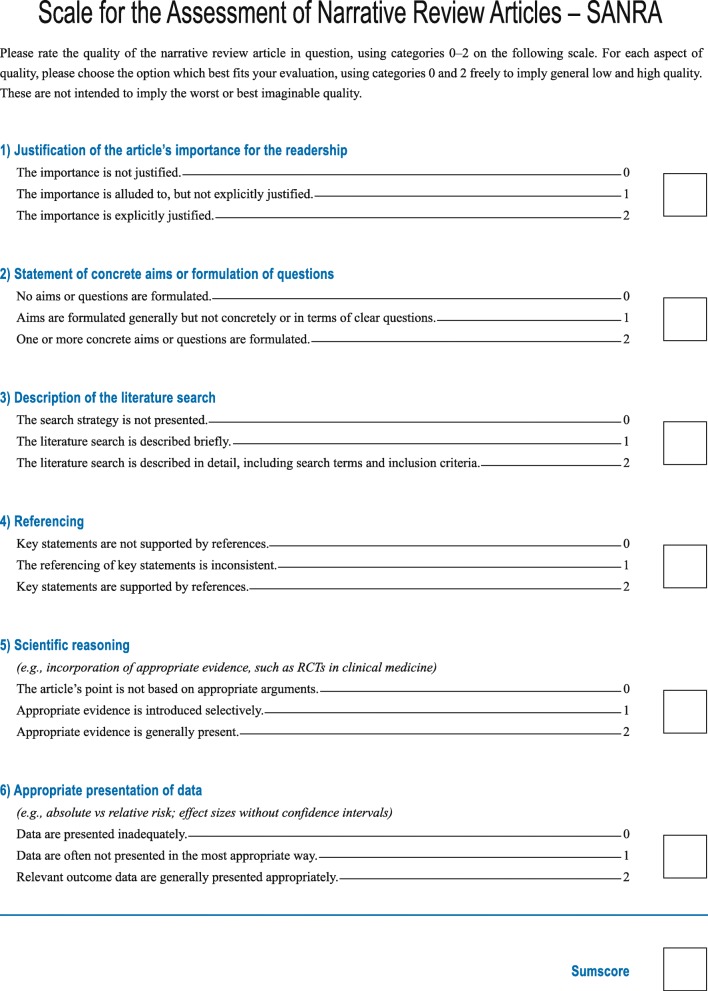
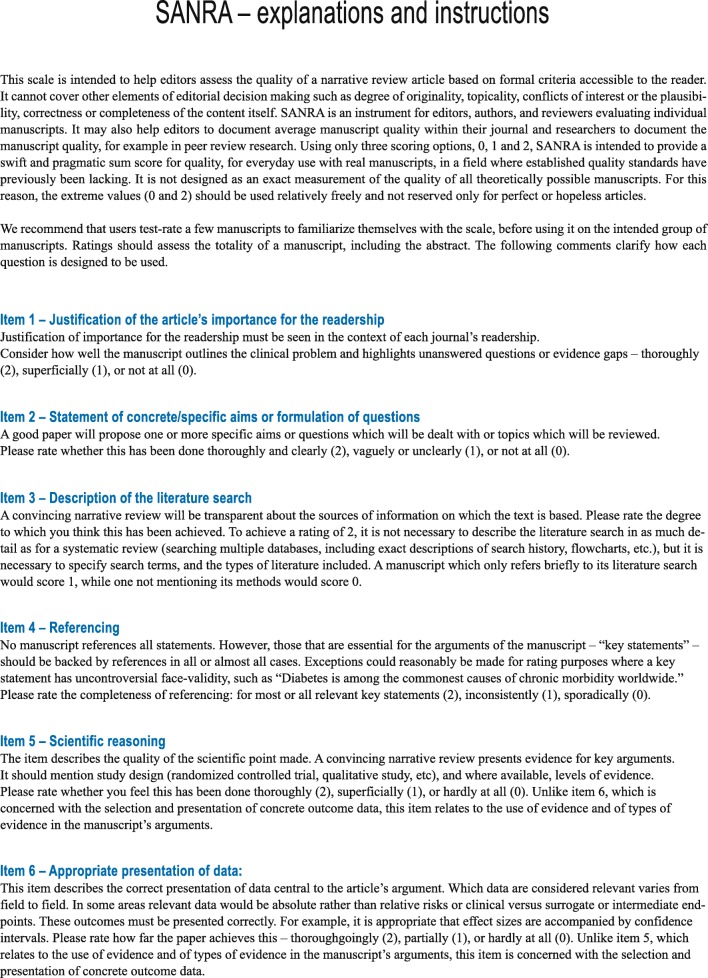
BACKGROUND: Narrative reviews are the commonest type of articles in the medical literature. However, unlike systematic reviews and randomized controlled trials (RCT) articles, for which formal instruments exist to evaluate quality, there is currently no instrument available to assess the quality of narrative reviews. In response to this gap, we developed SANRA, the Scale for the Assessment of Narrative Review Articles. METHODS: A team of three experienced journal editors modified or deleted items in an earlier SANRA version based on face validity, item-total correlations, and reliability scores from previous tests. We deleted an item which addressed a manuscript's writing and accessibility due to poor inter-rater reliability. The six items which form the revised scale are rated from 0 (low standard) to 2 (high standard) and cover the following topics: explanation of (1) the importance and (2) the aims of the review, (3) literature search and (4) referencing and presentation of (5) evidence level and (6) relevant endpoint data. For all items, we developed anchor definitions and examples to guide users in filling out the form. The revised scale was tested by the same editors (blinded to each other's ratings) in a group of 30 consecutive non-systematic review manuscripts submitted to a general medical journal. RESULTS: Raters confirmed that completing the scale is feasible in everyday editorial work. The mean sum score across all 30 manuscripts was 6.0 out of 12 possible points (SD 2.6, range 1-12). Corrected item-total correlations ranged from 0.33 (item 3) to 0.58 (item 6), and Cronbach's alpha was 0.68 (internal consistency). The intra-class correlation coefficient (average measure) was 0.77 [95% CI 0.57, 0.88] (inter-rater reliability). Raters often disagreed on items 1 and 4. CONCLUSIONS: SANRA's feasibility, inter-rater reliability, homogeneity of items, and internal consistency are sufficient for a scale of six items. Further field testing, particularly of validity, is desirable. We recommend rater training based on the "explanations and instructions" document provided with SANRA. In editorial decision-making, SANRA may complement journal-specific evaluation of manuscripts-pertaining to, e.g., audience, originality or difficulty-and may contribute to improving the standard of non-systematic reviews.
Overview
CoChat Summary
TL;DR
SANRA is a six-item, 0–2 scale (maximum 12) for assessing the quality of narrative review articles, developed and field-tested by three journal editors. In 30 consecutive non-systematic review manuscripts, it showed feasible use, sufficient internal consistency and inter-rater reliability, and a modest association with editorial acceptance.
Key findings
- Across 30 manuscripts (90 ratings), the mean SANRA sum score was 6.0 out of 12 (SD 2.6, range 1–12, median 6).
- Internal consistency was Cronbach’s alpha 0.68; corrected item-total correlations ranged from 0.33 (item 3) to 0.58 (item 6).
- Inter-rater reliability was an intra-class correlation coefficient (average measure) of 0.77 [95% CI 0.57, 0.88]; raters often disagreed on items 1 and 4.
- Average SANRA scores were modestly associated with editorial acceptance (mean 6.6, SD 1.9, n = 17) versus rejection (mean 5.1, SD 2.1, n = 13), point biserial correlation 0.37 (t = 2.09, df 28; two-sided p = 0.046).
Methods
- SANRA was developed between 2010 and 2017 by three experienced editors at Deutsches Ärzteblatt; the revised six-item version deleted an item on writing and accessibility due to poor inter-rater reliability.
- The revised scale was tested on 30 consecutive non-systematic review manuscripts submitted to Deutsches Ärzteblatt in 2015; three editor-raters scored them independently and blinded to each other’s ratings.
- Analyses included descriptive statistics, Cronbach’s alpha, corrected item-total correlations, average-measure intra-class correlation using a two-way random effects model (consistency definition), and a post hoc point biserial correlation between SANRA sum scores and acceptance/rejection.
Limitations
- The paper states the main limitation is sample size: 30 manuscripts was a compromise between representativeness, power, and feasibility, and took about 6 months to sample.
- The authors state that the scale’s authors were also the test-raters, so inter-rater reliability may be lower in groups less familiar with SANRA; the study also did not assess test-retest reliability, and results are study-specific.
- The paper acknowledges restricted content validity because SANRA is limited to six items and is a critical appraisal tool rather than a reporting guideline; criterion validity evidence is post hoc and weak, and no established cut-offs exist for comparing manuscripts across settings.
Model-written summary. Check it against the paper before relying on it.
Integrity signals
Registry
Cites
Statistics
Figures
Verification
Claims the paper makes
3 Valid · 0 Not valid · 5 Not checked · 27 Own results and interpretations
The cited sources support only part of this claim — read each source’s verdict below.
In the paper
“Bastian et al. found that they constitute the largest share of all text types in medicine and they concluded that they “remain the staple of medical literature” [1].”
- Also stated in: § Background · plain
“Narrative reviews are the commonest type of articles in the medical literature.”
§ SANRA—a scale for the quality assessment of narrative review articles > Background
What the sources say
- Partly supportedcites [1] Bastian H Glasziou P Chalmers I Seventy-five trials and eleven systematic reviews a day: how will we ever keep up? PLoS Med 2010 7 9 e1000326 10.1371/journal.pmed.1000326 20877712 PMC2943439 sourceExperimental — accuracy not yet measured
In “How Close Are We to Archie Cochrane’s Goal?” and the Summary Points (pages unavailable), the paper calls non-systematic narrative reviews the staple of medical literature synthesis. It does not say they constitute the largest share of all medical text types; that extends a claim about literature synthesis to medical literature as a whole. (LLM, conf=0.88)
plain- Asserted: passes — The authors put it forward as true.
- Checkable: passes — It can be checked against evidence.
- Load-bearing: unclear — It is unclear whether the paper’s conclusions depend on it.
- Based: passes — The paper gives a reason why it holds.
- Also stated in: § Background · plain
The sources with a verdict support this claim; the rest weren’t checked yet, have no full text we could read, or their verdicts aren’t rated yet.
In the paper
“non-systematic reviews or narrative reviews have been widely criticized as unreliable [1, 4].”
§ SANRA—a scale for the quality assessment of narrative review articles > Background
What the sources say
- Supportedcites [1] Bastian H Glasziou P Chalmers I Seventy-five trials and eleven systematic reviews a day: how will we ever keep up? PLoS Med 2010 7 9 e1000326 10.1371/journal.pmed.1000326 20877712 PMC2943439 source
In “How Close Are We to Archie Cochrane’s Goal?”, the paper describes reviews not conducted systematically as having great potential for error and calls them less reliable forms of information. Box 1 also says that articles and textbooks had highlighted the risk of bias and chance in reviews. Together, these passages support the broad characterization that narrative reviews have been criticized as unreliable; page numbers are not provided in our copy. (LLM, conf=0.89)
- Not checked — no full text of the sourcecites [4] Mulrow CD The medical review article: state of the science Ann Intern Med 1987 106 485 488 10.7326/0003-4819-106-3-485 3813259 source
plain- Asserted: passes — The authors put it forward as true.
- Checkable: passes — It can be checked against evidence.
- Load-bearing: passes — The paper’s conclusions depend on it.
- Based: passes — The paper gives a reason why it holds.
- Supported
A result the paper reports from its own data — it cites no other source for it, so there is none to check. The quote shows it is in the paper.
In the paper
“Cronbach’s alpha was 0.68 (internal consistency).”
- Also stated in: § Results · plain
“The scale’s internal consistency, measured as Cronbach’s alpha, was 0.68.”
§ SANRA—a scale for the quality assessment of narrative review articles > Abstract > Results
plainn = 90- Asserted: passes — The authors put it forward as true.
- Checkable: passes — It can be checked against evidence.
- Load-bearing: passes — The paper’s conclusions depend on it.
- Based: passes — The paper gives a reason why it holds.
- Also stated in: § Results · plain
A result the paper reports from its own data — it cites no other source for it, so there is none to check. The quote shows it is in the paper.
In the paper
“Raters often disagreed on items 1 and 4.”
- Also stated in: § Results · plain
“Disagreements most often occurred with regard to items 1 and 4.”
§ SANRA—a scale for the quality assessment of narrative review articles > Abstract > Results
plain- Asserted: passes — The authors put it forward as true.
- Checkable: passes — It can be checked against evidence.
- Load-bearing: unclear — It is unclear whether the paper’s conclusions depend on it.
- Based: passes — The paper gives a reason why it holds.
- Also stated in: § Results · plain
A result the paper reports from its own data — it cites no other source for it, so there is none to check. The quote shows it is in the paper.
In the paper
“The intra-class correlation coefficient (average measure) was 0.77 [95% CI 0.57, 0.88] (inter-rater reliability).”
- Also stated in: § Results · plain
“The intra-class correlation coefficient (average measure) amounted to 0.77 [95% CI 0.57, 0.88; F 4.3; df 29, 58].”
§ SANRA—a scale for the quality assessment of narrative review articles > Abstract > Results
plain- Asserted: passes — The authors put it forward as true.
- Checkable: passes — It can be checked against evidence.
- Load-bearing: passes — The paper’s conclusions depend on it.
- Based: passes — The paper gives a reason why it holds.
- Also stated in: § Results · plain
14 more claims
Create a free account to see all 35 claims and to verify the 3 references still open.
- Probably not a substantial claim. 11
- It may state two separate claims as one. 11
Claims other papers make about this one
Each is checked against this paper’s own text: does it say what the citing paper says it does?
The source backs part of the claim, not all of it — or backs it for a different population, condition or comparison.
In the citing paper
“The review was conducted and reported in accordance with the principles of the Scale for the Assessment of Narrative Review Articles (SANRA), which provides a validated framework for ensuring methodological transparency, scientific rigor, and balanced interpretation in narrative reviews [ 19 ].”
From Paracetamol: A History of Assumptions, Errors, and Evidence Reversals in Pain Management (2026) · cites this paper as [19]
Experimental — accuracy not yet measuredThe source backs part of the claim, not all of it — or backs it for a different population, condition or comparison.
In the citing paper
“As a narrative review, the present work does not include an aggregated quantitative assessment and is more exposed to selection subjectivity than a registered systematic review [124,125].”
From Berberine-Drug Interactions: Mechanisms, Clinical Relevance and Risk Stratification-A Narrative Review (2026) · cites this paper as [124]
Experimental — accuracy not yet measuredThe cited source says what the claim attributes to it.
In the citing paper
“This work is designed as a structured narrative review, with transparent reporting of the documentation strategy, guided by the quality criteria of the Scale for the Assessment of Narrative Review Articles (SANRA) [124].”
From Berberine-Drug Interactions: Mechanisms, Clinical Relevance and Risk Stratification-A Narrative Review (2026) · cites this paper as [124]
The cited source says what the claim attributes to it.
In the citing paper
“we used the following:-Cochrane Risk of Bias 2 (RoB 2) [29] and PEDRO scale tools for RCTs.-AMSTAR 2 [30] checklist for systematic review.-SANRA (Scale for the Assessment of Narrative Review Articles) [31] for narrative reviews.-JBI Checklist for Text and Opinion [32] for expert opinion papers.”
From Pelvic Floor Muscle Training Following Surgery for Pelvic Organ Prolapse: Recommendation from Scientific Literature (2026) · cites this paper as [31]
The cited source says what the claim attributes to it.
In the citing paper
“Data analysis employed a narrative and thematic synthesis methodology,adhering to the SANRA guidelines for narrative reviews (32).”
From Ethical issues in multi-agent AI systems for healthcare: a narrative review (2026) · cites this paper as [32]
12 more claims about this paper
Create a free account to see every claim other papers make about this one.
Citations
Cites
Shea, B. J., Reeves, B. C., Wells, G., Thuku, M., Hamel, C., Moran, J., Moher, D., Tugwell, P., Welch, V., Kristjansson, E., et al. (2017) · BMJ · doi:10.1136/bmj.j4008 · Cited by 10,636 · cited 2×
“Critical appraisal tools have been developed for systematic reviews (e.g., AMSTAR 2 [A MeaSurement Tool to Assess Systematic Reviews] [7]) and papers on RCTs (e.g., the CASP [Critical Appraisal Skills Program] checklist for randomized trials [8]) and other types of medical studies.”
BackgroundStreiner, D. L., & Norman, G. R. (2008) · doi:10.1093/acprof:oso/9780199231881.001.0001 · Cited by 2,631
Critical appraisal skills programme
Singh, J. (2013) · Journal of Pharmacology and Pharmacotherapeutics · doi:10.4103/0976-500x.107697 · Cited by 2,556
Guidelines for Reporting Reliability and Agreement Studies (GRRAS) were proposed
Kottner, J., Audigé, L., Brorson, S., Donner, A., Gajewski, B. J., Hróbjartsson, A., Roberts, C., Shoukri, M., & Streiner, D. L. (2011) · Journal of Clinical Epidemiology · doi:10.1016/j.jclinepi.2010.03.002 · Cited by 2,174
The Mass Production of Redundant, Misleading, and Conflicted Systematic Reviews and Meta‐analyses
IOANNIDIS, J. P. A. (2016) · The Milbank Quarterly · doi:10.1111/1468-0009.12210 · Cited by 1,483 · cited 1×
“While systematic reviews are not per se superior articles and while certain systematic reviews have been criticized lately [3], non-systematic reviews or narrative reviews have”
BackgroundSeventy-five trials and eleven systematic reviews a day: how will we ever keep up?
Bastian, H., Glasziou, P., & Chalmers, I. (2010) · PLoS Medicine · doi:10.1371/journal.pmed.1000326 · Cited by 1,188 · cited 2×
“found that they constitute the largest share of all text types in medicine and they concluded that they “remain the staple of medical literature” [1].”
BackgroundThe Medical Review Article: State of the Science
MULROW, C. D. (1987) · Annals of Internal Medicine · doi:10.7326/0003-4819-106-3-485 · Cited by 856 · cited 1×
“been widely criticized as unreliable [1, 4].”
Writing a narrative biomedical review: considerations for authors, peer reviewers, and editors
Gasparyan, A. Y., Ayvazyan, L., Blackmore, H., & Kitas, G. D. (2011) · Rheumatology International · doi:10.1007/s00296-011-1999-3 · Cited by 694 · cited 1×
“[13], for example, have provided guidance for writing narrative reviews, and Byrne [14] as well as Pautasso [15] has written, from different angles, thoughtful editorials on improving narrative reviews and presented lists of key features of writing a good review—lists that naturally overlap with SANRA items (e.”
BackgroundTen Simple Rules for Writing a Literature Review
Pautasso, M. (2013) · PLoS Computational Biology · doi:10.1371/journal.pcbi.1003149 · Cited by 272 · cited 3×
“[13], for example, have provided guidance for writing narrative reviews, and Byrne [14] as well as Pautasso [15] has written, from different angles, thoughtful editorials on improving narrative reviews and presented lists of key features of writing a good review—lists that naturally overlap with SANRA items (e.”
BackgroundImproving the peer review of narrative literature reviews
Byrne, J. A. (2016) · Research Integrity and Peer Review · doi:10.1186/s41073-016-0019-2 · Cited by 159 · cited 3×
“[13], for example, have provided guidance for writing narrative reviews, and Byrne [14] as well as Pautasso [15] has written, from different angles, thoughtful editorials on improving narrative reviews and presented lists of key features of writing a good review—lists that naturally overlap with SANRA items (e.”
Background
Research works printed but not linked: 3
- Higgins JPT, Green S. (eds.). Cochrane Handbook for Systematic Reviews and Interventions. Version 5.1.0. The Cochrane Collaboration 2011, section 1.2.2., www.handbook.cochrane.org, retrieved on Oct 31, 2018.
- Baethge C Mertens S Goldbeck-Wood S Development of a quality score for the assessment of non-systematic review articles (SANRA) Poster, Seventh International Congress on Peer Review and Biomedical Publication 2013 USA Chicago, Illinois
- Baethge C Goldbeck-Wood S Mertens S A scale for the assessment of non-systematic review articles (SANRA) Poster, Eighth International Congress on Peer and Biomedical Publication 2017 USA Chicago, Illinois
Cited by
Items 3,401–3,500 of 4,334
Krowiński, J., Opala, K., Kalicka, K., & Grzegorczyk, J. (2026) · International Journal of Innovative Technologies in Social Science · doi:10.31435/ijitss.3(51).2026.6594
Liu, Y., Lu, Y., Su, M., He, B., Wang, J., Haider, S. Z., & Nawaz, M. Z. (2026) · Marine Drugs · doi:10.3390/md24110394
Nasal Decongestants in Competitive Athletes: A Narrative Review
Minik, B., Ryń, K., Cieślewicz, K., Szymańska, K., Nowaczek, P., Mirkowski, K., Braksal, B., Szurek, Z. W., Chyła, Z. J., & Miroński, A. (2026) · Quality in Sport · doi:10.12775/qs.2026.75.74958
Ismaili, B., Eraković, M., Kovačević, B., Bokonjić, D., & Čolić, M. J. (2026) · Biomedicines · doi:10.3390/biomedicines14112464
Small airways dysfunction: associated factors, clinical aspects and new perspectives
Touilloux, B., Cartellà, A., von Garnier, C., Descombes, C., Nguyen, K., Ogna, A., Chollet, L., Vaucher, J., & Casutt, A. (2026) · European Respiratory Review · doi:10.1183/16000617.0008-2026
“We followed the Scale for the Assessment of Narrative Review Articles criteria (supplementary table S1) to enhance the quality of our narrative review [20].”
Singh, J. K., & Harika, K. (2026) · International Journal of Environment and Climate Change · doi:10.9734/ijecc/2026/v16i105697
Thanushree, N. (2026) · Asian Journal of Advances in Research · doi:10.56557/ajoair/2026/v9i1575
Santos-Cruz, T. J., Sánchez, N. S., Zavaleta, J. L. C., Jiménez, D., & Gonzales, J. D. R. (2026) · doi:10.70165/cici.188
Datta, D., Biswas, D., Mahapatra, U. S., Paul, M., & White, D. (2026) · Agriculture · doi:10.3390/agriculture16192069
Art-Making for Emotional Well-Being: A Review of Non-Clinical Painting and Drawing Practices
Miscenko, A. (2026) · American Impact Review · doi:10.66308/air.e2026080
Alam, K. K. A. E., Silva, I. H. A., Brum, W. L. M., Silva, L. M., Rebouças, M. C. M. E. S., Sampaio, N. N. N., da Silva, A. D. S. S., Cutrim, K. R. S., & de Carvalho, C. M. P. (2026) · Journal of Education Science and Health · doi:10.52832/jesh.v6i3.742
Roychowdhury, D. (2026) · Discover Public Health · doi:10.1186/s12982-026-02789-y
“The synthesis was conducted thematically – identifying convergent findings, tensions, and gaps across the source material – and the narrative approach is consistent with the quality principles articulated in the Scale for the Assessment of Narrative Review Articles (SANRA) [20].”
Orthodontic Management in Patients with Amelogenesis Imperfecta: A Narrative Review
Syrioti, A., Chatzikallinikidou, F., Charisi, C., Fytros, F., Spantidakis, N., Dimitropoulou, P., Poulopoulos, K., Zisis, S., Poulopoulos, A. K., & Zisis, V. (2026) · Reports — Medical Cases Images and Videos · doi:10.3390/reports9040321
“In patients with AmI, dentoalveolar issues such as crowding, spacing, and tooth malalignment are typically treated with traditional fixed orthodontic appliances, but bonding and appliance retention are still difficult due to compromised enamel, according to recent research [4,7,22].”
Nitsotolis, T. N., Assimakopoulos, S. F., Mastoridou, E. M., Kolios, N.-G., Biros, D., Oikonomidi, E.-D., Lagadinou, M., Papalexandrou, A., Milionis, H. J., Christaki, E., et al. (2026) · Cells · doi:10.3390/cells15191739
Yowetu, I. A., & Jepkogei, J. (2026) · Archives of Current Research International · doi:10.9734/acri/2026/v26i102180
Nwala, N. I., Nnah, C. E., & Gboeloh, L. B. (2026) · doi:10.9734/sajp/2026/v9i4314
Ogette, V., & Obi, J. E. (2026) · Cureus Journal of Business and Economics. · doi:10.7759/s44404-026-00293-9
“The Scale for the Assessment of Narrative Review Articles was used as a reporting and quality-control checklist during preparation and revision of the manuscript (Baethge et al., 2019); it was not used to assign a numerical quality score.”
Šantić, R., Kumrić, M., Kurir, T. T., Rušić, D., & Božić, J. (2026) · Molecules · doi:10.3390/molecules31193375
Chu, Y., Huang, K.-H., & Tseng, C. (2026) · International Journal of Molecular Sciences · doi:10.3390/ijms27198535
“Our methodology is re-ported according to the Scale for the Assessment of Narrative Review Articles (SANRA) [9], with a completed, item-by-item self-assessment provided as Supplementary S1.”
Choosing What to Be Known For: A Framework for Selecting an Institutional SignatureResearch Program
Rao, S. (2026) · INNOVAPATH · doi:10.63501/gnba8s81
“Narrative synthesis was selected over systematic review because the relevant evidence is distributed across literatures that do not share a common outcome measure, study design, or vocabulary, and cannot be pooled; the reporting follows the domains specified by SANRA, the Scale for the Assessment of Narrative Review A…”
Structural ageism in health professional education: A Brazilian case with global implications
Santana, L. K., BRANCO, M. D. F. F. C., Ferraz, A. A. S., & Silva, G. G. D. S. (2026) · Geriatric Nursing · doi:10.1016/j.gerinurse.2026.104359
The Intersection of Diabetes and Gastrointestinal Health: A Narrative Review
Bi’aragh, S. H., Afsahi, R., Nasab, A. E., Khani, M., Rasouli, K., Ahangar, M. H., Soltani, A. S., & Pourahmad, R. (2026) · SN Comprehensive Clinical Medicine · doi:10.1007/s42399-026-02712-1
“The completed SANRA checklist is presented below for reference [14] (Table 1).”
Brogaard, E., Nielsen, V. W., Pedersen, N. H., & Thomsen, S. F. (2026) · Expert Opinion on Therapeutic Targets · doi:10.1080/14728222.2026.2738341
Olanrewaju, J. E., & Okunola, O. J. (2026) · FUDMA Journal of Sciences · doi:10.33003/fjs-2026-1017-6055
Rivera-Manhualaya, J., Suchdev, P. S., Rees, C. A., Lobo, K., Ko, Y.-A., Young, M. F., Gonzales, G. F., & Vásquez‐Velásquez, C. (2026) · Nutrients · doi:10.3390/nu18193152
“The methodological quality and reporting of the final revised manuscript were independently assessed by two authors using the Scale for the Assessment of Narrative Review Articles (SANRA) [5].”
Pareja, C. G. G., Pera, L. Y. P., Lizares, A. A., Rojas, L. M. H., Gomez, H., Tavera, Z. R. D., Andrade, C. P. A., Wong, F. M. R., Santana, W. M. R., Salcedo, C. M. D., et al. (2026) · Encyclopedia · doi:10.3390/encyclopedia6100209 · Cited by 1
“The review was developed with reference to the Scale for the Assessment of Narrative Review Articles (SANRA) [28], a six-item instrument designed to support the quality assessment of narrative review articles.”
Liu, W., Guo, L., Lu, X., & Zhang, H. (2026) · Smart Agricultural Technology · doi:10.1016/j.atech.2026.102596
kumar, J., Rao, J. B., Akhtar, N., Mandal, P., Soni, M., Bhatnagar, N. S., Banerjee, S., Bhan, S., Begum, T., & Tiwari, M. (2026) · Letters in Drug Design & Discovery · doi:10.1016/j.lddd.2026.100571
Bindawas, S. M. (2026) · Journal of Disability Research · doi:10.57197/jdr-2026-0919
Kandilas, A., Samolis, Α., Κalamatianos, T., Margaritis, I., Tsakotos, G. A., Triantafyllou, G., & Piagkou, M. (2026) · Cureus · doi:10.7759/cureus.116848
The Evolving Role of Perioperative Nurses in Retrograde Intrarenal Surgery: A Narrative Review
Ratanatherawichian, Y., Preechakoon, B., Vassara, P., & Vichitvejpaisal, P. (2026) · International Journal of Urological Nursing · doi:10.1111/ijun.70070
Large language and multimodal foundation models in endoscopic retrograde cholangiopancreatography
Salman, M. A. A. (2026) · Journal of Pancreatology · doi:10.1097/jp9.0000000000000280
Awad, A., Aldabousi, A. M., Elbialy, H. E., & Elnazer, A. A. (2026) · Frontiers in Sports and Active Living · doi:10.3389/fspor.2026.1920675
“The six domains of SANRA (8) were used for the evaluation of narrative or critical reviews.”
Pruc, M., Bielski, A., Weglowski, R., Pecold, J., Szarpak, Ł., Jannasz, I., Olczak-Pruc, M., Lewicki, M., Masłyk, M., & Al-Jeabory, M. (2026) · International Journal of Molecular Sciences · doi:10.3390/ijms27198551
“…principles represented in the Scale for the Assessment of Narrative Review Articles (SANRA), particularly the articulation of the review’s importance and objectives, transparency of literature searching, appropriate referencing, scientific reasoning, and presentation of relevant endpoint data [6].”
Nitzan, I., Shlomov, T., & Gur, Z. (2026) · Frontiers in Ophthalmology · doi:10.3389/fopht.2026.1972892
Victoria, M. W., Kingdom, M. N. O., & Somtochukwu, B. P. M. M. (2026) · International journal of research and scientific innovation · doi:10.51244/ijrsi.2026.1308000307
Imamverdieva, M. I., Bajbulatov, R. Y., Sutormin, O. S., Чуланова, О., Гардт, А. А., & Kolesnik, A. A. (2026) · Urban Science · doi:10.3390/urbansci10100553
Gao, Z., Wang, S., zhang, Y., Wang, S., Qiu, D., Yao, L., Ma, T., Cao, W., Deng, W., Wei, X., et al. (2026) · Frontiers in Health Services · doi:10.3389/frhs.2026.1914377
Neuroendocrine Tumors (NETs) of the Larynx
Laco, J., Agaimy, A., & Ferlito, A. (2026) · Diagnostics · doi:10.3390/diagnostics16193096
“Instead, this narrative review was structured following the quality criteria proposed by the Scale for the Assessment of Narrative Review Articles (SANRA) [20], including an explicit strategy, transparent screening criteria, and independent full-text review by all authors.”
Moutinho, J. P. M. (2026) · IntechOpen eBooks · doi:10.5772/intechopen.1017953
Yongco, J. S. (2026) · Sexuality Research and Social Policy · doi:10.1007/s13178-026-01424-4
Bademkiran, E., & Bademkıran, S. (2026) · Surgical Endoscopy · doi:10.1007/s00464-026-13394-0
Hamidi, M., Kamrani, M., Karami, S., Nima, R., & Yazdani, R. (2026) · Endocrine Metabolic & Immune Disorders - Drug Targets · doi:10.2174/0118715303511788260918112249
Im, D. S. (2026) · Journal of Psychiatry and Neuroscience · doi:10.1139/jpn-2025-0167
Sergunova, V. A., Shashkovskaya, V. S., Kandrashina, S., Shvedov, M., Inozemtsev, V. A., & Sherstyukova, E. A. (2026) · Biology · doi:10.3390/biology15191710
“Given the narrative format of the review, its methodological quality was assessed using the Scale for the Assessment of Narrative Review Articles (SANRA) [17], an instrument specifically developed for evaluating narrative review articles.”
Virtual reality and immersive simulation in the learning of clinical skills
Benítez, M. P. R., Desiderio, M. J. Z., Torres, Y. G. V., & Chávez, V. R. Q. (2026) · MENTOR revista de investigación educativa y deportiva · doi:10.56200/mentor.v5i15.13655
Developing a mealtime assistance framework for geriatric psychiatric inpatients: A narrative review
Jordan, A., Hanson, V., & Ahmadi, L. (2026) · Clinical Nutrition ESPEN · doi:10.1016/j.clnesp.2026.105148
Sytykiewicz, H. (2026) · Molecules · doi:10.3390/molecules31193417
“SANRA was used only as an appraisal checklist for the quality of the completed narrative review; it did not define eligibility and is not presented as a reporting guideline or substitute for the search and selection methods [25].”
Sescu, V. A., Filipescu, A., Solomon-Condriuc, I. P., Burac, M., Scripcariu, I. S., Socolov, D. G., Socolov, R. V., & Cărăuleanu, A. (2026) · Pharmaceutics · doi:10.3390/pharmaceutics18101218
Tenemaza, G. E. G., Olvera, K. N. E., López, R. E. G., & Verdezoto, L. M. A. (2026) · MENTOR revista de investigación educativa y deportiva · doi:10.56200/mentor.v5i15.13656
Díaz-López, C., Verichev, K., Muñoz-González, C., & López-Osorio, J. M. (2026) · Buildings · doi:10.3390/buildings16193811
Shahrour, G., & Ibrahim, F. M. (2026) · Healthcare · doi:10.3390/healthcare14193180
“Researchers should pre-specify constructs and avoid causal language for cross-sectional associations [11,31].”
Pinheiro, M. T. R., Nascimento, J. F. M., Ramos, F. E. L., Queiroz, J. M. N. B., Santana, C. R., de Sousa, A. D. F., Vieira, A. D. M., Silva, E. N., de Jesus, J. M. N., Sousa, L. A. D. N., et al. (2026) · Veredas do Direito Direito Ambiental e Desenvolvimento Sustentável · doi:10.18623/rvd.v23.8456
Su, S., Yang, Y., Wu, J., & Xiao, Y. (2026) · Journal of Clinical Medicine · doi:10.3390/jcm15197482
Reassembling Adipose Tissue Complexity for Next-Generation Tissue Regeneration
Zhao, R., Sheng, L., Liu, X., Zeng, Y., Li, Q., & Huang, R. (2026) · Burns & Trauma · doi:10.1093/burnst/tkag066
Mannheim, I., Urbaniak, A., White, E. B., Karadkar, U. P., Klincewicz, K., Kucharski, A. B., Reuter, A., Ribeiro, R. T., van Staalduinen, W. H., White, P. J., et al. (2026) · The Gerontologist · doi:10.1093/geront/gnag229
“To attest to the quality of our analysis, extracted articles were assessed using the SANRA tool (Scale for the Quality Assessment of Narrative Review Articles) (Baethge et al., 2019), which evaluates literature search approaches, evidence documentation, scientific reasoning, and presentation of results, yielding up to…”
Debriefing Characteristics Associated With the Development of Clinical Judgment in Nursing Students
Desiderio, M. J. Z., Torres, Y. G. V., Chávez, V. R. Q., & Benítez, M. P. R. (2026) · MENTOR revista de investigación educativa y deportiva · doi:10.56200/mentor.v5i15.13654
Żmuda, O., Halot, A., Walo, P., Skórka, N., Tatara, M., Skórka, K., Wydra, K., Jakubiec, J., Szubartowski, M., & Szymczyk, A. (2026) · International Journal of Innovative Technologies in Social Science · doi:10.31435/ijitss.3(51).2026.6603
Vaccine Misinformation in the Digital Age: A Narrative Review
Atiba, O. (2026) · American Journal of Infectious Diseases · doi:10.3844/ajidsp.2026.32.45
“The work presented here is a narrative review, prepared in line with the Scale for the Assessment of Narrative Review Articles (Baethge et al., 2019).”
Sibanda, N., & Zebron, S. (2026) · Journal of Advanced Multidisciplinary Studies (JAMS) · doi:10.68050/jams.2026.579
Trajectory-Oriented Brain Vulnerability Framework for Cognitive Decline in Type 2 Diabetes
Komel, J., & Klen, J. (2026) · International Journal of Molecular Sciences · doi:10.3390/ijms27188342
“The review was assessed against the Scale for the Assessment of Narrative Review Articles (SANRA) [13].”
Floriano, J. F. (2026) · Revista Multidisciplinar do Nordeste Mineiro · doi:10.66104/m5bc1428
Stalder, J., Aubert, H., Barbarot, S., Chernyshov, P. V., Eichenfield, L. F., Gieler, U., Lio, P., Simon, D., Aroman, M. S., Troya, D., et al. (2026) · JEADV Clinical Practice · doi:10.1002/jvc2.70440
Mushi, R. T. (2026) · The International Information & Library Review · doi:10.1080/10572317.2026.2735044
George, D. M. M., & Thomas, S. A. (2026) · Asian Journal of Agricultural Extension Economics & Sociology · doi:10.9734/ajaees/2026/v44i103027
Skórka, K., Żmuda, O., Skórka, N., Halot, A., Walo, P., Wydra, K., Jakubiec, J., Szubartowski, M., Szymczyk, A., & Tatara, M. (2026) · International Journal of Innovative Technologies in Social Science · doi:10.31435/ijitss.3(51).2026.6617
Low, B., & Fidler, S. (2026) · SSRN Electronic Journal · doi:10.2139/ssrn.7524781
de Almeida, A. G. D. S. B. (2026) · Artefactum · doi:10.23900/artefactum.v25i9.4363
Doolan, L. (2026) · BIROn (Birkbeck, University of London)
Choosing the right reporting guideline in veterinary research: an editorial for authors and editors
Ryu, P. D. (2026) · Journal of Veterinary Science · doi:10.4142/jvs.26903
“SANRA (a ScAle for the quality assessment of Narrative Review Articles) governs narrative reviews [8], PRISMA-ScR (Preferred Reporting Items for Systematic Reviews and Meta-Analyses extension for Scoping Reviews) governs scoping reviews [9], and PRISMA 2020 governs systematic reviews and…”
Jezela‐Stanek, A. (2026) · Sage Open Chronic Disease · doi:10.1177/27558428261467684
Mo, X., Qiu, M., Song, R., Wu, Z., Liu, C., Su, L., Wang, H., Xue, R., Yu, L., Wang, M., et al. (2026) · Frontiers in Pharmacology · doi:10.3389/fphar.2026.1855808
“…also show that engineered culture and automated , 2004; Schneider et al., 2009; Hooijmans et al., 2014; Whiting et al., 2016; Shea et al., 2017; Baethge et al., 2019; Mongan et al., 2020; Percie du Sert et al., 2020) Frontiers in Pharmacology frontiersin.org handling can improve…”
Díaz, H. V., Silva, E., Castro, M., & Laguna, E. (2026) · Lecture notes in networks and systems · doi:10.1007/978-3-032-38803-2_6
Bearden, D. J. (2026) · Epilepsy & Behavior · doi:10.1016/j.yebeh.2026.111295
Rizzuti, M., Berretta, E., Gosti, V., Baglioni, C., Serra, L., & Gelfo, F. (2026) · Brain Sciences · doi:10.3390/brainsci16101031
Musical Instrument Practice as Sensorimotor and Motor–Cognitive Skill Training in Healthy Aging
Greco, G., Desantis, D., Cataldi, S., & Fischetti, F. (2026) · Brain Sciences · doi:10.3390/brainsci16101038
Bias in AI applications for audiology: cultural, linguistic and ethical considerations in Africa
Khoza‐Shangase, K. (2026) · International Journal of Health Care Quality Assurance · doi:10.1108/ijhcqa-05-2026-0128
Kalaivani, V., Vedavathi, N., Anitha, D. R., Devi, N., Precilla Jebarani., J., Bahadur, R. P., R., D. N., Wellington, A., Nisha, J., Koley, T., et al. (2026) · International Journal of Reproduction Contraception Obstetrics and Gynecology · doi:10.18203/2320-1770.ijrcog20263485
Uysal, E. (2026) · IntechOpen eBooks · doi:10.5772/intechopen.1017564
Cómo realizar en doce pasos una revisión narrativa de la literatura científica
Amezcua, M. (2026) · Index de Enfermería · doi:10.58807/indexenferm20268352
Fidler, S. (2026) · SSRN Electronic Journal · doi:10.2139/ssrn.7524840
Bibas, M., Amoroso, B., Matteini, E., Antinori, A., & Mazzotta, V. (2026) · Current Oncology · doi:10.3390/curroncol33100580
“The methods were informed by SANRA principles, including a stated aim, documented search logic, explicit selection criteria, and discussion of the limits of inference [35].”
Yıldız, N., Arslan, Ş., & Besler, H. T. (2026) · Obesity Surgery · doi:10.1007/s11695-026-08964-z
“This narrative review was conducted in accordance with the Scale for the Assessment of Narrative Review Articles (SANRA) guidance [17].”
Obeagu, E. I. (2026) · Health Science Reports · doi:10.1002/hsr2.73317
ECMO in hinterland—feasibility and challenges (case-based narrative review)
Jonnalagedda, V. K., Ramanathan, K. R., Oza, P. L., Chakraborty, A., Malhotra, P., Ganapathy, N., Venuturumilli, R., Chatterjee, D., Jahan, A., & Mishra, R. C. (2026) · Frontiers in Medicine · doi:10.3389/fmed.2026.1778714
“Instead, reporting was guided by the SANRA framework (Scale for the Assessment of Narrative Review Articles) (5), which emphasises a transparent search strategy, appropriate referencing, and description of the level of evidence rather than a systematic-review-style screening diagram.”
Schmidt, A. C., Fernandes, J. Z., Mayer, L. C., Silva, J. F. E., & AZEVEDO, L. O. D. (2026) · Fisioterapia Brasil · doi:10.62827/fb.v27i8.1289
Lima, L. A., Pereira, A. I., Pintado, M., & Carocho, M. (2026) · Foods · doi:10.3390/foods15193439
“The quality and reporting of the review were self-assessed using the Scale for the Assessment of Narrative Review Articles (SANRA) [13], which was developed specifically for narrative reviews.”
Tejeda, S., Sese-Owei, E., Taylor, J. M., & sharma, M. (2026) · Life · doi:10.3390/life16101624
“SANRA (the Scale for the Assessment of Narrative Review Articles) [23] is a quality appraisal instrument rather than a reporting guideline; it is used here as a drafting checklist rather than a claimed reporting standard, and this re-view’s structure was designed with reference to the quality…”
Zhou, F., Shi, Q., Fu, Y., Zhou, J., Chen, T., & Xu, J. (2026) · Frontiers in Medicine · doi:10.3389/fmed.2026.1920129
“This review was guided by the Scale for the Assessment of Narrative Review Articles (SANRA) as a quality-appraisal instrument (18), rather than as a comprehensive reporting guideline.”
Golestani, M., & Bollig, G. (2026) · Healthcare · doi:10.3390/healthcare14193199
“…by Green et al. [22] and reported in accordance with the key principles of the Scale for the Assessment of Narrative Review Articles (SANRA) [23], including justification of the review type, transparent description of the literature search, balanced presentation of the evidence, and…”
Yalav, O., Yildirim, A., Guliyeva, N., Aydın, İ., Gümüş, S., Topal, U., Eray, İ. C., & Parsak, C. K. (2026) · Medicina · doi:10.3390/medicina62101865
“This article is a narrative review, reported in accordance with the Scale for the Assessment of Narrative Review Articles (SANRA) [22].”
Bianco, G. L., Beall, D. P., Diwan, S. A., Martinez, S. M., Piraccini, E., Biondi, G., Biundo, C. F., Abd-Elsayed, A. A., Mavrocordatos, P., Baronio, M., et al. (2026) · Medicina · doi:10.3390/medicina62101881
“…is a critical-appraisal instrument for readers and editors rather than a reporting guideline, and completing it does not by itself make a review reproducible; we used it as a checklist against which to audit this manuscript, and the completed assessment is provided as Supplementary Table S1 [40].”
Salazar-Romo, D., Garces-Jiménez, A., Padilla-Torres, P., Núñez-Santamaria, J., López-Domínguez, D., & Romero-Riaño, P. (2026) · 593 Digital Publisher CEIT · doi:10.33386/593dp.2026.4-2.4284
La, B., Bai, Y., Du, Y., Qiu, Y., & Wang, L. (2026) · Frontiers in Medicine · doi:10.3389/fmed.2026.1972194
Herpes Zoster Vaccination as Cardiovascular Prevention in Adults with Heart Disease
Fácila, L., Pallarés‐Carratalá, V., Cordero, A., Trullàs, J. C., & Bonanad, C. (2026) · Cardiovascular Drugs and Therapy · doi:10.1007/s10557-026-07966-4
Tylec, P., Czerny, I., Pluta, W., Daniszewski, S., Bryl, J., Ściubak, A., Ostojska, K., Pacek, A., Drzewiecka, A., Surówka, B., et al. (2026) · Quality in Sport · doi:10.12775/qs.2026.76.75360
Basnawi, A. M. (2026) · Frontiers in Medicine · doi:10.3389/fmed.2026.1861093
Metadata
- Authors
- Baethge, C., Goldbeck-Wood, S., & Mertens, S.
- Affiliations
- University of Cologne (DE)
- BMJ Group (United Kingdom) (GB)
- Corresponding author
- Baethge, Christopher
- ORCID
- Baethge, Christopher
- Venue
- Research Integrity and Peer Review
- Published
- 2019-03-26
- Volume
- 4
- Issue
- 1
- Pages
- 5-5
- ISSN
- 2058-8615 (ISSN-L)
- PMC
- PMC6434870
- OpenAlex
- W2922577842
- Semantic Scholar
- ea7f35b3069b53791c3b746c5c4b3c72a83a526b
- Cited by
- 3,469
- References
- 13
- Citations by year
- 2026: 1823 · 2025: 551 · 2024: 379 · 2023: 309 · 2022: 218 · 2021: 152 · 2020: 32 · 2019: 4
- FWCI
- 20.57
- Type
- journal article
- Language
- en
- Open access
- gold
- doi.org
- Licence
- cc-by
- creativecommons.org/licenses/by/4.0/ (tdm)
- Locations
- Research Integrity and Peer Review (publishedVersion, cc-by)
- Europe PMC (PubMed Central) (publishedVersion, other-oa)
- PubMed Central (publishedVersion, cc-by)
- PubMed (publishedVersion)
- Kölner Universitäts PublikationsServer (Universität zu Köln) (publishedVersion)
- DOAJ (DOAJ: Directory of Open Access Journals) (submittedVersion, cc-by-sa)
- Topics
- Social Sciences › Decision Sciences › Statistics, Probability and Uncertainty › Meta-analysis and systematic reviews
- Social Sciences › Library and Information Sciences › Academic Writing and Publishing
- Social Sciences › Library and Information Sciences › scientometrics and bibliometrics research
- Keywords
- quality assessment scale, manuscript review, inter-rater reliability, level of evidence, scale development
About these checks
Registry, retraction, Cites and statistics results are computed, not judged, with one exception: a printed reference that no index lists is read once by a model before it counts as a citation error. Claims are extracted by a model and kept only when their quote appears verbatim in the text; each cited source is then checked, with a model’s help, for whether it says what the claim relies on. Those verdicts can be wrong — read the claim’s quote and the cited source before relying on one.
The claim verdicts this report counts are experimental: their accuracy is not yet measured.
A language model drew the claims from the paper on 2026-11-10, under version 3 of the claim definition (model deepseek-v4.1-flash, prompt extract-v3).
A second model labelled each claim on 2026-11-10 (model jev-1.13-20260917, definition revision gold-guideline-v0.2).
Cited sources are checked with a language model’s help (gpt-6-sol).
Statistics and arithmetic are recomputed, not judged.
Confidence bands are shown only for fields calibrated on our annotated test set. None is calibrated yet, so no band is shown.
What counts as a claim ›How we measure confidence ›How we check this ›
Are you an author, or do you see a problem with this page? Request a review
Data sources
Bibliographic data: Semantic Scholar, OpenAlex, Crossref.
Contains information from the Semantic Scholar Academic Graph Datasets, made available under the ODC Attribution License (ODC-BY 1.0).
Semantic Scholar’s data is described in: Kinney, R., et al. (2023). The Semantic Scholar Open Data Platform. arXiv:2301.10140.
