

An examination of teachers’ strategies to foster student engagement in blended learning in higher education
Open accessThe DOI matches its Crossref record; 85 of the 86 references it cites were found in a registry or an index.
Abstract
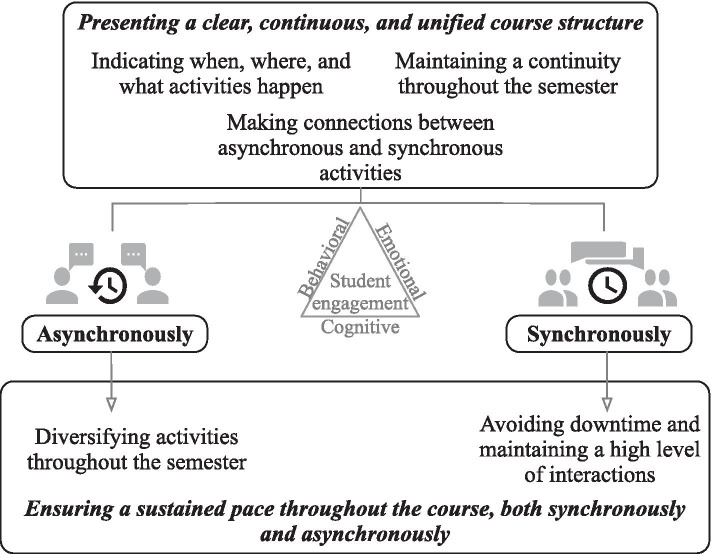
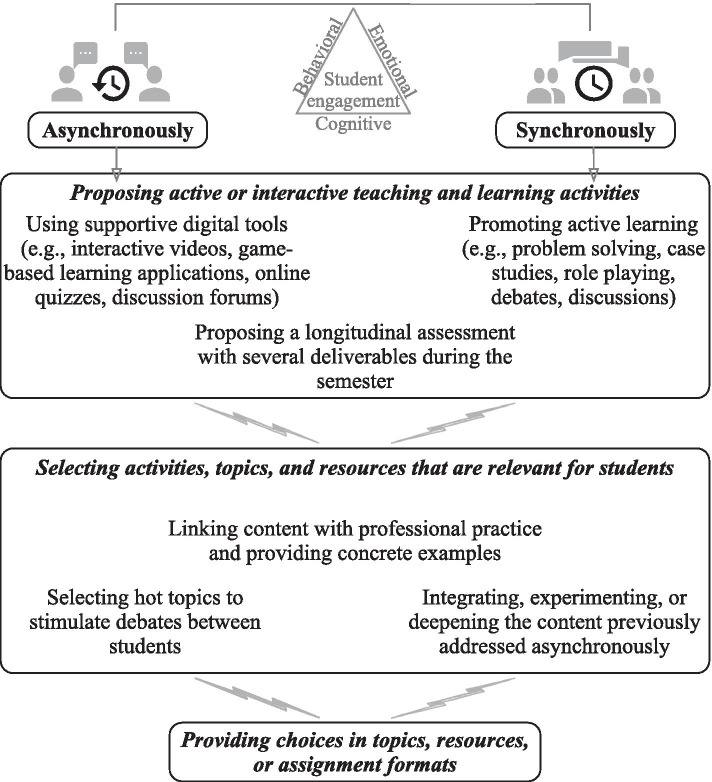
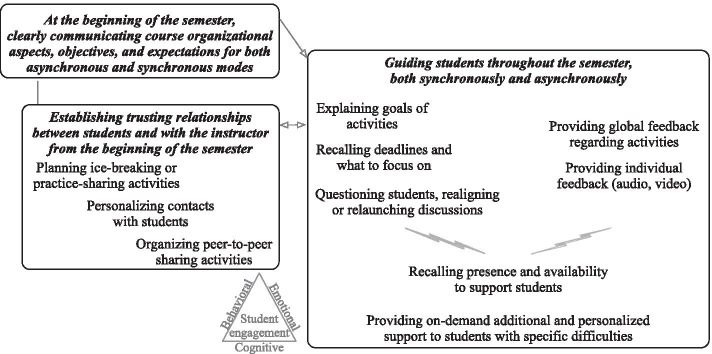
This qualitative study examined how teachers fostered student engagement in blended learning (BL), i.e., blended, blended online, and blended synchronous courses that combine synchronous and asynchronous activities. Twenty semi-structured interviews with teachers in various disciplines, at the undergraduate or graduate level in four universities, were conducted and analyzed using an inductive approach. Therefore, the study proposed a broad and comprehensive picture of teachers’ strategies to enhance student engagement in BL, that were classified in three meta-categories concerning (i) the course structure and pace; (ii) the selection of teaching and learning activities; and (iii) the teacher’s role and course relationships. Strategies were also linked with student engagement dimensions (behavioral, emotional, cognitive), whenever possible. The findings particularly emphasized the importance of a well-structured and -paced course, fully exploiting and integrating synchronous and asynchronous modes of BL. Clearly communicating how the course would unfold and corresponding expectations as well as establishing trusting relationships at the beginning of the semester also appeared as key to foster student engagement in BL. The use of various digital tools was also highlighted to promote student behavioral and emotional engagement at the undergraduate level, whereas cognitive and emotional engagement of graduate students was mainly targeted through experience-sharing and learning co-construction between students.
Overview
The claims and statistics of this paper haven’t been checked yet.
Free: it reads the open-access text and checks the first 5 claims that cite a source we can check. Create a free account to check every claim.
Integrity signals
Registry
Cites
Statistics
Figures
Verification
Claims the paper makes
The claims and statistics of this paper haven’t been checked yet.
Free: it reads the open-access text and checks the first 5 claims that cite a source we can check. Create a free account to check every claim.
Claims other papers make about this one
Each is checked against this paper’s own text: does it say what the citing paper says it does?
The source backs part of the claim, not all of it — or backs it for a different population, condition or comparison.
In the citing paper
“Although they may still be emerging in some contexts, these teaching and learning models are now accepted by a greater number of institutions [64].”
From Digital Learning and Digital Institution in Higher Education (2023) · cites this paper as [64]
Experimental — accuracy not yet measuredThe cited source says what the claim attributes to it.
In the citing paper
“Presenting a clear course structure and working at a particular pace, engaging learners with interactive activities, and providing additional support and constant feedback will help in improving overall student engagement.”
From Impact of online learning on student's performance and engagement: a systematic review (2024) · cites this paper as [56]
Self-check
Percentages, sums and reported differences re-computed from the paper’s own numbers.
The self-check needs the paper’s full text.
Citations
Cites
(2009) · Cited by 21,330
Qualitative Data Analysis: A Methods Sourcebook
Miles, M. B., Huberman, A. M., & Saldaña, J. (1988) · Cited by 20,701
School Engagement: Potential of the Concept, State of the Evidence
Fredricks, J. A., Blumenfeld, P. C., & Paris, A. H. (2004) · Review of Educational Research · doi:10.3102/00346543074001059 · Cited by 12,581
A General Inductive Approach for Analyzing Qualitative Evaluation Data
Thomas, D. R. (2006) · American Journal of Evaluation · doi:10.1177/1098214005283748 · Cited by 10,858 · cited 3×
“Specifically, Thomas (2006) described the following coding steps: initial reading of transcripts, identification of data segments related to objectives, labelling segments into emerging categories, refining categories to avoid redundancies, highlighting the main categories.”
BackgroundMethodHandbook of Research on Student Engagement
(2012) · doi:10.1007/978-1-4614-2018-7 · Cited by 3,050
The Handbook of Blended Learning: Global Perspectives, Local Designs
Bonk, C. J., Graham, C. R., Cross, J., & Moore, M. G. (2005) · Cited by 2,912
Framing student engagement in higher education
Kahu, E. R. (2013) · Studies in Higher Education · doi:10.1080/03075079.2011.598505 · Cited by 2,103 · cited 3×
“Often described as a multidimensional psycho-social process, numerous authors (Bond et al., 2020; Chris-tenson et al., 2012; Fredricks et al., 2019; Kahu, 2013; Lawson & Lawson, 2013; Manwar-ing et al., 2017; Schindler et al., 2017) refer to the definition provided by Fredricks et al. (2004) based…”
BackgroundBlended Learning in Higher Education: Framework, Principles, and Guidelines
Garrison, D. R., & Vaughan, N. D. (2007) · Wiley eBooks · doi:10.1002/9781118269558 · Cited by 1,609
Challenges in the online component of blended learning: A systematic review
Rasheed, R. A., Kamsin, A., & Abdullah, N. A. (2020) · Computers & Education · doi:10.1016/j.compedu.2019.103701 · Cited by 1,472
Blended Learning in Higher Education: Framework, Principles, and Guidelines.
Wainwright, S. (2011) · Journal of Physical Therapy Education · doi:10.1097/00001416-201110000-00013 · Cited by 1,438 · cited 5×
“…BL aims at “extending thinking and discourse over time and space” and is “specifically directed to enhancing [student] engagement” (Vaughan et al., 2013, p. 9) while leveraging digital technology opportunities in a learner-centered approach (Garrison & Vaughan, 2008; Taylor et al., 2018).”
BackgroundInfluentialDevelopmental Dynamics of Student Engagement, Coping, and Everyday Resilience
Skinner, E. A., & Pitzer, J. R. (2012) · Handbook of Research on Student Engagement · doi:10.1007/978-1-4614-2018-7_2 · Cited by 1,152 · cited 1×
“Here considered in a course context, it represents the investment and energy that students devote to learning (Borup et al., 2020; Fredricks et al., 2016; Skinner & Pitzer, 2012).”
BackgroundStudent engagement in the educational interface: Understanding the mechanisms of student success
Kahu, E. R., & Nelson, K. (2018) · Higher Education Research & Development · doi:10.1080/07294360.2017.1344197 · Cited by 1,108
Bond, M., Buntins, K., Bedenlier, S., Zawacki-Richter, O., & Kerres, M. (2020) · International Journal of Educational Technology in Higher Education · doi:10.1186/s41239-019-0176-8 · Cited by 1,097
The Challenges of Defining and Measuring Student Engagement in Science
Sinatra, G. M., Heddy, B. C., & Lombardi, D. (2015) · Educational Psychologist · doi:10.1080/00461520.2014.1002924 · Cited by 1,044
Jingle, Jangle, and Conceptual Haziness: Evolution and Future Directions of the Engagement Construct
Reschly, A. L., & Christenson, S. L. (2012) · Handbook of Research on Student Engagement · doi:10.1007/978-1-4614-2018-7_1 · Cited by 980 · cited 1×
“Recognized as a complex and multifaceted construct, student engagement is rooted in action (Bond et al., 2020; Kahu, 2013; Reschly & Christenson, 2012).”
BackgroundFredricks, J. A., Filsecker, M., & Lawson, M. A. (2016) · Learning and Instruction · doi:10.1016/j.learninstruc.2016.02.002 · Cited by 851
Grade Increase: Tracking Distance Education in the United States.
Seaman, J. E., Allen, I. E., & Seaman, J. (2018) · Cited by 810
(2016) · Cited by 785
Shea, P., Sau Li, C., & Pickett, A. (2006) · The Internet and Higher Education · doi:10.1016/j.iheduc.2006.06.005 · Cited by 740
Four key challenges to the design of blended learning: A systematic literature review
Boelens, R., De Wever, B., & Voet, M. (2017) · Educational Research Review · doi:10.1016/j.edurev.2017.06.001 · Cited by 698 · cited 2×
“Nevertheless, teachers play a central role in BL, from course design to facilitation of interactions and support of students’ learning processes (Boelens et al., 2017; McGee & Reis, 2012).”
BackgroundNew Conceptual Frameworks for Student Engagement Research, Policy, and Practice
Lawson, M. A., & Lawson, H. A. (2013) · Review of Educational Research · doi:10.3102/0034654313480891 · Cited by 681 · cited 2×
“…multidimensional psycho-social process, numerous authors (Bond et al., 2020; Chris-tenson et al., 2012; Fredricks et al., 2019; Kahu, 2013; Lawson & Lawson, 2013; Manwar-ing et al., 2017; Schindler et al., 2017) refer to the definition provided by Fredricks et al. (2004) based on a qualitative…”
BackgroundThe College and the University
Jordan, D. S. (1908) · Science · doi:10.1126/science.27.692.530 · Cited by 665
A systematic literature review on synchronous hybrid learning: gaps identified
Raes, A., Detienne, L., Windey, I., & Depaepe, F. (2020) · Learning Environments Research · doi:10.1007/s10984-019-09303-z · Cited by 600
Blended learning in higher education framework, principles, and guidelines
Garrison, D. R., & Vaughan, N. D. (2008) · Cited by 544
Bower, M., Dalgarno, B., Kennedy, G. E., Lee, M. J. W., & Kenney, J. (2015) · Computers & Education · doi:10.1016/j.compedu.2015.03.006 · Cited by 540
Computer-based technology and student engagement: a critical review of the literature
Schindler, L. A., Burkholder, G. J., Morad, O. A., & Marsh, C. (2017) · International Journal of Educational Technology in Higher Education · doi:10.1186/s41239-017-0063-0 · Cited by 475
Learner Engagement in Blended Learning Environments: A Conceptual Framework
Halverson, L. R., & Graham, C. R. (2019) · Online Learning · doi:10.24059/olj.v23i2.1481 · Cited by 437 · cited 4×
“…and asynchronous activities and are situated on a continuum between face-to-face and online teaching and learning, are of particular interest since the literature suggests that they have the potential to optimize student engagement (Graham, 2019; Halverson & Graham, 2019; Manwaring et al., 2017).”
BackgroundInfluentialThe Relationship Between Student Engagement and Academic Performance: Is It a Myth or Reality?
Lee, J.-S. (2014) · The Journal of Educational Research · doi:10.1080/00220671.2013.807491 · Cited by 406
International Journal of Learning, Teaching and Educational Research
(2017) · International Journal of Learning Teaching and Educational Research · doi:10.26803/ijlter · Cited by 394
Martin, F., Wang, C., & Sadaf, A. (2018) · The Internet and Higher Education · doi:10.1016/j.iheduc.2018.01.003 · Cited by 388 · cited 3×
“Finally, providing choices to the students was mentioned by teachers to foster student emotional and cognitive engagement, echoing other publications in BL or other environments (e.g., Bolliger & Martin, 2018; Cundell & Sheepy, 2018; Montgomery et al., 2015).”
BackgroundResultFacilitating Student Engagement Through Educational Technology: Towards a Conceptual Framework
Bond, M., & Bedenlier, S. (2019) · Journal of Interactive Media in Education · doi:10.5334/jime.528 · Cited by 374
Raes, A., Vanneste, P., Pieters, M., Windey, I., Van Den Noortgate, W., & Depaepe, F. (2020) · Computers & Education · doi:10.1016/j.compedu.2019.103682 · Cited by 336
Blended Course Design: A Synthesis of Best Practices
McGee, P., & Reis, A. (2012) · Online Learning · doi:10.24059/olj.v16i4.239 · Cited by 329 · cited 7×
“…BL as a combination of face-to-face and online activities (Bonk & Graham, 2012), while some more precise definitions explicitly identify a decrease in face-to-face meetings (Bates, 2018; McGee & Reis, 2012; Picciano, 2009), e.g., between 30 and 79% of online learning (Allen & Sea-man, 2016).”
BackgroundInfluentialHalverson, L. R., Graham, C. R., Spring, K. J., Drysdale, J. S., & Henrie, C. R. (2014) · The Internet and Higher Education · doi:10.1016/j.iheduc.2013.09.004 · Cited by 322
Defining the nature of blended learning through its depiction in current research
Smith, K., & Hill, J. (2019) · Higher Education Research & Development · doi:10.1080/07294360.2018.1517732 · Cited by 321
Boelens, R., Voet, M., & De Wever, B. (2018) · Computers & Education · doi:10.1016/j.compedu.2018.02.009 · Cited by 305
Teaching in Blended Learning Environments: Creating and Sustaining Communities of Inquiry
Vaughan, N. D., Cleveland-Innes, M., & Garrison, D. R. (2013) · Athabasca University Press eBooks · doi:10.15215/aupress/9781927356470.01 · Cited by 296 · cited 5×
“…(e.g., Berry, 2019; Bolliger & Martin, 2018; Lervik et al., 2018; Orcutt & Dringus, 2017; Robinson et al., 2017), and recalled the intersection of teaching and social presence of the Community of Inquiry Framework concerned with establishing a positive affective climate (Vaughan et al., 2013).”
BackgroundInfluentialAn analysis of research trends in dissertations and theses studying blended learning
Drysdale, J. S., Graham, C. R., Spring, K. J., & Halverson, L. R. (2013) · The Internet and Higher Education · doi:10.1016/j.iheduc.2012.11.003 · Cited by 286
Beatty, B. (2019) · doi:10.59668/33 · Cited by 282
Manwaring, K. C., Larsen, R., Graham, C. R., Henrie, C. R., & Halverson, L. R. (2017) · The Internet and Higher Education · doi:10.1016/j.iheduc.2017.06.002 · Cited by 279 · cited 5×
“Therefore, numerous authors identify BL as a fertile ground to optimize student engagement (Halverson & Graham, 2019; Halverson et al., 2014; Manwaring et al., 2017; Serrano et al., 2019; Spring et al., 2016; Taylor et al., 2018).”
BackgroundResultInfluentialExperts speaking: Crucial teacher attributes for implementing blended learning in higher education
Bruggeman, B., Tondeur, J., Struyven, K., Pynoo, B., Garone, A., & Vanslambrouck, S. (2021) · The Internet and Higher Education · doi:10.1016/j.iheduc.2020.100772 · Cited by 273
Ma, J., Han, X., Yang, J., & Cheng, J. (2015) · The Internet and Higher Education · doi:10.1016/j.iheduc.2014.09.005 · Cited by 246
Blended Learning: How Teachers Balance the Blend of Online and Classroom Components
Jeffrey, L., Milne, J., Suddaby, G., & Higgins, A. (2014) · Journal of Information Technology Education: Research · doi:10.28945/1968 · Cited by 236
Serrano, D. R., Dea‐Ayuela, M. A., Gonzalez‐Burgos, E., Serrano‐Gil, A., & Lalatsa, A. (2019) · European Journal of Education · doi:10.1111/ejed.12330 · Cited by 236
Instructor and student perceptions of online student engagement strategies
Bolliger, D. U., & Martin, F. (2018) · Distance Education · doi:10.1080/01587919.2018.1520041 · Cited by 233
A balancing act: a window into online student engagement experiences
Farrell, O., & Brunton, J. (2020) · International Journal of Educational Technology in Higher Education · doi:10.1186/s41239-020-00199-x · Cited by 233
Borup, J., Graham, C. R., West, R. E., Archambault, L., & Spring, K. J. (2020) · Educational Technology Research and Development · doi:10.1007/s11423-020-09744-x · Cited by 225
Student Engagement and Blended Learning: Making the Assessment Connection
Vaughan, N. D. (2014) · Education Sciences · doi:10.3390/educsci4040247 · Cited by 204 · cited 4×
“In contrast to publications with a specific focus like collaborative learning applications (e.g., Vaughan, 2014) or a limited number of participants (e.g., Jeffrey et al., 2014; Mont-gomery et al., 2015), this study aimed to present a broad and comprehensive picture of strategies used by teachers…”
BackgroundResultInfluentialCurrent Research in Blended Learning
Graham, C. R. (2018) · Routledge eBooks · doi:10.4324/9781315296135-15 · Cited by 204 · cited 13×
“…suggestions of enhanced student engagement in BL, few studies in BL have specifically addressed student engagement in their research questions, and even less so teachers’ strategies to promote student engagement (Graham, 2019; Halverson et al., 2014; Siemens et al., 2015; Taylor et al., 2018).”
BackgroundInfluentialInterventions for Student Engagement: Overview and State of the Field
Fredricks, J. A., Reschly, A. L., & Christenson, S. L. (2019) · Elsevier eBooks · doi:10.1016/b978-0-12-813413-9.00001-2 · Cited by 203 · cited 2×
“Often described as a multidimensional psycho-social process, numerous authors (Bond et al., 2020; Chris-tenson et al., 2012; Fredricks et al., 2019; Kahu, 2013; Lawson & Lawson, 2013; Manwar-ing et al., 2017; Schindler et al., 2017) refer to the definition provided by Fredricks et al. (2004) based…”
BackgroundAssessment of Student Engagement in Higher Education: A Synthesis of Literature and Assessment Tools
Mandernach, B. J. (2015) · International Journal of Learning Teaching and Educational Research · Cited by 202
Torrisi-Steele, G., & Drew, S. (2013) · International Journal for Academic Development · doi:10.1080/1360144x.2013.786720 · Cited by 196
Teaching to Connect: Community-Building Strategies for the Virtual Classroom
Berry, S. (2019) · Online Learning · doi:10.24059/olj.v23i1.1425 · Cited by 192 · cited 4×
“In some cases, students may also have the possibility to watch meeting recordings or alternative videos instead of participating in synchronous T&L activities, thus being offered full flexibility of participation corresponding to HyFlex Courses (Beatty, 2007, 2014, 2019).”
BackgroundResultInfluentialDeveloping Models and Theory for Blended Learning Research
(2013) · Blended Learning · doi:10.4324/9781315880310-12 · Cited by 179
Student engagement in very large classes: the teachers’ perspective
Exeter, D. J., Ameratunga, S., Ratima, M., Morton, S., Dickson, M., Hsu, D., & Jackson, R. (2010) · Studies in Higher Education · doi:10.1080/03075070903545058 · Cited by 168
BLENDING WITH PURPOSE: THE MULTIMODAL MODEL
Picciano, A. G. (2009) · Online Learning · doi:10.24059/olj.v13i1.1673 · Cited by 153 · cited 1×
“…BL as a combination of face-to-face and online activities (Bonk & Graham, 2012), while some more precise definitions explicitly identify a decrease in face-to-face meetings (Bates, 2018; McGee & Reis, 2012; Picciano, 2009), e.g., between 30 and 79% of online learning (Allen & Sea-man, 2016).”
BackgroundExploring intensive longitudinal measures of student engagement in blended learning
Henrie, C. R., Bodily, R., Manwaring, K. C., & Graham, C. R. (2015) · The International Review of Research in Open and Distributed Learning · doi:10.19173/irrodl.v16i3.2015 · Cited by 149
Tan, M., & Hew, K. F. (2016) · Australasian Journal of Educational Technology · doi:10.14742/ajet.2232 · Cited by 147 · cited 1×
“…also investigated single courses (e.g., Binnewies & Wang, 2019; Cundell & Sheepy, 2018; Raes et al., 2020), specific activities (e.g., Foogooa & Ferdinand-James, 2017; Kulkarni & Iwinski, 2016; Tan & Hew, 2016), or aspects of student engagement (e.g., Berry, 2019; Truhlar et al., 2018).”
BackgroundThe Emergence of a Blended Online Learning Environment
Power, M. (2008) · Cited by 125
Lakhal, S., Mukamurera, J., Bédard, M.-È., Heilporn, G., & Chauret, M. (2020) · International Journal of Educational Technology in Higher Education · doi:10.1186/s41239-020-0180-z · Cited by 124 · cited 2×
“Moreover, most publications did not present an explicit definition of student engagement and only Heilporn and Lakhal (2020) investigated the issue using a multidimensional perspective.”
BackgroundSelf-citationStudent engagement: students' and teachers' perceptions
Zepke, N., Leach, L., & Butler, P. J. (2013) · Higher Education Research & Development · doi:10.1080/07294360.2013.832160 · Cited by 111
The current landscape of international blended learning
Spring, K. J., Graham, C. R., & Hadlock, C. A. (2016) · International Journal of Technology Enhanced Learning · doi:10.1504/ijtel.2016.075961 · Cited by 109
Challenges of Student Equity and Engagement in a HyFlex Course
Binnewies, S., & Wang, Z. (2019) · Springer eBooks · doi:10.1007/978-981-13-6982-7_12 · Cited by 102 · cited 1×
“Most existing publications also investigated single courses (e.g., Binnewies & Wang, 2019; Cundell & Sheepy, 2018; Raes et al., 2020), specific activities (e.g., Foogooa & Ferdinand-James, 2017; Kulkarni & Iwinski, 2016; Tan & Hew, 2016), or aspects of student engagement (e.g., Berry, 2019; Truhlar…”
BackgroundSystematic Review of Two Decades (1995 to 2014) of Research on Synchronous Online Learning
Martin, F., Ahlgrim-Delzell, L., & Budhrani, K. (2017) · American Journal of Distance Education · doi:10.1080/08923647.2017.1264807 · Cited by 100
Student Retention Models in Higher Education: A Literature Review.
Burke, A. (2019) · College and university · Cited by 92
Blending for student engagement: Lessons learned for MOOCs and beyond
Montgomery, A. P., Hayward, D. V., Dunn, W., Carbonaro, M., & Amrhein, C. (2015) · Australasian Journal of Educational Technology · doi:10.14742/ajet.1869 · Cited by 90
Care, Communication, Support: Core for Designing Meaningful Online Collaborative Learning
Robinson, H. A., Kilgore, W., & Warren, S. J. (2017) · Online Learning · doi:10.24059/olj.v21i4.1240 · Cited by 89 · cited 1×
“…were in line with other studies in BL or online learning (e.g., Berry, 2019; Bolliger & Martin, 2018; Lervik et al., 2018; Orcutt & Dringus, 2017; Robinson et al., 2017), and recalled the intersection of teaching and social presence of the Community of Inquiry Framework concerned with…”
ResultLakhal, S., Bateman, D., & Bédard, J. (2017) · Collected Essays on Learning and Teaching · doi:10.22329/celt.v10i0.4747 · Cited by 76
Self-citationCundell, A., & Sheepy, E. (2018) · Online Learning · doi:10.24059/olj.v22i3.1467 · Cited by 76 · cited 2×
“Finally, providing choices to the students was mentioned by teachers to foster student emotional and cognitive engagement, echoing other publications in BL or other environments (e.g., Bolliger & Martin, 2018; Cundell & Sheepy, 2018; Montgomery et al., 2015).”
BackgroundHybrid Courses with Flexible Participation
Beatty, B. (2013) · Advances in mobile and distance learning book series · doi:10.4018/978-1-4666-4912-5.ch011 · Cited by 69 · cited 1×
“In some cases, students may also have the possibility to watch meeting recordings or alternative videos instead of participating in synchronous T&L activities, thus being offered full flexibility of participation corresponding to HyFlex Courses (Beatty, 2007, 2014, 2019).”
BackgroundBates, T. (2018) · International Journal of Educational Technology in Higher Education · doi:10.1186/s41239-018-0112-3 · Cited by 69 · cited 1×
“…BL as a combination of face-to-face and online activities (Bonk & Graham, 2012), while some more precise definitions explicitly identify a decrease in face-to-face meetings (Bates, 2018; McGee & Reis, 2012; Picciano, 2009), e.g., between 30 and 79% of online learning (Allen & Sea-man, 2016).”
BackgroundRedesigning Online Learning for International Graduate Seminar Delivery.
Power, M., & Vaughan, N. D. (2010) · Cited by 61
Orcutt, J. M., & Dringus, L. P. (2017) · Online Learning · doi:10.24059/olj.v21i3.1231 · Cited by 61
Assimilation in Online Course Design
Baldwin, S. J. (2019) · American Journal of Distance Education · doi:10.1080/08923647.2019.1610304 · Cited by 54
Transitioning to an Online World: Using HyFlex Courses to Bridge the Gap
Beatty, B. (2007) · EdMedia: World Conference on Educational Media and Technology · Cited by 47
A Thematic Review of Blended Learning in Higher Education
Pima, J. K. M., Odetayo, M. O., Iqbal, R., & Sedoyeka, E. (2017) · International Journal of Mobile and Blended Learning · doi:10.4018/ijmbl.2018010101 · Cited by 47
Looking Back and Looking Forward: A Glimpse of Blended Learning in Higher Education From 2007-2017
Taylor, M. C., Vaughan, N. D., Ghani, S. K., Ataş, S., & Fairbrother, M. (2018) · International Journal of Adult Vocational Education and Technology · doi:10.4018/ijavet.2018010101 · Cited by 42
Student engagement with course content and peers in synchronous online courses discussions
Truhlar, A. M., Williams, K. M., & Walter, M. T. (2018) · Online Learning · doi:10.24059/olj.v22i4.1389 · Cited by 33
A Continuum of Blended and Online Learning
Lakhal, S., & Bélisle, M. (2020) · The Canadian Journal for the Scholarship of Teaching and Learning · doi:10.5206/cjsotl-rcacea.2020.3.13420 · Cited by 20 · cited 2×
“Moreover, most publications did not present an explicit definition of student engagement and only Heilporn and Lakhal (2020) investigated the issue using a multidimensional perspective.”
BackgroundSelf-citationLakhal, S., & Meyer, F. (2019) · Springer eBooks · doi:10.1007/978-3-319-60013-0_41-1 · Cited by 19 · cited 1×
“BL is situated on a continuum between face-to-face and online learning (Lakhal & Meyer, 2019).”
BackgroundSelf-citationAlternate Dimensions of Cognitive Presence for Blended Learning in Higher Education
Taylor, M. C., Ataş, S., & Ghani, S. K. (2019) · International Journal of Mobile and Blended Learning · doi:10.4018/ijmbl.2019040101 · Cited by 16
Conditions for Cooperating and Dialogue through the Utilization of Technology in Online Education
Lervik, M. J., Vold, T., & Holen, S. (2018) · Universal Journal of Educational Research · doi:10.13189/ujer.2018.061034 · Cited by 14
Examining Academic Integrity Using Course-Level Learning Outcomes
Clark, A., Goodfellow, J., & Shoufani, S. (2020) · The Canadian Journal for the Scholarship of Teaching and Learning · doi:10.5206/cjsotl-rcacea.2020.2.8508 · Cited by 14
USE OF FACEBOOK FOR ENHANCING STUDENT ENGAGEMENT IN A HIGHER EDUCATION BLENDED ENGINEERING COURSE
Foogooa, R., & Ferdinand, D. (2017) · Innovative Issues and Approaches in Social Sciences · doi:10.12959/issn.1855-0541.iiass-2017-no1-art1 · Cited by 6 · cited 1×
“…publications also investigated single courses (e.g., Binnewies & Wang, 2019; Cundell & Sheepy, 2018; Raes et al., 2020), specific activities (e.g., Foogooa & Ferdinand-James, 2017; Kulkarni & Iwinski, 2016; Tan & Hew, 2016), or aspects of student engagement (e.g., Berry, 2019; Truhlar et al.,…”
BackgroundKulkarni, A. K., & Iwinski, T. (2016) · Journal of Engineering Education Transformations · doi:10.16920/jeet/2016/v30i1/97427 · Cited by 5
Research works printed but not linked: 1
- Siemens, G., Gašević, D., & Dawson, S. (2015). Preparing for the digital university: A review of the history and current state of distance, blended, and online learning. http://linkresearchlab.org/PreparingDigitalUniversity.pdf
Cited by
Digital Learning and Digital Institution in Higher Education
Alenezi, M. (2023) · Education Sciences · doi:10.3390/educsci13010088 · Cited by 376
“Although they may still be emerging in some contexts, these teaching and learning models are now accepted by a greater number of institutions [64].”
BackgroundExploring Student and Teacher Experiences in Hybrid Learning Environments: Does Presence Matter?
Raes, A. (2022) · Postdigital Science and Education · doi:10.1007/s42438-021-00274-0 · Cited by 189
“…variations such as learning environments (Bond and Bedenlier 2019; Fredericks et al. 2004; Raes et al. 2020; Shi et al. 2021) or teacher strategies (Heilporn et al. 2021), it is important to investigate how student engagement as an affective learning outcome is influenced both by the design of the…”
BackgroundInfluentialImpact of online learning on student's performance and engagement: a systematic review
Akpen, C. N., Asaolu, S., Atobatele, S., Okagbue, H., & Sampson, S. (2024) · Discover Education · doi:10.1007/s44217-024-00253-0 · Cited by 205
“In a study conducted by Heilporn et al. [56], the author examined strategies that can be used by teachers to improve student engagement in a blended learning environment.”
Imran, R., Fatima, A., Elbayoumi Salem, I., & Allil, K. (2023) · The International Journal of Management Education · doi:10.1016/j.ijme.2023.100805 · Cited by 172
Sayaf, A. M., Alamri, M. M., Alqahtani, M. A., & Al-Rahmi, W. M. (2021) · Sustainability · doi:10.3390/su13137074 · Cited by 149
“At the undergraduate level, the use of different digital technologies was also highlighted to boost student behavioural and emotional involvement, whilst graduate students’ cognitive and emotional engagement was primarily addressed through experience-sharing and learning co-construction online [80].”
Background
Metadata
- Authors
- Heilporn, G., Lakhal, S., & Bélisle, M.
- Affiliations
- Université de Sherbrooke (CA)
- Corresponding author
- Heilporn, Géraldine
- Venue
- International Journal of Educational Technology in Higher Education
- Published
- 2021-05-10
- Volume
- 18
- Issue
- 1
- Pages
- 25-25
- ISSN
- 2365-9440 (ISSN-L)
- PMC
- PMC8591686
- OpenAlex
- W3162288571
- Cited by
- 381
- References
- 86
- Citations by year
- 2026: 54 · 2025: 93 · 2024: 102 · 2023: 67 · 2022: 50 · 2021: 14
- FWCI
- 102.43
- Type
- journal article
- Language
- en
- Open access
- diamond
- doi.org
- Licence
- cc-by
- creativecommons.org/licenses/by/4.0 (tdm)
- creativecommons.org/licenses/by/4.0 (vor)
- Locations
- International Journal of Educational Technology in Higher Education (publishedVersion, cc-by)
- PubMed Central (publishedVersion, cc-by)
- PubMed (publishedVersion)
- DOAJ (DOAJ: Directory of Open Access Journals) (submittedVersion, cc-by-sa)
- Funders
- Social Sciences and Humanities Research Council of Canada (Doctoral Fellowship)
- Topics
- Social Sciences › Education › Online and Blended Learning
- Social Sciences › Education › Innovative Teaching Methods
- Social Sciences › Education › English Language Learning and Teaching
- Keywords
- blended learning, student engagement, teacher strategies, university teaching, synchronous and asynchronous activities, teacher role, teacher-student relationship, digital tools, behavioral engagement, emotional engagement, cognitive engagement, undergraduate students, graduate students, experience sharing
About these checks
Registry, retraction, Cites and statistics results are computed, not judged, with one exception: a printed reference that no index lists is read once by a model before it counts as a citation error. Claims are extracted by a model and kept only when their quote appears verbatim in the text; each cited source is then checked, with a model’s help, for whether it says what the claim relies on. Those verdicts can be wrong — read the claim’s quote and the cited source before relying on one.
Statistics and arithmetic are recomputed, not judged.
Confidence bands are shown only for fields calibrated on our annotated test set. None is calibrated yet, so no band is shown.
What counts as a claim ›How we measure confidence ›How we check this ›
Are you an author, or do you see a problem with this page? Request a review
Data sources
Bibliographic data: Semantic Scholar, OpenAlex, Crossref.
Contains information from the Semantic Scholar Academic Graph Datasets, made available under the ODC Attribution License (ODC-BY 1.0).
Semantic Scholar’s data is described in: Kinney, R., et al. (2023). The Semantic Scholar Open Data Platform. arXiv:2301.10140.
