

An examination of teachers’ strategies to foster student engagement in blended learning in higher education
Open accessThe DOI matches its Crossref record; 85 of the 86 references it cites were found in a registry or an index.
Abstract
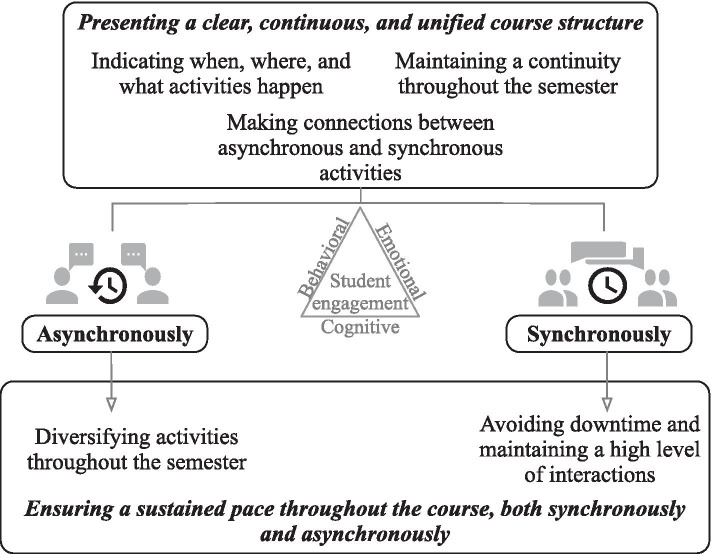
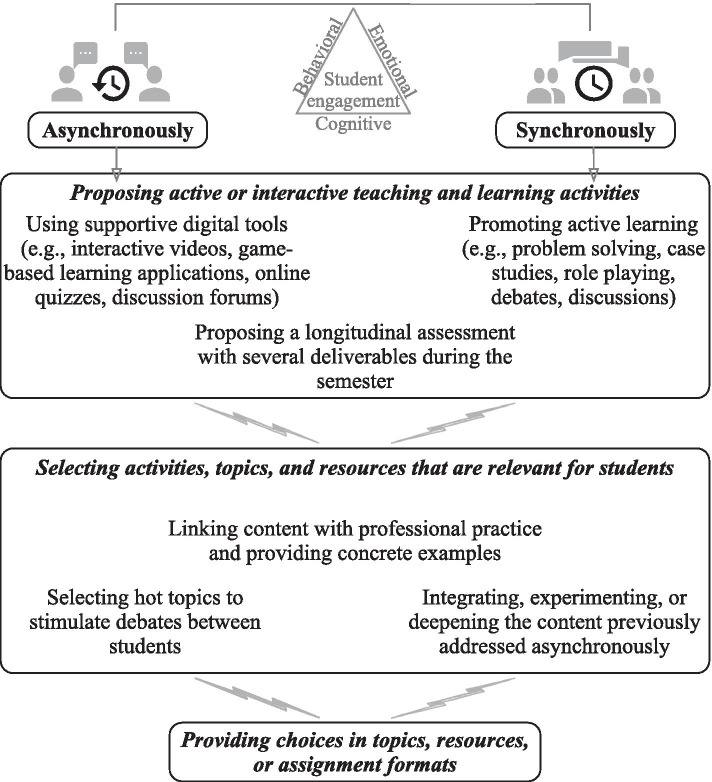
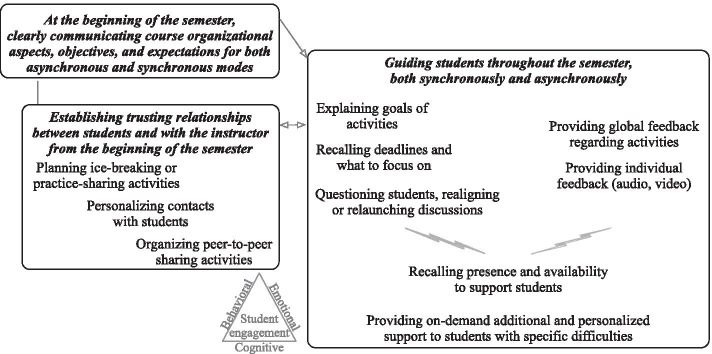
This qualitative study examined how teachers fostered student engagement in blended learning (BL), i.e., blended, blended online, and blended synchronous courses that combine synchronous and asynchronous activities. Twenty semi-structured interviews with teachers in various disciplines, at the undergraduate or graduate level in four universities, were conducted and analyzed using an inductive approach. Therefore, the study proposed a broad and comprehensive picture of teachers’ strategies to enhance student engagement in BL, that were classified in three meta-categories concerning (i) the course structure and pace; (ii) the selection of teaching and learning activities; and (iii) the teacher’s role and course relationships. Strategies were also linked with student engagement dimensions (behavioral, emotional, cognitive), whenever possible. The findings particularly emphasized the importance of a well-structured and -paced course, fully exploiting and integrating synchronous and asynchronous modes of BL. Clearly communicating how the course would unfold and corresponding expectations as well as establishing trusting relationships at the beginning of the semester also appeared as key to foster student engagement in BL. The use of various digital tools was also highlighted to promote student behavioral and emotional engagement at the undergraduate level, whereas cognitive and emotional engagement of graduate students was mainly targeted through experience-sharing and learning co-construction between students.
Overview
The claims and statistics of this paper haven’t been checked yet.
Free: it reads the open-access text and checks the first 5 claims that cite a source we can check. Create a free account to check every claim.
Integrity signals
Registry
Cites
Statistics
Figures
Verification
Claims the paper makes
The claims and statistics of this paper haven’t been checked yet.
Free: it reads the open-access text and checks the first 5 claims that cite a source we can check. Create a free account to check every claim.
Claims other papers make about this one
Each is checked against this paper’s own text: does it say what the citing paper says it does?
The source backs part of the claim, not all of it — or backs it for a different population, condition or comparison.
In the citing paper
“Although they may still be emerging in some contexts, these teaching and learning models are now accepted by a greater number of institutions [64].”
From Digital Learning and Digital Institution in Higher Education (2023) · cites this paper as [64]
Experimental — accuracy not yet measuredThe cited source says what the claim attributes to it.
In the citing paper
“Presenting a clear course structure and working at a particular pace, engaging learners with interactive activities, and providing additional support and constant feedback will help in improving overall student engagement.”
From Impact of online learning on student's performance and engagement: a systematic review (2024) · cites this paper as [56]
Self-check
Percentages, sums and reported differences re-computed from the paper’s own numbers.
The self-check needs the paper’s full text.
Citations
Cites
(2009) · Cited by 21,330
Qualitative Data Analysis: A Methods Sourcebook
Miles, M. B., Huberman, A. M., & Saldaña, J. (1988) · Cited by 20,701
School Engagement: Potential of the Concept, State of the Evidence
Fredricks, J. A., Blumenfeld, P. C., & Paris, A. H. (2004) · Review of Educational Research · doi:10.3102/00346543074001059 · Cited by 12,581
A General Inductive Approach for Analyzing Qualitative Evaluation Data
Thomas, D. R. (2006) · American Journal of Evaluation · doi:10.1177/1098214005283748 · Cited by 10,858 · cited 3×
“Specifically, Thomas (2006) described the following coding steps: initial reading of transcripts, identification of data segments related to objectives, labelling segments into emerging categories, refining categories to avoid redundancies, highlighting the main categories.”
BackgroundMethodHandbook of Research on Student Engagement
(2012) · doi:10.1007/978-1-4614-2018-7 · Cited by 3,050
The Handbook of Blended Learning: Global Perspectives, Local Designs
Bonk, C. J., Graham, C. R., Cross, J., & Moore, M. G. (2005) · Cited by 2,928
Framing student engagement in higher education
Kahu, E. R. (2013) · Studies in Higher Education · doi:10.1080/03075079.2011.598505 · Cited by 2,103 · cited 3×
“Often described as a multidimensional psycho-social process, numerous authors (Bond et al., 2020; Chris-tenson et al., 2012; Fredricks et al., 2019; Kahu, 2013; Lawson & Lawson, 2013; Manwar-ing et al., 2017; Schindler et al., 2017) refer to the definition provided by Fredricks et al. (2004) based…”
BackgroundBlended Learning in Higher Education: Framework, Principles, and Guidelines
Garrison, D. R., & Vaughan, N. D. (2007) · Wiley eBooks · doi:10.1002/9781118269558 · Cited by 1,609
Challenges in the online component of blended learning: A systematic review
Rasheed, R. A., Kamsin, A., & Abdullah, N. A. (2020) · Computers & Education · doi:10.1016/j.compedu.2019.103701 · Cited by 1,472
Blended Learning in Higher Education: Framework, Principles, and Guidelines.
Wainwright, S. (2011) · Journal of Physical Therapy Education · doi:10.1097/00001416-201110000-00013 · Cited by 1,438 · cited 5×
“…BL aims at “extending thinking and discourse over time and space” and is “specifically directed to enhancing [student] engagement” (Vaughan et al., 2013, p. 9) while leveraging digital technology opportunities in a learner-centered approach (Garrison & Vaughan, 2008; Taylor et al., 2018).”
BackgroundInfluential
Research works printed but not linked: 1
- Siemens, G., Gašević, D., & Dawson, S. (2015). Preparing for the digital university: A review of the history and current state of distance, blended, and online learning. http://linkresearchlab.org/PreparingDigitalUniversity.pdf
Cited by
Digital Learning and Digital Institution in Higher Education
Alenezi, M. (2023) · Education Sciences · doi:10.3390/educsci13010088 · Cited by 376
“Although they may still be emerging in some contexts, these teaching and learning models are now accepted by a greater number of institutions [64].”
BackgroundExploring Student and Teacher Experiences in Hybrid Learning Environments: Does Presence Matter?
Raes, A. (2022) · Postdigital Science and Education · doi:10.1007/s42438-021-00274-0 · Cited by 189
“…variations such as learning environments (Bond and Bedenlier 2019; Fredericks et al. 2004; Raes et al. 2020; Shi et al. 2021) or teacher strategies (Heilporn et al. 2021), it is important to investigate how student engagement as an affective learning outcome is influenced both by the design of the…”
BackgroundInfluentialImpact of online learning on student's performance and engagement: a systematic review
Akpen, C. N., Asaolu, S., Atobatele, S., Okagbue, H., & Sampson, S. (2024) · Discover Education · doi:10.1007/s44217-024-00253-0 · Cited by 205
“In a study conducted by Heilporn et al. [56], the author examined strategies that can be used by teachers to improve student engagement in a blended learning environment.”
Imran, R., Fatima, A., Elbayoumi Salem, I., & Allil, K. (2023) · The International Journal of Management Education · doi:10.1016/j.ijme.2023.100805 · Cited by 172
Sayaf, A. M., Alamri, M. M., Alqahtani, M. A., & Al-Rahmi, W. M. (2021) · Sustainability · doi:10.3390/su13137074 · Cited by 149
“At the undergraduate level, the use of different digital technologies was also highlighted to boost student behavioural and emotional involvement, whilst graduate students’ cognitive and emotional engagement was primarily addressed through experience-sharing and learning co-construction online [80].”
BackgroundMüller, C., Mildenberger, T., & Steingruber, D. (2023) · International Journal of Educational Technology in Higher Education · doi:10.1186/s41239-022-00379-x · Cited by 255
“Further studies (Caskurlu et al., 2021; Ellis et al., 2016; Han & Ellis, 2019; Heilporn et al., 2021) have also identified course structure and guidance as important design factors in blended learning.”
BackgroundZhao, Y., Zhao, M., & Shi, F. (2023) · Journal of the Knowledge Economy · doi:10.1007/s13132-023-01693-z · Cited by 215
“Heilporn et al. (2021) explored the correlation between teacher morality and student engagement in the learning process.”
RetractedTrabada, A. V., & Esteban, J. M. V. (2021) · Frontiers in Psychology · doi:10.3389/fpsyg.2021.648592 · Cited by 105
“Blended Learning This model is based on a combination of classroom education and online education in various forms (Lightner and LightnerLaws, 2016; Nuruzzaman, 2016; Heilporn et al., 2021).”
MethodMotivation, Stress and Impact of Online Teaching on Italian Teachers during COVID-19
Toto, G. A., & Limone, P. (2021) · Computers · doi:10.3390/computers10060075 · Cited by 102
“Everything is happening through the integrated use of technologies in educational paths, redesigning the space–time boundaries of learning thanks to the application of flexible teaching methodologies [30].”
BackgroundLee, J. J., Tsang, V. W. Y., Chan, M. M. K., O’Connor, S., Lokmic‐Tomkins, Z., Ye, F., Kwok, J. Y. Y., & Ho, M. (2023) · Nurse Education Today · doi:10.1016/j.nedt.2023.105903 · Cited by 86
Goh, T., & Bing, Y. (2021) · International Journal of Educational Technology in Higher Education · doi:10.1186/s41239-021-00285-8 · Cited by 102
“the lecture and for interactive lecture activities (Heilporn et al., 2021).”
BackgroundZhong, Q., Wang, Y., Lv, W., Xu, J., & Zhang, Y. (2022) · Sustainability · doi:10.3390/su14095619 · Cited by 98
Converting a graduate-level course into a HyFlex modality: What are effective engagement strategies?
Heilporn, G., & Lakhal, S. (2021) · The International Journal of Management Education · doi:10.1016/j.ijme.2021.100454 · Cited by 75
Self-citationStudent engagement and teaching presence in blended learning and emergency remote teaching
Su, F., Zou, D., Wang, L., & Kohnke, L. (2023) · Journal of Computers in Education · doi:10.1007/s40692-023-00263-1 · Cited by 93
“Heilporn et al. (2021) suggested that teachers improve SE in blended learning by presenting clear, continuous, and unified course structure, designing interactive teaching and learning activities, and explaining course organization, objectives, and expectations.”
Liao, H., Zhang, Q., Yang, L., & Fei, Y. (2023) · Education and Information Technologies · doi:10.1007/s10639-023-11717-5 · Cited by 82
“When appropriate, teachers may foster student engagement in blended learning by providing students with choices in resources, topics, or the form of assignments (Heilporn et al., 2021).”
BackgroundSahni, S., Verma, S. R., & Kaurav, R. P. S. (2024) · Benchmarking An International Journal · doi:10.1108/bij-04-2022-0245 · Cited by 111
Vo, H., & Ho, H. (2024) · The Australian Educational Researcher · doi:10.1007/s13384-024-00689-1 · Cited by 110
“Students are likely to feel a sense of autonomy and show greater participation in online learning when they are given tasks that are not only academically, professionally, and personally intriguing but also relevant to their future goals (Heilporn et al., 2021; Lee et al., 2015).”
Adigun, O. T., Mpofu, N., & Maphalala, M. C. (2024) · Higher Education Quarterly · doi:10.1111/hequ.12572 · Cited by 91
Engaging learners in synchronous online learning
Wang, Q., Wen, Y., & Quek, C. L. (2022) · Education and Information Technologies · doi:10.1007/s10639-022-11393-x · Cited by 74
“Online instructors therefore need to apply additional strategies that are more suitable for SOL (Heilporn et al., 2021).”
BackgroundDahri, N. A., Yahaya, N., Al-Rahmi, W. M., Noman, H. A., Alblehai, F., Kamin, Y., Soomro, R. B., Shutaleva, A. V., & Al‐Adwan, A. S. (2024) · Heliyon · doi:10.1016/j.heliyon.2024.e34900 · Cited by 76
“Similarly, various studies [125,126] emphasized that ongoing professional development and continuous learning opportunities are crucial for maintaining high motivation levels among teachers.”
BackgroundStudent Engagement Patterns in a Blended Learning Environment: an Educational Data Mining Approach
Nkomo, L. M., & Nat, M. C. (2021) · TechTrends · doi:10.1007/s11528-021-00638-0 · Cited by 48
Hurajová, A., Kollárová, D., & Huraj, L. (2022) · Heliyon · doi:10.1016/j.heliyon.2022.e09367 · Cited by 46
“…effective use of online interaction for online teaching (Moorhouse et al., 2021), and to deliver the content of traditional online courses in an innovative way through well-structured courses and increase the proximity between students and teachers asynchronously online (Heilporn et al., 2021).”
BackgroundDeveloping students' creative problem‐solving strategies in the context of blended sports education
Lin, Y., Hsia, L., & Hwang, G. (2024) · British Journal of Educational Technology · doi:10.1111/bjet.13495 · Cited by 46
Strategies for Successful Blended Learning—A Bibliometric Analysis and Reviews
Abuhassna, H., Vân, N. T., Yahaya, N., Zakaria, M. A. Z. M., Awae, F., Zitawi, D. U. D. D. M. A., & Bayoumi, K. A. (2022) · International Journal of Interactive Mobile Technologies (iJIM) · doi:10.3991/ijim.v16i13.30739 · Cited by 51
Effectiveness of LMS Digital Tools Used by the Academics to Foster Students’ Engagement
Simelane-Mnisi, S. (2023) · Education Sciences · doi:10.3390/educsci13100980 · Cited by 86
Gao, Z., Li, X., & Liao, H. (2024) · Acta Psychologica · doi:10.1016/j.actpsy.2024.104428 · Cited by 50
Song, Y., Kim, J., Xing, W., Liu, Z., Li, C., & Oh, H. (2025) · Journal of Research on Technology in Education · doi:10.1080/15391523.2025.2455057 · Cited by 64
Examining effects of instructional strategies on student engagement in blended online courses
Heilporn, G., Lakhal, S., & Bélisle, M. (2022) · Journal of Computer Assisted Learning · doi:10.1111/jcal.12701 · Cited by 49
Self-citationHeilporn, G., & Lakhal, S. (2021) · The International Journal of Management Education · doi:10.1016/j.ijme.2021.100569 · Cited by 33
Self-citationLiu, S., Kang, L., Liu, Z., Zhao, L., Yang, Z., & Su, Z. M. (2022) · Journal of Computing in Higher Education · doi:10.1007/s12528-022-09335-0 · Cited by 27
“…1 3 Exploring the relationships between students’ network… discussions, such as selecting engaging topics that can stimulate debates and setting participation awards, which can encourage isolated students to participate more in collaborative discussion activities in the ODF (Heilporn et al., 2021).”
BackgroundBeing in Two Places at the Same Time: a Future for Hybrid Learning Based on Student Preferences
Fabian, K., Smith, S., & Taylor‐Smith, E. (2024) · TechTrends · doi:10.1007/s11528-024-00974-x · Cited by 50
“Levels of discomfort and destabilisation experienced by educators cannot be ignored; however, many studies showed academic staff incorporating hybrid learning relatively smoothly (Heilporn et al., 2021; Singh et al., 2021).”
Limniou, M., Sedghi, N., Kumari, D. P., & Drousiotis, E. (2022) · Education Sciences · doi:10.3390/educsci12100671 · Cited by 45
“…peers, and course material, facilitate students’ learning processes, and foster an effective learning environment [20,21] where undergraduate student behavioural and emotional engagement was affected by how various digital learning tools are used by teachers to support student learning [22].”
Abuhassna, H., Awae, F., Zitawi, D. U. D. D. M. A., Bayoumi, K. A., & Alsharif, A. H. (2022) · International Journal of Academic Research in Progressive Education and Development · doi:10.6007/ijarped/v11-i1/12861 · Cited by 21
Empowering students’ agentive engagement through formative assessment in online learning environment
Zenouzagh, Z. M., Admiraal, W., & Saab, N. (2025) · International Journal of Educational Technology in Higher Education · doi:10.1186/s41239-024-00498-7 · Cited by 37
“Notably, research has also highlighted that synchronous and asynchronous blended learning approaches yield positive impacts on student engagement but with varying effects across different engagement levels (Heilporn et al., 2021).”
Rathnasekara, K., Yatigammana, K., & Suraweera, N. (2025) · Quality Education for All · doi:10.1108/qea-11-2024-0129 · Cited by 42
Becoming scholarly practitioners: creating community in online professional doctoral education
Lambrev, V. S., & Cruz, B. C. (2021) · Distance Education · doi:10.1080/01587919.2021.1986374 · Cited by 27
“In addition to synchronous interaction increasing students’ sense of community (Abdelmalak, 2015), it also promotes student engagement (Heilporn et al., 2021) and social presence (Clark et al., 2015).”
BackgroundMendoza, A., & Venables, A. T. (2023) · Journal of Information Technology Education Research · doi:10.28945/5082 · Cited by 48
“For encouraging students’ cognitive engagement through blended learning , Heilporn et al. (2021) investigated successful synchronous and asynchronous teaching practices by interviewing 20 instructors across differing disciplines at four universities in Canada.”
BackgroundInfluentialLuthra, A., Pancholi, N., Dixit, S., Singh, A., & Garg, S. (2025) · International Journal of Systems Assurance Engineering and Management · doi:10.1007/s13198-024-02648-6 · Cited by 36
Advancing project leadership education through AI-enhanced game-based learning
Daniels, M., Kelly, É., Flynn, S., & Kelly, J. J. (2025) · Project Leadership and Society · doi:10.1016/j.plas.2025.100189 · Cited by 30
Wu, L., & You, J. S. (2022) · Journal of Marketing Education · doi:10.1177/02734753221093740 · Cited by 23
“Therefore, instructors may consider contents or activities that maximize social interactions for their synchronous meetings and leave the more traditional contents such as lecture handouts and video clips for (Heilporn et al., 2021; Ramo et al., 2021; Watson et al., 2021).”
BackgroundCultural integration in AI-enhanced mathematics education: insights from Southeast Asian educators
Payadnya, I. P. A. A., Putri, G. A. M. A., Suwija, I. K., Saelee, S., & Jayantika, I. G. A. N. T. (2024) · Journal for Multicultural Education · doi:10.1108/jme-09-2024-0119 · Cited by 52
The Effect of Online Education on the Teachers’ Working Time Efficiency
Tsekhmister, Y. V., Yakovenko, O. O., Мізюк, В., Sliusar, A. M., & Pochynkova, M. M. (2022) · Journal of Curriculum and Teaching · doi:10.5430/jct.v11n6p44 · Cited by 24
Campos, H. Á. (2023) · Región Científica · doi:10.58763/rc202397 · Cited by 20
Borja‐Gil, J., Castellanos‐Verdugo, M., & Oviedo‐García, M. Á. (2024) · European Journal of Education · doi:10.1111/ejed.12642 · Cited by 24
Heilporn, G., Lakhal, S., Bélisle, M., & St‐Onge, C. (2021) · Mesure et évaluation en éducation · doi:10.7202/1081043ar · Cited by 22
“…ont été recueillis lors d’une collecte de données subséquente réalisée dans des cours hybrides en ligne 5 , collecte qui visait à mettre en relation les dimensions de l’engage-ment des étudiants et des catégories de stratégies pédagogiques influentes (Heilporn, 2021a ; Heilporn et al., 2021b).”
BackgroundSelf-citationMarey, A., Goubran, S., & Tarabieh, K. A. (2022) · Buildings · doi:10.3390/buildings12060738 · Cited by 22
Chen, H., Sun, D., Yang, Y., Looi, C., & Jia, F. (2023) · Eurasia Journal of Mathematics Science and Technology Education · doi:10.29333/ejmste/13592 · Cited by 20
“To address these problems, published research highlights the need to guide and facilitate the teachers to develop and implement interventions of BL (Heilporn et al., 2021; Zacharis, 2015), instructional strategies (Boelens et al.”
BackgroundFrom engagement to performance: the role of effort regulation in higher education online learning
Han, S., Zhang, Z., Liu, H., Kong, W., Xue, Z., Cao, T., & Shu, J. (2023) · Interactive Learning Environments · doi:10.1080/10494820.2023.2273486 · Cited by 17
“In online courses, students ’ behavioural engagement includes their participation in activities and adherence to rules or norms (Heilporn et al., 2021), such as activities involvement, assignments accomplished, and class attendance.”
An Exploration Of Icebreakers And Their Impact On Student Engagement In The Classroom
Sasan, J. M., Tugbong, G. M., & Alistre, K. L. C. (2023) · International Journal of Social Service and Research · doi:10.46799/ijssr.v3i11.566 · Cited by 40
Vargas-Mendoza, L., & Córdova, K. E. G. (2023) · International Journal of Engineering Pedagogy (iJEP) · doi:10.3991/ijep.v13i8.38481 · Cited by 19
Research on Digital Teaching of Creative Writing in the Context of Computer Big Data
Yang, X. (2022) · Wireless Communications and Mobile Computing · doi:10.1155/2022/2699833 · Cited by 23
“High engagement in learning can be achieved by the successful utilization of technologies; it helps the learner in understanding the content deeper [43].”
BackgroundExploring student engagement in virtual classrooms: a person-centred approach using cluster analysis
Gupta, K. P. (2022) · International Journal of Educational Management · doi:10.1108/ijem-08-2022-0309 · Cited by 17
Pattier, D., & Ferreira, P. D. (2023) · Revista Complutense de Educación · doi:10.5209/rced.76766 · Cited by 30
Ishmuradova, I. I., Chistyakov, A. A., Chudnovskiy, A. D., Grib, E. V., Kondrashev, S. V., & Zhdanov, S. P. (2024) · Contemporary Educational Technology · doi:10.30935/cedtech/14478 · Cited by 17
The genesis and prevalence of the HyFlex model: A systematic review and bibliometric analysis
Mahrishi, M., Abbas, A., Siddiqui, M. K., & Aladhadh, S. (2024) · International Journal of Educational Research Open · doi:10.1016/j.ijedro.2024.100410 · Cited by 11
LLM-SEM: A Sentiment-Based Student Engagement Metric Using LLMS for E-Learning Platforms
Hamdi, A., Mazrou, A. A., & Shaltout, M. (2025) · Lecture notes on data engineering and communications technologies · doi:10.1007/978-3-031-91354-9_12 · Cited by 16
Susantini, E., Isnawati, I., & Raharjo, R. (2022) · Journal of Science Education and Technology · doi:10.1007/s10956-022-09993-w · Cited by 22
“In addition, integrating digital technology in learning activities led to a well-organized learning scheme and it certainly helped to ensure the success of online learning (Heilporn et al., 2021).”
BackgroundXiangze, Z., & Abdullah, Z. B. (2023) · Arab World English Journal · doi:10.24093/awej/call9.7 · Cited by 18
“Studies on blended learning are entirely new and are connected with every field in education, like teaching methods, educational technology, computer-based learning, distance education and even digital learning (Heilporn et al., 2021).”
BackgroundWealth and power: Simulating global economic interactions in an online environment
Sierra, J., & Suárez-Collado, Á. (2022) · The International Journal of Management Education · doi:10.1016/j.ijme.2022.100629 · Cited by 14
Blended Learning in Higher Education
Özdemır, İ. H., Sarsar, F., & Harmon, S. W. (2023) · Advances in educational technologies and instructional design book series · doi:10.4018/978-1-6684-6092-4.ch020 · Cited by 11
Manchanda, M., & Arora, J. (2023) · International Journal of Educational Reform · doi:10.1177/10567879231211285 · Cited by 17
“Although in some settings these educational strategies may still be in their infancy, classrooms all over the world are increasingly adopting them (Heilporn et al., 2021).”
Puthiya, R., Anderson, P. J., Fonseca, C., & Hyland, L. (2023) · Interactive Learning Environments · doi:10.1080/10494820.2023.2290020 · Cited by 15
Castro, U. E. T. (2024) · Cogent Education · doi:10.1080/2331186x.2024.2369002 · Cited by 24
“Scholars such as Manwaring et al. (2017), Halverson and Graham (2019), Bond et al. (2020), and Heilporn et al. (2021) have investigated the integration of technology into multidimensional approaches to student engagement, underscoring the transformative potential of digital tools in enhancing…”
Regmi, A., Mao, X., Qi, Q., Tang, W., & Yang, K. (2024) · BMC Medical Education · doi:10.1186/s12909-024-06339-5 · Cited by 27
“Previous research [27, 38] underscored the importance of social interactions and teacher strategies in blended learning, our findings demonstrate that structured inter-actions—such as project-based tasks and collaborative problem-solving—are essential for creating a supportive and autonomous…”
Morgan, C. A., Tsai, M., Hsu, C. E., Chow, H.-W., Guo, H., & Lee, M.-H. (2022) · Education and Information Technologies · doi:10.1007/s10639-022-10896-x · Cited by 17
“However, if remote learning systems are executed properly, it can be a viable substitute to traditional learning, thus encouraging effective and interactive student-centered learning (Heilporn et al., 2021; Hew et al., 2020).”
BackgroundMarmet, M. D. (2023) · Journal of Research in Innovative Teaching & Learning · doi:10.1108/jrit-01-2023-0009 · Cited by 24
Wang, C., Yuan, Y., & Ji, X. (2024) · BMC Public Health · doi:10.1186/s12889-024-20001-1 · Cited by 19
“Additionally, the blended learning model provides students with more opportunities to communicate with teachers and peers, thereby enhancing their learning experience [18, 19].”
BackgroundBicaj, A., Berisha, F., & Gisewhite, R. A. (2024) · Education Sciences · doi:10.3390/educsci14111249 · Cited by 9
“However, balancing inclusivity and classroom management remains difficult, particularly when teachers as noted by Heliporn, Lakhal, and Belisle [71] link critical thinking and independent learning with three meta-categories: (i) course structure and pace, (ii) choice of teaching and learning…”
Hakim, M. A. R., Serasi, R., Revola, Y., Adnan, N. I., & Astari, A. R. N. (2023) · International Journal of Learning Teaching and Educational Research · doi:10.26803/ijlter.22.4.1 · Cited by 18
Heilporn, G., Lakhal, S., Bélisle, M., & St‐Onge, C. (2020) · Mesure et évaluation en éducation · doi:10.7202/1089051ar · Cited by 16
Self-citationKearney, C. A., Fensken, M., & Dupont, R. (2024) · Frontiers in Education · doi:10.3389/feduc.2024.1272297 · Cited by 13
Zhu, Y., Wang, C., Hanauer, D. I., & Graham, M. J. (2024) · Studies in Higher Education · doi:10.1080/03075079.2024.2361328 · Cited by 11
“…encouraging critical reflection among students, and integrating in-person and online teaching methods all can help students connect with the subject matter and stimulate their interest (Albrecht and Karabenick 2018; Heilporn, Lakhal, and Bélisle 2021; Shchipanova, Lebedeva, and Valieva 2016).”
Determinants of nursing students’ satisfaction with blended learning
Hassan, E. A., Mohamed, A. M., Eltaib, F. A., & Khaled, A. M. S. (2024) · BMC Nursing · doi:10.1186/s12912-024-02393-y · Cited by 25
“Tailored support and interventions may be beneficial to enhance the satisfaction of older nursing students in blended learning environments [43].”
BackgroundDong, H. (2025) · Psychology in the Schools · doi:10.1002/pits.23521 · Cited by 13
“At the same time, the teaching presence plays supportive roles, such as providing motivation and guidance when students encounter obstacles, offering timely feedback, and establishing a trusting relationship with students (Heilporn et al. 2021).”
Young learners’ online engagement: exploring learners’ and teachers’ perspectives
Yuan, Y., & Dao, P. (2025) · Language Awareness · doi:10.1080/09658416.2025.2502427 · Cited by 13
“…questions and informed by previous findings on online learning engagement and language learning (e.g. Al-shlowiy, 2022; Chiu, 2023; Dao, 2024; Heilporn et al., 2021). semi-structured online interviews were conducted with nine voluntary learners (30 min each) and 13 voluntary teachers (60 min…”
McCarthy, S., Palmer, E., & Falkner, N. (2025) · Higher Education Research & Development · doi:10.1080/07294360.2025.2510660 · Cited by 20
“Despite this relationship, there is currently little research investigating the way educators leverage blended learning in higher education as a pedagogical model (Heilporn et al., 2021).”
Zhang, N., Lao, S., Qiu, Z., Yang, Y., & Ouyang, F. (2025) · Education and Information Technologies · doi:10.1007/s10639-025-13648-9 · Cited by 10
“Student engagement refers to the level of interest, attention, and active participation that students exhibit in the learning process (Heilporn et al., 2021 ).”
Unlocking Creativity and Engagement in Students through Project-Based Learning
Basri, N., & Nurfajriah Basri, K. S. (2024) · Journal of Hunan University Natural Sciences · doi:10.55463/issn.1674-2974.51.1.11 · Cited by 23
Utami, A. M., & Amaliyah, N. (2022) · Jurnal Penelitian Pendidikan IPA · doi:10.29303/jppipa.v8i3.1675 · Cited by 8
Sibanda, T., & Josua, L. (2022) · African Journal of Education and Practice · doi:10.47604/ajep.1616 · Cited by 14
Perceptions of Faculty Members on Using Moodle as a Learning Management System in Distance Education
Alomari, A. M. (2024) · International Journal of Technology in Education and Science · doi:10.46328/ijtes.507 · Cited by 8
“Lack of familiarity with the platform and its features means that students need training and many resources to navigate and use Moodle properly (Heilporn et al., 2021).”
BackgroundLi, C.-T., & Hou, H. (2024) · Journal of Science Education and Technology · doi:10.1007/s10956-024-10118-8 · Cited by 14
“Second, in the blended learning model, the online synchronous and asynchronous learning activities should be designed with coherence and consistency (Heilporn et al., 2021).”
Zhang, E., Zhang, Z., Liu, H., Han, S., & Xue, Z. (2025) · British Journal of Educational Technology · doi:10.1111/bjet.13583 · Cited by 9
Seddighi-Khavidak, S., Sanchez, B. N., Chan, S. S. K., & Le-Chan, G. (2025) · Education Sciences · doi:10.3390/educsci16010009 · Cited by 14
“…GBL fosters emotional engagement through “flow condition” (fun and deep concentration), and cognitive engagement through problem-solving, which encourages students to be invested in learning and relish challenges (Heilporn et al., 2021; Fredricks et al., 2019; Lawson & Lawson, 2013; Trowler, 2010).”
Teaching Experiences of E-Authentic Assessment: Lessons Learned in Higher Education
Raynault, A., Heilporn, G., Mascarenhas, A., & Denis, C. (2022) · Journal of Teaching and Learning with Technology · doi:10.14434/jotlt.v11i1.34594 · Cited by 16
“These choices could be as simple as selecting the assessment topic from a predefined list or as broad as allowing several e-assessment methods (Heilporn et al., 2021).”
Self-citationLiao, H., Qu, Z., Yang, L., Wang, H., & Lin, Q. (2024) · Education and Information Technologies · doi:10.1007/s10639-024-13171-3 · Cited by 14
“Our comprehensive review of prevailing models for evaluating the quality of blended instruction (Heilporn et al., 2021; Shi et al., 2021; Van der Stap et al., 2024; Zhu et al., 2021) revealed three core dimensions that impact instructional quality: (1) the degree of cognitive challenge provided to…”
Decision comfort and student engagement in higher education
Roy, S. K., Japutra, A., Singh, G., & Chakraborti, R. (2023) · Journal of Marketing for HIGHER EDUCATION · doi:10.1080/08841241.2023.2186558 · Cited by 16
“Future studies should explore the possible presence of other antecedents and consequences of student engagement to overcome the omitted variable bias (Heilporn et al., 2021).”
Chinese EFL Teachers’ Emotion Regulation in Blended Teaching: A Contextual Perspective
Gu, H., Xu, Y., & Wang, Q. (2025) · The Asia-Pacific Education Researcher · doi:10.1007/s40299-025-00981-3 · Cited by 9
“…the complexities of aligning online and in-person instructional modes (Heilporn & Lakhal, 2021), motivating students to engage effectively with online content (Heilporn et al., 2021), and managing the increased workload associated with balancing both delivery modes simultaneously (Su & Lee, 2023).”
Hameed, N. S., Selvaraj, V., Islam, S. M. J., Sugadev, T., Abdulkadhar, M. J., & Kalimuthu, K. (2025) · Humanities and Social Sciences Communications · doi:10.1057/s41599-025-05699-7 · Cited by 6
“Apart from offering interactive activities that keep students on track, technology allows instructors to manage their classes (Heilporn et al., 2021).”
Bidari, S., & Hafeez, M. (2023) · Journal of Education and Research · doi:10.51474/jer.v13i2.713 · Cited by 8
“To address this challenge, educational institutions must integrate advanced digital learning tools and methodologies (Heilporn et al., 2021).”
BackgroundEngineering students trust teachers who ask, listen, and respond
Gleßmer, M. S., Persson, P., & Forsyth, R. (2024) · The International Journal for Academic Development · doi:10.1080/1360144x.2024.2438224 · Cited by 9
“Trust is often cited as a key factor in a teacher–student relationship (Chew & Cerbin, 2021; Felten & Lambert, 2020; Heilporn et al., 2021), but there is little research about how that trust is created and maintained in a university classroom setting (Beltrano et al., 2021; Hagenauer & Volet, 2014).”
Thrown into the fire: Do simulations in an introductory business course increase student engagement?
Randall, G. L., Wysong, S., Dilla, B., & Stodnick, M. (2025) · The International Journal of Management Education · doi:10.1016/j.ijme.2025.101149 · Cited by 14
Investigating the efficacy of blended learning in ESL classrooms
Majeed, M., & Dar, F. R. (2022) · Cogent Education · doi:10.1080/2331186x.2022.2133500 · Cited by 8
“In such scenario, global research on modern ESL classrooms identifies blended learning as an effective method of teaching for improving the language skills of the students (Ramalingam, Yunus & Hashim, 2022; Heilporn et al., 2021; Jnr et al.., 2020, Ramalingham).”
BackgroundZeng, C. (2023) · International Journal for the Scholarship of Teaching and Learning · doi:10.20429/ijsotl.2023.17107 · Cited by 9
“‘Blended learning’ is defined as a combination of face-to-face and online activities, incorporating asynchronous online and synchronous face-to-face/online activities (Bonk & Graham, 2012; Heilporn et al., 2021).”
Peteros, E. D. L. (2024) · Journal of Education and Learning (EduLearn) · doi:10.11591/edulearn.v18i2.21074 · Cited by 6
“…the modern educational system which provides more opportunities for teachers to transmit knowledge and experiences to students to acquire the utmost learning outcomes [9] such as integrating digital technology [10] students’ autonomy over their learning [11] and optimising student engagement [12].”
BackgroundCalonge, D. S., Shah, M. A., Connor, M., Hultberg, P., & Aguerrebere, P. M. (2024) · Journal of Applied Learning & Teaching · doi:10.37074/jalt.2024.7.1.18 · Cited by 8
Zhang, Y., Guan, X., Wang, J., Yin, S., Li, X., Yang, L., Jobe, M. C., & Ahmed, M. Z. (2025) · Frontiers in Psychology · doi:10.3389/fpsyg.2025.1513538 · Cited by 23
“Teacher support addresses psychological needs and motivation, whereas instructional strategies focus on structuring curricula and fostering cognitive engagement through optimized relationships (Xu et al., 2024; Heilporn et al., 2021).”
Miao, H., Zhao, L., & Wang, Z. (2025) · Frontiers in Psychology · doi:10.3389/fpsyg.2025.1600533 · Cited by 13
“…learning engagement has been identified as a mediating factor that links instructional strategies to improved student performance, reinforcing the idea that active involvement is essential for academic success (Guthrie et al., 2000; Mayer et al., 2009; Heilporn et al., 2021; Chen et al., 2024).”
Adaptive instructional designs in blended learning to enhance student engagement and self-regulation
Zou, J., & Jiang, S. (2025) · Computers and Education Open · doi:10.1016/j.caeo.2025.100299 · Cited by 12
Xu, Y., Gu, H., Wang, Q., Yu, J. J., Tornquist, M., & Shen, J. (2025) · International Journal of Educational Research · doi:10.1016/j.ijer.2025.102811 · Cited by 8
Metadata
- Authors
- Heilporn, G., Lakhal, S., & Bélisle, M.
- Affiliations
- Université de Sherbrooke (CA)
- Corresponding author
- Heilporn, Géraldine
- Venue
- International Journal of Educational Technology in Higher Education
- Published
- 2021-05-10
- Volume
- 18
- Issue
- 1
- Pages
- 25-25
- ISSN
- 2365-9440 (ISSN-L)
- PMC
- PMC8591686
- OpenAlex
- W3162288571
- Cited by
- 381
- References
- 86
- Citations by year
- 2026: 54 · 2025: 93 · 2024: 102 · 2023: 67 · 2022: 50 · 2021: 14
- FWCI
- 102.43
- Type
- journal article
- Language
- en
- Open access
- diamond
- doi.org
- Licence
- cc-by
- creativecommons.org/licenses/by/4.0 (tdm)
- creativecommons.org/licenses/by/4.0 (vor)
- Locations
- International Journal of Educational Technology in Higher Education (publishedVersion, cc-by)
- PubMed Central (publishedVersion, cc-by)
- PubMed (publishedVersion)
- DOAJ (DOAJ: Directory of Open Access Journals) (submittedVersion, cc-by-sa)
- Funders
- Social Sciences and Humanities Research Council of Canada (Doctoral Fellowship)
- Topics
- Social Sciences › Education › Online and Blended Learning
- Social Sciences › Education › Innovative Teaching Methods
- Social Sciences › Education › English Language Learning and Teaching
- Keywords
- blended learning, student engagement, teacher strategies, university teaching, synchronous and asynchronous activities, teacher role, teacher-student relationship, digital tools, behavioral engagement, emotional engagement, cognitive engagement, undergraduate students, graduate students, experience sharing
About these checks
Registry, retraction, Cites and statistics results are computed, not judged, with one exception: a printed reference that no index lists is read once by a model before it counts as a citation error. Claims are extracted by a model and kept only when their quote appears verbatim in the text; each cited source is then checked, with a model’s help, for whether it says what the claim relies on. Those verdicts can be wrong — read the claim’s quote and the cited source before relying on one.
Statistics and arithmetic are recomputed, not judged.
Confidence bands are shown only for fields calibrated on our annotated test set. None is calibrated yet, so no band is shown.
What counts as a claim ›How we measure confidence ›How we check this ›
Are you an author, or do you see a problem with this page? Request a review
Data sources
Bibliographic data: Semantic Scholar, OpenAlex, Crossref.
Contains information from the Semantic Scholar Academic Graph Datasets, made available under the ODC Attribution License (ODC-BY 1.0).
Semantic Scholar’s data is described in: Kinney, R., et al. (2023). The Semantic Scholar Open Data Platform. arXiv:2301.10140.
