

Unpacking student engagement in higher education learning analytics: a systematic review
Open accessThe DOI matches its Crossref record; 157 of the 157 references it cites were found in a registry or an index; 36 of the 86 sources its claims cite were checked for support.
Abstract
The findings reveal that LA research overwhelmingly approaches engagement using observable behavioural engagement measures, such as clicks and task duration, with very few studies exploring multiple dimensions of engagement.
Overview
CoChat Summary
## TL;DR
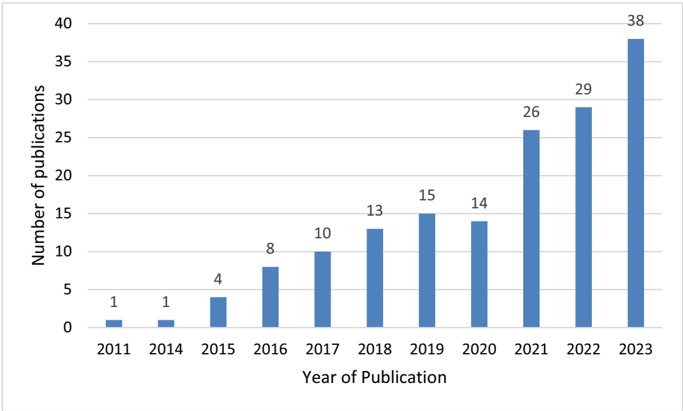
This systematic review synthesized 159 higher-education learning analytics studies on student engagement published between 2011 and 2023. It finds that HELA research overwhelmingly operationalizes engagement through behavioral log-data indicators, while cognitive, emotional, social, and disengagement dimensions are much less often measured.
## Key findings
- The review included 159 studies; 124 (78%) were journal articles and 35 (22%) were conference papers.
- Engagement measurement was dominated by behavioral engagement: 95.0% (n = 151) of studies measured it, and 56.0% (n = 89) operationalized engagement as behavioral only. By comparison, cognitive engagement appeared in 25.8% (n = 41), emotional engagement in 16.4% (n = 26), and social engagement in 16.4% (n = 26).
- The most common behavioral indicators were participation (86.2%, n = 137) and time on task (45.9%, n = 73). More than half of studies (50.9%, n = 81) combined log data with student assessments, and 33.3% (n = 53) used surveys.
- Theory use was uneven: 42 studies (26.4%) used an engagement framework to inform analysis, 71 (44.7%) used prior engagement research in their introduction/background and linked it to analysis, and 46 (28.9%) said they explored engagement but had an unclear link between data analysis and theory/frameworks.
## Methods
- The paper is a systematic review following PRISMA guidance as closely as possible; it was also checked against the Quality of Evidence Synthesis Tool.
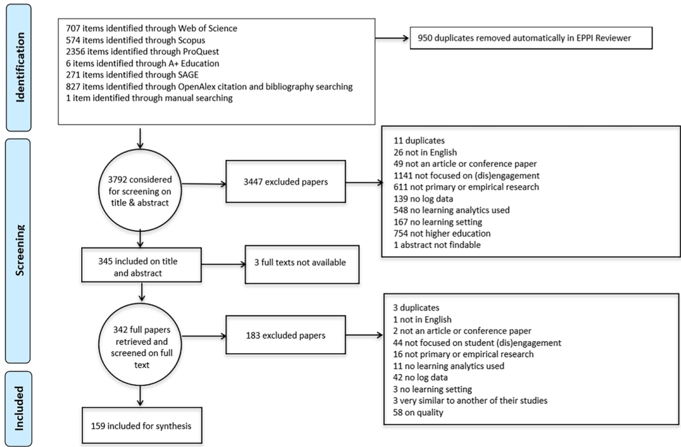
- Searches were run in Web of Science, Scopus (including LAK proceedings), ProQuest (including ERIC), A+ Education, and SAGE Journals, plus OpenAlex snowballing; the search spans 2011–2023.
- 159 studies were included after screening and quality appraisal; quality was assessed with the Mixed Methods Appraisal Tool (MMAT). The review used manual data extraction and a narrative synthesis, coding studies against the Student Engagement in Digital Learning (SEDL) framework.
## Limitations
- The paper states that no protocol was registered prior to the review.
- It included English-language research only, which the authors say limits understanding of work in other languages.
- The authors note that requiring system log data as an inclusion criterion excluded HELA studies that might inform engagement through other methods.
- The search required studies to explicitly use “engagement” or “disengagement” in the title, abstract, or keywords, so studies of related sub-constructs that did not use those terms may have been missed; this is stated in the paper.
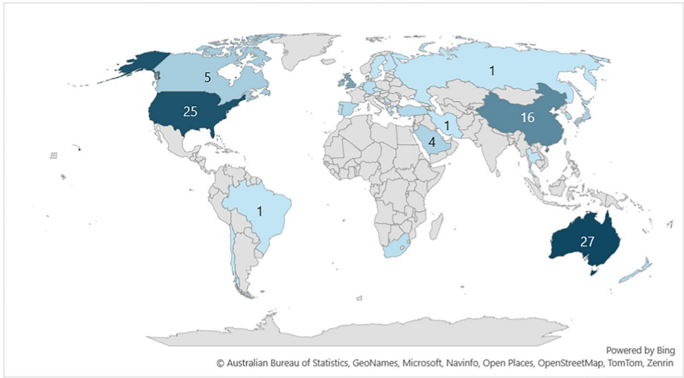
- The text also makes evident that some reporting is incomplete in the included literature: for example, 16 papers did not state the continent, 22 did not specify the country, and 14 did not specify whether participants were undergraduates or postgraduates; this is an evidence gap in the corpus, not a stated study design flaw.
Model-written summary. Check it against the paper before relying on it.
Integrity signals
Registry
Cites
Statistics
Figures

Verification
Claims the paper makes
26 Valid · 8 Not valid · 51 Not checked · 139 Own results and interpretations
The cited sources that could be checked couldn’t confirm or dispute this claim.
In the paper
“one arising problem relates to the emerging and disparate ways to convey what engagement is; for example, researchers may tend to either add variables that are not widely recognised as parts of engagement, supplement theory for research papers, or present vague conceptualisations (e.g., Masiello et al., 2024).”
§ Unpacking student engagement in higher education learning analytics: a systematic review > Student engagement theory
What the sources say
- Could not verifycites Masiello et al., 2024 matched to “A Current Overview of the Use of Learning Analytics Dashboards” (2024) sourceExperimental — accuracy not yet measured
Section 3.3 discusses theoretical frameworks used to design learning analytics dashboards, and Section 3.4 lists outcomes they track; neither addresses how engagement is conceptualised in research. Searches for engagement definitions, unrecognised variables, and vague conceptualisations found no passage making the attributed point. Page numbers were not available in our copy. (LLM, conf=0.73)
hedged- Asserted: passes — The authors put it forward as true.
- Checkable: passes — It can be checked against evidence.
- Load-bearing: passes — The paper’s conclusions depend on it.
- Based: passes — The paper gives a reason why it holds.
- Could not verify
The cited sources support only part of this claim — read each source’s verdict below.
In the paper
“While the unidimensional approach has potential, it has been criticised for using easy-to-count engagement indicators in LA research rather than considering differences in indicator value and distinguishing between meaningful and less meaningful ones (e.g., Johar et al., 2023).”
§ Unpacking student engagement in higher education learning analytics: a systematic review > Learning analytics and engagement
What the sources say
- Partly supportedcites Johar et al., 2023 matched to “Learning Analytics on Student Engagement to Enhance Students’ Learning Performance: A Systematic Review” (2023) sourceExperimental — accuracy not yet measured
Section 5.1 says that studying multiple types of engagement can yield more comprehensive measures, and Section 6 highlights the value of multifaceted engagement. The paper also describes measuring behavioural engagement through the frequency of LMS activity (Section 2.1). It does not, however, criticise unidimensional research for choosing indicators because they are easy to count or for failing to distinguish more meaningful indicators from less meaningful ones; no page numbers are available in our copy. (LLM, conf=0.83)
plain- Asserted: passes — The authors put it forward as true.
- Checkable: passes — It can be checked against evidence.
- Load-bearing: unclear — It is unclear whether the paper’s conclusions depend on it.
- Based: passes — The paper gives a reason why it holds.
- Partly supported
The cited sources support only part of this claim — read each source’s verdict below.
In the paper
“HELA research also focused heavily on undergraduate students, with only a small percentage of studies exploring postgraduate student engagement (Bergdahl et al., 2020;Bond et al., 2020), and a large proportion of participants (60%) were from a STEM discipline, which raises questions of wider study generalisability (Kaliisa et al., 2024).”
§ Unpacking student engagement in higher education learning analytics: a systematic review > Lack of diversity
What the sources say
- Could not verifycites Bergdahl et al., 2020 matched to “Learning Analytics for Blended Learning: A Systematic Review of Theory, Methodology, and Ethical Considerations” (2020) sourceExperimental — accuracy not yet measured
Section 4.4 discusses student learning behaviours and engagement, but does not compare the number of studies involving undergraduate and postgraduate students. Searches for “undergraduate” and “postgraduate” found an undergraduate cohort in a cited study’s title, but no review-level finding about the proportion of studies at either level. (LLM, conf=0.73)
- Partly supportedcites Bond et al., 2020 matched to “Mapping research in student engagement and educational technology in higher education: a systematic evidence map” (2020) sourceExperimental — accuracy not yet measured
The Study population characteristics section reports that 60% of the mapped studies focused on undergraduates and 14% on postgraduates, supporting the imbalance described. However, the map covers student engagement and educational technology broadly; it does not establish that these proportions apply specifically to HELA research. (LLM, conf=0.85)
plain- Asserted: passes — The authors put it forward as true.
- Checkable: passes — It can be checked against evidence.
- Load-bearing: unclear — It is unclear whether the paper’s conclusions depend on it.
- Based: passes — The paper gives a reason why it holds.
- Could not verify
The cited sources that could be checked couldn’t confirm or dispute this claim.
In the paper
“However, these were rare, with relatively few studies using qualitative data collection and analysis methods (Banihashem et al., 2022;Foster & Francis, 2020).”
§ Unpacking student engagement in higher education learning analytics: a systematic review > Lack of diversity
What the sources say
- Could not verifycites Banihashem et al., 2022 matched to “The impacts of constructivist learning design and learning analytics on students’ engagement and self-regulation” (2022) sourceExperimental — accuracy not yet measured
The Conclusion says this study relied mostly on Moodle and survey data because it had limited access to qualitative data. Neither that passage nor the Introduction establishes that studies using qualitative data collection and analysis methods were rare across the field; searches for that prevalence claim found no such passage in our copy. (LLM, conf=0.76)
- Not checked — no full text of the sourcecites Foster & Francis, 2020 matched to “A systematic review on the deployment and effectiveness of data analytics in higher education to improve student outcomes” (2020) source
plain- Asserted: passes — The authors put it forward as true.
- Checkable: passes — It can be checked against evidence.
- Load-bearing: unclear — It is unclear whether the paper’s conclusions depend on it.
- Based: passes — The paper gives a reason why it holds.
- Could not verify
The sources with a verdict support this claim; the rest weren’t checked yet, have no full text we could read, or their verdicts aren’t rated yet.
In the paper
“At times, papers embraced both traditional and innovative approaches, including experiments, surveys, ethnography, and design-oriented research, alongside emerging computational methods, for example, combining survey, LMS data, and multimodal data (e.g., Wang et al., 2023) or longitudinal studies combining a design intervention, a survey, test results and LMS data (e.g., Zhou et al., 2023).”
§ Unpacking student engagement in higher education learning analytics: a systematic review > Lack of diversity
What the sources say
- Supportedcites Wang et al., 2023 matched to “Key factors predicting problem-based learning in online environments: Evidence from multimodal learning analytics” (2023) source
The Research methodology > Instrument section describes a self-regulation questionnaire. Research methodology > Instrument and Research design and data describe online activity logs and discussion posts analyzed with machine-learning methods. Together, these support the citing sentence’s use of Wang et al. as an example combining survey, online-platform, and multimodal data; it does not attribute ethnography to Wang et al. The indexed copy provides no page numbers for these sections. (LLM, conf=0.90)
- Not checked — no full text of the sourcecites Zhou et al., 2023 matched to “Motivational design for enhancing behavioral engagement in a flipped Chinese course” (2024) source
hedged- Asserted: passes — The authors put it forward as true.
- Checkable: passes — It can be checked against evidence.
- Load-bearing: unclear — It is unclear whether the paper’s conclusions depend on it.
- Based: passes — The paper gives a reason why it holds.
- Supported
94 more claims · 4 with their cited sources checked
Create a free account to see all 224 claims and to verify the 8 references still open.
- Probably not a substantial claim. 66
- It may state two separate claims as one. 82
Citations
Cites
The PRISMA 2020 statement: An updated guideline for reporting systematic reviews
Page, M. J., McKenzie, J. E., Bossuyt, P. M., Boutron, I., Hoffmann, T. C., Mulrow, C. D., Shamseer, L., Tetzlaff, J. M., Akl, E. A., Brennan, S. E., et al. (2021) · BMJ · doi:10.1136/bmj.n71 · Cited by 108,283
Self-efficacy: Toward a unifying theory of behavioral change
Bandura, A. (1977) · Psychological Review · doi:10.1037/0033-295x.84.2.191 · Cited by 43,925
A Coefficient of Agreement for Nominal Scales
Cohen, J. (1960) · Educational and Psychological Measurement · doi:10.1177/001316446002000104 · Cited by 42,398
School Engagement: Potential of the Concept, State of the Evidence
Fredricks, J. A., Blumenfeld, P. C., & Paris, A. H. (2004) · Review of Educational Research · doi:10.3102/00346543074001059 · Cited by 12,581
The PRISMA 2020 statement: an updated guideline for reporting systematic reviews
Page, M. J., McKenzie, J., Bossuyt, P., Boutron, I., Hoffmann, T., mulrow, C., Shamseer, L., Tetzlaff, J., Akl, E., Brennan, S. E., et al. (2020) · doi:10.31222/osf.io/v7gm2_v1 · Cited by 8,090
Critical Inquiry in a Text-Based Environment: Computer Conferencing in Higher Education
Garrison, D. R., Anderson, T., & Archer, W. (1999) · The Internet and Higher Education · doi:10.1016/s1096-7516(00)00016-6 · Cited by 6,619
Zimmerman, B. J. (2000) · Handbook of Self-Regulation · doi:10.1016/b978-012109890-2/50031-7 · Cited by 6,069
The PRISMA 2020 statement: an updated guideline for reporting systematic reviews
Page, M. J., McKenzie, J., Bossuyt, P., Boutron, I., Hoffmann, T., mulrow, C., Shamseer, L., Tetzlaff, J., Akl, E., Brennan, S. E., et al. (2020) · doi:10.31222/osf.io/v7gm2 · Cited by 5,177
The Role of Goal Orientation in Self-Regulated Learning
Pintrich, P. R. (2000) · Handbook of Self-Regulation · doi:10.1016/b978-012109890-2/50043-3 · Cited by 5,173
Cohen, D. (1998) · The Women's Review of Books · doi:10.2307/4022859 · Cited by 4,261
Research works printed but not linked: 4
- 1. tional, 59(4), 442-452. https:// doi. org/ 10. 1080/ 14703 297. 2021. 18906
- 4. Bergdahl, N., Bond, M., & Brown, A. (Forthcoming). Cracking the engagement enigma: Decoding the multifaceted sociocultural influences on student engagement in digital learning. In G. Liem, J. Fredricks, & Z. Y. Wong (Eds.), Sociocultural perspectives on student engagement: Theory, research, and practice. Information Age Publishing.
- Fritz, J. (2013). Using analytics at UMBC: Encouraging student responsibility and identifying effective course designs. EDUCAUSE Center for Applied Research.
- * Wang, J.‑Y., Yang, C.‑H., Liao, W.‑C., Yang, K.‑C., Chang, I.‑W., Sheu, B.‑C., & Ni, Y.‑H. (2021). Highly engaged video-watching pattern in asynchronous online pharmacology course in pre-clinical 4th-year medical students was associated with a good self-expectation, understanding, and performance. Frontiers in Medicine, 8, 799412. https://doi.org/10.3389/fmed.2021.799412 · DOI
Cited by
Hoomanfard, M. H., & Shamsi, Y. (2025) · Journal of English for Academic Purposes · doi:10.1016/j.jeap.2025.101570 · Cited by 33
Yilmaz, M., Gauthier, A., & Cukurova, M. (2026) · Educational technology research and development · doi:10.1007/s11423-026-10595-1 · Cited by 9
“To provide a more comprehensive understanding of learning, qualitative data should therefore complement behavioural measures (Bergdahl et al., 2024).”
Evaluating the Use of 360-Degree Video in Education
Kavanagh, S., Luxton-Reilly, A., Wuensche, B. C., Plimmer, B., & Dunn, S. (2025) · Electronics · doi:10.3390/electronics14091830 · Cited by 13
Beyond Technology Tools: Supporting Student Engagement in Technology Enhanced Learning
Rotar, O. (2025) · Education Sciences · doi:10.3390/educsci15121617 · Cited by 39
The OpenAlex database in review: Evaluating its applications, capabilities, and limitations
Forchino, M. V., & Torres‐Salinas, D. (2026) · Journal of Informetrics · doi:10.1016/j.joi.2026.101800 · Cited by 20
Alruthaya, A. S. M., Khan, S., Saini, A., & Muthaly, S. (2025) · Computers in Human Behavior Reports · doi:10.1016/j.chbr.2025.100824 · Cited by 17
Kayande, D., & Kukreja, S. (2025) · MethodsX · doi:10.1016/j.mex.2025.103588 · Cited by 19
“Bergdahl et al. [2] similarly conduct a systematic Thematic review on learning analytics where student engagement appears to be best reflected in a combination of behavioral, affetive, and cognitive indicators.”
Jiang, Y., & Wang, T. (2025) · Frontiers in Psychology · doi:10.3389/fpsyg.2025.1618909 · Cited by 11
“On the contrary, if students lack of professional identity, they may find the content of learning boring, and it is difficult to generate interest in learning, and then easy to fall into the state of learning burnout (Bergdahl et al., 2024).”
Sridharan, B., Amrollahi, A., McKay, J., & de Castro, V. B. (2025) · Studies in Higher Education · doi:10.1080/03075079.2025.2536588 · Cited by 8
Cortez, L. H. V., Veloz, J. F. A., Oyarvide, W. R. V., Humanante, P. M. T., & Ramírez, C. S. T. (2026) · Data & Metadata · doi:10.56294/dm20261295 · Cited by 6
Pimblett, C., Rowe, L., & Fenton, A. (2026) · Journal of Work-Applied Management · doi:10.1108/jwam-10-2025-0196 · Cited by 2
Summers, R. J., Villar, P. F., Hume, S., & Sanders, M. J. (2025) · Perspectives Policy and Practice in Higher Education · doi:10.1080/13603108.2025.2556194 · Cited by 2
“While the relationship between analytics data and student engagement is poorly defined (for a review see Bergdahl et al. 2024) and there are ethical concerns of monitoring students (Selwyn 2019), analytics systems, with their real-time capture and aggregation of outcome data from different sources,…”
Garbers, S., John, K., Mauro, C., Lamb, M. R., Brown, A. S., Sorojsrisom, E. S., & Russell, L. R. (2025) · TechTrends · doi:10.1007/s11528-025-01125-6 · Cited by 2
“…and the ubiquity of digital learning tools in higher education to easily deploy nudges (Vogt, 2016) and measure their effects on engagement (Bergdahl et al., 2024; Brown et al., 2022; Nkomo & Nat, 2021; Nkomo et al., 2021), exploring tailored nudges has the potential to be leveraged in…”
Chen, J., & Chen, T. (2025) · Journal of Computer Assisted Learning · doi:10.1111/jcal.70084 · Cited by 3
Bravo, A. E. R., González, M. D., & Navarro, I. C. P. (2026) · Trends in Higher Education · doi:10.3390/higheredu5010005 · Cited by 3
“…tripartite conception of engagement and with the accumulated evidence on its value as a positive indicator of learning and academic well-being [2–5 , In a distance learning program, this profile—high dedication, accompanied by moderate levels of vigor and absorption—can be interpreted in light…”
From data to teaching: video lessons and learning analytics in blended university contexts
Pelizzari, F., Tassalini, E., & Scott, F. (2026) · Frontiers in Education · doi:10.3389/feduc.2026.1677494 · Cited by 3
Youssef, Y., Schneider, J., & Schiffner, D. (2025) · International Conference on Education Technology and Computer · doi:10.1109/icetc66579.2025.11387254 · Cited by 1
“These signals are often associated with engagement, distraction, boredom, and frustration [21], [25].”
Parsaeifard, B., Imhof, C., Pancar, T., Comşa, I.-S., Hlosta, M., Bergamin, N., & Bergamin, P. B. (2026) · IEEE Transactions on Learning Technologies · doi:10.1109/tlt.2026.3668612 · Cited by 6
“Currently, no definition of engagement has been universally accepted, and there is little to no consistency or specificity in the operationalization of the construct [6], [31].”
Data-Driven Decision-Making for Inclusive Institutional Policies
Salendab, F. A., Laviste, V. M., Badal, P. A., & Lumogdang, J. C. (2026) · IGI Global eBooks · doi:10.4018/979-8-3373-6132-1.ch005 · Cited by 1
Next-generation universities: the digital evolution of communication
Bogdanova, A. V., & Aleksandrova, Y. K. (2026) · The Education and science journal · doi:10.17853/1994-5639-2026-4-38-60 · Cited by 1
Lu, S., Zeng, J., & Huang, X. (2026) · Acta Psychologica · doi:10.1016/j.actpsy.2026.106837 · Cited by 3
Secondary school students’ creativity in STEM education: A systematic literature review
Guridi-Bikuña, A., Bilbao, A., & Álvarez‐Huerta, P. (2026) · Thinking Skills and Creativity · doi:10.1016/j.tsc.2026.102264 · Cited by 2
Dudeja, M. (2026) · IGI Global eBooks · doi:10.4018/979-8-2600-2158-3.ch005 · Cited by 1
Fadillah, R., Juhaidi, A., & Mubarak, F. (2026) · Cogent Education · doi:10.1080/2331186x.2026.2699489 · Cited by 1
From Movement to Learning: Leveraging Vr Behavioral Metrics to Evaluate Cognitive Load and CuriosityPreprint
Poupard, M., Larrue, F., Bertrand, M. M., et al. (2025) · SSRN Electronic Journal · doi:10.2139/ssrn.5168402 · Cited by 1
Zhang, J., Shi, Y., Ma, J., Luo, C., Song, M., Xu, X., Xu, L., & Shang, L. (2025) · Research Square · doi:10.21203/rs.3.rs-8128531/v1 · Cited by 2
Wahab, A., Djaohar, M., & Yuninda, N. H. (2024) · Journal of Electrical Vocational Education and Technology · doi:10.21009/jevet.0072.05
“Learning media can enhance students' active participation because it serves as a bridge between lecturers and students (Bergdahl et al., 2024; Picton & Baik, 2024).”
Mouaici, M. (2025) · Lecture notes in computer science · doi:10.1007/978-3-032-03873-9_24
Educar para transformar: innovaciones pedagógicas en la era digital
Azuero, E. M. H., Carrión, R. D. C. M., Martínez, H. F. N., Jaramillo, M. D. C., & Guamán, M. P. M. (2025) · Arandu-UTIC. · doi:10.69639/arandu.v12i3.1429 · Cited by 3
Santo, R. D. E., Niere, G. L., & Cabutihan, C. A. (2025) · Psychology and Education A Multidisciplinary Journal · doi:10.70838/pemj.480105
da Costa, S. G., Souza, F. P. D. M., & Alliprandini, P. M. Z. (2025) · Caderno Pedagógico · doi:10.54033/cadpedv22n12-203
Ishaq, I., Saleng, S., & Bancong, H. (2025) · Journal Evaluation in Education (JEE) · doi:10.37251/jee.v6i4.2099
“This pattern echoes recent reviews emphasizing the role of learning analytics and engagement metrics in enhancing learner-centered design [47].”
Cárdenas, R. A. P., Garcés, M. P. L., & Panchana, R. I. R. (2025) · Revista Científica Multidisciplinar G-nerando · doi:10.60100/rcmg.v6i2.853
Shape vs. Volume in Learning Analytics: Longitudinal Evidence from 11 Million LMS Interactions
Mehnen, L., & Pohn, B. (2025) · International Conference on Software, Telecommunications and Computer Networks (SoftCOM) · doi:10.23919/softcom66362.2025.11197447
Diani, R., Viyanti, V., Jalmo, T., & Lengkana, D. (2025) · Tadris Jurnal Keguruan dan Ilmu Tarbiyah · doi:10.24042/tadris.v10i1.28169 · Cited by 1
Bashir, E., Rehman, I. U., & Hussain, F. (2025) · IEEE International Smart Cities Conference (ISC2) · doi:10.1109/isc266238.2025.11293306
“Analysing this type of data can help uncover learner patterns and provide early warnings for disengagement or inconsistent participation [4] [5] [6].”
Retnawati, E. (2025) · Studies in Higher Education · doi:10.1080/03075079.2025.2610635
How initiative plays a role in the learning process
Ardhyantama, V., Andriningrum, H., Wardani, R. P., Indrawati, D., Malik, M. S., Bali, S., & Hadi, M. S. (2025) · Multidisciplinary Science Journal · doi:10.31893/multiscience.2026382 · Cited by 2
“In this context, initiative serves not only as a behavioral manifestation of engagement but also as an indicator of performance quality and productivity within the classroom (Bergdahl et al., 2024).”
Mohan, D. G., Ghazali, M., Sharef, N. M., & Othman, N. Z. S. (2025) · IEEE International Conference on Computing (ICOCO) · doi:10.1109/icoco67189.2025.11334129
“Research underscores that student engagement is central to academic success, yet most LADs provide only surface-level descriptive insights, often leading to cognitive overload, with 72% of students abandoning complex dashboards [4].”
Propuesta estratégica hacia 2030
Padrós, P. R. (2026) · Rastros Rostros · doi:10.16925/2382-4921.2026.01.06
Costa, S. F., & Borges, A. (2026) · Interactive Technology and Smart Education · doi:10.1108/itse-10-2025-0309
Montaño, M. L. A., Canchingre, E. T., Hernández, S. S. M., Guerrero, R. J. R., & Montaño, K. G. P. (2026) · ASCE MAGAZINE · doi:10.70577/asce.v5i1.682
AI-Enhanced ESG Education Driving Impact and Innovation in Malaysia
Yun, W. S., Pinjaman, S., & Nipo, D. T. (2026) · IGI Global eBooks · doi:10.4018/979-8-3373-4475-1.ch005
Wavre, S. P., & Kuknor, S. C. (2026) · European journal of training and development · doi:10.1108/ejtd-03-2025-0058 · Cited by 1
Bardon, A. G., Orlin, T. J. P., Jorgio, R. M., Avelino, E. J., Cajetas, R. J., Aliviado, R. M., & Tubera, F. J. D. (2026) · Psychology and Education A Multidisciplinary Journal · doi:10.70838/pemj.540708
Lin, J.-W. (2026) · Journal of Science Education and Technology · doi:10.1007/s10956-026-10318-4
Storytelling as a pedagogical approach in nursing education
Alegado, P. J., & Knickenberg, H. (2026) · British Journal of Nursing · doi:10.12968/bjon.2025.0329
Student Pose Recognition System Based on Deep Learning and Skeleton Feature Extraction
Le, H. L., Ha, H. T., Ngo, H., et al. (2026) · Lecture notes in networks and systems · doi:10.1007/978-3-032-18138-1_17
Xue, Y., & Khalid, F. B. (2026) · Research Square · doi:10.21203/rs.3.rs-9269094/v1
Sun, S., Xu, S., & Wang, X. (2026) · BMC Medical Education · doi:10.1186/s12909-026-09340-2
Motivating Learners Through Psychology-Informed Language Models
Vieira, E. T., & Li, Y. (2026) · Review of Artificial Intelligence in Education · doi:10.37497/rev.artif.intell.educ.v7ii.99
Conceptualising school dropout in developed and developing contexts: a systematic review
Sumap, S. N. A., Alias, B. S., & Amat, S. (2026) · Educational Review · doi:10.21203/rs.3.rs-9681939/v1
Data Governance and Privacy Protection in AI-Enabled Education Systems
Salendab, F. A. (2026) · Advances in computational intelligence and robotics book series · doi:10.4018/979-8-2600-0467-8.ch006 · Cited by 1
Olórtegui-Alcalde, L. M., & Córdova-Buiza, F. (2026) · Contemporary Educational Technology · doi:10.30935/cedtech/18690 · Cited by 1
Lutfiyyah, L., Zulhijra, Z., & Satra, A. (2026) · Indonesian Journal of Innovation Multidisipliner Research · doi:10.69693/ijim.v4i2.874
Anggreani, B., & Widhiastuti, R. (2026) · Academia Open · doi:10.21070/acopen.11.2026.14174
Ashari, D. P., Nugroho, I. A., Ekantini, A., Febriyani, U., Sembiring, Y. K., Fatimah, W. S., & Rahman, A. R. (2026) · Jurnal Penelitian Pendidikan IPA · doi:10.29303/jppipa.v12i5.13581
“Improving the quality of higher education requires systematic evaluation of various learning components, one of which is students’ active participation (Assefa et al., 2025; Bergdahl et al., 2024; Godsk & Møller, 2024; Heilporn et al., 2024; Johar et al., 2023; Waqar et al., 2025).”
Heilporn, G., Diallo, I., & Cano, C. (2026) · International Journal of Educational Research Open · doi:10.1016/j.ijedro.2026.100574
Hermaszewski, J. (2026) · Rozprawy Społeczne · doi:10.29316/rs/222529
Guizan, S., Alzahrani, A. J., Alshammari, T., & Hamam, H. (2026) · SSRN Electronic Journal · doi:10.2139/ssrn.6916023
Zhuang, R., Liao, L., Liu, Y., & Lin, X. (2026) · Behavioral Sciences · doi:10.3390/bs16060952
“This finding is not fully consistent with studies that treat learning participation as a generally positive variable, but it is consistent with recent arguments that participation is multidimensional and functionally differentiated (Bergdahl et al., 2024; Heilporn et al., 2024).”
Differences in Reading Habits Among Higher Education Students in Portugal: A Comparative Analysis
Barqueira, A., Oliveira, A. P., Esteves, S., & Leite, S. D. A. (2026) · Education Sciences · doi:10.3390/educsci16060946 · Cited by 1
Wu¹, H., & Zhang², Z. (2026) · Research Square · doi:10.21203/rs.3.rs-9671029/v1
Valdiviezod, E. P., Cudco, S. E. T., Villegas, M. X. D., & Gaibor, G. J. Á. (2026) · Athenea · doi:10.47460/athenea.v7i23.134 · Cited by 1
Wang, J., Laknapichonchat, T., & Xiong, R. (2026) · Frontiers in Education · doi:10.3389/feduc.2026.1782429
General Skills Strategies in Communication by Lecturers at the Beginning of Lectures to Students
Yusuf, M., & Abdullah, O. M. (2026) · Journal for Lesson and Learning Studies · doi:10.23887/jlls.v9i1.105971
Priročnik za razvijanje digitalnih kompetenc v pedagoških študijskih programih
Šumak, B., Pušnik, M., Grašić, S., & Györkös, J. (2026) · doi:10.18690/um.pef.2.2026
Yan, S., Xu, Q., & Hu, D. (2026) · Studies in Higher Education · doi:10.1080/03075079.2026.2696022
Uy, G. A., Ilagan, J. B., Ilagan, J. R., et al. (2026) · Communications in computer and information science · doi:10.1007/978-3-032-30833-7_17
Álvarez-Coto, G. G., Solana-Domínguez, I., Arana-Cuenca, A., Mata, L., & Tubío, J. (2026) · Journal of Computing in Higher Education · doi:10.1007/s12528-026-09502-7
Learning Analytics for personalizing learning in virtual higher education environments
Segura, V. T. V., Segura, E. A. V., Segura, J. A. V., & Seisdedos, L. F. (2026) · doi:10.63804/libroseuc.6
Smart hybrid models for personalized learning in higher education
Segura, E. A. V., Segura, V. T. V., Segura, J. A. V., & Fierro-Saltos, W. (2026) · doi:10.63804/libroseuc.5
The Association of Formative Feedback with Engagement and Student Performance
Kalaitzopoulou, E., Matthews, P., & Christopoulos, A. (2026) · International Convention on Information and Communication Technology, Electronics and Microelectronics · doi:10.1109/mipro70003.2026.11591878
“In addition, most of the research based on empirical studies is limited in sample sizes and concentrates mainly on task and content engagement [6] [7], rather than considering feedback access metrics to enable us to infer whether students engage with feedback provided and integrate it into their…”
Orozco, M. T. V., & Crosetti, B. D. B. (2026) · Digital · doi:10.3390/digital6030056 · Cited by 1
“It is consistent with engagement research in HCI and learning analytics, where engagement is understood as a multidimensional process and cannot be inferred only from satisfaction, duration, or frequency of use [15,37,38].”
Wang, Y., Singh, S. S. B., Shin, C., & Zhang, Q. (2026) · International Journal of Entrepreneurship and Management Practices · doi:10.35631/ijepc.1163016
Panchal, J. D., Maddirala, S., & Gudidinni, P. (2026) · Frontiers in Education · doi:10.3389/feduc.2026.1886800
Ariola, M. J. S. (2026) · ANALISTA International Journal of Multidisciplinary Research · doi:10.71182/aijmr.2606.0401.2002
Pengaruh Efektivitas Diskusi Online Berbasis LMS SPADA terhadap Aktivitas Belajar Mahasiswa
Zahra, F., Imran, I., Anas, F. A., & Iryani, J. (2026) · Indonesian Journal of Innovation Multidisipliner Research · doi:10.69693/ijim.v4i3.1604
AI-integrated interactive learning system for enhancing cybersecurity education
Foori, Y. K. H. A., & Oyelere, S. S. (2026) · Frontiers in Computer Science · doi:10.3389/fcomp.2026.1826732
Fikriyah, S. T., Hosna, R., Hanifudin, Kibtiyah, A., & Idawati, K. (2026) · Journal of Contemporary Islamic Education · doi:10.25217/jcie.v6i2.7873
“Student engagement in this study encompasses behavioral, cognitive, emotional, and social dimensions (Bergdahl et al., 2024; Wang, 2025; Dewi, 2024; Fredricks et al., 2004; Wang, 2025).”
Feedback and Teaching Reform for the National College Students Structural Design Competition Course
Wu, J., Zhang, Y. K., Liu, Z., Deng, H., & Wu, X. (2026) · Journal of Civil Engineering Education · doi:10.1061/jceecd.eieng-2431
Personality Responsive Persuasive Design to Achieve Sustainable Education
Minocha, A., Patra, B. C., & Bhatia, S. (2026) · Lecture notes in networks and systems · doi:10.1007/978-3-032-32476-4_24
Neuroeducation and Attentional Engagement Analytics in Initial Teacher Education: A Mixed Study
Fernández, C. A. A., & Laguna, M. P. (2026) · NeuroData · doi:10.63688/neurodata2026172
Rahman, A., Karim, A., & Destiarini (2026) · Journal of Nexural Intelligence · doi:10.71200/nexural.v1.i1.259 · Cited by 1
“These event traces are valuable for learning analytics because they provide observable behavioral indicators that are difficult to capture through conventional attendance or end-of-semester reports [1], [2].”
Pambudi, B., & Rachman, R. F. (2026) · College Teaching · doi:10.1080/87567555.2026.2715427
Peiyao, L. (2026) · Frontiers in Psychology · doi:10.3389/fpsyg.2026.1900245
“Recent learning analytics research has shown that engagement is often operationalized through observable behavioral traces, such as clicks, time on task, logins, and task completion, while multidimensional psychological engagement is less frequently captured (Bergdahl et al., 2024).”
Development and Practical Application of a Lifelong-Education-Oriented Mobile Learning System
Li, J., Wang, S., Fang, X., Yin, C., Tan, J., & Chen, Y. (2026) · International Conference on Electronic Information Technology and Computer Engineering (EITCE) · doi:10.1109/eitce70137.2026.11634499
Adviento, S. V. M. G., Salvador, R. Q., Basamot, C. M. B., Tamayo, M. L., Gamiao, S. K. A., Franco, D. L., Salvador, M., Laureta, J. R. A., & Limon, M. R. (2026) · Social Sciences & Humanities Open · doi:10.1016/j.ssaho.2026.103414
Celdrán, M. G. (2026) · REVISTA INTERNACIONAL DE EDUCACIÓN MUSICAL · doi:10.1177/23074841261479143 · Cited by 1
Zaker, M., Navimipour, N. J., & Hosseinzadeh, M. (2026) · Journal of Urban Technology · doi:10.1080/10630732.2026.2668307 · Cited by 1
Azad, H. G., Guedidi, A., Poëllhuber, B., & Hurtut, T. (2026) · Applied Sciences · doi:10.3390/app16168128
Hook, M., Carlyle, T., Lee, C., & Morrison, K. (2026) · Marketing Education Review · doi:10.1080/10528008.2026.2720468
Yang, L., Theskul, S., & Juikumjorn, K. (2026) · International Conference on Computer Science and Technologies in Education (CSTE) · doi:10.1109/cste69562.2026.11649792
“Behavioral patterns in these contexts often serve as imprints of internal cognitive states [3], [10], with interaction stability indicating "flow states" or "cognitive breakdowns" [8], [11].”
InfluentialFatmasari, R., Suroso, E., Pamungkas, O. Y., Frimayanti, A. I., Rosita, T., Kadarisman, K., Mudayat, M., & Simargolang, Z. (2026) · International Journal of ADVANCED AND APPLIED SCIENCES · doi:10.21833/ijaas.2026.07.014
An, C., Li, Y., Jiang, N., Yingying, W., & Peng, Y. (2026) · Frontiers in Education · doi:10.3389/feduc.2026.1849910
Yang, M. (2026) · Frontiers in Psychology · doi:10.3389/fpsyg.2026.1882907
Λαμπρόπουλος, Γ. (2026) · Advances in computational intelligence and robotics book series · doi:10.4018/979-8-3373-8919-6.ch011
Innovación pedagógica y rendimiento académico en estudiantes universitarios
Lino-Villamar, M. P., Menendez, M. C., Macias, R. L. C., & Figueroa, A. L. T. (2026) · Saber Estratégico Internacional · doi:10.70577/s.e.v4i3.85
Zhao, C. (2026) · Research Square · doi:10.21203/rs.3.rs-10470631/v1
Metadata
- Authors
- Bergdahl, N., Bond, M., Sjöberg, J., Dougherty, M., & Oxley, E.
- Affiliations
- Stockholm University (SE)
- University College London (GB)
- Halmstad University (SE)
- University of Glasgow (GB)
- Corresponding author
- Bond, Melissa
- Venue
- International Journal of Educational Technology in Higher Education
- Published
- 2024-12-20
- Volume
- 21
- Issue
- 1
- ISSN
- 2365-9440 (ISSN-L)
- OpenAlex
- W4405565085
- Semantic Scholar
- 536f08993b21fe7566324eba3bd21c1e248d1c5e
- Cited by
- 138
- References
- 152
- Citations by year
- 2026: 112 · 2025: 25 · 2024: 1
- FWCI
- 10.35
- Type
- journal article
- Language
- en
- Open access
- diamond
- doi.org
- Licence
- cc-by
- creativecommons.org/licenses/by/4.0 (tdm)
- creativecommons.org/licenses/by/4.0 (vor)
- Locations
- International Journal of Educational Technology in Higher Education (publishedVersion, cc-by)
- KTH Publication Database DiVA (KTH Royal Institute of Technology) (submittedVersion, other-oa)
- ENLIGHTEN (Jurnal Bimbingan dan Konseling Islam) (submittedVersion, cc-by-sa)
- UCL Discovery (University College London) (submittedVersion, cc-by)
- Theseus (Ammattikorkeakoulujen) (submittedVersion)
- DOAJ (DOAJ: Directory of Open Access Journals) (submittedVersion)
- Topics
- Physical Sciences › Computer Science › Computer Science Applications › Online Learning and Analytics
- Social Sciences › Education › Higher Education Research Studies
- Social Sciences › Education › Online and Blended Learning
- Keywords
- student engagement, learning analytics, higher education, engagement metrics, logs, disengagement, methodological reporting quality
About these checks
Registry, retraction, Cites and statistics results are computed, not judged, with one exception: a printed reference that no index lists is read once by a model before it counts as a citation error. Claims are extracted by a model and kept only when their quote appears verbatim in the text; each cited source is then checked, with a model’s help, for whether it says what the claim relies on. Those verdicts can be wrong — read the claim’s quote and the cited source before relying on one.
The claim verdicts this report counts are experimental: their accuracy is not yet measured.
A language model drew the claims from the paper on 2026-10-09, under version 3 of the claim definition (model deepseek-v4.1-flash, prompt extract-v3).
A second model labelled each claim on 2026-10-09 (model jev-1.13-20260917, definition revision gold-guideline-v0.2).
Cited sources are checked with a language model’s help (gpt-6-sol).
Statistics and arithmetic are recomputed, not judged.
Confidence bands are shown only for fields calibrated on our annotated test set. None is calibrated yet, so no band is shown.
What counts as a claim ›How we measure confidence ›How we check this ›
Are you an author, or do you see a problem with this page? Request a review
Data sources
Bibliographic data: Semantic Scholar, OpenAlex, Crossref.
Contains information from the Semantic Scholar Academic Graph Datasets, made available under the ODC Attribution License (ODC-BY 1.0).
Semantic Scholar’s data is described in: Kinney, R., et al. (2023). The Semantic Scholar Open Data Platform. arXiv:2301.10140.
