

Unpacking student engagement in higher education learning analytics: a systematic review
Open accessThe DOI matches its Crossref record; 157 of the 157 references it cites were found in a registry or an index; 36 of the 86 sources its claims cite were checked for support.
Abstract
The findings reveal that LA research overwhelmingly approaches engagement using observable behavioural engagement measures, such as clicks and task duration, with very few studies exploring multiple dimensions of engagement.
Overview
CoChat Summary
## TL;DR
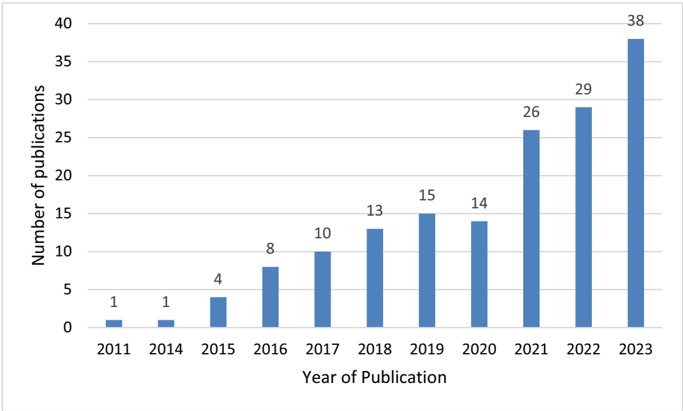
This systematic review synthesized 159 higher-education learning analytics studies on student engagement published between 2011 and 2023. It finds that HELA research overwhelmingly operationalizes engagement through behavioral log-data indicators, while cognitive, emotional, social, and disengagement dimensions are much less often measured.
## Key findings
- The review included 159 studies; 124 (78%) were journal articles and 35 (22%) were conference papers.
- Engagement measurement was dominated by behavioral engagement: 95.0% (n = 151) of studies measured it, and 56.0% (n = 89) operationalized engagement as behavioral only. By comparison, cognitive engagement appeared in 25.8% (n = 41), emotional engagement in 16.4% (n = 26), and social engagement in 16.4% (n = 26).
- The most common behavioral indicators were participation (86.2%, n = 137) and time on task (45.9%, n = 73). More than half of studies (50.9%, n = 81) combined log data with student assessments, and 33.3% (n = 53) used surveys.
- Theory use was uneven: 42 studies (26.4%) used an engagement framework to inform analysis, 71 (44.7%) used prior engagement research in their introduction/background and linked it to analysis, and 46 (28.9%) said they explored engagement but had an unclear link between data analysis and theory/frameworks.
## Methods
- The paper is a systematic review following PRISMA guidance as closely as possible; it was also checked against the Quality of Evidence Synthesis Tool.
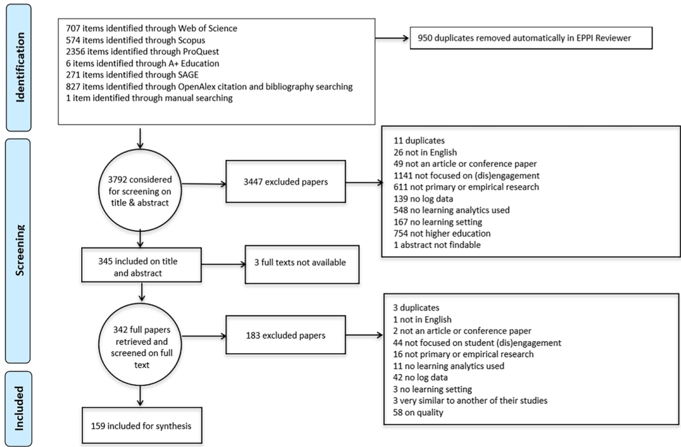
- Searches were run in Web of Science, Scopus (including LAK proceedings), ProQuest (including ERIC), A+ Education, and SAGE Journals, plus OpenAlex snowballing; the search spans 2011–2023.
- 159 studies were included after screening and quality appraisal; quality was assessed with the Mixed Methods Appraisal Tool (MMAT). The review used manual data extraction and a narrative synthesis, coding studies against the Student Engagement in Digital Learning (SEDL) framework.
## Limitations
- The paper states that no protocol was registered prior to the review.
- It included English-language research only, which the authors say limits understanding of work in other languages.
- The authors note that requiring system log data as an inclusion criterion excluded HELA studies that might inform engagement through other methods.
- The search required studies to explicitly use “engagement” or “disengagement” in the title, abstract, or keywords, so studies of related sub-constructs that did not use those terms may have been missed; this is stated in the paper.
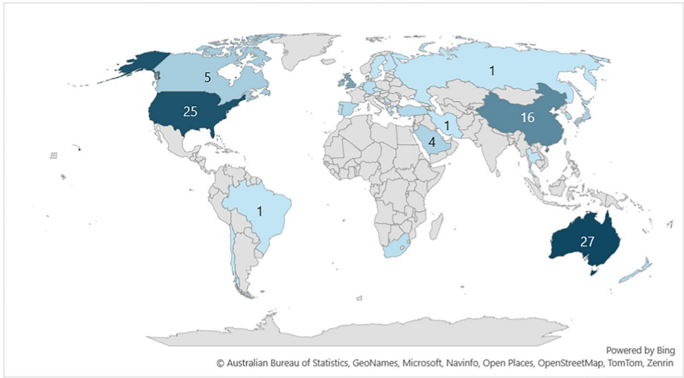
- The text also makes evident that some reporting is incomplete in the included literature: for example, 16 papers did not state the continent, 22 did not specify the country, and 14 did not specify whether participants were undergraduates or postgraduates; this is an evidence gap in the corpus, not a stated study design flaw.
Model-written summary. Check it against the paper before relying on it.
Integrity signals
Registry
Cites
Statistics
Figures

Verification
Claims the paper makes
26 Valid · 8 Not valid · 51 Not checked · 139 Own results and interpretations
The cited sources that could be checked couldn’t confirm or dispute this claim.
In the paper
“one arising problem relates to the emerging and disparate ways to convey what engagement is; for example, researchers may tend to either add variables that are not widely recognised as parts of engagement, supplement theory for research papers, or present vague conceptualisations (e.g., Masiello et al., 2024).”
§ Unpacking student engagement in higher education learning analytics: a systematic review > Student engagement theory
What the sources say
- Could not verifycites Masiello et al., 2024 matched to “A Current Overview of the Use of Learning Analytics Dashboards” (2024) sourceExperimental — accuracy not yet measured
Section 3.3 discusses theoretical frameworks used to design learning analytics dashboards, and Section 3.4 lists outcomes they track; neither addresses how engagement is conceptualised in research. Searches for engagement definitions, unrecognised variables, and vague conceptualisations found no passage making the attributed point. Page numbers were not available in our copy. (LLM, conf=0.73)
hedged- Asserted: passes — The authors put it forward as true.
- Checkable: passes — It can be checked against evidence.
- Load-bearing: passes — The paper’s conclusions depend on it.
- Based: passes — The paper gives a reason why it holds.
- Could not verify
The cited sources support only part of this claim — read each source’s verdict below.
In the paper
“While the unidimensional approach has potential, it has been criticised for using easy-to-count engagement indicators in LA research rather than considering differences in indicator value and distinguishing between meaningful and less meaningful ones (e.g., Johar et al., 2023).”
§ Unpacking student engagement in higher education learning analytics: a systematic review > Learning analytics and engagement
What the sources say
- Partly supportedcites Johar et al., 2023 matched to “Learning Analytics on Student Engagement to Enhance Students’ Learning Performance: A Systematic Review” (2023) sourceExperimental — accuracy not yet measured
Section 5.1 says that studying multiple types of engagement can yield more comprehensive measures, and Section 6 highlights the value of multifaceted engagement. The paper also describes measuring behavioural engagement through the frequency of LMS activity (Section 2.1). It does not, however, criticise unidimensional research for choosing indicators because they are easy to count or for failing to distinguish more meaningful indicators from less meaningful ones; no page numbers are available in our copy. (LLM, conf=0.83)
plain- Asserted: passes — The authors put it forward as true.
- Checkable: passes — It can be checked against evidence.
- Load-bearing: unclear — It is unclear whether the paper’s conclusions depend on it.
- Based: passes — The paper gives a reason why it holds.
- Partly supported
The cited sources support only part of this claim — read each source’s verdict below.
In the paper
“HELA research also focused heavily on undergraduate students, with only a small percentage of studies exploring postgraduate student engagement (Bergdahl et al., 2020;Bond et al., 2020), and a large proportion of participants (60%) were from a STEM discipline, which raises questions of wider study generalisability (Kaliisa et al., 2024).”
§ Unpacking student engagement in higher education learning analytics: a systematic review > Lack of diversity
What the sources say
- Could not verifycites Bergdahl et al., 2020 matched to “Learning Analytics for Blended Learning: A Systematic Review of Theory, Methodology, and Ethical Considerations” (2020) sourceExperimental — accuracy not yet measured
Section 4.4 discusses student learning behaviours and engagement, but does not compare the number of studies involving undergraduate and postgraduate students. Searches for “undergraduate” and “postgraduate” found an undergraduate cohort in a cited study’s title, but no review-level finding about the proportion of studies at either level. (LLM, conf=0.73)
- Partly supportedcites Bond et al., 2020 matched to “Mapping research in student engagement and educational technology in higher education: a systematic evidence map” (2020) sourceExperimental — accuracy not yet measured
The Study population characteristics section reports that 60% of the mapped studies focused on undergraduates and 14% on postgraduates, supporting the imbalance described. However, the map covers student engagement and educational technology broadly; it does not establish that these proportions apply specifically to HELA research. (LLM, conf=0.85)
plain- Asserted: passes — The authors put it forward as true.
- Checkable: passes — It can be checked against evidence.
- Load-bearing: unclear — It is unclear whether the paper’s conclusions depend on it.
- Based: passes — The paper gives a reason why it holds.
- Could not verify
The cited sources that could be checked couldn’t confirm or dispute this claim.
In the paper
“However, these were rare, with relatively few studies using qualitative data collection and analysis methods (Banihashem et al., 2022;Foster & Francis, 2020).”
§ Unpacking student engagement in higher education learning analytics: a systematic review > Lack of diversity
What the sources say
- Could not verifycites Banihashem et al., 2022 matched to “The impacts of constructivist learning design and learning analytics on students’ engagement and self-regulation” (2022) sourceExperimental — accuracy not yet measured
The Conclusion says this study relied mostly on Moodle and survey data because it had limited access to qualitative data. Neither that passage nor the Introduction establishes that studies using qualitative data collection and analysis methods were rare across the field; searches for that prevalence claim found no such passage in our copy. (LLM, conf=0.76)
- Not checked — no full text of the sourcecites Foster & Francis, 2020 matched to “A systematic review on the deployment and effectiveness of data analytics in higher education to improve student outcomes” (2020) source
plain- Asserted: passes — The authors put it forward as true.
- Checkable: passes — It can be checked against evidence.
- Load-bearing: unclear — It is unclear whether the paper’s conclusions depend on it.
- Based: passes — The paper gives a reason why it holds.
- Could not verify
The sources with a verdict support this claim; the rest weren’t checked yet, have no full text we could read, or their verdicts aren’t rated yet.
In the paper
“At times, papers embraced both traditional and innovative approaches, including experiments, surveys, ethnography, and design-oriented research, alongside emerging computational methods, for example, combining survey, LMS data, and multimodal data (e.g., Wang et al., 2023) or longitudinal studies combining a design intervention, a survey, test results and LMS data (e.g., Zhou et al., 2023).”
§ Unpacking student engagement in higher education learning analytics: a systematic review > Lack of diversity
What the sources say
- Supportedcites Wang et al., 2023 matched to “Key factors predicting problem-based learning in online environments: Evidence from multimodal learning analytics” (2023) source
The Research methodology > Instrument section describes a self-regulation questionnaire. Research methodology > Instrument and Research design and data describe online activity logs and discussion posts analyzed with machine-learning methods. Together, these support the citing sentence’s use of Wang et al. as an example combining survey, online-platform, and multimodal data; it does not attribute ethnography to Wang et al. The indexed copy provides no page numbers for these sections. (LLM, conf=0.90)
- Not checked — no full text of the sourcecites Zhou et al., 2023 matched to “Motivational design for enhancing behavioral engagement in a flipped Chinese course” (2024) source
hedged- Asserted: passes — The authors put it forward as true.
- Checkable: passes — It can be checked against evidence.
- Load-bearing: unclear — It is unclear whether the paper’s conclusions depend on it.
- Based: passes — The paper gives a reason why it holds.
- Supported
94 more claims · 4 with their cited sources checked
Create a free account to see all 224 claims and to verify the 7 references still open.
- Probably not a substantial claim. 66
- It may state two separate claims as one. 82
Citations
Cites
The PRISMA 2020 statement: An updated guideline for reporting systematic reviews
Page, M. J., McKenzie, J. E., Bossuyt, P. M., Boutron, I., Hoffmann, T. C., Mulrow, C. D., Shamseer, L., Tetzlaff, J. M., Akl, E. A., Brennan, S. E., et al. (2021) · BMJ · doi:10.1136/bmj.n71 · Cited by 108,283
Self-efficacy: Toward a unifying theory of behavioral change
Bandura, A. (1977) · Psychological Review · doi:10.1037/0033-295x.84.2.191 · Cited by 43,925
A Coefficient of Agreement for Nominal Scales
Cohen, J. (1960) · Educational and Psychological Measurement · doi:10.1177/001316446002000104 · Cited by 42,398
School Engagement: Potential of the Concept, State of the Evidence
Fredricks, J. A., Blumenfeld, P. C., & Paris, A. H. (2004) · Review of Educational Research · doi:10.3102/00346543074001059 · Cited by 12,581
The PRISMA 2020 statement: an updated guideline for reporting systematic reviews
Page, M. J., McKenzie, J., Bossuyt, P., Boutron, I., Hoffmann, T., mulrow, C., Shamseer, L., Tetzlaff, J., Akl, E., Brennan, S. E., et al. (2020) · doi:10.31222/osf.io/v7gm2_v1 · Cited by 8,090
Critical Inquiry in a Text-Based Environment: Computer Conferencing in Higher Education
Garrison, D. R., Anderson, T., & Archer, W. (1999) · The Internet and Higher Education · doi:10.1016/s1096-7516(00)00016-6 · Cited by 6,619
Zimmerman, B. J. (2000) · Handbook of Self-Regulation · doi:10.1016/b978-012109890-2/50031-7 · Cited by 6,069
The PRISMA 2020 statement: an updated guideline for reporting systematic reviews
Page, M. J., McKenzie, J., Bossuyt, P., Boutron, I., Hoffmann, T., mulrow, C., Shamseer, L., Tetzlaff, J., Akl, E., Brennan, S. E., et al. (2020) · doi:10.31222/osf.io/v7gm2 · Cited by 5,177
The Role of Goal Orientation in Self-Regulated Learning
Pintrich, P. R. (2000) · Handbook of Self-Regulation · doi:10.1016/b978-012109890-2/50043-3 · Cited by 5,173
Cohen, D. (1998) · The Women's Review of Books · doi:10.2307/4022859 · Cited by 4,261
Systematic Reviews in the Social Sciences: A Practical Guide
Petticrew, M., & Roberts, H. (2006) · doi:10.1002/9780470754887 · Cited by 3,586
Handbook of Research on Student Engagement
(2012) · doi:10.1007/978-1-4614-2018-7 · Cited by 3,050
Control and information in the intrapersonal sphere: An extension of cognitive evaluation theory.
Ryan, R. M. (1982) · Journal of Personality and Social Psychology · doi:10.1037/0022-3514.43.3.450 · Cited by 2,721
Gusenbauer, M., & Haddaway, N. R. (2020) · Research Synthesis Methods · doi:10.1002/jrsm.1378 · Cited by 2,379
Pekrun, R., Goetz, T., Frenzel, A. C., Barchfeld, P., & Perry, R. P. (2011) · Contemporary Educational Psychology · doi:10.1016/j.cedpsych.2010.10.002 · Cited by 2,248
A Self-determination Theory Perspective on Student Engagement
Reeve, J. (2012) · Handbook of Research on Student Engagement · doi:10.1007/978-1-4614-2018-7_7 · Cited by 1,650
Agency as a fourth aspect of students’ engagement during learning activities
Reeve, J., & Tseng, C.-M. (2011) · Contemporary Educational Psychology · doi:10.1016/j.cedpsych.2011.05.002 · Cited by 1,618
An Introduction to Systematic Reviews
Gough, D., Oliver, S., & Thomas, J. (2017) · doi:10.4135/9781036234942 · Cited by 1,239
Bond, M., Buntins, K., Bedenlier, S., Zawacki-Richter, O., & Kerres, M. (2020) · International Journal of Educational Technology in Higher Education · doi:10.1186/s41239-019-0176-8 · Cited by 1,097
Self-citationMining LMS data to develop an “early warning system” for educators: A proof of concept
Macfadyen, L. P., & Dawson, S. (2010) · Computers & Education · doi:10.1016/j.compedu.2009.09.008 · Cited by 1,045
Measuring student engagement in technology-mediated learning: A review
Henrie, C. R., Halverson, L. R., & Graham, C. R. (2015) · Computers & Education · doi:10.1016/j.compedu.2015.09.005 · Cited by 1,010
Bond, M., Khosravi, H., De Laat, M., Bergdahl, N., Negrea, V., Oxley, E., Pham, P., Chong, S. W., & Siemens, G. (2024) · International Journal of Educational Technology in Higher Education · doi:10.1186/s41239-023-00436-z · Cited by 852
Self-citationFredricks, J. A., Filsecker, M., & Lawson, M. A. (2016) · Learning and Instruction · doi:10.1016/j.learninstruc.2016.02.002 · Cited by 851
Sun, J. C., & Rueda, R. (2012) · British Journal of Educational Technology · doi:10.1111/j.1467-8535.2010.01157.x · Cited by 785
The current landscape of learning analytics in higher education
Viberg, O., Hatakka, M., Bälter, O., & Mavroudi, A. (2018) · Computers in Human Behavior · doi:10.1016/j.chb.2018.07.027 · Cited by 766
Martin, A. J. (2007) · British Journal of Educational Psychology · doi:10.1348/000709906x118036 · Cited by 727
A reference model for learning analytics
Chatti, M. A., Dyckhoff, A. L., Schroeder, U., & Thüs, H. (2012) · International Journal of Technology Enhanced Learning · doi:10.1504/ijtel.2012.051815 · Cited by 702
Utilising learning analytics to support study success in higher education: a systematic review
Ifenthaler, D., & Yau, J. Y.-K. (2020) · Educational Technology Research and Development · doi:10.1007/s11423-020-09788-z · Cited by 659
(2014) · Educational Technology & Society · Cited by 598
The Math and Science Engagement Scales: Scale development, validation, and psychometric properties
Wang, M.-T., Fredricks, J. A., Ye, F., Hofkens, T. L., & Linn, J. S. (2016) · Learning and Instruction · doi:10.1016/j.learninstruc.2016.01.008 · Cited by 592
Emergency remote teaching in higher education: mapping the first global online semester
Bond, M., Bedenlier, S., Marín, V. I., & Händel, M. (2021) · International Journal of Educational Technology in Higher Education · doi:10.1186/s41239-021-00282-x · Cited by 527
Self-citationAn Online Engagement Framework for Higher Education
(2018) · doi:10.24059/olj.v22i1.1175 · Cited by 497
Systematic Reviews in Educational Research: Methodology, Perspectives and Application
(2020) · doi:10.1007/978-3-658-27602-7 · Cited by 467
Self-citationLearner Engagement in Blended Learning Environments: A Conceptual Framework
Halverson, L. R., & Graham, C. R. (2019) · Online Learning · doi:10.24059/olj.v23i2.1481 · Cited by 437
Ouyang, F., Wu, M., Zheng, L., Zhang, L., & Jiao, P. (2023) · International Journal of Educational Technology in Higher Education · doi:10.1186/s41239-022-00372-4 · Cited by 387
Facilitating Student Engagement Through Educational Technology: Towards a Conceptual Framework
Bond, M., & Bedenlier, S. (2019) · Journal of Interactive Media in Education · doi:10.5334/jime.528 · Cited by 374
Self-citationMeasuring emotions during epistemic activities: the Epistemically-Related Emotion Scales
Pekrun, R., Vogl, E., Muis, K. R., & Sinatra, G. M. (2017) · Cognition and Emotion · doi:10.1080/02699931.2016.1204989 · Cited by 373
A multivariate approach to predicting student outcomes in web-enabled blended learning courses
Zacharis, N. Z. (2015) · The Internet and Higher Education · doi:10.1016/j.iheduc.2015.05.002 · Cited by 302
The efficacy of learning analytics interventions in higher education: a systematic review.
Larrabee Sønderlund, A., Hughes, E., & Smith, J. (2019) · British Journal of Educational Technology · doi:10.1111/bjet.12720 · Cited by 265
Adnan, M., Habib, A., Ashraf, J., Mussadiq, S., Raza, A. A., Abid, M., Bashir, M., & Khan, S. U. (2021) · IEEE Access · doi:10.1109/access.2021.3049446 · Cited by 250
Ma, J., Han, X., Yang, J., & Cheng, J. (2015) · The Internet and Higher Education · doi:10.1016/j.iheduc.2014.09.005 · Cited by 246
Online learner engagement: Conceptual definitions, research themes, and supportive practices
Martin, F., & Borup, J. (2022) · Educational Psychologist · doi:10.1080/00461520.2022.2089147 · Cited by 220
Gasevic, D., Jovanovic, J., Pardo, A., & Dawson, S. (2017) · Journal of Learning Analytics · doi:10.18608/jla.2017.42.10 · Cited by 218
Wang, M.-T., Fredricks, J., Ye, F., Hofkens, T., & Linn, J. S. (2019) · European Journal of Psychological Assessment · doi:10.1027/1015-5759/a000431 · Cited by 214
Tsai, Y.-S., & Gasevic, D. (2017) · Proceedings of the Seventh International Learning Analytics & Knowledge Conference · doi:10.1145/3027385.3027400 · Cited by 211
Hakulinen, L., Auvinen, T., & Korhonen, A. (2015) · International Journal of Emerging Technologies in Learning (iJET) · doi:10.3991/ijet.v10i1.4221 · Cited by 201
Viberg, O., Khalil, M., & Baars, M. (2020) · Proceedings of the Tenth International Conference on Learning Analytics & Knowledge · doi:10.1145/3375462.3375483 · Cited by 201
Fostering student engagement in online discussion through social learning analytics
Chen, B., Chang, Y.-H., Ouyang, F., & Zhou, W. (2018) · The Internet and Higher Education · doi:10.1016/j.iheduc.2017.12.002 · Cited by 184
Beer, C., Clark, K., & Jones, D. (2010) · ASCILITE Publications · doi:10.14742/apubs.2010.2044 · Cited by 169
Rajabalee, B. Y., Santally, M. I., & Rennie, F. (2020) · E-Learning and Digital Media · doi:10.1177/2042753019882567 · Cited by 158
Active learning with online video: The impact of learning context on engagement
Seo, K., Dodson, S., Harandi, N. M., Roberson, N., Fels, S., & Roll, I. (2021) · Computers & Education · doi:10.1016/j.compedu.2021.104132 · Cited by 158
Multimodal learning analytics for game‐based learning
Emerson, A., Cloude, E. B., Azevedo, R., & Lester, J. (2020) · British Journal of Educational Technology · doi:10.1111/bjet.12992 · Cited by 148
Stojanov, A., & Daniel, B. K. (2023) · Education and Information Technologies · doi:10.1007/s10639-023-12033-8 · Cited by 146
Tempelaar, D., Rienties, B., & Nguyen, Q. (2020) · PLOS ONE · doi:10.1371/journal.pone.0233977 · Cited by 137
Kim, D., Park, Y., Yoon, M., & Jo, I. (2016) · The Internet and Higher Education · doi:10.1016/j.iheduc.2016.03.002 · Cited by 136
Learning analytics in higher education: a preponderance of analytics but very little learning?
Guzmán-Valenzuela, C., Gómez-González, C., Rojas-Murphy Tagle, A., & Lorca-Vyhmeister, A. (2021) · International Journal of Educational Technology in Higher Education · doi:10.1186/s41239-021-00258-x · Cited by 131
Designing supports for promoting self-regulated learning in the flipped classroom
Yoon, M., Hill, J. R., & Kim, D. (2021) · Journal of Computing in Higher Education · doi:10.1007/s12528-021-09269-z · Cited by 130
Student Engagement in Adolescence: A Scoping Review of Longitudinal Studies 2010–2020
Salmela‐Aro, K., Tang, X., Symonds, J., & Upadyaya, K. (2021) · Journal of Research on Adolescence · doi:10.1111/jora.12619 · Cited by 112
Huang, C., Han, Z., Li, M., Wang, X., & Zhao, W. (2021) · Australasian Journal of Educational Technology · doi:10.14742/ajet.6749 · Cited by 111
Paulsen, L., & Lindsay, E. (2024) · Education and Information Technologies · doi:10.1007/s10639-023-12401-4 · Cited by 111
Johar, N. A., Kew, S. N., Tasir, Z., & Koh, E. (2023) · Sustainability · doi:10.3390/su15107849 · Cited by 108
(2007) · The chronicle of higher education · Cited by 107
How do we start? An approach to learning analytics adoption in higher education
Gasevic, D., Tsai, Y.-S., Dawson, S., & Pardo, A. (2019) · The International Journal of Information and Learning Technology · doi:10.1108/ijilt-02-2019-0024 · Cited by 103
The longitudinal trajectories of online engagement over a full program
Saqr, M., & López-Pernas, S. (2021) · Computers & Education · doi:10.1016/j.compedu.2021.104325 · Cited by 96
Exploring the potential of LMS log data as a proxy measure of student engagement
Henrie, C. R., Bodily, R., Larsen, R., & Graham, C. R. (2018) · Journal of Computing in Higher Education · doi:10.1007/s12528-017-9161-1 · Cited by 92
Charitopoulos, A., Rangoussi, M., & Koulouriotis, D. (2020) · International Journal of Artificial Intelligence in Education · doi:10.1007/s40593-020-00200-8 · Cited by 89
Utilizing Multimodal Data Through fsQCA to Explain Engagement in Adaptive Learning
Papamitsiou, Z., Pappas, I. O., Sharma, K., & Giannakos, M. N. (2020) · IEEE Transactions on Learning Technologies · doi:10.1109/tlt.2020.3020499 · Cited by 86
Rienties, B., Lewis, T., McFarlane, R., Nguyen, Q., & Toetenel, L. (2018) · Computer Assisted Language Learning · doi:10.1080/09588221.2017.1401548 · Cited by 82
Lee, J., & Recker, M. M. (2020) · Computers & Education · doi:10.1016/j.compedu.2020.104084 · Cited by 82
Banihashem, S. K., Farrokhnia, M., Badali, M., & Noroozi, O. (2022) · Innovations in Education and Teaching International · doi:10.1080/14703297.2021.1890634 · Cited by 82
Wu, T.-T., Lee, H.-Y., Wang, W.-S., Lin, C.-J., & Huang, Y.-M. (2023) · International Journal of Educational Technology in Higher Education · doi:10.1186/s41239-023-00422-5 · Cited by 82
Iglesias-Pradas, S., Ruiz-de-Azcárate, C., & Agudo-Peregrina, Á. F. (2015) · Computers in Human Behavior · doi:10.1016/j.chb.2014.09.065 · Cited by 81
Kaliisa, R., Misiejuk, K., López-Pernas, S., Khalil, M., & Saqr, M. (2024) · Proceedings of the 14th Learning Analytics and Knowledge Conference · doi:10.1145/3636555.3636884 · Cited by 75
Student Engagement and Disengagement as a Collective Action Problem
Lawson, H. A., & Lawson, M. (2020) · Education Sciences · doi:10.3390/educsci10080212 · Cited by 73
The impact of short videos on student performance in an online-flipped college engineering course
Zhu, J., Yuan, H., Zhang, Q., Huang, P.-H., Wang, Y., Duan, S., Lei, M., Lim, E. G., & Song, P. (2022) · Humanities and Social Sciences Communications · doi:10.1057/s41599-022-01355-6 · Cited by 72
Learning Analytics Intervention Improves Students’ Engagement in Online Learning
Karaoglan Yilmaz, F. G., & Yilmaz, R. (2022) · Technology, Knowledge and Learning · doi:10.1007/s10758-021-09547-w · Cited by 71
Linking students' timing of engagement to learning design and academic performance
Nguyen, Q., Huptych, M., & Rienties, B. (2018) · Proceedings of the 8th International Conference on Learning Analytics and Knowledge · doi:10.1145/3170358.3170398 · Cited by 69
Unpacking the intertemporal impact of self-regulation in a blended mathematics environment
Rienties, B., Tempelaar, D., Nguyen, Q., & Littlejohn, A. (2019) · Computers in Human Behavior · doi:10.1016/j.chb.2019.07.007 · Cited by 68
Complementing educational recommender systems with open learner models
Abdi, S., Khosravi, H., Sadiq, S., & Gasevic, D. (2020) · Proceedings of the Tenth International Conference on Learning Analytics & Knowledge · doi:10.1145/3375462.3375520 · Cited by 68
Flanagan, B., Majumdar, R., & Ogata, H. (2022) · International Journal of Educational Technology in Higher Education · doi:10.1186/s41239-022-00348-4 · Cited by 67
Suraworachet, W., Zhou, Q., & Cukurova, M. (2023) · International Journal of Educational Technology in Higher Education · doi:10.1186/s41239-022-00368-0 · Cited by 64
A Current Overview of the Use of Learning Analytics Dashboards
Masiello, I., Mohseni, Z. (., Palma, F., Nordmark, S., Augustsson, H., & Rundquist, R. (2024) · Education Sciences · doi:10.3390/educsci14010082 · Cited by 59
Counting Clicks is Not Enough: Validating a Theorized Model of Engagement in Learning Analytics
Fincham, E., Whitelock-Wainwright, A., Kovanović, V., Joksimović, S., van Staalduinen, J.-P., & Gašević, D. (2019) · Proceedings of the 9th International Conference on Learning Analytics & Knowledge · doi:10.1145/3303772.3303775 · Cited by 57
Foster, C., & Francis, P. (2020) · Assessment & Evaluation in Higher Education · doi:10.1080/02602938.2019.1696945 · Cited by 55
How do first year students utilize different lecture resources?
O'Brien, M. J., & Verma, R. (2018) · Higher Education · doi:10.1007/s10734-018-0250-5 · Cited by 54
Allen, L. K., Mills, C., Jacovina, M. E., Crossley, S. A., D’Mello, S. K., & McNamara, D. S. (2016) · International Conference on Learning Analytics and Knowledge (LAK) · doi:10.1145/2883851.2883939 · Cited by 52
Argyriou, P., Benamar, K., & Nikolajeva, M. (2022) · Psychology Learning & Teaching · doi:10.1177/14757257221091512 · Cited by 52
Oliveira, E., Galvao de Barba, P., & Corrin, L. (2021) · Australasian Journal of Educational Technology · doi:10.14742/ajet.6792 · Cited by 50
Student Engagement Patterns in a Blended Learning Environment: an Educational Data Mining Approach
Nkomo, L. M., & Nat, M. C. (2021) · TechTrends · doi:10.1007/s11528-021-00638-0 · Cited by 48
Veerasamy, A. K., Laakso, M., & D’Souza, D. (2021) · Informatics in Education · doi:10.15388/infedu.2022.15 · Cited by 43
Analytics of self-regulated learning scaffolding: effects on learning processes
Li, T., Fan, Y., Tan, Y., Wang, Y., Singh, S., Li, X., Raković, M., van der Graaf, J., Lim, L., Yang, B., et al. (2023) · Frontiers in Psychology · doi:10.3389/fpsyg.2023.1206696 · Cited by 43
Braunack-Mayer, A. J., Street, J. M., Tooher, R., Feng, X., & Scharling-Gamba, K. (2020) · Review of Educational Research · doi:10.3102/0034654320960213 · Cited by 41
Fan, S., Chen, L., Nair, M., Garg, S., Yeom, S., Kregor, G., Yang, Y., & Wang, Y. (2021) · Education Sciences · doi:10.3390/educsci11100608 · Cited by 41
Walsh, J. N., & Rísquez, A. (2020) · The International Journal of Management Education · doi:10.1016/j.ijme.2020.100381 · Cited by 39
Drugova, E., Zhuravleva, I., Zakharova, U., & Latipov, A. (2024) · Journal of Computer Assisted Learning · doi:10.1111/jcal.12894 · Cited by 39
Azcona, D., & Smeaton, A. F. (2017) · Lecture notes in computer science · doi:10.1007/978-3-319-66610-5_27 · Cited by 38
Negotiating (dis-)engagement in K-12 blended learning
Bergdahl, N., & Bond, M. (2022) · Education and Information Technologies · doi:10.1007/s10639-021-10714-w · Cited by 38
Self-citationDobashi, K., Ho, C. P., Fulford, C. P., Grace Lin, M.-F., & Higa, C. (2022) · Computers and Education: Artificial Intelligence · doi:10.1016/j.caeai.2022.100105 · Cited by 35
Alam, M. I., Malone, L., Nadolny, L., Brown, M., & Cervato, C. (2023) · Journal of Computer Assisted Learning · doi:10.1111/jcal.12853 · Cited by 35
Use of interactive storytelling trailers to engage students in an online learning environment
Hisey, F., Zhu, T., & He, Y. (2022) · Active Learning in Higher Education · doi:10.1177/14697874221107574 · Cited by 34
Supporting Student Engagement Through Explorable Visual Narratives
Yousuf, B., & Conlan, O. (2017) · IEEE Transactions on Learning Technologies · doi:10.1109/tlt.2017.2722416 · Cited by 33
Student Engagement in Open, Distance, and Digital Education
Bond, M., & Bergdahl, N. (2022) · Handbook of Open, Distance and Digital Education · doi:10.1007/978-981-19-0351-9_79-1 · Cited by 33
Self-citationLai, C., Su, Y.-S., & Ding, T.-J. (2017) · Eurasia Journal of Mathematics Science and Technology Education · doi:10.12973/eurasia.2017.01058a · Cited by 32
The Effects of Three Instructor Participatory Roles on a Small Group’s Collaborative Concept Mapping
Ouyang, F., & Xu, W. (2021) · Journal of Educational Computing Research · doi:10.1177/07356331211057283 · Cited by 32
Chaka, C., & Nkhobo, T. (2019) · International Journal of Educational Technology in Higher Education · doi:10.1186/s41239-019-0167-9 · Cited by 30
Summers, R. J., Higson, H. E., & Moores, E. (2020) · Assessment & Evaluation in Higher Education · doi:10.1080/02602938.2020.1822282 · Cited by 29
Educational Data Analytics for Teachers and School Leaders
Mougiakou, S., Vinatsella, D., Sampson, D. G., Papamitsiou, Z. K., Giannakos, M. N., & Ifenthaler, D. (2022) · Advances in analytics for learning and teaching · doi:10.1007/978-3-031-15266-5 · Cited by 29
Kannan, V., Kuromiya, H., Gouripeddi, S. P., Majumdar, R., Warriem, J. M., & Ogata, H. (2020) · Smart Learning Environments · doi:10.1186/s40561-020-00138-3 · Cited by 28
Brown, A., Basson, M., Axelsen, M., Redmond, P., & Lawrence, J. (2023) · Education Sciences · doi:10.3390/educsci13020145 · Cited by 27
Saqr, M., López-Pernas, S., & Vogelsmeier, L. V. D. E. (2023) · Computers & Education · doi:10.1016/j.compedu.2023.104934 · Cited by 26
Student Engagement in Open, Distance, and Digital Education
Bond, M., & Bergdahl, N. (2023) · Handbook of Open, Distance and Digital Education · doi:10.1007/978-981-19-2080-6_79 · Cited by 26
Self-citationIdentifying online communities of inquiry in higher education using social network analysis
Jan, S. K. (2018) · Research in Learning Technology · doi:10.25304/rlt.v26.2064 · Cited by 25
Analyzing the Efficacy of ECoach in Supporting Gateway Course Success Through Tailored Support
Matz, R. L., Schulz, K. W., Hanley, E., Derry, H. A., Hayward, B., Koester, B. P., Hayward, C., & McKay, T. A. (2021) · International Conference on Learning Analytics and Knowledge (LAK) · doi:10.1145/3448139.3448160 · Cited by 25
Modelling adult learners’ online engagement behaviour: proxy measures and its application
Wong, A., & Chong, S. (2018) · Journal of Computers in Education · doi:10.1007/s40692-018-0123-z · Cited by 23
Serembus, J. F., & Riccio, P. A. (2019) · Journal of Nursing Education · doi:10.3928/01484834-20190321-04 · Cited by 23
Daumiller, M. H., Rinas, R., & Dresel, M. (2023) · Behavioral Sciences · doi:10.3390/bs13020161 · Cited by 23
Student engagement and learning outcomes in the model United Nations
Jesuit, D. K., & Strachan, J. C. (2021) · Journal of University Teaching and Learning Practice · doi:10.53761/1.18.8.11 · Cited by 21
Implementation of Learning Analytics Indicators for Increasing Learners' Final Performance
Yıldırım, D., & Gülbahar, Y. (2022) · Technology Knowledge and Learning · doi:10.1007/s10758-021-09583-6 · Cited by 20
Poellhuber, L.-V., Poëllhuber, B., Desmarais, M. C., Léger, C., Roy, N., & Vu, M. C. (2023) · International Conference on Learning Analytics and Knowledge (LAK) · doi:10.1145/3576050.3576146 · Cited by 20
Data-informed nudges for student engagement and success
Blumenstein, M., Liu, D. Y. T., Richards, D., Leichtweis, S., & Stephens, J. M. (2018) · Routledge eBooks · doi:10.4324/9781351113038-12 · Cited by 19
Chilean University Students’ Digital Learning Technology Usage Patterns and Approaches to Learning
González, C., López, D., Calle-Arango, L., Montenegro, H., & Clasing-Manquian, P. (2022) · ECNU Review of Education · doi:10.1177/20965311211073538 · Cited by 19
(2015) · DeLFI Workshops · Cited by 18
Bergdahl, N., Nouri, J., Karunaratne, T., Afzaal, M., & Saqr, M. (2020) · International Journal of Learning Analytics and Artificial Intelligence for Education (iJAI) · doi:10.3991/ijai.v2i2.17887 · Cited by 18
Self-citationGarbers, S., Crinklaw, A., Brown, A. S., & Russell, R. (2023) · Education and Information Technologies · doi:10.1007/s10639-023-11709-5 · Cited by 18
Karapiperis, D., Tzafilkou, K., Tsoni, R., Feretzakis, G., & Verykios, V. S. (2023) · Information · doi:10.3390/info14080440 · Cited by 18
Bond, M., Bedenlier, S., Marín, V. I., & Händel, M. (2021) · International Journal of Educational Technology in Higher Education · doi:10.1186/s41239-021-00298-3 · Cited by 18
Self-citationHow student behavior and reflective learning impact grades in online business courses
Strang, K. D. (2016) · Journal of Applied Research in Higher Education · doi:10.1108/jarhe-06-2015-0048 · Cited by 17
Lewis, S., Heath, G., Lim, L., & Roberts, R. (2021) · Student Success · doi:10.5204/ssj.1623 · Cited by 17
Atif, A., Froissard, C., Liu, D. Y. T., & Richards, D. (2015) · AIS Electronic Library (AISeL) · Cited by 16
Wang, J., Yang, C.-H., Liao, W., Yang, K., Chang, I.-W., Sheu, B., & Ni, Y. (2022) · Frontiers in Medicine · doi:10.3389/fmed.2021.799412 · Cited by 16
Linden, K. C., van der Ploeg, N., & Roman, N. (2023) · Journal of Higher Education Policy and Management · doi:10.1080/1360080x.2023.2212418 · Cited by 16
Differential Usage of Learning Management Systems in Chemistry Courses in the Time after COVID-19
Guo, Y., & Lee, D. (2023) · Journal of Chemical Education · doi:10.1021/acs.jchemed.2c00850 · Cited by 15
Engagement with Optional Formative Feedback in a Portfolio-Based Digital Design Module
Kalaitzopoulou, E., Matthews, P., Mystakidis, S., & Christopoulos, A. (2023) · Information · doi:10.3390/info14050287 · Cited by 14
Kohnke, L., Foung, D., & Chen, J. (2022) · Sage Open · doi:10.1177/21582440221089957 · Cited by 13
Lee, J., & Recker, M. M. (2022) · Educational Technology Research and Development · doi:10.1007/s11423-022-10153-5 · Cited by 13
Wang, X., Sun, D., Cheng, G., & Luo, H. (2023) · Frontiers in Psychology · doi:10.3389/fpsyg.2023.1080294 · Cited by 13
A multi-modal study into students’ timing and learning regulation: time is ticking
Tempelaar, D., Rienties, B., & Nguyen, Q. (2018) · Interactive Technology and Smart Education · doi:10.1108/itse-02-2018-0015 · Cited by 12
Motivational design for enhancing behavioral engagement in a flipped Chinese course
Zhou, X., Chen, S., Ohno, S., She, J., & Kameda, H. (2024) · Asia Pacific Education Review · doi:10.1007/s12564-023-09849-x · Cited by 12
Doherty, C. (2023) · PLoS ONE · doi:10.1371/journal.pone.0284133 · Cited by 12
Burke, K., & Fanshawe, M. (2021) · The Australian journal of teacher education · doi:10.14221/ajte.2021v46n10.6 · Cited by 9
Bond, M., Viberg, O., & Bergdahl, N. (2023) · LAK23: 13th International Learning Analytics and Knowledge Conference · doi:10.1145/3576050.3576085 · Cited by 8
Self-citationAida, S. (2023) · Education Sciences · doi:10.3390/educsci13101005 · Cited by 8
Analytics for Tracking Student Engagement
Gardner, C., Jones, A., & Jefferis, H. (2020) · Journal of Interactive Media in Education · doi:10.5334/jime.590 · Cited by 7
Investigating the Effectiveness of Visual Learning Analytics in Active Video Watching
Mohammadhassan, N., & Mitrović, A. (2022) · Lecture notes in computer science · doi:10.1007/978-3-031-11644-5_11 · Cited by 7
Mougiakou, S., Vinatsella, D., Sampson, D. G., Papamitsiou, Z. K., Giannakos, M. N., & Ifenthaler, D. (2022) · Advances in analytics for learning and teaching · doi:10.1007/978-3-031-15266-5_3 · Cited by 7
Enabling Precision Education by Learning Analytics Applying Trace, Survey and Assessment Data
Tempelaar, D. T., Rienties, B., & Nguyen, Q. (2021) · IEEE International Conference on Advanced Learning Technologies (ICALT) · doi:10.1109/icalt52272.2021.00114 · Cited by 6
Smith, D., Pasieka, A., Becker, R., & Perdikoulias, C. (2022) · IEEE Global Engineering Education Conference (EDUCON) · doi:10.1109/educon52537.2022.9766578 · Cited by 6
Learner Engagement Analytics in a Hybrid Learning Environment
Naeem, U., & Bosman, L. (2023) · 2023 IEEE Global Engineering Education Conference (EDUCON) · doi:10.1109/educon54358.2023.10125108 · Cited by 6
Sherifi, D., Jia, Y., Hunt, T. J., & Ndanga, M. (2023) · Discover Education · doi:10.1007/s44217-023-00057-8 · Cited by 6
Improving the quality of learning in a blended learning environment for first-year biology
Kritzinger, A., Lemmens, J.-C., & Potgieter, M. (2018) · International Conference on Higher Education Advances (HEAd) · doi:10.4995/head18.2018.7917 · Cited by 5
Improving Online Learning Design for Employed Adult Learners
Nguyen, N. B. C. (2022) · European Conference on e-Learning · doi:10.34190/ecel.21.1.554 · Cited by 5
Elliott, R., & Luo, X. (2022) · 2022 IEEE Frontiers in Education Conference (FIE) · doi:10.1109/fie56618.2022.9962732 · Cited by 5
The Cost of Disengagement: Examining the Real Story of Absenteeism in Two Michigan Counties.
Tafelski, J., Hejnal, T., McDowell, G., et al. (2016) · ProQuest LLC eBooks · Cited by 4
Online Environments for Supporting Learning Analytics in the Flipped Classroom: A Scoping Review
(2019) · Proceedings of the 18th European Conference on e-Learning · doi:10.34190/eel.19.063 · Cited by 3
Measuring Learners’ Self-regulated Learning Skills from Their Digital Traces and Learning Pathways
Bourguet, M.-L. (2022) · Lecture notes in computer science · doi:10.1007/978-3-031-16290-9_42 · Cited by 3
Lin, Y., Zhang, Y., Yang, Y., Lu, Y., Zhou, P., & Wang, Y. (2024) · Journal of Computing in Higher Education · doi:10.1007/s12528-023-09374-1 · Cited by 3
A meta-scoping review of programming and robotics in primary and secondary education
Forsström, S., Bond, M., & Njå, M. (2024) · Zenodo · doi:10.5281/zenodo.13828377 · Cited by 2
Self-citation
Research works printed but not linked: 4
- 1. tional, 59(4), 442-452. https:// doi. org/ 10. 1080/ 14703 297. 2021. 18906
- 4. Bergdahl, N., Bond, M., & Brown, A. (Forthcoming). Cracking the engagement enigma: Decoding the multifaceted sociocultural influences on student engagement in digital learning. In G. Liem, J. Fredricks, & Z. Y. Wong (Eds.), Sociocultural perspectives on student engagement: Theory, research, and practice. Information Age Publishing.
- Fritz, J. (2013). Using analytics at UMBC: Encouraging student responsibility and identifying effective course designs. EDUCAUSE Center for Applied Research.
- * Wang, J.‑Y., Yang, C.‑H., Liao, W.‑C., Yang, K.‑C., Chang, I.‑W., Sheu, B.‑C., & Ni, Y.‑H. (2021). Highly engaged video-watching pattern in asynchronous online pharmacology course in pre-clinical 4th-year medical students was associated with a good self-expectation, understanding, and performance. Frontiers in Medicine, 8, 799412. https://doi.org/10.3389/fmed.2021.799412 · DOI
Cited by
Hoomanfard, M. H., & Shamsi, Y. (2025) · Journal of English for Academic Purposes · doi:10.1016/j.jeap.2025.101570 · Cited by 33
Evaluating the Use of 360-Degree Video in Education
Kavanagh, S., Luxton-Reilly, A., Wuensche, B. C., Plimmer, B., & Dunn, S. (2025) · Electronics · doi:10.3390/electronics14091830 · Cited by 13
Yilmaz, M., Gauthier, A., & Cukurova, M. (2026) · Educational technology research and development · doi:10.1007/s11423-026-10595-1 · Cited by 9
“To provide a more comprehensive understanding of learning, qualitative data should therefore complement behavioural measures (Bergdahl et al., 2024).”
Beyond Technology Tools: Supporting Student Engagement in Technology Enhanced Learning
Rotar, O. (2025) · Education Sciences · doi:10.3390/educsci15121617 · Cited by 39
The OpenAlex database in review: Evaluating its applications, capabilities, and limitations
Forchino, M. V., & Torres‐Salinas, D. (2026) · Journal of Informetrics · doi:10.1016/j.joi.2026.101800 · Cited by 20
Metadata
- Authors
- Bergdahl, N., Bond, M., Sjöberg, J., Dougherty, M., & Oxley, E.
- Affiliations
- Stockholm University (SE)
- University College London (GB)
- Halmstad University (SE)
- University of Glasgow (GB)
- Corresponding author
- Bond, Melissa
- Venue
- International Journal of Educational Technology in Higher Education
- Published
- 2024-12-20
- Volume
- 21
- Issue
- 1
- ISSN
- 2365-9440 (ISSN-L)
- OpenAlex
- W4405565085
- Semantic Scholar
- 536f08993b21fe7566324eba3bd21c1e248d1c5e
- Cited by
- 138
- References
- 152
- Citations by year
- 2026: 112 · 2025: 25 · 2024: 1
- FWCI
- 10.35
- Type
- journal article
- Language
- en
- Open access
- diamond
- doi.org
- Licence
- cc-by
- creativecommons.org/licenses/by/4.0 (tdm)
- creativecommons.org/licenses/by/4.0 (vor)
- Locations
- International Journal of Educational Technology in Higher Education (publishedVersion, cc-by)
- KTH Publication Database DiVA (KTH Royal Institute of Technology) (submittedVersion, other-oa)
- ENLIGHTEN (Jurnal Bimbingan dan Konseling Islam) (submittedVersion, cc-by-sa)
- UCL Discovery (University College London) (submittedVersion, cc-by)
- Theseus (Ammattikorkeakoulujen) (submittedVersion)
- DOAJ (DOAJ: Directory of Open Access Journals) (submittedVersion)
- Topics
- Physical Sciences › Computer Science › Computer Science Applications › Online Learning and Analytics
- Social Sciences › Education › Higher Education Research Studies
- Social Sciences › Education › Online and Blended Learning
- Keywords
- student engagement, learning analytics, higher education, engagement metrics, logs, disengagement, methodological reporting quality
About these checks
Registry, retraction, Cites and statistics results are computed, not judged, with one exception: a printed reference that no index lists is read once by a model before it counts as a citation error. Claims are extracted by a model and kept only when their quote appears verbatim in the text; each cited source is then checked, with a model’s help, for whether it says what the claim relies on. Those verdicts can be wrong — read the claim’s quote and the cited source before relying on one.
The claim verdicts this report counts are experimental: their accuracy is not yet measured.
A language model drew the claims from the paper on 2026-10-09, under version 3 of the claim definition (model deepseek-v4.1-flash, prompt extract-v3).
A second model labelled each claim on 2026-10-09 (model jev-1.13-20260917, definition revision gold-guideline-v0.2).
Cited sources are checked with a language model’s help (gpt-6-sol).
Statistics and arithmetic are recomputed, not judged.
Confidence bands are shown only for fields calibrated on our annotated test set. None is calibrated yet, so no band is shown.
What counts as a claim ›How we measure confidence ›How we check this ›
Are you an author, or do you see a problem with this page? Request a review
Data sources
Bibliographic data: Semantic Scholar, OpenAlex, Crossref.
Contains information from the Semantic Scholar Academic Graph Datasets, made available under the ODC Attribution License (ODC-BY 1.0).
Semantic Scholar’s data is described in: Kinney, R., et al. (2023). The Semantic Scholar Open Data Platform. arXiv:2301.10140.
