

Real-time vehicle-to-grid control for frequency regulation with high frequency regulating signal
Open accessThe DOI matches its Crossref record; 20 of the 20 references it cites were found in a registry or an index; none of the 3 sources its claims cite is checked for support yet.
Abstract
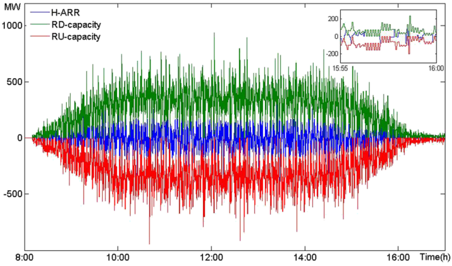
The large-scale popularization of electric vehicles (EVs) brings the potential for grid frequency regulation. Considering the characteristics of fast response and adjustment of EVs, two control strategies of automatic generation control (AGC) with EVs are proposed responding to two high frequency regulating signals extracted from area control error (ACE) and area regulation requirement (ARR) by a digital filter, respectively. In order to dispatch regulation task to EVs, the capacity of regulation is calculated based on maximum V2G power and the present V2G power of EVs. Finally, simulations based on a two-area interconnected power system show that the proposed approaches can significantly suppress frequency deviation and reduce the active power output of traditional generation units.
Overview
CoChat Summary
TL;DR
The paper proposes two real-time V2G control strategies that dispatch high-frequency components of ACE or ARR to EVs for AGC frequency regulation, with EV regulation capacity calculated from maximum and present V2G power. Simulations on a two-area interconnected system show both strategies reduce frequency deviation, ACE, and traditional generation output, with the ARR-based strategy generally performing better than the ACE-based strategy.
Key findings
- In area A, frequency deviation RMS fell from 0.0575 Hz (CS0, no EVs) to 0.0423 Hz with H-ACE (CS1) and 0.0405 Hz with H-ARR (CS2); max/min also improved (CS0: 0.2132/−0.2719 Hz; CS1: 0.1696/−0.2379 Hz; CS2: 0.1654/−0.2365 Hz).
- ACE RMS in area A fell from 232 MW (CS0) to 172 MW (CS1) and 163 MW (CS2); max/min improved from 846/−1131 MW to 687/−971 MW (CS1) and 693/−966 MW (CS2).
- Traditional generation output RMS fell from 126.75 MW (CS0) to 104.29 MW (CS1) and 90.64 MW (CS2); min output improved from −560.56 MW to −476.70 MW (CS1) and −428.99 MW (CS2).
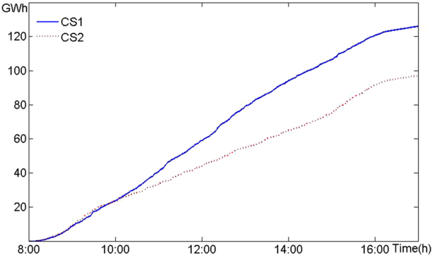
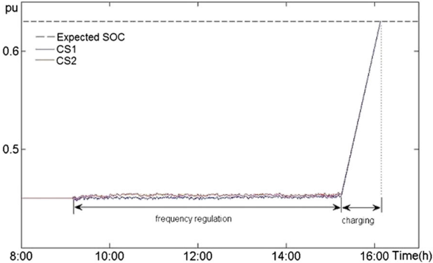
- CS1 caused higher EV power mileage than CS2, indicating greater battery influence; CS2 achieved better regulation and reduced generation output more. CS1 maintained battery SOC at the plug-in level during regulation and reached expected SOC after regulation; CS2 deviated initially but met charging demand before departure.
Methods
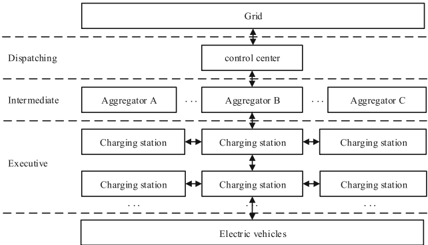
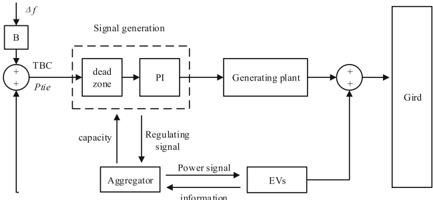
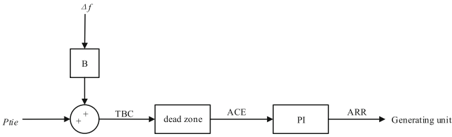
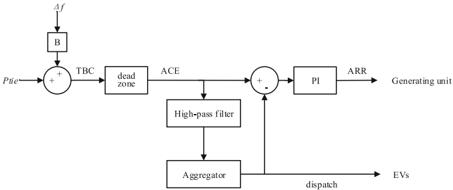
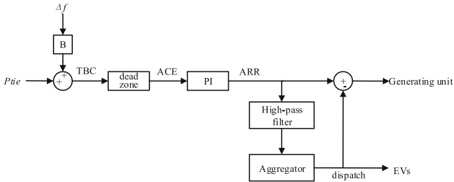
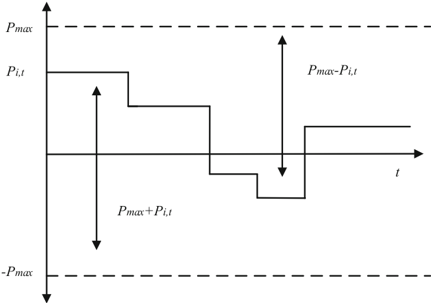
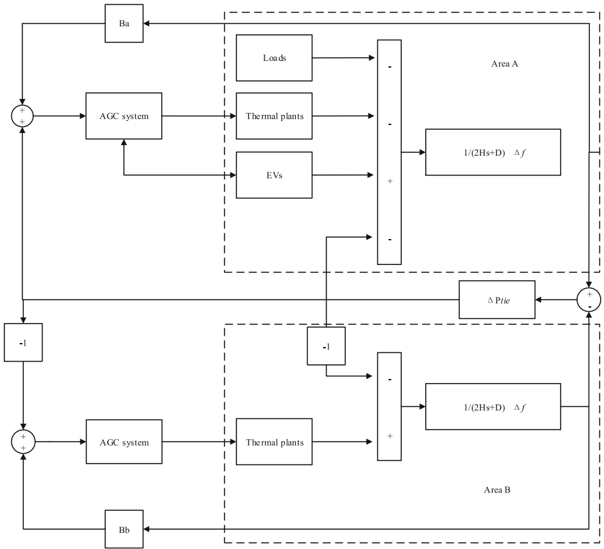
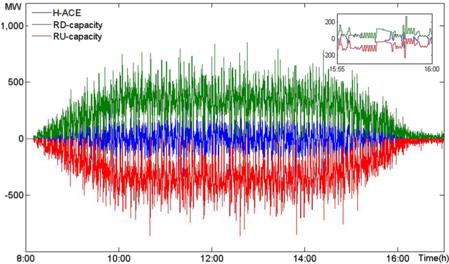
- Proposed two real-time closed-loop V2G control strategies for AGC: high-frequency components of ACE (H-ACE/CS1) and ARR (H-ARR/CS2) extracted by a digital high-pass filter; hierarchical dispatch from control center to EV aggregator to charging stations, with EV capacity for regulation up/down calculated from maximum V2G power plus/minus present V2G power.
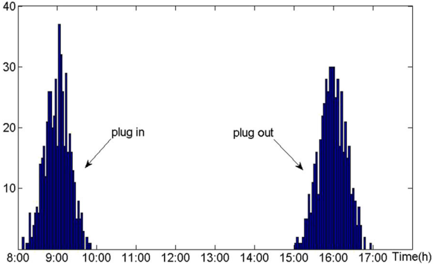
- Simulated a two-area interconnected power system with EVs integrated into area A; the EV aggregator had 100 charging stations, each managing 500 EVs; battery capacity 32 kWh, maximum charging/discharging power 7 kW, SOC limits 0.9/0.2; plug-in/out times, initial SOC, and expected SOC were normal distributions sampled by Latin Hypercube Sampling.
- Compared CS0 (no EV participation), CS1 (H-ACE), and CS2 (H-ARR) using frequency quality, ACE quality, traditional generation output, EV power mileage, and battery SOC.
Limitations
- Stated limitations: Not stated in the paper.
- Evident: The evaluation is simulation-based on a two-area interconnected power system and an EV aggregator model, not field deployment or real fleet data.
- Evident: Battery impact/SOC analysis is demonstrated with only one EV for clarity, and data availability states “Please contact author for data requests”; no explicit sensitivity or robustness analysis is reported.
Model-written summary. Check it against the paper before relying on it.
Integrity signals
Registry
Cites
Statistics
Figures
Verification
Claims the paper makes
0 Valid · 1 Not valid · 3 Not checked · 17 Own results and interpretations
A result the paper states — it cites no source for it, so there is none to check. The quote shows it is in the paper.
In the paper
“Since the duration for charging is budgeted at the plug-in time, charging demands can be achieved.”
§ Real-time vehicle-to-grid control for frequency regulation with high frequency regulating signal > 5.1.4 Influences of frequency regulation on EV battery
plainstates a causeSingle case- Asserted: passes — The authors put it forward as true.
- Checkable: passes — It can be checked against evidence.
- Load-bearing: passes — The paper’s conclusions depend on it.
- Based: passes — The paper gives a reason why it holds.
A result the paper states — it cites no source for it, so there is none to check. The quote shows it is in the paper.
In the paper
“As illustrated in Tables 3 and 4, compared with the case of CS0, the frequency deviation and ACE can be suppressed more effectively by CS1 and CS2.”
§ Real-time vehicle-to-grid control for frequency regulation with high frequency regulating signal > 5.1.2 Effect of EVs on grid frequency regulation
plainstates a cause- Asserted: passes — The authors put it forward as true.
- Checkable: passes — It can be checked against evidence.
- Load-bearing: passes — The paper’s conclusions depend on it.
- Based: passes — The paper gives a reason why it holds.
A result the paper states — it cites no source for it, so there is none to check. The quote shows it is in the paper.
In the paper
“Finally, simulations based on a two-area interconnected power system show that the proposed approaches can significantly suppress frequency deviation and reduce the active power output of traditional generation units.”
- Also stated in: § 5.1.2 Effect of EVs on grid frequency regulation · plain
“As illustrated in Tables 3 and 4, compared with the case of CS0, the frequency deviation and ACE can be suppressed more effectively by CS1 and CS2.”
§ Real-time vehicle-to-grid control for frequency regulation with high frequency regulating signal > Abstract
plainstates a causen = 2- Asserted: passes — The authors put it forward as true.
- Checkable: passes — It can be checked against evidence.
- Load-bearing: passes — The paper’s conclusions depend on it.
- Based: passes — The paper gives a reason why it holds.
- Also stated in: § 5.1.2 Effect of EVs on grid frequency regulation · plain
A result the paper reports from its own data — it cites no other source for it, so there is none to check. The quote shows it is in the paper.
In the paper
“At the same time, Tables 3, 4 and 5 show that CS2 can achieve better regulation than CS1.”
§ Real-time vehicle-to-grid control for frequency regulation with high frequency regulating signal > 5.1.4 Influences of frequency regulation on EV battery
plainstates a cause- Asserted: passes — The authors put it forward as true.
- Checkable: passes — It can be checked against evidence.
- Load-bearing: passes — The paper’s conclusions depend on it.
- Based: passes — The paper gives a reason why it holds.
A conclusion the paper draws from its own results — it cites no other source for it, so there is none to check. The quote shows it is in the paper.
In the paper
“Therefore, EVs are more suitable for responding to fast regulation signals (i.e., high frequency components of ACE or ARR) compared to traditional generation units.”
§ Real-time vehicle-to-grid control for frequency regulation with high frequency regulating signal > 3.1.1 Dispatching approach (1) ACE and ARR signal
plainstates a cause- Asserted: passes — The authors put it forward as true.
- Checkable: passes — It can be checked against evidence.
- Load-bearing: passes — The paper’s conclusions depend on it.
- Based: passes — The paper gives a reason why it holds.
- Rests on an assumption not shown here.
4 more claims
Create a free account to see all 21 claims and to verify the 3 references still open.
- It may state two separate claims as one. 10
- The quote only partly states this claim. 1
- Probably not a substantial claim. 4
Citations
Cites
Vehicle-to-grid power fundamentals: Calculating capacity and net revenue
Kempton, W., & Tomić, J. (2005) · Journal of Power Sources · doi:10.1016/j.jpowsour.2004.12.025 · Cited by 2,323 · cited 1×
“In [14], the economics of V2G providing regulation services, spinning services, and peak power were analyzed.”
Development of an Optimal Vehicle-to-Grid Aggregator for Frequency Regulation
Han, S., Han, S., & Sezaki, K. (2010) · IEEE Transactions on Smart Grid · doi:10.1109/tsg.2010.2045163 · Cited by 1,086
Electric vehicles as a new power source for electric utilities
Kempton, W., & Letendre, S. E. (1997) · Transportation Research Part D: Transport and Environment · doi:10.1016/s1361-9209(97)00001-1 · Cited by 929
The impact of plug-in hybrid electric vehicles on distribution networks: A review and outlook
Green, R. C., Wang, L., & Alam, M. (2011) · Renewable and Sustainable Energy Reviews · doi:10.1016/j.rser.2010.08.015 · Cited by 640
Decentralized Vehicle-to-Grid Control for Primary Frequency Regulation Considering Charging Demands
Liu, H., Hu, Z., Song, Y., & Lin, J. (2013) · IEEE Transactions on Power Systems · doi:10.1109/tpwrs.2013.2252029 · Cited by 482
Self-citationEvaluation of Achievable Vehicle-to-Grid Capacity Using Aggregate PEV Model
Zhang, H., Hu, Z., Xu, Z., & Song, Y. (2017) · IEEE Transactions on Power Systems · doi:10.1109/tpwrs.2016.2561296 · Cited by 329
Masuta, T., & Yokoyama, A. (2012) · IEEE Transactions on Smart Grid · doi:10.1109/tsg.2012.2194746 · Cited by 322
Vehicle-to-Grid Control for Supplementary Frequency Regulation Considering Charging Demands
Liu, H., Hu, Z., Song, Y., Wang, J., & Xie, X. (2015) · IEEE Transactions on Power Systems · doi:10.1109/tpwrs.2014.2382979 · Cited by 292
Self-citationVehicle-to-Grid Regulation Reserves Based on a Dynamic Simulation of Mobility Behavior
Dallinger, D., Krampe, D., & Wietschel, M. (2011) · IEEE Transactions on Smart Grid · doi:10.1109/tsg.2011.2131692 · Cited by 258
Han, S., Han, S., & Sezaki, K. (2011) · IEEE Transactions on Smart Grid · doi:10.1109/tsg.2011.2160299 · Cited by 235
Capacity Estimation for Vehicle-to-Grid Frequency Regulation Services With Smart Charging Mechanism
Lam, A. Y. S., Leung, K.-C., & Li, V. O. K. (2016) · IEEE Transactions on Smart Grid · doi:10.1109/tsg.2015.2436901 · Cited by 220
An Authenticated Control Framework for Distributed Voltage Support on the Smart Grid
Rogers, K. M., Klump, R., Khurana, H., Aquino-Lugo, A. A., & Overbye, T. J. (2010) · IEEE Transactions on Smart Grid · doi:10.1109/tsg.2010.2044816 · Cited by 205
Luo, Z., Hu, Z., Song, Y., Xu, Z., & Lu, H. (2013) · IEEE Transactions on Power Systems · doi:10.1109/tpwrs.2013.2262318 · Cited by 155
Value of flexible electric vehicles in providing spinning reserve services
Pavić, I., Capuder, T., & Kuzle, I. (2015) · Applied Energy · doi:10.1016/j.apenergy.2015.07.070 · Cited by 151
The impact of plug-in hybrid electric vehicles on distribution networks: a review and outlook
Green, R. C., Wang, L., & Alam, M. (2010) · IEEE PES General Meeting · doi:10.1109/pes.2010.5589654 · Cited by 128
Hidden Benefits of Electric Vehicles for Addressing Climate Change
Li, C., Cao, Y., Zhang, M., Wang, J., Liu, J., Shi, H., & Geng, Y. (2015) · Scientific Reports · doi:10.1038/srep09213 · Cited by 110
Fan, H., Jiang, L., Zhang, C., & Mao, C. (2016) · IET Generation Transmission & Distribution · doi:10.1049/iet-gtd.2016.0108 · Cited by 75
Real-time plug-in electric vehicles charging control for V2G frequency regulation
Ma, T., & Mohammed, O. A. (2013) · Annual Conference of the IEEE Industrial Electronics Society (IECON) · doi:10.1109/iecon.2013.6699303 · Cited by 24
Influences of Electric Vehicles on Power System and Key Technologies of Vehicle-to-Grid
Li, C., Cao, Y., Kuang, Y., & Zhou, B. (2016) · Power systems · doi:10.1007/978-3-662-49364-9 · Cited by 21
Vehicle-to-grid regulation based on a dynamic simulation of mobility behaviorPreprint
Dallinger, D., Krampe, D., & Wietschel, M. (2010) · RePEc: Research Papers in Economics · doi:10.24406/publica-fhg-294918 · Cited by 10
Research works printed but not linked: 1
- Hu, Z., Xie, X., Fang, F., Zhang, J., & Song, Y. (2014). Research on automatic generation control strategy incorporating energy storage resources[J]. Proc CSEE, 34(29), 5080-5087.
Cited by
Fang, Y., Wei, W., Mei, S., Chen, L., Zhang, X., & Huang, S. (2020) · Journal of Cleaner Production · doi:10.1016/j.jclepro.2020.120753 · Cited by 209
Alfaverh, F., Denai, M. A., & Sun, Y. (2022) · Electric Power Systems Research · doi:10.1016/j.epsr.2022.108949 · Cited by 119
Wang, D., Hu, Q., Jia, H., Hou, K., Du, W., Chen, N., Wang, X., & Fan, M. (2019) · Applied Energy · doi:10.1016/j.apenergy.2019.04.050 · Cited by 109
Jiang, S., Liu, Y., Liang, W., Peng, J., & Jiang, H. Q. (2019) · IEEE Transactions on Vehicular Technology · doi:10.1109/tvt.2019.2944220 · Cited by 90
Liu, H., Huang, K., Wang, N., Qi, J., Wu, Q., Ma, S., & Li, C. (2019) · Applied Energy · doi:10.1016/j.apenergy.2019.02.044 · Cited by 80
Self-citation
Metadata
- Authors
- Liu, H., Huang, K., Yang, Y., Wei, H., & Ma, S.
- Affiliations
- Guangxi University (CN)
- China Electric Power Research Institute (CN)
- Corresponding author
- Liu, H.
- Venue
- Protection and Control of Modern Power Systems
- Published
- 2018-05-21
- Volume
- 3
- Issue
- 1
- Pages
- 13
- ISSN
- 2367-0983 (ISSN-L)
- 2367-2617
- OpenAlex
- W2805550437
- Cited by
- 90
- References
- 18
- Citations by year
- 2026: 5 · 2025: 9 · 2024: 2 · 2023: 14 · 2022: 19 · 2021: 11 · 2020: 14 · 2019: 14 · 2018: 2
- FWCI
- 3.61
- Type
- journal article
- Language
- en
- Open access
- hybrid
- doi.org
- Licence
- cc-by
- creativecommons.org/licenses/by/4.0 (tdm)
- Locations
- Protection and Control of Modern Power Systems (publishedVersion, cc-by)
- Funders
- Sino-US international Science and Technology Cooperation Project (2016YFE0105300)
- Topics
- Physical Sciences › Engineering › Electrical and Electronic Engineering › Frequency Control in Power Systems
- Physical Sciences › Engineering › Electrical and Electronic Engineering › Electric Vehicles and Infrastructure
- Physical Sciences › Engineering › Electrical and Electronic Engineering › Smart Grid Energy Management
- Keywords
- vehicle-to-grid, electric vehicles, frequency regulation, automatic generation control, area control error, digital filters, two-area power system
About these checks
Registry, retraction, Cites and statistics results are computed, not judged, with one exception: a printed reference that no index lists is read once by a model before it counts as a citation error. Claims are extracted by a model and kept only when their quote appears verbatim in the text; each cited source is then checked, with a model’s help, for whether it says what the claim relies on. Those verdicts can be wrong — read the claim’s quote and the cited source before relying on one.
A language model drew the claims from the paper on 2026-11-25, under version 3 of the claim definition (model deepseek-v4.1-flash, prompt extract-v3).
A second model labelled each claim on 2026-11-25 (model jev-1.13-20260917, definition revision gold-guideline-v0.2).
Statistics and arithmetic are recomputed, not judged.
Confidence bands are shown only for fields calibrated on our annotated test set. None is calibrated yet, so no band is shown.
What counts as a claim ›How we measure confidence ›How we check this ›
Are you an author, or do you see a problem with this page? Request a review
Data sources
Bibliographic data: Semantic Scholar, OpenAlex, Crossref.
Contains information from the Semantic Scholar Academic Graph Datasets, made available under the ODC Attribution License (ODC-BY 1.0).
Semantic Scholar’s data is described in: Kinney, R., et al. (2023). The Semantic Scholar Open Data Platform. arXiv:2301.10140.
