

Environmental applications of Effective Microorganisms: a review of current knowledge and recommendations for future directions
Open accessThe DOI matches its Crossref record; 40 of the 40 references it cites were found in a registry or an index; 12 of the 95 sources its claims cite were checked for support.
Abstract
Abstract Nowadays, beneficial microorganisms are getting wider applicability. One example is referred to as Effective Microorganisms (EM) having its composition kept a secret. EM is a product in liquid form, which consists of a variety of not only effective and beneficial microorganisms but also nonpathogenic ones, with admirable coexistence between aerobic and anaerobic types of microorganisms. The aim of this narrative review is to provide a summary of the different uses and applications of EM, their applications, their benefits, and the expected results when using them in different applications. This is the first review to focus on the uses of EM in environmental engineering systems and processes such as wastewater treatment processes. Originally, EM was manufactured to be utilized in organic farming, but at the moment, this substance is getting wider applications such as in medicine, environment, livestock sector, forestry, and agriculture. When it comes to the protection of the environment, EM helps in waste deodorization, eutrophication control, and wastewater. Investigation on EM use in water quality restoration, wastewater treatment, the treatment of sludge, and composting has been undertaken by researchers. This review provides an overview of the current situation of environmental application of EM in various fields including water quality, wastewater treatment, sludge treatment, and composting.
Overview
CoChat Summary
## TL;DR
This narrative review summarizes environmental uses of Effective Microorganisms (EM) across water quality restoration, wastewater treatment, sludge treatment, and composting. The paper concludes that EM often performs well in water and wastewater applications, but results are inconsistent and composting results are generally poor.
## Key findings
- In an eutrophic artificial lake, an integrated restoration method using EM, aquatic vegetation, intermittent aeration, and fingerlings removed total phosphorus by 86.87%, TSS by 82.36%, turbidity by 79.28%, COD by 70.12%, and total nitrogen by 57.36%.
- In polluted river water, EM removal efficiency increased with dissolved oxygen for COD, TP, and ammonia nitrogen by 4.59%, 18.18%, and 34.34%, respectively; the authors note EM survived and reproduced under aerobic conditions.
- In domestic sewage, adding 3 mL/L EM under aerobic conditions reduced TSS by 91%, BOD by 85%, COD by 82%, and TDS by 55% after 3 days.
- In composting studies, multiple trials found little or no benefit from EM: adding EM failed to shorten composting time in chicken manure and did not improve pine bark composting or banana residue decomposition; one pyrethrum-waste study reported maximum biogas production at 1:500 v/v EM and highest methane yield at 1:250 v/v, but the review still concludes composting results were not good overall.
## Methods
- Narrative review of published studies on EM in environmental engineering, with emphasis on water quality restoration, wastewater treatment, sludge treatment, and composting.
- The paper synthesizes results from prior studies and tables of applications rather than reporting a new experiment or dataset.
- Main analysis is qualitative comparison of reported outcomes across studies, with selected numerical treatment/removal efficiencies extracted from the literature.
## Limitations
- The paper states that the precise EM components are still unidentified and that different opinions exist in the literature about EM’s environmental applications.
- It explicitly says further research is essential because there is a lack of precise information about EM behavior, including studies of temperature, pH, hydraulic retention time, dose, and aerobic/anaerobic performance.
- Evident from the text: this is a narrative review that does not present a systematic search strategy, inclusion criteria, or meta-analysis, so its conclusions depend on the studies it selected.
Model-written summary. Check it against the paper before relying on it.
Integrity signals
Registry
Cites
Statistics
Figures
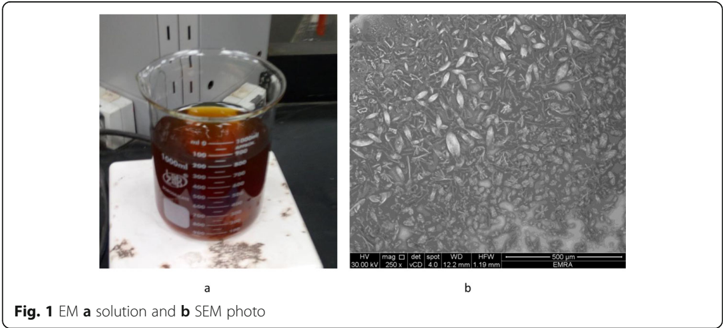

Verification
Claims the paper makes
11 Valid · 3 Not valid · 80 Not checked · 3 Own results and interpretations
The cited sources support only part of this claim — read each source’s verdict below.
In the paper
“The species that are majorly present in EM include lactic acid bacteria, which have been identified as crucial in cleaning septic tanks as well as algal control [39].”
§ Environmental applications of Effective Microorganisms: a review of current knowledge and recommendations for future directions > Introduction
What the sources say
- Partly supportedcites [39] 39. Sampaotong T, Lek-Uthai U, Roongruangchai J, Roongruangchai K (2016) Viability and morphological changes of Acanthamoeba spp. cysts after treatment with Effective microorganisms (EM). J Parasit Dis. 40(2):369-373. https://doi. org/10.1007/s12639-014-0511-x sourceExperimental — accuracy not yet measured
The Introduction lists lactic acid bacteria among the main organisms in EM and mentions cleaning septic tanks and algal control. It describes these as uses associated with EM, however; it does not establish that lactic acid bacteria specifically are crucial to either use. (LLM, conf=0.83)
plainstates a cause- Asserted: passes — The authors put it forward as true.
- Checkable: passes — It can be checked against evidence.
- Load-bearing: unclear — It is unclear whether the paper’s conclusions depend on it.
- Based: passes — The paper gives a reason why it holds.
- Partly supported
The cited sources support only part of this claim — read each source’s verdict below.
In the paper
“The efficiency of removal of various substances such as COD, TP, and ammonia nitrogen (NH 3 -N) was found to increase with the abundance of DO at 4.59%, 18.18%, and 34.34%, respectively.”
§ Environmental applications of Effective Microorganisms: a review of current knowledge and recommendations for future directions > Main text
What the sources say
- Partly supportedcites [19] 19. Ji M, Zhu J, Zhu R, Chen J, Wang C (2014) Experiments on the effects of dissolved oxygen on the free and immobilization effective microorganisms (EM) in treating polluted river water. Proc Int Conf Mater Environ Eng. (ICMAEE 2014) 57:5-7 sourceExperimental — accuracy not yet measured
The Abstract and Table 1 (Results and Discussion) give the claimed increases for free effective microorganisms (EM), in the order COD, TP, and NH₃-N. The citing sentence omits that qualifier: the paper reports smaller increases for immobilized microorganisms (IAEM). The Methods also specify that the experiment used synthetic polluted river water. (LLM, conf=0.87)
plainstates a cause- Asserted: passes — The authors put it forward as true.
- Checkable: passes — It can be checked against evidence.
- Load-bearing: unclear — It is unclear whether the paper’s conclusions depend on it.
- Based: passes — The paper gives a reason why it holds.
- Partly supported
Every source the paper cites for this claim was checked and supports it.
In the paper
“In addition, EM technology suppresses the harmful gases produced by decomposed garbage [41].”
§ Environmental applications of Effective Microorganisms: a review of current knowledge and recommendations for future directions > Introduction
What the sources say
- Supportedcites [41] 41. Shalaby EA (2011) Prospects of effective microorganisms technology in wastes treatment in Egypt. Asian Pac J Trop Biomed. 1(3):243-248. https://doi.org/10.1016/S2221-1691(11)60035-X source
The passage headed “Contents lists available at ScienceDirect” explicitly says that EM technology suppresses harmful gases generated from garbage. It also discusses removing the foul smell from decomposed garbage, matching the citing sentence’s context. (LLM, conf=0.94)
plainstates a cause- Asserted: passes — The authors put it forward as true.
- Checkable: passes — It can be checked against evidence.
- Load-bearing: unclear — It is unclear whether the paper’s conclusions depend on it.
- Based: passes — The paper gives a reason why it holds.
- Supported
Every source the paper cites for this claim was checked and supports it.
In the paper
“The application of EM led to a decrease in the number of possible pathogenic bacteria (E.coli) [10].”
§ Environmental applications of Effective Microorganisms: a review of current knowledge and recommendations for future directions > Bioremediation of sludge using EM
What the sources say
- Supportedcites [10] 10. Boruszko D, Butarewicz A (2015) Impact of effective microorganisms bacteria on low-input sewage sludge treatment. Environ Prot Eng. 41:83-96 source
The Summary and Conclusions state that EM application caused a more effective reduction in potential pathogenic bacteria (E. coli) during treatment of dairy sewage sludge. This directly supports the cited paraphrase. (LLM, conf=0.95)
plainstates a cause- Asserted: passes — The authors put it forward as true.
- Checkable: passes — It can be checked against evidence.
- Load-bearing: unclear — It is unclear whether the paper’s conclusions depend on it.
- Based: passes — The paper gives a reason why it holds.
- Supported
The cited sources that could be checked couldn’t confirm or dispute this claim.
In the paper
“This study points to the fact that EM application is appropriate in increasing the mineralization in the composting procedure [11].”
§ Environmental applications of Effective Microorganisms: a review of current knowledge and recommendations for future directions > Composting of organic matter using EM
What the sources say
- Could not verifycites [11] 11. Che Jusoh ML, Abd Manaf L, Abdul Latiff P (2013) Composting of rice straw with effective microorganisms (EM) and its influence on compost quality. Iran J Environ Heal Sci Eng. 10:1-9 sourceExperimental — accuracy not yet measured
The Introduction describes wet-air oxidation treatments for leachate from a composting factory, not EM application during composting. Searches for effective microorganisms and mineralization found no passage addressing whether EM increases compost mineralization. (LLM, conf=0.75)
hedgedstates a cause- Asserted: passes — The authors put it forward as true.
- Checkable: passes — It can be checked against evidence.
- Load-bearing: passes — The paper’s conclusions depend on it.
- Based: passes — The paper gives a reason why it holds.
- Could not verify
34 more claims
Create a free account to see all 97 claims and to verify the 2 references still open.
- It may state two separate claims as one. 51
- Probably not a substantial claim. 12
- The quote only partly states this claim. 1
Citations
Cites
Composting of rice straw with effective microorganisms (EM) and its influence on compost quality
Jusoh, M. L. C., Manaf, L. A., & Latiff, P. A. (2013) · Iranian Journal of Environmental Health Science & Engineering · doi:10.1186/1735-2746-10-17 · Cited by 231
Role and functions of beneficial microorganisms in sustainable aquaculture
Zhou, Q., Li, K., Jun, X., & Bo, L. (2009) · Bioresource Technology · doi:10.1016/j.biortech.2008.12.037 · Cited by 209
Lananan, F., Abdul Hamid, S. H., Din, W. N. S., Ali, N., Khatoon, H., Jusoh, A., & Endut, A. (2014) · International Biodeterioration & Biodegradation · doi:10.1016/j.ibiod.2014.06.013 · Cited by 183
Evaluation of Effective Microorganisms on home scale organic waste composting
Fan, Y. V., Lee, C. T., Klemeš, J. J., Chua, L. S., Sarmidi, M. R., & Leow, C. W. (2018) · Journal of Environmental Management · doi:10.1016/j.jenvman.2017.04.019 · Cited by 183
How effective are ‘Effective microorganisms® (EM)’? Results from a field study in temperate climate
Mayer, J., Scheid, S., Widmer, F., Fließbach, A., & Oberholzer, H.-R. (2010) · Applied Soil Ecology · doi:10.1016/j.apsoil.2010.08.007 · Cited by 161 · cited 5×
“In terms of composition, EM is commercially available as an EM-1® suspension concentrate, which is utilized as a basic formulation of various EM preparations obtain through sugar cane, molasses, and water’s anaerobic fermentation (EMA), or fermentation of water, sugar cane molasses, and vinegar (EM5), or fermentation…”
BackgroundMethodInfluentialThe study of leachate treatment by using three advanced oxidation process based wet air oxidation
Karimi, B., Ehrampoush, M. H., Ebrahimi, A., & Mokhtari, M. (2013) · Iranian Journal of Environmental Health Science & Engineering · doi:10.1186/1735-2746-10-1 · Cited by 143
Effective microorganisms and their influence on vegetable production – a review
Olle, M., & Williams, I. H. (2013) · The Journal of Horticultural Science and Biotechnology · doi:10.1080/14620316.2013.11512979 · Cited by 129 · cited 2×
“Presently, EM has been adopted by over 100 countries across the globe, not on an experimentation basis but for commercial use as well as environmental management [29].”
BackgroundTalaat, N. B., Ghoniem, A. E., Abdelhamid, M. T., & Shawky, B. T. (2015) · Plant Growth Regulation · doi:10.1007/s10725-014-9952-6 · Cited by 112 · cited 4×
“EM is a brand name for the various products developed by Dr. Teruo Higa, who is a professor of horticulture at the University of Ryukyus, a university located in Okinawa, Japan [44].”
BackgroundInfluentialMupondi, L. T., Mnkeni, P. N. S., & Brutsch, M. O. (2006) · Compost Science & Utilization · doi:10.1080/1065657x.2006.10702284 · Cited by 62 · cited 2×
“The use of EM in inoculation failed to influence the composting pine bark procedure alone or when combined with the two tested organic materials in a positive manner [27].”
BackgroundMethodPerformance of moving bed biofilm reactor using effective microorganisms
Safwat, S. M. (2018) · Journal of Cleaner Production · doi:10.1016/j.jclepro.2018.03.041 · Cited by 58 · cited 7×
“MBBR with EM was not as good as MBBR without EM under shock loadings [36].”
BackgroundMethodSelf-citation
Research works printed but not linked: 10
- 1. Abdel-megeed A, El-nakieb FA (2006) Bioremediation of dimethoate by effective micro-organisms in Egyptian contaminated water 2: 490-498
- 4. Ahmed S, Abdelhalim H, Rozaik E (2013) Treatment of primary settled wastewater using anaerobic sequencing batch reactor seeded with activated EM. Civ Environ Res. 3:130-137
- 7. Anwar ZR, Ariffin M, Hassan A, Mahmood I, Khamis AK (2013) Treatment of rubber processing wastewater by effective microorganisms using anaerobic sequencing batch reactor. J Agrobiotechnology 4:1-15
- 12. Doas N, Ghandour MAA, Abd-alla MH (2018) Sludge reduction in wastewater of beet sugar industry using the effective microorganisms. In Abu Qurqas Sugar Factory. Egypt Sugar J. 10:63-82
- 15. Embaby, A.A., El-Shahawy, ;, Abd-Allah, M.A., & Dawoud, I.A. (2010). Application of effective microorganisms in treatment of wastewater of beet sugar factory at Bilqas, Dakahlia Governorate, Egypt J Environ Sci. 39: 151-158.
- 20. Kulig A, Barczak R (2010) "Effective microorganisms" (EM) in reducing noxiousness of selected odorant. Environ Prot Eng. 36:13-24
- 28. Namsivayam SKR, Narendrakumar G, Kumar JA (2011) Evaluation of Effective Microorganism (EM) for treatment of domestic sewage. J Exp Sci. 2:30-32
- 30. Ong HK, Chew BH, Suhaimi M (2001) Effect of effective microorganisms on composting characteristics of chicken manure. J Trop Agric Food Sci. 29:189-196
- 33. Pushpa TB, Sekaran V, Sardhar Basha SJ, Jegan J (2016) Investigation on preparation, characterization and application of Effective Microorganisms (EM) based composts-an ecofriendly solution nature environment and pollution technology An International Quarterly Scientific Journal. Nat Environ Pollut Technol. 15:153
- 34. Rashid MT, West J (2007) Dairy wastewater treatment with effective and pathogen control 93-102
Cited by
Kumar, V., Lakkaboyana, S. K., Sharma, N., Chakraborty, P., Umesh, M., Pasrija, R., Thomas, J. B., Kalebar, V. U., Iyyappan, J., Awasthi, M. K., et al. (2023) · Case Studies in Chemical and Environmental Engineering · doi:10.1016/j.cscee.2023.100363 · Cited by 128
Mechanism of Microbial Detoxification of Heavy Metals: A Review
Jayaram, S., Munusamy, A. P., Aiswarya, K. P., Devi, M. P., & Rajakumar, S. (2022) · Journal of Pure and Applied Microbiology · doi:10.22207/jpam.16.3.64 · Cited by 33
Effective microorganism water treatment method for rapid eutrophic reservoir restoration
Tomczyk, P., Wierzchowski, P. S., Dobrzyński, J., Kulkova, I., Wróbel, B., Wiatkowski, M., Kuriqi, A., Skorulski, W., Kabat, T., Prycik, M., et al. (2023) · Environmental Science and Pollution Research · doi:10.1007/s11356-023-31354-2 · Cited by 29
“Currently, EM are used not only for the treatment of eutrophic waters but also for sludge treatment, wastewater treatment, composting, medicine, livestock, forestry, and agriculture (Safwat and Matta 2021; Kour et al. 2021).”
BackgroundSafwat, S. M., Meshref, M. N. A., Salama, M., & Elawwad, A. (2022) · International Journal of Environmental Science and Technology · doi:10.1007/s13762-022-04731-6 · Cited by 18
“…problems and affect the efficiency of biological treatment processes, it is essential to develop a suitable treatment method to reduce the concentration of phenol in wastewater and overcome the disadvantages of other treatment methods (Trujillo–Reyes et al. 2019; Safwat and Matta 2021).”
MethodSelf-citationVelmurugan, L., & Kannan, D. (2024) · Heliyon · doi:10.1016/j.heliyon.2024.e39501 · Cited by 17
“EM technology has been demonstrated with encouraging results pertinent to restoring water quality [50,51], treating wastewater [18,52,53], removing pollutants such as phosphorus, total suspended substances, nitrogen, and chemical oxygen demand (COD) [54] and reducing sludge volume [55].”
Background
Metadata
- Authors
- Safwat, S. M., & Matta, M. E.
- Affiliations
- Cairo University (EG)
- Corresponding author
- Safwat, Safwat M.
- Venue
- Journal of Engineering and Applied Science
- Published
- 2021-12
- Volume
- 68
- Issue
- 1
- ISSN
- 1110-1903 (ISSN-L)
- 2536-9512
- OpenAlex
- W4200171098
- Cited by
- 44
- References
- 31
- Citations by year
- 2026: 6 · 2025: 13 · 2024: 15 · 2023: 7 · 2022: 3
- FWCI
- 3.65
- Type
- journal article
- Language
- en
- Open access
- diamond
- doi.org
- Licence
- cc-by
- creativecommons.org/licenses/by/4.0 (tdm)
- creativecommons.org/licenses/by/4.0 (vor, 20 d)
- Locations
- Journal of Engineering and Applied Science (publishedVersion, cc-by)
- DOAJ (DOAJ: Directory of Open Access Journals) (submittedVersion, cc-by-sa)
- Topics
- Life Sciences › Agricultural and Biological Sciences › Soil Science › Composting and Vermicomposting Techniques
- Physical Sciences › Environmental Science › Pollution › Microbial bioremediation and biosurfactants
- Life Sciences › Agricultural and Biological Sciences › Plant Science › Agriculture, Plant Science, Crop Management
- Keywords
- effective microorganisms, beneficial microorganisms, wastewater treatment, sludge treatment, composting, water remediation, eutrophication control, organic farming
About these checks
Registry, retraction, Cites and statistics results are computed, not judged, with one exception: a printed reference that no index lists is read once by a model before it counts as a citation error. Claims are extracted by a model and kept only when their quote appears verbatim in the text; each cited source is then checked, with a model’s help, for whether it says what the claim relies on. Those verdicts can be wrong — read the claim’s quote and the cited source before relying on one.
The claim verdicts this report counts are experimental: their accuracy is not yet measured.
A language model drew the claims from the paper on 2026-10-11, under version 3 of the claim definition (model deepseek-v4.1-flash, prompt extract-v3).
A second model labelled each claim on 2026-10-11 (model jev-1.13-20260917, definition revision gold-guideline-v0.2).
Cited sources are checked with a language model’s help (gpt-6-sol).
Statistics and arithmetic are recomputed, not judged.
Confidence bands are shown only for fields calibrated on our annotated test set. None is calibrated yet, so no band is shown.
What counts as a claim ›How we measure confidence ›How we check this ›
Are you an author, or do you see a problem with this page? Request a review
How to cite
Cite CoChat for the checks on this page, and the paper for its own findings.
- This page
- CoChat. (2026). Citation check: Environmental applications of Effective Microorganisms: a review of current knowledge and recommendations for future directions. https://app.cochat.ai/papers/10.1186/s44147-021-00049-1
- The paper
- Safwat, S. M., & Matta, M. E. (2021). Environmental applications of Effective Microorganisms: a review of current knowledge and recommendations for future directions. Journal of Engineering and Applied Science. https://doi.org/10.1186/s44147-021-00049-1
Data sources
Bibliographic data: Semantic Scholar, OpenAlex, Crossref.
Contains information from the Semantic Scholar Academic Graph Datasets, made available under the ODC Attribution License (ODC-BY 1.0).
Semantic Scholar’s data is described in: Kinney, R., et al. (2023). The Semantic Scholar Open Data Platform. arXiv:2301.10140.
