

Monitoring disease activity in multiple sclerosis using serum neurofilament light protein
Open accessThe DOI matches its Crossref record; 32 of the 32 references it cites were found in a registry or an index.
Abstract
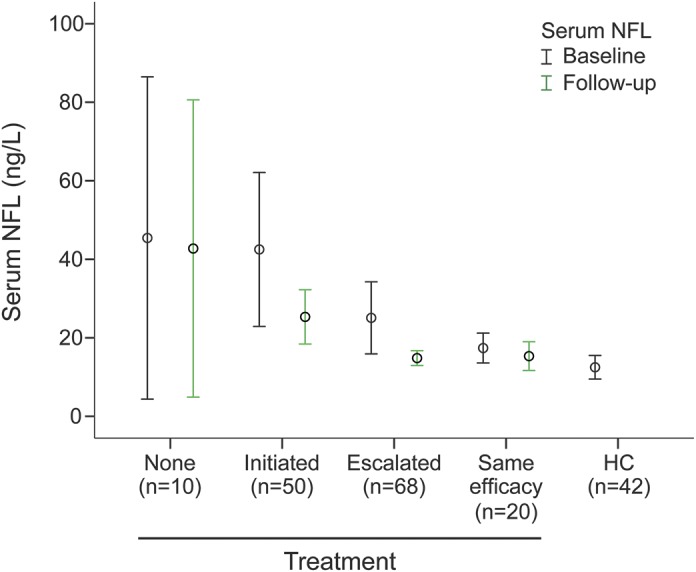
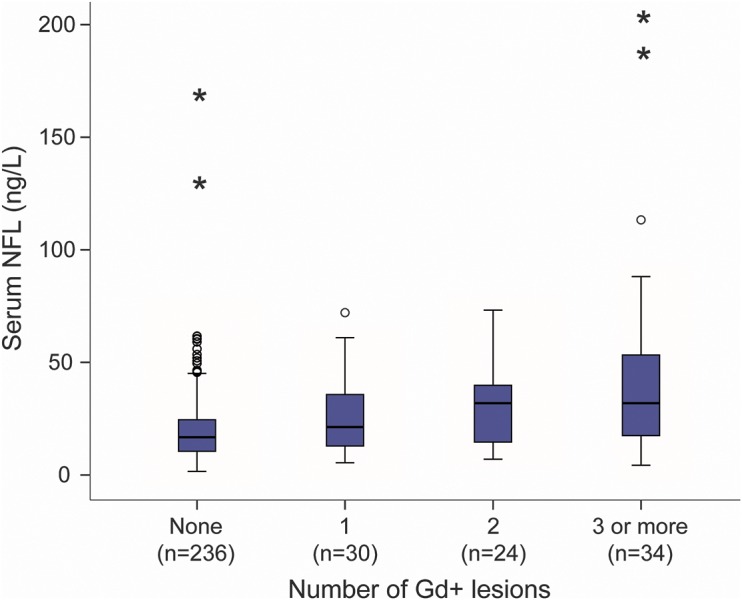
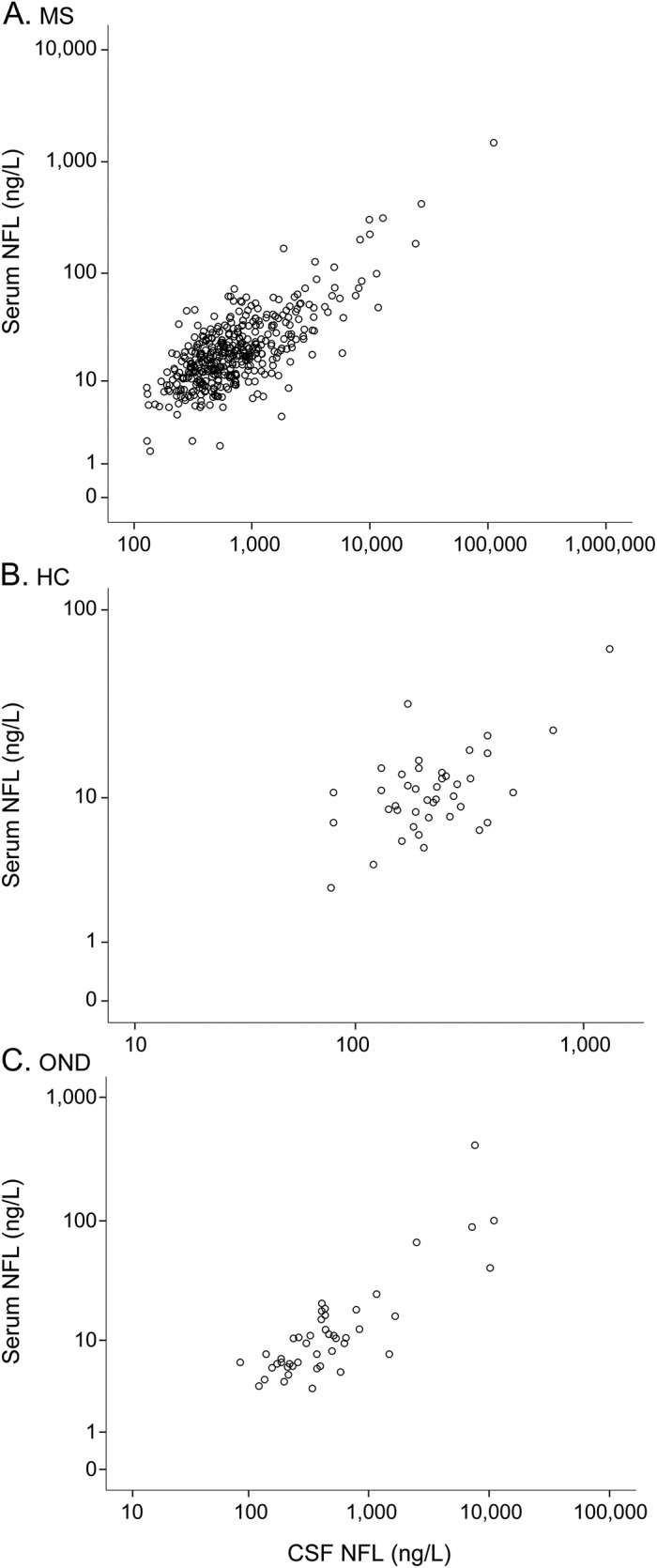
Objective: To examine the effects of disease activity, disability, and disease-modifying therapies (DMTs) on serum neurofilament light (NFL) and the correlation between NFL concentrations in serum and CSF in multiple sclerosis (MS). Methods: NFL concentrations were measured in paired serum and CSF samples (n = 521) from 373 participants: 286 had MS, 45 had other neurologic conditions, and 42 were healthy controls (HCs). In 138 patients with MS, the serum and CSF samples were obtained before and after DMT treatment with a median interval of 12 months. The CSF NFL concentration was measured with the UmanDiagnostics NF-light enzyme-linked immunosorbent assay. The serum NFL concentration was measured with an in-house ultrasensitive single-molecule array assay. Results: In MS, the correlation between serum and CSF NFL was r = 0.62 (p < 0.001). Serum concentrations were significantly higher in patients with relapsing-remitting MS (16.9 ng/L) and in patients with progressive MS (23 ng/L) than in HCs (10.5 ng/L, p < 0.001 and p < 0.001, respectively). Treatment with DMT reduced median serum NFL levels from 18.6 (interquartile range [IQR] 12.6–32.7) ng/L to 15.7 (IQR 9.6–22.7) ng/L (p < 0.001). Patients with relapse or with radiologic activity had significantly higher serum NFL levels than those in remission (p < 0.001) or those without new lesions on MRI (p < 0.001). Conclusions: Serum and CSF NFL levels were highly correlated, indicating that blood sampling can replace CSF taps for this particular marker. Disease activity and DMT had similar effects on serum and CSF NFL concentrations. Repeated NFL determinations in peripheral blood for detecting axonal damage may represent new possibilities in MS monitoring.
Overview
The claims and statistics of this paper haven’t been checked yet.
Free: it reads the open-access text and checks the first 5 claims that cite a source we can check. Create a free account to check every claim.
Integrity signals
Registry
Cites
Statistics
Figures
Verification
Claims the paper makes
The claims and statistics of this paper haven’t been checked yet.
Free: it reads the open-access text and checks the first 5 claims that cite a source we can check. Create a free account to check every claim.
Claims other papers make about this one
Each is checked against this paper’s own text: does it say what the citing paper says it does?
The check wasn’t confident either way, so it gives no verdict — never disputed.
In the citing paper
“Exenatide has also exhibited the potential to lessen brain deterioration and disability in patients with MS. 87”
From Anti-inflammatory role of glucagon-like peptide 1 receptor agonists and its clinical implications (2024) · cites this paper as [87]
Experimental — accuracy not yet measured
Self-check
Percentages, sums and reported differences re-computed from the paper’s own numbers.
The self-check needs the paper’s full text.
Citations
Cites
Rating neurologic impairment in multiple sclerosis: An expanded disability status scale (EDSS)
Kurtzke, J. F. (1983) · Neurology · doi:10.1212/wnl.33.11.1444 · Cited by 15,011
McDonald, W. I., Compston, A., Edan, G., Goodkin, D., Hartung, H., Lublin, F. D., McFarland, H. F., Paty, D. W., Polman, C. H., Reingold, S. C., et al. (2001) · Annals of Neurology · doi:10.1002/ana.1032 · Cited by 6,969 · cited 1×
“A relapse was defined as an episode of neurologic disturbance lasting for at least 24 hours that could not be better explained by another cause.(22)”
BackgroundAxonal transection in the lesions of multiple sclerosis
Trapp, B. D., Peterson, J., Ransohoff, R. M., Rudick, R., Mörk, S., & Bö, L. (1998) · New England Journal of Medicine · doi:10.1056/nejm199801293380502 · Cited by 4,029
Rissin, D. M., Kan, C. W., Campbell, T. G., Howes, S. C., Fournier, D. R., Song, L., Piech, T., Patel, P. P., Chang, L., Rivnak, A. J., et al. (2010) · Nature Biotechnology · doi:10.1038/nbt.1641 · Cited by 2,119 · cited 1×
“Recent technical developments have given rise to ultrasensitive antibody-based analytic techniques such as the single-molecule array (Simoa) technology, which enables quantification of protein biomarkers in blood samples at very low concentrations.(10) We recently developed a Simoa method for NFL in blood samples (ser…”
Multiple Sclerosis Severity Score: Using disability and disease duration to rate disease severity
Roxburgh, R. H. S. R., Seaman, S. R., Masterman, T., Hensiek, A. E., Sawcer, S. J., Vukusic, S., Achiti, I., Confavreux, C., Coustans, M., le Page, E., et al. (2005) · Neurology · doi:10.1212/01.wnl.0000156155.19270.f8 · Cited by 963 · cited 2×
“Disability was scored by the Expanded Disability Status Scale (EDSS),20 and disease severity was scored by the Multiple Sclerosis Severity Score.21 A relapse was defined as an episode of neurologic disturbance lasting for at least 24 hours that could not be better explained by another cause.22 A standard MRI protocol…”
MethodA consensus protocol for the standardization of cerebrospinal fluid collection and biobanking
Teunissen, C. E., Petzold, A., Bennett, J. L., Berven, F. S., Brundin, L., Comabella, M., Franciotta, D., Frederiksen, J. L., Fleming, J. O., Furlan, R., et al. (2009) · Neurology · doi:10.1212/wnl.0b013e3181c47cc2 · Cited by 845 · cited 12×
“They support serum NFL as a biomarker for monitoring disease activity and treatment intervention in MS.”
MethodInfluentialKuhle, J., Barro, C., Andreasson, U., Derfuss, T., Lindberg, R., Sandelius, Å., Liman, V., Norgren, N., Blennow, K., & Zetterberg, H. (2016) · Clinical Chemistry and Laboratory Medicine (CCLM) · doi:10.1515/cclm-2015-1195 · Cited by 740
Self-citationGisslén, M., Price, R. W., Andreasson, U., Norgren, N., Nilsson, S., Hagberg, L., Fuchs, D., Spudich, S., Blennow, K., & Zetterberg, H. (2016) · EBioMedicine · doi:10.1016/j.ebiom.2015.11.036 · Cited by 481 · cited 1×
“We also confirmed the high correlation between serum and CSF NFL levels in patients with OND as in previous studies on traumatic injury(15) and HIV encephalitis.(12) Because of the multiple treatment options, it is increasingly important to accurately identify patients with MS with insufficient treatment response.”
ResultSelf-citationSerum neurofilament light chain protein is a measure of disease intensity in frontotemporal dementia
Rohrer, J. D., Woollacott, I. O. C., Dick, K. M., Brotherhood, E., Gordon, E., Fellows, A., Toombs, J., Druyeh, R., Cardoso, M. J., Ourselin, S., et al. (2016) · Neurology · doi:10.1212/wnl.0000000000003154 · Cited by 432
Self-citationExploring the origins of grey matter damage in multiple sclerosis
Calabrese, M., Magliozzi, R., Ciccarelli, O., Geurts, J. J. G., Reynolds, R., & Martin, R. (2015) · Nature Reviews Neuroscience · doi:10.1038/nrn3900 · Cited by 414
Cited by
Items 401–425 of 425
Yeo, T., Bayuangga, H. F., Augusto‐Oliveira, M., Sealey, M. A., Claridge, T. D. W., Tanner, R., Leppert, D., Palace, J. A., Kühle, J., Probert, F., et al. (2022) · Figshare · doi:10.6084/m9.figshare.21303722
Wurtz, L. I., Knyazhanskaya, E. E., Sohaei, D., Prassas, I., Pittock, S., Willrich, M. A. V., Saadeh, R., Gupta, R., Atkinson, H. J., Grill, D. E., et al. (2024) · Figshare · doi:10.6084/m9.figshare.26047018
Verma, M., Raikwar, S., Beohar, M., Vishwakarma, N., & Sil, A. J. (2026) · BENTHAM SCIENCE PUBLISHERS eBooks · doi:10.2174/9798898814021126010004
Reyes-Mantilla, M. I., Vanegas, A. C., & Galvis-Palomino, V. (2026) · doi:10.59537/saupress.2516
Tunç, A., Seferoğlu, M., & Samadzadeh, S. (2026) · doi:10.59537/saupress.2514
Marzani, E., Alves, G. F., Zemer, A., Rubeo, C., Aimaretti, E., Porchietto, E., Camillò, L., Navarrete, P. I. R., Gurgone, A., Haim, Y., et al. (2026) · Biomedicine & Pharmacotherapy · doi:10.1016/j.biopha.2026.119274 · Cited by 1
“…the reliability of NT-proBNP as a brain dysfunction biomarker in polymicrobial sepsis, we measured blood concentrations of NFL, a well-defined prognostic biomarker for several cerebral disorders, including encephalopathy, traumatic brain injury, multiple and amyotrophic lateral scleroses [49].”
Alanazi, M. S., Motl, R. W., Jones, B. A., Qu, H., Li, P., & Reed, W. R. (2026) · Frontiers in Rehabilitation Sciences · doi:10.3389/fresc.2026.1699274
Rethinking MS Therapeutics: From Disease Pathogenesis Mechanisms to AI-Driven Drug Discovery
Ziaei, M., Sehhati, M., Torabi, M., Esmaeil, N., & Ghasemi, F. (2026) · Journal of Neuroimmune Pharmacology · doi:10.1007/s11481-026-10286-x
Early Diagnosis and Management of Autoimmune Diseases
Padmaja, V., Latha, A. H. D. P., Padmavathi, S., & Vaishnavi, D. S. (2026) · Springer eBooks · doi:10.1007/978-981-95-7490-2_2
Neurofilaments: A Promising Diagnostic and Prognostic Biomarker in Multiple Sclerosis
Mathur, D., Mishra, S. V., Rout, S., Kandimalla, R. J. L., Lopez-Iranzo, F. J., López‐Rodas, G., Vinayak, R., Casanova, B., & Mishra, B. K. (2026) · Annals of Neurosciences · doi:10.1177/09727531261421804
Sellathurai, S., Schoenholzer, K., Villena, F. B., Cerdá-Fuertes, N., Hofer, L., Schädelin, S., Kana, V., Mahenthiran, P., D’Souza, M., Maceski, A. M., et al. (2026) · Neurology Neuroimmunology & Neuroinflammation · doi:10.1212/nxi.0000000000200571
Arashlow, F. T., Fekri, M., Salarvandian, S., Darfarin, K., Esmaeilpour, K., & Ebrahimi, R. (2026) · Multiple Sclerosis and Related Disorders · doi:10.1016/j.msard.2026.107247
Unruh, D. J., Todtleben, J. C., Johnson, K., Schlichtmann, B. W., Szabo, M., Holland, M., Carlson, C. M., Hinson, J. S., & Levin, S. (2026) · The Journal of Applied Laboratory Medicine · doi:10.1093/jalm/jfag052
Flintere-Flinte, A., Krutovs, V., Pantelejeva, E., Blennow, K., Zetterberg, H., Zolovs, M., & Ķēniņa, V. (2026) · BMC Neurology · doi:10.1186/s12883-026-05024-y
“In our study, serum NfL levels were significantly higher in patients with MS compared to healthy controls, consistent with previous reports [14, 15].”
Self-citationMuñoz‐Vendrell, A., Arroyo-Pereiro, P., León, I., Bau, L., Matas, E., Romero-Pinel, L., Roca-Pereira, S., Martínez-Yélamos, A., & Martínez‐Yélamos, S. (2026) · Journal of Neurology · doi:10.1007/s00415-026-13949-0
“Serum neurofilament light chain (sNfL) has emerged as a leading blood-based biomarker capturing such activity and informing prognosis [7].”
PROGNOSTIC BIOMARKERS OF MULTIPLE SCLEROSIS: A NARRATIVE REVIEW
Andriievska, M. I., Kolodnitskiy, A. V., & Hinhin, A. I. (2026) · Reports of Vinnytsia National Medical University · doi:10.31393/reports-vnmedical-2026-30(2)-21
Neurofilament light chain (NfL) as a surrogate outcome measure for GM2 gangliosidoses
Martakis, Κ., Abreu, N. J., Baker, J. J., Baker, P. R., II, Billington, I., Burrow, T. A., Factor, M. A., Fields, T., Fields, C., Gannon, J. L., et al. (2026) · Journal of Neurology · doi:10.1007/s00415-026-13984-x
Circulating microRNA expression profiles as biomarkers of disease activity in multiple sclerosis
Vigiser, I., Zeevi, Y., Piura, Y. D., Kolb, H., Golan, M., Karni, A., & Regev, K. (2026) · Multiple Sclerosis Journal - Experimental Translational and Clinical · doi:10.1177/20552173261471723
Segna, A., Wannemacher, R., Rohn, K., Sippel, V., Steiner, M., Lühder, F., Flügel, A., Baumgärtner, W., & Hülskötter, K. (2026) · Journal of Cellular and Molecular Medicine · doi:10.1111/jcmm.71304 · Cited by 1
Domínguez, J. M. G., Villar, L. M., Arrambide, G., Blanco, Y., Calles, M. C., Casanova, B., Castillo‐Triviño, T., França, L. C. F., Eichau, S., Pérez, M. Á. H., et al. (2026) · Neurología · doi:10.1016/j.nrl.2026.502141
Advances in the clinical application of mesenchymal stem cells for neurological disorders
Jamali, M. C., Shafie, A., Alqahtani, A. J., Al-Samawi, R. I., Alyami, H. M., Ashour, A. A., Felemban, M. F., Mansuri, N., Tayeb, F. J., Ahmad, I., et al. (2026) · Stem Cell Research & Therapy · doi:10.1186/s13287-026-05229-5
“Various immunomodulatory therapies for MS have demonstrated moderate reductions in serum (neurofilament light chain) NF-L levels [112].”
Alashger, B. K., Alnoiser, S. N., Kaltham, A. H., Ahmed, A. R., & Elkattawy, H. A. (2026) · Multiple Sclerosis and Related Disorders · doi:10.1016/j.msard.2026.107893
Pogoda-Wesołowska, A., Świątek, A., Sługocka, N., Synowiec, A., Gągała, E., Święcka, J., Michalak-Siembida, A., Brodaczewska, K., & Stępień, A. (2026) · Research Square · doi:10.21203/rs.3.rs-10832685/v1
Kadirova, A. S., Rakhmatullaeva, G. K., & Salimjonov, J. (2026) · Neurological Sciences · doi:10.1007/s10072-026-09408-3
“Longitudi‑ nal observations suggest rising NfL can precede new MRI activity, indicating sensitivity to subclinical inflammation [ 42 ].”
Alanazi, M. M., Alqahtani, M. M. M., & Alrikhaimi, A. T. A. (2026) · doi:10.65759/sjccgm.msnf7q42
Metadata
- Authors
- Novakova, L., Zetterberg, H., Sundström, P., Axelsson, M., Khademi, M., Gunnarsson, M., Malmeström, C., Svenningsson, A., Olsson, T., Piehl, F., Blennow, K., & Lycke, J.
- Affiliations
- Sahlgrenska University Hospital (SE)
- Corresponding author
- Novakova, Lenka
- ORCID
- Venue
- Neurology
- Published
- 2017-11-28
- Volume
- 89
- Issue
- 22
- Pages
- 2230-2237
- ISSN
- 0028-3878 (ISSN-L)
- 1526-632X
- PMC
- PMC5705244
- OpenAlex
- W2766371671
- Semantic Scholar
- a2239f877551966492df3fbb3b7415f264f80c38
- Cited by
- 426
- References
- 32
- Citations by year
- 2026: 34 · 2025: 40 · 2024: 44 · 2023: 54 · 2022: 51 · 2021: 67 · 2020: 57 · 2019: 58 · 2018: 19 · 2017: 2
- FWCI
- 25.75
- Type
- journal article
- Language
- en
- Open access
- hybrid
- doi.org
- Licence
- cc-by
- Locations
- Neurology (publishedVersion, cc-by)
- Europe PMC (PubMed Central) (publishedVersion, cc-by)
- PubMed Central (publishedVersion, cc-by)
- PubMed (publishedVersion)
- UCL Discovery (University College London) (submittedVersion)
- Funders
- Eli Lilly and Company
- AstraZeneca
- Sanofi
- Biogen
- Teva Pharmaceutical Industries
- Association of Fraternity/Sorority Advisors Foundation
- Knut och Alice Wallenbergs Stiftelse
- Vetenskapsrådet
- Fujirebio Europe
- Göteborgs Universitet
- Topics
- Health Sciences › Medicine › Clinical Neurology › Multiple Sclerosis Research Studies
- Health Sciences › Medicine › Clinical Neurology › Peripheral Neuropathies and Disorders
- Health Sciences › Medicine › Oncology › Polyomavirus and related diseases
- Keywords
- multiple sclerosis, cerebrospinal fluid biomarkers, disease activity, disease-modifying therapy, relapsing-remitting multiple sclerosis, progressive multiple sclerosis, axonal injury, disability, MRI lesion activity, blood-based biomarkers
- MeSH terms
- Adult, Aged, Disability Evaluation, Enzyme-Linked Immunosorbent Assay, Female, Follow-Up Studies, Humans, Magnetic Resonance Imaging, Male, Middle Aged, Monitoring, Physiologic, Multiple Sclerosis, ROC Curve, Statistics as Topic, Sweden, Neurofilament Proteins, Young Adult
About these checks
Registry, retraction, Cites and statistics results are computed, not judged, with one exception: a printed reference that no index lists is read once by a model before it counts as a citation error. Claims are extracted by a model and kept only when their quote appears verbatim in the text; each cited source is then checked, with a model’s help, for whether it says what the claim relies on. Those verdicts can be wrong — read the claim’s quote and the cited source before relying on one.
Statistics and arithmetic are recomputed, not judged.
Confidence bands are shown only for fields calibrated on our annotated test set. None is calibrated yet, so no band is shown.
What counts as a claim ›How we measure confidence ›How we check this ›
Are you an author, or do you see a problem with this page? Request a review
Data sources
Bibliographic data: Semantic Scholar, OpenAlex, Crossref.
Contains information from the Semantic Scholar Academic Graph Datasets, made available under the ODC Attribution License (ODC-BY 1.0).
Semantic Scholar’s data is described in: Kinney, R., et al. (2023). The Semantic Scholar Open Data Platform. arXiv:2301.10140.
