

Nine-year prospective efficacy and safety of brain-responsive neurostimulation for focal epilepsy
Open accessThe DOI matches its Crossref record; 47 of the 49 references it cites were found in a registry or an index.
Abstract
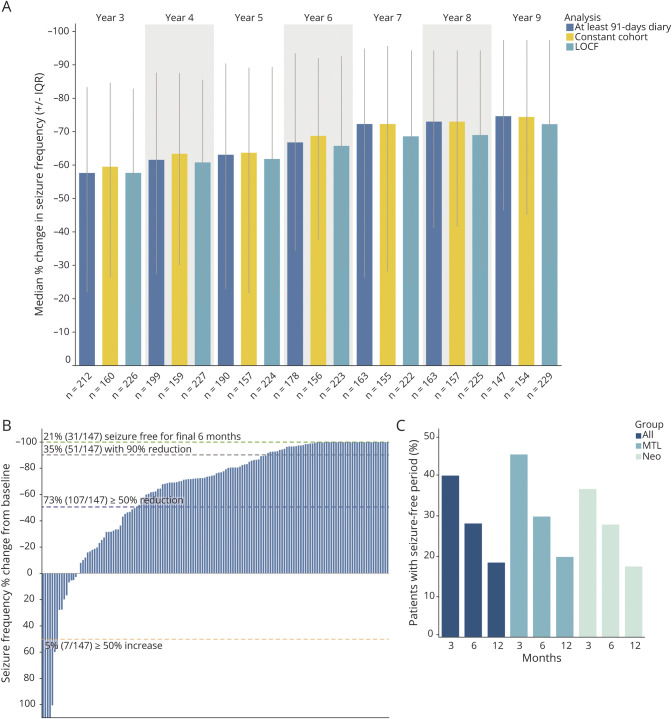
ObjectiveTo prospectively evaluate safety and efficacy of brain-responsive neurostimulation in adults with medically intractable focal onset seizures (FOS) over 9 years. MethodsAdults treated with brain-responsive neurostimulation in 2-year feasibility or randomized controlled trials were enrolled in a long-term prospective open label trial (LTT) to assess safety, efficacy, and quality of life (QOL) over an additional 7 years. Safety was assessed as adverse events (AEs), efficacy as median percent change in seizure frequency and responder rate, and QOL with the Quality of Life in Epilepsy (QOLIE-89) inventory. ResultsOf 256 patients treated in the initial trials, 230 participated in the LTT. At 9 years, the median percent reduction in seizure frequency was 75% (p < 0.0001, Wilcoxon signed rank), responder rate was 73%, and 35% had a ≥90% reduction in seizure frequency. We found that 18.4% (47 of 256) experienced ≥1 year of seizure freedom, with 62% (29 of 47) seizure-free at the last follow-up and an average seizure-free period of 3.2 years (range 1.04–9.6 years). Overall QOL and epilepsy-targeted and cognitive domains of QOLIE-89 remained significantly improved (p < 0.05). There were no serious AEs related to stimulation, and the sudden unexplained death in epilepsy (SUDEP) rate was significantly lower than predefined comparators (p < 0.05, 1-tailed χ2). ConclusionsAdjunctive brain-responsive neurostimulation provides significant and sustained reductions in the frequency of FOS with improved QOL. Stimulation was well tolerated; implantation-related AEs were typical of other neurostimulation devices; and SUDEP rates were low. Classification of evidenceThis study provides Class IV evidence that brain-responsive neurostimulation significantly reduces focal seizures with acceptable safety over 9 years.
Overview
The claims and statistics of this paper haven’t been checked yet.
Free: it reads the open-access text and checks the first 5 claims that cite a source we can check. Create a free account to check every claim.
Integrity signals
Registry
Cites
Statistics
Figures
Verification
Claims the paper makes
The claims and statistics of this paper haven’t been checked yet.
Free: it reads the open-access text and checks the first 5 claims that cite a source we can check. Create a free account to check every claim.
Claims other papers make about this one
Each is checked against this paper’s own text: does it say what the citing paper says it does?
The source backs part of the claim, not all of it — or backs it for a different population, condition or comparison.
In the citing paper
“Previously, data on the long-term safety and stability of ECoG primarily came from its application in epilepsy82,90–92, including the paddle-style surface strip electrodes with the Neuropace responsive neurostimulation system, which has demonstrated safety and signal stability for at least 9 years92.”
From The speech neuroprosthesis (2024) · cites this paper as [92]
Experimental — accuracy not yet measured
Self-check
Percentages, sums and reported differences re-computed from the paper’s own numbers.
The self-check needs the paper’s full text.
Citations
Cites
A Randomized, Controlled Trial of Surgery for Temporal-Lobe Epilepsy
Wiebe, S., Blume, W. T., Girvin, J. P., & Eliasziw, M. (2001) · New England Journal of Medicine · doi:10.1056/nejm200108023450501 · Cited by 3,525
Electrical stimulation of the anterior nucleus of thalamus for treatment of refractory epilepsy
Fisher, R., Salanova, V., Witt, T., Worth, R., Henry, T., Gross, R., Oommen, K., Osorio, I., Nazzaro, J., Labar, D., et al. (2010) · Epilepsia · doi:10.1111/j.1528-1167.2010.02536.x · Cited by 1,918 · cited 2×
“This compares favorably to other neurostimulation therapies that use a pectorally implanted pulse generator such as VNS(28) and DBS for Parkinson disease(24) or epilepsy.(6,7)”
BackgroundSelf-citationDalgleish, T. (2004) · Nature Reviews Neuroscience · doi:10.1038/nrn1432 · Cited by 1,849
Weaver, F. M. (2009) · JAMA · doi:10.1001/jama.2008.929 · Cited by 1,525
Responsive cortical stimulation for the treatment of medically intractable partial epilepsy
Morrell, M. J. (2011) · Neurology · doi:10.1212/wnl.0b013e3182302056 · Cited by 1,282
Self-citationDevinsky, O., & Pacia, S. (1993) · Neurologic Clinics · doi:10.1016/s0733-8619(18)30132-4 · Cited by 1,175
Engel, J., Wiebe, S., French, J., Sperling, M., Williamson, P., Spencer, D., Gumnit, R., Zahn, C., Westbrook, E., & Enos, B. (2003) · Neurology · doi:10.1212/01.wnl.0000055086.35806.2d · Cited by 904
Self-citationLong-term efficacy and safety of thalamic stimulation for drug-resistant partial epilepsy
Salanova, V., Witt, T., Worth, R., Henry, T. R., Gross, R. E., Nazzaro, J. M., Labar, D., Sperling, M. R., Sharan, A., Sandok, E., et al. (2015) · Neurology · doi:10.1212/wnl.0000000000001334 · Cited by 821
Self-citationChronic epilepsy and cognition: A longitudinal study in temporal lobe epilepsy
Helmstaedter, C., Kurthen, M., Lux, S., Reuber, M., & Elger, C. E. (2003) · Annals of Neurology · doi:10.1002/ana.10692 · Cited by 717
Heck, C. N., King‐Stephens, D., Massey, A. D., Nair, D. R., Jobst, B. C., Barkley, G. L., Salanova, V., Cole, A. J., Smith, M. C., Gwinn, R. P., et al. (2014) · Epilepsia · doi:10.1111/epi.12534 · Cited by 651
Self-citation
Research works printed but not linked: 1
- RNS System User Manual (RNS-300M). Mountain View: NeuroPace, Inc; 2018.
Cited by
Items 201–300 of 491
Oliger, A., Nerison, C. S., Tan, H., Raslan, A. M. T., Ernst, L. D. L., Datta, P., & Kellogg, M. A. (2024) · Clinical Neurophysiology · doi:10.1016/j.clinph.2024.03.032 · Cited by 8
Self-citationWu, C., Busch, R. M., Drane, D. L., Dugan, P. C., Serletis, D., Youngerman, B. E., & Jehi, L. E. (2025) · Epiliepsy currents/Epilepsy currents · doi:10.1177/15357597251318564 · Cited by 8
“44 ANT-DBS makes use of open-loop stimulation and is thought to modulate the synchronization of brain activity and epileptic networks through ANT connections with the Papez circuit.”
Structural network-specific effect of extreme capsule stimulation for drug-resistant focal epilepsy
Cheng, Y., Wang, D., Zhang, X., Jin, G., Wu, D., Wang, Q., Du, J., Qi, L., Xu, C., Qiao, Z., et al. (2025) · Brain · doi:10.1093/brain/awaf097 · Cited by 8
Beyond Resection: Neuromodulation and Minimally Invasive Epilepsy Surgery
Uysal, U., Shamim, D., & Nwabueze, O. (2022) · Nöro Psikiyatri Arşivi · doi:10.29399/npa.28181 · Cited by 14
O’Donnell, C. M., Anderson, C. T., Oleksy, A. J., & Swanson, S. J. (2023) · Brain Sciences · doi:10.3390/brainsci13121628 · Cited by 9
Connolly, M. J., Jiang, S., Samuel, L. C., Gutekunst, C., Gross, R. E., & Devergnas, A. D. (2024) · PLoS ONE · doi:10.1371/journal.pone.0307906 · Cited by 9
Self-citationKoryazhkina, M. N., Lebedeva, A., Pakhomova, D. D., Antonov, I. N., Razin, V. V., Budylina, E. D., Belov, A. I., Mikhaylov, A. N., & Konakov, A. A. (2024) · Chaos Solitons & Fractals · doi:10.1016/j.chaos.2024.115959 · Cited by 9
Guglielmi, G., Eschbach, K. L., & Alexander, A. (2021) · Seminars in Pediatric Neurology · doi:10.1016/j.spen.2021.100913 · Cited by 9
Yang, D., Ma, R., Yang, N., Sun, K., Han, J., Duan, Y., Liu, A., Zhao, X., Li, T., Liu, J., et al. (2022) · Epilepsy & Behavior · doi:10.1016/j.yebeh.2022.108876 · Cited by 11
Metto, A. C., Telgkamp, P., McLane-Svoboda, A. K., Gilad, A. A., & Pelled, G. (2023) · Brain Research · doi:10.1016/j.brainres.2023.148591 · Cited by 10
Niazi, F., Han, A., Stamm, L., Shlobin, N. A., Korman, C., Hoang, T. S., Kielian, A., Pont‐Thibodeau, G. D., Ducharme‐Crevier, L., Major, P., et al. (2024) · Frontiers in Neurology · doi:10.3389/fneur.2024.1403266 · Cited by 7
Genetic and Cellular Mechanisms Underlying SUDEP Risk
Noebels, J. L. (2024) · Oxford University Press eBooks · doi:10.1093/med/9780197549469.003.0063 · Cited by 7
Therapeutic approaches targeting seizure networks
Langbein, J., Boddeti, U., Kreinbrink, M., Khan, Z., Rampalli, I., Bachani, M., & Ksendzovsky, A. (2024) · Frontiers in Network Physiology · doi:10.3389/fnetp.2024.1441983 · Cited by 9
Seizure forecasting with ultra long-term EEG signals
Yang, H., Müller, J., Eberlein, M., Kalousios, S., Leonhardt, G., Duun‐Henriksen, J., Kjær, T. W., & Tetzlaff, R. (2024) · Clinical Neurophysiology · doi:10.1016/j.clinph.2024.09.017 · Cited by 9
“…recordings of continuous iEEG (Cook et al., 2013; Davis et al., 2011; Howbert et al., 2014) and/or counts of interictal epileptiform activity (IEA) (Nair et al., 2020) allowed the identification of the ubiquitous presence of different cycles in seizure timing and other forms of epileptic brain…”
BackgroundBridging the Gap in FDA Approval for Pediatric Neuromodulation Devices
Shaikhouni, A., Brandon, C., & Criss, C. N. (2025) · Children · doi:10.3390/children12020148 · Cited by 12
“However, the Neuropace RNS device, approved in 2013, was the first approved neuromodulation device for the treatment of drug-resistant epilepsy [24,25].”
Annotating neurophysiologic data at scale with optimized human input
Xu, Z., Scheid, B. H., Conrad, E. C., Davis, K. A., Ganguly, T. M., Gelfand, M. A., Gugger, J. J., Jiang, X., LaRocque, J. J., Ojemann, W. K. S., et al. (2025) · Journal of Neural Engineering · doi:10.1088/1741-2552/ade402 · Cited by 7
Clinical practice of Brain–Machine interfaces in neurological disorders
Wang, K., Wei, P., Shan, Y., & Zhao, G. (2025) · EngMedicine · doi:10.1016/j.engmed.2025.100090 · Cited by 9
Potential for Therapeutic Alteration of the Underlying Biology of Epilepsy
Sperling, M. R., Peters, J. M., Wu, Q., Guignet, M. A., White, H. S., Shih, E. K., Ngo, L. Y., Carrazana, E. J., & Rabinowicz, A. L. (2025) · Biomedicines · doi:10.3390/biomedicines13092258 · Cited by 9
“In three open-label extension (OLE) studies, the median reduction in seizure frequency in patients with RNS at 2, 5, and 9 years of observation were 53%, 66%, and 75%, respectively [113–115].”
Self-citationThe Utility of Responsive Neurostimulation for the Treatment of Pediatric Drug-Resistant Epilepsy
Piazza, M., Varga, G. J., Welch, W. C., & Abel, T. J. (2023) · Brain Sciences · doi:10.3390/brainsci13101455 · Cited by 9
“While sample size was also small (49 patients), the results are supported by similar findings in the nine-year follow-up study in adults [50].”
BackgroundResultInfluentialEpilepsy Networks and Their Surgical Relevance
Hines, K., & Wu, C. (2023) · Brain Sciences · doi:10.3390/brainsci14010031 · Cited by 10
“Similar to other forms of neuromodulation, the efficacy increases over time as neuromodulation alters epilepsy networks [56].”
Predictors of SOZ localization, subsequent surgical intervention, and seizure outcomes in iEEG
Jha, R., Chua, M. M. J., Sarkis, R. A., Tobochnik, S. D., & Rolston, J. D. (2024) · Annals of Clinical and Translational Neurology · doi:10.1002/acn3.52084 · Cited by 7
“14 Hence, characterizing success after iEEG and epilepsy surgery is a complex consideration.”
BackgroundHadar, P., Zelmann, R., Salami, P., Cash, S. S., & Paulk, A. C. (2024) · Frontiers in Human Neuroscience · doi:10.3389/fnhum.2024.1439541 · Cited by 9
“A recent 9-year follow-up study of RNS outcomes shows that over 50% of patients are RNS responders ( ≥ 50% reduction in seizures) after 1 year, and over 70% respond at 3 years (Nair et al., 2020; Jarosiewicz and Morrell, 2021).”
BackgroundInfluentialSelf-citationDaly, S. R., Soto, J. M., Gonzalez, S.-M. C., Ankrah, N. K., Gogineni, E., Andraos, T. Y., Skalina, K. A., Fekrmandi, F., Quinn, A. E., Romanelli, P., et al. (2024) · Clinical Neurology and Neurosurgery · doi:10.1016/j.clineuro.2024.108550 · Cited by 7
Bahadori, A. R., Javadnia, P., Davari, A., Sheikhvatan, M., Ranji, S., Shafiee, S., & Tafakhori, A. (2024) · Neurosurgical Review · doi:10.1007/s10143-024-03090-9 · Cited by 8
“There are several neuromodulation strategies for addressing drug-resistant seizures, including Responsive neurostimulation [9].”
Brain–computer interfaces for human gait restoration
Nenadić, Z. (2021) · Control Theory and Technology · doi:10.1007/s11768-021-00070-y · Cited by 9
Zelmann, R., Frauscher, B., Aro, R. P., Gueziri, H.-E., & Collins, D. L. (2023) · Journal of Neural Engineering · doi:10.1088/1741-2552/acd6bd · Cited by 10
Bystrom, L. L., Levy, A. S., Brown, E. C., Fajardo, M., & Wang, S. (2023) · Journal of Neurosurgery Pediatrics · doi:10.3171/2023.5.peds22559 · Cited by 8
Control of epileptic seizures by electrical stimulation: a model-based study
Sohanian-Haghighi, H., & Markazi, A. H. D. (2021) · Biomedical Physics & Engineering Express · doi:10.1088/2057-1976/ac240d · Cited by 7
Wadi, L., Pati, S. B. B., & Agashe, S. H. (2025) · Journal of Clinical Neurophysiology · doi:10.1097/wnp.0000000000001195 · Cited by 6
Löscher, W., & Worrell, G. A. (2022) · Frontiers in Veterinary Science · doi:10.3389/fvets.2022.1014269 · Cited by 12
Self-citationSkelton, H. M., Brandman, D. M., Bullinger, K. L., Isbaine, F., & Gross, R. E. (2023) · Stereotactic and Functional Neurosurgery · doi:10.1159/000533680 · Cited by 6
“Responsive neurostimulation (RNS) [1], deep brain stimulation (DBS) [2], and vagus nerve stimulation (VNS) [3] have been shown to reduce seizure frequency and severity, though they infrequently result in seizure freedom.”
BackgroundSelf-citationSafety profile of intracranial neuromodulation for drug-resistant epilepsy in children
Singh, S., Armstrong, C., Melamed, S. E., Galligan, K., Han, M., DiGiovine, M. P., Kessler, S. K., & Kennedy, B. C. (2025) · Journal of Neurosurgery Pediatrics · doi:10.3171/2025.1.peds24463 · Cited by 6
Buch, V., Mirro, E. A., Purger, D. A., Zeineh, M., Wilmer‐Fierro, K. E., Razavi, B., & Halpern, C. H. (2022) · Journal of Neurosurgery Case Lessons · doi:10.3171/case22117 · Cited by 6
“Clinical studies have demonstrated a median seizure frequency reduction of 58% at year 3 and 75% at year 9.(1) Post-trial realworld studies report similar median seizure frequency reductions in a much shorter time frame: 75% at 2 years and 82% at 3 or more years.”
BackgroundO’Donnell, C. M., Swanson, S. J., Carlson, C., Raghavan, M., Pahapill, P. A., & Anderson, C. T. (2023) · Brain Sciences · doi:10.3390/brainsci13020324 · Cited by 8
“Although the basis for RNS therapy was initially believed to be the ability of brief pulse stimulation to abort localized ictal buildup, continued reduction in seizures over time without further changes in stimulation or detection parameters in patients with focal epilepsy have suggested that neuromodulatory effects o…”
BackgroundMethodResultZhang, F., Yang, Y., Xin, Y., Sun, Y., Wang, C., Zhu, J., Tang, T., Zhang, J., & Xu, K. (2023) · Epilepsy & Behavior · doi:10.1016/j.yebeh.2023.109212 · Cited by 6
Alcalá-Zermeño, J. L., Fureman, B. E., Grzeskowiak, C. L., Potnis, O., Taveras, M., Logan, M. W., Rybacki, D., Friedman, D. J., Lowenstein, D. H., Kuzniecky, R., et al. (2024) · Epilepsia · doi:10.1111/epi.17961 · Cited by 6
“The only patient population with a statistically different proportion was patients reporting two or more races (33 848 943 [10”
BackgroundResultBarlatey, S. L., Kouvas, G., Sobolewski, A., Nowacki, A., Pollo, C., & Baud, M. O. (2024) · Epilepsy Research · doi:10.1016/j.eplepsyres.2024.107356 · Cited by 6
Weiss, S. A., Sperling, M. R., Engel, J., Liu, A. A., Fried, I., Wu, C., Doyle, W., Mikell, C. B., Mofakham, S., Salamon, N., et al. (2024) · Brain Communications · doi:10.1093/braincomms/fcae367 · Cited by 7
“62 Seizure frequency decreases gradually over years following RNS. 63 Furthermore, closed-and open-loop stimulations have been shown to similarly effective.”
BackgroundSelf-citationSurges, R. (2021) · Klinische Neurophysiologie · doi:10.1055/a-1353-9099 · Cited by 6
“bei der Herzraten-responsiven Vagusnervstimulation und der responsiven Neurostimulation realisiert ist [63, 64].”
BackgroundDeveloping Precision Invasive Neuromodulation for Psychiatry
Bormann, N. L., Trapp, N. T., Narayanan, N. S., & Boes, A. D. (2021) · Journal of Neuropsychiatry · doi:10.1176/appi.neuropsych.20100268 · Cited by 8
“4 years and 75% at 9 years (N=191 and N=168, respectively) (27, 28).”
Karakas, C., Ward, R., Hegazy, M. I. R., Skrehot, H. C., & Haneef, Z. (2022) · Clinical Neurophysiology · doi:10.1016/j.clinph.2022.05.003 · Cited by 6
“We speculate that this may be related to better efficacy of RNS in unilateral compared to bilateral seizures (Nair et al., 2020).”
Evans, K. L., Stamas, N., Li, Q., Vincent, T., Halchenko, Y., Zhang, L., Danielson, V., Murphy, J., Barion, F., Lam, S. K., et al. (2023) · Clinical Therapeutics · doi:10.1016/j.clinthera.2023.01.007 · Cited by 6
Insights From Chronic ECoG by RNS
Traner, C. B., & King‐Stephens, D. (2023) · Journal of Clinical Neurophysiology · doi:10.1097/wnp.0000000000001010 · Cited by 6
Responsive neuro stimulation [RNS] system for management of refractory status epilepticus
Graley, C., Aubert, R., Gowda, S., & Holloway, K. L. (2020) · Interdisciplinary Neurosurgery · doi:10.1016/j.inat.2020.101052 · Cited by 6
Personalizing Responsive Neurostimulation for Epilepsy
Rao, V. R. (2025) · Journal of Clinical Neurophysiology · doi:10.1097/wnp.0000000000001179 · Cited by 7
Aiello, G., Elshahabi, A., Stieglitz, L. H., Belvedere, A., Dubček, T., Polanía, R., & Imbach, L. (2026) · Brain · doi:10.1093/brain/awag120 · Cited by 8
Montoya-Gálvez, J., Ivankovic, K., Rocamora, R., & Príncipe, A. (2025) · Applied Sciences · doi:10.3390/app16010294 · Cited by 7
Neurophysiologic Biomarkers of Invasive Neuromodulation Therapy for Epilepsy
Okoroafor, F., Qiang, Z., Rosenke, S., Chari, A., Moeller, F., Piper, R. J., Baldeweg, T., Denison, T., & Tisdall, M. M. (2026) · Neuromodulation Technology at the Neural Interface · doi:10.1016/j.neurom.2026.01.004 · Cited by 5
Human–artificial intelligence collaboration for comanaging epilepsy in real time
Goldblum, Z., Shi, H., Xu, Z., Ojemann, W. K. S., Aguila, C. A., Long, K. W., Xie, K., Nix, K. C., Walsh, K. G., Chang, E., et al. (2026) · Nature Medicine · doi:10.1038/s41591-026-04680-4 · Cited by 5
Automated sleep classification with chronic neural implants in freely behaving canines
Mívalt, F., Sladky, V., Worrell, S., Gregg, N. M., Balzekas, I., Kim, I., Chang, S.-Y., Montonye, D., Duque-Lopez, A., Krakorova, M., et al. (2023) · Journal of Neural Engineering · doi:10.1088/1741-2552/aced21 · Cited by 5
“Electrical deep brain stimulation using implantable neural stimulators is a proven treatment in human drug resistant focal epilepsy [14–17].”
Self-citationPediatric Neurostimulation and Practice Evolution
Ghatan, S. (2023) · Neurosurgery Clinics of North America · doi:10.1016/j.nec.2023.09.006 · Cited by 5
Combined neuromodulation and resection for functional cortex epilepsy: a case series
Merenzon, M. A., Sivaraju, A., Herlopian, A., Gerrard, J. L., Quraishi, I. H., Hirsch, L. J., Spencer, D. D., & Damisah, E. C. (2024) · Journal of neurosurgery · doi:10.3171/2024.3.jns24122 · Cited by 7
Self-citationConnolly, M. J., Piallat, B., Sendi, M. S. E., Mahmoudi, B., Higgins, M. K., Gutekunst, C., Devergnas, A. D., & Gross, R. E. (2024) · Heliyon · doi:10.1016/j.heliyon.2024.e34257 · Cited by 6
Self-citationJha, R., Chua, M. M. J., Liu, D. D., Cosgrove, G. R., Tobochnik, S. D., & Rolston, J. D. (2024) · Epilepsy & Behavior · doi:10.1016/j.yebeh.2024.109944 · Cited by 5
Cummins, D. D., Schulman, Z., Maher, C., Tortolero, L., Saad, A. E., Martinez, L. N., Davidson, R. J., Marcuse, L. V., Sáez, I., & Panov, F. E. (2024) · Epilepsy & Behavior · doi:10.1016/j.yebeh.2024.110150 · Cited by 5
Ding, J., Tian, Y., Zeng, M., Zhang, Y., Chen, Z., Liu, X., Xiao, Z., Wu, C., Wei, D., Sun, J., et al. (2025) · Chemical Engineering Journal · doi:10.1016/j.cej.2025.160263 · Cited by 5
Responsive neurostimulation in Epilepsy: Effects on mood and quality of life
Santiago-Mejías, S., Land, M., Haneef, Z., & Stinson, J. M. (2025) · Epilepsy & Behavior · doi:10.1016/j.yebeh.2025.110406 · Cited by 5
Toward Unified Biomarkers for Focal Epilepsy
Wang, S. H., Ferrari, P., Arnulfo, G., Marzulli, M., Degras, D., Myrov, V. O., Palva, S., Nobili, L., Ciuciu, P., & Palva, J. M. (2025) · Journal of Neuroscience · doi:10.1523/jneurosci.0879-25.2025 · Cited by 6
Sudden Unexpected Death in Epilepsy: Pathogenesis, Risk Factors, and Prevention
Haridas, B., Chuang, D. T., Nei, M., & Kang, J. Y. (2022) · Seminars in Neurology · doi:10.1055/a-1960-1355 · Cited by 5
Yang, Y., Zhang, F., Gao, X., Feng, L., & Xu, K. (2023) · Epilepsy & Behavior · doi:10.1016/j.yebeh.2023.109120 · Cited by 5
Intracranial and epicranial focus stimulation—concepts and approval status—English Version
Schulze‐Bonhage, A. (2023) · Clinical Epileptology · doi:10.1007/s10309-023-00595-z · Cited by 5
CM ‐Pf deep brain stimulation in polyneuromodulation for epilepsy
Tatum, W. O., Freund, B. E., Middlebrooks, E. H., Lundstrom, B. N., Feyissa, A. M., Gompel, J. J. V., & Grewal, S. S. (2024) · Epileptic Disorders · doi:10.1002/epd2.20255 · Cited by 5
Self-citationEthical Considerations of Endovascular Brain–Computer Interfaces
Fry, A., Breyman, E., LaGrassa, E., Oxley, T. J., & Putrino, D. F. (2023) · Advances in neuroethics · doi:10.1007/978-3-031-26801-4_4 · Cited by 7
Adaptive Bayesian Optimization for State-Dependent Brain Stimulation
Dabiri, S., Cole, E. R., & Gross, R. E. (2023) · International IEEE/EMBS Conference on Neural Engineering · doi:10.1109/ner52421.2023.10123861 · Cited by 6
Self-citationEmerging Technologies for Epilepsy Surgery
Paulo, D. L., Ball, T., & Englot, D. J. (2022) · Neurologic Clinics · doi:10.1016/j.ncl.2022.03.012 · Cited by 5
Thalamic connectivity-based Biomarkers for Neuromodulation in Patients with Refractory EpilepsiesPreprint
Aiello, G., Soper, D. J., Hadar, P., Paulk, A. C., Cash, S. S., Polanía, R., Imbach, L., & Salami, P. (2025) · medRxiv · doi:10.1101/2025.02.05.25320539 · Cited by 5
Self-citationEpileptic Network Surgery: From Network Basis to Clinical Practice
Wang, D., Zhang, H., Fan, X., Yang, Y., Ren, L., Shan, Y., Wei, P., & Zhao, G. (2024) · Acta Neurologica Scandinavica · doi:10.1155/2024/1735404 · Cited by 5
Beaudreault, C. P., Chiang, S., Sacknovitz, A., Moss, R., Brabant, P., Zuckerman, D., Dorilio, J., Spirollari, E., Naftchi, A., McGoldrick, P. E., et al. (2024) · Epilepsy & Behavior · doi:10.1016/j.yebeh.2024.110008 · Cited by 4
“…use, magnet swipe frequency and user-reported seizure frequency are also consistent with progressive effects seen with responsive neuro-stimulation [31,32] and thalamic stimulation [33], and may be correlated with long-term neuromodulatory effects on seizure networks generating status epilepticus…”
Miron, G., & Meisel, C. (2024) · Clinical Epileptology · doi:10.1007/s10309-024-00709-1 · Cited by 6
“Datasets established during clinical trials and made availabletoresearchersincludedhundreds of patients with long-duration recordings of up to 9 years [11–13].”
Yan, H., Wang, X., Zhao, G., Ren, L., & Yu, T. (2024) · Brain Network Disorders · doi:10.1016/j.bnd.2024.10.002 · Cited by 4
Gauging and controlling excitability in cortical disorders
Friedrichs‐Maeder, C., Lepeu, G., & Baud, M. O. (2025) · Current Opinion in Neurology · doi:10.1097/wco.0000000000001345 · Cited by 4
Lusk, Z., Kwon, A. Y., Pantis, S., Nam, S., Lyu, D., Fisher, R. S., van Staalduinen, E. K., Buch, V., & Parvizi, J. (2025) · Journal of Cognitive Neuroscience · doi:10.1162/jocn.a.53 · Cited by 4
de Mônaco, B. A., Santos, A. N., Cordeiro, J. G., Alho, E. J. L., Piedade, G. S., Dawoud, B., Doomi, A., O’Boyle, R. P., Kanner, A. M., Velez-Ruiz, N. J., et al. (2025) · Neurosurgical Review · doi:10.1007/s10143-025-03966-4 · Cited by 4
“Drug resistant epilepsy (DRE), affecting approximately 30–40% of patients with epilepsy, presents a formidable challenge in clinical practice [ 1 ].”
Swaminathan, A. (2021) · Frontiers in Surgery · doi:10.3389/fsurg.2021.630930 · Cited by 4
ASSFN Position Statement on Deep Brain Stimulation for Medication-Refractory Epilepsy
Gummadavelli, A., Englot, D. J., Schwalb, J. M., Wu, C., Gonzalez-Martinez, J., Niemat, J., & Gerrard, J. L. (2022) · Neurosurgery · doi:10.1227/neu.0000000000001923 · Cited by 6
Ho, V. M., Dewar, S. R., Salamon, N., Fried, I., & Eliashiv, D. E. (2022) · Epilepsia · doi:10.1111/epi.17362 · Cited by 4
Buch, V., & Parvizi, J. (2023) · Neurosurgery Clinics of North America · doi:10.1016/j.nec.2023.08.003 · Cited by 4
Chronic subthreshold cortical stimulation: A promising therapy for motor cortex seizures
Heyndrickx, S., Lamquet, S., Oerlemans, J., Vonck, K. E. J., Boon, P., Roost, D. V., & Meurs, A. (2023) · Epilepsy & Behavior Reports · doi:10.1016/j.ebr.2023.100638 · Cited by 5
“[18] but only retrospective data is available for VNS, with one large registry study and systematic review reportering a terminal rate of seizure freedom of 8 % [19].”
BackgroundVagus nerve electroneurogram-based detection of acute kainic acid induced seizures
Reina, E. A., Germany, E., Dereli, A. S., Collard, E., Raffoul, R., Nonclercq, A., & Tahry, R. E. (2024) · Frontiers in Neuroscience · doi:10.3389/fnins.2024.1427308 · Cited by 5
Yang, J. C., Skelton, H. M., Isbaine, F., Bullinger, K. L., Alwaki, A., Cabaniss, B. T., Willie, J. T., & Gross, R. E. (2024) · Stereotactic and Functional Neurosurgery · doi:10.1159/000540431 · Cited by 5
“Other factors may include the interplay be-tween medication management and neuromodulation, though medications were thought to not signi fi cantly affect ANT DBS and RNS long-term results [4, 5].”
InfluentialSelf-citationEmergent responsive neurostimulation in pediatric super‐refractory epilepsia partialis continua
Hadar, P., Nanda, P., Walsh, K. G., McLaren, J., Geffrey, A. L., Simon, M. V., Kahle, K. T., Richardson, R. M., & Chu, C. J. (2024) · Annals of Clinical and Translational Neurology · doi:10.1002/acn3.52199 · Cited by 6
Recent advances in nanotherapy-based treatment of epilepsy
Chen, P., Wang, S., Zhang, H., & Li, J. (2025) · Colloids and Surfaces B Biointerfaces · doi:10.1016/j.colsurfb.2025.114499 · Cited by 4
Thalamocortical seizure onset patterns in drug-resistant focal epilepsy
Simpson, H. D., Křemen, V., Sladky, V., Brinkmann, B. H., Gregg, N. M., Lundstrom, B. N., Miller, K. J., Gompel, J. J. V., & Worrell, G. A. (2026) · Brain Communications · doi:10.1093/braincomms/fcag227 · Cited by 5
Self-citationKleis, P., Paschen, E., Djie-Maletz, A., Vlachos, A., Haas, C. A., & Häussler, U. (2025) · Neurobiology of Disease · doi:10.1016/j.nbd.2025.106965 · Cited by 5
Contributions of Imaging to Neuromodulatory Treatment of Drug-Refractory Epilepsy
Foit, N. A., Bernasconi, N., & Bernasconi, N. (2020) · Brain Sciences · doi:10.3390/brainsci10100700 · Cited by 5
“Additionally, results from a recently published long-term observational study confirmed sustained reduction in seizure frequencies and improved quality of life [83].”
BackgroundA data augmentation procedure to improve detection of spike ripples in brain voltage recordings
Schlafly, E. D., Carbonero, D., Chu, C. J., & Kramer, M. (2024) · Neuroscience Research · doi:10.1016/j.neures.2024.07.005 · Cited by 4
The Impact of Responsive Neurostimulation on the Treatment of Epilepsy
Sharan, A. D., Mandloi, S., Matias, C. M., & Wu, C. (2020) · Neurology India · doi:10.4103/0028-3886.302468 · Cited by 5
Wirksamkeit der iktalen Neurostimulation
Hirsch, M., & Schulze‐Bonhage, A. (2023) · Clinical Epileptology · doi:10.1007/s10309-023-00550-y · Cited by 4
“Prospektiv erhobene 9-Jahres-Followup-Daten zeigten eine progressive Verbesserung der Anfallskontrolle im Laufe der Zeit (mediane prozentuale Anfallsreduktion 75%, Responder-Rate 73%; [28]).”
BackgroundCheers for SANTĖ: Long Term Safety and Efficacy of Anterior Nucleus of the Thalamus DBS
King‐Stephens, D. (2021) · Epiliepsy currents/Epilepsy currents · doi:10.1177/15357597211029169 · Cited by 4
“Are there different thalamic nuclei that should be targeted depending on the epileptic syndrome, ie, localization-related vs symptomatic generalized epilepsy? Can the incidence of adverse effects on mood and cognition be minimized by differential stimulation paradigms/targets? Might there be a differential response be…”
Replay of Interictal Sequential Activity Shapes the Epileptic Network DynamicsPreprint
Wang, K., Wang, H., Yan, Y., Li, W., Cai, F., Zhou, W., & Hong, B. (2024) · medRxiv · doi:10.1101/2024.03.28.24304879 · Cited by 4
Seizure network characterization by functional connectivity mapping and manipulation
Luo, P., Pons, C., Wu, S., Ma, H., Liou, J.-Y., Surinach, D. A., & Kodandaramaiah, S. B. (2025) · Neurophotonics · doi:10.1117/1.nph.12.s1.s14605 · Cited by 5
Seizure and psychosocial outcomes in patients with DBS for intractable epilepsy
Sternberg, M., Air, E. L., Schwalb, J. M., Barkley, G. L., Constantinou, J. E. C., Smith, B. J., & Wasade, V. S. (2025) · Clinical Neurology and Neurosurgery · doi:10.1016/j.clineuro.2025.109096 · Cited by 3
Self-citationKanai, S., Daida, A., Zhang, Y., Ding, Y., Monsoor, T., Qiao, J. X., Salamon, N., Ronne, E., Ahn, S. S., Hussain, S. A., et al. (2025) · Epilepsia · doi:10.1111/epi.18675 · Cited by 5
“4,5 Its long-term efficacy is hypothesized to stem from neuroplastic changes within epileptic networks.”
InfluentialCardiorespiratory cross‐frequency coupling biomarker for sudden unexpected death in epilepsy
Gravitis, A. C., Wennberg, R. A., Carlen, P. L., Chinvarun, Y., Lira, V., Laze, J., Devinsky, O., & Bardakjian, B. L. (2025) · Epilepsia · doi:10.1002/epi.70057 · Cited by 3
Safety of Intracranial Neuromodulation in Drug-Resistant Pediatric and Adult Epilepsy
Kuo, C., Mívalt, F., Singh, R., Nguyen, R. T. D., Starnes, K., Wong‐Kisiel, L. C., Gregg, N. M., Gompel, J. J. V., Miller, K. J., Worrell, G. A., et al. (2026) · Neurology · doi:10.1212/wnl.0000000000214626 · Cited by 5
Self-citationSeizure forecasting with epilepsy cycles: On the causality of forecasting pipelines
Yang, H., Müller, J., Kalousios, S., Leonhardt, G., Dümpelmann, M., Schulze‐Bonhage, A., & Tetzlaff, R. (2026) · Epilepsia · doi:10.1002/epi.70110 · Cited by 3
“20 Sophisticated analytic approaches that go beyond fixed-duration cycles have revealed the previously underappreciated ubiquity of cyclic influences.”
Artificial intelligence for adaptive neuromodulation in drug‐resistant epilepsy
Daraie, A. H., Damiani, A., Khoshkhou, M., Sanchez, L., Smith, R. J., Agashe, S. H., Gonzalez-Martinez, J. A., Hopp, J. L., Charles, A. S., Sarma, S. V., et al. (2026) · Epilepsia · doi:10.1002/epi.70224 · Cited by 4
Utility of Chronic Intracranial Electroencephalography in Responsive Neurostimulation Therapy
Khambhati, A. N. (2023) · Neurosurgery Clinics of North America · doi:10.1016/j.nec.2023.09.004 · Cited by 3
Moosavi, S. A., Feldman, J., & Truccolo, W. (2025) · Scientific Reports · doi:10.1038/s41598-025-90632-w · Cited by 3
Neuromodulation in pediatric drug-resistant epilepsy
Hyslop, A. E., & Fajardo, M. (2025) · Epilepsy & Behavior · doi:10.1016/j.yebeh.2025.110332 · Cited by 3
Metadata
- Authors
- Nair, D. R., Laxer, K. D., Weber, P. B., Murro, A. M., Park, Y. D., Barkley, G. L., Smith, B. J., Gwinn, R. P., Doherty, M. J., Noe, K. H., Zimmerman, R. S., Bergey, G. K., Anderson, W. S., Heck, C., Liu, C. Y., Lee, R. W., Sadler, T., Duckrow, R. B., Hirsch, L. J., Wharen, R. E., Tatum, W., Srinivasan, S., McKhann, G. M., Agostini, M. A., Alexopoulos, A. V., Jobst, B. C., Roberts, D. W., Salanova, V., Witt, T. C., Cash, S. S., Cole, A. J., Worrell, G. A., Lundstrom, B. N., Edwards, J. C., Halford, J. J., Spencer, D. C., Ernst, L., Skidmore, C. T., Sperling, M. R., Miller, I., Geller, E. B., Berg, M. J., Fessler, A. J., Rutecki, P., Goldman, A. M., Mizrahi, E. M., Gross, R. E., Shields, D. C., Schwartz, T. H., Labar, D. R., Fountain, N. B., Elias, W. J., Olejniczak, P. W., Villemarette-Pittman, N. R., Eisenschenk, S., Roper, S. N., Boggs, J. G., Courtney, T. A., Sun, F. T., Seale, C. G., Miller, K. L., Skarpaas, T. L., Morrell, M. J., & Study, O. B. O. T. R. S. L.
- Affiliations
- Cleveland Clinic (US)
- Corresponding author
- Morrell, Martha J.
- ORCID
- Nair, Dileep R.
- Laxer, Kenneth D.
- Gwinn, Ryder P.
- Doherty, Michael J.
- Noe, Katherine H.
- Zimmerman, Richard S.
- Bergey, Gregory K.
- Anderson, William S.
- Liu, Charles Y.
- Lee, Ricky W.
- Hirsch, Lawrence J.
- Wharen, Robert E.
- Tatum, William
- McKhann, Guy M.
- Alexopoulos, Andreas V.
- Jobst, Barbara C.
- Roberts, David W.
- Salanova, Vicenta
- Cash, Sydney S.
- Cole, Andrew J.
- Worrell, Gregory A.
- Lundstrom, Brian N.
- Edwards, Jonathan C.
- Halford, Jonathan J.
- Spencer, David C.
- Ernst, Lia
- Skidmore, Christopher T.
- Sperling, Michael R.
- Miller, Ian
- Rutecki, Paul
- Goldman, Alica M.
- Gross, Robert E.
- Shields, Donald C.
- Schwartz, Theodore H.
- Fountain, Nathan B.
- Villemarette-Pittman, Nicole R.
- Eisenschenk, Stephan
- Roper, Steven N.
- Boggs, Jane G.
- Seale, Cairn G.
- Skarpaas, Tara L.
- Morrell, Martha J.
- Venue
- Neurology
- Published
- 2020-09
- Volume
- 95
- Issue
- 9
- Pages
- e1244-e1256
- ISSN
- 0028-3878 (ISSN-L)
- 1526-632X
- PMC
- PMC7538230
- OpenAlex
- W3044132865
- Semantic Scholar
- 547079eede15c79fc8e9c5ecf806d09dc4419025
- Cited by
- 490
- References
- 49
- Citations by year
- 2026: 65 · 2025: 100 · 2024: 87 · 2023: 93 · 2022: 84 · 2021: 45 · 2020: 15
- FWCI
- 43.23
- Type
- journal article
- Language
- en
- Open access
- hybrid
- doi.org
- Licence
- cc-by-nc-nd
- Locations
- Neurology (publishedVersion, cc-by-nc-nd)
- PubMed Central (publishedVersion, cc-by-nc-nd)
- PubMed (publishedVersion)
- Digital Commons-TMC (Texas Medical Center) (submittedVersion)
- Funders
- National Science Foundation
- U.S. Department of Defense
- American Epilepsy Society
- Epilepsy Foundation
- Citizens United for Research in Epilepsy
- Pfizer
- Brigham and Women's Hospital
- Massachusetts General Hospital
- Yale University
- Biogen
- Emory University
- George Washington University
- Wake Forest University
- Cleveland Clinic
- Cleveland Clinic Foundation
- Johns Hopkins University
- University of Rochester
- Dartmouth College
- Boston Scientific Corporation
- Thomas Jefferson University
- Rush University
- University of South Carolina
- Sunovion
- Dravet Syndrome Foundation
- DUSA Pharmaceuticals
- Augusta University
- Zogenix
- Ultragenyx Pharmaceutical
- GW Pharmaceuticals
- Acorda Therapeutics
- Sage Therapeutics
- Adamas Pharmaceuticals
- Boston Pharmaceuticals
- SK Life Science
- NeuroPace
- Upsher-Smith
- Martin Family Foundation
- University of Oxford
- Carl Zeiss Meditec AG
- Eisai
- H. Lundbeck A/S
- Epilepsy Society
- National Institutes of Health (UL1TR001863)
- Centers for Disease Control and Prevention
- U.S. Food and Drug Administration
- Genentech
- St. Jude Medical
- Weill Cornell Medical College
- School of Medicine, Emory University
- Advanced Research Projects Agency
- Audrey and Theodor Geisel School of Medicine at Dartmouth
- Medical Center, University of Rochester
- School of Medicine, Indiana University
- UCB US
- Greenwich Biosciences
- National Cancer Institute (P30CA023108)
- National Center for Advancing Translational Sciences
- UCB Pharma
- Medical Research and Materiel Command
- Topics
- Health Sciences › Medicine › Clinical Neurology › Epilepsy research and treatment
- Life Sciences › Neuroscience › Neurology › Vagus Nerve Stimulation Research
- Health Sciences › Medicine › Clinical Neurology › Deep Brain Stimulation and Movement Disorders
- Keywords
- focal epilepsy, drug-resistant epilepsy, focal seizures, seizure frequency reduction, seizure freedom, quality of life, sudden unexpected death in epilepsy, long-term safety, adjunctive therapy
- MeSH terms
- Drug Resistant Epilepsy, Sudden Unexpected Death in Epilepsy, Adolescent, Adult, Aged, Depressive Disorder, Electric Stimulation Therapy, Epilepsies, Partial, Female, Follow-Up Studies, Humans, Male, Memory Disorders, Middle Aged, Prospective Studies, Quality of Life, Status Epilepticus, Suicide, Randomized Controlled Trials as Topic, Prosthesis-Related Infections, Treatment Outcome, Intracranial Hemorrhages, Young Adult, Implantable Neurostimulators
About these checks
Registry, retraction, Cites and statistics results are computed, not judged, with one exception: a printed reference that no index lists is read once by a model before it counts as a citation error. Claims are extracted by a model and kept only when their quote appears verbatim in the text; each cited source is then checked, with a model’s help, for whether it says what the claim relies on. Those verdicts can be wrong — read the claim’s quote and the cited source before relying on one.
Statistics and arithmetic are recomputed, not judged.
Confidence bands are shown only for fields calibrated on our annotated test set. None is calibrated yet, so no band is shown.
What counts as a claim ›How we measure confidence ›How we check this ›
Are you an author, or do you see a problem with this page? Request a review
Data sources
Bibliographic data: Semantic Scholar, OpenAlex, Crossref.
Contains information from the Semantic Scholar Academic Graph Datasets, made available under the ODC Attribution License (ODC-BY 1.0).
Semantic Scholar’s data is described in: Kinney, R., et al. (2023). The Semantic Scholar Open Data Platform. arXiv:2301.10140.
