

Nine-year prospective efficacy and safety of brain-responsive neurostimulation for focal epilepsy
Open accessThe DOI matches its Crossref record; 47 of the 49 references it cites were found in a registry or an index.
Abstract
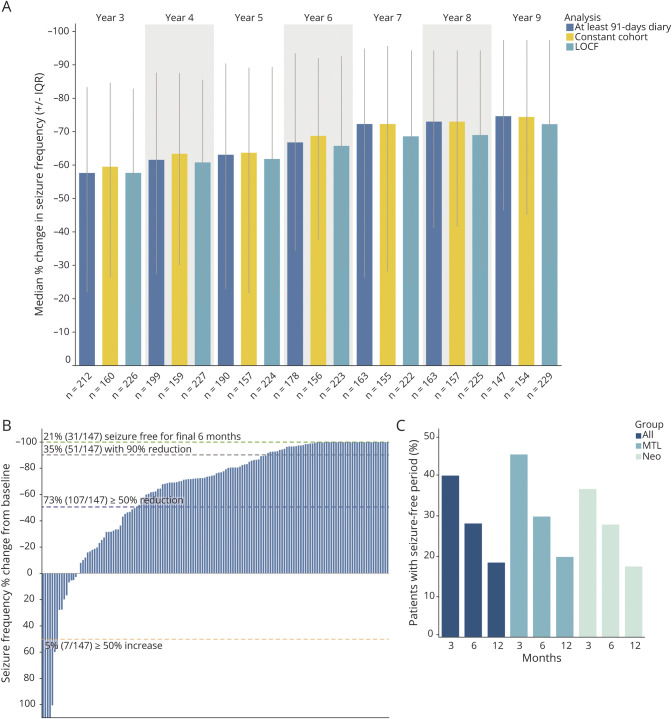
ObjectiveTo prospectively evaluate safety and efficacy of brain-responsive neurostimulation in adults with medically intractable focal onset seizures (FOS) over 9 years. MethodsAdults treated with brain-responsive neurostimulation in 2-year feasibility or randomized controlled trials were enrolled in a long-term prospective open label trial (LTT) to assess safety, efficacy, and quality of life (QOL) over an additional 7 years. Safety was assessed as adverse events (AEs), efficacy as median percent change in seizure frequency and responder rate, and QOL with the Quality of Life in Epilepsy (QOLIE-89) inventory. ResultsOf 256 patients treated in the initial trials, 230 participated in the LTT. At 9 years, the median percent reduction in seizure frequency was 75% (p < 0.0001, Wilcoxon signed rank), responder rate was 73%, and 35% had a ≥90% reduction in seizure frequency. We found that 18.4% (47 of 256) experienced ≥1 year of seizure freedom, with 62% (29 of 47) seizure-free at the last follow-up and an average seizure-free period of 3.2 years (range 1.04–9.6 years). Overall QOL and epilepsy-targeted and cognitive domains of QOLIE-89 remained significantly improved (p < 0.05). There were no serious AEs related to stimulation, and the sudden unexplained death in epilepsy (SUDEP) rate was significantly lower than predefined comparators (p < 0.05, 1-tailed χ2). ConclusionsAdjunctive brain-responsive neurostimulation provides significant and sustained reductions in the frequency of FOS with improved QOL. Stimulation was well tolerated; implantation-related AEs were typical of other neurostimulation devices; and SUDEP rates were low. Classification of evidenceThis study provides Class IV evidence that brain-responsive neurostimulation significantly reduces focal seizures with acceptable safety over 9 years.
Overview
The claims and statistics of this paper haven’t been checked yet.
Free: it reads the open-access text and checks the first 5 claims that cite a source we can check. Create a free account to check every claim.
Integrity signals
Registry
Cites
Statistics
Figures
Verification
Claims the paper makes
The claims and statistics of this paper haven’t been checked yet.
Free: it reads the open-access text and checks the first 5 claims that cite a source we can check. Create a free account to check every claim.
Claims other papers make about this one
Each is checked against this paper’s own text: does it say what the citing paper says it does?
The source backs part of the claim, not all of it — or backs it for a different population, condition or comparison.
In the citing paper
“Previously, data on the long-term safety and stability of ECoG primarily came from its application in epilepsy82,90–92, including the paddle-style surface strip electrodes with the Neuropace responsive neurostimulation system, which has demonstrated safety and signal stability for at least 9 years92.”
From The speech neuroprosthesis (2024) · cites this paper as [92]
Experimental — accuracy not yet measured
Self-check
Percentages, sums and reported differences re-computed from the paper’s own numbers.
The self-check needs the paper’s full text.
Citations
Cites
A Randomized, Controlled Trial of Surgery for Temporal-Lobe Epilepsy
Wiebe, S., Blume, W. T., Girvin, J. P., & Eliasziw, M. (2001) · New England Journal of Medicine · doi:10.1056/nejm200108023450501 · Cited by 3,525
Electrical stimulation of the anterior nucleus of thalamus for treatment of refractory epilepsy
Fisher, R., Salanova, V., Witt, T., Worth, R., Henry, T., Gross, R., Oommen, K., Osorio, I., Nazzaro, J., Labar, D., et al. (2010) · Epilepsia · doi:10.1111/j.1528-1167.2010.02536.x · Cited by 1,918 · cited 2×
“This compares favorably to other neurostimulation therapies that use a pectorally implanted pulse generator such as VNS(28) and DBS for Parkinson disease(24) or epilepsy.(6,7)”
BackgroundSelf-citationDalgleish, T. (2004) · Nature Reviews Neuroscience · doi:10.1038/nrn1432 · Cited by 1,849
Weaver, F. M. (2009) · JAMA · doi:10.1001/jama.2008.929 · Cited by 1,525
Responsive cortical stimulation for the treatment of medically intractable partial epilepsy
Morrell, M. J. (2011) · Neurology · doi:10.1212/wnl.0b013e3182302056 · Cited by 1,282
Self-citationDevinsky, O., & Pacia, S. (1993) · Neurologic Clinics · doi:10.1016/s0733-8619(18)30132-4 · Cited by 1,175
Engel, J., Wiebe, S., French, J., Sperling, M., Williamson, P., Spencer, D., Gumnit, R., Zahn, C., Westbrook, E., & Enos, B. (2003) · Neurology · doi:10.1212/01.wnl.0000055086.35806.2d · Cited by 904
Self-citationLong-term efficacy and safety of thalamic stimulation for drug-resistant partial epilepsy
Salanova, V., Witt, T., Worth, R., Henry, T. R., Gross, R. E., Nazzaro, J. M., Labar, D., Sperling, M. R., Sharan, A., Sandok, E., et al. (2015) · Neurology · doi:10.1212/wnl.0000000000001334 · Cited by 821
Self-citationChronic epilepsy and cognition: A longitudinal study in temporal lobe epilepsy
Helmstaedter, C., Kurthen, M., Lux, S., Reuber, M., & Elger, C. E. (2003) · Annals of Neurology · doi:10.1002/ana.10692 · Cited by 717
Heck, C. N., King‐Stephens, D., Massey, A. D., Nair, D. R., Jobst, B. C., Barkley, G. L., Salanova, V., Cole, A. J., Smith, M. C., Gwinn, R. P., et al. (2014) · Epilepsia · doi:10.1111/epi.12534 · Cited by 651
Self-citation
Research works printed but not linked: 1
- RNS System User Manual (RNS-300M). Mountain View: NeuroPace, Inc; 2018.
Cited by
Items 401–491 of 491
Perspectives de la chirurgie de l’épilepsie à l’heure des nouvelles technologies
Mathon, B. (2023) · Bulletin de l Académie Nationale de Médecine · doi:10.1016/j.banm.2022.11.018 · Cited by 1
Burdette, D. E., & Swartz, B. E. (2023) · Elsevier eBooks · doi:10.1016/b978-0-323-91702-5.00002-5 · Cited by 3
Ochoa, J. Á., Gonzalez-Burgos, I., Nicolás, M. J., & Valencia, M. (2023) · Bioengineering · doi:10.3390/bioengineering10121350 · Cited by 1
“Some solutions for closed-loop stimulation, such as NeuroPace for epilepsy [37], As-pireRS 106 for vagus nerve stimulation [38], or the investigational Activa PC+S, Summit RC+S [39], and Percept PC system for movement disorders, are capable of sensing and stimulating in close-loop.”
BackgroundAn overview of responsive neurostimulation for the pediatrician
Han, M., DiGiovine, M. P., & Armstrong, C. (2024) · Current problems in pediatric and adolescent health care · doi:10.1016/j.cppeds.2024.101622 · Cited by 1
Punia, V. (2021) · Epiliepsy currents/Epilepsy currents · doi:10.1177/15357597211018234 · Cited by 1
Closed-loop Low-frequency stimulation: seizure reduction and more
Goodman, J. H. (2024) · Epiliepsy currents/Epilepsy currents · doi:10.1177/15357597241280683 · Cited by 1
“4,5 The most common stimulation frequency used in this trial was a high-frequency stimulus ranging from 100 to 200 Hz.”
Cui, J., Duque-Lopez, A., Brinkmann, G., Joseph, B., Faust, L. J., Stabile, A., Ethridge, J., Worrell, G. A., Dubey, D., & Brinkmann, B. H. (2025) · medRxiv · doi:10.1101/2025.03.07.25323205 · Cited by 2
Self-citationNeuromodulation and Surgery for Drug-Resistant Epilepsy
Dabboucy, B., & Bonaventure, P. L. (2025) · Springer eBooks · doi:10.1007/978-3-031-40858-8_526-1 · Cited by 1
Ni, H., Yang, Y., Zhang, F., Sun, Y., Zheng, Y., Zhu, J., & Xu, K. (2025) · Scientific Data · doi:10.1038/s41597-025-05023-7 · Cited by 1
“Also, its effect on seizure control has been widely recognized in clinical practice 14,15 .”
Immunity, Inflammation, and Epilepsy
Dalmau, J. O., & Graus, F. (2022) · Cambridge University Press eBooks · doi:10.1017/9781108696722.024
Development and Clinical Application of BMI
Yanagisawa, T. (2022) · Japanese Journal of Neurosurgery · doi:10.7887/jcns.31.558
Current situation and development tendency of implantable neuro-stimulator
Wang, J. (2022) · International Conference on Biomedical and Intelligent Systems (IC-BIS) · doi:10.1117/12.2660120
Snehal, I., Zhou, D. J., & Swaminathan, A. (2022) · Journal of Experimental Neurology · doi:10.33696/neurol.3.060
Seizure control during spontaneous battery failure with responsive neurostimulation
Ward, R., Vallera, A., Ali, I., Karakas, C., & Haneef, Z. (2023) · Epileptic Disorders · doi:10.1002/epd2.20022
Applications of long-term data from neurostimulation devices
Dugan, P. C., & Rao, V. R. (2023) · Elsevier eBooks · doi:10.1016/b978-0-323-91702-5.00003-7
Vlaicu, M. B. ̆., & Vlaicu, A. (2023) · Elsevier eBooks · doi:10.1016/b978-2-294-77862-9.00007-4
What Are the Promises and Challenges of Closed-Loop Stimulation?
Ezzyat, Y. (2023) · Studies in neuroscience, psychology and behavioral economics · doi:10.1007/978-3-031-20910-9_41
The Role of High-Frequency Oscillation Networks in Managing Pharmacoresistant Epilepsy
Weiss, S. A., & Staba, R. J. (2023) · Springer eBooks · doi:10.1007/978-3-031-36526-3_5
Neuromodulation techniques in medically refractory epilepsy: A comprehensive assessment
Kumar, S., Gupta, S. K., & Gupta, A. (2023) · IP Indian Journal of Neurosciences · doi:10.18231/j.ijn.2023.027
Oster, J. M., & Kryzanski, J. T. (2023) · Medical Research Archives · doi:10.18103/mra.v11i10.4492
Closing the Loop for Precise Seizure Control
Gu, B. (2024) · Epiliepsy currents/Epilepsy currents · doi:10.1177/15357597241233221
“5 Ongoing preclinical studies are further refining neruomodulation techniquescontinue to enhance efficacy and safety while expanding their therapeutic scope.”
BackgroundNeuromodulation for pharmacoresistant epilepsy: From bench to bed
(2024) · Frontiers research topics · doi:10.3389/978-2-8325-4558-4
Non-lesional Bilateral Mesial Temporal Lobe Epilpesy
Quraishi, I. H., & Herlopian, A. (2024) · Springer eBooks · doi:10.1007/978-3-031-23828-4_32
Dominant, Lesional Temporal Lobe Epilepsy
Herlopian, A. (2024) · Springer eBooks · doi:10.1007/978-3-031-23828-4_34
Novel Surgical Approaches in Childhood Epilepsy: Laser, Brain Stimulation, and Focused Ultrasound
Katlowitz, K. A., Curry, D. J., & Weiner, H. L. (2024) · Advances and technical standards in neurosurgery · doi:10.1007/978-3-031-42398-7_13 · Cited by 1
Chen, W., Tariq, F., Ashraf, K. H., Norregaard, T., Youkilis, A., Kundu, B., & Siddiq, F. (2024) · PubMed Central · Cited by 3
Mushtaq, O., Grezenko, H., Rehman, A., Sher, H., Sher, Z., Kaakyire, D. A., Hanifullah, S., Dabas, M. M., Saleh, G., Shehryar, A., et al. (2024) · Cureus · doi:10.7759/cureus.68032 · Cited by 4
“Notably, our review identified broader implications for quality of life improvements, a key aspect that enhances the clinical relevance of RNS beyond mere seizure control [12].”
BackgroundJoris, V., Royer, J., & Weil, A. G. (2024) · Elsevier eBooks · doi:10.1016/b978-0-323-95981-0.00004-7
Evidence in pediatric epilepsy surgery
Kwon, C., & Subramaniam, V. R. (2024) · Elsevier eBooks · doi:10.1016/b978-0-323-95981-0.00010-2 · Cited by 1
Epilepsy in eloquent cortex: resection versus responsive neurostimulation
Ghatan, S. (2024) · Elsevier eBooks · doi:10.1016/b978-0-323-95981-0.00002-3
MORE Than Meets the Eye: The Evolving Landscape of DBS in Epilepsy
Agashe, S. H. (2024) · Epiliepsy currents/Epilepsy currents · doi:10.1177/15357597241306592
Epilepsy Therapies Symposium | Do We Really “Outgrow” Seizures?
Ostendorf, A. P., Waldman, G. J., Jehi, L. E., Ilyas, M., Naritoku, D. K., & Goldman, A. M. (2024) · Epiliepsy currents/Epilepsy currents · doi:10.1177/15357597241304501
Self-citationNath, M., Haneef, Z., & Ali, I. (2024) · Springer eBooks · doi:10.1007/978-3-031-77741-7_18
Surgical: Resection/Destructive Procedures
Sharma, A., Serletis, D., & Gupta, A. K. (2025) · Seminars in Neurology · doi:10.1055/a-2559-7520
“21,22 This section provides an overview of resective surgical options for epilepsy.”
Ziechmann, R., Galligan, K., DiGiovine, M. P., Marsh, E. D., & Kennedy, B. C. (2025) · Journal of Neurosurgery Case Lessons · doi:10.3171/case24445
Bayman, E., Anigbogu, C., Razmara, A., Ojemann, S. G., Thompson, J. A., & Kramer, D. R. (2025) · Stereotactic and Functional Neurosurgery · doi:10.1159/000545146
Application of Neuromodulation Techniques in Super-Refractory Status Epilepticus
王, 灵. (2025) · Advances in Clinical Medicine · doi:10.12677/acm.2025.1541113 · Cited by 1
16 Movement Disorders and Epilepsy Movement disorders
(2025) · Thieme Medical Publishers eBooks · doi:10.1055/b-0045-213189
Responsive neurostimulation detections: “Recognizing the unseen”
Haskell-Mendoza, A. P., Ramani, P. K., Dhoot, R., Parikh, P., Frauscher, B., Sinha, S. R., Muh, C. R., Southwell, D. G., Husain, A. M., & Agashe, S. H. (2025) · Epileptic Disorders · doi:10.1002/epd2.70049 · Cited by 2
Epilepsy Surgery in the Pediatric Population
Chiu, M. Y., Hadjinicolaou, A., Bolton, J. B., & Stone, S. S. D. (2025) · Elsevier eBooks · doi:10.1016/b978-0-443-10944-7.00099-8
Chiu, M. Y., & Rotenberg, A. (2025) · Elsevier eBooks · doi:10.1016/b978-0-443-10944-7.00100-1
Surgical Approaches for the Hippocampal Lesions
Sağıroğlu, S., & Turgut, M. (2025) · Springer eBooks · doi:10.1007/978-3-031-88907-3_12
Pertsch, N. J., Sakakura, K., Sani, S., & Shils, J. L. (2025) · The Neurodiagnostic Journal · doi:10.1080/21646821.2025.2516861 · Cited by 1
“Like other forms of neuromodulation, the exact mechanism through which RNS reduces seizures is unknown, but efficacy appears to increase over time (Heck et al. 2014, Nair et al. 2020).”
InfluentialPregnancy Outcomes in Epilepsy Patients Treated with Neuromodulating Devices
Lü, L., & Li, Y. (2025) · Current Neurology and Neuroscience Reports · doi:10.1007/s11910-025-01441-7
Neuropsychiatric outcomes in responsive neurostimulation: A single-center experience
Jaffee, S., Nashman, Z., Gandhi, J., Kite, T. S., Yadlipalli, V., Schramke, C. J., Kusyk, D. M., & Whiting, A. C. (2025) · Surgical Neurology International · doi:10.25259/sni_139_2025
Evans, K., Li, Q., Zhang, L., Lam, S. K., Rego, B. D., Danielson, V., Lassagne, R., & Berger, A. (2025) · ClinicoEconomics and Outcomes Research · doi:10.2147/ceor.s551202
Editorial: Personalizing Intracranial Neuromodulation in Epilepsy
Agashe, S. H., & Worrell, G. A. (2025) · Journal of Clinical Neurophysiology · doi:10.1097/wnp.0000000000001194
Self-citationNeuralace: manufacture, parylene-C coating, and mechanical properties
Botero, J. P., Roberts, S. M., Mackowiak, P., Witham, N., Selzer, L., Srikanthan, B., Zoschke, K., Negi, S., & Solzbacher, F. (2025) · Journal of Neural Engineering · doi:10.1088/1741-2552/ae0c39 · Cited by 1
“Such devices have undergone long-term prospective open-label trials that have demonstrated the long-term (9 years) functional efficacy [4].”
Yang, Y., Ni, H., Sun, Y., Xing, Y., Wang, C., Zhang, J., Zhu, J., & Xu, K. (2025) · IEEE Transactions on Neural Systems and Rehabilitation Engineering · doi:10.1109/tnsre.2025.3614867
“Previous studies have often focused on fixed-target stimulation, neglecting individual di ff erences and the dynamic characteristics of epilepsy, leading to suboptimal long-term treatment results [14].”
Single-center retrospective analysis of responsive neurostimulation outcomes
Jaffeee, S., Kite, T. S., Arora, S., Sanfillipo, C., Vyas, P., Gupta, N., Valeriano, J. P., Quezada, T., Kusyk, D. M., & Whiting, A. C. (2025) · Surgical Neurology International · doi:10.25259/sni_130_2025
“[19] Advantages of RNS include the ability to target eloquent or disparate regions or networks with a presumed lower risk of postoperative neurocognitive deficits.”
Advances in the Treatment of Refractory Epilepsy
梁, 福. (2025) · Advances in Clinical Medicine · doi:10.12677/acm.2025.15113097
The Palliative Nature of Pediatric Epilepsy Surgery and Our Procedures
Futch, H. S., Skelton, H. M., & Laxpati, N. G. (2025) · Pediatric Neurosurgery · doi:10.1159/000549249
“The role of long-term changes in neuromodulation has been evidenced by the improved clinical response to VNS [40], DBS [48], and RNS [60] over time.”
Barkelew, G., Kish, K. E., Sanger, Z. T., Varshney, R., Dykstra, S., Brang, D., Netoff, T. I., & Stacey, W. C. (2025) · Journal of Neural Engineering · doi:10.1088/1741-2552/ae2e8c
“The most widely used intracranial refractory epilepsy neuromodulatory device to date is NeuroPace’s responsive neurostimulation (RNS) sys-tem (Nair et al 2020).”
Modern approaches to the management of brain tumor–related epilepsy: a review
Nazarov, A. F., Ganiev, G. R., Popova, D. L., Magaramova, A. T., Masnenko, Y. D., Pimenov, D. S., Gammadaeva, K. S., Surakmatov, N. B., Abdrakhmanova, R. R., Khafizova, A. S., et al. (2025) · Russian Journal of Oncology · doi:10.17816/onco696241
Pathway to Adaptive Neuromodulation: Modeling Epileptogenic Brain States Using SEEG
Makhoul, G. S., Johnson, G. W., Reda, A. J., Lerma, B. H. M., Fan, J. M., Worrell, G. A., & Englot, D. J. (2026) · Epiliepsy currents/Epilepsy currents · doi:10.1177/15357597261422447
“12,14 With over 12 million possible parameters, it is impossible to explore all safe stimulation and trigger settings within the lifetime of any given patient.”
Self-citationImplanted Devices for Management of Drug-Resistant Epilepsy
Watson, R. E., & Lundstrom, B. N. (2026) · Neuroimaging Clinics of North America · doi:10.1016/j.nic.2025.11.005
Self-citationReyes, G., Giridharan, N., Shofty, B., Banks, G. P., Hasen, M. A., Paulo, D. L., Katlowitz, K. A., Kabotyanski, K. E., Devara, E., Dang, H. Q., et al. (2026) · Operative Neurosurgery · doi:10.1227/ons.0000000000001962
Open- vs. Closed-Loop Stimulation in the Management of Drug-Resistant Epilepsy
Τάσιου, Α., & Fountas, K. N. (2026) · Springer eBooks · doi:10.1007/978-3-032-04182-1_49
Implantable Neurotechnology and Future Prospects
Shah, H. A., Park, J. W., Rapoport, D., & Ben-Shalom, N. (2026) · Springer eBooks · doi:10.1007/978-3-032-12571-2_39
Wankhede, N. L., Alshahrani, S., Mohammed, A., Taksande, B. G., Upaganlawar, A. B., Umekar, M. J., Kopalli, S. R., Koppula, S., & Kale, M. B. (2026) · Neurological Sciences · doi:10.1007/s10072-026-08996-4
Switching Sides: A Case of Sepsis, Seizures, Mood, and Shifting Hemispheric Language Dominance
Moon, Y. M., Ertenu, D. D., Kelley, S. A., Salorio, C. F., Razdan, A., & Salpekar, J. A. (2026) · Springer eBooks · doi:10.1007/978-3-032-10099-3_22
Gluski, J. M., Keister, E., Latzman, S., Thomas, G., Syed, S. A., Croft, Z. A., McDermott, M., Shao, M. M., Lo, S.-F. L., Sciubba, D. M., et al. (2026) · Journal of Clinical Neuroscience · doi:10.1016/j.jocn.2026.112058
Fundamental questions on closed-loop neuromodulation: a control theory perspective
Wang, M., Zhang, L., Liang, Z., & Huang, G. (2026) · Cognitive Neurodynamics · doi:10.1007/s11571-026-10452-0 · Cited by 1
Zhang, S., Wang, H., Wang, B., Chi, N., He, Q., Sun, Y. M., & Zhang, H. (2026) · Frontiers in Oncology · doi:10.3389/fonc.2026.1793961 · Cited by 1
Tai, Y., Huang, C., Wei, Z., Liu, T., Li, X., & Liang, S. (2026) · Epilepsy Research · doi:10.1016/j.eplepsyres.2026.107852
Neuromodulation for Drug-Resistant Epilepsy in Children
Choi, H. W. (2026) · Annals of Child Neurology · doi:10.26815/acn.2026.01515
Helton, C., Rodgers, N., & Gupta, K. (2026) · Biomedicine & Pharmacotherapy · doi:10.1016/j.biopha.2026.119737
“The surgical treatment of bilateral TLE, however, is considerably more limited due to cognitive deficits associated with bilateral hippocampal resection [9,10] and is therefore typically limited to neuromodulation, which has comparatively lower rates of seizure freedom [11,12].”
Olatunji, B. A., Subramaniyam, N. P., Siitama, E., Mattila, H., Lehtimäki, K. A., Hyttinen, J., Peltola, J., & Pursiainen, S. (2026) · Journal of Neural Engineering · doi:10.1088/1741-2552/ae87d0
Samanta, D., Nath, M., Prabhu, N., Haneef, Z., & Albert, G. W. (2026) · Seizure · doi:10.1016/j.seizure.2026.07.007
Stereo‐electroencephalography–guided responsive neuromodulation: A propensity‐matched cohort study
Botros, D. B. R., Brown, J., Rolston, J. D., House, P. A., Arain, A. M., Jensen, M., Newman, B. J., Johnson, B., Richards, S. V., Peters, A. Y., et al. (2026) · Epilepsia · doi:10.1002/epi.70377
“6,10,11 Furthermore, Sadeghzadeh et al. 12 recently examined the Euclidean distance between the seizure-onset zone (determined via sEEG) and the implanted RNS lead in neocortical epilepsy without any demonstrable relationship with seizure outcome at last follow-up.”
Brosch, M., Oya, H., Gibson-Corley, K. N., Flouty, O., Howard, M., & Nourski, K. V. (2026) · bioRxiv (Cold Spring Harbor Laboratory) · doi:10.64898/2026.07.13.737768
Slama, K., Yahyaouy, A., Riffi, J., Mahraz, M. A., & Tairi, H. (2026) · Cognitive Neurodynamics · doi:10.1007/s11571-026-10515-2
Starting Young: Responsive Neurostimulation in Children
Agashe, S. H. (2026) · Epiliepsy currents/Epilepsy currents · doi:10.1177/15357597261468968
Ranpariya, M., Kaur, G., Shallwani, H., Ludwig, A., Nazam, I., Farooq, O., Glover, R. L., & Li, P. (2026) · Acta Neurologica Belgica · doi:10.1007/s13760-026-03113-w
Benninger, F., & Goldberg, I. (2026) · Epilepsy & Behavior · doi:10.1016/j.yebeh.2026.111227
Freund, B. E., Vijayanarasimhan, V., Safa, A., Ekert, J. O., Colella, F. E., Block, C. K., Sabsevitz, D. S., Perez‐Vega, C., Middlebrooks, E. H., Mirsattari, S. M., et al. (2026) · Journal of Neurosurgery Case Lessons · doi:10.3171/case26376
“19,20 21–23 The rates of seizure freedom and reduction after RFTC are similar to those with neuromodulation with shorter time to effect.”
Self-citationOptimal Size of Electrocorticography Grids for Classification of Hand Movements
Offenberg, E. C., Keller, D., Mehrkanoon, S., Berezutskaya, J., Vansteensel, M. J., & Branco, M. P. (2026) · Neuroinformatics · doi:10.1007/s12021-026-09807-z
“…; Chao et al., 2010; Rouse et al., 2013) and clinical trials (Lee et al., 2022; Vansteensel et al., 2016; Luo et al., 2023; Silva et al., 2024), which enables stable BCI performance over several months and years (Vansteensel et al., 2024; Pels et al., 2019; Nair et al., 2020; Wyse et al., 2024).”
Pathophysiological frameworks and emerging preventative strategies in SUDEP
Xu, C., Wang, Y., Nie, S., Gao, J., & Guan, Y. (2026) · Frontiers in Neurology · doi:10.3389/fneur.2026.1916085
Epilepsy advances and neuromodulation
Carney, P. (2026) · Advanced Neurology · doi:10.36922/an026260030
Complications of brain and cranial nerve stimulation
Falowski, S. M., Khan, I., Ranjan, M., & Ali, R. (2026) · Elsevier eBooks · doi:10.1016/b978-0-443-36528-7.00045-5
Perils and progress in epilepsy surgery utilization: Twenty‐five years later
Englot, D. J. (2026) · Epilepsia · doi:10.1002/epi.70419
Krothapally, R., Perven, G., Veerapaneni, D., & Podkorytova, I. (2026) · NeuroSci · doi:10.3390/neurosci7040092
“There has not been a significant difference in response to RNS in focal compared to multifocal epilepsies in the prior large cohort studies [23,31].”
Lampert, F., Baker, M. R., Mívalt, F., Engelhardt, W., Luczak, N., Gkogkidis, C. A., Schüttler, M., Ayyoubi, A. H., Besheli, B. F., van den Boom, M., et al. (2026) · Journal of Neural Engineering · doi:10.64898/2026.08.27.747359
“As a result, sophisticated adaptive stimulation algorithms and investigation of neural dynamics at high temporal and spatial resolution remain difficult to implement outside controlled clinical environments [31], [32].”
Self-citationCao, X., Liu, Y., Ding, M., Zhang, C., Gao, S., Chen, H., & Deng, C. (2026) · Materials Today Bio · doi:10.1016/j.mtbio.2026.103643 · Cited by 1
“…should be interpreted relative to DBS [150]; epilepsy studies should be compared with responsive neurostimulation, DBS, and vagus nerve stimulation [102,103]; stroke studies should be evaluated in a rehabilitation context; and neuromuscular studies should be considered alongside gene, RNA, cell,…”
InfluentialLiu, C., Mao, Y., Fan, K., Chen, Y., Hu, X., & Li, Z. (2026) · Nano Energy · doi:10.1016/j.nanoen.2026.112410
Self-citationBioNICs: Biomaterial-enabled neural interfaces with closed-loop control for brain disorders
Ju, Y., Dou, Z., Yang, Y., & Yang, F. (2026) · EngMedicine · doi:10.1016/j.engmed.2026.100167
Xu, Z., Shirani, S., Sanei, S., Alarcón, G., Lei, J., Valentín, A., & Stavropoulos, I. (2026) · Advanced technology in neuroscience . · doi:10.4103/atn.atn-d-26-00022
Depannemaecker, D., Carrère, M., Sorrentino, P., Jirsa, V., Bedoui, M. H., & Depannemaecker, D. (2026) · Brain Topography · doi:10.1007/s10548-026-01256-w
Ramos, C. G. L., Raslan, A. M., Rao, V. R., Chang, E. F., Liu, M., Krishnan, V., Sheth, S. A., Paulo, D. L., Patra, S., Burdette, D. E., et al. (2026) · Journal of neurosurgery · doi:10.3171/2026.5.jns252911
Self-citationConversational brain AI for adaptive epilepsy care
Lhatoo, S. D., & Vashin, V. (2026) · Nature Medicine · doi:10.1038/s41591-026-04719-6
Veljanoski, D., & Tisdall, M. M. (2026) · Elsevier eBooks · doi:10.1016/b978-0-443-23540-5.00027-8
Metadata
- Authors
- Nair, D. R., Laxer, K. D., Weber, P. B., Murro, A. M., Park, Y. D., Barkley, G. L., Smith, B. J., Gwinn, R. P., Doherty, M. J., Noe, K. H., Zimmerman, R. S., Bergey, G. K., Anderson, W. S., Heck, C., Liu, C. Y., Lee, R. W., Sadler, T., Duckrow, R. B., Hirsch, L. J., Wharen, R. E., Tatum, W., Srinivasan, S., McKhann, G. M., Agostini, M. A., Alexopoulos, A. V., Jobst, B. C., Roberts, D. W., Salanova, V., Witt, T. C., Cash, S. S., Cole, A. J., Worrell, G. A., Lundstrom, B. N., Edwards, J. C., Halford, J. J., Spencer, D. C., Ernst, L., Skidmore, C. T., Sperling, M. R., Miller, I., Geller, E. B., Berg, M. J., Fessler, A. J., Rutecki, P., Goldman, A. M., Mizrahi, E. M., Gross, R. E., Shields, D. C., Schwartz, T. H., Labar, D. R., Fountain, N. B., Elias, W. J., Olejniczak, P. W., Villemarette-Pittman, N. R., Eisenschenk, S., Roper, S. N., Boggs, J. G., Courtney, T. A., Sun, F. T., Seale, C. G., Miller, K. L., Skarpaas, T. L., Morrell, M. J., & Study, O. B. O. T. R. S. L.
- Affiliations
- Cleveland Clinic (US)
- Corresponding author
- Morrell, Martha J.
- ORCID
- Nair, Dileep R.
- Laxer, Kenneth D.
- Gwinn, Ryder P.
- Doherty, Michael J.
- Noe, Katherine H.
- Zimmerman, Richard S.
- Bergey, Gregory K.
- Anderson, William S.
- Liu, Charles Y.
- Lee, Ricky W.
- Hirsch, Lawrence J.
- Wharen, Robert E.
- Tatum, William
- McKhann, Guy M.
- Alexopoulos, Andreas V.
- Jobst, Barbara C.
- Roberts, David W.
- Salanova, Vicenta
- Cash, Sydney S.
- Cole, Andrew J.
- Worrell, Gregory A.
- Lundstrom, Brian N.
- Edwards, Jonathan C.
- Halford, Jonathan J.
- Spencer, David C.
- Ernst, Lia
- Skidmore, Christopher T.
- Sperling, Michael R.
- Miller, Ian
- Rutecki, Paul
- Goldman, Alica M.
- Gross, Robert E.
- Shields, Donald C.
- Schwartz, Theodore H.
- Fountain, Nathan B.
- Villemarette-Pittman, Nicole R.
- Eisenschenk, Stephan
- Roper, Steven N.
- Boggs, Jane G.
- Seale, Cairn G.
- Skarpaas, Tara L.
- Morrell, Martha J.
- Venue
- Neurology
- Published
- 2020-09
- Volume
- 95
- Issue
- 9
- Pages
- e1244-e1256
- ISSN
- 0028-3878 (ISSN-L)
- 1526-632X
- PMC
- PMC7538230
- OpenAlex
- W3044132865
- Semantic Scholar
- 547079eede15c79fc8e9c5ecf806d09dc4419025
- Cited by
- 490
- References
- 49
- Citations by year
- 2026: 65 · 2025: 100 · 2024: 87 · 2023: 93 · 2022: 84 · 2021: 45 · 2020: 15
- FWCI
- 43.23
- Type
- journal article
- Language
- en
- Open access
- hybrid
- doi.org
- Licence
- cc-by-nc-nd
- Locations
- Neurology (publishedVersion, cc-by-nc-nd)
- PubMed Central (publishedVersion, cc-by-nc-nd)
- PubMed (publishedVersion)
- Digital Commons-TMC (Texas Medical Center) (submittedVersion)
- Funders
- National Science Foundation
- U.S. Department of Defense
- American Epilepsy Society
- Epilepsy Foundation
- Citizens United for Research in Epilepsy
- Pfizer
- Brigham and Women's Hospital
- Massachusetts General Hospital
- Yale University
- Biogen
- Emory University
- George Washington University
- Wake Forest University
- Cleveland Clinic
- Cleveland Clinic Foundation
- Johns Hopkins University
- University of Rochester
- Dartmouth College
- Boston Scientific Corporation
- Thomas Jefferson University
- Rush University
- University of South Carolina
- Sunovion
- Dravet Syndrome Foundation
- DUSA Pharmaceuticals
- Augusta University
- Zogenix
- Ultragenyx Pharmaceutical
- GW Pharmaceuticals
- Acorda Therapeutics
- Sage Therapeutics
- Adamas Pharmaceuticals
- Boston Pharmaceuticals
- SK Life Science
- NeuroPace
- Upsher-Smith
- Martin Family Foundation
- University of Oxford
- Carl Zeiss Meditec AG
- Eisai
- H. Lundbeck A/S
- Epilepsy Society
- National Institutes of Health (UL1TR001863)
- Centers for Disease Control and Prevention
- U.S. Food and Drug Administration
- Genentech
- St. Jude Medical
- Weill Cornell Medical College
- School of Medicine, Emory University
- Advanced Research Projects Agency
- Audrey and Theodor Geisel School of Medicine at Dartmouth
- Medical Center, University of Rochester
- School of Medicine, Indiana University
- UCB US
- Greenwich Biosciences
- National Cancer Institute (P30CA023108)
- National Center for Advancing Translational Sciences
- UCB Pharma
- Medical Research and Materiel Command
- Topics
- Health Sciences › Medicine › Clinical Neurology › Epilepsy research and treatment
- Life Sciences › Neuroscience › Neurology › Vagus Nerve Stimulation Research
- Health Sciences › Medicine › Clinical Neurology › Deep Brain Stimulation and Movement Disorders
- Keywords
- focal epilepsy, drug-resistant epilepsy, focal seizures, seizure frequency reduction, seizure freedom, quality of life, sudden unexpected death in epilepsy, long-term safety, adjunctive therapy
- MeSH terms
- Drug Resistant Epilepsy, Sudden Unexpected Death in Epilepsy, Adolescent, Adult, Aged, Depressive Disorder, Electric Stimulation Therapy, Epilepsies, Partial, Female, Follow-Up Studies, Humans, Male, Memory Disorders, Middle Aged, Prospective Studies, Quality of Life, Status Epilepticus, Suicide, Randomized Controlled Trials as Topic, Prosthesis-Related Infections, Treatment Outcome, Intracranial Hemorrhages, Young Adult, Implantable Neurostimulators
About these checks
Registry, retraction, Cites and statistics results are computed, not judged, with one exception: a printed reference that no index lists is read once by a model before it counts as a citation error. Claims are extracted by a model and kept only when their quote appears verbatim in the text; each cited source is then checked, with a model’s help, for whether it says what the claim relies on. Those verdicts can be wrong — read the claim’s quote and the cited source before relying on one.
Statistics and arithmetic are recomputed, not judged.
Confidence bands are shown only for fields calibrated on our annotated test set. None is calibrated yet, so no band is shown.
What counts as a claim ›How we measure confidence ›How we check this ›
Are you an author, or do you see a problem with this page? Request a review
Data sources
Bibliographic data: Semantic Scholar, OpenAlex, Crossref.
Contains information from the Semantic Scholar Academic Graph Datasets, made available under the ODC Attribution License (ODC-BY 1.0).
Semantic Scholar’s data is described in: Kinney, R., et al. (2023). The Semantic Scholar Open Data Platform. arXiv:2301.10140.
