

Association of APOE Genotype With Heterogeneity of Cognitive Decline Rate in Alzheimer Disease
Open accessThe DOI matches its Crossref record; 53 of the 53 references it cites were found in a registry or an index.
Abstract
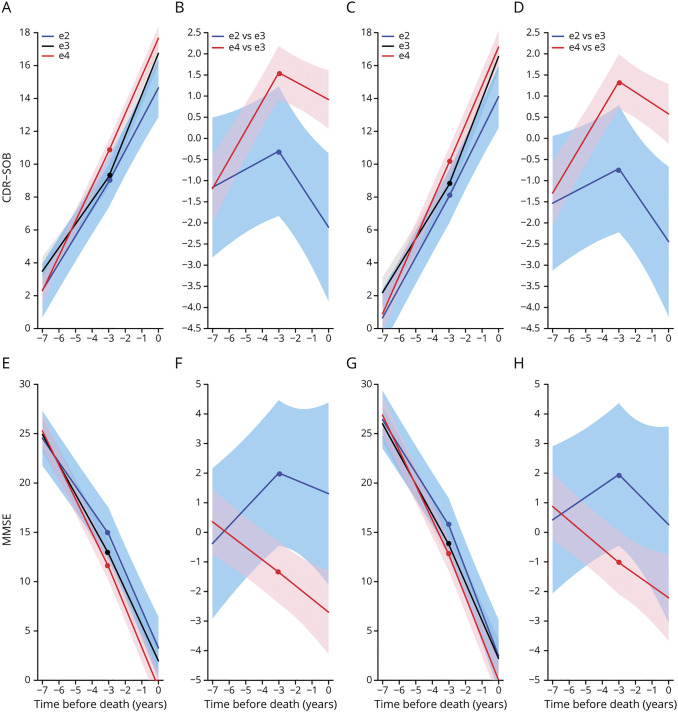
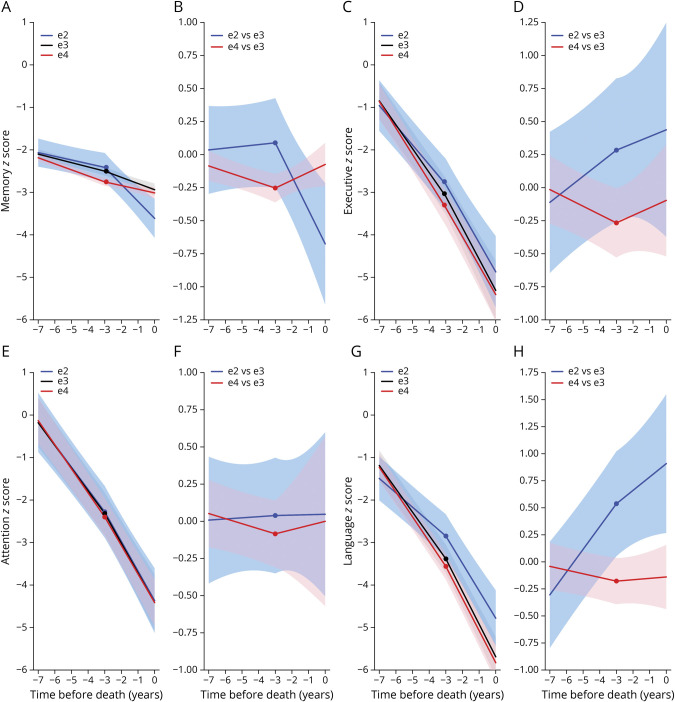
OBJECTIVE: genotype is a significant driver of heterogeneity in Alzheimer disease (AD) clinical progression, which could have important implications for clinical trial design and interpretation. METHODS: We applied novel reverse-time longitudinal models to analyze the trajectories of Clinical Dementia Rating Sum of Boxes (CDR-SOB) and Mini-Mental State Examination (MMSE) scores-2 common outcome measures in AD clinical trials-in 1,102 autopsy-proven AD cases (moderate/frequent neuritic plaques and Braak tangle stage III or greater) from the National Alzheimer's Coordinating Center Neuropathology database resembling participants with mild to moderate AD in therapeutic clinical trials. RESULTS: ε3/ε3 carriers (-2.43 vs -3.03 points per year). These findings remained largely unchanged after controlling for the effect of AD neuropathologic changes on the rate of cognitive decline and for the presence and severity of comorbid pathologies. CONCLUSION: genotype contributes to the heterogeneity in rate of clinical progression in AD.
Overview
The claims and statistics of this paper haven’t been checked yet.
Free: it reads the open-access text and checks the first 5 claims that cite a source we can check. Create a free account to check every claim.
Integrity signals
Registry
Cites
Statistics
Figures
Verification
Claims the paper makes
The claims and statistics of this paper haven’t been checked yet.
Free: it reads the open-access text and checks the first 5 claims that cite a source we can check. Create a free account to check every claim.
Claims other papers make about this one
Each is checked against this paper’s own text: does it say what the citing paper says it does?
The source backs part of the claim, not all of it — or backs it for a different population, condition or comparison.
In the citing paper
“A post-mortem study (N= 1109) found a 10% faster rate of cognitive decline yearly in APOE ε4 carriers (-3.45 vs -3.03 MMSE points per year) and a 20% lower rate of decline in e2 carriers (-2.43 vs -3.03 points per year) compared to APOE ε 3/ ε 3 carriers.(468)”
From Dementia prevention, intervention, and care: 2024 report of the Lancet standing Commission (2024) · cites this paper as [468]
Experimental — accuracy not yet measuredThe source backs part of the claim, not all of it — or backs it for a different population, condition or comparison.
In the citing paper
“However, after controlling for the presence and severity of AD neuropathology and comorbid pathologies, carrying the APOEε4 allele might still accelerate the rate of cognitive decline in the normal ageing-sporadic AD continuum, whereas carrying the APOEε2 allele might slow down cognitive decline47,77,80,81.”
From Multifaceted roles of APOE in Alzheimer disease (2024) · cites this paper as [80]
Experimental — accuracy not yet measured
Self-check
Percentages, sums and reported differences re-computed from the paper’s own numbers.
The self-check needs the paper’s full text.
Citations
Cites
Corder, E. H., Saunders, A. M., Strittmatter, W. J., Schmechel, D. E., Gaskell, P. C., Small, G. W., Roses, A. D., Haines, J. L., & Pericak-Vance, M. A. (1993) · Science · doi:10.1126/science.8346443 · Cited by 9,429
The antibody aducanumab reduces Aβ plaques in Alzheimer’s disease
Sevigny, J., Chiao, P., Bussière, T., Weinreb, P. H., Williams, L., Maier, M., Dunstan, R., Salloway, S., Chen, T., Ling, Y., et al. (2016) · Nature · doi:10.1038/nature19323 · Cited by 3,059
Montine, T. J., Phelps, C. H., Beach, T. G., Bigio, E. H., Cairns, N. J., Dickson, D. W., Duyckaerts, C., Frosch, M. P., Masliah, E., Mirra, S. S., et al. (2012) · Acta Neuropathologica · doi:10.1007/s00401-011-0910-3 · Cited by 2,894 · cited 1×
“Participants can donate their brain on death for research purposes, including a standardized neuropathologic evaluation.(27) The NACCNeuropathology database was interrogated for UDS visits conducted between September 2005 and November 2018.”
Self-citationTwo Phase 3 Trials of Bapineuzumab in Mild-to-Moderate Alzheimer's Disease
Salloway, S., Sperling, R., Fox, N. C., Blennow, K., Klunk, W., Raskind, M., Sabbagh, M., Honig, L. S., Porsteinsson, A. P., Ferris, S., et al. (2014) · New England Journal of Medicine · doi:10.1056/nejmoa1304839 · Cited by 1,960
Protective effect of apolipoprotein E type 2 allele for late onset Alzheimer disease
Corder, E. H., Saunders, A. M., Risch, N. J., Strittmatter, W. J., Schmechel, D. E., Gaskell, P. C., Rimmler, J. B., Locke, P. A., Conneally, P. M., Schmader, K. E., et al. (1994) · Nature Genetics · doi:10.1038/ng0694-180 · Cited by 1,920
APOE4 leads to blood–brain barrier dysfunction predicting cognitive decline
Montagne, A., Nation, D. A., Sagare, A. P., Barisano, G., Sweeney, M. D., Chakhoyan, A., Pachicano, M., Joe, E., Nelson, A. R., D’Orazio, L. M., et al. (2020) · Nature · doi:10.1038/s41586-020-2247-3 · Cited by 1,281
ApoE4 markedly exacerbates tau-mediated neurodegeneration in a mouse model of tauopathy
Initiative, A. D. N., Shi, Y., Yamada, K., Liddelow, S. A., Smith, S. T., Zhao, L., Luo, W., Tsai, R. M., Spina, S., Grinberg, L. T., et al. (2017) · Nature · doi:10.1038/nature24016 · Cited by 1,220
PET Imaging of Tau Deposition in the Aging Human Brain
Schöll, M., Lockhart, S. N., Schonhaut, D. R., O’Neil, J. P., Janabi, M., Ossenkoppele, R., Baker, S. L., Vogel, J. W., Faria, J., Schwimmer, H. D., et al. (2016) · Neuron · doi:10.1016/j.neuron.2016.01.028 · Cited by 1,214
Lin, Y.-T., Seo, J., Gao, F., Feldman, H. M., Wen, H.-L., Penney, J., Cam, H. P., Gjoneska, E., Raja, W. K., Cheng, J., et al. (2018) · Neuron · doi:10.1016/j.neuron.2018.05.008 · Cited by 1,125
Estimation of Extended Mixed Models Using Latent Classes and Latent Processes: The R Package lcmm
Proust-Lima, C., Philipps, V., & Liquet, B. (2017) · Journal of Statistical Software · doi:10.18637/jss.v078.i02 · Cited by 1,106
Beach, T. G., Monsell, S. E., Phillips, L. E., & Kukull, W. (2012) · Journal of Neuropathology & Experimental Neurology · doi:10.1097/nen.0b013e31824b211b · Cited by 1,103
Sperling, R. A., Jack, C. R., Black, S. E., Frosch, M. P., Greenberg, S. M., Hyman, B. T., Scheltens, P., Carrillo, M. C., Thies, W., Bednar, M. M., et al. (2011) · Alzheimer's & Dementia · doi:10.1016/j.jalz.2011.05.2351 · Cited by 857
Self-citationClark, C. M., Pontecorvo, M. J., Beach, T. G., Bedell, B. J., Coleman, R. E., Doraiswamy, P. M., Fleisher, A. S., Reiman, E. M., Sabbagh, M. N., Sadowsky, C. H., et al. (2012) · The Lancet Neurology · doi:10.1016/s1474-4422(12)70142-4 · Cited by 855 · cited 1×
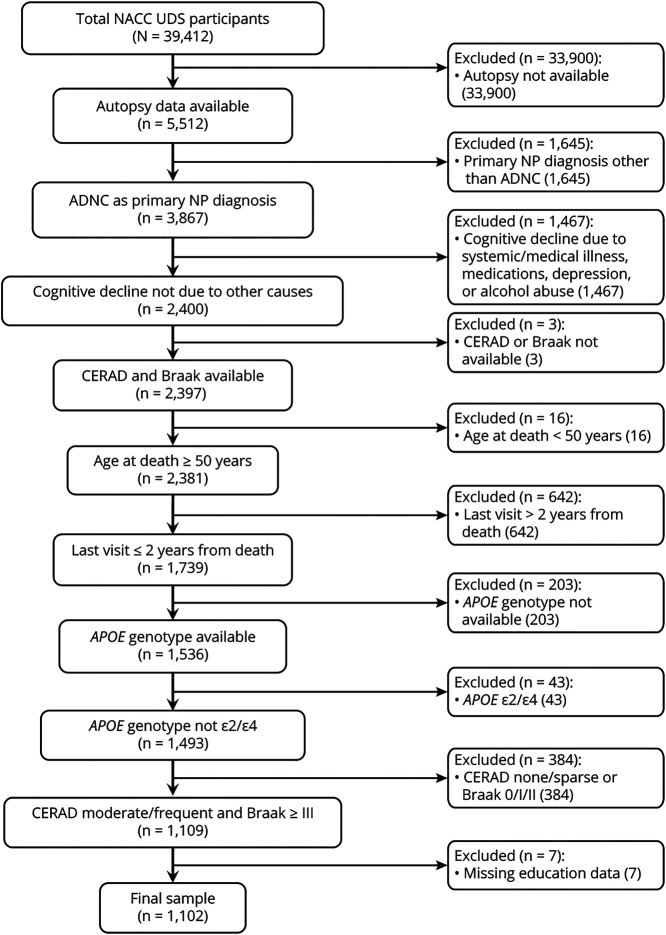
“Tomimic the scenario of a clinical trial with biomarker-based enrollment of participants, we excluded those with none/sparse neuritic plaques (NP) at postmortem examination because theywould have had a negative baseline amyloid PET scan before enrollment.(28) Similarly, to resemble a therapeutic rather than preventive…”
BackgroundEstimation of extended mixed models using latent classes and latent processes: the R package lcmm
Proust‐Lima, C., Philipps, V., & Liquet, B. (2015) · RePEc: Research Papers in Economics · doi:10.48550/arxiv.1503.00890 · Cited by 764
The A4 Study: Stopping AD Before Symptoms Begin?
Sperling, R. A., Rentz, D. M., Johnson, K. A., Karlawish, J., Donohue, M., Salmon, D. P., & Aisen, P. (2014) · Science Translational Medicine · doi:10.1126/scitranslmed.3007941 · Cited by 760
Weintraub, S., Besser, L., Dodge, H. H., Teylan, M., Ferris, S., Goldstein, F. C., Giordani, B., Kramer, J., Loewenstein, D., Marson, D., et al. (2018) · Alzheimer Disease & Associated Disorders · doi:10.1097/wad.0000000000000223 · Cited by 671
Arboleda-Velasquez, J. F., Lopera, F., O’Hare, M., Delgado-Tirado, S., Marino, C., Chmielewska, N., Saez-Torres, K. L., Amarnani, D., Schultz, A. P., Sperling, R. A., et al. (2019) · Nature Medicine · doi:10.1038/s41591-019-0611-3 · Cited by 598
Version 3 of the National Alzheimer’s Coordinating Center’s Uniform Data Set
Besser, L., Kukull, W., Knopman, D. S., Chui, H., Galasko, D., Weintraub, S., Jicha, G., Carlsson, C., Burns, J., Quinn, J., et al. (2018) · Alzheimer Disease & Associated Disorders · doi:10.1097/wad.0000000000000279 · Cited by 510
Reiman, E. M., Arboleda-Velasquez, J. F., Quiroz, Y. T., Huentelman, M. J., Beach, T. G., Caselli, R. J., Chen, Y., Su, Y., Myers, A. J., Hardy, J., et al. (2020) · Nature Communications · doi:10.1038/s41467-019-14279-8 · Cited by 473 · cited 3×
“The underrepresentation of APOE e2 carriers with substantial ADNC (n = 44) is expected given the protective effect of this allele against AD; APOE e4 carriers would also be underrepresented in a sample of cognitively intact individuals with low ADNC.(5,45) In addition, the effects of APOE genotype on the visuospatial/…”
InfluentialSelf-citationBrain β-amyloid load approaches a plateau
Jack, C. R., Wiste, H. J., Lesnick, T. G., Weigand, S. D., Knopman, D. S., Vemuri, P., Pankratz, V. S., Senjem, M. L., Gunter, J. L., Mielke, M. M., et al. (2013) · Neurology · doi:10.1212/wnl.0b013e3182840bbe · Cited by 406 · cited 2×
“To be able to use the autopsy variables as baseline covariates and to apply reverse longitudinal modeling, we assumed that amyloid plaque burden plateaus early in the clinical course of AD and that the sequence of Braak NFT stages from limbic (III/IV) to neocortical (V/VI) is valid over the extent of the follow-up; th…”
MethodResultClinical and pathological correlates of apolipoprotein E ε4 in Alzheimer's disease
Gomez‐Isla, T., West, H. L., Rebeck, G. W., Harr, S. D., Growdon, J. H., Locascio, J. J., Perls, T. T., Lipsitz, L. A., & Hyman, B. T. (1996) · Annals of Neurology · doi:10.1002/ana.410390110 · Cited by 378
Self-citationApolipoprotein E4 effects in Alzheimer’s disease are mediated by synaptotoxic oligomeric amyloid-β
Koffie, R. M., Hashimoto, T., Tai, H.-C., Kay, K. R., Serrano-Pozo, A., Joyner, D., Hou, S., Kopeikina, K. J., Frosch, M. P., Lee, V. M., et al. (2012) · Brain · doi:10.1093/brain/aws127 · Cited by 327
Self-citationAttributable risk of Alzheimer's dementia attributed to age-related neuropathologies
Boyle, P. A., Yu, L., Leurgans, S. E., Wilson, R. S., Brookmeyer, R., Schneider, J. A., & Bennett, D. A. (2019) · Annals of Neurology · doi:10.1002/ana.25380 · Cited by 318
Apolipoprotein E, Especially Apolipoprotein E4, Increases the Oligomerization of Amyloid β Peptide
Hashimoto, T., Serrano-Pozo, A., Hori, Y., Adams, K. W., Takeda, S., Banerji, A. O., Mitani, A., Joyner, D., Thyssen, D. H., Bacskai, B. J., et al. (2012) · The Journal of Neuroscience · doi:10.1523/jneurosci.1542-12.2012 · Cited by 294
Self-citationApolipoprotein E ε4 allele, AD pathology, and the clinical expression of Alzheimer’s disease
Bennett, D. A., Wilson, R. S., Schneider, J. A., Evans, D. A., Aggarwal, N. T., Arnold, S. E., Cochran, E. J., Berry-Kravis, E., & Bienias, J. L. (2003) · Neurology · doi:10.1212/01.wnl.0000042478.08543.f7 · Cited by 282
Wolk, D. A., Dickerson, B. C., Initiative, T. A. D. N., Weiner, M., Aiello, M., Aisen, P., Albert, M. S., Alexander, G., Anderson, H. S., Anderson, K., et al. (2010) · Proceedings of the National Academy of Sciences · doi:10.1073/pnas.1001412107 · Cited by 248
Novel allele-dependent role for APOE in controlling the rate of synapse pruning by astrocytes
Chung, W.-S., Verghese, P. B., Chakraborty, C., Joung, J., Hyman, B. T., Ulrich, J. D., Holtzman, D. M., & Barres, B. A. (2016) · Proceedings of the National Academy of Sciences · doi:10.1073/pnas.1609896113 · Cited by 242
Self-citationBesser, L. M., Kukull, W. A., Teylan, M. A., Bigio, E. H., Cairns, N. J., Kofler, J. K., Montine, T. J., Schneider, J. A., & Nelson, P. T. (2018) · Journal of Neuropathology & Experimental Neurology · doi:10.1093/jnen/nly049 · Cited by 224
APOE ε4/ε4 diminishes neurotrophic function of human iPSC-derived astrocytes
Zhao, J., Davis, M. D., Martens, Y. A., Shinohara, M., Graff-Radford, N. R., Younkin, S. G., Wszolek, Z. K., Kanekiyo, T., & Bu, G. (2017) · Human Molecular Genetics · doi:10.1093/hmg/ddx155 · Cited by 221
APOE ε4 allele predicts faster cognitive decline in mild Alzheimer disease
Cosentino, S., Scarmeas, N., Helzner, E., Glymour, M. M., Brandt, J., Albert, M., Blacker, D., & Stern, Y. (2008) · Neurology · doi:10.1212/01.wnl.0000304038.37421.cc · Cited by 214
APOE ε4 is associated with severity of Lewy body pathology independent of Alzheimer pathology
Dickson, D. W., Heckman, M. G., Murray, M. E., Soto, A. I., Walton, R. L., Diehl, N. N., van Gerpen, J. A., Uitti, R. J., Wszolek, Z. K., Ertekin-Taner, N., et al. (2018) · Neurology · doi:10.1212/wnl.0000000000006212 · Cited by 210
APOE alleles predict the rate of cognitive decline in Alzheimer disease: A nonlinear model
Martins, C. A. R., Oulhaj, A., de Jager, C. A., & Williams, J. H. (2005) · Neurology · doi:10.1212/01.wnl.0000188871.74093.12 · Cited by 205
The Apolipoprotein E ϵ4 Allele and Decline in Different Cognitive Systems During a 6-Year Period
Wilson, R. S., Schneider, J. A., Barnes, L. L., Beckett, L. A., Aggarwal, N. T., Cochran, E. J., Berry-Kravis, E., Bach, J., Fox, J. H., Evans, D. A., et al. (2002) · Archives of Neurology · doi:10.1001/archneur.59.7.1154 · Cited by 193
APOE ε2 is associated with milder clinical and pathological Alzheimer disease
Serrano‐Pozo, A., Qian, J., Monsell, S. E., Betensky, R. A., & Hyman, B. T. (2015) · Annals of Neurology · doi:10.1002/ana.24369 · Cited by 176 · cited 3×
“These results largely agree with those from a NACC sample of cognitively impaired (CDR-SOB score >0) selected to represent the AD clinicopathologic continuum.(5)”
ResultInfluentialSelf-citationThe apolipoprotein E varepsilon2 allele and decline in episodic memory
Wilson, R. S. (2002) · Journal of Neurology, Neurosurgery & Psychiatry · doi:10.1136/jnnp.73.6.672 · Cited by 161
Yang, H.-S., Yu, L., White, C. C., Chibnik, L. B., Chhatwal, J. P., Sperling, R. A., Bennett, D. A., Schneider, J. A., & De Jager, P. L. (2018) · The Lancet Neurology · doi:10.1016/s1474-4422(18)30251-5 · Cited by 146
Dickerson, B. C., Wolk, D. A., & Initiative, T. A. D. N. (2011) · Journal of Neurology, Neurosurgery & Psychiatry · doi:10.1136/jnnp.2009.199505 · Cited by 140
Stern, Y., Brandt, J., Albert, M., Jacobs, D. M., Liu, X., Bell, K., Marder, K., Sano, M., Albert, S., Castenada, C. D., et al. (1997) · Annals of Neurology · doi:10.1002/ana.410410510 · Cited by 127
Mild to moderate Alzheimer dementia with insufficient neuropathological changes
Serrano‐Pozo, A., Qian, J., Monsell, S. E., Blacker, D., Gómez‐Isla, T., Betensky, R. A., Growdon, J. H., Johnson, K. A., Frosch, M. P., Sperling, R. A., et al. (2014) · Annals of Neurology · doi:10.1002/ana.24125 · Cited by 120
Self-citationAPOE2 eases cognitive decline during Aging: Clinical and preclinical evaluations
Shinohara, M., Kanekiyo, T., Yang, L., Linthicum, D., Shinohara, M., Fu, Y., Price, L., Frisch‐Daiello, J. L., Han, X., Fryer, J. D., et al. (2016) · Annals of Neurology · doi:10.1002/ana.24628 · Cited by 111
APOE and cognitive decline in preclinical Alzheimer disease and non-demented aging
Bunce, D., Fratiglioni, L., Small, B. J., Winblad, B., & Bäckman, L. (2004) · Neurology · doi:10.1212/01.wnl.0000137041.86153.42 · Cited by 110
[F-18]-AV-1451 binding correlates with postmortem neurofibrillary tangle Braak staging
Marquié, M., Siao Tick Chong, M., Antón-Fernández, A., Verwer, E. E., Sáez-Calveras, N., Meltzer, A. C., Ramanan, P., Amaral, A. C., Gonzalez, J., Normandin, M. D., et al. (2017) · Acta Neuropathologica · doi:10.1007/s00401-017-1740-8 · Cited by 109
Apolipoprotein E Genotype and Rate of Decline in Probable Alzheimer's Disease
Forno, G. D., Rasmusson, D. X., Brandt, J., Carson, K. A., Brookmeyer, R., Troncoso, J., & Kawas, C. H. (1996) · Archives of Neurology · doi:10.1001/archneur.1996.00550040085017 · Cited by 108
Serrano-Pozo, A., Qian, J., Monsell, S. E., Frosch, M. P., Betensky, R. A., & Hyman, B. T. (2013) · Journal of Neuropathology & Experimental Neurology · doi:10.1097/nen.0000000000000016 · Cited by 108
Self-citationMost rapid cognitive decline in APOE ε4 negative Alzheimer's disease with early onset
van der Vlies, A. E., Koedam, E. L. G. E., Pijnenburg, Y. A. L., Twisk, J. W. R., Scheltens, P., & van der Flier, W. M. (2009) · Psychological Medicine · doi:10.1017/s0033291709005492 · Cited by 107
The effect of APOE genotype on clinical phenotype in Alzheimer disease
van der Flier, W. M., Schoonenboom, S. N. M., Pijnenburg, Y. A. L., Fox, N. C., & Scheltens, P. (2006) · Neurology · doi:10.1212/01.wnl.0000228222.17111.2a · Cited by 98
Individual Growth Curve Analysis of APOE ε4–Associated Cognitive Decline in Alzheimer Disease
Hoyt, B. D., Massman, P. J., Schatschneider, C., Cooke, N., & Doody, R. S. (2005) · Archives of Neurology · doi:10.1001/archneur.62.3.454 · Cited by 83
Brain metabolic decreases related to the dose of the ApoE e4 allele in Alzheimer's disease
Mosconi, L. (2004) · Journal of Neurology, Neurosurgery & Psychiatry · doi:10.1136/jnnp.2003.014993 · Cited by 83
Hayden, K. M., Jones, R. N., Zimmer, C., Plassman, B. L., Browndyke, J. N., Pieper, C., Warren, L. H., & Welsh-Bohmer, K. A. (2011) · Alzheimer Disease & Associated Disorders · doi:10.1097/wad.0b013e3181ffa76d · Cited by 74
Yu, L., Boyle, P., Schneider, J. A., Segawa, E., Wilson, R. S., Leurgans, S., & Bennett, D. A. (2013) · Psychology and Aging · doi:10.1037/a0031642 · Cited by 47
Qian, J., Hyman, B. T., & Betensky, R. A. (2017) · JAMA Neurology · doi:10.1001/jamaneurol.2016.5953 · Cited by 40
Self-citationKennedy, R. E., Cutter, G. R., & Schneider, L. S. (2014) · Alzheimer's & Dementia · doi:10.1016/j.jalz.2013.03.003 · Cited by 38
Bonner-Jackson, A., Okonkwo, O., & Tremont, G. (2012) · The American Journal of Geriatric Psychiatry · doi:10.1097/jgp.0b013e3182203c32 · Cited by 28
Cited by
Dementia prevention, intervention, and care: 2024 report of the Lancet standing Commission
Livingston, G., Huntley, J., Liu, K. Y., Costafreda, S. G., Selbæk, G., Alladi, S., Ames, D., Banerjee, S., Burns, A., Brayne, C., et al. (2024) · The Lancet · doi:10.1016/s0140-6736(24)01296-0 · Cited by 3,860
The amyloid hypothesis in Alzheimer disease: new insights from new therapeutics
Karran, E., & De Strooper, B. (2022) · Nature Reviews Drug Discovery · doi:10.1038/s41573-022-00391-w · Cited by 742
“Whether APOE4 genotype affects disease progression is still a matter of debate, but it will be important in future trials to address this aspect 69,70 .”
APOE Genotype and Alzheimer Disease Risk Across Age, Sex, and Population Ancestry
Belloy, M. E., Andrews, S. J., Le Guen, Y., Cuccaro, M., Farrer, L. A., Napolioni, V., & Greicius, M. D. (2023) · JAMA Neurology · doi:10.1001/jamaneurol.2023.3599 · Cited by 320
Multifaceted roles of APOE in Alzheimer disease
Jackson, R. J., Hyman, B. T., & Serrano-Pozo, A. (2024) · Nature Reviews Neurology · doi:10.1038/s41582-024-00988-2 · Cited by 193
Self-citationDuara, R., & Barker, W. (2022) · Neurotherapeutics · doi:10.1007/s13311-022-01185-z · Cited by 187
“[147] evaluated longitudinal neuropsychological data from patients with mild to moderate Alzheimer’s disease, with typical versus atypical cognitive profiles, in the US National Alzheimer’s Coordinating Center (NACC) database.”
Background
Metadata
- Authors
- Qian, J., Betensky, R. A., Hyman, B. T., & Serrano-Pozo, A.
- Affiliations
- Harvard University (US)
- From the Department of Biostatistics and Epidemiology (J.Q.), University of Massachusetts, Amherst; New York University College of Global Public Health (R.A.B.), New York City; Department of Neurology (B.T.H., A.S.-P.), Massachusetts General Hospital, Boston; Massachusetts Alzheimer's Disease Research Center (B.T.H., A.S.-P.), Charlestown; and Harvard Medical School (B.T.H., A.S.-P.), Boston, MA.
- Venue
- Neurology
- Published
- 2021-05-11
- Volume
- 96
- Issue
- 19
- Pages
- e2414-e2428
- ISSN
- 0028-3878 (ISSN-L)
- 1526-632X
- PMC
- PMC8166439
- OpenAlex
- W3136651487
- Semantic Scholar
- 17a28bbc83cffb55d132bb7faac8c4a4f2b6d3d9
- Cited by
- 71
- References
- 53
- Citations by year
- 2026: 16 · 2025: 14 · 2024: 10 · 2023: 15 · 2022: 10 · 2021: 6
- FWCI
- 7.35
- Type
- journal article
- Language
- en
- Open access
- hybrid
- doi.org
- Licence
- cc-by-nc-nd
- Locations
- Neurology (publishedVersion, cc-by-nc-nd)
- PubMed Central (publishedVersion, cc-by-nc-nd)
- PubMed (publishedVersion)
- Funders
- Alzheimer's Association (U01 AG016976, P50 AG025688, AACF-17-524184, P30 AG062421, P50 AG008702, P30 AG010133, P50 AG005146)
- National Institutes of Health (5p30ag062428-02, AG062421, AG016976, P30 AG062428–01, AG019610, AG025688, R25-NS065743, AG013846, AG047266, AG008702)
- National Institute on Aging (AG010133, AG 016976, P30AG053760, P30AG010129, P30AG010133, P30AG066512, AG062421, P30-AG062428, P30AG049638, P30AG028383, P30AG012300, AG 025688, P50AG005133, U01AG016976, P50AG005138, AG019610, P30AG010124, AG047266, P50AG016573, P50AG047366, P30AG008017, P30 AG062428‐01, P30AG010161, P30AG008051, R21AG053695, P50AG008702, K08AG064039, P30AG035982, AG013846, P50AG005681, P50AG005142, P50AG047270, P30AG019610, P50AG005146, P30AG013846, P50AG005136, P30AG013854, P50AG025688, P50AG047266, P30AG062429, P30AG066444, P30AG062422, P30AG062421, P50AG023501)
- National Institute of Neurological Disorders and Stroke (R01NS094610, R25NS065743)
- Topics
- Health Sciences › Medicine › Psychiatry and Mental health › Dementia and Cognitive Impairment Research
- Life Sciences › Neuroscience › Cellular and Molecular Neuroscience › Alzheimer's disease research and treatments
- Health Sciences › Medicine › Clinical Neurology › Amyotrophic Lateral Sclerosis Research
- Keywords
- Alzheimer's disease, APOE genotype, APOE ε4, Mini-Mental State Examination, neuropathology, comorbid pathology, clinical trial design
- MeSH terms
- Aged, Aged, 80 and over, Alzheimer Disease, Female, Genotype, Humans, Longitudinal Studies, Male, Cohort Studies, Disease Progression, Apolipoprotein E3, Apolipoprotein E4, Apolipoprotein E2, Cognitive Dysfunction
About these checks
Registry, retraction, Cites and statistics results are computed, not judged, with one exception: a printed reference that no index lists is read once by a model before it counts as a citation error. Claims are extracted by a model and kept only when their quote appears verbatim in the text; each cited source is then checked, with a model’s help, for whether it says what the claim relies on. Those verdicts can be wrong — read the claim’s quote and the cited source before relying on one.
Statistics and arithmetic are recomputed, not judged.
Confidence bands are shown only for fields calibrated on our annotated test set. None is calibrated yet, so no band is shown.
What counts as a claim ›How we measure confidence ›How we check this ›
Are you an author, or do you see a problem with this page? Request a review
Data sources
Bibliographic data: Semantic Scholar, OpenAlex, Crossref.
Contains information from the Semantic Scholar Academic Graph Datasets, made available under the ODC Attribution License (ODC-BY 1.0).
Semantic Scholar’s data is described in: Kinney, R., et al. (2023). The Semantic Scholar Open Data Platform. arXiv:2301.10140.
