

Mathematics Teachers’ Subject Matter Knowledge and Pedagogical Content Knowledge in Problem Posing
Open accessThe DOI matches its Crossref record; 43 of the 45 references it cites were found in a registry or an index; none of the 29 sources its claims cite is checked for support yet.
Abstract
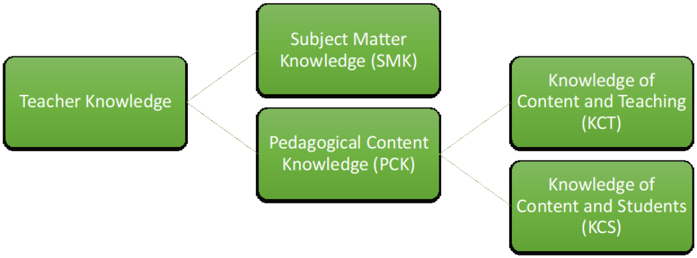
Since the National Council of Teachers of Mathematics ([NCTM], 2000) and the National Research Council ([NRC], 2005) revealed that problem posing needed to be incorporated into mathematics classrooms, the importance of teachers’ roles in problem posing has been emphasized in K-12 mathematics curriculum because of instructors’ impact on students’ mathematical performance. In the present study, researchers investigated teachers’ subject matter knowledge (SMK), knowledge of content and teaching (KCT), and knowledge of content and students (KCS) in terms of problem-posing. A qualitative study design and inductive analysis were used to gather and interpret data from interviews conducted with four mathematics teachers. Results indicated that participants had SMK of problem posing, but their actual problem-posing results did not reflect their SMK well. In terms of KCS and KCT, teachers were aware of the importance of problem posing for students’ mathematical development but felt that there were several significant factors impeding the effective incorporation of problem posing within their classes. These findings underscore the importance of professional development for teacher pedagogical knowledge in problem posing.
Overview
CoChat Summary
TL;DR
This qualitative study of four Korean middle/high school mathematics teachers found that although they could define problem posing and distinguish problem generation from reformulation, their actual posed problems often did not reflect that subject matter knowledge and were less varied or lower-level than expected. Teachers valued problem posing but reported barriers to classroom implementation, and they differed in how they assessed students’ incorrect posed problems, pointing to professional development needs.
Key findings
- All four teachers defined problem posing and identified problem generation and problem reformulation as types, but their actual problem-posing results did not match their stated SMK; three of the four posed problems requiring a low level of cognitive demand, and Table 4 shows fewer problem-posing types in reality than in their expectations.
- For KCT, teachers viewed problem posing as important but cited barriers including insufficient class time and limited textbook examples; all except Yoon expressed positive perspectives, while Yoon said problem posing was important but “not easy to apply” and lacked usable assessment standards.
- For KCS, teachers linked problem-posing proficiency to mathematical proficiency and stressed students’ prior concept knowledge, but they disagreed about the role of problem solving in problem posing and about evaluating incorrect posed problems: Kim and Yoon evaluated the student’s posed problems negatively, whereas Seo and Hyun inferred conceptual understanding even when the answer was incorrect.
- The authors conclude that professional development is needed for teachers’ pedagogical knowledge in problem posing.
Methods
- Qualitative interview design with four Korean intermediate-level middle/high school mathematics teachers; each participated in one semi-structured, open-ended interview of approximately one hour, with two mathematics questionnaires—one for problem generation and one for problem reformulation—and 10 minutes to pose problems.
- Interviews were audio recorded, transcribed, supplemented with researchers’ observation notes, and analyzed with inductive analysis and open coding using problem-posing codes and teacher-knowledge codes.
- Data were triangulated for internal validity; researchers coded independently, resolved disagreements, and reported an inter-rater agreement of 0.95.
Limitations
- The paper states that the participants each had no more than five years of teaching experience, that the limited number of posed problems may have constrained the variety of problems observed, and that the study is a preliminary analysis requiring follow-up research.
- The paper also notes that teachers’ practices did not fully reflect their KCT and KCS because of educational-setting constraints such as limited time and textbook content.
- Evident from the design: the sample is only four volunteer teachers in Korea, so findings are not presented as broadly generalizable, and the data rely on interviews, questionnaires, and observation notes rather than extended classroom observation.
Model-written summary. Check it against the paper before relying on it.
Integrity signals
Registry
Cites
Statistics
Figures
Verification
Claims the paper makes
0 Valid · 0 Not valid · 20 Not checked · 88 Own results and interpretations
A result the paper reports from its own data — it cites no other source for it, so there is none to check. The quote shows it is in the paper.
In the paper
“In general, the teachers were divided in their preference and reasons for the use of mathematical situations versus real-world situations in their problem posing instruction.”
§ Mathematics Teachers' Subject Matter Knowledge and Pedagogical Content Knowledge in Problem Posing > Yoon: I know it (problem posing) is important. But it's not easy to apply. If I use problem posing, I need assessment standards, but, I don't know what they are, and I don't think it is usable.
plain- Asserted: passes — The authors put it forward as true.
- Checkable: passes — It can be checked against evidence.
- Load-bearing: unclear — It is unclear whether the paper’s conclusions depend on it.
- Based: passes — The paper gives a reason why it holds.
A result the paper reports from its own data — it cites no other source for it, so there is none to check. The quote shows it is in the paper.
In the paper
“Results indicated that participants had SMK of problem posing, but their actual problem-posing results did not reflect their SMK well.”
- Also stated in: § Teachers' SMK in Problem Posing · plain
“their actual problemposing activity results did not match with the SMK they demonstrated in their responses”
§ Mathematics Teachers' Subject Matter Knowledge and Pedagogical Content Knowledge in Problem Posing > Abstract
plain- Asserted: passes — The authors put it forward as true.
- Checkable: passes — It can be checked against evidence.
- Load-bearing: passes — The paper’s conclusions depend on it.
- Based: passes — The paper gives a reason why it holds.
- Rests on an assumption not shown here.
- Also stated in: § Teachers' SMK in Problem Posing · plain
A result the paper reports from its own data — it cites no other source for it, so there is none to check. The quote shows it is in the paper.
In the paper
“the diversity of problem-posing types actually included in the problems they posed was less than the amount the teachers thought they would include”
§ Mathematics Teachers' Subject Matter Knowledge and Pedagogical Content Knowledge in Problem Posing > Teachers' SMK in Problem Posing
plain- Asserted: passes — The authors put it forward as true.
- Checkable: passes — It can be checked against evidence.
- Load-bearing: passes — The paper’s conclusions depend on it.
- Based: passes — The paper gives a reason why it holds.
- Rests on an assumption not shown here.
A result the paper reports from its own data — it cites no other source for it, so there is none to check. The quote shows it is in the paper.
In the paper
“Differences between teachers emerged concerning the awareness of constructing problem-posing instructions.”
§ Mathematics Teachers' Subject Matter Knowledge and Pedagogical Content Knowledge in Problem Posing > Yoon: I know it (problem posing) is important. But it's not easy to apply. If I use problem posing, I need assessment standards, but, I don't know what they are, and I don't think it is usable.
plainstates an associationSingle case- Asserted: passes — The authors put it forward as true.
- Checkable: passes — It can be checked against evidence.
- Load-bearing: passes — The paper’s conclusions depend on it.
- Based: passes — The paper gives a reason why it holds.
A result the paper reports from its own data — it cites no other source for it, so there is none to check. The quote shows it is in the paper.
In the paper
“However, there was a difference between the teachers in terms of how they perceived the importance of problem solving in problem posing, and this difference impacted their assessment of problem posing.”
§ Mathematics Teachers' Subject Matter Knowledge and Pedagogical Content Knowledge in Problem Posing > DISCUSSION
plain- Asserted: passes — The authors put it forward as true.
- Checkable: passes — It can be checked against evidence.
- Load-bearing: unclear — It is unclear whether the paper’s conclusions depend on it.
- Based: passes — The paper gives a reason why it holds.
46 more claims
Create a free account to see all 108 claims and to verify the 23 references still open.
- Probably not a substantial claim. 50
- It may state two separate claims as one. 24
Self-check
Percentages, sums and reported differences re-computed from the paper’s own numbers.
Each contradiction between two passages listed here was confirmed by an independent check.
Rated minor: it would not touch a result — a value no result rests on, a p-value that stays on the same side of the significance level, or a conflict that is clerical, resolved elsewhere in the paper, or outside its own findings.
In the paper
§ Mathematics Teachers' Subject Matter Knowledge and Pedagogical Content Knowledge in Problem Posing > Participants
“Hyun had teaching experience at both levels, teaching at a private middle school for two years before she began teaching at a private high school, which she had taught at for four years.”
§ Mathematics Teachers' Subject Matter Knowledge and Pedagogical Content Knowledge in Problem Posing > DISCUSSION
“Because the participants in the current study each had no more than five years of teaching experience, this experiential prerequisite may have been a significant factor impacting their problem-posing teaching practices.”
Rated minor: it would not touch a result — a value no result rests on, a p-value that stays on the same side of the significance level, or a conflict that is clerical, resolved elsewhere in the paper, or outside its own findings.
In the paper
§ Mathematics Teachers' Subject Matter Knowledge and Pedagogical Content Knowledge in Problem Posing > Teachers' SMK in Problem Posing
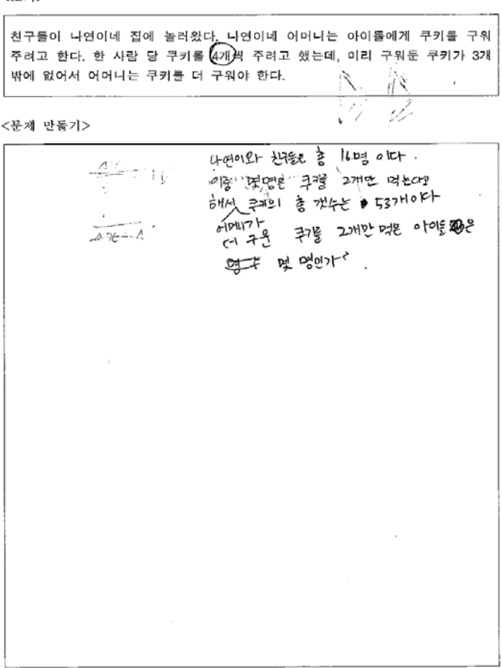
“The following was Hyun's posed problem for Questionnaire 2: Eugene and 5 friends decided to go to the amusement park the day the midterm exam finished.”
§ Mathematics Teachers' Subject Matter Knowledge and Pedagogical Content Knowledge in Problem Posing > Teachers' SMK in Problem Posing
“Seo changed the original scenarios of the questionnaire from a buffet situation to an amusement park situation and also changed the assumptions from the question about number of people to the full price of a ticket.”
Citations
Cites
Those Who Understand: Knowledge Growth in Teaching
SHULMAN, L. S. (1986) · Educational Researcher · doi:10.3102/0013189x015002004 · Cited by 18,546 · cited 1×
“In particular, since Shulman (1986) introduced PCK, many researchers in mathematics education have described the subscales of PCK by extending Shulman’s (1986) concept.”
BackgroundBasics of Qualitative Research: Grounded Theory Procedures and Techniques
Long, D. R., Strauss, A., & Corbin, J. (1993) · The Modern Language Journal · doi:10.2307/328955 · Cited by 17,576
Content Knowledge for Teaching: What Makes It Special?
Loewenberg Ball, D., Thames, M. H., & Phelps, G. (2008) · Journal of Teacher Education · doi:10.1177/0022487108324554 · Cited by 5,388
(1990) · Cited by 5,210
Teacher Quality and Student Achievement
Darling-Hammond, L. (2000) · Education Policy Analysis Archives · doi:10.14507/epaa.v8n1.2000 · Cited by 2,262
Schmidt, D. A., Baran, E., Thompson, A. D., Mishra, P., Koehler, M. J., & Shin, T. S. (2009) · Journal of Research on Technology in Education · doi:10.1080/15391523.2009.10782544 · Cited by 1,853
Qualitative Interview Design: A Practical Guide for Novice Investigators
Turner, D. (2014) · The Qualitative Report · doi:10.46743/2160-3715/2010.1178 · Cited by 1,697
Hill, H. C., Ball, D. L., & Schilling, S. G. (2008) · Journal for Research in Mathematics Education · doi:10.5951/jresematheduc.39.4.0372 · Cited by 1,679
Qualitative Analysis on Stage: Making the Research Process More Public
Anfara, V. A., Brown, K. M., & Mangione, T. L. (2002) · Educational Researcher · doi:10.3102/0013189x031007028 · Cited by 1,362
The Mathematical Understandings That Prospective Teachers Bring to Teacher Education
Ball, D. L. (1990) · The Elementary School Journal · doi:10.1086/461626 · Cited by 911 · cited 1×
“Since many teachers have not experienced problem posing when they were students or pre-service teachers, they tended to avoid problem posing or provide routinized exercises (Ball, 1990).”
BackgroundHow students learn: history, mathematics, and science in the classroom
(2005) · Choice Reviews Online · doi:10.5860/choice.43-1716 · Cited by 889
Implementing standards-based mathematics instruction: a casebook for professional development
(2000) · Choice Reviews Online · doi:10.5860/choice.38-1691 · Cited by 814
Rowan, B., Correnti, R., & Miller, R. J. (2002) · Teachers College Record: The Voice of Scholarship in Education · doi:10.1177/016146810210400804 · Cited by 412
Teacher Preparation Research: An Insider’s View from the Outside
Wilson, S. M., Floden, R. E., & Ferrini-Mundy, J. (2002) · Journal of Teacher Education · doi:10.1177/0022487102053003002 · Cited by 411
Even, R. (1993) · Journal for Research in Mathematics Education · doi:10.2307/749215 · Cited by 401
Cai, J., & Hwang, S. (2002) · The Journal of Mathematical Behavior · doi:10.1016/s0732-3123(02)00142-6 · Cited by 320
Children's Problem Posing within Formal and Informal Contexts
English, L. D. (1998) · Journal for Research in Mathematics Education · doi:10.2307/749719 · Cited by 304
Learning to pose mathematical problems: Exploring changes in preservice teachers' practices
Crespo, S. (2003) · Educational Studies in Mathematics · doi:10.1023/a:1024364304664 · Cited by 269
Crespo, S., & Sinclair, N. (2008) · Journal of Mathematics Teacher Education · doi:10.1007/s10857-008-9081-0 · Cited by 225
Artifacts as sources for problem-posing activities
Bonotto, C. (2013) · Educational Studies in Mathematics · doi:10.1007/s10649-012-9441-7 · Cited by 165
A problem-solving conceptual framework and its implications in designing problem-posing tasks
Singer, F. M., & Voica, C. (2012) · Educational Studies in Mathematics · doi:10.1007/s10649-012-9422-x · Cited by 159
Leung, S. S., & Silver, E. A. (1997) · Mathematics Education Research Journal · doi:10.1007/bf03217299 · Cited by 151
The development of beginning mathematics teacher pedagogical content knowledge
Lannin, J. K., Webb, M., Chval, K. B., Arbaugh, F., Hicks, S., Taylor, C. E., & Bruton, R. (2013) · Journal of Mathematics Teacher Education · doi:10.1007/s10857-013-9244-5 · Cited by 110
Probing adults' conceptual understanding and transfer of learning via problem posing
Mestre, J. P. (2002) · Journal of Applied Developmental Psychology · doi:10.1016/s0193-3973(01)00101-0 · Cited by 81
What Teachers Need to Know to Teach Mathematics: An argument for a reconceptualised model
Hurrell, D. (2013) · The Australian journal of teacher education · doi:10.14221/ajte.2013v38n11.3 · Cited by 72
VALANIDES, N. (2000) · Chem. Educ. Res. Pract. · doi:10.1039/a9rp90026h · Cited by 67
Van Harpen, X. Y., & Presmeg, N. C. (2013) · Educational Studies in Mathematics · doi:10.1007/s10649-012-9456-0 · Cited by 65
Barlow, A. T., & Cates, J. M. (2006) · School Science and Mathematics · doi:10.1111/j.1949-8594.2006.tb18136.x · Cited by 62
Özden, M. (2008) · Educational Sciences Theory & Practice · Cited by 62
Koichu, B., Harel, G., & Manaster, A. B. (2012) · Instructional Science · doi:10.1007/s11251-012-9254-1 · Cited by 50
An Analysis of Secondary and Middle School Teachers’ Mathematical Problem Posing
Stickles, P. R. (2011) · Investigations in Mathematics Learning · doi:10.1080/24727466.2011.11790301 · Cited by 46
Prospective teachers’ ability to pose word problems
Rizvi, N. F. (2004) · eCommons - AKU (Aga Khan University) · Cited by 46
Hauk, S., Toney, A. F., Jackson, B., Nair, R., & Tsay, J.-J. (2014) · Dialogic Pedagogy A Journal for Studies of Dialogic Education · doi:10.5195/dpj.2014.40 · Cited by 41
Creativity assessment in school settings through problem posing tasks
Pelczer, I., & Rodríguez, F. G. (2011) · The Mathematics Enthusiast · doi:10.54870/1551-3440.1221 · Cited by 39
Chen, L., Van Dooren, W., Chen, Q., & Verschaffel, L. (2011) · International Journal of Science and Mathematics Education · doi:10.1007/s10763-010-9259-7 · Cited by 38
Quinn, R. J. (1997) · The Journal of Educational Research · doi:10.1080/00220679709597528 · Cited by 34
Analogical Problem Construction and Transfer in Mathematical Problem Solving
Bernardo, A. B. I. (2001) · Educational Psychology · doi:10.1080/01443410020043841 · Cited by 34
An Investigation on Chinese Teachers' Realistic Problem Solving Abilities and Beliefs
Chen, L., Dooren, W. V., & Verschaffel, L. (2011) · Lirias · Cited by 11
EFFICACY BELIEFS, PROBLEM POSING, AND MATHEMATICS ACHIEVEMENT
Nicolaou, A. A., & Philippou, G. N. (2007) · Unpublished · doi:10.13140/2.1.3259.8406
(2009) · Faculty of Education
(2010) · Educational Sciences Theory & Practice
(2003) · University of New Hampshire Scholars Repository (University of New Hampshire at Manchester)
(1994) · for the learning of mathematics
Research works printed but not linked: 5
- Brown, S. I., & Walter, M. I. (1990). The art of problem posing (2nd ed.). Hillsdale, NJ: Erlbaum.
- Lee, Y. (2012). An analysis of students' mathematical problem posing (Unpublished master's thesis). Ewha Womans University, Seoul, Korea.
- Pelczer, I., & Rodríguez, F. G. (2011). Creativity assessment in school settings through problem posing tasks. The Mathematics Enthusiast, 8(1), 383-398.
- Rowland, T., Huckstep, P., & Thwaites, A. (2003). The knowledge quartet. In J. Williams (Ed.), Proceedings of the British society for research into learning mathematics, 23(3), 97-103.
- Stickles, P. (2006). An analysis of secondary and middle school teacher's mathematical problem posing (Unpublished doctoral dissertation). Indiana University.
Cited by
Hu, B., Zheng, L., Zhu, J., Ding, L., Wang, Y., & Gu, X. (2024) · IEEE Transactions on Learning Technologies · doi:10.1109/tlt.2024.3384765 · Cited by 109
Can ChatGPT support prospective teachers in physics task development?
Küchemann, S., Steinert, S., Revenga, N., Schweinberger, M., Dinc, Y., Avila, K. E., & Kuhn, J. (2023) · Physical Review Physics Education Research · doi:10.1103/physrevphyseducres.19.020128 · Cited by 132
Young students posing problem-solving tasks: what does posing a similar task imply to students?
Palmér, H., & van Bommel, J. (2020) · ZDM · doi:10.1007/s11858-020-01129-x · Cited by 21
Sevinç, Ş., & Lesh, R. (2021) · Journal of Mathematics Teacher Education · doi:10.1007/s10857-021-09512-5 · Cited by 56
Zayyadi, M., Nusantara, T., Hidayanto, E., Sulandra, I. M., & Sa’dijah, C. (2020) · Journal for the Education of Gifted Young Scientists · doi:10.17478/jegys.642131 · Cited by 56
Metadata
- Authors
- Lee, Y., Capraro, R. M., & Capraro, M. M.
- Affiliations
- Texas A&M University (US)
- Corresponding author
- Lee, Yujin
- Venue
- International Electronic Journal of Mathematics Education
- Publisher
- Modestum Ltd
- Published
- 2018-06-10
- Volume
- 13
- Issue
- 2
- ISSN
- 1306-3030 (ISSN-L)
- OpenAlex
- W2806351672
- Cited by
- 142
- References
- 45
- Citations by year
- 2026: 11 · 2025: 14 · 2024: 23 · 2023: 27 · 2022: 12 · 2021: 36 · 2020: 10 · 2019: 9
- FWCI
- 35.55
- Type
- journal article
- Language
- en
- Open access
- diamond
- doi.org
- Licence
- cc-by
- Locations
- International Electronic Journal of Mathematics Education (publishedVersion, cc-by)
- Topics
- Social Sciences › Education › Mathematics Education and Teaching Techniques
- Social Sciences › Education › Mathematics Education and Pedagogy
- Social Sciences › Education › Teacher Education and Leadership Studies
- Keywords
- problem posing, mathematics teachers, content knowledge, pedagogical content knowledge, teacher professional development, K-12 mathematics curriculum
About these checks
Registry, retraction, Cites and statistics results are computed, not judged, with one exception: a printed reference that no index lists is read once by a model before it counts as a citation error. Claims are extracted by a model and kept only when their quote appears verbatim in the text; each cited source is then checked, with a model’s help, for whether it says what the claim relies on. Those verdicts can be wrong — read the claim’s quote and the cited source before relying on one.
A language model drew the claims from the paper on 2026-11-15, under version 3 of the claim definition (model deepseek-v4.1-flash, prompt extract-v3).
A second model labelled each claim on 2026-11-15 (model jev-1.13-20260917, definition revision gold-guideline-v0.2).
Statistics and arithmetic are recomputed, not judged.
Confidence bands are shown only for fields calibrated on our annotated test set. None is calibrated yet, so no band is shown.
What counts as a claim ›How we measure confidence ›How we check this ›
Are you an author, or do you see a problem with this page? Request a review
Data sources
Bibliographic data: Semantic Scholar, OpenAlex, Crossref.
Contains information from the Semantic Scholar Academic Graph Datasets, made available under the ODC Attribution License (ODC-BY 1.0).
Semantic Scholar’s data is described in: Kinney, R., et al. (2023). The Semantic Scholar Open Data Platform. arXiv:2301.10140.
