

The DOI matches its Crossref record; 27 of the 28 references it cites were found in a registry or an index.
Identifying a High Fraction of the Human Genome to be under Selective Constraint Using GERP++
Open accessAbstract
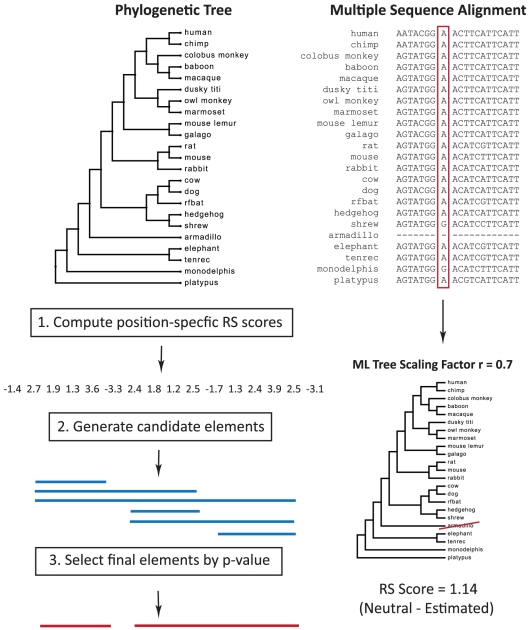
Computational efforts to identify functional elements within genomes leverage comparative sequence information by looking for regions that exhibit evidence of selective constraint. One way of detecting constrained elements is to follow a bottom-up approach by computing constraint scores for individual positions of a multiple alignment and then defining constrained elements as segments of contiguous, highly scoring nucleotide positions. Here we present GERP++, a new tool that uses maximum likelihood evolutionary rate estimation for position-specific scoring and, in contrast to previous bottom-up methods, a novel dynamic programming approach to subsequently define constrained elements. GERP++ evaluates a richer set of candidate element breakpoints and ranks them based on statistical significance, eliminating the need for biased heuristic extension techniques. Using GERP++ we identify over 1.3 million constrained elements spanning over 7% of the human genome. We predict a higher fraction than earlier estimates largely due to the annotation of longer constrained elements, which improves one to one correspondence between predicted elements with known functional sequences. GERP++ is an efficient and effective tool to provide both nucleotide- and element-level constraint scores within deep multiple sequence alignments.
Overview
The claims and statistics of this paper haven’t been checked yet.
Run the check — free, no account needed. It reads the open-access text and checks the sources it cites.
Integrity signals
Registry
Cites
Statistics
Figures
Verification
Claims the paper makes
The claims and statistics of this paper haven’t been checked yet.
Run the check — free, no account needed. It reads the open-access text and checks the sources it cites.
Claims other papers make about this one
Each is checked against this paper’s own text: does it say what the citing paper says it does?
In the citing paper
“Various comparative genomics resources, including PhyloP (Pollard et al., 2010), PhastCons (Siepel et al., 2005), and GERP++ (Davydov et al., 2010), showed our top loci to have similar properties regardless of the extent of pleiotropy.”
From Genomic Relationships, Novel Loci, and Pleiotropic Mechanisms across Eight Psychiatric Disorders (2019) · cites this paper as Davydov et al., 2010
Self-check
Percentages, sums and reported differences re-computed from the paper’s own numbers.
The self-check needs the paper’s full text.
Citations
Cites
Basic local alignment search tool
Altschul, S. F., Gish, W., Miller, W., Myers, E. W., & Lipman, D. J. (1990) · Journal of Molecular Biology · doi:10.1006/jmbi.1990.9999 · Cited by 98,669
Maximum Likelihood from Incomplete Data Via the EM Algorithm
Dempster, A. P., Laird, N. M., & Rubin, D. B. (1977) · Journal of the Royal Statistical Society Series B: Statistical Methodology · doi:10.1111/j.2517-6161.1977.tb01600.x · Cited by 50,444
Kimura, M. (1980) · Journal of Molecular Evolution · doi:10.1007/bf01731581 · Cited by 29,778
Numerical recipes in C: the art of scientific computing
(1993) · Choice Reviews Online · doi:10.5860/choice.30-5638 · Cited by 17,933
Evolutionary trees from DNA sequences: A maximum likelihood approach.
Felsenstein, J. (1981) · Journal of Molecular Evolution · doi:10.1007/bf01734359 · Cited by 14,571
Numerical recipes in Pascal: the art of scientific computing
(1990) · Choice Reviews Online · doi:10.5860/choice.27-5158 · Cited by 12,040
Evolution of Protein Molecules
JUKES, T. H., & CANTOR, C. R. (1969) · Mammalian Protein Metabolism · doi:10.1016/b978-1-4832-3211-9.50009-7 · Cited by 11,032
The Human Genome Browser at UCSC
Kent, W. J., Sugnet, C. W., Furey, T. S., Roskin, K. M., Pringle, T. H., Zahler, A. M., & Haussler, A. D. (2002) · Genome Research · doi:10.1101/gr.229102 · Cited by 10,400
Dating of the human–ape splitting by a molecular clock of mitochondrial DNA.
Hasegawa, M., Kishino, H., & Yano, T.-A. (1985) · Journal of Molecular Evolution · doi:10.1007/bf02101694 · Cited by 8,687
The ENCODE Project Consortium (2007) · Nature · doi:10.1038/nature05874 · Cited by 5,223
Evolutionarily conserved elements in vertebrate, insect, worm, and yeast genomes
Siepel, A., Bejerano, G., Pedersen, J. S., Hinrichs, A. S., Hou, M., Rosenbloom, K., Clawson, H., Spieth, J., Hillier, L. W., Richards, S., et al. (2005) · Genome Research · doi:10.1101/gr.3715005 · Cited by 3,971 · cited 3×
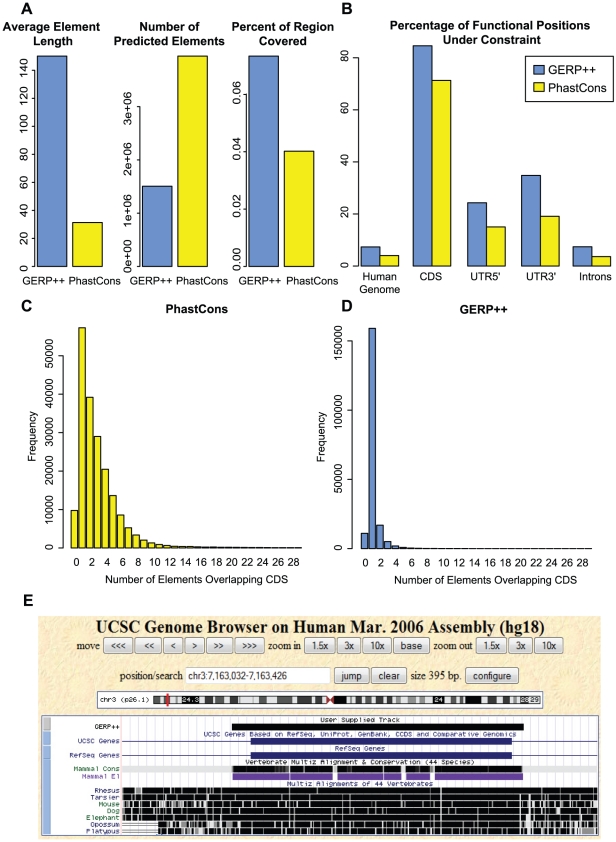
“We compared the GERP ++ constrained element predictions in placental mammals (see Methods) to phastCons [4], the leading generative model-based tool.”
MethodResult(1964) · Elsevier eBooks · doi:10.1016/b978-1-4832-3210-2.50006-6 · Cited by 3,130
Algorithms for Minimization Without Derivatives
G., D., & Brent, R. P. (1974) · Mathematics of Computation · doi:10.2307/2005713 · Cited by 2,914
The ENCODE (ENCyclopedia Of DNA Elements) Project
(2004) · Science · doi:10.1126/science.1105136 · Cited by 2,390
Detection of nonneutral substitution rates on mammalian phylogenies
Pollard, K. S., Hubisz, M. J., Rosenbloom, K. R., & Siepel, A. (2010) · Genome Research · doi:10.1101/gr.097857.109 · Cited by 2,353
The UCSC Genome Browser database: update 2011
Fujita, P. A., Rhead, B., Zweig, A. S., Hinrichs, A. S., Karolchik, D., Cline, M., Goldman, M. J., Barber, G. P., Clawson, H., Coelho, A., et al. (2010) · Nucleic Acids Research · doi:10.1093/nar/gkq963 · Cited by 1,843
Aligning Multiple Genomic Sequences With the Threaded Blockset Aligner
Blanchette, M., Kent, W. J., Riemer, C., Elnitski, L., Smit, A. F. A., Roskin, K. M., Baertsch, R., Rosenbloom, K., Clawson, H., Green, E. D., et al. (2004) · Genome Research · doi:10.1101/gr.1933104 · Cited by 1,452
Distribution and intensity of constraint in mammalian genomic sequence
Cooper, G. M., Stone, E. A., Asimenos, G., Green, E. D., Batzoglou, S., & Sidow, A. (2005) · Genome Research · doi:10.1101/gr.3577405 · Cited by 1,359
Self-citationBrent, R. P. (1975) · Mathematics of Computation · doi:10.1090/s0025-5718-1975-0371062-9 · Cited by 608
The UCSC Genome Browser database: update 2010
Rhead, B., Karolchik, D., Kuhn, R. M., Hinrichs, A. S., Zweig, A. S., Fujita, P. A., Diekhans, M., Smith, K. E., Rosenbloom, K. R., Raney, B. J., et al. (2009) · Nucleic Acids Research · doi:10.1093/nar/gkp939 · Cited by 572
Hsu, F., Kent, W. J., Clawson, H., Kuhn, R. M., Diekhans, M., & Haussler, D. H. (2006) · Bioinformatics · doi:10.1093/bioinformatics/btl048 · Cited by 503
Identifying novel constrained elements by exploiting biased substitution patterns
Garber, M., Guttman, M., Clamp, M., Zody, M. C., Friedman, N., & Xie, X. (2009) · Bioinformatics · doi:10.1093/bioinformatics/btp190 · Cited by 370
Identification and Characterization of Multi-Species Conserved SequencesPreprint
Margulies, E. H. (2003) · Genome Research · doi:10.1101/gr.1602203 · Cited by 332
Algorithms for minimization without derivatives
Brent, R. P. (1973) · International Linear Collider · Cited by 224
Analyses of deep mammalian sequence alignments and constraint predictions for 1% of the human genomePreprint
Margulies, E. H., Cooper, G. M., Asimenos, G., Thomas, D. J., Dewey, C. N., Siepel, A. C., Birney, E., Keefe, D., Schwartz, A. S., Hou, M., et al. (2007) · Genome Research · doi:10.1101/gr.6034307 · Cited by 213
Self-citationEvidence for a selectively favourable reduction in the mutation rate of the X chromosome
McVean, G. T., & Hurst, L. D. (1997) · Nature · doi:10.1038/386388a0 · Cited by 146
CONTRAST: a discriminative, phylogeny-free approach to multiple informant de novogene prediction
Gross, S. S., Do, C. B., Sirota, M., & Batzoglou, S. (2007) · Genome biology · doi:10.1186/gb-2007-8-12-r269 · Cited by 103
Self-citation
Cited by
Sorted by citations
An integrated map of genetic variation from 1,092 human genomes
The 1000 Genomes Project Consortium (2012) · Nature · doi:10.1038/nature11632 · Cited by 7,711
Integrative analysis of 111 reference human epigenomes
Roadmap Epigenomics Consortium, Kundaje, A., Meuleman, W., Ernst, J., Bilenky, M., Yen, A., Heravi-Moussavi, A., Kheradpour, P., Zhang, Z., Wang, J., et al. (2015) · Nature · doi:10.1038/nature14248 · Cited by 6,368
A general framework for estimating the relative pathogenicity of human genetic variants
Kircher, M., Witten, D. M., Jain, P., O'Roak, B. J., Cooper, G. M., & Shendure, J. (2014) · Nature Genetics · doi:10.1038/ng.2892 · Cited by 6,183
Self-citationCADD: predicting the deleteriousness of variants throughout the human genome
Rentzsch, P., Witten, D., Cooper, G. M., Shendure, J., & Kircher, M. (2019) · Nucleic Acids Research · doi:10.1093/nar/gky1016 · Cited by 3,534
Self-citationREVEL: An Ensemble Method for Predicting the Pathogenicity of Rare Missense Variants
Ioannidis, N. M., Rothstein, J. H., Pejaver, V., Middha, S., McDonnell, S. K., Baheti, S., Musolf, A., Li, Q., Holzinger, E., Karyadi, D., et al. (2016) · The American Journal of Human Genetics · doi:10.1016/j.ajhg.2016.08.016 · Cited by 2,908
Metadata
- Authors
- Davydov, E. V., Goode, D. L., Sirota, M., Cooper, G. M., Sidow, A., & Batzoglou, S.
- Affiliations
- Stanford University (US)
- Stanford Medicine (US)
- Howard Hughes Medical Institute (US)
- Corresponding author
- Sidow, Arend
- Venue
- PLoS Computational Biology
- Publisher
- Public Library of Science (PLoS)
- Published
- 2010-12-02
- Volume
- 6
- Issue
- 12
- Pages
- e1001025
- ISSN
- 1553-734X (ISSN-L)
- 1553-7358
- PMC
- PMC2996323
- OpenAlex
- W2038473742
- Cited by
- 1,757
- References
- 28
- Citations by year
- 2026: 105 · 2025: 116 · 2024: 128 · 2023: 134 · 2022: 142 · 2021: 174 · 2020: 156 · 2019: 164 · 2018: 134 · 2017: 107 · 2016: 118 · 2015: 100 · 2014: 69 · 2013: 71 · 2012: 25
- FWCI
- 14.08
- Type
- journal article
- Language
- en
- Open access
- gold
- doi.org
- Locations
- PLoS Computational Biology (publishedVersion, cc-by)
- PubMed Central (publishedVersion, cc-by)
- PubMed (publishedVersion)
- DOAJ (DOAJ: Directory of Open Access Journals) (submittedVersion, cc-by-sa)
- Figshare (submittedVersion, cc-by)
- Minerva Access (University of Melbourne) (submittedVersion, cc-by)
- Funders
- National Science Foundation (0347952)
- National Institutes of Health (LM007033)
- National Human Genome Research Institute
- U.S. National Library of Medicine (K22LM008261, LM007033, T15LM007033)
- Topics
- Life Sciences › Biochemistry, Genetics and Molecular Biology › Molecular Biology › Genomics and Phylogenetic Studies
- Life Sciences › Biochemistry, Genetics and Molecular Biology › Molecular Biology › Genomics and Chromatin Dynamics
- Life Sciences › Biochemistry, Genetics and Molecular Biology › Genetics › Chromosomal and Genetic Variations
- Keywords
- GERP, selective constraint, functional elements, human genome, sequence comparison, multiple sequence alignment, dynamic programming
- MeSH terms
- Algorithms, Animals, Humans, Mammals, Models, Genetic, Phylogeny, Software, User-Computer Interface, Genome, Human, Sequence Alignment, Sequence Analysis, DNA, Genomics
About these checks
Registry, retraction, Cites and statistics results are computed, not judged, with one exception: a printed reference that no index lists is read once by a model before it counts as a citation error. Claims are extracted by a model and kept only when their quote appears verbatim in the text; each cited source is then checked, with a model’s help, for whether it says what the claim relies on. Those verdicts can be wrong — read the claim’s quote and the cited source before relying on one.
Statistics and arithmetic are recomputed, not judged.
Confidence bands are shown only for fields calibrated on our annotated test set. None is calibrated yet, so no band is shown.
What counts as a claim ›How we measure confidence ›How we check this ›
Are you an author, or do you see a problem with this page? Request a review
