

The DOI matches its Crossref record; 27 of the 28 references it cites were found in a registry or an index.
Identifying a High Fraction of the Human Genome to be under Selective Constraint Using GERP++
Open accessAbstract
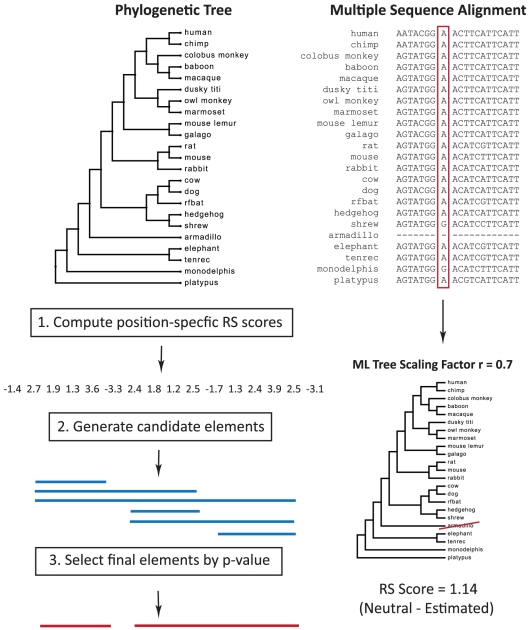
Computational efforts to identify functional elements within genomes leverage comparative sequence information by looking for regions that exhibit evidence of selective constraint. One way of detecting constrained elements is to follow a bottom-up approach by computing constraint scores for individual positions of a multiple alignment and then defining constrained elements as segments of contiguous, highly scoring nucleotide positions. Here we present GERP++, a new tool that uses maximum likelihood evolutionary rate estimation for position-specific scoring and, in contrast to previous bottom-up methods, a novel dynamic programming approach to subsequently define constrained elements. GERP++ evaluates a richer set of candidate element breakpoints and ranks them based on statistical significance, eliminating the need for biased heuristic extension techniques. Using GERP++ we identify over 1.3 million constrained elements spanning over 7% of the human genome. We predict a higher fraction than earlier estimates largely due to the annotation of longer constrained elements, which improves one to one correspondence between predicted elements with known functional sequences. GERP++ is an efficient and effective tool to provide both nucleotide- and element-level constraint scores within deep multiple sequence alignments.
Overview
The claims and statistics of this paper haven’t been checked yet.
Run the check — free, no account needed. It reads the open-access text and checks the sources it cites.
Integrity signals
Registry
Cites
Statistics
Figures
Verification
Claims the paper makes
The claims and statistics of this paper haven’t been checked yet.
Run the check — free, no account needed. It reads the open-access text and checks the sources it cites.
Claims other papers make about this one
Each is checked against this paper’s own text: does it say what the citing paper says it does?
In the citing paper
“Various comparative genomics resources, including PhyloP (Pollard et al., 2010), PhastCons (Siepel et al., 2005), and GERP++ (Davydov et al., 2010), showed our top loci to have similar properties regardless of the extent of pleiotropy.”
From Genomic Relationships, Novel Loci, and Pleiotropic Mechanisms across Eight Psychiatric Disorders (2019) · cites this paper as Davydov et al., 2010
Self-check
Percentages, sums and reported differences re-computed from the paper’s own numbers.
The self-check needs the paper’s full text.
Citations
Cites
Basic local alignment search tool
Altschul, S. F., Gish, W., Miller, W., Myers, E. W., & Lipman, D. J. (1990) · Journal of Molecular Biology · doi:10.1006/jmbi.1990.9999 · Cited by 98,669
Maximum Likelihood from Incomplete Data Via the EM Algorithm
Dempster, A. P., Laird, N. M., & Rubin, D. B. (1977) · Journal of the Royal Statistical Society Series B: Statistical Methodology · doi:10.1111/j.2517-6161.1977.tb01600.x · Cited by 50,444
Kimura, M. (1980) · Journal of Molecular Evolution · doi:10.1007/bf01731581 · Cited by 29,778
Numerical recipes in C: the art of scientific computing
(1993) · Choice Reviews Online · doi:10.5860/choice.30-5638 · Cited by 17,933
Evolutionary trees from DNA sequences: A maximum likelihood approach.
Felsenstein, J. (1981) · Journal of Molecular Evolution · doi:10.1007/bf01734359 · Cited by 14,571
Numerical recipes in Pascal: the art of scientific computing
(1990) · Choice Reviews Online · doi:10.5860/choice.27-5158 · Cited by 12,040
Evolution of Protein Molecules
JUKES, T. H., & CANTOR, C. R. (1969) · Mammalian Protein Metabolism · doi:10.1016/b978-1-4832-3211-9.50009-7 · Cited by 11,032
The Human Genome Browser at UCSC
Kent, W. J., Sugnet, C. W., Furey, T. S., Roskin, K. M., Pringle, T. H., Zahler, A. M., & Haussler, A. D. (2002) · Genome Research · doi:10.1101/gr.229102 · Cited by 10,400
Dating of the human–ape splitting by a molecular clock of mitochondrial DNA.
Hasegawa, M., Kishino, H., & Yano, T.-A. (1985) · Journal of Molecular Evolution · doi:10.1007/bf02101694 · Cited by 8,687
The ENCODE Project Consortium (2007) · Nature · doi:10.1038/nature05874 · Cited by 5,223
Cited by
Sorted by citations
An integrated map of genetic variation from 1,092 human genomes
The 1000 Genomes Project Consortium (2012) · Nature · doi:10.1038/nature11632 · Cited by 7,711
Integrative analysis of 111 reference human epigenomes
Roadmap Epigenomics Consortium, Kundaje, A., Meuleman, W., Ernst, J., Bilenky, M., Yen, A., Heravi-Moussavi, A., Kheradpour, P., Zhang, Z., Wang, J., et al. (2015) · Nature · doi:10.1038/nature14248 · Cited by 6,368
A general framework for estimating the relative pathogenicity of human genetic variants
Kircher, M., Witten, D. M., Jain, P., O'Roak, B. J., Cooper, G. M., & Shendure, J. (2014) · Nature Genetics · doi:10.1038/ng.2892 · Cited by 6,183
Self-citationCADD: predicting the deleteriousness of variants throughout the human genome
Rentzsch, P., Witten, D., Cooper, G. M., Shendure, J., & Kircher, M. (2019) · Nucleic Acids Research · doi:10.1093/nar/gky1016 · Cited by 3,534
Self-citationREVEL: An Ensemble Method for Predicting the Pathogenicity of Rare Missense Variants
Ioannidis, N. M., Rothstein, J. H., Pejaver, V., Middha, S., McDonnell, S. K., Baheti, S., Musolf, A., Li, Q., Holzinger, E., Karyadi, D., et al. (2016) · The American Journal of Human Genetics · doi:10.1016/j.ajhg.2016.08.016 · Cited by 2,908
Predicting effects of noncoding variants with deep learning–based sequence model
Zhou, J., & Troyanskaya, O. G. (2015) · Nature Methods · doi:10.1038/nmeth.3547 · Cited by 2,338
Ward, L. D., & Kellis, M. (2012) · Nucleic Acids Research · doi:10.1093/nar/gkr917 · Cited by 2,229
Standards and Guidelines for the Interpretation and Reporting of Sequence Variants in Cancer
Li, M. M., Datto, M., Duncavage, E. J., Kulkarni, S., Lindeman, N. I., Roy, S., Tsimberidou, A. M., Vnencak‐Jones, C. L., Wolff, D. J., Younes, A., et al. (2016) · Journal of Molecular Diagnostics · doi:10.1016/j.jmoldx.2016.10.002 · Cited by 2,113
A genomic mutational constraint map using variation in 76,156 human genomes
Chen, S., Francioli, L. C., Goodrich, J. K., Collins, R. L., Kanai, M., Wang, Q., Alföldi, J., Watts, N. A., Vittal, C., Gauthier, L. D., et al. (2024) · Nature · doi:10.1038/s41586-023-06045-0 · Cited by 1,727
Analysis of immune-related loci identifies 48 new susceptibility variants for multiple sclerosis
International Multiple Sclerosis Genetics Consortium (IMSGC) (2013) · Nature Genetics · doi:10.1038/ng.2770 · Cited by 1,386
Genomic Relationships, Novel Loci, and Pleiotropic Mechanisms across Eight Psychiatric Disorders
Lee, P. H., Anttila, V., Won, H., Feng, Y.-C. A., Rosenthal, J., Zhu, Z., Tucker-Drob, E. M., Nivard, M. G., Grotzinger, A. D., Posthuma, D., et al. (2019) · Cell · doi:10.1016/j.cell.2019.11.020 · Cited by 1,381
“Various comparative genomics resources, including PhyloP (Pollard et al., 2010), PhastCons (Siepel et al., 2005), and GERP++ (Davydov et al., 2010), showed our top loci to have similar properties regardless of the extent of pleiotropy.”
BackgroundA high-resolution map of human evolutionary constraint using 29 mammals
Broad Institute Sequencing Platform and Whole Genome Assembly Team, Lindblad-Toh, K., Baylor College of Medicine Human Genome Sequencing Center Sequencing Team, Genome Institute at Washington University, Garber, M., Zuk, O., Lin, M. F., Parker, B. J., Washietl, S., Kheradpour, P., et al. (2011) · Nature · doi:10.1038/nature10530 · Cited by 1,108
Dong, C., Wei, P., Jian, X., Gibbs, R. A., Boerwinkle, E., Wang, K., & Liu, X. (2014) · Human Molecular Genetics · doi:10.1093/hmg/ddu733 · Cited by 1,140
An atlas of human long non-coding RNAs with accurate 5′ ends
Hon, C.-C., Ramilowski, J. A., Harshbarger, J., Bertin, N., Rackham, O. J. L., Gough, J., Denisenko, E., Schmeier, S., Poulsen, T. M., Severin, J., et al. (2017) · Nature · doi:10.1038/nature21374 · Cited by 1,007
Liu, X., Wu, C., Li, C., & Boerwinkle, E. (2015) · Human Mutation · doi:10.1002/humu.22932 · Cited by 977
Analysis of 6,515 exomes reveals the recent origin of most human protein-coding variants
Fu, W., O’Connor, T. D., Jun, G., Kang, H. M., Abecasis, G. R., Leal, S. M., Gabriel, S., Rieder, M. J., Altshuler, D., Shendure, J., et al. (2012) · Nature · doi:10.1038/nature11690 · Cited by 969
Ward, L. D., & Kellis, M. (2015) · Nucleic Acids Research · doi:10.1093/nar/gkv1340 · Cited by 948
Inferring the molecular and phenotypic impact of amino acid variants with MutPred2
Pejaver, V., Urresti, J., Lugo-Martinez, J., Pagel, K. A., Lin, G. N., Nam, H.-J., Mort, M., Cooper, D. N., Sebat, J., Iakoucheva, L. M., et al. (2020) · Nature Communications · doi:10.1038/s41467-020-19669-x · Cited by 923
Genic Intolerance to Functional Variation and the Interpretation of Personal Genomes
Petrovski, S., Wang, Q., Heinzen, E. L., Allen, A. S., & Goldstein, D. B. (2013) · PLoS Genetics · doi:10.1371/journal.pgen.1003709 · Cited by 901
Jagadeesh, K. A., Wenger, A. M., Berger, M. J., Guturu, H., Stenson, P. D., Cooper, D. N., Bernstein, J. A., & Bejerano, G. (2016) · Nature Genetics · doi:10.1038/ng.3703 · Cited by 852
Defining functional DNA elements in the human genome
Kellis, M., Wold, B. J., Snyder, M. P., Bernstein, B., Kundaje, A. B., Marinov, G. K., Ward, L. D., Birney, E., Crawford, G. E., Dekker, J., et al. (2014) · Proceedings of the National Academy of Sciences · doi:10.1073/pnas.1318948111 · Cited by 724
De novo assembly, annotation, and comparative analysis of 26 diverse maize genomes
Hufford, M. B., Seetharam, A. S., Woodhouse, M. R., Chougule, K. M., Ou, S., Liu, J., Ricci, W. A., Guo, T., Olson, A., Qiu, Y., et al. (2021) · Science · doi:10.1126/science.abg5289 · Cited by 747
The Genetic Basis of Mendelian Phenotypes: Discoveries, Challenges, and Opportunities
Chong, J. X., Buckingham, K. J., Jhangiani, S. N., Boehm, C., Sobreira, N., Smith, J. D., Harrell, T. M., McMillin, M. J., Wiszniewski, W., Gambin, T., et al. (2015) · The American Journal of Human Genetics · doi:10.1016/j.ajhg.2015.06.009 · Cited by 643
Rentzsch, P., Schubach, M., Shendure, J., & Kircher, M. (2021) · Genome Medicine · doi:10.1186/s13073-021-00835-9 · Cited by 640
Day, F., Karaderi, T., Jones, M. R., Meun, C., He, C., Drong, A., Kraft, P., Lin, N., Huang, H., Broer, L., et al. (2018) · PLOS Genetics · doi:10.1371/journal.pgen.1007813 · Cited by 619
A survey of tools for variant analysis of next-generation genome sequencing data
Pabinger, S., Dander, A., Fischer, M., Snajder, R., Sperk, M., Efremova, M., Krabichler, B., Speicher, M. R., Zschocke, J., & Trajanoski, Z. (2013) · Briefings in Bioinformatics · doi:10.1093/bib/bbs086 · Cited by 631
Whole‐genome sequencing identifies EN1 as a determinant of bone density and fracture
Zheng, H., Forgetta, V., Hsu, Y., Estrada, K., Roselló‐Díez, A., Leo, P. J., Dahia, C. L., Park‐Min, K. H., Tobias, J. H., Kooperberg, C. L., et al. (2015) · Nature · doi:10.1038/nature14878 · Cited by 596
Pejaver, V., Byrne, A. B., Feng, B.-J., Pagel, K. A., Mooney, S. D., Karchin, R., O’Donnell-Luria, A., Harrison, S. M., Tavtigian, S. V., Greenblatt, M. S., et al. (2022) · The American Journal of Human Genetics · doi:10.1016/j.ajhg.2022.10.013 · Cited by 589
A spectral approach integrating functional genomic annotations for coding and noncoding variants
Ionita‐Laza, I., McCallum, K., Xu, B., & Buxbaum, J. D. (2016) · Nature Genetics · doi:10.1038/ng.3477 · Cited by 602
Liu, X., Jian, X., & Boerwinkle, E. (2013) · Human Mutation · doi:10.1002/humu.22376 · Cited by 595
Needles in stacks of needles: finding disease-causal variants in a wealth of genomic data
Cooper, G. M., & Shendure, J. (2011) · Nature Reviews Genetics · doi:10.1038/nrg3046 · Cited by 593
Self-citationSchwartzentruber, J., Cooper, S., Liu, J. Z., Barrio-Hernandez, I., Bello, E., Kumasaka, N., Young, A. M. H., Franklin, R. J. M., Johnson, T., Estrada, K., et al. (2021) · Nature Genetics · doi:10.1038/s41588-020-00776-w · Cited by 532
Gazal, S., Finucane, H. K., Furlotte, N. A., Loh, P.-R., Palamara, P. F., Liu, X., Schoech, A., Bulik-Sullivan, B., Neale, B. M., Gusev, A., et al. (2017) · Nature Genetics · doi:10.1038/ng.3954 · Cited by 525
Functional annotation of noncoding sequence variants
Ritchie, G. R. S., Dunham, I., Zeggini, E., & Flicek, P. (2014) · Nature Methods · doi:10.1038/nmeth.2832 · Cited by 520
Wang, M., Beckmann, N. D., Roussos, P., Wang, E., Zhou, X., Wang, Q., Ming, C., Neff, R., Ma, W., Fullard, J. F., et al. (2018) · Scientific Data · doi:10.1038/sdata.2018.185 · Cited by 502
Oncotator: Cancer Variant Annotation Tool
Ramos, A. H., Lichtenstein, L., Gupta, M., Lawrence, M. S., Pugh, T. J., Saksena, G., Meyerson, M. M., & Getz, G. A. (2015) · Human Mutation · doi:10.1002/humu.22771 · Cited by 495
Predicting the clinical impact of human mutation with deep neural networks
Sundaram, L., Gao, H., Padigepati, S. R., McRae, J. F., Li, Y., Kosmicki, J. A., Fritzilas, N., Hakenberg, J., Dutta, A., Shon, J. C., et al. (2018) · Nature Genetics · doi:10.1038/s41588-018-0167-z · Cited by 505
Self-citationwANNOVAR: annotating genetic variants for personal genomes via the web
Chang, X., & Wang, K. (2012) · Journal of Medical Genetics · doi:10.1136/jmedgenet-2012-100918 · Cited by 442
GEMINI: Integrative Exploration of Genetic Variation and Genome Annotations
Paila, U., Chapman, B., Kirchner, R., & Quinlan, A. R. (2013) · PLoS Computational Biology · doi:10.1371/journal.pcbi.1003153 · Cited by 436
A method to predict the impact of regulatory variants from DNA sequence
Lee, D., Gorkin, D. U., Baker, M., Strober, B. J., Asoni, A. L., McCallion, A. S., & Beer, M. (2015) · Nature Genetics · doi:10.1038/ng.3331 · Cited by 430
Eggers, S., Sadedin, S., van den Bergen, J. A., Robevska, G., Ohnesorg, T., Hewitt, J. K., Lambeth, L. S., Bouty, A., Knarston, I. M., Tan, T. Y., et al. (2016) · Genome biology · doi:10.1186/s13059-016-1105-y · Cited by 406
The million mutation project: A new approach to genetics in Caenorhabditis elegansPreprint
Thompson, O. A., Edgley, M. L., Strasbourger, P., Flibotte, S., Ewing, B., Adair, R., Au, V., Chaudhry, I., Fernando, L., Hutter, H., et al. (2013) · Genome Research · doi:10.1101/gr.157651.113 · Cited by 388
College of American Pathologists' Laboratory Standards for Next-Generation Sequencing Clinical Tests
Aziz, N., Zhao, Q., Bry, L., Driscoll, D. K., Funke, B., Gibson, J. S., Grody, W. W., Hegde, M., Hoeltge, G. A., Leonard, D. G. B., et al. (2014) · Archives of Pathology & Laboratory Medicine · doi:10.5858/arpa.2014-0250-cp · Cited by 392
High-resolution Xist binding maps reveal two-step spreading during X-chromosome inactivation
Simon, M. D., Pinter, S. F., Fang, R., Sarma, K., Rutenberg-Schoenberg, M., Bowman, S., Kesner, B., Maier, V., Kingston, R. E., & Lee, J. T. (2013) · Nature · doi:10.1038/nature12719 · Cited by 382
Characterization of Greater Middle Eastern genetic variation for enhanced disease gene discovery
Greater Middle East Variome Consortium, Scott, E. M., Halees, A., Itan, Y., Spencer, E. G., He, Y., Azab, M. A., Gabriel, S. B., Belkadi, A., Boisson, B., et al. (2016) · Nature Genetics · doi:10.1038/ng.3592 · Cited by 376
Rapid and Pervasive Changes in Genome-wide Enhancer Usage during Mammalian Development
Nord, A. S., Blow, M. J., Attanasio, C., Akiyama, J. A., Holt, A., Hosseini, R., Phouanenavong, S., Plajzer-Frick, I., Shoukry, M., Afzal, V., et al. (2013) · Cell · doi:10.1016/j.cell.2013.11.033 · Cited by 375
Corradin, O., Saiakhova, A., Akhtar-Zaidi, B., Myeroff, L., Willis, J., Cowper-Sal·lari, R., Lupien, M., Markowitz, S., & Scacheri, P. C. (2014) · Genome Research · doi:10.1101/gr.164079.113 · Cited by 366
Genetics of Coronary Artery Disease
McPherson, R., & Tybjærg‐Hansen, A. (2016) · Circulation Research · doi:10.1161/circresaha.115.306566 · Cited by 384
Distinct Properties of Cell-Type-Specific and Shared Transcription Factor Binding Sites
Gertz, J., Savic, D., Varley, K. E., Partridge, E. C., Safi, A., Jain, P., Cooper, G. M., Reddy, T. E., Crawford, G. E., & Myers, R. (2013) · Molecular Cell · doi:10.1016/j.molcel.2013.08.037 · Cited by 369
Self-citationActionable exomic incidental findings in 6503 participants: challenges of variant classificationPreprint
Amendola, L. M., Dorschner, M. O., Robertson, P. D., Salama, J. S., Hart, R., Shirts, B. H., Murray, M. L., Tokita, M., Gallego, C. J., Kim, D. S., et al. (2015) · Genome Research · doi:10.1101/gr.183483.114 · Cited by 371
Self-citationDynamic landscape and evolution of m6A methylation in human
Zhang, H., Shi, X., Huang, T., Zhao, X., Chen, W., Gu, N., & Zhang, R. (2020) · Nucleic Acids Research · doi:10.1093/nar/gkaa347 · Cited by 360
Integrative Annotation of Variants from 1092 Humans: Application to Cancer Genomics
Khurana, E., Fu, Y., Colonna, V., Mu, X. J., Kang, H. M., Lappalainen, T., Sboner, A., Lochovsky, L., Chen, J., Harmanci, A. O., et al. (2013) · Science · doi:10.1126/science.1235587 · Cited by 368
Grimm, D. G., Azencott, C., Aicheler, F., Gieraths, U., MacArthur, D. G., Samocha, K. E., Cooper, D. N., Stenson, P. D., Daly, M. J., Smoller, J. W., et al. (2015) · Human Mutation · doi:10.1002/humu.22768 · Cited by 356
Mutations in the NOTCH pathway regulator MIB1 cause left ventricular noncompaction cardiomyopathy
Luxán, G., Casanova, J. C., Martı́nez-Poveda, B., Prados, B., D’Amato, G., MacGrogan, D., González-Rajal, Á., Dobarro, D., Torroja, C., Martínez, F., et al. (2013) · Nature Medicine · doi:10.1038/nm.3046 · Cited by 354
Whole-exome sequencing in undiagnosed genetic diseases: interpreting 119 trios
Zhu, X., Petrovski, S., Xie, P., Ruzzo, E. K., Lu, Y., McSweeney, K. M., Ben‐Zeev, B., Nissenkorn, A., Anikster, Y., Oz-Levi, D., et al. (2015) · Genetics in Medicine · doi:10.1038/gim.2014.191 · Cited by 340
Lachance, J., Vernot, B., Elbers, C. C., Ferwerda, B., Froment, A., Bodo, J.-M., Lema, G., Fu, W., Nyambo, T., Rebbeck, T. R., et al. (2012) · Cell · doi:10.1016/j.cell.2012.07.009 · Cited by 343
Marsden, C. D., Ortega-Del Vecchyo, D., O’Brien, D. P., Taylor, J. F., Ramirez, O., Vilà, C., Marques-Bonet, T., Schnabel, R. D., Wayne, R. K., & Lohmueller, K. E. (2016) · Proceedings of the National Academy of Sciences · doi:10.1073/pnas.1512501113 · Cited by 333
McCarthy, S. E., Gillis, J., Kramer, M., Lihm, J., Yoon, S. C., Berstein, Y., Mistry, M., Pavlidis, P., Solomon, R., Ghiban, E., et al. (2014) · Molecular Psychiatry · doi:10.1038/mp.2014.29 · Cited by 338
Genomic Patterns of De Novo Mutation in Simplex Autism
Turner, T. N., Coe, B. P., Dickel, D. E., Hoekzema, K., Nelson, B. J., Zody, M. C., Kronenberg, Z. N., Hormozdiari, F., Raja, A. N., Pennacchio, L. A., et al. (2017) · Cell · doi:10.1016/j.cell.2017.08.047 · Cited by 343
Huang, Y.-F., Gulko, B., & Siepel, A. C. (2017) · Nature Genetics · doi:10.1038/ng.3810 · Cited by 337
Mutations in the gene encoding PDGF-B cause brain calcifications in humans and mice
Keller, A., Westenberger, A., Sobrido, M. J., García-Murias, M., Domingo, A., Sears, R. L., Lemos, R. R., Ordoñez-Ugalde, A., Nicolas, G., da Cunha, J. E. G., et al. (2013) · Nature Genetics · doi:10.1038/ng.2723 · Cited by 324
Identification of rare-disease genes using blood transcriptome sequencing and large control cohorts
Undiagnosed Diseases Network, Frésard, L., Care4Rare Canada Consortium, Smail, C., Ferraro, N. M., Teran, N. A., Li, X., Smith, K. S., Bonner, D., Kernohan, K. D., et al. (2019) · Nature Medicine · doi:10.1038/s41591-019-0457-8 · Cited by 321
Multiproxy evidence highlights a complex evolutionary legacy of maize in South America
Kistler, L., Maezumi, S. Y., de Souza, J. G., Przelomska, N. A. S., Costa, F. M., Smith, O., Loiselle, H., Ramos‐Madrigal, J., Wales, N., Ribeiro, E. R., et al. (2018) · Science · doi:10.1126/science.aav0207 · Cited by 326
Genetic load: genomic estimates and applications in non-model animals
Bertorelle, G., Raffini, F., Bosse, M., Bortoluzzi, C., Iannucci, A., Trucchi, E., Morales, H. E., & van Oosterhout, C. (2022) · Nature Reviews Genetics · doi:10.1038/s41576-022-00448-x · Cited by 306
On the accumulation of deleterious mutations during range expansions
Peischl, S., Dupanloup, I., Kirkpatrick, M., & Excoffier, L. (2013) · Molecular Ecology · doi:10.1111/mec.12524 · Cited by 317
Wooderchak‐Donahue, W. L., McDonald, J., O’Fallon, B. D., Upton, P. D., Li, W., Roman, B. L., Young, S., Plant, P., Fülöp, G. T., Langa, C., et al. (2013) · The American Journal of Human Genetics · doi:10.1016/j.ajhg.2013.07.004 · Cited by 319
Deconstructing a Syndrome: Genomic Insights Into PCOS Causal Mechanisms and Classification
Dapas, M., & Dunaif, A. (2022) · Endocrine Reviews · doi:10.1210/endrev/bnac001 · Cited by 300
Genomic Landscape and Mutational Signatures of Deafness-Associated Genes
Azaiez, H., Booth, K. T. A., Ephraim, S. S., Crone, B., Black-Ziegelbein, E. A., Marini, R. J., Shearer, A. E., Sloan-Heggen, C., Kolbe, D. L., Casavant, T. L., et al. (2018) · The American Journal of Human Genetics · doi:10.1016/j.ajhg.2018.08.006 · Cited by 309
Chimpanzee genomic diversity reveals ancient admixture with bonobos
de Manuel, M., Kuhlwilm, M., Frandsen, P., Sousa, V. C., Desai, T., Prado-Martinez, J., Hernández-Rodríguez, J., Dupanloup, I., Lao, Ó., Hallast, P., et al. (2016) · Science · doi:10.1126/science.aag2602 · Cited by 307
Recessive mutations in a distal PTF1A enhancer cause isolated pancreatic agenesis
Weedon, M. N., Cebola, I., Patch, A., Flanagan, S. E., Franco, E. D., Caswell, R. C., Rodríguez‐Seguí, S. A., Shaw-Smith, C. J., Cho, C. H.-H., Allen, H. L., et al. (2013) · Nature Genetics · doi:10.1038/ng.2826 · Cited by 305
PERCH: A Unified Framework for Disease Gene Prioritization: HUMAN MUTATION
Feng, B.-J. (2017) · Human Mutation · doi:10.1002/humu.23158 · Cited by 289
Open chromatin reveals the functional maize genome
Rodgers‐Melnick, E., Vera, D. L., Bass, H. W., & Buckler, E. S. (2016) · Proceedings of the National Academy of Sciences · doi:10.1073/pnas.1525244113 · Cited by 287
NEK1 variants confer susceptibility to amyotrophic lateral sclerosis
Kenna, K. P., van Doormaal, P. T. C., Dekker, A. M., Ticozzi, N., Kenna, B., Diekstra, F. P., van Rheenen, W., van Eijk, K. R., Jones, A. R., Keagle, P. J., et al. (2016) · Nature Genetics · doi:10.1038/ng.3626 · Cited by 294
Demography and its effects on genomic variation in crop domestication
Gaut, B. S., Seymour, D. K., Liu, Q., & Zhou, Y. (2018) · Nature Plants · doi:10.1038/s41477-018-0210-1 · Cited by 272
Meta-analysis of shared genetic architecture across ten pediatric autoimmune diseases
Li, Y. R., Li, J., Zhao, S. D., Bradfield, J. P., Mentch, F. D., Maggadottir, S. M., Hou, C., Abrams, D. J., Chang, D., Gao, F., et al. (2015) · Nature Medicine · doi:10.1038/nm.3933 · Cited by 266
Martin, H. C., Kim, G. J., Pagnamenta, A. T., Murakami, Y., Carvill, G. L., Meyer, E., Copley, R. R., Rimmer, A., Barcia, G., Fleming, M. R., et al. (2014) · Human Molecular Genetics · doi:10.1093/hmg/ddu030 · Cited by 259
Evolutionary constraint and innovation across hundreds of placental mammals
Christmas, M. J., Kaplow, I. M., Genereux, D. P., Dong, M. X., Hughes, G. M., Li, X., Sullivan, P. F., Hindle, A. G., Andrews, G., Armstrong, J. C., et al. (2023) · Science · doi:10.1126/science.abn3943 · Cited by 292
Sequencing studies in human genetics: design and interpretation
Goldstein, D. B., Allen, A. S., Keebler, J., Margulies, E. H., Petrou, S., Petrovski, S., & Sunyaev, S. R. (2013) · Nature Reviews Genetics · doi:10.1038/nrg3455 · Cited by 262
Montgomery, S. B., Goode, D. L., Kvikstad, E. M., Albers, C. A., Zhang, Z. D., Mu, X. J., Ananda, G., Howie, B., Karczewski, K. J., Smith, K. S., et al. (2013) · Genome Research · doi:10.1101/gr.148718.112 · Cited by 262
Self-citationCassava haplotype map highlights fixation of deleterious mutations during clonal propagation
Ramu, P., Esuma, W., Kawuki, R., Rabbi, I. Y., Egesi, C. N., Bredeson, J. V., Bart, R. S., Verma, J., Buckler, E. S., & Lü, F. (2017) · Nature Genetics · doi:10.1038/ng.3845 · Cited by 250
Patterns of coding variation in the complete exomes of three Neandertals
Castellano, S., Parra, G., Sánchez-Quinto, F. A., Racimo, F., Kuhlwilm, M., Kircher, M., Sawyer, S., Fu, Q., Heinze, A., Nickel, B., et al. (2014) · Proceedings of the National Academy of Sciences · doi:10.1073/pnas.1405138111 · Cited by 247
Rands, C. M., Meader, S., Ponting, C. P., & Lunter, G. A. (2014) · PLoS Genetics · doi:10.1371/journal.pgen.1004525 · Cited by 263
Rare variant association studies: considerations, challenges and opportunities
Auer, P. L., & Lettre, G. (2015) · Genome Medicine · doi:10.1186/s13073-015-0138-2 · Cited by 261
Hsu, A. P., Johnson, K. D., Falcone, E. L., Sanalkumar, R., Sanchez, L. A., Hickstein, D. D., Cuellar‐Rodríguez, J., Lemieux, J. E., Zerbe, C. S., Bresnick, E. H., et al. (2013) · Blood · doi:10.1182/blood-2012-08-452763 · Cited by 251
Kircher, M., Xiong, C., Martin, B., Schubach, M., Inoue, F., Bell, R. J. A., Costello, J. F., Shendure, J., & Ahituv, N. (2019) · Nature Communications · doi:10.1038/s41467-019-11526-w · Cited by 234
Evaluation of in silico algorithms for use with ACMG/AMP clinical variant interpretation guidelines
Ghosh, R., Oak, N., & Plon, S. E. (2017) · Genome biology · doi:10.1186/s13059-017-1353-5 · Cited by 233
Zhang, L., Yao, Y., Zhang, S., Liu, Y., Guo, H., Ahmed, M., Bell, T., Zhang, H., Han, G., Lorence, E., et al. (2019) · Science Translational Medicine · doi:10.1126/scitranslmed.aau1167 · Cited by 233
Chèneby, J., Gheorghe, M., Artufel, M., Mathelier, A., & Ballester, B. (2017) · Nucleic Acids Research · doi:10.1093/nar/gkx1092 · Cited by 232
A map of constrained coding regions in the human genome
Havrilla, J. M., Pedersen, B. S., Layer, R. M., & Quinlan, A. R. (2018) · Nature Genetics · doi:10.1038/s41588-018-0294-6 · Cited by 242
Eisenberger, T., Neuhaus, C., Khan, A. O., Decker, C., Preising, M. N., Friedburg, C., Anika, B., Gliem, M., Issa, P. C., Holz, F. G., et al. (2013) · PLoS ONE · doi:10.1371/journal.pone.0078496 · Cited by 229
Population genomics of the critically endangered kākāpō
Dussex, N., van der Valk, T., Morales, H. E., Wheat, C. W., Díez-del-Molino, D., von Seth, J., Foster, Y., Kutschera, V. E., Guschanski, K., Rhie, A., et al. (2021) · Cell Genomics · doi:10.1016/j.xgen.2021.100002 · Cited by 226
Strong Purifying Selection at Synonymous Sites in D. melanogaster
Lawrie, D. S., Messer, P. W., Hershberg, R., & Petrov, D. A. (2013) · PLoS Genetics · doi:10.1371/journal.pgen.1003527 · Cited by 229
Settling the score: variant prioritization and Mendelian disease
Eilbeck, K. L., Quinlan, A. R., & Yandell, M. D. (2017) · Nature Reviews Genetics · doi:10.1038/nrg.2017.52 · Cited by 230
A mammalian methylation array for profiling methylation levels at conserved sequences
Arneson, A., Haghani, A., Thompson, M. J., Pellegrini, M. A., Kwon, S. B., Vu, H., Maciejewski, E., Yao, M., Li, C. Z., Lu, A. T.-H., et al. (2022) · Nature Communications · doi:10.1038/s41467-022-28355-z · Cited by 224
Genetic Costs of Domestication and Improvement
Moyers, B. T., Morrell, P. L., & McKay, J. K. (2018) · Journal of Heredity · doi:10.1093/jhered/esx069 · Cited by 216
Recombination in diverse maize is stable, predictable, and associated with genetic load
Rodgers‐Melnick, E., Bradbury, P. J., Elshire, R. J., Glaubitz, J. C., Acharya, C. B., Mitchell, S. E., Li, C., Li, Y., & Buckler, E. S. (2015) · Proceedings of the National Academy of Sciences · doi:10.1073/pnas.1413864112 · Cited by 214
Performance evaluation of pathogenicity-computation methods for missense variants
Li, J., Zhao, T., Zhang, Y., Zhang, K., Shi, L., Chen, Y., Wang, X., & Sun, Z. (2018) · Nucleic Acids Research · doi:10.1093/nar/gky678 · Cited by 219
Capture Hi-C identifies the chromatin interactome of colorectal cancer risk loci
Jäger, R., Migliorini, G., Henrion, M., Kandaswamy, R., Speedy, H. E., Heindl, A., Whiffin, N., Carnicer, M. J., Broome, L. R., Dryden, N. H., et al. (2015) · Nature Communications · doi:10.1038/ncomms7178 · Cited by 216
The interplay of demography and selection during maize domestication and expansion
Wang, L., Beissinger, T. M., Lorant, A., Ross-Ibarra, C., Ross‐Ibarra, J., & Hufford, M. B. (2017) · Genome biology · doi:10.1186/s13059-017-1346-4 · Cited by 215
Li, J., Cai, T., Jiang, Y. W., Chen, H., He, X., Chen, C., Li, X., Shao, Q., Xia, R., Li, Z., et al. (2015) · Molecular Psychiatry · doi:10.1038/mp.2015.40 · Cited by 212
Metadata
- Authors
- Davydov, E. V., Goode, D. L., Sirota, M., Cooper, G. M., Sidow, A., & Batzoglou, S.
- Affiliations
- Stanford University (US)
- Stanford Medicine (US)
- Howard Hughes Medical Institute (US)
- Corresponding author
- Sidow, Arend
- Venue
- PLoS Computational Biology
- Publisher
- Public Library of Science (PLoS)
- Published
- 2010-12-02
- Volume
- 6
- Issue
- 12
- Pages
- e1001025
- ISSN
- 1553-734X (ISSN-L)
- 1553-7358
- PMC
- PMC2996323
- OpenAlex
- W2038473742
- Cited by
- 1,757
- References
- 28
- Citations by year
- 2026: 105 · 2025: 116 · 2024: 128 · 2023: 134 · 2022: 142 · 2021: 174 · 2020: 156 · 2019: 164 · 2018: 134 · 2017: 107 · 2016: 118 · 2015: 100 · 2014: 69 · 2013: 71 · 2012: 25
- FWCI
- 14.08
- Type
- journal article
- Language
- en
- Open access
- gold
- doi.org
- Locations
- PLoS Computational Biology (publishedVersion, cc-by)
- PubMed Central (publishedVersion, cc-by)
- PubMed (publishedVersion)
- DOAJ (DOAJ: Directory of Open Access Journals) (submittedVersion, cc-by-sa)
- Figshare (submittedVersion, cc-by)
- Minerva Access (University of Melbourne) (submittedVersion, cc-by)
- Funders
- National Science Foundation (0347952)
- National Institutes of Health (LM007033)
- National Human Genome Research Institute
- U.S. National Library of Medicine (K22LM008261, LM007033, T15LM007033)
- Topics
- Life Sciences › Biochemistry, Genetics and Molecular Biology › Molecular Biology › Genomics and Phylogenetic Studies
- Life Sciences › Biochemistry, Genetics and Molecular Biology › Molecular Biology › Genomics and Chromatin Dynamics
- Life Sciences › Biochemistry, Genetics and Molecular Biology › Genetics › Chromosomal and Genetic Variations
- Keywords
- GERP, selective constraint, functional elements, human genome, sequence comparison, multiple sequence alignment, dynamic programming
- MeSH terms
- Algorithms, Animals, Humans, Mammals, Models, Genetic, Phylogeny, Software, User-Computer Interface, Genome, Human, Sequence Alignment, Sequence Analysis, DNA, Genomics
About these checks
Registry, retraction, Cites and statistics results are computed, not judged, with one exception: a printed reference that no index lists is read once by a model before it counts as a citation error. Claims are extracted by a model and kept only when their quote appears verbatim in the text; each cited source is then checked, with a model’s help, for whether it says what the claim relies on. Those verdicts can be wrong — read the claim’s quote and the cited source before relying on one.
Statistics and arithmetic are recomputed, not judged.
Confidence bands are shown only for fields calibrated on our annotated test set. None is calibrated yet, so no band is shown.
What counts as a claim ›How we measure confidence ›How we check this ›
Are you an author, or do you see a problem with this page? Request a review
