

The DOI matches its Crossref record; 59 of the 59 references it cites were found in a registry or an index.
Worldwide Patterns of Ancestry, Divergence, and Admixture in Domesticated Cattle
Open accessAbstract
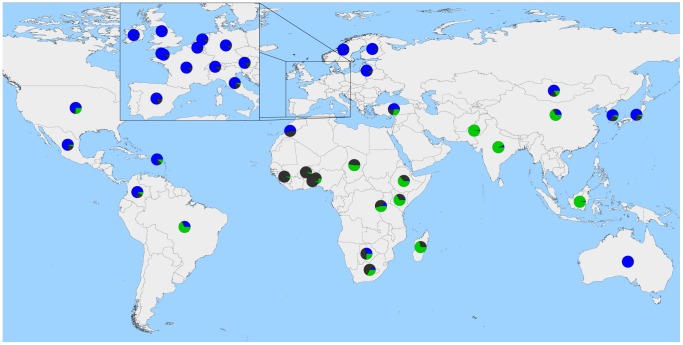
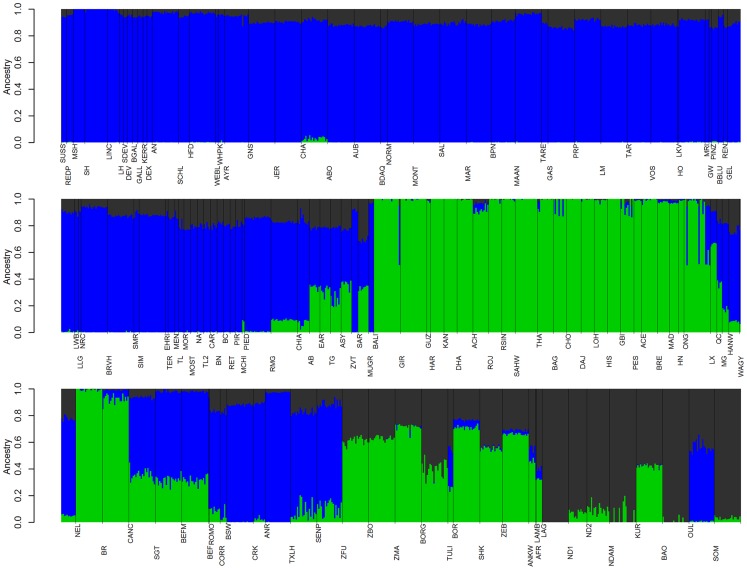
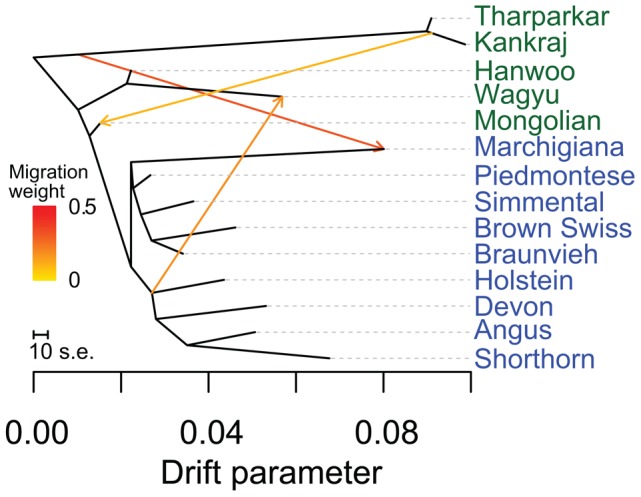
The domestication and development of cattle has considerably impacted human societies, but the histories of cattle breeds and populations have been poorly understood especially for African, Asian, and American breeds. Using genotypes from 43,043 autosomal single nucleotide polymorphism markers scored in 1,543 animals, we evaluate the population structure of 134 domesticated bovid breeds. Regardless of the analytical method or sample subset, the three major groups of Asian indicine, Eurasian taurine, and African taurine were consistently observed. Patterns of geographic dispersal resulting from co-migration with humans and exportation are recognizable in phylogenetic networks. All analytical methods reveal patterns of hybridization which occurred after divergence. Using 19 breeds, we map the cline of indicine introgression into Africa. We infer that African taurine possess a large portion of wild African auroch ancestry, causing their divergence from Eurasian taurine. We detect exportation patterns in Asia and identify a cline of Eurasian taurine/indicine hybridization in Asia. We also identify the influence of species other than Bos taurus taurus and B. t. indicus in the formation of Asian breeds. We detect the pronounced influence of Shorthorn cattle in the formation of European breeds. Iberian and Italian cattle possess introgression from African taurine. American Criollo cattle originate from Iberia, and not directly from Africa with African ancestry inherited via Iberian ancestors. Indicine introgression into American cattle occurred in the Americas, and not Europe. We argue that cattle migration, movement and trading followed by admixture have been important forces in shaping modern bovine genomic variation.
Overview
The claims and statistics of this paper haven’t been checked yet.
Run the check — free, no account needed. It reads the open-access text and checks the sources it cites.
Integrity signals
Registry
Cites
Statistics
Figures
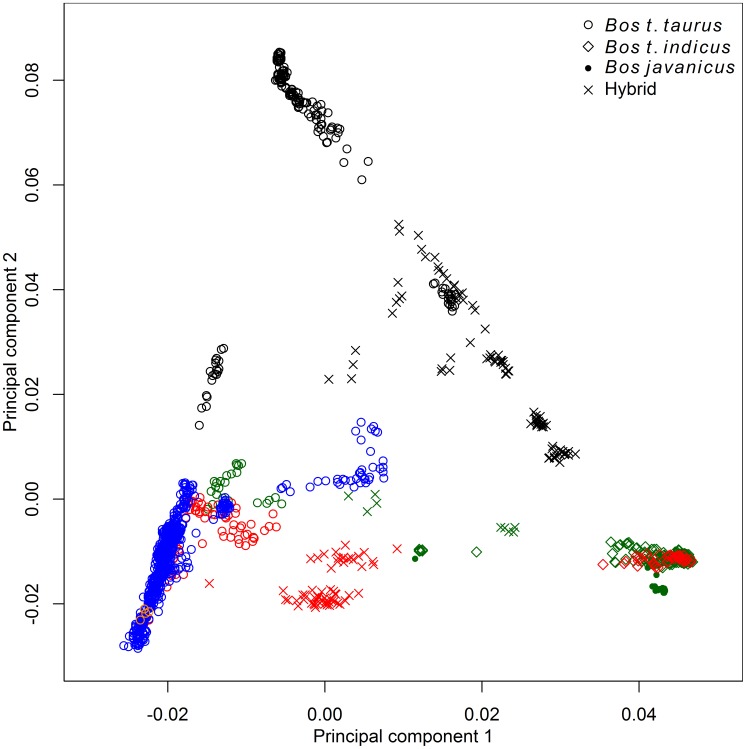
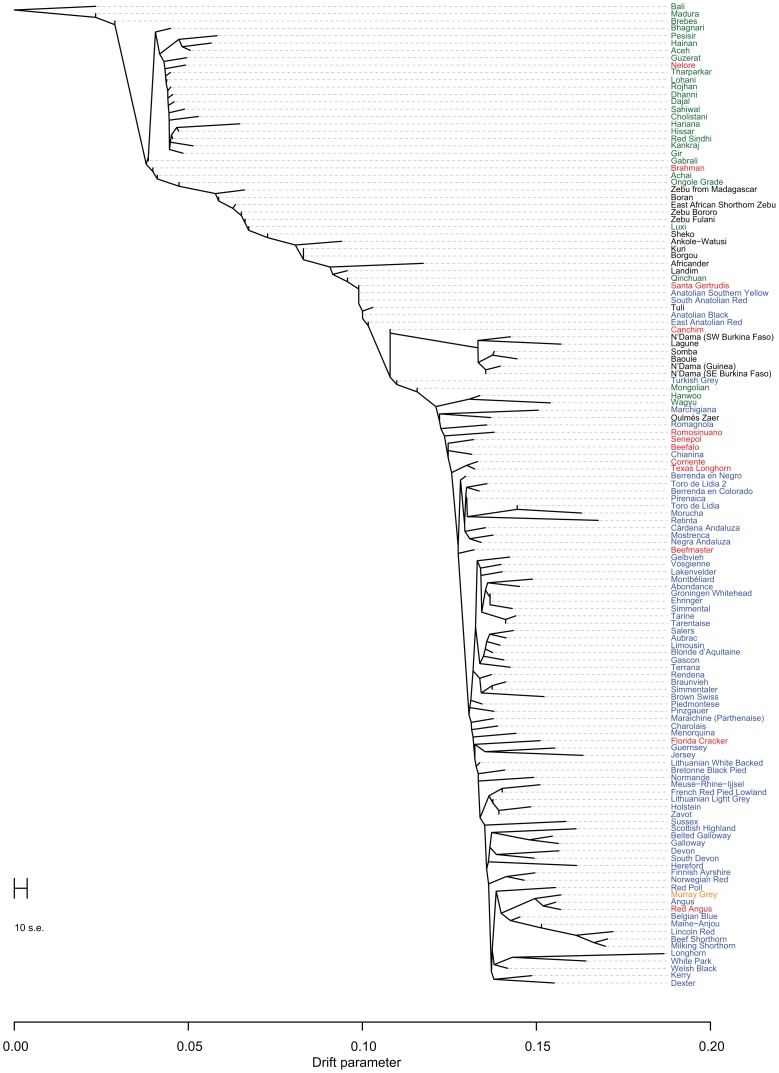
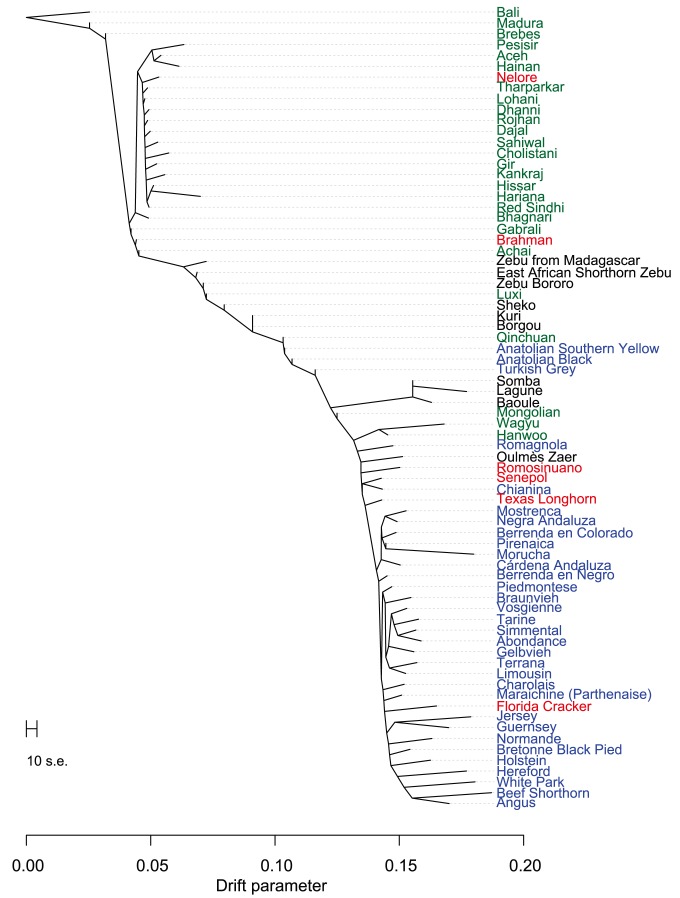
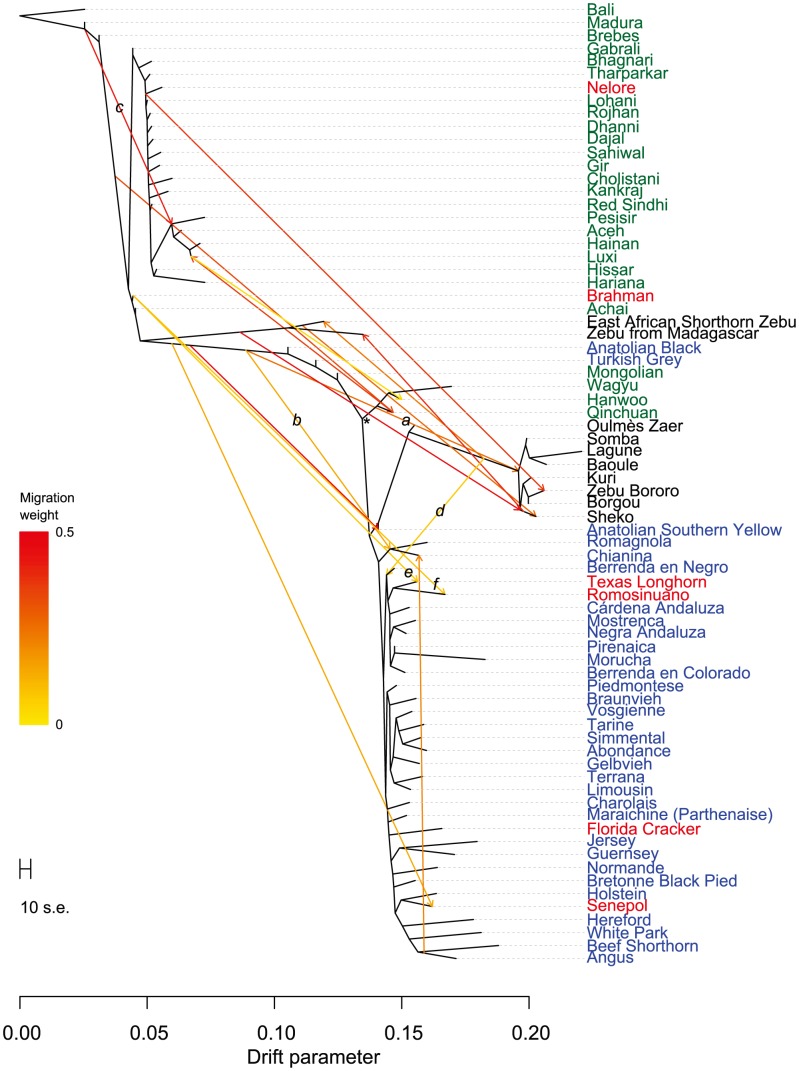
Verification
Claims the paper makes
The claims and statistics of this paper haven’t been checked yet.
Run the check — free, no account needed. It reads the open-access text and checks the sources it cites.
Claims other papers make about this one
Each is checked against this paper’s own text: does it say what the citing paper says it does?
The cited source doesn’t support the claim as written.
In the citing paper
“The autosomal genetic structure of modern cattle is primarily divided into six ancestries (Table 1): European taurine, East Asian taurine, African taurine, South Asian or Indian indicine, East Asian or Chinese indicine, and African indicine ancestry [9,10,31].”
From The Genomic Landscape of Cattle: Domestication, Dispersal, and Adaptive Evolution (2026) · cites this paper as [31]
Checked by a reasoning model — may be wrong.
Experimental — accuracy not yet measured
Self-check
Percentages, sums and reported differences re-computed from the paper’s own numbers.
The self-check needs the paper’s full text.
Citations
Cites
PLINK: a tool set for whole-genome association and population-based linkage analyses.
Purcell, S., Neale, B., Todd-Brown, K., Thomas, L., Ferreira, M. A. R., Bender, D., Maller, J., Sklar, P., de Bakker, P. I. W., Daly, M. J., et al. (2007) · The American Journal of Human Genetics · doi:10.1086/519795 · Cited by 34,089
Detecting the number of clusters of individuals using the software structure: a simulation study
Evanno, G., Regnaut, S., & Goudet, J. (2005) · Molecular Ecology · doi:10.1111/j.1365-294x.2005.02553.x · Cited by 21,540
Fast model-based estimation of ancestry in unrelated individuals
Alexander, D. H., Novembre, J., & Lange, K. (2009) · Genome Research · doi:10.1101/gr.094052.109 · Cited by 9,898
Falush, D., Stephens, M., & Pritchard, J. K. (2003) · Genetics · doi:10.1093/genetics/164.4.1567 · Cited by 8,006
Population Structure and Eigenanalysis
Patterson, N., Price, A. L., & Reich, D. (2006) · PLoS Genetics · doi:10.1371/journal.pgen.0020190 · Cited by 5,280
Ancient Admixture in Human History
Patterson, N., Moorjani, P., Luo, Y., Mallick, S., Rohland, N., Zhan, Y., Genschoreck, T., Webster, T., & Reich, D. (2012) · Genetics · doi:10.1534/genetics.112.145037 · Cited by 2,848
Inference of population splits and mixtures from genome-wide allele frequency data
Pickrell, J. K., & Pritchard, J. K. (2012) · PLoS Genetics · doi:10.1371/journal.pgen.1002967 · Cited by 2,731
Evolution, consequences and future of plant and animal domestication
Diamond, J. M. (2002) · Nature · doi:10.1038/nature01019 · Cited by 1,772
Reconstructing Indian population history
Reich, D., Thangaraj, K., Patterson, N., Price, A. L., & Singh, L. (2009) · Nature · doi:10.1038/nature08365 · Cited by 1,674
A whole-genome assembly of the domestic cow, Bos taurus
Zimin, A. V., Delcher, A. L., Florea, L., Kelley, D. R., Schatz, M. C., Puiu, D., Hanrahan, F., Pertea, G. M., Tassell, C. P. V., Sonstegard, T. S., et al. (2009) · Genome biology · doi:10.1186/gb-2009-10-4-r42 · Cited by 1,168
Self-citation
Research works printed but not linked: 2
- JL Stewart, 1951, The West African Shorthorn cattle. Their value to Africa as trypanosomiasis-resistant animals, Vet Rec, 63, 454
- D Reich, 2009, Reconstructing Indian population history, Nature, 461, 489, 10.1038/nature08365 · DOI · Paper page
Cited by
Sorted by citations
OptM : estimating the optimal number of migration edges on population trees using Treemix
Fitak, R. R. (2021) · Biology Methods and Protocols · doi:10.1093/biomethods/bpab017 · Cited by 404
Chen, N., Cai, Y., Chen, Q., Li, R., Wang, K., Huang, Y., Hu, S., Huang, S., Zhang, H., Zheng, Z., et al. (2018) · Nature Communications · doi:10.1038/s41467-018-04737-0 · Cited by 403
Self-citation- Invited Review - African Indigenous Cattle: Unique Genetic Resources in a Rapidly Changing World
Mwai, O., Hanotte, O., Kwon, Y.-J., & Cho, S. (2015) · Asian-Australasian Journal of Animal Sciences · doi:10.5713/ajas.15.0002r · Cited by 300
Self-citationThe Genome Landscape of Indigenous African Cattle
Kim, J., Hanotte, O., Mwai, O. A., Dessie, T., Bashir, S., Diallo, B., Agaba, M., Kim, K., Kwak, W., Sung, S., et al. (2017) · Genome biology · doi:10.1186/s13059-017-1153-y · Cited by 271
Self-citationCattle Sex-Specific Recombination and Genetic Control from a Large Pedigree Analysis
Ma, L., O’Connell, J. R., VanRaden, P. M., Shen, B., Padhi, A., Sun, C., Bickhart, D. M., Cole, J. B., Null, D. J., Liu, G. E., et al. (2015) · PLoS Genetics · doi:10.1371/journal.pgen.1005387 · Cited by 232
Metadata
- Authors
- Decker, J. E., McKay, S. D., Rolf, M. M., Kim, J., Molina Alcalá, A., Sonstegard, T. S., Hanotte, O., Götherström, A., Seabury, C. M., Praharani, L., Babar, M. E., Correia de Almeida Regitano, L., Yildiz, M. A., Heaton, M. P., Liu, W.-S., Lei, C.-Z., Reecy, J. M., Saif-Ur-Rehman, M., Schnabel, R. D., & Taylor, J. F.
- Affiliations
- University of Missouri (US)
- University of Vermont (US)
- Oklahoma State University (US)
- Agricultural Research Service (US)
- University of Nottingham (GB)
- Uppsala University (SE)
- Texas A&M University (US)
- University of Veterinary and Animal Sciences (PK)
- Roman L. Hruska U.S. Meat Animal Research Center (US)
- Pennsylvania State University (US)
- Iowa State University (US)
- Corresponding author
- Decker, Jared E.
- Taylor, Jeremy F.
- ORCID
- Venue
- PLoS Genetics
- Publisher
- Public Library of Science (PLoS)
- Published
- 2014-03-27
- Volume
- 10
- Issue
- 3
- Pages
- e1004254
- ISSN
- 1553-7390 (ISSN-L)
- 1553-7404
- PMC
- PMC3967955
- OpenAlex
- W2177259980
- Cited by
- 521
- References
- 59
- Citations by year
- 2026: 33 · 2025: 29 · 2024: 34 · 2023: 36 · 2022: 45 · 2021: 93 · 2020: 40 · 2019: 35 · 2018: 64 · 2017: 34 · 2016: 29 · 2015: 34 · 2014: 13
- FWCI
- 24.02
- Type
- journal article
- Language
- en
- Open access
- gold
- doi.org
- Licence
- Locations
- PLoS Genetics (publishedVersion, public-domain)
- Europe PMC (PubMed Central) (publishedVersion, public-domain)
- PubMed Central (publishedVersion, public-domain)
- PubMed (publishedVersion)
- LA Referencia (Red Federada de Repositorios Institucionales de Publicaciones Científicas) (publishedVersion, other-oa)
- arXiv (Cornell University) (submittedVersion)
- Iowa State University Digital Repository (Iowa State University) (submittedVersion)
- KTH Publication Database DiVA (KTH Royal Institute of Technology) (submittedVersion, other-oa)
- RePEc: Research Papers in Economics (submittedVersion)
- LA Referencia (Red Federada de Repositorios Institucionales de Publicaciones Científicas) (submittedVersion, cc-by-nc-nd)
- DOAJ (DOAJ: Directory of Open Access Journals) (submittedVersion, cc-by-sa)
- Figshare (submittedVersion, cc-by)
- Universidad de Córdoba Insitutional Repository (Universidad de Córdoba) (submittedVersion, cc-by-nc-nd)
- OakTrust (Texas A&M University Libraries) (submittedVersion)
- arXiv (Cornell University)
- Greater South Information System
- Funders
- U.S. Department of Agriculture (#2011-68004-30367, 2013-68004-20364, 2013-68004, 2011-68004-30214)
- National Institute of Food and Agriculture (2013-68004, 2011-68004-30214, 2011-68004-30367, 2013-68004-20364, 2009-65205-05635)
- Topics
- Life Sciences › Biochemistry, Genetics and Molecular Biology › Genetics › Genetic and phenotypic traits in livestock
- Life Sciences › Biochemistry, Genetics and Molecular Biology › Genetics › Genetic diversity and population structure
- Life Sciences › Biochemistry, Genetics and Molecular Biology › Genetics › Forensic and Genetic Research
- Keywords
- cattle breeds, population structure, admixture, hybridization, Bos indicus, taurine cattle, introgression, Shorthorn cattle, Criollo cattle, Iberian cattle, European cattle breeds, cattle, phylogenetic networks
- MeSH terms
- Alleles, Animals, Animals, Domestic, Breeding, Cattle, Gene Frequency, Genetics, Population, Humans, Phylogeny, Genetic Variation, Polymorphism, Single Nucleotide
About these checks
Registry, retraction, Cites and statistics results are computed, not judged, with one exception: a printed reference that no index lists is read once by a model before it counts as a citation error. Claims are extracted by a model and kept only when their quote appears verbatim in the text; each cited source is then checked, with a model’s help, for whether it says what the claim relies on. Those verdicts can be wrong — read the claim’s quote and the cited source before relying on one.
Statistics and arithmetic are recomputed, not judged.
Confidence bands are shown only for fields calibrated on our annotated test set. None is calibrated yet, so no band is shown.
What counts as a claim ›How we measure confidence ›How we check this ›
Are you an author, or do you see a problem with this page? Request a review
