

Short Sleep Duration Is Associated with Reduced Leptin, Elevated Ghrelin, and Increased Body Mass Index
Open accessThe DOI matches its Crossref record; 42 of the 42 references it cites were found in a registry or an index.
Abstract
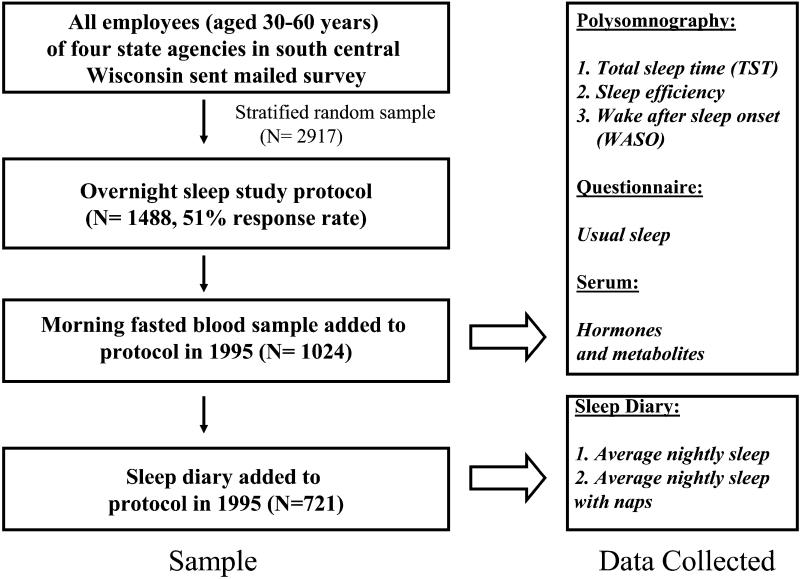
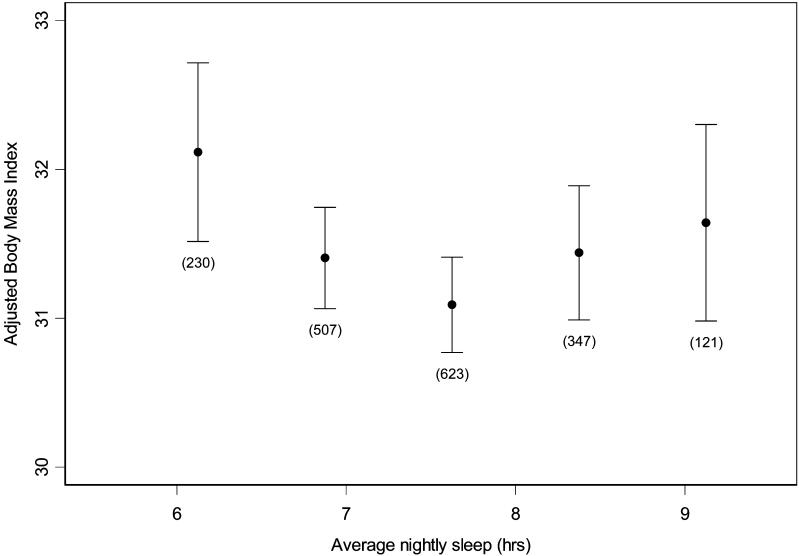
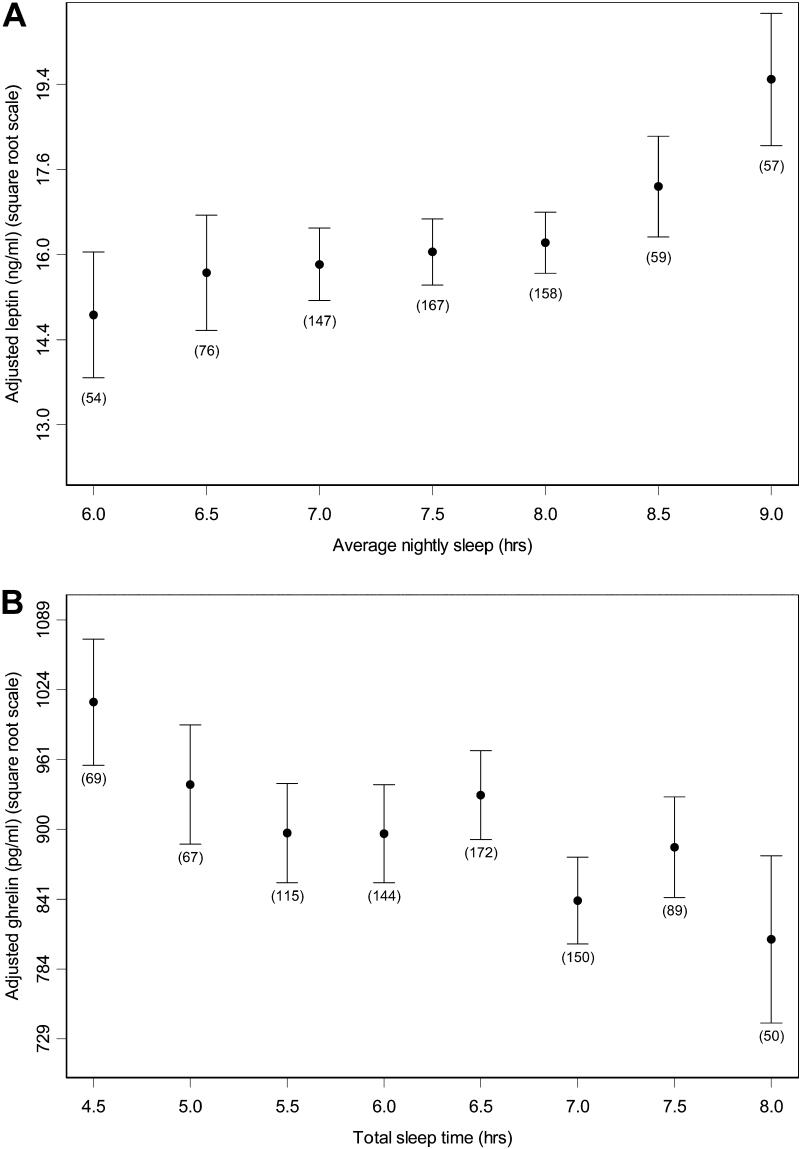
BACKGROUND: Sleep duration may be an important regulator of body weight and metabolism. An association between short habitual sleep time and increased body mass index (BMI) has been reported in large population samples. The potential role of metabolic hormones in this association is unknown. METHODS AND FINDINGS: Study participants were 1,024 volunteers from the Wisconsin Sleep Cohort Study, a population-based longitudinal study of sleep disorders. Participants underwent nocturnal polysomnography and reported on their sleep habits through questionnaires and sleep diaries. Following polysomnography, morning, fasted blood samples were evaluated for serum leptin and ghrelin (two key opposing hormones in appetite regulation), adiponectin, insulin, glucose, and lipid profile. Relationships among these measures, BMI, and sleep duration (habitual and immediately prior to blood sampling) were examined using multiple variable regressions with control for confounding factors. A U-shaped curvilinear association between sleep duration and BMI was observed. In persons sleeping less than 8 h (74.4% of the sample), increased BMI was proportional to decreased sleep. Short sleep was associated with low leptin (p for slope = 0.01), with a predicted 15.5% lower leptin for habitual sleep of 5 h versus 8 h, and high ghrelin (p for slope = 0.008), with a predicted 14.9% higher ghrelin for nocturnal (polysomnographic) sleep of 5 h versus 8 h, independent of BMI. CONCLUSION: Participants with short sleep had reduced leptin and elevated ghrelin. These differences in leptin and ghrelin are likely to increase appetite, possibly explaining the increased BMI observed with short sleep duration. In Western societies, where chronic sleep restriction is common and food is widely available, changes in appetite regulatory hormones with sleep curtailment may contribute to obesity.
Overview
The claims and statistics of this paper haven’t been checked yet.
Free: it reads the open-access text and checks the first 5 claims that cite a source we can check. Create a free account to check every claim.
Integrity signals
Registry
Cites
Statistics
Figures
Verification
Claims the paper makes
The claims and statistics of this paper haven’t been checked yet.
Free: it reads the open-access text and checks the first 5 claims that cite a source we can check. Create a free account to check every claim.
Claims other papers make about this one
Each is checked against this paper’s own text: does it say what the citing paper says it does?
The source backs part of the claim, not all of it — or backs it for a different population, condition or comparison.
In the citing paper
“Chronic sleep deprivation, defined as less than seven hours per night, disrupts appetite regulation by increasing ghrelin and decreasing leptin, leading to greater caloric intake and weight gain [108].”
From Obesity: Clinical Impact, Pathophysiology, Complications, and Modern Innovations in Therapeutic Strategies (2025) · cites this paper as [108]
Experimental — accuracy not yet measuredThe source backs part of the claim, not all of it — or backs it for a different population, condition or comparison.
In the citing paper
“and leptin concentrations were positively associated with average sleep duration (β = 0.11, p = 0.01).”
From The effects of sleep disruption on metabolism, hunger, and satiety, and the influence of psychosocial stress and exercise: A narrative review (2024) · cites this paper as [64]
Experimental — accuracy not yet measuredThe cited source says what the claim attributes to it.
In the citing paper
“Sleep deprivation is associated with various hormonal responses which may lead to appetite dysregulation, affecting both hunger and satiety.”
From Sleep duration and incidence of obesity in infants, children, and adolescents: a systematic review and meta-analysis of prospective studies (2018) · cites this paper as [67]
The cited source says what the claim attributes to it.
In the citing paper
“Furthermore, cross-sectional observations of lower leptin and higher ghrelin concentrations in people with short sleep, independent of BMI, have led to the hypothesis that such hormonal changes promote over-eating and lead to increased risk of obesity [14], [15].”
From Metabolic effects of sleep disruption, links to obesity and diabetes (2014) · cites this paper as [14]
In the citing paper
“Although there is preclinical 70 and crosssectional evidence 64 suggesting that low sleep quality (i.e., high sleep fragmentation) may be associated with impaired leptin metabolism, it appears that these associations may be weaker than for sleep duration.”
From The effects of sleep disruption on metabolism, hunger, and satiety, and the influence of psychosocial stress and exercise: A narrative review (2024) · cites this paper as [64]
8 more claims about this paper
Create a free account to see every claim other papers make about this one.
Self-check
Percentages, sums and reported differences re-computed from the paper’s own numbers.
The self-check needs the paper’s full text.
Citations
Cites
The Occurrence of Sleep-Disordered Breathing among Middle-Aged Adults
Young, T., Palta, M., Dempsey, J., Skatrud, J., Weber, S., & Badr, S. (1993) · New England Journal of Medicine · doi:10.1056/nejm199304293281704 · Cited by 10,183 · cited 13×
“Abbreviations: AHI, apnea-hypopnea index; BMI, body mass index; BUN, blood urea nitrogen; HDL, high-density lipoprotein; QUICKI, quantitative insulin sensitivity check index; SDB, sleepdisordered breathing; WASO, wake after sleep onset *To whom correspondence should be addressed.”
InfluentialSelf-citationCentral nervous system control of food intake
Schwartz, M. W., Woods, S. C., Porte, D., Seeley, R. J., & Baskin, D. G. (2000) · Nature · doi:10.1038/35007534 · Cited by 6,451 · cited 1×
“Leptin administration suppresses food intake and reduces energy expenditure [21,22].”
Katz, A., Nambi, S. S., Mather, K., Baron, A. D., Follmann, D. A., Sullivan, G., & Quon, M. J. (2000) · The Journal of Clinical Endocrinology & Metabolism · doi:10.1210/jcem.85.7.6661 · Cited by 3,931 · cited 1×
“The quantitative insulin sensitivity check index (QUICKI) was 1/(log (I)þ log (G)), where I is fasting insulin and G is fasting glucose [15,16].”
Impact of sleep debt on metabolic and endocrine function
Spiegel, K., Leproult, R., & Van Cauter, E. (1999) · The Lancet · doi:10.1016/s0140-6736(99)01376-8 · Cited by 3,668 · cited 1×
“Insulin resistance with sleep deprivation has been reported in a laboratory study of young, healthy volunteers [”
The Triad of Sleep Apnea, Hypertension, and Chronic Kidney Disease: A Spectrum of Common Pathology
Aziz, F., & Chaudhary, K. (2017) · Cardiorenal Medicine · doi:10.1159/000450796 · Cited by 3,267
A preprandial rise in plasma ghrelin levels suggests a role in meal initiation in humans
Cummings, D. E., Purnell, J. Q., Frayo, R. S., Schmidova, K., Wisse, B. E., & Weigle, D. S. (2001) · Diabetes · doi:10.2337/diabetes.50.8.1714 · Cited by 2,940 · cited 2×
“Additionally, studies have shown a high correlation between morning, fasting leptin and ghrelin levels and 24-h mean profile [29,30].”
Ghrelin enhances appetite and increases food intake in humans
Wren, A. M., Seal, L. J., Cohen, M. A., Brynes, A. E., Frost, G. S., Murphy, K. G., Dhillo, W. S., Ghatei, M. A., & Bloom, S. R. (2001) · The Journal of Clinical Endocrinology & Metabolism · doi:10.1210/jcem.86.12.8111 · Cited by 2,494 · cited 1×
“Levels of ghrelin, a potent stimulator of appetite [23,24,25], were higher in those with shorter sleep.”
Spiegel, K., Tasali, E., Penev, P., & Cauter, E. V. (2004) · Annals of Internal Medicine · doi:10.7326/0003-4819-141-11-200412070-00008 · Cited by 2,459
Mortality Associated With Sleep Duration and Insomnia
Kripke, D. F., Garfinkel, L., Wingard, D. L., Klauber, M. R., & Marler, M. R. (2002) · Archives of General Psychiatry · doi:10.1001/archpsyc.59.2.131 · Cited by 1,614 · cited 1×
“In the largest studied sample, elevated BMI occurred for habitual sleep amounts below 7–8 h [2].”
Inhibition of Food Intake in Obese Subjects by Peptide YY 3–36
Batterham, R. L., Cohen, M. A., Ellis, S. M., Le Roux, C. W., Withers, D. J., Frost, G. S., Ghatei, M. A., & Bloom, S. R. (2003) · New England Journal of Medicine · doi:10.1056/nejmoa030204 · Cited by 1,604 · cited 1×
“appetite regulatory hormones, such as PYY 3–36 [28], were not measured.”
Cited by
Items 1,001–1,012 of 1,012
Changes in sleep duration and changes in weight in obese patients: The Swedish Obese Subjects Study
MARSHALL, N. S., GRUNSTEIN, R. R., PELTONEN, M., STENLOF, K., HEDNER, J., & SJOSTROM, L. V. (2010) · Sleep and Biological Rhythms · doi:10.1111/j.1479-8425.2010.00431.x · Cited by 17
Effects of ad libitum food intake, insufficient sleep and weekend recovery sleep on energy balance
Depner, C. M., Melanson, E. L., Eckel, R. H., Higgins, J. A., Bergman, B. C., Perreault, L., Knauer, O. A., Birks, B. R., & Wright, K. P. (2021) · Sleep · doi:10.1093/sleep/zsab136 · Cited by 14
Sleep and cardiometabolic health—not so strange bedfellows
Taheri, S. (2023) · The Lancet Diabetes & Endocrinology · doi:10.1016/s2213-8587(23)00170-5 · Cited by 12
Self-citationAssociation between habitual sleep duration/quality and appetite markers in individuals with obesity
Nymo, S., Kleppe, M. M., Coutinho, S. R., Rehfeld, J. F., Kulseng, B., & Martins, C. (2021) · Physiology & Behavior · doi:10.1016/j.physbeh.2021.113345 · Cited by 11
“ghrelin plasma concentrations, with some reporting an increase [24, 29, 37-39], others a”
BackgroundSleep-deprived cognitive impairment in aging mice is alleviated by rapamycin
(2019) · Aging Pathobiology and Therapeutics · doi:10.31491/apt.2019.12.002 · Cited by 10
“Sleep deprivation is a major health concern in developed countries and is associated with increasing age [1-3].”
BackgroundDuggan, M. P., Taveras, E. M., Gerber, M. W., Horan, C. M., & Oreskovic, N. M. (2019) · Academic Pediatrics · doi:10.1016/j.acap.2018.11.004 · Cited by 10
Homeostatic and Circadian Control of Food Intake: Clinical Strategies to Prevent Overconsumption
Drapeau, V., & Gallant, A. R. (2013) · Current Obesity Reports · doi:10.1007/s13679-012-0038-3 · Cited by 10
“Lack of sleep is directly related to hormonal changes favoring increased appetite [55] and may impair the action of leptin [56].”
BackgroundShort Sleep and Circulating Adipokine Concentrations: Does the Fat Hit the Fire?
Penev, P. D. (2011) · Sleep · doi:10.1093/sleep/34.2.131 · Cited by 7
Law, O., & Rasmussen, E. B. (2024) · Journal of Behavioral Decision Making · doi:10.1002/bdm.2353 · Cited by 6
“…of health-related reasons, but one issue is its association with weight gain and obesity; this too occurs in college students (Coughlin & Smith, 2014; Rahe et al., 2015; Sa et al., 2020; Taheri et al., 2004; Vargas et al., 2014; Wang et al., 2019; see also meta-analysis by Fatima et al., 2016).”
BackgroundLai, Y., Wang, C., Ouyang, J., Wu, L., Wang, Y., Wu, P., Ye, Y.-X., Yang, X., Gao, Y., Wang, Y.-X., et al. (2024) · Sleep Medicine · doi:10.1016/j.sleep.2024.04.003 · Cited by 5
Impact of Fibromyalgia on Female Infertility
Koné, M. C., Kambiré, N. A., & Ahoua, Y. (2021) · Open Journal of Epidemiology · doi:10.4236/ojepi.2021.114037 · Cited by 2
“Thus, in the event of sleep disturbances, ovulation is compromised, thereby leading to menstrual disturbances [44] [45] [46].”
BackgroundSleep Patterns and Obesity Risk in Children
Samara, B. A. M., & Rawaqa, I. M. I. (2025) · Scholars Journal of Applied Medical Sciences · doi:10.36347/sjams.2025.v13i04.012 · Cited by 1
Metadata
- Authors
- Taheri, S., Lin, L., Austin, D., Young, T., & Mignot, E.
- Affiliations
- Howard Hughes Medical Institute (US)
- University of Wisconsin–Madison (US)
- Corresponding author
- Mignot, Emmanuel
- Venue
- PLoS Medicine
- Publisher
- Public Library of Science (PLoS)
- Published
- 2004-12-07
- Volume
- 1
- Issue
- 3
- Pages
- e62
- ISSN
- 1549-1277 (ISSN-L)
- 1549-1676
- PMC
- PMC535701
- OpenAlex
- W2130357926
- Cited by
- 2,477
- References
- 42
- Citations by year
- 2026: 88 · 2025: 119 · 2024: 110 · 2023: 127 · 2022: 142 · 2021: 141 · 2020: 142 · 2019: 116 · 2018: 125 · 2017: 133 · 2016: 123 · 2015: 127 · 2014: 142 · 2013: 144 · 2012: 130
- FWCI
- 16.15
- Type
- journal article
- Language
- en
- Open access
- gold
- doi.org
- Locations
- PLoS Medicine (publishedVersion, cc-by)
- Europe PMC (PubMed Central) (publishedVersion, cc-by)
- PubMed Central (publishedVersion, cc-by)
- PubMed (publishedVersion)
- DOAJ (DOAJ: Directory of Open Access Journals) (submittedVersion, cc-by-sa)
- University of Birmingham Research Portal (University of Birmingham) (submittedVersion, other-oa)
- Funders
- Howard Hughes Medical Institute
- National Institutes of Health (RR 03186)
- National Institute on Aging (AG14124, R01AG014124)
- National Heart, Lung, and Blood Institute (R01HL062252, HL 071515, R01HL071515, HL62252)
- National Institute of Mental Health (MH-073435, R01MH073435)
- National Center for Research Resources (M01RR003186, RR03186)
- Topics
- Life Sciences › Neuroscience › Endocrine and Autonomic Systems › Regulation of Appetite and Obesity
- Life Sciences › Neuroscience › Cognitive Neuroscience › Sleep and Wakefulness Research
- Social Sciences › Psychology › Experimental and Cognitive Psychology › Sleep and related disorders
- Keywords
- short sleep duration, sleep restriction, leptin, ghrelin, body mass index, obesity, appetite regulation, adiponectin, insulin, lipid profile, Wisconsin Sleep Cohort Study
- MeSH terms
- Adult, Appetite, Body Weight, Female, Humans, Longitudinal Studies, Male, Middle Aged, Obesity, Sleep, Sleep Wake Disorders, Body Mass Index, Leptin, Peptide Hormones, Ghrelin
About these checks
Registry, retraction, Cites and statistics results are computed, not judged, with one exception: a printed reference that no index lists is read once by a model before it counts as a citation error. Claims are extracted by a model and kept only when their quote appears verbatim in the text; each cited source is then checked, with a model’s help, for whether it says what the claim relies on. Those verdicts can be wrong — read the claim’s quote and the cited source before relying on one.
Statistics and arithmetic are recomputed, not judged.
Confidence bands are shown only for fields calibrated on our annotated test set. None is calibrated yet, so no band is shown.
What counts as a claim ›How we measure confidence ›How we check this ›
Are you an author, or do you see a problem with this page? Request a review
Data sources
Bibliographic data: Semantic Scholar, OpenAlex, Crossref.
Contains information from the Semantic Scholar Academic Graph Datasets, made available under the ODC Attribution License (ODC-BY 1.0).
Semantic Scholar’s data is described in: Kinney, R., et al. (2023). The Semantic Scholar Open Data Platform. arXiv:2301.10140.
