

The DOI matches its Crossref record; 45 of the 45 references it cites were found in a registry or an index; 7 of the 27 sources its claims cite were checked for support.
ApoE Plasma Levels and Risk of Cardiovascular Mortality in Old Age
Open accessAbstract
BACKGROUND: The epsilon2, epsilon3, and epsilon4 alleles of the apolipoprotein E gene (APOE) encode three isoforms, apoE2, E3, and E4, respectively. The apoE isoforms circulate in different plasma concentrations, but plasma concentrations of the same isoform also differ between individuals. Whereas the isoforms have been associated with cardiovascular disease, the relation between plasma apoE levels and cardiovascular disease is unknown. METHODS AND FINDINGS: We assessed APOE genotypes, plasma levels of apoE, cardiovascular risk factors, and mortality in a population-based sample of 546 individuals aged 85 y who participated in the Leiden 85-plus Study and were prospectively followed for specific causes of death for 5 y. Participants in the highest tertile of apoE levels suffered a twofold-increased risk of cardiovascular mortality (hazard ratio compared to lowest tertile, 2.08; 95% confidence interval [CI], 1.30 to 3.33). Among the 324 participants with the epsilon3epsilon3 genotype, the hazard from cardiovascular disease was threefold increased (highest versus lowest tertile 3.01; 95% CI 1.60 to 5.66), with similar estimates for men and women. Other causes of death were not increased significantly. Plasma levels of apoE in epsilon3epsilon3 participants were positively correlated with total cholesterol (p < 0.001), low-density lipoprotein cholesterol (p < 0.001) and triglycerides (p < 0.001) and negatively with high-density lipoprotein cholesterol levels (p = 0.010). Adjustment for plasma lipids did not change the hazard ratios, whereas interaction was absent. The risk associated with high levels of apoE, however, was strongest in participants from the lowest tertile of C-reactive protein (CRP) levels and absent in those from the highest tertile (p(interaction) < 0.001). Among participants from the lowest tertile of CRP levels, those with a high apoE levels had a significantly steeper increase in CRP than those with low apoE levels (p = 0.020). Similar cardiovascular mortality risks as in epsilon3epsilon3 participants were found in epsilon2 and epsilon4 carriers. CONCLUSIONS: In old age, high plasma apoE levels precede an increase of circulating CRP and strongly associates with cardiovascular mortality, independent of APOE genotype and plasma lipids.
Overview
AI snapshot
Written from the paper’s full text.
TL;DR
In a population-based cohort of 546 85-year-olds, high plasma apoE levels were associated with increased cardiovascular mortality, independent of APOE genotype and plasma lipids. High apoE also preceded rises in CRP, suggesting a proinflammatory pathway.
Key findings
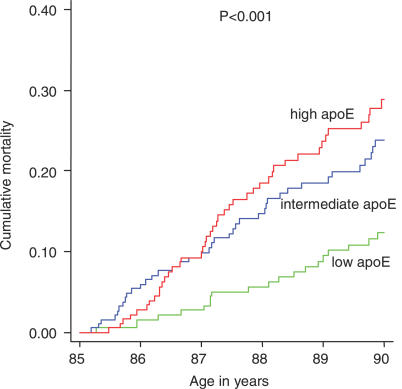
- In the total cohort, the highest apoE tertile had a 2.08-fold increased risk of cardiovascular mortality versus the lowest tertile (HR 2.08; 95% CI 1.30–3.33); intermediate levels had HR 1.74 (95% CI 1.09–2.79).
- Among 324 participants with the ε3ε3 genotype, high apoE was associated with increased all-cause mortality (HR 2.05; 95% CI 1.39–3.02) and a threefold increased cardiovascular mortality risk (HR 3.01; 95% CI 1.60–5.66), with similar estimates in men (HR 2.89; 95% CI 1.13–7.36) and women (HR 2.96; 95% CI 1.27–6.90); other causes of death were not significantly increased.
- In ε3ε3 participants, apoE levels correlated positively with total cholesterol, LDL cholesterol, and triglycerides (all p < 0.001) and negatively with HDL cholesterol (p = 0.010); adjustment for lipids did not change the mortality estimate (HR 3.09; 95% CI 1.55–6.15), and further adjustment for cardiovascular risk factors gave HR 3.20 (95% CI 1.56–6.59).
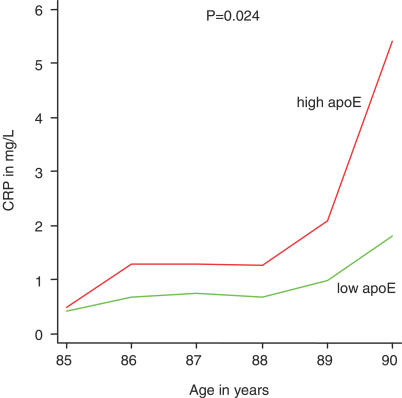
- The cardiovascular mortality risk associated with high apoE was strongest in the lowest CRP tertile and absent in the highest tertile (p interaction < 0.001); in the lowest CRP stratum, high baseline apoE was associated with a steeper increase in CRP during follow-up (p = 0.020). Similar cardiovascular mortality risks were found in ε2 and ε4 carriers, and in the entire cohort with APOE genotype accounted for, high apoE had HR 3.45 (95% CI 1.98–6.02).
Methods
- Prospective population-based follow-up within the Leiden 85-plus Study: 705 inhabitants reached age 85, 599 participated, 561 provided blood samples, and 546 were analyzed; there were no selection criteria on health or demographic characteristics. Follow-up was until 1 April 2004, mean 4.2 y, during which 274 of 546 participants died.
- APOE genotypes were determined with TaqMan assays; plasma apoE was measured by a human apoE-specific sandwich ELISA in stored baseline samples; total cholesterol, HDL cholesterol, triglycerides, and CRP were measured on automated analyzers, with LDL cholesterol estimated by the Friedewald equation; causes of death were classified by ICD-10 codes.
- Mortality risks were estimated with Cox proportional hazards models adjusted for gender; baseline comparisons used sex-adjusted linear regression or linear mixed models, and prospective CRP analysis used a linear mixed model adjusting for gender.
Limitations
- Stated by the paper: blood samples were not fasting, which could add random error; CRP was not measured with high-sensitivity methods; few participants were on lipid-lowering medication because of Dutch prescribing policy at enrollment; findings cannot be directly extrapolated to nonfatal cardiovascular disease or beyond this age group; participants were survivors of their birth cohort; and stored plasma shifts apoE between lipoproteins, while many participants had died, preventing subclass fractionation.
- Evident from the observational cohort design: causality cannot be established, although the paper interprets high apoE as a possible causal factor; residual confounding cannot be excluded despite adjustment for lipids and other cardiovascular risk factors.
Model-written summary. Check it against the paper before relying on it.
Integrity signals
Registry
Cites
Statistics
Figures
Verification
Claims the paper makes
47 Own result · 13 Own interpretation · 10 No full text of the sources · 10 Own method · 3 Supported · 3 Partly supported · 3 No basis given · 1 Supported so far · accuracy not yet measured
The cited sources support only part of this claim — read each source’s verdict below.
In the paper
“the APOE ɛ2/ɛ3/ɛ4 genotype is only a minor determinant of these levels [ 8, 40]”
§ ApoE Plasma Levels and Risk of Cardiovascular Mortality in Old Age > Discussion > Literature Context
What the sources say
- Not checked — no full text of the sourcecites [8] Neale, 2000, Genet Epidemiol source
- Partly supportedcites [40] Beekman, 2004, Genet Epidemiol sourceExperimental — accuracy not yet measured
The indexed Abstract reports that the APOE ε2/ε3/ε4 polymorphism was strongly associated with plasma apoE levels in two Dutch twin cohorts. It does not establish that the genotype is only a minor determinant of those levels; strength of association alone does not quantify its contribution to variation in levels. (LLM, conf=0.78)
plaincorrelational- Asserted: passes — The authors put it forward as true.
- Checkable: passes — It can be checked against evidence.
- Load-bearing: passes — The paper’s conclusions depend on it.
- Based: passes — The paper gives a reason why it holds.
A result the paper reports from its own data — it cites no other source for it, so there is none to check. The quote shows it is in the paper.
In the paper
“because we found in our analysis that the effect of apoE on cardiovascular mortality is independent of lipid levels”
§ ApoE Plasma Levels and Risk of Cardiovascular Mortality in Old Age > Discussion > Proposed Mechanisms: Plasma ApoE Levels Associate with a Detrimental Lipoprotein Profile and/or with a Proinflammation Response
plain- Asserted: passes — The authors put it forward as true.
- Checkable: passes — It can be checked against evidence.
- Load-bearing: passes — The paper’s conclusions depend on it.
- Based: passes — The paper gives a reason why it holds.
A result the paper reports from its own data — it cites no other source for it, so there is none to check. The quote shows it is in the paper.
In the paper
“A similar association was observed in ɛ4 carriers ( p = 0.041), but was absent in ɛ2 carriers ( p = 0.76).”
§ ApoE Plasma Levels and Risk of Cardiovascular Mortality in Old Age > Results > Association of Plasma ApoE Level and Increase in CRP Level during Follow-Up
plain- Asserted: passes — The authors put it forward as true.
- Checkable: passes — It can be checked against evidence.
- Load-bearing: unclear — It is unclear whether the paper’s conclusions depend on it.
- Based: passes — The paper gives a reason why it holds.
A result the paper reports from its own data — it cites no other source for it, so there is none to check. The quote shows it is in the paper.
In the paper
“As the cardiovascular mortality risk associated with high levels of apoE was even higher in participants who did not have a history of myocardial infarction compared to those who did”
§ ApoE Plasma Levels and Risk of Cardiovascular Mortality in Old Age > Discussion > Plasma ApoE Levels Are a Cause, Not a Consequence, of Atherosclerosis
plaincorrelational- Asserted: passes — The authors put it forward as true.
- Checkable: passes — It can be checked against evidence.
- Load-bearing: passes — The paper’s conclusions depend on it.
- Based: passes — The paper gives a reason why it holds.
A result the paper reports from its own data — it cites no other source for it, so there is none to check. The quote shows it is in the paper.
In the paper
“triglyceride levels do not contribute to the association of levels of apoE with cardiovascular disease mortality, as stratification and correction for triglyceride levels did not alter the effect of apoE levels on cardiovascular disease mortality.”
§ ApoE Plasma Levels and Risk of Cardiovascular Mortality in Old Age > Discussion > Proposed Mechanisms: Plasma ApoE Levels Associate with a Detrimental Lipoprotein Profile and/or with a Proinflammation Response
plain- Asserted: passes — The authors put it forward as true.
- Checkable: passes — It can be checked against evidence.
- Load-bearing: passes — The paper’s conclusions depend on it.
- Based: passes — The paper gives a reason why it holds.
A result the paper reports from its own data — it cites no other source for it, so there is none to check. The quote shows it is in the paper.
In the paper
“Among participants from the lowest tertile of CRP levels, those with a high apoE levels had a significantly steeper increase in CRP than those with low apoE levels ( p = 0.020).”
- Also stated in: § Association of Plasma ApoE Level and Increase in CRP Level during Follow-Up · plain
“We found that high levels of apoE at baseline correlate with higher increases in levels of CRP during follow-up ( p = 0.024). Adjusting for classical cardiovascular risk factors did not change the observed association ( p = 0.020).”
§ ApoE Plasma Levels and Risk of Cardiovascular Mortality in Old Age > Abstract > Methods and Findings
plaincorrelational- Asserted: passes — The authors put it forward as true.
- Checkable: passes — It can be checked against evidence.
- Load-bearing: passes — The paper’s conclusions depend on it.
- Based: passes — The paper gives a reason why it holds.
- Also stated in: § Association of Plasma ApoE Level and Increase in CRP Level during Follow-Up · plain
A result the paper reports from its own data — it cites no other source for it, so there is none to check. The quote shows it is in the paper.
In the paper
“Among ɛ3ɛ3 participants, those with high levels of apoE had significantly higher levels of total cholesterol ( p < 0.001), LDL cholesterol ( p < 0.001), and triglycerides ( p < 0.001) and lower HDL cholesterol ( p = 0.010).”
§ ApoE Plasma Levels and Risk of Cardiovascular Mortality in Old Age > Results > Association of Plasma ApoE Levels with Lipid Levels at Baseline and Relationship of Cardiovascular Mortality Risk Associated with Plasma ApoE and Lipid Levels
plaincorrelational- Asserted: passes — The authors put it forward as true.
- Checkable: passes — It can be checked against evidence.
- Load-bearing: unclear — It is unclear whether the paper’s conclusions depend on it.
- Based: passes — The paper gives a reason why it holds.
A result the paper reports from its own data — it cites no other source for it, so there is none to check. The quote shows it is in the paper.
In the paper
“In the total study population, high apoE levels were associated with a 2.08-fold (95% CI, 1.30 to 3.33) increased risk, and intermediate levels with a 1.74-fold (95% CI, 1.09 to 2.79) increased risk, of cardiovascular mortality compared to those with low apoE levels ( Figure 1).”
§ ApoE Plasma Levels and Risk of Cardiovascular Mortality in Old Age > Results > Association of Plasma ApoE Levels and Mortality during Follow-Up
plaincorrelationaln = 546 ·- Asserted: passes — The authors put it forward as true.
- Checkable: passes — It can be checked against evidence.
- Load-bearing: passes — The paper’s conclusions depend on it.
- Based: passes — The paper gives a reason why it holds.
A result the paper reports from its own data — it cites no other source for it, so there is none to check. The quote shows it is in the paper.
In the paper
“Among ɛ3ɛ3 participants, those with high levels of apoE had significantly higher levels of total cholesterol ( p < 0.001), LDL cholesterol ( p < 0.001), and triglycerides ( p < 0.001) and lower HDL cholesterol ( p = 0.010).”
§ ApoE Plasma Levels and Risk of Cardiovascular Mortality in Old Age > Results > Association of Plasma ApoE Levels with Lipid Levels at Baseline and Relationship of Cardiovascular Mortality Risk Associated with Plasma ApoE and Lipid Levels
plaincorrelational- Asserted: passes — The authors put it forward as true.
- Checkable: passes — It can be checked against evidence.
- Load-bearing: unclear — It is unclear whether the paper’s conclusions depend on it.
- Based: passes — The paper gives a reason why it holds.
A result the paper reports from its own data — it cites no other source for it, so there is none to check. The quote shows it is in the paper.
In the paper
“Among the 324 participants with the ɛ3ɛ3 genotype, the hazard from cardiovascular disease was threefold increased (highest versus lowest tertile 3.01; 95% CI 1.60 to 5.66), with similar estimates for men and women.”
- Also stated in: § Association of Plasma ApoE Levels and Mortality during Follow-Up · plain
“This was predominantly due to a threefold increase in cardiovascular mortality risk (hazard ratio, 3.01; 95% CI, 1.60 to 5.66), whereas other causes of death were nonsignificantly increased.”
§ ApoE Plasma Levels and Risk of Cardiovascular Mortality in Old Age > Abstract > Methods and Findings
plaincorrelationaln = 324- Asserted: passes — The authors put it forward as true.
- Checkable: passes — It can be checked against evidence.
- Load-bearing: passes — The paper’s conclusions depend on it.
- Based: passes — The paper gives a reason why it holds.
- Also stated in: § Association of Plasma ApoE Levels and Mortality during Follow-Up · plain
A result the paper reports from its own data — it cites no other source for it, so there is none to check. The quote shows it is in the paper.
In the paper
“Here we show that high plasma apoE levels in fact do associate with an increased cardiovascular mortality risk.”
§ ApoE Plasma Levels and Risk of Cardiovascular Mortality in Old Age > Discussion > Proposed Mechanisms: Plasma ApoE Levels Associate with a Detrimental Lipoprotein Profile and/or with a Proinflammation Response
boostedcorrelational- Asserted: passes — The authors put it forward as true.
- Checkable: passes — It can be checked against evidence.
- Load-bearing: passes — The paper’s conclusions depend on it.
- Based: passes — The paper gives a reason why it holds.
A result the paper reports from its own data — it cites no other source for it, so there is none to check. The quote shows it is in the paper.
In the paper
“Among ɛ3ɛ3 participants, those with high levels of apoE had significantly higher levels of total cholesterol ( p < 0.001), LDL cholesterol ( p < 0.001), and triglycerides ( p < 0.001) and lower HDL cholesterol ( p = 0.010).”
§ ApoE Plasma Levels and Risk of Cardiovascular Mortality in Old Age > Results > Association of Plasma ApoE Levels with Lipid Levels at Baseline and Relationship of Cardiovascular Mortality Risk Associated with Plasma ApoE and Lipid Levels
plaincorrelational- Asserted: passes — The authors put it forward as true.
- Checkable: passes — It can be checked against evidence.
- Load-bearing: unclear — It is unclear whether the paper’s conclusions depend on it.
- Based: passes — The paper gives a reason why it holds.
A result the paper reports from its own data — it cites no other source for it, so there is none to check. The quote shows it is in the paper.
In the paper
“In the total population, high levels of CRP are associated with increased cardiovascular mortality compared to low levels (hazard ratio, 2.42; 95% CI, 1.58 to 3.70).”
§ ApoE Plasma Levels and Risk of Cardiovascular Mortality in Old Age > Results > Association of Plasma ApoE Level and Increase in CRP Level during Follow-Up
plaincorrelational- Asserted: passes — The authors put it forward as true.
- Checkable: passes — It can be checked against evidence.
- Load-bearing: unclear — It is unclear whether the paper’s conclusions depend on it.
- Based: passes — The paper gives a reason why it holds.
A result the paper reports from its own data — it cites no other source for it, so there is none to check. The quote shows it is in the paper.
In the paper
“Among ɛ3ɛ3 participants, those with high levels of apoE had significantly higher levels of total cholesterol ( p < 0.001), LDL cholesterol ( p < 0.001), and triglycerides ( p < 0.001) and lower HDL cholesterol ( p = 0.010).”
§ ApoE Plasma Levels and Risk of Cardiovascular Mortality in Old Age > Results > Association of Plasma ApoE Levels with Lipid Levels at Baseline and Relationship of Cardiovascular Mortality Risk Associated with Plasma ApoE and Lipid Levels
plaincorrelational- Asserted: passes — The authors put it forward as true.
- Checkable: passes — It can be checked against evidence.
- Load-bearing: unclear — It is unclear whether the paper’s conclusions depend on it.
- Based: passes — The paper gives a reason why it holds.
A result the paper reports from its own data — it cites no other source for it, so there is none to check. The quote shows it is in the paper.
In the paper
“Similar cardiovascular mortality risks as in ɛ3ɛ3 participants were found in ɛ2 and ɛ4 carriers.”
§ ApoE Plasma Levels and Risk of Cardiovascular Mortality in Old Age > Abstract > Methods and Findings
plain- Asserted: passes — The authors put it forward as true.
- Checkable: passes — It can be checked against evidence.
- Load-bearing: passes — The paper’s conclusions depend on it.
- Based: unclear — It is unclear why the paper says it holds.
A result the paper reports from its own data — it cites no other source for it, so there is none to check. The quote shows it is in the paper.
In the paper
“When participants with extreme levels of CRP (> 10 mg/l) were excluded from the analysis, the results remained similar.”
§ ApoE Plasma Levels and Risk of Cardiovascular Mortality in Old Age > Results > Association of Plasma ApoE Level and Increase in CRP Level during Follow-Up
plain- Asserted: passes — The authors put it forward as true.
- Checkable: passes — It can be checked against evidence.
- Load-bearing: unclear — It is unclear whether the paper’s conclusions depend on it.
- Based: passes — The paper gives a reason why it holds.
A result the paper reports from its own data — it cites no other source for it, so there is none to check. The quote shows it is in the paper.
In the paper
“Other causes of death were not increased significantly.”
- Also stated in: § Association of Plasma ApoE Levels and Mortality during Follow-Up · plain
“When combined, mortality from all causes except cardiovascular disease was not significantly increased for participants with intermediate apoE levels (hazard ratio, 1.19; 95% CI 0.71 to 2.01) and high apoE levels (hazard ratio, 1.63; 95% CI 0.98 to 2.71), compared to participants with low levels.”
§ ApoE Plasma Levels and Risk of Cardiovascular Mortality in Old Age > Abstract > Methods and Findings
plainn = 324- Asserted: passes — The authors put it forward as true.
- Checkable: passes — It can be checked against evidence.
- Load-bearing: passes — The paper’s conclusions depend on it.
- Based: passes — The paper gives a reason why it holds.
- Also stated in: § Association of Plasma ApoE Levels and Mortality during Follow-Up · plain
A result the paper reports from its own data — it cites no other source for it, so there is none to check. The quote shows it is in the paper.
In the paper
“Similar mortality risks were observed among carriers of the ɛ2 or ɛ4 allele.”
§ ApoE Plasma Levels and Risk of Cardiovascular Mortality in Old Age > Discussion
plain- Asserted: passes — The authors put it forward as true.
- Checkable: passes — It can be checked against evidence.
- Load-bearing: unclear — It is unclear whether the paper’s conclusions depend on it.
- Based: passes — The paper gives a reason why it holds.
A result the paper reports from its own data — it cites no other source for it, so there is none to check. The quote shows it is in the paper.
In the paper
“Participants in the highest tertile of apoE levels suffered a twofold-increased risk of cardiovascular mortality (hazard ratio compared to lowest tertile, 2.08; 95% confidence interval [CI], 1.30 to 3.33).”
- Also stated in: § Association of Plasma ApoE Levels and Mortality during Follow-Up · plain
“In the total study population, high apoE levels were associated with a 2.08-fold (95% CI, 1.30 to 3.33) increased risk, and intermediate levels with a 1.74-fold (95% CI, 1.09 to 2.79) increased risk, of cardiovascular mortality compared to those with low apoE levels ( Figure 1).”
§ ApoE Plasma Levels and Risk of Cardiovascular Mortality in Old Age > Abstract > Methods and Findings
plaincorrelational- Asserted: passes — The authors put it forward as true.
- Checkable: passes — It can be checked against evidence.
- Load-bearing: passes — The paper’s conclusions depend on it.
- Based: passes — The paper gives a reason why it holds.
- Also stated in: § Association of Plasma ApoE Levels and Mortality during Follow-Up · plain
A result the paper reports from its own data — it cites no other source for it, so there is none to check. The quote shows it is in the paper.
In the paper
“A similar increase in cardiovascular mortality was found in men (hazard ratio, 2.89; 95% CI 1.13 to 7.36) and women (hazard ratio, 2.96; 95% CI 1.27 to 6.90).”
§ ApoE Plasma Levels and Risk of Cardiovascular Mortality in Old Age > Results > Association of Plasma ApoE Levels and Mortality during Follow-Up
plaincorrelational- Asserted: passes — The authors put it forward as true.
- Checkable: passes — It can be checked against evidence.
- Load-bearing: passes — The paper’s conclusions depend on it.
- Based: passes — The paper gives a reason why it holds.
A result the paper reports from its own data — it cites no other source for it, so there is none to check. The quote shows it is in the paper.
In the paper
“High levels of HDL cholesterol associated with decreased cardiovascular mortality compared to low levels (hazard ratio, 0.58; 95% CI, 0.36 to 0.92).”
§ ApoE Plasma Levels and Risk of Cardiovascular Mortality in Old Age > Results > Association of Plasma ApoE Levels with Lipid Levels at Baseline and Relationship of Cardiovascular Mortality Risk Associated with Plasma ApoE and Lipid Levels
plaincorrelational- Asserted: passes — The authors put it forward as true.
- Checkable: passes — It can be checked against evidence.
- Load-bearing: unclear — It is unclear whether the paper’s conclusions depend on it.
- Based: passes — The paper gives a reason why it holds.
A result the paper reports from its own data — it cites no other source for it, so there is none to check. The quote shows it is in the paper.
In the paper
“However, in participants with high levels of CRP these associations were not observed.”
§ ApoE Plasma Levels and Risk of Cardiovascular Mortality in Old Age > Discussion > Plasma ApoE Levels Are a Cause, Not a Consequence, of Atherosclerosis
plain- Asserted: passes — The authors put it forward as true.
- Checkable: passes — It can be checked against evidence.
- Load-bearing: passes — The paper’s conclusions depend on it.
- Based: passes — The paper gives a reason why it holds.
A result the paper reports from its own data — it cites no other source for it, so there is none to check. The quote shows it is in the paper.
In the paper
“We found a similar increase in cardiovascular mortality for participants in the highest apoE tertile as compared to the lowest tertile in ɛ2 carriers (hazard ratio, 2.43; 95% CI, 0.44 to 13.5) and ɛ4 carriers (hazard ratio, 4.74; 95% CI, 1.54 to 41.6).”
§ ApoE Plasma Levels and Risk of Cardiovascular Mortality in Old Age > Results > Association of Plasma ApoE Levels and Cardiovascular Mortality in Different APOE Genotypes
plaincorrelational- Asserted: passes — The authors put it forward as true.
- Checkable: passes — It can be checked against evidence.
- Load-bearing: passes — The paper’s conclusions depend on it.
- Based: passes — The paper gives a reason why it holds.
A result the paper reports from its own data — it cites no other source for it, so there is none to check. The quote shows it is in the paper.
In the paper
“No association was found with cardiovascular mortality for high levels of LDL cholesterol (hazard ratio, 0.89; 95% CI, 0.58 to 1.39) or triglycerides (hazard ratio, 1.00; 95% CI 0.65–1.56).”
§ ApoE Plasma Levels and Risk of Cardiovascular Mortality in Old Age > Results > Association of Plasma ApoE Levels with Lipid Levels at Baseline and Relationship of Cardiovascular Mortality Risk Associated with Plasma ApoE and Lipid Levels
plain- Asserted: passes — The authors put it forward as true.
- Checkable: passes — It can be checked against evidence.
- Load-bearing: passes — The paper’s conclusions depend on it.
- Based: passes — The paper gives a reason why it holds.
A result the paper reports from its own data — it cites no other source for it, so there is none to check. The quote shows it is in the paper.
In the paper
“A similar increase in cardiovascular mortality was found in men (hazard ratio, 2.89; 95% CI 1.13 to 7.36) and women (hazard ratio, 2.96; 95% CI 1.27 to 6.90).”
§ ApoE Plasma Levels and Risk of Cardiovascular Mortality in Old Age > Results > Association of Plasma ApoE Levels and Mortality during Follow-Up
plaincorrelational- Asserted: passes — The authors put it forward as true.
- Checkable: passes — It can be checked against evidence.
- Load-bearing: passes — The paper’s conclusions depend on it.
- Based: passes — The paper gives a reason why it holds.
A result the paper reports from its own data — it cites no other source for it, so there is none to check. The quote shows it is in the paper.
In the paper
“When the entire cohort was analyzed with APOE genotype accounted for, participants with high levels of apoE had a 3.45-fold increased risk of cardiovascular mortality (95% CI, 1.98 to 6.02).”
§ ApoE Plasma Levels and Risk of Cardiovascular Mortality in Old Age > Results > Association of Plasma ApoE Levels and Cardiovascular Mortality in Different APOE Genotypes
plaincorrelational- Asserted: passes — The authors put it forward as true.
- Checkable: passes — It can be checked against evidence.
- Load-bearing: passes — The paper’s conclusions depend on it.
- Based: passes — The paper gives a reason why it holds.
A result the paper reports from its own data — it cites no other source for it, so there is none to check. The quote shows it is in the paper.
In the paper
“A similar association was observed in ɛ4 carriers ( p = 0.041), but was absent in ɛ2 carriers ( p = 0.76).”
§ ApoE Plasma Levels and Risk of Cardiovascular Mortality in Old Age > Results > Association of Plasma ApoE Level and Increase in CRP Level during Follow-Up
plaincorrelational- Asserted: passes — The authors put it forward as true.
- Checkable: passes — It can be checked against evidence.
- Load-bearing: unclear — It is unclear whether the paper’s conclusions depend on it.
- Based: passes — The paper gives a reason why it holds.
A result the paper reports from its own data — it cites no other source for it, so there is none to check. The quote shows it is in the paper.
In the paper
“Finally, we repeated the cardiovascular mortality analysis within the ɛ3ɛ3 group, excluding individuals with a positive history of myocardial infarction ( n = 28) and those on lipid-lowering medication ( n = 4). In the fully adjusted model the risk associated with high levels of apoE was 4.14-fold higher than that of participants with low levels (95% CI, 1.75 to 9.84).”
§ ApoE Plasma Levels and Risk of Cardiovascular Mortality in Old Age > Results > Association of Plasma ApoE Levels with Lipid Levels at Baseline and Relationship of Cardiovascular Mortality Risk Associated with Plasma ApoE and Lipid Levels
plaincorrelational- Asserted: passes — The authors put it forward as true.
- Checkable: passes — It can be checked against evidence.
- Load-bearing: passes — The paper’s conclusions depend on it.
- Based: passes — The paper gives a reason why it holds.
A result the paper reports from its own data — it cites no other source for it, so there is none to check. The quote shows it is in the paper.
In the paper
“We found a similar increase in cardiovascular mortality for participants in the highest apoE tertile as compared to the lowest tertile in ɛ2 carriers (hazard ratio, 2.43; 95% CI, 0.44 to 13.5) and ɛ4 carriers (hazard ratio, 4.74; 95% CI, 1.54 to 41.6).”
§ ApoE Plasma Levels and Risk of Cardiovascular Mortality in Old Age > Results > Association of Plasma ApoE Levels and Cardiovascular Mortality in Different APOE Genotypes
plaincorrelational- Asserted: passes — The authors put it forward as true.
- Checkable: passes — It can be checked against evidence.
- Load-bearing: unclear — It is unclear whether the paper’s conclusions depend on it.
- Based: passes — The paper gives a reason why it holds.
A result the paper reports from its own data — it cites no other source for it, so there is none to check. The quote shows it is in the paper.
In the paper
“No association was found with cardiovascular mortality for high levels of LDL cholesterol (hazard ratio, 0.89; 95% CI, 0.58 to 1.39) or triglycerides (hazard ratio, 1.00; 95% CI 0.65–1.56).”
§ ApoE Plasma Levels and Risk of Cardiovascular Mortality in Old Age > Results > Association of Plasma ApoE Levels with Lipid Levels at Baseline and Relationship of Cardiovascular Mortality Risk Associated with Plasma ApoE and Lipid Levels
plain- Asserted: passes — The authors put it forward as true.
- Checkable: passes — It can be checked against evidence.
- Load-bearing: passes — The paper’s conclusions depend on it.
- Based: passes — The paper gives a reason why it holds.
A result the paper reports from its own data — it cites no other source for it, so there is none to check. The quote shows it is in the paper.
In the paper
“Adjustment for lipids ( p interaction < 0.001) and other cardiovascular risk factors ( p interaction < 0.001) did not alter the interaction.”
§ ApoE Plasma Levels and Risk of Cardiovascular Mortality in Old Age > Results > Association of Plasma ApoE Level and Increase in CRP Level during Follow-Up
plaincorrelational- Asserted: passes — The authors put it forward as true.
- Checkable: passes — It can be checked against evidence.
- Load-bearing: passes — The paper’s conclusions depend on it.
- Based: passes — The paper gives a reason why it holds.
A result the paper reports from its own data — it cites no other source for it, so there is none to check. The quote shows it is in the paper.
In the paper
“Participants with high levels of plasma apoE had a twofold increased all-cause mortality risk (hazard ratio, 2.05; 95% CI, 1.39 to 3.02) as compared to those with low levels.”
§ ApoE Plasma Levels and Risk of Cardiovascular Mortality in Old Age > Results > Association of Plasma ApoE Levels and Mortality during Follow-Up
plaincorrelational- Asserted: passes — The authors put it forward as true.
- Checkable: passes — It can be checked against evidence.
- Load-bearing: passes — The paper’s conclusions depend on it.
- Based: passes — The paper gives a reason why it holds.
The paper states this without a source or data behind it here, so there is nothing to check it against. The quote shows it is in the paper.
In the paper
“Here we show that the effect of the plasma levels of apoE masks the effect of the common APOE ɛ2/ɛ3/ɛ4 genotypes”
§ ApoE Plasma Levels and Risk of Cardiovascular Mortality in Old Age > Discussion > Literature Context
boosteddirect- Asserted: passes — The authors put it forward as true.
- Checkable: passes — It can be checked against evidence.
- Load-bearing: passes — The paper’s conclusions depend on it.
- Based: passes — The paper gives a reason why it holds.
A result the paper reports from its own data — it cites no other source for it, so there is none to check. The quote shows it is in the paper.
In the paper
“The present data show that a high apoE plasma level is a new predictor of cardiovascular mortality in elderly people.”
§ ApoE Plasma Levels and Risk of Cardiovascular Mortality in Old Age > Discussion > General Conclusion
boostedcorrelational- Asserted: passes — The authors put it forward as true.
- Checkable: passes — It can be checked against evidence.
- Load-bearing: passes — The paper’s conclusions depend on it.
- Based: passes — The paper gives a reason why it holds.
The paper states this without a source or data behind it here, so there is nothing to check it against. The quote shows it is in the paper.
In the paper
“accordingly the plasma levels of apoE varied markedly in persons with ɛ3ɛ3 genotypes.”
§ ApoE Plasma Levels and Risk of Cardiovascular Mortality in Old Age > Discussion > Literature Context
plain- Asserted: passes — The authors put it forward as true.
- Checkable: passes — It can be checked against evidence.
- Load-bearing: unclear — It is unclear whether the paper’s conclusions depend on it.
- Based: passes — The paper gives a reason why it holds.
A conclusion the paper draws from its own results — it cites no other source for it, so there is none to check. The quote shows it is in the paper.
In the paper
“high levels of apoE are unlikely to be the consequence of cardiovascular disease.”
§ ApoE Plasma Levels and Risk of Cardiovascular Mortality in Old Age > Discussion > Plasma ApoE Levels Are a Cause, Not a Consequence, of Atherosclerosis
hedged- Asserted: passes — The authors put it forward as true.
- Checkable: passes — It can be checked against evidence.
- Load-bearing: passes — The paper’s conclusions depend on it.
- Based: passes — The paper gives a reason why it holds.
A conclusion the paper draws from its own results — it cites no other source for it, so there is none to check. The quote shows it is in the paper.
In the paper
“The main finding of our study is that in old age, individuals with high plasma levels of apoE are at an increased risk of cardiovascular mortality, independent of their APOE genotype, lipid levels, and other cardiovascular risk factors.”
§ ApoE Plasma Levels and Risk of Cardiovascular Mortality in Old Age > Discussion
plaincorrelational- Asserted: passes — The authors put it forward as true.
- Checkable: passes — It can be checked against evidence.
- Load-bearing: passes — The paper’s conclusions depend on it.
- Based: passes — The paper gives a reason why it holds.
A conclusion the paper draws from its own results — it cites no other source for it, so there is none to check. The quote shows it is in the paper.
In the paper
“In the prospective analysis, we also found that high plasma apoE levels precede a rise in CRP levels.”
§ ApoE Plasma Levels and Risk of Cardiovascular Mortality in Old Age > Discussion
plaindirect- Asserted: passes — The authors put it forward as true.
- Checkable: passes — It can be checked against evidence.
- Load-bearing: unclear — It is unclear whether the paper’s conclusions depend on it.
- Based: passes — The paper gives a reason why it holds.
A conclusion the paper draws from its own results — it cites no other source for it, so there is none to check. The quote shows it is in the paper.
In the paper
“However, once there is a proinflammatory state—through whichever mechanism—high plasma apoE levels do not add to an increased risk.”
§ ApoE Plasma Levels and Risk of Cardiovascular Mortality in Old Age > Discussion > Plasma ApoE Levels Are a Cause, Not a Consequence, of Atherosclerosis
plain- Asserted: passes — The authors put it forward as true.
- Checkable: passes — It can be checked against evidence.
- Load-bearing: passes — The paper’s conclusions depend on it.
- Based: passes — The paper gives a reason why it holds.
What the paper did — it cites no source for this, so there is none to check. The quote shows it is in the paper.
In the paper
“A strength of our study is the specificity and sensitivity of the analyses due to the high incidence of fatal events during follow-up.”
§ ApoE Plasma Levels and Risk of Cardiovascular Mortality in Old Age > Discussion > Strengths and Weaknesses of the Present Study
plaindirect- Asserted: passes — The authors put it forward as true.
- Checkable: passes — It can be checked against evidence.
- Load-bearing: unclear — It is unclear whether the paper’s conclusions depend on it.
- Based: passes — The paper gives a reason why it holds.
What the paper did — it cites no source for this, so there is none to check. The quote shows it is in the paper.
In the paper
“it is unlikely that high-sensitivity measurements would have systematically changed the attrition of participants to these strata.”
§ ApoE Plasma Levels and Risk of Cardiovascular Mortality in Old Age > Discussion > Strengths and Weaknesses of the Present Study
hedgedn = 563- Asserted: passes — The authors put it forward as true.
- Checkable: passes — It can be checked against evidence.
- Load-bearing: passes — The paper’s conclusions depend on it.
- Based: passes — The paper gives a reason why it holds.
What the paper did — it cites no source for this, so there is none to check. The quote shows it is in the paper.
In the paper
“which suggests that the magnitude of random error is relatively small.”
§ ApoE Plasma Levels and Risk of Cardiovascular Mortality in Old Age > Discussion > Strengths and Weaknesses of the Present Study
hedged- Asserted: passes — The authors put it forward as true.
- Checkable: passes — It can be checked against evidence.
- Load-bearing: unclear — It is unclear whether the paper’s conclusions depend on it.
- Based: passes — The paper gives a reason why it holds.
What the paper did — it cites no source for this, so there is none to check. The quote shows it is in the paper.
In the paper
“Therefore we believe that the measurement that we used resulted in adequate discriminative power.”
§ ApoE Plasma Levels and Risk of Cardiovascular Mortality in Old Age > Discussion > Strengths and Weaknesses of the Present Study
hedgedn = 563- Asserted: passes — The authors put it forward as true.
- Checkable: passes — It can be checked against evidence.
- Load-bearing: unclear — It is unclear whether the paper’s conclusions depend on it.
- Based: passes — The paper gives a reason why it holds.
A conclusion the paper draws from its own results — it cites no other source for it, so there is none to check. The quote shows it is in the paper.
In the paper
“The observed association of high plasma apoE levels with increased inflammation seems to contradict earlier reports on specific anti-inflammatory properties of apoE.”
§ ApoE Plasma Levels and Risk of Cardiovascular Mortality in Old Age > Discussion > Plasma ApoE Levels Are a Cause, Not a Consequence, of Atherosclerosis
hedgedcorrelational- Asserted: passes — The authors put it forward as true.
- Checkable: passes — It can be checked against evidence.
- Load-bearing: unclear — It is unclear whether the paper’s conclusions depend on it.
- Based: passes — The paper gives a reason why it holds.
A conclusion the paper draws from its own results — it cites no other source for it, so there is none to check. The quote shows it is in the paper.
In the paper
“and may explain why the reported associations of the APOE genotype have been contradictory”
§ ApoE Plasma Levels and Risk of Cardiovascular Mortality in Old Age > Discussion > Literature Context
hedgedconditional- Asserted: passes — The authors put it forward as true.
- Checkable: passes — It can be checked against evidence.
- Load-bearing: passes — The paper’s conclusions depend on it.
- Based: passes — The paper gives a reason why it holds.
A conclusion the paper draws from its own results — it cites no other source for it, so there is none to check. The quote shows it is in the paper.
In the paper
“and that at least part of the mechanism involves a proinflammatory response.”
§ ApoE Plasma Levels and Risk of Cardiovascular Mortality in Old Age > Discussion > Plasma ApoE Levels Are a Cause, Not a Consequence, of Atherosclerosis
hedgedconditional- Asserted: passes — The authors put it forward as true.
- Checkable: passes — It can be checked against evidence.
- Load-bearing: passes — The paper’s conclusions depend on it.
- Based: passes — The paper gives a reason why it holds.
- The authors state this as an assumption: High plasma levels of apoE in combination with increased lipid-antigen presentation lead to chronic inflammation and thus may contribute to atherosclerosis.
A conclusion the paper draws from its own results — it cites no other source for it, so there is none to check. The quote shows it is in the paper.
In the paper
“our data may suggest that plasma apoE levels are a causal factor in cardiovascular mortality risk”
§ ApoE Plasma Levels and Risk of Cardiovascular Mortality in Old Age > Discussion > Plasma ApoE Levels Are a Cause, Not a Consequence, of Atherosclerosis
hedgeddirect- Asserted: passes — The authors put it forward as true.
- Checkable: passes — It can be checked against evidence.
- Load-bearing: passes — The paper’s conclusions depend on it.
- Based: passes — The paper gives a reason why it holds.
- The authors state this as an assumption: High plasma levels of apoE in combination with increased lipid-antigen presentation lead to chronic inflammation and thus may contribute to atherosclerosis.
In the paper
“The results of individual studies on the association of the ɛ2 allele and cardiovascular disease have been conflicting.”
§ ApoE Plasma Levels and Risk of Cardiovascular Mortality in Old Age > Discussion > Literature Context
What the sources say
- Not checked — no full text of the sourcecites [43] Wilson, 1996, Arterioscler Thromb Vasc Biol source
plaincorrelational- Asserted: passes — The authors put it forward as true.
- Checkable: passes — It can be checked against evidence.
- Load-bearing: passes — The paper’s conclusions depend on it.
- Based: passes — The paper gives a reason why it holds.
- Probably not a substantial claim. 21
- It may state two separate claims as one. 29
- The quote only partly states this claim. 2
Every source the paper cites for this claim was checked and supports it.
In the paper
“The apolipoprotein E (APOE) gene influences lipid metabolism and disease risk.”
§ ApoE Plasma Levels and Risk of Cardiovascular Mortality in Old Age > Introduction
What the sources say
- Supportedcites [1] Mahley, 1999, J Lipid Res source
The passage labeled Supplementary key words on apoE mutations describes impaired remnant-lipoprotein clearance and hyperlipidemia, supporting an influence on lipid metabolism and disease risk. Another passage in the same section identifies apoE4 as a risk factor for Alzheimer’s disease. (LLM, conf=0.92)
plaindirect- Asserted: passes — The authors put it forward as true.
- Checkable: passes — It can be checked against evidence.
- Load-bearing: passes — The paper’s conclusions depend on it.
- Based: passes — The paper gives a reason why it holds.
Probably not a substantial claim. It may state two separate claims as one.
- Supported
Every source the paper cites for this claim was checked and supports it.
In the paper
“ApoE is the main ligand for clearance of VLDLs and chylomicron remnants, and as such affects circulating concentrations of lipoproteins and plasma levels of cholesterol and triglycerides [ 1].”
§ ApoE Plasma Levels and Risk of Cardiovascular Mortality in Old Age > Introduction
What the sources say
- Supportedcites [1] Mahley, 1999, J Lipid Res source
The paper’s Summary (page unavailable in our copy) calls apoE the major ligand for remnant lipoprotein catabolism and says remnants accumulate in plasma when apoE is absent. Its discussion of apoE infusion reports reduced plasma cholesterol, while its discussion of defective apoE describes accumulation of remnants enriched in both cholesterol and triglycerides; the paper also identifies VLDL and chylomicron remnants as the relevant particles. (LLM, conf=0.90)
plaindirect- Asserted: passes — The authors put it forward as true.
- Checkable: passes — It can be checked against evidence.
- Load-bearing: fails — The paper’s conclusions may not depend on it.
- Based: passes — The paper gives a reason why it holds.
Probably not a substantial claim. The paper’s conclusions may not depend on it. It may state two separate claims as one.
- Supported
The cited sources support only part of this claim — read each source’s verdict below.
In the paper
“Irrespective of APOE genotype, plasma apoE levels are also associated with cholesterol levels [ 9, 10].”
§ ApoE Plasma Levels and Risk of Cardiovascular Mortality in Old Age > Introduction
What the sources say
- Not matchedcites [9] Boerwinkle, 1988, Am J Hum Genet
Couldn’t be matched to a paper in Crossref, so it can’t be checked.
- Supportedcites [10] Haddy, 2002, Eur J Hum Genet source
The Results (p. 844) report that adding plasma apoE concentration to a model already containing APOE genotype substantially increased the explained variation in cholesterol levels. Table 4 shows a significant association between apoE concentration and total cholesterol in that genotype-adjusted model for both men and women. (LLM, conf=0.93)
plaincorrelational- Asserted: passes — The authors put it forward as true.
- Checkable: passes — It can be checked against evidence.
- Load-bearing: fails — The paper’s conclusions may not depend on it.
- Based: passes — The paper gives a reason why it holds.
Probably not a substantial claim. The paper’s conclusions may not depend on it.
- Not matched
The cited sources support only part of this claim — read each source’s verdict below.
In the paper
“apoE was involved in the direct binding of lipopolysaccharide, the main toxic component of gram-negative bacteria [ 36], thereby decreasing the inflammatory response to lipopolysaccharide [ 37].”
§ ApoE Plasma Levels and Risk of Cardiovascular Mortality in Old Age > Discussion > Plasma ApoE Levels Are a Cause, Not a Consequence, of Atherosclerosis
What the sources say
- Partly supportedcites [36] Rensen, 1997, J Clin Invest sourceExperimental — accuracy not yet measured
The Discussion (page unavailable) reports that apoE binds LPS and redirects it away from Kupffer cells in rats. The Introduction says lipoproteins reduced TNF and inhibited cytokine production, but the paper only suspects apoE is responsible for their protective effect; it does not directly demonstrate that apoE decreases the inflammatory response. (LLM, conf=0.85)
- Not checked — no full text of the sourcecites [37] Van Oosten, 2001, J Biol Chem source
plaindirect- Asserted: passes — The authors put it forward as true.
- Checkable: passes — It can be checked against evidence.
- Load-bearing: fails — The paper’s conclusions may not depend on it.
- Based: passes — The paper gives a reason why it holds.
Probably not a substantial claim. The paper’s conclusions may not depend on it. It may state two separate claims as one.
- Partly supported
Every source the paper cites for this claim was checked and supports it.
In the paper
“ApoE4 binds to lipid particles with higher affinity than does apoE3 and shows preference for VLDL, whereas apoE2 and apoE3 mainly bind to HDL [ 42].”
§ ApoE Plasma Levels and Risk of Cardiovascular Mortality in Old Age > Discussion > Literature Context
What the sources say
- Supportedcites [42] Saito, 2003, J Biol Chem source
The Abstract states that apoE2 and apoE3 preferentially bind to HDL, whereas apoE4 prefers VLDL. It also reports higher binding affinity for apoE4 than apoE3 on lipid emulsion particles and on human VLDL. (LLM, conf=0.94)
plaincorrelational- Asserted: passes — The authors put it forward as true.
- Checkable: passes — It can be checked against evidence.
- Load-bearing: fails — The paper’s conclusions may not depend on it.
- Based: passes — The paper gives a reason why it holds.
Probably not a substantial claim. The paper’s conclusions may not depend on it. It may state two separate claims as one.
- Supported
The sources with a verdict support this claim; the rest weren’t checked yet, have no full text we could read, or their verdicts aren’t rated yet.
In the paper
“Plasma apoE levels are highly dependent on heritable factors [ 3, 24, 25]”
§ ApoE Plasma Levels and Risk of Cardiovascular Mortality in Old Age > Discussion > Literature Context
What the sources say
- Not checked — no full text of the sourcecites [3] Smit, 1988, Hum Genet source
- Supportedcites [24] Beekman, 2002, Twin Res source
The Discussion (p. 94) states that variation in apolipoprotein E levels depended largely on genetic influences, with heritability estimates of 0.87 in middle-aged Dutch twins and 0.57 in Australian twins. Its conclusion likewise describes apolipoprotein E levels as highly heritable across four twin samples. (LLM, conf=0.95)
- Not checked — no full text of the sourcecites [25] Siest, 1995, Clin Chem source
boosteddirect- Asserted: passes — The authors put it forward as true.
- Checkable: passes — It can be checked against evidence.
- Load-bearing: fails — The paper’s conclusions may not depend on it.
- Based: passes — The paper gives a reason why it holds.
Probably not a substantial claim. The paper’s conclusions may not depend on it.
A result the paper reports from its own data — it cites no other source for it, so there is none to check. The quote shows it is in the paper.
In the paper
“At baseline, ɛ3ɛ3 participants with high levels of apoE had significantly higher levels of CRP than those with intermediate and low levels ( p trend < 0.001), and adjustment for sex and lipids did not alter the association ( p trend < 0.001).”
§ ApoE Plasma Levels and Risk of Cardiovascular Mortality in Old Age > Results > Association of Plasma ApoE Level and Increase in CRP Level during Follow-Up
plaincorrelational- Asserted: passes — The authors put it forward as true.
- Checkable: passes — It can be checked against evidence.
- Load-bearing: passes — The paper’s conclusions depend on it.
- Based: passes — The paper gives a reason why it holds.
It may state two separate claims as one.
A result the paper reports from its own data — it cites no other source for it, so there is none to check. The quote shows it is in the paper.
In the paper
“We found that the risk associated with high level of apoE was similar in all tertiles of LDL and HDL cholesterol and triglycerides.”
- Also stated in: § Association of Plasma ApoE Levels with Lipid Levels at Baseline and Relationship of Cardiovascular Mortality Risk Associated with Plasma ApoE and Lipid Levels · plain
“Formal testing for interactions showed that there was no significant interaction between the risk of cardiovascular mortality associated with apoE and these lipids (all p interaction > 0.6).”
§ ApoE Plasma Levels and Risk of Cardiovascular Mortality in Old Age > Results > Association of Plasma ApoE Levels with Lipid Levels at Baseline and Relationship of Cardiovascular Mortality Risk Associated with Plasma ApoE and Lipid Levels
plain- Asserted: passes — The authors put it forward as true.
- Checkable: passes — It can be checked against evidence.
- Load-bearing: passes — The paper’s conclusions depend on it.
- Based: passes — The paper gives a reason why it holds.
It may state two separate claims as one.
- Also stated in: § Association of Plasma ApoE Levels with Lipid Levels at Baseline and Relationship of Cardiovascular Mortality Risk Associated with Plasma ApoE and Lipid Levels · plain
A result the paper reports from its own data — it cites no other source for it, so there is none to check. The quote shows it is in the paper.
In the paper
“We found that high levels of apoE at baseline correlate with higher increases in levels of CRP during follow-up ( p = 0.024). Adjusting for classical cardiovascular risk factors did not change the observed association ( p = 0.020).”
§ ApoE Plasma Levels and Risk of Cardiovascular Mortality in Old Age > Results > Association of Plasma ApoE Level and Increase in CRP Level during Follow-Up
plaincorrelational- Asserted: passes — The authors put it forward as true.
- Checkable: passes — It can be checked against evidence.
- Load-bearing: passes — The paper’s conclusions depend on it.
- Based: passes — The paper gives a reason why it holds.
It may state two separate claims as one.
A result the paper reports from its own data — it cites no other source for it, so there is none to check. The quote shows it is in the paper.
In the paper
“In brief, participants who were carriers of the ɛ2 allele had significantly higher plasma levels of apoE and lower levels of LDL cholesterol and total cholesterol, whereas carriers of the ɛ4 allele had lower levels of plasma apoE and higher levels of LDL and total cholesterol ( Table 2).”
§ ApoE Plasma Levels and Risk of Cardiovascular Mortality in Old Age > Results > Association of APOE Genotype with Plasma ApoE, CRP, and Lipid Levels at Baseline and Cardiovascular Mortality during Follow-Up
plaincorrelational- Asserted: passes — The authors put it forward as true.
- Checkable: passes — It can be checked against evidence.
- Load-bearing: unclear — It is unclear whether the paper’s conclusions depend on it.
- Based: passes — The paper gives a reason why it holds.
It may state two separate claims as one.
A result the paper reports from its own data — it cites no other source for it, so there is none to check. The quote shows it is in the paper.
In the paper
“In our study, the association of apoE levels with cardiovascular disease was strongest in participants with low levels of CRP, and in these persons high levels of apoE preceded an increase in CRP.”
§ ApoE Plasma Levels and Risk of Cardiovascular Mortality in Old Age > Discussion > Plasma ApoE Levels Are a Cause, Not a Consequence, of Atherosclerosis
plaincorrelational- Asserted: passes — The authors put it forward as true.
- Checkable: passes — It can be checked against evidence.
- Load-bearing: passes — The paper’s conclusions depend on it.
- Based: passes — The paper gives a reason why it holds.
It may state two separate claims as one.
A result the paper reports from its own data — it cites no other source for it, so there is none to check. The quote shows it is in the paper.
In the paper
“In brief, participants who were carriers of the ɛ2 allele had significantly higher plasma levels of apoE and lower levels of LDL cholesterol and total cholesterol, whereas carriers of the ɛ4 allele had lower levels of plasma apoE and higher levels of LDL and total cholesterol ( Table 2).”
§ ApoE Plasma Levels and Risk of Cardiovascular Mortality in Old Age > Results > Association of APOE Genotype with Plasma ApoE, CRP, and Lipid Levels at Baseline and Cardiovascular Mortality during Follow-Up
plaincorrelational- Asserted: passes — The authors put it forward as true.
- Checkable: passes — It can be checked against evidence.
- Load-bearing: unclear — It is unclear whether the paper’s conclusions depend on it.
- Based: passes — The paper gives a reason why it holds.
It may state two separate claims as one.
A result the paper reports from its own data — it cites no other source for it, so there is none to check. The quote shows it is in the paper.
In the paper
“Levels of HDL cholesterol, triglycerides, and circulating CRP did not differ between the various genotypes.”
§ ApoE Plasma Levels and Risk of Cardiovascular Mortality in Old Age > Results > Association of APOE Genotype with Plasma ApoE, CRP, and Lipid Levels at Baseline and Cardiovascular Mortality during Follow-Up
plain- Asserted: passes — The authors put it forward as true.
- Checkable: passes — It can be checked against evidence.
- Load-bearing: unclear — It is unclear whether the paper’s conclusions depend on it.
- Based: passes — The paper gives a reason why it holds.
It may state two separate claims as one.
A result the paper reports from its own data — it cites no other source for it, so there is none to check. The quote shows it is in the paper.
In the paper
“Participants with high levels of apoE had mortality risks similar to those in the crude model (hazard ratio, 3.09; 95% CI, 1.55 to 6.15).”
§ ApoE Plasma Levels and Risk of Cardiovascular Mortality in Old Age > Results > Association of Plasma ApoE Levels with Lipid Levels at Baseline and Relationship of Cardiovascular Mortality Risk Associated with Plasma ApoE and Lipid Levels
plaincorrelational- Asserted: passes — The authors put it forward as true.
- Checkable: passes — It can be checked against evidence.
- Load-bearing: passes — The paper’s conclusions depend on it.
- Based: passes — The paper gives a reason why it holds.
The quote only partly states this claim.
A result the paper reports from its own data — it cites no other source for it, so there is none to check. The quote shows it is in the paper.
In the paper
“we now show that high plasma apoE levels precede chronic inflammation (of which circulating levels of CRP are a marker [ 35]) and cardiovascular mortality risk.”
§ ApoE Plasma Levels and Risk of Cardiovascular Mortality in Old Age > Discussion > Proposed Mechanisms: Plasma ApoE Levels Associate with a Detrimental Lipoprotein Profile and/or with a Proinflammation Response
boosteddirect- Asserted: passes — The authors put it forward as true.
- Checkable: passes — It can be checked against evidence.
- Load-bearing: passes — The paper’s conclusions depend on it.
- Based: passes — The paper gives a reason why it holds.
It may state two separate claims as one.
A result the paper reports from its own data — it cites no other source for it, so there is none to check. The quote shows it is in the paper.
In the paper
“The risk associated with high levels of apoE, however, was strongest in participants from the lowest tertile of C-reactive protein (CRP) levels and absent in those from the highest tertile ( p interaction < 0.001).”
- Also stated in: § Association of Plasma ApoE Level and Increase in CRP Level during Follow-Up · plain
“The cardiovascular mortality risk associated with high levels of apoE was dependent on level of CRP ( Table 5), as it was highest in participants with low levels of CRP and absent in those with high levels of CRP ( p interaction < 0.001).”
§ ApoE Plasma Levels and Risk of Cardiovascular Mortality in Old Age > Abstract > Methods and Findings
plaincorrelational- Asserted: passes — The authors put it forward as true.
- Checkable: passes — It can be checked against evidence.
- Load-bearing: passes — The paper’s conclusions depend on it.
- Based: passes — The paper gives a reason why it holds.
It may state two separate claims as one.
- Also stated in: § Association of Plasma ApoE Level and Increase in CRP Level during Follow-Up · plain
A result the paper reports from its own data — it cites no other source for it, so there is none to check. The quote shows it is in the paper.
In the paper
“Compared to ɛ3ɛ3 participants, cardiovascular mortality was lower in ɛ2ɛ3 and ɛ2ɛ4 carriers, and higher in ɛ2ɛ2, ɛ3ɛ4, and ɛ4ɛ4 carriers, although none of the differences are statistically significant, possibly due to small numbers.”
§ ApoE Plasma Levels and Risk of Cardiovascular Mortality in Old Age > Results > Association of APOE Genotype with Plasma ApoE, CRP, and Lipid Levels at Baseline and Cardiovascular Mortality during Follow-Up
plain- Asserted: passes — The authors put it forward as true.
- Checkable: passes — It can be checked against evidence.
- Load-bearing: unclear — It is unclear whether the paper’s conclusions depend on it.
- Based: passes — The paper gives a reason why it holds.
It may state two separate claims as one.
A result the paper reports from its own data — it cites no other source for it, so there is none to check. The quote shows it is in the paper.
In the paper
“Further adjustment for the cardiovascular risk factors hypertension, diabetes, BMI, and smoking did not change the estimate (hazard ratio, 3.20; 95% CI, 1.56 to 6.59).”
§ ApoE Plasma Levels and Risk of Cardiovascular Mortality in Old Age > Results > Association of Plasma ApoE Levels with Lipid Levels at Baseline and Relationship of Cardiovascular Mortality Risk Associated with Plasma ApoE and Lipid Levels
plaincorrelational- Asserted: passes — The authors put it forward as true.
- Checkable: passes — It can be checked against evidence.
- Load-bearing: passes — The paper’s conclusions depend on it.
- Based: passes — The paper gives a reason why it holds.
The quote only partly states this claim.
A result the paper reports from its own data — it cites no other source for it, so there is none to check. The quote shows it is in the paper.
In the paper
“Adjustment for plasma lipids did not change the hazard ratios, whereas interaction was absent.”
- Also stated in: § Association of Plasma ApoE Levels with Lipid Levels at Baseline and Relationship of Cardiovascular Mortality Risk Associated with Plasma ApoE and Lipid Levels · plain
“Participants with high levels of apoE had mortality risks similar to those in the crude model (hazard ratio, 3.09; 95% CI, 1.55 to 6.15).”
§ ApoE Plasma Levels and Risk of Cardiovascular Mortality in Old Age > Abstract > Methods and Findings
plain- Asserted: passes — The authors put it forward as true.
- Checkable: passes — It can be checked against evidence.
- Load-bearing: passes — The paper’s conclusions depend on it.
- Based: passes — The paper gives a reason why it holds.
It may state two separate claims as one.
- Also stated in: § Association of Plasma ApoE Levels with Lipid Levels at Baseline and Relationship of Cardiovascular Mortality Risk Associated with Plasma ApoE and Lipid Levels · plain
A result the paper reports from its own data — it cites no other source for it, so there is none to check. The quote shows it is in the paper.
In the paper
“We found, as in other (younger) study populations, that APOE genotypes associate with plasma levels of apoE.”
§ ApoE Plasma Levels and Risk of Cardiovascular Mortality in Old Age > Discussion > Literature Context
plaincorrelational- Asserted: passes — The authors put it forward as true.
- Checkable: passes — It can be checked against evidence.
- Load-bearing: fails — The paper’s conclusions may not depend on it.
- Based: passes — The paper gives a reason why it holds.
Probably not a substantial claim. The paper’s conclusions may not depend on it.
The paper states this without a source or data behind it here, so there is nothing to check it against. The quote shows it is in the paper.
In the paper
“In our study population, as in other (younger) populations, apoE level associates with levels of total cholesterol, HDL cholesterol, LDL cholesterol, and triglycerides.”
§ ApoE Plasma Levels and Risk of Cardiovascular Mortality in Old Age > Discussion > Literature Context
plaincorrelational- Asserted: passes — The authors put it forward as true.
- Checkable: passes — It can be checked against evidence.
- Load-bearing: fails — The paper’s conclusions may not depend on it.
- Based: passes — The paper gives a reason why it holds.
Probably not a substantial claim. The paper’s conclusions may not depend on it. It may state two separate claims as one.
A result the paper reports from its own data — it cites no other source for it, so there is none to check. The quote shows it is in the paper.
In the paper
“in this age group the number of participants with levels of CRP below the detection limit of the assay was relatively small (102 out of 563 participants), and the variation in CRP levels was considerable.”
§ ApoE Plasma Levels and Risk of Cardiovascular Mortality in Old Age > Discussion > Strengths and Weaknesses of the Present Study
plainn = 563- Asserted: passes — The authors put it forward as true.
- Checkable: passes — It can be checked against evidence.
- Load-bearing: unclear — It is unclear whether the paper’s conclusions depend on it.
- Based: passes — The paper gives a reason why it holds.
It may state two separate claims as one.
A conclusion the paper draws from its own results — it cites no other source for it, so there is none to check. The quote shows it is in the paper.
In the paper
“In old age, high plasma apoE levels precede an increase of circulating CRP and strongly associates with cardiovascular mortality, independent of APOE genotype and plasma lipids.”
§ ApoE Plasma Levels and Risk of Cardiovascular Mortality in Old Age > Abstract > Conclusions
boostedcorrelational- Asserted: passes — The authors put it forward as true.
- Checkable: passes — It can be checked against evidence.
- Load-bearing: passes — The paper’s conclusions depend on it.
- Based: passes — The paper gives a reason why it holds.
It may state two separate claims as one.
A claim is checked only against the cited paper’s full text, never its abstract, and none is available for its sources.
In the paper
“ApoE2 exhibits lower affinity for the LDL receptor, resulting in slower clearance of apoE and higher plasma apoE levels [ 3, 4].”
§ ApoE Plasma Levels and Risk of Cardiovascular Mortality in Old Age > Introduction
What the sources say
plaindirect- Asserted: passes — The authors put it forward as true.
- Checkable: passes — It can be checked against evidence.
- Load-bearing: fails — The paper’s conclusions may not depend on it.
- Based: passes — The paper gives a reason why it holds.
Probably not a substantial claim. The paper’s conclusions may not depend on it. It may state two separate claims as one.
A claim is checked only against the cited paper’s full text, never its abstract, and none is available for its sources.
In the paper
“Conversely, apoE4 is cleared more efficiently, resulting in lower apoE levels and higher cholesterol levels [ 3, 4].”
§ ApoE Plasma Levels and Risk of Cardiovascular Mortality in Old Age > Introduction
What the sources say
plaindirect- Asserted: passes — The authors put it forward as true.
- Checkable: passes — It can be checked against evidence.
- Load-bearing: fails — The paper’s conclusions may not depend on it.
- Based: passes — The paper gives a reason why it holds.
Probably not a substantial claim. The paper’s conclusions may not depend on it. It may state two separate claims as one.
In the paper
“Moreover, it was shown recently that apoE mediates the presentation of lipid antigens to the immune system and in this way influences the inflammatory process [ 11].”
§ ApoE Plasma Levels and Risk of Cardiovascular Mortality in Old Age > Introduction
What the sources say
- Not checked — no full text of the sourcecites [11] van den Elzen, 2005, Nature source
boosteddirect- Asserted: passes — The authors put it forward as true.
- Checkable: passes — It can be checked against evidence.
- Load-bearing: fails — The paper’s conclusions may not depend on it.
- Based: passes — The paper gives a reason why it holds.
Probably not a substantial claim. The paper’s conclusions may not depend on it. It may state two separate claims as one.
In the paper
“Plasma apoE levels are only partially explained by the ɛ2/ɛ3/ɛ4 polymorphism [ 8], and plasma apoE levels vary between individuals with the same APOE genotype.”
§ ApoE Plasma Levels and Risk of Cardiovascular Mortality in Old Age > Introduction
What the sources say
- Not checked — no full text of the sourcecites [8] Neale, 2000, Genet Epidemiol source
plaincorrelational- Asserted: passes — The authors put it forward as true.
- Checkable: passes — It can be checked against evidence.
- Load-bearing: passes — The paper’s conclusions depend on it.
- Based: passes — The paper gives a reason why it holds.
It may state two separate claims as one.
A conclusion the paper draws from its own results — it cites no other source for it, so there is none to check. The quote shows it is in the paper.
In the paper
“we interpret these findings to suggest that, in old age, high plasma apoE levels associate better with a proinflammatory response and/or detrimental lipoprotein profile than with the antiatherosclerotic effect of apoE expression in macrophages.”
§ ApoE Plasma Levels and Risk of Cardiovascular Mortality in Old Age > Discussion > Proposed Mechanisms: Plasma ApoE Levels Associate with a Detrimental Lipoprotein Profile and/or with a Proinflammation Response
hedgedcorrelational- Asserted: passes — The authors put it forward as true.
- Checkable: passes — It can be checked against evidence.
- Load-bearing: passes — The paper’s conclusions depend on it.
- Based: passes — The paper gives a reason why it holds.
It may state two separate claims as one.
- The authors state this as an assumption: High plasma levels of apoE in combination with increased lipid-antigen presentation lead to chronic inflammation and thus may contribute to atherosclerosis.
In the paper
“ApoE2 has lower receptor binding affinity than apoE3 and apoE4 [ 41].”
§ ApoE Plasma Levels and Risk of Cardiovascular Mortality in Old Age > Discussion > Literature Context
What the sources say
- Not checked — no full text of the sourcecites [41] Lund-Katz, 2001, J Lipid Res source
plain- Asserted: passes — The authors put it forward as true.
- Checkable: passes — It can be checked against evidence.
- Load-bearing: fails — The paper’s conclusions may not depend on it.
- Based: passes — The paper gives a reason why it holds.
Probably not a substantial claim. The paper’s conclusions may not depend on it.
In the paper
“For instance, LDL cholesterol is no longer a cardiovascular risk factor [ 38].”
§ ApoE Plasma Levels and Risk of Cardiovascular Mortality in Old Age > Discussion > Strengths and Weaknesses of the Present Study
What the sources say
- Not checked — no full text of the sourcecites [38] Shepherd, 2002, Lancet source
plain- Asserted: passes — The authors put it forward as true.
- Checkable: passes — It can be checked against evidence.
- Load-bearing: fails — The paper’s conclusions may not depend on it.
- Based: passes — The paper gives a reason why it holds.
Probably not a substantial claim. The paper’s conclusions may not depend on it.
What the paper did — it cites no source for this, so there is none to check. The quote shows it is in the paper.
In the paper
“A limitation of our study is that this finding cannot directly be extrapolated to the incidence of nonfatal cardiovascular disease, and not beyond this age group.”
§ ApoE Plasma Levels and Risk of Cardiovascular Mortality in Old Age > Discussion > Strengths and Weaknesses of the Present Study
plain- Asserted: passes — The authors put it forward as true.
- Checkable: passes — It can be checked against evidence.
- Load-bearing: unclear — It is unclear whether the paper’s conclusions depend on it.
- Based: passes — The paper gives a reason why it holds.
It may state two separate claims as one.
What the paper did — it cites no source for this, so there is none to check. The quote shows it is in the paper.
In the paper
“The participants of this study were the survivors of their birth cohort, and earlier studies in people of over 70 y of age have shown that biology in old age may be different from that in other age groups, which may prevent extrapolation of the results to the population at large.”
§ ApoE Plasma Levels and Risk of Cardiovascular Mortality in Old Age > Discussion > Strengths and Weaknesses of the Present Study
hedgedconditional- Asserted: passes — The authors put it forward as true.
- Checkable: passes — It can be checked against evidence.
- Load-bearing: unclear — It is unclear whether the paper’s conclusions depend on it.
- Based: passes — The paper gives a reason why it holds.
It may state two separate claims as one.
A conclusion the paper draws from its own results — it cites no other source for it, so there is none to check. The quote shows it is in the paper.
In the paper
“We interpret these results to indicate that high plasma apoE levels are an early and specific indicator of cardiovascular disease risk and drive a proinflammatory response.”
§ ApoE Plasma Levels and Risk of Cardiovascular Mortality in Old Age > Discussion > Plasma ApoE Levels Are a Cause, Not a Consequence, of Atherosclerosis
hedgeddirect- Asserted: passes — The authors put it forward as true.
- Checkable: passes — It can be checked against evidence.
- Load-bearing: passes — The paper’s conclusions depend on it.
- Based: passes — The paper gives a reason why it holds.
It may state two separate claims as one.
- The authors state this as an assumption: High plasma levels of apoE in combination with increased lipid-antigen presentation lead to chronic inflammation and thus may contribute to atherosclerosis.
What the paper did — it cites no source for this, so there is none to check. The quote shows it is in the paper.
In the paper
“The current study was performed in a population-based sample of 85-y-olds.”
§ ApoE Plasma Levels and Risk of Cardiovascular Mortality in Old Age > Discussion > Strengths and Weaknesses of the Present Study
plain- Asserted: passes — The authors put it forward as true.
- Checkable: passes — It can be checked against evidence.
- Load-bearing: passes — The paper’s conclusions depend on it.
- Based: passes — The paper gives a reason why it holds.
Probably not a substantial claim.
A conclusion the paper draws from its own results — it cites no other source for it, so there is none to check. The quote shows it is in the paper.
In the paper
“We conclude that levels of apoE may indicate a detrimental lipoprotein profile and/or a proinflammatory response, which both contribute to cardiovascular mortality.”
§ ApoE Plasma Levels and Risk of Cardiovascular Mortality in Old Age > Discussion > General Conclusion
hedgedconditional- Asserted: passes — The authors put it forward as true.
- Checkable: passes — It can be checked against evidence.
- Load-bearing: passes — The paper’s conclusions depend on it.
- Based: passes — The paper gives a reason why it holds.
It may state two separate claims as one.
- The authors state this as an assumption: High plasma levels of apoE in combination with increased lipid-antigen presentation lead to chronic inflammation and thus may contribute to atherosclerosis.
What the paper did — it cites no source for this, so there is none to check. The quote shows it is in the paper.
In the paper
“Blood samples were not drawn fasting, which could add to the random error of the measurement of triglycerides, apoE, and CRP.”
§ ApoE Plasma Levels and Risk of Cardiovascular Mortality in Old Age > Discussion > Strengths and Weaknesses of the Present Study
hedgedconditional- Asserted: passes — The authors put it forward as true.
- Checkable: passes — It can be checked against evidence.
- Load-bearing: fails — The paper’s conclusions may not depend on it.
- Based: passes — The paper gives a reason why it holds.
Probably not a substantial claim. The paper’s conclusions may not depend on it.
A claim is checked only against the cited paper’s full text, never its abstract, and none is available for its sources.
In the paper
“In contrast, in old age, only levels of HDL cholesterol, but not of total cholesterol, LDL cholesterol, and triglycerides, affect cardiovascular disease risk [ 12, 32, 38, 39].”
§ ApoE Plasma Levels and Risk of Cardiovascular Mortality in Old Age > Discussion > Literature Context
What the sources say
- Not checked — no full text of the sourcecites [12] Weverling-Rijnsburger, 2003, Arch Intern Med source
- Not checked — no full text of the sourcecites [32] Weverling-Rijnsburger, 1997, Lancet source
- Not checked — no full text of the sourcecites [38] Shepherd, 2002, Lancet source
- Not checked — no full text of the sourcecites [39] Packard, 2005, Circulation source
plain- Asserted: passes — The authors put it forward as true.
- Checkable: passes — It can be checked against evidence.
- Load-bearing: fails — The paper’s conclusions may not depend on it.
- Based: passes — The paper gives a reason why it holds.
Probably not a substantial claim. The paper’s conclusions may not depend on it. It may state two separate claims as one.
In the paper
“The PROSPER study, in part carried out in the same region as the current study, showed that lipid-lowering medication (in this case pravastatin) protects individuals from coronary artery disease at least up to the age of 82 [ 38].”
§ ApoE Plasma Levels and Risk of Cardiovascular Mortality in Old Age > Discussion > Strengths and Weaknesses of the Present Study
What the sources say
- Not checked — no full text of the sourcecites [38] Shepherd, 2002, Lancet source
plaindirect- Asserted: passes — The authors put it forward as true.
- Checkable: passes — It can be checked against evidence.
- Load-bearing: fails — The paper’s conclusions may not depend on it.
- Based: passes — The paper gives a reason why it holds.
Probably not a substantial claim. The paper’s conclusions may not depend on it.
In the paper
“the ɛ4 allele has been associated with an increased risk of cardiovascular disease in a meta-analysis of studies up to 1996 [ 43].”
§ ApoE Plasma Levels and Risk of Cardiovascular Mortality in Old Age > Discussion > Literature Context
What the sources say
- Not checked — no full text of the sourcecites [43] Wilson, 1996, Arterioscler Thromb Vasc Biol source
plaincorrelational- Asserted: passes — The authors put it forward as true.
- Checkable: passes — It can be checked against evidence.
- Load-bearing: fails — The paper’s conclusions may not depend on it.
- Based: passes — The paper gives a reason why it holds.
Probably not a substantial claim. The paper’s conclusions may not depend on it.
What the paper did — it cites no source for this, so there is none to check. The quote shows it is in the paper.
In the paper
“Moreover, the data come from a population-based study without inclusion criteria based on health and demographic characteristics.”
§ ApoE Plasma Levels and Risk of Cardiovascular Mortality in Old Age > Discussion > Strengths and Weaknesses of the Present Study
plain- Asserted: passes — The authors put it forward as true.
- Checkable: passes — It can be checked against evidence.
- Load-bearing: fails — The paper’s conclusions may not depend on it.
- Based: passes — The paper gives a reason why it holds.
Probably not a substantial claim. The paper’s conclusions may not depend on it. It may state two separate claims as one.
What the paper did — it cites no source for this, so there is none to check. The quote shows it is in the paper.
In the paper
“CRP levels were not measured with high-sensitivity methods.”
§ ApoE Plasma Levels and Risk of Cardiovascular Mortality in Old Age > Discussion > Strengths and Weaknesses of the Present Study
plain- Asserted: passes — The authors put it forward as true.
- Checkable: passes — It can be checked against evidence.
- Load-bearing: fails — The paper’s conclusions may not depend on it.
- Based: passes — The paper gives a reason why it holds.
Probably not a substantial claim. The paper’s conclusions may not depend on it.
A conclusion the paper draws from its own results — it cites no other source for it, so there is none to check. The quote shows it is in the paper.
In the paper
“However, the pathways that neutralize endogenous and exogenous stimuli may be different.”
§ ApoE Plasma Levels and Risk of Cardiovascular Mortality in Old Age > Discussion > Plasma ApoE Levels Are a Cause, Not a Consequence, of Atherosclerosis
hedged- Asserted: passes — The authors put it forward as true.
- Checkable: fails — It may be too vague to check against evidence.
- Load-bearing: fails — The paper’s conclusions may not depend on it.
- Based: fails — The paper may give no reason why it holds.
Probably not a substantial claim. It may be too vague to check against evidence. The paper’s conclusions may not depend on it. The paper may give no reason why it holds.
- The authors state this as an assumption: ApoE has a pleiotropic effect, with different pathways neutralizing endogenous and exogenous stimuli.
The paper relies on this without support.
The relation between plasma apoE levels and cardiovascular disease risk has not been reported.
“Whereas the isoforms have been associated with cardiovascular disease, the relation between plasma apoE levels and cardiovascular disease is unknown.”
“Both lipids and inflammation are involved in the pathogenesis of atherosclerosis, but the relation of plasma apoE levels and cardiovascular disease risk has not yet been reported.”
The authors state this as an assumption.
High plasma levels of apoE in combination with increased lipid-antigen presentation lead to chronic inflammation and thus may contribute to atherosclerosis.
“In this model, high plasma levels of apoE in combination with increased lipid-antigen presentation lead to chronic inflammation and thus may contribute to atherosclerosis.”
The authors state this as an assumption.
ApoE has a pleiotropic effect, with different pathways neutralizing endogenous and exogenous stimuli.
“It is logical to assume such a pleiotropic effect, since genes regulating the inflammatory host response are under balanced evolutionary selection pressure.”
The paper relies on this without support.
The concomitant inflammatory response adequately eliminates the lipid antigen from the circulation.
“The concomitant inflammatory response adequately eliminates the lipid antigen from the circulation.”
Claims other papers make about this one
Each is checked against this paper’s own text: does it say what the citing paper says it does?
The cited source doesn’t support the claim as written.
In the citing paper
“The importance of high C-reactive protein levels has been investigated by some studies, however Rasmussen et al. showed that adjustment for C-reactive protein did not have any impact on the risk between plasma levels of apoE and ischemic heart disease [44,116,121,122].”
From Plasma levels of apolipoprotein E, APOE genotype and risk of dementia and ischemic heart disease: A review (2016) · cites this paper as [44]
Checked by a reasoning model — may be wrong.
Experimental — accuracy not yet measuredThe source backs part of the claim, not all of it — or backs it for a different population, condition or comparison.
In the citing paper
“A possible explanation for the independence of plasma lipids in the study of 546 elderly individuals may be that the study only included individuals at the age of 85 years at baseline, an age-range shown not to reproduce the well-known strong risk association between plasma lipids and”
From Plasma levels of apolipoprotein E, APOE genotype and risk of dementia and ischemic heart disease: A review (2016) · cites this paper as [44]
Experimental — accuracy not yet measuredThe cited source says what the claim attributes to it.
In the citing paper
“In a population-based study of 546 elderly individuals, prospectively followed for specific causes of death for 5 years, high plasma levels of apoE were associated with increased cardiovascular mortality in both genders, independently of APOE genotype and plasma levels of triglycerides, LDL cholesterol and HDL cholesterol [44].”
From Plasma levels of apolipoprotein E, APOE genotype and risk of dementia and ischemic heart disease: A review (2016) · cites this paper as [44]
The cited source says what the claim attributes to it.
In the citing paper
“A few studies have addressed the association between plasma apoE and cardiovascular mortality.26,27”
From Plasma levels of apolipoprotein E, APOE genotype, and all-cause and cause-specific mortality in 105 949 individuals from a white general population cohort (2019) · cites this paper as [26]
Self-check
Percentages, sums and reported differences re-computed from the paper’s own numbers.
Each contradiction between two passages listed here was confirmed by an independent check.
Rated minor: it would not touch a result — a value no result rests on, a p-value that stays on the same side of the significance level, or a conflict that is clerical, resolved elsewhere in the paper, or outside its own findings.
In the paper
§ ApoE Plasma Levels and Risk of Cardiovascular Mortality in Old Age > Discussion > Strengths and Weaknesses of the Present Study
“However, the results of this study were published several years after the start of the Leiden 85-plus Study (2003).”
§ ApoE Plasma Levels and Risk of Cardiovascular Mortality in Old Age > References
“38. Shepherd J Blauw GJ Murphy MB Bollen EL Buckley BM Pravastatin in elderly individuals at risk of vascular disease (PROSPER): A randomised controlled trial Lancet 2002 360 1623 1630 12457784”
Citations
Cites
Shepherd, J., Blauw, G. J., Murphy, M. B., Bollen, E. L., Buckley, B. M., Cobbe, S. M., Ford, I., Gaw, A., Hyland, M., Jukema, J. W., et al. (2002) · The Lancet · doi:10.1016/s0140-6736(02)11600-x · Cited by 3,378
Self-citationC-Reactive Protein Levels and Outcomes after Statin Therapy
Ridker, P. M., Cannon, C. P., Morrow, D., Rifai, N., Rose, L. M., McCabe, C. H., Pfeffer, M. A., & Braunwald, E. (2005) · New England Journal of Medicine · doi:10.1056/nejmoa042378 · Cited by 2,292
Plump, A. S., Smith, J. D., Hayek, T., Aalto-Setälä, K., Walsh, A., Verstuyft, J. G., Rubin, E. M., & Breslow, J. L. (1992) · Cell · doi:10.1016/0092-8674(92)90362-g · Cited by 2,263
Apolipoprotein E Polymorphism and Cardiovascular Disease: A HuGE Review
Eichner, J. E. (2002) · American Journal of Epidemiology · doi:10.1093/aje/155.6.487 · Cited by 796
Weisgraber, K. H., Rall, S. C., & Mahley, R. W. (1981) · Journal of Biological Chemistry · doi:10.1016/s0021-9258(19)52510-8 · Cited by 777
Mahley, R. W., & Ji, Z.-S. (1999) · Journal of Lipid Research · doi:10.1016/s0022-2275(20)33334-4 · Cited by 693
Unique Lipoprotein Phenotype and Genotype Associated With Exceptional Longevity
Barzilai, N. (2003) · JAMA · doi:10.1001/jama.290.15.2030 · Cited by 578
Apolipoprotein E Alleles and Risk of Coronary Disease: A Meta-analysis
Wilson, P. W. F., Schaefer, E. J., Larson, M. G., & Ordovas, J. M. (1996) · Arteriosclerosis, Thrombosis, and Vascular Biology · doi:10.1161/01.atv.16.10.1250 · Cited by 539
Atherogenic Lipoprotein Particles in Atherosclerosis
Carmena, R., Duriez, P., & Fruchart, J.-C. (2004) · Circulation · doi:10.1161/01.cir.0000131511.50734.44 · Cited by 494
Prevention of atherosclerosis in apolipoprotein E-deficient mice by bone marrow transplantation
Linton, M. F., Atkinson, J. B., & Fazio, S. (1995) · Science · doi:10.1126/science.7863332 · Cited by 478
Research works printed but not linked: 3
- Boerwinkle, 1988, Am J Hum Genet, 42, 104
- Larkin, 2000, Int J Mol Med, 6, 253
- O'Brien, 1994, Am J Pathol, 144, 538
Cited by
Sorted by citations
The role of apolipoprotein E in Alzheimer's disease
Kim, J., Basak, J. M., & Holtzman, D. M. (2009) · Neuron · doi:10.1016/j.neuron.2009.06.026 · Cited by 1,661
Lin, Y.-T., Seo, J., Gao, F., Feldman, H. M., Wen, H.-L., Penney, J., Cam, H. P., Gjoneska, E., Raja, W. K., Cheng, J., et al. (2018) · Neuron · doi:10.1016/j.neuron.2018.05.008 · Cited by 1,125
The role of lipid metabolism in aging, lifespan regulation, and age‐related disease
Johnson, A. A., & Stolzing, A. (2019) · Aging Cell · doi:10.1111/acel.13048 · Cited by 464
Deelen, J., Beekman, M., Uh, H., Helmer, Q., Kuningas, M., Christiansen, L., Kremer, D., van der Breggen, R., Suchiman, H. E. D., Lakenberg, N., et al. (2011) · Aging Cell · doi:10.1111/j.1474-9726.2011.00705.x · Cited by 285
Self-citationBürkle, A., Moreno‐Villanueva, M., Bernhard, J., Blasco, M. A., Zondag, G. C. M., Hoeijmakers, J. H. J., Toussaint, O., Grubeck‐Loebenstein, B., Mocchegiani, E., Collino, S., et al. (2015) · Mechanisms of Ageing and Development · doi:10.1016/j.mad.2015.03.006 · Cited by 239
Self-citation
Metadata
- Authors
- Mooijaart, S. P., Berbée, J. F. P., van Heemst, D., Havekes, L. M., de Craen, A. J. M., Slagboom, P. E., Rensen, P. C. N., & Westendorp, R. G. J.
- Affiliations
- Leiden University Medical Center (NL)
- Netherlands Organisation for Applied Scientific Research (NL)
- Corresponding author
- Mooijaart, Simon P
- ORCID
- Venue
- PLoS Medicine
- Publisher
- Public Library of Science (PLoS)
- Published
- 2006-05-09
- Volume
- 3
- Issue
- 6
- Pages
- e176
- ISSN
- 1549-1277 (ISSN-L)
- 1549-1676
- PMC
- PMC1457005
- OpenAlex
- W2100023507
- Semantic Scholar
- e38d2cf5153b44a1e1d83065e58f7cde32a54da8
- Cited by
- 129
- References
- 44
- Citations by year
- 2026: 4 · 2025: 3 · 2024: 4 · 2023: 2 · 2022: 7 · 2021: 7 · 2020: 1 · 2019: 10 · 2018: 5 · 2017: 9 · 2016: 6 · 2015: 9 · 2014: 5 · 2013: 9 · 2012: 7
- FWCI
- 8.16
- Type
- journal article
- Language
- en
- Open access
- gold
- doi.org
- Locations
- PLoS Medicine (publishedVersion, cc-by)
- PubMed Central (publishedVersion, cc-by)
- PubMed (publishedVersion)
- DOAJ (DOAJ: Directory of Open Access Journals) (submittedVersion, cc-by-sa)
- TNO Repository (submittedVersion)
- Repository hosted by TU Delft Library (TU Delft) (submittedVersion)
- Data Archiving and Networked Services (DANS) (submittedVersion, other-oa)
- Funders
- Universiteit Leiden
- Nederlandse Organisatie voor Wetenschappelijk Onderzoek (917.36.351, 014-90-001)
- Leids Universitair Medisch Centrum
- Topics
- Health Sciences › Medicine › Cardiology and Cardiovascular Medicine › Lipoproteins and Cardiovascular Health
- Life Sciences › Biochemistry, Genetics and Molecular Biology › Clinical Biochemistry › Paraoxonase enzyme and polymorphisms
- Life Sciences › Biochemistry, Genetics and Molecular Biology › Genetics › Genetic Associations and Epidemiology
- Keywords
- apolipoprotein E, cardiovascular mortality, APOE genotype, APOE ε3, APOE ε4, APOE ε2, C-reactive protein, cardiovascular risk factors, plasma lipids, older adults, Leiden 85-plus Study, cardiovascular risk, genetic polymorphism, triglycerides, LDL cholesterol, HDL cholesterol
- MeSH terms
- Age Factors, Aged, 80 and over, Apolipoproteins E, C-Reactive Protein, Cardiovascular Diseases, Female, Follow-Up Studies, Genotype, Humans, Lipids, Male, Risk Factors, Survival Rate, Proportional Hazards Models, Protein Isoforms
About these checks
Registry, retraction, Cites and statistics results are computed, not judged, with one exception: a printed reference that no index lists is read once by a model before it counts as a citation error. Claims are extracted by a model and kept only when their quote appears verbatim in the text; each cited source is then checked, with a model’s help, for whether it says what the claim relies on. Those verdicts can be wrong — read the claim’s quote and the cited source before relying on one.
A language model drew the claims from the paper on 2026-10-31, under version 3 of the claim definition (model deepseek-v4.1-flash, prompt extract-v3).
A second model labelled each claim on 2026-10-31 (model jev-1.13-20260917, definition revision gold-guideline-v0.2).
Cited sources are checked with a language model’s help (gpt-6-sol).
Statistics and arithmetic are recomputed, not judged.
Confidence bands are shown only for fields calibrated on our annotated test set. None is calibrated yet, so no band is shown.
What counts as a claim ›How we measure confidence ›How we check this ›
Are you an author, or do you see a problem with this page? Request a review
