

The DOI matches its Crossref record; 83 of the 88 references it cites were found in a registry or an index; 2 of the 74 sources its claims cite were checked for support.
Reporting and Methods in Clinical Prediction Research: A Systematic Review
Open accessAbstract
BACKGROUND: We investigated the reporting and methods of prediction studies, focusing on aims, designs, participant selection, outcomes, predictors, statistical power, statistical methods, and predictive performance measures. METHODS AND FINDINGS: We used a full hand search to identify all prediction studies published in 2008 in six high impact general medical journals. We developed a comprehensive item list to systematically score conduct and reporting of the studies, based on recent recommendations for prediction research. Two reviewers independently scored the studies. We retrieved 71 papers for full text review: 51 were predictor finding studies, 14 were prediction model development studies, three addressed an external validation of a previously developed model, and three reported on a model's impact on participant outcome. Study design was unclear in 15% of studies, and a prospective cohort was used in most studies (60%). Descriptions of the participants and definitions of predictor and outcome were generally good. Despite many recommendations against doing so, continuous predictors were often dichotomized (32% of studies). The number of events per predictor as a measure of statistical power could not be determined in 67% of the studies; of the remainder, 53% had fewer than the commonly recommended value of ten events per predictor. Methods for a priori selection of candidate predictors were described in most studies (68%). A substantial number of studies relied on a p-value cut-off of p<0.05 to select predictors in the multivariable analyses (29%). Predictive model performance measures, i.e., calibration and discrimination, were reported in 12% and 27% of studies, respectively. CONCLUSIONS: The majority of prediction studies in high impact journals do not follow current methodological recommendations, limiting their reliability and applicability.
Overview
AI snapshot
Written from the paper’s full text.
TL;DR
This systematic review of 71 multivariable clinical prediction studies published in six high-impact general medical journals in 2008 found that most were predictor-finding studies and that key methodological and reporting recommendations were frequently not followed. Reporting was generally adequate for aims, participant selection, and predictor/outcome definitions, but poor for blinding, continuous predictors, power, missing data, multivariable result presentation, and model performance/validation.
Key findings
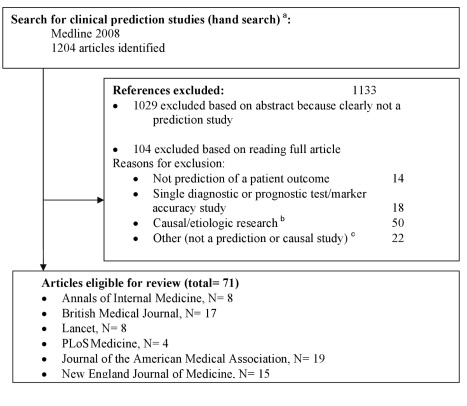
- Of 1,204 hand-searched articles, 71 met inclusion criteria: 51 were predictor-finding studies, 14 were model development studies (11 without and 3 with external validation), 3 were external validation studies, and 3 were impact studies; these 71 papers studied 135 models or sets of predictors.
- Statistical power was often inadequately reported: based on predictors in the final model, >10 events per variable occurred in 84 of 124 models, but candidate predictors were not described in the vast majority of studies; among studies clearly describing candidate predictors, effective sample size was <10 events per variable in 50% (n = 21) of presented models.
- Missing data occurrence or handling was not described or unclear in 38% of all studies; complete case analysis was used in 65% (45/71), while multiple imputation was used in 7% (5/71) per Table 7 (the text states 8% of all studies).
- Model performance and validation were limited: C-statistic/AUC-ROC was reported in 12% of predictor-finding and 80% of development/external-validation studies combined; calibration plots in 6% (4/66) and Hosmer-Lemeshow statistic in 9% (6/66); internal validation was performed in 33% (5/14) of model development studies, and external validation in only four studies.
Methods
- Systematic review by hand search of the six highest-impact general medicine journals for 2008: *The New England Journal of Medicine*, *The Lancet*, *JAMA*, *Annals of Internal Medicine*, *BMJ*, and *PLoS Medicine*; original research with an abstract was eligible, and two reviewers independently assessed eligibility and extracted data, with median inter-reviewer agreement of 92% (IQR 75%–100%).
- Included multivariable diagnostic and prognostic prediction studies predicting an outcome by two or more independent variables; excluded single predictor/test/marker studies, causality-only studies, and studies not contributing to patient care. An item list was developed from existing reporting statements/checklists (CONSORT, REMARK, STARD, STROBE, QUADAS) and prediction methodology recommendations.
- Studies were classified into five types: predictor finding, model development without external validation, model development with external validation, external validation without or with model updating, and model impact; results were grouped by study type, medical specialty, and whether prediction was a primary or secondary aim.
Limitations
- Stated: the review examined six high-impact journals, likely representing higher-quality studies; reporting may have improved since 2008, though the authors considered this unlikely because no major reporting guidelines for this research type had been produced recently; the work assessed reporting and statistical methods, not necessarily the appropriateness of design and conduct; conduct may be better than reported because journals limit paper length; poor reporting prevents readers from gauging relevance and reliability.
- Stated: statistical power or effective sample size could not be assessed for many studies because of inadequate reporting of the number of candidate predictors; selective reporting of outcomes and predictors could not generally be assessed because study registration is not mandated for prediction research.
- Evident from the text: the review is restricted to 2008 publications in six general medical journals, so findings may not generalize to other years, journals, or specialty journals; classification relied on full-text interpretation because authors generally did not explicitly state their aim, especially to distinguish predictor-finding from model-development studies.
Model-written summary. Check it against the paper before relying on it.
Integrity signals
Registry
Cites
Statistics
Figures
Verification
Claims the paper makes
71 Own result · 26 Not checked yet · 12 No basis given · 5 Own interpretation · 4 Own method · 1 Partly supported · accuracy not yet measured
The cited sources support only part of this claim — read each source’s verdict below.
In the paper
“Commonly missing values are related to observed participant or disease characteristics.”
§ Reporting and Methods in Clinical Prediction Research: A Systematic Review > Results > Missing Values
What the sources say
- Not checked yetcites [10] EW Steyerberg, 2009, Clinical prediction models: a practical approach to development, validation, and updating source
- Not checked yetcites [12] FE Harrell, 2001, Regression modeling strategies with applications to linear models, logistic regression and survival analysis
- Not checked yetcites [13] FE Harrell Jr, 1996, Multivariable prognostic models: issues in developing models, evaluating assumptions and adequacy, and measuring and reducing errors., Stat Med source
- Supportedcites [23] AR Donders, 2006, Review: a gentle introduction to imputation of missing values., J Clin Epidemiol source
Section 2, “Types of missing data,” says the probability of missingness commonly depends on observed patient characteristics. It gives disease status as an example of such an observed characteristic, directly supporting the claim. (LLM, conf=0.94)
- Not checked yetcites [24] S Greenland, 1995, A critical look at methods for handling missing covariates in epidemiologic regression analyses., Am J Epidemiol source
- Partly supportedcites [57] A Burton, 2004, Missing covariate data within cancer prognostic studies: a review of current reporting and proposed guidelines., Br J Cancer sourceExperimental — accuracy not yet measured
The Results section ('Exploration of the missing data mechanism'; page not provided) reports differences between patients with complete and missing data in seven articles, including comparisons of patient or clinical characteristics. But only 10 of the 100 reviewed articles examined such differences, so the paper does not establish that missingness is commonly related to observed participant or disease characteristics across studies. (LLM, conf=0.85)
- Not checked yetcites [58] MH Gorelick, 2006, Bias arising from missing data in predictive models., J Clin Epidemiol source
plaincorrelational- Asserted: passes — The authors put it forward as true.
- Checkable: passes — It can be checked against evidence.
- Load-bearing: passes — The paper’s conclusions depend on it.
- Based: passes — The paper gives a reason why it holds.
A result the paper reports from its own data — it cites no other source for it, so there is none to check. The quote shows it is in the paper.
In the paper
“Study recruitment dates were reported in 88% of the studies.”
§ Reporting and Methods in Clinical Prediction Research: A Systematic Review > Results > Participant Recruitment, Follow-Up, and Setting
plain- Asserted: passes — The authors put it forward as true.
- Checkable: passes — It can be checked against evidence.
- Load-bearing: unclear — It is unclear whether the paper’s conclusions depend on it.
- Based: passes — The paper gives a reason why it holds.
The paper states this without a source or data behind it here, so there is nothing to check it against. The quote shows it is in the paper.
In the paper
“11/68 studies had all cause mortality as the outcome, where such bias would not be a factor.”
§ Reporting and Methods in Clinical Prediction Research: A Systematic Review > Results > Outcome
plain- Asserted: passes — The authors put it forward as true.
- Checkable: passes — It can be checked against evidence.
- Load-bearing: unclear — It is unclear whether the paper’s conclusions depend on it.
- Based: passes — The paper gives a reason why it holds.
None of the sources cited for this claim have been checked yet.
In the paper
“Given this, effective sample size was sufficient in the majority of the external validation studies (9/13 models).”
§ Reporting and Methods in Clinical Prediction Research: A Systematic Review > Results > Statistical Power
plain- Asserted: passes — The authors put it forward as true.
- Checkable: passes — It can be checked against evidence.
- Load-bearing: unclear — It is unclear whether the paper’s conclusions depend on it.
- Based: passes — The paper gives a reason why it holds.
A result the paper reports from its own data — it cites no other source for it, so there is none to check. The quote shows it is in the paper.
In the paper
“Outcomes were well defined in 62/68 studies (Table 3).”
§ Reporting and Methods in Clinical Prediction Research: A Systematic Review > Results > Outcome
plain- Asserted: passes — The authors put it forward as true.
- Checkable: passes — It can be checked against evidence.
- Load-bearing: unclear — It is unclear whether the paper’s conclusions depend on it.
- Based: passes — The paper gives a reason why it holds.
A result the paper reports from its own data — it cites no other source for it, so there is none to check. The quote shows it is in the paper.
In the paper
“A number of studies predicted a combined endpoint (14/71).”
§ Reporting and Methods in Clinical Prediction Research: A Systematic Review > Results > Outcome
plain- Asserted: passes — The authors put it forward as true.
- Checkable: passes — It can be checked against evidence.
- Load-bearing: unclear — It is unclear whether the paper’s conclusions depend on it.
- Based: passes — The paper gives a reason why it holds.
A result the paper reports from its own data — it cites no other source for it, so there is none to check. The quote shows it is in the paper.
In the paper
“In the studies that clearly described the number of candidate predictors, the effective sample size was <10 events per variable in 50% (n = 21) of the presented models.”
§ Reporting and Methods in Clinical Prediction Research: A Systematic Review > Results > Statistical Power
plainn = 21- Asserted: passes — The authors put it forward as true.
- Checkable: passes — It can be checked against evidence.
- Load-bearing: passes — The paper’s conclusions depend on it.
- Based: passes — The paper gives a reason why it holds.
The paper states this without a source or data behind it here, so there is nothing to check it against. The quote shows it is in the paper.
In the paper
“Prediction of more than one outcome was very common in predictor finding studies, apparently because of their exploratory aim (Table S1).”
§ Reporting and Methods in Clinical Prediction Research: A Systematic Review > Results > Outcome
plain- Asserted: passes — The authors put it forward as true.
- Checkable: passes — It can be checked against evidence.
- Load-bearing: unclear — It is unclear whether the paper’s conclusions depend on it.
- Based: passes — The paper gives a reason why it holds.
A result the paper reports from its own data — it cites no other source for it, so there is none to check. The quote shows it is in the paper.
In the paper
“There were few multivariable diagnostic studies (n = 5).”
§ Reporting and Methods in Clinical Prediction Research: A Systematic Review > Results > Study Aims
plainn = 5- Asserted: passes — The authors put it forward as true.
- Checkable: passes — It can be checked against evidence.
- Load-bearing: unclear — It is unclear whether the paper’s conclusions depend on it.
- Based: passes — The paper gives a reason why it holds.
A result the paper reports from its own data — it cites no other source for it, so there is none to check. The quote shows it is in the paper.
In the paper
“Description of the cohort characteristics was clear in 68/69 of the relevant prediction studies (not applicable for two non-nested case-control studies).”
§ Reporting and Methods in Clinical Prediction Research: A Systematic Review > Results > Participant Recruitment, Follow-Up, and Setting
plain- Asserted: passes — The authors put it forward as true.
- Checkable: passes — It can be checked against evidence.
- Load-bearing: unclear — It is unclear whether the paper’s conclusions depend on it.
- Based: passes — The paper gives a reason why it holds.
- It may state two separate claims as one. 37
- Probably not a substantial claim. 13
A result the paper reports from its own data — it cites no other source for it, so there is none to check. The quote shows it is in the paper.
In the paper
“A randomized trial was used by two of the three impact studies; the third used an observational before-after (prospective) cohort design, comparing participant outcomes before and after the introduction of a prediction model.”
§ Reporting and Methods in Clinical Prediction Research: A Systematic Review > Results > Design of Participant Sampling
plain- Asserted: passes — The authors put it forward as true.
- Checkable: passes — It can be checked against evidence.
- Load-bearing: unclear — It is unclear whether the paper’s conclusions depend on it.
- Based: passes — The paper gives a reason why it holds.
It may state two separate claims as one.
A result the paper reports from its own data — it cites no other source for it, so there is none to check. The quote shows it is in the paper.
In the paper
“Of the prediction modelling studies (n = 20), the vast majority were model development studies, without (n = 11) or with (n = 3) external validation.”
§ Reporting and Methods in Clinical Prediction Research: A Systematic Review > Results > Study Aims
plainn = 20- Asserted: passes — The authors put it forward as true.
- Checkable: passes — It can be checked against evidence.
- Load-bearing: unclear — It is unclear whether the paper’s conclusions depend on it.
- Based: passes — The paper gives a reason why it holds.
It may state two separate claims as one.
A result the paper reports from its own data — it cites no other source for it, so there is none to check. The quote shows it is in the paper.
In the paper
“Predictor interaction (non-additivity) was tested in 25 of the 51 predictor finding studies and in 11 of the 14 model development studies (total n = 36).”
§ Reporting and Methods in Clinical Prediction Research: A Systematic Review > Results > Candidate Predictors
plainn = 36- Asserted: passes — The authors put it forward as true.
- Checkable: passes — It can be checked against evidence.
- Load-bearing: unclear — It is unclear whether the paper’s conclusions depend on it.
- Based: passes — The paper gives a reason why it holds.
It may state two separate claims as one.
A result the paper reports from its own data — it cites no other source for it, so there is none to check. The quote shows it is in the paper.
In the paper
“Pure external validation (n = 3) and impact studies (n = 3) were rare.”
§ Reporting and Methods in Clinical Prediction Research: A Systematic Review > Results > Study Aims
plainn = 3- Asserted: passes — The authors put it forward as true.
- Checkable: passes — It can be checked against evidence.
- Load-bearing: unclear — It is unclear whether the paper’s conclusions depend on it.
- Based: passes — The paper gives a reason why it holds.
It may state two separate claims as one.
A result the paper reports from its own data — it cites no other source for it, so there is none to check. The quote shows it is in the paper.
In the paper
“Whether (all) consecutive participants were included or how many participants refused to participate was rarely reported and so could not be evaluated.”
§ Reporting and Methods in Clinical Prediction Research: A Systematic Review > Results > Participant Recruitment, Follow-Up, and Setting
plain- Asserted: passes — The authors put it forward as true.
- Checkable: passes — It can be checked against evidence.
- Load-bearing: unclear — It is unclear whether the paper’s conclusions depend on it.
- Based: passes — The paper gives a reason why it holds.
It may state two separate claims as one.
A result the paper reports from its own data — it cites no other source for it, so there is none to check. The quote shows it is in the paper.
In the paper
“In outcome reporting, we expected differences between studies with prediction as a primary versus a secondary aim, but this was not observed.”
§ Reporting and Methods in Clinical Prediction Research: A Systematic Review > Results > Outcome
plain- Asserted: passes — The authors put it forward as true.
- Checkable: passes — It can be checked against evidence.
- Load-bearing: unclear — It is unclear whether the paper’s conclusions depend on it.
- Based: passes — The paper gives a reason why it holds.
It may state two separate claims as one.
A result the paper reports from its own data — it cites no other source for it, so there is none to check. The quote shows it is in the paper.
In the paper
“We identified 1,204 articles by hand searching, of which 71 met the inclusion criteria (Figure 1 and Text S2).”
§ Reporting and Methods in Clinical Prediction Research: A Systematic Review > Results
plain- Asserted: passes — The authors put it forward as true.
- Checkable: passes — It can be checked against evidence.
- Load-bearing: passes — The paper’s conclusions depend on it.
- Based: passes — The paper gives a reason why it holds.
It may state two separate claims as one.
A result the paper reports from its own data — it cites no other source for it, so there is none to check. The quote shows it is in the paper.
In the paper
“Authors in general did not explicitly state their aim, so we used full text interpretations to classify studies as predictor finding or model development studies.”
§ Reporting and Methods in Clinical Prediction Research: A Systematic Review > Results > Data Extraction and Reviewer Agreement
plaindirect- Asserted: passes — The authors put it forward as true.
- Checkable: passes — It can be checked against evidence.
- Load-bearing: fails — The paper’s conclusions may not depend on it.
- Based: passes — The paper gives a reason why it holds.
Probably not a substantial claim. The paper’s conclusions may not depend on it. It may state two separate claims as one.
A result the paper reports from its own data — it cites no other source for it, so there is none to check. The quote shows it is in the paper.
In the paper
“Discrimination was assessed with the C-statistic or area under the receiver operating characteristic (ROC) curve in 12% of the predictor finding and, as expected, 80% of the model development and external validation studies.”
§ Reporting and Methods in Clinical Prediction Research: A Systematic Review > Results > Model Performance and Internal and External Validity
plain- Asserted: passes — The authors put it forward as true.
- Checkable: passes — It can be checked against evidence.
- Load-bearing: unclear — It is unclear whether the paper’s conclusions depend on it.
- Based: passes — The paper gives a reason why it holds.
It may state two separate claims as one.
A result the paper reports from its own data — it cites no other source for it, so there is none to check. The quote shows it is in the paper.
In the paper
“The majority, 65% of the predictor finding and 79% of the model development studies, reported the predictor coefficients or effect estimates of the model after predictor selection (the final model).”
§ Reporting and Methods in Clinical Prediction Research: A Systematic Review > Results > Presentation of Results
plain- Asserted: passes — The authors put it forward as true.
- Checkable: passes — It can be checked against evidence.
- Load-bearing: passes — The paper’s conclusions depend on it.
- Based: passes — The paper gives a reason why it holds.
It may state two separate claims as one.
A result the paper reports from its own data — it cites no other source for it, so there is none to check. The quote shows it is in the paper.
In the paper
“By comparison, multiple imputation, the most rigorous strategy for dealing with missing values, was used in only 8% of all studies.”
- Also stated in: § Discussion · hedged
“Recommended methods, such as multiple imputation, were applied and reported in very few studies, although this may be due to the fact that consensus in recommending these methods was arrived at only recently.”
§ Reporting and Methods in Clinical Prediction Research: A Systematic Review > Results > Missing Values
plain- Asserted: passes — The authors put it forward as true.
- Checkable: passes — It can be checked against evidence.
- Load-bearing: passes — The paper’s conclusions depend on it.
- Based: passes — The paper gives a reason why it holds.
It may state two separate claims as one.
- Also stated in: § Discussion · hedged
The paper states this without a source or data behind it here, so there is nothing to check it against. The quote shows it is in the paper.
In the paper
“In descriptions of participant selection, it often remained unclear whether participants were included in an unbiased way, notably with respect to refusals and whether all consecutive eligible participants were included.”
§ Reporting and Methods in Clinical Prediction Research: A Systematic Review > Discussion
plain- Asserted: passes — The authors put it forward as true.
- Checkable: passes — It can be checked against evidence.
- Load-bearing: passes — The paper’s conclusions depend on it.
- Based: passes — The paper gives a reason why it holds.
It may state two separate claims as one.
A result the paper reports from its own data — it cites no other source for it, so there is none to check. The quote shows it is in the paper.
In the paper
“and external validation in only four studies.”
- Also stated in: § Discussion · plain
“Similarly, only a very few model development studies reported an external validation of the model in the same paper.”
§ Reporting and Methods in Clinical Prediction Research: A Systematic Review > Results > Model Performance and Internal and External Validity
plain- Asserted: passes — The authors put it forward as true.
- Checkable: passes — It can be checked against evidence.
- Load-bearing: passes — The paper’s conclusions depend on it.
- Based: passes — The paper gives a reason why it holds.
It may state two separate claims as one.
- Also stated in: § Discussion · plain
A result the paper reports from its own data — it cites no other source for it, so there is none to check. The quote shows it is in the paper.
In the paper
“External validation and model impact studies were rare (n = 6).”
- Also stated in: § Discussion · plain
“Only a very small minority of the papers involved the most useful approaches in predicting participant clinical outcomes, namely, external validations or impact assessments of a previously developed prediction model.”
§ Reporting and Methods in Clinical Prediction Research: A Systematic Review > Discussion
plainn = 6- Asserted: passes — The authors put it forward as true.
- Checkable: passes — It can be checked against evidence.
- Load-bearing: passes — The paper’s conclusions depend on it.
- Based: passes — The paper gives a reason why it holds.
It may state two separate claims as one.
- Also stated in: § Discussion · plain
A result the paper reports from its own data — it cites no other source for it, so there is none to check. The quote shows it is in the paper.
In the paper
“Study design, participant selection, definitions of outcomes and predictors, and predictor selection were generally well reported.”
§ Reporting and Methods in Clinical Prediction Research: A Systematic Review > Discussion
plain- Asserted: passes — The authors put it forward as true.
- Checkable: passes — It can be checked against evidence.
- Load-bearing: unclear — It is unclear whether the paper’s conclusions depend on it.
- Based: passes — The paper gives a reason why it holds.
It may state two separate claims as one.
A result the paper reports from its own data — it cites no other source for it, so there is none to check. The quote shows it is in the paper.
In the paper
“18% of all studies investigated the added value of specific predictors, and 42% included predictors regardless of statistical significance.”
§ Reporting and Methods in Clinical Prediction Research: A Systematic Review > Results > Selection of Candidate and Final Predictors
plain- Asserted: passes — The authors put it forward as true.
- Checkable: passes — It can be checked against evidence.
- Load-bearing: unclear — It is unclear whether the paper’s conclusions depend on it.
- Based: passes — The paper gives a reason why it holds.
It may state two separate claims as one.
A result the paper reports from its own data — it cites no other source for it, so there is none to check. The quote shows it is in the paper.
In the paper
“Analysis of participants with complete data (i.e., complete case analysis) was performed in the vast majority of studies.”
- Also stated in: § Discussion · plain
“Complete case analysis was by far the most commonly used approach to handle missing values, despite many methodological recommendations to do otherwise [10],[12],[13],[23],[24],[57],[58].”
§ Reporting and Methods in Clinical Prediction Research: A Systematic Review > Results > Missing Values
plain- Asserted: passes — The authors put it forward as true.
- Checkable: passes — It can be checked against evidence.
- Load-bearing: passes — The paper’s conclusions depend on it.
- Based: passes — The paper gives a reason why it holds.
It may state two separate claims as one.
- Also stated in: § Discussion · plain
A result the paper reports from its own data — it cites no other source for it, so there is none to check. The quote shows it is in the paper.
In the paper
“The most commonly reported criterion for predictor selection in multivariable models was a p-value of <0.05, used in 18% of all studies (and in 26% of the studies that indeed applied predictor selection in multivariable analyses).”
§ Reporting and Methods in Clinical Prediction Research: A Systematic Review > Results > Selection of Candidate and Final Predictors
plain- Asserted: passes — The authors put it forward as true.
- Checkable: passes — It can be checked against evidence.
- Load-bearing: unclear — It is unclear whether the paper’s conclusions depend on it.
- Based: passes — The paper gives a reason why it holds.
It may state two separate claims as one.
A result the paper reports from its own data — it cites no other source for it, so there is none to check. The quote shows it is in the paper.
In the paper
“Our investigation found that among the 71 prediction studies identified, the vast majority were predictor finding studies (n = 51), followed by model development studies (n = 14).”
§ Reporting and Methods in Clinical Prediction Research: A Systematic Review > Discussion
plainn = 51- Asserted: passes — The authors put it forward as true.
- Checkable: passes — It can be checked against evidence.
- Load-bearing: unclear — It is unclear whether the paper’s conclusions depend on it.
- Based: passes — The paper gives a reason why it holds.
It may state two separate claims as one.
A result the paper reports from its own data — it cites no other source for it, so there is none to check. The quote shows it is in the paper.
In the paper
“We found that 14 studies developed new prediction models (of which three included an external validation).”
§ Reporting and Methods in Clinical Prediction Research: A Systematic Review > Discussion
plainn = 14- Asserted: passes — The authors put it forward as true.
- Checkable: passes — It can be checked against evidence.
- Load-bearing: passes — The paper’s conclusions depend on it.
- Based: passes — The paper gives a reason why it holds.
It may state two separate claims as one.
A result the paper reports from its own data — it cites no other source for it, so there is none to check. The quote shows it is in the paper.
In the paper
“Three studies externally validated models, and three investigated the impact of an existing prediction model.”
§ Reporting and Methods in Clinical Prediction Research: A Systematic Review > Discussion
plain- Asserted: passes — The authors put it forward as true.
- Checkable: passes — It can be checked against evidence.
- Load-bearing: unclear — It is unclear whether the paper’s conclusions depend on it.
- Based: passes — The paper gives a reason why it holds.
It may state two separate claims as one.
A result the paper reports from its own data — it cites no other source for it, so there is none to check. The quote shows it is in the paper.
In the paper
“Studies reported using backward selection in 17% of the primary-aim and 18% of the secondary-aim studies, whereas forward selection was reported in 6% and 0%, respectively.”
§ Reporting and Methods in Clinical Prediction Research: A Systematic Review > Results > Selection of Candidate and Final Predictors
plain- Asserted: passes — The authors put it forward as true.
- Checkable: passes — It can be checked against evidence.
- Load-bearing: unclear — It is unclear whether the paper’s conclusions depend on it.
- Based: passes — The paper gives a reason why it holds.
It may state two separate claims as one.
A result the paper reports from its own data — it cites no other source for it, so there is none to check. The quote shows it is in the paper.
In the paper
“In studies with prediction as the primary aim, the majority (71%) selected their candidate predictors based on existing literature, whereas this was less often the case (29%) in studies with prediction as a secondary aim.”
§ Reporting and Methods in Clinical Prediction Research: A Systematic Review > Results > Selection of Candidate and Final Predictors
plaincorrelational- Asserted: passes — The authors put it forward as true.
- Checkable: passes — It can be checked against evidence.
- Load-bearing: unclear — It is unclear whether the paper’s conclusions depend on it.
- Based: passes — The paper gives a reason why it holds.
It may state two separate claims as one.
A result the paper reports from its own data — it cites no other source for it, so there is none to check. The quote shows it is in the paper.
In the paper
“Internal validation was performed in 33% (n = 5) of the 14 model development studies”
- Also stated in: § Discussion · plain
“but use of these techniques was rare.”
§ Reporting and Methods in Clinical Prediction Research: A Systematic Review > Results > Model Performance and Internal and External Validity
plainn = 5- Asserted: passes — The authors put it forward as true.
- Checkable: passes — It can be checked against evidence.
- Load-bearing: passes — The paper’s conclusions depend on it.
- Based: passes — The paper gives a reason why it holds.
It may state two separate claims as one.
- Also stated in: § Discussion · plain
A result the paper reports from its own data — it cites no other source for it, so there is none to check. The quote shows it is in the paper.
In the paper
“Pre-selection of candidate predictors for inclusion in the multivariable analyses based on univariable predictor–outcome associations was used in 13% of the primary-aim and in 24% of the secondary-aim prediction studies.”
§ Reporting and Methods in Clinical Prediction Research: A Systematic Review > Results > Selection of Candidate and Final Predictors
plain- Asserted: passes — The authors put it forward as true.
- Checkable: passes — It can be checked against evidence.
- Load-bearing: unclear — It is unclear whether the paper’s conclusions depend on it.
- Based: passes — The paper gives a reason why it holds.
It may state two separate claims as one.
A result the paper reports from its own data — it cites no other source for it, so there is none to check. The quote shows it is in the paper.
In the paper
“We found that selection of candidate predictors was described for 36 (75%) of the studies where prediction was the primary aim and for eight (47%) of the studies where prediction was a secondary aim (Table 6).”
§ Reporting and Methods in Clinical Prediction Research: A Systematic Review > Results > Selection of Candidate and Final Predictors
plain- Asserted: passes — The authors put it forward as true.
- Checkable: passes — It can be checked against evidence.
- Load-bearing: passes — The paper’s conclusions depend on it.
- Based: passes — The paper gives a reason why it holds.
It may state two separate claims as one.
A result the paper reports from its own data — it cites no other source for it, so there is none to check. The quote shows it is in the paper.
In the paper
“However, sample size considerations, applied statistical methods, and procedures for dealing with missing data were poorly reported despite being highlighted in several reporting guidelines.”
§ Reporting and Methods in Clinical Prediction Research: A Systematic Review > Discussion
plain- Asserted: passes — The authors put it forward as true.
- Checkable: passes — It can be checked against evidence.
- Load-bearing: passes — The paper’s conclusions depend on it.
- Based: passes — The paper gives a reason why it holds.
It may state two separate claims as one.
- Rests on an assumption: The statistical methods reported in the published prediction studies reflect the methods actually used in those studies.
The paper states this without a source or data behind it here, so there is nothing to check it against. The quote shows it is in the paper.
In the paper
“Most studies reported the occurrence of missing data but did not report sufficient detail.”
§ Reporting and Methods in Clinical Prediction Research: A Systematic Review > Discussion
plain- Asserted: passes — The authors put it forward as true.
- Checkable: passes — It can be checked against evidence.
- Load-bearing: passes — The paper’s conclusions depend on it.
- Based: passes — The paper gives a reason why it holds.
It may state two separate claims as one.
A result the paper reports from its own data — it cites no other source for it, so there is none to check. The quote shows it is in the paper.
In the paper
“C-statistics or area under the ROC curves were the most frequently reported discrimination statistics, whereas measures of calibration (such as calibration slope) and overall measures of fit were rarely reported.”
§ Reporting and Methods in Clinical Prediction Research: A Systematic Review > Discussion
plain- Asserted: passes — The authors put it forward as true.
- Checkable: passes — It can be checked against evidence.
- Load-bearing: passes — The paper’s conclusions depend on it.
- Based: passes — The paper gives a reason why it holds.
It may state two separate claims as one.
A result the paper reports from its own data — it cites no other source for it, so there is none to check. The quote shows it is in the paper.
In the paper
“However, encouraging findings included the frequent use of prospective studies, and adequate description of participant selection, predictor and outcome definitions, and the process for (pre)selection of candidate predictors.”
§ Reporting and Methods in Clinical Prediction Research: A Systematic Review > Discussion
plain- Asserted: passes — The authors put it forward as true.
- Checkable: passes — It can be checked against evidence.
- Load-bearing: passes — The paper’s conclusions depend on it.
- Based: passes — The paper gives a reason why it holds.
It may state two separate claims as one.
What the paper did — it cites no source for this, so there is none to check. The quote shows it is in the paper.
In the paper
“Two authors (W. B., N. P. A. Z.) independently extracted the data. In case of doubt, items were discussed with a third and fourth reviewer (K. G. M. M., Y. V.).”
§ Reporting and Methods in Clinical Prediction Research: A Systematic Review > Methods > Data Extraction
plain- Asserted: passes — The authors put it forward as true.
- Checkable: passes — It can be checked against evidence.
- Load-bearing: fails — The paper’s conclusions may not depend on it.
- Based: passes — The paper gives a reason why it holds.
Probably not a substantial claim. The paper’s conclusions may not depend on it. It may state two separate claims as one.
None of the sources cited for this claim have been checked yet.
In the paper
“However, many methodological reports have shown that selection based on (significant) univariable predictor–outcome associations is not recommended, as this method increases the chance of biased results in terms of spurious predictors and overfitted and unstable models [12],[13],[43],[56].”
§ Reporting and Methods in Clinical Prediction Research: A Systematic Review > Results > Selection of Candidate and Final Predictors
What the sources say
- Not checked yetcites [12] FE Harrell, 2001, Regression modeling strategies with applications to linear models, logistic regression and survival analysis
- Not checked yetcites [13] FE Harrell Jr, 1996, Multivariable prognostic models: issues in developing models, evaluating assumptions and adequacy, and measuring and reducing errors., Stat Med source
- Not checked yetcites [43] EW Steyerberg, 2001, Internal validation of predictive models: efficiency of some procedures for logistic regression analysis., J Clin Epidemiol source
boosteddirect- Asserted: passes — The authors put it forward as true.
- Checkable: passes — It can be checked against evidence.
- Load-bearing: passes — The paper’s conclusions depend on it.
- Based: passes — The paper gives a reason why it holds.
It may state two separate claims as one.
In the paper
“To externally validate a prediction model, a minimum effective sample size of 100 participants with and 100 without the event has been recommended [55].”
§ Reporting and Methods in Clinical Prediction Research: A Systematic Review > Results > Statistical Power
What the sources say
- Not checked yetcites [55] Y Vergouwe, 2005, Substantial effective sample sizes were required for external validation studies of predictive logistic regression models., J Clin Epidemiol source
plainn = 100- Asserted: passes — The authors put it forward as true.
- Checkable: passes — It can be checked against evidence.
- Load-bearing: passes — The paper’s conclusions depend on it.
- Based: passes — The paper gives a reason why it holds.
Probably not a substantial claim.
None of the sources cited for this claim have been checked yet.
In the paper
“A frequently mentioned rule of thumb is “10 events needed per candidate predictor” [12],[25],[26],[30],[54].”
§ Reporting and Methods in Clinical Prediction Research: A Systematic Review > Results > Statistical Power
What the sources say
- Not checked yetcites [12] FE Harrell, 2001, Regression modeling strategies with applications to linear models, logistic regression and survival analysis
- Not checked yetcites [25] P Peduzzi, 1996, A simulation study of the number of events per variable in logistic regression analysis., J Clin Epidemiol source
- Not checked yetcites [26] P Peduzzi, 1995, Importance of events per independent variable in proportional hazards regression analysis. II. Accuracy and precision of regression estimates., J Clin Epidemiol source
plain- Asserted: passes — The authors put it forward as true.
- Checkable: passes — It can be checked against evidence.
- Load-bearing: fails — The paper’s conclusions may not depend on it.
- Based: passes — The paper gives a reason why it holds.
Probably not a substantial claim. The paper’s conclusions may not depend on it.
In the paper
“a practice that is not recommended because less accurate predictions are likely to result, as with dichotomizing predictor variables [50].”
§ Reporting and Methods in Clinical Prediction Research: A Systematic Review > Results > Outcome
What the sources say
- Not checked yetcites [50] P Royston, 2006, Dichotomizing continuous predictors in multiple regression: a bad idea., Stat Med source
hedgeddirect- Asserted: passes — The authors put it forward as true.
- Checkable: passes — It can be checked against evidence.
- Load-bearing: passes — The paper’s conclusions depend on it.
- Based: passes — The paper gives a reason why it holds.
Probably not a substantial claim.
None of the sources cited for this claim have been checked yet.
In the paper
“Adequate reporting of predictor selection methods used is important, because the number of candidate predictors and how they were selected at various stages of the study can both influence the specific predictors included in the final multivariable model, and thus affect the interpretation of the results 12,13,43,56.”
§ Reporting and Methods in Clinical Prediction Research: A Systematic Review > Results > Selection of Candidate and Final Predictors
What the sources say
- Not checked yetcites [12] FE Harrell, 2001, Regression modeling strategies with applications to linear models, logistic regression and survival analysis
- Not checked yetcites [13] FE Harrell Jr, 1996, Multivariable prognostic models: issues in developing models, evaluating assumptions and adequacy, and measuring and reducing errors., Stat Med source
- Not checked yetcites [43] EW Steyerberg, 2001, Internal validation of predictive models: efficiency of some procedures for logistic regression analysis., J Clin Epidemiol source
plaindirect- Asserted: passes — The authors put it forward as true.
- Checkable: passes — It can be checked against evidence.
- Load-bearing: passes — The paper’s conclusions depend on it.
- Based: passes — The paper gives a reason why it holds.
It may state two separate claims as one.
What the paper did — it cites no source for this, so there is none to check. The quote shows it is in the paper.
In the paper
“The two reviewers agreed on a median of 92% (interquartile range 75%–100%) of the items extracted.”
§ Reporting and Methods in Clinical Prediction Research: A Systematic Review > Results > Data Extraction and Reviewer Agreement
plain- Asserted: passes — The authors put it forward as true.
- Checkable: passes — It can be checked against evidence.
- Load-bearing: fails — The paper’s conclusions may not depend on it.
- Based: passes — The paper gives a reason why it holds.
Probably not a substantial claim. The paper’s conclusions may not depend on it.
What the paper did — it cites no source for this, so there is none to check. The quote shows it is in the paper.
In the paper
“The full text of all thus selected studies was obtained, and two authors (W. B. and N. P. A. Z.) independently assessed eligibility; in case of doubt a third independent reader was involved (K. G. M. M. or Y. V.).”
§ Reporting and Methods in Clinical Prediction Research: A Systematic Review > Methods > Literature Search
plain- Asserted: passes — The authors put it forward as true.
- Checkable: passes — It can be checked against evidence.
- Load-bearing: fails — The paper’s conclusions may not depend on it.
- Based: passes — The paper gives a reason why it holds.
Probably not a substantial claim. The paper’s conclusions may not depend on it. It may state two separate claims as one.
What the paper did — it cites no source for this, so there is none to check. The quote shows it is in the paper.
In the paper
“The inter-reviewer agreement on the data extraction was assessed by calculating the percentage of overall agreement between the two reviewers.”
§ Reporting and Methods in Clinical Prediction Research: A Systematic Review > Methods > Data Extraction
plain- Asserted: passes — The authors put it forward as true.
- Checkable: passes — It can be checked against evidence.
- Load-bearing: fails — The paper’s conclusions may not depend on it.
- Based: passes — The paper gives a reason why it holds.
Probably not a substantial claim. The paper’s conclusions may not depend on it.
The paper states this without a source or data behind it here, so there is nothing to check it against. The quote shows it is in the paper.
In the paper
“Imputation, notably multiple imputation, of missing values is often advocated to preserve power and obtain less biased results, on the assumption that the reason for the missing data is not entirely due to non-observed information (i.e., data are not “missing not at random”).”
§ Reporting and Methods in Clinical Prediction Research: A Systematic Review > Results > Missing Values
plainconditional- Asserted: passes — The authors put it forward as true.
- Checkable: passes — It can be checked against evidence.
- Load-bearing: fails — The paper’s conclusions may not depend on it.
- Based: passes — The paper gives a reason why it holds.
Probably not a substantial claim. The paper’s conclusions may not depend on it.
- The authors state this as an assumption: The reason for missing data is not entirely due to non-observed information (data are not missing not at random) when multiple imputation is used.
None of the sources cited for this claim have been checked yet.
In the paper
“Various reports have indicated that in prediction modelling research there is an unfortunate practice of developing new models instead of externally validating or updating existing models [8]–[10],[15],[29],[36],[48].”
§ Reporting and Methods in Clinical Prediction Research: A Systematic Review > Discussion
What the sources say
- Not checked yetcites [8]–[10]
- Not checked yetcites [15] A Laupacis, 1997, Clinical prediction rules. a review and suggested modifications of methodological standards., JAMA source
- Not checked yetcites [29] JH Wasson, 1985, Clinical prediction rules. Applications and methodological standards., N Engl J Med source
hedged- Asserted: passes — The authors put it forward as true.
- Checkable: passes — It can be checked against evidence.
- Load-bearing: fails — The paper’s conclusions may not depend on it.
- Based: passes — The paper gives a reason why it holds.
Probably not a substantial claim. The paper’s conclusions may not depend on it.
None of the sources cited for this claim have been checked yet.
In the paper
“Exclusion of participants with missing values will therefore not only lead to loss of statistical power, but often also to biased results 10,12,13,23,24,57,58.”
§ Reporting and Methods in Clinical Prediction Research: A Systematic Review > Results > Missing Values
What the sources say
- Not checked yetcites [10] EW Steyerberg, 2009, Clinical prediction models: a practical approach to development, validation, and updating source
- Not checked yetcites [12] FE Harrell, 2001, Regression modeling strategies with applications to linear models, logistic regression and survival analysis
- Not checked yetcites [13] FE Harrell Jr, 1996, Multivariable prognostic models: issues in developing models, evaluating assumptions and adequacy, and measuring and reducing errors., Stat Med source
- Not checked yetcites [23] AR Donders, 2006, Review: a gentle introduction to imputation of missing values., J Clin Epidemiol source
- Not checked yetcites [24] S Greenland, 1995, A critical look at methods for handling missing covariates in epidemiologic regression analyses., Am J Epidemiol source
- Not checked yetcites [57] A Burton, 2004, Missing covariate data within cancer prognostic studies: a review of current reporting and proposed guidelines., Br J Cancer source
- Not checked yetcites [58] MH Gorelick, 2006, Bias arising from missing data in predictive models., J Clin Epidemiol source
plaindirect- Asserted: passes — The authors put it forward as true.
- Checkable: passes — It can be checked against evidence.
- Load-bearing: passes — The paper’s conclusions depend on it.
- Based: passes — The paper gives a reason why it holds.
It may state two separate claims as one.
None of the sources cited for this claim have been checked yet.
In the paper
“These items have been identified as important in several well-known guidelines for reporting of clinical research [4],[38]–[41].”
§ Reporting and Methods in Clinical Prediction Research: A Systematic Review > Discussion
What the sources say
- Not checked yetcites [4] LM McShane, 2005, Reporting recommendations for tumor marker prognostic studies (REMARK)., J Natl Cancer Inst source
- Not checked yetcites [38]–[41]
boosted- Asserted: passes — The authors put it forward as true.
- Checkable: passes — It can be checked against evidence.
- Load-bearing: fails — The paper’s conclusions may not depend on it.
- Based: passes — The paper gives a reason why it holds.
Probably not a substantial claim. The paper’s conclusions may not depend on it.
None of the sources cited for this claim have been checked yet.
In the paper
“Poor reporting of sample size rationale has also been observed by others [3],[21],[68].”
§ Reporting and Methods in Clinical Prediction Research: A Systematic Review > Discussion
What the sources say
- Not checked yetcites [3] DG Altman, 1998, Methodological challenges in the evaluation of prognostic factors in breast cancer., Breast Cancer Res Treat source
- Not checked yetcites [21] S Mallett, 2010, Reporting methods in studies developing prognostic models in cancer: a review., BMC Med source
- Not checked yetcites [68] LM Bachmann, 2006, Sample sizes of studies on diagnostic accuracy: literature survey., BMJ source
plain- Asserted: passes — The authors put it forward as true.
- Checkable: passes — It can be checked against evidence.
- Load-bearing: fails — The paper’s conclusions may not depend on it.
- Based: passes — The paper gives a reason why it holds.
Probably not a substantial claim. The paper’s conclusions may not depend on it.
A conclusion the paper draws from its own results — it cites no other source for it, so there is none to check. The quote shows it is in the paper.
In the paper
“To conclude, we identified poor reporting and poor methods in many published prediction studies, which limits the reliability and applicability of the published findings.”
§ Reporting and Methods in Clinical Prediction Research: A Systematic Review > Discussion
plaindirect- Asserted: passes — The authors put it forward as true.
- Checkable: passes — It can be checked against evidence.
- Load-bearing: passes — The paper’s conclusions depend on it.
- Based: passes — The paper gives a reason why it holds.
It may state two separate claims as one.
- Rests on an assumption: The 71 prediction studies published in six high-impact general medical journals in 2008 are representative of current clinical prediction research.
- Rests on an assumption: The statistical methods reported in the published prediction studies reflect the methods actually used in those studies.
None of the sources cited for this claim have been checked yet.
In the paper
“This apparent model performance, however, is generally too optimistic, as the model has been tailored to the dataset at hand.”
§ Reporting and Methods in Clinical Prediction Research: A Systematic Review > Discussion
What the sources say
- Not checked yetcites [10] EW Steyerberg, 2009, Clinical prediction models: a practical approach to development, validation, and updating source
- Not checked yetcites [12] FE Harrell, 2001, Regression modeling strategies with applications to linear models, logistic regression and survival analysis
- Not checked yetcites [70] JC Van Houwelingen, 1990, Predictive value of statistical models., Stat Med source
plaindirect- Asserted: passes — The authors put it forward as true.
- Checkable: passes — It can be checked against evidence.
- Load-bearing: passes — The paper’s conclusions depend on it.
- Based: passes — The paper gives a reason why it holds.
It may state two separate claims as one.
In the paper
“The REMARK guidelines for prognostic tumour marker studies recommend using a REMARK profile table instead of a flow diagram [69].”
§ Reporting and Methods in Clinical Prediction Research: A Systematic Review > Discussion
What the sources say
- Not checked yetcites [69] S Mallett, 2010, Reporting of prognostic studies of tumour markers: a review of published articles in relation to REMARK guidelines., Br J Cancer source
plain- Asserted: passes — The authors put it forward as true.
- Checkable: passes — It can be checked against evidence.
- Load-bearing: fails — The paper’s conclusions may not depend on it.
- Based: passes — The paper gives a reason why it holds.
Probably not a substantial claim. The paper’s conclusions may not depend on it.
The paper relies on this without support.
Study registration is not mandated for prediction research.
“study registration is not mandated for prediction research”
The authors state this as an assumption.
The reason for missing data is not entirely due to non-observed information (data are not missing not at random) when multiple imputation is used.
“on the assumption that the reason for the missing data is not entirely due to non-observed information (i.e., data are not “missing not at random”).”
The paper relies on this without support.
The 71 prediction studies published in six high-impact general medical journals in 2008 are representative of current clinical prediction research.
“We assessed the reporting and methods in all clinical prediction studies published in six high-impact general medical journals in 2008.”
“We have described the state of current prediction research, and highlighted aspects that clearly need improvement.”
The paper relies on this without support.
The statistical methods reported in the published prediction studies reflect the methods actually used in those studies.
“We note that our work assessed researchers' reporting and statistical methods in modelling, and not necessarily the appropriateness of the design and conduct of the studies.”
Claims other papers make about this one
Each is checked against this paper’s own text: does it say what the citing paper says it does?
The cited source says what the claim attributes to it.
In the citing paper
“However, the overwhelming evidence shows that the quality of reporting of prediction model studies is poor.”
From Transparent Reporting of a Multivariable Prediction Model for Individual Prognosis or Diagnosis (TRIPOD): The TRIPOD Statement (2015) · cites this paper as [23]
In the citing paper
“Bouwmeester and colleagues [23] evaluated 71 reports, published in 2008 in 6 high-impact general medical journals, and likewise observed an overwhelmingly poor level of reporting.”
From Transparent reporting of a multivariable prediction model for individual prognosis or diagnosis (TRIPOD): the TRIPOD Statement (2015) · cites this paper as [23]
In the citing paper
“Many reviews have showed that the quality of reporting in published articles describing the development or validation of multivariable prediction models in medicine is poor [23–27,29].”
From Transparent reporting of a multivariable prediction model for individual prognosis or diagnosis (TRIPOD): the TRIPOD Statement (2015) · cites this paper as [23]
In the citing paper
“Unfortunately, extraction of calibration measures is often hampered by poor assessment and reporting.11,16”
From A framework for meta-analysis of prediction model studies with binary and time-to-event outcomes (2019) · cites this paper as [16]
In the citing paper
“In a meta-analysis without access to individual participant data (IPD), we are reliant on extracting these performance measures from study publications. However, they are often poorly reported.”
From A framework for meta-analysis of prediction model studies with binary and time-to-event outcomes (2019) · cites this paper as [16]
In the citing paper
“For instance, validation studies rarely present information on the calibration intercept and slope, or different studies report estimates for different risk strata or time horizons.”
From A framework for meta-analysis of prediction model studies with binary and time-to-event outcomes (2019) · cites this paper as [16]
In the citing paper
“Bouwmeester and colleagues23 evaluated 71 reports, published in 2008 in 6 high-impact general medical journals, and likewise observed an overwhelmingly poor level of reporting.”
From Transparent Reporting of a Multivariable Prediction Model for Individual Prognosis or Diagnosis (TRIPOD): The TRIPOD Statement (2015) · cites this paper as [23]
In the citing paper
“Many reviews have showed that the quality of reporting in published articles describing the development or validation of multivariable prediction models in medicine is poor.23–27,29”
From Transparent Reporting of a Multivariable Prediction Model for Individual Prognosis or Diagnosis (TRIPOD): The TRIPOD Statement (2015) · cites this paper as [23]
Self-check
Percentages, sums and reported differences re-computed from the paper’s own numbers.
Each contradiction between two passages listed here was confirmed by an independent check.
Rated minor: it would not touch a result — a value no result rests on, a p-value that stays on the same side of the significance level, or a conflict that is clerical, resolved elsewhere in the paper, or outside its own findings.
In the paper
“| Similar predictors combinedd | 17 (8) | 6 (1) | 11 (7) |”
§ Reporting and Methods in Clinical Prediction Research: A Systematic Review > Results > Selection of Candidate and Final Predictors
Reported 7 · recomputed 9
Rated minor: it would not touch a result — a value no result rests on, a p-value that stays on the same side of the significance level, or a conflict that is clerical, resolved elsewhere in the paper, or outside its own findings.
In the paper
“| Not reported or unclear | 35 (18) | 53 (9) | 0 (0) | 0 (0) | 38 (27) |”
§ Reporting and Methods in Clinical Prediction Research: A Systematic Review > Results > Missing Values
Reported 35 · recomputed 37.5
Rated minor: it would not touch a result — a value no result rests on, a p-value that stays on the same side of the significance level, or a conflict that is clerical, resolved elsewhere in the paper, or outside its own findings.
In the paper
“| Time to event | 48 (30) |”
§ Reporting and Methods in Clinical Prediction Research: A Systematic Review > Results > Outcome
Reported 48 · recomputed 44.117647
Rated minor: it would not touch a result — a value no result rests on, a p-value that stays on the same side of the significance level, or a conflict that is clerical, resolved elsewhere in the paper, or outside its own findings.
In the paper
§ Reporting and Methods in Clinical Prediction Research: A Systematic Review > Results > Selection of Candidate and Final Predictors
“48 predictor finding studies, 17 model development studies, or 65 total”
§ Reporting and Methods in Clinical Prediction Research: A Systematic Review > Results > Presentation of Results
“| Type of Result Presented | Predictor Finding Studies (n = 51) | Development Studies (n = 14) | Total (n = 65)a |”
Rated minor: it would not touch a result — a value no result rests on, a p-value that stays on the same side of the significance level, or a conflict that is clerical, resolved elsewhere in the paper, or outside its own findings.
In the paper
“| Change in C-statistic | 10; 14 (5) | 0; 0 (0) | 9; 13 (6) |”
§ Reporting and Methods in Clinical Prediction Research: A Systematic Review > Results > Selection of Candidate and Final Predictors
Reported 6 · recomputed 5
Citations
Cites
von Elm, E., Altman, D. G., Egger, M., Pocock, S. J., Gøtzsche, P. C., Vandenbroucke, J. P., & Initiative, F. T. S. (2007) · PLoS Medicine · doi:10.1371/journal.pmed.0040296 · Cited by 23,020
Self-citationvon Elm, E., Altman, D. G., Egger, M., Pocock, S. J., Gøtzsche, P. C., & Vandenbroucke, J. P. (2007) · The Lancet · doi:10.1016/s0140-6736(07)61602-x · Cited by 21,320
Self-citationA simulation study of the number of events per variable in logistic regression analysis
Peduzzi, P., Concato, J., Kemper, E., Holford, T. R., & Feinstein, A. R. (1996) · Journal of Clinical Epidemiology · doi:10.1016/s0895-4356(96)00236-3 · Cited by 9,655
Regression Modeling Strategies
Harrell, F. E. (2001) · Springer series in statistics · doi:10.1007/978-1-4757-3462-1 · Cited by 9,270
Moher, D., Hopewell, S., Schulz, K. F., Montori, V., Gotzsche, P. C., Devereaux, P. J., Elbourne, D., Egger, M., & Altman, D. G. (2010) · BMJ · doi:10.1136/bmj.c869 · Cited by 8,883
Self-citationVandenbroucke, J. P., von Elm, E., Altman, D. G., Gøtzsche, P. C., Mulrow, C. D., Pocock, S. J., Poole, C., Schlesselman, J. J., Egger, M., & Initiative, F. T. S. (2007) · PLoS Medicine · doi:10.1371/journal.pmed.0040297 · Cited by 8,613 · cited 1×
“, from a multivariable analysis) [4,38,63].”
Self-citationRelaxing the Rule of Ten Events per Variable in Logistic and Cox Regression
Vittinghoff, E., & McCulloch, C. E. (2007) · American Journal of Epidemiology · doi:10.1093/aje/kwk052 · Cited by 4,359
Whiting, P., Rutjes, A. W., Reitsma, J. B., Bossuyt, P. M., & Kleijnen, J. (2003) · BMC Medical Research Methodology · doi:10.1186/1471-2288-3-25 · Cited by 3,592
Vandenbroucke, J. P., Elm, E. V., Altman, D. G., Gøtzsche, P. C., Mulrow, C. D., Pocock, S. J., Poole, C., Schlesselman, J. J., Egger, M., & initiative, F. T. S. (2007) · Annals of Internal Medicine · doi:10.7326/0003-4819-147-8-200710160-00010-w1 · Cited by 3,543
Self-citationClinical Prediction Models: A Practical Approach to Development, Validation, and Updating
Steyerberg, E. W. (2019) · Statistics for Biology and Health · doi:10.1007/978-3-030-16399-0 · Cited by 3,281
Self-citation
Cited by
Sorted by citations
Items 401–500 of 579
Prognostic models for chronic lymphocytic leukaemia: an exemplar systematic review and meta-analysis
Skoetz, N., Trivella, M., Kreuzer, K., Collins, P. G. S., Köhler, N., Wolff, R. F., Moons, K. G. M., & Estcourt, L. J. (2016) · Cochrane Database of Systematic Reviews · doi:10.1002/14651858.cd012022 · Cited by 4
Self-citationBan, J.-W., Chan, M. S., Muthee, T. B., Páez, A., Stevens, R., & Perera, R. (2021) · Journal of Clinical Epidemiology · doi:10.1016/j.jclinepi.2021.01.016 · Cited by 5
Insights into Mechanisms of Tumorigenesis in Neuroendocrine Neoplasms
Pastorino, L., Grillo, F., Albertelli, M., Ghiorzo, P., & Bruno, W. (2021) · International Journal of Molecular Sciences · doi:10.3390/ijms221910328 · Cited by 5
Liu, C., Qi, Y., Liu, X., Chen, M., Xiong, Y., Huang, S., Zou, K., Tan, J., & Sun, X. (2023) · BMC Medical Research Methodology · doi:10.1186/s12874-023-01832-9 · Cited by 6
“Unfortunately, incomplete reporting of prediction model studies was found in various medical fields [14, 15, 25, 30, 43].”
BackgroundKünstliche Intelligenz und akute Nierenschädigung
Perschinka, F., Peer, A., & Joannidis, M. (2024) · Medizinische Klinik - Intensivmedizin und Notfallmedizin · doi:10.1007/s00063-024-01111-5 · Cited by 5
Hillier, B., Scandrett, K., Coombe, A., Hernandez‐Boussard, T., Steyerberg, E. W., Takwoingi, Y., Veličković, V. M., & Dinnes, J. (2025) · Diagnostic and Prognostic Research · doi:10.1186/s41512-024-00182-4 · Cited by 8
Self-citationSocial deprivation and adult blunt chest trauma: A retrospective study
Battle, C. E., Hutchings, H. A., Bouamra, O., et al. (2014) · Journal of the Intensive Care Society · doi:10.1177/1751143714552989 · Cited by 5
“There was less than 1% missing data and therefore we used a simple imputation of the mean method to avoid exclusion of patients from the final analysis.(15)”
MethodPredicting Death without Dialysis in Elderly Patients with CKD
Brar, R., & Tangri, N. (2015) · Clinical Journal of the American Society of Nephrology · doi:10.2215/cjn.00610115 · Cited by 5
“Three measures are important to establish before introducing a prediction model into a clinical setting: internal validity, external validity, and clinical usefulness (7,8).”
BackgroundKundeti, S. R., Vaidyanathan, M. K., Shivashankar, B., & Gorthi, S. P. (2021) · BMJ Open · doi:10.1136/bmjopen-2020-043665 · Cited by 6
Brusq, C., Mieusset, R., & Hamdi, S. M. (2021) · Andrology · doi:10.1111/andr.13106 · Cited by 5
Sanfilippo, K. M., Wang, T., Carrier, M., Falanga, A., Gage, B. F., Khorana, A. A., Maraveyas, A., Soff, G. A., Wells, P. S., & Zwicker, J. I. (2022) · Journal of Thrombosis and Haemostasis · doi:10.1111/jth.15759 · Cited by 5
Reis, Z. S. N., de Aguiar, R. A. L. P., Sales, T. L. S., Maurílio, A. D. O., Scotton, A. L. B. A., Farace, B. L., Ramos, C. M., Cimini, C. C. R., Cardoso, C. S., Rempel, C., et al. (2023) · BMC Pregnancy and Childbirth · doi:10.1186/s12884-022-05310-w · Cited by 6
On the aggregation of published prognostic scores for causal inference in observational studies
Nguyen, T., Collins, P. G. S., Pellegrini, F., Moons, K. G. M., & Debray, T. P. A. (2020) · Statistics in Medicine · doi:10.1002/sim.8489 · Cited by 4
Self-citationGouvêa, M. V., de Mendonça, I. L., Cruz, M. D. S. P. E., et al. (2016) · Revista da Sociedade Brasileira de Medicina Tropical · doi:10.1590/0037-8682-0187-2015 · Cited by 5
“Marcus Vinicius Gouvêa[1], Ivete Lopes Mendonça[2], Maria do Socorro Pires e Cruz[3], Carlos Henrique Nery Costa[4],[5], José Ueleres Braga[1] and Guilherme Loureiro Werneck[1]”
BackgroundChu, C., Ma, L., Wang, Y., Huynh, A. L. H., Dunstan, M. K., Cui, X., Masters, C. L., Goudey, B., Jin, L., & Pan, Y. (2025) · Alzheimer s & Dementia · doi:10.1002/alz.70057 · Cited by 4
Mir, Z. M., Djerboua, M. K., Nanji, S. A., et al. (2021) · Annals of Surgical Oncology · doi:10.1245/s10434-021-10801-9 · Cited by 4
Abdulaziz, K. E., Perry, J. J., Yadav, K., Dowlatshahi, D. D., Stiell, I. G., Wells, G. A., & Taljaard, M. (2022) · Diagnostic and Prognostic Research · doi:10.1186/s41512-022-00123-z · Cited by 4
Diagnostic clinical prediction rules for categorising low back pain: A systematic review
Hill, C., Banerjee, A., Hill, J. C., & Stapleton, C. H. (2023) · Musculoskeletal Care · doi:10.1002/msc.1816 · Cited by 5
Pereira, E. C., Bertolami, M. C., Faludi, A. Á., Monte, O., Xavier, H. T., Pereira, T., & Abdalla, D. S. P. (2015) · International Journal of Endocrinology · doi:10.1155/2015/146816 · Cited by 4
“Although we have developed a multivariable prediction model, we did not aim at the development of a model for use in clinical practice to guide patient management [12].”
MethodA Review of Methodological Approaches for Developing Diagnostic Algorithms for Diabetes Screening
Muchira, J. M., Gona, P. N., Leveille, S. G., & Hayman, L. L. (2019) · Journal of Nursing Measurement · doi:10.1891/1061-3749.27.3.433 · Cited by 4
“…are not representative of the general population, applying improper statistical control of data, categorization of continuous predictors and statistical overfitting; all of which threaten external validity and reliability (Bouwmeester et al., 2012; Steyerberg et al., 2013; Taljaard et al., 2014).”
BackgroundMethodInfluentialBarrios, M., Jimeno, M., Villalba, P., & Navarro, É. (2020) · Applied Sciences · doi:10.3390/app10238404 · Cited by 4
“Several research articles have proposed that the balanced dataset improves prediction [61,62], and most importantly, it improves ANN training as the model can correctly adapt to the minority feature of the data.”
BackgroundBach, P., Wallisch, C., Klein, N., Hafermann, L., Sauerbrei, W., Steyerberg, E., Heinze, G., & Rauch, G. (2020) · PLoS ONE · doi:10.1371/journal.pone.0241427 · Cited by 5
“Furthermore, fundamentally flawed techniques like univariate screening are still often applied for variable selection [6, 7].”
MethodSelf-citationVillani, M. T., Morini, D., Spaggiari, G., Furini, C., Melli, B., Nicoli, A., Iannotti, F., Sala, G. B. L., Simoni, M., Aguzzoli, L., et al. (2022) · Journal of Assisted Reproduction and Genetics · doi:10.1007/s10815-021-02353-4 · Cited by 4
“Despite the wide literature describing how to perform a predictive research, the majority of models published so far suffer from methodological shortcomings [16, 17].”
BackgroundSystematic Reviews of Prediction Models
Collins, P. G. S., Moons, K. G. M., Debray, T. P. A., Altman, D. G., & Riley, R. D. (2022) · Wiley eBooks · doi:10.1002/9781119099369.ch18 · Cited by 6
Self-citationGu, Y., Wu, W., Kong, C., Luo, Q.-Q., Li, R., Tan, X., & Zhang, Q. (2022) · The Journals of Gerontology Series A · doi:10.1093/gerona/glac256 · Cited by 5
“As in previous studies (14,27), model performance was evaluated through discrimination using Harrell’s C statistic and calibration was determined by calibration plots.”
Miscalibration of lung allocation models leads to inaccurate waitlist mortality predictions
Dalton, J. E., Lehr, C. J., Gunsalus, P. R., Mourany, L., & Valapour, M. (2023) · American Journal of Transplantation · doi:10.1016/j.ajt.2022.11.012 · Cited by 5
Iwakami, N., Nagai, T., Furukawa, T. A., Tajika, A., Ōnishi, A., Nishimura, K., Ogata, S., Nakai, M., Takegami, M., Nakano, H., et al. (2020) · Journal of Clinical Epidemiology · doi:10.1016/j.jclinepi.2020.01.011 · Cited by 4
Ogero, M. O., Sarguta, R. J., Malla, L., Aluvaala, J., Agweyu, A., & Akech, S. (2020) · Wellcome Open Research · doi:10.12688/wellcomeopenres.15955.1 · Cited by 4
Mir, Z. M., Golding, H., McKeown, S., Nanji, S. A., Flemming, J. A., & Groome, P. A. (2021) · HPB · doi:10.1016/j.hpb.2021.06.430 · Cited by 4
Clinical Prediction and Decision Rules in Neurosurgery
Stein, S. C., & Attiah, M. A. (2015) · Neurosurgery · doi:10.1227/neu.0000000000000818 · Cited by 4
Clinical prediction models for pre-eclampsia: time to take the next step
Kleinrouweler, C. E., & Mol, B. W. (2014) · Ultrasound in Obstetrics and Gynecology · doi:10.1002/uog.14638 · Cited by 4
Delir bei Patienten mit Schlaganfall
Nydahl, P., Margraf, N. G., & Ewers, A. (2017) · Medizinische Klinik - Intensivmedizin und Notfallmedizin · doi:10.1007/s00063-016-0257-6 · Cited by 4
Cognitive impairment in medical inpatients
Torisson, G. (2015) · Lund University Publications (Lund University) · Cited by 4
Risk prediction models for familial breast cancer
McGarrigle, S. A., Hanhauser, Y. P., Mockler, D., Gallagher, D. J., Kennedy, M. J., Damen, J. A., Bennett, K., Connolly, E. M., & Supported by the Cochrane Breast Cancer Review Group (2018) · Cochrane Database of Systematic Reviews · doi:10.1002/14651858.cd013185 · Cited by 3
Fast leave-one-cluster-out cross-validation using clustered network information criterion
Qiu, J., Lake, D. E., Chernyavskiy, P., & Henry, T. R. (2025) · Statistical Methods in Medical Research · doi:10.1177/09622802251345486 · Cited by 4
“…standard regression models, such as traditional generalized linear models (GLMs), and more complex machine learning or deep learning techniques neglect the within-cluster correlation in the model parameterization and focus instead on achieving high out-of-cluster predictive performance [5–7].”
Moes, H. R., Dafsari, H. S., Jost, W. H., Kovács, N., Pirtošek, Z., Henriksen, T., Falup‐Pecurariu, C., Minár, M., Buskens, E., & van Laar, T. (2024) · Journal of Neural Transmission · doi:10.1007/s00702-024-02783-1 · Cited by 4
“However, multiple review studies have demonstrated deficiencies in the method - ological quality and reporting of development and validation studies, limiting the usefulness of clinical decision rules in practice (Bouwmeester et al. 2012; Collins et al. 2014; Cowley et al. 2019).”
Belt, M., Smulders, K., Schreurs, B. W., & Hannink, G. (2024) · Acta Orthopaedica · doi:10.2340/17453674.2024.42449 · Cited by 3
Innovación en medicina: una mirada desde la bioética
Patricio, B. P., Armando, O. P., & Magdalena, C. C. E. U. (2012) · Revista Médica Clínica Las Condes · doi:10.1016/s0716-8640(12)70340-1 · Cited by 3
Pang, C. L., Pilkington, N., Wei, Y., Peters, J., Roobottom, C. A., & Hyde, C. (2018) · BMC Cardiovascular Disorders · doi:10.1186/s12872-018-0777-5 · Cited by 3
“Background Prediction models are not perfect [1] and often have methodological weaknesses meaning few are used in everyday practice [2].”
BackgroundEvaluation of a temporal causal model for predicting the mood of clients in an online therapy
Becker, D., Bremer, V., Funk, B., Hoogendoorn, M., Rocha, A., & Riper, H. M. (2020) · Evidence-Based Mental Health · doi:10.1136/ebmental-2019-300135 · Cited by 2
Lohmann, A., Groenwold, R. H. H., & van Smeden, M. (2023) · Biometrical Journal · doi:10.1002/bimj.202200108 · Cited by 3
“Binary logistic regression modeling remains one of the most common approaches for the development of clinical risk prediction models (Bouwmeester et al., 2012; Moons et al., 2015; Wynants et al., 2020).”
BackgroundMethodZhang, X., Zhou, K., You, L., Zhang, J., Chen, Y., Dai, H., Wan, S., Guan, Z., Hu, M., Kang, J., et al. (2023) · PLoS ONE · doi:10.1371/journal.pone.0283307 · Cited by 3
Major Trauma Triage Tool Study (MATTS) expert consensus-derived injury assessment tool
Fuller, G. W., Howes, N., Mackenzie, R., Keating, S., Turner, J., Holt, C., Miller, J., & Goodacre, S. W. (2024) · British Paramedic Journal · doi:10.29045/14784726.2024.6.9.1.10 · Cited by 3
“…models and machine-learning algorithms have increased complexity, often require very large robust datasets for development, may be less inter-pretable and are often difficult to implement into clinical practice (Andaur Navarro et al., 2023; Bouwmeester et al., 2012; Volovici et al., 2022).”
Tutorial: dos and don’ts in clinical prediction research for venous thromboembolism
Nemeth, B., Smeets, M. J. R., Cannegieter, S. C., & van Smeden, M. (2024) · Research and Practice in Thrombosis and Haemostasis · doi:10.1016/j.rpth.2024.102480 · Cited by 3
“Whilepredictionresearchhasbecomeincreasinglypopularinrecent years, several papers have shown methodological shortcomings and a lackofuniformandadequatereportingformanyofthesemodels[10,11].”
BackgroundMcIlroy, D. R. (2024) · British Journal of Anaesthesia · doi:10.1016/j.bja.2024.05.013 · Cited by 3
Chu, C., Wang, Y., Ma, L., Jin, L., & Pan, Y. (2025) · Alzheimer s & Dementia · doi:10.1002/alz.70543 · Cited by 3
Developing Prediction Models from Results of Regression Analysis: Woodpecker™ Technique
Goldfarb Rumyantzev, A. S., & Dong, N. (2015) · Journal of Biometrics & Biostatistics · doi:10.4172/2155-6180.1000276 · Cited by 3
“, discrimination, calibration, and reclassification) in the population that was used for original study (internal validity) as well as in the separate group of subjects (external validity) [12,13].”
MethodModels for predicting live birth before a first IVF cycle
Dessolle, L., Barrière, P., & Fréour, T. (2016) · Human Reproduction · doi:10.1093/humrep/dew090 · Cited by 3
The future of plastic surgery data collection, analysis and presentation
Freshwater, M. F. (2016) · Journal of Plastic Reconstructive & Aesthetic Surgery · doi:10.1016/j.bjps.2016.03.020 · Cited by 3
Asgarzadeh, S., Feizi, B., Sarabandi, F., et al. (2017) · Archives of Academic Emergency Medicine · doi:10.22037/aaem.v5i1.151 · Cited by 3
Interim PET for prognosis in adults with Hodgkin lymphoma: a prognostic factor exemplar review
Skoetz, N., Collins, P. G. S., Moons, K. G. M., Estcourt, L. J., Engert, A., Kobe, C., von Tresckow, B., & Trivella, M. (2017) · Cochrane Database of Systematic Reviews · doi:10.1002/14651858.cd012643 · Cited by 3
Self-citationApplication of multilevel models for predicting pain following root canal treatment
Du, M., Haag, D. G., Lynch, J. W., & Mittinty, M. (2022) · Community Dentistry And Oral Epidemiology · doi:10.1111/cdoe.12807 · Cited by 3
Ahmadi, A., & Soori, H. (2015) · Europe PMC (PubMed Central) · doi:10.12861/jrip.2015.02 · Cited by 3
“After examination, 32 articles had the inclusion criteria and were relevant (2-33).”
BackgroundSmith, A. M., Christodouleas, J. P., & Hwang, W. (2019) · BMC Medical Research Methodology · doi:10.1186/s12874-019-0721-0 · Cited by 3
Calibration of Prognostic Risk Scores
CALSTER, B. V., & Steyerberg, E. W. (2018) · Wiley eBooks · doi:10.1002/9781118445112.stat08078 · Cited by 3
Self-citationHuang, X. B., Cao, T., Chen, L., et al. (2022) · SSRN Electronic Journal · doi:10.2139/ssrn.4000455 · Cited by 3
Klemp, M., & Rein, R. (2025) · Sports Medicine · doi:10.1007/s40279-025-02211-8 · Cited by 3
Jing, C.-Y., Zhang, L., Feng, L., Li, J., Liang, L., Hu, J., & Liao, X. (2024) · Frontiers in Cardiovascular Medicine · doi:10.3389/fcvm.2024.1449058 · Cited by 2
The reporting quality and methodological quality of dynamic prediction models for cancer prognosis
Yan, P., Xu, Z., Xu, H., Chu, X., Chen, Y., Yang, C., Xu, S., Cui, H., Zhang, L., Zhang, W., et al. (2025) · BMC Medical Research Methodology · doi:10.1186/s12874-025-02516-2 · Cited by 3
“This practice can lead to the model overfitting, especially when combined with small sample sizes or collinearity among variables [27, 48].”
Predicting Mild Cognitive Impairment in Type 2 Diabetes: A Machine Learning Approach
Li, F., Zhao, S., Wu, T., Yang, S., Duan, Y., Sun, J., Zhu, W., Zhai, B., Yu, C., Chen, S., et al. (2025) · Journal of Diabetes Research · doi:10.1155/jdr/7304414 · Cited by 3
Zhang, J., Wang, D., Dong, J., He, Y., Liu, Y., You, T., Li, J., Li, L., Wu, X., Tang, Q., et al. (2026) · BMC Medical Research Methodology · doi:10.1186/s12874-026-02893-2 · Cited by 2
Prognostic models for predicting recurrence and survival in women with endometrial cancer
Wan, Y.-L. L., Sayed, I. E., Walker, T. D. J., Russell, B., Badrick, E., McAleenan, A., Edmondson, R. J., & Crosbie, E. J. (2021) · Cochrane Database of Systematic Reviews · doi:10.1002/14651858.cd014625 · Cited by 2
Prognostic models of quality of life after total knee replacement: A systematic review
Ohyama, Y., Iwamura, T., Hoshino, T., & Miyata, K. (2023) · Physiotherapy Theory and Practice · doi:10.1080/09593985.2023.2211716 · Cited by 2
“This result is similar to a 2012 review of prognostic models published in the Journal of General Internal Medicine showing that internal validation was performed in only 5 of 14 articles (Bouwmeester et al., 2012).”
Sun, T., McCoy, A. B., Storrow, A. B., et al. (2024) · Statistics in Medicine · doi:10.1002/sim.10184 · Cited by 2
Ban, J.-W., Abel, L., Stevens, R., & Perera, R. (2024) · PLoS ONE · doi:10.1371/journal.pone.0310321 · Cited by 2
Lu, J., Zhu, K., Yang, N., et al. (2024) · Open Forum Infectious Diseases · doi:10.1093/ofid/ofae581 · Cited by 2
“Second, we employed the Quality Assessment of Studies for Diagnostic Accuracy (QUADAS-2) guidelines to scrutinize each study [25].”
Exploring Dysphagia in Congenital Diaphragmatic Hernia: A Retrospective Analysis
Gilley, J., Whalen, E. C., Latimore, A., et al. (2025) · Pediatric Reports · doi:10.3390/pediatric17010003 · Cited by 2
Impact of pectoral muscle removal on deep-learning-based breast cancer risk prediction
Klaneček, Ž., Wang, Y., Wagner, T., Cockmartin, L., Marshall, N., Schott, B., Deatsch, A. E., Studen, A., Jarm, K., Krajc, M., et al. (2025) · Physics in Medicine and Biology · doi:10.1088/1361-6560/adb367 · Cited by 2
“As found by many systematic reviews (Bouwmeester et al 2012, Collins et al 2014, Kleinrouweler et al 2016, Wessler et al 2017, Christodoulou et al 2019), calibration of risk prediction models, which adjusts the predicted probabilities to more accurately reflect the true likelihood of cancer…”
Guide to evaluating performance of prediction models for recurrent clinical events
Bonnett, L. J., Spain, T., Hunt, A., et al. (2025) · Diagnostic and Prognostic Research · doi:10.1186/s41512-025-00187-7 · Cited by 2
“Many such models (prognostic prediction models) are published in the medical literature each year [4], and they are usually developed using a regression framework such as logistic or Cox models.”
Wang, J., & Yao, X. (2025) · Comput. Biol. Medicine · doi:10.1016/j.compbiomed.2025.110035 · Cited by 2
Management of Cancer-Associated Venous Thromboembolism in the Emergency Department
Nene, R. V., & Coyne, C. J. (2017) · Annals of Emergency Medicine · doi:10.1016/j.annemergmed.2016.12.003 · Cited by 2
Mateen, B. A., & Sonabend, R. (2019) · Significance · doi:10.1111/j.1740-9713.2019.01336.x · Cited by 2
Factors influencing duration of neonatal cranial ultrasound: A pilot study of retrospective data
Dare, N., & Ramis, M. (2021) · Sonography · doi:10.1002/sono.12297 · Cited by 2
“Bouwmeester et al.(16) reported in their systematic review on prediction modelling studies, that many researchers use the “10 events per variable” rationale with the actual power of the study being determined by the “number of participants in smallest group” (Reference 16, p.”
BackgroundUse of Prediction Rules in Control of Sexually Transmitted Infections
Götz, H. M., & Klaveren, D. V. (2014) · Sexually Transmitted Diseases · doi:10.1097/olq.0000000000000128 · Cited by 2
“assessed the methodological quality with 16 items (Tables 1 and 3),(2) similar to other methodological review studies of CPRs.(8,9) We agree with their discussion of the limitation that equal weights assigned to items on the quality checklist ignore the possibility that some items are THE REAL WORLD OF STD PREVENTION”
BackgroundStatistical principles for omics-based clinical trials.
Sachs, M. C. (2015) · PubMed · doi:10.3978/j.issn.2304-3865.2015.01.02 · Cited by 2
“Formal sets of reporting criteria exist for the producers of such literature (1-3,56) and these are also useful for readers to be aware of.”
BackgroundRauh, S. P., Heymans, M. W., Mehr, D. R., Kruse, R. L., Lane, P., Kowall, N. W., Volicer, L., & van der Steen, J. T. (2016) · BMJ Open · doi:10.1136/bmjopen-2016-011380 · Cited by 2
EVOLUTIONARILY DERIVED NETWORKS TO INFORM DISEASE PATHWAYS
Graham, B. E., Darabos, C., Huang, M., Muglia, L., Moore, J. H., & Williams, S. M. (2017) · Genetic Epidemiology · doi:10.1002/gepi.22078 · Cited by 2
Ni, H., Klugkist, I. G., van der Drift, S., et al. (2021) · PLoS ONE · doi:10.1371/journal.pone.0244752 · Cited by 2
“In traditional prediction models, the random effects are either neglected or conventionally substituted with zero for all new clusters after model development [1].”
BackgroundProspective Validation of the Iowa Rectal Surgery Risk Calculator
Sherman, S. K., Hrabe, J. E., Huang, E. S., Cromwell, J. W., & Byrn, J. C. (2018) · Journal of Gastrointestinal Surgery · doi:10.1007/s11605-018-3770-5 · Cited by 2
“Despite the known tendency of clinical risk models to perform better when tested against the same data used to develop them, systematic reviews of published risk calculators conclude that for most, external validation is reported inappropriately or not at all.(6,15,16) Serious limitations in the development and testin…”
Development and application of statistical methods for prognosis research
Snell, K. I. (2015) · University of Birmingham Institutional Research Archive (University of Birmingham) · Cited by 2
Khalifa, M., Magrabi, F., & Gallego, B. (2019) · arXiv (Cornell University) · doi:10.13140/rg.2.2.16448.89600 · Cited by 1
Patterson, W. M., Fajnzylber, J., Nero, N., Hernández, A. V., & Deshpande, A. (2023) · Infection control and hospital epidemiology · doi:10.1017/ice.2023.185 · Cited by 5
Wang, C., Liu, X., Zhang, C., Yan, R., Li, Y., & Peng, X. (2024) · Pediatric Investigation · doi:10.1002/ped4.12458 · Cited by 1
“…according to the change of SCr; 18 2) Study conclusions are potentially unreliable due to substandard reporting of methodology and results; 19 3) The population used to train the model is not well representative, resulting in poor extrapolation of the model; 4) The prediction models have…”
The state of prediction models in hematologic disease: a worrisome assessment
Wang, X., Zhang, K., Wang, L., Xu, J., Wang, Y., Chen, S., & Tang, Z. (2025) · Current Opinion in Hematology · doi:10.1097/moh.0000000000000865 · Cited by 1
Perceived Social Isolation and Fentanyl Use Among Adults Who Inject Drugs in Rural Kentucky
Otachi, J. K., Thrasher, S. S., Tate, M. C., & Surratt, H. L. (2025) · Social Work in Public Health · doi:10.1080/19371918.2025.2468818 · Cited by 1
“…PSI scores around the mean as “low PSI scores (between 0–35) indicating less or diminished experiences of PSI” versus “higher PSI scores (greater than 35) indicating elevated experiences of PSI (Bouwmeester et al., 2012; Mabikwa et al., 2017; MacCallum et al., 2002; Manemann et al., 2018).”
Yang, Q., Li, Y., Tian, C., Ning, J., Ma, Y., Pan, B., Tian, J. H., & Ge, L. (2025) · BMC Medical Research Methodology · doi:10.1186/s12874-025-02639-6 · Cited by 2
“Recently, many prediction models have been published in the medical field each year [5, 6].”
Simon, J. E., Kraiński, Ł., Karlinski, M. A., & Niewada, M. (2025) · Journal of Clinical Medicine · doi:10.3390/jcm14207327 · Cited by 1
“Yet numerous studies evaluating CPR publications have found them to be poorly conducted and incompletely reported, with pervasive deficiencies in statistical methods and high risk of bias (ROB) [45–48].”
Jiang, F., Ye, C., Yu, D., Chen, F., Xu, W., He, P., Zhang, C., Tong, M., & Bao, X. (2025) · Frontiers in Neurology · doi:10.3389/fneur.2025.1659212 · Cited by 1
“However, current research reveals that most predictive models remain at the development stage, with insufficient emphasis on external validation (39–41).”
Liu, X., Peng, Y., Li, N., Tang, X., Cai, S., Yan, R., Zhang, C., Chen, G., Chen, Y., Huang, L., et al. (2025) · Journal of Evidence-Based Medicine · doi:10.1111/jebm.70106 · Cited by 1
“This concept also applies and should be used in the clinical prediction model research [ 8 ].”
Lin, J. Y., Natarajan, P., Liu, V. K., Jenkin, D., Chang, W., Naylor, J., & Adie, S. (2026) · Bone & Joint Open · doi:10.1302/2633-1462.71.bjo-2025-0014.r1 · Cited by 1
Feng, G., Wang, H., Zhang, T., Wang, L., Huang, L., Wei, Y., Chen, Z., Sun, F., & Xu, H. (2026) · The Innovation Medicine · doi:10.59717/j.xinn-med.2026.100197 · Cited by 1
Roefs, M. M., Sartipy, U., Friberg, Ö., Daeter, E. J., van Zwet, E., Steyerberg, E. W., van Veghel, D., Houterman, S., Bramer, S., van Wijngaarden, R. A. F. D. L., et al. (2026) · Interdisciplinary CardioVascular and Thoracic Surgery · doi:10.1093/icvts/ivag076 · Cited by 1
Self-citationSample size calculation for training ensemble machine learning models on health data
Mitsakakis, N., Liu, D., Walters, T. D., & Emam, K. E. (2026) · Patterns · doi:10.1016/j.patter.2026.101498 · Cited by 3
Advancing Psychological Research With Random Forests: A Review of Methods, Tools, and Applications
Feng, Y., Du, H., Song, J., Sun, Y., Wang, Y., & Joel, A. (2026) · Advances in Methods and Practices in Psychological Science · doi:10.1177/25152459251404358 · Cited by 4
“The quality of technical reporting is poor overall, which was also found in previous work that reviewed the application of predictive modeling in clinical studies (e.g., Bouwmeester et al., 2012; Mallett et al., 2010).”
Brenner, A. T., Gupta, S., Ko, L. K., Janz, N. K., & Inadomi, J. M. (2016) · Journal of Health Care for the Poor and Underserved · doi:10.1353/hpu.2016.0090 · Cited by 1
Improving Prognostic Web Calculators: Violation of Preferential Risk Independence
Alemi, F., Levy, C. R., Citron, B. A., Williams, A. R., Pracht, E. E., & Williams, A. E. (2016) · Journal of Palliative Medicine · doi:10.1089/jpm.2016.0126 · Cited by 1
“36,37 Sta-tisticians often describe this phenomenon in terms of pooled estimation across different subgroups and subgroup (stratified) analysis.”
Don-Wauchope, A., & Santaguida, P. L. (2015) · PubMed Central · Cited by 1
Leila, M., & Sabour, S. (2019) · Journal of Cellular Physiology · doi:10.1002/jcp.29400 · Cited by 1
“Other point is that to determine biomarkers as predictors, we need appropriate models and tests for validation of those models (Bouwmeester et al., 2012).”
BackgroundFranco, D. M., Duque, M. G., Beltrán, E., González, M. V., Valbuena, I. F. R., Franco, L. F., Colmenares, J. A. C., Estupiñan, A., Sánchez, G., Rodríguez, Í. A., et al. (2020) · Revista Repertorio de Medicina y Cirugía · doi:10.31260/repertmedcir.01217273.973 · Cited by 1
Mrara, B., Paruk, F., Sewani-Rusike, C. R., & Oladimeji, O. (2022) · BMJ Open · doi:10.1136/bmjopen-2022-060788 · Cited by 1
Metadata
- Authors
- Bouwmeester, W., Zuithoff, N. P. A., Mallett, S., Geerlings, M. I., Vergouwe, Y., Steyerberg, E. W., Altman, D. G., & Moons, K. G. M.
- Affiliations
- University Medical Center Utrecht (NL)
- University of Oxford (GB)
- Erasmus MC (NL)
- Corresponding author
- Moons, Karel G. M.
- ORCID
- Venue
- PLoS Medicine
- Publisher
- Public Library of Science (PLoS)
- Published
- 2012-05-22
- Volume
- 9
- Issue
- 5
- Pages
- e1001221
- ISSN
- 1549-1277 (ISSN-L)
- 1549-1676
- PMC
- PMC3358324
- OpenAlex
- W1998392635
- Semantic Scholar
- 2d86e73e56aa4394fe4ac9a6ed742d850abc73ce
- Cited by
- 600
- References
- 88
- Citations by year
- 2026: 24 · 2025: 39 · 2024: 36 · 2023: 47 · 2022: 65 · 2021: 50 · 2020: 65 · 2019: 36 · 2018: 40 · 2017: 43 · 2016: 40 · 2015: 46 · 2014: 38 · 2013: 24 · 2012: 7
- FWCI
- 5.61
- Type
- journal article
- Language
- en
- Open access
- gold
- doi.org
- Locations
- PLoS Medicine (publishedVersion, cc-by)
- Europe PMC (PubMed Central) (publishedVersion, cc-by)
- PubMed Central (publishedVersion, cc-by)
- PubMed (publishedVersion)
- EUR Research Repository (Erasmus University Rotterdam) (publishedVersion, other-oa)
- EUR Research Repository (Erasmus University Rotterdam) (submittedVersion, other-oa)
- RePub (Erasmus University Rotterdam) (submittedVersion, other-oa)
- RePEc: Research Papers in Economics (submittedVersion)
- DOAJ (DOAJ: Directory of Open Access Journals) (submittedVersion, cc-by-sa)
- Figshare (submittedVersion, cc-by)
- University of Birmingham Research Portal (University of Birmingham) (submittedVersion, other-oa)
- Topics
- Physical Sciences › Mathematics › Statistics and Probability › Statistical Methods in Epidemiology
- Social Sciences › Decision Sciences › Statistics, Probability and Uncertainty › Meta-analysis and systematic reviews
- Health Sciences › Nursing › Research and Theory › Methodologies in Health Research and Practice
- Keywords
- prediction model development, reporting quality, methodological quality, predictor selection, calibration, discrimination (statistics), external validation, prospective cohort, general medical journals
- MeSH terms
- Forecasting, Humans, Periodicals as Topic, Prospective Studies, Research Design, Biomedical Research, Research Report
About these checks
Registry, retraction, Cites and statistics results are computed, not judged, with one exception: a printed reference that no index lists is read once by a model before it counts as a citation error. Claims are extracted by a model and kept only when their quote appears verbatim in the text; each cited source is then checked, with a model’s help, for whether it says what the claim relies on. Those verdicts can be wrong — read the claim’s quote and the cited source before relying on one.
A language model drew the claims from the paper on 2026-10-09, under version 3 of the claim definition (model deepseek-v4.1-flash, prompt extract-v3).
A second model labelled each claim on 2026-10-09 (model jev-1.13-20260917, definition revision gold-guideline-v0.2).
Cited sources are checked with a language model’s help (gpt-6-sol).
Statistics and arithmetic are recomputed, not judged.
Confidence bands are shown only for fields calibrated on our annotated test set. None is calibrated yet, so no band is shown.
What counts as a claim ›How we measure confidence ›How we check this ›
Are you an author, or do you see a problem with this page? Request a review
